Topic	
  7:	
  Photosynthesis	
  
h0ps://youtu.be/1XilneV3cJI	
  
During	
  photosynthesis,	
  plants	
  emit	
  
what	
  is	
  called	
  fluorescence	
  –	
  light	
  
invisible	
  to	
  the	
  naked	
  eye	
  but	
  
detectable	
  by	
  satellites	
  orbiHng	
  
hundreds	
  of	
  miles	
  above	
  Earth.	
  NASA	
  
scienHsts	
  have	
  now	
  established	
  a	
  
method	
  to	
  turn	
  this	
  satellite	
  data	
  into	
  
global	
  maps	
  of	
  the	
  subtle	
  
phenomenon	
  in	
  more	
  detail	
  than	
  ever	
  
before.	
  
Learning	
  Outcomes	
  
1.  Define	
  what	
  is	
  photosynthesis	
  
2.  Explain	
  the	
  light	
  dependent	
  reacHons	
  
3.  Explain	
  the	
  Calvin	
  cycle	
  
4.  Define	
  what	
  is	
  photorespiraHon	
  
5.  Compare	
  the	
  photorespiraHon	
  in	
  C3,	
  C4	
  
and	
  CAM	
  plants	
  
h0ps://www.khanacademy.org/science/biology/photosynthesis-­‐in-­‐plants	
  
h0ps://youtu.be/joZ1EsA5_NY	
  
1.  Define	
  what	
  is	
  photosynthesis	
  
2.  Explain	
  the	
  light	
  dependent	
  reacHons	
  
3.  Explain	
  the	
  Calvin	
  cycle	
  
4.  Define	
  what	
  is	
  photorespiraHon	
  
5.  Compare	
  the	
  photorespiraHon	
  in	
  C3,	
  C4	
  
and	
  CAM	
  plants	
  
Group	
  tasks	
  
1.  Write	
  your	
  definiHon	
  of	
  photosynthesis	
  
2.  Find	
  an	
  animaHon	
  or	
  video	
  on	
  photosynthesis	
  
that	
  you	
  will	
  recommend	
  
3.  Prepare	
  an	
  infographic	
  on	
  photosynthesis	
  
process	
  
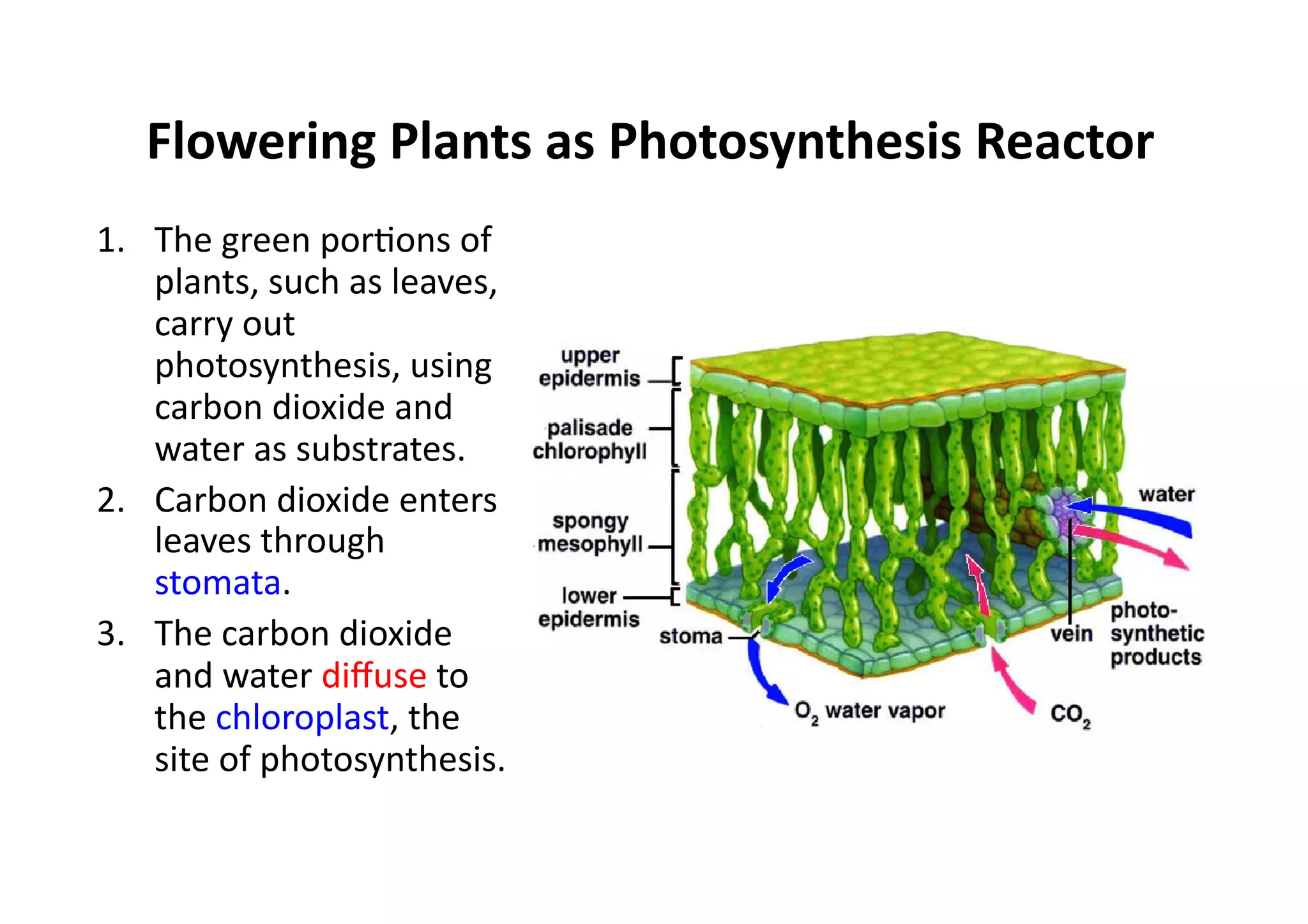
Flowering	
  Plants	
  as	
  Photosynthesis	
  Reactor	
  
1.  The	
  green	
  porHons	
  of	
  
plants,	
  such	
  as	
  leaves,	
  
carry	
  out	
  
photosynthesis,	
  using	
  
carbon	
  dioxide	
  and	
  
water	
  as	
  substrates.	
  
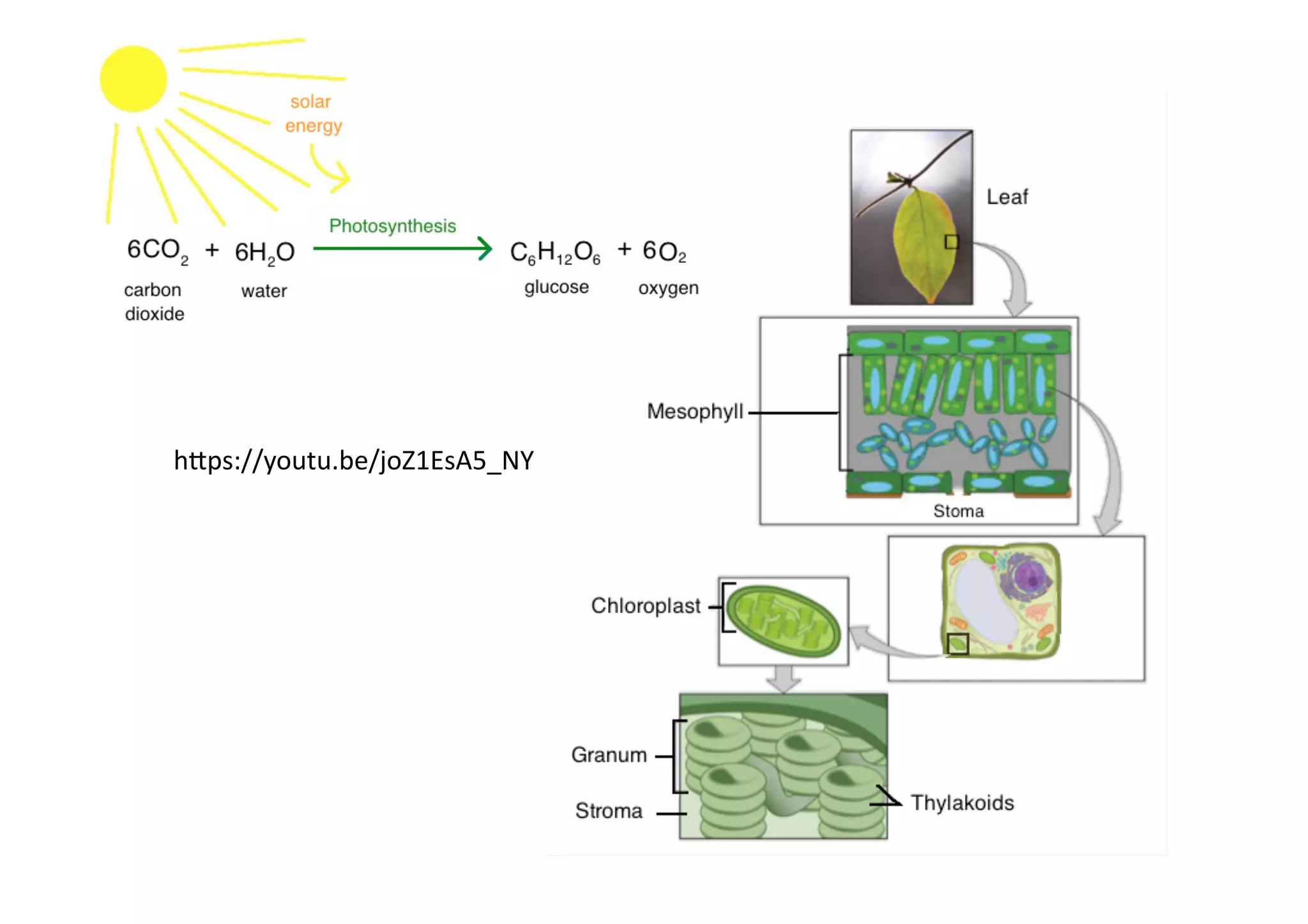
2.  Carbon	
  dioxide	
  enters	
  
leaves	
  through	
  
stomata.	
  
3.  The	
  carbon	
  dioxide	
  
and	
  water	
  diffuse	
  to	
  
the	
  chloroplast,	
  the	
  
site	
  of	
  photosynthesis.	


Chloroplasts	
  
1.  The	
  chloroplast	
  has	
  a	
  
double	
  membrane	
  that	
  
surrounds	
  the	
  liquid	
  
stroma.	
  
2.  The	
  stroma	
  contains	
  
numerous	
  flat	
  thylakoid	
  
disc	
  arranged	
  in	
  stacks	
  
called	
  grana.	
  
3.  The	
  chlorophyll	
  pigments	
  
imbedded	
  in	
  the	
  thylakoid	
  
membranes	
  absorb	
  solar	
  
energy	
  during	
  
photosynthesis.	
  
The	
  Photosynthesis	
  Process	
  
CO2	
  	
  +	
  	
  H2O	
   (CH2O)	
  +	
  O2	
  
oxida>on	
  
reduc>on	
  
gain	
  of	
  hydrogen	
  atoms	
  
loss	
  of	
  hydrogen	
  atoms	
  
Solar	
  energy	
  
Produce/genera>ng	
  
glucose	
  
Release/waste	
  
product	
  
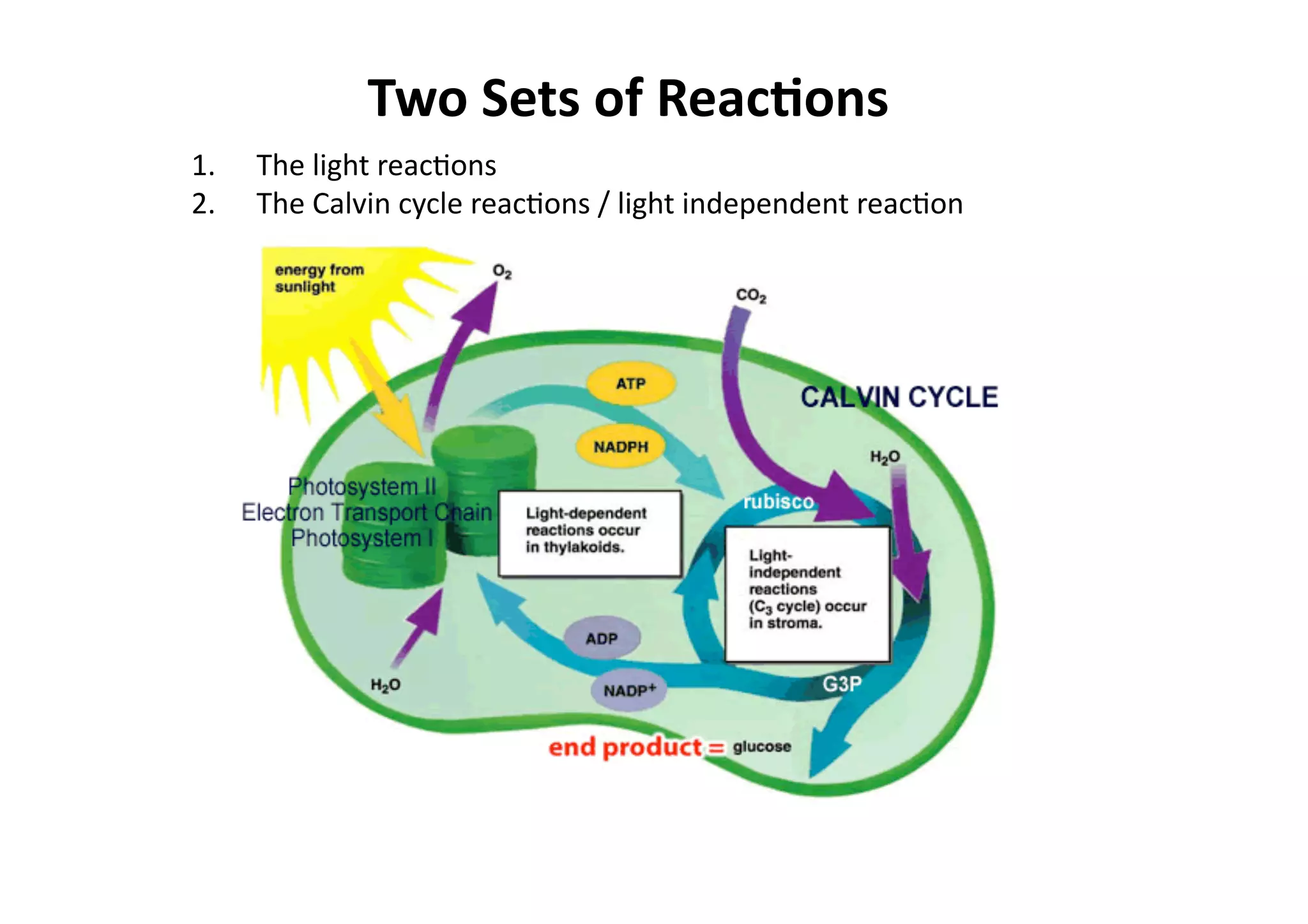
Two	
  Sets	
  of	
  Reac>ons	
  
1.  The	
  light	
  reacHons	
  
2.  The	
  Calvin	
  cycle	
  reacHons	
  /	
  light	
  independent	
  reacHon	
  
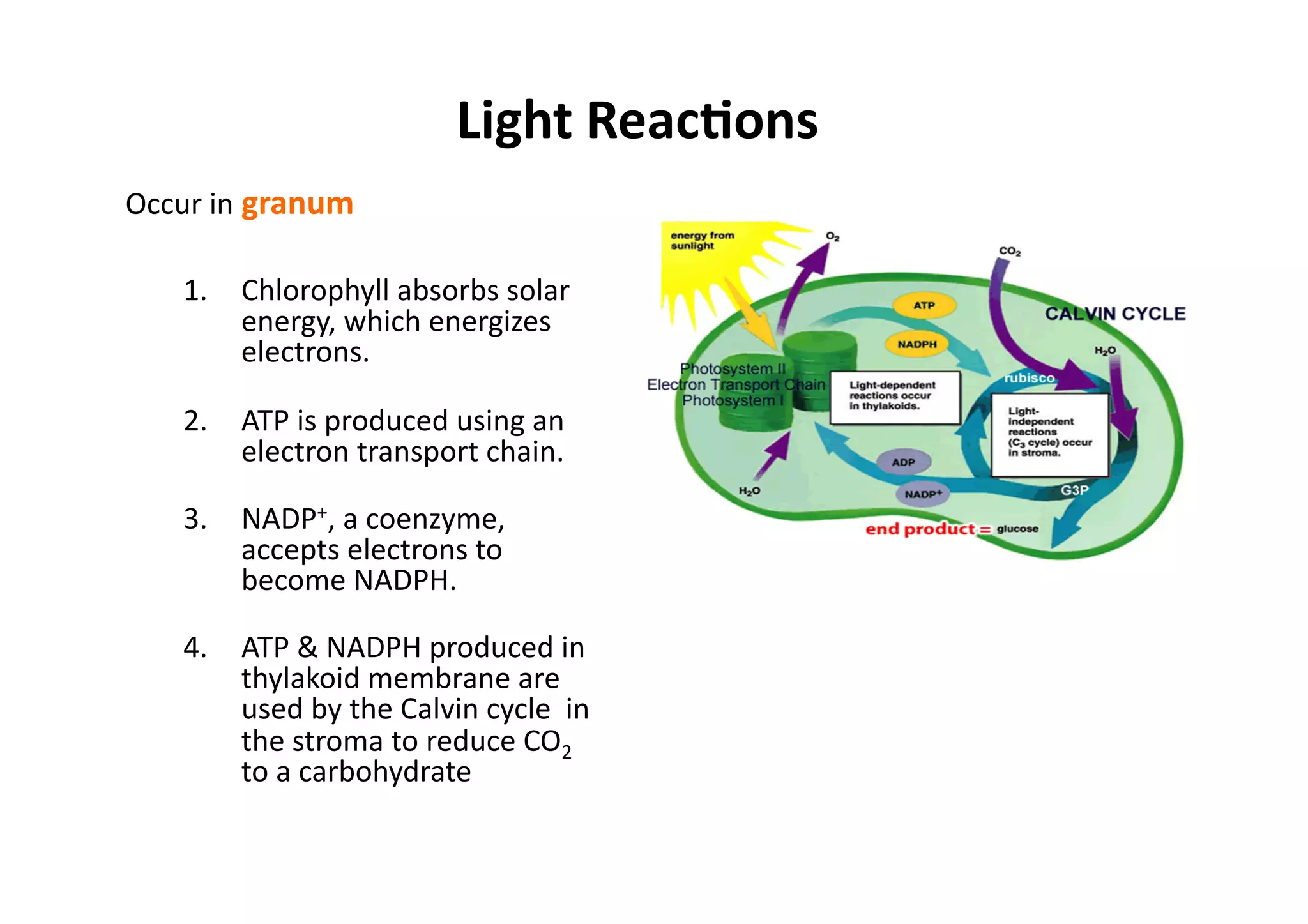
Light	
  Reac>ons	
  
Occur	
  in	
  granum	
  	
  
1.  Chlorophyll	
  absorbs	
  solar	
  
energy,	
  which	
  energizes	
  
electrons.	
  
2.  ATP	
  is	
  produced	
  using	
  an	
  
electron	
  transport	
  chain.	
  
3.  NADP+,	
  a	
  coenzyme,	
  
accepts	
  electrons	
  to	
  
become	
  NADPH.	
  
4.  ATP	
  &	
  NADPH	
  produced	
  in	
  
thylakoid	
  membrane	
  are	
  
used	
  by	
  the	
  Calvin	
  cycle	
  	
  in	
  
the	
  stroma	
  to	
  reduce	
  CO2	
  
to	
  a	
  carbohydrate	
  
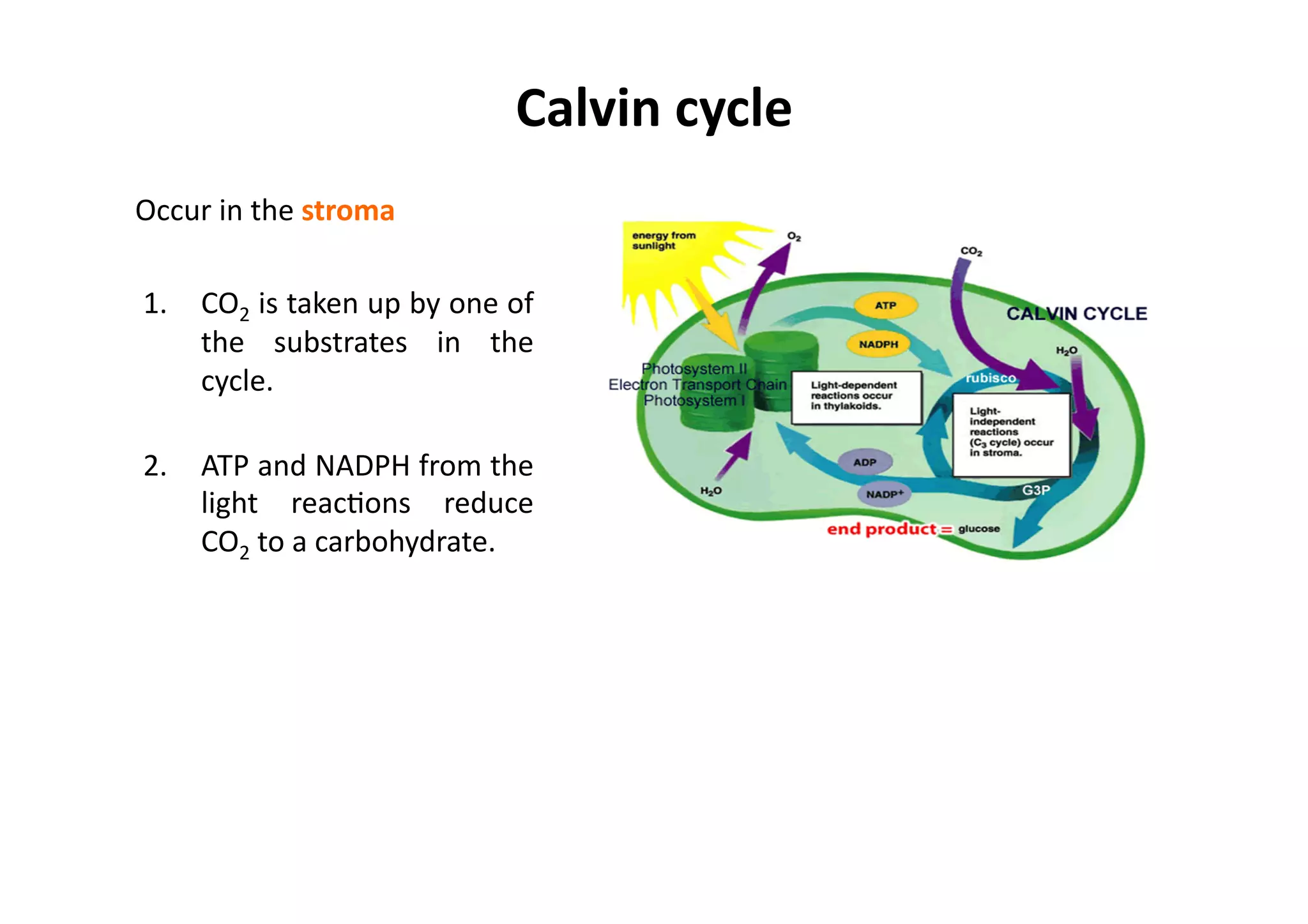
Calvin	
  cycle	
  
Occur	
  in	
  the	
  stroma	
  
1.  CO2	
  is	
  taken	
  up	
  by	
  one	
  of	
  
the	
   substrates	
   in	
   the	
  
cycle.	


2.  ATP	
  and	
  NADPH	
  from	
  the	
  
light	
   reacHons	
   reduce	
  
CO2	
  to	
  a	
  carbohydrate.	


Calvin Cycle/Light Independent
Reaction/Dark reaction
1.  Define	
  what	
  is	
  photosynthesis	
  
2.  Explain	
  the	
  light	
  dependent	
  reacHons	
  
3.  Explain	
  the	
  Calvin	
  cycle	
  
4.  Define	
  what	
  is	
  photorespiraHon	
  
5.  Compare	
  the	
  photorespiraHon	
  in	
  C3,	
  C4	
  
and	
  CAM	
  plants	
  
LIGHT	
  REACTIONS	
  
The	
  light	
  reac>ons	
  
The	
  electron	
  pathway	
  of	
  the	
  light	
  reac>ons	
  
•  The	
  light	
  reacHons	
  consist	
  of	
  an	
  electron	
  pathway	
  that	
  produces	
  
ATP	
  and	
  NADPH.	
  
•  The	
  pathway	
  uses	
  2	
  photosystems	
  to	
  complete	
  the	
  light	
  reacHons.	
  	
  
–  Photosystem	
  I	
  (PS	
  I)	
  
–  Photosystem	
  II	
  (PS	
  II)	
  
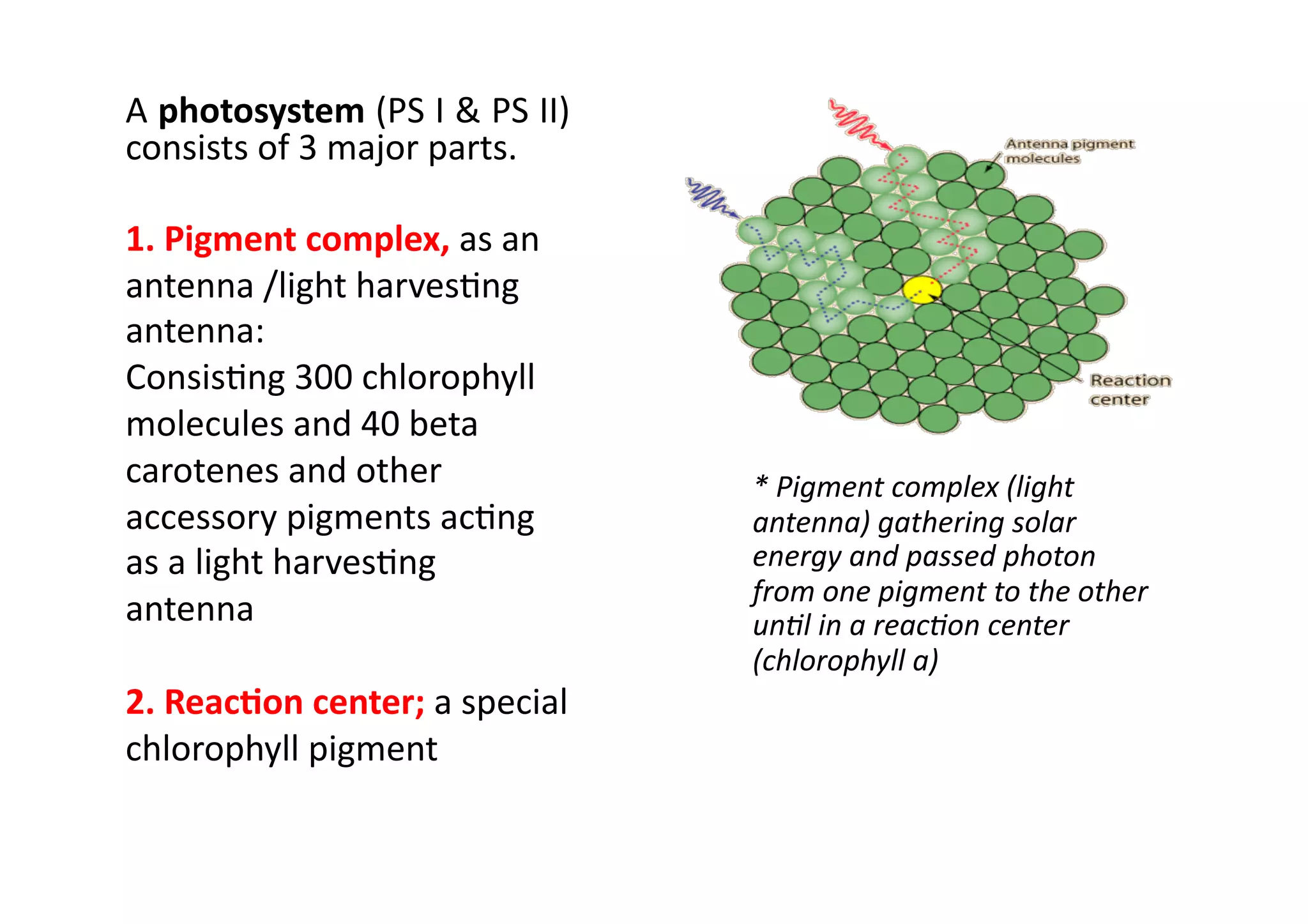
A	
  photosystem	
  (PS	
  I	
  &	
  PS	
  II)	
  
consists	
  of	
  3	
  major	
  parts.	
  
1. 	
  Pigment	
  complex,	
  as	
  an	
  
antenna	
  /light	
  harvesHng	
  
antenna:	
  	
  
ConsisHng	
  300	
  chlorophyll	
  
molecules	
  and	
  40	
  beta	
  
carotenes	
  and	
  other	
  
accessory	
  pigments	
  acHng	
  
as	
  a	
  light	
  harvesHng	
  
antenna	
  
2.	
  Reac>on	
  center;	
  a	
  special	
  
chlorophyll	
  pigment	
  
*	
  Pigment	
  complex	
  (light	
  
antenna)	
  gathering	
  solar	
  
energy	
  and	
  passed	
  photon	
  
from	
  one	
  pigment	
  to	
  the	
  other	
  
un9l	
  in	
  a	
  reac9on	
  center	
  
(chlorophyll	
  a)	
  
3.	
  Electron	
  acceptor	
  
molecules:	
  
Photon	
  is	
  absorbed	
  by	
  one	
  of	
  
the	
  pigment	
  molecules	
  and,	
  
!	
  transfers	
  that	
  energy	
  to	
  
neighboring	
  molecules,	
  
!	
  unHl	
  it	
  reaches	
  the	
  acHon	
  
center	
  where,	
  
!	
  the	
  energy	
  is	
  used	
  to	
  
transfer	
  an	
  energeHc	
  electron	
  
to	
  an	
  electron	
  acceptor.	
  
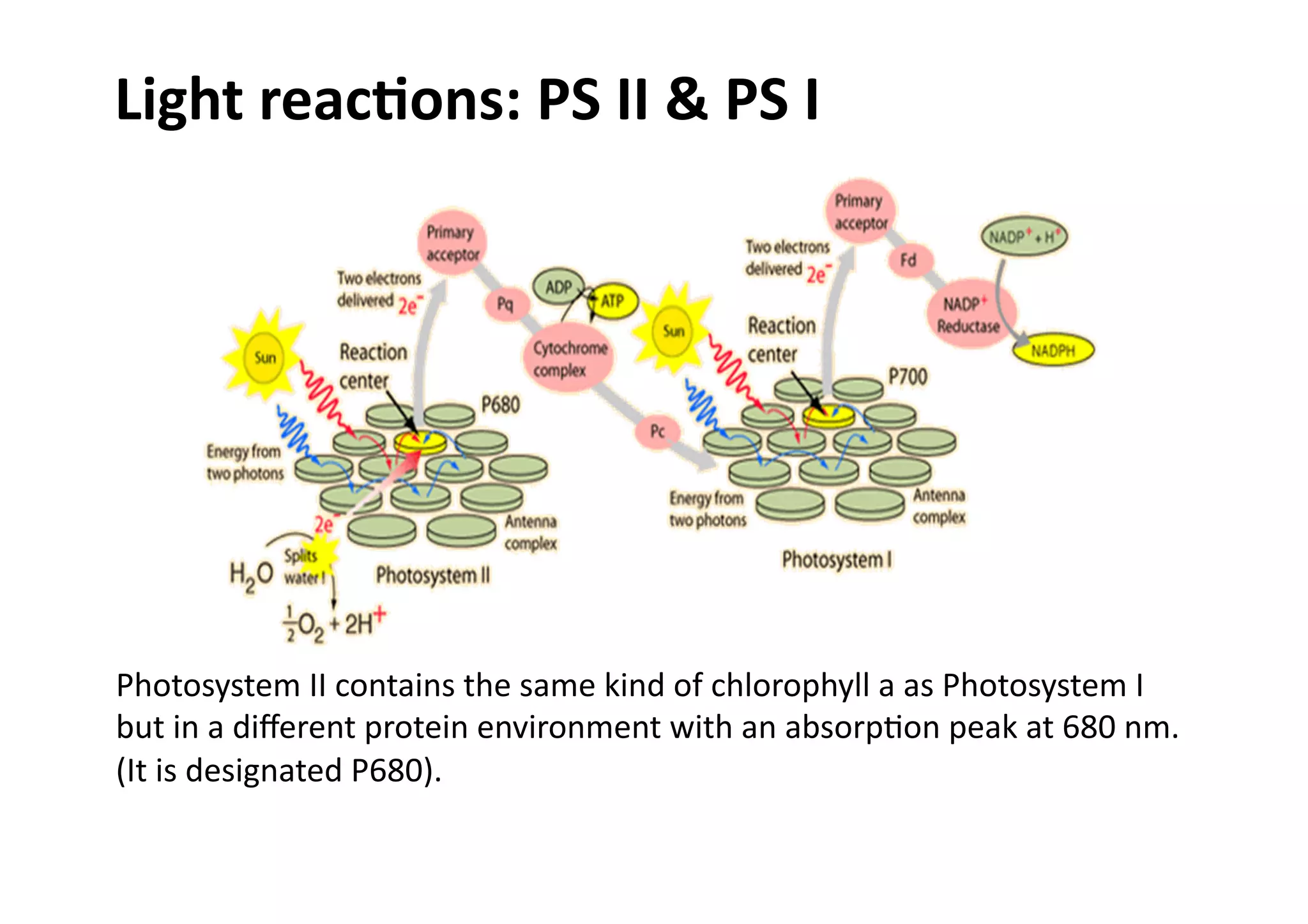
Photosystem	
  II	
  contains	
  the	
  same	
  kind	
  of	
  chlorophyll	
  a	
  as	
  Photosystem	
  I	
  
but	
  in	
  a	
  different	
  protein	
  environment	
  with	
  an	
  absorpHon	
  peak	
  at	
  680	
  nm.	
  
(It	
  is	
  designated	
  P680).	
  
Light	
  reac>ons:	
  PS	
  II	
  &	
  PS	
  I	
  
Light	
  reac>ons:	
  PS	
  II	
  
1.  When	
  PS	
  II	
  absorbs	
  solar	
  energy,	
  electron	
  in	
  reacHon	
  center	
  of	
  PS	
  II	
  become	
  
energized	
  electrons	
  
2.  Energized	
  electron	
  are	
  passed	
  to	
  electron	
  acceptors.	
  
3.  PS	
  II	
  splits	
  a	
  water	
  molecule	
  to	
  recover	
  the	
  electrons	
  passed	
  to	
  the	
  electron	
  
acceptors	
  (at	
  electron	
  transport	
  chain),	
  releasing	
  O2	
  +	
  H2O	
  	
  
4.  The	
   electron	
   acceptors	
   send	
   the	
   energized	
   electrons	
   down	
   an	
   electron	
  
transport	
  chain.	
  
5.  Energy	
  is	
  released	
  and	
  stored	
  in	
  the	
  form	
  of	
  H+	
  gradient	
  in	
  thylakoid	
  lumen	
  
6.  Electron	
  transport	
  chain	
  establishes	
  an	
  energy	
  gradient.	
  
7.  Electron	
   transport	
   chain	
   carries	
   electron,	
   pass	
   electron	
   from	
   one	
   to	
   the	
  
other	
  	
  
8.  As	
   the	
   electrons	
   are	
   passed	
   down	
   an	
   electron	
   transport	
   chain,	
   energy	
   is	
  
released	
  and	
  stored	
  in	
  the	
  form	
  of	
  a	
  hydrogen	
  ion	
  (H+)	
  gradient.	
  
9.  This	
  H+	
  gradient	
  is	
  used	
  later	
  in	
  photosynthesis	
  to	
  produce	
  ATP	
  
ATP	
  Produc>on	
  
1.  During	
   photosynthesis,	
   the	
   thylakoid	
   space	
   becomes	
   an	
   H+	
  
reservoir.	
  
2.  The	
  H+	
  ions	
  that	
  fill	
  this	
  reservoir	
  come	
  from	
  two	
  sources. 	
  	
  
1.  The	
  oxidaHon	
  of	
  water	
  by	
  PS	
  II	
  adds	
  H+.	
  
2.  The	
   flow	
   of	
   electrons	
   through	
   the	
   electron	
   transport	
   chain	
  
releases	
  energy	
  that	
  pumps	
  H+	
  into	
  the	
  thylakoid	
  space. 	
  	
  
3.  As	
  the	
  H+	
  are	
  released	
  through	
  an	
  ATP	
  synthase,	
  the	
  H+	
  flow	
  down	
  
their	
  concentraHon	
  gradient	
  and	
  release	
  energy.	
  
4.  The	
   ATP	
   synthase	
   couples	
   that	
   release	
   of	
   energy	
   to	
   the	
  
producHon	
  of	
  ATP	
  (ADP	
  +	
  Pi	
  "	
  ATP).	
  
Light	
  reac>ons:	
  PS	
  I	
  
1.  When	
  PS	
  I	
  absorbs	
  solar	
  energy,	
  energized	
  electrons	
  are	
  passed	
  to	
  
different	
  electron	
  acceptors.	
  
2.  Electrons	
  from	
  the	
  end	
  of	
  the	
  electron	
  transport	
  chain	
  (from	
  PS	
  II)	
  
replace	
  the	
  electrons	
  from	
  PS	
  I.	
  
3.  The	
   electron	
   acceptors	
   pass	
   the	
   electrons	
   to	
   NADP+	
   to	
   form	
  
NADPH.	
  
4.  Electron	
  from	
  PS	
  II	
  replace	
  those	
  lost	
  by	
  PS	
  I	
  
5.  When	
  PSI	
  absorbs	
  solar	
  energy,	
  electron	
  are	
  energized	
  
6.  Electron	
  energized	
  are	
  passed	
  to	
  electron	
  acceptor.	
  
7.  Electron	
  acceptor	
  pass	
  the	
  electron	
  to	
  series	
  of	
  electron	
  transport	
  
chain,	
  then	
  final	
  electron	
  acceptor	
  (enzyme	
  that	
  accepts	
  H+)	
  ;	
  
NADP	
  
8.  NADP+	
  to	
  form	
  NADPH	
  
1.  Define	
  what	
  is	
  photosynthesis	
  
2.  Explain	
  the	
  light	
  dependent	
  reacHons	
  
3.  Explain	
  the	
  Calvin	
  cycle	
  
4.  Define	
  what	
  is	
  photorespiraHon	
  
5.  Compare	
  the	
  photorespiraHon	
  in	
  C3,	
  C4	
  
and	
  CAM	
  plants	
  
CALVIN	
  CYCLE	
  
•  The	
   Calvin	
   cycle	
   is	
   a	
   series	
   of	
   reacHons	
   that	
   conHnually	
  
produce	
  a	
  carbohydrate	
  (glucose)	
  from	
  carbon	
  dioxide	
  during	
  
photosynthesis.	
  
Calvin	
  Cycle	
  Reac>ons	
  
The	
  Calvin	
  cycle	
  has	
  3	
  steps.	
  
1.  Carbon	
  dioxide	
  fixaHon	
  
2.  Carbon	
  dioxide	
  reducHon	
  
3.  RegeneraHon	
   of	
  
ribulose-­‐1,5-­‐
bisphosphate	
  (RuBP)	
  
Step	
  1:	
  Fixa>on	
  of	
  Carbon	
  Dioxide	
  
1.  During	
  the	
  first	
  step	
  of	
  
the	
   Calvin	
   cycle,	
   CO2	
  
from	
   the	
   air	
   is	
  
a0ached	
   (fixed)	
   to	
  
RuBP.	
  
2.  The	
   enzyme	
   for	
   this	
  
reacHon	
   is	
   RuBP	
  
carboxylase	
  oxygenase	
  
(rubisco).	
  
3.  Rubisco	
   splits	
   the	
  
resulHng	
   6-­‐carbon	
  
molecule	
   to	
   form	
   two	
  
3-­‐carbon	
   molecules	
  
(PGA).	


Step	
  2:	
  Reduc>on	
  of	
  Carbon	
  Dioxide	
  
4.  ReducHon	
   of	
   CO2	
  
is	
   a	
   series	
   of	
  
reacHons	
  that	
  uses	
  
NADPH	
   and	
   ATP	
  
from	
   the	
   light	
  
reacHons	
   to	
   form	
  
the	
  carbohydrate.	
  
–  NADPH	
   provides	
  
electrons	
   for	
   the	
  
reducHon.	
  
–  ATP	
   provides	
   the	
  
energy.	


Step	
  3:	
  Regenera>on	
  of	
  RuBP	
  
5.  The	
   product	
   of	
   the	
  
Calvin	
   cycle	
   is	
  
glyceraldehyde-­‐3-­‐
phosphate	
  (G3P).	
  
6.  About	
  1/6	
  of	
  the	
  G3P	
  is	
  
used	
  to	
  make	
  glucose.	
  
7.  About	
   5/6	
   of	
   the	
  
glucose	
   is	
   used	
   to	
  
regenerate	
   the	
   RuBP	
  
required	
  for	
  the	
  fixaHon	
  
of	
  carbon	
  dioxide.	
  
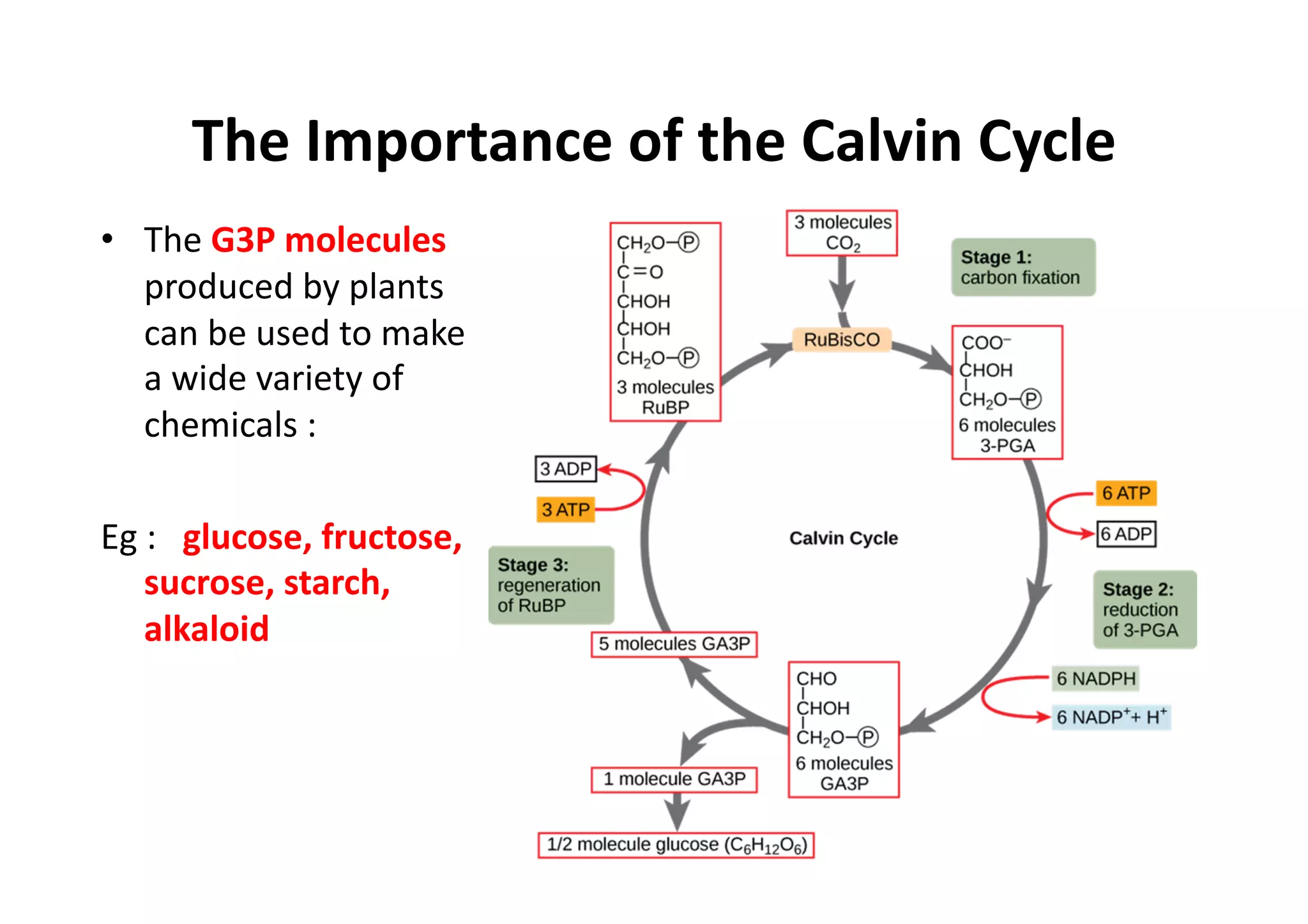
The	
  Importance	
  of	
  the	
  Calvin	
  Cycle	
  
•  The	
  G3P	
  molecules	
  
produced	
  by	
  plants	
  
can	
  be	
  used	
  to	
  make	
  
a	
  wide	
  variety	
  of	
  
chemicals	
  :	
  
Eg	
  :	
  	
  	
  glucose,	
  fructose,	
  
sucrose,	
  starch,	
  
alkaloid	
  
1.  Define	
  what	
  is	
  photosynthesis	
  
2.  Explain	
  the	
  light	
  dependent	
  reacHons	
  
3.  Explain	
  the	
  Calvin	
  cycle	
  
4.  Define	
  what	
  is	
  photorespiraHon	
  
5.  Compare	
  the	
  photorespiraHon	
  in	
  C3,	
  C4	
  
and	
  CAM	
  plants	
  
Photorespira>on	
  (also	
  known	
  as	
  the	
  oxidaHve	
  
photosyntheHc	
  carbon	
  cycle,	
  or	
  C2	
  photosynthesis)	
  	
  
! a	
  process	
  in	
  plant	
  metabolism	
  where	
  the	
  enzyme	
  
RuBisCO	
  oxygenates	
  RuBP,	
  causing	
  some	
  of	
  the	
  energy	
  
produced	
  by	
  photosynthesis	
  to	
  be	
  wasted.	
  
! Consumes	
  O2	
  and	
  organic	
  fuel	
  and	
  releases	
  CO2	
  
! Uses	
  ATP	
  but	
  not	
  making	
  ATP	
  
! Doesn’t	
  make	
  sugar	
  
! Decreases	
  photosynthesis	
  output	
  
Types	
  of	
  Photosynthesis	
  :	
  Carbon	
  metabolism	
  
•  Plants	
   are	
   physically	
   adapted	
   to	
   their	
  
environment	
  
•  Plants	
   have	
   metabolically	
   adapted	
  
photosynthesis	
  to	
  different	
  climates.	
  
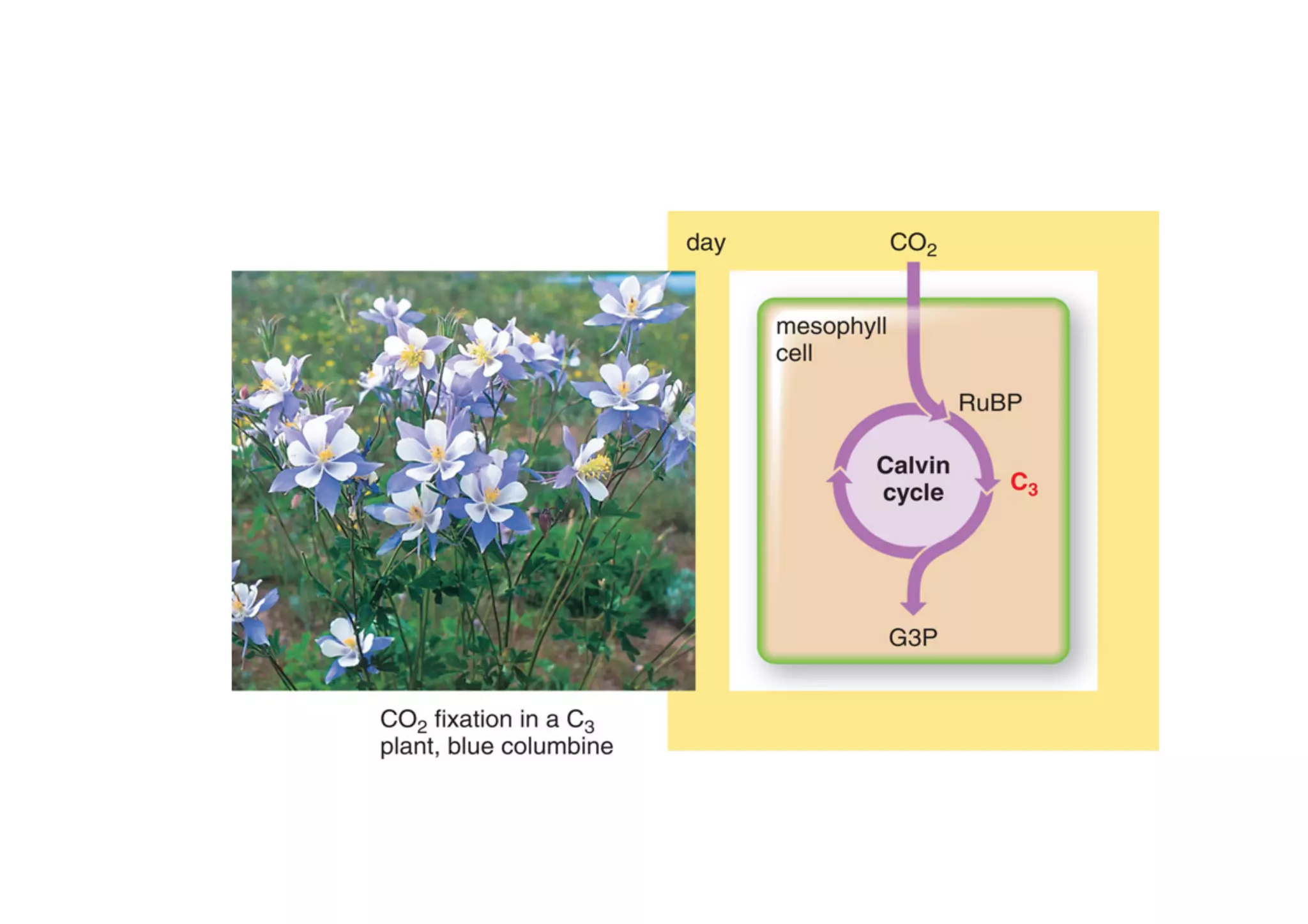
1.  C3	
  plants	
  
2.  C4	
  plants	
  
3.  CAM	
  plants	
  
1.	
  C3	
  Photosynthesis	
  	
  
•  In	
  areas	
  with	
  moderate	
  temperature	
  	
  
•  plants	
  carry	
  out	
  C3	
  photosynthesis,	
  	
  
•  the	
  first	
  detectable	
  molecule	
  from	
  the	
  Calvin	
  cycle	
  is	
  a	
  3-­‐carbon	
  
compound.	
  
•  FixaHon	
  by	
  RuBP	
  carboxylase	
  (RUBISCO)	
  in	
  C3	
  plants:	
  with	
  CO2	
  &	
  
O2.	
  	
  
•  The	
   process	
   of	
  
RuBP	
   binding	
   with	
  
O2	
   is	
   known	
   as	
  
photorespiraHon.	
  	
  
•  PhotorespiraHon	
  
reduce	
  
photosynthesis	
  
product	
  yield	
  
If	
  the	
  weather	
  is	
  hot	
  &	
  dry,	
  C3	
  plant:	
  
o 	
  stomata	
  closed	
  
o 	
  PrevenHng	
  the	
  loss	
  of	
  H2O	
  
o 	
  Also	
  prevents	
  CO2	
  from	
  entering	
  	
  the	
  leaf	
  
o 	
   	
   Traps	
   O2	
   (by-­‐product	
   of	
   photosynthesis	
   within	
   the	
   leaf	
  
space	
  in	
  between	
  spongy	
  mesophyll)	
  
o C3	
   photosynthesis	
   are	
   necessary	
   adapta>on	
   to	
   minimize	
  
photorespira>on	
   effect	
   (O2	
   competes	
   with	
   CO2	
   for	
   the	
  
binding	
   site	
   on	
   Rubisco,	
   decreasing	
   the	
   efficiency	
   of	
  
photosynthesis/yield	
  decrease)	
  
C3	
  
•  C4	
  have	
  an	
  adapta>on	
  that	
  allow	
  them	
  to	
  be	
  successful	
  in	
  hot	
  
dry	
  climates	
  	
  
•  These	
  plants	
  carry	
  out/perform	
  C4	
  photosynthesis	
  	
  
2.	
  	
  C4	
  Photosynthesis	
  	
  
The	
  anatomy	
  of	
  a	
  C4	
  plant	
  is	
  different	
  from	
  that	
  of	
  a	
  C3	
  plant.	


General	
  leaf/C3	
  leaf	
  	
  
C4	
  leaf	
  
Keong BP
Cross	
  sec>on	
  of	
  leaf	
  :	
  General	
  Versus	
  C4	
  Leaf	
  
C4	
  
•  C4	
  photosynthesis	
  forming	
  a	
  4-­‐
carbon	
  compound.	
  
•  PEP	
  carboxylase	
  fix	
  PEP	
  (3C)	
  
with	
  CO2	
  	
  in	
  bundle	
  sheath	
  cell.	
  
•  the	
  first	
  detectable	
  molecule	
  
from	
  the	
  Calvin	
  cycle	
  is	
  a	
  4-­‐
carbon	
  compound	
  (OAA)	
  
•  C4	
  are	
  able	
  to	
  avoid	
  the	
  uptake	
  
of	
  O2	
  by	
  Rubisco	
  
C4	
  
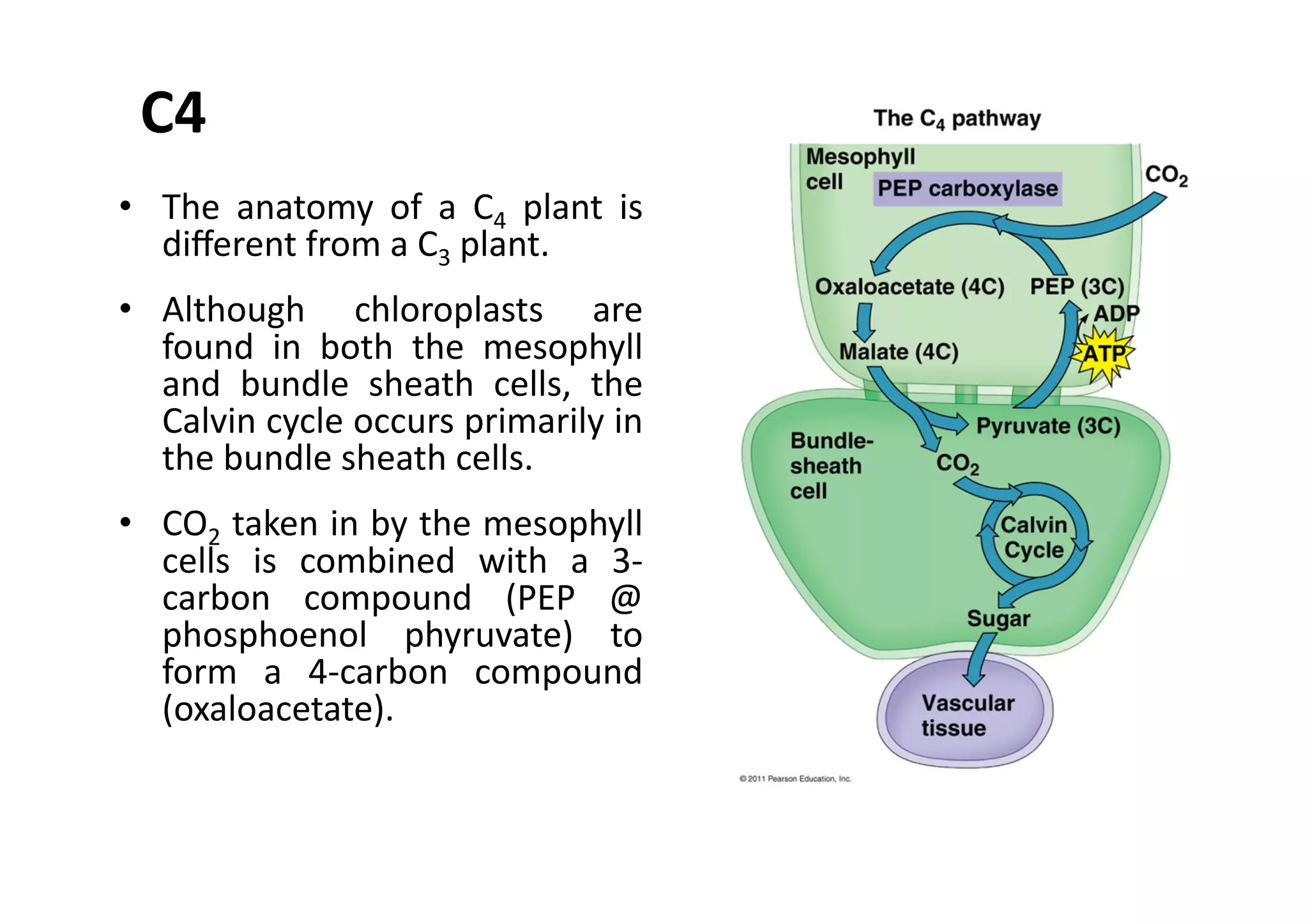
•  The	
   anatomy	
   of	
   a	
   C4	
   plant	
   is	
  
different	
  from	
  a	
  C3	
  plant.	


•  Although	
   chloroplasts	
   are	
  
found	
   in	
   both	
   the	
   mesophyll	
  
and	
   bundle	
   sheath	
   cells,	
   the	
  
Calvin	
  cycle	
  occurs	
  primarily	
  in	
  
the	
  bundle	
  sheath	
  cells.	
  
•  CO2	
  taken	
  in	
  by	
  the	
  mesophyll	
  
cells	
   is	
   combined	
   with	
   a	
   3-­‐
carbon	
   compound	
   (PEP	
   @	
  
phosphoenol	
   phyruvate)	
   to	
  
form	
   a	
   4-­‐carbon	
   compound	
  
(oxaloacetate).	


C4	
  
The	
  C4	
  pathway	
  
CO2	
   is	
   fixed	
   by	
   enzyme	
  
PEP	
  carboxylase,	
  forming	
  
a	
   four-­‐carbon	
   product	
  
oxaloacetate	
  (4C)	


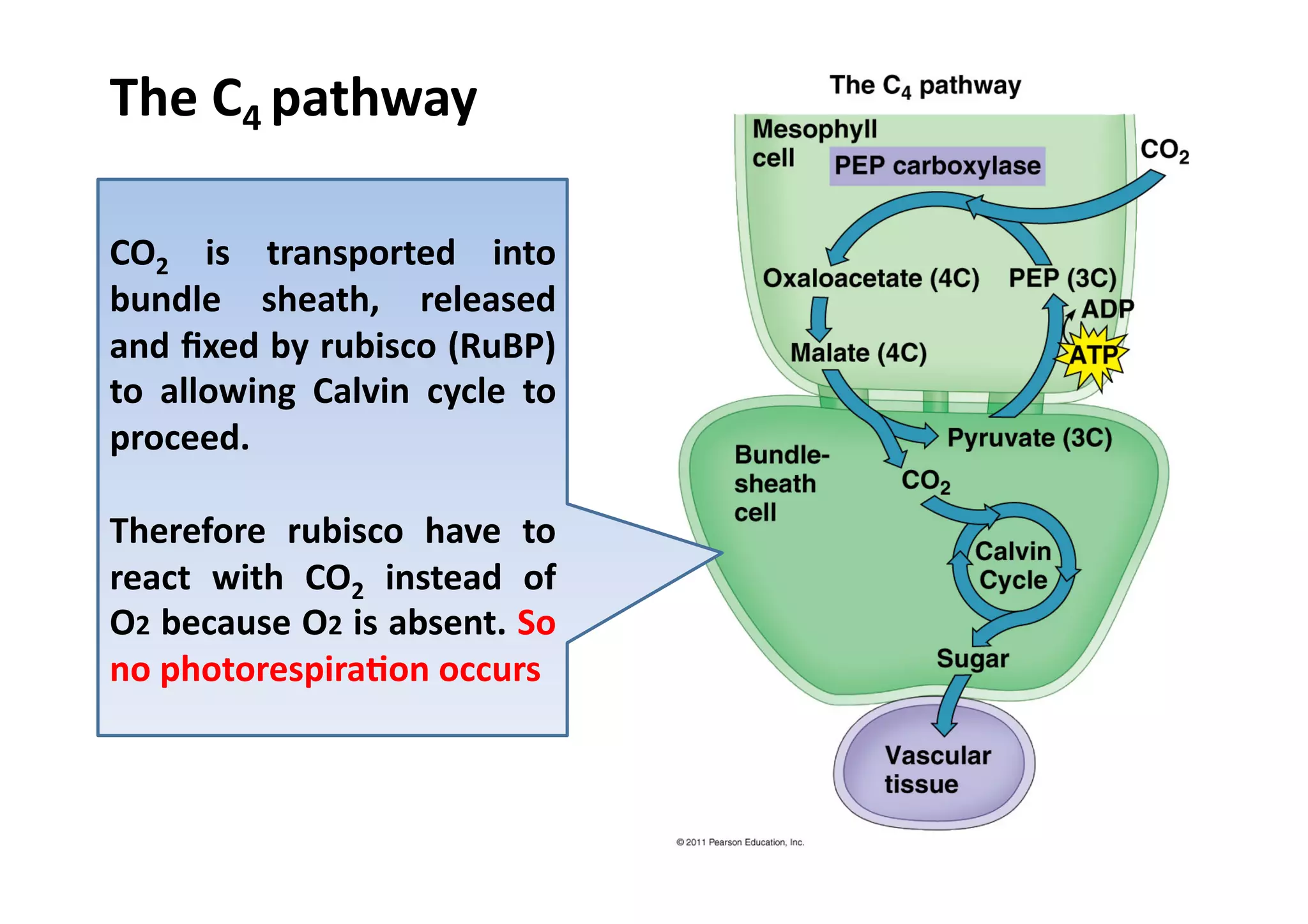
The	
  C4	
  pathway	
  
CO2	
   is	
   transported	
   into	
  
bundle	
   sheath,	
   released	
  
and	
  fixed	
  by	
  rubisco	
  (RuBP)	
  
to	
   allowing	
   Calvin	
   cycle	
   to	
  
proceed.	
  
Therefore	
   rubisco	
   have	
   to	
  
react	
   with	
   CO2	
   instead	
   of	
  
O2	
  because	
  O2	
  is	
  absent.	
  So	
  
no	
  photorespira>on	
  occurs	
  
•  Crassulacean	
   Acid	
   Metabolism	
   (CAM),	
   found	
   commonly	
   in	
  
desert	
  plants,	
  in	
  warm,	
  arid	
  regions.	


3.	
  CAM	
  Photosynthesis	
  
CAM	
  
•  Similar	
  to	
  C4	
  photosynthesis,	
  CAM	
  plants	
  separate	
  CO2	
  fixaHon	
  from	
  
the	
  Calvin	
  cycle	
  reacHon	
  to	
  minimize	
  compeHHon	
  from	
  O2.	
  
•  However	
  CAM	
  plants	
  separate	
  these	
  events	
  by	
  Hme.	
  
•  CO2	
  is	
  fixed	
  during	
  the	
  night.	
  
•  The	
  Calvin	
  cycle	
  reacHons	
  occur	
  during	
  the	
  day.	


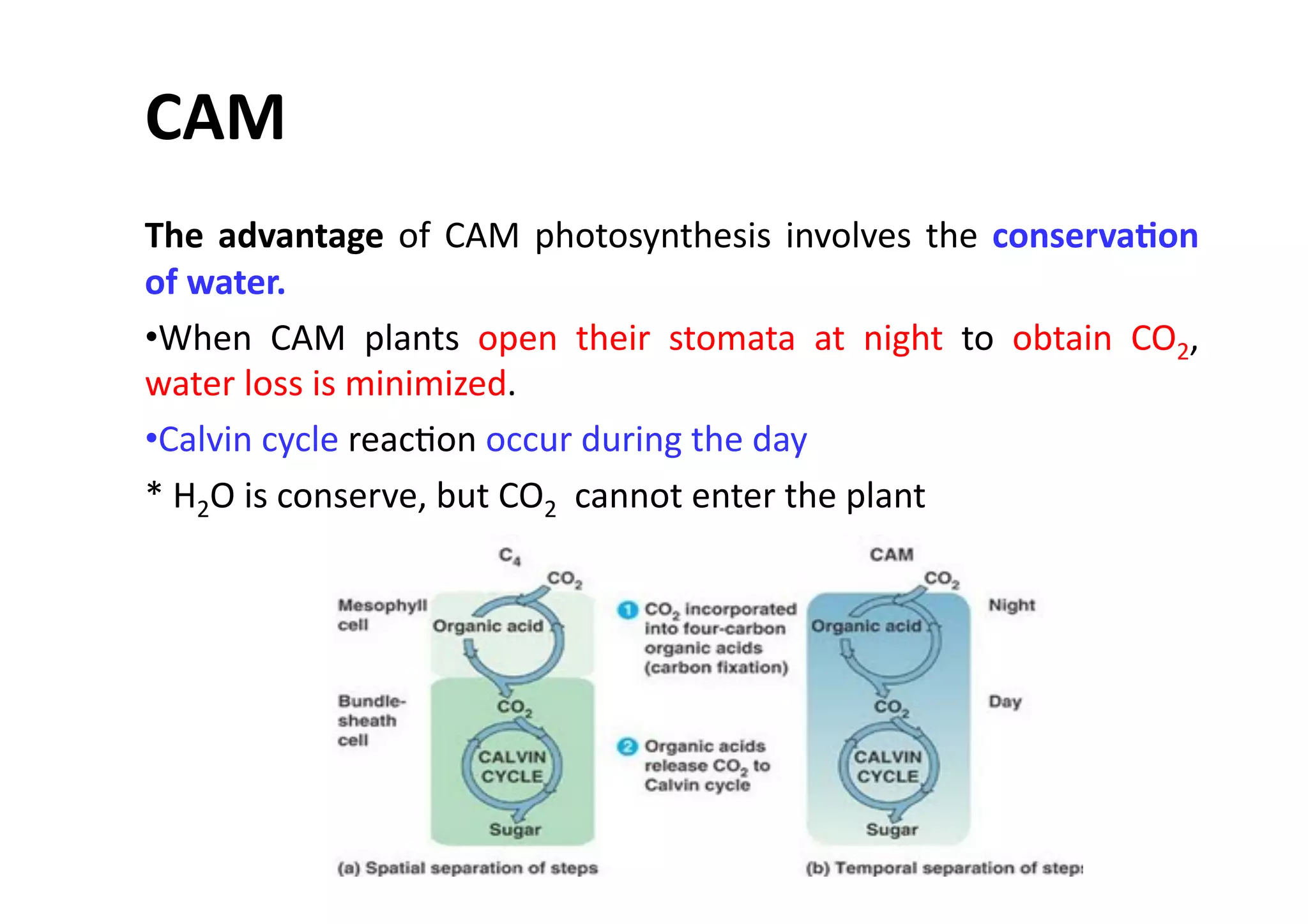
The	
  advantage	
  of	
  CAM	
  photosynthesis	
  involves	
  the	
  conserva>on	
  
of	
  water.	
  
• When	
   CAM	
   plants	
   open	
   their	
   stomata	
   at	
   night	
   to	
   obtain	
   CO2,	
  
water	
  loss	
  is	
  minimized.	
  	
  
• Calvin	
  cycle	
  reacHon	
  occur	
  during	
  the	
  day	
  	
  
*	
  H2O	
  is	
  conserve,	
  but	
  CO2	
  	
  cannot	
  enter	
  the	
  plant	
  
CAM	
  
1.  Define	
  what	
  is	
  photosynthesis	
  
2.  Explain	
  the	
  light	
  dependent	
  reacHons	
  
3.  Explain	
  the	
  Calvin	
  cycle	
  
4.  Define	
  what	
  is	
  photorespiraHon	
  
5.  Compare	
  the	
  photorespiraHon	
  in	
  C3,	
  C4	
  
and	
  CAM	
  plants	
  
Evolu>onary	
  Trends	
  
•  C4	
   plants	
   most	
   likely	
   involved	
   in	
   areas	
   with	
  
high	
  light,	
  high	
  temperature,	
  and	
  low	
  rainfall.	
  
•  C3	
   plants	
   survive	
   be0er	
   than	
   C4	
   plants	
   in	
  
temperatures	
  less	
  than	
  25˚C.	
  
•  CAM	
  plants	
  compete	
  well	
  with	
  both	
  C3	
  and	
  C4	
  
plants,	
  parHcularly	
  in	
  arid	
  environments.	
  	
  
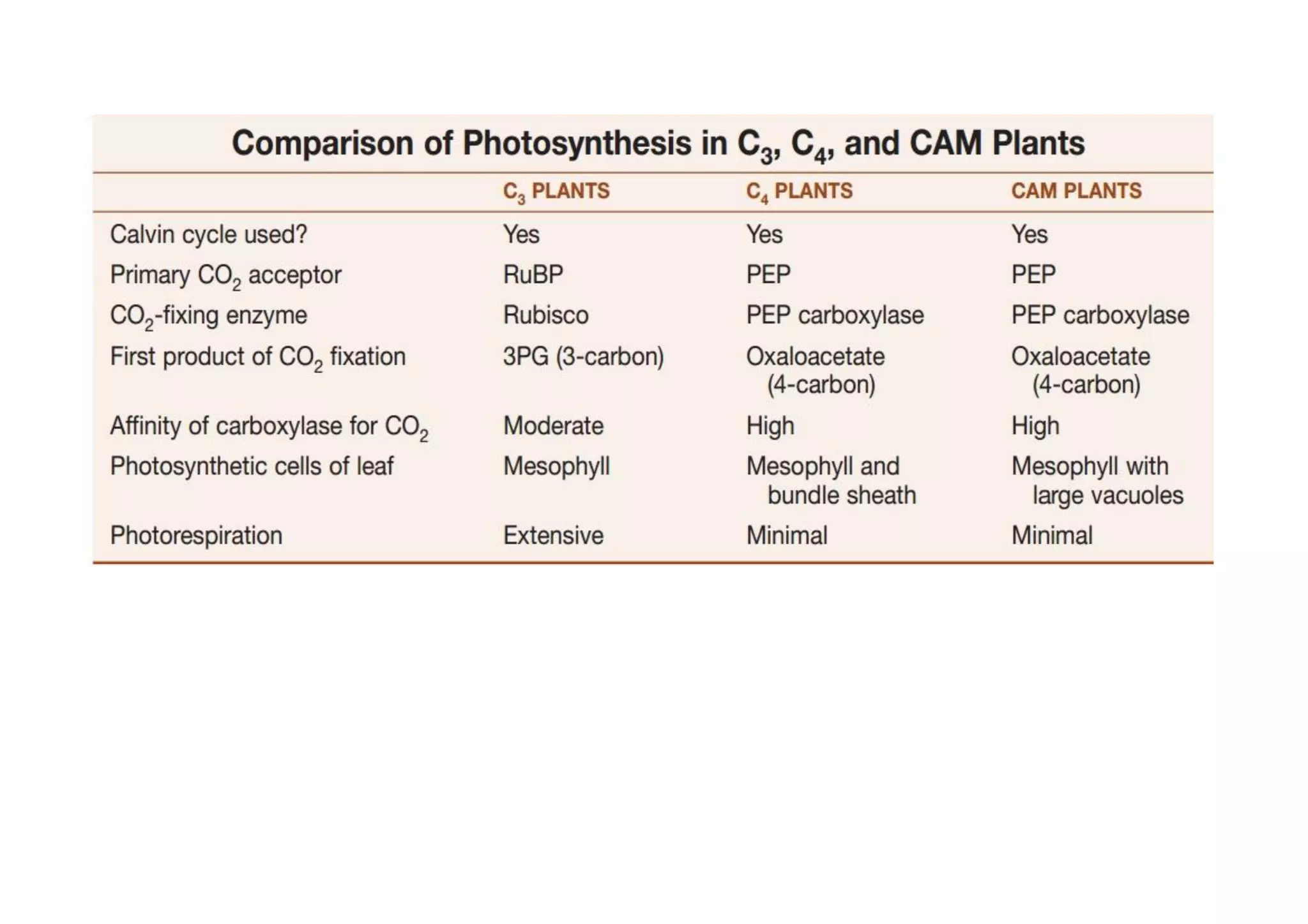
PEP	
  carboxylase	
   PEP	
  carboxylase	
  
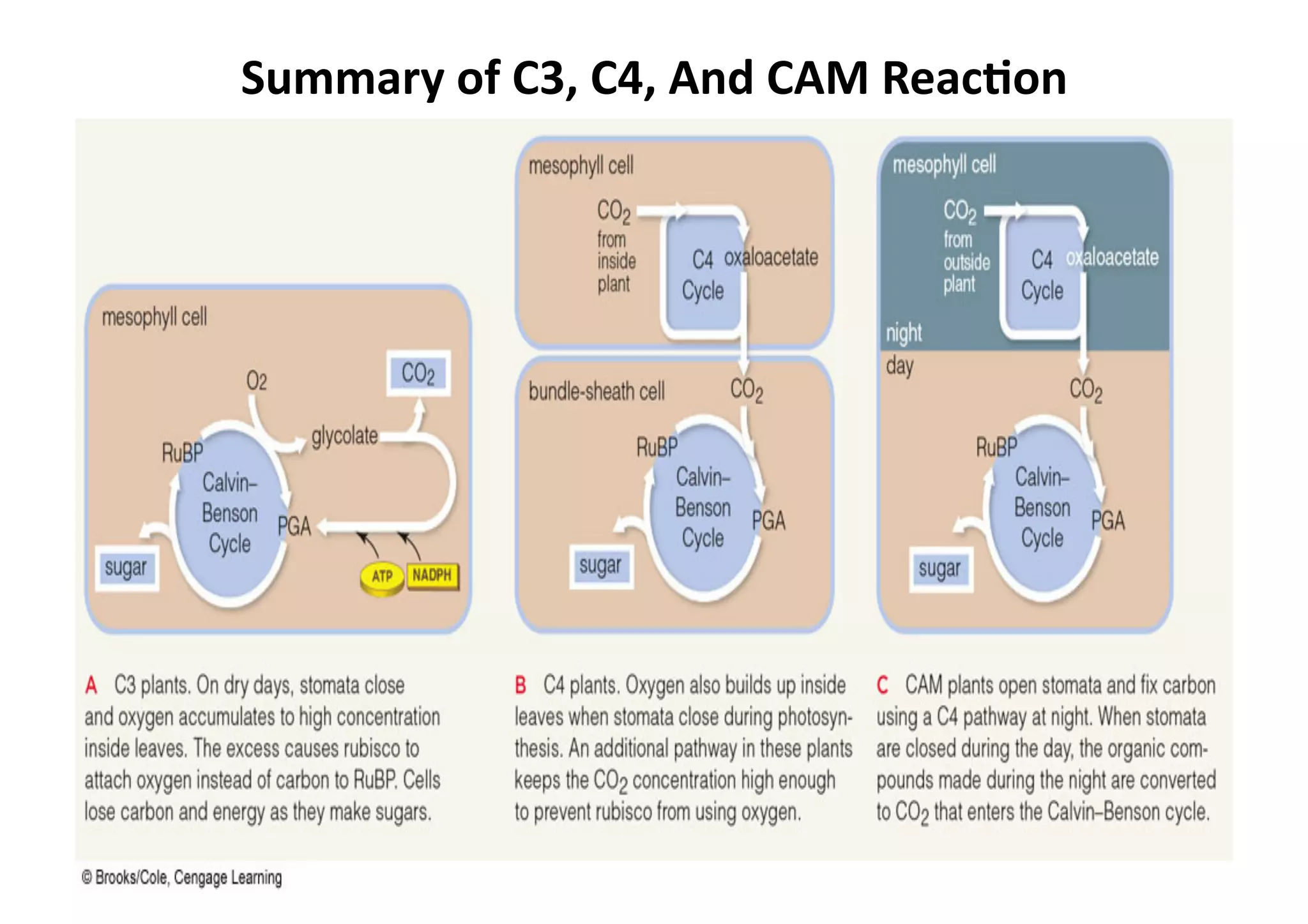
Summary	
  of	
  C3,	
  C4,	
  And	
  CAM	
  Reac>on	
  

Topic 7 Photosynthesis

  • 1.
  • 2.
    h0ps://youtu.be/1XilneV3cJI   During  photosynthesis,  plants  emit   what  is  called  fluorescence  –  light   invisible  to  the  naked  eye  but   detectable  by  satellites  orbiHng   hundreds  of  miles  above  Earth.  NASA   scienHsts  have  now  established  a   method  to  turn  this  satellite  data  into   global  maps  of  the  subtle   phenomenon  in  more  detail  than  ever   before.  
  • 3.
    Learning  Outcomes   1. Define  what  is  photosynthesis   2.  Explain  the  light  dependent  reacHons   3.  Explain  the  Calvin  cycle   4.  Define  what  is  photorespiraHon   5.  Compare  the  photorespiraHon  in  C3,  C4   and  CAM  plants   h0ps://www.khanacademy.org/science/biology/photosynthesis-­‐in-­‐plants  
  • 4.
  • 5.
    1.  Define  what  is  photosynthesis   2.  Explain  the  light  dependent  reacHons   3.  Explain  the  Calvin  cycle   4.  Define  what  is  photorespiraHon   5.  Compare  the  photorespiraHon  in  C3,  C4   and  CAM  plants  
  • 6.
    Group  tasks   1. Write  your  definiHon  of  photosynthesis   2.  Find  an  animaHon  or  video  on  photosynthesis   that  you  will  recommend   3.  Prepare  an  infographic  on  photosynthesis   process  
  • 7.
    Flowering  Plants  as  Photosynthesis  Reactor   1.  The  green  porHons  of   plants,  such  as  leaves,   carry  out   photosynthesis,  using   carbon  dioxide  and   water  as  substrates.   2.  Carbon  dioxide  enters   leaves  through   stomata.   3.  The  carbon  dioxide   and  water  diffuse  to   the  chloroplast,  the   site  of  photosynthesis.      
  • 8.
    Chloroplasts   1.  The  chloroplast  has  a   double  membrane  that   surrounds  the  liquid   stroma.   2.  The  stroma  contains   numerous  flat  thylakoid   disc  arranged  in  stacks   called  grana.   3.  The  chlorophyll  pigments   imbedded  in  the  thylakoid   membranes  absorb  solar   energy  during   photosynthesis.  
  • 9.
    The  Photosynthesis  Process   CO2    +    H2O   (CH2O)  +  O2   oxida>on   reduc>on   gain  of  hydrogen  atoms   loss  of  hydrogen  atoms   Solar  energy   Produce/genera>ng   glucose   Release/waste   product  
  • 10.
    Two  Sets  of  Reac>ons   1.  The  light  reacHons   2.  The  Calvin  cycle  reacHons  /  light  independent  reacHon  
  • 12.
    Light  Reac>ons   Occur  in  granum     1.  Chlorophyll  absorbs  solar   energy,  which  energizes   electrons.   2.  ATP  is  produced  using  an   electron  transport  chain.   3.  NADP+,  a  coenzyme,   accepts  electrons  to   become  NADPH.   4.  ATP  &  NADPH  produced  in   thylakoid  membrane  are   used  by  the  Calvin  cycle    in   the  stroma  to  reduce  CO2   to  a  carbohydrate  
  • 13.
    Calvin  cycle   Occur  in  the  stroma   1.  CO2  is  taken  up  by  one  of   the   substrates   in   the   cycle.       2.  ATP  and  NADPH  from  the   light   reacHons   reduce   CO2  to  a  carbohydrate.      
  • 14.
  • 15.
    1.  Define  what  is  photosynthesis   2.  Explain  the  light  dependent  reacHons   3.  Explain  the  Calvin  cycle   4.  Define  what  is  photorespiraHon   5.  Compare  the  photorespiraHon  in  C3,  C4   and  CAM  plants  
  • 16.
  • 17.
  • 18.
    The  electron  pathway  of  the  light  reac>ons   •  The  light  reacHons  consist  of  an  electron  pathway  that  produces   ATP  and  NADPH.   •  The  pathway  uses  2  photosystems  to  complete  the  light  reacHons.     –  Photosystem  I  (PS  I)   –  Photosystem  II  (PS  II)  
  • 19.
    A  photosystem  (PS  I  &  PS  II)   consists  of  3  major  parts.   1.   Pigment  complex,  as  an   antenna  /light  harvesHng   antenna:     ConsisHng  300  chlorophyll   molecules  and  40  beta   carotenes  and  other   accessory  pigments  acHng   as  a  light  harvesHng   antenna   2.  Reac>on  center;  a  special   chlorophyll  pigment   *  Pigment  complex  (light   antenna)  gathering  solar   energy  and  passed  photon   from  one  pigment  to  the  other   un9l  in  a  reac9on  center   (chlorophyll  a)  
  • 20.
    3.  Electron  acceptor   molecules:   Photon  is  absorbed  by  one  of   the  pigment  molecules  and,   !  transfers  that  energy  to   neighboring  molecules,   !  unHl  it  reaches  the  acHon   center  where,   !  the  energy  is  used  to   transfer  an  energeHc  electron   to  an  electron  acceptor.  
  • 21.
    Photosystem  II  contains  the  same  kind  of  chlorophyll  a  as  Photosystem  I   but  in  a  different  protein  environment  with  an  absorpHon  peak  at  680  nm.   (It  is  designated  P680).   Light  reac>ons:  PS  II  &  PS  I  
  • 23.
    Light  reac>ons:  PS  II   1.  When  PS  II  absorbs  solar  energy,  electron  in  reacHon  center  of  PS  II  become   energized  electrons   2.  Energized  electron  are  passed  to  electron  acceptors.   3.  PS  II  splits  a  water  molecule  to  recover  the  electrons  passed  to  the  electron   acceptors  (at  electron  transport  chain),  releasing  O2  +  H2O     4.  The   electron   acceptors   send   the   energized   electrons   down   an   electron   transport  chain.   5.  Energy  is  released  and  stored  in  the  form  of  H+  gradient  in  thylakoid  lumen   6.  Electron  transport  chain  establishes  an  energy  gradient.   7.  Electron   transport   chain   carries   electron,   pass   electron   from   one   to   the   other     8.  As   the   electrons   are   passed   down   an   electron   transport   chain,   energy   is   released  and  stored  in  the  form  of  a  hydrogen  ion  (H+)  gradient.   9.  This  H+  gradient  is  used  later  in  photosynthesis  to  produce  ATP  
  • 24.
    ATP  Produc>on   1. During   photosynthesis,   the   thylakoid   space   becomes   an   H+   reservoir.   2.  The  H+  ions  that  fill  this  reservoir  come  from  two  sources.     1.  The  oxidaHon  of  water  by  PS  II  adds  H+.   2.  The   flow   of   electrons   through   the   electron   transport   chain   releases  energy  that  pumps  H+  into  the  thylakoid  space.     3.  As  the  H+  are  released  through  an  ATP  synthase,  the  H+  flow  down   their  concentraHon  gradient  and  release  energy.   4.  The   ATP   synthase   couples   that   release   of   energy   to   the   producHon  of  ATP  (ADP  +  Pi  "  ATP).  
  • 26.
    Light  reac>ons:  PS  I   1.  When  PS  I  absorbs  solar  energy,  energized  electrons  are  passed  to   different  electron  acceptors.   2.  Electrons  from  the  end  of  the  electron  transport  chain  (from  PS  II)   replace  the  electrons  from  PS  I.   3.  The   electron   acceptors   pass   the   electrons   to   NADP+   to   form   NADPH.   4.  Electron  from  PS  II  replace  those  lost  by  PS  I   5.  When  PSI  absorbs  solar  energy,  electron  are  energized   6.  Electron  energized  are  passed  to  electron  acceptor.   7.  Electron  acceptor  pass  the  electron  to  series  of  electron  transport   chain,  then  final  electron  acceptor  (enzyme  that  accepts  H+)  ;   NADP   8.  NADP+  to  form  NADPH  
  • 28.
    1.  Define  what  is  photosynthesis   2.  Explain  the  light  dependent  reacHons   3.  Explain  the  Calvin  cycle   4.  Define  what  is  photorespiraHon   5.  Compare  the  photorespiraHon  in  C3,  C4   and  CAM  plants  
  • 29.
  • 30.
    •  The  Calvin   cycle   is   a   series   of   reacHons   that   conHnually   produce  a  carbohydrate  (glucose)  from  carbon  dioxide  during   photosynthesis.  
  • 31.
    Calvin  Cycle  Reac>ons   The  Calvin  cycle  has  3  steps.   1.  Carbon  dioxide  fixaHon   2.  Carbon  dioxide  reducHon   3.  RegeneraHon   of   ribulose-­‐1,5-­‐ bisphosphate  (RuBP)  
  • 32.
    Step  1:  Fixa>on  of  Carbon  Dioxide   1.  During  the  first  step  of   the   Calvin   cycle,   CO2   from   the   air   is   a0ached   (fixed)   to   RuBP.   2.  The   enzyme   for   this   reacHon   is   RuBP   carboxylase  oxygenase   (rubisco).   3.  Rubisco   splits   the   resulHng   6-­‐carbon   molecule   to   form   two   3-­‐carbon   molecules   (PGA).      
  • 33.
    Step  2:  Reduc>on  of  Carbon  Dioxide   4.  ReducHon   of   CO2   is   a   series   of   reacHons  that  uses   NADPH   and   ATP   from   the   light   reacHons   to   form   the  carbohydrate.   –  NADPH   provides   electrons   for   the   reducHon.   –  ATP   provides   the   energy.      
  • 34.
    Step  3:  Regenera>on  of  RuBP   5.  The   product   of   the   Calvin   cycle   is   glyceraldehyde-­‐3-­‐ phosphate  (G3P).   6.  About  1/6  of  the  G3P  is   used  to  make  glucose.   7.  About   5/6   of   the   glucose   is   used   to   regenerate   the   RuBP   required  for  the  fixaHon   of  carbon  dioxide.  
  • 35.
    The  Importance  of  the  Calvin  Cycle   •  The  G3P  molecules   produced  by  plants   can  be  used  to  make   a  wide  variety  of   chemicals  :   Eg  :      glucose,  fructose,   sucrose,  starch,   alkaloid  
  • 36.
    1.  Define  what  is  photosynthesis   2.  Explain  the  light  dependent  reacHons   3.  Explain  the  Calvin  cycle   4.  Define  what  is  photorespiraHon   5.  Compare  the  photorespiraHon  in  C3,  C4   and  CAM  plants  
  • 37.
    Photorespira>on  (also  known  as  the  oxidaHve   photosyntheHc  carbon  cycle,  or  C2  photosynthesis)     ! a  process  in  plant  metabolism  where  the  enzyme   RuBisCO  oxygenates  RuBP,  causing  some  of  the  energy   produced  by  photosynthesis  to  be  wasted.   ! Consumes  O2  and  organic  fuel  and  releases  CO2   ! Uses  ATP  but  not  making  ATP   ! Doesn’t  make  sugar   ! Decreases  photosynthesis  output  
  • 38.
    Types  of  Photosynthesis  :  Carbon  metabolism   •  Plants   are   physically   adapted   to   their   environment   •  Plants   have   metabolically   adapted   photosynthesis  to  different  climates.   1.  C3  plants   2.  C4  plants   3.  CAM  plants  
  • 39.
    1.  C3  Photosynthesis     •  In  areas  with  moderate  temperature     •  plants  carry  out  C3  photosynthesis,     •  the  first  detectable  molecule  from  the  Calvin  cycle  is  a  3-­‐carbon   compound.   •  FixaHon  by  RuBP  carboxylase  (RUBISCO)  in  C3  plants:  with  CO2  &   O2.     •  The   process   of   RuBP   binding   with   O2   is   known   as   photorespiraHon.     •  PhotorespiraHon   reduce   photosynthesis   product  yield  
  • 40.
    If  the  weather  is  hot  &  dry,  C3  plant:   o   stomata  closed   o   PrevenHng  the  loss  of  H2O   o   Also  prevents  CO2  from  entering    the  leaf   o      Traps   O2   (by-­‐product   of   photosynthesis   within   the   leaf   space  in  between  spongy  mesophyll)   o C3   photosynthesis   are   necessary   adapta>on   to   minimize   photorespira>on   effect   (O2   competes   with   CO2   for   the   binding   site   on   Rubisco,   decreasing   the   efficiency   of   photosynthesis/yield  decrease)   C3  
  • 42.
    •  C4  have  an  adapta>on  that  allow  them  to  be  successful  in  hot   dry  climates     •  These  plants  carry  out/perform  C4  photosynthesis     2.    C4  Photosynthesis    
  • 43.
    The  anatomy  of  a  C4  plant  is  different  from  that  of  a  C3  plant.       General  leaf/C3  leaf     C4  leaf   Keong BP Cross  sec>on  of  leaf  :  General  Versus  C4  Leaf   C4  
  • 45.
    •  C4  photosynthesis  forming  a  4-­‐ carbon  compound.   •  PEP  carboxylase  fix  PEP  (3C)   with  CO2    in  bundle  sheath  cell.   •  the  first  detectable  molecule   from  the  Calvin  cycle  is  a  4-­‐ carbon  compound  (OAA)   •  C4  are  able  to  avoid  the  uptake   of  O2  by  Rubisco   C4  
  • 46.
    •  The  anatomy   of   a   C4   plant   is   different  from  a  C3  plant.       •  Although   chloroplasts   are   found   in   both   the   mesophyll   and   bundle   sheath   cells,   the   Calvin  cycle  occurs  primarily  in   the  bundle  sheath  cells.   •  CO2  taken  in  by  the  mesophyll   cells   is   combined   with   a   3-­‐ carbon   compound   (PEP   @   phosphoenol   phyruvate)   to   form   a   4-­‐carbon   compound   (oxaloacetate).       C4  
  • 47.
    The  C4  pathway   CO2   is   fixed   by   enzyme   PEP  carboxylase,  forming   a   four-­‐carbon   product   oxaloacetate  (4C)      
  • 48.
    The  C4  pathway   CO2   is   transported   into   bundle   sheath,   released   and  fixed  by  rubisco  (RuBP)   to   allowing   Calvin   cycle   to   proceed.   Therefore   rubisco   have   to   react   with   CO2   instead   of   O2  because  O2  is  absent.  So   no  photorespira>on  occurs  
  • 49.
    •  Crassulacean  Acid   Metabolism   (CAM),   found   commonly   in   desert  plants,  in  warm,  arid  regions.       3.  CAM  Photosynthesis  
  • 50.
    CAM   •  Similar  to  C4  photosynthesis,  CAM  plants  separate  CO2  fixaHon  from   the  Calvin  cycle  reacHon  to  minimize  compeHHon  from  O2.   •  However  CAM  plants  separate  these  events  by  Hme.   •  CO2  is  fixed  during  the  night.   •  The  Calvin  cycle  reacHons  occur  during  the  day.      
  • 51.
    The  advantage  of  CAM  photosynthesis  involves  the  conserva>on   of  water.   • When   CAM   plants   open   their   stomata   at   night   to   obtain   CO2,   water  loss  is  minimized.     • Calvin  cycle  reacHon  occur  during  the  day     *  H2O  is  conserve,  but  CO2    cannot  enter  the  plant   CAM  
  • 52.
    1.  Define  what  is  photosynthesis   2.  Explain  the  light  dependent  reacHons   3.  Explain  the  Calvin  cycle   4.  Define  what  is  photorespiraHon   5.  Compare  the  photorespiraHon  in  C3,  C4   and  CAM  plants  
  • 53.
    Evolu>onary  Trends   • C4   plants   most   likely   involved   in   areas   with   high  light,  high  temperature,  and  low  rainfall.   •  C3   plants   survive   be0er   than   C4   plants   in   temperatures  less  than  25˚C.   •  CAM  plants  compete  well  with  both  C3  and  C4   plants,  parHcularly  in  arid  environments.    
  • 55.
    PEP  carboxylase  PEP  carboxylase  
  • 56.
    Summary  of  C3,  C4,  And  CAM  Reac>on