Lipids
Digestion and Absorption
R. C. Gupta
Professor and Head
Department of Biochemistry
National Institute of Medical Sciences
Jaipur, India
Lipids are chemically a heterogeneous
group of compounds
Their common property is insolubility in
water and solubility in organic solvents
Secondly, they are actually or
potentially related to fatty acids
Unlike carbohydrates and proteins, lipids
can be stored in large quantities
Stored lipids constitute an important
reservoir of energy
About four-fifths of the stored energy is in
the form of lipids
The major storage form of lipids is
triglycerides (triacylglycerols)
Triglycerides are stored in specialized
cells called adipocytes
A tissue rich in adipocytes is known as
adipose tissue
The other lipids present
in the body are:
Phospholipids
Glycolipids
Cholesterol
Free fatty acids
Fat-soluble vitamins
All the lipids except vitamins can be
synthesized in the body
However, all these lipids are present in
diet also
The dietary lipids have to be digested and
absorbed
Major dietary lipids are triglycerides,
phospholipids and esterified cholesterol
These have to be hydrolysed before their
absorption from the alimentary tract
Digestion and absorption
Bile also plays an important role in
digestion and absorption of lipids
Saliva
Digestive juices which participate in
digestion of lipids are:
Succus entericus
Pancreatic juice
Saliva contains a lipase which is secreted
by the dorsal surface of tongue
Food stays in mouth for a very short period
But salivary lipase remains active even in
the acidic environment of stomach
Salivary lipase converts triglycerides into
diglycerides and free fatty acids
Salivary lipase acts
preferentially on:
Triglycerides containing
short-chain fatty acids
The ester bond at
position 3
CH2‒ O ‒ C ‒R1
CH ‒ O ‒ C ‒ R2
CH2‒ O ‒ C ‒R3
Salivary lipase
O
II
O
II
O
II
Upon reaching small intestine, food comes
in contact with pancreatic juice
Pancreatic juice contains a lipase which is
far more powerful than salivary lipase
However, the hydrophobic nature of lipids
poses a problem
Being hydrophobic, lipids are insoluble in
the aqueous environment of the gut
They are present in the gut as large
globules
Pancreatic lipase can act only at the
surface of fat globules
For efficient digestion, the lipids need to be
emulsified
Emulsification is breaking up of fat
globules into small droplets
Bile salts, present in bile, play a key role in
emulsification
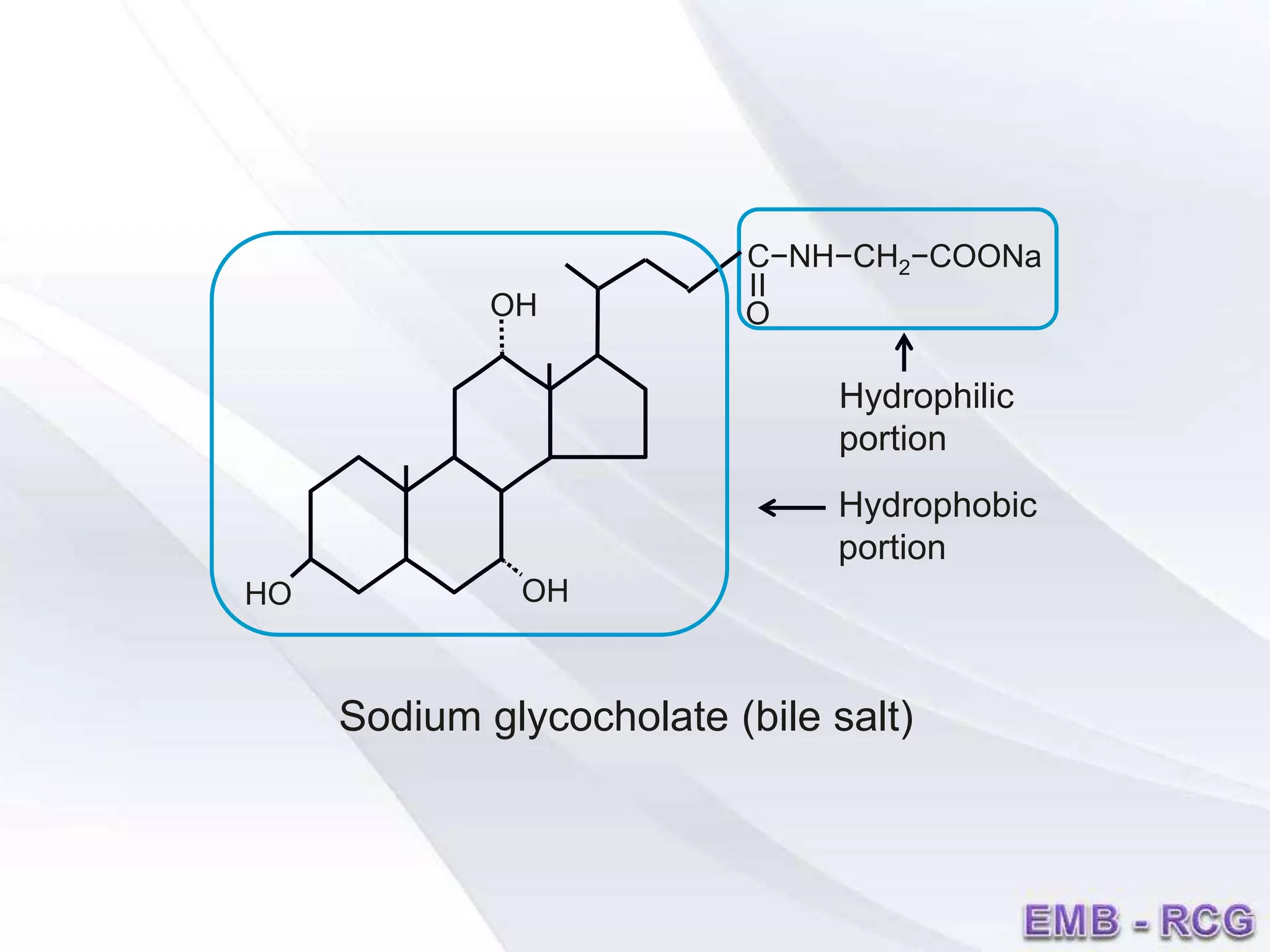
Bile salts are powerful emulsifying agents
They have both hydrophilic and hydro-
phobic domains
The hydrophobic portion dips into the fat
globule
The hydrophilic domain attracts water
OH
OHHO
Sodium glycocholate (bile salt)
II
O
C−NH−CH2−COONa
Hydrophilic
portion
Hydrophobic
portion
Peristaltic movement of the gut breaks up
fat globules into small droplets
Presence of bile salts on their surface
prevents their re-association
Phospholipids which are amphipathic
molecules also help in emulsification
Emulsification greatly increases the
surface area for pancreatic lipase to act on
Pancreatic lipase requires co-lipase to
become active
Co-lipase is a protein present in pancreatic
juice
Pancreatic lipase can easily hydrolyse the
ester bonds at positions 1 and 3
The ester bond at position 2 is resistant to
the action of pancreatic lipase
Pancreatic lipase converts triglycerides
into 2-monoacylglycerol and fatty acids
CH2‒ O ‒ C ‒R1
CH ‒ O ‒ C ‒ R2
CH2‒ O ‒ C ‒R3
O
II
O
II
O
II
CH2‒ OH
CH ‒ O ‒ C ‒ R2
CH2‒ OH
2-Monoacylglycerol
O
II
R1‒COOH
+
R3‒COOH
2 H2O


Pancreatic
lipase
Triacylglycerol
Pancreatic juice also contains phospho-
lipase A2 and cholesterol esterase
Phospholipase A2 hydrolyses the ester
bond at position 2 of glycerophospholipids
Cholesterol esterase hydrolyses the ester
bond of esterified cholesterol
Phospholipase A2
CH2‒O‒C‒R1
CH‒O‒C‒R2
CH2‒O‒‒Choline
CH2‒O‒C‒R1
CH‒OH
CH2‒O‒‒Choline
H2O
R2‒COOH
Hydrolysis of a glycerophospholipid
O
II
O
II
O
II
Cholesterol esterase
H2O
R‒COOH
HO
Hydrolysis of esterified cholesterol
R‒C‒O
O
II
Succus entericus contains a powerful
phospholipase
This causes complete hydrolysis of the
phospholipids
Glycerol, fatty acids, phosphate and
inositol/nitrogenous bases are liberated
Thus, the major products
of digestion of lipids are:
Glycerol
Cholesterol
Fatty acids
Monoglycerides
Emulsification also helps in their absorption
Digested lipids are passively absorbed into
the mucosal cells of the small intestine
Being hydrophobic, they can easily pass
through the lipid bilayer of cell membrane
Lipase
Lipase
Bile salts
Bile salts
Fat
globule
Micelles
Mucosal
cells
The products of digestion are re-combined
in the mucosal cells
Re-combination produces triglycerides,
esterified cholesterol and phospholipids
These are combined with a small amount
of some proteins (apolipoproteins)
The products are chylomicrons, a type of
lipoproteins
Cholesteryl
esters
Triglycerides
Free cholesterol
Apoprotein
Chylomicron
Phospholipids
The chylomicrons enter the lymphatic
vessels (lacteals)
They reach the systemic circulation via
thoracic duct
The lipids present in chylomicrons are
taken up by various tissues
Lipids   digestion and absorption

Lipids digestion and absorption

  • 1.
    Lipids Digestion and Absorption R.C. Gupta Professor and Head Department of Biochemistry National Institute of Medical Sciences Jaipur, India
  • 2.
    Lipids are chemicallya heterogeneous group of compounds Their common property is insolubility in water and solubility in organic solvents Secondly, they are actually or potentially related to fatty acids
  • 3.
    Unlike carbohydrates andproteins, lipids can be stored in large quantities Stored lipids constitute an important reservoir of energy About four-fifths of the stored energy is in the form of lipids
  • 4.
    The major storageform of lipids is triglycerides (triacylglycerols) Triglycerides are stored in specialized cells called adipocytes A tissue rich in adipocytes is known as adipose tissue
  • 5.
    The other lipidspresent in the body are: Phospholipids Glycolipids Cholesterol Free fatty acids Fat-soluble vitamins
  • 6.
    All the lipidsexcept vitamins can be synthesized in the body However, all these lipids are present in diet also The dietary lipids have to be digested and absorbed
  • 7.
    Major dietary lipidsare triglycerides, phospholipids and esterified cholesterol These have to be hydrolysed before their absorption from the alimentary tract Digestion and absorption
  • 8.
    Bile also playsan important role in digestion and absorption of lipids Saliva Digestive juices which participate in digestion of lipids are: Succus entericus Pancreatic juice
  • 9.
    Saliva contains alipase which is secreted by the dorsal surface of tongue Food stays in mouth for a very short period But salivary lipase remains active even in the acidic environment of stomach Salivary lipase converts triglycerides into diglycerides and free fatty acids
  • 10.
    Salivary lipase acts preferentiallyon: Triglycerides containing short-chain fatty acids The ester bond at position 3
  • 11.
    CH2‒ O ‒C ‒R1 CH ‒ O ‒ C ‒ R2 CH2‒ O ‒ C ‒R3 Salivary lipase O II O II O II
  • 12.
    Upon reaching smallintestine, food comes in contact with pancreatic juice Pancreatic juice contains a lipase which is far more powerful than salivary lipase However, the hydrophobic nature of lipids poses a problem
  • 13.
    Being hydrophobic, lipidsare insoluble in the aqueous environment of the gut They are present in the gut as large globules Pancreatic lipase can act only at the surface of fat globules
  • 14.
    For efficient digestion,the lipids need to be emulsified Emulsification is breaking up of fat globules into small droplets Bile salts, present in bile, play a key role in emulsification
  • 15.
    Bile salts arepowerful emulsifying agents They have both hydrophilic and hydro- phobic domains The hydrophobic portion dips into the fat globule The hydrophilic domain attracts water
  • 16.
    OH OHHO Sodium glycocholate (bilesalt) II O C−NH−CH2−COONa Hydrophilic portion Hydrophobic portion
  • 17.
    Peristaltic movement ofthe gut breaks up fat globules into small droplets Presence of bile salts on their surface prevents their re-association Phospholipids which are amphipathic molecules also help in emulsification
  • 18.
    Emulsification greatly increasesthe surface area for pancreatic lipase to act on Pancreatic lipase requires co-lipase to become active Co-lipase is a protein present in pancreatic juice
  • 19.
    Pancreatic lipase caneasily hydrolyse the ester bonds at positions 1 and 3 The ester bond at position 2 is resistant to the action of pancreatic lipase Pancreatic lipase converts triglycerides into 2-monoacylglycerol and fatty acids
  • 20.
    CH2‒ O ‒C ‒R1 CH ‒ O ‒ C ‒ R2 CH2‒ O ‒ C ‒R3 O II O II O II CH2‒ OH CH ‒ O ‒ C ‒ R2 CH2‒ OH 2-Monoacylglycerol O II R1‒COOH + R3‒COOH 2 H2O   Pancreatic lipase Triacylglycerol
  • 21.
    Pancreatic juice alsocontains phospho- lipase A2 and cholesterol esterase Phospholipase A2 hydrolyses the ester bond at position 2 of glycerophospholipids Cholesterol esterase hydrolyses the ester bond of esterified cholesterol
  • 22.
  • 23.
    Cholesterol esterase H2O R‒COOH HO Hydrolysis ofesterified cholesterol R‒C‒O O II
  • 24.
    Succus entericus containsa powerful phospholipase This causes complete hydrolysis of the phospholipids Glycerol, fatty acids, phosphate and inositol/nitrogenous bases are liberated
  • 25.
    Thus, the majorproducts of digestion of lipids are: Glycerol Cholesterol Fatty acids Monoglycerides
  • 26.
    Emulsification also helpsin their absorption Digested lipids are passively absorbed into the mucosal cells of the small intestine Being hydrophobic, they can easily pass through the lipid bilayer of cell membrane
  • 27.
  • 28.
    The products ofdigestion are re-combined in the mucosal cells Re-combination produces triglycerides, esterified cholesterol and phospholipids These are combined with a small amount of some proteins (apolipoproteins) The products are chylomicrons, a type of lipoproteins
  • 29.
  • 30.
    The chylomicrons enterthe lymphatic vessels (lacteals) They reach the systemic circulation via thoracic duct The lipids present in chylomicrons are taken up by various tissues