DR. AINA KHURSHID
ASSISTANT PROFESSOR
MBBS, MPhil biochemistry, CHPE, PhD
Scholar biochemistry
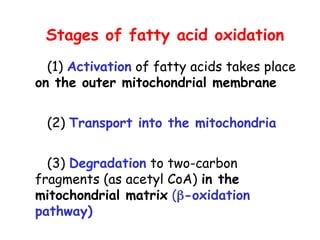
(1) Activation of fatty acids takes place
on the outer mitochondrial membrane
(2) Transport into the mitochondria
(3) Degradation to two-carbon
fragments (as acetyl CoA) in the
mitochondrial matrix (-oxidation
pathway)
Stages of fatty acid oxidation
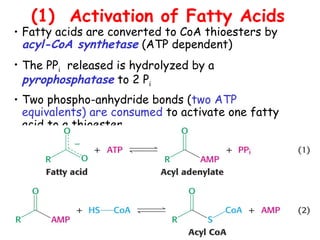
(1) Activation of Fatty Acids
• Fatty acids are converted to CoA thioesters by
acyl-CoA synthetase (ATP dependent)
• The PPi released is hydrolyzed by a
pyrophosphatase to 2 Pi
• Two phospho-anhydride bonds (two ATP
equivalents) are consumed to activate one fatty
acid to a thioester
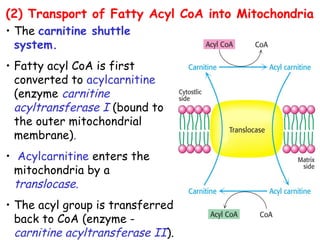
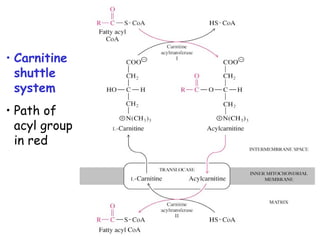
• The carnitine shuttle
system.
• Fatty acyl CoA is first
converted to acylcarnitine
(enzyme carnitine
acyltransferase I (bound to
the outer mitochondrial
membrane).
• Acylcarnitine enters the
mitochondria by a
translocase.
• The acyl group is transferred
back to CoA (enzyme -
carnitine acyltransferase II).
(2) Transport of Fatty Acyl CoA into Mitochondria
• Carnitine
shuttle
system
• Path of
acyl group
in red
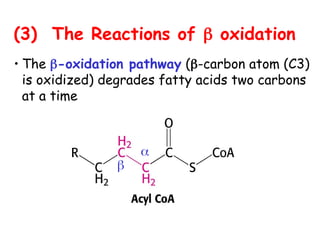
• The -oxidation pathway (-carbon atom (C3)
is oxidized) degrades fatty acids two carbons
at a time


(3) The Reactions of  oxidation
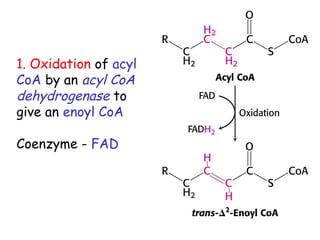
1. Oxidation of acyl
CoA by an acyl CoA
dehydrogenase to
give an enoyl CoA
Coenzyme - FAD
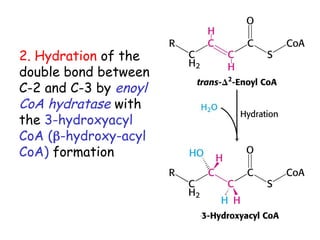
2. Hydration of the
double bond between
C-2 and C-3 by enoyl
CoA hydratase with
the 3-hydroxyacyl
CoA (-hydroxy-acyl
CoA) formation
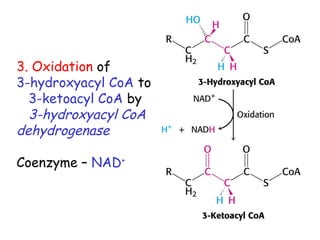
3. Oxidation of
3-hydroxyacyl CoA to
3-ketoacyl CoA by
3-hydroxyacyl CoA
dehydrogenase
Coenzyme – NAD+
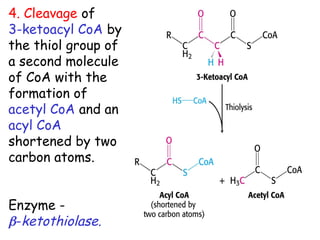
4. Cleavage of
3-ketoacyl CoA by
the thiol group of
a second molecule
of CoA with the
formation of
acetyl CoA and an
acyl CoA
shortened by two
carbon atoms.
Enzyme -
-ketothiolase.
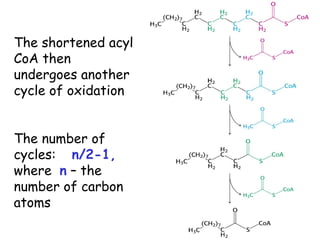
The shortened acyl
CoA then
undergoes another
cycle of oxidation
The number of
cycles: n/2-1,
where n – the
number of carbon
atoms
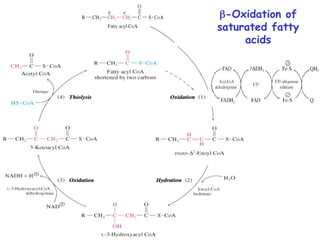
Fatty acyl CoA
-Oxidation of
saturated fatty
acids
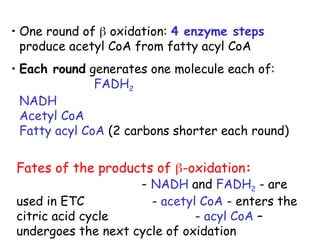
• One round of  oxidation: 4 enzyme steps
produce acetyl CoA from fatty acyl CoA
• Each round generates one molecule each of:
FADH2
NADH
Acetyl CoA
Fatty acyl CoA (2 carbons shorter each round)
Fates of the products of -oxidation:
- NADH and FADH2 - are
used in ETC - acetyl CoA - enters the
citric acid cycle - acyl CoA –
undergoes the next cycle of oxidation
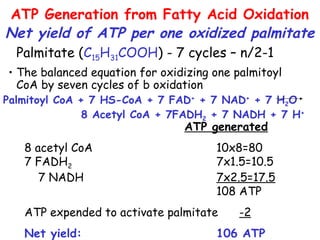
ATP Generation from Fatty Acid Oxidation
• The balanced equation for oxidizing one palmitoyl
CoA by seven cycles of b oxidation
Palmitoyl CoA + 7 HS-CoA + 7 FAD+
+ 7 NAD+
+ 7 H2O
8 Acetyl CoA + 7FADH2 + 7 NADH + 7 H+
ATP generated
8 acetyl CoA 10x8=80
7 FADH2 7x1.5=10.5
7 NADH 7x2.5=17.5
108 ATP
ATP expended to activate palmitate -2
Net yield: 106 ATP
Net yield of ATP per one oxidized palmitate
Palmitate (C15H31COOH) - 7 cycles – n/2-1
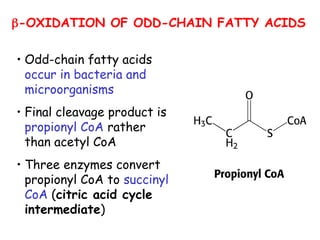
• Odd-chain fatty acids
occur in bacteria and
microorganisms
• Final cleavage product is
propionyl CoA rather
than acetyl CoA
• Three enzymes convert
propionyl CoA to succinyl
CoA (citric acid cycle
intermediate)
-OXIDATION OF ODD-CHAIN FATTY ACIDS
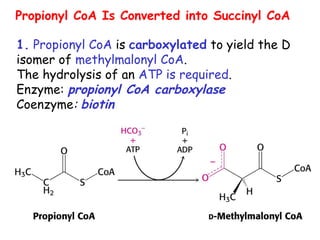
Propionyl CoA Is Converted into Succinyl CoA
1. Propionyl CoA is carboxylated to yield the D
isomer of methylmalonyl CoA.
The hydrolysis of an ATP is required.
Enzyme: propionyl CoA carboxylase
Coenzyme: biotin
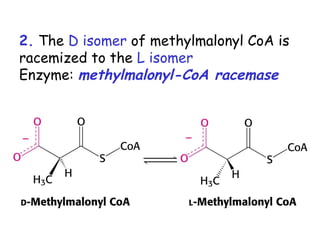
2. The D isomer of methylmalonyl CoA is
racemized to the L isomer
Enzyme: methylmalonyl-CoA racemase
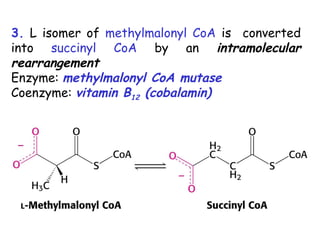
3. L isomer of methylmalonyl CoA is converted
into succinyl CoA by an intramolecular
rearrangement
Enzyme: methylmalonyl CoA mutase
Coenzyme: vitamin B12 (cobalamin)
OXIDATION OF FATTY ACIDS IN
PEROXISOMES
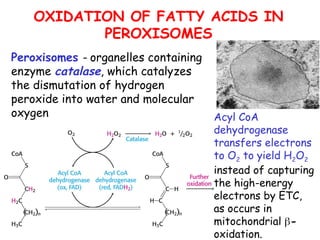
Peroxisomes - organelles containing
enzyme catalase, which catalyzes
the dismutation of hydrogen
peroxide into water and molecular
oxygen Acyl CoA
dehydrogenase
transfers electrons
to O2 to yield H2O2
instead of capturing
the high-energy
electrons by ETC,
as occurs in
mitochondrial -
oxidation.
Fatty Acid Synthesis
• Occurs mainly in liver and adipocytes, in
mammary glands during lactation
• Occurs in cytoplasm
• FA synthesis and degradation occur by
two completely separate pathways
• When glucose is plentiful, large amounts
of acetyl CoA are produced by glycolysis
and can be used for fatty acid synthesis
Three stages of fatty acid
synthesis:
A. Transport of acetyl CoA into
cytosol
B. Carboxylation of acetyl CoA
C. Assembly of fatty acid chain
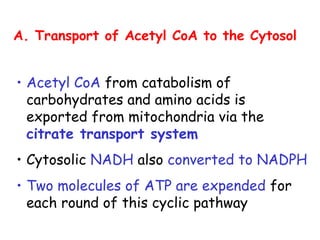
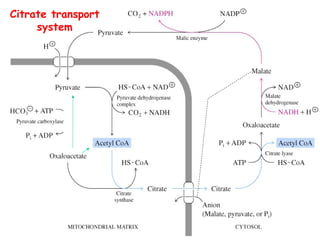
A. Transport of Acetyl CoA to the Cytosol
• Acetyl CoA from catabolism of
carbohydrates and amino acids is
exported from mitochondria via the
citrate transport system
• Cytosolic NADH also converted to NADPH
• Two molecules of ATP are expended for
each round of this cyclic pathway
Citrate transport
system
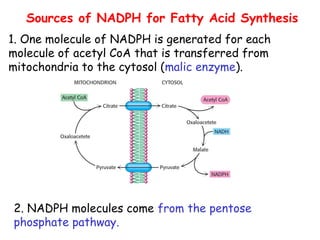
Sources of NADPH for Fatty Acid Synthesis
1. One molecule of NADPH is generated for each
molecule of acetyl CoA that is transferred from
mitochondria to the cytosol (malic enzyme).
2. NADPH molecules come from the pentose
phosphate pathway.
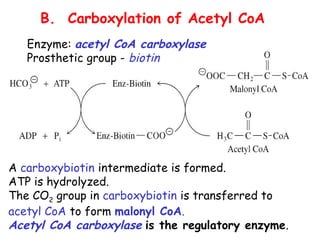
B. Carboxylation of Acetyl CoA
Enzyme: acetyl CoA carboxylase
Prosthetic group - biotin
A carboxybiotin intermediate is formed.
ATP is hydrolyzed.
The CO2 group in carboxybiotin is transferred to
acetyl CoA to form malonyl CoA.
Acetyl CoA carboxylase is the regulatory enzyme.
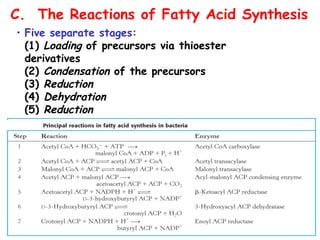
C. The Reactions of Fatty Acid Synthesis
• Five separate stages:
(1) Loading of precursors via thioester
derivatives
(2) Condensation of the precursors
(3) Reduction
(4) Dehydration
(5) Reduction
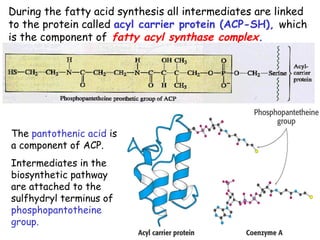
During the fatty acid synthesis all intermediates are linked
to the protein called acyl carrier protein (ACP-SH), which
is the component of fatty acyl synthase complex.
The pantothenic acid is
a component of ACP.
Intermediates in the
biosynthetic pathway
are attached to the
sulfhydryl terminus of
phosphopantotheine
group.
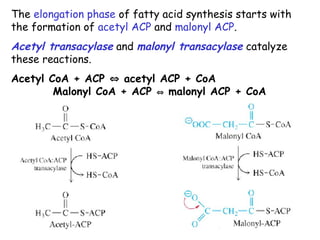
The elongation phase of fatty acid synthesis starts with
the formation of acetyl ACP and malonyl ACP.
Acetyl transacylase and malonyl transacylase catalyze
these reactions.
Acetyl CoA + ACP  acetyl ACP + CoA
Malonyl CoA + ACP  malonyl ACP + CoA
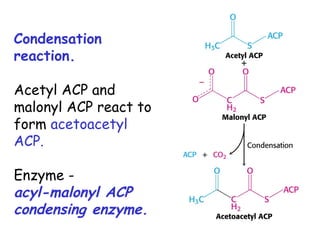
Condensation
reaction.
Acetyl ACP and
malonyl ACP react to
form acetoacetyl
ACP.
Enzyme -
acyl-malonyl ACP
condensing enzyme.
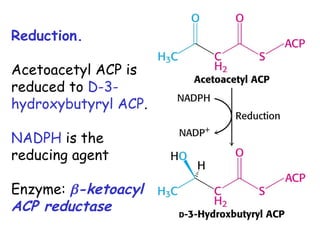
Reduction.
Acetoacetyl ACP is
reduced to D-3-
hydroxybutyryl ACP.
NADPH is the
reducing agent
Enzyme: -ketoacyl
ACP reductase
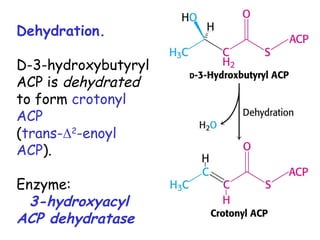
Dehydration.
D-3-hydroxybutyryl
ACP is dehydrated
to form crotonyl
ACP
(trans-2
-enoyl
ACP).
Enzyme:
3-hydroxyacyl
ACP dehydratase
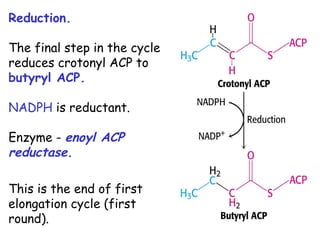
Reduction.
The final step in the cycle
reduces crotonyl ACP to
butyryl ACP.
NADPH is reductant.
Enzyme - enoyl ACP
reductase.
This is the end of first
elongation cycle (first
round).
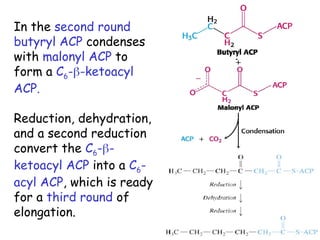
In the second round
butyryl ACP condenses
with malonyl ACP to
form a C6--ketoacyl
ACP.
Reduction, dehydration,
and a second reduction
convert the C6--
ketoacyl ACP into a C6-
acyl ACP, which is ready
for a third round of
elongation.
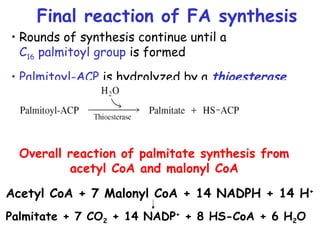
• Rounds of synthesis continue until a
C16 palmitoyl group is formed
• Palmitoyl-ACP is hydrolyzed by a thioesterase
Final reaction of FA synthesis
Acetyl CoA + 7 Malonyl CoA + 14 NADPH + 14 H+
Palmitate + 7 CO2 + 14 NADP+
+ 8 HS-CoA + 6 H2O
Overall reaction of palmitate synthesis from
acetyl CoA and malonyl CoA
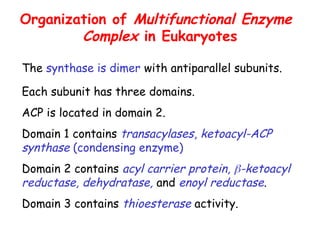
Organization of Multifunctional Enzyme
Complex in Eukaryotes
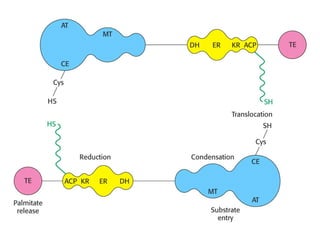
The synthase is dimer with antiparallel subunits.
Each subunit has three domains.
ACP is located in domain 2.
Domain 1 contains transacylases, ketoacyl-ACP
synthase (condensing enzyme)
Domain 2 contains acyl carrier protein, -ketoacyl
reductase, dehydratase, and enoyl reductase.
Domain 3 contains thioesterase activity.
Fatty Acid Elongation and Desaturation
The common product of fatty acid synthesis is
palmitate (16:0).
Cells contain longer fatty acids and unsaturated
fatty acids they are synthesized in the endoplasmic
reticulum.
The reactions of elongation are similar to the ones
seen with fatty acid synthase (new carbons are
added in the form of malonyl CoA).
For the formation of unsaturated fatty acids there
are various desaturases catalizing the formation of
double bonds.
THE CONTROL OF FATTY ACID METABOLISM
Acetyl CoA carboxylase plays an essential role
in regulating fatty acid synthesis and
degradation.
The carboxylase is controlled by hormones:
 glucagon,
 epinephrine, and
 insulin.
Another regulatory factors:
 citrate,
 palmitoyl CoA, and
 AMP
Insulin stimulates fatty acid synthesis causing
dephosphorylation of carboxylase.
Glucagon and epinephrine have the reverse effect (keep the
carboxylase in the inactive phosphorylated state).
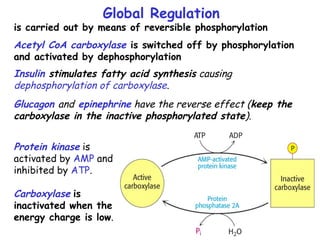
Global Regulation
is carried out by means of reversible phosphorylation
Acetyl CoA carboxylase is switched off by phosphorylation
and activated by dephosphorylation
Protein kinase is
activated by AMP and
inhibited by ATP.
Carboxylase is
inactivated when the
energy charge is low.
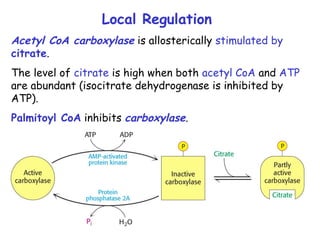
Local Regulation
Acetyl CoA carboxylase is allosterically stimulated by
citrate.
The level of citrate is high when both acetyl CoA and ATP
are abundant (isocitrate dehydrogenase is inhibited by
ATP).
Palmitoyl CoA inhibits carboxylase.
Fed state:
• Insulin level is increased
• Inhibits hydrolysis of stored TGs
• Stimulates formation of malonyl CoA, which inhibits
carnitine acyltransferase I
• FA remain in cytosol (FA oxidation enzymes are in the
mitochondria)
Starvation:
• Epinephrine and glucagon are produced and stimulate
adipose cell lipase and the level of free fatty acids rises
• Inactivate carboxylase, so decrease formation of malonyl
CoA (lead to increased transport of FA into mitochondria
and activate the b-oxidation pathway)
Response to Diet

fatty acid synthesis & oxidation.ppt biochem

  • 1.
    DR. AINA KHURSHID ASSISTANTPROFESSOR MBBS, MPhil biochemistry, CHPE, PhD Scholar biochemistry
  • 2.
    (1) Activation offatty acids takes place on the outer mitochondrial membrane (2) Transport into the mitochondria (3) Degradation to two-carbon fragments (as acetyl CoA) in the mitochondrial matrix (-oxidation pathway) Stages of fatty acid oxidation
  • 3.
    (1) Activation ofFatty Acids • Fatty acids are converted to CoA thioesters by acyl-CoA synthetase (ATP dependent) • The PPi released is hydrolyzed by a pyrophosphatase to 2 Pi • Two phospho-anhydride bonds (two ATP equivalents) are consumed to activate one fatty acid to a thioester
  • 4.
    • The carnitineshuttle system. • Fatty acyl CoA is first converted to acylcarnitine (enzyme carnitine acyltransferase I (bound to the outer mitochondrial membrane). • Acylcarnitine enters the mitochondria by a translocase. • The acyl group is transferred back to CoA (enzyme - carnitine acyltransferase II). (2) Transport of Fatty Acyl CoA into Mitochondria
  • 5.
  • 6.
    • The -oxidationpathway (-carbon atom (C3) is oxidized) degrades fatty acids two carbons at a time   (3) The Reactions of  oxidation
  • 7.
    1. Oxidation ofacyl CoA by an acyl CoA dehydrogenase to give an enoyl CoA Coenzyme - FAD
  • 8.
    2. Hydration ofthe double bond between C-2 and C-3 by enoyl CoA hydratase with the 3-hydroxyacyl CoA (-hydroxy-acyl CoA) formation
  • 9.
    3. Oxidation of 3-hydroxyacylCoA to 3-ketoacyl CoA by 3-hydroxyacyl CoA dehydrogenase Coenzyme – NAD+
  • 10.
    4. Cleavage of 3-ketoacylCoA by the thiol group of a second molecule of CoA with the formation of acetyl CoA and an acyl CoA shortened by two carbon atoms. Enzyme - -ketothiolase.
  • 11.
    The shortened acyl CoAthen undergoes another cycle of oxidation The number of cycles: n/2-1, where n – the number of carbon atoms
  • 12.
    Fatty acyl CoA -Oxidationof saturated fatty acids
  • 13.
    • One roundof  oxidation: 4 enzyme steps produce acetyl CoA from fatty acyl CoA • Each round generates one molecule each of: FADH2 NADH Acetyl CoA Fatty acyl CoA (2 carbons shorter each round) Fates of the products of -oxidation: - NADH and FADH2 - are used in ETC - acetyl CoA - enters the citric acid cycle - acyl CoA – undergoes the next cycle of oxidation
  • 14.
    ATP Generation fromFatty Acid Oxidation • The balanced equation for oxidizing one palmitoyl CoA by seven cycles of b oxidation Palmitoyl CoA + 7 HS-CoA + 7 FAD+ + 7 NAD+ + 7 H2O 8 Acetyl CoA + 7FADH2 + 7 NADH + 7 H+ ATP generated 8 acetyl CoA 10x8=80 7 FADH2 7x1.5=10.5 7 NADH 7x2.5=17.5 108 ATP ATP expended to activate palmitate -2 Net yield: 106 ATP Net yield of ATP per one oxidized palmitate Palmitate (C15H31COOH) - 7 cycles – n/2-1
  • 15.
    • Odd-chain fattyacids occur in bacteria and microorganisms • Final cleavage product is propionyl CoA rather than acetyl CoA • Three enzymes convert propionyl CoA to succinyl CoA (citric acid cycle intermediate) -OXIDATION OF ODD-CHAIN FATTY ACIDS
  • 16.
    Propionyl CoA IsConverted into Succinyl CoA 1. Propionyl CoA is carboxylated to yield the D isomer of methylmalonyl CoA. The hydrolysis of an ATP is required. Enzyme: propionyl CoA carboxylase Coenzyme: biotin
  • 17.
    2. The Disomer of methylmalonyl CoA is racemized to the L isomer Enzyme: methylmalonyl-CoA racemase
  • 18.
    3. L isomerof methylmalonyl CoA is converted into succinyl CoA by an intramolecular rearrangement Enzyme: methylmalonyl CoA mutase Coenzyme: vitamin B12 (cobalamin)
  • 19.
    OXIDATION OF FATTYACIDS IN PEROXISOMES Peroxisomes - organelles containing enzyme catalase, which catalyzes the dismutation of hydrogen peroxide into water and molecular oxygen Acyl CoA dehydrogenase transfers electrons to O2 to yield H2O2 instead of capturing the high-energy electrons by ETC, as occurs in mitochondrial - oxidation.
  • 20.
    Fatty Acid Synthesis •Occurs mainly in liver and adipocytes, in mammary glands during lactation • Occurs in cytoplasm • FA synthesis and degradation occur by two completely separate pathways • When glucose is plentiful, large amounts of acetyl CoA are produced by glycolysis and can be used for fatty acid synthesis
  • 21.
    Three stages offatty acid synthesis: A. Transport of acetyl CoA into cytosol B. Carboxylation of acetyl CoA C. Assembly of fatty acid chain
  • 22.
    A. Transport ofAcetyl CoA to the Cytosol • Acetyl CoA from catabolism of carbohydrates and amino acids is exported from mitochondria via the citrate transport system • Cytosolic NADH also converted to NADPH • Two molecules of ATP are expended for each round of this cyclic pathway
  • 23.
  • 24.
    Sources of NADPHfor Fatty Acid Synthesis 1. One molecule of NADPH is generated for each molecule of acetyl CoA that is transferred from mitochondria to the cytosol (malic enzyme). 2. NADPH molecules come from the pentose phosphate pathway.
  • 25.
    B. Carboxylation ofAcetyl CoA Enzyme: acetyl CoA carboxylase Prosthetic group - biotin A carboxybiotin intermediate is formed. ATP is hydrolyzed. The CO2 group in carboxybiotin is transferred to acetyl CoA to form malonyl CoA. Acetyl CoA carboxylase is the regulatory enzyme.
  • 26.
    C. The Reactionsof Fatty Acid Synthesis • Five separate stages: (1) Loading of precursors via thioester derivatives (2) Condensation of the precursors (3) Reduction (4) Dehydration (5) Reduction
  • 27.
    During the fattyacid synthesis all intermediates are linked to the protein called acyl carrier protein (ACP-SH), which is the component of fatty acyl synthase complex. The pantothenic acid is a component of ACP. Intermediates in the biosynthetic pathway are attached to the sulfhydryl terminus of phosphopantotheine group.
  • 28.
    The elongation phaseof fatty acid synthesis starts with the formation of acetyl ACP and malonyl ACP. Acetyl transacylase and malonyl transacylase catalyze these reactions. Acetyl CoA + ACP  acetyl ACP + CoA Malonyl CoA + ACP  malonyl ACP + CoA
  • 29.
    Condensation reaction. Acetyl ACP and malonylACP react to form acetoacetyl ACP. Enzyme - acyl-malonyl ACP condensing enzyme.
  • 30.
    Reduction. Acetoacetyl ACP is reducedto D-3- hydroxybutyryl ACP. NADPH is the reducing agent Enzyme: -ketoacyl ACP reductase
  • 31.
    Dehydration. D-3-hydroxybutyryl ACP is dehydrated toform crotonyl ACP (trans-2 -enoyl ACP). Enzyme: 3-hydroxyacyl ACP dehydratase
  • 32.
    Reduction. The final stepin the cycle reduces crotonyl ACP to butyryl ACP. NADPH is reductant. Enzyme - enoyl ACP reductase. This is the end of first elongation cycle (first round).
  • 33.
    In the secondround butyryl ACP condenses with malonyl ACP to form a C6--ketoacyl ACP. Reduction, dehydration, and a second reduction convert the C6-- ketoacyl ACP into a C6- acyl ACP, which is ready for a third round of elongation.
  • 34.
    • Rounds ofsynthesis continue until a C16 palmitoyl group is formed • Palmitoyl-ACP is hydrolyzed by a thioesterase Final reaction of FA synthesis Acetyl CoA + 7 Malonyl CoA + 14 NADPH + 14 H+ Palmitate + 7 CO2 + 14 NADP+ + 8 HS-CoA + 6 H2O Overall reaction of palmitate synthesis from acetyl CoA and malonyl CoA
  • 35.
    Organization of MultifunctionalEnzyme Complex in Eukaryotes The synthase is dimer with antiparallel subunits. Each subunit has three domains. ACP is located in domain 2. Domain 1 contains transacylases, ketoacyl-ACP synthase (condensing enzyme) Domain 2 contains acyl carrier protein, -ketoacyl reductase, dehydratase, and enoyl reductase. Domain 3 contains thioesterase activity.
  • 37.
    Fatty Acid Elongationand Desaturation The common product of fatty acid synthesis is palmitate (16:0). Cells contain longer fatty acids and unsaturated fatty acids they are synthesized in the endoplasmic reticulum. The reactions of elongation are similar to the ones seen with fatty acid synthase (new carbons are added in the form of malonyl CoA). For the formation of unsaturated fatty acids there are various desaturases catalizing the formation of double bonds.
  • 38.
    THE CONTROL OFFATTY ACID METABOLISM Acetyl CoA carboxylase plays an essential role in regulating fatty acid synthesis and degradation. The carboxylase is controlled by hormones:  glucagon,  epinephrine, and  insulin. Another regulatory factors:  citrate,  palmitoyl CoA, and  AMP
  • 39.
    Insulin stimulates fattyacid synthesis causing dephosphorylation of carboxylase. Glucagon and epinephrine have the reverse effect (keep the carboxylase in the inactive phosphorylated state). Global Regulation is carried out by means of reversible phosphorylation Acetyl CoA carboxylase is switched off by phosphorylation and activated by dephosphorylation Protein kinase is activated by AMP and inhibited by ATP. Carboxylase is inactivated when the energy charge is low.
  • 40.
    Local Regulation Acetyl CoAcarboxylase is allosterically stimulated by citrate. The level of citrate is high when both acetyl CoA and ATP are abundant (isocitrate dehydrogenase is inhibited by ATP). Palmitoyl CoA inhibits carboxylase.
  • 41.
    Fed state: • Insulinlevel is increased • Inhibits hydrolysis of stored TGs • Stimulates formation of malonyl CoA, which inhibits carnitine acyltransferase I • FA remain in cytosol (FA oxidation enzymes are in the mitochondria) Starvation: • Epinephrine and glucagon are produced and stimulate adipose cell lipase and the level of free fatty acids rises • Inactivate carboxylase, so decrease formation of malonyl CoA (lead to increased transport of FA into mitochondria and activate the b-oxidation pathway) Response to Diet