BETA OXIDATION OF FATTY ACIDS & ITS REGULATION
DR ROHINI C SANE
LECTURE 61 INTRODUCTION TO LIPID METABOLISM AND FATTY ACIDS OXIDATION
learning outcomes:
At the end of lecture, students should be able to:
1. Describe beta oxidation of Palmitic acid and along with its energetics.
2. Explain the role of Carnitine in transport of fatty acids into mitochondria.
LECTURE 62,63 OXIDATION OF FATTY ACIDS II
Learning outcomes:
At the end of lecture, students should be able to:
1. Discuss alpha & omega oxidation of fatty acids.
2. Describe the oxidation of odd chain fatty acids .
3. Describe REFSUME disease & Zellweger syndrome.
BETA OXIDATION PROPER (MITOCHONDRIAL)
STEPS ENZYMES PRODUCTS
1.OXIDATION FAD DEPENDENT ACYL Co A
DEHYDROGENASE ( ( FAD+ )
α ,β unsaturated acyl
CoA
2.HYDRATION ENOYL Co A HYDRATASE (H2 O) β HYDROXYL acyl CoA
3.OXIDATION β HYDROXYL acyl CoA
DEHYDROGENASE (NAD+ )
β KETO acyl CoA
4.SPLITTING THIOLASE (CoASH) acyl CoA( 2 CARBON
LESS THAN ORIGINAL )
4
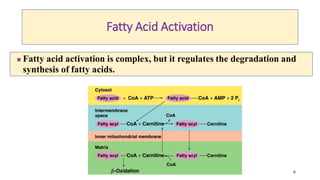
Fatty Acid Activation
Fatty acid activation:
• Enzymes for fatty acid oxidation are located in Mitochondria
• FFA can’t pass through mitochondrial membrane
• Activation allows the fatty acids in the cytosol to enter the mitochondria for
oxidation.
• a fatty acid combines with CoASH to yield fatty acyl CoA in presence of ATP.
Fatty acyl CoA combines with carnitine. Enzyme involved is acyl-CoA
synthetase
5
Fatty Acid Activation
• Fatty acyl-Carnitine transports the fatty acid into the matrix.
• The fatty acid acyl group recombines with CoA for oxidation.
6
Fatty Acid Activation
 Fatty acid activation is complex, but it regulates the degradation and
synthesis of fatty acids.
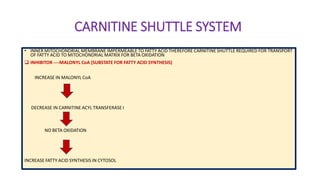
CARNITINE SHUTTLE SYSTEM
• INNER MITOCHONDRIAL MEMBRANE IMPERMEABLE TO FATTY ACID THEREFORE CARNITINE SHUTTLE REQUIRED FOR TRANSPORT
OF FATTY ACID TO MITOCHONDRIAL MATRIX FOR BETA OXIDATION
 INHIBITOR ----MALONYL CoA (SUBSTATE FOR FATTY ACID SYNTHESIS)
INCREASE IN MALONYL CoA
DECREASE IN CARNITINE ACYL TRANSFERASE I
NO BETA OXIDATION
INCREASE FATTY ACID SYNTHESIS IN CYTOSOL
Fatty acid oxidation
• Four steps involved in Fatty acid oxidation
9
10
11
Beta-Oxidation of Fatty Acids
4 reactions involved in
Beta-Oxidation of Fatty Acids
12
Beta-Oxidation of Fatty Acids
In reaction 1, oxidation:
• Dehydrogenation
• Removes H atoms from the  and 
carbons.
• Forms a trans C=C bond.
• Reduces FAD to FADH2.
• Enzyme- Acyl CoA dehydrogenase
 
13
Beta-Oxidation of Fatty Acids
In reaction 2, hydration:
• Adds water across the trans C=C bond.
• Forms a hydroxyl group (—OH) on the
 carbon.
• Enzyme-Enoyl CoA hydratase
 
14
Beta ()-Oxidation of Fatty Acids
In reaction 3, dehydrogenation :
• Forms a keto group on the  carbon.
• Reduces NAD to NADH2
• Enzyme- beta hydroxyl acyl CoA
dehydrogenase
 
15
Beta ()-Oxidation of Fatty Acids
In Reaction 4, acetyl CoA is cleaved:
• By splitting the bond between the  and 
carbons.
• To form a shortened fatty acyl CoA that repeats
steps 1 - 4 of -oxidation.
• Enzyme-Acyl CoA acyl transferase-(Thiolase)
16
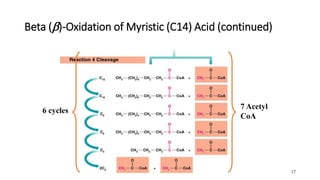
Beta ()-Oxidation of Myristic (C14) Acid
17
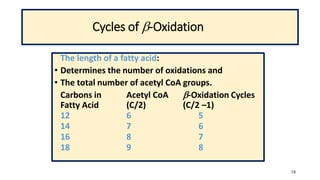
Beta ()-Oxidation of Myristic (C14) Acid (continued)
7 Acetyl
CoA
6 cycles
18
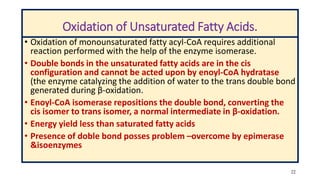
Cycles of -Oxidation
The length of a fatty acid:
• Determines the number of oxidations and
• The total number of acetyl CoA groups.
Carbons in Acetyl CoA -Oxidation Cycles
Fatty Acid (C/2) (C/2 –1)
12 6 5
14 7 6
16 8 7
18 9 8
19
-Oxidation and ATP synthesis
Activation of a fatty acid requires:1 ATP
One cycle of oxidation of a fatty acid produces:
1 NADH 2.5 ATP and
1 FADH2 1.5 ATP
Acetyl CoA entering the citric acid cycle produces:
1 Acetyl CoA 10 ATP
The energetic yield of β-oxidation of Palmitic acid
– to eight acetyl coenzymes A
Palmitoyl CoA + 7 FAD + 7 NAD+ + 7 H2O + 7 CoA---->8 acetyl CoA + 7 FADH2 + 7 NADH + 7 H+
14 ATP + 21 ATP – 2 ATP (activation of Palmitic acid )
– and eight acetyl CoA in the Citrate cycle
8 X 12 ATP = 96 ATP
Net yield of complete Palmitic acid oxidation to CO2
14 ATP + 21 ATP – 2 ATP + 96 ATP = 129 ATP
Standard free energy of Palmitic acid =2340 Cal
Energy yield by its oxidation 129 ATP = 7.3X 129 = 940Cal
NET YEILD = 940/2340 X100 = 40%
60% is used for HEAT GENERATION
21
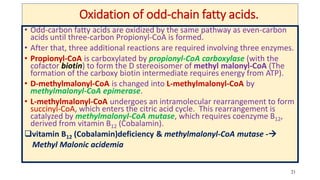
Oxidation of odd-chain fatty acids.
• Odd-carbon fatty acids are oxidized by the same pathway as even-carbon
acids until three-carbon Propionyl-CoA is formed.
• After that, three additional reactions are required involving three enzymes.
• Propionyl-CoA is carboxylated by propionyl-CoA carboxylase (with the
cofactor biotin) to form the D stereoisomer of methyl malonyl-CoA (The
formation of the carboxy biotin intermediate requires energy from ATP).
• D-methylmalonyl-CoA is changed into L-methylmalonyl-CoA by
methylmalonyl-CoA epimerase.
• L-methylmalonyl-CoA undergoes an intramolecular rearrangement to form
succinyl-CoA, which enters the citric acid cycle. This rearrangement is
catalyzed by methylmalonyl-CoA mutase, which requires coenzyme B12,
derived from vitamin B12 (Cobalamin).
vitamin B12 (Cobalamin)deficiency & methylmalonyl-CoA mutase -
Methyl Malonic acidemia
22
Oxidation of Unsaturated Fatty Acids.
• Oxidation of monounsaturated fatty acyl-CoA requires additional
reaction performed with the help of the enzyme isomerase.
• Double bonds in the unsaturated fatty acids are in the cis
configuration and cannot be acted upon by enoyl-CoA hydratase
(the enzyme catalyzing the addition of water to the trans double bond
generated during β-oxidation.
• Enoyl-CoA isomerase repositions the double bond, converting the
cis isomer to trans isomer, a normal intermediate in β-oxidation.
• Energy yield less than saturated fatty acids
• Presence of doble bond posses problem –overcome by epimerase
&isoenzymes
23
Oxidation of Polyunsaturated fatty acids.
• Requires two additional reactions and a second enzyme, reductase, in addition
to isomerase.
• NADPH-dependent 2,4-dienoyl-CoA reductase converts trans-2, cis-4-dienoyl-
CoA intermediate into the trans-2-enoyl-CoA substrate necessary for β-
oxidation.
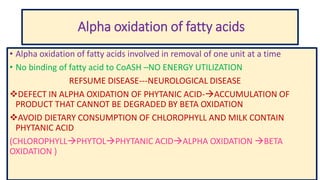
Alpha oxidation of fatty acids
• Alpha oxidation of fatty acids involved in removal of one unit at a time
• No binding of fatty acid to CoASH –NO ENERGY UTILIZATION
REFSUME DISEASE---NEUROLOGICAL DISEASE
DEFECT IN ALPHA OXIDATION OF PHYTANIC ACID-ACCUMULATION OF
PRODUCT THAT CANNOT BE DEGRADED BY BETA OXIDATION
AVOID DIETARY CONSUMPTION OF CHLOROPHYLL AND MILK CONTAIN
PHYTANIC ACID
(CHLOROPHYLLPHYTOLPHYTANIC ACIDALPHA OXIDATION BETA
OXIDATION )
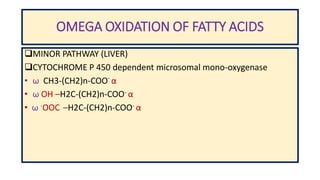
OMEGA OXIDATION OF FATTY ACIDS
MINOR PATHWAY (LIVER)
CYTOCHROME P 450 dependent microsomal mono-oxygenase
• ω CH3-(CH2)n-COO-
α
• ω OH –H2C-(CH2)n-COO- α
• ω -OOC –H2C-(CH2)n-COO- α
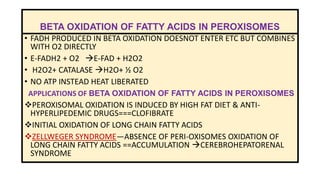
BETA OXIDATION OF FATTY ACIDS IN PEROXISOMES
• FADH PRODUCED IN BETA OXIDATION DOESNOT ENTER ETC BUT COMBINES
WITH O2 DIRECTLY
• E-FADH2 + O2 E-FAD + H2O2
• H2O2+ CATALASE H2O+ ½ O2
• NO ATP INSTEAD HEAT LIBERATED
APPLICATIONS OF BETA OXIDATION OF FATTY ACIDS IN PEROXISOMES
PEROXISOMAL OXIDATION IS INDUCED BY HIGH FAT DIET & ANTI-
HYPERLIPEDEMIC DRUGS===CLOFIBRATE
INITIAL OXIDATION OF LONG CHAIN FATTY ACIDS
ZELLWEGER SYNDROME—ABSENCE OF PERI-OXISOMES OXIDATION OF
LONG CHAIN FATTY ACIDS ==ACCUMULATION CEREBROHEPATORENAL
SYNDROME
Jamacian Vomiting Sickness
Cause of Jamacian Vomiting Sickness Unripe jack fruit contains
amino acid HYPGLYCIN A –inhibits acyl CoA dehydrogenase beta
oxidation inhibited
Symptoms
• Hypoglycemia
• Vommiting
• Convulsions
• Coma
• Death
Sudden infant death syndrome –SIDS
• Cause of Sudden infant death syndrome –SIDS is Deficiency of
medium chain acyl CoA dehydrogenase (mutation )death
• Consequence of Sudden infant death syndrome –SIDS is Decrease in
beta oxidation of medium chain fatty acid hypoglycemia
29
ATP production for Stearic acid (18 carbons):
HOME ASSIGNMENT
GOOGLE –IMAGES USED

Beta oxidation

  • 1.
    BETA OXIDATION OFFATTY ACIDS & ITS REGULATION DR ROHINI C SANE
  • 2.
    LECTURE 61 INTRODUCTIONTO LIPID METABOLISM AND FATTY ACIDS OXIDATION learning outcomes: At the end of lecture, students should be able to: 1. Describe beta oxidation of Palmitic acid and along with its energetics. 2. Explain the role of Carnitine in transport of fatty acids into mitochondria. LECTURE 62,63 OXIDATION OF FATTY ACIDS II Learning outcomes: At the end of lecture, students should be able to: 1. Discuss alpha & omega oxidation of fatty acids. 2. Describe the oxidation of odd chain fatty acids . 3. Describe REFSUME disease & Zellweger syndrome.
  • 3.
    BETA OXIDATION PROPER(MITOCHONDRIAL) STEPS ENZYMES PRODUCTS 1.OXIDATION FAD DEPENDENT ACYL Co A DEHYDROGENASE ( ( FAD+ ) α ,β unsaturated acyl CoA 2.HYDRATION ENOYL Co A HYDRATASE (H2 O) β HYDROXYL acyl CoA 3.OXIDATION β HYDROXYL acyl CoA DEHYDROGENASE (NAD+ ) β KETO acyl CoA 4.SPLITTING THIOLASE (CoASH) acyl CoA( 2 CARBON LESS THAN ORIGINAL )
  • 4.
    4 Fatty Acid Activation Fattyacid activation: • Enzymes for fatty acid oxidation are located in Mitochondria • FFA can’t pass through mitochondrial membrane • Activation allows the fatty acids in the cytosol to enter the mitochondria for oxidation. • a fatty acid combines with CoASH to yield fatty acyl CoA in presence of ATP. Fatty acyl CoA combines with carnitine. Enzyme involved is acyl-CoA synthetase
  • 5.
    5 Fatty Acid Activation •Fatty acyl-Carnitine transports the fatty acid into the matrix. • The fatty acid acyl group recombines with CoA for oxidation.
  • 6.
    6 Fatty Acid Activation Fatty acid activation is complex, but it regulates the degradation and synthesis of fatty acids.
  • 8.
    CARNITINE SHUTTLE SYSTEM •INNER MITOCHONDRIAL MEMBRANE IMPERMEABLE TO FATTY ACID THEREFORE CARNITINE SHUTTLE REQUIRED FOR TRANSPORT OF FATTY ACID TO MITOCHONDRIAL MATRIX FOR BETA OXIDATION  INHIBITOR ----MALONYL CoA (SUBSTATE FOR FATTY ACID SYNTHESIS) INCREASE IN MALONYL CoA DECREASE IN CARNITINE ACYL TRANSFERASE I NO BETA OXIDATION INCREASE FATTY ACID SYNTHESIS IN CYTOSOL
  • 9.
    Fatty acid oxidation •Four steps involved in Fatty acid oxidation 9
  • 10.
  • 11.
    11 Beta-Oxidation of FattyAcids 4 reactions involved in Beta-Oxidation of Fatty Acids
  • 12.
    12 Beta-Oxidation of FattyAcids In reaction 1, oxidation: • Dehydrogenation • Removes H atoms from the  and  carbons. • Forms a trans C=C bond. • Reduces FAD to FADH2. • Enzyme- Acyl CoA dehydrogenase  
  • 13.
    13 Beta-Oxidation of FattyAcids In reaction 2, hydration: • Adds water across the trans C=C bond. • Forms a hydroxyl group (—OH) on the  carbon. • Enzyme-Enoyl CoA hydratase  
  • 14.
    14 Beta ()-Oxidation ofFatty Acids In reaction 3, dehydrogenation : • Forms a keto group on the  carbon. • Reduces NAD to NADH2 • Enzyme- beta hydroxyl acyl CoA dehydrogenase  
  • 15.
    15 Beta ()-Oxidation ofFatty Acids In Reaction 4, acetyl CoA is cleaved: • By splitting the bond between the  and  carbons. • To form a shortened fatty acyl CoA that repeats steps 1 - 4 of -oxidation. • Enzyme-Acyl CoA acyl transferase-(Thiolase)
  • 16.
    16 Beta ()-Oxidation ofMyristic (C14) Acid
  • 17.
    17 Beta ()-Oxidation ofMyristic (C14) Acid (continued) 7 Acetyl CoA 6 cycles
  • 18.
    18 Cycles of -Oxidation Thelength of a fatty acid: • Determines the number of oxidations and • The total number of acetyl CoA groups. Carbons in Acetyl CoA -Oxidation Cycles Fatty Acid (C/2) (C/2 –1) 12 6 5 14 7 6 16 8 7 18 9 8
  • 19.
    19 -Oxidation and ATPsynthesis Activation of a fatty acid requires:1 ATP One cycle of oxidation of a fatty acid produces: 1 NADH 2.5 ATP and 1 FADH2 1.5 ATP Acetyl CoA entering the citric acid cycle produces: 1 Acetyl CoA 10 ATP
  • 20.
    The energetic yieldof β-oxidation of Palmitic acid – to eight acetyl coenzymes A Palmitoyl CoA + 7 FAD + 7 NAD+ + 7 H2O + 7 CoA---->8 acetyl CoA + 7 FADH2 + 7 NADH + 7 H+ 14 ATP + 21 ATP – 2 ATP (activation of Palmitic acid ) – and eight acetyl CoA in the Citrate cycle 8 X 12 ATP = 96 ATP Net yield of complete Palmitic acid oxidation to CO2 14 ATP + 21 ATP – 2 ATP + 96 ATP = 129 ATP Standard free energy of Palmitic acid =2340 Cal Energy yield by its oxidation 129 ATP = 7.3X 129 = 940Cal NET YEILD = 940/2340 X100 = 40% 60% is used for HEAT GENERATION
  • 21.
    21 Oxidation of odd-chainfatty acids. • Odd-carbon fatty acids are oxidized by the same pathway as even-carbon acids until three-carbon Propionyl-CoA is formed. • After that, three additional reactions are required involving three enzymes. • Propionyl-CoA is carboxylated by propionyl-CoA carboxylase (with the cofactor biotin) to form the D stereoisomer of methyl malonyl-CoA (The formation of the carboxy biotin intermediate requires energy from ATP). • D-methylmalonyl-CoA is changed into L-methylmalonyl-CoA by methylmalonyl-CoA epimerase. • L-methylmalonyl-CoA undergoes an intramolecular rearrangement to form succinyl-CoA, which enters the citric acid cycle. This rearrangement is catalyzed by methylmalonyl-CoA mutase, which requires coenzyme B12, derived from vitamin B12 (Cobalamin). vitamin B12 (Cobalamin)deficiency & methylmalonyl-CoA mutase - Methyl Malonic acidemia
  • 22.
    22 Oxidation of UnsaturatedFatty Acids. • Oxidation of monounsaturated fatty acyl-CoA requires additional reaction performed with the help of the enzyme isomerase. • Double bonds in the unsaturated fatty acids are in the cis configuration and cannot be acted upon by enoyl-CoA hydratase (the enzyme catalyzing the addition of water to the trans double bond generated during β-oxidation. • Enoyl-CoA isomerase repositions the double bond, converting the cis isomer to trans isomer, a normal intermediate in β-oxidation. • Energy yield less than saturated fatty acids • Presence of doble bond posses problem –overcome by epimerase &isoenzymes
  • 23.
    23 Oxidation of Polyunsaturatedfatty acids. • Requires two additional reactions and a second enzyme, reductase, in addition to isomerase. • NADPH-dependent 2,4-dienoyl-CoA reductase converts trans-2, cis-4-dienoyl- CoA intermediate into the trans-2-enoyl-CoA substrate necessary for β- oxidation.
  • 24.
    Alpha oxidation offatty acids • Alpha oxidation of fatty acids involved in removal of one unit at a time • No binding of fatty acid to CoASH –NO ENERGY UTILIZATION REFSUME DISEASE---NEUROLOGICAL DISEASE DEFECT IN ALPHA OXIDATION OF PHYTANIC ACID-ACCUMULATION OF PRODUCT THAT CANNOT BE DEGRADED BY BETA OXIDATION AVOID DIETARY CONSUMPTION OF CHLOROPHYLL AND MILK CONTAIN PHYTANIC ACID (CHLOROPHYLLPHYTOLPHYTANIC ACIDALPHA OXIDATION BETA OXIDATION )
  • 25.
    OMEGA OXIDATION OFFATTY ACIDS MINOR PATHWAY (LIVER) CYTOCHROME P 450 dependent microsomal mono-oxygenase • ω CH3-(CH2)n-COO- α • ω OH –H2C-(CH2)n-COO- α • ω -OOC –H2C-(CH2)n-COO- α
  • 26.
    BETA OXIDATION OFFATTY ACIDS IN PEROXISOMES • FADH PRODUCED IN BETA OXIDATION DOESNOT ENTER ETC BUT COMBINES WITH O2 DIRECTLY • E-FADH2 + O2 E-FAD + H2O2 • H2O2+ CATALASE H2O+ ½ O2 • NO ATP INSTEAD HEAT LIBERATED APPLICATIONS OF BETA OXIDATION OF FATTY ACIDS IN PEROXISOMES PEROXISOMAL OXIDATION IS INDUCED BY HIGH FAT DIET & ANTI- HYPERLIPEDEMIC DRUGS===CLOFIBRATE INITIAL OXIDATION OF LONG CHAIN FATTY ACIDS ZELLWEGER SYNDROME—ABSENCE OF PERI-OXISOMES OXIDATION OF LONG CHAIN FATTY ACIDS ==ACCUMULATION CEREBROHEPATORENAL SYNDROME
  • 27.
    Jamacian Vomiting Sickness Causeof Jamacian Vomiting Sickness Unripe jack fruit contains amino acid HYPGLYCIN A –inhibits acyl CoA dehydrogenase beta oxidation inhibited Symptoms • Hypoglycemia • Vommiting • Convulsions • Coma • Death
  • 28.
    Sudden infant deathsyndrome –SIDS • Cause of Sudden infant death syndrome –SIDS is Deficiency of medium chain acyl CoA dehydrogenase (mutation )death • Consequence of Sudden infant death syndrome –SIDS is Decrease in beta oxidation of medium chain fatty acid hypoglycemia
  • 29.
    29 ATP production forStearic acid (18 carbons): HOME ASSIGNMENT
  • 30.