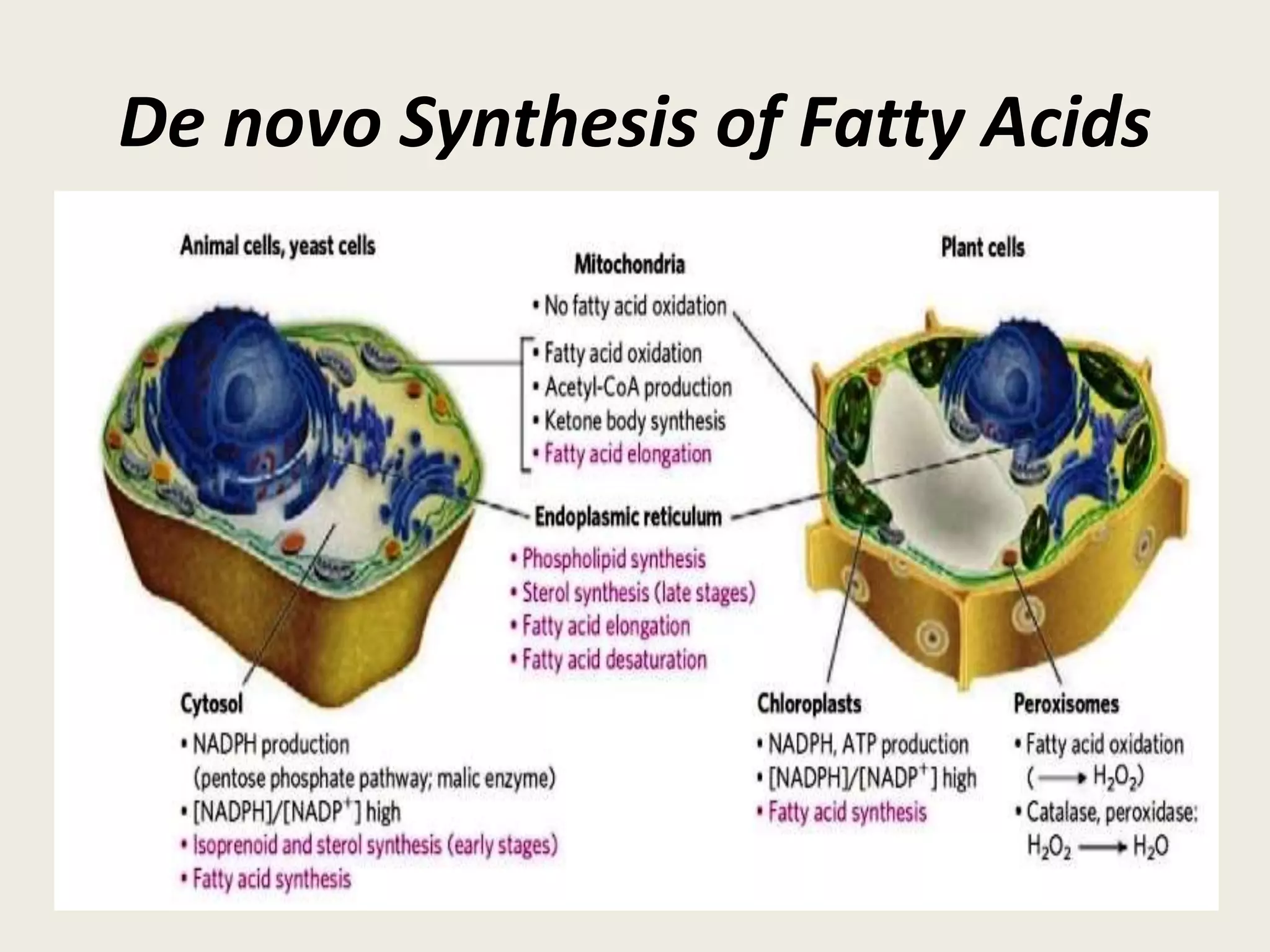
De novo Synthesis of Fatty Acids
Learning Objectives
• Sources of substrates required for Fatty acid
synthesis.
• Synthesis of palmitic acid on FAS complex.
• Elongation of palmitic acid.
• Desaturation.
• Regulation of fatty acid synthesis.
• β oxidation v/s fatty acid synthesis.
• Recent advances
Introduction
• In the body:
Major :
Liver, lactating mammary gland
Minor:
Brain, renal cortex, adipose tissue, lungs
• In the cell: Cytoplasm
• End product: Palmitic acid (mostly)
• Substrates: Acetyl-CoA and HCO3-
• Energy source: ATP
• Electron donor: NADPH
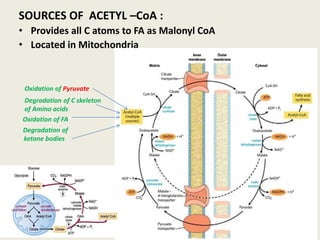
SOURCES OF ACETYL –CoA :
• Provides all C atoms to FA as Malonyl CoA
• Located in Mitochondria
Degradation of
ketone bodies
Degradation of C skeleton
of Amino acids
Oxidation of Pyruvate
Oxidation of FA
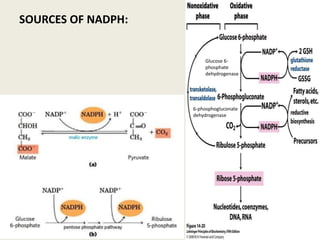
SOURCES OF NADPH:
6-phosphogluconate
dehydrogenase
Glucose 6-
phosphate
dehydrogenase
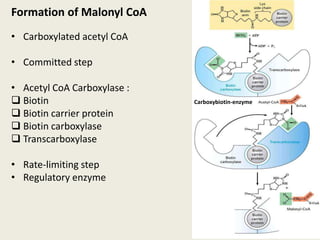
Formation of Malonyl CoA
• Carboxylated acetyl CoA
• Committed step
• Acetyl CoA Carboxylase :
 Biotin
 Biotin carrier protein
 Biotin carboxylase
 Transcarboxylase
• Rate-limiting step
• Regulatory enzyme
Carboxybiotin-enzyme
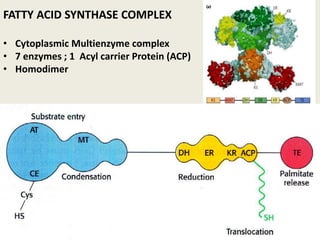
FATTY ACID SYNTHASE COMPLEX
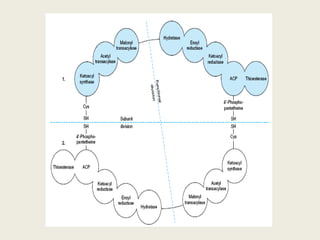
• Cytoplasmic Multienzyme complex
• 7 enzymes ; 1 Acyl carrier Protein (ACP)
• Homodimer
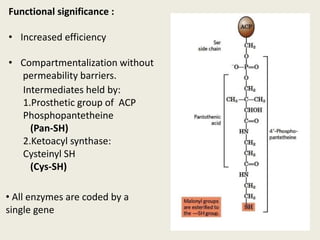
Intermediates held by:
1.Prosthetic group of ACP
Phosphopantetheine
(Pan-SH)
2.Ketoacyl synthase:
Cysteinyl SH
(Cys-SH)
Functional significance :
• Increased efficiency
• Compartmentalization without
permeability barriers.
• All enzymes are coded by a
single gene
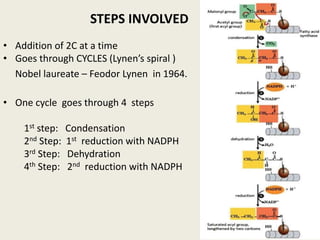
• Addition of 2C at a time
• Goes through CYCLES (Lynen’s spiral )
Nobel laureate – Feodor Lynen in 1964.
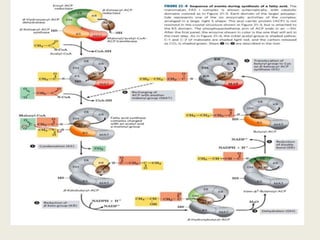
• One cycle goes through 4 steps
1st step: Condensation
2nd Step: 1st reduction with NADPH
3rd Step: Dehydration
4th Step: 2nd reduction with NADPH
STEPS INVOLVED
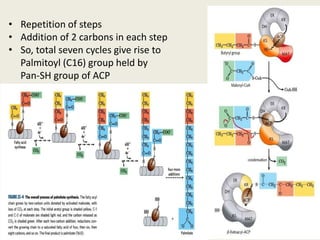
• Repetition of steps
• Addition of 2 carbons in each step
• So, total seven cycles give rise to
Palmitoyl (C16) group held by
Pan-SH group of ACP
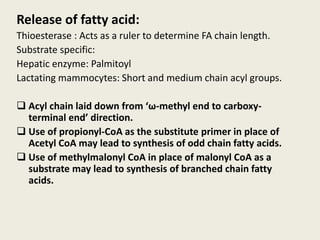
Release of fatty acid:
Thioesterase : Acts as a ruler to determine FA chain length.
Substrate specific:
Hepatic enzyme: Palmitoyl
Lactating mammocytes: Short and medium chain acyl groups.
 Acyl chain laid down from ‘ω-methyl end to carboxy-
terminal end’ direction.
 Use of propionyl-CoA as the substitute primer in place of
Acetyl CoA may lead to synthesis of odd chain fatty acids.
 Use of methylmalonyl CoA in place of malonyl CoA as a
substrate may lead to synthesis of branched chain fatty
acids.
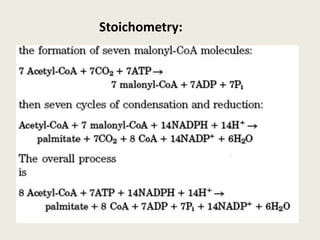
Stoichometry:
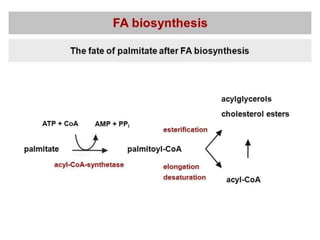
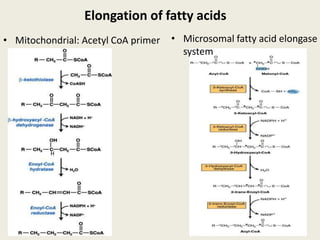
Elongation of fatty acids
• Microsomal fatty acid elongase
system
• Mitochondrial: Acetyl CoA primer
H
Synthesis of Unsaturated
Fatty acids
• Microsomal desaturase system
• Electron transport chain on smooth ER
• Mixed function oxidases
• Δ9 ,Δ6 ,Δ5 & Δ4 positional specificity
• Δ6 ,Δ5 & Δ4 : at C-terminal side: can never
produce ω-3 or ω-6 polyenoic acids
(Essential fatty acids)
Δ9 Desaturase
Δ9 Desaturase
(ω-9)
(ω-7)
(ω-6)
(ω-3)
(ω-6)
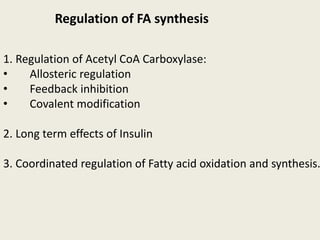
Regulation of FA synthesis
1. Regulation of Acetyl CoA Carboxylase:
• Allosteric regulation
• Feedback inhibition
• Covalent modification
2. Long term effects of Insulin
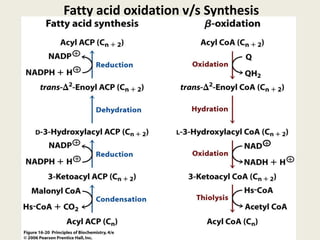
3. Coordinated regulation of Fatty acid oxidation and synthesis.
Regulation of Acetyl CoA Carboxylase:
1. Allosteric activation
[phospho]
[dephospho]
• Carbohydrate oxidation
(well fed state)
Citrate
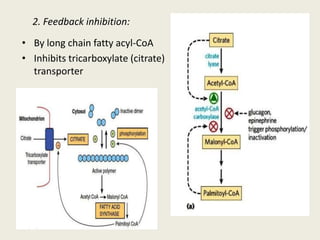
• By long chain fatty acyl-CoA
• Inhibits tricarboxylate (citrate)
transporter
2. Feedback inhibition:
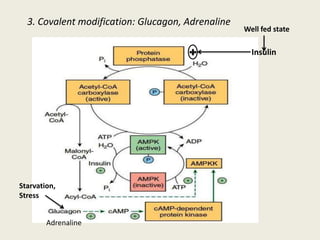
3. Covalent modification: Glucagon, Adrenaline
Insulin
Well fed state
Starvation,
Stress
Adrenaline
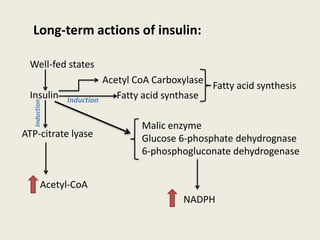
Long-term actions of insulin:
Well-fed states
Insulin
Acetyl CoA Carboxylase
Fatty acid synthase
ATP-citrate lyase
Fatty acid synthesis
Induction
Malic enzyme
Glucose 6-phosphate dehydrognase
6-phosphogluconate dehydrogenase
Acetyl-CoA
NADPH
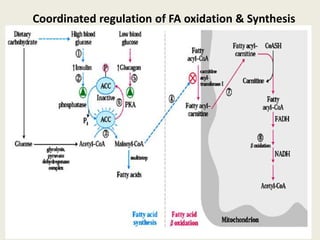
Coordinated regulation of FA oxidation & Synthesis
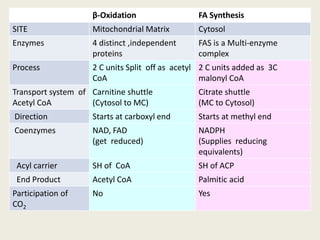
Fatty acid oxidation v/s Synthesis
β-Oxidation FA Synthesis
SITE Mitochondrial Matrix Cytosol
Enzymes 4 distinct ,independent
proteins
FAS is a Multi-enzyme
complex
Process 2 C units Split off as acetyl
CoA
2 C units added as 3C
malonyl CoA
Transport system of
Acetyl CoA
Carnitine shuttle
(Cytosol to MC)
Citrate shuttle
(MC to Cytosol)
Direction Starts at carboxyl end Starts at methyl end
Coenzymes NAD, FAD
(get reduced)
NADPH
(Supplies reducing
equivalents)
Acyl carrier SH of CoA SH of ACP
End Product Acetyl CoA Palmitic acid
Participation of
CO2
No Yes
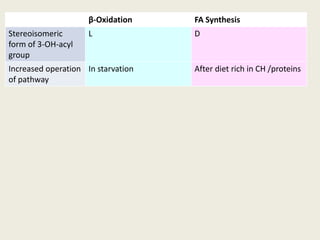
β-Oxidation FA Synthesis
Stereoisomeric
form of 3-OH-acyl
group
L D
Increased operation
of pathway
In starvation After diet rich in CH /proteins
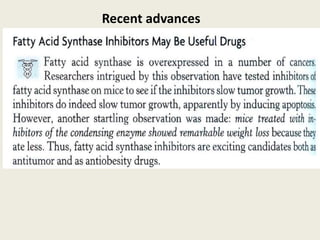
Recent advances
• Curcumin : one of the major active ingredients of
Curcuma longa, which has been proven to inhibit the
growth of cancer cells.
• In this study, potential activity of curcumin as a FAS
inhibitor for chemoprevention of breast cancer was
investigated.
• As a result, curcumin induced human breast cancer cell
apoptosis ,blocked FAS activity, expression and mRNA
level in a dose-dependent manner.
• Moreover, FAS knockdown showed similar effect as
curcumin. All these results suggested that curcumin may
induce cell apoptosis via inhibiting FAS.
Fan, H., Liang, Y., Jiang, B., Li, X., Xun, H., Sun, J., He, W., Lau, H. T., Ma,
X."Curcumin inhibits intracellular fatty acid synthase and induces apoptosis in
human breast cancer MDA-MB-231 cells". Oncology Reports 35, no. 5 (2016):
2651-2656. http://dx.doi.org/10.3892/or.2016.4682
Summary
• FA synthesis occurs in cytosol and uses Acetyl CoA as
substrate.
• Formation of Malonyl CoA is committed step in FA
synthesis .
• Acetyl CoA carboxylase is the regulatory enzyme.
• Occurs on Multifunctional enzyme complex.
• Elongation and unsaturation of FA are accomplished by
accessory enzyme systems.
• FA synthethic and degradative pathways are distinct.
References
1. Debajyoti Das: Biochemistry 14th Edition
2. Harper’s Illustrated Biochemistry: 30th Edition
3. Lippincott’s Illustrated Reviews :Biochemistry 5th
Edition
4. Devlin, Thomas M: Textbook of Biochemistry :
With Clinical Correlations- Sixth Edition
5. Lehninger Principles of biochemistry -Sixth
Edition
6. Jeremy M Berg , John M. Tymoczko, Lubert
Stryer : Biochemistry- Fifth Edition
Thank-you

Fatty acid synthesis

  • 1.
    De novo Synthesisof Fatty Acids
  • 2.
    Learning Objectives • Sourcesof substrates required for Fatty acid synthesis. • Synthesis of palmitic acid on FAS complex. • Elongation of palmitic acid. • Desaturation. • Regulation of fatty acid synthesis. • β oxidation v/s fatty acid synthesis. • Recent advances
  • 3.
    Introduction • In thebody: Major : Liver, lactating mammary gland Minor: Brain, renal cortex, adipose tissue, lungs • In the cell: Cytoplasm • End product: Palmitic acid (mostly) • Substrates: Acetyl-CoA and HCO3- • Energy source: ATP • Electron donor: NADPH
  • 4.
    SOURCES OF ACETYL–CoA : • Provides all C atoms to FA as Malonyl CoA • Located in Mitochondria Degradation of ketone bodies Degradation of C skeleton of Amino acids Oxidation of Pyruvate Oxidation of FA
  • 5.
  • 6.
    Formation of MalonylCoA • Carboxylated acetyl CoA • Committed step • Acetyl CoA Carboxylase :  Biotin  Biotin carrier protein  Biotin carboxylase  Transcarboxylase • Rate-limiting step • Regulatory enzyme Carboxybiotin-enzyme
  • 7.
    FATTY ACID SYNTHASECOMPLEX • Cytoplasmic Multienzyme complex • 7 enzymes ; 1 Acyl carrier Protein (ACP) • Homodimer
  • 9.
    Intermediates held by: 1.Prostheticgroup of ACP Phosphopantetheine (Pan-SH) 2.Ketoacyl synthase: Cysteinyl SH (Cys-SH) Functional significance : • Increased efficiency • Compartmentalization without permeability barriers. • All enzymes are coded by a single gene
  • 10.
    • Addition of2C at a time • Goes through CYCLES (Lynen’s spiral ) Nobel laureate – Feodor Lynen in 1964. • One cycle goes through 4 steps 1st step: Condensation 2nd Step: 1st reduction with NADPH 3rd Step: Dehydration 4th Step: 2nd reduction with NADPH STEPS INVOLVED
  • 12.
    • Repetition ofsteps • Addition of 2 carbons in each step • So, total seven cycles give rise to Palmitoyl (C16) group held by Pan-SH group of ACP
  • 13.
    Release of fattyacid: Thioesterase : Acts as a ruler to determine FA chain length. Substrate specific: Hepatic enzyme: Palmitoyl Lactating mammocytes: Short and medium chain acyl groups.  Acyl chain laid down from ‘ω-methyl end to carboxy- terminal end’ direction.  Use of propionyl-CoA as the substitute primer in place of Acetyl CoA may lead to synthesis of odd chain fatty acids.  Use of methylmalonyl CoA in place of malonyl CoA as a substrate may lead to synthesis of branched chain fatty acids.
  • 14.
  • 16.
    Elongation of fattyacids • Microsomal fatty acid elongase system • Mitochondrial: Acetyl CoA primer H
  • 17.
    Synthesis of Unsaturated Fattyacids • Microsomal desaturase system • Electron transport chain on smooth ER • Mixed function oxidases • Δ9 ,Δ6 ,Δ5 & Δ4 positional specificity • Δ6 ,Δ5 & Δ4 : at C-terminal side: can never produce ω-3 or ω-6 polyenoic acids (Essential fatty acids) Δ9 Desaturase Δ9 Desaturase (ω-9) (ω-7) (ω-6) (ω-3) (ω-6)
  • 18.
    Regulation of FAsynthesis 1. Regulation of Acetyl CoA Carboxylase: • Allosteric regulation • Feedback inhibition • Covalent modification 2. Long term effects of Insulin 3. Coordinated regulation of Fatty acid oxidation and synthesis.
  • 19.
    Regulation of AcetylCoA Carboxylase: 1. Allosteric activation [phospho] [dephospho] • Carbohydrate oxidation (well fed state) Citrate
  • 20.
    • By longchain fatty acyl-CoA • Inhibits tricarboxylate (citrate) transporter 2. Feedback inhibition:
  • 21.
    3. Covalent modification:Glucagon, Adrenaline Insulin Well fed state Starvation, Stress Adrenaline
  • 22.
    Long-term actions ofinsulin: Well-fed states Insulin Acetyl CoA Carboxylase Fatty acid synthase ATP-citrate lyase Fatty acid synthesis Induction Malic enzyme Glucose 6-phosphate dehydrognase 6-phosphogluconate dehydrogenase Acetyl-CoA NADPH
  • 23.
    Coordinated regulation ofFA oxidation & Synthesis
  • 24.
    Fatty acid oxidationv/s Synthesis
  • 25.
    β-Oxidation FA Synthesis SITEMitochondrial Matrix Cytosol Enzymes 4 distinct ,independent proteins FAS is a Multi-enzyme complex Process 2 C units Split off as acetyl CoA 2 C units added as 3C malonyl CoA Transport system of Acetyl CoA Carnitine shuttle (Cytosol to MC) Citrate shuttle (MC to Cytosol) Direction Starts at carboxyl end Starts at methyl end Coenzymes NAD, FAD (get reduced) NADPH (Supplies reducing equivalents) Acyl carrier SH of CoA SH of ACP End Product Acetyl CoA Palmitic acid Participation of CO2 No Yes
  • 26.
    β-Oxidation FA Synthesis Stereoisomeric formof 3-OH-acyl group L D Increased operation of pathway In starvation After diet rich in CH /proteins
  • 27.
  • 28.
    • Curcumin :one of the major active ingredients of Curcuma longa, which has been proven to inhibit the growth of cancer cells. • In this study, potential activity of curcumin as a FAS inhibitor for chemoprevention of breast cancer was investigated. • As a result, curcumin induced human breast cancer cell apoptosis ,blocked FAS activity, expression and mRNA level in a dose-dependent manner. • Moreover, FAS knockdown showed similar effect as curcumin. All these results suggested that curcumin may induce cell apoptosis via inhibiting FAS. Fan, H., Liang, Y., Jiang, B., Li, X., Xun, H., Sun, J., He, W., Lau, H. T., Ma, X."Curcumin inhibits intracellular fatty acid synthase and induces apoptosis in human breast cancer MDA-MB-231 cells". Oncology Reports 35, no. 5 (2016): 2651-2656. http://dx.doi.org/10.3892/or.2016.4682
  • 29.
    Summary • FA synthesisoccurs in cytosol and uses Acetyl CoA as substrate. • Formation of Malonyl CoA is committed step in FA synthesis . • Acetyl CoA carboxylase is the regulatory enzyme. • Occurs on Multifunctional enzyme complex. • Elongation and unsaturation of FA are accomplished by accessory enzyme systems. • FA synthethic and degradative pathways are distinct.
  • 30.
    References 1. Debajyoti Das:Biochemistry 14th Edition 2. Harper’s Illustrated Biochemistry: 30th Edition 3. Lippincott’s Illustrated Reviews :Biochemistry 5th Edition 4. Devlin, Thomas M: Textbook of Biochemistry : With Clinical Correlations- Sixth Edition 5. Lehninger Principles of biochemistry -Sixth Edition 6. Jeremy M Berg , John M. Tymoczko, Lubert Stryer : Biochemistry- Fifth Edition Thank-you