Lipid breakdown and
biosynthesis
Archana Soni
archi22ss@gmail.com
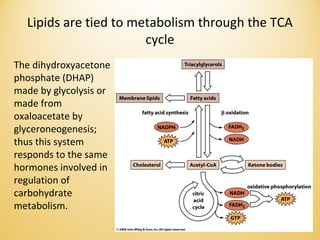
Lipids are tied to metabolism through the TCA
cycle
The dihydroxyacetone
phosphate (DHAP)
made by glycolysis or
made from
oxaloacetate by
glyceroneogenesis;
thus this system
responds to the same
hormones involved in
regulation of
carbohydrate
metabolism.
Lipids are degraded by digestion prior to
absorption
• Triacylglycerols are 90% of dietary lipids.
• Digestion of these occurs at the lipid-water
interface since lipids are insoluble in water
and digestive proteins are soluble.
• Bile acids (or bile salts) are cholesterol
derivatives that help emulsify the mixture in
the small intestine.
• Lipases are the class of proteins that digest
the triacylglycerols.
Lipid digestion by lipases occurs by a
variety of mechanisms
All lipases convert
triacylglycerols
into fatty acids,
monoacylglycerols
or diacylglycerols.
The specific
mechanisms vary;
phospholipase A2
has a hydrophobic
channel that
allows lipids to
enter active site.
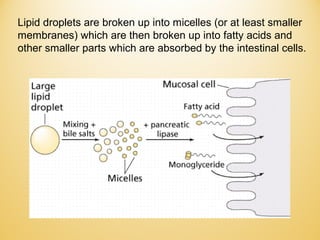
Lipid droplets are broken up into micelles (or at least smaller
membranes) which are then broken up into fatty acids and
other smaller parts which are absorbed by the intestinal cells.
Further in the cell, the fatty acids end up in the ER and are
packaged into chylomicrons (a type of lipoprotein), which
are then extruded into the lymphatic system.
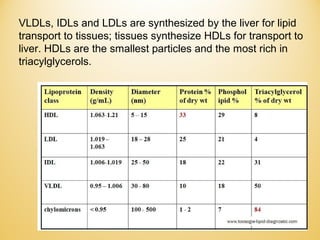
VLDLs, IDLs and LDLs are synthesized by the liver for lipid
transport to tissues; tissues synthesize HDLs for transport to
liver. HDLs are the smallest particles and the most rich in
triacylglycerols.
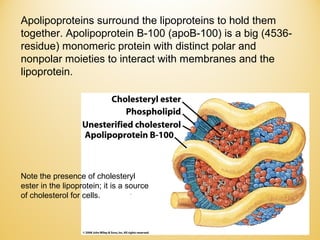
Apolipoproteins surround the lipoproteins to hold them
together. Apolipoprotein B-100 (apoB-100) is a big (4536-
residue) monomeric protein with distinct polar and
nonpolar moieties to interact with membranes and the
lipoprotein.
Note the presence of cholesteryl
ester in the lipoprotein; it is a source
of cholesterol for cells.
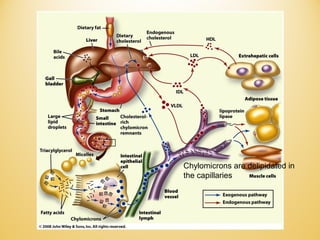
Chylomicrons are delipidated in
the capillaries
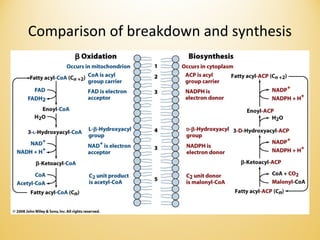
Comparison of breakdown and synthesis
Breakdown versus synthesis
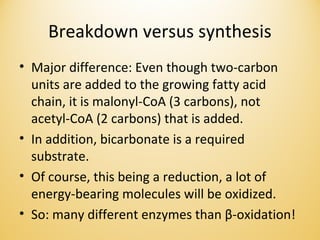
• Major difference: Even though two-carbon
units are added to the growing fatty acid
chain, it is malonyl-CoA (3 carbons), not
acetyl-CoA (2 carbons) that is added.
• In addition, bicarbonate is a required
substrate.
• Of course, this being a reduction, a lot of
energy-bearing molecules will be oxidized.
• So: many different enzymes than β-oxidation!
The sites of these activities
• In much the same way that
hormones like glucagon and
insulin regulate the glycolytic
and glucogenolytic pathways,
these hormones regulate the
breakdown and buildup of
fatty acids.
• Hormone-sensitive
triacylglycerol lipase is turned
on and off via
phosphorylation and
dephosphorylation, which is
triggered by cAMP
concentration.
Fatty acid oxidation
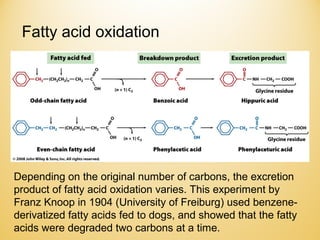
Depending on the original number of carbons, the excretion
product of fatty acid oxidation varies. This experiment by
Franz Knoop in 1904 (University of Freiburg) used benzene-
derivatized fatty acids fed to dogs, and showed that the fatty
acids were degraded two carbons at a time.
Fatty acids are activated by their attachment to coenzyme A,
facilitated by acyl-CoA synthetases. These are located on the
ER or the outer mitochondrial membrane.
Mixed anhydride intermediate initiated by a nucleophilic attack on ATP α-
phosphorus.
Fatty acids are oxidized
in the mitochondrial
matrix, and thus must be
transported in. The acyl
portion of the fatty acid
is transported and
reattached to CoA inside
the matrix.
Fatty acid oxidation to
produce a single acetyl-
CoA unit also produces
a FADH2,which is
oxidized by the standard
electron-transport chain,
for a further 1.5 ATP.
Note the formation of a
trans-fatty acid in the
first step.
The fourth step (the one that
produces the acetyl-CoA)
involves a thiolase, which
proceeds as a Claisen ester
cleavage (the reverse of a
Claisen condensation).
Much energy can thus be produced
from a single fatty acid; one palmitate
(C16) yields 106 ATP.
Unsaturated fatty
acids require an
additional set of
enzymes, because an
adjacent set of double
bonds cannot be
formed. Note the
usage of some energy
to achieve this.
Odd-numbered fatty
acids yields propionyl-
CoA, which is
converted to succinyl-
CoA to enter the TCA.
Dorothy Hodgkin in
1956 (Oxford; Nobel
Prize, 1964)
determined the
structure of the
enzyme involved in
producing succinyl-
CoA, using X-ray
crystallography. It is
a rare cobalt-
containing enzyme;
note its position in a
heme-like ring.
Ketone bodies are produced by the liver mitochondria as an
alternate fuel source for tissues like the heart and other
muscles, or the brain during starvation.
Fatty acid biosynthesis begins with acetyl-CoA
The malonyl-CoA then reacts with an acyl-carrier
protein (ACP) through a thiol group to make malonyl-
ACP; an acetyl-CoA does the same reaction to
produce acetyl-ACP. The malonyl-ACP and acetyl-
ACP react to make acetoacetyl-ACP, with the loss of
a CO2 and an ACP.
Much energy is
required: To make
palmitic acid, in
addition to 8 acetyl-
CoA, 14 NADPH and
7 ATP are required.
The enzyme complex
is fatty acid sythase,
which is (not
surprisingly) a multi-
function enzyme.
Other enzymes are
required to form
unsaturations.
Citrate shuttle allows acetyl-CoA out of mitochondrion
The site of fatty acid (and other lipid) biosynthesis is in the cytosol (usually the
endoplasmic reticulum), but the acetyl-CoA precursor is found in the
mitochondria. The inner mitochondrial membrane, as might be expected, is
impermeable to acetyl-CoA, so the acetyl-CoA is converted to pyruvate and then
to citrate and transported out of the mitochondrion, and then reconverted to
acetyl-CoA (similar to the aspartate/malate shuttle for gluconeogenesis).
Acetyl-CoA carboxylase produces malonyl-CoA
ACC is a 230-kD polypeptide (shown below), first step in turning acetyl-CoA into
a fatty acid. Citrate is an activator; fatty acids are an inhibitor (feedback).
Serine 79 is a phosphorylation site; phosphorylation by AMP-dependent protein
kinase inactivates enzyme.
Glucagon and
epinephrine activate
protein kinase A,
which inhibits
dephosphorylation of
serine 79, and thus
inhibits ACC; insulin
promotes
dephosphorylation,
which activates ACC.
α-ACC in adipose
tissue; β-ACC in heart
tissue
Triacylglyceride synthesis
Independent of fatty acid synthesis, triacylglycerol synthesis begins
with a glycolysis intermediate, dihydroxyacetone phosphate (DHAP)
undergoing reduction by glycerol-3-P dehydrogenase to glycerol-3-
phosphate.
Interestingly, the loss of glycerol-3-phosphate by liver tumor cells is
part of the mechanism of cancer (Howard, Morris and Bailey, “Ether-
lipids, a-glycerol phosphate dehydrogenase, and growth rate in tumors
and cultured cells”, Cancer Res., 1972)
Triacylglyceride synthesis
The fatty acid comes in, now, as the R (acyl)
group added with the help of glycerol-3-phosphate
acyltransferase (first step here).
Triacylglyceride synthesis
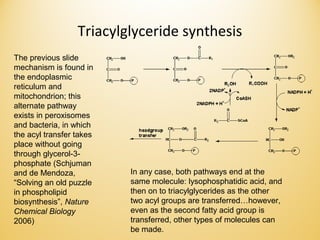
The previous slide
mechanism is found in
the endoplasmic
reticulum and
mitochondrion; this
alternate pathway
exists in peroxisomes
and bacteria, in which
the acyl transfer takes
place without going
through glycerol-3-
phosphate (Schjuman
and de Mendoza,
“Solving an old puzzle
in phospholipid
biosynthesis”, Nature
Chemical Biology
2006)
In any case, both pathways end at the
same molecule: lysophosphatidic acid, and
then on to triacylglycerides as the other
two acyl groups are transferred…however,
even as the second fatty acid group is
transferred, other types of molecules can
be made.
The synthesis of glycerophospholipids
• Note in this mechanism,
the head group is
phosphorylated and then
the diacylglycerol is
transferred.
• In the second step,
cytidine triphosphate
(CTP – a nucleotide) is
used as an energy source
and a phosphate source.
The synthesis of sphingolipids
• Sphingolipids deviate from the
triacylglyceride synthesis path;
instead, these molecules start
from t palmitoyl-CoA and
another acyl-CoA, as well as the
amino acid serine.
• At this point, the head group is
modified to include
carbohydrate units (ceramides).
The initiation of eicosanoid lipids
• To activate the arachidonic acid, an
unusual peroxide structure is formed,
requiring prostaglandin H2 synthase
which has the cyclooxygenase and
peroxidase function.
• Aspirin’s mechanism involves
acetylating a serine residue of
prostaglandin H2 synthase which
prevents the formation of PGH2, a
precursor to the pain signal
prostaglandins (Vain, “Inhibition of
prostaglandin synthesis as a mechanism
of action for aspirin-like drugs”, Nature
New Biology, 1971).
Steroid synthesis - the first steps (the amino acid
residue numbers refer to a HMG-CoA synthase enzyme)
Steroid synthesis
• HMG-CoA ( = 3-hydroxy-3-
methylglutaryl-coenzyme A) is a
necessary precursor. Note the
HMG unit is modified into the
isoprenoid structure on this
molecule.
Steroid synthesis
• The C30 cholesterol precursor
squalene is built from the
condensation of six isoprene
units, though a farensyl
intermediate.
• The farensyl intermediate is
made through the head-to-
tail condensation of three
isoprenoid units, then the
squalene is made through
the head-to-head
condensation of two
farensyl units.
Steroid synthesis
• Another unusual structure, an epoxide (catalyzed by
squalene epoxidase) leads to the placement of the
hydroxy group at C-3.
Steroid synthesis
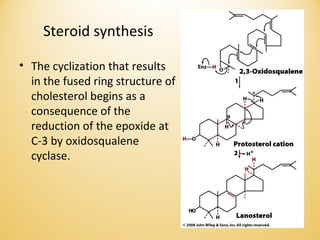
• The cyclization that results
in the fused ring structure of
cholesterol begins as a
consequence of the
reduction of the epoxide at
C-3 by oxidosqualene
cyclase.
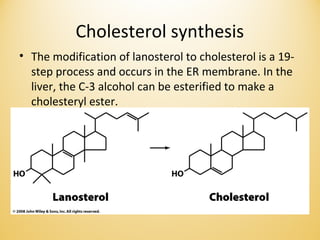
Cholesterol synthesis
• The modification of lanosterol to cholesterol is a 19-
step process and occurs in the ER membrane. In the
liver, the C-3 alcohol can be esterified to make a
cholesteryl ester.

Lipid breakdown and biosynthesis

  • 1.
  • 2.
    Lipids are tiedto metabolism through the TCA cycle The dihydroxyacetone phosphate (DHAP) made by glycolysis or made from oxaloacetate by glyceroneogenesis; thus this system responds to the same hormones involved in regulation of carbohydrate metabolism.
  • 3.
    Lipids are degradedby digestion prior to absorption • Triacylglycerols are 90% of dietary lipids. • Digestion of these occurs at the lipid-water interface since lipids are insoluble in water and digestive proteins are soluble. • Bile acids (or bile salts) are cholesterol derivatives that help emulsify the mixture in the small intestine. • Lipases are the class of proteins that digest the triacylglycerols.
  • 4.
    Lipid digestion bylipases occurs by a variety of mechanisms All lipases convert triacylglycerols into fatty acids, monoacylglycerols or diacylglycerols. The specific mechanisms vary; phospholipase A2 has a hydrophobic channel that allows lipids to enter active site.
  • 5.
    Lipid droplets arebroken up into micelles (or at least smaller membranes) which are then broken up into fatty acids and other smaller parts which are absorbed by the intestinal cells.
  • 6.
    Further in thecell, the fatty acids end up in the ER and are packaged into chylomicrons (a type of lipoprotein), which are then extruded into the lymphatic system.
  • 7.
    VLDLs, IDLs andLDLs are synthesized by the liver for lipid transport to tissues; tissues synthesize HDLs for transport to liver. HDLs are the smallest particles and the most rich in triacylglycerols.
  • 8.
    Apolipoproteins surround thelipoproteins to hold them together. Apolipoprotein B-100 (apoB-100) is a big (4536- residue) monomeric protein with distinct polar and nonpolar moieties to interact with membranes and the lipoprotein. Note the presence of cholesteryl ester in the lipoprotein; it is a source of cholesterol for cells.
  • 9.
    Chylomicrons are delipidatedin the capillaries
  • 11.
  • 12.
    Breakdown versus synthesis •Major difference: Even though two-carbon units are added to the growing fatty acid chain, it is malonyl-CoA (3 carbons), not acetyl-CoA (2 carbons) that is added. • In addition, bicarbonate is a required substrate. • Of course, this being a reduction, a lot of energy-bearing molecules will be oxidized. • So: many different enzymes than β-oxidation!
  • 13.
    The sites ofthese activities • In much the same way that hormones like glucagon and insulin regulate the glycolytic and glucogenolytic pathways, these hormones regulate the breakdown and buildup of fatty acids. • Hormone-sensitive triacylglycerol lipase is turned on and off via phosphorylation and dephosphorylation, which is triggered by cAMP concentration.
  • 14.
    Fatty acid oxidation Dependingon the original number of carbons, the excretion product of fatty acid oxidation varies. This experiment by Franz Knoop in 1904 (University of Freiburg) used benzene- derivatized fatty acids fed to dogs, and showed that the fatty acids were degraded two carbons at a time.
  • 15.
    Fatty acids areactivated by their attachment to coenzyme A, facilitated by acyl-CoA synthetases. These are located on the ER or the outer mitochondrial membrane. Mixed anhydride intermediate initiated by a nucleophilic attack on ATP α- phosphorus.
  • 16.
    Fatty acids areoxidized in the mitochondrial matrix, and thus must be transported in. The acyl portion of the fatty acid is transported and reattached to CoA inside the matrix.
  • 17.
    Fatty acid oxidationto produce a single acetyl- CoA unit also produces a FADH2,which is oxidized by the standard electron-transport chain, for a further 1.5 ATP. Note the formation of a trans-fatty acid in the first step.
  • 18.
    The fourth step(the one that produces the acetyl-CoA) involves a thiolase, which proceeds as a Claisen ester cleavage (the reverse of a Claisen condensation). Much energy can thus be produced from a single fatty acid; one palmitate (C16) yields 106 ATP.
  • 19.
    Unsaturated fatty acids requirean additional set of enzymes, because an adjacent set of double bonds cannot be formed. Note the usage of some energy to achieve this. Odd-numbered fatty acids yields propionyl- CoA, which is converted to succinyl- CoA to enter the TCA.
  • 20.
    Dorothy Hodgkin in 1956(Oxford; Nobel Prize, 1964) determined the structure of the enzyme involved in producing succinyl- CoA, using X-ray crystallography. It is a rare cobalt- containing enzyme; note its position in a heme-like ring.
  • 21.
    Ketone bodies areproduced by the liver mitochondria as an alternate fuel source for tissues like the heart and other muscles, or the brain during starvation.
  • 22.
    Fatty acid biosynthesisbegins with acetyl-CoA The malonyl-CoA then reacts with an acyl-carrier protein (ACP) through a thiol group to make malonyl- ACP; an acetyl-CoA does the same reaction to produce acetyl-ACP. The malonyl-ACP and acetyl- ACP react to make acetoacetyl-ACP, with the loss of a CO2 and an ACP.
  • 23.
    Much energy is required:To make palmitic acid, in addition to 8 acetyl- CoA, 14 NADPH and 7 ATP are required. The enzyme complex is fatty acid sythase, which is (not surprisingly) a multi- function enzyme. Other enzymes are required to form unsaturations.
  • 24.
    Citrate shuttle allowsacetyl-CoA out of mitochondrion The site of fatty acid (and other lipid) biosynthesis is in the cytosol (usually the endoplasmic reticulum), but the acetyl-CoA precursor is found in the mitochondria. The inner mitochondrial membrane, as might be expected, is impermeable to acetyl-CoA, so the acetyl-CoA is converted to pyruvate and then to citrate and transported out of the mitochondrion, and then reconverted to acetyl-CoA (similar to the aspartate/malate shuttle for gluconeogenesis).
  • 25.
    Acetyl-CoA carboxylase producesmalonyl-CoA ACC is a 230-kD polypeptide (shown below), first step in turning acetyl-CoA into a fatty acid. Citrate is an activator; fatty acids are an inhibitor (feedback). Serine 79 is a phosphorylation site; phosphorylation by AMP-dependent protein kinase inactivates enzyme. Glucagon and epinephrine activate protein kinase A, which inhibits dephosphorylation of serine 79, and thus inhibits ACC; insulin promotes dephosphorylation, which activates ACC. α-ACC in adipose tissue; β-ACC in heart tissue
  • 26.
    Triacylglyceride synthesis Independent offatty acid synthesis, triacylglycerol synthesis begins with a glycolysis intermediate, dihydroxyacetone phosphate (DHAP) undergoing reduction by glycerol-3-P dehydrogenase to glycerol-3- phosphate. Interestingly, the loss of glycerol-3-phosphate by liver tumor cells is part of the mechanism of cancer (Howard, Morris and Bailey, “Ether- lipids, a-glycerol phosphate dehydrogenase, and growth rate in tumors and cultured cells”, Cancer Res., 1972)
  • 27.
    Triacylglyceride synthesis The fattyacid comes in, now, as the R (acyl) group added with the help of glycerol-3-phosphate acyltransferase (first step here).
  • 28.
    Triacylglyceride synthesis The previousslide mechanism is found in the endoplasmic reticulum and mitochondrion; this alternate pathway exists in peroxisomes and bacteria, in which the acyl transfer takes place without going through glycerol-3- phosphate (Schjuman and de Mendoza, “Solving an old puzzle in phospholipid biosynthesis”, Nature Chemical Biology 2006) In any case, both pathways end at the same molecule: lysophosphatidic acid, and then on to triacylglycerides as the other two acyl groups are transferred…however, even as the second fatty acid group is transferred, other types of molecules can be made.
  • 29.
    The synthesis ofglycerophospholipids • Note in this mechanism, the head group is phosphorylated and then the diacylglycerol is transferred. • In the second step, cytidine triphosphate (CTP – a nucleotide) is used as an energy source and a phosphate source.
  • 30.
    The synthesis ofsphingolipids • Sphingolipids deviate from the triacylglyceride synthesis path; instead, these molecules start from t palmitoyl-CoA and another acyl-CoA, as well as the amino acid serine. • At this point, the head group is modified to include carbohydrate units (ceramides).
  • 31.
    The initiation ofeicosanoid lipids • To activate the arachidonic acid, an unusual peroxide structure is formed, requiring prostaglandin H2 synthase which has the cyclooxygenase and peroxidase function. • Aspirin’s mechanism involves acetylating a serine residue of prostaglandin H2 synthase which prevents the formation of PGH2, a precursor to the pain signal prostaglandins (Vain, “Inhibition of prostaglandin synthesis as a mechanism of action for aspirin-like drugs”, Nature New Biology, 1971).
  • 32.
    Steroid synthesis -the first steps (the amino acid residue numbers refer to a HMG-CoA synthase enzyme)
  • 33.
    Steroid synthesis • HMG-CoA( = 3-hydroxy-3- methylglutaryl-coenzyme A) is a necessary precursor. Note the HMG unit is modified into the isoprenoid structure on this molecule.
  • 34.
    Steroid synthesis • TheC30 cholesterol precursor squalene is built from the condensation of six isoprene units, though a farensyl intermediate. • The farensyl intermediate is made through the head-to- tail condensation of three isoprenoid units, then the squalene is made through the head-to-head condensation of two farensyl units.
  • 35.
    Steroid synthesis • Anotherunusual structure, an epoxide (catalyzed by squalene epoxidase) leads to the placement of the hydroxy group at C-3.
  • 36.
    Steroid synthesis • Thecyclization that results in the fused ring structure of cholesterol begins as a consequence of the reduction of the epoxide at C-3 by oxidosqualene cyclase.
  • 37.
    Cholesterol synthesis • Themodification of lanosterol to cholesterol is a 19- step process and occurs in the ER membrane. In the liver, the C-3 alcohol can be esterified to make a cholesteryl ester.