Limits and Continuity


Thu Mai, Michelle Wong,
        Tam Vu
What are Limits?
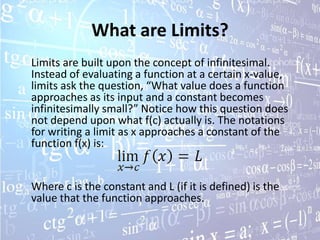
Limits are built upon the concept of infinitesimal.
Instead of evaluating a function at a certain x-value,
limits ask the question, “What value does a function
approaches as its input and a constant becomes
infinitesimally small?” Notice how this question does
not depend upon what f(c) actually is. The notations
for writing a limit as x approaches a constant of the
function f(x) is:


Where c is the constant and L (if it is defined) is the
value that the function approaches.
Evaluating Limits: Direct Substitution
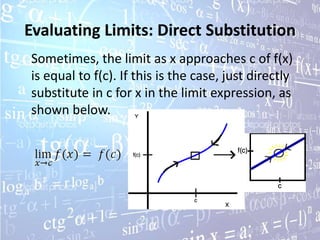
Sometimes, the limit as x approaches c of f(x)
is equal to f(c). If this is the case, just directly
substitute in c for x in the limit expression, as
shown below.
Dividing Out Technique
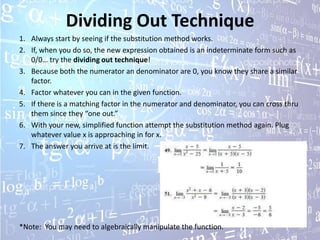
1. Always start by seeing if the substitution method works.
2. If, when you do so, the new expression obtained is an indeterminate form such as
   0/0… try the dividing out technique!
3. Because both the numerator an denominator are 0, you know they share a similar
   factor.
4. Factor whatever you can in the given function.
5. If there is a matching factor in the numerator and denominator, you can cross thru
   them since they “one out.”
6. With your new, simplified function attempt the substitution method again. Plug
   whatever value x is approaching in for x.
7. The answer you arrive at is the limit.


*Note: You may need to algebraically manipulate the function.
Rationalizing
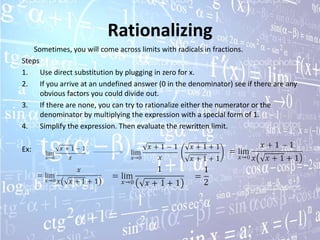
   Sometimes, you will come across limits with radicals in fractions.
Steps
1. Use direct substitution by plugging in zero for x.
2. If you arrive at an undefined answer (0 in the denominator) see if there are any
      obvious factors you could divide out.
3. If there are none, you can try to rationalize either the numerator or the
      denominator by multiplying the expression with a special form of 1.
4. Simplify the expression. Then evaluate the rewritten limit.

Ex:
Squeeze Theorem
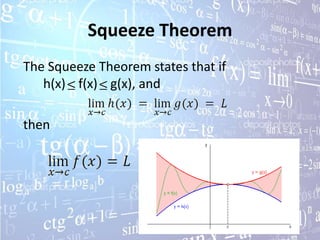
The Squeeze Theorem states that if
   h(x) f(x) g(x), and

then
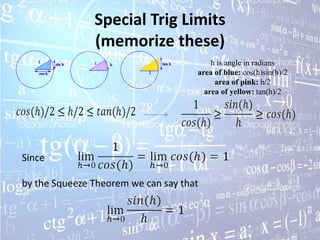
Special Trig Limits
               (memorize these)
                                         h is angle in radians
                                     area of blue: cos(h)sin(h)/2
                                          area of pink: h/2
                                       area of yellow: tan(h)/2


Since

by the Squeeze Theorem we can say that
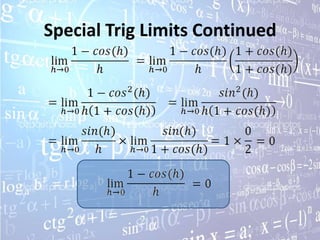
Special Trig Limits Continued
Continuity and Discontinuity
A function is continuous in the interval [a,b] if
there does not exist a c in the interval [a,b]
such that:
1) f(c) is undefined, or
2)                       , or 3)
 The following functions are discontinuous b/c they do not fulfill ALL
 the properties of continuity as defined above.
Removable vs Non-removable
           Discontinuities
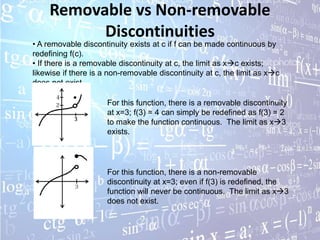
• A removable discontinuity exists at c if f can be made continuous by
redefining f(c).
• If there is a removable discontinuity at c, the limit as xc exists;
likewise if there is a non-removable discontinuity at c, the limit as xc
does not exist.

                      For this function, there is a removable discontinuity
                      at x=3; f(3) = 4 can simply be redefined as f(3) = 2
                      to make the function continuous. The limit as x3
                      exists.


                      For this function, there is a non-removable
                      discontinuity at x=3; even if f(3) is redefined, the
                      function will never be continuous. The limit as x3
                      does not exist.
Intermediate Value Theorem
The Intermediate Value Theorem states that if
f(x) is continuous in the closed interval [a,b]
and f(a) M f(b), then at least one c exists in
the interval [a,b] such that:

         f(c) = M
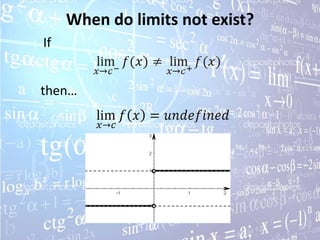
When do limits not exist?
If


then…
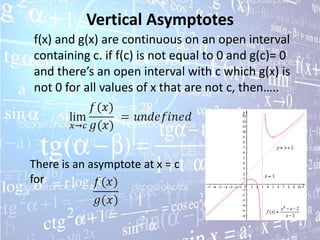
Vertical Asymptotes
f(x) and g(x) are continuous on an open interval
containing c. if f(c) is not equal to 0 and g(c)= 0
and there’s an open interval with c which g(x) is
not 0 for all values of x that are not c, then…..


There is an asymptote at x = c
for
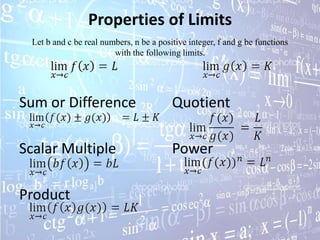
Properties of Limits
 Let b and c be real numbers, n be a positive integer, f and g be functions
                        with the following limits.


Sum or Difference                        Quotient

Scalar Multiple                          Power

Product
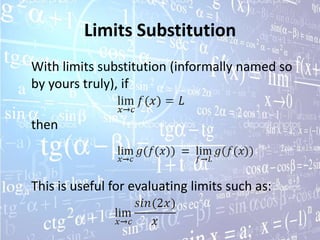
Limits Substitution
With limits substitution (informally named so
by yours truly), if

then


This is useful for evaluating limits such as:
How Do Limits Relate to
          Derivatives?
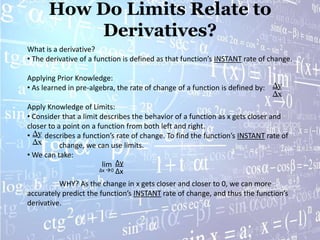
What is a derivative?
• The derivative of a function is defined as that function’s INSTANT rate of change.

Applying Prior Knowledge:
• As learned in pre-algebra, the rate of change of a function is defined by: Δy
                                                                             Δx
Apply Knowledge of Limits:
• Consider that a limit describes the behavior of a function as x gets closer and
closer to a point on a function from both left and right.
• Δy describes a function’s rate of change. To find the function’s INSTANT rate of
  Δx       change, we can use limits.
• We can take:
                         lim Δy
                        Δx 0 Δx

          WHY? As the change in x gets closer and closer to 0, we can more
accurately predict the function’s INSTANT rate of change, and thus the function’s
derivative.
How Do Limits Relate to
      Derivatives?
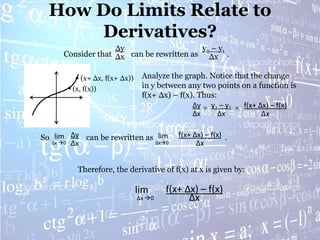
                   Δy                     y –y
     Consider that Δx can be rewritten as 2Δx 1 .

           (x+ Δx, f(x+ Δx))    Analyze the graph. Notice that the change
        (x, f(x))               in y between any two points on a function is
                                f(x+ Δx) – f(x). Thus:
                                               Δy = y2 – y1 = f(x+ Δx) – f(x)
                                               Δx      Δx           Δx

So lim Δy can be rewritten as lim         f(x+ Δx) – f(x) .
  Δx 0 Δx                   Δx0               Δx


          Therefore, the derivative of f(x) at x is given by:

                               lim     f(x+ Δx) – f(x)
                               Δx 0         Δx

Limits and continuity powerpoint

  • 1.
    Limits and Continuity ThuMai, Michelle Wong, Tam Vu
  • 2.
    What are Limits? Limitsare built upon the concept of infinitesimal. Instead of evaluating a function at a certain x-value, limits ask the question, “What value does a function approaches as its input and a constant becomes infinitesimally small?” Notice how this question does not depend upon what f(c) actually is. The notations for writing a limit as x approaches a constant of the function f(x) is: Where c is the constant and L (if it is defined) is the value that the function approaches.
  • 3.
    Evaluating Limits: DirectSubstitution Sometimes, the limit as x approaches c of f(x) is equal to f(c). If this is the case, just directly substitute in c for x in the limit expression, as shown below.
  • 4.
    Dividing Out Technique 1.Always start by seeing if the substitution method works. 2. If, when you do so, the new expression obtained is an indeterminate form such as 0/0… try the dividing out technique! 3. Because both the numerator an denominator are 0, you know they share a similar factor. 4. Factor whatever you can in the given function. 5. If there is a matching factor in the numerator and denominator, you can cross thru them since they “one out.” 6. With your new, simplified function attempt the substitution method again. Plug whatever value x is approaching in for x. 7. The answer you arrive at is the limit. *Note: You may need to algebraically manipulate the function.
  • 5.
    Rationalizing Sometimes, you will come across limits with radicals in fractions. Steps 1. Use direct substitution by plugging in zero for x. 2. If you arrive at an undefined answer (0 in the denominator) see if there are any obvious factors you could divide out. 3. If there are none, you can try to rationalize either the numerator or the denominator by multiplying the expression with a special form of 1. 4. Simplify the expression. Then evaluate the rewritten limit. Ex:
  • 6.
    Squeeze Theorem The SqueezeTheorem states that if h(x) f(x) g(x), and then
  • 7.
    Special Trig Limits (memorize these) h is angle in radians area of blue: cos(h)sin(h)/2 area of pink: h/2 area of yellow: tan(h)/2 Since by the Squeeze Theorem we can say that
  • 8.
  • 9.
    Continuity and Discontinuity Afunction is continuous in the interval [a,b] if there does not exist a c in the interval [a,b] such that: 1) f(c) is undefined, or 2) , or 3) The following functions are discontinuous b/c they do not fulfill ALL the properties of continuity as defined above.
  • 10.
    Removable vs Non-removable Discontinuities • A removable discontinuity exists at c if f can be made continuous by redefining f(c). • If there is a removable discontinuity at c, the limit as xc exists; likewise if there is a non-removable discontinuity at c, the limit as xc does not exist. For this function, there is a removable discontinuity at x=3; f(3) = 4 can simply be redefined as f(3) = 2 to make the function continuous. The limit as x3 exists. For this function, there is a non-removable discontinuity at x=3; even if f(3) is redefined, the function will never be continuous. The limit as x3 does not exist.
  • 11.
    Intermediate Value Theorem TheIntermediate Value Theorem states that if f(x) is continuous in the closed interval [a,b] and f(a) M f(b), then at least one c exists in the interval [a,b] such that: f(c) = M
  • 12.
    When do limitsnot exist? If then…
  • 13.
    Vertical Asymptotes f(x) andg(x) are continuous on an open interval containing c. if f(c) is not equal to 0 and g(c)= 0 and there’s an open interval with c which g(x) is not 0 for all values of x that are not c, then….. There is an asymptote at x = c for
  • 14.
    Properties of Limits Let b and c be real numbers, n be a positive integer, f and g be functions with the following limits. Sum or Difference Quotient Scalar Multiple Power Product
  • 15.
    Limits Substitution With limitssubstitution (informally named so by yours truly), if then This is useful for evaluating limits such as:
  • 16.
    How Do LimitsRelate to Derivatives? What is a derivative? • The derivative of a function is defined as that function’s INSTANT rate of change. Applying Prior Knowledge: • As learned in pre-algebra, the rate of change of a function is defined by: Δy Δx Apply Knowledge of Limits: • Consider that a limit describes the behavior of a function as x gets closer and closer to a point on a function from both left and right. • Δy describes a function’s rate of change. To find the function’s INSTANT rate of Δx change, we can use limits. • We can take: lim Δy Δx 0 Δx WHY? As the change in x gets closer and closer to 0, we can more accurately predict the function’s INSTANT rate of change, and thus the function’s derivative.
  • 17.
    How Do LimitsRelate to Derivatives? Δy y –y Consider that Δx can be rewritten as 2Δx 1 . (x+ Δx, f(x+ Δx)) Analyze the graph. Notice that the change (x, f(x)) in y between any two points on a function is f(x+ Δx) – f(x). Thus: Δy = y2 – y1 = f(x+ Δx) – f(x) Δx Δx Δx So lim Δy can be rewritten as lim f(x+ Δx) – f(x) . Δx 0 Δx Δx0 Δx Therefore, the derivative of f(x) at x is given by: lim f(x+ Δx) – f(x) Δx 0 Δx