Lecture on Limits and
Continuity
Dr. Manisha Jain
Functions :
 Is every relation is a function?
 The answer is “A unique relation is known as
a function”.
 A function is a relation in which each element of
the domain is paired with exactly one element of
the range. Another way of saying it is that there
is one and only one output (y) with each input
(x).
3
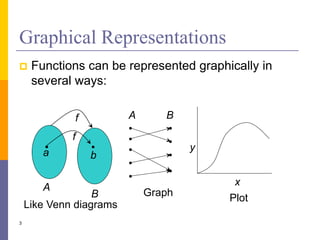
Graphical Representations
 Functions can be represented graphically in
several ways:
• •
A
B
a b
f
f
•
•
•
•
•
•
•
•
•
x
y
Plot
Graph
Like Venn diagrams
A B
4
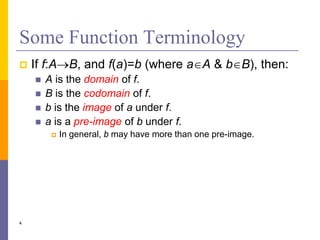
Some Function Terminology
 If f:AB, and f(a)=b (where aA & bB), then:
 A is the domain of f.
 B is the codomain of f.
 b is the image of a under f.
 a is a pre-image of b under f.
 In general, b may have more than one pre-image.
5
Types of Functions :
One-to-One Illustration
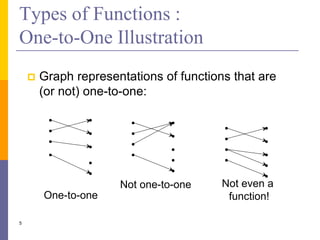
 Graph representations of functions that are
(or not) one-to-one:
•
•
•
•
•
•
•
•
•
One-to-one
•
•
•
•
•
•
•
•
•
Not one-to-one
•
•
•
•
•
•
•
•
•
Not even a
function!
Types of the Function:
 linear.
 quadratic.
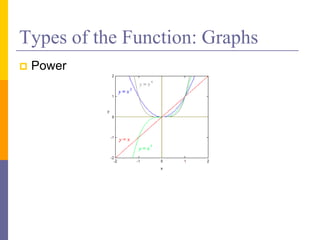
 power.
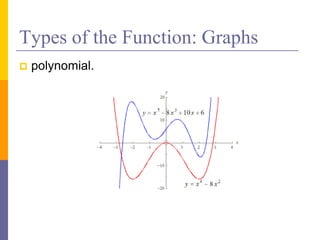
 polynomial.
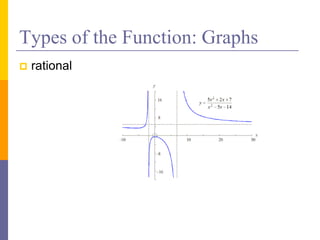
 rational.
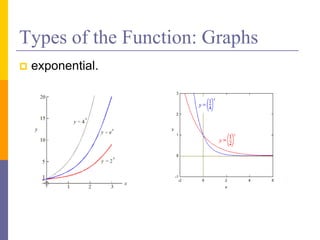
 exponential.
 logarithmic.
 sinusoidal.
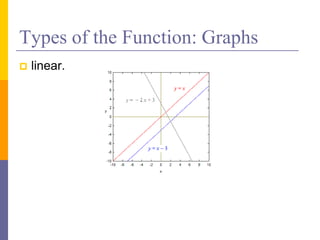
Types of the Function: Graphs
 linear.
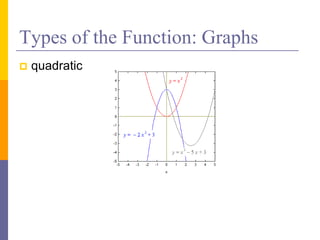
Types of the Function: Graphs
 quadratic
Types of the Function: Graphs
 Power
Types of the Function: Graphs
 polynomial.
Types of the Function: Graphs
 rational
Types of the Function: Graphs
 exponential.
Types of the Function: Graphs
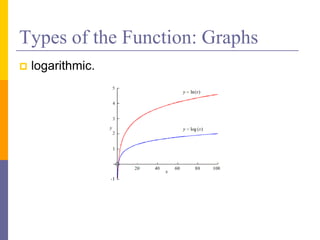
 logarithmic.
Types of the Function: Graphs
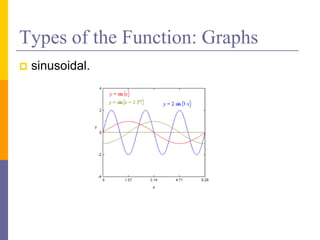
 sinusoidal.
Implicit and Explicit Function
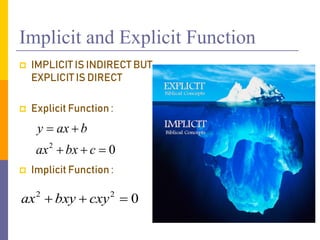
 IMPLICIT IS INDIRECT BUT
EXPLICIT IS DIRECT
 Explicit Function :
 Implicit Function :
2
0
y ax b
ax bx c
 
  
2 2
0
ax bxy cxy
  
Algebraic and Transcendental
Functions
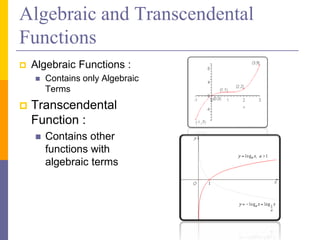
 Algebraic Functions :
 Contains only Algebraic
Terms
 Transcendental
Function :
 Contains other
functions with
algebraic terms
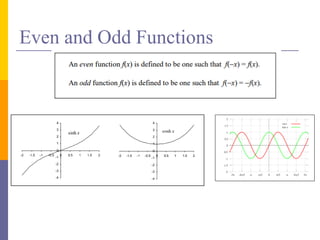
Even and Odd Functions
Limits and Continuity
Limits of a Function
1. Single Variable Function
2. Two or more Variables
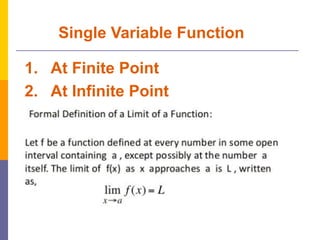
Single Variable Function
1. At Finite Point
2. At Infinite Point
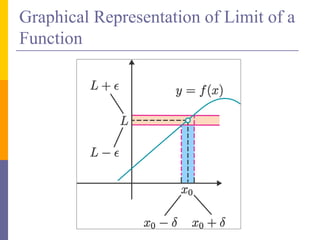
Graphical Representation of Limit of a
Function
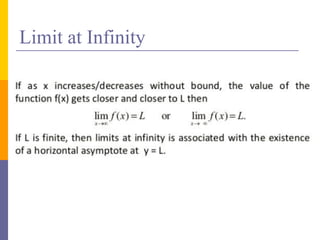
Limit at Infinity
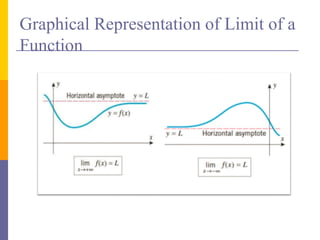
Graphical Representation of Limit of a
Function
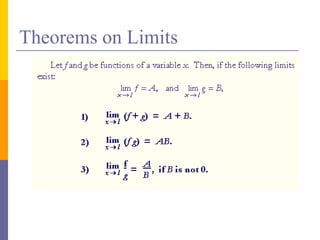
Theorems on Limits
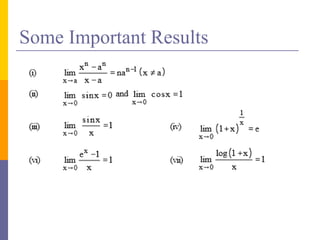
Some Important Results
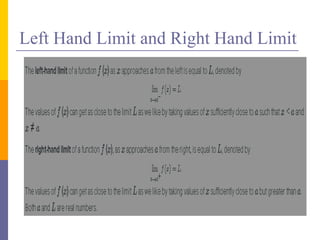
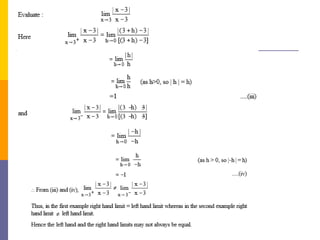
Left Hand Limit and Right Hand Limit
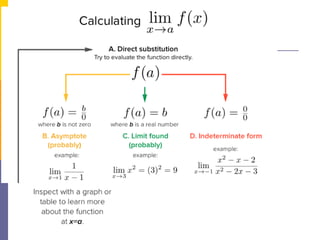
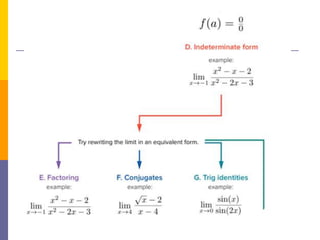
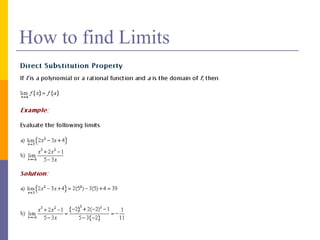
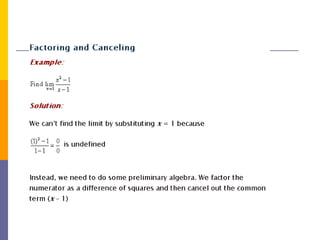
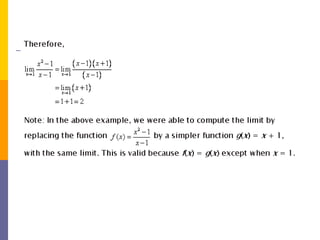
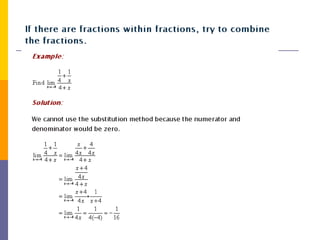
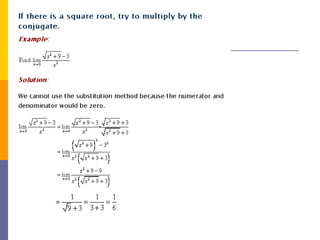
How to find Limits
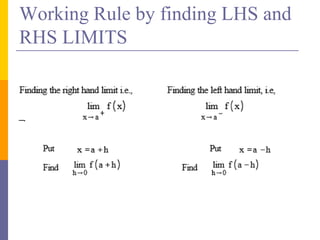
Working Rule by finding LHS and
RHS LIMITS
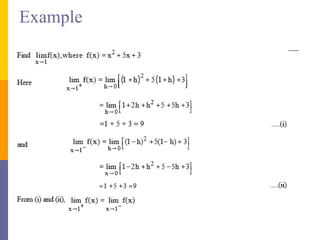
Example
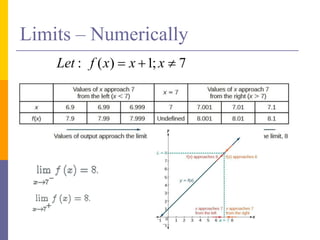
: ( ) 1; 7
Let f x x x
  
Limits – Numerically
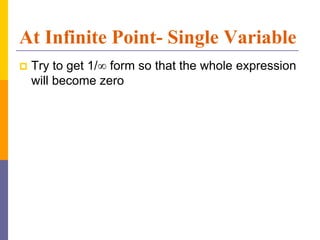
At Infinite Point- Single Variable
 Try to get 1/ form so that the whole expression
will become zero
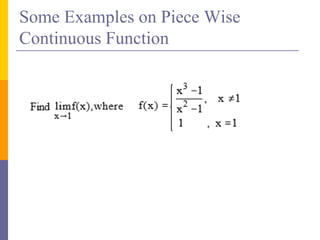
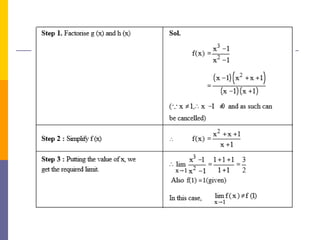
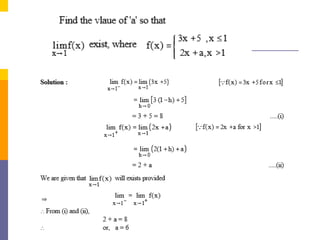
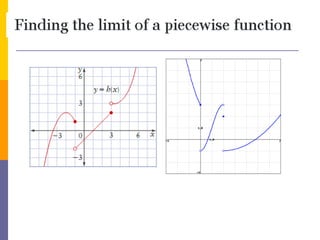
Some Examples on Piece Wise
Continuous Function
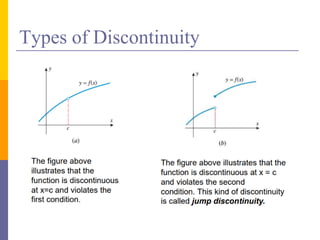
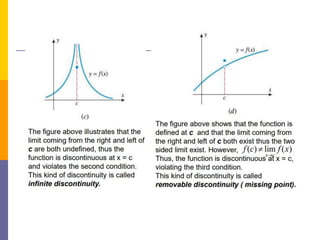
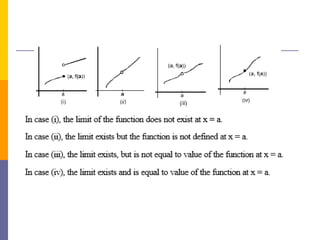
Types of Discontinuity
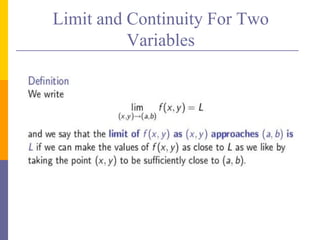
Limit and Continuity For Two
Variables
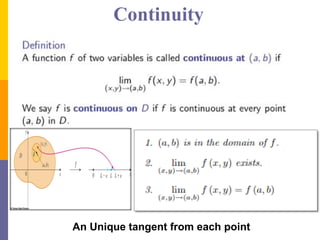
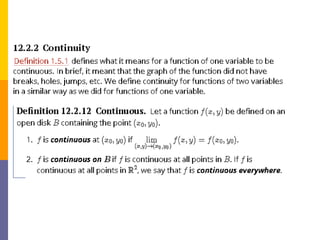
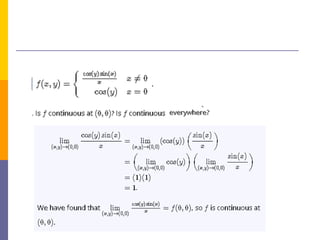
Continuity
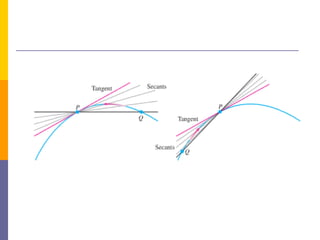
An Unique tangent from each point
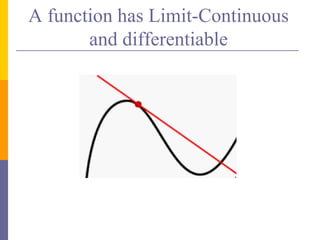
A function has Limit-Continuous
and differentiable
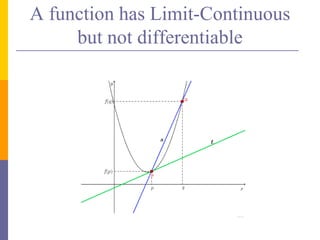
A function has Limit-Continuous
but not differentiable
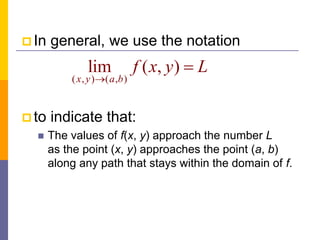
 In general, we use the notation
 to indicate that:
 The values of f(x, y) approach the number L
as the point (x, y) approaches the point (a, b)
along any path that stays within the domain of f.
( , ) ( , )
lim ( , )
x y a b
f x y L


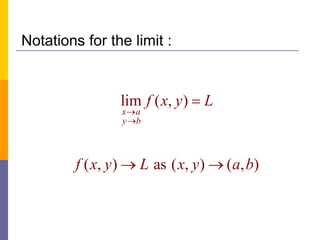
Notations for the limit :
lim ( , )
( , ) as ( , ) ( , )
x a
y b
f x y L
f x y L x y a b



 
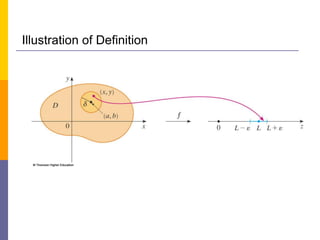
Illustration of Definition
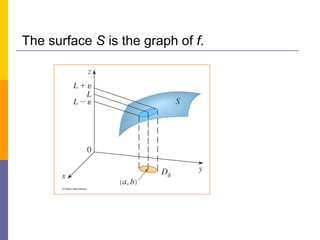
 If any small interval (L – ε, L + ε) is given around L, then
we can find a disk Dδ with center (a, b) and radius δ > 0
such that:
 f maps all the points in Dδ [except possibly (a, b)]
into the interval (L – ε, L + ε).
The surface S is the graph of f.
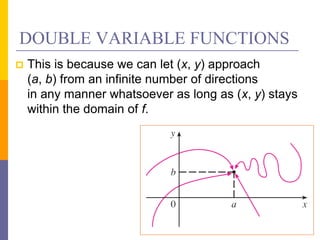
DOUBLE VARIABLE FUNCTIONS
 This is because we can let (x, y) approach
(a, b) from an infinite number of directions
in any manner whatsoever as long as (x, y) stays
within the domain of f.
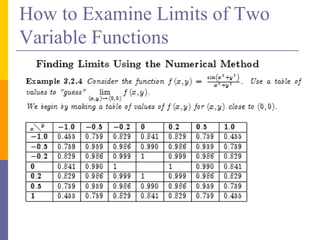
How to Examine Limits of Two
Variable Functions
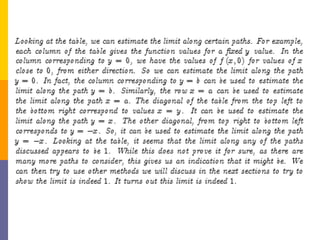
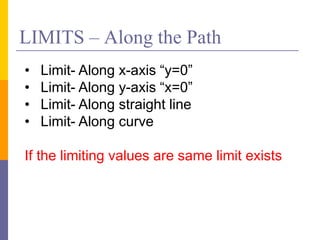
LIMITS – Along the Path
• Limit- Along x-axis “y=0”
• Limit- Along y-axis “x=0”
• Limit- Along straight line
• Limit- Along curve
If the limiting values are same limit exists
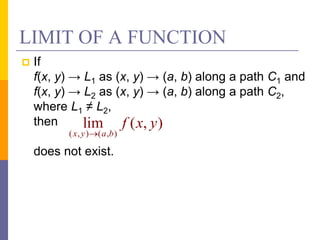
LIMIT OF A FUNCTION
 If
f(x, y) → L1 as (x, y) → (a, b) along a path C1 and
f(x, y) → L2 as (x, y) → (a, b) along a path C2,
where L1 ≠ L2,
then
does not exist.
( , ) ( , )
lim ( , )
x y a b
f x y

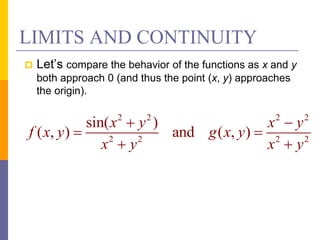
LIMITS AND CONTINUITY
 Let’s compare the behavior of the functions as x and y
both approach 0 (and thus the point (x, y) approaches
the origin).
2 2 2 2
2 2 2 2
sin( )
( , ) and ( , )
x y x y
f x y g x y
x y x y
 
 
 
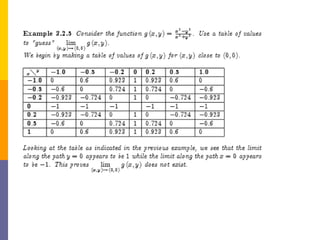
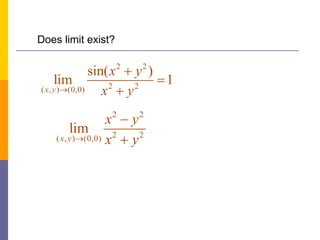
Does limit exist?
2 2
2 2
( , ) (0,0)
sin( )
lim 1
x y
x y
x y




2 2
2 2
( , ) (0,0)
lim
x y
x y
x y



LIMIT OF A FUNCTION
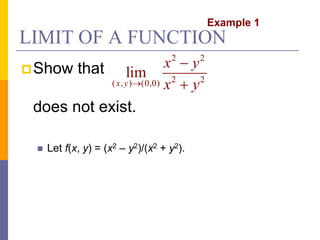
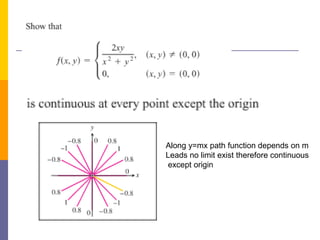
Show that
does not exist.
 Let f(x, y) = (x2 – y2)/(x2 + y2).
Example 1
2 2
2 2
( , ) (0,0)
lim
x y
x y
x y



LIMIT OF A FUNCTION
First, let’s approach (0, 0) along
the x-axis.
 Then, y = 0 gives f(x, 0) = x2/x2 = 1 for all x ≠ 0.
 So, f(x, y) → 1 as (x, y) → (0, 0) along the x-axis.
Example 1
LIMIT OF A FUNCTION
We now approach along the y-axis by
putting x = 0.
 Then, f(0, y) = –y2/y2 = –1 for all y ≠ 0.
 So, f(x, y) → –1 as (x, y) → (0, 0) along the y-
axis.
Example 1
LIMIT OF A FUNCTION
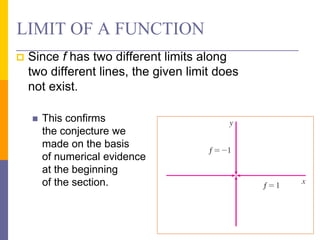
 Since f has two different limits along
two different lines, the given limit does
not exist.
 This confirms
the conjecture we
made on the basis
of numerical evidence
at the beginning
of the section.
LIMIT OF A FUNCTION
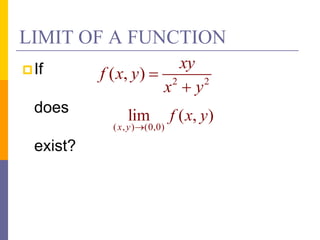
If
does
exist?
2 2
( , )
xy
f x y
x y


( , ) (0,0)
lim ( , )
x y
f x y

LIMIT OF A FUNCTION
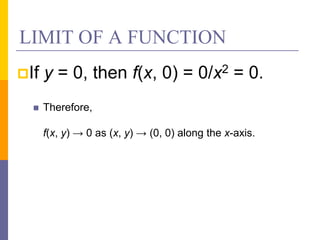
If y = 0, then f(x, 0) = 0/x2 = 0.
 Therefore,
f(x, y) → 0 as (x, y) → (0, 0) along the x-axis.
LIMIT OF A FUNCTION
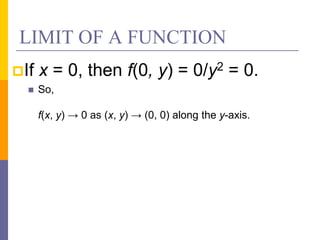
If x = 0, then f(0, y) = 0/y2 = 0.
 So,
f(x, y) → 0 as (x, y) → (0, 0) along the y-axis.
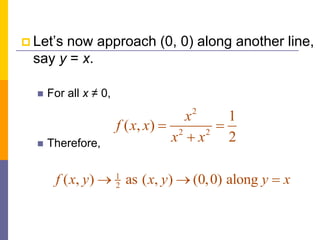
 Let’s now approach (0, 0) along another line,
say y = x.
 For all x ≠ 0,
 Therefore,
2
2 2
1
( , )
2
x
f x x
x x
 

1
2
( , ) as ( , ) (0,0) along
f x y x y y x
  
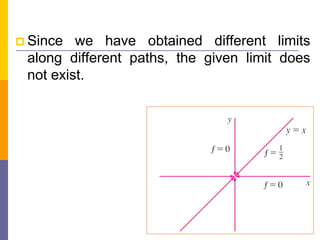
 Since we have obtained different limits
along different paths, the given limit does
not exist.
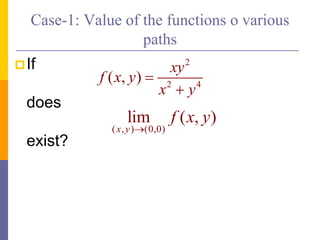
Case-1: Value of the functions o various
paths
If
does
exist?
2
2 4
( , )
xy
f x y
x y


( , ) (0,0)
lim ( , )
x y
f x y

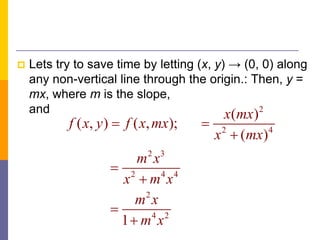
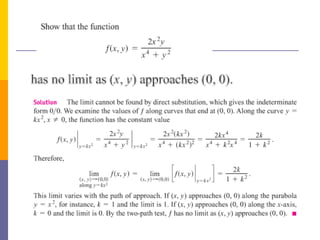
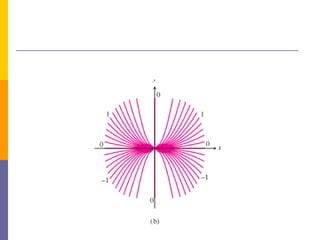
 Lets try to save time by letting (x, y) → (0, 0) along
any non-vertical line through the origin.: Then, y =
mx, where m is the slope,
and 2
2 4
2 3
2 4 4
2
4 2
( )
( , ) ( , );
( )
1
x mx
f x y f x mx
x mx
m x
x m x
m x
m x
 





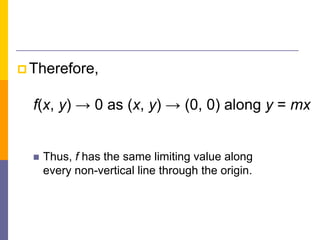
 Therefore,
f(x, y) → 0 as (x, y) → (0, 0) along y = mx
 Thus, f has the same limiting value along
every non-vertical line through the origin.
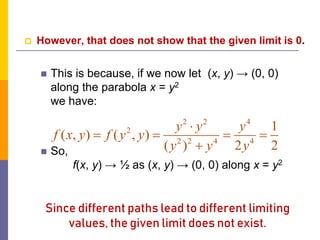
 However, that does not show that the given limit is 0.
 This is because, if we now let (x, y) → (0, 0)
along the parabola x = y2
we have:
 So,
f(x, y) → ½ as (x, y) → (0, 0) along x = y2
2 2 4
2
2 2 4 4
1
( , ) ( , )
( ) 2 2
y y y
f x y f y y
y y y

   

Since different paths lead to different limiting
values, the given limit does not exist.
Along y=mx path function depends on m
Leads no limit exist therefore continuous
except origin
1.1 Lecture on Limits and Coninuity.pdf

1.1 Lecture on Limits and Coninuity.pdf

  • 1.
    Lecture on Limitsand Continuity Dr. Manisha Jain
  • 2.
    Functions :  Isevery relation is a function?  The answer is “A unique relation is known as a function”.  A function is a relation in which each element of the domain is paired with exactly one element of the range. Another way of saying it is that there is one and only one output (y) with each input (x).
  • 3.
    3 Graphical Representations  Functionscan be represented graphically in several ways: • • A B a b f f • • • • • • • • • x y Plot Graph Like Venn diagrams A B
  • 4.
    4 Some Function Terminology If f:AB, and f(a)=b (where aA & bB), then:  A is the domain of f.  B is the codomain of f.  b is the image of a under f.  a is a pre-image of b under f.  In general, b may have more than one pre-image.
  • 5.
    5 Types of Functions: One-to-One Illustration  Graph representations of functions that are (or not) one-to-one: • • • • • • • • • One-to-one • • • • • • • • • Not one-to-one • • • • • • • • • Not even a function!
  • 6.
    Types of theFunction:  linear.  quadratic.  power.  polynomial.  rational.  exponential.  logarithmic.  sinusoidal.
  • 7.
    Types of theFunction: Graphs  linear.
  • 8.
    Types of theFunction: Graphs  quadratic
  • 9.
    Types of theFunction: Graphs  Power
  • 10.
    Types of theFunction: Graphs  polynomial.
  • 11.
    Types of theFunction: Graphs  rational
  • 12.
    Types of theFunction: Graphs  exponential.
  • 13.
    Types of theFunction: Graphs  logarithmic.
  • 14.
    Types of theFunction: Graphs  sinusoidal.
  • 15.
    Implicit and ExplicitFunction  IMPLICIT IS INDIRECT BUT EXPLICIT IS DIRECT  Explicit Function :  Implicit Function : 2 0 y ax b ax bx c      2 2 0 ax bxy cxy   
  • 16.
    Algebraic and Transcendental Functions Algebraic Functions :  Contains only Algebraic Terms  Transcendental Function :  Contains other functions with algebraic terms
  • 17.
    Even and OddFunctions
  • 18.
  • 19.
    Limits of aFunction 1. Single Variable Function 2. Two or more Variables
  • 20.
    Single Variable Function 1.At Finite Point 2. At Infinite Point
  • 21.
    Graphical Representation ofLimit of a Function
  • 22.
  • 23.
    Graphical Representation ofLimit of a Function
  • 24.
  • 25.
  • 26.
    Left Hand Limitand Right Hand Limit
  • 29.
  • 34.
    Working Rule byfinding LHS and RHS LIMITS
  • 35.
  • 37.
    : ( )1; 7 Let f x x x    Limits – Numerically
  • 38.
    At Infinite Point-Single Variable  Try to get 1/ form so that the whole expression will become zero
  • 40.
    Some Examples onPiece Wise Continuous Function
  • 43.
  • 46.
    Limit and ContinuityFor Two Variables
  • 47.
  • 48.
    A function hasLimit-Continuous and differentiable
  • 49.
    A function hasLimit-Continuous but not differentiable
  • 50.
     In general,we use the notation  to indicate that:  The values of f(x, y) approach the number L as the point (x, y) approaches the point (a, b) along any path that stays within the domain of f. ( , ) ( , ) lim ( , ) x y a b f x y L  
  • 51.
    Notations for thelimit : lim ( , ) ( , ) as ( , ) ( , ) x a y b f x y L f x y L x y a b     
  • 52.
  • 53.
     If anysmall interval (L – ε, L + ε) is given around L, then we can find a disk Dδ with center (a, b) and radius δ > 0 such that:  f maps all the points in Dδ [except possibly (a, b)] into the interval (L – ε, L + ε).
  • 54.
    The surface Sis the graph of f.
  • 55.
    DOUBLE VARIABLE FUNCTIONS This is because we can let (x, y) approach (a, b) from an infinite number of directions in any manner whatsoever as long as (x, y) stays within the domain of f.
  • 56.
    How to ExamineLimits of Two Variable Functions
  • 63.
    LIMITS – Alongthe Path • Limit- Along x-axis “y=0” • Limit- Along y-axis “x=0” • Limit- Along straight line • Limit- Along curve If the limiting values are same limit exists
  • 65.
    LIMIT OF AFUNCTION  If f(x, y) → L1 as (x, y) → (a, b) along a path C1 and f(x, y) → L2 as (x, y) → (a, b) along a path C2, where L1 ≠ L2, then does not exist. ( , ) ( , ) lim ( , ) x y a b f x y 
  • 66.
    LIMITS AND CONTINUITY Let’s compare the behavior of the functions as x and y both approach 0 (and thus the point (x, y) approaches the origin). 2 2 2 2 2 2 2 2 sin( ) ( , ) and ( , ) x y x y f x y g x y x y x y      
  • 67.
    Does limit exist? 22 2 2 ( , ) (0,0) sin( ) lim 1 x y x y x y     2 2 2 2 ( , ) (0,0) lim x y x y x y   
  • 68.
    LIMIT OF AFUNCTION Show that does not exist.  Let f(x, y) = (x2 – y2)/(x2 + y2). Example 1 2 2 2 2 ( , ) (0,0) lim x y x y x y   
  • 69.
    LIMIT OF AFUNCTION First, let’s approach (0, 0) along the x-axis.  Then, y = 0 gives f(x, 0) = x2/x2 = 1 for all x ≠ 0.  So, f(x, y) → 1 as (x, y) → (0, 0) along the x-axis. Example 1
  • 70.
    LIMIT OF AFUNCTION We now approach along the y-axis by putting x = 0.  Then, f(0, y) = –y2/y2 = –1 for all y ≠ 0.  So, f(x, y) → –1 as (x, y) → (0, 0) along the y- axis. Example 1
  • 71.
    LIMIT OF AFUNCTION  Since f has two different limits along two different lines, the given limit does not exist.  This confirms the conjecture we made on the basis of numerical evidence at the beginning of the section.
  • 72.
    LIMIT OF AFUNCTION If does exist? 2 2 ( , ) xy f x y x y   ( , ) (0,0) lim ( , ) x y f x y 
  • 73.
    LIMIT OF AFUNCTION If y = 0, then f(x, 0) = 0/x2 = 0.  Therefore, f(x, y) → 0 as (x, y) → (0, 0) along the x-axis.
  • 74.
    LIMIT OF AFUNCTION If x = 0, then f(0, y) = 0/y2 = 0.  So, f(x, y) → 0 as (x, y) → (0, 0) along the y-axis.
  • 75.
     Let’s nowapproach (0, 0) along another line, say y = x.  For all x ≠ 0,  Therefore, 2 2 2 1 ( , ) 2 x f x x x x    1 2 ( , ) as ( , ) (0,0) along f x y x y y x   
  • 76.
     Since wehave obtained different limits along different paths, the given limit does not exist.
  • 77.
    Case-1: Value ofthe functions o various paths If does exist? 2 2 4 ( , ) xy f x y x y   ( , ) (0,0) lim ( , ) x y f x y 
  • 78.
     Lets tryto save time by letting (x, y) → (0, 0) along any non-vertical line through the origin.: Then, y = mx, where m is the slope, and 2 2 4 2 3 2 4 4 2 4 2 ( ) ( , ) ( , ); ( ) 1 x mx f x y f x mx x mx m x x m x m x m x       
  • 79.
     Therefore, f(x, y)→ 0 as (x, y) → (0, 0) along y = mx  Thus, f has the same limiting value along every non-vertical line through the origin.
  • 80.
     However, thatdoes not show that the given limit is 0.  This is because, if we now let (x, y) → (0, 0) along the parabola x = y2 we have:  So, f(x, y) → ½ as (x, y) → (0, 0) along x = y2 2 2 4 2 2 2 4 4 1 ( , ) ( , ) ( ) 2 2 y y y f x y f y y y y y       Since different paths lead to different limiting values, the given limit does not exist.
  • 84.
    Along y=mx pathfunction depends on m Leads no limit exist therefore continuous except origin