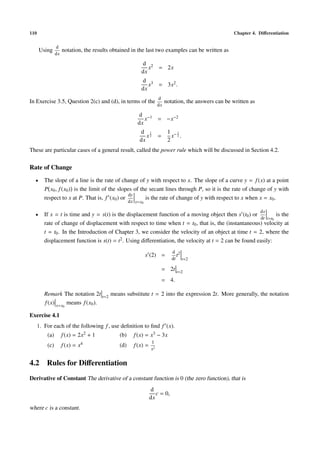
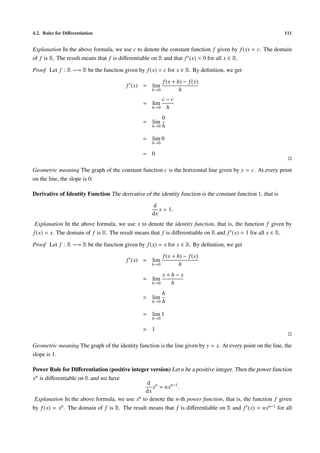
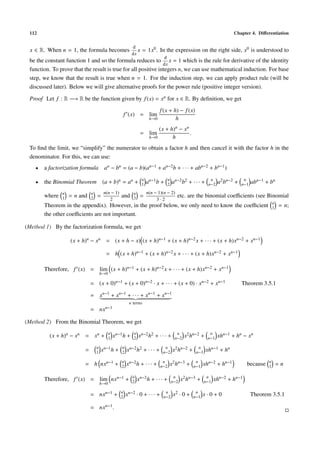
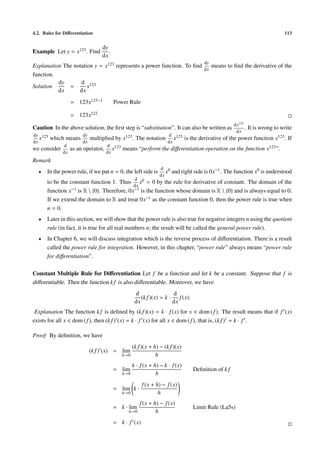
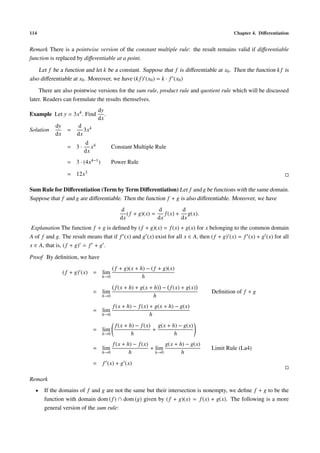
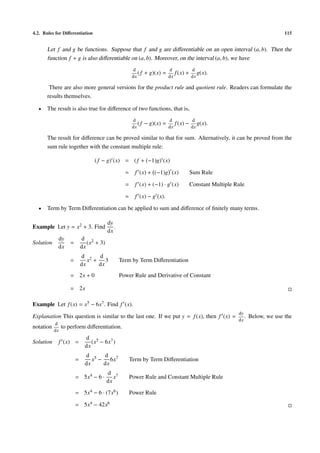
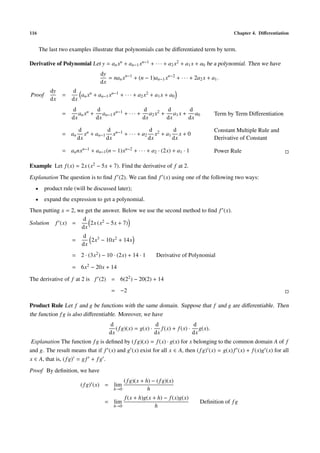
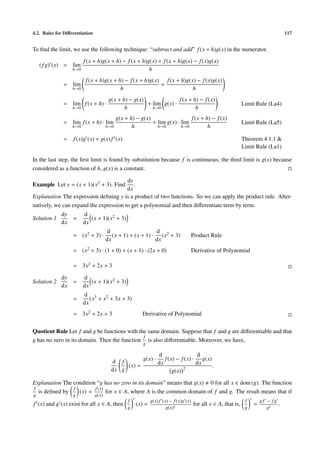
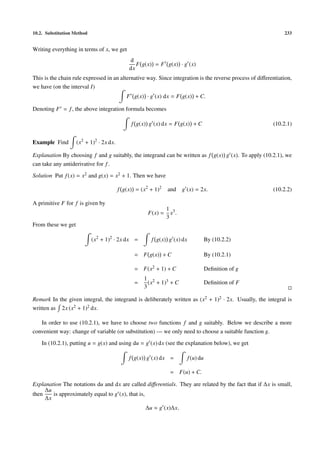
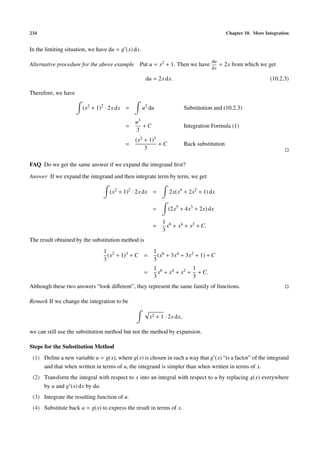
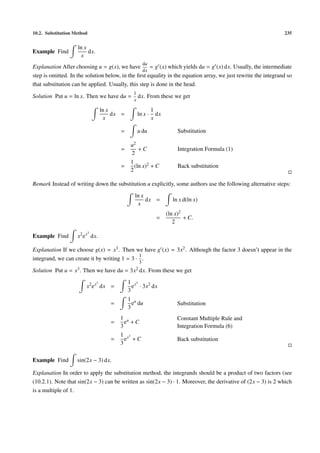
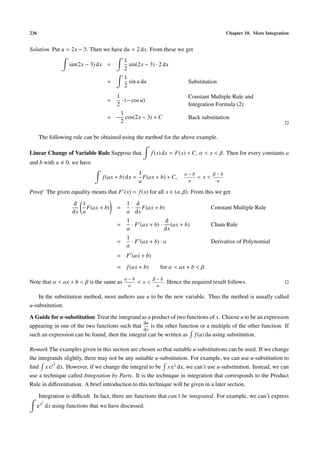
Understanding
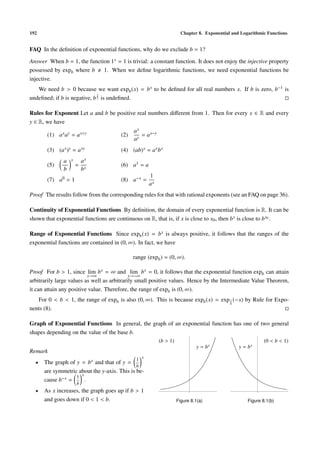
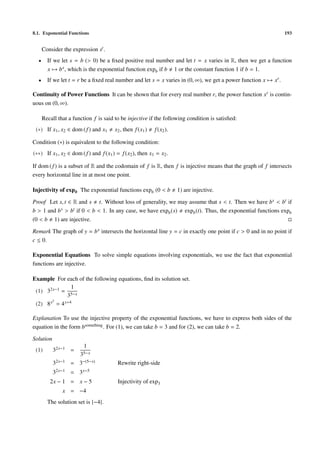
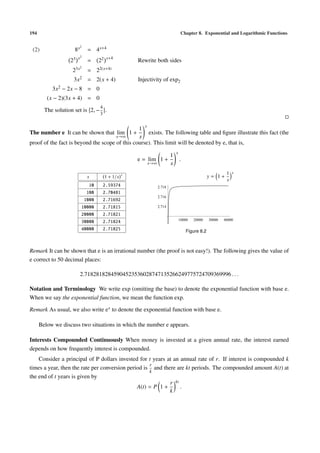
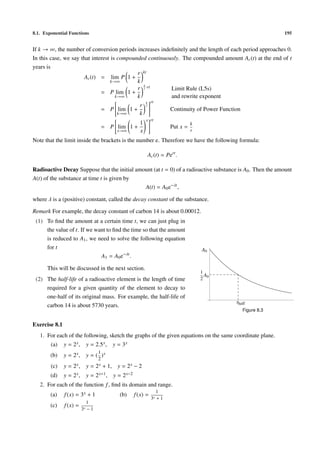
Basic Calculus


             S.K. Chung
Dedicated to all the people who have helped me in my life.
i


                                                  Preface

   This book is a revised and expanded version of the lecture notes for Basic Calculus and other similar courses
offered by the Department of Mathematics, University of Hong Kong, from the first semester of the academic
year 1998-1999 through the second semester of 2006-2007. It can be used as a textbook or a reference book
for an introductory course on one variable calculus.
   In this book, much emphasis is put on explanations of concepts and solutions to examples. By reading
the book carefully, students should be able to understand the concepts introduced and know how to answer
questions with justification. At the end of each section (except the last few), there is an exercise. Students
are advised to do as many questions as possible. Most of the exercises are simple drills. Such exercises may
not help students understand the concepts; however, without practices, students may find it difficult to continue
reading the subsequent sections.

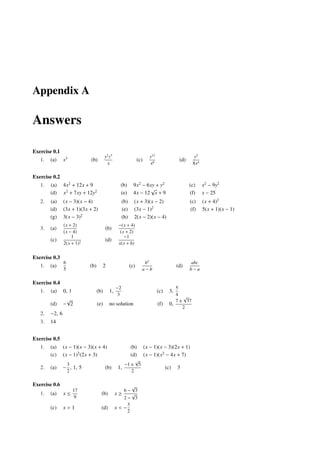
   Chapter 0 is written for students who have forgotten the materials that they have learnt for HKCEE Mathe-
matics. Students who are familiar with the materials may skip this chapter.

   Chapter 1 is on sets, real numbers and inequalities. Since the concept of sets is new to most students, detail
explanations and elaborations are given. For the real number system, notations and terminologies that will
be used in the rest of the book are introduced. For solving polynomial inequalities, the method will be used
later when we consider where a function is increasing or decreasing as well as where a function is convex or
concave. Students should note that there is a shortcut for solving inequalities, using the Intermediate Value
Theorem discussed in Chapter 3.

   Chapter 2 is on functions and graphs. Some materials are covered by HKCEE Mathematics. New concepts
introduced include domain and range (which are fundamental concepts related to functions); composition of
functions (which will be needed when we consider the Chain Rule for differentiation) and inverse functions
(which will be needed when we consider exponential functions and logarithmic functions).

   In Chapter 3, intuitive idea of limit is introduced. Limit is a fundamental concept in calculus. It is used
when we consider differentiation (to define derivatives) and integration (to define definite integrals). There are
many types of limits. Students should notice that their definitions are similar. To help students understand
such similarities, a summary is given at the end of the section on two-sided limits. The section of continuous
functions is rather conceptual. Students should understand the statements of the Intermediate Value Theorem
(several versions) and the Extreme Value Theorem.

   In Chapters 4 and 5, basic concepts and applications of differentiation are discussed. Students who know
how to work on limits of functions at a point should be able to apply definition to find derivatives of “simple”
functions. For more complicated ones (polynomial and rational functions), students are advised not to use
definition; instead, they can use rules for differentiation. For application to curve sketching, related concepts
like critical numbers, local extremizers, convex or concave functions etc. are introduced. There are many easily
confused terminologies. Students should distinguish whether a concept or terminology is related to a function,
to the x-coordinate of a point or to a point in the coordinate plane. For applied extremum problems, students
ii


should note that the questions ask for global extremum. In most of the examples for such problems, more than
one solutions are given.

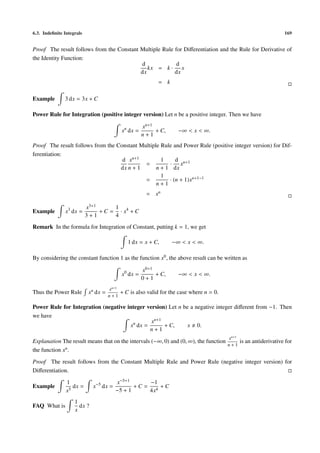
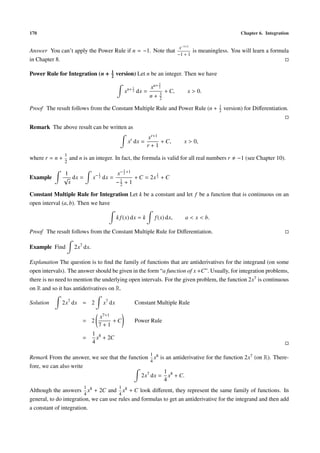
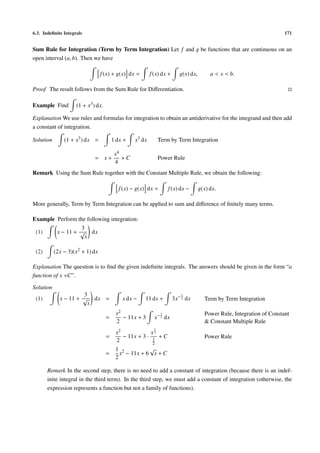
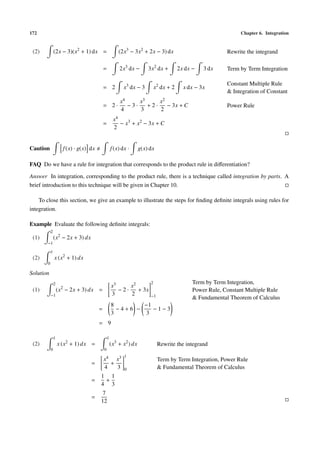
     In Chapter 6, basic concepts and applications of integration are discussed. We use limit of sums in a specific
form to define the definite integral of a continuous function over a closed and bounded interval. This is to make
the definition easier to handle (compared with the more subtle concept of “limit” of Riemann sums). Since
definite integrals work on closed intervals and indefinite integrals work on open intervals, we give different
definitions for primitives and antiderivatives. Students should notice how we can obtain antiderivatives from
primitives and vice versa. The Fundamental Theorem of Calculus (several versions) tells that differentiation
and integration are reverse process of each other. Using rules for integration, students should be able to find
indefinite integrals of polynomials as well as to evaluate definite integrals of polynomials over closed and
bounded intervals.

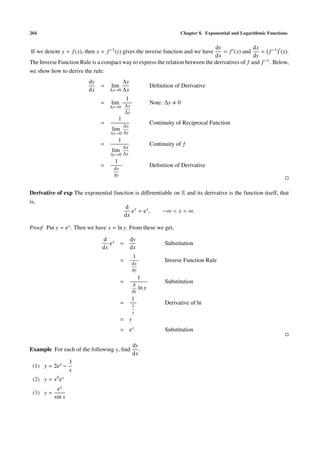
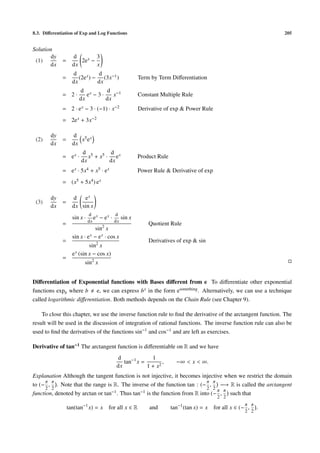
     Chapters 7 and 8 give more formulas for differentiation. More specifically, formulas for the derivatives of
the sine, cosine and tangent functions as well as that of the logarithmic and exponential functions are given.
For that, revision of properties of the functions together with relevant limit results are discussed.

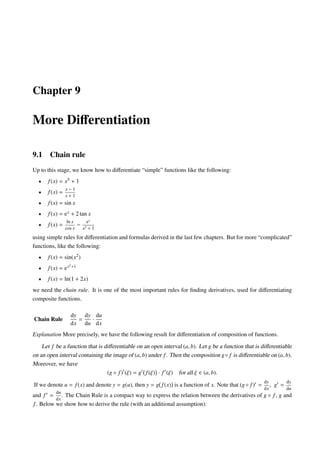
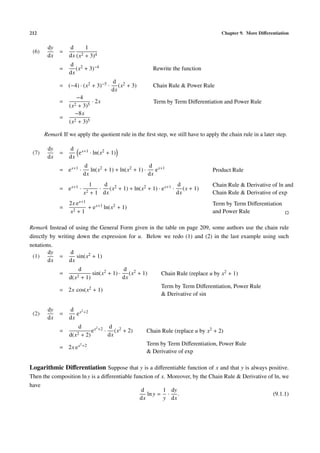
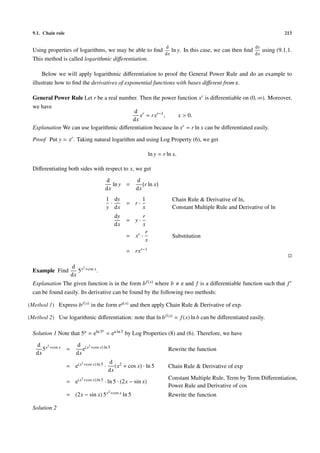
     Chapter 9 is on the Chain Rule which is the most important rule for differentiation. To make the rule
easier to handle, formulas obtained from combining the rule with simple differentiation formulas are given.
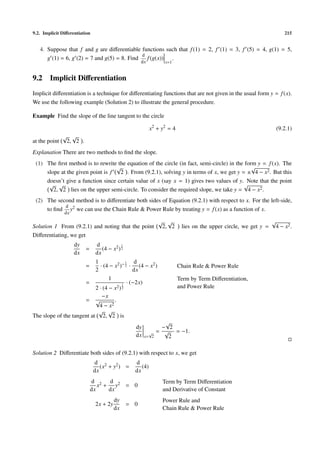
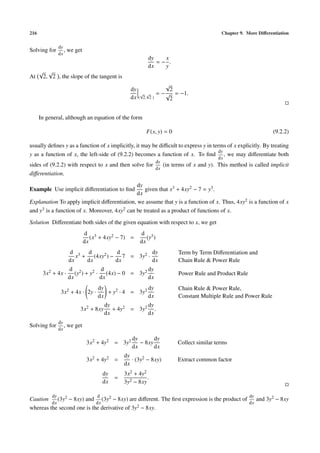
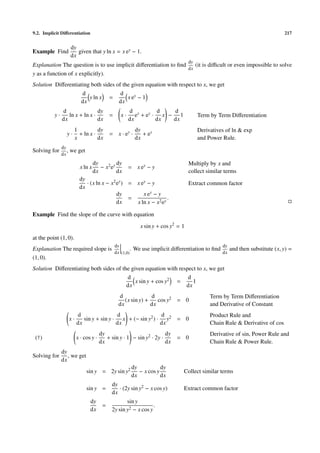
Students should notice that the Chain Rule is used in the process of logarithmic differentiation as well as that
of implicit differentiation. To close the discussion on differentiation, more examples on curve sketching and
applied extremum problems are given.

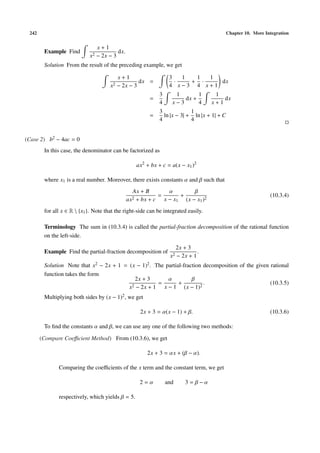
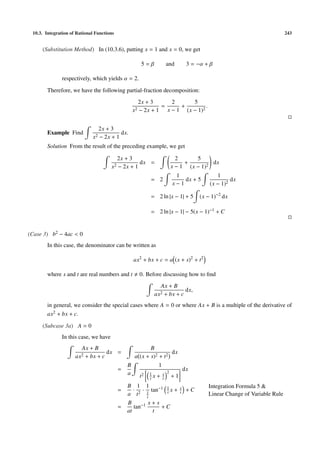
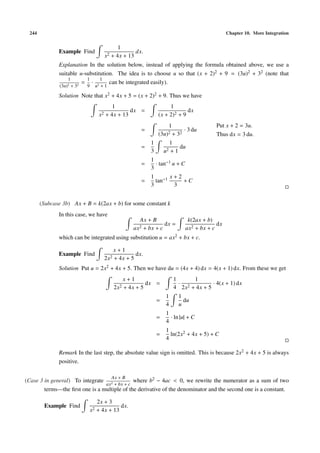
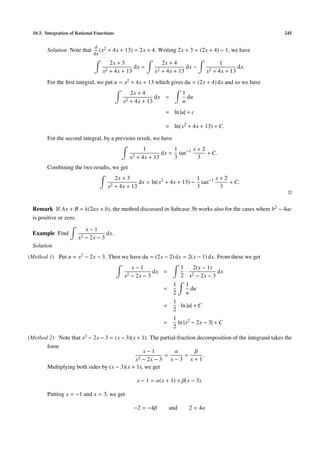
     Chapter 10 is on formulas and techniques of integration. First, a list of formulas for integration is given.
Students should notice that they are obtained from the corresponding formulas for differentiation. Next, several
techniques of integration are discussed. The substitution method for integration corresponds to the Chain Rule
for differentiation. Since the method is used very often, detail discussions are given. The method of Integration
by Parts corresponds to the Product Rule for differentiation. For integration of rational functions, only some
special cases are discussed. Complete discussion for the general case is rather complicated. Since Integration
by Parts and integration of rational functions are not covered in the course Basic Calculus, the discussion on
these two techniques are brief and exercises are not given. Students who want to know more about techniques of
integration may consult other books on calculus. To close the discussion on integration, application of definite
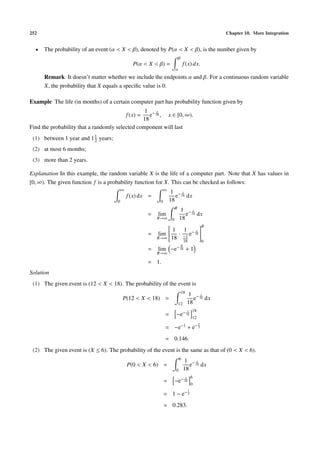
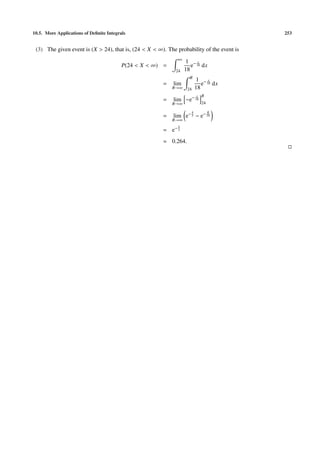
integrals to probability (which is a vast field in mathematics) is given.

     Students should bear in mind that the main purpose of learning calculus is not just knowing how to perform
differentiation and integration but also knowing how to apply differentiation and integration to solve problems.
For that, one must understand the concepts. To perform calculation, we can use calculators or computer soft-
wares, like Mathematica, Maple or Matlab. Accompanying the pdf file of this book is a set of Mathematica
notebook files (with extension .nb, one for each chapter) which give the answers to most of the questions in the
exercises. Information on how to read the notebook files as well as trial version of Mathematica can be found
at http://www.wolfram.com .
Contents

0 Revision                                                                                                                                                                                                1
  0.1 Exponents . . . . . . . . . . . . . . . . . . . . . .                          .   .   .   .   .   .   .   .   .   .   .   .   .   .   .   .   .   .   .   .   .   .   .   .   .   .   .   .   .    1
  0.2 Algebraic Identities and Algebraic Expressions . .                             .   .   .   .   .   .   .   .   .   .   .   .   .   .   .   .   .   .   .   .   .   .   .   .   .   .   .   .   .    2
  0.3 Solving Linear Equations . . . . . . . . . . . . . .                           .   .   .   .   .   .   .   .   .   .   .   .   .   .   .   .   .   .   .   .   .   .   .   .   .   .   .   .   .    4
  0.4 Solving Quadratic Equations . . . . . . . . . . . .                            .   .   .   .   .   .   .   .   .   .   .   .   .   .   .   .   .   .   .   .   .   .   .   .   .   .   .   .   .    6
  0.5 Remainder Theorem and Factor Theorem . . . . .                                 .   .   .   .   .   .   .   .   .   .   .   .   .   .   .   .   .   .   .   .   .   .   .   .   .   .   .   .   .    8
  0.6 Solving Linear Inequalities . . . . . . . . . . . . .                          .   .   .   .   .   .   .   .   .   .   .   .   .   .   .   .   .   .   .   .   .   .   .   .   .   .   .   .   .   10
  0.7 Lines . . . . . . . . . . . . . . . . . . . . . . . .                          .   .   .   .   .   .   .   .   .   .   .   .   .   .   .   .   .   .   .   .   .   .   .   .   .   .   .   .   .   12
  0.8 Pythagoras Theorem, Distance Formula and Circles                               .   .   .   .   .   .   .   .   .   .   .   .   .   .   .   .   .   .   .   .   .   .   .   .   .   .   .   .   .   17
  0.9 Parabola . . . . . . . . . . . . . . . . . . . . . . .                         .   .   .   .   .   .   .   .   .   .   .   .   .   .   .   .   .   .   .   .   .   .   .   .   .   .   .   .   .   19
  0.10 Systems of Equations . . . . . . . . . . . . . . . .                          .   .   .   .   .   .   .   .   .   .   .   .   .   .   .   .   .   .   .   .   .   .   .   .   .   .   .   .   .   20

1 Sets, Real Numbers and Inequalities                                                                                                                                                                    23
  1.1 Sets . . . . . . . . . . . . . . . . . . . . . . . .                       .   .   .   .   .   .   .   .   .   .   .   .   .   .   .   .   .   .   .   .   .   .   .   .   .   .   .   .   .   .   23
        1.1.1 Introduction . . . . . . . . . . . . . . . .                       .   .   .   .   .   .   .   .   .   .   .   .   .   .   .   .   .   .   .   .   .   .   .   .   .   .   .   .   .   .   23
        1.1.2 Set Operations . . . . . . . . . . . . . .                         .   .   .   .   .   .   .   .   .   .   .   .   .   .   .   .   .   .   .   .   .   .   .   .   .   .   .   .   .   .   28
  1.2 Real Numbers . . . . . . . . . . . . . . . . . . .                         .   .   .   .   .   .   .   .   .   .   .   .   .   .   .   .   .   .   .   .   .   .   .   .   .   .   .   .   .   .   32
        1.2.1 The Number Systems . . . . . . . . . . .                           .   .   .   .   .   .   .   .   .   .   .   .   .   .   .   .   .   .   .   .   .   .   .   .   .   .   .   .   .   .   32
        1.2.2 Radicals . . . . . . . . . . . . . . . . . .                       .   .   .   .   .   .   .   .   .   .   .   .   .   .   .   .   .   .   .   .   .   .   .   .   .   .   .   .   .   .   34
  1.3 Solving Inequalities . . . . . . . . . . . . . . . .                       .   .   .   .   .   .   .   .   .   .   .   .   .   .   .   .   .   .   .   .   .   .   .   .   .   .   .   .   .   .   37
        1.3.1 Quadratic Inequalities . . . . . . . . . .                         .   .   .   .   .   .   .   .   .   .   .   .   .   .   .   .   .   .   .   .   .   .   .   .   .   .   .   .   .   .   38
        1.3.2 Polynomial Inequalities with degrees ≥ 3                           .   .   .   .   .   .   .   .   .   .   .   .   .   .   .   .   .   .   .   .   .   .   .   .   .   .   .   .   .   .   39

2 Functions and Graphs                                                                                                                                                                                   43
  2.1 Functions . . . . . . . . . . . . .        .   .   .   .   .   .   .   .   .   .   .   .   .   .   .   .   .   .   .   .   .   .   .   .   .   .   .   .   .   .   .   .   .   .   .   .   .   .   43
  2.2 Domains and Ranges of Functions            .   .   .   .   .   .   .   .   .   .   .   .   .   .   .   .   .   .   .   .   .   .   .   .   .   .   .   .   .   .   .   .   .   .   .   .   .   .   45
  2.3 Graphs of Equations . . . . . . .          .   .   .   .   .   .   .   .   .   .   .   .   .   .   .   .   .   .   .   .   .   .   .   .   .   .   .   .   .   .   .   .   .   .   .   .   .   .   49
  2.4 Graphs of Functions . . . . . . . .        .   .   .   .   .   .   .   .   .   .   .   .   .   .   .   .   .   .   .   .   .   .   .   .   .   .   .   .   .   .   .   .   .   .   .   .   .   .   53
  2.5 Compositions of Functions . . . .          .   .   .   .   .   .   .   .   .   .   .   .   .   .   .   .   .   .   .   .   .   .   .   .   .   .   .   .   .   .   .   .   .   .   .   .   .   .   64
  2.6 Inverse Functions . . . . . . . . .        .   .   .   .   .   .   .   .   .   .   .   .   .   .   .   .   .   .   .   .   .   .   .   .   .   .   .   .   .   .   .   .   .   .   .   .   .   .   66
  2.7 More on Solving Equations . . . .          .   .   .   .   .   .   .   .   .   .   .   .   .   .   .   .   .   .   .   .   .   .   .   .   .   .   .   .   .   .   .   .   .   .   .   .   .   .   69

3 Limits                                                                                                                                                                                                 73
  3.1 Introduction . . . . . . . . . .   .   .   .   .   .   .   .   .   .   .   .   .   .   .   .   .   .   .   .   .   .   .   .   .   .   .   .   .   .   .   .   .   .   .   .   .   .   .   .   .   73
  3.2 Limits of Sequences . . . . . .    .   .   .   .   .   .   .   .   .   .   .   .   .   .   .   .   .   .   .   .   .   .   .   .   .   .   .   .   .   .   .   .   .   .   .   .   .   .   .   .   75
  3.3 Limits of Functions at Infinity     .   .   .   .   .   .   .   .   .   .   .   .   .   .   .   .   .   .   .   .   .   .   .   .   .   .   .   .   .   .   .   .   .   .   .   .   .   .   .   .   80
  3.4 One-sided Limits . . . . . . .     .   .   .   .   .   .   .   .   .   .   .   .   .   .   .   .   .   .   .   .   .   .   .   .   .   .   .   .   .   .   .   .   .   .   .   .   .   .   .   .   86
  3.5 Two-sided Limits . . . . . . .     .   .   .   .   .   .   .   .   .   .   .   .   .   .   .   .   .   .   .   .   .   .   .   .   .   .   .   .   .   .   .   .   .   .   .   .   .   .   .   .   89
  3.6 Continuous Functions . . . . .     .   .   .   .   .   .   .   .   .   .   .   .   .   .   .   .   .   .   .   .   .   .   .   .   .   .   .   .   .   .   .   .   .   .   .   .   .   .   .   .   94

4 Differentiation                                                                                                      103
  4.1 Derivatives . . . . . . . . . . . . . . . . . . . . . . . . . . . . . . . . . . . . . . . . . . . . . . . . . . 103
  4.2 Rules for Differentiation . . . . . . . . . . . . . . . . . . . . . . . . . . . . . . . . . . . . . . . . . . . 110
  4.3 Higher-Order Derivatives . . . . . . . . . . . . . . . . . . . . . . . . . . . . . . . . . . . . . . . . . . . 123
iv                                                                                                                                                                                            CONTENTS


5 Applications of Differentiation                                                                                                                                                                              127
  5.1 Curve Sketching . . . . . . . . . . . . . . . .                         .   .   .   .   .   .   .   .   .   .   .   .   .   .   .   .   .   .   .   .   .   .   .   .   .   .   .   .   .   .   .   .   128
       5.1.1 Increasing and Decreasing Functions                              .   .   .   .   .   .   .   .   .   .   .   .   .   .   .   .   .   .   .   .   .   .   .   .   .   .   .   .   .   .   .   .   128
       5.1.2 Relative Extrema . . . . . . . . . . .                           .   .   .   .   .   .   .   .   .   .   .   .   .   .   .   .   .   .   .   .   .   .   .   .   .   .   .   .   .   .   .   .   131
       5.1.3 Convexity . . . . . . . . . . . . . . .                          .   .   .   .   .   .   .   .   .   .   .   .   .   .   .   .   .   .   .   .   .   .   .   .   .   .   .   .   .   .   .   .   136
       5.1.4 Curve Sketching . . . . . . . . . . .                            .   .   .   .   .   .   .   .   .   .   .   .   .   .   .   .   .   .   .   .   .   .   .   .   .   .   .   .   .   .   .   .   143
  5.2 Applied Extremum Problems . . . . . . . . .                             .   .   .   .   .   .   .   .   .   .   .   .   .   .   .   .   .   .   .   .   .   .   .   .   .   .   .   .   .   .   .   .   146
       5.2.1 Absolute Extrema . . . . . . . . . . .                           .   .   .   .   .   .   .   .   .   .   .   .   .   .   .   .   .   .   .   .   .   .   .   .   .   .   .   .   .   .   .   .   146
       5.2.2 Applied Maxima and Minima . . . .                                .   .   .   .   .   .   .   .   .   .   .   .   .   .   .   .   .   .   .   .   .   .   .   .   .   .   .   .   .   .   .   .   148
       5.2.3 Applications to Economics . . . . . .                            .   .   .   .   .   .   .   .   .   .   .   .   .   .   .   .   .   .   .   .   .   .   .   .   .   .   .   .   .   .   .   .   153

6 Integration                                                                                                                                                                                                 157
  6.1 Definite Integrals . . . . . . . . .             .   .   .   .   .   .   .   .   .   .   .   .   .   .   .   .   .   .   .   .   .   .   .   .   .   .   .   .   .   .   .   .   .   .   .   .   .   .   157
  6.2 Fundamental Theorem of Calculus                 .   .   .   .   .   .   .   .   .   .   .   .   .   .   .   .   .   .   .   .   .   .   .   .   .   .   .   .   .   .   .   .   .   .   .   .   .   .   162
  6.3 Indefinite Integrals . . . . . . . .             .   .   .   .   .   .   .   .   .   .   .   .   .   .   .   .   .   .   .   .   .   .   .   .   .   .   .   .   .   .   .   .   .   .   .   .   .   .   167
  6.4 Application of Integration . . . . .            .   .   .   .   .   .   .   .   .   .   .   .   .   .   .   .   .   .   .   .   .   .   .   .   .   .   .   .   .   .   .   .   .   .   .   .   .   .   173

7 Trigonometric Functions                                                                                              179
  7.1 Angles . . . . . . . . . . . . . . . . . . . . . . . . . . . . . . . . . . . . . . . . . . . . . . . . . . . . . 179
  7.2 Trigonometric Functions . . . . . . . . . . . . . . . . . . . . . . . . . . . . . . . . . . . . . . . . . . . 180
  7.3 Differentiation of Trigonometric Functions . . . . . . . . . . . . . . . . . . . . . . . . . . . . . . . . . . 187

8 Exponential and Logarithmic Functions                                                                             191
  8.1 Exponential Functions . . . . . . . . . . . . . . . . . . . . . . . . . . . . . . . . . . . . . . . . . . . . 191
  8.2 Logarithmic Functions . . . . . . . . . . . . . . . . . . . . . . . . . . . . . . . . . . . . . . . . . . . . 196
  8.3 Differentiation of Exp and Log Functions . . . . . . . . . . . . . . . . . . . . . . . . . . . . . . . . . . 201

9 More Differentiation                                                                                                                                                                                         207
  9.1 Chain rule . . . . . . . . .    .   .   .   .   .   .   .   .   .   .   .   .   .   .   .   .   .   .   .   .   .   .   .   .   .   .   .   .   .   .   .   .   .   .   .   .   .   .   .   .   .   .   207
  9.2 Implicit Differentiation . .     .   .   .   .   .   .   .   .   .   .   .   .   .   .   .   .   .   .   .   .   .   .   .   .   .   .   .   .   .   .   .   .   .   .   .   .   .   .   .   .   .   .   215
  9.3 More Curve Sketching . .        .   .   .   .   .   .   .   .   .   .   .   .   .   .   .   .   .   .   .   .   .   .   .   .   .   .   .   .   .   .   .   .   .   .   .   .   .   .   .   .   .   .   219
  9.4 More Extremum Problems          .   .   .   .   .   .   .   .   .   .   .   .   .   .   .   .   .   .   .   .   .   .   .   .   .   .   .   .   .   .   .   .   .   .   .   .   .   .   .   .   .   .   222

10 More Integration                                                                                                                                                                                           229
   10.1 More Formulas . . . . . . . . . . . . .                   .   .   .   .   .   .   .   .   .   .   .   .   .   .   .   .   .   .   .   .   .   .   .   .   .   .   .   .   .   .   .   .   .   .   .   229
   10.2 Substitution Method . . . . . . . . . . .                 .   .   .   .   .   .   .   .   .   .   .   .   .   .   .   .   .   .   .   .   .   .   .   .   .   .   .   .   .   .   .   .   .   .   .   232
   10.3 Integration of Rational Functions . . . .                 .   .   .   .   .   .   .   .   .   .   .   .   .   .   .   .   .   .   .   .   .   .   .   .   .   .   .   .   .   .   .   .   .   .   .   240
   10.4 Integration by Parts . . . . . . . . . . .                .   .   .   .   .   .   .   .   .   .   .   .   .   .   .   .   .   .   .   .   .   .   .   .   .   .   .   .   .   .   .   .   .   .   .   246
   10.5 More Applications of Definite Integrals                    .   .   .   .   .   .   .   .   .   .   .   .   .   .   .   .   .   .   .   .   .   .   .   .   .   .   .   .   .   .   .   .   .   .   .   248

A Answers                                                                                                                                                                                                     255

B Supplementary Notes                                                                                                                                                                                         269
  B.1 Mathematical Induction . . . . . .              .   .   .   .   .   .   .   .   .   .   .   .   .   .   .   .   .   .   .   .   .   .   .   .   .   .   .   .   .   .   .   .   .   .   .   .   .   .   269
  B.2 Binomial Theorem . . . . . . . .                .   .   .   .   .   .   .   .   .   .   .   .   .   .   .   .   .   .   .   .   .   .   .   .   .   .   .   .   .   .   .   .   .   .   .   .   .   .   271
  B.3 Mean Value Theorem . . . . . . .                .   .   .   .   .   .   .   .   .   .   .   .   .   .   .   .   .   .   .   .   .   .   .   .   .   .   .   .   .   .   .   .   .   .   .   .   .   .   274
  B.4 Fundamental Theorem of Calculus                 .   .   .   .   .   .   .   .   .   .   .   .   .   .   .   .   .   .   .   .   .   .   .   .   .   .   .   .   .   .   .   .   .   .   .   .   .   .   276
Chapter 0

Revision

0.1    Exponents
Definition
 (1) Let n be a positive integer and let a be a real number. We define an to be the real number given by

                                                                    an = a · a · · · a .
                                                                            n factors

 (2) Let n be a negative integer n, that is, n = −k where k is a positive integer, and let a be a real number
     different from 0. We define a−k to be the real number given by
                                                                                1
                                                                       a−k =       .
                                                                                ak
 (3)   (i) Let a be a real number different from 0. We define a0 = 1.
       (ii) We do not define 00 (thus the notation 00 is meaningless).
Terminology In the notation an , the numbers n and a are called the exponent and base respectively.

Rules for Exponents Let a and b be real numbers and let m and n be integers (when a = 0 or b = 0, we have
to add the condition: m, n different from 0). Then we have
 (1) am an = am+n
     am
 (2)     = am−n                 provided that a     0
      an
 (3) (am )n = amn

 (4) (ab)n = an bn
       a   n        an
 (5)           =                provided that b     0
       b            bn

Exercise 0.1
   1. Simplify the following; give your answers without negative exponents.
                                                  x−1 y2
       (a)         x6 x−3                 (b)
                                                   z−3
                            4                              −3 4             2
       (c)         x−2 y3                 (d)     2x2        y    ÷ x−1 y
2                                                                                                                           Chapter 0. Revision


0.2 Algebraic Identities and Algebraic Expressions
Identities Let a and b be real numbers. Then we have
    (1) (a + b)2 = a2 + 2ab + b2
    (2) (a − b)2 = a2 − 2ab + b2
    (3) (a + b)(a − b) = a2 − b2

Remark The above equalities are called identities because they are valid for all real numbers a and b.

Caution In general, (a + b)2                          a2 + b2 .       Note: (a + b)2 = a2 + b2 if and only if a = 0 or b = 0.

Example Expand the following:
     √     2
 (1)   x+2
                     2
                5
    (2)   x−
                x
          √                          √
    (3)       x2 + 1 + 7                 x2 + 1 − 7

Solution
        √                    2            √
                                          √       2
 (1)      x+2                    =     + 2 x (2) + 22
                                              x
                                      √
                                 = x+4 x+4

                         2                                        2
                 5                                    5   5
    (2)    x−                    = x2 − 2(x)            +
                 x                                    x   x
                                                      25
                                 = x2 − 10 +
                                                      x2
           √                         √                            √            2
    (3)        x2 + 1 + 7                 x2 + 1 − 7       =          x2 + 1       − 72

                                                           =      x2 + 1 − 49

                                                           = x2 − 48


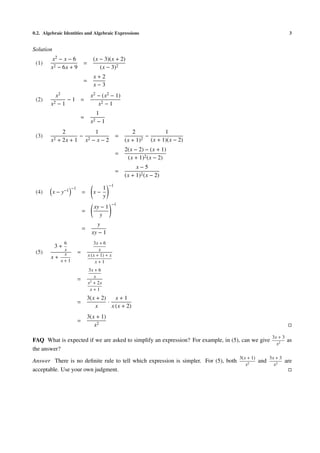
Example Simplify the following:
           x2 − x − 6
    (1)
          x2 − 6x + 9
          x2
    (2)        −1
        x2 − 1
             2        1
    (3) 2         − 2
        x + 2x + 1 x − x − 2
                         −1
    (4)   x − y−1
                6
           3+
                x
    (5)         x
          x+
               x+1
0.2. Algebraic Identities and Algebraic Expressions                                                              3


Solution
         x2 − x − 6                 (x − 3)(x + 2)
 (1)                          =
        x2 − 6x + 9                    (x − 3)2
                                     x+2
                              =
                                     x−3
          x2                       x2 − (x2 − 1)
 (2)           −1 =
        x2 − 1                        x2 − 1
                                        1
                          =
                                   x2   −1
             2          1                                   2           1
 (3)               −                                 =           −
        x2 + 2x + 1 x2 − x − 2                           (x + 1)2 (x + 1)(x − 2)
                                                         2(x − 2) − (x + 1)
                                                     =
                                                          (x + 1)2 (x − 2)
                                                              x−5
                                                     =
                                                         (x + 1)2 (x − 2)
                                                −1
                     −1                     1
 (4)       x − y−1            =     x−
                                            y
                                                 −1
                                     xy − 1
                              =
                                       y
                                      y
                              =
                                    xy − 1
               6                     3x + 6
           3+
               x                        x
 (5)           x          =       x (x + 1) + x
        x+
              x+1                     x+1
                                  3x + 6
                                     x
                          =
                                  x2 + 2x
                                   x+1
                                  3(x + 2)     x+1
                          =                ·
                                     x       x (x + 2)
                                  3(x + 1)
                          =
                                     x2

                                                                                                       3x + 3
FAQ What is expected if we are asked to simplify an expression? For example, in (5), can we give                as
                                                                                                         x2
the answer?
                                                                                     3(x + 1)         3x + 3
Answer There is no definite rule to tell which expression is simpler. For (5), both              and             are
                                                                                        x2              x2
acceptable. Use your own judgment.
4                                                                                           Chapter 0. Revision


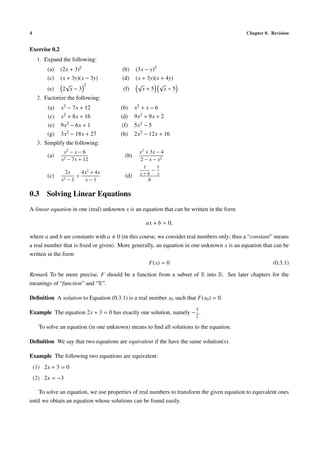
Exercise 0.2
     1. Expand the following:
         (a)   (2x + 3)2                 (b)    (3x − y)2
         (c)   (x + 3y)(x − 3y)          (d)    (x + 3y)(x + 4y)
                 √       2                       √        √
         (e)    2 x−3                    (f)       x+5      x−5
     2. Factorize the following:
         (a)   x2 − 7x + 12             (b)     x2 + x − 6
         (c)   x2 + 8x + 16             (d)     9x2 + 9x + 2
         (e)   9x2 − 6x + 1              (f)    5x2 − 5
         (g)   3x2 − 18x + 27           (h)     2x2 − 12x + 16
     3. Simplify the following:
                x2 − x − 6                        x2 + 3x − 4
         (a)                              (b)
               x2 − 7x + 12                       2 − x − x2
                                                   1    1
                 2x     4x2 + 4x                      −
                                                  x+h   x
         (c)          ÷                   (d)
               x2 − 1    x−1                          h

0.3 Solving Linear Equations
A linear equation in one (real) unknown x is an equation that can be written in the form

                                                    ax + b = 0,

where a and b are constants with a 0 (in this course, we consider real numbers only; thus a “constant” means
a real number that is fixed or given). More generally, an equation in one unknown x is an equation that can be
written in the form
                                                  F(x) = 0                                             (0.3.1)

Remark To be more precise, F should be a function from a subset of R into R. See later chapters for the
meanings of “function” and “R”.

Definition A solution to Equation (0.3.1) is a real number x0 such that F(x0 ) = 0.
                                                                        3
Example The equation 2x + 3 = 0 has exactly one solution, namely − .
                                                                        2

      To solve an equation (in one unknown) means to find all solutions to the equation.

Definition We say that two equations are equivalent if the have the same solution(s).

Example The following two equations are equivalent:
    (1) 2x + 3 = 0
    (2) 2x = −3

    To solve an equation, we use properties of real numbers to transform the given equation to equivalent ones
until we obtain an equation whose solutions can be found easily.
0.3. Solving Linear Equations                                                                                       5


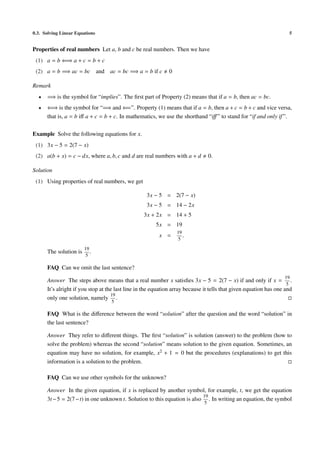
Properties of real numbers Let a, b and c be real numbers. Then we have
 (1) a = b ⇐⇒ a + c = b + c
 (2) a = b =⇒ ac = bc and ac = bc =⇒ a = b if c              0

Remark
  •   =⇒ is the symbol for “implies”. The first part of Property (2) means that if a = b, then ac = bc.
  •   ⇐⇒ is the symbol for “=⇒ and ⇐=”. Property (1) means that if a = b, then a + c = b + c and vice versa,
      that is, a = b iff a + c = b + c. In mathematics, we use the shorthand “iff ” to stand for “if and only if ”.

Example Solve the following equations for x.
 (1) 3x − 5 = 2(7 − x)
 (2) a(b + x) = c − dx, where a, b, c and d are real numbers with a + d          0.

Solution
 (1) Using properties of real numbers, we get

                                                   3x − 5 = 2(7 − x)
                                                   3x − 5 = 14 − 2x
                                                  3x + 2x = 14 + 5
                                                       5x = 19
                                                                 19
                                                         x =        .
                                                                 5

                        19
      The solution is      .
                         5

      FAQ Can we omit the last sentence?
                                                                                                                  19
      Answer The steps above means that a real number x satisfies 3x − 5 = 2(7 − x) if and only if x = .
                                                                                                                    5
      It’s alright if you stop at the last line in the equation array because it tells that given equation has one and
                                    19
      only one solution, namely .
                                   5

      FAQ What is the difference between the word “solution” after the question and the word “solution” in
      the last sentence?

      Answer They refer to different things. The first “solution” is solution (answer) to the problem (how to
      solve the problem) whereas the second “solution” means solution to the given equation. Sometimes, an
      equation may have no solution, for example, x2 + 1 = 0 but the procedures (explanations) to get this
      information is a solution to the problem.

      FAQ Can we use other symbols for the unknown?

      Answer In the given equation, if x is replaced by another symbol, for example, t, we get the equation
                                                                           19
      3t − 5 = 2(7 − t) in one unknown t. Solution to this equation is also . In writing an equation, the symbol
                                                                             5
6                                                                                            Chapter 0. Revision


        for the unknown is not important. However, if the unknown is expressed in t, all the intermediate steps
        should use t as unknown:
                                               3t − 5 = 2(7 − t)
                                                         .
                                                         .
                                                         .
                                                                 19
                                                          t =
                                                                  5


    (2) Using properties of real numbers, we get

                                                   a(b + x) = c − dx
                                                      ab + ax = c − dx
                                                      ax + dx = c − ab
                                                   (a + d)x = c − ab
                                                                  c − ab
                                                           x =           .
                                                                  a+d


Exercise 0.3
     1. Solve the following equations for x.
                                                          5x + 3     5x − 4
          (a)   2(x + 4) = 7x + 2                  (b)           −5=
                                                            2          4
                                                          x x
          (c)   (a + b)x + x2 = (x + b)2           (d)      − =c
                                                          a b
        where a, b and c are constants with a    b.


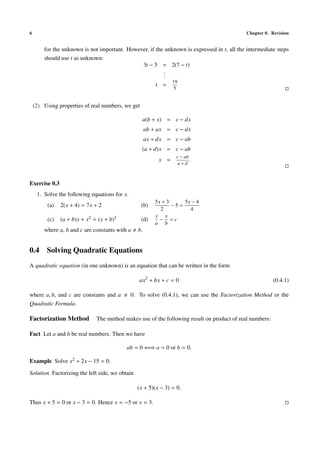
0.4 Solving Quadratic Equations
A quadratic equation (in one unknown) is an equation that can be written in the form

                                                  ax2 + bx + c = 0                                        (0.4.1)

where a, b, and c are constants and a          0. To solve (0.4.1), we can use the Factorization Method or the
Quadratic Formula.

Factorization Method           The method makes use of the following result on product of real numbers:

Fact Let a and b be real numbers. Then we have

                                           ab = 0 ⇐⇒ a = 0 or b = 0.

Example Solve x2 + 2x − 15 = 0.

Solution Factorizing the left side, we obtain

                                                 (x + 5)(x − 3) = 0.

Thus x + 5 = 0 or x − 3 = 0. Hence x = −5 or x = 3.
0.4. Solving Quadratic Equations                                                                                7


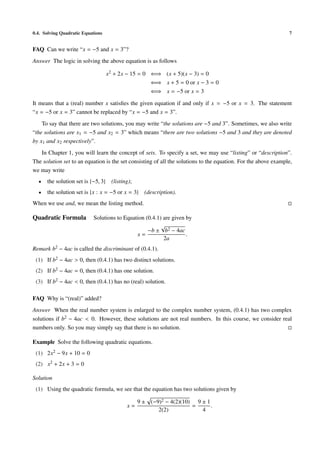
FAQ Can we write “x = −5 and x = 3”?
Answer The logic in solving the above equation is as follows

                                   x2 + 2x − 15 = 0 ⇐⇒ (x + 5)(x − 3) = 0
                                                    ⇐⇒ x + 5 = 0 or x − 3 = 0
                                                    ⇐⇒ x = −5 or x = 3

It means that a (real) number x satisfies the given equation if and only if x = −5 or x = 3. The statement
“x = −5 or x = 3” cannot be replaced by “x = −5 and x = 3”.
    To say that there are two solutions, you may write “the solutions are −5 and 3”. Sometimes, we also write
“the solutions are x1 = −5 and x2 = 3” which means “there are two solutions −5 and 3 and they are denoted
by x1 and x2 respectively”.
   In Chapter 1, you will learn the concept of sets. To specify a set, we may use “listing” or “description”.
The solution set to an equation is the set consisting of all the solutions to the equation. For the above example,
we may write
  •   the solution set is {−5, 3} (listing);
  •   the solution set is {x : x = −5 or x = 3}   (description).
When we use and, we mean the listing method.

Quadratic Formula          Solutions to Equation (0.4.1) are given by
                                                        √
                                                  −b ± b2 − 4ac
                                             x=                    .
                                                         2a
Remark b2 − 4ac is called the discriminant of (0.4.1).
 (1) If b2 − 4ac > 0, then (0.4.1) has two distinct solutions.
 (2) If b2 − 4ac = 0, then (0.4.1) has one solution.
 (3) If b2 − 4ac < 0, then (0.4.1) has no (real) solution.

FAQ Why is “(real)” added?
Answer When the real number system is enlarged to the complex number system, (0.4.1) has two complex
solutions if b2 − 4ac < 0. However, these solutions are not real numbers. In this course, we consider real
numbers only. So you may simply say that there is no solution.

Example Solve the following quadratic equations.
 (1) 2x2 − 9x + 10 = 0
 (2) x2 + 2x + 3 = 0

Solution
 (1) Using the quadratic formula, we see that the equation has two solutions given by

                                               9 ± (−9)2 − 4(2)(10) 9 ± 1
                                          x=                       =      .
                                                      2(2)            4
8                                                                                               Chapter 0. Revision

                                 5
        Thus the solutions are       and 2.
                                 2

    (2) Since 22 − 4(1)(3) = −8 < 0, the equation has no solutions.


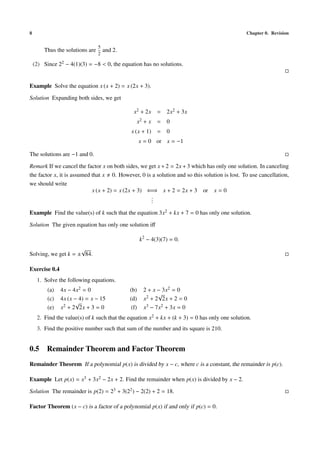
Example Solve the equation x (x + 2) = x (2x + 3).

Solution Expanding both sides, we get

                                                x2 + 2x     =   2x2 + 3x
                                                 x2 + x     =   0
                                              x (x + 1)     =   0
                                                     x = 0 or x = −1

The solutions are −1 and 0.

Remark If we cancel the factor x on both sides, we get x + 2 = 2x + 3 which has only one solution. In canceling
the factor x, it is assumed that x 0. However, 0 is a solution and so this solution is lost. To use cancellation,
we should write
                            x (x + 2) = x (2x + 3) ⇐⇒ x + 2 = 2x + 3 or x = 0
                                                    .
                                                    .
                                                    .
Example Find the value(s) of k such that the equation 3x2 + kx + 7 = 0 has only one solution.

Solution The given equation has only one solution iff

                                                     k2 − 4(3)(7) = 0.
                     √
Solving, we get k = ± 84.

Exercise 0.4
     1. Solve the following equations.
          (a)   4x − 4x2 = 0                  (b)     2 + x − 3x2 = 0
                                                            √
          (c)   4x (x − 4) = x − 15           (d)     x2 + 2 2x + 2 = 0
                      √
          (e)   x2 + 2 2x + 3 = 0              (f)    x3 − 7x2 + 3x = 0
     2. Find the value(s) of k such that the equation x2 + kx + (k + 3) = 0 has only one solution.
     3. Find the positive number such that sum of the number and its square is 210.


0.5 Remainder Theorem and Factor Theorem
Remainder Theorem If a polynomial p(x) is divided by x − c, where c is a constant, the remainder is p(c).

Example Let p(x) = x3 + 3x2 − 2x + 2. Find the remainder when p(x) is divided by x − 2.

Solution The remainder is p(2) = 23 + 3(22 ) − 2(2) + 2 = 18.

Factor Theorem (x − c) is a factor of a polynomial p(x) if and only if p(c) = 0.
0.5. Remainder Theorem and Factor Theorem                                                                  9


Proof This follows immediately from the remainder theorem because (x−c) is a factor means that the remainder
is 0.

Example Let p(x) = x3 + kx2 + x − 6. Suppose that (x + 2) is a factor of p(x).
 (1) Find the value of k.
 (2) With the value of k found in (1), factorize p(x).

Solution
 (1) Since x − (−2) is a factor of p(x), it follows from the Factor Theorem that p(−2) = 0, that is

                                             (−2)3 + k(−2)2 + (−2) − 6 = 0.

      Solving, we get k = 4.
 (2) Using long division, we get

                                      x3 + 4x2 + x − 6 = (x + 2)(x2 + 2x − 3).

      By inspection, we have p(x) = (x + 2)(x + 3)(x − 1).

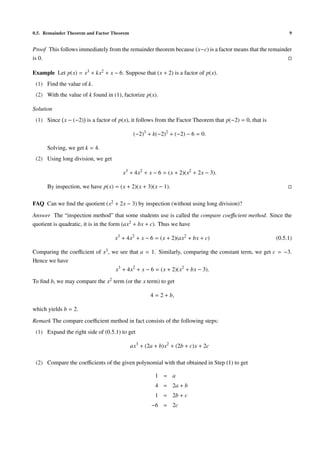
FAQ Can we find the quotient (x2 + 2x − 3) by inspection (without using long division)?
Answer The “inspection method” that some students use is called the compare coefficient method. Since the
quotient is quadratic, it is in the form (ax2 + bx + c). Thus we have

                                   x3 + 4x2 + x − 6 = (x + 2)(ax2 + bx + c)                           (0.5.1)

Comparing the coefficient of x3 , we see that a = 1. Similarly, comparing the constant term, we get c = −3.
Hence we have
                                 x3 + 4x2 + x − 6 = (x + 2)(x2 + bx − 3).

To find b, we may compare the x2 term (or the x term) to get

                                                    4 = 2 + b,

which yields b = 2.
Remark The compare coefficient method in fact consists of the following steps:
 (1) Expand the right side of (0.5.1) to get

                                            ax3 + (2a + b)x2 + (2b + c)x + 2c

 (2) Compare the coefficients of the given polynomial with that obtained in Step (1) to get

                                                      1 = a
                                                      4 = 2a + b
                                                      1 = 2b + c
                                                    −6 = 2c
10                                                                                                     Chapter 0. Revision


 (3) Solve the above system to find a, b and c.


Example Factorize p(x) = 2x2 − 3x − 1.

Solution Solving p(x) = 0 by the quadratic formula, we get
                                                                  √
                                      −(−3) ± (−3)2 − 4(2)(−1) 3 ± 17
                                   x=                         =       .
                                               2(2)               4
                                       √                      √
                                    3 + 17                 3 − 17
By the Factor Theorem, both x −                and x −                  are factors of p(x). Therefore, we have
                                       4                      4
                                                              √                 √
                                                           3 + 17            3 − 17
                                         p(x) = 2 x −                   x−
                                                              4                 4

where the factor 2 is obtained by comparing the leading term (that is, the x2 term).

FAQ Can we say that p(x) can’t be factorized?

Answer Although p(x) does not have factors in the form (x − c) where c is an integer, it has linear factors as
given above. If the question asks for factors with integer coefficients, then p(x) cannot be factorized as product
of linear factors.

FAQ Can we use the above method to factorize, for example, p(x) = 6x2 + x − 2 ?

Answer If you don’t know how to factorize p(x) by inspection, you can solve p(x) = 0 using the quadratic
                                   1         2
formula (or calculators) to get x = or x = − . Therefore (by the Factor Theorem and comparing the leading
                                   2         3
term), we have
                                                        1       2
                                         p(x) = 6 x −       x+
                                                                    2         3

                                                     = (2x − 1)(3x + 2).

Exercise 0.5
     1. For each of the following expressions, use the factor theorem to find a linear factor (x − c) and hence
        factorize it completely (using integer coefficients).
         (a)   x3 − 13x + 12                  (b)   2x3 − 7x2 + 2x + 3
         (c)   2x3 − x2 − 4x + 3              (d)   x3 − 5x2 + 11x − 7
     2. Solve the following equation for x.
         (a)   2x3 − 9x2 − 8x + 15 = 0               (b)    x3 − 2x + 1 = 0
         (c)   2x3 − 5x2 + 2x − 15 = 0


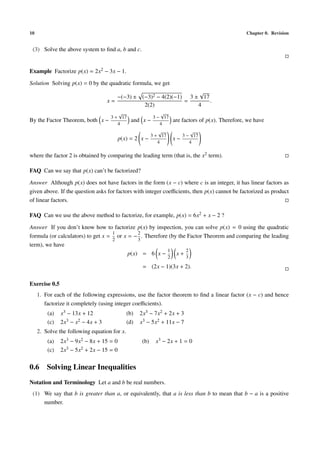
0.6 Solving Linear Inequalities
Notation and Terminology Let a and b be real numbers.
 (1) We say that b is greater than a, or equivalently, that a is less than b to mean that b − a is a positive
     number.
0.6. Solving Linear Inequalities                                                                               11


 (2) We write b > a to denote that b is greater than a and we write a < b to denote that a is less than b.
 (3) We write b ≥ a to denote that b is greater than or equal to a and we write a ≤ b to denote that a is less
     than or equal to b.

    A linear inequality in one unknown x is an inequality that can be written in one of the following forms:
 (1) ax + b < 0
 (2) ax + b ≤ 0
 (3) ax + b > 0
 (4) ax + b ≥ 0
where a and b are constants with a 0. More generally, an inequality in one unknown x is an inequality that
can be written in one of the following forms:
 (1) F(x) < 0
 (2) F(x) ≤ 0
 (3) F(x) > 0
 (4) F(x) ≥ 0
where F is a function from a subset of R into R.

Definition A solution to an inequality F(x) < 0 is a real number x0 such that F(x0 ) < 0. The definition also
applies to other types of inequalities.

Example Consider the inequality 2x + 3 ≥ 0. By direct substitution, we see that 1 is a solution and −2 is not a
solution.

    To solve an inequality means to find all solutions to the inequality.

Rules for Inequalities Let a, b and c be real numbers. Then the following holds.
 (1) If a < b, then a + c < b + c.
 (2) If a < b and c > 0, then ac < bc.
 (3) If a < b and c < 0, then ac > bc. Note: The inequality is reversed.
 (4) If a < b and b ≤ c, then a < c.
                                                     1    1
 (5) If a < b and a and b have the same sign, then       > .
                                                     a    b
                                                                  √        √
                                                                           n
 (6) If 0 < a < b and n is a positive integer, then an < bn and   n
                                                                      a<     b.

Terminology Two numbers have the same sign means that both of them are positive or both of them are negative.

Remark One common mistake in solving inequalities is to apply a rule with the wrong sign (positive or
negative). For example, if c is negative, it would be wrong to apply Rule (2).

Example Solve the following inequalities.
 (1) 2x + 1 > 7(x + 3)
12                                                                                                  Chapter 0. Revision


 (2) 3(x − 2) + 5 > 3x + 7

Solution
 (1) Using rules for inequalities, we get
                                                   2x + 1   >   7(x + 3)
                                                   2x + 1   >   7x + 21
                                                   1 − 21   >   7x − 2x
                                                     −20    >   5x
                                                      −4    >   x.
        The solutions are all the real numbers x such that x < −4, that is, all real numbers less than −4.
 (2) Expanding the left side, we get
                                                  3(x − 2) + 5 = 3x − 1

        which is always less than the right side. Thus the inequality has no solution.


Exercise 0.6
     1. Solve the following inequalities for x.
               1 − x 3x − 7                             √
         (a)        ≥                   (b)   2(3 − x) ≤ 3(1 − x)
                 2     3
                3x                               2x
         (c)        +3<0                (d)           >1
               1−x                             2x + 3

0.7 Lines
A linear equation in two unknowns x and y is an equation that can be written in the form

                                                  ax + by + c = 0                                              (0.7.1)

where a, b and c are constants with a, b not both 0. More generally, an equation in two unknowns x and y is an
equation that can be written in the form
                                                   F(x, y) = 0,                                        (0.7.2)

where F is a function (from a collection of ordered pairs into R).

Definition An ordered pair (of real numbers) is a pair of real numbers x0 , y0 enclosed inside parenthesis:
(x0 , y0 ).

Remark Two ordered pairs (x0 , y0 ) and (x1 , y1 ) are equal if and only if x0 = x1 and y0 = y1 . For example, the
ordered pairs (1, 2) and (2, 1) are not equal.

Definition A solution to Equation (0.7.2) is an ordered pair (x0 , y0 ) such that F(x0 , y0 ) = 0.

Example Consider the equation
                                                  2x + 3y − 4 = 0.

By direct substitution, we see that (2, 0) is a solution whereas (1, 2) is not a solution.
0.7. Lines                                                                                                         13


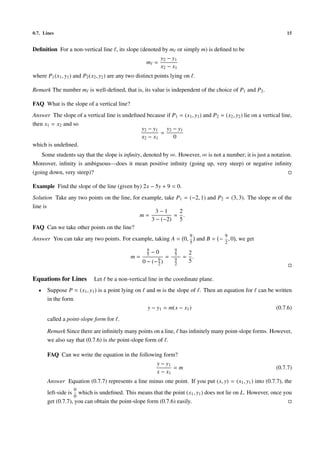
Rectangular Coordinate System Given a plane, there is a one-to-one correspondence between points in the
plane and ordered pairs of real numbers (see the construction below). The plane described in this way is called
the Cartesian plane or the rectangular coordinate plane.

First we construct a horizontal line and a vertical line on the plane.
Their point of intersection is called the origin. The horizontal line
is called the x-axis and the vertical line y-axis. For each point P
in the plane we can label it by two real numbers. To this ends, we
draw perpendiculars from P to the x-axis and y-axis. The first per-                3

pendicular meets the x-axis at a point which can be represented
by a real number a. Similarly, the second perpendicular meets                     2

the y-axis at a point which can be represented by a real number
b. Moreover, the ordered pair of numbers a and b determines P                     1

uniquely, that is, if P1 and P2 are distinct points in the plane, then
the ordered pairs corresponding to P1 and P2 are different. There-
fore, we may identify the point P with the ordered pair (a, b) and         -1                 1        2   3       4

we write P = (a, b) or P(a, b). The numbers a and b are called the               -1
x-coordinate and y-coordinate of P respectively.                                              Figure 0.1

    The x- and y-axes divide the (rectangular) coordinate plane into 4 regions (called quadrants):

        Quadrant I = {(a, b) : a > 0 and b > 0},                   Quadrant II = {(a, b) : a < 0 and b > 0},
       Quadrant III = {(a, b) : a < 0 and b < 0},                 Quadrant IV = {(a, b) : a > 0 and b < 0}.

Lines in the Coordinate Plane Consider the following equation

                                                  Ax + By + C = 0                                              (0.7.3)

where A, B and C are constants with A, B not both zero. It is not difficult to see that the equation has infinitely
many solutions. Each solution (x0 , y0 ) represents a point in the (rectangular) coordinate plane. The collection
of all solutions (points) form a line, called the graph of Equation (0.7.3). Moreover, every line in the plane can
be represented in this way. For example, if is the line passing through the origin and making an angle of 45
degrees with the positive x-axis, then it is the graph of the equation y = x. Although this equation is not in the
form (0.7.3), it can be written as
                                                (1)x + (−1)y + 0 = 0,

that is, x − y = 0.

Terminology If a line is represented by an equation in the form (0.7.3), we say that the equation is a general
linear form for .

Remark In Equation (0.7.3),
                                                     C
 (1) if A = 0, then the equation reduces to y = −         and its graph is a horizontal line;
                                                     B
                                                      C
 (2) if B = 0, then the equation reduces to x = −         and its graph is a vertical line.
                                                      A
14                                                                                           Chapter 0. Revision


Example Consider the line given by
                                                   2x + 3y − 4 = 0                                      (0.7.4)

For each of the following points, determine whether it lies on or not.
 (1) A = (4, −1)
 (2) B = (5, −2)

Solution
 (1) Putting (x, y) = (4, −1) into (0.7.4), we get

                                              L.S . = 2(4) + 3(−1) − 4 = 1
                                                       0.

         Therefore A does not lie on .

 (2) Putting (x, y) = (5, −2) into (0.7.4), we get

                                              L.S . = 2(5) + 3(−2) − 4 = 0
                                                   = R.S .

         Therefore B lies on .


Example Consider the line given by
                                                    x + 2y − 4 = 0                                      (0.7.5)

Find the points of intersection of with the x-axis and the y-axis.

Solution
     •   Putting y = 0 into (0.7.5), we get
                                                            x−4=0

         from which we obtain x = 4.
         The point of intersection of with the x-axis is (4, 0).
     •   Putting x = 0 into (0.7.5), we get
                                                         2y − 4 = 0

         from which we obtain y = 2.
         The point of intersection of with the y-axis is (0, 2).


Remark The point (4, 0) and (0, 2) are called the x-intercept and y-intercept of respectively.

FAQ Can we say that the x-intercept is 4 etc?

Answer Some authors define x-intercept to be the x-coordinate of point of intersection etc. Using this conven-
tion, the x-intercept is 4 and the y-intercept is 2.
0.7. Lines                                                                                                         15


Definition For a non-vertical line , its slope (denoted by m or simply m) is defined to be
                                                              y2 − y1
                                                     m =
                                                              x2 − x1
where P1 (x1 , y1 ) and P2 (x2 , y2 ) are any two distinct points lying on .

Remark The number m is well-defined, that is, its value is independent of the choice of P1 and P2 .

FAQ What is the slope of a vertical line?
Answer The slope of a vertical line is undefined because if P1 = (x1 , y1 ) and P2 = (x2 , y2 ) lie on a vertical line,
then x1 = x2 and so
                                              y2 − y1   y2 − y1
                                                      =
                                              x2 − x1      0
which is undefined.
    Some students say that the slope is infinity, denoted by ∞. However, ∞ is not a number; it is just a notation.
Moreover, infinity is ambiguous—does it mean positive infinity (going up, very steep) or negative infinity
(going down, very steep)?

Example Find the slope of the line (given by) 2x − 5y + 9 = 0.
Solution Take any two points on the line, for example, take P1 = (−2, 1) and P2 = (3, 3). The slope m of the
line is
                                                   3−1       2
                                             m=            = .
                                                 3 − (−2) 5
FAQ Can we take other points on the line?
                                                                           9              9
Answer You can take any two points. For example, taking A = 0,                  and B = − , 0 , we get
                                                                           5              2
                                                     9                9
                                                     5   −0           5    2
                                             m=                   =       = .
                                                   0−    (− 9 )
                                                            2
                                                                      9
                                                                      2
                                                                           5


Equations for Lines         Let be a non-vertical line in the coordinate plane.
  •   Suppose P = (x1 , y1 ) is a point lying on and m is the slope of . Then an equation for can be written
      in the form
                                                 y − y1 = m(x − x1 )                                 (0.7.6)
      called a point-slope form for .

      Remark Since there are infinitely many points on a line, has infinitely many point-slope forms. However,
      we also say that (0.7.6) is the point-slope form of .

      FAQ Can we write the equation in the following form?
                                                           y − y1
                                                                  =m                                          (0.7.7)
                                                           x − x1
      Answer Equation (0.7.7) represents a line minus one point. If you put (x, y) = (x1 , y1 ) into (0.7.7), the
                   0
      left-side is which is undefined. This means that the point (x1 , y1 ) does not lie on L. However, once you
                   0
      get (0.7.7), you can obtain the point-slope form (0.7.6) easily.
16                                                                                                                Chapter 0. Revision


     •   Suppose the y-intercept of is (0, b) and the slope of is m. Then a point-slope form for is

                                                                     y − b = m(x − 0)

         which can be written as
                                                                       y = mx + b

         called the slope-intercept form for .

Example Find the slope of the line having general linear form 2x + 3y − 4 = 0.

Solution Rewrite the given equation in slope-intercept form:

                                                         2x + 3y − 4 = 0
                                                                      3y = −2x + 4
                                                                            2   4
                                                                       y = − x+
                                                                            3   3
                                    2
The slope of the line is − .
                                    3

Example Let be the line that passes through the points A(1, 3) and B(2, −4). Find an equation in general
linear form for .

Solution Using the points A and B, we get the slope m of
                                                                     3 − (−4)
                                                            m=                = −7.
                                                                       1−2
Using the slope m and the point A (or B), we get the point slope form

                                                                y − 3 = −7(x − 1).                                           (0.7.8)

Expanding and rearranging terms, (0.7.8) can be written in the following general linear form

                                                                7x + y − 10 = 0.


Parallel and Perpendicular Lines                          Let    1   and   2   be (non-vertical) lines with slopes m1 and m2 respec-
tively. Then
 (1)      1   and    2   are parallel if and only if m1 = m2 ;
 (2)      1   and    2   are perpendicular to each other if and only if m1 · m2 = −1.

Note
     •   If   1   and    2   are vertical, then they are parallel.
     •   If   1   is vertical and       2   is horizontal (or the other way round), then they are perpendicular to each other.
0.8. Pythagoras Theorem, Distance Formula and Circles                                                                           17


Example Find equations in general linear form for the two lines passing through the point (3, −2) such that
one is parallel to the line y = 3x + 1 and the other is perpendicular to it.

Solution Let 1 (respectively 2 ) be the line that passes through the point (3, −2) and parallel (respectively
perpendicular) to the given line. It is clear that the slope of the given line is 3. Thus the slope of 1 is 3 and the
               1
slope of 2 is − . From these, we get the point-slope forms for 1 and 2 :
                         3

                                                                                      1
                                       y − (−2) = 3(x − 3)     and        y − (−2) = − (x − 3)
                                                                                      3
respectively. Expanding and rearranging terms, we get the following linear forms

                                            3x − y − 11 = 0      and        x + 3y + 3 = 0

for    1   and     2   respectively.

Exercise 0.7
      1. For each of the following, find an equation of the line satisfying the given conditions. Give your answer
         in general linear form.
            (a)        Passing through the origin and (−2, 3).
            (b)        With slope 2 and passing through (5, −1).
            (c)        With slope −3 and y-intercept (0, 7).
            (d)        Passing through (−3, 2) and parallel to 2x − y − 3 = 0.
            (e)        Passing through (1, 4) and perpendicular to x + 3y = 0.
             (f)       Passing through (1, −1) and perpendicular to the y-axis.


0.8        Pythagoras Theorem, Distance Formula and Circles
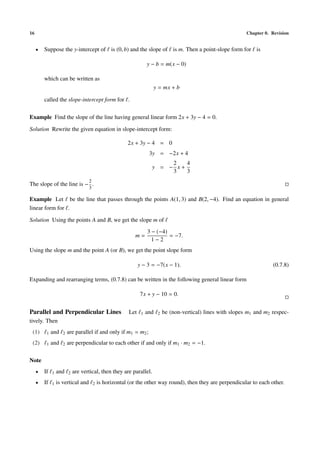
Pythagoras Theorem Let a, b and c be the (lengths of the) sides of a right-angled triangle where c is the
hypotenuse. Then we have
                                            a2 + b2 = c2 .
                                                                                    c
                                                                                                 b
                                                                                                               a
                                                                                                         Figure 0.2


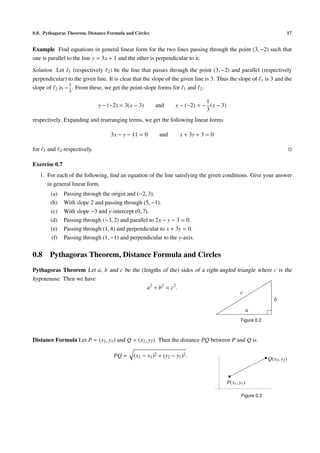
Distance Formula Let P = (x1 , y1 ) and Q = (x2 , y2 ). Then the distance PQ between P and Q is

                                             PQ =    (x2 − x1 )2 + (y2 − y1 )2 .
                                                                                                                      Q(x2 , y2 )


                                                                                                 P(x1 , y1 )

                                                                                                         Figure 0.3
18                                                                                               Chapter 0. Revision


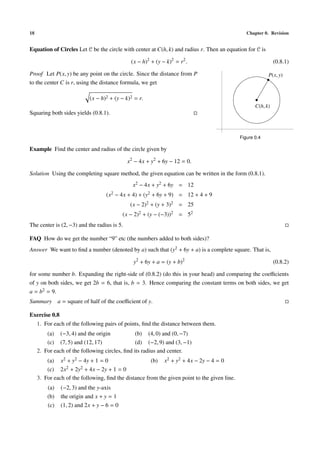
Equation of Circles Let 𝒞 be the circle with center at C(h, k) and radius r. Then an equation for 𝒞 is

                                              (x − h)2 + (y − k)2 = r2 .                                       (0.8.1)

Proof Let P(x, y) be any point on the circle. Since the distance from P                                    P(x, y)
to the center C is r, using the distance formula, we get

                           (x − h)2 + (y − k)2 = r.
                                                                                                     C(h, k)
Squaring both sides yields (0.8.1).


                                                                                              Figure 0.4

Example Find the center and radius of the circle given by

                                             x2 − 4x + y2 + 6y − 12 = 0.

Solution Using the completing square method, the given equation can be written in the form (0.8.1).
                                               x2 − 4x + y2 + 6y = 12
                                   (x2 − 4x + 4) + (y2 + 6y + 9) = 12 + 4 + 9
                                              (x − 2)2 + (y + 3)2 = 25
                                           (x − 2)2 + (y − (−3))2 = 52
The center is (2, −3) and the radius is 5.

FAQ How do we get the number “9” etc (the numbers added to both sides)?
Answer We want to find a number (denoted by a) such that (y2 + 6y + a) is a complete square. That is,

                                               y2 + 6y + a = (y + b)2                                          (0.8.2)

for some number b. Expanding the right-side of (0.8.2) (do this in your head) and comparing the coefficients
of y on both sides, we get 2b = 6, that is, b = 3. Hence comparing the constant terms on both sides, we get
a = b2 = 9.
Summary a = square of half of the coefficient of y.

Exercise 0.8
     1. For each of the following pairs of points, find the distance between them.
         (a) (−3, 4) and the origin             (b) (4, 0) and (0, −7)
         (c) (7, 5) and (12, 17)                (d) (−2, 9) and (3, −1)
     2. For each of the following circles, find its radius and center.
         (a) x2 + y2 − 4y + 1 = 0                     (b) x2 + y2 + 4x − 2y − 4 = 0
         (c) 2x2 + 2y2 + 4x − 2y + 1 = 0
     3. For each of the following, find the distance from the given point to the given line.
         (a)   (−2, 3) and the y-axis
         (b)   the origin and x + y = 1
         (c)   (1, 2) and 2x + y − 6 = 0
0.9. Parabola                                                                                                      19


0.9      Parabola
The graph of
                                                   y = ax2 + bx + c

where a 0, is a parabola. The parabola intersects the x-axis at two distinct points if b2 − 4ac > 0. It touches
the x-axis (one intersection point only) if b2 − 4ac = 0 and does not intersect the x-axis if b2 − 4ac < 0.
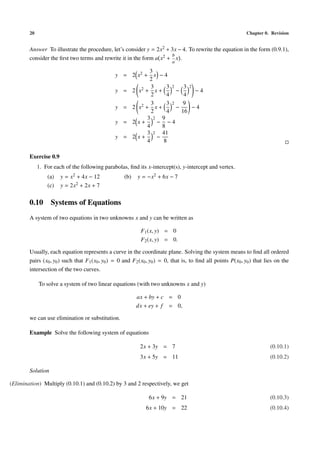
  •     If a > 0, the parabola opens upward and there is a lowest point (called the vertex of the parabola).
  •     If a < 0, the parabola opens downward and there is a highest point (vertex).

                            a>0
                                                                                 a<0


                         Figure 0.5(a)                                         Figure 0.5(b)

The vertical line that passes through the vertex is called the axis of symmetry because the parabola is symmetric
about this line.

      To find the vertex, we can use the completing square method to write the equation in the form

                                                   y = a(x − h)2 + k                                           (0.9.1)

The vertex is (h, k) because (x − h)2 is always non-negative and so
  •     if a > 0, then y ≥ k and thus (h, k) is the lowest point;
  •     if a < 0, then y ≤ k and thus (h, k) is the highest point.

Example Consider the parabola given by
                                                   y = x2 + 6x + 5.

Find its vertex and axis of symmetry.

Solution Using the completing square method, the given equation can be written in the form (0.9.1).

                                             y   = x2 + 6x + 5
                                             y   = (x2 + 6x + 9) − 9 + 5
                                             y   = (x + 3)2 − 4
                                             y   = x − (−3) 2 − 4.

The vertex is (−3, −4) and the axis of symmetry is the line given by x = −3 (the vertical line that passes through
the vertex).

FAQ In the above example, the coefficient of x2 is 1, what should we do if it is not 1?
20                                                                                                    Chapter 0. Revision


        Answer To illustrate the procedure, let’s consider y = 2x2 + 3x − 4. To rewrite the equation in the form (0.9.1),
                                                                     b
        consider the first two terms and rewrite it in the form a x2 + x .
                                                                           a
                                                           3
                                                y = 2 x2 + x − 4
                                                           2
                                                            3     3 2            3 2
                                                y = 2 x2 + x +        −               −4
                                                            2     4              4
                                                            3     3 2            9
                                                y = 2 x2 + x +        −              −4
                                                            2     4             16
                                                          3 2 9
                                                y = 2 x+      − −4
                                                          4     8
                                                          3 2 41
                                                y = 2 x+      −
                                                          4      8

        Exercise 0.9
             1. For each of the following parabolas, find its x-intercept(s), y-intercept and vertex.
                 (a)   y = x2 + 4x − 12             (b)    y = −x2 + 6x − 7
                 (c)   y = 2x2 + 2x + 7

        0.10 Systems of Equations
        A system of two equations in two unknowns x and y can be written as

                                                            F1 (x, y) = 0
                                                            F2 (x, y) = 0.

        Usually, each equation represents a curve in the coordinate plane. Solving the system means to find all ordered
        pairs (x0 , y0 ) such that F1 (x0 , y0 ) = 0 and F2 (x0 , y0 ) = 0, that is, to find all points P(x0 , y0 ) that lies on the
        intersection of the two curves.

             To solve a system of two linear equations (with two unknowns x and y)

                                                          ax + by + c = 0
                                                          dx + ey + f = 0,

        we can use elimination or substitution.

        Example Solve the following system of equations

                                                            2x + 3y = 7                                                   (0.10.1)
                                                            3x + 5y = 11                                                  (0.10.2)

        Solution

(Elimination) Multiply (0.10.1) and (0.10.2) by 3 and 2 respectively, we get

                                                                6x + 9y = 21                                              (0.10.3)
                                                               6x + 10y = 22                                              (0.10.4)
0.10. Systems of Equations                                                                                             21


                Subtracting (0.10.3) from (0.10.4), we get y = 1.
                Substituting y = 1 back into (0.10.1) or (0.10.2) and solving, we get x = 2.
                The solution to the system is (2, 1).

                Remark The point (2, 1) is the intersection point of the lines given by 2x + 3y = 7 and 3x + 5y = 11.
                                            7 − 3y
(Substitution) From (0.10.1), we get x =           .   Substituting into (0.10.2), we get
                                              2

                                                                      7 − 3y
                                                              3                + 5y = 11
                                                                        2

                                                             3(7 − 3y) + 10y = 22
                                                                                 y = 1

                and we can proceed as in the elimination method.


              To solve a system in two unknowns, with one linear equation and one quadratic equation

                                                                             ax + by + c = 0
                                                 dx2   + exy +    f y2     + gx + hy + k = 0

        we can use substitution. From the linear equation, we can express x in terms of y (or vice versa). Substituting
        into the quadratic equation, we get a quadratic equation in y which can be solved by factorization or by formula.
        Substituting the value(s) of y back into the linear equation, we get the corresponding value(s) of x.

        Example Solve the following system of equations

                                                                  x − 2y = 4                                              (0.10.5)
                                                                  2        2
                                                                 x +y          = 5                                        (0.10.6)

        Solution From (0.10.5), we get x = 4 + 2y. Substituting into (0.10.6), we get

                                                           (4 + 2y)2 + y2 = 5
                                                          5y2 + 16y + 11 = 0.

                                          11
        Solving we get y = −1 or y = −       .
                                           5
                                                                                     11                              2
        Substituting y = −1 into (0.10.5), we get x = 2; substituting y = −               into (0.10.5), we get x = − .
                                                                                     5                               5
                                                             2        11
        The solutions to the system are (2, −1) and − , −                  .
                                                             5         5

        Remark
          •     If we substitute y = −1 into (0.10.6), we get two values of x, one of which should be rejected.
          •     The solutions are the intersection points of the line x − 2y = 4 and the circle x2 + y2 = 5.

        Example Find the point(s) of intersection, if any, of the line and the parabola given by x + y − 1 = 0 and
        y = x2 + 2 respectively.
22                                                                                            Chapter 0. Revision


Solution From the equation of the line, we get y = 1 − x. Putting into the equation of the parabola, we get

                                              1 − x = x2 + 2
                                                   0 = x2 + x + 1.

Since ∆ = 12 − 4(1)(1) < 0, the above quadratic equation has no solution. Hence the system

                                               x+y−1 = 0
                                                   y = x2 + 2

has no solution, that is, the line and the parabola do not intersect.

Exercise 0.10
     1. Consider a rectangle with perimeter 28 cm and diagonal 10 cm. Find the length and width of the rectangle.
Chapter 1

  Sets, Real Numbers and Inequalities

  1.1      Sets
  1.1.1     Introduction
  Idea of definition A set is a collection of objects.

       This is not a definition because we have not defined what a collection is. If we give a definition for collec-
  tion, it must involve something that have not been defined. It is impossible to define everything. In mathematics,
  set is a fundamental concept that cannot be defined. The idea of definition given above describes what a set is
  using daily language. This helps us “understand” the meaning of a set.

  Terminology An object in a set is called an element or a member of the set.

        To describe sets, we can use listing or description.
[Listing] To denote a set with finitely many elements, we can list all the elements of the set and enclose them by
         braces. For example,
                                                       {1, 2, 3}

          is the set which has exactly three elements, namely 1, 2 and 3.

          If we want to denote the set whose elements are the first one hundred positive integers, it is impractical
          to write down all the elements. Instead, we write

                                           {1, 2, 3, . . . , 99, 100},   or simply {1, 2, . . . , 100}.

          The three dots “. . .”(read “and so on”) means that the pattern is repeated, up to the number(s) listed at
          the end.

       Suppose in a problem, we consider a set, say {1, 2, . . . , 100}. We may have to refer to the set later many
  times. Instead of writing {1, 2, . . . , 100} repeatedly, we can give it a name by using a symbol to represent the
  set. Usually, we use small letters (eg. a, b, . . .) to denote objects and capital letters (eg. A, B, . . .) to denote sets.
  For example, we may write
    •     “Let A = {1, 2, . . . , 100}.”
24                                                                        Chapter 1. Sets, Real Numbers and Inequalities


 which means that the set {1, 2, . . . , 100} is given the “name” A. If we want to refer to the set later, we can just
 write A. For example,
      •   “Let A = {1, 2, . . . , 100}. Then 100 is an element of A, but 101 is not an element of A.”
 If we consider another set, say {1, 2, 3, 4, 5} and want to give it a name, we must not use the symbol A again,
 because in the problem, A always means the set {1, 2, . . . , 100}. For example,
      •   “Let A = {1, 2, . . . , 100}. Let B = {1, 2, 3, 4, 5}. Then every element of B is also an element of A. But
          there are elements of A that are not elements of B.”

 Remark The equality sign “=” can be used in several ways as the following examples illustrate.
   (1) 1 + 2 = 3.
   (2) x2 + 1 = 5.
   (3) Let A = {1, 2, 3}.
     The equality sign in (1) means equality of two quantities: the quantity on the left and the quantity on the
 right are equal.
    The equality sign in (2) is an equality in an equation. It is true when x = 2 (for example) and it is not true
 when x = 1 (for example). Instead of using the equality sign, some authors use “==”. The equation in (2) may
 be written as
  (2 ) x2 + 1 == 5.
     The equality sign in (3) has a different meaning. The sentence in (3) means that the set {1, 2, 3} is denoted
 by A. The symbol “=” assigns a name to an object (a set is also an object). The name is written on the left
 side and the object on the right side. Instead of using the equality sign, some authors use the symbol “:=”. The
 sentence in (3) may be written as
  (3 ) Let A := {1, 2, 3}.
 In this course, we will not use the notations “:=” and “==”. Readers can determine the meaning of “=” from
 the context.

 Notation Given an object x and a set A, either x is an element of A or x is not an element of A.
   (1) If x is an element of A, we write x ∈ A (read “x belongs to A”).
   (2) If x is not an element of A, we write x      A (read “x does not belong to A”).

     There is a set that has no element. It is called the empty set, denoted by ∅. This is a Scandinavian letter, a
 zero 0 together with a slash /.
 Definition The set that has no element is called the empty set and is denoted by ∅.
 Remark Because the empty set has no element, if we list all the elements of it and enclose “them” by braces,
 we get { }. This is an alternative notation for the empty set.


[Description] Another way to denote a set is to describe a common property of the elements of the set, using the
        following notation:
                                            {x : P(x)}      or  {x | P(x)}
1.1. Sets                                                                                                             25


       read “the set of all x such that P(x) (is true)”. For example, the set whose elements are the first one
       hundred positive integers can be expressed as

        (†) {x : x is a positive integer less than 101}

       In considering “property”, it is understood that the property applies to a certain collection of objects only.
       For example, when we say “an old person” (a person is said to be old if his or her age is 65 or above),
       the property of being “old” is applied to people. It is meaningless to say “this is an old atom” (unless we
       have a definition which tells whether an atom is old or not).
       The property of being a positive integer less than 101 is applied to numbers. In this course, we consider
       real numbers only. The set of all real numbers is denoted by R. In considering the set given in (†), it is
       understood that x is a real number. To make this explicit, we write

        (‡) {x ∈ R : x is a positive integer less than 101}

       read “the set of all x belonging to R such that x is a positive integer less than 101”.

Notation
 (1) The set of all real numbers is denoted by R.
 (2) The set of all rational numbers is denoted by Q.
 (3) The set of all integers is denoted by Z.
 (4) The set of all positive integers is denoted by Z+ .
 (5) The set of all natural numbers is denoted by N.

Definition
                                                                              p
 (1) A rational number is a number that can be written in the form                where p and q are integers and q   0.
                                                                              q
 (2) Positive integers together with 0 are called natural numbers.

Remark Some authors do not include 0 as natural number. In that case, N means the set of all positive integers.

Example
 (1) To say that 2 is a natural number, we may write 2 ∈ N.
 (2) To say that 2 is a rational number, we may write 2 ∈ Q.
                                                                              2   6
       Note: The number 2 is a rational number because it can be written as     or etc.
                                                                              1   3
 (3) To say that π is not a rational number, we may write π         Q.
                 22                       22
       Note: π      ; the rational number    is only an approximation to π.
                  7                       7

Definition Let A and B be sets. If every element of A is also an element of B and vice versa, then we say that
A and B are equal, denoted by A = B.

Remark
  •    In mathematics, definitions are important. Students who want to take more courses in mathematics must
       pay attention to definitions. Understand the meaning, give examples, give nonexamples.
26                                                                       Chapter 1. Sets, Real Numbers and Inequalities


     •   In the definition, the first sentence “Let A and B be sets” describes the setting. The definition for equality
         applies to sets only and does not apply to other objects. Of course, we can consider equality of other
         objects, but it is another definition.

     •   In the first sentence “Let A and B be sets”, the use of plural “sets” does not mean that A and B are two
         different sets. It also includes the case where A and B are the same set. The following are alternative
         ways to say this:
          ♦ Let A and B be set(s).
          ♦ Let A be a set and let B be a set.
         However, these alternative ways are rather cumbersome and will not be used in most situations.

     •   Some students may not be familiar with the use of the word “let”. It is used very often in mathematics.
         Consider the following sentences:
          ♦ Let A = {1, 2, 3, 4, 5}.
          ♦ Let A be a set.
         The word “let” appears in both sentences. However, the meanings of “let” in the two sentences are quite
         different. In the first sentence, “let” means denote whereas in the second sentence, it means suppose. The
         definition for equality of sets can also be stated in the following ways:
          ♦ Suppose A and B are sets. If every element of A is also an element of B and vice versa, then we say
              that A and B are equal.
          ♦ If A and B are sets and if every element of A is also an element of B and vice versa, then we say that
              A and B are equal.

     •   The definition can also be stated in a way that the assumption that A and B are sets is combined with the
         condition for equality of A and B.
          ♦ If every element of a set A is also an element of a set B and vice versa, then we say that A and B are
              equal.

     •   The definition tells that if A and B are sets having the same elements, then A = B. Conversely, it also tells
         that if A and B are sets and A = B, then A and B have the same elements because this is the condition to
         check whether A and B are equal. Some mathematicians give the definition using iff:
          ♦ Let A and B be sets. We say that A and B are equal if and only if every element of A is also an
              element of B and vice versa.

     •   Sometimes, we also give definition of a concept together with its “opposite”. The following is a definition
         of equality of sets together with its opposite. In this course, we will use the following format
         (a) describe the setting;
         (b) give condition(s) for the concept;
         (c) give condition(s) for the opposite concept,
         whenever it is appropriate.

Definition Let A and B be sets. If every element of A is also an element of B and vice versa, then we say that
1.1. Sets                                                                                                               27


A and B are equal, denoted by A = B. Otherwise, we say that A and B are unequal, denoted by A                      B.

Example Let A = {1, 3, 5, 7, 9} and let B = {x ∈ Z : x is a positive odd number less than 10}. Then we have
A = B, that is, A and B are equal. This is because every element of A is also an element of B and vice versa.
Recall: Z is the set of all integers. Thus B is the set of all integers that are positive, odd and less than 10.

Remark To prove that the sets A and B in the above example are equal, we check whether the condition given
in the definition is satisfied. This is called proof by definition.

Example Let A = {1, 3, 5, 7, 9} and let B = {x ∈ Z+ : x is a prime number less than 10}. Then we have A                 B.
Recall: Z+ is the set of all positive integers.

Proof The number 9 is an element of A, but it is not an element of B. Therefore, it is not true that every element
of A is also an element of B. Hence we have A B.

FAQ In the above two examples, the assertions are quite obvious. Do we need to prove them?

Answer Sometimes, mathematicians also write “obvious” in proofs of theorems. To some people, a result may
be obvious; but, it may not be obvious to other people. If you say obvious, make sure that it is really obvious—
if your classmates ask you why, you should be able to explain to them.
    It is impractical to explain everything. In proving theorems or giving solutions to examples, reasons that
are “obvious” will not be given. When you answer questions, you should use your own judgment.

Remark Because it is impractical (in fact, impossible) to explain everything, discussion below will not be
so detail as that above. If you don’t understand a concept, read the definition again. Try different ways to
understand it. Relate it with what you have learnt. Guess what the meaning is. See whether your guess is
correct if you apply it to examples . . .

Example Let A = {1, 2, 3} and let B = {1, 3, 2}. Then we have A = B.

Proof Obvious (use definition).

    The above example shows that in listing elements of a set, order is not important. It should also be noted
that in listing elements, there is no need to repeat the elements. For example, {1, 2, 3, 2, 1} and {1, 2, 3} are the
same set.

Definition Let A and B be sets. If every element of A is also an element of B, then we say that A is a subset of
B, denoted by A ⊆ B. Otherwise, we say that A is not a subset of B, denoted by A B.

Note
 (1) A ⊆ A.
 (2) A = B if and only if A ⊆ B and B ⊆ A.
 (3) A      B means that there is at least one element of A that is not an element of B.
28                                                                    Chapter 1. Sets, Real Numbers and Inequalities


Remark Instead of A ⊆ B, some authors use A ⊂ B to denote A is a subset of B.

Example Let A = {1, 2, 3, 4, 5}, B = {1, 3, 5} and C = {2, 4, 6}.
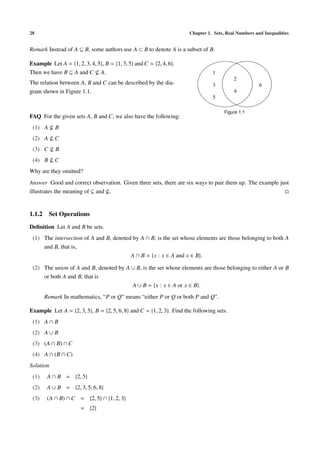
Then we have B ⊆ A and C A.                                                     1
                                                                                          2
The relation between A, B and C can be described by the dia-                    3                     6
gram shown in Figure 1.1.                                                                 4
                                                                                5

                                                                                      Figure 1.1
FAQ For the given sets A, B and C, we also have the following:
 (1) A     B
 (2) A     C
 (3) C     B
 (4) B     C
Why are they omitted?
Answer Good and correct observation. Given three sets, there are six ways to pair them up. The example just
illustrates the meaning of ⊆ and .


1.1.2 Set Operations
Definition Let A and B be sets.
 (1) The intersection of A and B, denoted by A ∩ B, is the set whose elements are those belonging to both A
     and B, that is,
                                         A ∩ B = {x : x ∈ A and x ∈ B}.

 (2) The union of A and B, denoted by A ∪ B, is the set whose elements are those belonging to either A or B
     or both A and B, that is
                                        A ∪ B = {x : x ∈ A or x ∈ B}.
       Remark In mathematics, “P or Q” means “either P or Q or both P and Q”.

Example Let A = {2, 3, 5}, B = {2, 5, 6, 8} and C = {1, 2, 3}. Find the following sets.
 (1) A ∩ B
 (2) A ∪ B
 (3) (A ∩ B) ∩ C
 (4) A ∩ (B ∩ C)
Solution
 (1)    A ∩ B = {2, 5}
 (2)    A ∪ B = {2, 3, 5, 6, 8}
 (3)    (A ∩ B) ∩ C = {2, 5} ∩ {1, 2, 3}
                      = {2}
1.1. Sets                                                                                                     29


 (4)    A ∩ (B ∩ C) = {2, 3, 5} ∩ {2}
                       = {2}

Note Given any sets A, B and C, we always have

                      (A ∩ B) ∩ C = A ∩ (B ∩ C)          and         (A ∪ B) ∪ C = A ∪ (B ∪ C).

Thus we may write A ∩ B ∩ C and A ∪ B ∪ C without ambiguity. We say that set intersection and set union are
associative.

Definition Let A and B be sets. The relative complement of B in A, denoted by A  B or A − B (read “A setminus
(or minus) B”), is the set whose elements are those belonging to A but not belonging to B, that is,

                                                A  B = {x ∈ A : x     B}.

Example Let A = {a, b, c} and B = {c, d, e}. Then we have A  B = {a, b}.

   For each problem, we will consider a set that is “large” enough, containing all objects under consideration.
Such a set is called a universal set and is usually denoted by U. In this case, all sets under consideration are
subsets of U and they can be written in the form {x ∈ U : P(x)}.

Example In considering addition and subtraction of whole numbers (0, 1, 2, 3, 4, . . .), we may use Z (the set of
all integers) as a universal set.
 (1) The set of all positive even numbers can be written as {x ∈ Z : x > 0 and x is divisible by 2}.
 (2) The set of all prime numbers can be written as {x ∈ Z : x > 0 and x has exactly two divisors}.

Definition Let U be a universal set and let B be a subset of U. Then the set U  B is called the complement of
B (in U) and is denoted by B (or Bc ).

Example Let U = Z+ , the set of all positive integers. Let B be the set of all positive even numbers. Then B is
the set of all positive odd numbers.

Example Let U = {1, 2, 3, . . . , 12} and let

                                       A = {x ∈ U : x is a prime number}
                                       B = {x ∈ U : x is an even number}
                                      C = {x ∈ U : x is divisible by 3}.

Find the following sets.
 (1) A ∪ B
 (2) A ∩ C
 (3) B ∩ C
 (4) (A ∪ B) ∩ C
 (5) (A ∩ C) ∪ (B ∩ C)
30                                                                            Chapter 1. Sets, Real Numbers and Inequalities


 (6) (A ∪ B)
 (7) A ∩ B
Solution Note that
                                                   A = {2, 3, 5, 7, 11}
                                                   B = {2, 4, 6, 8, 10, 12}
                                                   C = {3, 6, 9, 12}.

 (1)        A ∪ B = {2, 3, 4, 5, 6, 7, 8, 10, 11, 12}
 (2)        A ∩ C = {3}
 (3)        B ∩ C = {6, 12}
 (4)        (A ∪ B) ∩ C = {2, 3, 4, 5, 6, 7, 8, 10, 11, 12} ∩ {3, 6, 9, 12}
                           = {3, 6, 12}
 (5)        (A ∩ C) ∪ (B ∩ C) = {3} ∪ {6, 12}
                                  = {3, 6, 12}
 (6)        (A ∪ B)    = {2, 3, 4, 5, 6, 7, 8, 10, 11, 12}
                       = {1, 9}
 (7)        A ∩B      = {1, 4, 6, 8, 9, 10, 12} ∩ {1, 3, 5, 7, 9, 11}
                      = {1, 9}

Remark In the above example, we have

                           (A ∪ B) = A ∩ B            and       (A ∪ B) ∩ C = (A ∩ C) ∪ (B ∩ C).

In fact, these equalities are true in general.


Venn Diagrams
                                                                                A                                    U
A Venn diagram is a very useful and simple device to rep-
resent sets graphically.

In a Venn diagram, the universal set U is usually repre-
sented by a rectangle. Inside this rectangle, subsets of the                                                   C
universal set are represented by circles, rectangles, or some
other geometrical figures.
                                                                                            B
                                                                                                Figure 1.2
         We can use Venn diagrams to obtain useful formulas for set operations.
     •     In Figure 1.3(a), the portion shaded by horizontal lines represents A ∪ B and that by vertical lines repre-
           sents C; thus the portion shaded by both horizontal and vertical lines represents (A ∪ B) ∩ C.
     •     In Figure 1.3(b), the portion shaded by horizontal lines represents A ∩ C and that by vertical lines repre-
           sents B ∩ C; thus the portion shaded by vertical or horizontal lines represents (A ∩ C) ∪ (B ∩ C).
1.1. Sets                                                                                                    31


                 A                                     U                   A                            U


                                                C                                                   C

                 B                                                          B

                         Figure 1.3(a)                                              Figure 1.3(b)


    From the two figures, we see that

                                            (A ∪ B) ∩ C = (A ∩ C) ∪ (B ∩ C).

Venn diagrams help us in a visual way to identify the above formulas. However, in order to prove these formulas
in a rigorous manner, one should use formal mathematical logic.

Proof Using definition of set operations, we have

                          x ∈ (A ∪ B) ∩ C ⇐⇒ x ∈ A ∪ B and x ∈ C
                                                    ⇐⇒ (x ∈ A or x ∈ B) and x ∈ C
                                                    ⇐⇒ (x ∈ A and x ∈ C) or (x ∈ B and x ∈ C)
                                                    ⇐⇒ (x ∈ A ∩ C) or (x ∈ B ∩ C)
                                                    ⇐⇒ x ∈ (A ∩ C) ∪ (B ∩ C)

This means that every element of (A ∪ B) ∩ C is also an element of (A ∩ C) ∪ (B ∩ C) and vice versa. Thus the
two sets are equal.

Remark For more than three subsets of U, observations obtained from Venn diagrams may not be correct. For
four subsets, we need to draw 3-dimensional Venn diagrams.

Exercise 1.1
   1. Let A = {x ∈ U : x ≤ 10}, B = {x ∈ U : x is a prime number} and C = {x ∈ U : x is an even number},
      where U = {1, 2, 3, . . . , 19} is the universal set. Find the following sets.
          (a)    A∩B                     (b)        A∩C
          (c)    B∩C                     (d)        A∪B
          (e)    A∪C                      (f)       B∪C
          (g)    A∪ B∪C                  (h)        A∩ B∩C
           (i)   (A ∪ B) ∩ C              (j)       (A ∩ B) ∪ C
          (k)    A∩B                      (l)       A ∩B
  ∗ 2.   Let A, B and C be subsets of a universal set U. For each of the following statements, determine whether
         it is true or not.
32                                                                           Chapter 1. Sets, Real Numbers and Inequalities


       (a)   A−B= A ∩B
       (b)   (A ∪ B) ∩ C = A ∪ (B ∩ C)
       (c)   (A ∪ B ) ∩ B = B − A
      A statement above is true means that it is true for all possible choices of A, B, C and U. To show that
      the statement is false, it is enough to give a counterexample. To show that it is true, you can draw a Venn
      diagram to convince yourself; but to be more rigorous, you should use formal mathematical logic.


1.2 Real Numbers
1.2.1 The Number Systems
 (1) The numbers 0, 1, 2, 3, . . . are called natural numbers. The set of all natural numbers is denoted by N,
     that is,
                                                   N = {0, 1, 2, 3, . . .}.

      Remark The three dots “. . .” means that the pattern is repeated indefinitely.

      FAQ In some books, N is defined to be {1, 2, 3, . . .}. Which one should we follow?

      Answer Some authors do not include 0 in N. This is just a convention; once we know the definition, it
      will not cause any problem.

 (2) The numbers 0, 1, −1, 2, −2, . . . are called integers. The set of all integers is denoted by Z, that is,

                                           Z = {· · · , −3, −2, −1, 0, 1, 2, 3, · · · }.

                              p
 (3) Numbers in the form where p, q ∈ Z and q                  0 are called rational numbers. The set of all rational
                          q
     numbers is denoted by Q, that is,
                                                 p
                                         Q=          : p, q are integers, and q        0.
                                                 q

                                                                                                                         2
      Note Z ⊆ Q, that is, every integer is a rational number. For example, the integer 2 can be written as
                                                                                                            1
      and is therefore a rational number.
                                                                                                         3
      All rational numbers can be represented by decimal numbers that terminate, such as                     = 0.75, or by
                                                                                                         4
                                                              4
      non-terminating but repeating decimals, such as             = 0.363636 · · · .
                                                             11
      Numbers that can be represented by non-terminating and non-repeating decimals are called irrational
                                  √
      numbers. For example, π and 2 are irrational numbers. The following shows the first 50 decimals of π:

                       π = 3.14159265358979323846264338327950288419716939937511 . . .

      Remark The proof for the fact that π is irrational is difficult.
 (4) Rational numbers together with irrational numbers are called real numbers. The set of all real numbers
     is denoted by R.
1.2. Real Numbers                                                                                            33


    In R, we have the algebraic operations +, × (and −, ÷ also) as well as binary relations <, ≤, >, ≥. Numbers
greater than (respectively smaller than) 0 are called positive (respectively negative).

Real Number Line Real numbers can be represented by points on a line, called the real number line.


                             |            |            |             |                 >
                            −1            0            1            2
                                                   Figure 1.4


Notation The following nine types of subsets of R are called intervals:

                                          [a, b] = {x ∈ R : a ≤ x ≤ b}                                   (1.2.1)
                                          (a, b) = {x ∈ R : a < x < b}                                   (1.2.2)
                                          [a, b) = {x ∈ R : a ≤ x < b}                                   (1.2.3)
                                          (a, b] = {x ∈ R : a < x ≤ b}                                   (1.2.4)
                                         [a, ∞) = {x ∈ R : a ≤ x}                                        (1.2.5)
                                         (a, ∞) = {x ∈ R : a < x}                                        (1.2.6)
                                       (−∞, b] = {x ∈ R : x ≤ b}                                         (1.2.7)
                                       (−∞, b) = {x ∈ R : x < b}                                         (1.2.8)
                                      (−∞, ∞) = R                                                        (1.2.9)

where a and b are real numbers with a < b and ∞ and −∞ (read “infinity” and “minus infinity”) are just symbols
but not real numbers.

FAQ What are the meaning of ∞ and −∞?

Answer Intuitively, you may imagine that there is a point, denoted by ∞, very far away on the right (and −∞
on the left). So (a, ∞) is the set whose elements are the points between a and ∞, that is, real numbers greater
than a.

Remark The notation (a, b), where a < b, has two different meanings. It denotes an ordered pair as well as an
interval. To avoid ambiguity, some authors use ]a, b[ to denote the open interval {x ∈ R : a < x < b}. In this
course, we will not use this notation. Readers can determine the meaning from the context.

Terminology
  •   Intervals in the form (a, b), [a, b], (a, b] and [a, b) are called bounded intervals and those in the form
      (−∞, b), (−∞, b], (a, ∞), [a, ∞) and (−∞, ∞) are called unbounded intervals.
  •   Intervals in the form (a, b), (−∞, b), (a, ∞) and (−∞, ∞) are called open intervals. For each of such
      intervals, the endpoint(s), if there is any, does not belong to the interval.
  •   Intervals in the form [a, b], (−∞, b], [a, ∞) and (−∞, ∞) are called closed intervals. For each of such
      intervals, the endpoint(s), if there is any, belongs to the interval.
  •   Intervals in the form [a, b] are called closed and bounded intervals.
34                                                                       Chapter 1. Sets, Real Numbers and Inequalities


     •   A set {a} with exactly one element of R is called a degenerated interval (its length is 0).
     •   Some authors also include ∅ as an interval (called the empty interval).
In this course, an interval means a nonempty, non-degenerated interval, that is, an infinite subset of R that can
be written in the form (1.2.1), (1.2.2), (1.2.3), (1.2.4), (1.2.5), (1.2.6), (1.2.7), (1.2.8) or (1.2.9).

Example For each of the following pairs of intervals A and B,
 (1) A = [1, 5] and B = (3, 10]
 (2) A = [−2, 3] and B = (7, 11]
 (3) A = [−7, −2) and B = [−2, ∞)
 • determine whether it is (i) an open interval, (ii) a closed interval , (iii) a bounded interval;
 • find A ∩ B and determine whether it is an interval.
 • find A ∪ B and determine whether it is an interval.

Solution
 (1)      Both A and B are not open intervals.
          A is a closed interval but B is not a closed interval.
          Both A and B are bounded intervals.
          A ∩ B = (3, 5]; it is an interval.
          A ∪ B = [1, 10]; it is an interval.
 (2)      Both A and B are not open intervals.
          A is a closed interval but B is not a closed interval.
          Both A and B are bounded intervals.
          A ∩ B = ∅; it is not an interval.
          A ∪ B = [−2, 3] ∪ (7, 11]; it is not an interval.
 (3)      Both A and B are not open intervals.
          B is a closed interval but A is not a closed interval.
          A is a bounded interval but B is not a bounded interval.
          A ∩ B = ∅; it is not an interval.
          A ∪ B = [−7, ∞); it is an interval.


1.2.2 Radicals
Definition
 (1) Let a and b be real numbers and let q be a positive integer. If aq = b, we say that a is a qth root of b.

         Example
         (a) −2 is the cube root of −8.
         (b) 3 and −3 are the square roots of 9.
1.2. Real Numbers                                                                                                35


      Note
       (a) If q is odd, then every real number has a unique qth root.
      (b) If q is even, then
             (i) every positive real number has two qth roots;
             (ii) negative real numbers do not have qth root;
           (iii) the qth root of 0 is 0.
                                                                                                           √
                                                                                                           q
 (2) Let b be a real number and let q be a positive integer. The principal qth root of b, denoted by           b, is
     defined as follows:
                      √q
      (a) if q is odd, b is the unique qth root of b;
      (b) if q is even,
                 √
                 q
            (i) b is the positive qth root of b if b > 0;
                 √
                 q
           (ii) b is undefined b if b < 0;
                 √
                 q
          (iii) b is 0 if b = 0.
                    √                       √
      When q = 2, 2 x is simply written as x.
                          √
      FAQ Can we write 4 = ±2 ?
                                          √
      Answer According to the definition, 4 is the principle square root of 4, which is the positive real number
                                 √
      whose square is 4. That is, 4 = 2.

      FAQ In solving x2 = 4, we get x = ±2. Is this different from the above question?
                      √
      Answer To find 4 is different from solving x2 = 4.
          √
       (a) 4 is a uniquely defined real number.
      (b) To solve x2 = 4 is to find real numbers whose square is 4. There are two such numbers, namely 2
          and −2.
      Don’t mix up the two questions.

      Example
           √
           4
       (a)   81 = 3
           √
           3
       (b)   −8 = −2
           √        √
                    2
       (c)   25 = 25 = 5
           √      √
                  2
       (d)   0= 0=0
           √
           6
       (e)   −3 is undefined.
                                   √
                                   q
      Terminology The symbol           b is called a radical (q is called the index and b the radicand).
            √
      FAQ Is a2 = a always true?
                                                                      √
      Answer It is true if (and only if) a ≥ 0. If a < 0, we have         a2 = −a.
36                                                                                                   Chapter 1. Sets, Real Numbers and Inequalities


 (3) Let b be a positive real number. Let p and q be integers where q > 0. We define
                                                                                    p    √
                                                                                         q
                                                                                bq =       bp,
                                     √
                                     q       p
        which is the same as             b .

                       2     √
                             3           √
                                         3
        Example 8 3 =            82 =        64 = 4
                                                      2        √
                                                               3       2
        Remark Equivalently, we have 8 3 =                         8       = 22 = 4.

FAQ Are the rules for exponents on page 1 valid if m and n are rational numbers?

Answer The rules remain valid for rational exponents, provided that the base is positive (this is required in the
               p
definition of b q ). For example, we have b s bt = b s+t , where b > 0 and s, t ∈ Q.
                      m              p
Proof Write s =            and t =       where m, n, p, q are integers with q, n > 0. Note that
                      n              q

                                                  mq                       np                             mq + np
                                             s=      ,         t=                       and    s+t =              .
                                                  nq                       nq                               nq

By definition (equivalent form), we have
                                                          √
                                                          nq       mq                                √
                                                                                                     nq       np
                                                 bs =      b                    and           bt =        b        .
               √
               nq
Denote α =          b. Then we have
                                                               b s · bt = αmq · αnp
                                                                                = αmq+np
                                                                                = αnq(s+t)
                                                                                              s+t
                                                                                =       αnq
                                                                                = b s+t

FAQ Can we define b raising to an irrational power? For example, can we define 2π ? How?

Answer This is deep question. The idea will be discussed Chapter 8.

Exercise 1.2
     1. Find the following sets.
         (a)   {x ∈ R : x2 = 2}
         (b)   {x ∈ R : x ≥ 0 and x2 = 2}
         (c)   {x ∈ Q : x2 = 2}
     2. Let A = [1, 5], B = [3, 9), C            = {1, 5} and D = [5, ∞). Find
         (a) A ∩ B                                (b) A ∪ B
         (c) A − C                                (d) B ∩ C
         (e) C − B                                 (f) B − C
         (g) B − (B − C)                          (h) A ∪ D
          (i) C ∩ D
1.3. Solving Inequalities                                                                                       37


1.3     Solving Inequalities
An inequality in one unknown x can be written in one of the following forms:
 (1) F(x) > 0
 (2) F(x) ≥ 0
 (3) F(x) < 0
 (4) F(x) ≤ 0
where F is a function from a subset of R into R.

Definition Consider an inequality in the form F(x) > 0 (the other cases can be treated similarly).
 (1) A real number x0 satisfying F(x0 ) > 0 is called a solution to the inequality.
 (2) The set of all solutions to the inequality is called the solution set to the inequality.
To solve an inequality means to find all the solutions to the inequality, or equivalently, to find the solution set.
    In this section, we consider polynomial inequalities

                            an xn + an−1 xn−1 + · · · + a1 x + a0 < 0 (or > 0, or ≤ 0, or ≥ 0)              (1.3.1)

where n ≥ 1 and an          0.
    When n = 1, (1.3.1) is a linear inequality. A revision for solving linear inequalities is given in Chapter 0.
In the following examples, we consider several linear inequalities simultaneously.

Example Find the solution set to the following compound inequality:

                                                     1 ≤ 3 − 2x ≤ 9

Solution The inequality means
                                          1 ≤ 3 − 2x      and      3 − 2x ≤ 9.
Solving them separately, we get

                                          2x ≤ 2                      −6 ≤ x
                                                          and
                                           x ≤ 1                      −3 ≤ x.

The solution set is {x ∈ R : x ≤ 1 and − 3 ≤ x} = {x ∈ R : −3 ≤ x ≤ 1}.
Remark Using interval notation, the solution set can be written as [−3, 1].

Example Find the solution set to the following:

                                            2x + 1 < 3 and 3x + 10 < 4.

Give your answer using interval notation.
Solution Solving the inequalities separately, we get

                                         2x < 2                    3x < −6
                                                          and
                                          x < 1                     x < −2.
38                                                                     Chapter 1. Sets, Real Numbers and Inequalities


      Therefore, we have
                                       solution set = {x ∈ R : x < 1 and x < −2}
                                                    = {x ∈ R : x < −2}
                                                    = (−∞, −2).

      Example Find the solution set to the following:

                                               2x + 1 > 9 and 3x + 4 < 10

      Solution Solving the inequalities separately, we get

                                             2x > 8                     3x < 6
                                                             and
                                              x > 4                      x < 2.
      The solution set is {x ∈ R : x > 4 and x < 2} = ∅.

      1.3.1 Quadratic Inequalities
      A quadratic inequality (in one unknown) is an inequality that can be written in the form

                                       ax2 + bx + c < 0 (or > 0, or ≤ 0, or ≥ 0)                                   (1.3.2)

      where a    0. This corresponds to n = 2 in (1.3.1).
         We use an example to describe three methods for solving quadratic inequalities. The first two methods
      make use of the following properties of real numbers.
       (1) α > 0 and β > 0 =⇒ α · β > 0
       (2) α < 0 and β < 0 =⇒ α · β > 0
       (3) α > 0 and β < 0 =⇒ α · β < 0
      From these we get
       (4) α · β > 0 ⇐⇒ (α > 0 and β > 0) or (α < 0 and β < 0)
       (5) α · β < 0 ⇐⇒ (α > 0 and β < 0) or (α < 0 and β > 0)

      Example Find the solution set to the inequality x2 + 2x − 15 > 0.
      Solution

(Method 1) First we factorize the quadratic polynomial:

                                                        x2 + 2x − 15 > 0
                                                       (x + 5)(x − 3) > 0,
            and then apply Property (4):

                                   (x + 5 > 0 and x − 3 > 0)       or   (x + 5 < 0 and x − 3 < 0)
                                           (x > −5 and x > 3)      or   (x < −5 and x < 3)
                                                        x>3        or   x < −5
            The solution set is {x ∈ R : x < −5 or x > 3} = (−∞, −5) ∪ (3, ∞).
1.3. Solving Inequalities                                                                                           39


(Method 2) By factorization, we have
                                                          L.S . = (x + 5)(x − 3).
              The left-side is zero when x = −5 or 3. These two points divide the real number line into three intervals:

                                                  (−∞, −5),        (−5, 3),        (3, ∞).

              In the following table, the first two rows give the signs of (x + 5) and (x − 3) on each of these intervals.
              Hence, using Properties (1), (2) and (3), we obtain the signs of (x + 5)(x − 3) in the third row.

                                                 x < −5        x = −5    −5 < x < 3          x=3          x>3
                                  x+5               −             0            +              +           +
                                  x−3               −             −            −              0           +
                              (x + 5)(x − 3)        +             0            −              0           +

              The solution set is (−∞, −5) ∪ (3, ∞).

              Remark To determine the sign of (x + 5), first we note that it is 0 when x = −5. Since (x + 5) increases as
              x increases, it is positive when x > −5 and negative when x < −5.

(Method 3) The graph of y = x2 + 2x − 15 is a parabola opening upward
           and it cuts the x-axis at x1 = −5 and x2 = 3. To solve the                        y = x2 + 2x − 15
                                                                                                              5
           inequality x2 + 2x − 15 > 0 means to find all x such that
           the corresponding points on the parabola has y-coordinates                  -6      -4    -2           2   4
                                                                                                           -5
           greater than 0. From the graph, we see that the parabola is
           above the x-axis if and only if x < −5 or x > 3. Therefore,
                                                                                                          -15
           the solution set is (−∞, −5) ∪ (3, ∞).
                                                                                                     Figure 1.5


      1.3.2     Polynomial Inequalities with degrees ≥ 3
      In this section, we consider polynomial inequalities (1.3.1) of degree n ≥ 3. To solve such polynomial inequal-
      ities, for example p(x) > 0, we can use methods similar to that for quadratic inequalities. The first step is to
      factorize p(x).

      Example Factorize the polynomial p(x) = x3 + 3x2 − 4x − 12.
      Solution First we try to find a factor of the form (x − c) where c is an integer. For this, we try

                                                  c = ±1, ±2, ±3, ±4, ±6, ±12.

      Direct substitution gives p(2) = 0 and so (x − 2) is a factor of p(x). Using long division, we obtain

                                           x3 + 3x2 − 4x − 12 = (x − 2)(x2 + 5x + 6)

      and then using inspection we get

                                           x3 + 3x2 − 4x − 12 = (x − 2)(x + 2)(x + 3).


          In the above procedure, we make use of the following
40                                                                       Chapter 1. Sets, Real Numbers and Inequalities


Theorem 1.3.1 Let
                                     p(x) = cn xn + cn−1 xn−1 + · · · + c1 x + c0
be a polynomial of degree n where c0 , c1 , . . . , cn ∈ Z. Suppose (ax − b) is a factor of p(x) where a, b ∈ Z. Then
a divides cn and b divides c0 .

FAQ Can we use Factor Theorem to find all the linear factors?
Answer If some linear factors are repeated more than once, we can’t determine which one is repeated (and also
how many times?). For example, let p(x) = x3 − 3x + 2. Using Factor Theorem, we get linear factors (x − 1)
and (x + 2). It is incorrect to write p(x) = (x − 1)(x + 2). Indeed, we have

                                              p(x) = (x − 1)2 (x + 2).

Remark We say that (x − 1) is a factor of p(x) repeated twice.

Example Find the solution set to the inequality x3 + 3x2 − 4x − 12 ≤ 0.
Solution Factorizing the polynomial p(x) on the left side we obtain

                                p(x) = x3 + 3x2 − 4x − 12 = (x − 2)(x + 2)(x + 3).

The sign of p(x) can be determined from the following table:

                     x < −3       x = −3    −3 < x < −2       x = −2     −2 < x < 2        x=2        2<x
         x−2            −            −            −              −            −              0            +
         x+2            −            −            −              0            +              +            +
         x+3            −            0            +              +            +              +            +
          p(x)          −            0            +              0            −              0            +

The solution set is {x ∈ R : x ≤ −3 or − 2 ≤ x ≤ 2} = (−∞, −3] ∪ [−2, 2].

FAQ Can we use Method 1 described in Section 1.3.1?
Answer You can use that method. However the “and/or” logic is more complicated. If the degree of the
polynomial is 3, there are 4 cases; if the degree is 4, there are 8 cases. The number of cases doubles if the
degree increases by 1.
    For the table method, if the degree increases by 1, the number of factors and the number of intervals increase
by (at most) 1 only.

FAQ Can we use graphical method?

Answer If you know the graph of y = x3 + 3x2 − 4x − 12,                   y = x3 + 3x2 − 4x − 12
                                                                                                 10
you can write down the solution immediately. For that,
                                                                                                 5
you need to know the x-intercepts (obtained by factoring
the polynomial) and also the shape of the graph (on which                -4   -3    -2     -1         1       2
                                                                                                -5
interval is the graph going up or down?). This will be dis-
                                                                                                -10
cussed in Chapter 5.
                                                                                         Figure 1.6
1.3. Solving Inequalities                                                                          41


Exercise 1.3
   1. Solve the following inequalities:
         (a)       2x − 3 ≥ 4 + 7x               (b)   8(x + 1) − 2 < 5(x − 6) + 7
                   x2 − 3x + 7
         (c)                   <1                (d)   (2x + 7)(5 − 11x) ≤ 0
                      x2 + 1
         (e)       x2 − 2x − 3 < 0               (f)   2x2 − 3x > 4
                                                       2x + 3
        (g)        2x2 − 3x < −4                 (h)          ≥0
                                                        x−4
                   2x + 3
         (i)              <1
                    x−4
               a
       Note:   b   < 0 is equivalent to a · b < 0.

   2. Factorize the following polynomials:
        (a)        2x3 + 7x2 − 15x                     (b)    2x3 + 3x2 − 2x − 3
        (c)        x3 − x 2 − x − 2                    (d)    x4 − 3x3 − 13x2 + 15x
        (e)        x4 − 3x3 + x2 + 3x − 2               (f)   x4 − x3 + x2 − 3x + 2
   3. Solve the following inequalities:
        (a)        (x − 4)(9 − 5x)(2x + 3) < 0                   (b)    (x − 3)(2x + 1)2 ≤ 0
        (c)        x3 − 2x2 − 5x + 6 < 0                         (d)    −2x3 + x2 + 15x − 18 ≤ 0
        (e)        x3 − x2 − 5x − 3 > 0                           (f)   x3 + 3x2 + 5x + 3 ≤ 0
        (g)        x4 + 2x3 − 13x2 − 14x + 24 > 0                (h)    6x4 + x3 − 15x2 ≤ 0
42   Chapter 1. Sets, Real Numbers and Inequalities
Chapter 2

Functions and Graphs

2.1    Functions
Informal definition Let A and B be sets. A function from A into B, denoted by f : A −→ B, is a “rule” that
assigns to each element of A exactly one element of B.

Remark If the sets A and B are understood (or are not important for the problem under consideration), instead
of saying “a function from A into B”, we simply say “a function” and instead of writing f : A −→ B, we simply
write f .

Terminology and Notation The sets A and B are called the domain and codomain of f respectively. The domain
of f is denoted by dom ( f ).

FAQ In the above informal definition, what is the meaning of a rule?

Answer It is difficult to tell what a rule is. The above informal definition describes the idea of a function. There
is a rigorous definition. However, it involves more definitions and notations. Interested readers may consult
books on set theory or foundation of mathematics.

Notation & Terminology Let f be a function. For each x belonging to the domain of f , the corresponding
element (in the codomain of f ) assigned by f is denoted by f (x) and is called the image of x under f .

Remark Some people write f (x) to denote a function. This notation may be misleading because it also means
an image. However, sometimes for convenience, such notations are used. For example, we write x2 to denote
the square function, that is, the function f (from R into R) given by f (x) = x2 .

    In this course, most of the functions we consider are functions whose domains and codomains are subsets
of R. A variable that represents the “input numbers” for a function is called an independent variable. A variable
that represents the “output numbers” is called a dependent variable because its value depends on the value of
the independent variable.

Example Consider the function f : R −→ R given by

                                                 f (x) = x2 + 2.
44                                                                                   Chapter 2. Functions and Graphs


We may also write y = x2 + 2 to represent this function. For each input x, the function gives exactly one output
x2 + 2, which is y. If x = 3, then y = 11; if x = 6, then y = 38 etc. The independent variable is x and the
dependent variable is y.

Example Let g(x) = x2 − 3x + 7. Find the following:
 (1) g(10)
 (2) g(a + 1)
 (3) g(r2 )
 (4) g(x + h)
       g(x + h) − g(x)
 (5)
              h
Solution
 (1)     g(10) = 102 − 3(10) + 7
               = 77
 (2)     g(a + 1) = (a + 1)2 − 3(a + 1) + 7
                  = (a2 + 2a + 1) − 3a − 3 + 7
                  = a2 − a + 5
 (3)     g(r2 ) = (r2 )2 − 3(r2 ) + 7
                = r4 − 3r2 + 7
 (4)     g(x + h) = (x + h)2 − 3(x + h) + 7
                  = x2 + 2xh + h2 − 3x − 3h + 7
         g(x + h) − g(x)            [(x + h)2 − 3(x + h) + 7] − (x2 − 3x + 7)
 (5)                              =
                h                                       h
                                    (x 2 + 2xh + h2 − 3x − 3h + 7) − (x2 − 3x + 7)
                                  =
                                                           h
                                    2xh + h  2 − 3h
                                  =
                                           h
                                  = 2x + h − 3

Exercise 2.1
                       x−5
     1. Let f (x) =           .   Find the following:
                       x2 + 4
         (a)   f (2)                  (b) f (3.5)
                                              √
         (c)   f (a + 1)              (d) f ( a)
         (e)   f (a2 )                 (f) f (a) + f (1)
                        x                √
     2. Let f (x) =          and g(x) = x − 1. Find the following:
                       x+1
         (a)   f (1) + g(1)                        (b)   f (2)g(2)
               f (3)
         (c)                                       (d)   f (a − 1) + g(a + 1)
               g(3)

         (e)   f (a2 + 1)g(a2 + 1)
2.2. Domains and Ranges of Functions                                                                            45


   3. Let f (x) = x2 − 3x + 4. Find and simplify the following:
                                             f (1 + h) − f (1)
        (a)   f (a + b)                (b)
                                                     h
              f (a + h) − f (a)
        (c)
                      h


2.2    Domains and Ranges of Functions
To describe a function f , sometimes we just write down the rule defining f , omitting its domain and codomain.
  •   In this course, the codomain is always taken to be R unless otherwise stated.
                                                                                                           √
  •   For the domain, it can be determined from the rule defining the function. For example, f (x) = x is
      defined for all real numbers x ≥ 0 but undefined for x < 0. Therefore, we may take [0, ∞) as the domain
      of f . The domain obtained in this way is called the natural domain of the function. For a function that is
      described by formula, we always take its domain to be the natural domain unless otherwise stated.

Summary Suppose f is a function described by a formula. Then the domain of f is the set of all real numbers
x such that f (x) is defined.

Remark For functions appeared in many applied problems, we do not take their natural domains. For example,
the area A of a circle (to be more accurate, a circular region) with radius r is given by A(r) = πr2 . Although πr2
is defined for all real numbers r, for the area function A, its domain is taken to be {r ∈ R : r > 0} = (0, ∞).

FAQ For the above area function, can we take the domain to be [0, ∞)?

Answer When the radius is 0, we get a point only. A point may be considered to be a circle, called a degenerated
circle. Under this convention, 0 is included in the domain. In many problems, it doesn’t matter whether we
take (0, ∞) or [0, ∞) as the domain.

Example For each of the following functions, find its (natural) domain.
 (1) f (x) = x2 + 3;
             1
 (2) g(x) =     ;
           x−2
           √
 (3) h(x) = 1 + 5x

Solution
 (1) Since f (x) = x2 + 3 is defined for all real numbers x, the domain of f is R.

 (2) Note that g(x) is defined for all real numbers x except 2.
      The domain of g is {x ∈ R : x     2} = R  {2}.
     Remark The domain can also be written as {x ∈ R : x < 2 or x > 2} = (−∞, 2) ∪ (2, ∞).
              √
 (3) Note that 1 + 5x is defined if and only if 1 + 5x ≥ 0.
                                                                      1
      The domain of h is {x ∈ R : 1 + 5x ≥ 0} = {x ∈ R : x ≥ − }
                                                                      5
                                                                 1
                                                     = [− , ∞).
                                                                 5
46                                                                                 Chapter 2. Functions and Graphs


Definition Let f : A −→ B be a function and let S ⊆ A. The image of S under f , denoted by f [S ], is the
subset of B given by
                              f [S ] = {y ∈ B : y = f (x) for some x ∈ S }.

Note f [S ] is the subset of B consisting of all the images under f of elements in S .

Example
 (1) Let f : R −→ R be the function given by f (x) = x2 . For S = {1, 2, 3}, we have f [S ] = {1, 4, 9}.
 (2) Let f : R −→ R be the function given by f (x) = 2x + 1. For S = [0, 1], we have f [S ] = [1, 3].

Definition Let f : A −→ B be a function. The range of f , denoted by ran ( f ), is the image of A under f , that
is, ran ( f ) = f [A].

Remark By definition, ran ( f ) = {y ∈ B : y = f (x) for some x ∈ A}. The condition
 (∗) y = f (x) for some x ∈ A
means that y is an output (image) corresponding to some input (element of A). When A and B are subsets of R,
(∗) means that the equation
                                                   y = f (x)

has at least one solution belonging to A.

Example Let f : R −→ R be the function given by f (x) = x2 + 2. Then
 (1) 3 belongs to the range of f because f (1) = 3, that is, 3 is the image of 1 under f . In terms of solving
     equation, 3 belongs to the range means that the equation 3 = x2 + 1 has solution in R (the domain of f ).
     Indeed, the equation has two solutions in R, namely 1 and −1;
 (2) 2 belongs to the range because the equation 2 = x2 + 2 has solution in R, namely, 0;
 (3) 1 does not belong to the range because the equation 1 = x2 + 2 has no solution in R.

Steps to find range of function To find the range of a function f described by formula, where the domain is
taken to be the natural domain:
 (1) Put y = f (x).
 (2) Solve x in terms of y.
 (3) The range of f is the set of all real numbers y such that x can be solved.

Example For each of the following functions, find its range.
 (1) f (x) = x2 + 2
               1
 (2) g(x) =
             x−2
             √
 (3) h(x) = 1 + 5x
Solution
 (1) Put y = f (x) = x2 + 2.
2.2. Domains and Ranges of Functions                                                                                      47


      Solve for x.    x2 = y − 2
                       x = ± y − 2.
      Note that x can be solved if and only if y − 2 ≥ 0.
      The range of f is {y ∈ R : y − 2 ≥ 0} = {y ∈ R : y ≥ 2}                                    10

                                                                                                 8
                                                     = [2, ∞).
                                                                                                 6

      Alternatively, to see that the range is [2, ∞), we may                                     4

      use the graph of y = x2 + 2 which is a parabola. The                                       2

      lowest point (vertex) is (0, 2). For any y ≥ 2, we can
                                                                                                          1       2   3
      always find x ∈ R such that f (x) = y.
                                                                              -3   -2       -1

                                                                                             Figure 2.1


                        1
 (2) Put y = g(x) =        .                                              4
                       x−2
                                       1
      Solve for x.          y =                                           2
                                      x−2
                                      1
                      x−2 =
                                      y
                                                                               1   2    3
                                      1
                                                                     -1
                            x =           + 2.
                                      y
                                                                         -2
      Note that x can be solved if and only if y           0.
      The range of g is {y ∈ R : y         0} = R  {0}.                 -4

                                                                              Figure 2.2

                   √
 (3) Put y = h(x) = 1 + 5x. Note that y cannot be negative.
                           √
     Solve for x.   y =      1 + 5x,     y≥0
                      y2 = 1 + 5x,                y≥0                4
                                  2
                                 y −1
                       x =            ,           y ≥ 0.
                                   5                                 3

      Note that x can always be solved for every y ≥ 0.              2
      The range of h is {y ∈ R : y ≥ 0} = [0, ∞).
                                                                     1
                  √
      Remark y = 1 + 5x =⇒ y2 = 1 + 5x
      but the converse is true only if y ≥ 0.                                      1              2           3

                                                                                   Figure 2.3

                       √          √
Example Let f (x) =        x + 7 − x2 + 2x − 15. Find the domain of f .

Solution Note that f (x) is defined if and only if x + 7 ≥ 0 and x2 + 2x − 15 ≥ 0.
Solve the two inequalities separately:
  •    x+7 ≥ 0
         x ≥ −7;
48                                                                                                            Chapter 2. Functions and Graphs


     •       x2 + 2x − 15 ≥ 0
            (x + 5)(x − 3) ≥ 0                                        x < −5       x = −5           −5 < x < 3      x=3        x>3
                                                  x−3                   −               −               −             0          +
                                                  x+5                   −               0               +             +          +
                                          (x − 3)(x + 5)                +               0               −             0          +

           thus, x ≤ −5 or x ≥ 3.

         Therefore, we have dom ( f ) = {x ∈ R : x ≥ −7 and (x ≤ −5 or x ≥ 3)}
                                           = {x ∈ R : (x ≥ −7 and x ≤ −5) or (x ≥ −7 and x ≥ 3)}
                                           = {x ∈ R : −7 ≤ x ≤ −5 or x ≥ 3}
                                           = [−7, −5] ∪ [3, ∞).

                           2x + 1
Example Let f (x) =               . Find the range of f .
                           x2 + 1
Solution
               2x + 1
Put y = f (x) = 2 .
                    x +1
                                                      2x + 1
Solve for x.                          y =
                                                      x2 + 1
                                  yx2 + y = 2x + 1
                    yx2 − 2x + (y − 1) = 0
                                                      2 ± 4 − 4y(y − 1)                                       −1
                                      x =                                   if y        0,           x =           if y = 0,
                                                            2y                                                 2
                                                      1 ± 1 − y2 + y
                                              =                         if y       0.
                                                           y

Combining the two cases, we see that x can be solved if and only if 1 − y2 + y ≥ 0, that is, y2 − y − 1 ≤ 0.

The range of f is {y ∈ R : y2 − y − 1 ≤ 0}.
                                                                                                          √
                                                                                                       1± 5
                            y2
To solve the inequality − y − 1 ≤ 0, first we find the zero of the left-side by quadratic formula to get      .
                                                                                       √            √    2
                                                                                   1− 5         1+ 5
By the factor theorem and comparing coefficient of y2 , we see that y2 − y − 1 = y −          y−
                                                                                      2            2

                                            √                    √        √                    √              √             √
                                          1− 5                 1− 5     1− 5                 1+ 5           1+ 5          1+ 5
                                     y<     2           y=       2        2    <y<             2     y=       2     y>      2
                             √
                           1− 5
                      y−     2            −                    0                   +                      +               +
                             √
                           1+ 5
                      y−     2            −                    −                   −                      0               +

                     y2 − y − 1           +                    0                   −                      0               +

                                                                  √                        √
                                                               1− 5                     1+ 5
From the table, we see that ran ( f ) =                 y∈R:                ≤y≤
                                                                 2                        2
                                                           √      √
                                                        1− 5 1+ 5
                                                  =          ,
                                                          2     2
2.3. Graphs of Equations                                                                                       49


Remark To solve the inequality y2 − y − 1 ≤ 0, we
may also use graphical method:

The figure shown is the graph of z = y2 −y−1, where
the horizontal and vertical axes are the y-axis and the
z-axis respectively.


                                                                                        Figure 2.4
Exercise 2.2
   1. For each of the following functions f , find its domain.
                                                                        2
        (a)    f (x) = x2 − 5                     (b)      f (x) =
                                                                     5x + 6
                            1                                             1
        (c)    f (x) =                            (d)      f (x) =
                         x2 − 5                                      x2 − 2x − 3
                             1                                          1      √
        (e)    f (x) =   √                        (f)      f (x) =          − x+3
                           2x − 3                                    1 − 2x
                            3     √                                          1
        (g)    f (x) =          + 2x + 5          (h)      f (x) = √
                         1 − x2                                        x2   + 3x − 10

   2. For each of the following functions f , find its range.
        (a)    f (x) = x2 − 5              (b)   f (x) = x2 − 2x − 3
                            2                                     1
        (c)    f (x) =                     (d)   f (x) = 3 −
                         5x + 6                                 2x − 1
                             1                                1
        (e)    f (x) =   √                 (f)   f (x) =
                           2x − 3                          x2 − 5
                               1
        (g)    f (x) =
                         x2 − 2x − 3

   3. Consider a rectangle with perimeter 28 (units). Let the width of the rectangle be w (units) and let the
      area of the region enclosed by the rectangle be A (square units). Express A as a function of w. State the
      domain of A and find the range of A.


2.3    Graphs of Equations
Recall that an ordered pair of real numbers is denoted by (x0 , y0 ) where x0 and y0 are real numbers. The set of
all ordered pairs is denoted by R2 (read “R two”). The superscript 2 indicates that elements in R2 are represented
by two real numbers. Since an ordered pair of real numbers represents a point in the coordinate plane, R2 can
be identified with the plane.

    Let f : A −→ R be a function where A ⊆ R2 . Each element in the domain of f is an ordered pair (x, y) of
real numbers. Its image under f is denoted by f (x, y) , or simply f (x, y). Functions whose domains are subsets
of R2 are called functions of two variables.

Example Let f : R2 −→ R be the function given by f (x, y) = x + y2 . Then we have
 (1) f (1, 2) = 1 + 22 = 5
 (2) f (2, 1) = 2 + 12 = 3
50                                                                                       Chapter 2. Functions and Graphs


     Consider an equation in the form
                                                      F(x, y) = 0                                                     (2.3.1)
where F is a function of two variables. The set of all ordered pairs (x, y) satisfying (2.3.1) is called the graph
of (2.3.1). That is, the graph is the following subset of R2 :

                                               (x, y) ∈ R2 : F(x, y) = 0 .

Since ordered pairs can be considered as points in the coordinate plane, the graph can be considered as a subset
of the plane.
Example Consider the following equation

                                                   2x + 3y − 4 = 0.

 (1) Since 2(2) + 3(0) − 4 = 0, the point (ordered pair) P(2, 0) belongs to the graph of the equation.
 (2) Since 2(−1) + 3(2) − 4 = 0, point Q(−1, 2) belongs to the graph of the equation.
 (3) Since 2(1) + 3(2) − 4 = 4       0, the point R(1, 2) does not belong to the graph.

Remark The graph of the equation is the line passing through P and Q.

Definition An x-intercept (respectively a y-intercept) of the graph of an equation F(x, y) = 0 is a point where
the graph intersects the x-axis (respectively the y-axis).

Example The graph of the equation
                                                   2x + 3y − 4 = 0                                                    (2.3.2)
                                                                  4
is a line. Its x-intercept is (2, 0) and its y-intercept is (0,     ).   These are obtained by putting y = 0 and x = 0
                                                                  3
respectively into (2.3.2).
Example The graph of the equation
                                                                                                  1

                             x2 + y2 = 1
                                                                                                0.5
is a circle centered at the origin (0, 0) with radius 1.

The graph has two x-intercepts, namely (1, 0) and (−1, 0) and two
                                                                                 -1     -0.5                0.5   1
y-intercepts, namely, (0, 1) and (0, −1).
                                                                                               -0.5


                                                                                                -1

                                                                                               Figure 2.5
Example Find the x-intercept(s) and y-intercept(s) of the graph of

                                                    y = x2 − 5x + 6                                                   (2.3.3)

Solution To find the x-intercepts, we put y = 0 in (2.3.3). Solving

                                                0 = x2 − 5x + 6
                                                0 = (x − 2)(x − 3)
2.3. Graphs of Equations                                                                                                51


we get x = 2 or x = 3. Thus the x-intercepts are (2, 0) and (3, 0).
      To find the y-intercept, we put x = 0 in (2.3.3) and get y = 6. Thus the y-intercept is (0, 6).

Symmetry Consider the graph of the equation

                                        y = x2 .
                                                                                                       8
The graph is a parabola. If (a, b) is a point belonging to the parabola, that is
b = a2 , then (−a, b) also belongs to the parabola since b = (−a)2 . Note that                         6

  •     the line segment joining (a, b) and (−a, b) is perpendicular to the y-axis;
                                                                                                       4
  •     the two points (a, b) and (−a, b) are equidistant from the y-axis (distances
        to the y-axis are the same).                                                                   2

We say that the parabola is symmetric about the y-axis.
                                                                                            -3 -2 -1       1    2   3

                                                                                                   Figure 2.6

    In general, a subset 𝒜 of the plane is said to be symmetric about a line if the following condition is
satisfied: For any point P belonging to 𝒜 (but not belonging to ), there is a point Q belonging to 𝒜 such that
 (1) the line segment PQ is perpendicular to ;
 (2) P and Q are equidistant from .

Example The parabola given by x = y2 is symmetric about the x-axis.


                                                                                                 Figure 2.7
Example The graph of       2x2 + y2 = 6 is an ellipse. It is symmetric
about the x-axis and also symmetric about the y-axis.
If (a, b) is a point belonging to the ellipse, then the point (−a, −b)
also belongs to the ellipse. Note that
  •     the line segment joining (a, b) and (−a, −b) passes through
        the origin;
  •     the points (a, b) and (−a, −b) are equidistant from the ori-
        gin.
We say that the ellipse is symmetric about the origin.
                                                                                              Figure 2.8

    In general, a subset 𝒜 of the plane is said to be symmetric about a point C if the following condition is
satisfied: For any point P belonging to 𝒜 (but different from C), there is a point Q belonging to 𝒜 such that
 (1) the line segment PQ passes through C;
 (2) P and Q are equidistant from C.
52                                                                                   Chapter 2. Functions and Graphs


Example The graph of y = x3 is symmetric about the origin.


                                                                                          Figure 2.9

    We close this section with the following example of finding intersection of two curves (in fact, one is a
line). This is the same as solving a system of two equations in two unknowns.

Example Let ℰ and ℒ be the ellipse and the line given by

                                        2x2 + y2 = 6 and       x + 2y − 3 = 0

respectively. Find ℰ ∩ ℒ.

Solution We need to solve the following system:

                                                    2x2 + y2 = 6                                              (2.3.4)
                                                  x + 2y − 3 = 0                                              (2.3.5)

From (2.3.5), we get x = 3 − 2y. Putting into (2.3.4) and solving

                                                  2(3 − 2y)2 + y2    =   6
                                            2(9 − 12y + 4y2 ) + y2   =   6
                                                  9y2 − 24y + 12     =   0
                                                 3(y − 2)(3y − 2)    =   0

                      2                                                           5 2
we get y = 2 or y = . Substitute back into (2.3.5), we get (x, y) = (−1, 2) or ( , ).
                      3                                                           3 3
                                         5 2
Therefore we have ℰ ∩ ℒ = (−1, 2), ( , ) .
                                         3 3

Exercise 2.3
     1. Consider the graph of 2x2 + 3y2 = 4 (which is an ellipse). Find its x- and y-intercepts.
     2. Suppose the graph of y = ax2 + bx + c has x-intercepts (2, 0) and (−3, 0) and y-intercept (0, −6). Find a,
        b and c.
     3. Consider the graph of y = x2 + 4x + 5.
         (a)   Find its x- and y-intercepts.
         (b)   Show that the graph lies entirely above the x-axis.
     4. Let C = {(x, y) ∈ R2 : x2 + y2 = 5}, E = {(x, y) ∈ R2 : x2 + 2y2 = 6} and L = {(x, y) ∈ R2 : 2x + y − 3 = 0}.
        Find the following:
         (a)   L∩C              (b)   L∩E              (c)   C∩E
     5. Let C = {(x, y) ∈ R2 : x2 + y2 = 1} and L = {(x, y) ∈ R2 : ax + y = 2} where a is a constant. Find the
        values of a such that C ∩ L is a singleton (that is, a set with only one element).
2.4. Graphs of Functions                                                                                   53


2.4    Graphs of Functions
Let f : A −→ R be a function where A ⊆ R. The graph of f is the following subset of R2 :

                                        (x, y) ∈ R2 : x ∈ A and y = f (x) .

Example
 (1) Constant Functions        A constant function is a function f that is given by

                                                            f (x) = c,

      where c is a constant (a real number).

      The domain of every constant function is R.
                                                                               c
      The range is a singleton: {c}.
      The graph is a horizontal line whose y-intercept
      is (0, c).
                                                                                   Figure 2.10

      Remark Let f (x) = x0 . Note that for all x 0, we have f (x) = 1 and that f (0) is undefined. So there is
      a small difference between f and the constant function 1 whose domain is R. However, for convenience,
      we treat the function x0 as the constant function 1.

      In the above discussion, we use the symbol 1 to represent the function with domain and codomain equal
      to R and assigning every x ∈ R to the number 1. Thus the symbol 1 has two different meanings. It may be
      a function or a number. This abuse of notation is sometimes used in mathematics. Readers can determine
      the meaning from the context.

 (2) Linear Functions       A linear function is a function f given by

                                                          f (x) = ax + b,

      where a and b are constants and a      0.

      The domain of every linear function is R.
                                                                                       b
      The range is also R (note that a is assumed to be non-zero).
      The graph is a line with slope a and y-intercept (0, b).
                                                                                           Figure 2.11

 (3) Quadratic Functions        A quadratic function is a function f given by

                                                       f (x) = ax2 + bx + c,

      where a, b and c are constants and a        0.

      The domain of every quadratic function is R.
      The range is [k, ∞) if a > 0 and (−∞, k] if a < 0 where k is the y-coordinate of the vertex.
      The graph is a parabola which opens upward if a > 0 and downward if a < 0.
54                                                                                              Chapter 2. Functions and Graphs


                                       a>0
                                                                                           a<0


                                   Figure 2.12(a)                                      Figure 2.12(b)

     Remark Besides using the completing square method to find the vertex, we can also use differentiation
     (see Chapter 5).

 (4) Polynomial Functions           A function f given by

                                              f (x) = an xn + an−1 xn−1 + · · · + a1 x + a0 ,

     where a0 , a1 , . . . , an are constants with an       0, is called a polynomial function of degree n.

     If n = 0, f is a constant function.
     If n = 1, f is a linear function.
     If n = 2, f is a quadratic function.
                                                                                                2
     Example Let f (x) =      x3   −   3x2   + x − 1.
                                                                                                          1       2
     The graph of f is shown in Figure 2.13.
                                                                                      -1
                                                                                            -2

     In Chapter 5, we will discuss how to sketch graphs of poly-
                                                                                            -4
     nomial functions.
                                                                                            -6

                                                                                                    Figure 2.13
     The domain of every polynomial function f is R.
     There are three possibilities for the range.
     (a) If the degree is odd, then ran ( f ) = R.
     (b) If the degree is even and positive, then
            (i) ran ( f ) = [k, ∞) if an > 0;
           (ii) ran ( f ) = (−∞, k] if an < 0,
          where k is the y-coordinate of the lowest point for case (i), or the highest point for case (ii), of the
          graph.

     Remark The constant function 0 is also considered to be a polynomial function. However, its degree is
     assigned to be −∞ (for convenience of a rule for degree of product of polynomials).

 (5) Rational Functions         A rational function is a function f in the form
                                                                        p(x)
                                                              f (x) =        ,
                                                                        q(x)
     where p and q are polynomial functions.
2.4. Graphs of Functions                                                                                                    55


                           1
      Example Let f (x) = .                                                                    2
                           x
      The domain of f is R  {0}.                                                              1


      The range of f is also R  {0}.
                                                                                  -2     -1            1       2
      The graph consists of two curves, one in the first quadrant                              -1

      and the other in the third quadrant. It is symmetric about
                                           1
                                                                                              -2
      the origin. This is because f (−x) =    = − f (x).
                                          −x

                                                                                          Figure 2.14
                            1
      Example Let f (x) =     .
                           x2
                                                                                                   3
      The domain of f is R  {0}.
      The range of f is (0, ∞).                                                                    2

      The graph consists of two curves, one in the first quadrant                                   1

      and the other in the second quadrant. It is symmetric about
                                             1      1
      the y-axis. This is because f (−x) =     2
                                                  = 2 = f (x).                                             1       2
                                          (−x)    x                               -2      -1

                                                                                              Figure 2.15


                              2x − 1
      Example Let f (x) =            .
                              x2 + 3
      The domain of f is R.                                                       0.5

      The graph of f is shown in Figure 2.16. Note
      that when x is very large in magnitude, f (x) is
                                                                            -5                         5               10
      very small. This is because the degree of the nu-
                                                                                 -0.5
      merator is smaller than that of the denominator.
      See Chapter 3 for more details.                                                  Figure 2.16

      The range of f can be found using the method described in Section 2.2. Alternatively, it can be found if
      the x-coordinates of the highest and lowest point are known. See Chapter 5 for more details.

 (6) Square-root Function

      Recall that for each positive real number x, there are two real numbers whose square is x. The two
                                                                                          √
      numbers are called the square roots of x. The principle square root of x, denoted by x, is defined to be
      the positive square root of x.
                                                                                               √
      Example The square roots of 9 are 3 and −3. The principle square root of 9 is 3, that is, 9 = 3.
                                                                               √
      By convention, the principle square root of 0 is defined to be 0, that is, 0 = 0.
      The operation of taking principle square root can be considered as a function. Each nonnegative real
                                                                      √
      number x can be used as an input and its corresponding output is x.

      Definition The principle-square-root function, denoted by sqrt, is the function given by
                                                                   √
                                                      sqrt (x) =       x.
56                                                                                    Chapter 2. Functions and Graphs


     Remark
      • Usually we use a single letter to denote a function. For functions that will be used very often,
          we create special notations for them. Usually, we use a few letters, taken from the names of the
          functions, to represent the functions.
      • For simplicity, the principle-square-root function is also called the square-root function.
                                                                        √                                 √
      • Sometimes, the square-root function is also denoted by              x. Thus the notation              x can have two
          different meanings:
           ♦ a function (the square-root function)
           ♦ a real number (the image of x under the square-root function)
                                                                       √                    √                      √               √
      • Sometimes, the square-root function is also denoted by          · (a dot inside           ). Thus,             · (x) =         x.
          The position of the dot indicates that the variable is put there.

     The domain of the square-root function is [0, ∞).
     The range is also [0, ∞).
                                                                   √
     The following steps describe how to draw the graph of y =         x.
      (i) Square both sides to get   y2   = x.
          The graph pf y2 = x is a parabola opening to the right. It can be obtained from the parabola given
          by y = x2 by rotating 90◦ in the clockwise direction. Note that in the two equations, the role of x
          and y are interchanged.
                            √
     (ii) The graph of y = x is the upper half of the parabola obtained in (i).
                                                  √                                 4
          The lower part is not included because x is always non-
          negative. Squaring introduces extra points.                               3
                              √
          In the equation y = x, it is implied implicitly that x ≥ 0                2

          and y ≥ 0.                                                                1

          The graph of the equation is the following subset of R2 :
                                         √
           Graph = {(x, y) ∈ R2 : y = x, x ≥ 0, y ≥ 0}
                                                                                                      1        2           3       4
                                                                                            -1

                    = {(x, y) ∈ R2 : y2 = x, x ≥ 0, y ≥ 0}
                                                                                            -2

                                                                                                 Figure 2.17
     Example For each of the following equations, sketch its graph.
            √
     (a) y = x − 2
            √
     (b) y = x − 2
            √
     (c) y = 2 − x

     Solution                                                                 2

     (a) The graph is a half of a parabola. It is obtained by                 1
                                  √
         moving the graph of y = x two units down.
                                                                                  1    2     3    4   5        6       7       8
                                                                             -1

                                                                             -2
                                                                                           Figure 2.18
2.4. Graphs of Functions                                                                                              57


            Remark Let a be a positive constant.
              • The graph of y = f (x) + a can be obtained from that of y = f (x) by moving it a units up.
              • The graph of y = f (x) − a can be obtained from that of y = f (x) by moving it a units down.
                     √
       (b) Note that x − 2 is defined for x ≥ 2 only. The                      2
                       √
           graph of y = x − 2 is obtained by moving that of                   1
               √
           y = x two units to the right.
                                                                                   1     2   3    4       5   6

                                                                                        Figure 2.19
            Remark Let a be a positive constant.
              • The graph of y = f (x − a) can be obtained from that of y = f (x) by moving it a units to the
                 right.
              • The graph of y = f (x + a) can be obtained from that of y = f (x) by moving it a units to the left.
                     √
       (c) Note that 2 − x is defined for x ≤ 2 only. The
                         √                           √
           graph of y = 2 − x and that of y = x − 2 are                             2

           symmetric with respect to the vertical line x = 2.                       1


                                                                         -4   -2              2       4           6   8

                                                                                        Figure 2.20


            In general, two subsets of the plane are said to be symmetric about a line if for each point P
            belonging to any one of the two sets, there is a point Q belonging to the other set such that either
            P = Q belongs to or
              • the line segment PQ is perpendicular to ;
              • P and Q are equidistant from .


 (7) Exponential Functions Let b be a positive real number different from 1. The exponential function
     with base b, denoted by expb , is the function given by

                                                      expb (x) = b x .

      The domain of every exponential function is R.
      The range of every exponential function is (0, ∞).
      The y-intercept of the graph of every exponential function is (0, 1). This is because b0 = 1.

      Remark
        • Because there are infinitely many exponential functions, one for each base, the notation expb , where
            b is written as a subscript, indicates that the base is b. Thus, for example, exp2 and exp3 are the
            exponential functions with base 2 and 3 respectively.
        • Sometimes, for convenience, we also write b x to denote the exponential function with base b.
58                                                                                       Chapter 2. Functions and Graphs


     Example Consider exp2 , the exponential function with base                                       8

     2. It is the function from R to R given by exp2 (x) = 2 x .                                      6

     The graph of exp2 goes up (as x increases) and the rate that                                     4
     the graph goes up increases as x increases.
                                                                                                      2


                                                                                    -3    -2     -1            1     2     3

                                                                                                  Figure 2.21


     Example Consider exp 1 , the exponential function with base                                      25
                                  3
                                                                      x
      1                                                           1
        .   It is the function from R to R given by exp 1 (x) =           .                           20
      3                                                 3         3
                                                                                                      15
     The graph of exp 1 goes down (as x increases).                                                   10
                          3

                                                                                                      5


                                                                                    -3    -2     -1            1     2     3

                                                                                                  Figure 2.22
     In Chapter 8, exponential functions will be discussed in more detail.

 (8) Logarithmic Function Recall that for every positive real number x, there is a unique real number y
     such that 10y = x. Different positive x give different values of y. In this way, we obtain a function defined
     for all positive real numbers. This function, denoted by log, is called the common logarithmic function.
     For each positive real number x, log(x) is defined to be the unique real number such that 10log(x) = x.
     That is, log(x) = y if and only if y = 10 x . For simplicity, log(x) is also written as log x.

     Remark Sometimes, for convenience, we also write log x to denote the common logarithmic function. So
     the notation log x has two different meanings. It can be a function (the log function) or a number (the
     image of x under the log function).

     The domain of log is (0, ∞).
     The range is R.                                                           2

     The graph of log is shown in Figure 2.23. As x increases,                1.5

     the graph goes up. The rate that the graph goes up de-                    1

     creases as x increases. Note that the x-intercept is (1, 0).             0.5

     This is because log 1 = 0.                                                           20     40       60    80   100

                                                                                               Figure 2.23

     Remark In Chapter 8, logarithmic functions with bases other than 10 will be considered. Relation be-
     tween exponential functions and logarithmic functions will be discussed.


 (9) Trigonometric Functions Similar to the common logarithmic function, we use three letters sin, cos
     and tan to denote the sine, cosine and tangent functions respectively. Recall that sin(x) is defined to be
     the y-coordinate of the point on the unit circle x2 + y2 = 1 corresponding to the angle with measure x
     radians. More details on trigonometric functions can be found in Chapter 7.
2.4. Graphs of Functions                                                                                      59


      For simplicity, we write sin(x) = sin x etc.

        • The sine function: sin

            The domain of the sine function is R.
            The range is [−1, 1].
            The graph of the sine function has a waveform as shown in Figure 2.24 (the symbol p stands for the
            number π). The graph is symmetric about the origin. This is because sin(−x) = − sin x. The graph
            crosses the x-axis infinitely often, at points with x-coordinates 0, ±π, ±2π, . . .
                                                              1


                                      -4p         -2p                      2p          4p


                                                             -1

                                                          Figure 2.24
            The sine function is periodic with period 2π, that is, sin(x + 2π) = sin x for all x ∈ R.

            Definition If f is a function such that f (x + p) = f (x) for all x ∈ dom ( f ), where p is a positive
            constant, then we say that f is periodic with period p.

        • The cosine function: cos

            The domain of the cosine function is R.
            The range is [−1, 1].
            The graph of the cosine function has a waveform. It is symmetric about the y-axis. This is be-
            cause cos(−x) = cos x. The graph crosses the x-axis infinitely often, at points with x-coordinates
              π   3π
            ± ,± ,...
                2   2
                                                              1


                                      -4p         -2p                      2p          4p


                                                             -1

                                                          Figure 2.25
            The cosine function is periodic with period 2π, that is, cos(x + 2π) = cos x for all x ∈ R.

            Remark The graph of the cosine function can be obtained by shifting the graph of the sine function
            π                                                   π
              units to the left. This is because cos x = sin x + for all x ∈ R.
            2                                                     2
60                                                                               Chapter 2. Functions and Graphs


      (a) The tangent function: tan
                          sin x                               π      3π
          Since tan x =         ,   tan x is undefined at x = ± , ±      ,...
                          cos x                               2       2
          The domain of the tangent function is R  {± π , ± 3π , . . .}.
                                                       2      2
          The range is R.
          The tangent function is periodic with period π, that is,                    -
                                                                                          p        p
                                                                                          2        2
          tan(x + π) = tan x for all x belonging to the domain.


                                                                                          Figure 2.26

(10) Absolute Value Function The absolute value function, denoted by | · |, is the function from R to R
     given by                                
                                              x if x > 0,
                                             
                                             
                                             
                                             
                                             
                                       |x| =  0 if x = 0,
                                             
                                             
                                             
                                             
                                              −x if x < 0.

     For each real number a, the number |a| is called the absolute value of a.

     In defining |x|, the domain R is divided into three disjoint subsets, namely (0, ∞), {0} and (−∞, 0).
      (a) If x ∈ (0, ∞) which means x > 0, then |x| is defined to be x.
      (b) If x ∈ {0} which means x = 0, then |x| is defined to be 0.
      (c) If x ∈ (−∞, 0) which means x < 0, then |x| is defined to be −x.
     Functions defined in this way are called piecewise-defined functions.

     Remark Unlike most functions, the image of a real number x under the absolute value function | · | is
                                                                                                    √
     denoted by |x|. That is, |x| = | · |(x). Readers may compare this with the square-root function · , where
     √        √
       · (x) = x.

     Example
      (a) |2| = 2
      (b) |−3| = −(−3) = 3
      (c) −|2| = −2
      (d) −|−3| = −3
      (e) |5 − (−7)| = |12| = 12
      (f) |3 − 12| − |7 + 6| = |−9| − |13| = |9 − 13| = |−4| = 4

     Remark
      (a) |a| is always nonnegative.
      (b) |a| = |−a|.
      (c) |a| is the distance from the point a to 0 on the real number line.
2.4. Graphs of Functions                                                                                       61


       (d) |a − b| is the distance between a and b.
            √
       (e) a2 = |a|.
      The domain of | · | is R.
      The range is [0, ∞).
      The graph of the absolute value function a V-shape figure.
      It is the union of the following three subsets of R2 .                               2


        • {(x, y) ∈ R2 : x > 0 and y = x} which is the half-
                                                                                           1
            line in the first quadrant with slope equal to 1, starting
            from the origin but not including the origin.
        • {(x, y) ∈ R2 : x = 0 and y = 0} which is the point                -2     -1                 1    2

            {0, 0}, that is, the origin.
                                                                                          -1
        • {(x, y) ∈ R2 : x < 0 and y = −x} which is the half-line
            in the second quadrant with slope equal to −1, starting                       -2
            from the origin but not including the origin.                               Figure 2.27

      Remark We may also define the absolute value function in the following ways:
                  
                   x if x ≥ 0,
                  
                  
        (i) |x| = 
                   −x if x < 0.
                  
                  
                   x if x > 0,
                  
                  
       (ii) |x| = 
                   −x if x ≤ 0.
                  
                  
                   x if x ≥ 0,
                  
                  
      (iii) |x| = 
                   −x if x ≤ 0.
                  
      In (i) or (ii), the domain R is divided into two disjoint subsets.
      In (iii), although R is the union of (−∞, 0] and [0, ∞), the two subsets are not disjoint; the number 0
      belongs to both. However, this will not cause any problem to define |0| because if we use the first rule,
      we get |0| = 0 and if we use the second rule, we get |0| = −0 = 0. We say that |0| is well-defined because
      its value does not depend on the choice of the rule.

      Example For each of the following equations, sketch its graph.
       (a) y = 1 − |x|
       (b) y = |x − 1|

      Solution
       (a) By the definition of the absolute value function, the equation is
                                                   
                                                    1−x
                                                   
                                                                if x > 0,
                                                   
                                                   
                                                   
                                               y= 1−0
                                                                if x = 0,
                                                   
                                                   
                                                   
                                                    1 − (−x) if x < 0.

            The graph is shown in Figure 2.28. It consists of the half-line y = 1 − x, x > 0, the point (0, 1) and
            the half-line y = 1 + x, x < 0.
62                                                                                    Chapter 2. Functions and Graphs


          Remark Alternatively, the graph can be obtained as                                         1

          follows:
             • The graph of y = −|x| and that of y = |x| are
                                                                                                              1           2
                 symmetric about the x-axis. So the graph of
                                                                                 -2        -1


                 y = −|x| is an inverted V-shape figure.                                             -1

             • Move the inverted V-shape figure 1 unit up.
                                                                                                    -2

                                                                                                Figure 2.28
     (b) The graph of y = |x − 1| is a V-shape figure. It can
                                                                                           2
         be obtained by moving the graph of y = |x| one unit
         to the right.                                                                     1


                                                                           -2        -1              1    2       3

                                                                                          Figure 2.29

(11) Piecewise-defined Functions         Below we give more examples of piecewise-defined functions.

     Example Let f : [−2, 6] −→ R be the function given by
                                              
                                               x2
                                              
                                                      if − 2 ≤ x < 0
                                              
                                              
                                              
                                      f (x) =  2x if 0 ≤ x < 2
                                              
                                              
                                              
                                              
                                               4 − x if 2 ≤ x ≤ 6.

     For each of the following, find its value:
     (a) f (−1)
             1
     (b) f
             2
     (c) f (3)
     Sketch the graph of f .
     Solution
     (a) f (−1) = (−1)2 = 1
             1         1
     (b) f       =2·       =1
             2         2
     (c) f (3) = 4 − 3 = 1                                                       4


     The graph of f consists of three parts:
      • the curve y = x2 , −2 ≤ x < 0 (part of a parabola);                      2

      • the line segment y = 2x, 0 ≤ x < 2 (excluding the
          right endpoint);
      • the line segment y = 4 − x, 2 ≤ x ≤ 6.                       -2                         2         4           6


                                                                                -2

                                                                                          Figure 2.30

     Remark In the figure, the little circle indicates that the point (2, 4) is not included in the graph. The little
     dot (which can be omitted) emphasizes that the point (2, 2) is included.
2.4. Graphs of Functions                                                                                        63


      The next example shows that piecewise-defined functions can be used in daily life. The piecewise-defined
      function in the example is called a step function. It jumps from one value to another.

      Example Suppose the long-distance rate for a telephone call from City A to City B is $1.4 for the first
      minute and $0.9 for each additional minute or fraction thereof. If y = f (t) is a function that indicates the
      total charge y for a call of t minutes’ duration, sketch the graph of f for 0 < t ≤ 4 1 .
                                                                                            2

      Solution Note that                              
                                                      
                                                      1.4
                                                      
                                                      
                                                                   if 0 < t ≤ 1
                                                      
                                                      
                                                      
                                                      
                                                      2.3
                                                      
                                                      
                                                                   if 1 < t ≤ 2
                                                      
                                                      
                                                      
                                              f (t) = 3.2
                                                                   if 2 < t ≤ 3
                                                      
                                                      
                                                      
                                                      
                                                      4.1
                                                      
                                                      
                                                                   if 3 < t ≤ 4
                                                      
                                                      
                                                      
                                                      
                                                      5.0
                                                                   if 4 < t ≤ 4 1 .
                                                                                 2
      The graph of y = f (t) is shown in Figure 2.31.
                                        5

                                       4.1

                                       3.2

                                       2.3

                                       1.4


                                                  1             2          3           4   4.5

                                                             Figure 2.31


      Remark The ceiling of a real number t, denoted by t , is defined to be the smallest integer greater than
      or equal to t. Using this notation, we have

                                               f (t) = 1.4 + 0.9 t − 1 .

Exercise 2.4
  1. For each of the following equations, sketch its graph.
       (a) y = 2x − 3                  (b) y + 3 = 2(x − 5)
       (c) 7x − 5y + 4 = 0             (d) y = |2x − 1| + 5
       (e) x  2 = y2                    (f) y = −x2
       (g) y − 2 = −x2                 (h) y − 2 = −(x − 3)2
                                                 √
        (i) y = x2 + 2x − 3             (j) y = 1 − x2
                 √
       (k) x = y
   2. For each of the following equations, use a computer software to sketch its graph.
        (a)    y = x3                                 (b)       y = x3 − 2x2 − 3x + 4
        (c)    y = 2x3 − x + 5                        (d)       y = x3 − 3x2 + 3x − 1
        (e)    y = −x3                                 (f)      y = −x3 + 2x2 + 3x − 4
        (g)    y = x4                                 (h)       y = x4 − x 3 − x2 + x + 1
         (i)   y = x4 − 3x3 + 2x2 + x − 1              (j)      y = x4 − 4x3 + 6x2 − 4x
        (k)    y = −x4                                 (l)      y = −x4 − 2x3 + 3x
64                                                                                          Chapter 2. Functions and Graphs


        Can you generalize the results for graphs of polynomial functions of degree 3, 4, . . . ?
                     2x − 1
     3. Let f (x) = 2 . The graph of f is shown on page 55. Note that there is a highest point and a lowest
                     x +3
        point. Find the coordinates of these two points. Hint: consider the range of f
        The points are called relative extremum points. An easy way to find their coordinates is to use differentiation, see
        Chapter 5.
     4. An object is thrown upward and its height h(t) in meters after t seconds is given by h(t) = 1 + 4t − 5t2 .
         (a)    When will the object hit the ground?
         (b)    Find the maximum height attained by the object.
     5. The manager of an 80-unit apartment complex is trying to decide what rent to charge. Experience has shown that
        at a rent of $20000, all the units will be full. On the average, one additional unit will remain vacant for each $500
        increase in rent.
          (a) Let n represent the number of $500 increases.
                Find an expression for the total revenue R from all the rented apartments.
                What is the domain of R?
          (b) What value of n leads to maximum revenue?
                What is the maximum revenue?


2.5 Compositions of Functions
Consider the function f given by
                                                        f (x) = sin2 x.

Recall that sin2 x = (sin x)2 . For each input x, to find the output y = f (x),
 (1) first calculate sin x, call the resulted value u;
 (2) and then calculate u2 .
These two steps correspond to two functions:
 (1) u = sin x;
 (2) y = u2 .
Given two functions, we can “combine” them by letting one function acting on the output of the other.

Definition Let f and g be functions such that the codomain of f is a subset of the domain of g. The composition
of g with f , denoted by g ◦ f , is the function given by

                                                    (g ◦ f )(x) = g f (x) .                                          (2.5.1)

The right-side of (2.5.1) is read “g of f of x”.

     Figure 2.32 indicates that f is a function from A to B and g is a function from C to D where B ⊆ C.
2.5. Compositions of Functions                                                                                65


For each element x of A (the domain                        A                               C              D

of f ), its image f (x) is an element of
B. Because B ⊆ C, f (x) is an element                                                          B
of C which is the domain of g. There-                                     f                          g
                                                                      −→                             −→
fore, f (x) can be used an input for the
function g and the output g f (x) is an
element of D. Thus g ◦ f is a function
from A to D.
                                                                                       Figure 2.32

Remark In the above definition, the condition that codomain of f ⊆ domain of g can be relaxed. In order to
consider g f (x) , we only need f (x) belong to the domain of g. This is satisfied if ran ( f ) ⊆ dom (g).

    In the following two examples, the domains of both f and g are equal to R. Therefore we can consider g ◦ f
as well as f ◦ g. The first example illustrates how the functions sin x and x2 are used as building blocks for
the more complicated function sin2 x (see the discussion preceding the above definition). The second example
shows that composition of functions is not commutative, that is, f ◦ g g ◦ f in general.

Example Let f : R −→ R and g : R −→ R be given by

                                      f (x) = sin x            and       g(x) = x2 .

Then we have (g ◦ f )(x) = g f (x)
                             = g(sin x)
                             = (sin x)2        = sin2 x.

Example Let f (x) = x2 and g(x) = 2x + 1. Find ( f ◦ g)(x) and (g ◦ f )(x).
Solution By the definition of composition, we have

                                  ( f ◦ g)(x) =        f (g(x))      =        f (2x + 1)
                                                   = (2x + 1)2 = 4x2 + 4x + 1

                                  (g ◦ f )(x) = g( f (x))            = g(x2 )
                                                   = 2x2 + 1.

Remark If the range of f is not contained in the domain of g, then we have to restrict f to a smaller set so that
for every x in that set, f (x) belongs to the domain of g. The domain of g ◦ f is taken to be the following:

                                 dom (g ◦ f ) = {x ∈ dom ( f ) : f (x) ∈ dom (g)}.
                                           √
Example Let f (x) = x + 1 and g(x) =           x. Find the domain of g ◦ f .
Solution Note that the domain of f is R and the domain of g is [0, ∞). Thus the domain of g ◦ f is

                                   dom (g ◦ f ) = {x ∈ R : x + 1 ∈ [0, ∞)}
                                                = {x ∈ R : x ≥ −1}
                                                = [−1, ∞).
66                                                                                     Chapter 2. Functions and Graphs

                                                  √
Remark Alternatively, note that (g ◦ f )(x) =         x + 1. Thus we have dom (g ◦ f ) = {x ∈ R : x + 1 ≥ 0}.

Exercise 2.5
     1. Let f (x) = x2 + 1 and g(x) = x + 1. Find the following:
         (a)   ( f ◦ g)(1)           (b)     (g ◦ f )(1)
         (c)   ( f ◦ g)(x)           (d)     (g ◦ f )(x)
                                                      √
         (e)   ( f ◦ g)(a2 )          (f)    (g ◦ f )( a)
     2. For each of the following, find f (x) and g(x) where g(x) is in the form xr with r       1 such that (g ◦ f )(x)
        equals the given expression.
               √                         1
         (a)     x2 + 1          (b)
                                            x+1


2.6 Inverse Functions
Let f be the function given by f (x) = 2 x for x ∈ R. Consider the equation y = f (x), that is,

                                                            y = 2x.                                             (2.6.1)

 • In Equation (2.6.1), if we put x = x1 , we obtain the corresponding value of y, namely y1 = 2 x1 . The
      number x1 is an input of the function f and the value y1 is the corresponding output.
 • Now we consider the reverse problem. If we put y = y1 , can we find a real number x1 such that 2 x1 = y1 ?

        (1) If y1 ≤ 0, there is no solution because 2 x is always positive.
        (2) If y1 > 0, there is exactly one solution because f is injective (see definition below) and its range is
            (0, ∞).

Definition Let f be a function. We say that f is injective if the following condition is satisfied:
 (∗) x1 , x2 ∈ dom ( f ) and x1    x2 =⇒ f (x1 )        f (x2 ).

     Condition (∗) means that different elements of the domain are mapped to different elements of the codomain.
It is equivalent to the following condition:
(∗∗) x1 , x2 ∈ dom ( f ) and f (x1 ) = f (x2 ) =⇒ x1 = x2 .

Example Let f (x) = 2 x . The domain of f is R. The function f is injective. This is because if x1 , x2 ∈ R and
x1 x2 , then 2 x1 2 x2 .

Example Let g(x) = x2 . The domain of g is R. The function g is not injective. This is because −1               1 (both
are elements of R), but g(−1) = g(1).

    To show that a function f is injective, we have to consider all x1 , x2 belonging to the domain with x1 x2
and check that f (x1 ) f (x2 ). However, to show that a function g is not injective, it suffices to find two different
elements x1 , x2 of the domain such that g(x1 ) = g(x2 ). Below we give a geometric method to determine whether
a function is injective or not.

Horizontal Line Test Let f : X −→ R be a function where X ⊆ R. Then f is injective if and only if every
horizontal line intersects the graph of f in at most one point.
2.6. Inverse Functions                                                                                                        67


  Example The following two figures show the                   f (x) = 2 x                                           g(x) = x2
                                                                            4                                   4
  graphs of f and g in the last two examples. It
                                                                            3                                   3
  is easy to see from the Horizontal Line Test
  that f is injective whereas g is not injective.                           2                                   2
                                                                                injective                              not injective
                                                                            1                                   1


                                                               -2    -1           1     2         -2     -1            1    2


                                                                      Figure 2.33                            Figure 2.34

      Let f be an injective function. Then given any element y of ran ( f ), there is exactly one element x of
  dom ( f ) such that f (x) = y. This means that if we use an element y of ran ( f ) as input, we get one and only one
  output x. The function obtained in this way is called the inverse of f .

  Definition Let f : X −→ Y be an injective function and let Y1 be the range of f . The inverse (function) of
  f , denoted by f −1 , is the function from Y1 to X such that for every y ∈ Y1 , f −1 (y) is the unique element of X
  satisfying f f −1 (y) = y.

  The following figure indicates a function f from a set X to
  a set Y. Assuming that f is injective, for each y belonging
  to the range of f , there is one and only one element x of X
                                                                            X                                                    Y
  such that f (x) = y. This element x is defined to be f −1 (y).
  That is,                                                                                    f
                                                                                                  >
                 −1
             f        (y) = x   if and only if   f (x) = y.
                                                                                  x•                                  •y
  Remark
                                                                                                  <
   (1) For every x ∈ X, we have ( f −1 ◦ f )(x) = x.
                                                                                                      f −1
       For every y ∈ Y1 , we have ( f ◦ f −1 )(y) = y.
   (2) f −1 is injective and ( f −1 )−1 (x) = f (x) for all x ∈
                                                                                            Figure 2.35
       dom ( f ).

  Steps to find inverse functions

       Let f : X −→ R be an injective function where X ⊆ R. To find the inverse function of f means to find the
  domain of f −1 as well as a formula for f −1 (y). If the formula for f (x) is not very complicated, dom ( f −1 ) and
  f −1 (y) can be found by solving the equation y = f (x) for x.
(Step 1) Put y = f (x).
(Step 2) Solve x in terms of y. The result will be in the form x = an expression in y.
(Step 3) From the expression in y obtained in Step 2, the range of f can be determined. This is the domain of
        f −1 . The required formula is f −1 (y) = the expression in y obtained in Step 2.

  Remark Steps 1 and 2 can be used to find range of a function. If the function is not injective, the expression in
  y obtained in Step 2 does not give a function; some y give more than one values of x.
68                                                                                          Chapter 2. Functions and Graphs


Example Let f (x) = 2x3 + 1. Find the inverse of f .

Solution The domain of f is R. It is not difficult to show that f is injective and that the range of f is R. These
two facts can also be seen from the following steps:
Put y = f (x). That is, y = 2x3 + 1.
Solve for x:         y − 1 = 2x3
                     y−1
                              = x3
                      2
                 3   y−1
                              = x    (x can be solved for all real numbers y)
                      2
                                                   3   y−1
Thus we have dom ( f −1 ) = R and f −1 (y) =               .
                                                        2

Example Let g : [0, ∞) −→ R be the function given by g(x) = x2 . Find the inverse of g.

Solution Because the domain of g is [0, ∞), the function g is injective . Moreover, the range of g is [0, ∞).
These two facts can also be seen from the following steps:
Put y = g(x). That is, y = x2 . Note that y ≥ 0 and that x ≥ 0 since x ∈ dom ( f ).
Solve for x:         y = x2 ,       y ≥ 0, x ≥ 0
                 √                                                     √
                     y = x (x can be solved if and only if y ≥ 0, x = − y is rejected)
                                               √
Thus we have dom (g−1 ) = [0, ∞) and g−1 (y) = y.

Remark Usually, we use x to denote the independent variable of a function. For the above examples, we may
                   x−1              √
write f −1 (x) = 3     and g−1 (x) = x.
                      2

                        1
Caution f −1 (x)
                      f (x)

Remark We use sin−1 or arcsin to denote the inverse of sin etc.                                   1
                                                                                                             y = sin x

Although the sine function is not injective, we can make it injec-
tive by restricting the domain to [− π , π ].
                                     2 2
                                                                                        p                                p
x = sin−1 y means sin x = y and − π ≤ x ≤
                                     2
                                                       π
                                                       2.   The domain of           -
                                                                                        2                                2

sin−1 is [−1, 1] because −1 ≤ sin x ≤ 1.
                                                                                                 -1

                                                                                               Figure 2.36
FAQ Why do we use the notation          f −1 ?

Answer The following example gives a reason why we use such a notation. Let f (x) = 2x. Then f is injective
                                      1                              1
and its inverse is given by f −1 (x) = x. The multiplicative constant is 2−1 .
                                         2                                   2
     Another reason is to have the “index law” (details omitted):

                                             f m ◦ f n = f m+n      for m, n ∈ Z.
2.7. More on Solving Equations                                                                                  69


Graph of the inverse function

     Let f : X −→ R be a function, where X ⊆ R. Then its graph is a subset of the plane. If, in addition, f is
injective, then f has an inverse and dom ( f −1 ) ⊆ R. Hence the graph of f −1 is also a subset of the plane. There
is a nice relationship between the graph of f and that of f −1 :
 (∗) The graph of f and the graph of f −1 are symmetric about the line x = y.

Reason Suppose P(a, b) belongs to the graph of f . This means that b = f (a) or equivalently, a = f −1 (b). Thus
Q(b, a) belongs to the graph of f −1 . It is straightforward to show that the line segment PQ is perpendicular to
the line y = x (denoted by ) and that P and Q are equidistant from .

                                              2              y = x2


                                                                           √
                                              1                       y=       x


                                                              1                    2

                                                        Figure 2.37

Figure 2.37 is an illustration for (∗). The function f : [0, ∞) −→ R given by f (x) = x2 is injective. Its range is
                                                    √
[0, ∞). The domain of f −1 is [0, ∞) and f −1 (x) = x.

Exercise 2.6
   1. For each of the following functions f , determine whether it is injective or not.
        (a)    f (x) = x3 + 2x         (b)        f (x) = x2 − 5
   2. For each of the following functions f , find its inverse.
        (a)    f (x) = 3x − 2           (b)       f (x) = x5 + 3
                                1                         √3
        (c)    f (x) = 1 + 2x   7       (d)       f (x) = 2x3 − 1

2.7    More on Solving Equations
In this section, we will consider fractional equations and radical equations. In solving equations, if there is a
one-sided implication (=⇒) in any one of the steps, we have to check solution. If all the steps are two-sided
implications (⇐⇒), there is no need to check solution.

Example For each of the following equations, find its solution set.
        5   10
 (1)      =
       x−2 x+3
         x   2   1
 (2)        + =
       x − 1 x x2 − x
Solution
70                                                                                  Chapter 2. Functions and Graphs


 (1) Multiplying both sides of the given equation by (x − 2)(x + 3), we get
                                                     5          10
                                                           =
                                                    x−2        x+3
                                     5                          10
                                        · (x − 2)(x + 3) =         · (x − 2)(x + 3)
                                    x−2                        x+3
                                                5(x + 3) = 10(x − 2)
                                                5x + 15 = 10x − 20
                                                      35 = 5x
                                                       x = 7
     By direct substitution, we see that 7 is the solution to the given equation.
     The solution set is {7}.

 (2) Multiplying both sides by x(x − 1) which is the LCM of the denominators of the terms appearing in the
     equation, we get
                                                  x   2                 1
                                                    +          =
                                                 x−1 x             x2   −x
                                        x   2                        1
                                          +   · x(x − 1)       =          · x(x − 1)
                                       x−1 x                       x2 − x
                                              x2 + 2(x − 1)    =   1                                        (2.7.1)
                                                2
                                               x + 2x − 3      =   0
                                             (x − 1)(x + 3)    =   0
                                                     x = 1 or x = −3

     By direct substitution, we see that −3 is a solution but 1 is not a solution to the given equation.
     The solution set is {−3}.

     FAQ Why do we need to check solution?

     Answer When we multiply both sides by x(x − 1), extra solutions may be introduced. Solutions to (2.7.1)
     may not be solutions to the original equation. This is because

                                a = b =⇒ ac = bc,   but the converse is true only if c   0.


     FAQ Can we add some conditions on x so that the implication can go backward?

     Answer In the given equation, it is understood that x 0 and x 1. This is because the domain of both
              x    2                                1
     f (x) =     + (the left-side) and g(x) = 2         (the right-side) are R  {0, 1}. Adding the conditions
             x−1    x                             x −x
     x 0 and x 1, each step below is a two-sided implication:
                     x  2    1
                       + = 2                ⇐⇒ x2 + 2(x − 1) = 1 and          x     0 and     x   1
                    x−1 x x −x
                                             .
                                             .
                                             .
                                            ⇐⇒ (x − 1)(x + 3) = 0 and          x    0 and     x   1
                                            ⇐⇒ x = −3.
2.7. More on Solving Equations                                                                             71


Example For each of the following equations, find its solution set.
     √
 (1)   x2 − 7 + x = 7
     √     √
 (2)   x− x−3=3

Solution
 (1) Rearranging terms and squaring both sides, we get
                                       √
                                         x2 − 7 + x = 7
                                            √
                                              x2 − 7 = 7 − x
                                                   x2 − 7 = (7 − x)2
                                                   x2 − 7 = 49 − 14x + x2
                                                    −56 = −14x
                                                       x = 4

      By direct substitution, we see that 4 is the solution to the given equation.
      The solution set is {4}.

 (2) Rearranging terms and squaring both sides, we get
                                               √   √
                                                x− x−3        = 3
                                                   √            √
                                                     x−3      =   x−3                                  (2.7.2)
                                                 √      2
                                                   x−3        = x−3                                    (2.7.3)
                                                   √
                                               x−6 x+9        = x−3
                                                      √
                                                    −6 x      = −12
                                                      √
                                                        x     = 2
                                                           x = 4

      By direct substitution, we see that 4 is not a solution to the given equation.
      The equation has no solution. The solution set is ∅.

FAQ Why do we need to check solution?

Answer When we square both sides of an equation, extra solutions may be introduced. Solutions to (2.7.3)
may not be solutions to (2.7.2). This is because

                a = b =⇒ a2 = b2 ,    but the converse is true only if a and b have the same sign.


FAQ Can we add some conditions so that the implication can go backward?
                                                                                                       √
Answer In the equation, it is understood that x ≥ 0 and x − 3 ≥ 0. Moreover, it is also understood that x ≥ 3.
This can be seen easily from (2.7.2) Simplifying the three conditions: x ≥ 0, x ≥ 3 and x ≥ 9, we get x ≥ 9.
72                                                                                         Chapter 2. Functions and Graphs


Adding this condition, each step below is a two-sided implication:
                                √      √                √     √
                                    x − x − 3 = 3 ⇐⇒ x−3= x−3
                                                    √
                                                ⇐⇒    x − 3 2 = x − 3 and x ≥ 9
                                                        √
                                                ⇐⇒ x − 6 x + 9 = x − 3 and x ≥ 9
                                                 .
                                                 .
                                                 .
                                                        √
                                                ⇐⇒           x = 2 and        x≥9
                                                ⇐⇒ x = 4 and             x≥9

From this we see that there is no solution.

Exercise 2.7

     1. For each of the following equations, find its solution set.
         (a)    (2x + 1)(x − 2) = x(x + 2)             (b)    (2x + 1)(x − 2) = x(x − 2)
                 1          2                                  x         x         −4x
         (c)         =                                 (d)          −         =
                x+1        x+2                                x+2       x−2       x2 − 4
                    √                                         √
         (e)    3 − 2x + 5 = 0                         (f)     x2 − 9 + x = 9
                √                                             √              √
         (g)      x2 − 9 + 9 = x                       (h)      x+5+1=2 x
          (i)   x6   −   9x3   +8=0
     2. Let C(q) = 2q + 12 be the cost to produce q units of a product and let R(q) = 10q − q2 be the revenue.
         (a)    Find the profit (function).
         (b)    Find the break-even quantity.
     3. The stopping distance y in feet of a car traveling at x mph is described by the equation

                                                y = 0.056057x2 + 1.06657x.

         (a)    Find the stopping distance for a car traveling at 35 mph.
         (b)    How fast can one drive if one needs to be certain of stopping within 200 ft?
     4. Find the right-angle triangle such that the sides adjacent to the right angle differ by 1 unit and the perime-
        ter is 12 units.
Chapter 3

Limits

Calculus is the study of differentiation and integration (this is indicated by the Chinese translation of “calcu-
lus”). Both concepts of differentiation and integration are based on the idea of limit. In this chapter, we use an
intuitive approach to consider limits, omitting the more difficult -δ definition.


3.1    Introduction
In this section, we introduce the idea of limit by considering two problems. The first problem is to “find” the
velocity of an object at a particular instant. The idea is related to differentiation. The second problem is to
“find” the area under the graph of a curve (and above the x-axis). The idea is related to integration.

Problem 1 Suppose an object moves along the x-axis and its displacement (in meters) s at time t (in seconds)
is given by
                                         s(t) = t2 ,    t ≥ 0.

We want to consider its velocity at a certain time instant, say at t = 2.

Idea Velocity (or speed) is defined by
                                   distance traveled
                      velocity =                                    (3.1.1)                                 distance
                                     time elapsed
(3.1.1) can only be applied to find average velocities over time intervals.                        time
We (still) don’t have a definition for velocity at t = 2.
                                                                                           Figure 3.1

   To define the velocity at t = 2, we consider short time intervals
                                            1
about t = 2, say from t = 2 to t = 2 + n . Using (3.1.1), we                  n   Time interval          Velocity
                                            2
can compute the average velocity over the time intervals [2, 2.5],            1    [2,2.5]             4.5    m/s
[2, 2.25] etc.                                                                2    [2,2.25]           4.25    m/s
                                                                              3    [2,2.125]         4.125    m/s
                                                                              4    [2,2.0625]       4.0625    m/s
                                                                              .
                                                                              .
                                                                              .
74                                                                                                                  Chapter 3. Limits

                                                                          1
      In general, the velocity vn over the time interval 2, 2 +                is
                                                                          2n
                                                        1 2
                                                 (2 +   2n )   − 22
                                    vn =                  1
                                                         2n
                                                               1    1 2
                                                 4+2·2·        2n + 2n     −4                  1
                                           =                                            = 4+      .
                                                                 1
                                                                2n
                                                                                               2n
It is clear that if n is very large (that is, if the time interval is very short), vn is very close to 4. The velocity,
called the instantaneous velocity, at t = 2 is (defined to be) 4.

Problem 2 Find the area of the region that lies under the curve y = x2 and
                                                                                                          1
above the x-axis for x between 0 and 1.


                                                                                                                            1
                                                                                                              Figure 3.2

Idea Similar to the idea in Problem 1, we use approximation to find/define
area. First we divide the interval [0, 1] into finitely many subintervals of equal
lengths:                                                                                              1
                    1       1 2        2 3              n−1
                  0, ,        , ,        , , ...,            ,1 .
                       n      n n          n n                        n
                      i−1 i
For each subinterval       , , we consider the rectangular region with base on
                        n n
                            i−1 2
the subinterval and height        (the largest region that lies under the curve).
                             n
If we add the area of these rectangular regions, the sum is smaller than that of
the required region. However, if n is very large, the error is very small and we
get a good approximation for the required area.                                                                                 1
                                                                                                               Figure 3.3

   The following table gives the sum S n of the areas of the rectangular regions (correct
to 3 decimal places) for several values of n.

     In general, if there are n subintervals, the sum S n is
                                                                                                                n     Sum of areas
                                       2                2                           2
                      1 2 1 1                  1 2                    1 n−1                                    2           0.125
             Sn =       ·0 + ·             +    ·           + ··· +     ·
                      n     n n                n n                    n   n                                    3           0.185
                      12 + 22 + · · · + (n − 1)2                                                               4           0.219
                  =                                                                                             .
                                 n3                                                                             .
                                                                                                                .
                      n(n − 1)(2n − 1)                                                                         10          0.285
                  =                                     By Sum of Squares Formula
                            6n3                                                                                 .
                                                                                                                .
                                                                                                                .
                      2n3 − 3n2 + n                                                                           100          0.328
                  =
                           6n3                                                                                  .
                                                                                                                .
                                                                                                                .
                      1    1     1
                  =     −    + 2                                                                              500          0.332
                      3 2n 6n
                                                                                                 1
It is clear that if n is very large (so that the error is small), S n is very close to .
                                                                                                 3
3.2. Limits of Sequences                                                                                            75

                                               1
Conclusion The area of the region is .
                                               3
                                                             n(n + 1)(2n + 1)
Sum of Squares Formula 12 + 22 + · · · + n2 =
                                                                    6
Exercise 3.1
  ∗ 1.                                                                                     1
         In the first problem: If we consider short time intervals other than 2, 2 +             , for example consider
                                                                                           2n
                  1            1
         2, 2 +       or 2 −   n2
                                  ,2   , do we get the same result?
                  n
  ∗ 2.   In the second problem:
          (a)     For each subinterval, we use the value of y at the left endpoint as the height of the rectangular
                  region. If we take the right endpoint instead (we will get a surplus in this case), do we get the
                  same result? How about taking an arbitrary point in each subinterval?
          (b)     In finding the approximations, we divide [0, 1] into equal subintervals. How about dividing it into
                  unequal subintervals?


3.2       Limits of Sequences
In the last section, we obtained formulas for vn and S n in Problems 1 and 2 respectively. Each of these formulas
gives a sequence (which is a special type of function). To consider the behavior of a sequence for large n, we
introduce the concept of limit of a sequence.

Definition
  •      A sequence is a function whose domain is Z+ (the set of all positive integers).
  •      A sequence of real numbers is a sequence whose codomain is R.

   A sequence of real numbers is a function from Z+ to R. In this course, we will not consider sequences with
codomains different from R. Thus, in what follows, a sequence means a sequence of real numbers.

     Let f : Z+ −→ R be a sequence. For each positive integer n, the value f (n) is called the nth term of the
sequence and is usually denoted by a small letter together with n in the subscript, for example an . The sequence
is also denoted by (an )∞ because if we know all the an ’s, then we know the sequence.
                        n=1

      Sometimes, we represent a sequence (an )∞ by listing a few terms in the sequence:
                                              n=1

                                                     a1 , a2 , a3 , a4 , a5 , . . .

In the following example, the sequences (an )∞ and (bn )∞ are the sequences obtained in Problem 1 and
                                             n=1        n=1
Problem 2 in the last section respectively.

Example
                        1
 (1) Let an = 4 +          .   The sequence (an )∞ can be represented by
                                                 n=1
                        2n

                                                            9 17 33 65
                                                             , , , ,             ...                           (3.2.1)
                                                            2 4   8 16
76                                                                                                                   Chapter 3. Limits

                          1       1         1
 (2) Let bn =                 −        +       .   The sequence (bn )∞ can be represented by
                                                                     n=1
                          3       2n       6n2

                                                                        1 5   7  6
                                                                   0,    , , , ,          ...                                  (3.2.2)
                                                                        8 27 32 25

Remark
     •     It is not a good way to describe a sequence by listing a few terms in the sequence. For example, in
           (3.2.1) or (3.2.2), it may not be easy to find a formula for the nth term. Moreover, different people may
           obtain different formulas. It is better to describe a sequence by writing down a formula for the nth term
           explicitly.
     •     To denote a sequence, some authors use the notation {an }∞ instead of (an )∞ .
                                                                    n=1               n=1


Definition A sequence (an )∞ is said to be convergent if there exists a real number L such that
                          n=1

         (∗) an is arbitrarily close to L if n is sufficiently large.

Remark Condition (∗) means that we can make |an − L| as small as we want by taking n large enough. For the
                            1
sequence (an )∞ where an = n , we can make an arbitrarily close to 0 by taking n large enough. For example,
              n=1                                  2
                 1                                                              1
if we want            − 0 < 0.01, we can take n > 7; if we want                      − 0 < 0.001, we can take n > 10 etc.
                 2n                                                             2n

    Intuitively, Condition (∗) means that if we let n increase without bound (or let n approach “∞”, an imag-
inary point very far on the right), the value an approaches L. Geometrically, this means that the point (n, an )
approaches the horizontal line y = L as n increases without bound.


                      1           2           3        4     5     6        7        8     9     10    11     12     13
                                                                        Figure 3.4


Remark For simplicity, instead of saying Condition (∗), we will say
         (∗∗) an is close to L if n is large.

     In the definition of “convergent”, it is clear that if L exists, then it is unique. We say that L is the limit of
(an )∞ and we write lim an = L.
     n=1                           n→∞

FAQ Can we just write lim an = L, omitting n → ∞?

Answer For sequences, this will not cause ambiguity. However, for functions, we will consider (in later
sections) limits at infinity as well as limits at a point a (where a ∈ R). The notations lim f (x) and lim f (x) have
                                                                                        x→∞           x→a
different meanings.

    The following rules can be proved by definition using an alternative method, called -N method, to describe
condition (∗). However, the -N definition is outside the scope of this course. Readers may convince themselves
that the rules are true using intuition.
3.2. Limits of Sequences                                                                                                77


Rules for Limits of Sequences

(L1) lim k = k       (where k is a constant)
      n→∞

          1
(L2) lim      = 0 (where p is a positive constant)
      n→∞ n p

          1
(L3) lim     = 0 (where b is a constant greater than 1)
      n→∞ bn


(L4) lim (an + bn ) = lim an + lim bn
      n→∞                  n→∞         n→∞


(L5) lim an bn = lim an · lim bn
      n→∞            n→∞         n→∞


          an n→∞ an
               lim
(L6) lim     =                   provided that lim bn   0.
      n→∞ bn   lim bn                             n→∞
                  n→∞

Remark
  •   The meaning of (L1) is that if an = k for all n where k is a constant, then the sequence (an )∞ is
                                                                                                    n=1
      convergent and its limit is k.

  •   The meaning of (L4) is that if both (an )∞ and (bn )∞ are convergent and their limits are L and M
                                                 n=1         n=1
                                   ∞ is also convergent and its limit is L + M.
      respectively, then (an + bn )n=1

  •   The following is a special case of (L5). It can be obtained by putting an = k for all n and applying (L1).

      (L5s)     lim kbn = k lim bn
               n→∞               n→∞

  •   Using (L4) and (L5s), we get

      (L4 )    lim (an − bn ) = lim an − lim bn
               n→∞                 n→∞       n→∞

      In fact, Rule (L4) is valid for sum and difference of finitely many sequences. This general result will be
      referred to as Rule (L4). Similarly, the result for product of finitely many sequences will be referred to
      as Rule (L5).

                                                                                                                 1
    In Problem 1 in the last section, the sequence obtained can be represented by the formula an = 4 + n . Our
                                                                                                              2
intuition tells us that the limit of the sequence is 4. Below we use rules for limits to justify this result.

                             1
Example Find lim 4 +            , if it exists.
                  n→∞        2n
                                                                           1
Explanation The sequence under consideration is given by an = 4 +             .   The question asks for the following
                                                                           2n
 (1) Does the limit of (an )∞ exist or not (or equivalently, is the sequence convergent)?
                            n=1

 (2) If the answer to (1) is affirmative, find the limit.
                        1                          1
Solution    lim 4 +          =      lim 4 + lim              Rule (L4)
            n→∞         2n         n→∞       n→∞   2n
                             = 4+0                           Rules (L1) and (L3)
                             = 4
78                                                                                              Chapter 3. Limits


Remark Below is the logic in the above calculation:
                                                                                   1 ∞
 (1) In the first step, because the constant sequence (4)∞ and the sequence n
                                                        n=1                               are convergent, we can
                                                                           2        n=1
     apply Rule (L4).
 (2) The limits of the two sequences are found by Rule (L1) and Rule (L3) respectively in the second step.

     The sequence in the next example is the one obtained in Problem 2 in the last section.

                     2n3 − 3n2 + n
Example Find lim                   , if it exists.
                 n→∞      6n3
Solution
         2n3 − 3n2 + n               1   1   1
     lim                  =    lim     −   +                           Rewrite the expression
     n→∞      6n3              n→∞   3 2n 6n2
                                 1        1 1       1 1
                          =    lim − lim   ·  + lim  ·                 Rule (L4), rewrite 2nd and 3rd terms
                                 3
                               n→∞   n→∞ 2 n    n→∞ 6 n2

                               1 1       1 1      1
                          =     − · lim + · lim                        Rules (L1) and (L5s)
                               3 2 n→∞ n 6 n→∞ n2
                               1 1      1
                          =     − ·0+ ·0                               Rule (L2)
                               3 2      6
                               1
                          =
                               3

Example Find lim (1 + 2n), if it exists.
                 n→∞
Solution Limit does not exist. This is because we can’t find any real number L satisfying the condition that
2n + 1 is close to L if n is large.

Remark If we apply rules for limits, we get

                          lim (2n + 1) =      lim 2n + lim 1       Rule (L4)
                         n→∞                 n→∞      n→∞

                                         = 2 lim n + 1             Rules (L1) and (L5s)
                                               n→∞

However, we can’t proceed because lim n does not exist. From this, we see that the given limit does not exist.
                                      n→∞
FAQ Can we say that lim (1 + 2n) is ∞?
                         n→∞
Answer Limit of a sequence is a real number satisfying Condition (∗) given in the definition on page 76.
Because ∞ is not a real number, we should say that the limit does not exist.
     In the next section, we will discuss the meaning of lim f (x) = ∞ etc.
                                                         x→∞

                    n+1
Example Find lim          , if it exists.
               n→∞ 2n + 1
Explanation We can’t use Rule (L6) because limits of the numerator and the denominator do not exist. However,
we can’t conclude from this that the given limit does not exist. To find the limit, we use a trick: divide the
numerator and the denominator by n.
3.2. Limits of Sequences                                                                                           79

                                             n+1
             n+1                              n
Solution lim                    =    lim    2n + 1
                                                               Divide numerator and denominator by n
         n→∞ 2n + 1                  n→∞
                                              n
                                                1
                                      lim 1 +   n
                                     n→∞
                                =               1
                                                               Rule (L6), rewrite numerator and denominator
                                      lim 2 +   n
                                     n→∞
                                                    1
                                      lim 1 + lim
                                     n→∞        n→∞ n
                                =                              Rule (L4)
                                      lim 2 +   lim 1
                                     n→∞        n→∞ n
                                     1+0
                                =                              Rules (L1) and (L2)
                                     2+0
                                     1
                                =
                                     2

Remark We can apply the following shortcut (called the Leading Terms Rule). The method is to throw away
the constant term 1 in the numerator and the denominator (note that if n is very large, compared with n or 2n,
1 is very small).
                                           n+1              n
                                      lim         = lim
                                      n→∞ 2n + 1      n→∞ 2n

                                                                             1       1
                                                                   =      lim    =     .
                                                                         n→∞ 2       2
The Leading Terms Rule for limits of functions at infinity will be discussed in more details in the next section
(see page 83).

Exercise 3.2
  1. For each of the following, find the limit if it exists.
                         1                                             5
          (a)     lim √                          (b)    lim (7 −          )
                  n→∞     n                             n→∞            n2
                       3n2 − 4000                           n2 − 12345
          (c)     lim                            (d)    lim
                  n→∞ 2n2 + 10000                       n→∞    n+1
                      5n2 + 4                                  1
          (e)     lim                            (f)    lim        + (−1)n
                  n→∞ 2n3 + 3                           n→∞ n

   2. Suppose $50,000 is deposited at a bank and the annual interests rate is 2%.
           (a)    What amount (correct to the nearest cent) will the account have after one year if interests is
                     (i) compounded quarterly;
                    (ii) compounded monthly?
           (b)    If interest is compounded n times a year, express the amount An after one year in terms of n.
          ∗ (c)   Does lim An exist? What is the value?
                          n→∞
  ∗ 3.   For each of the following sequences (an )∞ , use computer to find the first 100 (or more) terms. Does
                                                   n=1
         lim an exists? If yes, what is the value?
         n→∞
                               1 n
          (a)     an = 1 +
                               n
                               2
          (b)     an =    1+ n
                               n
                               1
          (c)     an =   n sin       (angles are in radians)
                               n
80                                                                                                    Chapter 3. Limits

     ∗ 4.   Suppose (an ) is a sequence such that 0 < an for all n and a1 > a2 > a3 > · · · . Does lim an exist? What
                                                                                                   n→∞
            can you tell about the limit?


3.3 Limits of Functions at Infinity
When we consider limit of a sequence (an )∞ , we let n approach ∞ through the discrete points n = 1, 2, 3, . . . .
                                          n=1
Recall that a sequence means a sequence of real numbers; it is a function from Z+ to R. In many cases, we will
consider functions f from a subset of R to R such that f (x) is defined when x is large. For such functions, we
can let x approach ∞ continuously (through large real numbers) and consider the behavior of f (x).

Convention A function means a function whose domain is a subset of R and whose codomain is R, unless
otherwise stated.

Definition Let f be a function such that f (x) is defined for sufficiently large x. Suppose L is a real number
satisfying the following condition:
         (∗)   f (x) is arbitrarily close to L if x is sufficiently large.
Then we say that L is the limit of f at infinity and write lim f (x) = L.
                                                                  x→∞

Remark
     •      The condition “ f (x) is defined for sufficiently large x” means that there is a real number r such that f (x)
            is defined for all x > r.

     •      L is called the limit because it is unique (if it exists).

     •      For simplicity, instead of saying Condition (∗), we will say
            (∗∗)   f (x) is close to L if x is large.

    Condition (∗) means that if we let x increase without bound, then the value f (x) approaches L. To visualize
this, imagine a small creature living on the curve y = f (x). Suppose the small creature moves to the right
indefinitely. It will get “closer and closer” to the horizontal line y = L.


                                                             Figure 3.5

FAQ For sequences, we just say “limit”. For functions, why are the words “at infinity” added?

Answer For functions, there are other types of limits. In Section 3.5, we will discuss limits of functions at a
(where a ∈ R).
3.3. Limits of Functions at Infinity                                                                              81


     The following rules for limits of functions at infinity are similar to that for limits of sequences. In (4), (5),
 (5s) and (6), f and g are functions such that f (x) and g(x) are defined for sufficiently large x.

 Rules for Limits of Functions at Infinity

(L1) lim k = k        (where k is a constant)
        x→∞

              1
(L2) lim         = 0 (where p is a positive constant)
        x→∞   xp
              1
(L3) lim         =0       (where b is a constant greater than 1)
        x→∞   bx

(L4) lim f (x) ± g(x) = lim f (x) ± lim g(x)
        x→∞                     x→∞           x→∞

        The result is valid for sum and difference of finitely many functions.

(L5) lim f (x) · g(x) = lim f (x) · lim g(x)
        x→∞                    x→∞           x→∞

        The result is valid for product of finitely many functions.

(L5s) lim k · g(x) = k · lim g(x)
        x→∞                    x→∞


              f (x) x→∞ f (x)
                     lim
(L6) lim           =                   provided that lim g(x)      0.
        x→∞   g(x)   lim g(x)                             x→∞
                      x→∞


      To consider limits of functions at infinity, we should first check the domains of the functions. For example,
           √
 if f (x) = 1 − x, the domain of f is {x ∈ R : 1 − x ≥ 0} = (−∞, 1]; it is meaningless to talk about limit of f at
                                                                2
 infinity. In the next example, the domain of the function 1 − 3 is R  {0}; the function is defined for large x and
                                                                x
 hence we may consider its limit at infinity (whether the limit exists; and if exists, find the value).

                               2
 Example Find lim 1 −             , if it exists.
                    x→∞        x3
                          2                                1
 Solution     lim 1 −           =      lim 1 − lim 2 ·              Rule (L4), rewrite 2nd term
              x→∞         x3         x→∞      x→∞          x3
                                                    1
                                = 1 − 2 · lim                       Rules (L1) and (L5s)
                                             x→∞    x3
                                = 1−2·0                             Rule (L2)
                                = 1


 Example Find lim 2−x + 3 , if it exists.
                    x→∞

 Solution     lim (2−x + 3) =          lim 2−x + lim 3          Rule (L4)
              x→∞                    x→∞            x→∞

                                         1
                               =       lim   +3                 Rewrite first term and Rule (L1)
                                     x→∞ 2 x

                               = 0+3                            Rule (L3)
                               = 3
82                                                                                               Chapter 3. Limits


                           x2 + 1
Example Find lim                     , if it exists.
                    x→∞ 3x3 − 4x + 5

Explanation Because limits of the numerator and denominator do not exist, we can’t apply Rule (6). The first
step is to divide the numerator and denominator by x3 so that the limits at infinity of the new numerator and
denominator exist.

Solution
                                           x2 + 1
              x2    +1                       x3
      lim                    =    lim                           Divide numerator and denominator by x3
     x→∞    3x3   − 4x + 5        x→∞ 3x3 − 4x + 5
                                             x3
                                           1     1
                                      lim    + 3
                                     x→∞ x      x
                             =                                  Rule (L6), rewrite numerator and denominator
                                              4     5
                                   lim 3 − 2 + 3
                                  x→∞        x      x
                                             1         1
                                        lim + lim 3
                                        x→∞ x     x→∞ x
                             =                                  Rule (L4)
                                                  4       5
                                   lim 3 − lim 2 + lim 3
                                  x→∞      x→∞ x      x→∞ x

                                   0+0
                             =                                  Rules (L1), (L2) and (L5s)
                                  3−0+0
                             = 0


    The next example is similar to the last one. To find limits at infinity for rational functions, we can divide
the numerator and denominator by a suitable power of x.

                           x3 + 1
Example Find lim                     , if it exists.
                    x→∞ 3x3 − 4x + 5

Solution
                                             x3 + 1
              x3 + 1                           x3
       lim 3                  =    lim     3
                                                               Divide numerator and denominator by x3
       x→∞ 3x − 4x + 5             x→∞ 3x − 4x + 5
                                               x3
                                                   1
                                       lim 1 + 3
                                      x→∞          x
                              =                                Rule (L6), rewrite numerator and denominator
                                                4      5
                                    lim 3 − 2 + 3
                                   x→∞         x       x
                                                         1
                                       lim 1 + lim 3
                                      x→∞         x→∞ x
                              =                      4     5
                                                               Rule (L4)
                                    lim 3 − lim 2 + 3
                                   x→∞       x→∞ x         x
                                     1+0
                              =                                Rules (L1), (L2) and (L5s)
                                   3−0+0
                                   1
                              =
                                   3

     To find limits at infinity for rational functions, we can also use the following shortcut.
3.3. Limits of Functions at Infinity                                                                                                                  83


Leading Terms Rule Let f (x) = an xn + an−1 xn−1 + · · · + a1 x + a0 and g(x) = bm xm + bm−1 xm−1 + · · · + b1 x + b0 ,
where an 0 and bm 0. Then we have

                                f (x)       an xn + an−1 xn−1 + · · · + a1 x + a0       an xn
                          lim         = lim                                       = lim
                         x→∞    g(x) x→∞ bm xm + bm−1 xm−1 + · · · + b1 x + b0 x→∞ bm xm
Proof The idea is to extract factor an xn in the numerator and bm xm in the denominator. Putting
                                                   an−1 1    an−2             1             a1        1       a0   1
                                             1+     an · x + an          ·   x2
                                                                                  + ··· +   an   ·   xn−1
                                                                                                            + an · x n
                                ϕ(x) =            bm−1 1    bm−2             1              b1         1      b0
                                             1+    bm · x + bm          ·    x2
                                                                                  + ··· +   bm   ·   xm−1
                                                                                                            + bm · x1 m


          f (x)    an x n
we have         =         · ϕ(x). It is straightforward to check that lim ϕ(x) = 1. Hence by Rule (5), we obtain
          g(x)    bm xm                                               x→∞
the required result.

Remark
                                      an
  •     (a) If n = m, the limit is       .
                                      bn
                                              an          1
        (b) If n < m, the limit is lim               ·          = 0.
                                      x→∞ bm             xm−n
                                                 a
        (c) If n > m, the limit is lim n · xn−m which does not exist because as x increases indefinitely, xn−m
                                   x→∞ bm
        increases indefinitely.

  •     The Leading Terms Rule can also be applied to “functions similar to rational functions”, for example, for
                                                                       √
                     √                       √                     x+2 x+3              x
        f (x) = x + 2 x + 3 and g(x) = 5x + 6 x + 7, we have lim        √       = lim
                                                                                     x→∞ 5x + 6 x + 7               x→∞ 5x

                                                                                                                                 f (x)
  •     The Leading Terms Rule can’t be applied to limits of rational functions at a point: lim                                          , where a ∈ R.
                                                                                                                             x→a g(x)


      Below we re-do the last two examples using the Leading Terms Rule.

                     x2 + 1                       x2
Example       lim                     =      lim                             Leading Terms Rule
              x→∞ 3x3 − 4x + 5               x→∞ 3x3

                                                         1 1
                                      =      lim          ·                  Simplify and rewrite expression
                                             x→∞         3 x
                                             1
                                      =        ·0                            Rules (L2) and (L5s)
                                             3
                                      = 0

                     x3 + 1                       x3
Example       lim                     =      lim                       Leading Terms Rule
              x→∞ 3x3 − 4x + 5               x→∞ 3x3

                                                         1
                                      =      lim                       Simplify expression
                                             x→∞         3
                                             1
                                      =                                Rule (L1)
                                             3
84                                                                                                               Chapter 3. Limits


   In the next example, the function can be considered as a product or a quotient of two functions. However,
we can’t apply Rule (5) or (6) because limit at infinity of one of the functions does not exist. To find the limit,
we need the following result.

Sandwich Theorem Let f , g and h be functions such that f (x), g(x) and h(x) are defined for sufficiently large
x. Suppose that f (x) ≤ g(x) ≤ h(x) if x is sufficiently large and that both lim f (x) and lim h(x) exist and are
                                                                           x→∞           x→∞
equal (with common limit denoted by L). Then we have lim g(x) = L.
                                                                      x→∞
Remark The condition “ f (x) ≤ g(x) ≤ h(x) if x is sufficiently large” means that there is a real number r such
that the inequalities are true for all x > r.

                            sin x
Example Find lim                  , if it exists.
                      x→∞     x
                                                                                                             1
Explanation The given function can be written as a product of two functions: sin x and . For the second
                                                                                               x
function, its limit at infinity is 0. However, for the first function, its limit at infinity does not exist. Thus we
can’t apply Rule (5).

Solution Since −1 ≤ sin x ≤ 1 for all real numbers x, it follows that
                                                    −1 sin x 1
                                                       ≤    ≤          for all x > 0.
                                                     x   x    x
                     −1           1                                                           sin x
Note that lim             = lim       = 0. Thus by the Sandwich Theorem, we have lim                  = 0.
               x→∞ x        x→∞ x                                                       x→∞     x

Example Find lim (1 + log x), if it exists.
                      x→∞
Remark Since lim log x does not exist, we can’t apply Rule (L4).
                     x→∞
Solution lim (1 + log x) does not exist. This is because if x increases without bound, so does 1 + log x.
               x→∞


Infinite Limits
In the last example, although limit does not exist, we know that if x increases indefinitely, so does (1 + log x).
In the limit notation lim , the symbol x → ∞ indicates that “x increases indefinitely”, or “x approaches ∞”.
                      x→∞
Using the same idea, we also write 1 + log x → ∞ which indicates that the value increases indefinitely (as x
increases indefinitely). Putting y = 1 + log x, we write y → ∞ as x → ∞. Concerning the graph of y = f (x) in
the coordinate plane, x → ∞ means that x goes to the right indefinitely, approaching the point ∞ (an imaginary
point on the right) and y → ∞ means that y goes up indefinitely, approaching the point ∞ (an imaginary point
at the top).

Notation Let f be a function such that f (x) is defined for sufficiently large x. Suppose that
         (∗)   f (x) is arbitrarily large if x is sufficiently large.
Then we write lim f (x) = ∞.
                     x→∞

Remark
     •     Because ∞ is not a real number, lim f (x) = ∞ does not mean the limit exists. In fact, it indicates that
                                              x→∞
           the limit does not exist and explains why it does not exist.
3.3. Limits of Functions at Infinity                                                                                              85


  •    Instead of lim f (x) = ∞, we also write f (x) → ∞ as x → ∞.
                     x→∞
  •    For simplicity, instead of saying Condition (∗), we will say
       (∗∗)    f (x) is large if x is large.

  •    Similar to lim f (x) = ∞, we also have lim f (x) = −∞ which means that
                     x→∞                                 x→∞
       (∗∗)    f (x) is large negative if x is large.

Example       (a) lim (1 + x2 ) = ∞ (limit does not exist)             (b) lim (1 − x2 ) = −∞ (limit does not exist)
                    x→∞                                                      x→∞

               100

                80                                                                    2       4        6       8       10
                                                                           -20
                60                                                         -40
                40                                                         -60
                20                                                         -80

                                                                           -100
                           2       4         6    8     10
                                                                                          Figure 3.7
                               Figure 3.6


                  1 + x2                     x2                                   8
Example       lim              =       lim            Leading Terms Rule
              x→∞ 1 + x                x→∞   x                                    6


                               =       lim x                                      4
                                       x→∞
                                                                                  2
                               = ∞ (limit does not exist)
                                                                                          2        4       6       8        10

                                                                                                  Figure 3.8

Limits at negative infinity
Similar to limits at infinity, we may consider limits at negative infinity provided that f (x) is defined for x
sufficiently large negative. Readers can figure out the meaning of the following notations:

  •     lim f (x) = L where L is a real number;
       x→−∞

  •     lim f (x) = ∞;
       x→−∞

  •     lim f (x) = −∞.
       x→−∞


Example
            1
 (1)    lim   =0
       x→−∞ x

 (2)    lim x3 = −∞ (limit does not exist)
       x→−∞
 (3)    lim (1 − x3 ) = ∞ (limit does not exist)
       x→−∞

FAQ Can we perform addition, multiplication etc. with ∞ or −∞?

Answer Yes and no. For example,
  •    1 + ∞ = ∞,
86                                                                                                Chapter 3. Limits


     •      2 · ∞ = ∞.
However,
     •      ∞ − ∞ is undefined,
     •      0 · ∞ is undefined.
Be careful when you perform such operations.

Exercise 3.3
      1. For each of the following, find the limit if it exists.
                             1
             (a)   lim √                   (b)    lim (15 − 16x−3 )
                   x→∞       x−1                  x→∞
                                                       √
             (c)   lim 5−x                 (d)    lim x
                   x→∞                            x→∞
                       x2 + 9                         x2 + 9
             (e)   lim 3                   (f)    lim
                   x→∞ x +1                       x→∞ x2 + 1
                        x2 + 9                          |x|
             (g)   lim                     (h)    lim
                   x→∞ x + 1                      x→∞ x
                         |x|
             (i)    lim                    (j)    lim x sin x
                   x→−∞ x                         x→−∞

      2. The concentration C of a drug in a patient’s bloodstream t hours after it was injected is given by
                                                                        0.15t
                                                               C(t) =          .
                                                                        t2 + 3

             (a)   Find lim C(t).
                         t→∞
             (b)   Interpret the result in (a).
                                                                                                         10000
      3. The population P of a certain small town t years from now is predicted to be P(t) = 35000 +             .
                                                                                                        (t + 2)2
             (a)   Find the population in the long run.
             (b)   Use computer to sketch the graph of P. What can you tell from the graph?
     ∗ 4.   For each of the following functions f , use computer to find f (x) for large x. Guess whether lim f (x)
                                                                                                         x→∞
            exists or not. If the limit exists, what is the limit?
                            √          √
             (a) f (x) = x + 1 − x
                            √
             (b) f (x) = x2 + x − x
                             x99
             (c)   f (x) =
                             2x


3.4 One-sided Limits
In the last section, we consider limits at infinity (or negative infinity) by letting x approach the imaginary point
∞ (or −∞). In this section, we consider limits at a point a on the real line by letting x approach a. Because x
can approach a from the left-side or from the right-side, we have left-side and right-side limits. They are called
one-sided limits.
3.4. One-sided Limits                                                                                                                       87


Right-side Limits

Definition Let a ∈ R and let f be a function such that f (x) is defined for x sufficiently close to and greater than
a. Suppose L is a real number satisfying
      (∗)   f (x) is arbitrarily close to L if x is sufficiently close to and greater than a.
Then we say that L is the right-side limit of f at a and we write lim f (x) = L.
                                                                                  x→a+
Remark
  •     The condition “ f (x) is defined for x sufficiently close to and greater than a” means that there is a positive
        real number δ such that f (x) is defined for all x ∈ (a, a+δ). For simplicity, instead of saying the condition,
        we will say “ f is defined on the right-side of a”.
  •     Instead of saying Condition (∗), we will say
        (∗∗)   f (x) is close to L if x is close to and greater than a.

  •     In the definition, it doesn’t matter whether f is defined at a or not. If f (a) is defined, its value has no
        effect on the existence and the value of lim f (x). This is because right-side limit depends on the values
                                                   x→a+
        of f (x) for x close to and greater than a.
                                    1
                                   −√
Example Let f (x) = 1 − 2 x . The domain of f is (0, ∞) and so f is
                                                                                                    1
defined on the right-side of 0. The graph of f is shown in the following
                                                                                                0.8
figure.
                                                                                                0.6
Imagine a small creature living on the curve. Suppose it moves to the                           0.4

left so that the x-coordinate of its position approaches 0 (from the right).                    0.2

From the graph, we see that the y-coordinate will approach 1. In other
                                                                1
                                                               −√                                             0.5        1            1.5   2
words, the right-side limit of f at 0 is 1, that is, lim (1 − 2 x ) = 1.
                                                            x→0+                                                  Figure 3.9

FAQ How can we know the graph of f ?

Answer This example is chosen to illustrate the idea of right-side limit. The graph is generated by computer.
                         −√1                                                  √              1
  • To see why lim (1−2 x ) = 1, note that if x is small positive, then so is x and hence √ is large positive;
                    x→0+                                                                                             x
                             1
                           − √x                                1
        the expression 2          = 2−large positive =                     is small positive and so f (x) = (1 − small positive) is
                                                         2large positive
        close to 1.
                                                                                                                             √              1
  •     To see why the graph goes down (as x increases), note that if x increases, then so does                                  x and so √
                                                                                                                                             x
                                                                     1
                                  1                                − √x
        decreases; hence − √ increases; therefore 2                       increases and thus f (x) decreases. An alternative way
                                   x
        to see this is to use differentiation (see Chapter 5 and Chapter 9).
                      √
Example Let f (x) = x. The domain of f is [0, ∞) and so f                                1

is defined on the right-side of 0.                                                     0.8

                                                                                      0.6
Note that if x is close to and greater than 0, then f (x) is close
                             √                                                        0.4
to 0. This means that lim x = 0.
                         x→0+                                                         0.2


                                                                                              0.2       0.4   0.6     0.8         1

                                                                                                    Figure 3.10
88                                                                                                              Chapter 3. Limits

                                  1
Example Let f (x) = sin . The domain of f is R  {0}. Thus f is defined on the right-side of 0 and we can
                           x
consider the right-side limit of f at 0.

Remark In fact, f (x) is also defined for x < 0 and so we can
consider its left-side limit. See the definition for left-side limit              1

below.                                                                         0.5


The graph of f (for 0 < x ≤ 2) is shown in Figure 3.11. Note that                            0.5           1            1.5       2
                                                                              -0.5
when x approaches 0 from the right-side, f (x) oscillates between
                        1
                                                                               -1
−1 and 1. Thus lim sin does not exist.                                                             Figure 3.11
                    x→0+      x

                            sin x
Example Let f (x) = 2 . The domain of f is R  {0, 1}. Thus
                       x −x
f (x) is defined for 0 < x < 1 and we can consider lim f (x).
                                                         x→0+
The graph of f (for 0 < x ≤ 0.8) is shown in Figure 3.12. From
                           sin x
the graph, we see that lim 2     = −1.                                                      0.2      0.4        0.6         0.8
                           x→0+ x − x                                           -1

                                                                                -2
Remark The limit can be calculated using the following fact:
                                                                                -3
                                        sin x
                                  lim           =1                              -4
                                  x→0     x
                                                                                -5

It is a two-sided limit. See next section for more details.                                   Figure 3.12


Left-side Limits

If a function f is defined on the left-side of a, we can consider its left-side limit. The notation lim f (x) = L
                                                                                                   x→a−
means that
     (∗)     f (x) is arbitrarily close to L if x is sufficiently close to and less than a.

                            sin x
Example Let f (x) = 2 . The domain of f is R  {0, 1}. Thus
                       x −x
f (x) is defined for x < 0 and we can consider lim f (x).
                                                                                -2     -1.5        -1          -0.5
                                                     x→0−                                                             -0.5

The graph of f (for x close to and less than 0) is shown in the                                                        -1
                                                   sin x
following figure. From the graph, we see that lim 2       = −1.
                                                     x→0− x − x                                                       -1.5

                                                                                                                       -2

                                                                                              Figure 3.13

Similar to lim f (x) = ∞ etc., we have the following notations:
              x→∞

 (1)       lim f (x) = ∞
       x→a+

 (2)       lim f (x) = −∞
       x→a+

 (3)       lim f (x) = ∞
       x→a−

 (4)       lim f (x) = −∞
       x→a−
3.5. Two-sided Limits                                                                                                                       89


Readers can figure out the meaning of the notations themselves. Geometrically, if any one of these notations is
true, then the line x = a is a vertical asymptote for the graph of f .

                   1                                                                1
Example        lim   =∞                                                     lim        = −∞
              x→0+ x                                                    x→1−       x−1
                50

                40                                                                    0.2     0.4   0.6    0.8     1
                                                                             -10
                30
                                                                             -20
                20
                                                                             -30
                10                                                           -40

                                                                             -50
                         0.2         0.4   0.6     0.8     1
                                                                                            Figure 3.15
                                   Figure 3.14

Exercise 3.4
   1. For each of the following, find the limit if it exists.
                  √                               1
       (a) lim x − 1                (b) lim √
               x→1+                                      x→0+   x
                    1                                               1
        (c)     lim                              (d)     lim sin
               x→0− x3                                   x→0−       x
                               1                                        1
        (e)     lim (2 − 3 x )                   (f)     lim (2 − 3 x )
               x→0+                                      x→0−


3.5     Two-sided Limits
Definition Let a ∈ R and let f be a function that is defined on the left-side and right-side of a. Suppose that
both lim f (x) and lim f (x) exist and are equal (with the common limit denoted by L which is a real number).
     x→a−          x→a+
Then the two-sided limit, or more simply, the limit of f at a is defined to be L, written lim f (x) = L.
                                                                                                                       x→a

Remark
  •   lim f (x) = L means that
      x→a
      (∗)     f (x) is arbitrarily close to L if x is sufficiently close to (but not equal to) a.
  •   The condition “ f be a function that is defined on the left-side and the right-side of a” means that there is
      a positive real number δ such that f (x) is defined for all x ∈ (a − δ) ∪ (a, a + δ).
  •   In considering lim f (x), it doesn’t matter whether f is defined at a or not.
                         x→a

                          sin x
Example Let f (x) = 2           . The domain of f is R  {0, 1}. Thus
                         x −x                                                                                                         0.5
 f is defined on the left-side and right-side of 0. In Section 3.4, the                                -2    -1.5       -1    -0.5
                                                                                                                               -0.5
left-side and right-side limits of f at 0 were found to be
                                                                                                                                -1
                     sin x                              sin x
                lim            = −1 and            lim          = −1.
               x→0+ x2 − x                        x→0− x2 − x                                                                  -1.5


                                                                     sin x                                                      -2
Thus, by definition, the limit of f at 0 exists and lim                             = −1.
                                                                x→0 x2 − x                                             Figure 3.16
90                                                                                                                              Chapter 3. Limits

                                       x
 Example Let f (x) =                      .
                                      |x|
                                                                        x
      •     For x > 0, we have |x| = x and so f (x) =                       = 1.
                                                                        x
                                           x                                                                      1
            Hence we get              lim       = 1.
                                     x→0+ |x|                                                                    0.5
                                                                             x
      •     For x < 0, we have |x| = −x and so f (x) =                           = −1.
                                                                            −x
                                           x                                                                                 1         2       3
            Hence we get              lim       = −1.
                                                                                         -3     -2        -1
                                                                                                               -0.5
                                     x→0− |x|
                           x
 Therefore, lim                 does not exist.
                                                                                                                 -1

                  x→0 |x|                                                                                      Figure 3.17


     The following rules are useful to find limits of functions at a point a. In Rules (La4), (La5), (La5s) and
 (La6), f and g are functions that are defined on the left-side and right-side of a. Some of the rules are similar
 to that for limits of functions at infinity.

 Rules for Limits of Functions at a Point

(La1) lim k = k                 (where a ∈ R and k is a constant)
            x→a

(La2) lim xn = an                    (where a ∈ R and n is a positive integer)
            x→a
                  √
                  n
                               √
                               n
(La2 ) lim            x=         a     (where a ∈ R and n is an odd positive integer)
            x→a
                  √
                  n
                           √
                           n
            lim       x=     a         (where 0 < a ∈ R and n is an even positive integer)
            x→a

(La3) lim b x = ba                   (where a ∈ R and b is a positive real number)
            x→a

(La4) lim f (x) ± g(x) = lim f (x) ± lim g(x)
            x→a                               x→a          x→a

            The result is valid for sum and difference of finitely many functions.

(La5) lim f (x) · g(x) = lim f (x) · lim g(x)
            x→a                           x→a            x→a

            The result is valid for product of finitely many functions.

(La5s) lim k · g(x) = k · lim g(x)                        (where k is a constant)
            x→a                           x→a

                  f (x) x→a f (x)
                         lim
(La6) lim              =                            provided that lim g(x)         0.
            x→a   g(x)   lim g(x)                                 x→a
                                x→a


 Example Find lim (1 + x2 ), if it exists.
                           x→4

 Solution         lim (1 + x2 ) = lim 1 + lim x2                            Rule (La4)
                  x→4                           x→4       x→4

                                         = 1 + 42                           Rules (La1) and (La2)
                                         = 17

          Recall that a polynomial function p is a function that can be written in the following form

                                                         p(x) = cn xn + cn−1 xn−1 + · · · + c1 x + c0 ,
3.5. Two-sided Limits                                                                                                          91


where c0 , c1 , . . . , cn are constants. Using the method in the above example, we can prove the following theorem
which means that the limit of a polynomial function at any real number can be found by substitution.

Theorem 3.5.1 Let p(x) be a polynomial and let a be a real number. Then we have

                                                                  lim p(x) = p(a).
                                                                  x→a

                             x−1
Example Find lim                  , if it exists.
                 x→2 x2      +x−2
                                                lim (x − 1)
                    x−1                       x→2
Solution   lim                     =                                        Rule (La6)
           x→2   x2 + x − 2                lim (x2   + x − 2)
                                           x→2
                                                2−1
                                   =                                        Theorem 3.5.1
                                           22   +2−2
                                           1
                                   =
                                           4

    Recall that a rational function r is a function that can be written in the form
                                                                             p(x)
                                                                    r(x) =        ,
                                                                             q(x)

where p and q are polynomial functions. Using the method in the above example, we can prove the following
theorem which means that the limit of a rational function at any a belonging to its domain can be found by
substitution.

Theorem 3.5.2 Let p(x) and q(x) be polynomials and let a be a real number. Suppose that q(a)                           0. Then we
have
                                               p(x) p(a)
                                          lim       =        .
                                          x→a q(x)      q(a)

                             x−1
Example Find lim                  , if it exists.
                 x→1 x2      +x−2
                                                              x−1
Explanation The rational function f (x) = 2         is undefined at x = 1. This means that 1 does not belong
                                          x +x−2
to the domain of f and so we can’t apply Theorem 3.5.2. If we substitute x = 1 into the numerator and
                    0                                                   0
denominator, we get . We say that the limit is in the indeterminate form .
                         0                                                                         0
   To find the limit, we replace f by a function g which coincides with f on the left-side and right-side of 1
such that the limit of g at 1 can be found by substitution (see the following figures).

                              1                                                        1

                             0.8                                                      0.8

                             0.6                                                      0.6
                                           y = f (x)                                            y = g(x)
                             0.4                                                      0.4

                             0.2                                                      0.2


                        -1             1         2     3      4         5      -1           1      2       3   4   5

                                       Figure 3.18(a)                                       Figure 3.18(b)
92                                                                                                                  Chapter 3. Limits

                                                1
The function g is given by g(x) =                  .   It can be found by simplifying the expression defining f :
                                               x+2

                                                       x−1
                                         f (x) =                    = g(x) for all x ∈ R  {1, −2}.
                                                   (x − 1)(x + 2)

                        x−1                          x−1
Solution     lim                    = lim
             x→1   x2   +x−2               x→1   (x − 1)(x + 2)
                                                  1
                                    = lim                                    Simplify expression
                                           x→1   x+2
                                            1
                                    =                                        Theorem 3.5.2
                                           1+2
                                           1
                                    =
                                           3
                               x+1
Example Find lim                       , if it exists.
                   x→1      x2 + x − 2
                                                               x+1
Explanation The rational function f (x) =                                is undefined at x = 1. Thus we can’t use Theorem 3.5.2.
                                                            x2 + x − 2
                                                                                  2
If we put x = 1 into the numerator and denominator, we get . Limits (left-side and right-side) of the form
                                                                                  0
non-zero number
                   are ∞ or −∞. See the solution below for more details.
       0
                 x+1                                                                                  20
Solution lim 2            does not exist. This is because if x is close
           x→1 x + x − 2
to 1, the numerator is close to 2 whereas the denominator is close to                                 10
0 and so the fraction is very large in magnitude (may be positive or
negative).
                                                                                                                1        2     3
Remark Indeed, the denominator is x2 + x − 2 = (x − 1)(x + 2).
                                                                                             -1


Therefore, if x is close to and greater than 1, the denominator is                                 -10
                                        x+1
small positive. Hence we have lim 2            = ∞. Similarly we
                                            x→1+ x + x − 2
               x+1
have    lim                 = −∞.
                                                                                                   -20

       x→1− x2 + x − 2                                                                                     Figure 3.19

                                                       f (x + h) − f (x)
Example Let f (x) = x2 + 3. Find lim                                     .
                                               h→0             h
                                        f (x + h) − f (x)
Explanation The expression                        involves two variables x and h. However, the question asks for lim
                                                h                                                                 h→0
(limit of the expression as h approaches 0). This implies that x is considered as a constant. In this way, the
             f (x + h) − f (x)
expression                     is considered as a function of h, defined for all h 0. The limit is in the indeterminate
                        h
       0
form because if we put h = 0 in the expression, the numerator and denominator are both 0. To find the limit,
     0
we simplify the expression so that the troublesome factor h in the denominator is canceled.
             f (x + h) − f (x)                 (x + h)2 + 3 − (x2 + 3)
Solution                              =
                     h                                    h
                                            (x2 + 2xh + h2 + 3) − (x2 + 3)
                                      =
                                                          h
                                        2xh + h2
                                      =
                                            h
                                        h(2x + h)
                                      =
                                            h
                                      = 2x + h
3.5. Two-sided Limits                                                                                             93


            f (x + h) − f (x)
    Since                     and 2x + h (considered as functions of h) are equal on the left-side and right-side of
                    h
h = 0, it follows that
                                  f (x + h) − f (x)
                              lim                   = lim (2x + h)
                              h→0         h             h→0

                                                        = 2x + 0                 Theorem 3.5.1
                                                        = 2x

                           f (x + h) − f (x)
Remark The expression                          is called a difference quotient. Limits of difference quotients will be
                                h
discussed in detail in Chapter 4.

Summary for Limits In this chapter, we have introduced the following types of limits:

               lim an ,     lim f (x),           lim f (x),         lim f (x),      lim f (x),   lim f (x).
              n→∞           x→∞                 x→−∞               x→a−             x→a+         x→a

Since the definitions for lim an and lim f (x) are similar, we will omit limits of sequences in the following
                          n→∞          x→∞
discussion. Note that for functions, the five types of limits take the form

                                                             lim f (x)
                                                          x→

where     can be ∞, −∞, a−, a+ or a. The notation

                                                        lim f (x) = L,
                                                        x→

where L is a real number, means the following

                 f (x) is arbitrarily close to L if x is “sufficiently close to (and different from)” ,

which, in short, is written as

                            f (x) is close to L if x is “close to (and different from)” ,

where f (x) is close to L has the usual meaning and
  •     x is “close to (and different from)” ∞ means x is large;
  •     x is “close to (and different from)” −∞ means x is large negative;
  •     x is “close to (and different from)” a− means x is close to and less than a;
  •     x is “close to (and different from)” a+ means x is close to and greater than a;
  •     x is “close to (and different from)” a has the usual meaning.
If we cannot find a real number L such that lim f (x) = L, then we say that lim f (x) does not exist. There are
                                            x→                             x→
several possibilities for this. We may have

                  lim f (x) = ∞ or         lim f (x) = −∞ or other behavior such as oscillation.
                  x→                       x→

Similar to the above discussion, the notation lim f (x) = ∞ means that f (x) is “close to” ∞ if x is “close to (and
                                              x→
different from)” , where “close to” ∞ means large.
94                                                                                                       Chapter 3. Limits


Exercise 3.5
     1. For each of the following, find the limit, if it exists.
               (a)    lim (x2 + 3x − 4)             (b)       lim (x2 − 5x − 8)3
                      x→2                                     x→7
                                                                   √
                          3x − 5 2                                x x2 + 1
               (c)    lim                           (d)       lim
                      x→0 2x + 7                              x→1 x + 1
                                                                     x2 − 4
               (e)    lim 25+4x                      (f)       lim 2
                      x→−2                                    x→−2 x + x − 2
                                  x2 − 4                                 x2 − 6x
               (g)    lim                           (h)       lim
                      x→−2   x2    −x+2                       x→6   x2    − 5x − 6
                             2
                            x + 25                                  x−3
               (i)    lim                            (j)      lim
                      x→5 x − 5                               x→3 x2 + 9
                            √
                           x−2                                       x−5
               (k)    lim                            (l)      lim     √
                      x→4 x−4                                 x→2 2 − x − 1

                                                           f (x + h) − f (x)
     2. For each of the following f , find lim                                .
                                                   h→0             h
               (a)    f (x) = 4x − 13              (b)     f (x) = x3
                                  1                                √
               (c)    f (x) =                      (d)     f (x) = x
                                  x


3.6 Continuous Functions
In the last section, we see that for “nice” functions, we can use substitution to find limits, that is, lim f (x) equals
                                                                                                       x→a
f (a). Functions with this property are called continuous functions. They are very important in the theory of
more advanced calculus because they have many other nice properties.

Definition Let a ∈ R and let f be a function such that f (x) is defined for x sufficiently close to a (including a).
If the following condition holds,
         (∗)    lim f (x) = f (a).
                x→a
then we say that f is continuous at a. Otherwise, we say that f is discontinuous (or not continuous) at a.
Remark
     •     The condition “ f (x) is defined for x sufficiently close to a” means that there exists a positive real number
           δ such that f (x) is defined for all x ∈ (a − δ, a + δ). This condition implies that f is defined on the left-side
           and right-side of a as well as at the point a. Condition (∗) means that the left-side and right-side limits
           exist and lim f (x) = lim f (x) = f (a).
                        x→a+                x→a−

     •     Condition (∗) can be replaced by the following:
           (∗ )      f (x) is arbitrarily close to f (a) if x is sufficiently close to a.
           Many authors use (∗ ) as definition for “ f is continuous at a”.

     •     Since lim x = a, condition (∗) means that
                     x→a

           (∗ )       lim f (x) = f lim x .
                      x→a                  x→a

           If we consider f (x) as an operation: f acts on x, (∗ ) means that the operation of taking f and that of
           taking limit commute, that is, the order of taking f and taking limit can be interchanged.
3.6. Continuous Functions                                                                                              95


  •     Instead of saying (∗ ), we will say
        (∗∗)   f (x) is close to f (a) if x is close to a.
        Roughly speaking, (∗∗) means that if x is change from a to a + ∆x
        where ∆x is a small number (see the following figure which shows
        the graph of y = f (x) where f is a function continuous at a), then
        the corresponding change in y, denoted by ∆y, is small, where
        ∆y = f (a + ∆x) − f (a).
                                                                                                              ∆y
                                                                                                         ∆x
        Remark ∆x is a symbol to denote a small change in x; it doesn’t
        mean a product of two numbers ∆ and x.                                                          a

                                                                                           Figure 3.20

   If a function f is undefined at a, it is meaningless to talk about whether f is continuous at a. Condition (∗)
means that
 (1) lim f (x) exists;
        x→a
 (2) the limit in (1) equals f (a).
If lim f (x) does not exist or if lim f (x) exists but does not equal f (a), then f is discontinuous at a.
  x→a                              x→a
                    
                    
                    −1 if x < 0
                    
                    
                    
                    
                    
                    
Example Let f (x) = 0
                       if x = 0 . Determine whether f is continuous at 0 or not.
                    
                    
                    
                    
                    1
                       if x > 0
Explanation The function is defined on the left-side and the right-side of 0 as well as at 0. Therefore, we may
consider whether f is continuous at 0. In fact, we may consider whether f is continuous at 1 etc., but this is
another question.

Solution By the definition of f , we have:                                                          1

                                                                                                  0.5
   lim f (x) = lim −1 = −1             and     lim f (x) = lim 1 = 1.
  x→0−           x→0−                          x→0+          x→0+             -3    -2     -1                 1    2        3
                                                                                                 -0.5
Since lim f (x)       lim f (x), it follows that lim f (x) does not                               -1
       x→0−          x→0+                        x→0
exist. Hence f is not continuous at 0.                                                          Figure 3.21

                    
                     x2
                    
                               if x     0,
                    
Example Let f (x) = 
                                             For each real number a, determine whether f is continuous or discontin-
                    1
                               if x = 0.
uous at a.

Explanation The domain of f is R. So we may consider continuity of f at any point a ∈ R (that is, whether f
is continuous at a).

Solution Consider the two cases where a = 0 or a              0:
96                                                                                                      Chapter 3. Limits


(a = 0) Note that f (x) = x2 on the left-side and the right-side of 0. Thus we have

                                              lim f (x) = lim x2
                                              x→0             x→0

                                                          = 02          Theorem 3.5.1
                                                          = 0
                                                              f (0)

           Therefore, f is not continuous at 0.
(a     0) Note that f (x) = x2 on the left-side and the right-side of a. Thus we have

                                              lim f (x) = lim x2
                                              x→a             x→a

                                                          = a2          Theorem 3.5.1
                                                          =   f (a)

           Therefore, f is continuous at a.
                                                                                          4

  Remark The graph of f is shown in Figure 3.22.
                                                                                          3


                                                                                          2


                                                                                          1


                                                                                -2   -1        1      2

                                                                                     Figure 3.22

      In the preceding definition, we consider continuity of a function f at a point a (a real number is considered
  as a point on the real line). In the next definition, we consider continuity of f on an open interval. Recall that
  an open interval is a subset of R that can be written in one of the following forms:

                                                 (α, β)   =   {x ∈ R : α < x < β}
                                                (α, ∞)    =   {x ∈ R : α < x}
                                               (−∞, β)    =   {x ∈ R : x < β}
                                              (−∞, ∞)     =   R

  where α and β are real numbers, and for the first type, we need α < β.

  Definition Let I be an open interval and let f be a function defined on I. If f is continuous at every a ∈ I, then
  we say that f is continuous on I.

  Remark
       •   In the definition, the condition “ f is a function defined on I” means that f is a function such that f (x) is
           defined for all x ∈ I, that is, I ⊆ dom ( f ).
       •   Since I is an open interval, we may consider continuity of f at any point a belonging to I.
       •   If there exists a ∈ I such that f is not continuous at a, then f is not continuous on I.
3.6. Continuous Functions                                                                                    97


Example In the last example, the domain of f is R. The function is not continuous on R because it is not
continuous at 0. For the open interval (0, ∞), the function f is continuous at all a belonging to this interval.
Therefore, f is continuous on (0, ∞). Similarly, f is continuous on (−∞, 0).

                       1
Example Let f (x) = . Show that f is continuous on (0, ∞) as well as on (−∞, 0).
                       x
Explanation The domain of f is R  {0}. Since f is undefined at 0, we can’t consider continuity of f at 0. The
domain can be written as the union of two open intervals: (−∞, 0) and (0, ∞). The question is to show that f
is continuous on each of these two intervals, that is, f is continuous at every a in the two intervals. We may
also say that f is continuous on (−∞, 0) ∪ (0, ∞). However, this terminology will not be used in this course.
We will consider continuity on intervals only, because functions continuous on (closed and bounded) intervals
have nice properties (see Intermediate Value Theorem and Extreme Value Theorem below).

Proof For every a ∈ (0, ∞), we have
                                                     1
                                  lim f (x) = lim
                                  x→a            x→a x
                                                 1
                                             =                Theorem 3.5.2
                                                 a

                                             =   f (a)

Therefore, f is continuous at a. By definition, f is continuous on (0, ∞). Similarly, f is continuous on (−∞, 0).


Remark The graph of f is shown in Figure 3.23.                                       4

                                                                                     2


                                                                          -4   -2         2    4
                                                                                    -2

                                                                                    -4


                                                                                Figure 3.23

Remark Geometrically, a function f is continuous on an open interval I means that the graph of f on I has no
“break”; if we use a pen to draw the graph on paper, we can draw it continuously without raising the pen above
the paper.

    The following two results give examples of continuous functions. They are just immediate consequences
of the corresponding results for limits.

Theorem 3.6.1 Every polynomial function is continuous on R.

Explanation The result means that if p is a polynomial function, then it is continuous on R.

Proof Let p be a polynomial function. For every a ∈ R, by Theorem 3.5.1, we have lim p(x) = p(a), that is, p
                                                                                 x→a
is continuous at a. Thus by definition, p is continuous on R.

Theorem 3.6.2 Every rational function is continuous on every open interval contained in its domain.
98                                                                                                                       Chapter 3. Limits


Explanation The result means that if f is a rational function and if I is an open interval with I ⊆ dom ( f ), then
                                                                       p(x)
f is continuous on I. Recall that f can be written in the form f (x) =      where p(x) and q(x) are polynomials.
                                                                                       q(x)
     •   If q(x) is never 0, then dom ( f ) = R.
     •   If q(x) = 0 has solutions, then dom ( f ) is the union of finitely many open intervals:

                     dom ( f ) = R  {z1 , z2 , . . . , zk−1 , zk } = (−∞, z1 ) ∪ (z1 , z2 ) ∪ · · · ∪ (zk−1 , zk ) ∪ (zk , ∞),

         where z1 , . . . , zk are the (distinct) solutions arranged in increasing order.
                                                                p(x)
Proof Let f be a rational function, that is, f (x) =       where p(x) and q(x) are polynomials. Let I be an open
                                                      q(x)
interval with I ⊆ dom ( f ). For every a ∈ I, we have a ∈ dom ( f ) and so by the definition of domain, we have
                                                                p(a)
q(a) 0. Therefore, by Theorem 3.5.2, we have lim f (x) =             = f (a), that is, f is continuous at a. Thus by
                                                    x→a        q(a)
definition, f is continuous on I.

   In the preceding definition, we consider continuity on open intervals. If the domain of a function f is in the
form [a, b), we cannot talk about continuity of f at a because f is not defined on the left-side of a. Since f is
defined on the right-side of a, we may consider lim f (x) and also whether the right-side limit equals f (a).
                                                            x→a+

Definition Let a be a real number and let f be a function defined on the right-side of a as well as at a. If
lim f (x) = f (a), then we say that f is right-continuous at a.
x→a+
                      √
Example Let f (x) = x. The domain of f is [0, ∞). Using a rule
similar to Rule (La2 ), we get
                                                                                              2
                                                    √
                         lim f (x) =          lim       x                                 1.5
                         x→0+                x→0+
                                                                                              1
                                        = 0
                                                                                          0.5
                                        = f (0).
                                                                                                       1         2        3       4
Therefore, f is right-continuous at 0.
                                                                                                           Figure 3.24

     In the above example, f is also continuous at every a > 0. Thus, it is “continuous” at every a belonging to
its domain, where “continuous at 0” means right-continuous at 0.

Definition Let I be an interval in the form [c, d) where c is a real number and d is ∞ or a real number greater
than c. Let f be a function defined on I. We say that f is continuous on I if it is continuous at every a ∈ (c, d)
and is right-continuous at c.

   Similar to the above treatment, we may also consider continuity of functions f defined on intervals in the
form (c, d] or [c, d].

Definition Let a be a real number and let f be a function defined on the left-side of a as well as at a. If
lim f (x) = f (a), then we say that f is left-continuous at a.
x→a−

Definition Let I be an interval in the form (c, d] where d is a real number and c is −∞ or a real number less
than d. Let f be a function defined on I. We say that f is continuous on I if it is continuous at every a ∈ (c, d)
and is left-continuous at d.
3.6. Continuous Functions                                                                                      99


Definition Let I be an interval in the form [c, d] where c and d are real numbers and c < d. Let f be a function
defined on I. We say that f is continuous on I if it is continuous at every a ∈ (c, d) and is right-continuous at c
and left-continuous at d.

Example Let f : R −→ R be the function given by
                                            
                                             |x| if − 1 ≤ x ≤ 1,
                                            
                                            
                                    f (x) = 
                                             −1 otherwise.
                                            

Discuss whether f is continuous on [−1, 1].

Explanation In defining f , the word “otherwise” means that if x < −1 or x > 1; this is because it is given that
dom ( f ) = R. Thus we have f (x) = −1 if x < −1 or x > 1.

Solution It is straightforward to check that f is continuous at every a ∈ (−1, 1) and that f is left-continuous at
1 and right-continuous at −1. Thus by definition, f is continuous on [−1, 1].

Remark
  •   Note that f is also defined on the right-side of 1 (for example).
      Thus we can also consider the continuity of f at 1. In fact, since
       lim f (x) = −1 and lim f (x) = 1, it follows that lim f (x) does
      x→1+                  x→1−                         x→1
      not exist and so f is not continuous at 1.
                                                                                              1

  •   Let I be an interval in the form [c, d] or [c, d) or (c, d] and let
      f be a function defined on an open interval containing I. Then
                                                                                       1                 1
      for every a ∈ I, we may consider whether f is continuous at a.
      The above example shows that f may be continuous on I but not                           1

      continuous at some a ∈ I.                                                            Figure 3.25

    The following theorem describes an important property of continuous functions on intervals. The proof
requires a deep understanding of real numbers and is beyond the scope of this course.

Intermediate Value Theorem Let f be a function that is defined and continuous on an interval I . Then for
every pair of elements a and b of I , and for every real number η between f (a) and f (b), there exists a number ξ
between a and b such that f (ξ) = η.

Explanation In the theorem, the condition “ f is a function that is defined and continuous on an interval I”
means that “ f is a function, I is an interval, I ⊆ dom ( f ) and f is continuous on I”.
  •   Let x, y and z be real numbers. We say that z lies between x and y if
       (1) x ≤ z ≤ y for the case where x ≤ y;
       (2) y ≤ z ≤ x for the case where y ≤ x.
      Note that if x = y, then z lies between x and y means that z = x = y.
  •   Because I is an interval, if a and b belong to I and a < ξ < b, then ξ belongs to I also.
  •   The result means that if f is a continuous function whose domain is an interval, then its range is either a
      singleton (in this case, f is a constant function) or an interval.
100                                                                                               Chapter 3. Limits


      The following result is also called the Intermediate Value Theorem.

Corollary 3.6.3 Let f be a function that is defined and continuous on an interval I . Suppose that a and b
are elements of I such that f (a) and f (b) have opposite signs. Then there exists ξ between a and b such that
f (ξ) = 0.

Explanation The condition “ f (a) and f (b) have opposite signs” means that one of the two values is positive
and the other is negative.
Proof The result is a special case of the Intermediate Value Theorem. This is because f (a) and f (b) have
opposite signs implies that 0 lies between f (a) and f (b).

   In the Intermediate Value Theorem, the assumption that f is continuous cannot be omitted. The following
example is an illustration.

Example Let f : [0, 2] −→ R be defined by
                        
                         −1 if 0 ≤ x ≤ 1,
                        
                        
                f (x) = 
                         1 if 1 < x ≤ 2.
                        
                                                                              1
Note that f (0) = −1 and f (2) = 1 have opposite signs. However,
                                                                             0.5
there does not exist any ξ ∈ [0, 2] such that f (ξ) = 0.
We can’t apply the Intermediate Value Theorem. This is because                     0.5     1      1.5     2
f is not continuous on [0, 2]. Indeed, it is not continuous at 0            -0.5

since lim f (x) and lim f (x) are not equal.                                 -1
       x→0−           x→0+
                                                                                    Figure 3.26

Corollary 3.6.4 Let f be a function that is defined and continuous on an interval I . Suppose that f has no zero
in I . Then f is either always positive in I or always negative in I .

Explanation The condition “ f has no zero in I” means that the equation f (x) = 0 has no solution in I, that is,
f (x) 0 for all x ∈ I. The conclusion “ f is either always positive in I or always negative in I” means that
either one of the following two cases is true:
 (1) f (x) > 0 for all x ∈ I;
 (2) f (x) < 0 for all x ∈ I.

Proof Suppose f takes both positive and negative values in I, that is, there exist a, b ∈ I such that f (a) < 0
and f (b) > 0. Then by the Intermediate Value Theorem (Corollary 1), f has a zero between a and b which
contradicts the assumption that f has no zero in I.

    The above corollary is also called the Intermediate Value Theorem. The following example illustrates how
to apply the theorem to solve inequalities.

Example Find the solution set to the inequality x3 + 3x2 − 4x − 12 ≤ 0.
Solution Let p : R −→ R be the function given by

                                           p(x) = x3 + 3x2 − 4x − 12.
3.6. Continuous Functions                                                                                     101


Factorizing we get
                                             p(x) = (x − 2)(x + 2)(x + 3).

The zeros of the function p are −3, −2 and 2 (and no more). Since p is continuous on R, it follows from
the Intermediate Value Theorem that on each of the following intervals, p is either always positive or always
negative:
                             (−∞, −3),     (−3, −2),      (−2, 2),     (2, ∞).

To determine the sign of p on each of these intervals, we can just pick a point there and find the value (sign) of
p at that point. Taking the points −4, −2.5, 0 and 3, we find that

                              p(−4) < 0,      p(−2.5) > 0,        p(0) < 0,        p(3) > 0.

Thus we have
  •     p(x) < 0 for x < −3;
  •     p(x) > 0 for −3 < x < −2;
  •     p(x) < 0 for −2 < x < 2;
  •     p(x) > 0 for x > 2.
The solution set is {x ∈ R : x ≤ −3 or − 2 ≤ x ≤ 2} = (−∞, −3] ∪ [−2, 2].

Remark The above steps can be expressed in a compact form using a table:

                     x < −3        x = −3     −3 < x < −2        x = −2    −2 < x < 2     x=2       x>2
          p(x)       −               0            +                0             −             0      +
                  p(−4) < 0                   p(−2.5) > 0                     p(0) < 0             p(3) > 0


    The next result describes an important property of functions continuous on closed and bounded intervals. It
has many important consequences (for example, see the proof of the Mean Value Theorem in the appendix).

Extreme Value Theorem Let f be a function that is defined and continuous on a closed and bounded interval
[a, b]. Then f attains its maximum and minimum in [a, b], that is, there exist x1 , x2 ∈ [a, b] such that

                                     f (x1 ) ≤ f (x) ≤ f (x2 )    for all x ∈ [a, b].

Explanation The theorem is a deep result. Its proof is beyond the scope of this course and is thus omitted.

      The following two examples illustrate that in the Extreme Value Theorem,
  •     closed intervals cannot be replaced by open intervals;
  •     the assumption that f is continuous cannot be omitted.
102                                                                                                   Chapter 3. Limits

                                                                                                4
Example Let f : (0, 1) −→ R be the function given by
                                                          1                                     3
                                                f (x) =
                                                          x

It is straightforward to show that f is continuous on (0, 1). However, the function f           2

does not attain its maximum nor minimum in (0, 1). This is because the range of f is
                                                                                                1
(1, ∞); f (x) can be arbitrarily large and it can be arbitrarily close to and greater than
1 but it can’t be equal to 1.
                                                                                                            1
                                                                                                    Figure 3.27
Example Let f : [0, 1] −→ R be the function given by
                                                                                                4
                                  
                                   1 if x = 0,
                                  
                                  
                                  
                          f (x) =  1
                                  
                                  
                                      if 0 < x ≤ 1.
                                                                                                3
                                                x

The function f does not attain its maximum in [0, 1]. This is because the range of f            2

is [1, ∞); f (x) can be arbitrarily large.
                                                                                                1
Note that f is not right-continuous at 0 since lim f (x) = ∞ (limit does not exist).
                                                          x→0+

                                                                                                            1
Exercise 3.6                                                                                     Figure 3.28
                     
                      x2
                     
                               if x < 1,
                     
                     
                     
                     
                     
      1. Let f (x) = 1
                               if 1 ≤ x < 2,
                     
                     
                     1
                     
                     
                               if x ≥ 2.
                        x
          (a)   Sketch the graph of f for x ∈ [0, 5].
          (b)   Find all the point(s) in R at which f is discontinuous.
                       x2 + x − 2
      2. Let f (x) =         √ .
                        1− x
          (a)   What is the domain of f ?
          (b)   Find lim f (x).
                       x→1
          (c)   Can we define f (1) to make f continuous at 1? If yes, what is the value?
                            1
      3. Let f (x) = sin .
                            x
          (a)   What is the domain of f ?
          (b)   Find lim f (x).
                       x→0
          (c)   Can we define f (0) to make f continuous at 0? If yes, what is the value?
      4. Let p(x) = x5 − x4 − 5x3 + x2 + 8x + 4. It is given that the equation p(x) = 0 has exactly two solutions,
         namely 2 and −1. Use this information to solve the inequality p(x) > 0.
      5. Let p(x) = x5 − 6x4 − 3x3 + 5x2 + 7.
          (a)   Show that the equation p(x) = 0 has a solution between 1 and 2.
          (b)   It is given that p(x) = 0 has exactly one solution between 1 and 2. Is the solution closer to 1 or 2?
Chapter 4

Differentiation

4.1    Derivatives
Consider the curve shown Figure 4.1. It is clear from intuition that the “slope” changes as we move along the
curve. At P , the slope is very steep whereas at P, the slope is gentle (in this sentence, slope means a piece of
ground going up or down).


                                                                         P


                                                                   P

                                                      Figure 4.1

   In elementary coordinate geometry, readers have learnt the concept “slope of a line”. It is a number which
measures how steep is the line. For a non-vertical line, its slope is given by
                                                      y2 − y1
                                                      x2 − x1
where (x1 , y1 ) and (x2 , y2 ) are two distinct points on the line and the value is independent of the choice of the
two points.


                                                      Figure 4.2

For curves, we shouldn’t say “slope of a curve” because at different points of the curve, the slopes are different.
Instead we should say “slope of a curve at a point”. Below is how we define this concept.
104                                                                                      Chapter 4. Differentiation


    First we have a curve 𝒞 and a point P on the curve. To define the slope of 𝒞 at P, take a point Q on the
curve different from P. The line PQ is called a secant line at P. Its slope, denoted by mPQ , can be found using
the coordinates of P and Q. If we let Q move along the curve, the slope mPQ changes.


                                                                                    𝒞


                                                                          Q


                                                                    P

                                                       Figure 4.3

Suppose that as Q approaches P, the number mPQ approaches a fixed value. This value, denoted by m𝒞,P or
simply mP if the curve is understood, is called the slope of 𝒞 at P; and the line with slope mP and passing
through P is called the tangent line to the curve 𝒞 at P.

Remark The number m𝒞,P (if exist) is the unique real number satisfying
      (∗) mPQ is arbitrarily close to m𝒞,P if Q belonging to 𝒞 is sufficiently close to (but different from) P.
In view of the concept “limit of a function at a point” and the notation lim f (x), we may write
                                                                              x→a

                                                 lim mPQ = m𝒞,P
                                                 Q→P
                                                along 𝒞

to mean that (∗) holds. Below, we will discuss how to find lim mPQ by rewriting it as the limit of a difference
                                                                    Q→P
                                                               along 𝒞
quotient.

Formula for Slope Suppose 𝒞 is given by y = f (x), where f is a function; and P(x0 , f (x0 )) is a point on 𝒞.
For any point Q on 𝒞 with Q P, its x-coordinate can be written as x0 + h where h 0 (if h > 0, Q is on the
right of P; if h < 0, Q is on the left of P). Thus, Q can be written as (x0 + h, f (x0 + h)). The slope mPQ of the
secant line PQ is
                                                       f (x0 + h) − f (x0 )
                                            mPQ =
                                                          (x0 + h) − x0
                                                 f (x0 + h) − f (x0 )
                                                  =
                                                          h
Note that as Q approaches P, the number h approaches 0. From these, we see that the slope of 𝒞 at P (denoted
by mP ) is
                                                 f (x0 + h) − f (x0 )
                                       mP = lim                                                       (4.1.1)
                                             h→0          h
provided that the limit exists.

Remark The limit in (4.1.1) is a two-sided limit. This is because Q can approach P from the left or from the
right and so h can approach 0 from the left or from the right.
4.1. Derivatives                                                                                                        105


Example Find the slope of the curve given by y = x2 at the point P(3, 9).

Solution Put f (x) = x2 . By (4.1.1), the required slope (denoted by mP ) is
                                                          f (3 + h) − f (3)
                                         mP = lim
                                                    h→0           h                                  14

                                                        (3 + h)2 − 32                                12
                                               = lim
                                                    h→0       h                                      10

                                                        (9 + 6h +     h2 )   −9
                                               = lim                                                  8
                                                    h→0         h
                                                                                                      6
                                                          6h +   h2
                                               = lim                                                  4
                                                    h→0      h
                                                                                                      2
                                               = lim (6 + h)
                                                    h→0
                                                                                               -3 -2 -1   1 2 3
                                               = 6.                                                 Figure 4.4

Definition Let x0 be a real number and let f be a function defined on an open interval containing x0 . Suppose
the limit in (4.1.1) exists. Then we say that f is differentiable at x0 .

Convention Open intervals will be denoted by (a, b) including the cases where a = −∞ and/or b = ∞, unless
otherwise stated. Thus (a, b) can be any one of the following:
  •    (a, b) where a, b ∈ R and a < b;
  •    (−∞, b) where a = −∞ and b ∈ R;
  •    (a, ∞) where a ∈ R and b = ∞;
  •    (−∞, ∞) where a = −∞ and b = ∞.

Remark
  •    The condition “ f is a function defined on an open interval containing x0 ” means that there is an open
       interval (a, b) such that (a, b) ⊆ dom ( f ) and x0 ∈ (a, b). Hence, f is defined on the left-side and right-side
                                                 f (x + h) − f (x0 )
       of x0 as well as at x0 . The expression 0                     in the limit in (4.1.1), considered as a function of h,
                                                         h
       is defined on the left-side and the right-side of 0 but is undefined at 0.
  •    “ f is differentiable at x0 ” means that the slope of the curve 𝒞 at P exists, where 𝒞 is given by y = f (x)
       and P is the point on 𝒞 whose x-coordinate is x0 .
  •    There is an alternative way to describe the limit in (4.1.1). Putting x = x0 + h, we have x − x0 = h. Note
       that as h approaches to 0, x approaches to x0 . Hence we have
                                               f (x0 + h) − f (x0 )        f (x) − f (x0 )
                                         lim                        = lim                  .
                                         h→0            h             x→x0     x − x0

Theorem 4.1.1 Let x0 be a real number and let f be a function defined on an open interval containing x0 .
Suppose f is differentiable at x0 . Then f is continuous at x0 .
106                                                                                                                    Chapter 4. Differentiation

                                                                           f (x) − f (x0 )
Proof Since f is differentiable at x0 , by definition, lim                                      exists (a real number). Hence we have
                                                                   x→x0        x − x0

                                                             f (x) − f (x0 )
                     lim f (x) − f (x0 )       =      lim                      · (x − x0 )
                     x→x0                             x→x0       x − x0

                                                             f (x) − f (x0 )
                                               =      lim                       · lim (x − x0 )           Limit Rule (La5)
                                                      x→x0       x − x0          x→x0

                                                             f (x) − f (x0 )
                                               =      lim                       · (x0 − x0 )              Theorem 3.5.1
                                                      x→x0       x − x0

                                                             f (x) − f (x0 )
                                               =      lim                       ·0
                                                      x→x0       x − x0

                                               = 0.

Therefore, we get

               lim f (x) =          lim f (x) − f (x0 ) + f (x0 )
               x→x0                x→x0


                              =     lim f (x) − f (x0 ) + lim f (x0 )                   Limit Rule (La4)
                                   x→x0                        x→x0

                              = 0 + f (x0 )                                             From above and Limit Rule (La1)

                              =     f (x0 ).

That is, f is continuous at x0 .

      The following example illustrates that converse of Theorem 4.1.1 is not true.

Example Let f (x) = |x|. The domain of f is R.                                                               2

The function f is continuous at 0. This is because
  •      lim f (x) = lim (−x) = 0;                                                                           1
        x→0−           x→0−

  •      lim f (x) = lim x = 0,
        x→0+           x→0+
                                                                                         -2        -1                   1        2
and so lim f (x) = 0 = f (0).                                                                             Figure 4.5
         x→0
                                                                                     f (0 + h) − f (0)
However, f is not differentiable at 0. This is because lim                                                does not exist as the left-side and
                                                      h→0                                    h
right-side limits are unequal:
                      f (0 + h) − f (0)               h−0                                     f (0 + h) − f (0)               −h − 0
               lim                        =    lim                  and               lim                         =    lim
               h→0+           h                h→0+    h                             h→0−             h                h→0−     h

                                          =    lim 1                                                              =    lim −1
                                               h→0+                                                                    h→0−

                                          = 1                                                                     = −1.


Definition Let f be a function.
 (1) Suppose that f is differentiable at every point belonging to an open interval (a, b). Then we say that f is
     differentiable on (a, b).
4.1. Derivatives                                                                                                                  107


   (2) Suppose that f is differentiable at every point belonging to its domain. Then we say that f is a differen-
       tiable function.

 Remark If f is a differentiable function, then its domain can be written as a union of open intervals.

 Example Let f (x) = |x|. In a previous example, we have seen that f is not differentiable at 0. Thus f is not a
 differentiable function. Below we will show that f is differentiable at every x0 0. Thus, f is differentiable on
 (0, ∞) as well as on (−∞, 0).
(x0 > 0) In this case, if h is a small enough real number, then x0 + h > 0 and so we have

                                      f (x0 + h) − f (x0 ) = |x0 + h| − |x0 |
                                                              = (x0 + h) − x0         = h,

        which yields
                                             f (x0 + h) − f (x0 )                 h
                                       lim                           = lim
                                       h→0            h                   h→0     h
                                                                     = lim 1          = 1.
                                                                          h→0

(x0 < 0) In this case, if h is a small enough real number, then x0 + h < 0 and so we have

                                   f (x0 + h) − f (x0 ) = |x0 + h| − |x0 |
                                                            = −(x0 + h) − (−x0 ) = −h,

        which yields
                                            f (x0 + h) − f (x0 )           −h
                                      lim                           = lim
                                      h→0            h                  h→0 h

                                                                    = lim −1          = −1.
                                                                        h→0


     A function f is differentiable means that for every x ∈ dom ( f ), the limit of the difference quotient
      f (x + h) − f (x)
 lim                    exists; the limit is a real number and its value depends on x. In this way, we get a func-
 h→0          h
 tion, called the derivative of f and denoted by f , from dom ( f ) to R.

 The graph of f is a curve. The assumption that f is a                                                    y = f (x)

 differentiable function implies that at every point on the
 curve, the slope exists; at the point whose x-coordinate is                                                          slope = f (x0 )
 x0 , the slope is f (x0 ). Thus f can be considered as slope                          (x1 , f (x1 ))
                                                                                                           (x0 , f (x0 ))
 function.
                                                                           slope = f (x1 )

                                                                                             Figure 4.6

     More generally, if f is differentiable only at some points in its domain, we can still define the derivative of
  f on a smaller set.

 Definition Let f be a function that is differentiable at some points belonging in its domain. Then the derivative
 of f , denoted by f , is the function (from a subset of dom ( f ) into R) given by
                                                            f (x + h) − f (x)
                                             f (x) = lim                      ,
                                                      h→0           h
108                                                                                       Chapter 4. Differentiation

                                                         f (x + h) − f (x)
where the domain of f is x ∈ dom ( f ) : lim                                 exists .
                                                   h→0           h

Example Let f (x) = |x|. Using results in a previous example, we see that
                                                   
                                                    1 if x > 0,
                                                   
                                                   
                                           f (x) = 
                                                    −1 if x < 0,
                                                   

where dom ( f ) = {x ∈ R : x      0}.

Example Let f (x) = x2 . Find the derivative of f .
Explanation To find the derivative of f means to find the domain of f and find a formula for f (x).
Solution By definition, we have
                                                                   f (x + h) − f (x)
                                           f (x) = lim
                                                            h→0            h
                                                                (x + h)2 − x2
                                                     = lim
                                                            h→0       h
                                                                (x2 + 2xh + h2 ) − x2
                                                     = lim
                                                            h→0          h
                                                                2xh + h2
                                                     = lim
                                                            h→0    h
                                                     = lim (2x + h)
                                                            h→0

                                                     = 2x.

The domain of f is R.
Remark The logic in the above solution is as follows:
                               f (x + h) − f (x)
 (1) First we find that lim                         = 2x for all x ∈ R.
                        h→0            h
 (2) From (1), we see that the domain of f is R and f (x) = 2x for all x ∈ R.

Example Let f (x) = x3 . Find f (x).
Solution By definition, we have
                                                             f (x + h) − f (x)
                                     f (x) = lim
                                                     h→0             h
                                                         (x + h)3 − x3
                                               = lim
                                                     h→0       h
                                                         (x3 + 3x2 h + 3xh2 + h3 ) − x3
                                               = lim
                                                     h→0               h
                                                         3x2 h + 3xh2 + h3
                                               = lim
                                                     h→0         h
                                               = lim (3x2 + 3xh + h2 )
                                                     h→0

                                               = 3x2 .
4.1. Derivatives                                                                                                                        109


Remark The domain of f is R.

Terminology The process of finding derivatives is called differentiation.

   In a previous example to find the slope of the parabola y = f (x) = x2 at the point (3, 9), we use definition to
find f (3). In fact, if we know that f (x) = 2x, then by direct substitution, we get f (3) = 6. In the next section,
we will discuss how to find f (x) using rules for differentiation.

Terminology f (x0 ) is called the derivative of f at x0 .

    To represent a function f , we sometimes write y or f (x). Similarly, the derivative of a function can be
represented in many ways.

Notation
     •   To denote the derivative of a function f , we have the following notations.
                                                       dy                                           d
                                         f ,    y,        ,     D f,     Dy,        f (x) and          f (x).
                                                       dx                                           dx
     •   To denote the derivative of f at x0 , we have the following notations.
                                                                 dy
                                         f (x0 ),    y (x0 ),                 ,   D f (x0 )   and   Dy(x0 ).
                                                                 dx    x=x0

                                                                                               d
Some readers may wonder why we have the notation as well as the
                                                                             dx
notation. Calculus was “invented” by Newton and Leibniz independently
                                                                   dx
in the late 17th century. Newton used x whereas Leibniz used
                                          ˙                           to denote
                                                                   dt
the derivative of x with respect to t (time). The notation y is simple whereas
dy
    reminds us that it is defined as a limit of difference quotient:
dx                                                                                                                                      ∆y
                                        dy       ∆y
                                           = lim
                                        dx ∆x→0 ∆x                                                                               ∆x

where ∆x = h = (x + h) − x and ∆y = f (x + h) − f (x) are changes in x and
                                                                                                                    Figure 4.7
y respectively.

              dy
Caution            is not a fraction.
              dx
         dy                                                                                                 d                           d
     •        is f or f (x); it is a function or an expression in x. It can be written as                      y   also. The notation
         dx                                                                                                 dx                          dx
                                                                dy
         can be considered as an operation; to find      means to perform the differentiation operation on y. Some
                                                     dx
         authors use the notation Dy instead, where D stands for the differentiation operator (some authors use
         D x y to emphasize that the variable is x).
                                                                                    dy
     •   Although we can define dy and dx (called differentials),    does not mean “divide dy by dx”. In Chap-
                                                                dx
         ter 10, we will describe differentials briefly (the purpose is to introduce the substitution method for
         integration).
110                                                                                                    Chapter 4. Differentiation

                d
      Using          notation, the results obtained in the last two examples can be written as
                dx

                                                          d 2
                                                             x = 2x
                                                          dx
                                                          d 3
                                                             x = 3x2 .
                                                          dx
                                                                     d
In Exercise 3.5, Question 2(c) and (d), in terms of the                   notation, the answers can be written as
                                                                     dx

                                                        d −1
                                                           x = −x−2
                                                        dx
                                                         d 1               1 −1
                                                            x2       =       x 2.
                                                         dx                2
These are particular cases of a general result, called the power rule which will be discussed in Section 4.2.

Rate of Change
  •      The slope of a line is the rate of change of y with respect to x. The slope of a curve y = f (x) at a point
         P x0 , f (x0 ) is the limit of the slopes of the secant lines through P, so it is the rate of change of y with
                                                dy
         respect to x at P. That is, f (x0 ) or         is the rate of change of y with respect to x when x = x0 .
                                                    dx x=x0

                                                                                                                    ds
  •      If x = t is time and y = s(t) is the displacement function of a moving object then s (t0 ) or           is the
                                                                                                         dt t=t0
         rate of change of displacement with respect to time when t = t0 , that is, the (instantaneous) velocity at
         t = t0 . In the Introduction of Chapter 3, we consider the velocity of an object at time t = 2, where the
         displacement function is s(t) = t2 . Using differentiation, the velocity at t = 2 can be found easily:
                                                                             d 2
                                                              s (2) =          t
                                                                             dt t=2

                                                                      = 2t t=2
                                                                      = 4.

         Remark The notation 2t t=2 means substitute t = 2 into the expression 2t. More generally, the notation
         f (x) x=x means f (x0 ).
                     0


Exercise 4.1
      1. For each of the following f , use definition to find f (x).
          (a)        f (x) = 2x2 + 1          (b)     f (x) = x3 − 3x
                                                                1
          (c)        f (x) = x4               (d)     f (x) =
                                                                x2


4.2 Rules for Differentiation
Derivative of Constant The derivative of a constant function is 0 (the zero function), that is
                                                                d
                                                                   c = 0,
                                                                dx
where c is a constant.
4.2. Rules for Differentiation                                                                                 111


Explanation In the above formula, we use c to denote the constant function f given by f (x) = c. The domain
of f is R. The result means that f is differentiable on R and that f (x) = 0 for all x ∈ R.

Proof Let f : R −→ R be the function given by f (x) = c for x ∈ R. By definition, we get
                                                          f (x + h) − f (x)
                                        f (x) = lim
                                                    h→0           h
                                                       c−c
                                                = lim
                                                    h→0 h

                                                        0
                                                = lim
                                                    h→0 h


                                                = lim 0
                                                    h→0

                                                = 0

Geometric meaning The graph of the constant function c is the horizontal line given by y = c. At every point
on the line, the slope is 0.

Derivative of Identity Function The derivative of the identity function is the constant function 1, that is
                                                    d
                                                       x = 1.
                                                    dx
 Explanation In the above formula, we use x to denote the identity function, that is, the function f given by
f (x) = x. The domain of f is R. The result means that f is differentiable on R and f (x) = 1 for all x ∈ R.

Proof Let f : R −→ R be the function given by f (x) = x for x ∈ R. By definition, we get
                                                          f (x + h) − f (x)
                                        f (x) = lim
                                                    h→0           h
                                                          x+h−x
                                                = lim
                                                    h→0     h
                                                          h
                                                = lim
                                                    h→0   h

                                                = lim 1
                                                    h→0

                                                = 1

Geometric meaning The graph of the identity function is the line given by y = x. At every point on the line, the
slope is 1.

Power Rule for Differentiation (positive integer version) Let n be a positive integer. Then the power function
xn is differentiable on R and we have
                                                d n
                                                  x = nxn−1 .
                                               dx
 Explanation In the above formula, we use xn to denote the n-th power function, that is, the function f given
by f (x) = xn . The domain of f is R. The result means that f is differentiable on R and f (x) = nxn−1 for all
112                                                                                                                       Chapter 4. Differentiation

                                                           d
  x ∈ R. When n = 1, the formula becomes                      x   = 1x0 . In the expression on the right side, x0 is understood to
                                                           dx
                                                                                 d
 be the constant function 1 and so the formula reduces to x = 1 which is the rule for derivative of the identity
                                                               dx
 function. To prove that the result is true for all positive integers n, we can use mathematical induction. For base
 step, we know that the result is true when n = 1. For the induction step, we can apply product rule (will be
 discussed later). Below we will give alternative proofs for the power rule (positive integer version).

 Proof Let f : R −→ R be the function given by f (x) = xn for x ∈ R. By definition, we get
                                                                             f (x + h) − f (x)
                                                       f (x) = lim
                                                                       h→0           h
                                                                           (x + h)n − xn
                                                                 = lim                   .
                                                                       h→0       h
 To find the limit, we “simplify” the numerator to obtain a factor h and then cancel it with the factor h in the
 denominator. For this, we can use:
    •   a factorization formula an − bn = (a − b)(an−1 + an−2 b + · · · + abn−2 + bn−1 )
                                                                  n                  n                         n                 n
    •   the Binomial Theorem (a + b)n = an +                      1   an−1 b +       2   an−2 b2 + · · · +    n−2   a2 bn−2 +   n−1   abn−1 + bn
                n             n        n(n − 1)             n         n(n − 1)(n − 2)
        where   1   = n and   2   =                and      3    =                          etc. are the binomial coefficients (see Binomial
                                          2                                3·2
                                                                                                                                                 n
        Theorem in the appendix). However, in the proof below, we only need to know the coefficient                                                1   = n;
        the other coefficients are not important.

(Method 1) By the factorization formula, we get

                    (x + h)n − xn = (x + h − x) (x + h)n−1 + (x + h)n−2 x + · · · + (x + h)xn−2 + xn−1

                                        = h (x + h)n−1 + (x + h)n−2 x + · · · + (x + h)xn−2 + xn−1

        Therefore, f (x) = lim (x + h)n−1 + (x + h)n−2 x + · · · + (x + h)xn−2 + xn−1
                                      h→0

                              = (x + 0)n−1 + (x + 0)n−2 · x + · · · + (x + 0) · xn−2 + xn−1                                     Theorem 3.5.1

                              = xn−1 + xn−1 + · · · + xn−1 + xn−1
                                                         n terms
                              = nxn−1

(Method 2) From the Binomial Theorem, we get
                                            n               n                               n                  n
          (x + h)n − xn = xn +              1   xn−1 h +    2   xn−2 h2 + · · · +          n−2   x2 hn−2 +    n−1   xhn−1 + hn − xn
                                  n                 n                          n                        n
                          =       1   xn−1 h +      2   xn−2 h2 + · · · +     n−2         x2 hn−2 +    n−1   xhn−1 + hn
                                                    n                         n                        n                                     n
                          = h nxn−1 +               2   xn−2 h + · · · +     n−2         x2 hn−3 +    n−1   xhn−2 + hn−1          because    1       =n

                                                           n                              n                   n
        Therefore, f (x) = lim nxn−1 +                     2    xn−2 h + · · · +         n−2   x2 hn−3 +     n−1   xhn−2 + hn−1
                                      h→0

                                                   n                           n                       n
                              = nxn−1 +            2    xn−2 · 0 + · · · +    n−2         x2 · 0 +    n−1   x·0+0                     Theorem 3.5.1

                              = nxn−1 .
4.2. Rules for Differentiation                                                                                                  113


                                  dy
Example Let y = x123 . Find          .
                                  dx
                                                                                      dy
Explanation The notation y = x123 represents a power function. To find    means to find the derivative of the
                                                                      dx
function.
          dy       d 123
Solution      =       x
          dx      dx
                   = 123x123−1           Power Rule

                   = 123x122
                                                                                                     dx123
Caution In the above solution, the first step is “substitution”. It can also be written as                  .   It is wrong to write
                                                                                                      dx
dy 123                  dy                                          d 123
   x     which means         multiplied by x123 . The notation         x     is the derivative of the power function x123 . If
dx                      dx                                          dx
              d                      d 123
we consider        as an operator,      x    means “perform the differentiation operation on the function x123 ”.
              dx                     dx
Remark
                                                                d 0
  •    In the power rule, if we put n = 0, the left side is        x and right side is 0x−1 .   The function x0 is understood
                                                                dx
                                                   d
       to be the constant function 1. Thus x0 = 0 by the rule for derivative of constant. The domain of the
                                             dx
       function x−1 is R  {0}. Therefore, 0x−1 is the function whose domain is R  {0} and is always equal to 0.
       If we extend the domain to R and treat 0x−1 as the constant function 0, then the power rule is true when
       n = 0.
  •    Later in this section, we will show that the power rule is also true for negative integers n using the quotient
       rule (in fact, it is true for all real numbers n; the result will be called the general power rule).
  •    In Chapter 6, we will discuss integration which is the reverse process of differentiation. There is a result
       called the power rule for integration. However, in this chapter, “power rule” always means “power rule
       for differentiation”.

Constant Multiple Rule for Differentiation Let f be a function and let k be a constant. Suppose that f is
differentiable. Then the function k f is also differentiable. Moreover, we have
                                                   d                  d
                                                      (k f )(x) = k ·    f (x).
                                                   dx                 dx
 Explanation The function k f is defined by (k f )(x) = k · f (x) for x ∈ dom ( f ). The result means that if f (x)
exists for all x ∈ dom ( f ), then (k f ) (x) = k · f (x) for all x ∈ dom ( f ), that is, (k f ) = k · f .

Proof By definition, we have
                                                 (k f )(x + h) − (k f )(x)
                             (k f ) (x) = lim
                                             h→0             h
                                                 k · f (x + h) − k · f (x)
                                         = lim                                    Definition of k f
                                             h→0             h
                                                        f (x + h) − f (x)
                                         = lim k ·
                                             h→0                h
                                                       f (x + h) − f (x)
                                         = k · lim                                Limit Rule (La5s)
                                                h→0            h
                                         = k · f (x)
114                                                                                         Chapter 4. Differentiation


Remark There is a pointwise version of the constant multiple rule: the result remains valid if differentiable
function is replaced by differentiable at a point.

    Let f be a function and let k be a constant. Suppose that f is differentiable at x0 . Then the function k f is
also differentiable at x0 . Moreover, we have (k f ) (x0 ) = k · f (x0 )
    There are also pointwise versions for the sum rule, product rule and quotient rule which will be discussed
later. Readers can formulate the results themselves.
                                 dy
Example Let y = 3x4 . Find          .
                                 dx
           dy        d 4
Solution         =      3x
           dx        dx
                        d 4
                 = 3·      x             Constant Multiple Rule
                        dx
                 = 3 · (4x4−1 )          Power Rule

                 = 12x3

Sum Rule for Differentiation (Term by Term Differentiation) Let f and g be functions with the same domain.
Suppose that f and g are differentiable. Then the function f + g is also differentiable. Moreover, we have
                                            d                d         d
                                               ( f + g)(x) =    f (x) + g(x).
                                            dx               dx        dx
Explanation The function f + g is defined by ( f + g)(x) = f (x) + g(x) for x belonging to the common domain
A of f and g. The result means that if f (x) and g (x) exist for all x ∈ A, then ( f + g) (x) = f (x) + g (x) for all
x ∈ A, that is, ( f + g) = f + g .

Proof By definition, we have
                                       ( f + g)(x + h) − ( f + g)(x)
                ( f + g) (x) = lim
                                   h→0               h
                                          f (x + h) + g(x + h) − f (x) + g(x)
                             = lim                                                 Definition of f + g
                                   h→0                     h
                                         f (x + h) − f (x) + g(x + h) − g(x)
                             = lim
                                   h→0                     h
                                          f (x + h) − f (x) g(x + h) − g(x)
                             = lim                         +
                                   h→0            h                h
                                         f (x + h) − f (x)       g(x + h) − g(x)
                             = lim                         + lim                   Limit Rule (La4)
                                   h→0           h           h→0        h
                             =     f (x) + g (x)

Remark
  •   If the domains of f and g are not the same but their intersection is nonempty, we define f + g to be the
      function with domain dom ( f ) ∩ dom (g) given by ( f + g)(x) = f (x) + g(x). The following is a more
      general version of the sum rule:
4.2. Rules for Differentiation                                                                                                     115


       Let f and g be functions. Suppose that f and g are differentiable on an open interval (a, b). Then the
       function f + g is also differentiable on (a, b). Moreover, on the interval (a, b), we have
                                                       d                   d              d
                                                          (f   + g)(x) =        f (x) +      g(x).
                                                       dx                  dx             dx

        There are also more general versions for the product rule and quotient rule. Readers can formulate the
       results themselves.

  •    The result is also true for difference of two functions, that is,
                                                       d                   d              d
                                                          (f   − g)(x) =        f (x) −      g(x).
                                                       dx                  dx             dx

       The result for difference can be proved similar to that for sum. Alternatively, it can be proved from the
       sum rule together with the constant multiple rule:

                                 ( f − g) (x) = ( f + (−1)g) (x)

                                                  =     f (x) + (−1)g (x)                 Sum Rule

                                                  =     f (x) + (−1) · g (x)              Constant Multiple Rule

                                                  =     f (x) − g (x).

  •    Term by Term Differentiation can be applied to sum and difference of finitely many terms.

                                         dy
Example Let y = x2 + 3. Find                .
                                         dx
            dy              d 2
Solution            =          (x + 3)
            dx              dx
                            d 2 d
                    =          x + 3            Term by Term Differentiation
                            dx    dx
                    = 2x + 0                    Power Rule and Derivative of Constant

                    = 2x

Example Let f (x) = x5 − 6x7 . Find f (x).
                                                                                                             dy
Explanation This question is similar to the last one. If we put y = f (x), then f (x) =                         .   Below, we use the
                                                                                                             dx
           d
notation        to perform differentiation.
           dx
                             d 5
Solution    f (x) =             (x − 6x7 )
                             dx
                             d 5 d 7
                        =       x − 6x                Term by Term Differentiation
                             dx    dx
                                         d 7
                        = 5x4 − 6 ·         x         Power Rule and Constant Multiple Rule
                                         dx
                        = 5x4 − 6 · (7x6 )            Power Rule

                        = 5x4 − 42x6
116                                                                                          Chapter 4. Differentiation


      The last two examples illustrate that polynomials can be differentiated term by term.

Derivative of Polynomial Let y = an xn + an−1 xn−1 + · · · + a2 x2 + a1 x + a0 be a polynomial. Then we have
                                 dy
                                    = nan xn−1 + (n − 1)an−1 xn−2 + · · · + 2a2 x + a1 .
                                 dx
          dy        d
Proof          =       an xn + an−1 xn−1 + · · · + a2 x2 + a1 x + a0
          dx        dx
                    d         d                   d       d      d
               =       an xn + an−1 xn−1 + · · · + a2 x2 + a1 x + a0                  Term by Term Differentiation
                    dx        dx                  dx      dx     dx

                        d n        d                 d       d                        Constant Multiple Rule and
               = an        x + an−1 xn−1 + · · · + a2 x2 + a1 x + 0
                        dx         dx                dx      dx                       Derivative of Constant

               = an nxn−1 + an−1 (n − 1)xn−2 + · · · + a2 · (2x) + a1 · 1             Power Rule

Example Let f (x) = 2x (x2 − 5x + 7). Find the derivative of f at 2.
Explanation The question is to find f (2). We can find f (x) using one of the following two ways:
  •     product rule (will be discussed later);
  •     expand the expression to get a polynomial.
Then putting x = 2, we get the answer. Below we use the second method to find f (x).
                      d
Solution f (x) =         2x (x2 − 5x + 7)
                     dx
                         d
                    =       2x3 − 10x2 + 14x
                         dx
                    = 2 · (3x2 ) − 10 · (2x) + 14 · 1      Derivative of Polynomial

                    = 6x2 − 20x + 14

The derivative of f at 2 is f (2) = 6(22 ) − 20(2) + 14
                                      = −2

Product Rule Let f and g be functions with the same domain. Suppose that f and g are differentiable. Then
the function f g is also differentiable. Moreover, we have
                                     d                     d                 d
                                        ( f g)(x) = g(x) ·    f (x) + f (x) · g(x).
                                     dx                    dx                dx
 Explanation The function f g is defined by ( f g)(x) = f (x) · g(x) for x belonging to the common domain A of f
and g. The result means that if f (x) and g (x) exist for all x ∈ A, then ( f g) (x) = g(x) f (x) + f (x)g (x) for all
x ∈ A, that is, ( f g) = g f + f g .
Proof By definition, we have
                                           ( f g)(x + h) − ( f g)(x)
                         ( f g) (x) = lim
                                       h→0             h
                                             f (x + h)g(x + h) − f (x)g(x)
                                   = lim                                       Definition of f g
                                       h→0                 h
4.2. Rules for Differentiation                                                                                                          117


To find the limit, we use the following technique: “subtract and add” f (x + h)g(x) in the numerator.
                         f (x + h)g(x + h) − f (x + h)g(x) + f (x + h)g(x) − f (x)g(x)
    ( f g) (x) = lim
                   h→0                                 h
                          f (x + h)g(x + h) − f (x + h)g(x) f (x + h)g(x) − f (x)g(x)
              = lim                                        +
                   h→0                    h                             h
                                        g(x + h) − g(x)              f (x + h) − f (x)
              = lim f (x + h) ·                         + lim g(x) ·                                            Limit Rule (La4)
                   h→0                         h          h→0                h
                                           g(x + h) − g(x)                  f (x + h) − f (x)
              = lim f (x + h) · lim                        + lim g(x) · lim                                     Limit Rule (La5)
                   h→0                 h→0        h          h→0        h→0         h

              =    f (x)g (x) + g(x) f (x)                                                                      Theorem 4.1.1 &
                                                                                                                Limit Rule (La1)

In the last step, the first limit is found by substitution because f is continuous; the third limit is g(x) because
considered as a function of h, g(x) is a constant.

                                        dy
Example Let y = (x + 1)(x2 + 3). Find      .
                                        dx
Explanation The expression defining y is a product of two functions. So we can apply the product rule. Alter-
natively, we can expand the expression to get a polynomial and then differentiate term by term.
             dy          d
Solution 1         =        (x + 1)(x2 + 3)
             dx          dx
                                       d                     d
                   = (x2 + 3) ·           (x + 1) + (x + 1) · (x2 + 3)                Product Rule
                                       dx                    dx
                   = (x2 + 3) · (1 + 0) + (x + 1) · (2x + 0)                          Derivative of Polynomial

                   = 3x2 + 2x + 3

             dy          d
Solution 2         =        (x + 1)(x2 + 3)
             dx          dx
                         d 3
                   =        (x + x2 + 3x + 3)
                         dx
                   = 3x2 + 2x + 3                      Derivative of Polynomial

Quotient Rule Let f and g be functions with the same domain. Suppose that f and g are differentiable and that
                                              f
g has no zero in its domain. Then the function is also differentiable. Moreover, we have,
                                                       g

                                                           d                 d
                                         d f        g(x) ·    f (x) − f (x) · g(x)
                                              (x) =        dx                dx    .
                                         dx g                          2
                                                                  g(x)

Explanation The condition “g has no zero in its domain” means that g(x) 0 for all x ∈ dom (g). The function
f               f        f (x)
  is defined by    (x) =        for x ∈ A, where A is the common domain of f and g. The result means that if
g                  g            g(x)
                                                f           g(x) f (x) − f (x)g (x)                              f       gf − fg
f (x) and g (x) exist for all x ∈ A, then           (x) =                             for all x ∈ A, that is,        =             .
                                                g                    g(x)2                                       g          g2
118                                                                                             Chapter 4. Differentiation


Proof The proof is similar to that for the product rule.

                     x2 + 3x − 4       dy
Example Let y =                  . Find .
                       2x + 1          dx
           dy        d x2 + 3x − 4
Solution         =
           dx        dx  2x + 1
                                  d 2                                   d
                     (2x + 1) ·      (x   + 3x − 4) − (x2 + 3x − 4) ·      (2x + 1)
                                  dx                                    dx
                 =                                                                      Quotient Rule
                                                (2x + 1)2
                     (2x + 1)(2x + 3) − (x2 + 3x − 4)(2)
                 =                                                                      Derivative of Polynomial
                                  (2x + 1)2
                     (4x2 + 8x + 3) − (2x2 + 6x − 8)
                 =
                                (2x + 1)2
                     2x2 + 2x + 11
                 =
                       (2x + 1)2

Power Rule for Differentiation (negative integer version) Let n be a negative integer. Then the power func-
tion xn is differentiable on R  {0} and we have
                                                       d n
                                                          x = nxn−1 .
                                                       dx
 Explanation Since n is a negative integer, it can be written as −m where m is a positive integer. The function
            1
xn = x−m = m is defined for all x 0, that is, the domain of xn is R  {0}.
             x
Proof Let f : R  {0} −→ R be the function given by f (x) = x−m , where m = −n. By definition, we have
                                            d 1
                               f (x) =
                                            dx xm
                                                   d         d
                                            xm ·      1 − 1 · xm
                                                   dx        dx
                                      =                                 Quotient Rule
                                                     (xm )2

                                            xm · 0 − 1 · mxm−1          Derivative of Constant &
                                      =
                                                    x2m                 Power Rule (positive integer version)

                                      = −mx(m−1)−2m

                                      = −mx−m−1

                                      = nxn−1

                                                                        3x2 − 1
Example Find an equation for the tangent line to the curve y =                  at the point (1, 2).
                                                                            x
                                                                   3x2 − 1
Explanation The curve is given by y = f (x) where f (x) =                  . Since f (1) = 2, the point
                                                                                                  (1, 2) lies on the
                                                                      x
curve. To find an equation for the tangent line, we have to find the slope at the point (and then use point-slope
form). The slope at the point (1, 2) is f (1). We can use rules for differentiation to find f (x) and then substitute
x = 1 to get f (1).
                  dy
Solution To find      ,   we can use quotient rule or term by term differentiation.
                  dx
4.2. Rules for Differentiation                                                                              119


               dy        d 3x2 − 1
(Method 1)          =
               dx        dx   x
                              d                               d
                         x·      (3x2   − 1) − (3x2 − 1) ·       x
                              dx                              dx
                    =                                                    Quotient Rule
                                             x2
                         x · 3 · (2x) − (3x2 − 1) · 1
                    =                                                    Derivative of Polynomial
                                      x2
                         3x2 + 1
                    =
                           x2

               dy        d
(Method 2)          =       (3x2 − 1)x−1
               dx        dx
                         d
                    =       (3x − x−1 )
                         dx
                         d      d
                    =       3x − x−1                  Term by Term Differentiation
                         dx     dx
                    = 3 − (−1)x−2                     Derivative of Polynomial & Power Rule
                                 1
                    = 3+            .
                                 x2
                                                             dy               1
 The slope of the tangent line at the point (1, 2) is                   =3+     = 4.
                                                             dx   x=1         1
 Equation for the tangent line: y − 2 = 4(x − 1)              (point-slope form)
                                        4x − y − 2 = 0        (general linear form)

    The next result is a special case of the general power rule. Since the square root function appears often in
 applied problems and the proof is not difficult, we give the result here.
                                                                                  √     1
 Derivative of the Square Root Function The derivative of the square root function x is √ , that is,
                                                                                                    2 x
                                                             d√    1
                                                                x= √ .
                                                             dx   2 x
 Explanation The domain of the square root function is [0, ∞). Since the function is undefined on the left-side
                                                                                                      1
 of 0, we can only consider differentiability of the function on (0, ∞). The result means that f (x) = √ for all
                          √                                                                          2 x
 x ∈ (0, ∞) where f (x) = x.
                                                                  √
 Proof Let f : [0, ∞) −→ R be the function given by f (x) = x. For every x > 0, note that if h is a small
 enough real number, then x + h ∈ dom ( f ) and hence if h is a small enough non-zero real number, we have
                                         √          √             √        √ √            √
                   f (x + h) − f (x)        x+h− x                  x+h− x         x+h+ x
                                     =                       =            √         √
                           h                    h                       h x+h+ x
                                                   (x + h) − x                         h
                                            =      √         √           =        √       √
                                                  h x+h+ x                    h       x+h+ x
                                                         1
                                            =     √       √
                                                      x+h+ x
120                                                                                                 Chapter 4. Differentiation


which, by definition, implies that
                                                             1
                             f (x) = lim √                 √
                                           h→0         x+h+ x
                                                         1
                                    =               √       √                    Limit Rule (La6)
                                           lim          x+h+ x
                                           h→0
                                                         1
                                    =              √      √                      Limit Rule (La4)
                                           lim x + h + lim x
                                           h→0                   h→0
                                                    1                            By continuity &
                                    =      √             √
                                               x+0+ x                            Limit Rule (La1)
                                            1
                                    =       √
                                           2 x
In the second last step, the first limit is found by substitution because the square root function is continuous;
the second limit is the limit of a constant.
                    √                     dy
Example Let y =         x (x + 1). Find      .
                                          dx
           dy        d√
Solution        =        x (x + 1)
           dx       dx
                               d√      √  d
                =   (x + 1) ·      x + x · (x + 1)                     Product Rule
                              dx          dx
                               1      √
                =   (x + 1) · √ + x · 1                                 Derivative of Square Root Function
                              2 x
                    √                                                   & Derivative of Polynomial
                      x      1     √
                =       + √ + x
                     2     2 x
                      √
                    3 x       1
                =        + √
                      2      2 x
                                                                        3    1
Remark If we expand the expression defining y, we get x 2 + x 2 . The derivative can be found if we know the
                3
derivative of x 2 .

                                               1                                                          1
Power Rule for Differentiation (n +             2
                                                   version) Let n be an integer. Then the function xn+ 2 is differentiable
on (0, ∞) and we have
                                               d n+ 1         1      1
                                                  x 2 = n + xn− 2 .
                                               dx             2
 Explanation Denoting the function by f , if n = 0, then f is the square root function; if n is positive, then the
                                                                                        1
domain of f is [0, ∞); if n is negative, then the domain of f is (0, ∞). Putting r = n + , then we have f (x) = xr
                                                                                        2
and the result means that f (x) = rxr−1 for all x > 0. This result has the same form as the power rule and it will
be referred to as the power rule.

Remark There is a more general result called the General Power Rule (see Chapter 9).
                                                 1                         √
Proof Let f be the function given by f (x) = xn+ 2 . Note that f (x) = xn · x and so by the Product Rule and the
4.2. Rules for Differentiation                                                                                        121


Rule for Derivative of the Square Root Function, the function f is differentiable on (0, ∞) and we have
                                             d n √
                                 f (x) =         x · x
                                            dx
                                            √     d          d√
                                          =   x · xn + x n ·    x                  Product Rule
                                                 dx          dx
                                                  √           1                    Power Rule &
                                          =  x · nxn−1 + xn · √
                                                             2 x                   Derivative Square Root Function
                                                 1   1 n− 1
                                          = nxn− 2 + x 2
                                                     2
                                                 1 n− 1
                                          = n+      x 2
                                                 2

                                                                     1
    Below, we redo the preceding example using the n +                   version of the power rule.
                                                                     2
                       √                      dy
Example Let y =            x (x + 1). Find       .
                                              dx
             dy        d 1
Solution           =      x 2 (x + 1)
             dx        dx
                       d 3          1
                   =        x2 + x2
                       dx
                       d 3        d 1
                   =      x2 + x2                     Term by Term Differentiation
                       dx        dx
                       3 3 −1 1 1 −1
                   =     x2 + x2                      Power Rule
                       2          2
                       3 1 1 −1
                   =     x2 + x 2
                       2        2

                       2x2 − 3   dy
Example Let y =          √ . Find .
                           x     dx

              dy           d 2x2 − 3
Solution 1         =              √
              dx           dx       x
                           √     d                        d√
                             x · (2x2 − 3) − (2x2 − 3) ·     x
                                 dx                       dx
                   =                         √ 2                               Quotient Rule
                                            ( x)
                           √                            1
                             x · 2 · (2x) − (2x2 − 3) · √
                                                            2 x                Derivative of Polynomial &
                   =
                                              x                                Derivative of Square Root Function
                             √     √    3
                           4x x − x x + √
                                               2 x
                   =
                                     x
                      √              3
                   = 3 x+            √
                                   2x x
122                                                                                                          Chapter 4. Differentiation


                 dy          d              1
Solution 2            =        (2x2 − 3)x− 2
                 dx         dx
                             d      3       1
                      =          2x 2 − 3x− 2
                            dx
                                 d 3         d 1
                      =     2 · x 2 − 3 · x− 2                     Term by Term Differentiation
                                dx         dx
                                 3 1          1 3
                      =     2 · x 2 − 3 · − x− 2                   Power Rule
                                 2            2
                               1   3 −3
                      =     3x 2 + x 2
                                   2

   We close this section with the following “Caution” and “Question”. The “caution” points out a common
mistake that many students made.

             d x
Caution         2      x · 2 x−1 , we can’t apply the Power Rule because 2 x is not a power function;
             dx
                                   it is an exponential function (see Chapter 8).

Question Using rules discussed in this chapter, we can differentiate polynomial functions as well as rational
functions. For example, to differentiate f (x) = (x2 + 5)3 , we can first expand the cube to get a polynomial of
degree 6 and then differentiate term by term. How about the following
 (1) f (x) = (x2 + 5)30 ?
             √
 (2) f (x) = x2 + 5 ?
For (1), we can expand and then differentiate term by term (if we have enough patience). However, this doesn’t
work for (2). Note that both functions are in the form x → (x2 + 5)r which can be considered as composition of
two functions:
                                            x → (x2 + 5) → (x2 + 5)r .

In Chapter 9, we will discuss the chain rule, a tool to handle this kind of differentiation.


Exercise 4.2
                                                   dy
      1. For each of the following y, find             .
                                                   dx
          (a)    y = −π                                   (b)    y = 2x9 + 3x
          (c)    y = x2 + 5x − 7                          (d)    y = x (x − 1)
          (e)    y = (2x − 3)(5 − 6x)                      (f)   y = (x2 + 5)3
                      23                                              x−1
          (g)    y=                                       (h)    y=
                      x4                                               x
                      x−1                                             √       √
           (i)   y=                                       (j)    y=       x       x+1
                      x+1
      2. For each of the following f , find f (a) for the given a.
                                                                                            2     4
          (a)     f (x) = x3 − 4x,          a=1                       (b)         f (x) =        + ,
                                                                                                   a=2
                                                                                            x3   √x
                               1       2
          (c)     f (x) = 3x − 5x , a = 27
                               3       3                              (d)         f (x) = πx2 − 2 x, a = 4
                                                                                            x2 + 1
          (e)     f (x) = (x2 + 3)(x3 + 2), a = 1                         (f)     f (x) =          ,   a=2
                                                                                            2x − 3
                            x2 + 3x − 5
          (g)     f (x) =               ,    a=1
                            x2 − 7x + 5
4.3. Higher-Order Derivatives                                                                                                  123


   3. Consider the curve given by y = 3x4 − 6x2 + 2.
         (a)   Find the slope of the curve at the point whose x-coordinate is 2.
         (b)   Find an equation for the tangent line at the point (1, −1).
         (c)   Find the point(s) on the curve at which the tangent line is horizontal.
                              d                                                                   dy
   4. It is known that             sin x = cos x. For each of the following y, find                   .
                              dx                                                                  dx
                                                          sin x
         (a)   y = x sin x                 (b)    y=
                                                          x+1
                     x2 + 1
         (c)   y=                          (d)    y = x (x + 2) sin x
                      sin x
   5. Let f be a differentiable function.
                                                          d                         d
         (a)   Use product rule to show that                   f (x)2 = 2 f (x) ·        f (x).
                                                          dx                        dx
                                                                                     d                           d
         (b)   Use product rule and the result in (a) to show that                         f (x)3 = 3 f (x)2 ·        f (x).
                                                                                     dx                          dx
                                                                         d
         (c)   Can you guess (and prove) a formula for                        f (x)n , where n is a positive integer?
                                                                         dx
                                                     d 3
   6.    (a)   Use the result in 5(a) to find            (x + 5x2 − 2)2 .
                                                     dx
                                                      d 2
         (b)   Use the result in 5(b) to find            (x + 5)3 . Compare               your answer with that in Q.1(f).
                                                     dx


4.3      Higher-Order Derivatives
Let f be a function that is differentiable at some points belonging to dom ( f ). Then f is a function.
  •     If, in addition, f is differentiable at some points belonging to dom ( f ), then the derivative of f exists
                                                                         f (x + h) − f (x)
        and is denoted by f ; it is the function given by f (x) = lim                      and is called the second
                                                                     h→0         h
        derivative of f .
  •     If, in addition, f is differentiable at some points belonging to dom ( f ), then the derivative of f                     is
        denoted by f , called the third derivative of f .
  •     In general, the n-th derivative of f (where n is a positive integer), denoted by f (n) , is defined to be the
        derivative of the (n−1)-th derivative of f (where the 0-th derivative of f means f ). For n = 1, the first
        derivative of f is simply the derivative f of f . For n > 1, f (n) is called a higher-order derivative of f .

Notation Similar to first order derivative, we have different notations for second order derivative of f .

                                                 d2 y                                                    d2
                                   y ,    f ,         ,        D2 f,   D2 y,        f (x) and                f (x).
                                                 dx2                                                     dx2
Readers may compare these with that on page 109. Similarly, we also have different notations for other higher-
order derivatives.

Example Let f (x) = 5x3 − 2x2 + 6x + 1. Find the derivative and all the higher-order derivatives of f .

Explanation The question is to find for each positive integer n, the domain of the n-th derivative of f and a
formula for f (n) (x). To find f (x), we can apply differentiation term by term. To find f (x), by definition, we
                d
have f (x) = f (x) which can be simplified using the result for f (x) and rules for differentiation.
                dx
124                                                                                              Chapter 4. Differentiation


                          d
Solution      f (x) =        (5x3 − 2x2 + 6x + 1)
                          dx
                    = 15x2 − 4x + 6                        Derivative of Polynomial
                          d
            f (x) =          (15x2 − 4x + 6)
                          dx
                    = 30x − 4                              Derivative of Polynomial
                          d
           f (x) =           (30x − 4)
                          dx
                    = 30                                   Derivative of Polynomial

           f (4) (x) = 0                                   Derivative of Constant

From this we see that for n ≥ 4, f (n) (x) = 0. Moreover, for every positive integer n, the domain of f (n) is R.

                         x3 − 1
Example Let f (x) =             .   Find f (3) and f (−4).
                            x
Explanation
  •   To find f (3), we find f (x) first and then substitute x = 3. Although f (x) is written as a quotient of two
      functions, it is better to find f (x) by expanding (x3 − 1)x−1 .
  •   To find f (−4), we find f (x) first and then substitute x = −4. To find f (x), we differentiate the result
      obtained for f (x).
                           d
Solution      f (x) =         (x3 − 1)x−1
                           dx
                           d 2
                     =        x − x−1
                           dx
                     = 2x − (−1)x−2                Term by Term Differentiation & Power Rule
                     = 2x + x−2
              f (3) = 2 · (3) + 3−2
                           55
                     =
                            9
                           d
              f (x) =         2x + x−2             By result for f (x)
                           dx
                     = 2 + (−2)x−3                 Term by Term Differentiation & Power Rule
                     = 2 − 2x−3
           f (−4) = 2 − 2 · (−4)−3
                           65
                     =
                           32

Meaning of Second Derivative
                                                                      dy
  •   The graph of y = f (x) is a curve. Note that f (x) =                 is the slope function; it is the rate of change
                                                                      dx
                                                    2
                                                   dy
      of y with respect to x. Since f (x) =              is the derivative of the slope function, it is the rate of change
                                                   dx2
4.3. Higher-Order Derivatives                                                                               125


      of slope and is related to a concept called convexity (bending) of a curve. More details can be found in
      Chapter 5.
                                                                                                           ds
  •   If x = t is time and if y = s(t) is the displacement function of a moving object, then s (t) =            is
                                                                                                           dt
                                                                                 2
                                                                                d s
      the velocity function. The derivative of velocity is s (t) or 2 ; it is the rate of change of the velocity
                                                                   dt
      (function), that is, the acceleration (function).

Exercise 4.3
                                                 d2 y
   1. For each of the following y, find                .
                                                 dx2
        (a)    y = x3 − 3x2 + 4x − 1                      (b)   y = (2x + 3)(4 − x)
                   √                                                 1 − 2x
        (c)    y = x (1 + x)                              (d)   y=
                                                                       x2
        (e)    y = (x3 + 1)2
   2. For each of the following f , find f (a) for the given a.
        (a)    f (x) = 7x6 − 8x5 + 15x,              a=1
        (b)    f (x) = x2 (1 − 2x),       a=2
        (c)    f (x) = (2 +   3x)2 ,     a=0
   3. Let f (x) = an xn + an−1 xn−1 + · · · + a1 x + a0 be a polynomial of degree n.
        (a)    Find f (0) and f (0).
        (b)    Find f (n) (x) and f (n+1) (x).
126   Chapter 4. Differentiation
Chapter 5

Applications of Differentiation

In this chapter, we will discuss applications of differentiation to curve sketching and extremal problems. For
curve sketching, we need to consider geometric meanings of the first and second order derivatives. For conve-
nience, some of the concepts and results are given not in their most general forms. Many of the concepts and
results are stated for functions that are differentiable, twice differentiable etc. Below are the meanings of these
terms.
Terminology Let f be a function that is defined on an open interval (a, b). We say that
  •   f is differentiable on (a, b) if f (x) exists for all x ∈ (a, b);
  •   f is twice differentiable on (a, b) if f (x) exists for all x ∈ (a, b).

Explanation The condition “ f is a function defined on an open interval (a, b)” means that (a, b) ⊆ dom ( f ).

Terminology Let f be a function and let x0 be a real number. We say that
  •   f is defined on an open interval containing x0 if there is an open interval (a, b) such that x0 ∈ (a, b) and
      (a, b) ⊆ dom ( f );
  •   f is differentiable on an open interval containing x0 if there is an open interval (a, b) such that x0 ∈ (a, b)
      and f is differentiable on (a, b);

Remark If f is a function defined on an open interval containing x0 , then we may consider continuity and
differentiability of f at x0 .
                       √
Example Let f (x) =        x. The domain of f is [0, ∞).
  •   Although 0 ∈ dom ( f ), the function f is not defined on an open interval containing 0. This is because
      there does not exist any open interval (a, b) such that 0 ∈ (a, b) and (a, b) ⊆ dom ( f ).
  •   If x0 is a positive real number, then f is defined on an open interval containing x0 . This is because
      x0 ∈ (0, ∞) and (0, ∞) ⊆ dom ( f ).
                                                    1
For x > 0, by the Power Rule, we have f (x) = √ . Thus, f is differentiable on (0, ∞).
                                                   2 x
  •   If x0 is a positive real number, then f is differentiable on an open interval containing x0 .
                                                                                           −1
For x > 0, by the Constant Multiple Rule and the Power Rule, we have f (x) =               √ .    Thus, f is twice
                                                                                          4 x3
differentiable on (0, ∞).
128                                                                          Chapter 5. Applications of Differentiation


5.1 Curve Sketching
5.1.1 Increasing and Decreasing Functions
Definition Let f be a function and let I be an interval such that I ⊆ dom ( f ). We say that f is
  •   strictly increasing on I if for any two numbers x1 , x2 ∈ I, where x1 < x2 , we have f (x1 ) < f (x2 );
  •   strictly decreasing on I if for any two numbers x1 , x2 in I, where x1 < x2 , we have f (x1 ) > f (x2 ).

Remark
  •   In the definition, I can be an open interval, a closed interval or a half-open half-closed interval in the
      form [a, b) or (a, b].
  •   Although we can define the concepts “ f is strictly increasing (or strictly decreasing) on a set S , where
      S ⊆ dom ( f )”, we will not use such concepts in this course because the concepts “strictly increasing (or
      strictly decreasing) on an interval” are good enough for our consideration; moreover, a function strictly
      increasing (or strictly decreasing) on a set S 1 and also on a set S 2 may not be strictly increasing (or
      strictly decreasing) on S 1 ∪ S 2 .

Geometric Meaning A function is strictly increasing (respectively strictly decreasing) on an interval I means
that for x ∈ I, the graph of f goes up (respectively goes down) as x goes from left to right.

Terminology For simplicity, instead of saying “strictly increasing”, we will say “increasing” etc.

Remark Some authors have a different definition for “increasing”. In that case, “increasing” and “strictly
increasing” refer to different concepts.

Example Let f : R −→ R be the function given by f (x) = x3 .
Then f is increasing on R.
                          3    3
Reason If x1 < x2 , then x1 < x2 .

                                                                                      Figure 5.1

                                                                     1
Example Let f : (0, ∞) −→ R be the function given by f (x) = √ .
                                                                      x
Then f is decreasing on (0, ∞).
                             √   √           1   1
Reason If 0 < x1 < x2 , then x1 < x2 and so √ > √ .
                                                    x1     x2

                                                                                          Figure 5.2


Example Let f : R −→ R be the function given by f (x) = x2 .
Then f is decreasing on (−∞, 0) and increasing on (0, ∞).

Reason
  •                         2    2
      If x1 < x2 < 0, then x1 > x2 .

  •                          2    2
      If 0 < x1 < x2 , then x1 < x2 .                                                 Figure 5.3
5.1. Curve Sketching                                                                                                   129


Remark
  •   If a function is increasing (respectively decreasing) on an interval I, then it is also increasing (respectively
      decreasing) on any interval J with J ⊆ I. For the function f in the above example, we can also say that
      f is increasing on (0, 1]; f is decreasing on [−10, −2] etc.
  •   If a function is continuous on an interval [a, b) and if it is increasing (respectively decreasing) on the
      open interval (a, b), then it is increasing (respectively decreasing) on [a, b). Similar results holds if [a, b)
      is replaced by (a, b] or [a, b]. For the function in the above example, it is decreasing on (−∞, 0] and
      increasing on [0, ∞). These intervals are maximal in the sense that they cannot be enlarged.

Definition Let f be a function and let I be an interval with I ⊆ dom ( f ) such that f is increasing (respectively
decreasing) on I. We say that I is a maximal interval on which f is increasing (respectively decreasing) if there
does not exist any interval J with I J ⊆ dom ( f ) such that f is increasing (respectively decreasing) on J.

Example For the function f given in the preceding example, the interval (−∞, 0] is the maximal interval on
which f is decreasing and [0, ∞) is the maximal interval on which f is increasing.

    In the above examples, we can determine where the function f is increasing or decreasing using inspection
or using the graph of f . In general, given a function f , for example, f (x) = 27x − x3 , it is not easy to see
where f is increasing or decreasing. For differentiable functions, the next theorem describes a simple way to
determine where f is increasing or decreasing.

Theorem 5.1.1 Let f be a function that is defined and differentiable on an open interval (a, b).
 (1) If f (x) > 0 for all x ∈ (a, b), then f is increasing on (a, b).
 (2) If f (x) < 0 for all x ∈ (a, b), then f is decreasing on (a, b).
 (3) If f (x) = 0 for all x ∈ (a, b), then f is constant on (a, b), that is, f (x1 ) = f (x2 ) for all x1 , x2 ∈ (a, b), or
     equivalently, there exists a real number c such that f (x) = c for all x ∈ (a, b).

Explanation In the first result, the condition “ f (x) > 0 for all x ∈ (a, b)” means that the slope is always positive.
From intuition, we “see” that the graph of f goes up. However, this is not a proof.

Proof The results can be proved rigorously using a result called the Mean-Value Theorem. For details, see
Theorem B.3.1 in the Appendix.

Example Let f : R −→ R be the function given by

                                                    f (x) = 27x − x3 .

Find the interval(s), if any, on which f is increasing or decreasing.

Explanation
  •   The question is to find maximal interval(s) on which f is increasing and to find maximal interval(s) on
      which f is decreasing.
130                                                                           Chapter 5. Applications of Differentiation


  •   Before getting the answer, we do not know whether there is any interval on which f is increasing or
      decreasing, so in the question, “if any” is added. Moreover, we do not know whether there are more
      than one intervals on which f is increasing or decreasing, so instead of asking for “interval”, we ask
      for “interval(s)”. This kind of wording is cumbersome; therefore, sometimes, we simply ask: “Find the
      intervals on which f is increasing or decreasing”.
  •   Because f is continuous, it suffices to find maximal open intervals on which f is increasing or decreasing.
      For this, we have to solve f (x) > 0 or f (x) < 0 respectively.
                                                        d
Solution Differentiating f (x), we get     f (x) =          (27x − x3 )
                                                        dx
                                                                                         (−∞, −3)     (−3, 3)    (3, ∞)
                                                    = 27 − 3x2
                                                                                 3          +             +         +
                                                    = 3(3 + x)(3 − x).         3+x          −             +         +
                                                                               3−x          +             +         −
From the table, we see that                                                      f          −             +         −
                                                                                     f
  •   on the interval [−3, 3], f is increasing;
  •   on the intervals (−∞, −3] and [3, ∞), f is decreasing.


Remark
  •   In the last row of the above table, the first          indicates that f is decreasing on (−∞, −3) etc. This
      information is obtained from Theorem 5.1.1.
  •   Since f is decreasing on (−∞, −3), by continuity, it is decreasing on (−∞, 3] etc.

Example Let f : R −→ R be the function given by

                                                  f (x) = x4 − 4x3 + 5.

Find where the function f is increasing or decreasing.

Explanation This example is similar to the last one. The question is to find maximal intervals on which f is
increasing or decreasing.
                                                         d 4
Solution Differentiating f (x), we get      f (x) =          (x   − 4x3 + 5)
                                                         dx
                                                                                         (−∞, 0)    (0, 3)    (3, ∞)
                                                    = 4x3 − 12x2
                                                                                 4         +          +         +
                                                    =   4x2 (x   − 3)           x2         +          +         +
                                                                               x−3         −          −         +
From the table, we see that                                                      f         −          −         +
                                                                                 f
  •   on the interval [3, ∞), f is increasing;
  •   on the interval (−∞, 3], f is decreasing.


Remark In the above example, to get the maximal interval on which f is decreasing, the following simple result
is used.
5.1. Curve Sketching                                                                                                131


Theorem 5.1.2 Let f be a function that is defined on an open interval (a, c). If f is increasing (respectively
decreasing) on (a, b) as well as on (b, c) and is continuous at b, then it is increasing (respectively decreasing)
on (a, c).

Proof We give the proof for the increasing case. Let x1 , x2 ∈ (a, c) and x1 < x2 . We want to show that
f (x1 ) < f (x2 ). For this, we consider the following cases:
 (1) If x1 , x2 ∈ (a, b), then f (x1 ) < f (x2 ) since f is increasing on (a, b).
 (2) If x1 , x2 ∈ (b, c), then f (x1 ) < f (x2 ) since f is increasing on (b, c).
 (3) If x1 ∈ (a, b) and x2 = b, then f (x1 ) < f (x2 ) since f is increasing on (a, b) and continuous at b.
 (4) If x1 = b and x2 ∈ (b, c), then f (x1 ) < f (x2 ) since f is increasing on (b, c) and continuous at b.
 (5) If x1 ∈ (a, b) and x2 ∈ (b, c), then f (x1 ) < f (b) < f (x2 ) by Cases (3) and (4).


5.1.2     Relative Extrema
In the last section, we use Theorem 5.1.1 to find where a function f is increasing or decreasing. For that,
we solve inequalities f (x) > 0 and f (x) < 0. In each of the tables obtained in the last two examples, the
intervals are obtained from R by deleting the zeros of f . For example, in the last example, R  {0, 3} =
(−∞, 0) ∪ (0, 3) ∪ (3, ∞). Zeros of f are important because they play an important role in extremum problems.

Definition Let f be a function and let x0 be a real number such that f is defined on an open interval containing
x0 . If f (x0 ) = 0, then we say that x0 is a stationary number of f .

Explanation
                                                                                                      dy
  •     If x = t is time and y = f (t) is the displacement (function) of a moving object, then           = f (t) is the
                                                                                                      dt
        velocity (function). Thus f (t0 ) = 0 means that the velocity at time t0 is 0, that is, the object is stationary
        at that moment.
  •     In the definition, the condition “ f is defined on an open interval containing x0 ” can be omitted because
        the condition “ f (x0 ) = 0” implicitly implies that f is defined on the left-side and right-side of x0 as well
        as at x0 . However, we will continue to use this lengthy description to give the general setting.

Definition Let f be a function and let x0 be a real number such that f is defined on an open interval containing
x0 . If f (x0 ) does not exist or f (x0 ) = 0, then we say that x0 is a critical number of f .

Explanation
  •     Most functions considered in this course are differentiable (on open intervals that are subsets of their
        domains). For such functions, critical numbers and stationary numbers are the same.
  •     Instead of “critical number”, many authors use the term “critical point”. However, many students mis-
        understand this terminology and take x0 , f (x0 ) as a critical point.
        Caution A critical point is a point on the real line (that is, a real number) rather than a point on the graph
        of f (an ordered pair).
132                                                                            Chapter 5. Applications of Differentiation


Example Let f : R −→ R be the function given by f (x) = x2 + 4x − 11. Find the critical number(s) of f .
Explanation Because f is differentiable on R, the question is to find the stationary numbers of f .
                                                          d 2
Solution Differentiating f (x), we get        f (x) =         (x   + 4x − 11)
                                                          dx

                                                     = 2x + 4.
Solving f (x) = 0, we get x = −2 which is the critical number of f .

Definition Let f be a function and let x0 be a real number such that f is defined on an open interval containing
x0 . We say that
  •   ] f has a relative maximum at x = x0 if f (x0 ) ≥ f (x) for all x sufficiently close to x0 ;
  •    f has a relative minimum at x = x0 if f (x0 ) ≤ f (x) for all x sufficiently close to x0 .

Remark The condition “ f (x0 ) ≥ f (x) for all x sufficiently close to x0 ” means that there exists an open interval
(α, β) with x0 ∈ (α, β) such that f (x0 ) ≥ f (x) for all x ∈ (α, β). The interval (α, β) may be different from (a, b).

Terminology Suppose that f has a relative maximum (respectively relative minimum) at x0 . Then
  •   the number x0 is called a relative maximizer (respectively relative minimizer) of f ;
  •   the ordered pair x0 , f (x0 ) is called a relative maximum point (respectively relative minimum point) of
      the graph of f ;
  •   the number f (x0 ) is called a relative maximum value (respectively relative minimum value) of f .

Remark The terms relative maximum value and relative minimum value will not be used in this course because
they are ambiguous; a value can be a relative maximum value as well as a relative minimum value.

   If a function f has a relative maximum (respectively relative min-
imum) at x0 , then the graph of f has a peak (respectively a valley) at            Local maximum point
 x0 , f (x0 ) , that is, the point x0 , f (x0 ) is higher than (respectively
lower than) its neighboring points. However, it may not be the high-
est point (respectively lowest point) on the whole graph. For this
reason, we say that x0 , f (x0 ) is a local maximum point (respectively
local minimum point) of the graph.                                                           Figure 5.4

  •   The adjectives “relative” and “local” will be used interchangeably. For example, a local maximizer
      means a relative maximizer and a local minimum point means a relative minimum point etc.
  •   A local maximizer or a local minimizer will be called a local extremizer and a local maximum point or a
      local minimum point will be called a local extremum point etc.

Remark Consider the function f : [0, 2] −→ R defined by

                                                 f (x) = −2x2 + 3x + 1.

The graph of f is shown in Figure 5.5. Although f (0) ≤ f (x) for all x sufficiently close to and greater 0, the
number 0 is not considered as a local minimizer of f .
5.1. Curve Sketching                                                                                                       133
                                                                                                 2

  •     In order to consider whether a number is a local extremizer of a
                                                                                                 1
        function, the function has to be defined on an open interval con-
        taining the number.
                                                                                                                   1         2

                                                                                                -1
                                                                                                           Figure 5.5
      The following theorem gives a necessary condition for local extremizers.

Theorem 5.1.3 Let f be a function and let x0 be a real number such that f is defined on an open interval
containing x0 . Suppose that f has a local extremum at x0 . Then x0 is a critical number of f , that is, f (x0 ) does
not exist or f (x0 ) = 0.

Proof Suppose that f (x0 ) exists (that is, f is differentiable at x0 ). We want to show that f (x0 ) = 0.
    Without loss of generality, we may assume that f has a local maximum at x0 (otherwise, we may consider
the function − f instead). By definition, there exists an open interval (a, b) with x0 ∈ (a, b) ⊆ dom ( f ) such that

                                                      f (x) ≤ f (x0 ) for all x ∈ (a, b).                               (5.1.1)
                             f (x0 + h) − f (x0 )
Note that f (x0 ) = lim                           ;   the limit exists and is a two-sided limit. Thus we have
                       h→0            h

                                                       f (x0 + h) − f (x0 )       f (x0 + h) − f (x0 )
                                f (x0 ) = lim                               = lim                      .
                                             h→0−               h            h→0+          h
To show that f (x0 ) = 0, we show that one of the one-sided limits is at least zero and the other is at most zero.
  •     For h < 0 such that a < x0 + h, by (5.1.1), we have f (x0 + h) ≤ f (x0 ) which implies that
                                                                 f (x0 + h) − f (x0 )
                                                                                      ≥ 0.
                                                                          h
                                   f (x0 + h) − f (x0 )
        Hence we have lim                                 ≥ 0.
                         h→0−               h
  •     For h > 0 such that x0 + h < b, by (5.1.1), we have f (x0 + h) ≤ f (x0 ) which implies that
                                                                 f (x0 + h) − f (x0 )
                                                                                      ≤ 0.
                                                                          h
                                   f (x0 + h) − f (x0 )
        Hence we have lim                                 ≤ 0.
                         h→0+               h

Therefore, the required result follows.
Remark For differentiable functions f , the result means that if f has a local extremum at x0 , then f (x0 ) = 0.
                                                √
Example Let f be the function given by f (x) = 2 x − x. We want to apply Theorem 5.1.3 to look for all the
possible local extremizers of f .
   Note that the domain of f is [0, ∞). Thus local extremizers of f must belong to (0, ∞). For x > 0, by the
                             1
Power Rule, we have f (x) = √ − 1. Thus f is differentiable on (0, ∞). To look for local extremizers of f , by
                                         x
                                                                                                              1
Theorem 5.1.3, we only need to find positive real numbers x0 such that f (x0 ) = 0. Solving √ − 1 = 0, we get
                                                                                                               x
x = 1, which is the only possible candidate for local extremizer of f .

    The next example shows that the converse Theorem 5.1.3 is not true: if f (x0 ) = 0, f may not have a local
extremum at x0 .
134                                                                             Chapter 5. Applications of Differentiation


Example Let f : R −→ R be the function given by

                                                 f (x) = x3 − 3x2 + 3x.
                               d 3
Then we have       f (x) =        (x   − 3x2 + 3x)
                               dx
                           = 3x2 − 6x + 3
                           = 3(x − 1)2 .
Thus f is differentiable on R. The number 1 is a critical number of f .
However, it is not a local extremizer of f since f is increasing on R.                            Figure 5.6


    Suppose x0 is a critical number of a function f . At x0 , the function f may have a local maximum, a
local minimum or neither. The next result describes a simple way to determine which case it is using the first
derivative of f .

First Derivative Test Let f be a function that is differentiable on an open interval (a, b) and let x0 ∈ (a, b).
Suppose that x0 is a critical number of f .
 (1) If f (x) changes from positive to negative as x increases through x0 , then x0 is a local maximizer of f .
 (2) If f (x) changes from negative to positive as x increases through x0 , then x0 is a local minimizer of f .
 (3) If f (x) does not change sign as x increases through x0 , then x0 is neither a local maximizer nor local
     minimizer of f .

Explanation The assumption on x0 is that f (x0 ) = 0.
  •   The condition “ f (x) changes from positive to negative as x increases through x0 ” means that f (x) > 0
      for x sufficiently close to and less than x0 and f (x) < 0 for x sufficiently close to and greater than x0 .
  •   The condition “ f (x) does not change sign as x increases through x0 ” means that f (x) is either always
      positive or always positive for x sufficiently close and different from x0 .

Proof We give the proof for (1) and (3). The proof for (2) is similar to that for (1).
 (1) If f (x) changes from positive to negative as x increases through x0 , then there is an open interval in the
     form (a, x0 ) such that f (x) > 0 for all x ∈ (a, x0 ) and there is an open interval in the form (x0 , b) such
     that f (x) < 0 for all x ∈ (x0 , b); hence by Theorem 5.1.1 and continuity, f is increasing on (a, x0 ] and
     decreasing on [x0 , b). Therefore, f has a local maximum at x0 .
 (3) If f (x) does not change sign as x increases through x0 , then there are open intervals in the form (a, x0 )
     and (x0 , b) such that f (x) > 0 for all x ∈ (a, x0 ) ∪ (x0 , b) or f (x) < 0 for all x ∈ (a, x0 ) ∪ (x0 , b). In the
     first case, by Theorem 5.1.1 f is increasing on (a, x0 ) as well as on (x0 , b) and hence by continuity, it is
     increasing on (a, b). In the second case, f is decreasing on (a, b). Therefore, in any case, f does not have
     a local extremum at x0 .

Remark For “nice” functions (for example, polynomials), the above result includes all possibilities. But we can
construct weird functions f such that x0 is a critical number of f and that f changes sign infinitely often on
the left and right of x0 . Figure 5.7 shows the graph of the function f given below; the number 0 is a critical
number of f .
5.1. Curve Sketching                                                                                                     135


                         
                          x2 sin 1
                         
                                      if x   0,
                 f (x) =         x
                         
                             0        if x = 0.


                                                                               Figure 5.7

Example Let f : R −→ R be the function given by

                                                    f (x) = 27x − x3 .

Find and determine the nature of the critical number(s) of f .

Explanation The question is to find all the critical numbers of f and for each critical number, determine whether
it is a local maximizer, a local minimizer or not a local extremizer.
                                                          d
Solution Differentiating f (x), we get         f (x) =        (27x − x3 )
                                                          dx
                                                     = 27 − 3x2
                                                     = 3(3 + x)(3 − x).

Solving f (x) = 0, we get the critical numbers of f : x1 = −3 and x2 = 3.
  •   When x is sufficiently close to and less than −3, f (x) is negative; when x is sufficiently close to and
      greater than −3, f (x) is positive. Hence, by the First Derivative Test, x1 = −3 is a local minimizer of f .
  •   When x is sufficiently close to and less than 3, f (x) is positive; when x is sufficiently close to and greater
      than 3, f (x) is negative. Hence, by the First Derivative Test, x2 = 3 is a local maximizer of f .

Remark The function in the above example is considered in
                                                                                           (−∞, −3)   (−3, 3)   (3, ∞)
the last subsection in which a table is obtained. It is clear
                                                                                 3            +         +         +
from the table that f has a local minimum at −3 and a local
                                                                               3+x            −         +         +
maximum at 3. In the next example, we will use the table
                                                                               3−x            +         +         −
method to determine nature of critical numbers.
                                                                                 f            −         +         −
                                                                                 f
Example Let f : R −→ R be the function given by

                                                   f (x) = x4 − 4x3 + 5.

Find and determine the nature of the critical number(s) of the f .

Explanation The function is considered in an example in the last subsection. Below we just copy the main steps
from the solution there.

Solution   f (x) = 4x3 − 12x2                              (−∞, 0)    (0, 3)         (3, ∞)
                   =   4x2 (x   − 3)                  f       −            −           +
                                                      f
136                                                                         Chapter 5. Applications of Differentiation


Solving f (x) = 0, we get the critical numbers of f : x1 = 0 and x2 = 3.
From the table, we see that
  •   the critical number x1 = 0 is not a local extremizer of f ;
  •   the critical number x2 = 3 is a local minimizer of f .


5.1.3 Convexity
In studying curves, we are also interested in finding out how the curves bend. Both curves shown in Figures
5.8(a) and (b) go up (as x goes from left to right). However the way how they bend are quite different.


                          Figure 5.8(a)                                    Figure 5.8(b)

  •   In Figure 5.8(a), the curve goes up faster and faster, that is, the slope becomes more and more positive as
      we move from left to right (the slope is increasing). We say that the curve is bending up.
  •   In Figure 5.8(b), although the curve goes up, the slope becomes less and less positive (the slope is
      decreasing). We say that the curve is bending down.

Similarly we can consider curves that go down.


                              Figure 5.9(a)                                Figure 5.9(b)

  •   The curve in Figure 5.9(a) goes down. However, the slope becomes less and less negative. This means
      that the slope is increasing and we say that the curve is bending up.
  •   The curve in Figure 5.9(b) also goes down. Moreover, the slope becomes more and more negative. This
      means that the slope is decreasing and we say that the curve is bending down.

   In summary, curves having shape shown in Figure 5.10(a) [or part of it] is said to be bending up and those
having shape shown in Figure 5.10(b) [or part of it] is said to be bending down.
5.1. Curve Sketching                                                                                              137


                           bending
                             up                                                    bending
                                                                                    down


                        Figure 5.10(a)                                          Figure 5.10(b)

    Alternatively, if the curve is the graph of y = f (x) where f is a differentiable function, the graph is bending
up (respectively bending down) means that the graph is always above (respectively always below) the tangent
lines.

Remark In many books, instead of bending up and bending down, the terms concave up and concave down
respectively are used.

    Bending up and bending down are properties of curves. Below are properties of functions corresponding to
these geometric properties.

Definition Let f be a function that is defined and differentiable on an open interval (a, b). We say that
  •    f is strictly convex on (a, b) if f is increasing on (a, b);
  •    f is strictly concave on (a, b) if f is decreasing on (a, b).

    Since f is the slope function, f is strictly convex on (a, b) means that the slope is increasing and so in the
interval (a, b), the graph of f is bending up. Similarly, f is strictly concave means that in (a, b), its graph is
bending down.

Terminology For simplicity, instead of saying “strictly convex”, we will say “convex” etc.

   The next theorem describes a simple way to find where a function is convex or concave. The method is to
consider the sign of f .

Theorem 5.1.4 Let f be a function that is defined and is twice differentiable on an open interval (a, b).
 (1) If f (x) > 0 for all x ∈ (a, b), then f is convex on (a, b).
 (2) If f (x) < 0 for all x ∈ (a, b), then f is concave on (a, b).

Proof We give the proof for (1). The proof of (2) is similar to that for (1).
   Note that f is the derivative of f . If f (x) > 0 for all x ∈ I, that is, ( f ) (x) > 0 for all x ∈ (a, b), then by
Theorem 5.1.1, f is increasing on (a, b), that is, f is convex on (a, b).

Example Let f : R −→ R be the function given by

                                                   f (x) = 27x − x3 .

Find the interval(s) on which f is convex or concave.
138                                                                                 Chapter 5. Applications of Differentiation


Explanation
  •   The question is to find maximal open interval(s), if any, on which f is convex or concave.
  •   The given function f is a “nice” function (a polynomial function). It can be differentiated any number
      of times: f (n) (x) exists for all positive integers n and for all real numbers x. In particular, f is twice
      differentiable on R. To apply Theorem 5.1.4, we have to solve inequalities f (x) > 0 and f (x) < 0.
      This is done by setting up a table.
                                                         d
Solution Differentiating f (x), we get     f (x) =           (27x − x3 )
                                                         dx
                                                  = 27 − 3x2 .
                                              d
Differentiating f (x), we get    f (x) =          (27 − 3x2 )
                                              dx
                                                                                  (−∞, 0)    (0, ∞)
                                        = −6x.
                                                                       −6           −           −
                                                                          x         −           +
  •   On the interval (−∞, 0), f is convex.
                                                                          f         +           −
  •   On the interval (0, ∞), f is concave.


Remark
  •   When we consider “a function is convex/concave on an interval”, unlike increasing/decreasing, we do
      not include the endpoint(s) of the interval. This is because the concept is defined for open intervals only.
      Note that for a function f whose domain is a closed and bounded interval [a, b], f (x) is undefined when
      x = a or b.
  •   There is a more general definition for convex/concave functions. The definition does not involve f and
      it can be applied to closed intervals also.

Example Let f : R −→ R be the function given by

                                               f (x) = x4 − 4x3 + 5.

Find where the graph of f is bending up or bending down.

Explanation This question is similar to the last one. The graph of f is bending up (or down) means that f is
convex (or concave). So we have to find intervals on which f is positive (or negative).
                                                         d 4
Solution Differentiating f (x), we get     f (x) =           (x   − 4x3 + 5)
                                                         dx
                                                  = 4x3 − 12x2 .
                                              d
Differentiating f (x), we get    f (x) =          (4x3   − 12x2 )
                                              dx
                                                                                      (−∞, 0)       (0, 2)   (2, ∞)
                                        = 12x2 − 24x
                                                                              12x        −            +        +
                                        = 12x (x − 2).
                                                                              x−2        −            −        +
                                                                              f          +            −        +

  •   On the intervals (−∞, 0) and (2, ∞), the graph of f is bending up.
5.1. Curve Sketching                                                                                           139


  •     On the interval (0, 2), the graph of f is bending down.


Definition Let f be a function and let x0 be a real number such that f is continuous at x0 and differentiable
on both sides of x0 . If f is convex on one side of x0 and concave on the other side, then we say that x0 is an
inflection number of f .

Explanation
  •     The condition “ f is differentiable on both sides of x0 ” means that there is an open interval in the form
        (a, x0 ) and an open interval in the form (x0 , b) such that f (x) exists for all x ∈ (a, x0 ) ∪ (x0 , b).
  •     The condition “ f is convex on one side of x0 and concave on the other side” means that there is an open
        interval in the form (α, x0 ) and an open interval in the form (x0 , β) on which f is convex on one of them
        and concave on the other, that is, there is a change of convexity at x0 .

    Suppose that x0 is an inflection number of a function f . By definition, on one side of the point x0 , f (x0 ) ,
the graph of f is bending up and on the other side, the graph is bending down. That is, there is a change of
bending at the point x0 , f (x0 ) .

Terminology Suppose that x0 is an inflection number of a function f . Then the point x0 , f (x0 ) is called an
inflection point of the graph of f .

    In the following example, the function f is discussed in a previous example. Below we just copy part of the
table obtained in the solution there.

Example Consider the function f : R −→ R given by

                                                f (x) = x4 − 4x3 + 5.

From the table
                          (−∞, 0)   (0, 2)   (2, ∞)
                    f        +        −        +

we see that the inflection numbers of f are 0 and 2.

Remark We can also say that the inflection points of the graph are (0, 5) and (2, −11).

      The next result gives a necessary condition for inflection number.

Theorem 5.1.5 Let f be a function and let x0 be a real number such that f is differentiable on an open interval
containing x0 and that f (x0 ) exists. Suppose that x0 is an inflection number of f . Then we have f (x0 ) = 0.

Proof By symmetry, we may assume that f is convex on the left-side of x0 and concave on the right-side of x0 ,
that is, there exist real numbers a and b with a < x0 < b such that f is increasing on (a, x0 ) and decreasing on
(x0 , b), which by continuity of f at x0 , implies that

                                    f (x) < f (x0 ) for all x ∈ (a, x0 ) ∪ (x0 , b).
140                                                                              Chapter 5. Applications of Differentiation


Thus, the function f has a local maximum at x0 . Hence by Theorem 5.1.3 (and using the assumption that the
derivative of f at x0 exists), the derivative of f at x0 is 0, that is, f (x0 ) = 0.

Remark The converse of Theorem 5.1.5 is not true: if f (x0 ) = 0, x0 may not be an inflection number of f .

Example Let f : R −→ R be the function given by

                                   f (x) = x4 .

Then we have       f (x) = 4x3
                                                     (−∞, 0)       (0, ∞)
                  f (x) = 12x2
                                             f             +         +

Although f (0) = 0, the number 0 is not an inflection number of f . This is
because f is convex on (−∞, 0) as well as on (0, ∞).

Remark The function f is convex on (−∞, ∞).                                                       Figure 5.11


Terminology
  •   If f (x0 ) = 0, we say that x0 is a stationary number of f . However, if f (x0 ) = 0, we do not have a
      specific name for x0 .
  •   For local extremizers, there are two types: local maximizers and local minimizers. Correspondingly,
      there are also two types of inflection numbers. However, we do not have specific names to distinguish
      the two types.

Example Let f : R −→ R be the function given by

                                             f (x) = x4 − 6x2 + 5x − 6.

Find the inflection point(s) of the graph of f .

Explanation To find the inflection points of the graph, first we find the inflection numbers of the function. For
that, we solve the equation f (x) = 0. By Theorem 5.1.5, solutions to this equation include all the possible can-
didates for inflection numbers. However, for each of these candidates, we have to check whether the convexity
of f are different on the left-side and right-side of it.
                                                           d 4
Solution Differentiating f (x), we get      f (x) =            (x   − 6x2 + 5x − 6)
                                                           dx
                                                     = 4x3 − 12x + 5.
                                                 d
Differentiating f (x), we get     f (x) =            (4x3   − 12x + 5)
                                                 dx
                                         = 12x2 − 12
                                         = 12(x + 1)(x − 1).

Solving f (x) = 0, we get two solutions: x1 = 1 and x2 = −1.
5.1. Curve Sketching                                                                                             141


                                                 (−∞, −1)    (−1, 1)     (1, ∞)
                                         12          +           +          +
                                        x+1          −           +          +
                                        x−1          −           −          +
                                         f           +           −          +

From the table, we see that f is convex on (−∞, −1), concave on (−1, 1) and convex on (1, ∞). Hence x1 = 1
and x2 = −1 are the inflection numbers of f .
The inflection points of the graph are 1, f (1) = (1, −6) and −1, f (−1) = (−1, −16).

   To determine the nature of critical numbers, we can use the First Derivative Test discussed in the last
subsection. Below, we discuss an alternative way using second derivatives.

Second Derivative Test Let f be a function and let x0 be a real number such that f is differentiable on an open
interval containing x0 . Suppose that x0 is a critical number of f , that is, f (x0 ) = 0.
 (1) If f (x0 ) < 0, then x0 is a local maximizer of f (in fact, we have f (x0 ) > f (x) for all x sufficiently close
     to and different from x0 ).
 (2) If f (x0 ) > 0, then x0 is a local minimizer of f (in fact, we have f (x0 ) < f (x) for all x sufficiently close
     to and different from x0 ).

Explanation Below we give a proof for (1). To prove (2), we can use the method for (1). Alternatively, we can
apply (1) to the function − f because (− f ) (x0 ) < 0 in this case.

Proof It suffices to prove (1). Suppose that f (x0 ) < 0. We want to show that f is increasing on the left-side
of x0 and decreasing on the right-side.
      By definition, together with the condition f (x0 ) = 0, we have

                                                                 f (x0 + h)
                                             0 > f (x0 ) = lim              ,
                                                          h→0        h
which implies that f (x0 + h) > 0 if h is sufficiently close to and less than 0, that is,

                         f (x) > 0 if x = x0 + h is sufficiently close to and less than x0 .

Hence, by Theorem 5.1.1, f is increasing on the left-side of x0 . Similarly, f is decreasing on the right-side of
x0 . Therefore, by the continuity of f at x0 , we see that f (x0 ) > f (x) for all x sufficiently close to and different
from x0 .

Remark
  •     To determine the nature of a critical number using the Second Derivative Test, we consider the sign of
        f at the critical number. If we apply the First Derivative Test, we consider the sign of f on the left-side
        and the right-side of the critical number.
  •     If f (x0 ) = 0, we can’t apply the Second Derivative Test. At x0 , the function f may have a local
        maximum, a local minimum or neither. See the last example in this subsection.
142                                                                              Chapter 5. Applications of Differentiation


  •     Some students have the following conjecture:
           Suppose f (x0 ) = 0 and x0 is not a local extremizer of f , then x0 is an inflection number of f .
        For “nice” functions (for example, polynomial functions), the conjecture is correct. However, we can
        construct weird functions with “weird” critical point (see Figure 5.7).
        However, when we consider nature of a critical number, there is no need to discuss whether it is an
        inflection number because critical numbers are related to first derivatives whereas inflection numbers are
        related to second derivatives.

      Below, we redo a previous example using the Second Derivative Test.

Example Let f : R −→ R be the function given by

                                                    f (x) = 27x − x3 .

Find and determine the nature of the critical number(s) of f .
                                                         d
Solution Differentiating f (x), we get        f (x) =        (27x − x3 )
                                                         dx
                                                     = 27 − 3x2
                                                     = 3(3 + x)(3 − x).
Solving f (x) = 0, we get the critical numbers of f : x1 = −3 and x2 = 3.
                                                d
Differentiating f (x), we get        f (x) =        (27 − 3x2 )
                                                dx
                                             = −6x
  •     At x1 = −3, we have f (−3) = 18 > 0; therefore, x1 is a local minimizer of f .
  •     At x2 = 3, we have f (3) = −18 < 0; therefore, x2 is a local maximizer of f .


Example Let f , g and h be functions from R to R given by

                                     f (x) = x4 ,     g(x) = −x4 ,        h(x) = x3 .

It is clear that x1 = 0 is a critical number of f , g and h. Moreover, we have f (0) = g (0) = h (0). However,
  •     at x1 = 0, f has a local minimum;
  •     at x1 = 0, g has a local maximum;
  •     at x1 = 0, h does not have a local extremum.


                                                                                                                   y = x3
                                    y = x4                                   y = −x4


                   Figure 5.12(a)                           Figure 5.12(b)                        Figure 5.12(c)
5.1. Curve Sketching                                                                                         143


5.1.4     Curve Sketching
Given a function f that is twice differentiable on an open interval (a, b), to sketch the graph of y = f (x) for
a < x < b, we can use the first derivative of f to find where the graph goes up or down and use the second
derivative of f to find where the graph bends up or down. Hence we can locate the local extremum points and
inflection points of the graph. Intercepts give additional information for the graph. If f is a rational function,
limits at infinity (±∞) and vertical asymptotes (infinite limits) are also useful.

    The following table gives the shape of the graph of f corresponding to the four cases determined by the
signs of f and f . For example, first row first column corresponds to that both f and f are positive: the
figure indicates that the graph goes up and bends up.

                                                        f >0        f <0
                                      f >0
                                      f <0


Example Sketch the graph of y = 27x − x3 for x ∈ [−5.5, 5.5].

Explanation In the question, we are ask to draw the graph of f where f (x) = 27x − x3 for −5.5 ≤ x ≤ 5.5.
In the graph, we should locate the endpoints −5.5, f (−5.5) and 5.5, f (5.5) . In two previous examples, we
obtain the following:

                         (−∞, −3)    (−3, 3)     (3, ∞)                 (−∞, 0)    (0, ∞)
                 f          −           +          −                f      +         −

The three numbers −3, 3 (zeros of f ) and 0 (zero of f ) divide R into four intervals: (−∞, −3), (−3, 0), (0, 3)
and (3, ∞). On each of these intervals, we can use the above tables to consider the signs of f and f .

Solution
                          (−∞, −3)    (−3, 0)     (0, 3)   (3, ∞)
                     f       −               +      +          −
                     f       +               +      −          −
                     f

      On the graph, we have
  •     Local minimum point          −3, f (−3) = (−3, −54)
  •     Inflection point      0, f (0) = (0, 0)
144                                                                                            Chapter 5. Applications of Differentiation


  •   Local maximum point 3, f (3) = (3, 54)
                           √             √
  •   Intercepts (0, 0), (3 3, 0) and (−3 3, 0)
  •   Endpoints       −5.5, f (−5.5) = (−5.5, 17.875)
                      and 5.5, f (5.5) = (5.5, −17.875)
The required graph is shown in the following figure:

                                                                    40

                                                                    20


                                             -4           -2                     2         4
                                                                   -20

                                                                   -40


Remark Since f is an odd function, the graph is symmetric about the origin.

Example Sketch the graph of y = x4 − 4x3 + 5 for −1.5 ≤ x ≤ 4.2.

Explanation In two previous examples, we obtain the following:

           (−∞, 0)     (0, 3)    (3, ∞)                                  (−∞, 0)     (0, 2)    (2, ∞)
      f       −          −         +                           f           +           −           +

Solution
                       (−∞, 0)     (0, 2)    (2, 3)       (3, ∞)
                  f       −            −         −             +
                  f       +            −         +             +
                  f

On the graph, we have
  •   Inflection points       0, f (0) = (0, 5) and 2, f (2) = (2, −11)
  •   Local minimum point         3, f (3) = (3, −22)
  •   Endpoints        − 1.5, f (−1.5) ≈ (−1.5, 23.6)
                      and 4.2, f (4.2) ≈ (4.2, 19.8)
The required graph is shown in the following figure:

                                                     20


                                                     10


                                            -1                     1         2        3        4
                                                  -10


                                                  -20
5.1. Curve Sketching                                                                                                       145


Remark There are two x-intercepts. Approximate values of their x-coordinates are 1.2 and 3.9 which can be
estimated using the Intermediate Value Theorem.

Example Sketch the graph of y = x3 + 3x2 − 45x for −9 ≤ x ≤ 6.

Solution Differentiating f (x), we get       f (x) = 3x2 + 6x − 45
                                                                                                (−∞, −5)   (−5, 3)   (3, ∞)
                                                    = 3(x − 3)(x + 5)
                                                                                        3             +      +         +
                                                                                       x−3            −      −         +
                                                                                       x+5            −      +         +
                                                                                        f             +      −         +

Differentiating f (x), we get      f (x) = 6x + 6
                                                                         (−∞, −1)      (−1, ∞)
                                                                 f           −              +
Combining the two tables, we get
                                                   (−∞, −5)       (−5, −1)       (−1, 3)     (3, ∞)
                                             f         +                 −         −            +
                                            f          −                 −         +            +
                                             f
On the graph, we have
  •   Local maximum point         − 5, f (−5) = (−5, 175)
  •   Inflection point       − 1, f (−1) = (−1, 47)
  •   Local minimum point        3, f (3) = (3, −81)
                                   √                     √
                             −3 + 3 21             −3 − 3 21
  •   Intercepts (0, 0),               ,0   and              ,0
                                 2                     2
  •   Endpoints        − 9, f (−9) = (−9, −81) and 6, f (6) = (6, 54)
The required graph is shown in the following figure:


                                                           150


                                                           100


                                                            50


                                                 -8 -6 -4 -2         2   4   6


                                                           -50
146                                                                                     Chapter 5. Applications of Differentiation


Exercise 5.1
      1. For each of the following functions f , find the interval(s) on which it is increasing.
          (a)   f (x) = 2x2 − 5x + 6                         (b)      f (x) = 1 + 3x − x3
          (c)   f (x) = x3 + 6x2 − 63x                       (d)      f (x) = 2x3 + 9x2 − 6x + 7
                                                                                    4
          (e)   f (x) = 3x4 + 4x3 − 24x2 − 48x                (f)     f (x) = x +
                                                                                    x
      2. For each of the following functions f , find and determine the nature of its critical number(s).
          (a)   f (x) = −x2 + 7x − 13             (b)     f (x) = x4 − 2x3
                                                                    x2 + x + 1
          (c)   f (x) = x5 − 15x3                 (d)     f (x) =
                                                                       x+1
      3. For each of the following functions f , find the interval(s) on which it is convex.
                       √
          (a) f (x) = x                            (b) f (x) = x3 − 6x2 + 9x
                                                                          2
          (c)   f (x) = 3x5 − 9x4 + 8x3             (d)    f (x) = x +
                                                                          x
      4. For each of the following functions f , find its inflection number(s).
                                                                                   1       1
          (a)   f (x) = 2x3 + 9x2 − 108x + 35               (b)      f (x) = 1 −       +
                                                                                   x       x2
      5. For each of the following equations, sketch its graph (you have to choose a suitable interval).
          (a)   y = x3 − 6x2              (b)   y = 8x3 − 2x4
          (c)   y = (x2 − 3)2             (d)   y = x3 + x + 1


5.2 Applied Extremum Problems
In this section, we will consider application of differentiation to applied extremum problems. In such problems,
we are interested in absolute (or global) extrema rather than relative extrema.

5.2.1 Absolute Extrema
Definition Let f be a function and let x0 be a real number belonging to the domain of f .
  •      If f (x0 ) ≥ f (x) for all x ∈ dom ( f ), then we say that f attains its (absolute or global) maximum at x0 and
         that the number f (x0 ) is the (absolute or global) maximum (value) of f .
  •      If f (x0 ) ≤ f (x) for all x ∈ dom ( f ), then we say that f attains its (absolute or global) minimum at x0 and
         that the number f (x0 ) is the (absolute or global) minimum (value) of f .

Remark Maximum and minimum values are unique (if exist).

Example Let f : R −→ R be the function given by f (x) = x2 + 1. Then
  •      f attains its (absolute) minimum at 0 and the minimum of f is 1;
  •      f does not attain its (absolute) maximum, that is, there does not exist any x0 ∈ R such that f (x0 ) ≥ f (x)
         for all x ∈ R.

Terminology Maximum and minimum (values) of a function f are called (absolute or global) extrema of f .
5.2. Applied Extremum Problems                                                                                         147


Recall (Extreme Value Theorem ) Let f : [a, b] −→ R be a continuous function. Then f attains its (absolute)
maximum and minimum. That is, there exist x1 , x2 ∈ [a, b] such that

                                    f (x1 ) ≤ f (x) ≤ f (x2 )      for all x ∈ [a, b].

Note Extrema may occur at the endpoints a, b or at points in (a, b).

   Figure 5.13 shows the graph of a function f with domain
[a, b]. Note that f attains its absolute minimum at x2 which
                                                                                                       y = f (x)
belongs to the open interval (a, b) and attains its absolute max-
imum at b which is an endpoint. Also note that f has a relative
maximum at x1 but it does not attains its absolute maximum
there.

                                                                                  a      x1                 x2     b
                                                                                              Figure 5.13

   Let f : [a, b] −→ R be a function that is differentiable on (a, b). Suppose that f attains its maximum or
minimum at x0 where a < x0 < b. Then by Theorem 5.1.3, x0 must be a critical number of f , that is, f (x0 ) = 0.
Thus we have the following procedures to find the absolute extrema of f .

Steps to find absolute extrema
 (1) Find the critical number(s) of f in (a, b).
 (2) Find the values of f at the endpoints a and b and that at the critical number(s) found in (1).
 (3) The maximum and minimum values of f are, respectively, the greatest and smallest of the values found
     in Step 2.

FAQ Do we need to check the nature (relative maximum or minimum) of the critical numbers?

Answer If you want to find absolute extrema, there is no need to check the nature of the critical numbers. Even
if you know that f has a local maximum (say) at a certain critical number x0 , you still have to compare values.
However if you know that f is increasing on [a, x0 ] and decreasing on [x0 , b], then you can tell that f attains
its absolute maximum at x0 , that is, f (x0 ) is the absolute maximum; and to get the absolute minimum, you can
compare the values f (a) and f (b).

Example Find the absolute extremum values of the function f given by

                                              f (x) = 2x3 − 18x2 + 30x

on the closed interval [0, 3].

Explanation In this question, the domain of f is taken to be [0, 3]. Since f is continuous on [0, 3], it follows
from the Extreme Value Theorem that f attains its absolute extrema. Note that f is differentiable on (0, 3).
Thus we can apply the above steps to find the absolute extremum values.
                                                         d
Solution Differentiating f (x), we get       f (x) =         (2x3   − 18x2 + 30x)
                                                         dx
                                                    = 6x2 − 36x + 30                  (0 < x < 3)
148                                                                                        Chapter 5. Applications of Differentiation


Solving f (x) = 0, that is,  6x2 − 36x + 30 = 0 (0 < x < 3)
                              6(x − 1)(x − 5) = 0 (0 < x < 3)
we get the critical number of f in (0, 3): x1 = 1.
Comparing the values of f at the critical number and that at the endpoints:

                                                  x         0       1          3
                                                f (x)       0       14       −18

we see that the maximum value of f is 14 and the minimum value of f is −18.

                                                                     y = 2x3 − 18x2 + 30x
                                10


                                                      1                        2                3


                                10


                                                          Figure 5.14


5.2.2 Applied Maxima and Minima
Example An article in a sociology journal stated that if a particular health-care program for the elderly were
initiated, then t years after its start, n thousand elderly people would receive direct benefits, where

                                                t3
                                       n(t) =      − 6t2 + 32t,              0 ≤ t ≤ 10.
                                                3
After how many years does the number of people receiving benefits attain maximum?
                                                          d t3
Solution Differentiating n(t), we get     n (t) =                    − 6t2 + 32t
                                                          dt 3

                                                  = t2 − 12t + 32                        (0 < t < 10)
Solving n (t) = 0, that is,  t2 − 12t + 32 = 0 (0 < t < 10)
                             (t − 8)(t − 4) = 0 (0 < t < 10),
we get the critical numbers of n in (0, 10): t1 = 4 and t2 = 8.
Comparing the values of n at the critical numbers and that at the endpoints:

                                            x         0         4        8         10
                                                             160         128       160
                                          n(x)        0
                                                              3           3         3
we see that n attains its maximum at t1 = 4 and also at t2 = 10.
The number of people receiving benefits attains maximum after 4 years as well as after 10 years.

Remark Although the maximum (if exist) of a function is unique, the above example shows that the values of
x at which a function attains its maximum may not be unique. The following figure show the graph of the
function n. Note that there are two highest points.
5.2. Applied Extremum Problems                                                                                       149


                                  60


                                                       t3
                                  40              n=      − 6t2 + 32t
                                                       3


                                  20


                                              2         4         6         8        10
                                                       Figure 5.15


Example Find the dimensions of the rectangle that has maximum area if its perimeter is 20 cm.
Explanation The question asks for the length and width of the rectangle.
In the solution below, the domain of the area function A
is not a closed interval. We can’t use the steps as in the                                  x
last example. Instead, we consider where A is increasing
or decreasing.
                                                                            10 − x
Solution Let the length of one side of the rectangle be x cm.
Then the length of an adjacent side is (10 − x) cm.
Note that 0 < x and 0 < 10 − x. Thus we have 0 < x < 10.

The area A (in cm2 ) of the rectangle is                                                  Figure 5.16

                                       A(x) = x (10 − x),             0 < x < 10.

We want to find the value of x at which A attains its maximum.
                                              d
Differentiating A(x), we get      A (x) =         (10x − x2 )
                                              dx
                                           = 10 − 2x        (0 < x < 10).
Solving A (x) = 0, we obtain the critical number of A: x1 = 5.                                    (0, 5)   (5, 10)
                                                                                            A       +        −
Since A is increasing on (0, 5) and decreasing on (5, 10), it follows that A
                                                                                            A
attains its absolute maximum at x1 = 5.
The dimensions of the largest rectangle is 5 cm × 5 cm.

Remark The largest rectangle is, in fact, a square.

FAQ Can we include 0 and 10 in the domain of A?
Answer We may allow 0 and 10 in the domain of A. If x = 0 or 10, we get a rectangle one side of which is
0 cm. Such a figure is called a degenerate rectangle. Including the endpoints, the domain becomes a closed
and bounded interval. Below we redo this problem using the method for the last example.

Alternative solution Let the length of one side of the rectangle be x cm. Then the length of an adjacent side is
(10 − x) cm. The area A (in cm2 ) of the rectangle is

                                       A(x) = x (10 − x),             0 ≤ x ≤ 10.
150                                                                                 Chapter 5. Applications of Differentiation


Differentiating A(x), we get      A (x) = 10 − 2x (0 < x < 10).
Solving A (x) = 0, we obtain the critical number of A: x1 = 5. Comparing the values of A at the critical number
and that at the endpoints:

                                                    x         0     5        10
                                                  A(x)        0    25        0
we see that A attains its maximum at x1 = 5. Hence the dimensions of the largest rectangle is 5 cm × 5 cm.

FAQ Can we apply the Second Derivative Test to check that A has maximum at x1 = 5?

Answer If you use the Second Derivative Test, you can only tell that A has local maximum at x1 = 5. In this
problem, we want global maximum.
      However, there is a special version of the Second Derivative Test which can be applied to this problem.

Second Derivative Test (Special Version) Let f be a function and let x0 be a real number such that f is
differentiable on an open interval (a, b) containing x0 . Suppose that x0 is the only critical number of f in (a, b).
 (1) If f (x0 ) < 0, then in (a, b), f attains its maximum at x0 , that is, f (x0 ) ≥ f (x) for all x ∈ (a, b).
 (2) If f (x0 ) > 0, then in (a, b), f attains its minimum at x0 , that is, f (x0 ) ≤ f (x) for all x ∈ (a, b).

Explanation Below we give a proof for (1). For this, we use a method called Proof by Contradiction. The result
we want to prove is in the form “Assumption; Conclusion”.
  •     The assumption is “ f is differentiable on an open interval (a, b) containing x0 and x0 is the only critical
        number of f in (a, b)”.
  •     The conclusion is “If f (x0 ) < 0, then in (a, b), f attains its maximum at x0 ”.
The negation (opposite) of the conclusion is “It is not true that if f (x0 ) < 0, then in (a, b), f attains its
maximum at x0 ” which can be restated as “ f (x0 ) < 0 and in (a, b), f does not attain its maximum at x0 ”.

     The method of Proof by Contradiction is to assume that the conclusion is false and use it (together with the
given assumption) to deduce something that contradicts the given assumption. More specifically, we want to
deduce that there exists x2 ∈ (a, b) with x2 x0 such that f (x2 ) = 0, which contradicts the assumption that x0
is the only critical number of f in (a, b).

    In the proof below, we write “Without loss of generality, we may assume that x1 > x0 ”. It means that the
other case where x1 < x0 can be treated similarly.

Proof We give a proof for (1). For (2), it can be proved similarly or alternatively proved by applying (1) to the
function − f .
      Suppose that (1) does not hold, that is, suppose that f (x0 ) < 0 but there exists x1 ∈ (a, b) such that

                                                        f (x1 ) > f (x0 ).

Without loss of generality, we may assume that x1 > x0 . Applying the Extreme Value Theorem to f on the
interval [x0 , x1 ], we see that there exists x2 ∈ [x0 , x1 ] such that

                                          f (x2 ) ≤ f (x) for all x ∈ [x0 , x1 ].
5.2. Applied Extremum Problems                                                                                             151


It is clear that x2   x1 . Moreover, we have x2       x0 ; this is because

       f (x0 ) > f (x) if x is sufficiently close to x0 and x         x0
                                                                                                            can’t happen

by the Second Derivative Test (since f (x0 ) < 0). Thus we have

         x2 ∈ (x0 , x1 ) and   f (x2 ) ≤ f (x) for all x ∈ (x0 , x1 ),

which implies that f has a local minimum at x2 . By Theorem 5.1.3,
we have f (x2 ) = 0, which (together with that x2 x0 ) contradicts
                                                                                     a      x0              x2     x1 b
the assumption that x0 is the only critical number of f in (a, b).
                                                                                                    Figure 5.17

Alternative solution to the rectangle problem Let the length of one side of the rectangle be x cm. Then the
length of an adjacent side is (10 − x) cm. The area A (in cm2 ) of the rectangle is

                                          A(x) = x(10 − x),              0 < x < 10.

Differentiating A(x), we get      A (x) = 10 − 2x (0 < x < 10).
Solving A (x) = 0, we obtain the critical number of A: x1 = 5.
                                            d
Differentiating A (x), we get     A (x) =       (10 − 2x)    = −2.
                                            dx
Since A (5) = −2 < 0 and 5 is the only critical number of A in (0, 10), it follows from the Second Derivative
Test (Special Version) that A attains its maximum at x1 = 5. Hence the dimensions of the largest rectangle is
5 cm × 5 cm.

Example A rectangular box without lid is to be made from a square cardboard of sides 18 cm by cutting equal
squares from each corner and then folding up the sides. Find the length of the side of the square that must be
cut off if the volume of the box is to be maximized. What is the maximum volume?

Solution 1 Let the length of the side of the square to be cut off be x cm. Then the base of the box is a square
with each side equals to (18 − 2x) cm. Hence we have 0 < x < 9.


                                                x

                                                                                          18 − 2x
                      18


                                  18 − 2x                                x

                                 Figure 5.18                                     Figure 5.18(b)

The volume V, in cm3 , of the open box is

                                         V(x) = x (18 − 2x)2 ,               0 < x < 9.
                                                d
Differentiating V(x), we get       V (x) =          (324x − 72x2     + 4x3 )
                                                dx
                                            = 324 − 144x + 12x2                   (0 < x < 9)
152                                                                            Chapter 5. Applications of Differentiation


Solving V (x) = 0, that is     324 − 144x + 12x2 = 0 (0 < x < 9)
                                 12(x − 9)(x − 3) = 0 (0 < x < 9)
we get the critical number of V in (0, 9): x1 = 3.                                   (0, 3)   (3, 9)
                                                                               V       +        −
Since V is increasing on (0, 3) and decreasing on (3, 9), it follows
                                                                               V
that on (0, 9), V attains its maximum at x1 = 3.
To maximize the volume of the box, the length of the side of the square that must be cut off is 3 cm.
The maximum volume is V(3) = 432 cm3 .

Solution 2 Let the length of the side of the square to be cut off be x cm. Then the base of the box is a square
with each side equals to (18 − 2x) cm. Hence we have 0 ≤ x ≤ 9 (when x = 0 or 9, we get a degenerate box
with zero volume).
The volume V, in cm3 , of the open box is

                                      V(x) = x (18 − 2x)2 ,       0 ≤ x ≤ 9.
                                             d
Differentiating V(x), we get      V (x) =        (324x − 72x2   + 4x3 )
                                             dx
                                        = 324 − 144x + 12x2              (0 < x < 9)
Solving V (x) = 0, that is     324 − 144x + 12x2 = 0 (0 < x < 9)
                                 12(x − 9)(x − 3) = 0 (0 < x < 9)
we get the critical number of V in (0, 9): x1 = 3.
Comparing the value of V at the critical number and that the the endpoints:

                                                 x     0      3    9
                                               V(x)    0   432     0

we see that to have maximum volume, the length of the side of the square that must be cut off is 3 cm; and that
the maximum volume is 432 cm3 .

Solution 3 Let the length of the side of the square to be cut off be x cm. Then the base of the box is a square
with each side equals to (18 − 2x) cm. Hence we have 0 < x < 9.
The volume V, in cm3 , of the open box is

                                      V(x) = x (18 − 2x)2 ,       0 < x < 9.
                                             d
Differentiating V(x), we get      V (x) =        (324x − 72x2   + 4x3 )
                                             dx
                                        = 324 − 144x + 12x2              (0 < x < 9)

Solving V (x) = 0, that is     324 − 144x + 12x2 = 0 (0 < x < 9)
                                 12(x − 9)(x − 3) = 0 (0 < x < 9)
we get the critical number of V in (0, 9): x1 = 3.
                                              d
Differentiating V (x), we get     V (x) =         (324 − 144x + 12x2 )
                                              dx
                                          = −144 + 24x.
5.2. Applied Extremum Problems                                                                                 153


Since V (3) = −72 < 0 and x1 = 3 is the only critical number of V in (0, 9), it follows from the Second
Derivative Test (Special Version) that in (0, 9), V attains its maximum at x1 = 3. Thus the length of the side of
the square that must be cut off is 3 cm and the maximum volume is V(3) = 432 cm3 .

                                    400
                                                              V = x(18 − 2x)2
                                    300


                                    200


                                    100


                                                 2       4          6          8

                                                     Figure 5.19


5.2.3   Applications to Economics
Suppose a manufacturer produces and sells a product. Denote C(q) to be the total cost for producing and
marketing q units of the product. Thus C is a function of q and it is called the (total) cost function. The rate of
change of C with respect to q is called the marginal cost, that is,
                                                                    dC
                                                marginal cost =        .
                                                                    dq
Denote R(q) to be the total amount received for selling q units of the product. Thus R is a function of q and it
is called the revenue function. The rate of change of R with respect to q is called the marginal revenue, that is,
                                                                        dR
                                              marginal revenue =           .
                                                                        dq
Denote P(q) to be the profit of producing and selling q units of the product, that is,

                                                P(q) = R(q) − C(q).

Thus P is a function of q and it is called the profit function.
     Denote qmax to be the largest number of units of the product that the manufacturer can produce. Assuming
that q can take any value between 0 and qmax . Then for each of the functions C, R and P, the domain is
[0, qmax ]. Suppose that the cost function and the revenue function are differentiable on (0, qmax ) and suppose
that producing 0 or qmax units of the product will not give maximum profit. Then in order to have maximum
profit, we need
                                                     dP
                                                        = 0,
                                                     dq
or equivalently,
                                                     dC dR
                                                        =    ,
                                                     dq   dq
that is, marginal cost = marginal revenue.

Example The demand equation for a certain product is

                                          q − 90 + 2p = 0,         0 ≤ q ≤ 90,
154                                                                                                     Chapter 5. Applications of Differentiation


where q is the number of units and p is the price per unit, and the average cost function is
                                                                                2
                                    Cav = q2 − 8q + 57 +                                    0 < q ≤ 90.
                                                                                q
At what value of q will there be maximum profit? What is the maximum profit?
Explanation Although the average cost function is undefined at q = 0, we may include 0 in the domain of the
cost function. The cost function and the revenue function are differentiable on (0, 90). However, we do not
know whether maximum profit would be attained in (0, 90) or at an endpoint. So we use the method for finding
absolute extrema for functions on closed and bounded intervals.
Solution The cost function C is given by

                              C(q) = q · Cav = q3 − 8q2 + 57q + 2                                   (0 ≤ q ≤ 90),

and the revenue function R is given by
                                                                90 − q
                                    R(q) = p · q =                        ·q               (0 ≤ q ≤ 90).
                                                                  2
Therefore the profit function P is given by

                              P(q) = R(q) − C(q)
                                                       q2
                                   =        45q −      2        − (q3 − 8q2 + 57q + 2)
                                                    15 2
                                   = −q3 +            q         − 12q − 2,                           (0 ≤ q ≤ 90).
                                                    2
                                                  d                   15 2
Differentiating P(q), we get      P (q) =                −q3 +            q          − 12q − 2
                                                 dq                    2

                                            = −3q2 + 15q − 12                                         (0 < q < 90)

Solving P (q) = 0, that is,     −3q2 + 15q − 12 = 0 (0 < q < 90)
                                −3(q − 1)(q − 4) = 0 (0 < q < 90),
we get the critical numbers of P: q1 = 1 and q2 = 4.
Comparing the values of P at the critical numbers as well as that at the endpoints:
                                             q              0         1             4         90
                                                                       15
                                            P(q)        −2           −              6      −669332
                                                                        2
we see that maximum profit is attained at q2 = 4 and the maximum profit is 6 (units of money).
Remark If we know that maximum profit is not attained at the endpoints, we can simply compare the values of
P at q1 and q2 .

                                       5


                                                   1             2          3           4       5        6


                                       10
                                                                                    15 2
                                                            P = −q3 +               2 q    − 12q − 2

                                       20


                                                                 Figure 5.20
5.2. Applied Extremum Problems                                                                                 155


Exercise 5.2
   1. For each of the given function f , find its absolute extrema on the given interval.
       (a)     f (x) = 4x3 + 3x2 − 18x + 1,      [0, 3]
       (b)     f (x) = −3x5 + 5x3 + 2,      [−2, 0]
       (c)     f (x) = 1 + 2x 3 − 3x4 ,  [−1, 1]
   2. Find two positive real numbers whose sum is 50 and whose product is a maximum.
   3. Find two real numbers x and y satisfying 2x + y = 15 such that x2 + y2 is minimized.
      Can you find a geometric meaning for the result?
   4. Find the dimensions of the rectangle of area 100 square units that has the least perimeter.
   5. A rectangular field is to be enclosed by a fence and divided equally into two parts by a fence parallel to
      one pair of the sides. If a total of 600 m of fence is to be used, find the dimensions of the field if its area
      is to be maximized.
   6. A book is to contain 36 in2 of printed matter per page, with margins of 1 in along the sides and 1 1 in
                                                                                                         2
      along the top and bottom. Find the dimensions of the page that will require the minimum amount of
      paper.
   7. Suppose that a ball is thrown straight up into the air and its height after t seconds is 5 + 24t − 16t2 feet.
      Determine how long it will take the ball to reach its maximum height and determine the maximum height.
   8. It is known from experiments that the height (in meter) of a certain plant after t months is given (approx-
      imately) by
                                                   √
                                           h(t) = t − t,       0 ≤ t ≤ 1.

      How long, on the average, will it take a plant to reach its maximum height? What is the maximum height?
   9. A company manufactures and sells x pieces of a certain product per month. The monthly cost (in dollars)
      is
                                            C(x) = 120000 + 100x

      and the price-demand equation is
                                                              x
                                                          p = 300 −
                                                             15
      where 0 ≤ x ≤ 4000. Find the maximum profit, the production level that will give the maximum profit,
      and the price the company should charge for each piece of the product.
156   Chapter 5. Applications of Differentiation
Chapter 6

Integration

6.1      Definite Integrals
In the introduction of Chapter 3, we consider the area of the region under the curve y = x2 and above the x-axis
for x between 0 and 1. To get approximations for the area, we divide [0, 1] into n equal subintervals:

                                                 [x0 , x1 ],   [x1 , x2 ],     ...,    [xn−1 , xn ],
              i
where xi =        for 0 ≤ i ≤ n; and for each i = 1, . . . , n, in the subinterval [xi−1 , xi ], we take the left endpoint xi−1
              n
                            n                1                         1                         1
and consider the sum             f (xi−1 ) · , that is, f (x0 ) ·          + · · · + f (xn−1 ) · . We have seen that the sum is close to
                           i=1               n                         n                         n
1
    (which is the required area) if n is large. Using limit notation, the result can be written as
3
                                                                  n
                                                                                     1 1
                                                           lim         f (xi−1 ) ·    = .                                          (6.1.1)
                                                          n→∞
                                                                 i=1
                                                                                     n 3

The above idea can be generalized to any continuous functions f on any closed and bounded interval. Moreover,
f need not be non-negative.

Theorem 6.1.1 Let f be a function that is continuous on a closed and bounded interval [a, b]. Then the follow-
ing limit exists:
                                                 n
                                                                b−a
                                           lim      f (xi−1 ) ·     ,
                                           n→∞
                                                i=1
                                                                 n
                    i
where xi = a + (b − a) for 0 ≤ i ≤ n.
                    n

Explanation
                                                                                                                           y = f (x)
    •   By the construction of the xi ’s, we have x0 = a, xn = b,
        x0 < x1 < · · · < xn , and for every i = 1, . . . , n, the
                                            b−a
        subinterval [xi−1 , xi ] has length     and xi−1 is the left-
                                             n
        endpoint of the subinterval.
    •   If f is non-negative on [a, b], that is, f (x) ≥ 0 for all
                                   n                b−a
        x ∈ [a, b], then lim           f (xi−1 )·         is the area bounded
                          n→∞ i=1                    n
                                                                                            x0         x1       ···            xn−1    xn
        by the graph of f , the x-axis and the vertical lines given
        by x = a and x = b.                                                                                   Figure 6.1
158                                                                                                                                    Chapter 6. Integration


Definition Let f be a function that is continuous on a closed and bounded interval [a, b]. The number
        n                 b−a                              i
lim         f (xi−1 ) ·       ,   where xi = a + (b − a) for 0 ≤ i ≤ n, is called the definite integral of f from a to
n→∞ i=1                    n                               n
                              b
b and is denoted by          a
                                  f (x) dx, that is,

                                                       b                               n
                                                                                                            b−a
                                                           f (x) dx = lim                   f (xi−1 ) ·         .                                          (6.1.2)
                                                   a                          n→∞
                                                                                      i=1
                                                                                                             n

Example The result given in (6.1.1) can be written as
                                                                              1
                                                                                         1
                                                                                  x2 dx = .                                                                (6.1.3)
                                                                          0              3
Remark In Theorem 6.1.1, in each subinterval [xi−1 , xi ], instead of taking the left endpoint xi−1 , we can take
the right endpoint xi (see Figure 6.2) and we have
                                                               n                                     b
                                                                                  b−a
                                                   lim               f (xi ) ·        =                  f (x) dx.                                         (6.1.4)
                                                  n→∞
                                                               i=1
                                                                                   n             a


                            y = f (x)                                                                                                 y = f (x)


       x0       x1                  ···           xn−1             xn                       x0       t1 x1 t2           ···                     tn    xn

                                  Figure 6.2                                                                         Figure 6.3


                                                                                                                              n                 b−a
      In fact, we can take an arbitrarily point (denoted by ti ) in [xi−1 , xi ]: the sum                                           f (ti ) ·         is close to
                                                                                                                              i=1                n
  b
 a
      f (x) dx if n is large enough (see Figure 6.3).

    More generally, the subintervals [x0 , x1 ], . . . , [xn−1 , xn ] need not be of equal lengths. All we need is that the
lengths are small enough: if a = x0 < x1 < · · · < xn = b and ∆x1 , . . . , ∆xn are small enough, where ∆xi is the
length of the ith subinterval [xi−1 , xi ], then for every choice of t1 , . . . , tn with ti ∈ [xi−1 , xi ] for 1 ≤ i ≤ n, the
sum (called a Riemann Sum)
                                                                              n
                                                                                   f (ti )∆xi
                                                                          i=1
                 b
is close to     a
                     f (x) dx. Many authors use this to define definite integral.

    Below, we apply (6.1.4) to deduce the result given in (6.1.3). For this, we take f (x) = x2 , a = 0, b = 1 and
     i
xi = for 0 ≤ i ≤ n.
       n
6.1. Definite Integrals                                                                                                                               159


Example By (6.1.4), we have
                                   1                           n             2
                                                                         i           1
                                       x2 dx =         lim                       ·
                               0                       n→∞
                                                               i=1
                                                                         n           n
                                                                     n
                                                       1
                                                 =     lim    i2
                                                   n→∞ n3
                                                          i=1
                                                       1 n(n + 1)(2n + 1)
                                                 = lim 3 ·                                            Sum of Squares Formula
                                                   n→∞ n         6
                                                       2n3
                                                 =     lim                                            Leading Term Rule
                                                   n→∞ 6n3
                                                   1
                                                 =
                                                   3
                                b
FAQ Can we define               a
                                       f (x) dx if f is not continuous on [a, b]?
                                b
Answer In defining              a
                                       f (x) dx, we need Theorem 6.1.1. The condition “ f is continuous on [a, b]” is used to
                           n                     1
guarantee that lim                 f (xi−1 ) ·       exists.
                   n→∞ i=1                       n

      In general, if f is a function defined on [a, b] such that there exists a (unique) real number I satisfying
         n
 (∗)          f (ti )∆xi is arbitrarily close I if ∆x1 , . . . , ∆xn are sufficiently small, where ∆xi = xi − xi−1 for 1 ≤ i ≤ n,
        i=1
        a = x0 < x1 < · · · < xn = b and ti ∈ [xi−1 , xi ] for 1 ≤ i ≤ n,
                                                                    b
then the unique number I is defined to be                           a
                                                                         f (x) dx.

Remark
  •     In view of (∗), we may write
                                                                         b                      n
                                                                             f (x) dx = lim           f (ti )∆xi ,
                                                                     a                   ∆ →0
                                                                                                i=1

        where ∆ → 0 means the lengths ∆xi ’s tend to zero. However, this kind of limit is different from that
        discussed in Chapter 3.
  •     The symbol was introduced by Leibniz and is called the integral sign. It is an elongated S and was
        chosen because a definite integral is a limit of sums.
  •     Since the definite integral of a (continuous) function on [a, b] depends on the function f and the interval
                                                  b
        [a, b] only, it can simply be denoted by a f , omitting the variable x and the notation dx. However, the
                      b
        notation     a
                          f (x) dx is preferred. There are two reasons:
                                                                                                           n
         (1) the notation dx reminds us of the factors ∆xi in the sums                                          f (ti )∆xi ;
                                                                                                          i=1
         (2) with the variable included in the notation, it is easier to handle the substitution method for integra-
             tion (see Chapter 10).
                                    b
  •     In the notation            a
                                        f (x) dx, the variable x is called a dummy variable; it can be replaced by any other
                                                                                                                                1 2       1
        symbol. For example, using t as the dummy variable, (6.1.3) can be written as                                          0
                                                                                                                                 t dt   = . Note that if
                                                                                                                                          3
        we use t as the dummy variable, we have to change dx to dt accordingly.
160                                                                                                                    Chapter 6. Integration

                                                  2
Example Use definition to find                          x dx.
                                              1
                                                                                           i
Solution Applying (6.1.2) to f (x) = x, a = 1, b = 2 and xi = 1 +                              for 0 ≤ i ≤ n, we get
                                                                                           n

                                    2                            n
                                                                                 i−1 1
                                        x dx =            lim            1+          ·
                                1                         n→∞
                                                                i=1
                                                                                  n    n
                                                                         n
                                                        1
                                                  = lim 2      (n + i − 1)
                                                    n→∞ n
                                                           i=1
                                                        1 n(n + 2n − 1)
                                                  = lim 2 ·                                    Sum of A.P.
                                                    n→∞ n          2
                                                        3n − 1
                                                  = lim
                                                    n→∞ 2n

                                                        3n
                                                  =       lim                                  Leading Term Rule
                                                    n→∞ 2n
                                                    3
                                                  =   .
                                                    2

Remark The value of the definite integral is the area of the trapezoidal region                                     2

shown in Figure 6.4. Readers can check that the result agrees with that obtained
                                                                                                                   1
by using formula for area of trapezoid.

                                                                                                                               1         2

                                                                                                                        Figure 6.4

Definite Integral for Constant Functions Let c be a constant and let a and b be real numbers with a < b. Then
              b
we have           c dx = c · (b − a).
          a
                                                                             i
Proof Applying (6.1.2) to f (x) = c and xi = a + (b − a) for 0 ≤ i ≤ n, we get
                                                                             n

                                        b                            n
                                                                                 b−a
                                            c dx =         lim           c·
                                    a                      n→∞
                                                                 i=1
                                                                                  n
                                                                         b−a
                                                      =    lim c ·           ×n            Sum of Constants
                                                           n→∞            n
                                                      =    lim c · (b − a)                 Rule (L1) for Limit
                                                           n→∞

                                                      = c · (b − a)

                               b                                                                                   c
Remark If c > 0, then         a
                                 c dx       is the area of the rectangular region shown in
Figure 6.5.
                                                                                                                        a                b
                                                                                                                            Figure 6.5

Rules for Definite Integrals Let f and g be functions that are continuous on a closed and bounded interval
[a, b]. Let α be a constant and let c ∈ (a, b). Then we have
6.1. Definite Integrals                                                                                                                                               161

              b                                                  b                             b
(Int1)             f (x) + g(x) dx =                                 f (x) dx +                    g(x) dx
          a                                                  a                             a

         Proof Apply definition and Rule (L4) for limits of sequences.

              b                                      b
(Int2)            α f (x) dx = α                         f (x) dx
          a                                      a

         Proof Apply definition and Rule (L5s) for limits of sequences.

         Remark Using Rules (Int1) and (Int2), we get
                                                                                 b                               b                    b
                                                                                     f (x) − g(x) dx =               f (x) dx −           g(x) dx.
                                                                             a                               a                    a

         In fact, Rule (Int1) is valid for sum and difference of finitely many (continuous) functions.

              b                          c                                       b
                                                                                                                                                         y = f (x)
(Int3)            f (x) dx =                 f (x) dx +                              f (x) dx.
          a                          a                                       c

         Explanation The proof for the result is not easy. For the case where
          f is nonnegative on [a, b], the result can be seen from the geometric
         interpretation shown in Figure 6.6.
                                                                                                                                                     a           c    b
                                                                                                                                                         Figure 6.6
                         1                                           1
 Example                     5x2 dx = 5                                  x2 dx            Rule (Int2)
                     0                                           0
                                                                     1
                                             = 5×                                         by (6.1.3)
                                                                     3
                                                         5
                                             =
                                                         3
                         2                                               2                    2
 Example                     (3 − x) dx =                                    3 dx −               x dx       Rule (Int1)
                     1                                               1                    1

                                                                                              3              Definite Integral for Constant &
                                                     = 3 × (2 − 1) −
                                                                                              2              Example on Page 160
                                                                 3
                                                     =
                                                                 2
                              b
     In defining              a
                                  f (x) dx, we need a < b. For convenience, we introduce the following:

 Convention Let f be a function that is continuous on a closed and bounded interval [a, b] and let c ∈ [a, b].
 Then we define
              a                                  b
  (1)             f (x) dx = −                       f (x) dx
          b                                  a
              c
  (2)             f (x) dx = 0
          c
162                                                                                                           Chapter 6. Integration

                    2
Example                 (1 + 2x − 3x2 ) dx = 0 since the function 1 + 2x − 3x2 is continuous on [0, 3] (for example)
                2
                                               and 2 ∈ [0, 3].

                        0                         1
Example                     x2 dx = −                 x2 dx        by convention
                    1                         0
                                          1
                                  = −                              by (6.1.3)
                                          3
                                                         b
Terminology In a definite integral                       a
                                                              f (x) dx,
  •      the function f is called the integrand;
  •      the numbers a and b are called the limits of integration; a is the lower limit and b the upper limit.

Exercise 6.1
      1. For each of the following definite integrals, use the results in this section to find its value:
                     1                                               1
          (a)       0
                       (1    − 3x2 ) dx                      (b)    2
                                                                       4x dx
                                                                         1
      2. Use definition to find the definite                      integral 0 x3 dx.
                                                        n2 (n + 1)2
         Given: 13 + 23 + · · · + n3 =
                                                             4


6.2 Fundamental Theorem of Calculus
In the last section, we give the definition and some examples of definite integral. Although we have some
rules that are useful in calculating definite integrals, we still have to know the definite integrals of some “basic
functions”. For example, using rules, we can find the definite integrals of polynomials provided that we know
  b n
 a
   x dx for positive integers n. Finding definite integrals by first principle (that is, by definition) is very
tedious. In this section, we describe a simple way (Fundamental Theorem of Calculus, Version 2) to find
definite integrals. It is quite surprising that differentiation and integration are related— they are reverse process
of each other (see Fundamental Theorem of Calculus, Versions 1 and 3).

    Given a function f that is continuous on a closed and bounded interval [a, b], in order to “find” the definite
          b
integral a f (x) dx, we introduce an auxiliary function F from [a, b] into R defined by
                                                                              x
                                                             F(x) =               f (t) dt   a ≤ x ≤ b.
                                                                          a

In the construction of F, for each x ∈ (a, b], the value F(x) is defined
to be the definite integral of f over the interval [a, x] and for x = a, by
                      a
convention, F(a) = a f (t) dt is defined to be 0. Note that x is used as the
independent variable for the function F. For clarity, we use another symbol
t as the dummy variable for the definite integral of f over [a, x].

Geometrically, if f is nonnegative on [a, b], then F can be considered as an
                                                                                                          a     x                  b
“area function” with F(x) equal to the area under the graph of f (and above
                                                                                                                    Figure 6.7
the horizontal axis) from a to x.
6.2. Fundamental Theorem of Calculus                                                                                                                 163


    By the construction of F, the required definite integral is F(b). If we can find a formula for F(x), then we
can solve the problem. The following result gives a relation between F and f .

Fundamental Theorem of Calculus, Version 1 Let f be a function that is continuous on a closed and bounded
interval [a, b]. Let F be the function from [a, b] into R defined by
                                                                 x
                                                F(x) =               f (t) dt            for a ≤ t ≤ b.
                                                             a

Then F is continuous on [a, b] and differentiable on (a, b) with F (x) = f (x) for all x ∈ (a, b).

Explanation The proof of this result will be given in the appendix. Below we explain how to “obtain” F = f
on (a, b) intuitively for the case where f is nonnegative on [a, b]. Recall that
                                                                               F(x + h) − F(x)
                                                      F (x) = lim                              .
                                                                     h→0              h
For x ∈ (a, b) and for sufficiently small h > 0 (such that a + h ≤ b), we have
                                               x+h                        x
              F(x + h) − F(x) =                      f (t) dt −               f (t) dt                                 by construction of F
                                           a                             a
                                                x                        x+h                      x
                                     =              f (t) dt +                 f (t) dt −             f (t) dt         Rule (Int3)
                                               a                     x                        a
                                               x+h
                                     =               f (t) dt.
                                           x
              x+h
Note that x f (t) dt is the area of the region below the graph
of f (and above the horizontal axis) from x to x + h. If h is
small, then [x, x+h] is a short interval and the area of the small
region under consideration can be approximated by the area of
the rectangular region with base [x, x+h] on the horizontal axis
and height equal to f (x). Thus we have                                                                     a             x      x+h             b
                                                                                                                              Figure 6.8
              x+h
                    f (t) dt is close to f (x) · h if h is small,
          x

from which we obtain
                                                             x+h
                               F(x + h) − F(x)              x
                                                                     f (t) dt
                                               =                                   is close to f (x) if h is small.
                                      h                              h
Taking limit, we get F (x) = f (x).
                                                                                         F(x + h) − F(x)
Remark To be more precise, the above argument gives lim                                                          = f (x) only.
                                                                                h→0+            h

                                                                                                                  b
    In view of the Fundamental Theorem of Calculus (Version 1), to find                                           a
                                                                                                                      f (x) dx, we should look for func-
tions G such that G = f .

Definition Let f be a function that is continuous on a closed and bounded interval [a, b]. Suppose that G is a
function that is defined on [a, b] such that the following two conditions are satisfied:
164                                                                                       Chapter 6. Integration


 (1) G is continuous on [a, b];
 (2) G is differentiable on (a, b) and G (x) = f (x) for all x ∈ (a, b).
Then we say that G is a primitive for f on [a, b].

Example Let f (x) = 3x2 and let G(x) = x3 . Note that f and G are continuous on R and that G (x) = f (x) for
all x ∈ R. Thus G is a primitive for f on every closed and bounded interval [a, b].

Remark Primitive is not unique. For example, the function G1 (x) = x3 + 1 is also a primitive for f (on every
closed and bounded interval). In fact, for every constant C, the function

                                                         x3 + C                                         (6.2.1)

is a primitive for f (on every closed and bounded interval). It is natural to ask whether there are any more
primitives:
  •   If F (x) = f (x) for all x ∈ R, must F be in the form (6.2.1)?
Corollary 6.2.2, which is based on the following theorem, tells that the answer is affirmative.

Theorem 6.2.1 Let F and G be functions that are defined on a closed and bounded interval [a, b]. Suppose that
F and G are continuous on [a, b] and are differentiable on (a, b) with F (x) = G (x) for all x ∈ (a, b). Then on
[a, b], the functions F and G differ by a constant, that is, there exists a constant C such that

                                      F(x) − G(x) = C          for all x ∈ [a, b].

Explanation The following is the geometry meaning of the result:
  •   The condition “F (x) = G (x) for all x ∈ (a, b)” means that at corresponding points (same x-coordinates),
      tangents to the graphs of F and G are parallel.
  •   The conclusion is that the graph of F can be obtained from that of G by moving it upward (C > 0) or
      downward (C < 0).

Proof Let f be the function from [a, b] into R defined by

                                                   f (x) = F(x) − G(x).

Note that f (x) = F (x) − G (x) = 0 for all x ∈ (a, b). Hence by Theorem 5.1.1, there exists a constant C such
that
                                        f (x) = C      for all x ∈ (a, b).

Since f is continuous on [a, b], it follows that

                                          f (x) = C        for all x ∈ [a, b]

from which we get the required result.

Corollary 6.2.2 Let f be a function that is continuous on a closed and bounded interval [a, b]. Suppose that F
and G are primitives for f on [a, b]. Then on [a, b], the functions F and G differ by a constant.
6.2. Fundamental Theorem of Calculus                                                                                                        165


Proof This is an immediate consequence of Theorem 6.2.1 since by the definition of primitive, the functions
F and G are continuous on [a, b] and differentiable on (a, b) and F (x) = f (x) = G (x) for all x ∈ (a, b).
                                                                           2
Example Find the value of the definite integral                                 3x2 dx.
                                                                       1

Solution Let f (x) =   3x2   and let G(x) =    x3 .   Then G is a primitive for f on [1, 2].
By the Fundamental Theorem of Calculus (Version 1), the function F given by
                                                                   x
                                              F(x) =                   3t2 , dt,            1 ≤ x ≤ 2.
                                                               1

is a primitive for f on [1, 2].
By Corollary 6.2.2, on the interval [1, 2], the functions F and G differ by a constant, that is, there exists a
constant C such that
                                     F(x) − x3 = C       for all x ∈ [1, 2].

Putting x = 1 and using the construction of F, we get

                                                                       0 − 1 = C.

which implies that F(x) = x3 − 1 for all x ∈ [1, 2]. Hence, we have
                                        2
                                            3x2 dx = F(2)                               by construction of F
                                    1
                                                      = 23 − 1
                                                      = 7.

Remark The above procedure can be used to find the definite integral of f on any closed and bounded interval
[a, b]. This is because G is a primitive for f on every [a, b].

     From the above example, we see that given a function f that is continuous on a closed and bounded interval
                                                                                           b
[a, b], if we can find a primitive for f over [a, b], then we can find the definite integral a f (x) dx. The following
                                                                                b
result describe an alternative procedure for finding                            a
                                                                                    f (x) dx (there is no need to find the constant C).

Fundamental Theorem of Calculus, Version 2 Let f be a function that is continuous on a closed and bounded
interval [a, b]. Suppose that G is a primitive for f on [a, b]. Then we have
                                                          b
                                                              f (x) dx = G(b) − G(a).
                                                      a

Proof Let F be the function from [a, b] into R defined by
                                                                   x
                                              F(x) =                   f (t) dt,            a ≤ x ≤ b.
                                                               a

By the Fundamental Theorem of Calculus, Version 1, the function F is a primitive for f on [a, b]. Hence by
Corollary 6.2.2, there exists a constant C such that

                                             F(x) − G(x) = C                          for all x ∈ [a, b].                                (6.2.2)
166                                                                                                                    Chapter 6. Integration


Therefore, we have
                                    b
                                        f (x) dx = F(b)                                         by construction of F
                                a
                                               = F(b) − F(a)                                    since F(a) = 0
                                               =   G(b) + C − G(a) + C                          by (6.2.2)
                                               = G(b) − G(a)


      Below we redo the last example using the second version of the Fundamental Theorem of Calculus.
                               2
Example Evaluate                    3x2 dx
                           1
Solution Since the function G(x) = x3 is a primitive for the function 3x2 on the interval [1, 2], it follows from
the Fundamental Theorem of Calculus (Version 2) that
                                                         2
                                                             3x2 dx = G(2) − G(1)
                                                     1
                                                                           = 23 − 13
                                                                           = 7.

FAQ Can we use other primitives for f ?
Answer The Fundamental Theorem tells that any primitive will work. Try it yourselves.

Notation We will use the notation G(b) − G(a) quite often. For simplicity, it will be denoted by
                                                                       b                    b
                                                             G(x)          or G(x) .
                                                                       a                    a
                      5
Example Find              2x dx.
                  3
                            b
Explanation To find a f (x) dx, in applying the Fundamental Theorem of Calculus (Version 2), we have to find
a function G that is continuous on [a, b] such that G = f on (a, b). In this course, functions that we considered
are “nice”—there is no need to check continuity; we just need to check that G = f (usually valid on a much
larger interval).
Solution By inspection, we see that the function x2 is a primitive for the integrand 2x (on every closed and
bounded interval). Thus by the Fundamental Theorem of Calculus (Version 2), we have
                                                                 5                      5
                                                                     2x dx =      x2
                                                             3                          3
                                                                            =     52   − 32
                                                                            = 16.

Remark The definite integral is the area of the trapezoidal region that lies below the line y = 2x, above the
x-axis and is bounded on the left and right by the vertical lines x = 3 and x = 5. Use formula to check the
answer yourselves.
6.3. Indefinite Integrals                                                                                       167


Exercise 6.2
   1. For each of the following functions f , use inspection to find a primitive. Is your answer a primitive for f
      on every closed and bounded interval [a, b]? If not, what can you tell about [a, b]?
        (a)    f (x) = x               (b)     f (x) = 1
        (c)    f (x) = x5              (d)     f (x) = 2x + 1
                           1                           √
        (e)    f (x) = √               (f)     f (x) = x
                          2 x
   2. Use inspection to find a primitive for f (x) = x4 and hence evaluate the following definite integrals.
                 1 4                          3 4
        (a)     0
                  x dx           (b)         1
                                                x dx
                 3 4                          3
        (c)     0
                  x dx           (d)         0
                                                7x4 dx


6.3     Indefinite Integrals
Suppose that f and F are functions that are continuous on a closed and bounded interval [a, b]. To show that F
is a primitive for f on [a, b] means to show that F (x) = f (x) for all x ∈ (a, b). In view of this, we introduce a
concept similar to primitive.

Definition Let f be a function that is continuous on an open interval (a, b). Suppose F is a function defined on
(a, b) such that F (x) = f (x) for all x ∈ (a, b). Then we say that F is an antiderivative for f on (a, b).

Example
                                       1
 (1) Let f (x) = x2 and let F(x) = x3 . Then we have
                                       3

                                                   F (x) = f (x) for all x ∈ R.

     Thus F is an antiderivative for f on every open interval contained in R.
                 1                   √
 (2) Let g(x) = √ and let G(x) = 2 x. Then we have
                      x

                                                   G (x) = g(x) for all x > 0.

       Thus G is an antiderivative for g on every open interval contained in (0, ∞).

Remark Suppose that F is an antiderivative for f on (a, b). Then F is a primitive for f on every closed and
bounded interval [c, d] contained in (a, b). If in addition, F and f are defined at a and b and are continuous on
[a, b], then F is a primitive for f on [a, b].

    The following result is similar to that given in Corollary 6.2.2.

Theorem 6.3.1 Let f be a function that is continuous on an open interval (a, b). Suppose that F and G are
antiderivatives for f on (a, b). Then on (a, b), the functions F and G differ by a constant.

Proof Apply the proof (the first part) for Theorem 6.2.1
168                                                                                             Chapter 6. Integration


     Theorem 6.3.1 means that if we can find one antiderivative for a continuous function f on an open interval
(a, b), then we can find all. More precisely, if F is an antiderivative for f on (a, b), then all the antiderivatives
for f on (a, b) are in the form
                                           F(x) + C,        a<x<b                                            (6.3.1)

where C is a constant.
    Note that (6.3.1) represents a family of functions defined on (a, b)—there are infinitely many of them, with
each C corresponds to an antiderivative for f and vice versa. We call the family to be the indefinite integral of
f (with respect to x) and we denote it by
                                                         f (x) dx.

That is,
                                           f (x) dx = F(x) + C,      a < x < b,

where F is a function such that F (x) = f (x) for all x ∈ (a, b) and C is an arbitrary constant, called constant of
integration.

Example Using the two results in the last example, we have the following:
                      1 3
 (1)        x2 dx =     x + C,   −∞ < x < ∞,        where C is an arbitrary constant.
                      3
             1       √
 (2)         √ dx = 2 x + C,      x > 0,      where C is an arbitrary constant.
              x
Remark
                                                         1
  •    Sometimes, for simplicity, we write      x2 dx = x3 + C etc.
                                                         3
           ♦ The interval R is omitted because it can be determined easily.
           ♦ The symbol C is understood to be an arbitrary constant.
                                                                                                          1
  •    Since we can use any symbol to denote the independent variable, we may also write          t2 dt = t3 + C etc.
                                                                                                          3
  •    Instead of a family of functions, sometimes we write          f (x) dx to represent a function only. See the
       discussion in the Alternative Solution on page 177.

Terminology
  •    To integrate a function f means to find the indefinite integral of f (that is, to find      f (x) dx if x is chosen
       to be the independent variable).
  •    Same as that for definite integrals, in the notation     f (x) dx, the function f is called the integrand.

Integration of Constant (Function) Let k be a constant. Then we have

                                           k dx = kx + C,         −∞ < x < ∞.

Explanation As usual, C is understood to be an arbitrary constant.
6.3. Indefinite Integrals                                                                                    169


Proof The result follows from the Constant Multiple Rule for Differentiation and the Rule for Derivative of
the Identity Function:
                                           d              d
                                              kx = k · x
                                           dx            dx
                                                             = k

Example        3 dx = 3x + C

Power Rule for Integration (positive integer version) Let n be a positive integer. Then we have

                                                       xn+1
                                             xn dx =        + C,      −∞ < x < ∞.
                                                       n+1
Proof The result follows from the Constant Multiple Rule and Power Rule (positive integer version) for Dif-
ferentiation:
                                    d xn+1          1     d
                                             =         · xn+1
                                   dx n + 1       n + 1 dx
                                                    1
                                             =         · (n + 1)xn+1−1
                                                  n+1
                                                        = xn

                           x3+1      1
Example        x3 dx =          + C = · x4 + C
                           3+1       4
Remark In the formula for Integration of Constant, putting k = 1, we get

                                                1 dx = x + C,      −∞ < x < ∞.

By considering the constant function 1 as the function x0 , the above result can be written as

                                                       x0+1
                                             x0 dx =        + C,      −∞ < x < ∞.
                                                       0+1
                                      xn+1
Thus the Power Rule         xn dx =          + C is also valid for the case where n = 0.
                                      n+1

Power Rule for Integration (negative integer version) Let n be a negative integer different from −1. Then
we have
                                               xn+1
                                      xn dx =       + C,      x 0.
                                              n+1
                                                                                           xn+1
Explanation The result means that on the intervals (−∞, 0) and (0, ∞), the function     is an antiderivative for
                                                                                    n+1
the function x n.


Proof The result follows from the Constant Multiple Rule and Power Rule (negative integer version) for
Differentiation.

                1                       x−5+1      −1
Example            dx =      x−5 dx =          +C = 4 +C
                x5                      −5 + 1     4x
                    1
FAQ What is           dx ?
                    x
170                                                                                                               Chapter 6. Integration


                                                                                       x−1+1
Answer You can’t apply the Power Rule if n = −1. Note that        is meaningless. You will learn a formula
                                                           −1 + 1
in Chapter 8.

                                            1
Power Rule for Integration (n +             2
                                                 version) Let n be an integer. Then we have
                                                                             3
                                                          n+ 1        xn+ 2
                                                      x      2   dx =       + C,           x > 0.
                                                                      n+ 32
                                                                                                       1
Proof The result follows from the Constant Multiple Rule and Power Rule (n +                           2   version) for Differentiation.


Remark The above result can be written as
                                                                     xr+1
                                                          xr dx =         + C,           x > 0,
                                                                     r+1
                1
where r = n +       and n is an integer. In fact, the formula is valid for all real numbers r                   −1 (see Chapter 10).
                2
                                                      1
                1                   −1        x− 2 +1          1
Example         √ dx =          x    2   dx = 1       + C = 2x 2 + C
                 x                           −2 + 1

Constant Multiple Rule for Integration Let k be a constant and let f be a function that is continuous on an
open interval (a, b). Then we have

                                                 k f (x) dx = k            f (x) dx,      a < x < b.

Proof The result follows from the Constant Multiple Rule for Differentiation.

Example Find          2x7 dx.

Explanation The question is to find the family of functions that are antiderivatives for the integrand (on some
open intervals). The answer should be given in the form “a function of x +C”. Usually, for integration problems,
there is no need to mention the underlying open intervals. For the given problem, the function 2x7 is continuous
on R and so it has antiderivatives on R.

Solution      2x7 dx = 2                 x7 dx                   Constant Multiple Rule

                                     x7+1
                          = 2             +C                     Power Rule
                                     7+1
                                1 8
                          =       x + 2C
                                4

                                                                       1
Remark From the answer, we see that the function x8 is an antiderivative for the function 2x7 (on R). There-
                                                 4
fore, we can also write
                                                      1
                                             2x7 dx = x8 + C.
                                                      4
                          1                       1
Although the answers x8 + 2C and x8 + C look different, they represent the same family of functions. In
                        4              4
general, to do integration, we can use rules and formulas to get an antiderivative for the integrand and then add
a constant of integration.
6.3. Indefinite Integrals                                                                                                171


Sum Rule for Integration (Term by Term Integration) Let f and g be functions that are continuous on an
open interval (a, b). Then we have

                                 f (x) + g(x) dx =        f (x) dx +      g(x) dx,        a < x < b.

Proof The result follows from the Sum Rule for Differentiation.

Example Find         (1 + x3 ) dx.

Explanation We use rules and formulas for integration to obtain an antiderivative for the integrand and then add
a constant of integration.

Solution       (1 + x3 ) dx =            1 dx +   x3 dx         Term by Term Integration

                                          x4
                             = x+            +C                 Power Rule
                                          4
Remark Using the Sum Rule together with the Constant Multiple Rule, we obtain the following:

                                           f (x) − g(x) dx =         f (x) dx −      g(x) dx.

More generally, Term by Term Integration can be applied to sum and difference of finitely many terms.

Example Perform the following integration:
                     3
 (1)        x − 11 + √ dx
                      x

 (2)       (2x − 3)(x2 + 1) dx

Explanation The question is to find the given indefinite integrals. The answers should be given in the form “a
function of x +C”.

Solution
                      3                                                    1
 (1)         x − 11 + √ dx =                 x dx −   11 dx +          3x− 2 dx        Term by Term Integration
                       x
                                          x2                     1                     Power Rule, Integration of Constant
                                     =       − 11x + 3      x− 2 dx
                                          2                                            & Constant Multiple Rule
                                                            1
                                          x2             x2
                                     =       − 11x + 3 · 1 + C                         Power Rule
                                          2               2
                                          1 2           √
                                     =      x − 11x + 6 x + C
                                          2

       Remark In the second step, there is no need to add a constant of integration (because there is an indef-
       inite integral in the third term). In the third step, we must add a constant of integration (otherwise, the
       expression represents a function but not a family of functions).
172                                                                                                              Chapter 6. Integration


 (2)            (2x − 3)(x2 + 1) dx =                   (2x3 − 3x2 + 2x − 3) dx                             Rewrite the integrand

                                            =           2x3 dx −        3x2 dx +         2x dx −   3 dx     Term by Term Integration

                                                                                                            Constant Multiple Rule
                                            = 2            x3 dx − 3         x2 dx + 2     x dx − 3x
                                                                                                            & Integration of Constant
                                                         x4     x3     x2
                                            = 2·            −3·    +2·    − 3x + C                          Power Rule
                                                         4      3      2
                                                     x4
                                            =           − x3 + x2 − 3x + C
                                                     2


Caution               f (x) · g(x) dx               f (x) dx ·      g(x) dx

FAQ Do we have a rule for integration that corresponds to the product rule in differentiation?

Answer In integration, corresponding to the product rule, there is a technique called integration by parts. A
brief introduction to this technique will be given in Chapter 10.

    To close this section, we give an example to illustrate the steps for finding definite integrals using rules for
integration.

Example Evaluate the following definite integrals:
            2
 (1)            (x2 − 2x + 3) dx
        −1

            1
 (2)            x (x2 + 1) dx
        0

Solution
                2                                                        2                     Term by Term Integration,
                                                    x3     x2
 (1)                (x2 − 2x + 3) dx =                 −2·    + 3x                             Power Rule, Constant Multiple Rule
            −1                                      3      2             −1                    & Fundamental Theorem of Calculus
                                                    8        −1
                                        =             −4+6 −    −1−3
                                                    3        3
                                        = 9

                1                               1
 (2)                x (x2 + 1) dx =                 (x3 + x2 ) dx             Rewrite the integrand
            0                               0
                                                           1
                                            x4 x 3                            Term by Term Integration, Power Rule
                                   =          +
                                            4   3          0                  & Fundamental Theorem of Calculus
                                        1 1
                                   =     +
                                        4 3
                                         7
                                   =
                                        12
6.4. Application of Integration                                                                                                    173


Exercise 6.3
   1. Perform the following integration:
                                                                            4
        (a)      2x5 dx                             (b)           3 − √ dx
                                                                       x
                                                                      √
        (c)      (x7 − 3x + 2) dx                   (d)          (x2 − x + 3) dx
                   2
        (e)        √    dx                           (f)         (x2 − 5x + 1)(2 − 3x) dx
                 3x x
                                                                 x2 + 1
        (g)      (x2 − 3)2 dx                       (h)                     dx
                                                                   x2
   2. Evaluate the following definite integrals:
                 3                                                 3
        (a)     0
                   2x3 dx                              (b)        −3
                                                                      2x3 dx
                 2                                                 2 4
        (c)     −1
                   (1 − 5x4 ) dx                       (d)        0
                                                                     (x − 3x2 + 5) dx
                 2 4                                               4 2       1
        (e)     −2
                   (x − 3x2 + 5) dx                        (f)    1
                                                                      x + √ dx
                                                                           2 x
                 2 x2 + 1                                          2
        (g)     1
                     √      dx                         (h)        0
                                                                       x (2 − 3x)2 dx
                       x


6.4     Application of Integration
                                                                                                         y = f (x)
Area under Graph of Function Let f be a function that is continuous
on a closed and bounded interval [a, b]. Suppose that f is nonnegative
on [a, b]. Then the area A of the region that lies below the graph of f
                                                                                                              A
and above the x-axis from x = a to x = b is given by
                                           b
                                  A=           f (x) dx.                                         a                             b
                                       a                                                               Figure 6.9


Example Find the area of the region that is bounded by the curve
   √                                                                                                     R2
y = x, the line x = 1 and the x-axis.
                                                                                            R1
Explanation The curve, the vertical line and the x-axis divide the                                R3      R4
plane into six regions—five of them are unbounded (R1 , R2 , R4 , R5                              R5           R6
and R6 ) and one of them is bounded (R3 , the required one).                                Figure 6.10a
                        √
Solution Let f (x) = x. The region under consideration lies below the graph of f and above the x-axis from
x = 0 to x = 1. The required area A is
                                                                        1
                                                      A =                   f (x) dx                                   √
                                                                    0                                         y=           x
                                                                        1
                                                                             1
                                                             =              x 2 dx
                                                                    0
                                                                3 1                                              A
                                                                x2 
                                                                   
                                                             =  3 
                                                               
                                                               
                                                                   
                                                                    
                                                                    
                                                                        2       0                                              1

                                                                  2                                     Figure 6.10b
                                                             =      (square units).
                                                                  3
174                                                                                                                       Chapter 6. Integration


Area between Graphs of Functions Let f and g be functions
that are continuous on a closed and bounded interval [a, b]. Sup-
pose that f (x) ≤ g(x) for all x ∈ [a, b] (this means that the graph
                                                                                                                                 y = g(x)
of f lies below that of g). Then the area A of the region that is
bounded by the graphs of f and g and the vertical lines x = a and
                                                                                                                             A
x = b is given by
                                b                                                                                      y = f (x)
                      A=            g(x) − f (x) dx.
                            a
                                                                                                          a                                 b
                                                                                                                   Figure 6.11

Proof For the case where f is nonnegative (hence the graphs of both f and g are above the x-axis), we have
A = Ag − A f , where Ag (respectively A f ) is the area of the region that lies below the graph of g (respectively
the graph of f ) and above the x-axis from x = a to x = b (see Figure 6.12a). Hence, using rules for definite
integrals (Int1) and (Int2), we have
                                             b                    b                        b
                                    A=           g(x) dx −            f (x) dx =               g(x) − f (x) dx.
                                         a                    a                        a


                                                                                                                  y = g1 (x)


                                                                                                    y = f1 (x)

                                    Ag                                                                            y = g(x)
                            Af

                  a                                     b                                          y = f (x)
                           Figure 6.12a


                                                                                                        Figure 6.12b

For the general case, we can move the region upward suitably so that the graph of f is above the x-axis and
then apply the result for the case where f is nonnegative (see Figure 6.12b). Indeed, since f is continuous on
[a, b], there exists a constant k such that f (x) + k ≥ 0 for all x ∈ [a, b]. Let f1 and g1 be the functions from [a, b]
into R given by
                            f1 (x) = f (x) + k and g1 (x) = g(x) + k           for a ≤ x ≤ b.

Since area is translation invariant, the required area A is equal to the area of the region that is bounded by the
graphs of f1 and g1 and the vertical lines x = a and x = b. Hence by what we obtain for the special case (since
f1 is nonnegative), we have
                                                 b                                     b
                                    A=               g1 (x) − f1 (x) dx =                  g(x) − f (x) dx.
                                             a                                     a


Example Find the area of the region bounded by the parabola y = x2 and the line y = x + 2.
6.4. Application of Integration                                                                                        175


Explanation The parabola and the line divide the plane into five regions—
four of them are unbounded (R1 , R2 , R3 and R5 ) and one of them is bounded                                      R3

(R4 , the required one).
                                                                                               R2
Solution Solving for the x-coordinates of the intersection points of the
parabola and the line:
                                                                                    R1         R4             R5
                                        x2 = x + 2
                                x2 − x − 2 = 0
                                                                                              Figure 6.13a
                            (x − 2)(x + 1) = 0,

we get x1 = −1 and x2 = 2.
    The region under consideration lies below the graph of y = x + 2, above that of y = x2 (and between the
vertical lines x = −1 and x = 2). The area A of the region is
                                                                                                   y= x+2
                                                       2
                                            A =            (x + 2) − x2 dx
                                                      −1
                                                                    2
                                                     x2        x3
                                                =       + 2x −
                                                     2         3    −1
                                                              8   1     1                          A
                                                =    2+4−       −   −2+
                                                              3   2     3                                   y = x2
                                                    9
                                                =     (square units).                1                                 2
                                                    2
                                                                                              Figure 6.13b

Example Find the area of the combined region bounded by the curve y = x3 − 5x2 + 6x and the x-axis.
Explanation The curve and the x-axis divide the plane into six regions—
                                                                                    R1
four of them are unbounded (R1 , R3 , R4 and R5 ) and two of them are
bounded (R2 and R6 ). The two bounded regions intersect at one point and
their union forms a combined region. The question is to find the area of                  R2                      R3
R2 ∪ R6 .                                                                                              R6
                                                                               R4             R5
Solution Solving for the x-coordinates of the intersection points of the
                                                                                         Figure 6.14a
curve and the x-axis:

                               x3 − 5x2 + 6x = 0
                              x (x2 − 5x − 6) = 0
                             x (x − 2)(x − 3) = 0,
                                                                                         y = x3 − 5x2 + 6x
we get x1 = 0, x2 = 2 and x3 = 3.
The required area A is A = A1 + A2 (see Figure 6.14b).                              A1
Note that for 0 ≤ x ≤ 2,          the curve is above the x-axis,
            for 2 ≤ x ≤ 3,        the x-axis is above the curve.
                                                                                                   2        A2     3


                                                                                     Figure 6.14b
176                                                                                                                               Chapter 6. Integration


Therefore, we have
                                       2                                                        3
                       A =                 (x3 − 5x2 + 6x) − 0 dx +                                 0 − (x3 − 5x2 + 6x)] dx
                                   0                                                        2
                                                                    2                                  3
                                x4 5x3                                  x4 5x3
                           =      −    + 3x2                          −   −    + 3x2
                                4   3                               0   4   3                          2
                                8      9 8
                           =      −0 −  −
                                3      4 3
                               37
                           =      .
                               12

   Next we will give some examples that can be done using definite integrals as well as indefinite integrals.
Before that, we give a result that is also known as the Fundamental Theorem of Calculus.

Fundamental Theorem of Calculus, Version 3 Let f be a function such that f is continuous on an open
interval (a, b). Then for every x0 ∈ (a, b), we have
                                                        x
                                       f (x) =              f (t) dt + f (x0 ) for all x ∈ (a, b).
                                                       x0

Proof Let g be the function from (a, b) into R defined by
                                                                x
                                               g(x) =                   f (t) dt       for a < x < b.
                                                               x0

From the Fundamental Theorem of Calculus (Version 1), we see that g is an antiderivative for f on (a, b). Since
f is also an antiderivative of f on (a, b), it follows from Theorem 6.3.1 that there exists a constant k such that

                                                    f (x) − g(x) = k               for all x ∈ (a, b).
                                                                                                                        x0
Putting x = x0 , we get f (x0 ) − g(x0 ) = k which yields k = f (x0 ) since g(x0 ) =                                   x0
                                                                                                                             f (t) dt = 0. Therefore we
have
                                        f (x) = g(x) + f (x0 ) for all x ∈ (a, b)

and the required result follows.

Example Find an equation for the curve that passes through the point (1, 0) and has slope function given by
x3 − 2x + 1.

Solution Let the curve be given by y = f (x). Since the curve passes through the point (1, 0), it follows that
f (1) = 0. From the given slope function, we have f (x) = x3 − 2x + 1. Taking x0 = 1 in the Fundamental
Theorem of Calculus (Version 3), we have
                                                x                                           x
                         f (x) =                    f (t) dt + f (1) =                          (t3 − 2t + 1) dt + 0
                                            1                                           1
                                                                x
                                           t4                                          x4            1
                                =                   − t2 + t                   =          − x2 + x −   −1+1
                                            4                   1                      4             4
                                           x4             1
                                =               − x2 + x − .
                                           4              4
6.4. Application of Integration                                                                             177


                                                    x4                      1
 Therefore, an equation for the curve is: y =            − x2 + x − .
                                                    4                       4

 Alternative solution The function f can also be found using indefinite integral:

                                                                                x4
                                    f (x) =     (x3 − 2x + 1) dx =                 − x2 + x + c
                                                                                4

 where the first inequality means that f is an antiderivative for (x3 − 2x + 1) and the second equality means that
                            x4
 f is the function given by − x2 + x + c and c is a specific constant (which is determined by f ).
                               4
 Putting x = 1, we get
                                                                 1
                                               0 = f (1) =            − 1 + 1 + c,
                                                                 4
                1                               x4                      1
 that is, c = − . Therefore, we have f (x) =         − x2 + x − .
                4                               4                       4

 Example Find the cost function if the marginal cost is 3 + 40x − 5x2 and the fixed cost is 45.

 Explanation Fixed cost is the cost when x = 0.

 Solution
(Method 1) Let the cost function be C. By the Fundamental Theorem of Calculus (Version 3), we have
                                                                 x
                                              C(x) =                 C (t) dt + C(0)
                                                             0
                                                                 x
                                                         =           (3 + 40t − 5t2 ) dt + 45
                                                             0
                                                                                       x
                                                                                 5
                                                         =   3t +      20t2     − t3       + 45
                                                                                 3     0
                                                                      5
                                                         = 3x + 20x2 − x3 + 45.
                                                                      3
(Method 2) Let the cost function be C. Then we have
                                                                                5
                                   C(x) =      (3 + 40x − 5x2 ) dx = 3x + 20x2 − x3 + c,
                                                                                3
        for some constant c. Putting x = 0, we get 45 = C(0) = c and so
                                                                  5
                                                C(x) = 3x + 20x2 − x3 + 45.
                                                                  3

     The following result is a simple consequence of the Fundamental Theorem of Calculus (Version 3). It is
 known as the Net Change Theorem since f (x1 ) − f (x0 ) is the net change of the values of f as x changes from
 x0 to x1 .

 Theorem 6.4.1 Let f be a function such that f is continuous on an open interval (a, b). Then for every pair of
 numbers x0 , x1 in (a, b), we have
                                                x1
                                                     f (t) dt = f (x1 ) − f (x0 ).
                                               x0
178                                                                                                Chapter 6. Integration


 Example A particle moves along a line so that its velocity at time t is v(t) = t2 − t (measured in meters per
 second). Find the displacement of the particle during the time period 1 ≤ t ≤ 2.
 Explanation The question is to find s(2) − s(1), where s(t) is the position of the particle at time t. Note that the
 derivative of s is v.
 Solution
(Method 1) By Theorem 6.4.1, the required displacement is
                                                                       2
                                             s(2) − s(1) =                 s (t) dt
                                                                   1
                                                                       2
                                                           =               (t2 − t) dt
                                                                   1
                                                                                 2
                                                                t3 t2
                                                           =      −
                                                                3   2            1
                                                                8      1 1
                                                           =      −2 −  −
                                                                3      3 2
                                                               5
                                                           =               (meter).
                                                               6
(Method 2) The displacement function of the particle is given by
                                                                             t3 t2
                                               s(t) =   (t2 − t) dt =          − + c,
                                                                             3  2
          where c is the initial position of the particle. The required displacement is
                                                   8        1 1     5
                                   s(2) − s(1) =     −2+c −  − +c =                      (meter).
                                                   3        3 2     6

 Exercise 6.4
       1. For each of the following, find the area of the region bounded by the given curve, the x-axis, and the
          given vertical line(s).
           (a) y = x3 , x = 3
           (b) y = x2 − 4x, x = 1, x = 2
           (c) y = |x + 1| + 2, x = −2, x = 3
                     √
           (d) y = x + 3, x = 1 Hint: move the region appropriately.
       2. For each of the following, find the area of the (combined) region bounded by the given curves (or lines).
                     √
           (a) y = x and y = x
           (b) y = x2 − 4x − 8 and y = 2x − x2
           (c) y = x and y = x (x − 2)2
           (d) y = x2 − 4x + 4, y = 10 − x2 and y = 16
       3. Suppose f is a function such that f (x) = x2 + 1 and f (1) = 2. Find f (x).
       4. Suppose f is a function such that f (x) = (x + 1)(x − 2), f (0) = 1 and f (1) = 0. Find f (x).
       5. Water flows from the bottom of a storage tank at a rate of r(t) = 150 − 5t liters per minute, where
          0 ≤ t ≤ 30. Find the amount of water that flows from the tank during the first 15 minutes.
Chapter 7

Trigonometric Functions

7.1      Angles
Idea of Definition An angle is formed by rotating a ray about its endpoint.
  •     The initial position of the ray is called the initial side.
  •     The endpoint of the ray is called the vertex.
  •     The final position is called the terminal side.
An angle is said to be in standard position if its vertex is at the origin and its initial side is along the positive
x-axis.

Note An angle in standard position is uniquely determined by the direction and magnitude of rotation. So we
can use numbers to represent angles.
  •     The direction of rotation may be counterclockwise or clockwise which will be considered to be positive
        or negative respectively.
  •     Magnitudes of rotation are traditionally measured in degrees where one revolution is defined to be 360
        degrees, written 360◦ .

    Figures 7.1(a), (b) and (c) show three angles in standard position: Although the angles have the same
terminal sides, their measures are different.


                          60◦

                                                  −300◦                               420◦


                  Figure 7.1(a)                         Figure 7.1(b)                   Figure 7.1(c)


      Another unit for measuring angles is the radian. To define radian, we consider unit circles.
180                                                                           Chapter 7. Trigonometric Functions


Terminology A circle with radius 1 is called a unit circle. The circle with                 1

radius 1 and center at the origin is called the unit circle.                                             length = 1
                                                                                                1 rad.
Definition The angle determined by an arc of length 1 along the circum-                                   1

ference of a unit circle is said to be of measure one radian.

                                                                                         Figure 7.2

   Since the circumference of a unit circle has length 2π, there are 2π radians in one revolution. Therefore, we
have 360◦ = 2π radians. The conversion between degrees and radians is given by
                                                                 π
                                                     d◦ = d ×       radians
                                                                180
                        π                        π
Thus, we have 90◦ =         (radian) and 60◦ =       (radian) for example.
                        2                        3

Remark In calculus, it is more convenient to consider angles in radians and the unit radian is usually omitted.

Exercise 7.1
      1. Convert the following degree measures to radians:
          (a)   270◦            (b)    210◦
          (c)   315◦            (d)    750◦
      2. Convert the following radian measures to degrees:
                π                     3π
          (a)                 (b)
                6                      4
                5π
          (c)                 (d)     7π
                 2


7.2 Trigonometric Functions
Notation Consider an angle θ in standard position. Let P be the point of intersection of the terminal side and
the unit circle. We define

                                              sin θ = y-coordinate of P,                                         (7.2.1)
                                                                                            1
                                              cos θ = x-coordinate of P.                                         (7.2.2)

Remark Instead of considering the unit circle, we can also use circle of
                                                       a                b               θ
radius r (centered at the origin) and define cos θ =      and sin θ = ,
                                                       r                r                                    1
where a and b are the x- and y-coordinates of P respectively. It is easily
seen (using similar triangles) that these ratios are independent of the
                                                                                 P
choice of r.
                                                                                       Figure 7.3

Definition The rules given (7.2.1) and (7.2.2) define two functions from
R into R, called the sine and cosine functions respectively.

    Using the sine and cosine functions, we define four more trigonometric functions, called the tangent (de-
noted by tan), cotangent (denoted by cot), secant (denoted by sec) and cosecant (denoted by csc) functions as
7.2. Trigonometric Functions                                                                              181


follows:
                                             sin x
                                 tan x =              provided that cos x        0,
                                             cos x
                                             cos x
                                 cot x =              provided that sin x        0,
                                             sin x
                                               1
                                 sec x =              provided that cos x        0,
                                             cos x
                                               1
                                 csc x =              provided that sin x        0.
                                             sin x
                                                                                             kπ
Note Since sin x = 0 if and only if x = kπ for some integer k and cos x = 0 if and only if x =   for some odd
                                                                                               2
integer k, it follows that
                                                                       π    3π
                               dom (tan) = dom (sec) = R  ± , ±               ,...   ,
                                                                       2     2

                               dom (cot) = dom (csc) = R  ± π, ±2π, . . . .

Remark Below we will discuss some results for the sine, cosine and tangent functions. The secant function will
only be used in an identity and a formula for differentiating the tangent function. The cotangent and cosecant
functions will not be used in this course.

Properties
 (1) The sine and cosine functions are periodic with period 2π, that is,

                                        sin(x + 2π) = sin x          for all x ∈ R,
                                        cos(x + 2π) = cos x          for all x ∈ R.

 (2) The tangent function is periodic with period π, that is,

                                   tan(x + π) = tan x           for all x ∈ dom (tan).

 (3) The sine function and the tangent function are odd functions and the cosine function is an even function,
     that is,
                                 sin(−x) = − sin x          for all x ∈ R,
                                   cos(−x) = cos x              for all x ∈ R,
                                   tan(−x) = − tan x            for all x ∈ dom (tan).
 (4) From (3), we see that the graphs of the sine function and tangent function are symmetric about the origin
     and the graph of the cosine function is symmetric about the y-axis. See Figures 7.4(a), (b) and (c).
                                                         1
                                                                                 y = sin x


                                  -4p         -2p                      2p             4p


                                                        -1

                                                     Figure 7.4(a)
182                                                                                                             Chapter 7. Trigonometric Functions


                                                 1                       y = cos x


                 -4p             -2p                                2p                 4p


                                                -1                                                                      p              p
                                                                                                                    -
                                                                                                                        2              2
                                           Figure 7.4(b)
                                                                                                                                            y = tan x

      Remark The graph of the cosine function can be obtain
                                                 π
      from that of the sine function by moving it units to the
                                                 2
      left. This is because
                                            π                                                                           Figure 7.4(c)
                       cos x = sin x +               for all x ∈ R.
                                            2

CAST Rule The signs of sine, cosine and tangent in each quadrant can be memorized using the following rule:
                                                                         S       A

                                                                         T       C
where C stands for cosine, A for all, S for sine and T for tangent—for example, C in the 4th quadrant means
that if x is an angle in the fourth quadrant, then cos x is positive and the other two values sin x and tan x are
negative.

Sine, Cosine and Tangent of some Special Angles
                   sin 0 = 0                               cos 0 = 1                                      tan 0 = 0
                                                                    √
                         π           1                        π       3                                         π           1
                   sin       =                            cos    =                                        tan       =       √
                         6           2                        6      2                                          6             3
                         π           1                          π                1                              π
                   sin       =       √                    cos            =       √                        tan       = 1
                         4             2                        4                  2                            4
                                     √                                                                          π           √
                         π             3                        π                1                        tan       =           3
                   sin       =                            cos            =                                      3
                         3           2                          3                2
                         π                                      π                                               π
                   sin       = 1                          cos            = 0                              tan             undefined
                         2                                      2                                               2

    The values of the sine, cosine and tangent functions at the special angles can be obtained by drawing
appropriate figures or triangles. For example, we can use Figures 7.5(a), (b) and (c) to find the values of the
                                            π π     π
trigonometric functions for angles with size , and respectively.
                                                          2 4                6
                 P(0, 1)
             1                                                           1                                                              1
                                                                                                1   1
                                                                                            P   √ , √
                                                                                                 2    2                                                     1   1
                                                                                                                                                        P   √ , √
                                                                                                                                                             2    2
                   π
                   2                                                             π                                                             π
                                                                                 4                                                             6
                                 1                                                              1                                                       1


          Figure 7.5(a)                                         Figure 7.5(b)                                                       Figure 7.5(c)
7.2. Trigonometric Functions                                                                                                   183


 An Important Identity
 (Py) sin2 x + cos2 x = 1
                                                                                                                1
 Explanation The result is called an identity because it is true for all x ∈ R.
                                                                                                   P                sin x
 Note that sin2 x = (sin x)2 etc.
                                                                                                                     x
 Proof Let P(a, b) be the point on the unit circle corresponding to angle x.
                                                                                                       cos x                1
 By definition, we have

                          sin x = b and                cos x = a.

 The required result then follows since a2 + b2 = 1.                                                           Figure 7.6


 Another Identity
                                                   π     3π
(Py1) 1 + tan2 x = sec2 x,        x ∈ R  ± ,±              ,...
                                                   2      2

                                  sin2 x
 Proof     1 + tan2 x = 1 +                                Definition of tan
                                  cos2 x
                           cos2 x + sin2 x
                      =
                               cos2 x
                             1
                      =                                    Identity (Py)
                           cos2 x
                              1 2
                      =
                            cos x
                      = sec2 x                             Definition of sec


 More Identities
                                  π                                               π
                            sin        −x        = cos x                   cos         −x    = sin x
                                  2                                               2
                                  π                                               π
                            sin        +x        = cos x                   cos         +x    = − sin x
                                  2                                               2

                             sin(π − x) = sin x                               cos(π − x) = − cos x

                             sin(π + x) = − sin x                             cos(π + x) = − cos x

                                  3π                                              3π
                          sin          −x        = − cos x                 cos         −x    = − sin x
                                   2                                               2
                                  3π                                              3π
                          sin          +x        = − cos x                 cos         +x    = sin x
                                   2                                               2

                           sin(2π − x) = − sin x                           cos(2π − x) = cos x

 The above identities can be derived using appropriate figures. For example,
   •     from Figure 7.7(a), we get
                                             π                                     π
                                       sin       − x = a = cos x     and    cos        − x = b = sin x.
                                             2                                     2
184                                                                                                   Chapter 7. Trigonometric Functions


  •     from Figure 7.7(b), we get

                                       sin(π − x) = b = sin x        and        cos(π − x) = −a = − cos x.
                                   1        P2 (b, a)                                             1


                                                        P1 (a, b)         P2 (−a, b)                               P1 (a, b)
                                        π
                                            −x                                                   π−x
                                        2
                                            x                                                            x
                                                    1                                                              1


                                Figure 7.7(a)                                                   Figure 7.7(b)

Remark The above identities can be memorized in the following way:
                                                                      π
                                             f    odd multiple of             ±x       is ±g(x)
                                                                      2
                                                                          π
                                             f    even multiple of            ±x       is ± f (x)
                                                                          2

where ( f, g) = (sin, cos) or (cos, sin) and the sign can be obtained by the CAST rule.

      As illustrations, we describe how to obtaining the identities for
                                                                          3π                                 3π
                        sin(π − x),           cos(π − x),           sin        +x         and         cos         +x.
                                                                           2                                  2
                            π                                   π
  •     Note that π = 2 · is an even multiple of . According to the second form (the trigonometric functions
                         2                      2
        are unchanged),

         (1) sin(π − x) is either sin x or − sin x
         (2) cos(π − x) is either cos x or − cos x

        To determine the correct sign, we assume that x belongs to the 1st quadrant and so (π − x) belongs to the
        2nd quadrant. According to the CAST Rule, sin(π − x) is positive and cos(π − x) is negative (and sin x
        and cos x are positive). Thus we have

        (1c) sin(π − x) = sin x
        (2c) cos(π − x) = − cos x
                   3π                                   π
  •     Note that    is an odd multiple of . According to the first form (the two trigonometric functions are
                   2                      2
        switched),
                   3π
         (3) sin      +x        is either cos x or − cos x
                    2
                   3π
         (4) cos      +x        is either sin x or − sin x
                    2
                                                                                                                        3π
        To determine the correct sign, we assume that x belongs to the 1st quadrant and so                                   + x belongs to
                                                                                                                         2
                                                                               3π                                  3π
        the 4th quadrant. According to the CAST Rule, sin   + x is negative and cos   + x is positive (and
                                                          2                         2
        sin x and cos x are positive). Thus we have
                   3π
        (3c) sin        + x = − cos x
                    2
7.2. Trigonometric Functions                                                                                                185

                  3π
      (4c) cos         + x = sin x
                   2
                                                                    π           3π
Remark Since the values of the sine and cosine functions at or π or can be found easily, the above identities
                                                            2       2
can also be derived using the following results, called compound angle formulas.


Compound Angle Formulas Let A and B be real numbers. Then we have
            sin(A + B) = sin A cos B + cos A sin B                  cos(A + B) = cos A cos B − sin A sin B
            sin(A − B) = sin A cos B − cos A sin B                  cos(A − B) = cos A cos B + sin A sin B

Remark The formulas for sin(A − B) and cos(A − B) can be deduced from that for sin(A + B) and cos(A + B)
                                                                                                      π
respectively. This is because sin(−x) = − sin x and cos(−x) = cos x for all x ∈ R. Moreover, since sin − x =
               π                                                                                      2
cos x and cos − x = sin x, the formula for sin(A + B) can be deduced from that for cos(A + B) and vice versa.
               2
However, the proof for either formula is very tedious and thus is omitted.

                                                                                               1
                                                                                                        P
Continuity of sin and cos The sine and cosine functions are continuous                                          Q
on R, that is, for every a ∈ R, we have
                                                                                                        a
                               lim sin x = sin a                                                    x
                               x→a                                                                                  1

                            lim cos x = cos a
                            x→a

Reason If x is close to a, then the point Q lying on the unit circle that
corresponds to x is close to the point P that corresponds to a.                               Figure 7.8


An Important Limit
            sin x
(sin) lim         =1
      x→0     x
                                                                                      π
Proof First we consider right-side limit. Let x be small positive (0 < x < ).
                                                                           2                                            C
Consider the triangles OAB and OAC and the sector OAB shown in Figure 7.9.
Note that
                                                                                                                B
                                              1                         sin x
                       area of OAB =            · 1 · 1 · sin x =
                                              2                           2
                                              1 2                       x                                   x
                area of sector OAB =            ·1 ·x           =                                                       A
                                              2                         2                          O            1
                                              1                         tan x
                       area of OAC =            · 1 · AC        =
                                              2                           2

Since OAB ⊆ sector OAB ⊆ OAC, it follows that
                                                                                                   Figure 7.9
                                       sin x x tan x
                                            < <      .
                                         2    2  2
                         sin x
Dividing each term by            (which is positive), we get
                           2
                                                             x     1
                                                   1<           <      ,
                                                           sin x cos x
186                                                                                          Chapter 7. Trigonometric Functions


 which, by taking reciprocal, yields
                                                     sin x
                                                        1> > cos x.                                                                (7.2.3)
                                                       x
 By the continuity of the cosine function (at 0), we have

                                                    lim cos x = cos 0 = 1.                                                         (7.2.4)
                                                    x→0

 Letting x → 0+, by (7.2.3) and (7.2.4) together with the Sandwich Theorem (which is also valid for limits at a
 point and one-sided limits), we get
                                                         sin x
                                                    lim        = 1.
                                                   x→0+ x

        sin x                               sin(−x) sin x                                    sin x
 Since        is an even function, that is,        =        for all x 0, it follows that lim       = 1. Therefore,
          x                                   −x        x                                x→0− x
               sin x
 we have lim         = 1.
           x→0 x
                                                                                                             1
 Remark                                                                                                    0.8
                                                                                                           0.6             sin x
    •     The result means that if x is small, then sin x is approximately equal to x.                                y=
                                                                                                           0.4               x
                                                              sin x◦    π                                  0.2
    •     If x is in degrees, the result is different:     lim        =     .
                                                          x→0    x     180
                                                                                         10         5                      5        10
                                                                                                           0.2


                                                                             d                          Figure 7.10
        The following result will be used in deriving the formula for           sin x.
                                                                             dx
  A Limit Result
             cos h − 1
(cos −1) lim           =0
         h→0     h
 Explanation To get the limit, we try to “cancel” the factor h in the denominator. However, the numerator is not
 a polynomial. Instead of making a factor h in the numerator, we try to make a factor sin h and apply (sin).

                     cos h − 1             (cos h − 1)(cos h + 1)
 Proof           lim              = lim                                                          Note: cos h + 1               0 if h ≈ 0
                 h→0     h             h→0      h(cos h + 1)
                                            cos2 h − 1
                                  = lim
                                       h→0 h(cos h + 1)

                                             − sin2 h
                                  = lim                                                          Identity (Py)
                                       h→0 h(cos h + 1)

                                                         sin h       1
                                  = lim (− sin h) ·            ·
                                       h→0                 h     cos h + 1
                                                            sin h           1
                                  = lim (− sin h) × lim           × lim                          Limit Rule (La5)
                                       h→0               h→0 h      h→0 cos h + 1

                                                            1                                    Continuity of sin & cos
                                  = (− sin 0) · 1 ·
                                                        cos 0 + 1                                and Limit Result (sin)
                                  = 0.
7.3. Differentiation of Trigonometric Functions                                                                            187


Exercise 7.2
   1. For each of the following, find its value without using calculators.
                      2π                            2π                        2π
        (a)     sin                  (b)      cos                 (c)   tan
                       3                             3                         3
                      5π                            5π                        5π
        (d)     sin                  (e)      cos                 (f)   tan
                       4                             4                         4
   2. For each of the following limits, find its value.
                      tan x                              sin 2x
        (a)     lim                     (b)     lim
               x→0      x                       x→0         x


7.3     Differentiation of Trigonometric Functions
Derivative of sin The sine function is differentiable on R and its derivative is the cosine function, that is,
                                                d
                                                   sin x = cos x,        −∞ < x < ∞.
                                                dx
              d              sin(x + h) − sin x
Proof            sin x = lim                                                           Definition of Derivative
              dx         h→0         h
                                     sin x · cos h + cos x · sin h − sin x
                           = lim                                                       Compound Angle Formula
                               h→0                    h
                                     (sin x · cos h − sin x) + cos x · sin h
                           = lim
                               h→0                      h
                                     sin x (cos h − 1) + cos x · sin h
                           = lim
                               h→0                  h
                                               cos h − 1               sin h
                           = lim sin x ·                 + lim cos x ·                 Limit Rule (La4)
                               h→0                 h       h→0           h
                                              cos h − 1               sin h
                           = sin x · lim                + cos x · lim                  Limit Rule (La5s)
                                       h→0        h               h→0 h

                           = sin x · 0 + cos x · 1                                     Limit Results (cos −1) and (sin)
                           = cos x.


Derivative of cos The cosine function is differentiable on R and its derivative is the negative of the sine function,
that is,
                                     d
                                        cos x = − sin x,     −∞ < x < ∞.
                                    dx
Proof Similar to that for the derivative of the sine function, the result can be proved by definition, using the
compound angle formula cos(x + h) = cos x cos h − sin x sin h.
                                       π
Remark Note that cos x = sin − x . The result can also be proved using the result for the derivative of the
                                2
sine function. together with the chain rule which will be discussed in the Chapter 9.


Derivative of tan The tangent function is differentiable on its domain and its derivative is the square of the
secant function, that is,
                                  d                            π  3π
                                     tan x = sec2 x,    x ± ,± ,....
                                 dx                            2   2
188                                                                                         Chapter 7. Trigonometric Functions

                                      π         3π
Proof For x ∈ dom (tan) = R  {± , ±               , . . .},   we have
                                      2          2
                 d                d sin x
                    tan x =                                                         Definition of tan
                 dx               dx cos x
                                            d                        d
                                  cos x ·         sin x − sin x ·         cos x
                                            dx                       dx
                             =                                                      Quotient Rule
                                                      cos2 x
                                  cos x · cos x − sin x · (− sin x)
                             =                                                      Derivatives of sin and cos
                                               cos2 x
                                    1
                             =                                                      Identity (Py)
                                  cos2 x
                                            2
                                     1
                             =
                                   cos x
                             = (sec x)2                                             Definition of sec

                                                        dy
Example For each of the following y, find                   .
                                                        dx
 (1) y = 2 sin x − 7 cos x
 (2) y = tan x − x
 (3) y = x cos x
         sin x
 (4) y =
         x+1
Solution
        dy       d
 (1)         =      (2 sin x − 7 cos x)                         Substitution
       dx        dx
                     d              d
             = 2·       sin x − 7 ·    cos x                    Term by Term Differentiation & Constant Multiple Rule
                     dx             dx
             = 2 cos x − 7(− sin x)                             Derivative of sin and cos
             = 2 cos x + 7 sin x

       dy        d
 (2)         =      (tan x − x)                 Substitution
       dx        dx
                 d         d
             =      tan x − x                   Term by Term Differentiation
                 dx        dx
             = sec2 x − 1                       Derivative of tan and Power Rule
             = tan2 x                           Identity (Py1)

       dy        d 2
 (3)         =      (x cos x)                                     Substitution
       dx        dx
                      d                 d
             = x2 ·      cos x + cos x · x2                       Product Rule
                      dx                dx
             = x2 · (− sin x) + cos x · 2x                        Derivative of sin and Power Rule
             = 2x cos x − x2 sin x
7.3. Differentiation of Trigonometric Functions                                                                         189


        dy         d sin x
 (4)           =                                                               Substitution
        dx         dx x + 1
                                 d                        d
                   (x + 1) ·          sin x − sin x ·        (x + 1)
                                 dx                       dx
               =                                                               Quotient Rule
                                        (x + 1)2
                   (x + 1) · cos x − sin x · (1 + 0)                           Derivative of sin and
               =
                               (x + 1)2                                        Derivative of Polynomial
                   (x + 1) cos x − sin x
               =
                         (x + 1)2

Exercise 7.3
                                                   dy
   1. For each of the following y, find                .
                                                   dx
        (a)    y = 5 cos x − 2x                    (b)       y = 1 − 2 tan x
        (c)    y = sin x − x2                      (d)       y = x2 sin x
                                                                     1
        (e)    y = cos2 x                           (f)      y=
                                                                   cos x
                                                                    cos x
        (g)    y = sin x · cos x                   (h)       y=
                                                                   x3 + 1
         (i)   y = (x + cos x)2                     (j)      y = (sin x + cos x)2
   2. Let y = sinn x.
                      dy
        (a)    Find        for n = 2, 3 and 4.
                      dx
                                              dy
        (b)    Guess for formula for               for general n (positive integer).
                                              dx
   3. Let y = sin nx and let z = cos nx.
                      dy         dz
        (a)    Find        and        for n = 2.           Hint: use compound angle formulas.
                      dx         dx
                      dy         dz
        (b)    Find        and        for n = 3.           Hint: use compound angle formulas and the results in (a).
                      dx         dx
                                              dy           dz
        (c)    Guess for formula for               and          for general n (positive integer).
                                              dx           dx

   4. Let f (x) = sin(ax + b) and let g(x) = cos(ax + b) where a and b are constants.
        (a)    Use definition to find f (x) and g (x).
        (b)    Use the results in (a) to find f (x) and g (x)
        (c)    Guess for formula for f (n) (x) and g(n) (x) for general n (positive integer).
190   Chapter 7. Trigonometric Functions
Chapter 8

Exponential and Logarithmic Functions

8.1    Exponential Functions
Definition Let 0 < b      1. We define expb to be the function from R into R given by

                                                       expb (x) = b x ,     x ∈ R.

The function expb is called the exponential function with base b.

Remark
                                             4              4  √
                                                               3
  •   If x is a rational number, such as x = , then b x = b 3 = b4 .
                                             3
                                               √
  •   If x is an irrational number such as x = 2, to define b x we use approximations: more precisely we use
      limits.
                                                 √
      Example To assign a value to 3 2 :

      Note that
                                       √
                                           2 = 1.414213562373095 · · ·
                                  14
                                                                                √
      We may use 31.4 = 3 10 to give an approximate value for 3 2 . For better ap-                 n       3an
      proximations, we may use 31.41 , 31.414 and so on. Denote                                    1   4.655536722
                                                                                                   2   4.706965002
         a1 = 1.4,   a2 = 1.41,            a3 = 1.414,       a4 = 1.4142,    a5 = 1.41421,   ...   3   4.727695035
                                                                                                   4   4.728733930
      It can be shown that the sequence                                                            5   4.728785881
                                                                                                   6   4.728801466
                                            3a1 , 3a2 , 3a3 , 3a4 , . . .                          7   4.728804064
                          √                                                                        8   4.728804376
      is convergent and 3     2   is defined to be the limit of the sequence.                       9   4.728804386
                                                                                                   .
                                                                                                   .
                                                                                                   .

      FAQ Instead of the above sequence (an ), can we take other sequences (bn ) of rational numbers converging
        √                              √
      to 2 and use lim 3bn to define 3 2 ?
                     n→∞
                                                               √
      Answer You can take any sequence (bn ) converging to 2. It can be shown (but difficult!) that lim 3bn
                                                                                                        n→∞
      always exists and is independent of the choice of (bn ).
192                                                                   Chapter 8. Exponential and Logarithmic Functions


FAQ In the definition of exponential functions, why do we exclude b = 1?

Answer When b = 1, the function 1 x = 1 is trivial: a constant function. It does not enjoy the injective property
possessed by expb where b    1. When we define logarithmic functions, we need exponential functions be
injective.
   We need b > 0 because we want expb (x) = b x to be defined for all real numbers x. If b is zero, b−1 is
                              1
undefined; if b is negative, b 2 is undefined.

Rules for Exponent Let a and b be positive real numbers different from 1. Then for every x ∈ R and every
y ∈ R, we have
                                             ax
       (1) a x ay = a x+y              (2)      = a x−y
                                             ay
       (3) (a x )y = a xy              (4) (ab) x = a x b x
              a   x       ax
       (5)            =                (6) a1 = a
              b           bx
                                                    1
       (7) a0 = 1                      (8) a−x =
                                                    ax
Proof The results follow from the corresponding rules for that with rational exponents (see an FAQ on page 36).

Continuity of Exponential Functions By definition, the domain of every exponential function is R. It can be
shown that exponential functions are continuous on R, that is, if x is close to x0 , then b x is close to b x0 .

Range of Exponential Functions Since expb (x) = b x is always positive, it follows that the ranges of the
exponential functions are contained in (0, ∞). In fact, we have

                                             range (expb ) = (0, ∞).

Proof For b > 1, since lim b x = ∞ and lim b x = 0, it follows that the exponential function expb can attain
                          x→∞                x→−∞
arbitrarily large values as well as arbitrarily small positive values. Hence by the Intermediate Value Theorem,
it can attain any positive value. Therefore, the range of expb is (0, ∞).
   For 0 < b < 1, the range of expb is also (0, ∞). This is because expb (x) = exp 1 (−x) by Rule for Expo-
                                                                                   b
nents (8).

Graph of Exponential Functions In general, the graph of an exponential function has one of two general
shapes depending on the value of the base b.
                                                          (b > 1)                                           (0 < b < 1)
                                                                             y = bx             y = bx
Remark
                                              1 x
  •   The graph of y = b x and that of y =
                                              b
      are symmetric about the y-axis. This is be-
                   1 x
      cause b−x =      .
                      b
  •   As x increases, the graph goes up if b > 1
      and goes down if 0 < 1 < b.                                   Figure 8.1(a)                   Figure 8.1(b)
8.1. Exponential Functions                                                                                       193


      Consider the expression st .
  •     If we let s = b (> 0) be a fixed positive real number and let t = x varies in R, then we get a function
        x → b x , which is the exponential function expb if b 1 or the constant function 1 if b = 1.
  •     If we let t = r be a fixed real number and let s = x varies in (0, ∞), we get a power function x → xr .

Continuity of Power Functions It can be shown that for every real number r, the power function xr is contin-
uous on (0, ∞).

      Recall that a function f is said to be injective if the following condition is satisfied:
 (∗) If x1 , x2 ∈ dom ( f ) and x1     x2 , then f (x1 )   f (x2 ).

Condition (∗) is equivalent to the following condition:
(∗∗) If x1 , x2 ∈ dom ( f ) and f (x1 ) = f (x2 ), then x1 = x2 .

If dom ( f ) is a subset of R and the codomain of f is R, then f is injective means that the graph of f intersects
every horizontal line in at most one point.

Injectivity of exp b The exponential functions expb (0 < b            1) are injective.

Proof Let s, t ∈ R and s t. Without loss of generality, we may assume that s < t. Then we have b s < bt if
b > 1 and b s > bt if 0 < b < 1. In any case, we have expb (s) expb (t). Thus, the exponential functions expb
(0 < b 1) are injective.

Remark The graph of y = b x intersects the horizontal line y = c in exactly one point if c > 0 and in no point if
c ≤ 0.

Exponential Equations To solve simple equations involving exponentials, we use the fact that exponential
functions are injective.

Example For each of the following equations, find its solution set.
                 1
 (1) 32x−1 = 5−x
               3
 (2) 8 x2 = 4 x+4


Explanation To use the injective property of the exponential functions, we have to express both sides of the
equation in the form bsomething . For (1), we can take b = 3 and for (2), we can take b = 2.

Solution
                         1
 (1)       32x−1 =
                       35−x
           32x−1 = 3−(5−x)              Rewrite right-side
           32x−1   =   3 x−5
         2x − 1 = x − 5                 Injectivity of exp3
               x = −4
        The solution set is {−4}.
194                                                                                   Chapter 8. Exponential and Logarithmic Functions

                          2
 (2)                8x         = 4 x+4
                         x2               x+4
                   23          =     22                 Rewrite both sides
                   2    3x2    = 22(x+4)
                    3x2 = 2(x + 4)                      Injectivity of exp2
           3x2 − 2x − 8 = 0
         (x − 2)(3x + 4) = 0
                                     4
        The solution set is 2, − .
                                     3

                                                           x
                                                1
The number e It can be shown that lim 1 +           exists. The following table and figure illustrate this fact (the
                                      x→∞       x
proof of the fact is beyond the scope of this course). This limit will be denoted by e, that is,
                                                                                 x
                                                                             1
                                                        e = lim 1 +                  .
                                                               x→∞           x
                                                    x                                                          1   x
                               x          1 + 1/x                                                     y= 1+
                                                                                                               x
                                10       2.59374                     2.718
                               100       2.70481
                                                                     2.716
                              1000       2.71692
                          10000          2.71815                     2.714

                          20000          2.71821
                                                                                     10000   20000    30000   40000
                          30000          2.71824
                          40000          2.71825                                         Figure 8.2


Remark It can be shown that e is an irrational number (the proof is not easy!). The following gives the value of
e correct to 50 decimal places:

                          2.71828182845904523536028747135266249775724709369996 . . .

Notation and Terminology We write exp (omitting the base) to denote the exponential function with base e.
When we say the exponential function, we mean the function exp.

Remark As usual, we also write e x to denote the exponential function with base e.

      Below we discuss two situations in which the number e appears.

Interests Compounded Continuously When money is invested at a given annual rate, the interest earned
depends on how frequently interest is compounded.
    Consider a principal of P dollars invested for t years at an annual rate of r. If interest is compounded k
                                                    r
times a year, then the rate per conversion period is and there are kt periods. The compounded amount A(t) at
                                                    k
the end of t years is given by
                                                            r kt
                                               A(t) = P 1 +      .
                                                            k
8.1. Exponential Functions                                                                                  195


If k → ∞, the number of conversion periods increases indefinitely and the length of each period approaches 0.
In this case, we say that interest is compounded continuously. The compounded amount Ac (t) at the end of t
years is
                                             r kt
                      Ac (t) = lim P 1 +
                                   k→∞       k
                                                k
                                             r r ·rt      Limit Rule (L5s)
                              = P lim 1 +
                                     k→∞     k            and rewrite exponent
                                                 k rt
                                     
                                             r r  
                              = P  lim 1 +
                                     
                                                   
                                                    
                                                        Continuity of Power Function
                                      k→∞     k
                                                          x rt
                                                      1                          k
                                       = P lim 1 +                     Put x =
                                           x→∞        x                          r

Note that the limit inside the brackets is the number e. Therefore we have the following formula:

                                                          Ac (t) = Pert .

Radioactive Decay Suppose that the initial amount (at t = 0) of a radioactive substance is A0 . Then the amount
A(t) of the substance at time t is given by
                                              A(t) = A0 e−λt ,

where λ is a (positive) constant, called the decay constant of the substance.

Remark For example, the decay constant of carbon 14 is about 0.00012.
 (1) To find the amount at a certain time t, we can just plug in
     the value of t. If we want to find the time so that the amount
     is reduced to A1 , we need to solve the following equation
     for t                                                                           A0
                             A1 = A0 e−λt .

      This will be discussed in the next section.
                                                                                     1
                                                                                       A0
 (2) The half-life of a radioactive element is the length of time                    2
     required for a given quantity of the element to decay to
     one-half of its original mass. For example, the half-life of
                                                                                            thalf
     carbon 14 is about 5730 years.
                                                                                               Figure 8.3


Exercise 8.1
   1. For each of the following, sketch the graphs of the given equations on the same coordinate plane.
        (a)    y = 2x ,     y = 2.5 x ,   y = 3x
                                   1
        (b)    y = 2x ,     y = ( )x
                                   2
        (c)    y = 2x ,     y = 2 x + 1, y = 2 x − 2
        (d)    y = 2x ,     y = 2 x+1 , y = 2 x−2
   2. For each of the function f , find its domain and range.
                                                                 1
        (a)    f (x) = 3 x + 1              (b)     f (x) =
                                                              3x + 1
                             1
        (c)    f (x) =
                          3x − 1
196                                                                    Chapter 8. Exponential and Logarithmic Functions


        3. For each of the following equations, find its solution set.
                              2
            (a)    22x = 2 x −3          (b)    e x+2 = 1
            (c)    e x+2 = 0             (d)    x2 e x = 2xe x


  8.2 Logarithmic Functions
  For each b > 0 with b 1, the exponential function expb is injective and its range is (0, ∞). Thus it has an
  inverse whose domain is (0, ∞).

  Definition Let 0 < b 1. We define logb to be the inverse of the exponential function expb . The function logb
  is called the logarithmic function with base b.

  Remark logb is the function from (0, ∞) into R such that the following two conditions are satisfied:
(Log1) logb (b x ) = x for all x ∈ R;
(Log2) blogb y = y for all y ∈ (0, ∞).
  By the definition of inverse, we have the following:

                                               x = logb y        means   y = bx .                                 (8.2.1)

  Example For each of the following, convert it to an equivalent logarithmic form.
   (1) 52 = 25
   (2) 100 = 1

  Solution Using (8.2.1), we obtain
   (1) log5 25 = 2
   (2) log10 1 = 0

  Example For each of the following, convert it to an equivalent exponential form.
   (1) log10 1000 = 3
                   1
   (2) log2            = −4
                  16

  Solution Using (8.2.1), we obtain
   (1) 103 = 1000
                    1
   (2) 2−4 =
                   16

  Continuity of log b It can be shown that logarithmic functions are continuous on (0, ∞).

  Graphs of Logarithmic Functions For every b > 0 with b 1, since the logarithmic function logb is the
  inverse of the exponential function expb , it follows that the graph of logb and that of expb are symmetric about
  the line x = y.
8.2. Logarithmic Functions                                                                                   197


               (b > 1)                    y = bx                       y = bx          (0 < b < 1)


                                              y = logb x


                                                                                                y = logb x


                              Figure 8.4(a)                                     Figure 8.4(b)

Terminology and Notation Logarithms with the base 10 are called common logarithms. They were frequently
used for computational purposes before the calculator age. The subscript 10 is usually omitted:

                                                   log x   means   log10 x.

In calculus, logarithms with base e, called natural logarithms, are more important. We use the notation “ln” for
such logarithms:
                                              ln x means loge x.

Caution Many students write ln as In (which, of course, is not correct). To avoid this, some authors write n
for natural logarithm. Note that the letter “l” comes from the word “logarithm” and the letter “n” comes from
“natural”.

Remark In many advanced books, common logarithm is never used and the symbol “log” stands for natural
logarithm.

Properties of Logarithms
 (1) logb 1 = 0
 (2) logb b = 1
 (3) logb (mn) = logb m + logb n (logarithm of product is sum of logarithms)
           1
 (4) logb = − logb m
           m
           m
 (5) logb = logb m − logb n (logarithm of quotient is difference of logarithms)
           n
 (6) logb mr = r logb m
 (7) logb br = r
 (8) blogb m = m
               loga m
 (9) logb m =                (change of base formula)
               loga b
where m, n, a, b are positive real numbers with a and b different from 1 and r can be a real number.

Proof
 (1) Since b0 = 1, it follows from (8.2.1) that logb 1 = 0.
198                                                                    Chapter 8. Exponential and Logarithmic Functions


 (2) Since b1 = b, it follows from (8.2.1) that logb b = 1.
 (3) Denote x = logb m and y = logb n. By (8.2.1), we have b x = m, by = n which implies that

                                           mn = b x by
                                                = b x+y         Rule of Exponent (1).

       Again by (8.2.1), we have logb (mn) = x + y from which we get the required equality.
                                      1                 1
 (4) Note that        logb m + logb        = logb m ·             Property (3)
                                      m                 m
                                      = logb 1
                                      = 0                         Property (1).
       Thus the required equality follows.
 (5) Apply Properties (3) and (4).
 (6) Denote y = logb m. By (8.2.1), we have by = m which implies that

                                           mr = (by )r
                                               = bry            Rule of Exponent (3).

       Again by (8.2.1), we have logb mr = ry from which we get the required equality.
 (7) The result follows from the definition of logarithmic functions. See (Log1). Alternatively, we may apply
     Properties (6) and (2).
 (8) The result follows from the definition of logarithmic functions. See (Log2).
 (9) Denote x = logb m. By (8.2.1), we have b x = m. Take the logarithm to the base a of both sides, we get

                                                        loga b x = loga m.
                                                                                   log m
       By Property (6), we have x loga b = loga m, which implies that x =    a
                                                                                 . The required equality then
                                                                          loga b
       follows.


Caution In general, logb (m + n)           logb m × logb n      See Property (3) for the correct form.
                         logb (m − n)      logb m ÷ logb n      See Property (5) for the correct form.

Example For each of the following, find its values (without using calculators).
 (1) log6 54 − log6 9

 (2) e4 ln 3−3 ln 4

Solution
                                      54
 (1)    log6 54 − log6 9 = log6                  Property (5)
                                       9
                            = log6 6
                            = 1                  Property (2)
8.2. Logarithmic Functions                                                                                   199

                                      4 −ln 43
 (2)    e4 ln 3−3 ln 4 = eln 3                          Property (6)
                     = eln 81−ln 64                     Property (5)
                                  81
                             ln
                     = e          64

                          81
                     =                                  Property (8)
                          64


Exponential and Logarithmic Equations To solve simple equations involving logarithms and exponentials,
we may use the following methods:
  •    Apply (8.2.1) to change logarithmic form to its equivalent exponential form or vice versa.
  •    Use the fact that logarithmic functions and exponential functions are injective (examples of simple equa-
       tions involving are given in the last section).
       Remark The inverse function of every injective function is injective. In particular, logarithmic functions
       are injective.

Example For each of the following equations, find its solution set.
 (1) log2 x = −3
 (2) ln(2x + 1) = 4
 (3) log x 49 = 2
 (4) e3x = 14

Solution
 (1)    log2 x = −3
           2−3 = x                         by (8.2.1)
             1
                  = x
             8
                                  1
       The solution set is             .
                                  8

 (2)    ln(2x + 1) = 4
                e4 = 2x + 1                          by (8.2.1)
            e4 − 1 = 2x
                                  e4 − 1
       The solution set is                       .
                                     2

 (3)    log x 49 = 2
             x2 = 49          and x > 0                     by (8.2.1) and condition of base
                 x = ±7 and x > 0
       The solution set is {7}.
 (4)       e3x = 14
        ln 14 = 3x and x > 0                             by (8.2.1)
                                  ln 14
       The solution set is                   .
                                    3
200                                                                        Chapter 8. Exponential and Logarithmic Functions


Example Solve the equation log2 x = 5 − log2 (x + 4).

Explanation To apply (8.2.1), we have to rewrite the equation in the form logb m = n. Note that in the expres-
sions log2 x and log2 (x + 4), it is assumed that x > 0 and x + 4 > 0 respectively.
    Alternatively, we may use the fact that logarithmic functions are injective. In order to apply this, we have
to express both sides of the equation in the form logb (something).

Solution 1                     log2 x = 5 − log2 (x + 4)
                log2 x + log2 (x + 4) = 5
                      log2 x (x + 4) = 5 and            x > 0 and        x+4>0            Property (3) & Domain of log2
                             x (x + 4) = 25       and    x>0                              by (8.2.1)
                      x2 + 4x − 32 = 0 and              x>0
                     (x + 8)(x − 4) = 0 and             x>0

The solution set is {4}.

Solution 2             log2 x = log2 25 − log2 (x + 4)               Property (6)
                                             25
                       log2 x = log2                                 Property (5)
                                            x+4
                                  25
                              x =      and x > 0                     Injectivity of log2 & Domain of log2
                                 x+4
                     x (x + 4) = 32 and x > 0
                 x2 + 4x − 32 = 0 and             x>0
                (x + 8)(x − 4) = 0 and            x>0
The solution set is {4}.

Half-Life To find the half-life of a radioactive element, we have to solve
                                                        1
                                                          A0 = A0 e−λt .
                                                        2
Taking ln on both sides, or equivalently, using (8.2.1), we get
                                                1
                                             ln    = −λt
                                                2
                                            − ln 2 = −λt              Property (4)
                                                     ln 2
                                                 t =      .
                                                      λ
This gives the relation between the half-life thalf and the decay constant λ.

Exercise 8.2
      1. For each of the following, convert it to an equivalent logarithmic form.
                                             √                   1
          (a) 92 = 81             (b) 2 = 4                (c)     = 2−1
                                                                     2
      2. For each of the following, convert it to an equivalent exponential form.
                                                         3
          (a)   log2 8 = 3            (b)    log9 27 =                   (c)   ln 1 = 0
                                                         2
8.3. Differentiation of Exp and Log Functions                                                                                   201


   3. Simplify the following:
             3                                         2            1
               ln 4 − 2 ln 2                           3    log 8 + 2 log 9
       (a) 2 3                                (b)
                  2 ln 8
                                                            log 6 + log 2
   4. For each of the following equations, sketch its graph.
         (a)   y = log x                       (b)         y = log3 x
         (c)   y = ln x                        (d)         y = log 1 x
                                                                       3

         (e)   y = log x2                       (f)        y = 2 log x
         (g)   y = log(2x − 1)
   5. For each of the following functions, find its domain and range.
                                                                            2
         (a)   f (x) = e x + 1                      (b)      f (x) = e x
         (c)   f (x) = ln x2                        (d)      f (x) = 2 ln x
         (e)   f (x) = ln(2x − 1)                    (f)     f (x) = ln(x2 − 4)
   6. For each of the following equations, find its solution set.
                           1                                                           2
         (a)   log16 x =                                        (b)        log x 4 =
                           2                                                           5
         (c)   9 x−1 = 3 x+1                                    (d)        x ln x = ln x2
         (e)   2 log(x − 1) = log(x2 − 5)                        (f)       log(x − 3) = log(7x − 9) − 1
   7. For each of the following, find x correct to 3 significant figures.
         (a)   10 x = 123.4                    (b)         e x = 5678
         (c)   log x = −13.57                  (d)         ln x = 0.0187
         (e)   1.03754x = 2                     (f)        log x 5 = 2.34
   8. How long will it take money to double if it is invested at 2.275% interest compounded
         (a)   annually;                (b)   quarterly;                         (c)   monthly;           (d)   continuously
        Give your answer in years correct to two decimal places.


8.3      Differentiation of the Exponential and Logarithmic Functions
Derivative of ln The natural logarithmic function is differentiable on (0, ∞) and its derivative is the reciprocal
function, that is,
                                           d          1
                                              ln x = ,       x > 0.
                                           dx         x

          d             ln(x + h) − ln(x)
Proof        ln x = lim                                            Definition of Derivative
          dx        h→0         h
                                    x+h
                               ln
                                     x
                    = lim                                          Log Property (5)
                       h→0          h
                               1          h
                    = lim        · ln 1 +
                       h→0     h          x
                               1 x         h
                    = lim       · · ln 1 +                                      continued on next page
                       h→0     x h         x
202                                                                     Chapter 8. Exponential and Logarithmic Functions

                                            x
         d               1        
                                  ln 1 + h 
                                            h
                                               
                                               
            ln x =         · lim 
                                              
                                                         Limit Rule (La5s) & Log Property (6)
         dx              x h→0            x 
                                          x
                         1    lim 1 + h 
                              
                              
                                           h
                                             
                                             
                                             
                   =       ln 
                              h→0                       Continuity of ln
                         x               x 
                                            t
                         1            1                             x
                   =       ln lim 1 +                     Put t =
                         x    t→∞     t                             h

                         1
                   =       · ln e                         Definition of e
                         x
                         1
                   =                                      Log Property (2)
                         x

                                                   dy
Example For each of the following y, find              .
                                                   dx
 (1) y = 2 + 3 ln x
 (2) y = sin x · ln x
 (3) y = cos x + ln x2
 (4) y = x ln 2x

Solution
        dy     d
 (1)         =    (2 + 3 ln x)
       dx      dx
               d       d
             =    2+       3 ln x           Term by Term Differentiation
               dx     dx
                       d
             = 0+3·       ln x              Derivative of Constant & Constant Multiple Rule
                      dx
               3
             =                              Derivative of ln
               x

       dy       d
 (2)         =     (sin x · ln x)
       dx      dx
                       d                 d
             = sin x ·     ln x + ln x ·    sin x         Product Rule
                       dx                dx
               sin x
             =        + ln x · cos x                      Derivatives of ln & sin
                 x

       dy         d
 (3)         =      (cos x + ln x2 )
       dx        dx
                  d            d
             =       cos x +      ln x2         Term by Term Differentiation
                 dx           dx
                            d
             =   − sin x + (2 ln x)             Derivative of cos & Log Property (6)
                           dx
                                d
             =   − sin x + 2 ·     ln x         Constant Multiple Rule
                               dx
                           2
             =   − sin x +                      Derivatives of ln
                           x
8.3. Differentiation of Exp and Log Functions                                                                    203


        dy       d
 (4)          =    (x ln 2x)
        dx      dx
                    d                  d
              = x · (ln 2x) + ln 2x · x               Product Rule
                   dx                 dx
                    d
              = x · (ln 2 + ln x) + ln 2x             Log Property (3) & Power Rule
                   dx
                         1
              = x· 0+       + ln 2x                   Derivatives of Constant & ln
                         x
              = 1 + ln 2x


Differentiation of Logarithmic functions with other bases To differentiate other logarithmic functions logb x
where b e, we can use change of base formula:
                                                               ln m
                                                    logb m =        .
                                                               ln b
Example Find the derivative of y = log2 (5x3 ).
             dy       d
Solution          =      log2 (5x3 )
             dx       dx
                       d ln 5x3
                  =                                       Change of Base Formula
                      dx ln 2
                       1     d
                  =        · (ln 5 + 3 ln x)              Constant Multiple Rule and Log Properties (3) & (6)
                      ln 2 dx
                       1 d            d
                  =            ln 5 + (3 ln x)            Term by Term Differentiation
                      ln 2 dx         dx
                       1            d
                  =         0+3·      ln x                Derivative of Constant & Constant Multiple Rule
                      ln 2         dx
                       1       1
                  =        ·3·                            Derivative of ln
                      ln 2     x
                         3
                  =
                      x ln 2


   To find a formula for the derivative of the exponential function exp, we use the fact that the functions ln and
exp are inverses of each other and we need the following:

                            dx   1
Inverse Function Rule          =
                            dy  dy
                                dx
Explanation More precisely, we have the following result called the Inverse Function Theorem.

    Let f be a function defined on an open interval (a, b). Suppose that f is differentiable on (a, b) and f (x) 0
for all x ∈ (a, b). Then on (a, b), the function f is injective, the image of (a, b) under f is an open interval,
denoted by (c, d). Moreover, the inverse function f −1 is differentiable on (c, d) and
                                              1
                               f −1 (η) =           for all η ∈ (c, d), where ξ = f −1 (η).
                                            f (ξ)
204                                                                        Chapter 8. Exponential and Logarithmic Functions


                                                                               dy                dx
If we denote y = f (x), then x = f −1 (y) gives the inverse function and we have   = f (x) and      = f −1 (y).
                                                                               dx                dy
The Inverse Function Rule is a compact way to express the relation between the derivatives of f and f −1 . Below,
we show how to derive the rule:
                         dy            ∆y
                              =    lim                        Definition of Derivative
                         dx       ∆x→0 ∆x

                                       1
                              =    lim ∆x                     Note: ∆y   0
                                  ∆x→0
                                             ∆y
                                         1
                              =                               Continuity of Reciprocal Function
                                        ∆x
                                   lim
                                   ∆x→0 ∆y
                                         1
                              =         ∆x
                                                              Continuity of f
                                   lim
                                   ∆y→0 ∆y
                                     1
                              =                               Definition of Derivative
                                    dx
                                    dy


Derivative of exp The exponential function is differentiable on R and its derivative is the function itself, that
is,
                                       d x
                                         e = ex ,      −∞ < x < ∞.
                                      dx

Proof Put y = e x . Then we have x = ln y. From these we get,
                               d x            dy
                                  e =                               Substitution
                               dx             dx
                                                  1
                                         =                          Inverse Function Rule
                                                  dx
                                                  dy
                                                       1
                                         =        d
                                                                    Substitution
                                                       ln y
                                                  dy
                                                  1
                                         =        1
                                                                    Derivative of ln
                                                  y
                                         = y
                                         = ex                       Substitution

                                                  dy
Example For each of the following y, find             .
                                                  dx
                   3
 (1) y = 2e x −
                   x
 (2) y = x5 e x
            ex
 (3) y =
           sin x
8.3. Differentiation of Exp and Log Functions                                                                        205


Solution
        dy         d         3
 (1)         =        2e x −
       dx          dx        x
                   d           d
             =        (2e x ) − (3x−1 )                   Term by Term Differentiation
                   dx          dx
                      d x      d −1
             = 2·        e −3·    x                       Constant Multiple Rule
                      dx       dx
             = 2 · e x − 3 · (−1) · x−2                   Derivative of exp & Power Rule
             = 2e x + 3x−2

        dy         d 5 x
 (2)         =        x e
        dx         dx
                       d 5        d
             = ex ·       x + x5 · e x                    Product Rule
                       dx         dx
             = e x · 5x4 + x5 · e x                       Power Rule & Derivative of exp
             = (x5 + 5x4 ) e x

        dy         d   ex
 (3)         =
        dx         dx sin x
                             d x             d
                   sin x ·      e   − ex ·        sin x
                             dx              dx
             =                                                Quotient Rule
                                sin2 x
                   sin x · e x − e x · cos x
             =                                                Derivatives of exp & sin
                            sin2 x
                   e x (sin x − cos x)
             =
                         sin2 x


Differentiation of Exponential functions with Bases different from e To differentiate other exponential
functions expb where b e, we can express b x in the form esomething . Alternatively, we can use a technique
called logarithmic differentiation. Both methods depends on the Chain Rule (see Chapter 9).

    To close this chapter, we use the inverse function rule to find the derivative of the arctangent function. The
result will be used in the discussion of integration of rational functions. The inverse function rule can also be
used to find the derivatives of the functions sin−1 and cos−1 and are left as exercises.

Derivative of tan−1 The arctangent function is differentiable on R and we have
                                              d              1
                                                 tan−1 x =        ,        −∞ < x < ∞.
                                              dx           1 + x2
Explanation Although the tangent function is not injective, it becomes injective when we restrict the domain
      π π                                                                   π π
to (− , . Note that the range is R. The inverse of the function tan : (− ,         −→ R is called the arctangent
      2 2                                                                   2 2
function, denoted by arctan or tan−1 . Thus tan−1 is the function from R into (− π , π such that
                                                                                              2 2
                                                                                                          π π
                 tan(tan−1 x) = x       for all x ∈ R         and        tan−1 (tan x) = x   for all x ∈ (− ,   .
                                                                                                          2 2
206                                                                                    Chapter 8. Exponential and Logarithmic Functions


Proof Put y = tan−1 x. Then we have x = tan y. From these we get
                                       d                   dy
                                          tan−1 x =                                Substitution
                                       dx                  dx
                                                             1
                                                  =         dx
                                                                                   Inverse Function Rule
                                                            dy
                                                                  1
                                                  =        d
                                                                                   Substitution
                                                                  tan y
                                                           dy
                                                             1
                                                  =                                Derivative of tan
                                                           sec2 y
                                                               1
                                                  =                                Identity (Py1)
                                                           1 + tan2 y
                                                             1
                                                  =                                Substitution
                                                           1 + x2

Exercise 8.3
                                                  dy
      1. For each of the following y, find            .
                                                  dx
           (a)    y = 2x3 − 4e x − 5                       (b)        y = ln x − 1
           (c)    y = e x + ln x                           (d)        y = x2 + ln x2
                            √                                                √
           (e)    y = ex + x                                (f)       y = ln x − 1
           (g)    y = e x sin x                            (h)        y = cos x ln x
            (i)   y = (x2 + 1)e x                           (j)       y = (x2 + 1) ln x
                          ex                                               ln x
           (k)    y=                                       (l)        y=
                         cos x                                             sin x
                         x3 + 3x2 + 6x − 2                                 x3 + 3x2 + 6x − 2
          (m)     y=                                       (n)        y=
                                ex                                                ln x
      2. For each of the following f , find f (a) for the given a.
          (a)     f (x) = e x tan x, a = 0
                             ln x
          (b)     f (x) =          ,       a=1
                            x2 + 1
                                                  d2 y
      3. For each of the following f , find             .
                                                  dx2
          (a)     y = x2 + x − 1 − e x
                                       1
          (b)     y = 1 − ln x −
                                       x
      4. Use the inverse function rule to prove the following:
                  d                    1
          (a)          sin−1 x = √           , −1 < x < 1
                  dx                1 − x2
                  d                     1
          (b)          cos−1 x =   −√        ,   −1 < x < 1
                  dx                  1 − x2
                                                                                                                     π π
         Note: The functions sin−1 and cos−1 are the inverses of the injective functions sin : − , −→ [−1, 1]
                                                                                                2 2
         and cos : [0, π] −→ [−1, 1] respectively.
Chapter 9

More Differentiation

9.1    Chain rule
Up to this stage, we know how to differentiate “simple” functions like the following:
  •   f (x) = x5 + 1
                x−1
  •   f (x) =
                x+1
  •   f (x) = sin x
  •   f (x) = e x + 2 tan x
                 ln x            ex
  •   f (x) =              −
                cos x          x2 + 1
using simple rules for differentiation and formulas derived in the last few chapters. But for more “complicated”
functions, like the following:
  •   f (x) = sin(x2 )
                    2 +1
  •   f (x) = e x
  •   f (x) = ln(1 + 2x)
we need the chain rule. It is one of the most important rules for finding derivatives, used for differentiating
composite functions.

                    dy dy du
Chain Rule            =  ·
                    dx du dx
Explanation More precisely, we have the following result for differentiation of composition of functions.

    Let f be a function that is differentiable on an open interval (a, b). Let g be a function that is differentiable
on an open interval containing the image of (a, b) under f . Then the composition g ◦ f is differentiable on (a, b).
Moreover, we have
                                 (g ◦ f ) (ξ) = g f (ξ) · f (ξ) for all ξ ∈ (a, b).
                                                                                                        dy           dy
If we denote u = f (x) and denote y = g(u), then y = g f (x) is a function of x. Note that (g ◦ f ) =      ,   g =
                                                                                                        dx           du
          du
and f = . The Chain Rule is a compact way to express the relation between the derivatives of g ◦ f , g and
          dx
f . Below we show how to derive the rule (with an additional assumption):
208                                                                                     Chapter 9. More Differentiation


                                 dy                 ∆y
                                           =   lim
                                 dx            ∆x→0 ∆x

                                                      ∆y ∆u
                                           =   lim      ·            Assume ∆u     0
                                               ∆x→0   ∆u ∆x
                                                    ∆y       ∆u
                                           =   lim     · lim         Limit Rule (L.5)
                                               ∆x→0 ∆u ∆x→0 ∆x

                                                    ∆y       ∆u
                                           =   lim     · lim         Continuity of f
                                               ∆u→0 ∆u ∆x→0 ∆x

                                               dy du
                                           =     ·
                                               du dx

               d 2
Example Find     (x + 5)3
              dx
 (1) without using chain rule;
 (2) using chain rule.

Solution
        d 2                d 6
 (1)      (x + 5)3 =          (x + 15x4 + 75x2 + 125)              Rewrite the function
       dx                  dx
                      = 6x5 + 15 · 4x3 + 75 · 2x + 0               Term by Term Differentiation,
                                                                   Constant Multiple Rule & Power Rule
                      = 6x5 + 60x3 + 150x

 (2) Put u = x2 + 5 and put y = u3 . Then we have y = (x2 + 5)3 . From these we get
              d 2                     dy
                 (x + 5)3 =                                   Substitution
              dx                      dx
                                      dy du
                             =          ·                     Chain Rule
                                      du dx
                                      d 3 d 2
                             =           u · (x + 5)          Substitution
                                      du    dx
                             = 3u2 · (2x + 0)                 Power Rule and Term by Term Differentiation
                             = 3(x2 + 5)2 · 2x                Substitution
                             = 6x (x2 + 5)2

Remark
  •   It is straightforward to check that the above two results are the same.
                                                      1
  •   If we change the function to (x2 + 5) 3 , we can’t apply the first method but can still apply the second
      method which makes use of the chain rule together with the power rule.

    We can combine the chain rule with any formula to get a more general formula. In the table below, the gen-
eral form gives the derivative of g ◦ f where g is a power function, the sine function etc. and f is a differentiable
function such that g ◦ f is defined (for example, in order that ln[ f (x)] be defined, we have to assume that f is
9.1. Chain rule                                                                                                 209


positive). These formulas will be referred as the Chain Rule & Power Rule, Chain Rule & Derivative of sin etc.
                                                                                                           1
For the Power Rule, we have seen that it is true if r is an integer or a rational number in the form n + where n
                                                                                                           2
is an integer. In fact, it is true for all real numbers r. We will prove this result (called the General Power Rule)
later using logarithmic differentiation which is based on the Chain Rule & Derivative of ln.


                           Simple Form                                General Form

                            d r                            d                                d
                               x = rxr−1                      [ f (x)]r = r[ f (x)]r−1 ·        f (x)
                           dx                             dx                                dx
                          d                              d                                   d
                              sin x = cos x                  sin[ f (x)] = cos[ f (x)] ·          f (x)
                          dx                             dx                                  dx
                         d                              d                                      d
                            cos x = − sin x                 cos[ f (x)] = − sin[ f (x)] ·           f (x)
                         dx                             dx                                    dx
                          d                              d                                    d
                             tan x = sec2 x                 tan[ f (x)] = sec2 [ f (x)] ·          f (x)
                         dx                             dx                                   dx
                              d x                                d f (x)               d
                                 e = ex                             e      = e f (x) ·    f (x)
                             dx                                 dx                     dx
                             d         1                     d                     1      d
                                ln x =                            ln[ f (x)] =          ·    f (x)
                            dx         x                    dx                   f (x) dx

Proof We give the proof for the 1st, 2nd and 6th formulas. The proofs of the rest are left as exercises.
 (1) Put u = f (x) and put y = ur . Then we have y = [ f (x)]r . From these we get
                                 d                 dy
                                    [ f (x)]r =                                        Substitution
                                 dx                dx
                                                   dy du
                                              =      ·                                 Chain Rule
                                                   du dx
                                                    d r du
                                              =       u ·                              Substitution
                                                   du     dx
                                                             du
                                              = rur−1 ·                                Power Rule
                                                             dx
                                                                    d
                                              = r[ f (x)]r−1 ·         f (x)           Substitution
                                                                    dx


 (2) Put u = f (x) and put y = sin u. Then we have y = sin[ f (x)]. From these we get
                             d                    dy
                                sin[ f (x)] =                                         Substitution
                             dx                   dx
                                                  dy du
                                              =     ·                                 Chain Rule
                                                  du dx
                                                   d         du
                                              =      sin u ·                          Substitution
                                                  du         dx
                                                            du
                                              = cos u ·                               Derivative of sin
                                                            dx
                                                                  d
                                              = cos[ f (x)] ·        f (x)            Substitution
                                                                  dx
210                                                                                                Chapter 9. More Differentiation


 (6) Put u = f (x) and put y = ln u. Then we have y = ln[ f (x)]. From these we get
                                             d                    dy
                                                ln[ f (x)] =                          Substitution
                                             dx                   dx
                                                                  dy du
                                                           =        ·                 Chain Rule
                                                                  du dx
                                                                   d        du
                                                           =         ln u ·           Substitution
                                                                  du        dx
                                                                  1 du
                                                           =         ·                Derivative of ln
                                                                  u dx
                                                                    1    d
                                                           =           ·   f (x)      Substitution
                                                                  f (x) dx
                                                          dy
Example For each of the following y, find                     .
                                                          dx
 (1) y = sin(x2 + 1)
               2 +2
 (2) y = e x
 (3) y = ln(x2 − 3)
               2 +tan x2
 (4) y = e x
 (5) y = ln[sin2 (2x + 3)]
              1
 (6) y = 2
         (x + 3)4
 (7) y = e x+1 ln(x2 + 1)

Solution
        dy            d
 (1)           =         sin(x2 + 1)
       dx             dx
                                           d 2
               = cos(x2 + 1) ·                (x + 1)            Chain Rule & Derivative of sin
                                           dx
               = 2x cos(x2 + 1)                                  Term by Term Differentiation and Power Rule

       dy             d x2 +2
 (2)           =         e
       dx             dx
                           2 +2       d 2
               = ex               ·      (x + 2)        Chain Rule & Derivative of exp
                                      dx
                                  2 +2
               = 2x e x                                 Term by Term Differentiation and Power Rule

       dy             d
 (3)           =         ln(x2 − 3)
       dx             dx
                         1   d
               =            · (x2 − 3)                   Chain Rule & Derivative of ln
                      x2 − 3 dx
                        2x
               =        2−3
                                                         Term by Term Differentiation and Power Rule
                      x
9.1. Chain rule                                                                                                            211


        dy        d x2 +tan x2
 (4)         =       e
        dx        dx
                    2 +tan x2       d 2
             = ex               ·      (x + tan x2 )              Chain Rule & Derivative of exp
                                    dx
                    2 +tan x2       d 2 d
             = ex               ·      x +    tan x2              Term by Term Differentiation
                                    dx     dx
                    2 +tan x2                          d 2
             = ex               · 2x + sec2 x2 ·          x       Power Rule and Chain Rule & Derivative of tan
                                                       dx
                    2 +tan x2
             = ex               · (2x + sec2 x2 · 2x)             Power Rule
                                           2 +tan x2
             = 2x (1 + sec2 x2 ) e x

        dy        d
 (5)         =       ln[sin2 (2x + 3)]
        dx        dx
                         1     d
             =       2
                                  sin2 (2x + 3)
                                      ·                                                   Chain Rule & Derivative of ln
                  sin (2x + 3) dx
                         1     d
             =       2
                                  [sin(2x + 3)]2
                                      ·                                                   Rewrite sin2 u as (sin u)2
                  sin (2x + 3) dx
                         1                                d
             =       2
                                      · 2 sin(2x + 3) ·      sin(2x + 3)                  Chain Rule & Power Rule
                  sin (2x + 3)                            dx
                         1                                              d
             =       2
                                      · 2 sin(2x + 3) · cos(2x + 3) ·      (2x + 3)       Chain Rule & Derivative of sin
                  sin (2x + 3)                                          dx

                  4 cos(2x + 3)                                                           Term by Term Differentiation
             =
                   sin(2x + 3)                                                            and Power Rule

       Remark In the above solution, we apply the chain rule thrice. Alternatively, we may use a property of
       logarithm and apply the chain rule twice.

       Alternative solution
        dy        d
             =       ln[sin2 (2x + 3)]
        dx        dx
                  d
             =       ln[sin(2x + 3)]2                                      Rewrite the function
                  dx
                  d
             =       2 ln[sin(2x + 3)]                                     Log Property (6)
                  dx
                     d
             = 2·       ln[sin(2x + 3)]                                    Constant Multiple Rule
                     dx
                          1       d
             = 2·               ·   sin(2x + 3)                            Chain Rule & Derivative of ln
                     sin(2x + 3) dx
                       2                     d
             =                · cos(2x + 3) · (2x + 3)                     Chain Rule & Derivative of sin
                  sin(2x + 3)                dx

                  4 cos(2x + 3)                                            Term by Term Differentiation
             =
                   sin(2x + 3)                                             and Power Rule
212                                                                                   Chapter 9. More Differentiation


        dy        d       1
 (6)         =          2 + 3)4
        dx        dx (x
                  d 2
             =       (x + 3)−4                           Rewrite the function
                  dx
                                         d 2
             = (−4) · (x2 + 3)−5 ·          (x + 3)      Chain Rule & Power Rule
                                         dx
                      −4
             =               · 2x                        Term by Term Differentiation and Power Rule
                  (x2 + 3)5
                     −8x
             =       2 + 3)5
                  (x

       Remark If we apply the quotient rule in the first step, we still have to apply the chain rule in a later step.

        dy        d x+1
 (7)         =       e · ln(x2 + 1)
        dx        dx
                          d                            d x+1
             = e x+1 ·       ln(x2 + 1) + ln(x2 + 1) ·    e                       Product Rule
                          dx                           dx
                                1   d                               d             Chain Rule & Derivative of ln and
             = e x+1 ·             · (x2 + 1) + ln(x2 + 1) · e x+1 · (x + 1)
                          x2    + 1 dx                              dx            Chain Rule & Derivative of exp
                  2x e x+1                                                        Term by Term Differentiation
             =             + e x+1 ln(x2 + 1)
                  x2 + 1                                                          and Power Rule

Remark Instead of using the General Form given in the table on page 209, some authors use the chain rule
directly by writing down the expression for u. Below we redo (1) and (2) in the last example using such
notations.
        dy        d
 (1)        =       sin(x2 + 1)
        dx       dx
                      d                  d
             =              sin(x2 + 1) · (x2 + 1)           Chain Rule (replace u by x2 + 1)
                  d(x2 + 1)              dx
                                                             Term by Term Differentiation, Power Rule
             = 2x cos(x2 + 1)
                                                             & Derivative of sin

        dy        d x2 +2
 (2)         =       e
        dx        dx
                      d        2    d
             =              e x +2 · (x2 + 2)          Chain Rule (replace u by x2 + 2)
                  d(x2 + 2)         dx
                         2 +2                          Term by Term Differentiation, Power Rule
             = 2x e x
                                                       & Derivative of exp

Logarithmic Differentiation Suppose that y is a differentiable function of x and that y is always positive.
Then the composition ln y is a differentiable function of x. Moreover, by the Chain Rule & Derivative of ln, we
have
                                                d         1 dy
                                                   ln y = · .                                          (9.1.1)
                                               dx         y dx
9.1. Chain rule                                                                                                                  213

                                                                                 d                                     dy
  Using properties of logarithms, we may be able to find ln y. In this case, we can then find    using (9.1.1.
                                                       dx                                   dx
  This method is called logarithmic differentiation.

       Below we will apply logarithmic differentiation to proof the General Power Rule and do an example to
  illustrate how to find the derivatives of exponential functions with bases different from e.

  General Power Rule Let r be a real number. Then the power function xr is differentiable on (0, ∞). Moreover,
  we have
                                           d r
                                             x = rxr−1 ,      x > 0.
                                          dx
  Explanation We can use logarithmic differentiation because ln xr = r ln x can be differentiated easily.

  Proof Put y = xr . Taking natural logarithm and using Log Property (6), we get

                                                                         ln y = r ln x.

  Differentiating both sides with respect to x, we get
                                             d                     d
                                                ln y =                r ln x
                                             dx                    dx
                                             1 dy                    1               Chain Rule & Derivative of ln,
                                              ·              = r·
                                             y dx                    x               Constant Multiple Rule and Derivative of ln
                                                    dy             r
                                                             = y·
                                                    dx             x
                                                                     r
                                                             = xr ·                  Substitution
                                                                     x
                                                             = rxr−1

                     d x2 +cos x
  Example Find          5        .
                     dx
  Explanation The given function is in the form b f (x) where b e and f is a differentiable function such that f
  can be found easily. Its derivative can be found by the following two methods:

(Method 1) Express b f (x) in the form eg(x) and then apply Chain Rule & Derivative of exp.

(Method 2) Use logarithmic differentiation: note that ln b f (x) = f (x) ln b can be differentiated easily.

                                         u
  Solution 1 Note that 5u = eln 5 = eu ln 5 by Log Properties (8) and (6). Therefore, we have
   d x2 +cos x          d (x2 +cos x) ln 5
      5        =           e                                                      Rewrite the function
   dx                   dx
                            2 +cos x) ln 5       d 2
                    = e(x                    ·      (x + cos x) · ln 5            Chain Rule & Derivative of exp
                                                 dx
                            2 +cos x) ln 5                                        Constant Multiple Rule, Term by Term Differentiation,
                    = e(x                    · ln 5 · (2x − sin x)
                                                                                  Power Rule and Derivative of cos
                                                 2 +cos x
                    = (2x − sin x) 5 x                      ln 5                  Rewrite the function

  Solution 2
214                                                                                                 Chapter 9. More Differentiation

                            2 +cos x
(Step 1) Put y = 5 x                   .
(Step 2) Taking natural logarithm, we get
                                                                   ln y = (x2 + cos x) ln 5.

(Step 3) Differentiating both sides with respect to x, we get
             d                     d 2
                ln y =                (x + cos x) ln 5
             dx                    dx
                                                                         Chain Rule & Derivative of ln,
             1 dy
              ·             = ln 5 · (2x − sin x)                        Constant Multiple Rule, Term by Term Differentiation,
             y dx
                                                                         Power Rule and Derivative of cos
                   dy
                            = y (2x − sin x) ln 5
                   dx
                                                 2 +cos x
                            = (2x − sin x) 5 x              ln 5         Substitution


 Exercise 9.1
                  dy
       1. Find         for the following:
                  dx
                                                                           √
            (a)        y = (2x3 + 5x2 )6                      (b)       y = 9 + 4x
                            √
                                 4x2 + 5
            (c)        y=                                     (d)       y = cos 5x
                                   3
            (e)        y = sin(6x − 7)                        (f)       y = sin4 x
            (g)        y = cos5 (6x − 7)                      (h)       y = 4x sin 3x
                                                                             tan x
            (i)        y = tan(8x3 + 1)                        (j)      y=
                                                                             x+2
                                                                                   2
            (k)        y = 2e3x + 4x − 5                       (l)      y = x ex
                            x2
           (m)         y=                                     (n)       y = ln 8x
                            ex
            (o)        y = ln(5 − 2x)                         (p)       y = ln(1 − x2 )
                             √
            (q)        y = ln 2x + 11                          (r)      y = 3x ln x
                                                                               2
            (s)        y = ln(ln x)                            (t)      y = e x ln x
            (u)        y = etan x                             (v)       y = tan(e x )
           (w)         y = sin(e5x )                          (x)       y = esin 5x
            (y)        y = cos[ln(4x2 + 9)]                   (z)       y = ln[cos(4x2 + 9)]
                                                               dy
       2. Use logarithmic differentiation to find                      for the following:
                                                               dx
           (a)     y=2      x2 +1                  (b)       y = xx
                                                                     (2x + 1)(3x + 4)5
           (c)     y = (sin x)cos x                (d)       y=
                                                                         (x2 + 7)8

       3. Ecologists estimate that when the population of a certain city is x thousand persons, the average level L of
          carbon monoxide in the air above the city will be L ppm (parts per million), where L = 10+0.4x+0.001x2 .
          The population of the city is estimated to be x = 345 + 22t + 0.5t2 thousand persons t years from the
          present.
           (a)     Find the rate of change of carbon monoxide with respect to the population of the city.
           (b)     Find the time rate of change of the population when t = 3.
           (c)     How fast (with respect to time) is the carbon monoxide level changing at time t = 3?
9.2. Implicit Differentiation                                                                                             215


   4. Suppose that f and g are differentiable functions such that f (1) = 2, f (1) = 3, f (5) = 4, g(1) = 5,
                                              d
      g (1) = 6, g (2) = 7 and g(5) = 8. Find   f (g(x)) .
                                                      dx         x=1


9.2     Implicit Differentiation
Implicit differentiation is a technique for differentiating functions that are not given in the usual form y = f (x).
We use the following example (Solution 2) to illustrate the general procedure.

Example Find the slope of the line tangent to the circle

                                                           x2 + y2 = 4                                               (9.2.1)
               √ √
at the point    2, 2 .
Explanation There are two methods to find the slope.
 (1) The first method is to rewrite the equation of the circle (in fact, semi-circle) in the form y = f (x). The
                                   √                                                           √
     slope at the given point is f 2 . From (9.2.1), solving y in terms of x, we get y = ± 4 − x2 . But this
     doesn’t give a function since certain value of x (say x = 1) gives two values of y. Note that the point
      √ √                                                                                  √
        2, 2 lies on the upper semi-circle. To consider the required slope, we take y = 4 − x2 .
 (2) The second method is to differentiate both sides of Equation (9.2.1) with respect to x. For the left-side,
            d
     to find y2 we can use the Chain Rule & Power Rule by treating y = f (x) as a function of x.
               dx
                                                              √ √                                                √
Solution 1 From (9.2.1) and noting that the point              2, 2       lies on the upper circle, we get y =       4 − x2 .
Differentiating, we get
                    dy         d            1
                         =        (4 − x2 ) 2
                    dx         dx
                           1               1    d
                         =   · (4 − x2 )− 2 · (4 − x2 )                  Chain Rule & Power Rule
                           2                   dx
                                  1                                      Term by Term Differentiation,
                      =                  1
                                            · (−2x)
                           2 · (4 − x2 ) 2                               and Power Rule
                              −x
                      = √           .
                             4 − x2
                             √ √
The slope of the tangent at 2, 2 is
                                                                √
                                                  dy           − 2
                                                         √    = √ = −1.
                                                  dx   x= 2      2

Solution 2 Differentiate both sides of (9.2.1) with respect to x, we get
                               d 2                d
                                  (x + y2 ) =        (4)
                               dx                 dx
                             d 2 d 2                            Term by Term Differentiation
                                x + y = 0
                             dx    dx                           and Derivative of Constant
                                         dy                     Power Rule and
                               2x + 2y          = 0
                                         dx                     Chain Rule & Power Rule
216                                                                                            Chapter 9. More Differentiation

                dy
Solving for        ,   we get
                dx
                                                             dy   x
                                                                =− .
                                                             dx   y
      √ √
At     2, 2 , the slope of the tangent is
                                                                         √
                                                    dy                   2
                                                          √ √       = − √ = −1.
                                                    dx   ( 2, 2 )        2


      In general, although an equation of the form

                                                             F(x, y) = 0                                              (9.2.2)

usually defines y as a function of x implicitly, it may be difficult to express y in terms of x explicitly. By treating
                                                                                     dy
y as a function of x, the left-side of (9.2.2) becomes a function of x. To find , we may differentiate both
                                                                                              dx
                                                                    dy
sides of (9.2.2) with respect to x and then solve for    (in terms of x and y). This method is called implicit
                                                      dx
differentiation.

                                              dy
Example Use implicit differentiation to find        given that x3 + 4xy2 − 7 = y3 .
                                              dx
Explanation To apply implicit differentiation, we assume that y is a function of x. Thus, 4xy2 is a function of x
and y3 is a function of x. Moreover, 4xy2 can be treated as a product of functions of x.

Solution Differentiate both sides of the given equation with respect to x, we get
                                d 3                      d 3
                                   (x + 4xy2 − 7) =         (y )
                                dx                       dx
                       d 3 d           d          dy                         Term by Term Differentiation and
                          x + (4xy2 ) − 7 = 3y2 ·
                       dx    dx        dx         dx                         Chain Rule & Power Rule
                       d 2           d               dy
       3x2 + 4x ·         (y ) + y2 · (4x) − 0 = 3y2                         Power Rule and Product Rule
                       dx            dx              dx
                                     dy                dy                    Chain Rule & Power Rule,
                 3x2 + 4x · 2y ·        + y2 · 4 = 3y2
                                     dx                dx                    Constant Multiple Rule and Power Rule
                                         dy            dy
                            3x2 + 8xy       + 4y2 = 3y2 .
                                         dx            dx
                dy
Solving for        ,   we get
                dx

                                                     dy       dy
                                 3x2 + 4y2 = 3y2        − 8xy                Collect similar terms
                                                     dx       dx
                                                  dy
                                 3x2 + 4y2 =         · (3y2 − 8xy)           Extract common factor
                                                  dx
                                         dy       3x2 + 4y2
                                              =             .
                                         dx       3y2 − 8xy

           dy                        d                                                                     dy
Caution     (3y2 − 8xy) and (3y2 − 8xy) are different. The first expression is the product of    and 3y2 − 8xy
         dx                 dx                                                              dx
whereas the second one is the derivative of 3y2 − 8xy.
9.2. Implicit Differentiation                                                                                                          217


                      dy
Example Find             given that y ln x = x ey − 1.
                      dx
                                                                                          dy
Explanation The question is to use implicit differentiation to find    (it is difficult or even impossible to solve
                                                                  dx
y as a function of x explicitly).
Solution Differentiating both sides of the given equation with respect to x, we get
                    d                d
                       y ln x =         x ey − 1
                   dx               dx
               d                dy                          d y        d   d
          y·      ln x + ln x ·               =        x·      e + ey · x − 1                  Term by Term Differentiation
               dx               dx                          dx         dx  dx
                       1          dy                             dy                            Derivatives of ln & exp
                  y·     + ln x ·             = x · ey ·            + ey
                       x          dx                             dx                            and Power Rule.
               dy
Solving for       ,   we get
               dx
                                     dy          dy                                       Multiply by x and
                            x ln x      − x 2 ey            = x ey − y
                                     dx          dx                                       collect similar terms
                            dy
                               · (x ln x − x2 ey ) = x ey − y                             Extract common factor
                            dx
                                              dy        x ey − y
                                                   =                .
                                              dx     x ln x − x2 ey

Example Find the slope of the curve with equation
                                                                   x sin y + cos y2 = 1
at the point (1, 0).
                                                  dy                                                     dy
Explanation The required slope is                              . We use implicit differentiation to find        and then substitute (x, y) =
                                  dx                   (1,0)                                             dx
(1, 0).
Solution Differentiating both sides of the given equation with respect to x, we get
                                        d                         d
                                            x sin y + cos y2 =      1
                                        dx                       dx
                                                   d              d                                 Term by Term Differentiation
                                                      (x sin y) +    cos y2 = 0
                                                   dx             dx                                and Derivative of Constant
                           d                 d                 d                                    Product Rule and
                      x·      sin y + sin y · x + (− sin y2 ) · y2 = 0
                           dx                dx                dx                                   Chain Rule & Derivative of cos
                                         dy                             dy                          Derivative of sin, Power Rule and
 (†)                       x · cos y ·      + sin y · 1 − sin y2 · 2y ·            = 0
                                         dx                             dx                          Chain Rule & Power Rule.
               dy
Solving for       , we get
               dx
                                                               dy           dy
                                sin y = 2y sin y2                 − x cos y           Collect similar terms
                                                               dx           dx
                                               dy
                                sin y =           · (2y sin y2 − x cos y)             Extract common factor
                                               dx
                                  dy                  sin y
                                          =                        .
                                  dx           2y sin y2 − x cos y
218                                                                                                                  Chapter 9. More Differentiation


The slope of the curve at (1, 0) is
                                                            dy                   sin 0
                                                                           =             = 0.
                                                            dx     (1,0)       0 − cos 0

Remark Alternatively, we can substitute (x, y) = (1, 0) into (†) to get
                                                      dy                            dy                  dy
                                            cos 0 ·                + sin 0 ·                     = 0·
                                                      dx   (1,0)                    dx   (1,0)          dx   (1,0)
               dy
which yields                = 0.
               dx   (1,0)


Related Rates In implicit differentiation, we differentiate an equation involving x and y, with y treated as a
function of x. However, in some applications where x and y are related by an equation, they are functions of a
third variable, for example, time t. If we differentiate such an equation with respect to t, we get a relationship
                              dy      dx
between the rates of change and . These derivatives are called related rates.
                                       dt        dt

Example The radius of a circle is increasing at the rate of 3 cm per second. Find the rate of change of the area
inside the circle when the radius is 5 cm.
                                                                                                                                     dr
Explanation Both the area A and the radius r of the circle are functions of time t. It is give that                                       = 3. The
                                                                                                                                     dt
                      dA
question is to find          when r = 5.
                      dt
Solution The area A and the radius r of the circle are related by

                                                                           A = πr2 .

Differentiating both sides of the equation with respect to time t, we get
                                                d                  d 2
                                                   A =                πr
                                                dt                 dt
                                                 dA                            dr           Constant Multiple Rule and
                                                           = π · 2r ·
                                                 dt                            dt           Chain Rule & Power Rule.
                                       dA                                   dr
                                             = 2πr · 3            Given that = 3
                                        dt                                  dt
Thus at the instant where r = 5, we have
                                                dA
                                                    = 2π · 5 · 3 = 30π.
                                                dt
That is, the area is increasing at the rate of 30π cm2 per second.

Example A point is moving along the graph of 4x2 + y2 = 8. When the point is at (1, 2), its x-coordinate is
increasing at the rate of 3 units per second. How fast is the y-coordinate changing at that moment?
                                                 dy                                                 dx
Explanation The question is to find                    when (x, y) = (1, 2), given that                   = 3 at that instant.
                                                 dt                                                 dt
Solution Differentiating both sides of the equation with respect to time t, we get
                                       d                             d
                                          (4x2 + y2 ) =                 8
                                       dt                            dt
                                       d 2 d 2                                       Term by Term Differentiation
                                          4x + y = 0
                                       dt     dt                                     and Derivative of Constant
                                       dx        dy
                            4 · 2x ·      + 2y ·             = 0                     Chain Rule & Power Rule
                                       dt        dt
9.3. More Curve Sketching                                                                                    219

                 dy
  Solving for       ,   we get
                 dt
                                                                    dx
                                                    dy −8x dt   −4x dx
                                                       =      =    · .
                                                    dt   2y      y  dt
  At the given moment, we have
                                                 dy −4 · 1
                                                     =         · 3 = −6.
                                                 dt       2
  That is, the y-coordinate is decreasing at a rate of 6 units per second.

  Exercise 9.2
                                                            dy
     1. For each of the following equations, find               .
                                                            dx
          (a)     xy2 − x2 + y = 0                  (b)       x3 + y3 − 6xy = 0
          (c)     x5 + 4xy3 − 3y5 = 1               (d)       x sin y + y2 = 1
          (e)     sin(x + y) = y cos x               (f)      ey = x2 + y2
          (g)     x3 − y2 = x ln y                  (h)       x ey + y sin x = ln(x + y)
     2. Foe each of the following curves represented by the given equations, find the slope at the indicated point.
          (a)     2y3 + y2 − x = 0,       (3, 1)
          (b)     xy2 − 3y3 + 8 = 0,       (4, 2)
                                                            π
          (c)     y sin x + 3 cos y = 3 + cos x,              ,0
                                                            2
          (d)     ln y = 2y2 − x + 1,       (3, 1)
          (e)     ln(x + sin y) = x 2 + 2ey − 3,           (1, 0)
                                 2
           (f)    x3 + y2 + x3 ey = 1,       (0, 1)
     3. A point is moving on the graph of xy = 24. When the point is at (4, 6), its x-coordinate is increasing at 5
        units per second. How fast is the y-coordinate changing at that moment?
     4. The radius of a spherical balloon is increasing at the rate of 5 cm per minute. How fast is the volume
        changing when the radius is 8 cm?
     5. A 3 m ladder is placed against a wall. Suppose that the foot of the ladder is pulled along the ground at
        the rate of 1 m per second. How fast is the top end of the ladder sliding down the wall at the time when
        the foot is 2 m from the wall?


  9.3    More Curve Sketching
  Example Let f (x) = x ln x.
   (1) Find and classify the critical number(s) of f .
   (2) Find the interval(s) on which f is increasing or decreasing, convex or concave.
   (3) Sketch the graph of f .

  Solution
(1) & (2) First we note that the domain of f is (0, ∞).
220                                                                                                Chapter 9. More Differentiation


                                                     d
      Differentiating f , we get        f (x) =          (x ln x)
                                                     dx
                                                            d               d
                                            = x·               ln x + ln x · x
                                                            dx              dx
                                                 1
                                            = x·    + ln x
                                                 x
                                            = 1 + ln x.

      Solving f (x) = 0,     1 + ln x = 0
                                  ln x = −1
      we get the critical number of f : x1 = e−1 .
                                                                (0, e−1 )    (e−1 , ∞)
                                                      f              −            +
      The function f is decreasing on (0, e−1 ) and increasing on (e−1 , ∞).
      Thus f has a local minimum at x1 = e−1 .
                                                          d
      Differentiating f , we get        f (x) =               (1 + ln x)
                                                          dx
                                                          1
                                             =              .
                                                          x
                                                                         (0, ∞)
                                                                 f          +
      The function f is convex on (0, ∞).

 (3) The graph of f is shown in Figure 9.1.
                                   1
                                                                                      y = x ln x


                                                 1                           1


                                                                     Figure 9.1


Example Sketch the graph of f (x) = sin x + cos x for 0 ≤ x ≤ 2π. On the graph, indicate the local extremum
points and inflection points.
                                                 d
Solution Differentiating f , we get  f (x) =        (sin x + cos x)
                                                dx
                                                     = cos x − sin x.
9.3. More Curve Sketching                                                                                                          221


Solving f (x) = 0,             cos x = sin x
                                tan x = 1
                                                                                                π                5π
we get the critical number of f in the interval (0, 2π):                                 x1 =        and x2 =       .
                                                                                                4                 4

                                                                          π          π 5π            5π
                                                                     0,               ,                 , 2π
                                                                          4          4 4              4
                                                             f        +                  −             +
                                                π                                    π 5π                                  5π
The function f is increasing on 0, , decreasing on ,     and increasing on     , 2π .
                                  4                4 4                       4
       π   π        π √                               5π     5π      5π    √
Thus , f ( ) = , 2 is a local maximum point and          , f( ) =       , − 2 is a local minimum point of
       4   4        4                                  4      4       4
the graph.
                                                          d
Differentiating f , we get f (x) =                            (cos x − sin x)
                                                          dx
                                                = − sin x − cos x.
Solving f (x) = 0 in the interval [0, 2π]
                                                                      − cos x = sin x
                                                                                −1 = tan x
                                                                                    3π                 7π
we get the zeros of f in the interval (0, 2π):                            x3 =           and x4 =       4   .
                                                                                     4

                                                                          3π         3π 7π            7π
                                                                     0,                ,                 , 2π
                                                                           4          4 4              4
                                                         f            −                  +                  −
                                             3π                                3π 7π                                 7π
The function f is concave on 0,                     , convex on                  ,        and concave on                , 2π   .
                                              4                                 4 4                                   4
       3π          3π         3π            7π           7π           7π
Thus      ,   f(      )   =      ,0   and       ,   f(      )    =       ,0         are inflection points of the graph of f .
        4           4          4             4            4            4


                                            1
                                                                                                y = sin x + cos x


                                                         Π                     3Π               5Π              7Π
                                                         4                      4                4               4


                                            1


                                                                                Figure 9.2


Remark
  •    Because the sine and cosine functions are periodic with period 2π, we can use the above graph to get the
       whole graph of f .
222                                                                                                 Chapter 9. More Differentiation

                                                                                                             y = sin x + cos x
                                            1


                                                  Π                          2Π
                                                  4


                                                                         Figure 9.3

  •      Note that
                              f (x) = sin x + cos x
                                        √     1         1
                                   =      2 √ sin x + √ cos x
                                               2         2
                                        √        π         π
                                   =      2 cos sin x + sin cos x
                                                 4         4
                                        √           π
                                   =      2 sin x +                                    Compound angle formula
                                                    4
                                                                                                               π
         Thus the graph of f can be obtained from that of the sine function by shifting it units to the left and
                                          √                                               4
         then amplifying it by a factor of 2.

Exercise 9.3

      1. For each of the following equations, sketch its graph.
                          2
          (a)   y = e−x                           (b)      y = x e−x
                                                                  ln x
          (c)   y = x − ln x                      (d)      y=
                                                                   x
          (e)   y = x − 2 sin x                   (f)      y = sin2 x
                        √                                                1
          (g)   y = x − 1 − x2                    (h)      y= √
                                                                   1 + 2x2


9.4 More Extremum Problems
Example Among all line segments that stretch from points on the positive x-axis to points on the positive
y-axis and passes through the point (5, 2), find the one that has shortest length.

Explanation The length of the line segment can be expressed as a function of any one of the following: (1) the
x-intercept of the line segment; (2) the slope of the line segment; (3) the angle between the line segment and
the x-axis.
                B(0, y)                                                      B(0, y)

                                         (5, 2)                                                (5, 2)

                                                                                                         θ
                                                        A(x, 0)                                               A(x, 0)
                                  Figure 9.4(a)                                          Figure 9.4(b)

                                                                                                   π
Note that in Figure 9.4(a), we have x > 5 and in Figure 9.4(b), we have 0 < θ < . Moreover, if m denotes the
                                                                               2
slope of the line segment, then we have m < 0.
9.4. More Extremum Problems                                                                                           223


Solution 1 Let A(x, 0) and B(0, y) be the points of intersection of the line segment with the x- and y-axes
respectively. We want to minimize the length

                                                  L=         x 2 + y2 .

Since the line segment passes through (5, 2), we get the following relationship between x and y.
                                               y−2             2−0
                                                        =
                                               0−5             5−x
                                                               −10
                                                   y =             +2
                                                               5−x
                                                                2x
                                                        =
                                                               x−5
                                         2
                                    2x
Therefore, we have L =      x2 +       .
                                   x−5
Since L is a minimum when L2 is a minimum, we consider minimizing

                                                         4x2
                                        f (x) = x2 +            ,         x > 5.
                                                       (x − 5)2
Differentiating, we get
                                                             d                       d
                                                (x − 5)2 ·      (4x2 ) − 4x2     ·      (x − 5)2
                                                             dx                      dx
                              f (x) = 2x +                                   2
                                                                  (x − 5)2
                                                (x − 5)2 · 8x − 4x2 · 2(x − 5)
                                     = 2x +
                                                           (x − 5)4
                                            8x (x − 5) − 8x2
                                     = 2x +
                                                (x − 5)3
                                             −40x
                                     = 2x +          .
                                            (x − 5)3
                                       40x
Solving f (x) = 0,            2x =
                                     (x − 5)3
                         (x − 5)3 = 20              since x > 5 implies x              0
                                         1
                           x − 5 = 20    3

                                                      √
                                                      3
we get the critical number of f in (5, ∞):    x1 = 5 + 20.
                  √3          √
                              3
          (5, 5 + 20) (5 + 20, ∞)                                   2x (x − 5)3 − 40x          2x [(x − 5)3 − 20]
                                             Note that f (x) =                             =                      .
                                                                         (x − 5)3                   (x − 5)3
     f         −               +
                                 √3                              √
                                                                 3
Since f is decreasing on (5, 5 + 20) and increasing on (5 + 20, ∞), it follows that f attains its absolute
                                                                                                  √
                                                                                                  3
minimum at x1 . Therefore, the shortest line segment is the one that has x-intercept equal to (5 + 20, 0).

Solution 2 Let A(x, 0) and B(0, y) be the points of intersection of the line segment with the x- and y-axes
respectively. We want to minimize the length

                                                  L=         x 2 + y2 .
224                                                                                                         Chapter 9. More Differentiation


Note that both x and y are functions of the slope m of the line segment:
                               2−0                                                  y−2
                                            = m                     and                          = m
                               5−x                                                  0−5
                                    2                                               y − 2 = −5m
                                            = 5−x
                                    m
                                                       2                                     y = 2 − 5m
                                     x = 5−
                                                       m
                                            2
                                        2                                                         20   4
Therefore, we have L =          5−              + (2 − 5m)2 =           25m2 − 20m + 29 −            + 2
                                        m                                                         m m
Since L is a minimum when L2 is a minimum, we consider minimizing
                                                                              20   4
                                    f (m) = 25m2 − 20m + 29 −                    + 2,            m < 0.
                                                                              m m
Differentiating, we get
                                                        d
                                    f (m) =               25m2 − 20m + 29 − 20m−1 + 4m−2
                                                       dm
                                                = 50m − 20 + 20m−2 − 8m−3

Solving f (m) = 0,        50m − 20 + 20m−2 − 8m−3 = 0
                                                                                                                    m3
                              25m4 − 10m3 + 10m − 4 = 0                                 Multiply both sides by
                                                                                                                    2
                                                                                                                                   2
                                     (5m − 2)(5m3 + 2) = 0                              Factor Theorem: L.S . = 0 when m =
                                                                                                                                   5
                                                       5m3 + 2 = 0                      Since m < 0
                                                                   2
                                                             m3 = − ,
                                                                   5
                                                   3     2
we get the critical number of f : m1 =                 − .
                                                         5
Differentiating f , we get
                                                              d
                                        f (m) =                 50m − 20 + 20m−2 − 8m−3
                                                             dm
                                                       = 50 − 40m−3 + 24m−4 .
Note that
                                                           5         5 43
                                            f (m1 ) = 50 − 40 · −
                                                              + 24 ·       >0
                                                           2         2
and that m1 is the only critical number of f in the open interval (−∞, 0), it follows from the Second Derivative
Test (Special Version) that f attains its global minimum at m1 . Therefore, the shortest line segment is the one
                          3    2
that has slope equal to       − .
                               5
                                                                    2               5
                                                                                         1
                                                                                         3              1
Remark Corresponding to m1 , we have x1 = 5 −                               =5+2·            = 5 + 20 3 .
                                                                3       2           2
                                                                    −
                                                                        5

Solution 3 Let θ be the angle between the line segment and the x-axis. By considering the two right-angled
triangles shown in Figure 9.4(b), we have
                                                         x                                       2
                                        cos θ =                     and        tan θ =              ,
                                                         L                                      x−5
9.4. More Extremum Problems                                                                                                                           225


from which we get
                                                                                                  2
                                                                      x                5+
                                                                                                tan θ
                                                             L =                =                       .
                                                                    cos θ                 cos θ
We want to minimize
                                                                  5     2                                    π
                                                      L(θ) =         +      ,              0<θ< .
                                                                cos θ sin θ                                  2
Differentiating, we get
                             dL               d
                                      =          5 · (cos θ)−1 + 2 · (sin θ)−1
                             dθ               dθ
                                                                        d                                 d
                                      = 5 · (−1) · (cos θ)−2 ·             cos θ + 2 · (−1) · (sin θ)−2 ·    sin θ
                                                                        dθ                                dθ
                                      = 5 · (−1) · (cos θ)−2 · (− sin θ) + 2 · (−1) · (sin θ)−2 · cos θ
                                              5 sin θ 2 cos θ
                                      =              −        .
                                              cos2 θ   sin2 θ
          dL                5 sin θ             2 cos θ
Solving      = 0,                         =
          dθ                cos2 θ               sin2 θ
                        5 sin3 θ = 2 cos3 θ
                                                2
                            tan3 θ =              ,
                                                5
                                                        π                       2
we get the critical number of L in 0,                       : θ1 = tan−1    3
                                                                                  .
                                                        2                       5
                            2                       2 π                                                                                       2
            0, tan−1    3
                                      tan−1     3
                                                     ,                            dL        5 sin3 θ − 2 cos2 θ           5 cos3 θ tan3 θ −
                            5                       5 2            Note that           =                              =                       5   .
     dL                                                                           dθ           sin2 θ cos2 θ                  sin2 θ cos2 θ
                    −                          +
     dθ
                                                    2                                            2 π
Since L is decreasing on 0, tan−1               3
                                                        and increasing on tan−1             3
                                                                                                  ,         , it follows that L attains its minimum at
                                                    5                                            5 2
                                                                                                                      2
θ1 . Therefore, the shortest line segment is the one that makes an angle tan−1                                    3
                                                                                                                          with the x-axis.
                                                                                                                      5
                                                                    2                 √
                                                                                      3
Remark Corresponding to θ1 , we have x1 = 5 +                               =5+           20.
                                                                    3   2
                                                                        5

Example A recording company has produced a new CD. Before launching a sales campaign, the marketing
research department wants to determine the length of the campaign that will maximize total profits. From
empirical data, it is estimated that the proportion of a target group of 50000 persons buying the CD after t
days of TV promotion is given by 1 − e−0.06t . If $20 is received for each CD sold and the promotion cost is
C(t) = 200000 + 12000t.
 (1) How many days of TV promotion should be used to maximize the profit?
 (2) What is the maximum profit?
 (3) What percentage of the target group will have purchased the CD when the maximum profit is reached?

Explanation The number of days is a positive integer. In order to apply differentiation, we enlarge the domain
to (0, ∞).
226                                                                                              Chapter 9. More Differentiation


Solution The revenue (in dollars) after t days of promotion is

                                            R(t) = 20 × 50000 × (1 − e−0.06t ).

Therefore, the profit (in dollars) is

                                   P(t) = 1000000(1 − e−0.06t ) − 200000 − 12000t.

We want to maximize P(t) for positive integers t. First, we consider P as a function with domain (0, ∞).
Differentiating, we get
                                            d
                               P (t) =         1000000(1 − e−0.06t ) − 200000 − 12000t
                                            dt
                                                                           d
                                        = 1000000 · (−e−0.06t ) ·             (−0.06t) − 12000
                                                                           dt
                                        = 60000e−0.06t − 12000.

Solving P (t) = 0,        60000e−0.06t = 12000
                               e−0.06t = 0.2
                               −0.06t = ln 0.2,
                                                        ln 0.2
we get the critical number of P in (0, ∞): t1 =                .
                                                        −0.06
                                                            ln 0.2         ln 0.2
                                                       0,                         ,∞
                                                            −0.06          −0.06
                                               P            +                 −
                               ln 0.2                             ln 0.2
Since P is increasing on 0,         and decreasing on       , ∞ , it follows that on (0, ∞), P attains its maximum
                             −0.06                    −0.06
at t1 . However t1 ≈ 26.8 is not an integer. Comparing the profit at t2 = 26 and t3 = 27:

                                                   t         26             27
                                                   P    277864             278101
we see that
 (1) 27 days of TV promotion should be used to maximize the profit;
 (2) the maximum profit is $278101;
 (3) 1 − e−0.06×27 ≈ 80% of the target group will have purchased the CD.


Exercise 9.4
                                                                                                                             2
      1. Find the area of the largest rectangle that has one side on the x-axis and two vertices on the curve y = e−x .
      2. Suppose the price-demand equation for a product is determined from empirical data to be p = 100e−0.05q
         where q is the number of units sold. Find the production level and price that maximize revenue. What is
         the maximum revenue?
      3. A lake polluted by bacteria is treated with an antibacterial chemical. After t days, the number N of
         bacteria per ml of water is approximated by
                                                                    t       t
                                                   N(t) = 20(         − ln( )) + 30
                                                                   12      12
9.4. More Extremum Problems                                                                                     227


      for 1 ≤ t ≤ 15. During this time
        (a) when will the number of bacteria be a minimum? what is the minimum?
       (b) when will the number of bacteria be a maximum? what is the maximum?
   4. A company wishes to run an utility cable from a point A on the shore to an installation at point B on the
      island. The island is 6 km from the shore where C is the nearest point. Assume that the cable starts at a
      point A on the shore and runs along the shoreline, then angles and runs underwater to the island. It costs
      $3200 per km to run the cable on land and $4000 per km underwater. Find the point at which the line
      should begin to angle in order to yield the minimum cost if
        (a) the distance between A and C is 9 km;
        (b) the distance between A and C is 7 km.
   5. A light source is to be placed directly above the center of a circular table of radius 1.5 m. The illumination
      at any point on the table is directly proportional to the sine of the angle between the table and the line
      joining the source and the point and inversely proportional to the square of the distance from the source.
      Find the height above the circle at which illumination on the edge of the table is maximized.
   6. A long piece of metal one meter wide is to be bent in two places, 1 meter from the two ends, to form a
                                                                            3
      spillway so that its cross-section is an isosceles trapezoid. Find the angle θ at which the bend should be
      formed in order to obtain maximum possible flow along the spillway.


                                                  θ                 θ
228   Chapter 9. More Differentiation
Chapter 10

More Integration

10.1       More Formulas
Using formulas for differentiation discussed in previous chapters, we get the corresponding formulas for inte-
gration.

                                        xr+1
Integration Formula 1         xr dx =        +C        where −1   r∈R
                                        r+1

Integration Formula 2         sin x dx = − cos x + C


Integration Formula 3         cos x dx = sin x + C


Integration Formula 4         sec2 x dx = tan x + C

                                1
Integration Formula 5                dx = tan−1 x + C
                              1 + x2

Integration Formula 6         e x dx = e x + C

                              1
Integration Formula 7           dx = ln |x| + C
                              x

Explanation For each of the above formulas, the equality is valid on every open interval on which the integrand
is defined. For example, Formula 4 means that on every open interval not containing any real number in the
      kπ
form     where k is an odd integer, the function tan x is an antiderivative of the function sec2 x.
       2
    The formulas can be proved directly by differentiating the functions on the right side. Below we give the
proofs for (1), (2) and (7). For (7), since the domain of the function x−1 is R  {0}, we have to consider two
cases: x > 0 and x < 0.
230                                                                                               Chapter 10. More Integration


 Proof for (1) Let r be a constant different from −1. On every open interval in which the function xr+1 is
 defined (hence the function xr is also defined), we have
                           d xr+1                  1     d
                                             =        · xr+1                    Constant Multiple Rule for Differentiation
                           dx r + 1              r + 1 dx
                                                   1
                                             =        · (r + 1) · xr+1−1        (General) Power Rule for Differentiation
                                                 r+1
                                             = xr

 Proof for (2)     On R, we have
                  d                     d
                     (− cos x) = (−1) ·    cos x                    Constant Multiple Rule for Differentiation
                  dx                    dx
                                       = (−1) · (− sin x)           Derivative of cos

                                       = sin x

 Proof for (7)     To prove the result, we consider the following two cases:
                    d                    d
(Case x > 0)           ln |x| =             ln x         Definition of |x|
                    dx                   dx
                                         1
                                   =                     Derivative of ln
                                         x

                    d                    d
(Case x < 0)           ln |x| =             ln(−x)              Definition of |x|
                    dx                   dx
                                         1 d
                                   =       · (−x)               Chain Rule & Derivative of ln
                                         −x dx
                                         1                      Constant Multiple Rule for Differentiation and
                                   =        · (−1)
                                         −x                     Power Rule for Differentiation
                                         1
                                   =
                                         x


 Example Perform the following integration:

   (1)      (x2 + sin x) dx

                  1
   (2)       1−     dx
                  x

   (3)      (2 cos x + 3e x ) dx


 Solution
   (1)       (x2 + sin x) dx =               x2 dx +     sin x dx          Term by Term Integration

                                         x3
                                   =        − cos x + C                    Integration Formulas (1) & (2)
                                         3
10.1. More Formulas                                                                                                             231


                           1                            1
 (2)                1−       dx =         1 dx −          dx       Term by Term Integration
                           x                            x
                                  = x − ln |x| + C                 Integration Formulas (1) & (7)


 (3)            (2 cos x + 3e x ) dx =          2 cos x dx +       3e x dx        Term by Term Integration

                                         = 2        cos x dx + 3    e x dx        Constant Multiple for Integration

                                         = 2 sin x + 3e x + C                     Integration Formulas (3) & (6)


Example Evaluate the following definite integrals:
            π
            2
 (1)            3 sin x dx
        0

            2
                           1
 (2)                ex +     dx
        1                  x

Explanation In the first step of the solution, we apply rules and formulas for integration to find a primitive for the
given integrand (on the closed interval determined by the limits of integration) together with the Fundamental
Theorem of Calculus (Version 2).

Solution
                π
                                                    π
                2
                                                    2                   Constant Multiple Rule, Integration Formula (2)
 (1)                3 sin x dx =        − 3 cos x
            0                                       0                   & Fundamental Theorem of Calculus
                                              π
                                  = −3 cos      − (−3 cos 0)
                                              2
                                  = 3

                2
                            1                           2                    Integration Formulas (6) & (7)
 (2)                 ex +     dx =       e x + ln |x|
            1               x                           1                    & Fundamental Theorem of Calculus
                                    = (e2 + ln 2) − (e + ln 1)

                                    = e2 − e + ln 2


Example Find the area of the (combined) region that lies between the
                                                                                                                   y = ex − 1
x-axis and the graph of y = e x − 1 for −1 ≤ x ≤ 2.

Solution Note that for −1 ≤ x ≤ 0, the graph of y = e x − 1 is below the
x-axis and for 0 ≤ x ≤ 2, the graph is above the x-axis.


                                                                                             -1                                  2

                                                                                                         Figure 10.1
232                                                                                                                 Chapter 10. More Integration


      The required area A is
                                   0                                       2
                      A =              [0 − (e x − 1)] dx +                    [(e x − 1) − 0] dx
                                  −1                                   0
                                   0                          2
                         =             (1 − e x ) dx +            (e x − 1) dx
                                  −1                      0
                                                                                                           Term by Term Integration,
                                           0                  2
                         =        x − ex        + ex − x                                                   Integration Formulas (1) & (6)
                                           −1                 0
                                                                                                           & Fundamental Theorem of Calculus
                         = [(−1 + 0) − (−e−1 − 1)] + [(e2 − 2) − (1 − 0)]

                         = e2 + e−1 − 3

Exercise 10.1
  1. Perform the following integration:
          (a)     3 sec2 x dx                    (b)      (2e x + cos x) dx
                  2x + 3                                               1 2
          (c)              dx                    (d)              1+       dx
                    x                                                  x
      2. Evaluate the following definite integrals:
                  π
                                                                   1
          (a)    0
                  3
                      2 sin x dx                    (b)           −1
                                                                     (2e x + sin x) dx
                  −1          1                                    2 2−x
          (c)    −4
                       ex +        dx               (d)           1
                                                                           dx
                              x                                        x
      3. Find the area of the (combined) region that
          (a)   lies between the x-axis and the graph of y = sin x for 0 ≤ x ≤ π;
                                                                                       1         1
          (b)   lies between the x-axis and the graph of y =                               for       ≤ x ≤ e;
                                                                                       x         2
          (c)   lies under the graphs of y = e x and e−x and above the x-axis for −1 ≤ x ≤ 2                                       .

10.2 Substitution Method
Up to this stage, we can do simple integration using formulas and simple rules. For more complicated ones, like
        2
   x e x dx, we have to use some techniques for integration. In general, different forms of the integrand requires
different techniques. In this section, we discuss a simple but important technique — the substitution method. It
is the technique in integration that corresponds to the chain rule in differentiation.

    Let y = F(u) be a function of u and let u = g(x) be a function of x. Then y can be considered as a function
of x by taking the composition of F with g:
                                                 y = F g(x) .
Suppose that the function g is differentiable on an open interval I and that the function F is differentiable on
an open interval containing the image of I under g. Then by the Chain Rule, the composition function F ◦ g is
differentiable on I and we have
                                 d              dy
                                   F g(x) =                         Definition
                                dx              dx
                                                                       dy du
                                                              =          ·                            Chain Rule
                                                                       du dx
                                                              = F (u) · g (x).
10.2. Substitution Method                                                                                      233


Writing everything in terms of x, we get
                                             d
                                                F g(x) = F g(x) · g (x)
                                             dx
This is the chain rule expressed in an alternative way. Since integration is the reverse process of differentiation,
we have (on the interval I)
                                            F g(x) · g (x) dx = F g(x) + C.

Denoting F = f , the above integration formula becomes

                                              f g(x) g (x) dx = F g(x) + C                                (10.2.1)


Example Find        (x2 + 1)2 · 2x dx.

Explanation By choosing f and g suitably, the integrand can be written as f g(x) g (x). To apply (10.2.1), we
can take any antiderivative for f .
Solution Put f (x) = x2 and g(x) = x2 + 1. Then we have

                                         f g(x) = (x2 + 1)2   and g (x) = 2x.                             (10.2.2)

A primitive F for f is given by
                                                              1 3
                                                     F(x) =     x .
                                                              3
From these we get

                            (x2 + 1)2 · 2x dx =       f g(x) g (x) dx              By (10.2.2)

                                               = F g(x) + C                        By (10.2.1)

                                               = F(x2 + 1) + C                     Definition of g
                                                   1 2
                                               =     (x + 1)3 + C                  Definition of F
                                                   3

Remark In the given integral, the integrand is deliberately written as (x2 + 1)2 · 2x. Usually, the integral is
written as 2x (x2 + 1)2 dx.

   In order to use (10.2.1), we have to choose two functions f and g suitably. Below we describe a more
convenient way: change of variable (or substitution) — we only need to choose a suitable function g.
    In (10.2.1), putting u = g(x) and using du = g (x) dx (see the explanation below), we get

                                             f g(x) g (x) dx =          f (u) du

                                                               = F(u) + C.

Explanation The notations du and dx are called differentials. They are related by the fact that if ∆x is small,
     ∆u
then    is approximately equal to g (x), that is,
     ∆x
                                                    ∆u ≈ g (x)∆x.
234                                                                                           Chapter 10. More Integration


In the limiting situation, we have du = g (x) dx.
                                                                                     du
Alternative procedure for the above example Put u = x2 + 1. Then we have                  = 2x from which we get
                                                                                     dx

                                                     du = 2x dx.                                                 (10.2.3)

Therefore, we have

                       (x2 + 1)2 · 2x dx =          u2 du                 Substitution and (10.2.3)

                                              u3
                                          =      +C                       Integration Formula (1)
                                              3
                                              (x2 + 1)3
                                          =             +C                Back substitution
                                                  3

FAQ Do we get the same answer if we expand the integrand first?

Answer If we expand the integrand and then integrate term by term, we get

                                   (x2 + 1)2 · 2x dx =           2x(x4 + 2x2 + 1) dx

                                                         =      (2x5 + 4x3 + 2x) dx

                                                              1 6
                                                         =      x + x4 + x2 + C.
                                                              3
The result obtained by the substitution method is
                                1 2                      1 6
                                  (x + 1)3 + C =           (x + 3x4 + 3x2 + 1) + C
                                3                        3
                                                         1 6            1
                                                    =      x + x4 + x2 + + C.
                                                         3              3
Although these two answers “look different”, they represent the same family of functions.

Remark If we change the integration to be

                                                        x2 + 1 · 2x dx,

we can still use the substitution method but not the method by expansion.

Steps for the Substitution Method
 (1) Define a new variable u = g(x), where g(x) is chosen in such a way that g (x) “is a factor” of the integrand
     and that when written in terms of u, the integrand is simpler than when written in terms of x.
 (2) Transform the integral with respect to x into an integral with respect to u by replacing g(x) everywhere
     by u and g (x) dx by du.
 (3) Integrate the resulting function of u.
 (4) Substitute back u = g(x) to express the result in terms of x.
10.2. Substitution Method                                                                                       235


                     ln x
Example Find              dx.
                      x
                                                          du
Explanation After choosing u = g(x), we have         = g (x) which yields du = g (x) dx. Usually, the intermediate
                                                 dx
step is omitted. In the solution below, in the first equality in the equation array, we just rewrite the integrand so
that substitution can be applied. Usually, this step is done in the head.
                                                  1
Solution Put u = ln x. Then we have du =              dx. From these we get
                                                  x

                                    ln x                       1
                                         dx =         ln x ·     dx
                                     x                         x

                                           =          u du                 Substitution

                                                 u2
                                           =        +C                     Integration Formula (1)
                                                 2
                                                 1
                                           =       (ln x)2 + C             Back substitution
                                                 2

Remark Instead of writing down the substitution u explicitly, some authors use the following alternative steps:
                                                  ln x
                                                       dx =             ln x d(ln x)
                                                   x
                                                                      (ln x)2
                                                                  =           + C.
                                                                         2
                           3
Example Find        x2 e x dx.

Explanation If we choose g(x) = x3 . Then we have g (x) = 3x2 . Although the factor 3 doesn’t appear in the
                                              1
integrand, we can create it by writing 1 = 3 · .
                                                      3
Solution Put u =   x3 .   Then we have du =     3x2 dx.        From these we get
                                3               1 x3
                           x2 e x dx =            e · 3x2 dx
                                                3
                                                1 u
                                       =          e du                    Substitution
                                                3
                                           1 u                            Constant Multiple Rule and
                                       =     e +C
                                           3                              Integration Formula (6)
                                           1 x3
                                       =     e +C                         Back substitution
                                           3

Example Find        sin(2x − 3) dx.

Explanation In order to apply the substitution method, the integrands should be a product of two factors (see
(10.2.1). Note that sin(2x − 3) can be written as sin(2x − 3) · 1. Moreover, the derivative of (2x − 3) is 2 which
is a multiple of 1.
236                                                                                        Chapter 10. More Integration


Solution Put u = 2x − 3. Then we have du = 2 dx. From these we get
                                            1
                   sin(2x − 3) dx =           sin(2x − 3) · 2 dx
                                            2
                                            1
                                    =         sin u du                     Substitution
                                            2
                                        1                                  Constant Multiple Rule and
                                    =     · (− cos u)
                                        2                                  Integration Formula (2)
                                       1
                                    = − cos(2x − 3) + C                    Back substitution
                                       2

      The following rule can be obtained using the method for the above example.

Linear Change of Variable Rule Suppose that               f (x) dx = F(x) + C, α < x < β. Then for every constants a
and b with a      0, we have
                                                    1                    α−b         β−b
                                  f (ax + b) dx =     F(ax + b) + C,           <x<
                                                    a                     a           a

Proof The given equality means that F (x) = f (x) for all x ∈ (α, β). From this we get
                     d 1                     1 d
                          F(ax + b)     =     · F(ax + b)                            Constant Multiple Rule
                     dx a                    a dx
                                             1               d
                                        =      · F (ax + b) · (ax + b)               Chain Rule
                                             a               dx
                                             1
                                        =      · F (ax + b) · a                      Derivative of Polynomial
                                             a
                                        = F (ax + b)
                                        =    f (ax + b)      for α < ax + b < β.
                                            α−b           β−b
Note that α < ax + b < β is the same as             <x<       .   Hence the required result follows.
                                             a             a

    In the substitution method, most authors use u to be the new variable. Thus the method is usually called
u-substitution.
A Guide for u-substitution Treat the integrand as a product of two functions of x. Choose u to be an expression
                                                du
appearing in one of the two functions such that     is the other function or a multiple of the other function. If
                                                dx
such an expression can be found, then the integral can be written as f (u) du using substitution.

Remark The examples given in this section are chosen so that suitable u-substitutions can be used. If we change
the integrands slightly, there may not be any suitable u-substitution. For example, we can use u-substitution to
           2
find x e x dx. However, if we change the integral to be x e x dx, we can’t use u-substitution. Instead, we can
use a technique called Integration by Parts. It is the technique in integration that corresponds to the Product
Rule in differentiation. A brief introduction to this technique will be given in a later section.
      Integration is difficult. In fact, there are functions that can’t be integrated. For example, we can’t express
        2
      e x dx using functions that we have discussed.
10.2. Substitution Method                                                                                                  237


 Substitution Method for Definite Integrals
 To find definite integrals using u-substitution, one method is to find antiderivatives for the integrands and then
 apply the Fundamental Theorem of Calculus. Alternatively, we may change of the definite integrals to ones in
 terms of u by changing the limits of integration accordingly:
                                                      b                              g(b)
                                                           f g(x) g (x) dx =                     f (u) du               (10.2.4)
                                                  a                                 g(a)

 where g is a continuous function on [a, b] and f is a function defined and continuous on an open interval I
 containing the image of [a, b] under g.

 Proof Let F be a function such that F = f on I. Note that F ◦ g is a primitive for ( f ◦ g) · g on [a, b]. Thus
 we have
                   b                                                b
                       f g(x) g (x) dx =          F g(x)                              Fundamental Theorem of Calculus
               a                                                    a

                                            = F g(b) − F g(a)

                                                                 g(b)
                                            =     F(u)
                                                                 g(a)

                                                          g(b)
                                            =                    f (u) du             Fundamental Theorem of Calculus
                                                      g(a)

                               4
 Example Evaluate                  x x2 + 9 dx.
                           0

Solution 1 Put u = x2 + 9. Then we have du = 2x dx. From these we get
                                                                                     1
                                                      x x2 + 9 dx =                          x2 + 9 · 2x dx
                                                                                     2
                                                                                1            1
                                                                            =            u 2 du
                                                                                2
                                                                                         3
                                                                                1 u2
                                                                            =    ·   +C
                                                                                2 32
                                                                                1 2       3
                                                                            =     (x + 9) 2 + C.
                                                                                3
       By the Fundamental Theorem of Calculus, we have
                                                          4                                                 4
                                                                                     1 2       3
                                                              x x2 + 9 dx =            (x + 9) 2
                                                      0                              3                      0
                                                                                    1        1
                                                                                =     · 125 − · 27
                                                                                    3        3
                                                                                    98
                                                                                =
                                                                                     3

Solution 2 Put u = x2 + 9. Then we have du = 2x dx.
       Note that when x = 4, u = 25 and when x = 0, u = 9.
238                                                                                                                                   Chapter 10. More Integration


        Therefore by (10.2.4), we have
                                                                4                                   4
                                                                                                        1
                                                                    x x2 + 9 dx =                                    x2 + 9 · 2x dx
                                                            0                                   0       2
                                                                                                            25
                                                                                            1                        1
                                                                                    =                            u 2 du
                                                                                            2           9
                                                                                               3 25
                                                                                            1 u2 
                                                                                               
                                                                                               
                                                                                               
                                                                                    =          
                                                                                            2 3 
                                                                                                2                9
                                                                                            1 2        2
                                                                                    =           · 125 − · 27
                                                                                            2 3        3
                                                                                            98
                                                                                    =
                                                                                            3


Remark Instead of writing down the substitution u explicitly, some authors use the following alternative steps:
                                                        4                               4
                                                                                                    d(x2 + 9)
                                                            x x2 + 9 dx =                           x2 + 9
                                                    0                                 0                 2
                                                                                                3 4
                                                                                    1  (x2 + 9) 2 
                                                                                       
                                                                                       
                                                                                                  
                                                                                                   
                                                                                                   
                                                                               =       
                                                                                           3
                                                                                                   
                                                                                                   
                                                                                    2       2                            0
                                                                               .
                                                                               .
                                                                               .

      In the rest of this section, we will apply (10.2.4) to find definite integrals using u-substitution.
                               1
                                                2 +2x
Example Evaluate                   (x + 1)e x               dx.
                           0

Solution Put u = x2 + 2x. Then we have du = (2x + 2) dx.
Note that when x = 1, u = 3 and when x = 0, u = 0.
Therefore we have
                                                1                                           1
                                                                     2 +2x                      1 x2 +2x
                                                    (x + 1)e x               dx =                 e      · (2x + 2) dx
                                           0                                            0       2
                                                                                            3
                                                                                                1 u
                                                                                =                 e du
                                                                                        0       2
                                                                                                 3
                                                                                        1 u
                                                                                =         e
                                                                                        2        0
                                                                                    1 3
                                                                                =     (e − 1)
                                                                                    2
                               π
                               2
Example Evaluate                   sin x cos x dx.
                           0
Solution Put u = sin x. Then we have du = cos x dx.
                       π
Note that when x = , u = 1 and when x = 0, u = 0.
                       2
10.2. Substitution Method                                                                                                                                    239


Therefore we have                                             π
                                                              2                                             1
                                                                  sin x cos x dx =                         0
                                                                                                              u du
                                                      0
                                                                                                                 1
                                                                                                            u2
                                                                                               =
                                                                                                            2    0
                                                                                                           1
                                                                                               =             .
                                                                                                           2
Remark We can also use the u-substitution u = cos x.
                                                                                                                                                         2
Example Find the area of the (combined) region that lies between the x-axis and the graph of y = xe−x for
−1 ≤ x ≤ 2.
                                                                                           2
Solution Note that for −1 ≤ x ≤ 0, the graph of y = xe−x is below the                                                                         y = xe−x
                                                                                                                                                             2


x-axis and for 0 ≤ x ≤ 2, the graph is above the x-axis.
The required area A is
                                                                                                                     -1                                   2
                           0                              2
                                        2                                2
                A=             (0 − xe−x ) dx +               (xe−x − 0) dx.
                          −1                          0

Put u = −x2 . Then we have du = −2x dx.                                                                                        Figure 10.2

Note that when x = −1, u = −1; when x = 0, u = 0 and when x = 2, u = −4.
Therefore we have
                                                  0                                                    2
                                                      1 −x2                                                 1 2
                                      A =               e · (−2x) dx +                                     − e−x · (−2x) dx
                                                −1    2                                            0        2
                                                  0                              −4
                                                      1 u                               1
                                            =           e du +                         − eu du
                                                −1    2                      0          2
                                                          0                        −4
                                                1 u             1
                                            =     e          + − eu
                                                2         −1    2                  0

                                               1    1     1  1
                                            =    −    + − 4+
                                               2 2e      2e  2
                                                  1    1
                                            = 1−     − 4
                                                  2e 2e

Exercise 10.2
   1. Perform the following integration:
                                                                                   √
         (a)     2x(x2 + 1)9 dx                                   (b)            x4 x5 + 6 dx                                 (c)    x sin x2 dx
                                                                                          2
        (d)      sin x cos2 x dx                                  (e)        2xe x dx                                         (f)    e x sec2 (e x ) dx
                          2 +1                                                            3 −1                                           x
        (g)      xe−x            dx                               (h)            x2 e x          dx                           (i)             dx
                                                                                                                                     x2 + 1
                 sin 1                                                                                                                      x3 + x
         (j)          x
                          dx                                      (k)        (x + 1)(x2 + 2x + 3)7 dx                         (l)                         dx
                   x2                                                                                                                (x 4 + 2x2 + 3)11
                                                                                  √
                                                                                 e x                                                 ln(x + 1)
        (m)     (e x − 3x)4 (e x − 3) dx                          (n)            √      dx                                    (o)                dx
                                                                                   x                                                   x+1
                   1                                                                                                                      x
        (p)                 dx                                    (q)        (x + 1)15 dx                                     (r)     √        dx
                 2x + 7                                                                                                                 x+1
                                                                                   2             x+ 1
                                                                                 (x − 1)e           x
         (s)     x(x + 1)15 dx                                     (t)                                     dx
                                                                                     x2
240                                                                                                     Chapter 10. More Integration


       2. Evaluate the following definite integrals:
                    1                                            1     2
           (a)     0
                      x(x2 + 1)5 dx                      (b)    0
                                                                   xe x +1 dx
                    1 2                                          2    1
           (c)     0
                      x cos x3 dx                        (d)    0 2x + 3
                                                                          dx
                    0 x+1                                        eπ sin(ln x)
           (e)     −1
                      e dx                                (f)   1
                                                                                dx
                                                                        x
                    1                                            e2     1
           (g)     −1
                      (x − 1)(x2 −   2x)4 dx             (h)    e x ln x
                                                                            dx
                    1                                            8    x
            (i)    0
                      x(1 − x)7 dx                        (j)   0
                                                                   √        dx
                                                                     x+1
       3. Find the area of the region that lies between
                                                                                 √
           (a)    the x-axis and the graph of y = x sin x2 for 0 ≤ x ≤               π;
                                                  2
           (b)    the graphs of y = x and y = xe x for 0 ≤ x ≤ 1.


 10.3 Integration of Rational Functions
                                                                                                 f (x)
 Recall that rational functions are functions that can be written in the form      , where f (x) and g(x) are poly-
                                                                              g(x)
 nomials. If the degree of f (x) is greater than or equal to that of g(x), then by long division, we can find a
 polynomial p(x) and a polynomial r(x) with degree less than that of g(x) such that
                                       f (x)          r(x)
                                             = p(x) +                 for all x with g(x)          0.
                                       g(x)           g(x)
                                                                                 f (x)                                      r(x)
 Since polynomial functions can be integrated easily, to integrate                     , it suffices to know how to integrate      .
                                                                                 g(x)                                       g(x)
                                                                                          r(x)                   A
    For the case where the degree of g(x) is 1, the rational function      takes the form        (where a                         0)
                                                                      g(x)                ax + b
 which can be integrated as follows:
                        A                         1
                             dx = A                    dx                    Constant Multiple Rule
                      ax + b                    ax + b
                                               1                             Integration Formula (7) &
                                      = A·       · ln |ax + b| + C
                                               a                             Linear Change of Variable Rule

    Below we discuss how to integrate rational functions where the degree of the denominator is 2 and the
 degree of the numerator is less than 2. Readers who want to know how to integrate rational functions where the
 degree of the denominator is greater than 2 may consult any (one-variable) calculus book.

       To integrate rational functions in the form
                                                              Ax + B
                                                            ax2 + bx + c
 where A, B, a, b, c are constants and a           0, we consider the cases where the discriminant b2 − 4ac is positive,
 zero or negative:
(Case 1) b2 − 4ac > 0
          In this case, the denominator can be factorized as

                                                    ax2 + bx + c = a(x − x1 )(x − x2 )
10.3. Integration of Rational Functions                                                                           241


       where x1 and x2 are the distinct real numbers. Moreover, there exists constants α and β such that
                                                Ax + B       α      β
                                                          =      +                                           (10.3.1)
                                              ax2 + bx + c x − x1 x − x2
       for all x ∈ R  {x1 , x2 }. Note that the right-side can be integrated easily.

       Terminology Fractions in the form
                                                                 α
                                                                        ,
                                                             (x − x1 )n
       where n is a positive integer, are called partial fractions. The sum in (10.3.1) is called the partial-fraction
       decomposition of the rational function on the left-side.

                                                                              x
       Example Find the partial-fraction decomposition of                            .
                                                                       x2   − 2x − 3
       Solution Note that x2 − 2x − 3 = (x − 3)(x + 1). The partial-fraction decomposition of the given rational
       function takes the form
                                                  x          α         β
                                              2 − 2x − 3
                                                         =        +        .                            (10.3.2)
                                            x              x−3 x+1
       Multiplying both sides by (x − 3)(x + 1), we get

                                                     x = α(x + 1) + β(x − 3).                                (10.3.3)

       To find the constants α and β, we can use the compare coefficient method or the substitution method.

    (Compare Coefficient Method) From (10.3.3), we get

                                                         x = (α + β)x + (α − 3β).

              Comparing the coefficients of the x term and the constant term, we get

                                                1=α+β                  and       0 = α − 3β
                                                     3             1
              respectively. Solving, we get α =          and β = .
                                                     4             4
    (Substitution Method) In (10.3.3), putting x = −1 and x = 3, we get

                                                     −1 = −4β           and        3 = 4α
                                                 3             1
              respectively. Thus we have α =         and β = .
                                                 4             4
              Explanation α and β are constants such that (10.3.2) holds for all x ∈ R  {−1, 3} which (by
              continuity of polynomial functions) implies that (10.3.3) holds for all x ∈ R. To find α and β, we
              substitute x = 3 and x = −1 respectively. In fact, we can substitute any two values of x to get a
              system of two linear equations with knowns α and β.

       Therefore, we have the following partial-fraction decomposition:
                                                                        3          1
                                                     x
                                                           = 4 + 4 .
                                                x2 − 2x − 3 x − 3 x + 1
242                                                                                             Chapter 10. More Integration


                                  x+1
        Example Find                       dx.
                             x2   − 2x − 3
        Solution From the result of the preceding example, we get

                                            x+1                       3   1  1  1
                                                     dx =               ·   + ·   dx
                                       x2   − 2x − 3                  4 x−3 4 x+1
                                                                 3      1       1        1
                                                            =              dx +             dx
                                                                 4     x−3      4       x+1
                                                                 3             1
                                                            =      ln |x − 3| + ln |x + 1| + C
                                                                 4             4


(Case 2) b2 − 4ac = 0
        In this case, the denominator can be factorized as

                                                       ax2 + bx + c = a(x − x1 )2

        where x1 is a real number. Moreover, there exists constants α and β such that
                                                   Ax + B      α        β
                                                            =      +                                                (10.3.4)
                                                 ax2+ bx + c x − x1 (x − x1 )2
        for all x ∈ R  {x1 }. Note that the right-side can be integrated easily.

        Terminology The sum in (10.3.4) is called the partial-fraction decomposition of the rational function
        on the left-side.

                                                                           2x + 3
        Example Find the partial-fraction decomposition of                          .
                                                                      x2   − 2x + 1
        Solution Note that x2 − 2x + 1 = (x − 1)2 . The partial-fraction decomposition of the given rational
        function takes the form
                                            2x + 3        α         β
                                           2 − 2x + 1
                                                      =       +          .                          (10.3.5)
                                         x              x − 1 (x − 1)2
        Multiplying both sides by (x − 1)2 , we get

                                                        2x + 3 = α(x − 1) + β.                                      (10.3.6)

        To find the constants α and β, we can use any one of the following two methods:

       (Compare Coefficient Method) From (10.3.6), we get

                                                           2x + 3 = αx + (β − α).

              Comparing the coefficients of the x term and the constant term, we get

                                                        2=α          and       3=β−α

              respectively, which yields β = 5.
10.3. Integration of Rational Functions                                                                                     243


     (Substitution Method) In (10.3.6), putting x = 1 and x = 0, we get

                                                       5=β            and           3 = −α + β

               respectively, which yields α = 2.

        Therefore, we have the following partial-fraction decomposition:
                                                      2x + 3      2      5
                                                               =     +         .
                                                    x2 − 2x + 1 x − 1 (x − 1)2


                                  2x + 3
        Example Find                       dx.
                             x2   − 2x + 1
        Solution From the result of the preceding example, we get

                                            2x + 3                          2      5
                                                     dx =                      +         dx
                                       x2   − 2x + 1                      x − 1 (x − 1)2
                                                                           1                    1
                                                           = 2                dx + 5                  dx
                                                                          x−1                (x − 1)2

                                                           = 2 ln |x − 1| + 5            (x − 1)−2 dx

                                                           = 2 ln |x − 1| − 5(x − 1)−1 + C


(Case 3) b2 − 4ac < 0
        In this case, the denominator can be written as

                                                    ax2 + bx + c = a (x + s)2 + t2

        where s and t are real numbers and t          0. Before discussing how to find
                                                                    Ax + B
                                                                              dx,
                                                             ax2     + bx + c
        in general, we consider the special cases where A = 0 or where Ax + B is a multiple of the derivative of
        ax2 + bx + c.

     (Subcase 3a) A = 0
               In this case, we have
                        Ax + B                             B
                                  dx =                              dx
                     ax2 + bx + c                   a (x + s)2 + t2
                                                B               1
                                            =                                      dx
                                                a     t2   1        s 2
                                                           tx   +   t     +1
                                                B 1 1                                       Integration Formula 5 &
                                            =      · · tan−1 1 x +
                                                               t
                                                                               s
                                                                               t    +C
                                                a t2 1   t
                                                                                            Linear Change of Variable Rule
                                                B         x+s
                                            =      tan−1      +C
                                                at         t
244                                                                                                    Chapter 10. More Integration


                                                 1
              Example Find                              dx.
                                         x2   + 4x + 13
              Explanation In the solution below, instead of applying the formula obtained above, we use a
              suitable u-substitution. The idea is to choose u so that (x + 2)2 + 9 = (3u)2 + 32 (note that
                  1       1     1
                  2   2
                        = · 2       can be integrated easily).
              (3u) + 3    9        u +1

              Solution Note that x2 + 4x + 5 = (x + 2)2 + 9. Thus we have
                                            1                           1
                                                   dx =                         dx
                                    x2   + 4x + 13                 (x + 2)2 + 9
                                                                         1                        Put x + 2 = 3u.
                                                           =                          · 3 du
                                                                   (3u)2     +   32               Thus dx = 3 du.
                                                               1         1
                                                           =                  du
                                                               3       u2 + 1
                                                               1
                                                           =     · tan−1 u + C
                                                               3
                                                               1 −1 x + 2
                                                           =     tan      +C
                                                               3      3


       (Subcase 3b) Ax + B = k(2ax + b) for some constant k
              In this case, we have
                                                          Ax + B                       k(2ax + b)
                                                                     dx =                          dx
                                                        ax2 + bx + c                  ax2 + bx + c
              which can be integrated using substitution u = ax2 + bx + c.

                                             x+1
              Example Find                            dx.
                                         2x2 + 4x + 5
              Solution Put u = 2x2 + 4x + 5. Then we have du = (4x + 4) dx = 4(x + 1) dx. From these we get
                                                     x+1                     1     1
                                                              dx =             · 2         · 4(x + 1) dx
                                               2x2   + 4x + 5                4 2x + 4x + 5
                                                                        1        1
                                                                   =               du
                                                                        4        u
                                                                        1
                                                                   =      · ln |u| + C
                                                                        4
                                                                        1
                                                                   =      ln(2x2 + 4x + 5) + C
                                                                        4

              Remark In the last step, the absolute value sign is omitted. This is because 2x2 + 4x + 5 is always
              positive.

                                              Ax + B
(Case 3 in general) To integrate 2            where b2 − 4ac < 0, we rewrite the numerator as a sum of two
                                 ax + bx + c
        terms—the first one is a multiple of the derivative of the denominator and the second one is a constant.

                                   2x + 3
        Example Find                         dx.
                              x2   + 4x + 13
10.3. Integration of Rational Functions                                                                    245

                              d 2
        Solution Note that       (x   + 4x + 13) = 2x + 4. Writing 2x + 3 = (2x + 4) − 1, we have
                              dx
                                     2x + 3                  2x + 4                       1
                                               dx =                    dx −                      dx.
                                  x2 + 4x + 13            x2 + 4x + 13              x2 + 4x + 13
        For the first integral, we put u = x2 + 4x + 13 which gives du = (2x + 4) dx and so we have
                                                 2x + 4                 1
                                                           dx =           du
                                              x2 + 4x + 13              u
                                                               = ln |u| + c

                                                               = ln(x2 + 4x + 13) + C.

        For the second integral, by a previous result, we have
                                                       1          1      x+2
                                                              dx = tan−1     + C.
                                                 x2 + 4x + 13     3       3
        Combining the two results, we get
                                           2x + 3                           1      x+2
                                                     dx = ln(x2 + 4x + 13) − tan−1     + C.
                                      x2   + 4x + 13                        3       3


 Remark If Ax + B = k(2ax + b), the method discussed in Subcase 3b works also for the cases where b2 − 4ac
 is positive or zero.
                           x−1
 Example Find                       dx.
                      x2   − 2x − 3
 Solution
(Method 1) Put u = x2 − 2x − 3. Then we have du = (2x − 2) dx = 2(x − 1) dx. From these we get
                                                 x−1                    1   2(x − 1)
                                                          dx =            ·           dx
                                              x2 − 2x − 3               2 x2 − 2x − 3
                                                                   1     1
                                                              =            du
                                                                   2     u
                                                                   1
                                                              =      · ln |u| + C
                                                                   2
                                                                   1
                                                              =      ln |x2 − 2x − 3| + C
                                                                   2
(Method 2) Note that x2 − 2x − 3 = (x − 3)(x + 1). The partial-fraction decomposition of the integrand takes the
       form
                                                x−1           α        β
                                                        =         +       .
                                            x2 − 2x − 3 x − 3 x + 1
       Multiplying both sides by (x − 3)(x + 1), we get

                                                   x − 1 = α(x + 1) + β(x − 3).

        Putting x = −1 and x = 3, we get

                                                  −2 = −4β        and      2 = 4α
246                                                                                                Chapter 10. More Integration

                                              1
        respectively which yields α = β = . Therefore we have
                                              2

                                            x−1                        1   1  1  1
                                                     dx =                ·   + ·   dx
                                       x2   − 2x − 3                   2 x−3 2 x+1
                                                                   1
                                                             =       ln |x − 3| + ln |x + 1| + C
                                                                   2

Remark Since ln |x2 − 2x − 3| = ln |x − 3| · |x + 1| = ln |x − 3| + ln |x − 1|, the answers obtained in the above two
solutions are the same.


10.4 Integration by Parts
The technique in integration that corresponds to the product rule in differentiation is called integration by parts.
In this section, we give a brief discussion on this technique. Readers who want to know how to apply this
technique to more examples may consult (one variable) calculus books.

      Let f and g be functions that are differentiable on an open interval (a, b). By the product rule, we have
                                 d
                                    f (x)g(x) = f (x)g(x) + f (x)g (x),               a<x<b
                                 dx
which, written in terms of integration, becomes

                                 f (x)g(x) dx +       f (x)g (x) dx = f (x)g(x),         a < x < b.

If one of the two integrals on the left side is easy to find, then we can find the other one. By symmetry, we may
assume that the first integral is easy to find, then in this case, we can find the second integral by the following:

                                         f (x)g (x) dx = f (x)g(x) −            f (x)g(x) dx                          (10.4.1)

Remark For simplicity, in the above formula, the interval under consideration is omitted.

      Below, we give an example to illustrate how to apply (10.4.1).

Example Find         x e x dx.

Explanation In the calculation below, note that            f (x)g(x) dx =       e x dx is easy to find.

Solution Put f (x) = x and put g(x) = e x . Then we have f (x) = 1 and g (x) = e x . From these we get

                             x e x dx =           f (x)g (x) dx                     Substitution

                                       =     f (x)g(x) −         f (x)g(x) dx       By (10.4.1)

                                       = x ex −         e x dx                      Back substitution

                                       = x ex − ex + C
10.4. Integration by Parts                                                                                 247


Remark There are infinitely many way to choose g(x); we can add any constant to e x . If we take g(x) = e x + 1,
then we get
                                           x e x dx =        f (x)g (x) dx

                                                   =      f (x)g(x) −     f (x)g(x) dx

                                                   = x (e x + 1) −        (e x + 1) dx

                                                   = x (e x + 1) − (e x + x) + C
                                                   = x ex − ex + C

      In (10.4.1), by putting u = f (x) and v = g(x) so that du = f (x) dx and dv = g (x) dx, we get

                                                     u dv = uv −        v du                           (10.4.2)

   In applying (10.4.2), we have to choose suitable u and dv. From the chosen dv, we have to find v. This is
done by integration. For example, suppose that dv = e x dx, which means that
                                                          dv
                                                             = ex .
                                                          dx
Integrating, we get
                                                        v = e x + C.

To apply the formula, we only need to take a suitable v (see the solution and the remark of the preceding
example). Below we redo the example using integration by part, that is, using (10.4.2).

Example Find          x e x dx.

Solution Put u = x and dv = e x dx. Then we have du = dx and we can take v = e x . From these we get

                                    x e x dx =     u dv                  Substitution

                                            = uv −        v du           Integration by parts

                                            = x ex −       e x dx        Back substitution

                                            = x ex − ex + C


A Guide for Integration by Parts Treat the integrand as a product of two functions. Choose u to be one of
the two functions such that
  •     the other function can be integrated easily—choose dv = (the other function) dx;
  •     the new integral     v du is easier to find than the original integral     u dv.

Example Find          x cos x dx.

Explanation The integrand is a product of two functions. There are two options for u and dv.
248                                                                                         Chapter 10. More Integration


  •   Put u = x and dv = cos x dx. Then we have du = dx and we can take v = sin x. Note that                     v du =
        sin x dx is easy to find (the method works).
                                                                                                       1 2
  •   Put u = cos x and dv = x dx. Then we have du = − sin x dx and we can take v =                      x .   Note that
                                                                                                       2
                   1
        v du =   − x2 sin x dx which is even more complicated than the original integral.
                   2

Solution Put u = x and dv = cos x dx. Then we have du = dx and we can take v = sin x. From these we get

                          x cos x dx = x sin x −          sin x dx         Integration by parts

                                        = x sin x + cos x + C

Example Find       ln x dx.

Explanation The integrand can be written as ln x · 1, a product of two functions. To choose u and dv, there is
only one plausible way, namely u = ln x and dv = dx. Readers may try to see what happens if we choose u = 1
and dv = ln x dx.
                                                             1
Solution Put u = ln x and dv = dx. Then we have du =             dx and we can take v = x. From these we get
                                                             x
                                                             1
                              ln x dx = ln x · x −      x·     dx         Integration by parts
                                                             x

                                       = x ln x −    1 dx

                                       = x ln x − x + C


10.5 More Applications of Definite Integrals
In economics, we have the concepts of consumers’ surplus and producers’ surplus. These two concepts are
defined in terms of definite integrals.

Consumers’ and Producers’ Surplus
   Let p = D(q) and p = S (q) be respectively the demand and supply equations for a certain product. The
quantity q0 at which D(q) = S (q) is called the equilibrium quantity and the corresponding price p0 is called the
equilibrium price.


                                         demand curve
                                           p = D(q)                          supply curve
                                                                              p = S (q)


                                  p0


                                                                  q0
                                                     Figure 10.3
10.5. More Applications of Definite Integrals                                                                          249


Note that (q0 , p0 ) is the intersection point of the demand curve and the supply curve.
    The consumers’ surplus (denoted by CS ) and producers’ surplus (denoted by PS ) under market equilibrium
are defined as follows:
                                    q0                                                        q0
                        CS =             [D(q) − p0 ] dq,                         PS =             [p0 − S (q)] dq.
                                0                                                         0


                    CS

                                                                                         PS


                           Figure 10.4(a)                                                      Figure 10.4(b)


Example Find the consumers’ surplus and producers’ surplus if the demand and supply equations are

                                                             q                                  q2
                                    p = D(q) = 20 −            ,          p = S (q) = 2 +           .
                                                            20                                 5000
Solution First we find the intersection point (q0 , p0 ) of the demand curve p = D(q) and the supply curve
p = S (q). Solving D(q) = S (q) (noting that q > 0)

                                                             q                    q2
                                                   20 −               = 2+                (q > 0)
                                                            20                   5000
                                            q2   q
                                               +   − 18 = 0                               (q > 0)
                                           5000 20
                                     q2 + 250q − 90000 = 0                                (q > 0)

                                     (q − 200)(q + 450) = 0                               (q > 0)

we get q0 = 200 and so p0 = D(200) = 10.
The consumers’ surplus is
                                                                200
                                              CS    =                 [D(q) − 10] dq
                                                            0
                                                                200
                                                                                 q
                                                    =                  20 −        − 10 dq
                                                            0                   20
                                                                200
                                                                                 q
                                                    =                  10 −        dq
                                                            0                   20
                                                                            200
                                                                       q2
                                                    =       10q −
                                                                       40   0
                                                    = 1000.
250                                                                                        Chapter 10. More Integration


The producers’ surplus is
                                                           200
                                             PS   =              [10 − S (q)] dq
                                                       0
                                                           200
                                                                                q2
                                                  =               10 − 2 +            dq
                                                       0                       5000
                                                           200
                                                                        q2
                                                  =               8−        dq
                                                       0               5000
                                                                         200
                                                                   q3
                                                  =   8q −
                                                                 15000   0
                                                      3200
                                                  =        .
                                                       3


Probability
    To consider probabilities, the simplest method is to count, that is, to do addition. This works for the case
where the sample space is finite. However, if the sample space is infinite, we can’t count. To define probabilities,
we use definite integration which can be considered as a generalization of addition. Below we give a very brief
introduction to probabilities of events for continuous random variables.

Definition A variable whose values depend on the outcome of a random process is called a random variable.

Example
 (1) Suppose a die is rolled and X1 is the number that turns up. Then X1 is a random variable with values in
     {1, 2, 3, 4, 5, 6}.
 (2) The life (in months) of a certain computer part is a random variable X2 with values in [0, ∞).
Note that the values that X1 can take are discrete whereas X2 can take any value in the interval [0, ∞). For this
we say that X1 is a discrete random variable and X2 a continuous random variable.

Definition Let X be a discrete random variable with values in {x1 , x2 , . . . , xn }. A probability function of X is a
function f with domain {x1 , x2 , . . . , xn } such that
 (1) 0 ≤ f (xi ) for all i = 1, . . . , n;
 (2) f (x1 ) + · · · + f (xn ) = 1.

Example Suppose a die is rolled and X is the number that turns up. If the die is fair, then the probability of
                                     1
getting any one of the six numbers is . Thus we have the following probability function of X:
                                             6

                                                            1
                                                  f (i) =          for 1 ≤ i ≤ 6.
                                                            6
More generally, if the die is not fair, then the probability function g of X is given by

                                                  g(i) = wi        for 1 ≤ i ≤ 6,

where 0 < wi < 1 and w1 + · · · + w6 = 1.
10.5. More Applications of Definite Integrals                                                                   251


      From the probability function g, we can find (for example) the probability of getting an odd number:

                                             P(X is odd) = w1 + w3 + w5 =                              g(i),
                                                                                            i is odd

where (X is odd) denotes the event that the number X that turns up is odd and P(X is odd) denotes the probability
of the event (X is odd).

Probabilities of Events for Discrete Random Variables Suppose that X is a discrete random variable with
values in the set {x1 , . . . , xn } and that f is a probability function of X.
  •     An event for X is a subset of {x1 , . . . , xn }.
  •     The probability of an event E, denoted by P(E), is the number given by

                                                                  P(E) =           f (xi ).
                                                                           xi ∈E

      For continuous random variable, instead of taking sums, we consider integration.

Definition Let X be a continuous random variable with values in [a, ∞). A probability function of X is a
function f with domain [a, ∞) such that

 (1) 0 ≤ f (x) for all x ∈ [a, ∞);
             ∞
 (2)             f (x) dx = 1.
         a


                     ∞
Remark                   f (x) dx is called an improper integral and is defined by
                 a

                                                         ∞                         R
                                                             f (x) dx = lim            f (x) dx
                                                     a                 R→∞     a

provided that the limit exists. For example,
                                                     ∞                             R
                                                         1
                                                            dx =       lim             x−2 dx
                                                 1       x2           R→∞      1
                                                                                        R
                                                                              x−1
                                                                  =    lim
                                                                      R→∞     −1        1

                                                                  =    lim    −R−1          − (−1)
                                                                      R→∞

                                                                  = 1.

Probabilities of Events for Continuous Random Variables Suppose that X is a continuous random variable
with values in the interval [a, ∞) and that f is a probability function of X.
  •     An event for X is a “nice” subset of [a, ∞), where “nice” means that the integral of f over that subset
        “can be found”. In most cases, we consider events that are intervals contained in [a, ∞); such events are
        represented by (α ≤ X ≤ β), where a ≤ α < β ≤ ∞.
252                                                                                                     Chapter 10. More Integration


  •   The probability of an event (α < X < β), denoted by P(α < X < β), is the number given by
                                                                          β
                                                P(α < X < β) =                 f (x) dx.
                                                                      α
      Remark It doesn’t matter whether we include the endpoints α and β. For a continuous random variable
      X, the probability that X equals a specific value is 0.

Example The life (in months) of a certain computer part has probability function given by
                                                 1 −x
                                             f (x) =
                                                   e 18 , x ∈ [0, ∞).
                                                18
Find the probability that a randomly selected component will last
 (1) between 1 year and 1 1 years;
                          2

 (2) at most 6 months;
 (3) more than 2 years.

Explanation In this example, the random variable X is the life of a computer part. Note that X has values in
[0, ∞). The given function f is a probability function for X. This can be checked as follows:
                                         ∞                      ∞
                                                                     1 −x
                                             f (x) dx =                e 18 dx
                                     0                      0       18
                                                                      R
                                                                  1 −x
                                                       =   lim      e 18 dx
                                                           R→∞ 0 18
                                                                          R
                                                             1 1
                                                              · e− 18 
                                                                        x 
                                                                           
                                                             
                                                       = lim 
                                                                          
                                                                           
                                                                           
                                                         R→∞ 18 −1
                                                                   18                               0
                                                                         R
                                                                       − 18
                                                       =   lim −e                  +1
                                                           R→∞

                                                       = 1.
Solution
 (1) The given event is (12 < X < 18). The probability of the event is
                                                                              18
                                                                                       1 −x
                                         P(12 < X < 18) =                                 e 18 dx
                                                                          12           18
                                                                                       x   18
                                                                =      −e− 18
                                                                                           12
                                                                                                2
                                                                =     −e−1             + e− 3
                                                                ≈ 0.146.
 (2) The given event is (X ≤ 6). The probability of the event is the same as that of (0 < X < 6).
                                                                           6
                                                                                1 −x
                                             P(0 < X < 6) =                       e 18 dx
                                                                       0       18
                                                                                   x       6
                                                                =     −e− 18
                                                                                           0
                                                                               −1
                                                                = 1−e           3


                                                                ≈ 0.283.
10.5. More Applications of Definite Integrals                                               253


 (3) The given event is (X > 24), that is, (24 < X < ∞). The probability of the event is
                                                              ∞
                                                                   1 −x
                                          P(24 < X < ∞) =            e 18 dx
                                                             24   18
                                                                    R
                                                                            1 −x
                                                       =    lim                e 18 dx
                                                            R→∞    24       18
                                                                            x   R
                                                       =    lim −e− 18
                                                            R→∞                 24

                                                                        4            R
                                                       =    lim e− 3 − e− 18
                                                            R→∞
                                                              4
                                                       = e− 3
                                                       ≈ 0.264.
254   Chapter 10. More Integration
Appendix A

Answers

Exercise 0.1
                                         y2 z3                            y12                         y2
   1.   (a)     x3           (b)                                  (c)                         (d)
                                          x                               x8                         8x4

Exercise 0.2
   1.   (a)     4x2 + 12x + 9                      (b)        9x2 − 6xy + y2                        (c)    x2 − 9y2
                                                                     √
        (d)     x2 + 7xy + 12y2                    (e)        4x − 12 x + 9                         (f)    x − 25
   2.   (a)     (x − 3)(x − 4)                        (b)     (x + 3)(x − 2)                        (c)    (x + 4)2
        (d)     (3x + 1)(3x + 2)                      (e)     (3x − 1)2                             (f)    5(x + 1)(x − 1)
        (g)     3(x − 3)2                             (h)     2(x − 2)(x − 4)
                (x + 2)                           −(x + 4)
   3.   (a)                              (b)
                (x − 4)                            (x + 2)
                    1                                −1
        (c)                              (d)
                2(x + 1)2                         x(x + h)


Exercise 0.3
                6                                                    b2                             abc
   1.   (a)                  (b)     2                      (c)                              (d)
                5                                                   a−b                             b−a

Exercise 0.4
                                                 −2                                        5
   1.   (a)     0, 1               (b)      1,                                  (c)     3,
                                                  3                                        4 √
                 √                                                                         7 ± 37
        (d)     − 2                (e)      no solution                         (f)     0,
                                                                                              2
   2.   −2, 6
   3.   14


Exercise 0.5
   1.   (a)     (x − 1)(x − 3)(x + 4)                       (b)         (x − 1)(x − 3)(2x + 1)
        (c)     (x − 1)2 (2x + 3)                           (d)         (x − 1)(x2 − 4x + 7)
                                                            √
                    3                                  −1 ± 5
   2.   (a)     − , 1, 5                 (b)      1,                                  (c)    3
                    2                                     2

Exercise 0.6                                           √
                        17                         6− 3
   1.   (a)     x≤                   (b)         x≥    √
                        9                          2− 3
                                                     3
        (c)     x>1                  (d)         x<−
                                                     2
256                                                                                                                           Appendix A. Answers


Exercise 0.7
   1. (a) 3x + 2y = 0                                 (b)    2x − y − 11 = 0                       (c)   3x + y − 7 = 0
       (d) 2x − y + 8 = 0                             (e)    3x − y + 1 = 0                        (f)   y+1=0

Exercise 0.8
                                      √                                                             √
   1. (a) 5                    (b)         65                     (c)     13                (d)    5 5
                                                                                                                      √
                    √                                                                                                  3
      2.   (a)   r = 3 C = (0, 2)                           (b)         r = 3 C = (−2, 1)                  (c)   r=        C = (−1, 1 )
                                                                                                                                    2
                                                                                                                      2
                                        1                                 2
      3.   (a)   2             (b)     √                      (c)        √
                                         2                                 5

Exercise 0.9
   1. (a) x-intercepts: (−6, 0), (2, 0), y-intercept: (0, −12), vertex: (−2, −16)
                             √
       (b) x-intercepts: (3 ± 2, 0), y-intercept: (0, −7), vertex: (3, 2)
           (c)   no x-intercept,     y-intercept: (0, 7),                vertex: (− 1 , 13 )
                                                                                    2 2

Exercise 0.10
   1. 8 cm × 6 cm

Exercise 1.1
   1. (a)        {2, 3, 5, 7}
       (b)       {2, 4, 6, 8, 10}
        (c)      {2}
       (d)       {1, 2, 3, 4, 5, 6, 7, 8, 9, 10, 11, 13, 17, 19}
        (e)      {1, 2, 3, 4, 5, 6, 7, 8, 9, 10, 12, 14, 16, 18}
        (f)      {2, 3, 4, 5, 6, 7, 8, 10, 11, 12, 13, 14, 16, 17, 18, 19}
       (g)       {1, 2, 3, 4, 5, 6, 7, 8, 9, 10, 11, 12, 13, 14, 16, 17, 18, 19}
       (h)       {2}
        (i)      {2, 4, 6, 8, 10}
        (j)      {2, 3, 4, 5, 6, 7, 8, 10, 12, 14, 16, 18}
       (k)       {1, 4, 6, 8, 9, 10}
        (l)      {12, 14, 15, 16, 18}
      2.   (a)   False                 (b)        False                         (c)   True

Exercise 1.2
             √  √                                            √
   1. (a) { 2, − 2}                              (b)        { 2}                      (c)      ∅
      2.   (a)   [3, 5]              (b)     [1, 9)                       (c)    (1, 5)
           (d)   {5}                 (e)     {1}                          (f)    [3, 5) ∪ (5, 9)
           (g)   {5}                 (h)     [1, ∞)                       (i)    {5}

Exercise 1.3
                7                                             29
   1. (a) x ≤ −                                 (b)     x<−
                          5                                    3
                                                              7        5
           (c)   x>2                            (d)     x ≤ − or x ≥
                                                              2       11
                                                                  √            √
                                                            3 − 41         3 + 41
           (e)   −1 < x < 3                     (f)     x<          or x >
                                                                 4            4
                                                              3
           (g)   no solution                    (h)     x ≤ − or x > 4
                                                              2
           (i)   −7 < x < 4
257


   2.   (a)    x(x + 5)(2x − 3)                                  (b)      (x − 1)(x + 1)(2x + 3)
        (c)    (x − 2)(x2 + x + 1)                               (d)      x(x − 5)(x − 1)(x + 3)
        (e)    (x − 2)(x + 1)(x − 1)2                             (f)     (x − 1)2 (x2 + x + 2)
                 3            9
   3.   (a)    − <x<            or x > 4                                      (b)            x≤3
                 2            5
                                                                                                              3
        (c)    x < −2 or 1 < x < 3                                            (d)            −3 ≤ x ≤           or x ≥ 2
                                                                                                              2
        (e)    x>3                                                               (f)         x ≤ −1
                                                                                               5              3
        (g)    x < −4 or −2 < x < 1 or x > 3                                  (h)            − ≤x≤
                                                                                               3              2

Exercise 2.1
             3                                         6                                        a−4
   1. (a) −                                (b)    −                           (c)
                 8                                    65                                     a2 + 2a + 5
               √
                 a−5                               a2 − 5                                    a−5     4
        (d)                                (e)                                (f)                  −
                a+4                                a4 + 4                                    a2 + 4 5
               1                                       2                                             3
   2.   (a)                                      (b)                                           (c)   √
               2                                       3                                            4 2
                   1 √                                 (a2 + 1)|a|
        (d)    1− + a                            (e)
                   a                                      a2 + 2
   3.   (a)    a2 + 2ab + b2 − 3a − 3b + 4                                 (b)         −1 + h
        (c)    2a − 3 + h

Exercise 2.2
                                                                                                                                 √ √
   1. (a) R                                            (b)         R  { −6 }
                                                                         5                                           (c)   R  {− 5, 5}
                                                                     3
        (d)    R  {−1, 3}                             (e)         ( 2 , ∞)                                          (f)   [−3, ∞)  { 1 }
                                                                                                                                       2
        (g)    [− 5 , ∞)  {−1, 1}
                  2                                    (h)         (−∞, −5) ∪ (2, ∞)
   2.   (a)    [−5, ∞)                                     (b)          [−4, ∞)                        (c)        R  {0}
        (d)    R  {3}                                     (e)          (0, ∞)                         (f)        (−∞, − 1 ] ∪ (0, ∞)
                                                                                                                          5
        (g)    (−∞, − 1 ] ∪ (0, ∞)
                       4
   3. A(w) = 14w − w2 ,                  dom = (0, 14),                 range = (0, 49]

Exercise 2.3
                    √         √                       2         2
   1. x-intercept: ( 2, 0), (− 2, 0), y-intercept: 0, √ , (0, − √
                                                                                     3                 3
   2.   a = 1, b = 1, c = −6
   3.   (a) y-intercept: (0, 5),               no x-intercept
                              2 11
   4.   (a)    (2, −1),       5, 5                                                       (b)       (2, −1), 2 , 5
                                                                                                            3 3
        (c){(2, 1), (2, −1), (−2, 1), (−2, −1)}
           √
   5.   a=± 3

Exercise 2.4
   1. (a)                                                        (b)
                  4                                                              5


                  2
                                                                                         2     4   6   8 10


                                                                                 5
                          1    2     3     4

                                                                              10
                  2
258                                                                                                                                                        Appendix A. Answers


           (c)                                                                   (d)         10
                                           3
                                                                                             8
                                           2
                                                                                             6
                                           1
                                                                                             4

                     2             1                       1       2
                                                                                             2
                                           1

                                           2                                             2 1             1 2 3


           (e)                             3                                     (f)     2         1                      1        2
                                           2
                                                                                                           1
                                           1
                                                                                                           2
                     3     2           1               1       2   3
                                           1
                                                                                                           3
                                           2
                                           3                                                               4


           (g)                             2                                     (h)     2
                                                                                         1
                                           1
                                                                                                  1        2     3    4        5   6
                                                                                         1
                     2             1                       1       2
                                                                                         2
                                           1                                             3
                                                                                         4
                                           2

           (i)                                     2                             (j)                                   1
                                                   1                                                                 0.8
                                                                                                                     0.6
                     4         3       2       1               1   2                                                 0.4
                                                   1                                                                 0.2
                                                   2
                                                                                             1                 0.5                     0.5         1
                                                   3
                                                   4

           (k)
                 4


                 3


                 2


                 1


                         0.5 1 1.5 2


      2.   (a)                                 2                                   (b)                          5

                                           1.5                                                                  4
                                               1                                                                3
                                           0.5                                                                  2

                     1.5       1       0.5                 0.5     1       1.5                                  1
                                        0.5
                                               1                                               2           1               1       2     3
                                                                                                                1
                                           1.5
                                                                                                                2
                                               2


           (c)                                 6                                   (d)                 1
                                                                                               0.75
                                               5
                                                                                                   0.5
                                               4                                               0.25

                                               3                                                                     0.5           1         1.5       2
                                                                                               0.25
                                               2                                                   0.5
                                                                                               0.75
                                               1
                                                                                                       1

                           2           1                    1          2
259


        (e)                        2                                 (f)                     2
                               1.5                                                           1
                                   1
                               0.5                                               2       1          1       2     3   4
                                                                                             1
                   1.5 1 0.5             0.5 1 1.5                                           2
                         0.5
                                                                                             3
                                   1
                               1.5                                                           4

                                   2                                                         5


        (g)                      4
                               3.5                                   (h)                           3
                                                                                                  2.5
                                 3
                               2.5                                                                 2
                                 2                                                                1.5
                               1.5                                                                 1
                                 1
                               0.5                                                                0.5

                     2         1           1      2                                  1.5 1 0.5              0.5 1 1.5 2

        (i)              1.5
                                                                     (j)         1.5
                          1                                                          1
                         0.5                                                     0.5

                   1 0.5               0.5 1 1.5 2                                           0.5 1 1.5 2 2.5
                      0.5                                                        0.5
                          1                                                          1


        (k)                    0.5                                   (l)                            1
                   1.5 1 0.5             0.5 1 1.5
                         0.5
                                                                                 2 1.5 1 0.5                0.5 1 1.5
                                   1
                               1.5                                                                  1
                                   2
                                                                                                    2
                               2.5
                                   3
                                                                                                    3


          √       √                          √       √
        1− 13 −1− 13                       1+ 13 −1+ 13
   3.     2 ,    6                 ,         2 ,    6
   4.   (a)    1 second
               9
        (b)      meters
               5
   5.   (a)    R = 1600000 + 20000n − 500n2 ,                               domain = {0, 1, 2, 3, . . . , 80}
        (b)    n = 20,   $1800000


Exercise 2.5
   1.   (a)    5                               (b)     3                                         (c)         x2 + 2x + 2
        (d)    x2 + 2                          (e)     a4 + 2a2 + 2                              (f)         a+2
                                                           1
   2.   (a)    f (x) = x2 + 1, g(x) = x 2                                  (b)   f (x) = x + 1, g(x) = x−1


Exercise 2.6
   1.   (a)    Yes                          (b)       No
                                   x+2                                                                  1
   2.   (a)    f −1 (x) =                                      (b)    f −1 (x) = (x − 3) 5
                                    3
                                   (x − 1)7                                              3       x3 + 1
        (c)    f −1 (x) =                                      (d)    f −1 (x) =
                                     128                                                            2


Exercise 2.7       √
   1.   (a)    { 5±2 33 }                             (b)      {−1, 2}                       (c)            {0}
        (d)    R  {2, −2}                            (e)      {2}                           (f)            {5}
        (g)    ∅                                      (h)      {4}                           (i)            {1, 2}
260                                                                                             Appendix A. Answers


      2.   (a)   P(q) = 8q − q2 − 12
           (b)   q = 2, 6
      3.   (a)   106 ft
           (b)   51 mph
      4.   The sides are 3, 4, 5


Exercise 3.1
   1. Same result, provided that the lengths tend to zero.
   2. (a) Same result even for arbitrary point.
       (b) Same result, provided that the lengths tend to zero.

Exercise 3.2
   1. (a) 0                       (b)       7
                 3
           (c)                    (d)       ∞, does not exist
                 2
           (e)   0                (f)       Does not exist.
      2.   (a)   (i) $51007.53              (ii) $51009.22
                             1          n
           (b)   $50000 1 +
                            50n
                                                                                          1
           (c)   Limit exists, approximately $51010.07 (exact value is 50000e 50 ).
      3.   (a)   Limit exists, approximately 2.718 (exact value is e).
           (b)   Limit exists, approximately 7.389 (exact value is e2 ).
           (c)   The limit is 1.
      4.   (a)   Limit exists, the value is nonnegative.


Exercise 3.3
   1. (a)        0                                      (b)        15
        (c)      0                                      (d)        ∞, does not exist
        (e)      0                                       (f)       1
       (g)       ∞, does not exist                      (h)        1
        (i)      −1                                      (j)       Does not exist
      2.   (a)   0                (b)       The concentration will drop to 0 in the long run.
      3.   (a)   35000
           (b)       36500
                     36000
                     35500
                     35000
                     34500

                             20    40       60   80   100

                     The population decreases from initial population 37500 to 35000.
                                            1
      4.   (a)   0                (b)                       (c)      0
                                            2

Exercise 3.4
   1. (a) 0                                                 (b)      ∞, does not exist.
       (c) −∞, does not exist.                              (d)      Does not exist.
       (e) −∞, does not exist.                               (f)     2
261


Exercise 3.5
                                                                               25
   1.   (a)    6                     (b)        216                  (c)
                                                                               49
               1                                1                              4
        (d)    √                     (e)                             (f)
                 2                              8                              3
                                                6
        (g)    0                     (h)                             (i)       ∞, does not exist.
                                                7
                                                1
        (j)    0                     (k)                             (l)       −3
                                                4
   2.   (a)    4                     (b)         3x2
                   1                              1
        (c)    −                     (d)          √
                   x2                            2 x


Exercise 3.6
   1.   (a)             1

                    0.8

                    0.6

                    0.4

                    0.2


                                1          2          3          4   5

        (b)    2
   2.   (a)    [0, ∞)  {1}
        (b)    −6
        (c)    Yes, define f (1) = −6.
   3.   (a)    R − {0}
        (b)    Does not exist.
        (c)    No
   4.   (a)    −1 < x < 2 or x > 2
   5.   (a)    p(1) and p(2) have opposite signs
        (b)    Closer to one, the solution lies between 1 and 1.5


Exercise 4.1
   1.   (a)    4x                    (b)       3x2 − 3
                                                    2
        (c)    4x3                   (d)       −
                                                    x3

Exercise 4.2
   1.   (a)    0                               (b)        18x8 + 3                  (c)    2x + 5
        (d)    2x − 1                           (e)       28 − 24x                  (f)    6x(x2 + 5)2
                                                                                              2
        (g)    −92x−5                          (h)         x−2                       (i)
                                                                                           (x + 1)2
                        1   1
        (j)    1 + x− 2
                        2
                                                          11
   2.   (a)    −1                          (b)        −                    (c)      −1
                                                           8
                    1
        (d)    8π −                        (e)        18                   (f)      −6
                    2
        (g)    −10
   3.   (a)    72                   (b)        y = −1                    (c)     (−1, −1), (0, 2), (1, −1)
262                                                                                                                                        Appendix A. Answers

                                                                                            cos x   sin x
      4.   (a)   x cos x + sin x                                                   (b)            −
                                                                                            x + 1 (x + 1)2
                  2x       (x2 + 1) cos x
           (c)          −                                                          (d)      x(x + 2) cos x + 2(x + 1) sin x
                 sin x         sin2 x
                         n−1 d
      5.   (c)   n f (x)        f (x)
                            dx
      6.   (a)   2(3x2 + 10x)(x3 + 5x2 − 2)                                                     (b)    6x(x2 + 5)2


Exercise 4.3
                                                                                                                           3 −1   1 3
      1.   (a)   6x − 6                                                (b)        −4                                (c)      x 2 − x− 2
                                                                                                                           4      4
           (d)   6x−4 − 4x−3                                           (e)        6x(5x3 + 2)
      2.   (a)   50                                (b)       −22                         (c)      18
      3.   (a)   a0 ,            a1                          (b)           an n(n − 1) · · · 1, 0


Exercise 5.1
      1.   (a)   [ 5 , ∞)
                   4                                                              (b)     [−1, 1]
                                                                                                        √                  √
           (c)   (−∞, −7], [3, ∞)                                                 (d)     (−∞, −3− 13 ], [ −3+ 13 , ∞)
                                                                                                  2           2
           (e)   [−2, −1], [2, ∞)                                                 (f)     (−∞, −2], [2, ∞)
                 7
      2.   (a)      (local maximizer)
                 2
                               3
           (b)   0 (neither),    (local minimizer)
                               2
           (c)   −3 (local maximizer), 0 (neither), 3 (local minimizer)
           (d)   −2 (local maximizer), 0 (local minimizer)
      3.   (a)   none                                                       (b)        (2, ∞)
                         4
           (c)      0,   5       , (1, ∞)                                   (d)        (0, ∞)
                     3
      4.   (a)   −                                 (b)        3
                     2
      5.   (a)                                                                                  (b)
                                 40                                                                                 10
                                 20
                                                                                                                1              1   2   3
                         2                     2         4         6                                                10
                                 20
                                                                                                                    20


           (c)                                20
                                                                                                (d)                       10

                                              15                                                                           5
                                              10
                                               5                                                            2        1             1   2
                                                                                                                          5
                             3        2   1              1    2        3


Exercise 5.2
      1.   (a)   minimum: −10, maximum: 82
           (b)   minimum: 0, maximum: 58
                                                                                  17
           (c)   minimum: −4, maximum:
                                                                                  16
      2.   25, 25

      3.   x = 6, y = 3

      4.   10 units by 10 units
263


   5.   100 m by 150 m
              √                 √
   6.   (2 + 2 6 ) in. by (3 + 3 6 ) in.
        3
   7.     s, maximum height = 14 ft.
        4
        1                            1
   8.     month, maximum height = meter
        4                            4
   9.   Maximum profit: $30000,            produce 1500 pieces, price for each piece: $200.


Exercise 6.1
   1.   (a)    0            (b)     −6
        1
   2.
        4

Exercise 6.2
               x2                                                                                    x6
   1.   (a)       ,   yes                 (b)    x,     yes                                   (c)       , yes
               2                                                                                     6
                                                 √                                                   2 3
        (d)    x2 + x, yes                 (e)        x, contained in (0, ∞)                  (f)      x 2 , contained in [0, ∞)
                                                                                                     3
        x5            1                    242                          243                   1701
   2.          (a)                  (b)                           (c)                 (d)
        5             5                     5                            5                      5

Exercise 6.3
               x6                                                   √
   1.   (a)       +C                              (b)         3x − 8 x + C
               3
               1 8 3 2                                        1 3 2 3
        (c)      x − x + 2x + C                   (d)           x − x 2 + 3x + C
               8     2                                        3     3
                  4                                             3 4 17 3 13 2
        (e)    − √ +C                                 (f)     − x + x − x + 2x + C
                 3 x                                            4     3      2
               1 5                                                1
        (g)      x − 2x3 + 9x + C                 (h)         x− +C
               5                                                  x
               81                                                                             42
   2.   (a)                  (b)     0                 (c)        −30                 (d)
               2                                                                               5
                                                                    √
               84                                                 18 2 − 12
        (e)                   (f)    22                (g)                            (h)     12
               5                                                      5

Exercise 6.4
               81                    11                           37                 16
   1.   (a)                  (b)                        (c)                   (d)
               4                      3                           2                   3
               1                    125                           37
   2.   (a)                 (b)                         (c)                   (d)    64
               6                     3                            12
        1 3         2
   3.     x +x+
        3           3
        1 4 1 3        1
   4.      x − x − x2 + x + 1
        12      6      12
        3375
   5.        liters
          2

Exercise 7.1
               3π                    7π                           7π                 25π
   1.   (a)                  (b)                        (c)                   (d)
                2                     6                            4                  6
   2.   (a)    30◦            (b)     135◦                  (c)     450◦            (d)     1260◦
264                                                                                                                             Appendix A. Answers


Exercise 7.2 √
               3                                          1                        √
   1. (a)                                    (b)         −               (c)      − 3
                     2                                    2
                         1                                 1
           (d)   −√                          (e)         −√               (f)     1
                         2                                  2
      2.   (a)   1                   (b)         2


Exercise 7.3
      1.   (a)   −5 sin x − 2                                    (b)      −2 sec2 x
           (c)   cos x − 2x                                      (d)      x2 cos x + 2x sin x
           (e)   −2 sin x cos x                                   (f)     sin x sec2 x
                                                                          −(x3 + 1) sin x − 3x2 cos x
           (g)   cos2 x − sin2 x                                 (h)
                                                                                  (x3 + 1)2
           (i)   2(x + cos x)(1 − sin x)                         (j)      2(cos2 x − sin2 x)
      2.   (a)   2 cos x sin x, 3 cos x sin2 x, 4 cos x sin3 x
           (b)   n cos x sinn−1 x
      3.   (a)   2 cos 2x, −2 sin 2x
           (b)   3 cos 3x, −3 sin 3x
           (c)   n cos nx, −n sin nx
      4.   (a)   a cos(ax + b), −a sin(ax + b)
           (b)   −a2 sin(ax + b), −a2 cos(ax + b)
                              
                               (−1) j−1 an cos(ax + b)
                              
                                     2                                  if n = 4i + j,    j = 1, 3,
                    (n)
           (c)     f (x) =    (−1) 2j an sin(ax + b)
                                                                        if n = 4i + j,    j = 2, 4.
                              
                               (−1) j+1 an sin(ax + b)
                              
                                     2                                 if n = 4i + j,    j = 1, 3,
                   g(n) (x) = 
                               (−1) 2j an cos(ax + b)
                                                                       if n = 4i + j,    j = 2, 4.


Exercise 8.1
      1.   (a)                       7                                          (b)                     4

                                     6
                                                                                                        3
                                     5

                                     4                                                                  2

                                     3
                                                                                                        1
                                     2

                                     1
                                                                                          2     1               1       2
                         3   2   1           1       2       3

           (c)                           5                                      (d)                         8
                                                                                                            7
                                         4
                                                                                                            6
                                         3                                                                  5

                                         2                                                                  4
                                                                                                            3
                                         1
                                                                                                            2
                                                                                                            1
                         3   2   1               1       2
                                         1                                                 4        2               2       4

                                         2

                 red= 1st, green=2nd, blue=3rd
265


   2.   (a)    domain = R, range = (1, ∞)
        (b)    domain = R, range = (0, 1)
        (c)    domain = R  {0}, range = (−∞, −1) ∪ (0, ∞)
   3.   (a)    −1, 3                   (b)        −2                (c)       no solution                         (d)   0, 2


Exercise 8.2
                                                                        1                                    1
   1.   (a)    log9 81 = 2                        (b)        log4 2 =                      (c)        log2     = −1
                                                                        2                                    2
                                                        3
   2.   (a)    23 = 8                   (b)        9 2 = 27                   (c)         e0 = 1
               2
   3.   (a)                      (b)     1
               9
   4.   (a)            2
                                                                                 (b)              4
                   1.5                                                                            3
                       1                                                                          2
                   0.5                                                                            1

                            20     40        60         80   100                                             20    40   60     80   100
                   0.5                                                                            1
                       1                                                                          2


        (c)                                                                      (d)              2
                   4
                                                                                                  1
                   3
                   2
                                                                                                             20    40   60     80   100
                   1                                                                              1
                                                                                                  2
                           20     40         60         80   100
                   1                                                                              3
                   2                                                                              4


        (e)                        4                                                (f)           4
                                   3                                                              3
                                   2                                                              2
                                   1                                                              1

                   100      50                     50        100                                             20    40   60     80   100
                                   1                                                              1
                                   2                                                              2


        (g)
                     2
                   1.5
                     1
                   0.5

                            20     40        60         80   100
                   0.5
                     1


   5.   (a)    domain = R, range = (1, ∞)
        (b)    domain = R, range = [1, ∞)
        (c)    domain = R − {0}, range = R
        (d)    domain = (0, ∞), range = R
        (e)    domain = 1 , ∞ , range = R
                         2
         (f)   domain = (−∞, −2) ∪ (2, ∞), range = R
   6.   (a)    {4}                     (b)        {32}                  (c)    {3}
        (d)    {1, 2}                  (e)        {3}                   (f)    {7}
   7.   (a)    2.09                (b)            8.64                  (c)   2.69 × 10⁻¹⁴
        (d)    1.02                (e)            4.71                  (f)   1.99
   8.   (a)    30.81 years                         (b)       30.55 years                    (c)        30.50 years                  (d)   30.47 years
266                                                                                                        Appendix A. Answers


Exercise 8.3
                                                                1
      1.   (a)    6x2 − 4e x                             (b)
                                                                x
                           1                                           2
           (c)    ex +                                   (d)    2x +
                           x                                           x
                            1                                    1
           (e)    ex + √                                 (f)
                           2 x                                  2x
                                                                cos x
           (g)    e x (sin x + cos x)                    (h)           − sin x ln x
                                                                   x
                                                                     1
            (i)   (x + 1)2 e x                            (j)   x + + 2x ln x
                                                                     x
                                                                sin x − x ln x cos x
           (k)    (sin x + cos x)e x sec2 x               (l)
                                                                      x sin2 x
                                                                3x(x2 + 2x + 2) ln x − x3 − 3x2 − 6x + 2
           (m)    (8 − x3 )e−x                           (n)
                                                                                  x(ln x)2
                                          1
      2.   (a)    1                (b)
                                          2
                                               1     2
      3.   (a)    2 − ex                 (b)     2
                                                   − 3
                                               x    x

Exercise 9.1
                                                                               2
      1.   (a)    12x11 (2x + 5)5 (3x + 5)                      (b)    √
                                                                           9 + 4x
                          4x
           (c)        √                                         (d)    −5 sin 5x
                   3 4x2 + 5
           (e)    6 cos(6x − 7)                                 (f)    4 sin3 x cos x
           (g)    −30 cos4 (6x − 7) sin(6x − 7)                 (h)    12x cos 3x + 4 sin 3x
                                                                       sec2 x     tan x
            (i)   24x2 sec2 (8x3 + 1)                            (j)          −
                                                                       x+2      (x + 2)2
                                                                                         2
           (k)    6e3x + 4                                       (l)   (1 + 2x2 )e x
                   2x − x2                                             1
           (m)                                                  (n)
                      ex                                               x
                     −2                                                 −2x
           (o)                                                  (p)
                   5 − 2x                                              1 − x2
                       1
           (q)                                                  (r)    3 + 3 ln x
                   2x + 11
                                                                           2
                     1                                                 ex        2
            (s)                                                  (t)      + 2xe x ln x
                   x ln x                                               x
           (u)    etan x sec2 x                                 (v)    e x sec2 (e x )
           (w)    5e5x cos(e5x )                                (x)    5esin 5x cos 5x
                   −8x sin[ln(4x2 + 9)]
           (y)                                                  (z)    −8x tan(4x2 + 9)
                         4x2 + 9
                      2
      2.   (a)    2 x +2 x ln 2
           (b)    x x (1 + ln x)
           (c)    (sin x)cos x−1 cos2 x − (sin x)cos x+1 ln(sin x)
                  −16x(2x + 1)(3x + 4)5   15(2x + 1)(3x + 4)4  2(3x + 4)5
           (d)                          +                     + 2
                        (x2 + 7)9              (x2 + 7)8        (x + 7)8

      3.   (a)    0.4 + 0.002x ppm/thousand
           (b)    25 thousand/year
           (c)    30.8 ppm/year
      4.   (a)    24
267


Exercise 9.2
             2x − y2                                                     x2 − 2y
   1. (a)                                                        (b)
               2xy + 1                                                   2x − y2
                 5x4 + 4y3                                                  − sin y
        (c)                                                      (d)
               3y2 (5y2 − 4x)                                            2y + x cos y
               cos(x + y) + y sin x                                         2x
        (e)                                                      (f)
                cos x − cos(x + y)                                       ey − 2y
               y(3x2 − ln y)                                             1 − (x + y)(ey + y cos x)
        (g)                                                      (h)
                  x + 2y2                                                (x + y)(xey + sin x) − 1
               1                    1
   2.   (a)                   (b)                                      (c)   −1
               8                    5
               1
        (d)                   (e) −1                                   (f)   0
               3
   3.   Decrease at the rate of 7.5 units per second.
   4.   Increase at the rate of 1280π cm3 per minute.
        2
   5.   √ m/s
         5

Exercise 9.3
   1. (a)                                   1                                       (b)                0.5
                                                                                                      0.25
                                        0.8

                                        0.6                                                          1 0.25                  1       2         3            4
                                                                                                        0.5
                                        0.4
                                                                                                       0.75
                                        0.2                                                               1
                                                                                                       1.25
                     2              1                    1       2                                      1.5


        (c)        4                                                              (d)
                 3.5                                                                       0.3
                   3                                                                       0.2
                 2.5
                                                                                           0.1
                   2
                 1.5                                                                                   2       4         6       8   10       12       14
                   1                                                                       0.1
                 0.5                                                                       0.2

                                1       2        3       4   5

        (e)                                                                       (f)                                1
                               10
                                                                                                                   0.8
                                5
                                                                                                                   0.6

                  10      5             5       10                                                                 0.4
                                5                                                                                  0.2
                               10
                                                                                                 6     4       2                 2        4        6

        (g)                     1
                                                                                  (h)                                1

                                                                                                                   0.8
                              0.5
                                                                                                                   0.6

                 1       0.5            0.5          1                                                             0.4

                              0.5                                                                                  0.2

                                1                                                            4             2                         2             4


Exercise 9.4
        √
   1.     2e−1
   2. q = 20, price = 36.79, revenue = 735.76
   3. (a) t = 12, N = 50
       (b) t = 1, N ≈ 81
268                                                                                                            Appendix A. Answers


      4.   (a)    1 km from A
           (b)    at A
             3
      5.    √ m
           2 2
           π
      6.
           3

Exercise 10.1
      1.   (a)    3 tan x + C                             (b)     2e x + sin x + C
                                                                           1
           (c)    2x + 3 ln |x| + C                       (d)     x−         + 2 ln |x| + C
                                                                           x
                                                                       2
      2.   (a)    1                                 (b)     2e −
                                                                       e
                  1       1
           (c)      −     e4
                               − ln 4               (d)     ln 4 − 1
                  e
      3.   (a)    2                     (b)   1 + ln 2                     (c)   2 − e−1 − e−2


Exercise 10.2
                   1 2                                                                  2 5       3
      1.   (a)       (x + 1)10 + C                                               (b)      (x + 6) 2 + C
                  10                                                                   15
                    1                                                                    1
           (c)    − cos x2 + C                                                   (d)   − cos3 x + C
                    2                                                                    3
                      2
           (e)    ex + C                                                         (f)   tan(e x ) + C
                      1        2                                                       1 x3 −1
           (g)    − e−x            +1
                                        +C                                       (h)     e     +C
                      2                                                                3
                   1                                                                       1
            (i)       ln(x2 + 1) + C                                             (j)   cos + C
                   2                                                                       x
                   1 2                                                                         −1
           (k)         (x + 2x + 3)8 + C                                         (l)                      +C
                   16                                                                  40(x4 + 2x2 + 3)10
                   1 x                                                                      √
           (m)       (e − 3x)5 + C                                               (n)   2e       x
                                                                                                    +C
                   5
                   1                                                                   1
           (o)       (ln |x + 1|)2 + C                                           (p)     ln |2x + 7| + C
                   2                                                                   2
                    1                                                                  2        √
           (q)         (x + 1)16 + C                                             (r)     (x − 2) x + 1 + C
                   16                                                                  3
                    1                1                                                      1
            (s)        (x + 1)17 − (x + 1)16 + C                                 (t)   e x+ x + C
                   17               16
                  21                                            1 2                                  1
      2.   (a)                                      (b)           (e − e)                   (c)        sin 1
                  4                                             2                                    3
                  1
           (d)      (ln 7 − ln 3)                   (e)         e−1                         (f)      2
                  2
                  −122                                                                                1
           (g)                                      (h)         ln 2                        (i)
                    5                                                                                72
                  40
           (j)
                  3
                                              1
      3.   (a)    1                     (b)     (e − 2)
                                              2
Appendix B

Supplementary Notes

B.1     Mathematical Induction
Consider the following formula
                                                                  n(n + 1)
                                           1 + 2 + 3 + ··· + n =           .                                 (B.1.1)
                                                                      2
Note that (B.1.1) involves n (positive integer). If we denote the equality by P(n), then the statement “P(n) is
true for all positive integers n” means that “P(1) is true, P(2) is true, P(3) is true, and so on”. One way to proof
this is to use mathematical induction.

Principle of Mathematical Induction Let P(n) be a statement involving a positive integer variable n. Suppose
that the following two conditions hold:
 (I) P(1) is true;
(II) P(k + 1) is true whenever P(k) is true.
Then P(n) is true for all positive integers n.

    The above principle is easy to understand because (I) together with (II) implies that P(2) is true which in
turn together with (II) implies that P(3) is true, and so on. To prove the principle rigorously, we have to use a
property of natural numbers, namely, the well ordering property. This concept is discussed in more advanced
books on sets.

Example Use mathematical induction to show that (B.1.1) is true for all positive integers n.

Proof Denote (B.1.1) by P(n).

 (I) When n = 1, we have
                                                                         (1)(2)
                                        L.S . = 1     and      R.S . =          = 1.
                                                                           2
      Therefore P(1) is true.
(II) Suppose that P(k) is true, that is,
                                                                      k(k + 1)
                                              1 + 2 + 3 + ··· + k =            .                            (B.1.2)
                                                                         2
270                                                                                   Appendix B. Supplementary Notes


      Then we have
                                                            k(k + 1)
                        1 + 2 + 3 + · · · + k + (k + 1) =            + (k + 1)           By (B.1.2)
                                                               2
                                                            k(k + 1) + 2(k + 1)
                                                       =
                                                                     2
                                                            (k + 1)(k + 2)
                                                       =
                                                                  2
                                                            (k + 1)[(k + 1) + 1]
                                                       =
                                                                     2
      that is, P(k + 1) is true.
Thus by the Principle of Mathematical Induction, P(n) is true for all positive integers n.

Example Use mathematical induction to show that the following is true for all positive integers n:
                                                                 n(n + 1)(2n + 1)
                                   12 + 22 + 32 + · · · + n2 =                    .                          (B.1.3)
                                                                        6
Proof Denote (B.1.3) by P(n).

 (I) When n = 1, we have
                                                                     (1)(2)(3)
                                           L.S . = 1 and R.S . =               = 1.
                                                                         6
      Therefore P(1) is true.
(II) Suppose that P(k) is true, that is,
                                                                    k(k + 1)(2k + 1)
                                      12 + 22 + 32 + · · · + k2 =                    .                       (B.1.4)
                                                                           6
      Then we have
                                                       k(k + 1)(2k + 1)
             12 + 22 + 32 + · · · + k2 + (k + 1)2 =                     + (k + 1)2                 By (B.1.4)
                                                              6
                                                       k(k + 1)(2k + 1) + 6(k + 1)2
                                                  =
                                                                    6
                                                       (k + 1)[k(2k + 1) + 6(k + 1)]
                                                  =
                                                                     6
                                                       (k + 1)(2k2 + 7k + 6)
                                                  =
                                                                 6
                                                       (k + 1)(k + 2)(2k + 3)
                                                  =
                                                                  6
                                                       (k + 1)[(k + 1) + 1][(2(k + 1) + 1]
                                                  =
                                                                        6
      that is, P(k + 1) is true.
Thus by the Principle of Mathematical Induction, P(n) is true for all positive integers n.

Example Use mathematical induction (together with the product rule) to prove the power rule for positive
integers n:
                                           d n
                                              x = nxn−1                                          (B.1.5)
                                           dx
Proof Denote (B.1.5) by P(n).
B.2. Binomial Theorem                                                                                          271


                       d
 (I) P(1) is true since   x = 1 = x0 (by the convention for the function x0 ).
                      dx
(II) Suppose that P(k) is true, that is,
                                                   d k
                                                      x = kxk−1 .                                          (B.1.6)
                                                   dx
     Then we have
                                 d k+1       d k
                                   x     =      (x · x)
                                dx           dx
                                                 d          d
                                         = x · xk + x k · x            Product Rule
                                                dx         dx
                                            = x · kxk−1 + xk · 1                    By (B.1.6)
                                            = kxk + xk
                                            = (k + 1)x(k+1)−1
        that is, P(k + 1) is true.
Thus by Principle of Mathematical Induction, P(n) is true for all positive integers n.


B.2       Binomial Theorem
                                                                                          n
Before considering the Binomial Theorem, we introduce the notations n! and                k   .

      Consider a collection of three objects a, b and c. There are 6 permutations of the three objects:

                                                      abc       acb
                                                      bac       bca
                                                      cab       cba

Instead of writing down all the permutations, we can find the number of permutations as follows.
  •     Note that there are 3 choices for the first object. Once the first one is fixed, there are two choices for the
        second object. Once the first and second objects are fixed, the third one is determined. Thus the number
        of permutations is 3 × 2 × 1.
In general, given a collection of n objects, the number of permutations of the n objects is

                                           n · (n − 1) · (n − 2) · · · 3 · 2 · 1.

Notation Let n be a positive integer. We denote n! (read “n factorial”) to be the product of the first n positive
integers, that is,
                                       n! = n(n − 1)(n − 2) · · · 3 · 2 · 1
By convention, 0! is defined to be 1.

Example 5! = 5 × 4 × 3 × 2 = 120.

      Let A be the set having 5 elements a, b, c, d and e. The 2-element subsets of A are

                 {a, b} {a, c} {a, d} {a, e} {b, c} {b, d}           {b, e}   {c, d} {c, e} and {d, e}.

Instead of writing down all the 2-element subsets, we can find the number of such subsets as follows.
272                                                                                                 Appendix B. Supplementary Notes


  •   First we consider ordered pairs of distinct elements of A:

                            (a, b), (a, c), . . . (a, e),        (b, a), . . . (b, e),      (e, a), . . . (e, d).

      There are 5 choices for the first element and 4 choices for the second element.
  •   However for sets, {a, b} and {b, a} are equal. So the number of 2-element subsets of A is

                                                                 5 × 4 ÷ 2.

In general, given a set A with n elements, the number of k-element subsets of A can be found as follows:
  •   First we consider ordered k-tuples of distinct elements of A:

                                      (x1 , . . . , xk )     where xi ∈ A and xi         x j if i     j.

      There are n choices for the first element, (n − 1) choices for the second element, (n − 2) choices for the
      third element and so on such that the number of choices for the k-th element is (n − k + 1). Hence the
      number of ordered k-tuples of distinct elements of A is

                                                     n(n − 1)(n − 2) · · · (n − k + 1).

  •   However for sets, {x1 , x2 , x3 , . . . , xk } and {x2 , x1 , x3 , . . . , xk } are equal. In fact, given an ordered k-tuple
      {x1 , x2 , . . . , xk } of distinct elements of A, the sets formed by taking any permutation of the elements
      x1 , . . . , xk are the same. So the number of k-element subsets of A is

                                                 n(n − 1)(n − 2) · · · (n − k + 1) ÷ k!.
              n(n − 1)(n − 2) · · · (n − k + 1)             n(n − 1)(n − 2) · · · (n − k + 1) × (n − k)(n − k − 1) · · · 2 · 1
Note that                                              =
                            k!                                            k! × (n − k)(n − k − 1) · · · 2 · 1
                                                                n!
                                                       =
                                                            k! (n − k)!
Notation Let n be a natural number (positive integer or zero) and let k be a natural number not greater than n.
We denote
                                               n         n!
                                                 =
                                               k    k! (n − k)!

            5     5!      5·4          5     5!
Example       =         =     = 10 and   =         = 10.
            3   3! · 2!    2           2   2! · 3!

            n
Remark        is the number of combinations that k objects can be chosen from a collection of n objects.
            k

Example
        n          n!                                                n              n!
             =                    = 1                                      =                                   = 1
        0         0! n!                                              n          n! (n − n)!
        n             n!                                         n                        n!
             =                    = n                                      =                                   = n
        1         1! (n − 1)!                                   n−1             (n − 1)! (n − (n − 1))!
        n             n!               n (n − 1)                 n                        n!                        n (n − 1)
             =                    =                                        =                                   =
        2         2! (n − 2)!              2                    n−2             (n − 2)! (n − (n − 2))!                 2
B.2. Binomial Theorem                                                                                                   273


         n    n
Note       =
         k   n−k

   The following result will be used in the proof of the Binomial Theorem.

Lemma B.2.1 Let n be a positive integer and let k be a positive integer not greater than n. Then we have

                                                    n    n    n+1
                                                      +     =
                                                    k   k−1    k

                n    n                     n!                n!
Proof             +            =                  +
                k   k−1                k! (n − k)! (k − 1)! (n − (k − 1))!
                                           n!                n!
                               =                  +
                                       k! (n − k)! (k − 1)! (n − k + 1)!
                                       n! · (n − k + 1) + n! · k
                               =
                                            k! (n − k + 1)!
                                         n! · (n + 1)
                               =
                                       k! (n − k + 1)!
                                           (n + 1)!
                               =
                                       k! (n + 1 − k)!
                                       n+1
                               =
                                        k


Binomial Theorem Let a and b be real numbers. Then for every positive integer n, we have
                                                                    n
                                                           n              n n−k k
                                                  (a + b) =                 a b                                      (B.2.1)
                                                                   k=0
                                                                          k

where by convention 00 means 1 if a = 0 or b = 0.
          n
               n n−k k         n n 0   n n−1 1 n n−2 2        n             n            n 0 n
Note             a b =           a b +   a b +   a b + ··· +     a2 bn−2 +     a1 bn−1 +   a b
         k=0
               k               0       1       2             n−2           n−1           n

                                                 n(n − 1) n−2 2      n(n − 1) 2 n−2
                          = an + nan−1 b +               a b + ··· +         a b + nabn−1 + bn
                                                    2                   2

Proof Denote (B.2.1) by P(n).
 (I) When n = 1, we have
                                                                               1
                                   1                                                1 1−k k
                    L.S . = (a + b) = a + b          and           R.S . =            a b = a1 b0 + a0 b1 = a + b.
                                                                              k=0
                                                                                    k

        Thus L.S . = R.S . and so P(1) is true.
(II) Suppose that P(N) is true, that is
                                                                         N
                                                               N              N N−k k
                                                    (a + b) =                   a b.                                 (B.2.2)
                                                                        k=0
                                                                              k
274                                                                               Appendix B. Supplementary Notes


        Then we have

            (a + b)N+1 = (a + b)N · (a + b)
                                       N
                                             N N−k k
                         = (a + b)             a b                                  By B.2.2
                                       k=0
                                             k
                              N                    N
                                     N N−k+1 k      N N−k k+1
                         =             a    b +       a b
                              k=0
                                     k          k=0
                                                    k
                              N                    N+1
                                     N N−k+1 k             N                        Replace k by k − 1 and
                         =             a    b +               aN−(k−1) b(k−1)+1
                              k=0
                                     k             k=1
                                                          k−1                       shift summation index
                                        N
                                             N    N
                         = aN+1 +              +             aN−k+1 bk + bN+1
                                       k=1
                                             k   k−1
                                        N
                                             N + 1 N−k+1 k
                         = aN+1 +                  a    b + bN+1                    By Lemma B.2.1
                                       k=1
                                               k
                             N+1
                                     N + 1 N+1−k k
                         =                 a    b
                              k=0
                                       k

        That is, P(N + 1) is true.
Hence by the Principle of Mathematical Induction, P(n) is true for all positive integers n.


B.3 Mean Value Theorem
Mean Value Theorem Let f be a function that is continuous on [a, b] and differentiable on (a, b), where
a, b ∈ R and a < b. Then there exists ξ ∈ (a, b) such that
                                                            f (b) − f (a)
                                                 f (ξ) =                  .
                                                                b−a
 Explanation The conclusion means that there always exists (at least) a point C = ξ, f (ξ) on the graph of f ,
between A = a, f (a) and B = b, f (b) , such that the slope at C equals to the slope of the line AB.


      Before giving the proof for the Mean Value Theorem, we prove a special case of the result.

Rolle’s Theorem Let g be a function that is continuous on [a, b] and differentiable on (a, b), where a, b ∈ R
and a < b. Suppose that g(a) = g(b). Then there exists ξ ∈ (a, b) such that

                                                         g (ξ) = 0.
B.3. Mean Value Theorem                                                                                           275


  Proof We may assume that g(a) = g(b) = 0; otherwise, we can replace g by g1 where g1 (x) = g(x) − g(a).
(Case 1) g is identically zero on [a, b]
        In this case, g (x) = 0 for all x ∈ (a, b). So any ξ ∈ (a, b) satisfies the requirement.
(Case 2) g is not identically zero on [a, b]
        By the Extreme Value Theorem, g attains its maximum and minimum in [a, b], that is, there exists ξ1 and
        ξ2 in [a, b] such that
                                      g(ξ1 ) ≤ g(x) ≤ g(ξ2 ) for all x ∈ [a, b].

        Since g is not identically zero on [a, b], it follows that at least one of ξ1 , ξ2 is not an endpoint of [a, b].
        Hence there exists ξ ∈ (a, b) such that g has a local maximum or minimum at ξ. Therefore, by Theo-
        rem 5.1.3, we have g (ξ) = 0.


  Proof of the Mean Value Theorem Instead of working on f , we construct an auxiliary function g so that Rolle’s
  Theorem can be applied to g and the conclusion for g is what we want for f .
      Let g : [a, b] −→ R be the function defined by
                                                      f (b) − f (a)
                             g(x) = f (x) − f (a) −                 (x − a)     for x ∈ [a, b].
                                                          b−a
  Note that g is continuous on [a, b] and differentiable on (a, b) with
                                                      f (b) − f (a)
                                    g (x) = f (x) −                       for x ∈ (a, b).
                                                          b−a
  Moreover, we have g(b) = g(a) = 0. Hence by Rolle’s Theorem, there exists ξ ∈ (a, b) such that g (ξ) = 0, or
  equivalently that
                                                    f (b) − f (a)
                                            f (ξ) =               .
                                                        b−a


  Remark If f is a function that is differentiable on an open interval I, then for every x1 , x2 ∈ I with x1 < x2 , the
  function f is continuous on [x1 , x2 ] and differentiable on (x1 , x2 ) and so we can apply the Mean Value Theorem
  to f with a = x1 and b = x2 .

      Below we apply the Mean Value to prove the following result which is Theorem 5.1.1.

  Theorem B.3.1 Let f be a function that is defined and differentiable on an open interval (a, b).
   (1) If f (x) > 0 for all x ∈ (a, b), then f is increasing on (a, b).
   (2) If f (x) < 0 for all x ∈ (a, b), then f is decreasing on (a, b).
276                                                                                                          Appendix B. Supplementary Notes


 (3) If f (x) = 0 for all x ∈ (a, b), then f is constant on (a, b), that is, f (x1 ) = f (x2 ) for all x1 , x2 ∈ (a, b), or
     equivalently, there exists a real number c such that f (x) = c for all x ∈ (a, b).

Proof We give the proof for (1) and (3). The proof for (2) is similar to that for (1). Alternatively, to prove (2),
we may apply (1) to the function − f .
 (1) Suppose that f (x) > 0 for all x ∈ (a, b). Let x1 , x2 ∈ (a, b) where x1 < x2 . By the Mean Value Theorem,
     there exists ξ ∈ (x1 , x2 ) ⊆ (a, b) such that
                                                                                f (x2 ) − f (x1 )
                                                                f (ξ) =                           .
                                                                                    x2 − x1
      Therefore, we have
                                                 f (x2 ) − f (x1 ) = (x2 − x1 ) f (ξ) > 0,

      which implies that f (x1 ) < f (x2 ).
 (3) Suppose that f (x) = 0 for all x ∈ (a, b). From the proof of (1), we see that for every pair of x1 , x2 in
     (a, b), there exists ξ ∈ (a, b) such that

                                                 f (x2 ) − f (x1 ) = (x2 − x1 ) f (ξ) = 0.

      which implies that f (x1 ) = f (x2 ). Thus f is a constant function.


B.4 Fundamental Theorem of Calculus
Before giving the proof of the Fundamental Theorem of Calculus (Version 1), we need some preliminary results.

Lemma B.4.1 Let f and g be functions that are continuous on a closed and bounded interval [a, b]. Suppose
that f (x) ≤ g(x) for all x ∈ [a, b]. Then we have
                                                        b                              b
                                                            f (x) dx ≤                     g(x) dx.
                                                    a                              a

Proof By definition, we have
                             b                              n
                                                                                             b−a                     i
                                 (g − f )(x) dx = lim               (g − f )(xi−1 ) ·            ,    where xi = a + (b − a) for 0 ≤ i ≤ n.
                         a                       n→∞                                          n                      n
                                                            i=1

The condition on f and g implies that each term in the above sum is non-negative. Hence we have
                                                                b
                                                                    (g − f )(x) dx ≥ 0.
                                                            a

The required inequality then follows from Rules for Definite Integral (Int1) and (Int2).

Corollary B.4.2 Let f be a function that is continuous on a closed and bounded interval [a, b]. Suppose that m
and M are real numbers such that m ≤ f (x) ≤ M for all x ∈ [a, b]. Then we have
                                                                          b
                                             m(b − a) ≤                       f (x) dx ≤ M(b − a).
                                                                      a
B.4. Fundamental Theorem of Calculus                                                                                                          277


 Proof By Lemma B.4.1, we have
                                               b                         b                              b
                                                   m dx ≤                      f (x) dx ≤                   M dx.
                                           a                         a                              a

 The required inequalities then follow from Definite Integral for Constant.

     The next result is known as the Mean Value Theorem for Definite Integral.

 Theorem B.4.3 Let f be a function that is continuous on a closed and bounded interval [a, b]. Then there
 exists ξ ∈ [a, b] such that
                                                        b
                                                            f (x) dx = f (ξ) · (b − a).
                                                    a

 Proof By the Extreme Value Theorem, there exist x1 , x2 ∈ [a, b] such that

                                        f (x1 ) ≤ f (x) ≤ f (x2 ) for all x ∈ [a, b].

 By considering the constant functions f (x1 ) and f (x2 ) on the interval [a, b] and applying Corollary B.4.2, we
 get
                                                                          b
                                   f (x1 ) · (b − a) ≤                         f (x) dx ≤ f (x2 ) · (b − a),
                                                                      a
 which yields
                                                                       b
                                                                      a
                                                                              f (x) dx
                                                   f (x1 ) ≤≤ f (x2 ).
                                                    b−a
 By the Intermediate Value Theorem, there exists ξ between x1 and x2 such that
                                                                                 b
                                                                                a
                                                                                     f (x) dx
                                                            f (ξ) =                             .
                                                                                     b−a
 Hence the required result follows.

 Fundamental Theorem of Calculus, Version 1 Let f be a function that is continuous on a closed and bounded
 interval [a, b]. Let F be the function from [a, b] into R defined by
                                                                x
                                         F(x) =                     f (t) dt              for a ≤ t ≤ b.
                                                            a

 Then F is continuous on [a, b] and differentiable on (a, b) with F (x) = f (x) for all x ∈ (a, b).

 Proof We divide the proof into two parts: continuity and differentiability.
(Continuity) By the Extreme Value Theorem, there exist real numbers m and M such that

                                                   m ≤ f (x) ≤ M                       for all x ∈ [a, b].                                  (B.4.1)

       Let x1 , x2 ∈ [a, b] with x1 < x2 . By the construction of F together with Rule for Definite Integral (Int3),
       we have                                          x             x             x
                                                                           1                            2                    1
                              F(x2 ) − F(x1 ) =                                 f (t) dt +                  f (t) dt −           f (t) dt
                                                                     a                          x1                       a
                                                                      x2
                                                        =                      f (t) dt
                                                                    x1
278                                                                                       Appendix B. Supplementary Notes


        which, by (B.4.1) and Corollary B.4.2, yields

                                        m(x2 − x1 ) ≤ F(x2 ) − F(x1 ) ≤ M(x2 − x1 ).                              (B.4.2)

        For every α ∈ (a, b), putting x1 = α and x2 = x, by (B.4.2) and the Sandwich Theorem, we see that

                                                    lim F(x) − F(α) = 0,
                                                   x→α+

        that is, lim F(x) = F(α); similarly putting x2 = α and x1 = x, we see that
               x→α+

                                                         lim F(x) = F(α);
                                                        x→α−

        hence we have lim F(x) = F(α), that is, F is continuous at α. Similarly, the function F is left-continuous
                        x→α
        at a and right-continuous at b. Therefore F is continuous on [a, b].
(Differentiability) Let x ∈ (a, b). We want to show that
                                                    F(x + h) − F(x)
                                                 lim                = f (x).
                                               h→0          h
        For this, we consider left-side and right-side limits.
        For h > 0, by the construction of F together with Rule for Definite Integral (Int3), we have
                                                                         x+h
                                                F(x + h) − F(x) =              f (t) dt.
                                                                     x
        Hence by Theorem B.4.3, there exists ξh ∈ [x, x + h] such that

                                    F(x + h) − F(x) = f (ξh ) · (x + h) − x = f (ξh ) · h.

        Note that as h tends to 0 from the right, the number ξh tends to x (from the right). Therefore, we have
                                                F(x + h) − F(x)
                                         lim                    = lim f (ξh ) = f (x)                             (B.4.3)
                                         h→0+          h         h→0+
        by the continuity of f .
        For h < 0, by the construction of F together with Rule for Definite Integral (Int3), we have
                                                                         x
                                                F(x) − F(x + h) =              f (t) dt.
                                                                      x+h
        Hence by Theorem B.4.3, there exists ξh ∈ [x + h, x] such that

                                   F(x) − F(x + h) = f (ξh ) · x − (x + h) = f (ξh ) · (−h).

        Note that as h tends to 0 from the left, the number ξh tends to x (from the left). Therefore, we have
                                                F(x + h) − F(x)
                                         lim                    = lim f (ξh ) = f (x)                             (B.4.4)
                                         h→0−          h         h→0−
        by the continuity of f .
        Combining (B.4.3) and (B.4.4), we get
                                                        F(x + h) − F(x)
                                                  lim                   = f (x)
                                                 h→0           h
        as required.


 Remark Rule for Definite Integral (Int3) can be proved using a property of continuous functions on closed and
 bounded interval, namely, uniform continuity. This concept is discussed in more advanced calculus or analysis.
Index

=⇒, 7                          bending up, 136
⇐⇒, 7                          binomial theorem, 112, 273
. . ., 25, 34                  bounded interval, 33
∈, 26
  , 26                         Cartesian plane, 13
∅, 26                          cast rule, 182
{}, 26                         chain rule, 207
Z, 27                          change of base formula, 197
Z+ , 27                        circle
N, 27                                center, 18
Q, 27                                equation, 18
R, 27                                radius, 18
⊆, 29                          closed and bounded interval, 33
   , 29                        closed interval, 33
⊂, 30                          codomain of function, 43
∩, 30                          combination, 272
∪, 30                          common logarithm, 197
, 31                          common logarithmic function, 58
∞, 35                          compare coefficient method, 9
−∞, 35                         complement of set, 29
R2 , 51                        composition of functions, 64
e, 198                         compound angle formulas, 185
                               concave function, 137
absolute maximum, 146          constant, 4
absolute minimum, 146          constant function, 53
absolute value function, 60    constant of integration, 168
absolute value of number, 60   consumer surplus, 248
angle, 179                     continuous
     degree, 179                     at point, 94
     idea of definition, 179          on closed and bounded interval, 99
     initial side, 179               on half-open-half closed interval, 98
     radian, 180                     on open interval, 96
     standard position, 179    continuous random variable, 250
     terminal side, 179        convergent, 76
     vertex, 179               convex function, 137
antiderivative, 167            convexity, 136
axes                           coordinates
     x-axis, 13                      x-coordinate, 13
     y-axis, 13                      y-coordinate, 13
axis of symmetry, 19           cosecant function, 181
                               cosine function, 59, 180
base, 1                        cotangent function, 181
belong to, 24                  critical number, 131
bending down, 136
280                                                                                   INDEX


critical point, 131                     exponent, 1
                                             rules for, 1, 36, 192
decreasing function, 128                exponential function, 191
definite integral, 158                        base b, 57
     for constant function, 160              base of, 191
     lower limit of integration, 162         graph of, 192
     rules for, 160                          the exponential function, 194
     upper limit of integration, 162    extreme value theorem, 101
degenerate interval, 34                 extremum
dependent variable, 43                       absolute, 146
derivative, 107                              global, 146
     higher-order, 123
difference quotient, 93                  factor theorem, 8
differentiable                           factorial, 271
     at point, 105                      first derivative test, 134
     on open interval, 106              fractional equation, 69
differentiable function, 107             function, 43
differential, 109, 233                         (strictly) concave, 137
differentiation, 109                           (strictly) convex, 137
     rules for, 110                           (strictly) decreasing, 128
discontinuous                                 (strictly) increasing, 128
     at point, 94                             antiderivative for, 167
discrete random variable, 250                 attain (global/absolute) maximum, 146
discriminant of quadratic equation, 7         attain (global/absolute) minimum, 146
distance formula, 17                          codomain of, 43
domain of function, 43                        composition of, 64
dummy variable, 159                           derivative of, 107
                                              domain of, 43
element of set, 23                            graph of, 53
empty interval, 34                            has relative maximum, 132
empty set, 24                                 has relative minimum, 132
equality of sets, 25                          image of element, 43
equation                                      image of set, 46
     exponential, 199                         indefinite integral of, 168
     fractional, 69                           informal definition, 43
     graph of, 50                             injective, 66
     logarithmic, 199                         inverse, 67
     radical, 69                              natural domain of, 45
equation in one unknown, 4                    primitive for, 164
     linear, 4                                range of, 46
     quadratic, 6                             two variables, 49
     solution to, 4                     function of two variables, 49
equation in two unknowns, 12            fundamental theorem of calculus, 162
     graph of, 13                             version 1, 163
     linear, 12                               version 2, 165
     solutions to, 12                         version 3, 176
equation of circle, 18
equivalent equations, 4                 general linear form for line, 13
even function, 181                      general power rule, 213
event                                   global maximum, 146
     continuous random variable, 251    global minimum, 146
     discrete random variable, 251      graph of equation in two unknowns, 13, 50
INDEX                                                                                                    281


graph of function, 53                                    u-substitution, 236
graph of inverse function, 69                            for rational function, 240
                                                         integration by parts, 246
higher-order derivative, 123                             linear change of variable, 236
     second derivative, 123                              partial-fraction decomposition, 241
     third derivative, 123                               substitution method, 232
horizontal line test, 66                                 substitution method for definite integral, 237
                                                   intercept, 50
identity, 2
                                                         x-intercept, 50
identity function, 111
                                                         y-intercept, 50
iff, 5
                                                   interest compounded continuously, 194
image of element, 43
                                                   intermediate value theorem, 99
image of set, 46
                                                   intersection of sets, 28
implication
                                                   interval, 33
      one-sided, 69
                                                         bounded, 33
      two-sided, 69
                                                         closed, 33
implicit differentiation, 215
                                                         closed and bounded, 33
imply, 5
                                                         degenerate, 34
improper integral, 251
                                                         empty, 34
increasing function, 128
                                                         open, 33
indefinite integral, 167
                                                         unbounded, 33
      constant of integration, 168
                                                   inverse function, 67
      integrand, 168
                                                         graph of, 69
independent variable, 43
                                                   inverse function rule, 203
indeterminate form, 91
                                                   inverse function theorem, 203
index, 35
                                                   irrational number, 32
inequality
      polynomial, 37                               leading term rule, 83
      quadratic, 38                                left-continuous at point, 98
      rules for, 11                                left-sided limit, 88
inequality in one unknown, 11                      lie between, 99
      linear, 11                                   limit of function
      solution to, 11                                    at infinity, 80
infinite limit, 84                                        at negative infinity, 85
infinity, 33                                              at point, 89
inflection number, 139                                    left-sided limit at point, 88
inflection point, 139                                     one-sided limit at point, 86
injective, 66                                            right-sided limit at point, 87
integer, 32                                        limit of integration, 162
integral sign, 159                                       lower limit, 162
integrand, 162, 168                                      upper limit, 162
integrate, 168                                     limit of sequence, 76
integration, 157                                   line, 13
      constant function, 168                             x-intercept, 14
      constant multiple rule, 170                        y-intercept, 14
      power rule (n + 1 version), 170
                       2                                 equation for, 15
      power rule (negative integer version), 169         general linear form, 13
      power rule (positive integer version), 169         parallel, 16
      sum rule, 171                                      perpendicular, 16
      term by term integration, 171                      point-slope form, 15
integration formulas, 229                                slope of, 15
integration technique                                    slope-intercept form, 16
282                                                                                       INDEX


linear equation in one unknown, 4                   equation of, 19
linear equation in two unknowns, 12                 vertex of, 19
linear function, 53                            partial-fraction, 241
local extremizer, 132                          partial-fraction decomposition, 241
local extremum point, 132                           compare coefficient method, 241
local maximizer, 132                                substitution method, 241
local maximum point, 132                       period, 59
local minimizer, 132                           periodic, 59
local minimum point, 132                       permutation, 271
logarithm                                      piecewise-defined function, 60
     common logarithm, 197                     point-slope form for line, 15
     natural logarithm, 197                    polynomial function, 54
     properties of, 197                        polynomial inequality, 37
logarithmic differentiation, 213                power function, 111
logarithmic function, 196                      power rule
     base of, 196                                   n + 1 version, 120
                                                         2
     graph of, 196                                  general, 213
     natural logarithmic function, 197              negative integer version, 118
                                                    positive integer version, 111
marginal cost, 153                             primitive, 164
marginal revenue, 153                          principal qth root, 35
mathematical induction, 269                    principle of mathematical induction, 269
maximal interval                               principle-square-root function, 55
    on which function is decreasing, 129       probability function
    on which function is increasing, 129            continuous random variable, 251
maximum, 146                                        discrete random variable, 250
    absolute, 146                              probability of event
    global, 146                                     continuous random variable, 252
    value, 146                                      discrete random variable, 251
mean value theorem, 274                        producer surplus, 248
mean value theorem for definite integral, 277   product rule, 116
member of set, 23                              proof by definition, 27
minimum, 146                                   Pythagorus theorem, 17
    absolute, 146
    global, 146                                quadratic equation, 6
    value, 146                                      discriminant, 7
minus infinity, 33                                   factorization method, 6
                                                    quadratic formula, 7
natural domain of function, 45                 quadratic function, 53
natural logarithm, 197                         quadratic inequality, 38
natural number, 25, 32                         quotient rule, 117
net change theorem, 177
                                               radian, 180
odd function, 181                              radical, 34
one-sided limit, 86                                 index, 35
open interval, 33                                   radicand, 35
opposite signs, 100                            radical equation, 69
ordered pair, 12                               radicand, 35
origin, 13                                     radioactive decay, 195
                                                    decay constant, 195
parabola, 19
                                                    half-life, 195
     axis of symmetry, 19
                                               random variable
INDEX                                                                                                     283


      continuous, 250                                        inverse function rule, 203
      discrete, 250                                          power rule (n + 1 version), 120
                                                                               2
range of function, 46                                        power rule (negative integer version), 118
rational function, 54                                        power rule (positive integer version), 111
rational number, 25                                          product rule, 116
real number, 32                                              quotient rule, 117
      algebraic operation, 33                                sum rule, 114
      binary relation, 33                                    term by term differentiation, 114
      negative, 33                                      rules for exponent, 1, 36, 192
      positive, 33                                      rules for inequalities, 11
      real number line, 33
rectangular coordinate plane, 13                        same sign, 11
related rates, 218                                      sandwich theorem, 84
relative complement, 29                                 secant function, 181
relative extremizer, 132                                second derivative, 123
relative extremum point, 132                            second derivative test, 141
relative maximizer, 132                                 second derivative test (special version), 150
relative maximum point, 132                             sequence, 75
relative maximum value, 132                                   nth term, 75
relative minimizer, 132                                       convergent, 76
relative minimum point, 132                                   limit, 76
relative minimum value, 132                                   of real numbers, 75
remainder theorem, 8                                    set, 23
Riemann sum, 158                                              complement, 29
right-continuous at point, 98                                 description method, 24
right-sided limit, 87                                         element of, 23
Rolle’s theorem, 274                                          empty, 24
root                                                          equal, 25
      qth root of, 34                                         idea of definition, 23
      principal qth root of, 35                               intersection, 28
rules for                                                     listing method, 23
      limit of function at infinity, 81                        member of, 23
      limit of function at point, 90                          not subset of, 27
      limit of sequence, 77                                   operation, 28
rules for definite integral, 160                               relative complement, 29
rules for differentiation, 110                                 subset of, 27
      chain rule, 207                                         unequal, 27
      constant multiple rule, 113                             union, 28
      derivative of arctangent function, 205                  universal, 29
      derivative of constant, 110                       sine function, 59, 180
      derivative of cosine, 187                         slope function, 107
      derivative of exponential function, 213           slope of a line, 15
      derivative of identity function, 111              slope of curve at point, 104
      derivative of logarithmic functions, 203          slope-intercept form for line, 16
      derivative of natural logarithmic function, 201   solution set to equation, 7
      derivative of polynomial, 116                     solution set to inequality in one unknown, 37
      derivative of sine, 187                           solution to
      derivative of square root function, 119                 equations in two unknowns, 12
      derivative of tangent, 187                              equation in one unknown, 4
      derivative of the exponential function, 204             inequality in one unknown, 11
      general power rule, 213                           square-root function, 56
                                                        stationary number, 131
284                                                  INDEX


step function, 63
strictly concave function, 137
strictly convex function, 137
strictly decreasing function, 128
strictly increasing function, 128
subset, 27
substitution method, 234
sum of squares formula, 75
symmetric
      about x-axis, 51
      about y-axis, 51
      about line, 51
      about origin, 51
      about point, 51
symmetric about line
      two subsets, 57
symmetry, 51
system of two equations in two unknowns, 20
system of two linear equations in two unknowns, 20
      elimination method, 20
      substitution method, 21

tangent function, 60, 181
tangent to curve at point, 104
third derivative, 123
trigonometric function, 58
twice differentiable on open interval, 127
two subsets symmetric about line, 57
two-sided limit, 89

unbounded interval, 33
union of sets, 28
unit circle, 180
     the unit circle, 180
universal set, 29

Venn diagram, 30
vertex of parabola, 19

Basic calculus

  • 1.
  • 3.
    Dedicated to allthe people who have helped me in my life.
  • 5.
    i Preface This book is a revised and expanded version of the lecture notes for Basic Calculus and other similar courses offered by the Department of Mathematics, University of Hong Kong, from the first semester of the academic year 1998-1999 through the second semester of 2006-2007. It can be used as a textbook or a reference book for an introductory course on one variable calculus. In this book, much emphasis is put on explanations of concepts and solutions to examples. By reading the book carefully, students should be able to understand the concepts introduced and know how to answer questions with justification. At the end of each section (except the last few), there is an exercise. Students are advised to do as many questions as possible. Most of the exercises are simple drills. Such exercises may not help students understand the concepts; however, without practices, students may find it difficult to continue reading the subsequent sections. Chapter 0 is written for students who have forgotten the materials that they have learnt for HKCEE Mathe- matics. Students who are familiar with the materials may skip this chapter. Chapter 1 is on sets, real numbers and inequalities. Since the concept of sets is new to most students, detail explanations and elaborations are given. For the real number system, notations and terminologies that will be used in the rest of the book are introduced. For solving polynomial inequalities, the method will be used later when we consider where a function is increasing or decreasing as well as where a function is convex or concave. Students should note that there is a shortcut for solving inequalities, using the Intermediate Value Theorem discussed in Chapter 3. Chapter 2 is on functions and graphs. Some materials are covered by HKCEE Mathematics. New concepts introduced include domain and range (which are fundamental concepts related to functions); composition of functions (which will be needed when we consider the Chain Rule for differentiation) and inverse functions (which will be needed when we consider exponential functions and logarithmic functions). In Chapter 3, intuitive idea of limit is introduced. Limit is a fundamental concept in calculus. It is used when we consider differentiation (to define derivatives) and integration (to define definite integrals). There are many types of limits. Students should notice that their definitions are similar. To help students understand such similarities, a summary is given at the end of the section on two-sided limits. The section of continuous functions is rather conceptual. Students should understand the statements of the Intermediate Value Theorem (several versions) and the Extreme Value Theorem. In Chapters 4 and 5, basic concepts and applications of differentiation are discussed. Students who know how to work on limits of functions at a point should be able to apply definition to find derivatives of “simple” functions. For more complicated ones (polynomial and rational functions), students are advised not to use definition; instead, they can use rules for differentiation. For application to curve sketching, related concepts like critical numbers, local extremizers, convex or concave functions etc. are introduced. There are many easily confused terminologies. Students should distinguish whether a concept or terminology is related to a function, to the x-coordinate of a point or to a point in the coordinate plane. For applied extremum problems, students
  • 6.
    ii should note thatthe questions ask for global extremum. In most of the examples for such problems, more than one solutions are given. In Chapter 6, basic concepts and applications of integration are discussed. We use limit of sums in a specific form to define the definite integral of a continuous function over a closed and bounded interval. This is to make the definition easier to handle (compared with the more subtle concept of “limit” of Riemann sums). Since definite integrals work on closed intervals and indefinite integrals work on open intervals, we give different definitions for primitives and antiderivatives. Students should notice how we can obtain antiderivatives from primitives and vice versa. The Fundamental Theorem of Calculus (several versions) tells that differentiation and integration are reverse process of each other. Using rules for integration, students should be able to find indefinite integrals of polynomials as well as to evaluate definite integrals of polynomials over closed and bounded intervals. Chapters 7 and 8 give more formulas for differentiation. More specifically, formulas for the derivatives of the sine, cosine and tangent functions as well as that of the logarithmic and exponential functions are given. For that, revision of properties of the functions together with relevant limit results are discussed. Chapter 9 is on the Chain Rule which is the most important rule for differentiation. To make the rule easier to handle, formulas obtained from combining the rule with simple differentiation formulas are given. Students should notice that the Chain Rule is used in the process of logarithmic differentiation as well as that of implicit differentiation. To close the discussion on differentiation, more examples on curve sketching and applied extremum problems are given. Chapter 10 is on formulas and techniques of integration. First, a list of formulas for integration is given. Students should notice that they are obtained from the corresponding formulas for differentiation. Next, several techniques of integration are discussed. The substitution method for integration corresponds to the Chain Rule for differentiation. Since the method is used very often, detail discussions are given. The method of Integration by Parts corresponds to the Product Rule for differentiation. For integration of rational functions, only some special cases are discussed. Complete discussion for the general case is rather complicated. Since Integration by Parts and integration of rational functions are not covered in the course Basic Calculus, the discussion on these two techniques are brief and exercises are not given. Students who want to know more about techniques of integration may consult other books on calculus. To close the discussion on integration, application of definite integrals to probability (which is a vast field in mathematics) is given. Students should bear in mind that the main purpose of learning calculus is not just knowing how to perform differentiation and integration but also knowing how to apply differentiation and integration to solve problems. For that, one must understand the concepts. To perform calculation, we can use calculators or computer soft- wares, like Mathematica, Maple or Matlab. Accompanying the pdf file of this book is a set of Mathematica notebook files (with extension .nb, one for each chapter) which give the answers to most of the questions in the exercises. Information on how to read the notebook files as well as trial version of Mathematica can be found at http://www.wolfram.com .
  • 7.
    Contents 0 Revision 1 0.1 Exponents . . . . . . . . . . . . . . . . . . . . . . . . . . . . . . . . . . . . . . . . . . . . . . . . . . . 1 0.2 Algebraic Identities and Algebraic Expressions . . . . . . . . . . . . . . . . . . . . . . . . . . . . . . . 2 0.3 Solving Linear Equations . . . . . . . . . . . . . . . . . . . . . . . . . . . . . . . . . . . . . . . . . . . 4 0.4 Solving Quadratic Equations . . . . . . . . . . . . . . . . . . . . . . . . . . . . . . . . . . . . . . . . . 6 0.5 Remainder Theorem and Factor Theorem . . . . . . . . . . . . . . . . . . . . . . . . . . . . . . . . . . 8 0.6 Solving Linear Inequalities . . . . . . . . . . . . . . . . . . . . . . . . . . . . . . . . . . . . . . . . . . 10 0.7 Lines . . . . . . . . . . . . . . . . . . . . . . . . . . . . . . . . . . . . . . . . . . . . . . . . . . . . . 12 0.8 Pythagoras Theorem, Distance Formula and Circles . . . . . . . . . . . . . . . . . . . . . . . . . . . . . 17 0.9 Parabola . . . . . . . . . . . . . . . . . . . . . . . . . . . . . . . . . . . . . . . . . . . . . . . . . . . . 19 0.10 Systems of Equations . . . . . . . . . . . . . . . . . . . . . . . . . . . . . . . . . . . . . . . . . . . . . 20 1 Sets, Real Numbers and Inequalities 23 1.1 Sets . . . . . . . . . . . . . . . . . . . . . . . . . . . . . . . . . . . . . . . . . . . . . . . . . . . . . . 23 1.1.1 Introduction . . . . . . . . . . . . . . . . . . . . . . . . . . . . . . . . . . . . . . . . . . . . . . 23 1.1.2 Set Operations . . . . . . . . . . . . . . . . . . . . . . . . . . . . . . . . . . . . . . . . . . . . 28 1.2 Real Numbers . . . . . . . . . . . . . . . . . . . . . . . . . . . . . . . . . . . . . . . . . . . . . . . . . 32 1.2.1 The Number Systems . . . . . . . . . . . . . . . . . . . . . . . . . . . . . . . . . . . . . . . . . 32 1.2.2 Radicals . . . . . . . . . . . . . . . . . . . . . . . . . . . . . . . . . . . . . . . . . . . . . . . . 34 1.3 Solving Inequalities . . . . . . . . . . . . . . . . . . . . . . . . . . . . . . . . . . . . . . . . . . . . . . 37 1.3.1 Quadratic Inequalities . . . . . . . . . . . . . . . . . . . . . . . . . . . . . . . . . . . . . . . . 38 1.3.2 Polynomial Inequalities with degrees ≥ 3 . . . . . . . . . . . . . . . . . . . . . . . . . . . . . . 39 2 Functions and Graphs 43 2.1 Functions . . . . . . . . . . . . . . . . . . . . . . . . . . . . . . . . . . . . . . . . . . . . . . . . . . . 43 2.2 Domains and Ranges of Functions . . . . . . . . . . . . . . . . . . . . . . . . . . . . . . . . . . . . . . 45 2.3 Graphs of Equations . . . . . . . . . . . . . . . . . . . . . . . . . . . . . . . . . . . . . . . . . . . . . 49 2.4 Graphs of Functions . . . . . . . . . . . . . . . . . . . . . . . . . . . . . . . . . . . . . . . . . . . . . . 53 2.5 Compositions of Functions . . . . . . . . . . . . . . . . . . . . . . . . . . . . . . . . . . . . . . . . . . 64 2.6 Inverse Functions . . . . . . . . . . . . . . . . . . . . . . . . . . . . . . . . . . . . . . . . . . . . . . . 66 2.7 More on Solving Equations . . . . . . . . . . . . . . . . . . . . . . . . . . . . . . . . . . . . . . . . . . 69 3 Limits 73 3.1 Introduction . . . . . . . . . . . . . . . . . . . . . . . . . . . . . . . . . . . . . . . . . . . . . . . . . . 73 3.2 Limits of Sequences . . . . . . . . . . . . . . . . . . . . . . . . . . . . . . . . . . . . . . . . . . . . . . 75 3.3 Limits of Functions at Infinity . . . . . . . . . . . . . . . . . . . . . . . . . . . . . . . . . . . . . . . . 80 3.4 One-sided Limits . . . . . . . . . . . . . . . . . . . . . . . . . . . . . . . . . . . . . . . . . . . . . . . 86 3.5 Two-sided Limits . . . . . . . . . . . . . . . . . . . . . . . . . . . . . . . . . . . . . . . . . . . . . . . 89 3.6 Continuous Functions . . . . . . . . . . . . . . . . . . . . . . . . . . . . . . . . . . . . . . . . . . . . . 94 4 Differentiation 103 4.1 Derivatives . . . . . . . . . . . . . . . . . . . . . . . . . . . . . . . . . . . . . . . . . . . . . . . . . . 103 4.2 Rules for Differentiation . . . . . . . . . . . . . . . . . . . . . . . . . . . . . . . . . . . . . . . . . . . 110 4.3 Higher-Order Derivatives . . . . . . . . . . . . . . . . . . . . . . . . . . . . . . . . . . . . . . . . . . . 123
  • 8.
    iv CONTENTS 5 Applications of Differentiation 127 5.1 Curve Sketching . . . . . . . . . . . . . . . . . . . . . . . . . . . . . . . . . . . . . . . . . . . . . . . . 128 5.1.1 Increasing and Decreasing Functions . . . . . . . . . . . . . . . . . . . . . . . . . . . . . . . . 128 5.1.2 Relative Extrema . . . . . . . . . . . . . . . . . . . . . . . . . . . . . . . . . . . . . . . . . . . 131 5.1.3 Convexity . . . . . . . . . . . . . . . . . . . . . . . . . . . . . . . . . . . . . . . . . . . . . . . 136 5.1.4 Curve Sketching . . . . . . . . . . . . . . . . . . . . . . . . . . . . . . . . . . . . . . . . . . . 143 5.2 Applied Extremum Problems . . . . . . . . . . . . . . . . . . . . . . . . . . . . . . . . . . . . . . . . . 146 5.2.1 Absolute Extrema . . . . . . . . . . . . . . . . . . . . . . . . . . . . . . . . . . . . . . . . . . . 146 5.2.2 Applied Maxima and Minima . . . . . . . . . . . . . . . . . . . . . . . . . . . . . . . . . . . . 148 5.2.3 Applications to Economics . . . . . . . . . . . . . . . . . . . . . . . . . . . . . . . . . . . . . . 153 6 Integration 157 6.1 Definite Integrals . . . . . . . . . . . . . . . . . . . . . . . . . . . . . . . . . . . . . . . . . . . . . . . 157 6.2 Fundamental Theorem of Calculus . . . . . . . . . . . . . . . . . . . . . . . . . . . . . . . . . . . . . . 162 6.3 Indefinite Integrals . . . . . . . . . . . . . . . . . . . . . . . . . . . . . . . . . . . . . . . . . . . . . . 167 6.4 Application of Integration . . . . . . . . . . . . . . . . . . . . . . . . . . . . . . . . . . . . . . . . . . . 173 7 Trigonometric Functions 179 7.1 Angles . . . . . . . . . . . . . . . . . . . . . . . . . . . . . . . . . . . . . . . . . . . . . . . . . . . . . 179 7.2 Trigonometric Functions . . . . . . . . . . . . . . . . . . . . . . . . . . . . . . . . . . . . . . . . . . . 180 7.3 Differentiation of Trigonometric Functions . . . . . . . . . . . . . . . . . . . . . . . . . . . . . . . . . . 187 8 Exponential and Logarithmic Functions 191 8.1 Exponential Functions . . . . . . . . . . . . . . . . . . . . . . . . . . . . . . . . . . . . . . . . . . . . 191 8.2 Logarithmic Functions . . . . . . . . . . . . . . . . . . . . . . . . . . . . . . . . . . . . . . . . . . . . 196 8.3 Differentiation of Exp and Log Functions . . . . . . . . . . . . . . . . . . . . . . . . . . . . . . . . . . 201 9 More Differentiation 207 9.1 Chain rule . . . . . . . . . . . . . . . . . . . . . . . . . . . . . . . . . . . . . . . . . . . . . . . . . . . 207 9.2 Implicit Differentiation . . . . . . . . . . . . . . . . . . . . . . . . . . . . . . . . . . . . . . . . . . . . 215 9.3 More Curve Sketching . . . . . . . . . . . . . . . . . . . . . . . . . . . . . . . . . . . . . . . . . . . . 219 9.4 More Extremum Problems . . . . . . . . . . . . . . . . . . . . . . . . . . . . . . . . . . . . . . . . . . 222 10 More Integration 229 10.1 More Formulas . . . . . . . . . . . . . . . . . . . . . . . . . . . . . . . . . . . . . . . . . . . . . . . . 229 10.2 Substitution Method . . . . . . . . . . . . . . . . . . . . . . . . . . . . . . . . . . . . . . . . . . . . . . 232 10.3 Integration of Rational Functions . . . . . . . . . . . . . . . . . . . . . . . . . . . . . . . . . . . . . . . 240 10.4 Integration by Parts . . . . . . . . . . . . . . . . . . . . . . . . . . . . . . . . . . . . . . . . . . . . . . 246 10.5 More Applications of Definite Integrals . . . . . . . . . . . . . . . . . . . . . . . . . . . . . . . . . . . 248 A Answers 255 B Supplementary Notes 269 B.1 Mathematical Induction . . . . . . . . . . . . . . . . . . . . . . . . . . . . . . . . . . . . . . . . . . . . 269 B.2 Binomial Theorem . . . . . . . . . . . . . . . . . . . . . . . . . . . . . . . . . . . . . . . . . . . . . . 271 B.3 Mean Value Theorem . . . . . . . . . . . . . . . . . . . . . . . . . . . . . . . . . . . . . . . . . . . . . 274 B.4 Fundamental Theorem of Calculus . . . . . . . . . . . . . . . . . . . . . . . . . . . . . . . . . . . . . . 276
  • 9.
    Chapter 0 Revision 0.1 Exponents Definition (1) Let n be a positive integer and let a be a real number. We define an to be the real number given by an = a · a · · · a . n factors (2) Let n be a negative integer n, that is, n = −k where k is a positive integer, and let a be a real number different from 0. We define a−k to be the real number given by 1 a−k = . ak (3) (i) Let a be a real number different from 0. We define a0 = 1. (ii) We do not define 00 (thus the notation 00 is meaningless). Terminology In the notation an , the numbers n and a are called the exponent and base respectively. Rules for Exponents Let a and b be real numbers and let m and n be integers (when a = 0 or b = 0, we have to add the condition: m, n different from 0). Then we have (1) am an = am+n am (2) = am−n provided that a 0 an (3) (am )n = amn (4) (ab)n = an bn a n an (5) = provided that b 0 b bn Exercise 0.1 1. Simplify the following; give your answers without negative exponents. x−1 y2 (a) x6 x−3 (b) z−3 4 −3 4 2 (c) x−2 y3 (d) 2x2 y ÷ x−1 y
  • 10.
    2 Chapter 0. Revision 0.2 Algebraic Identities and Algebraic Expressions Identities Let a and b be real numbers. Then we have (1) (a + b)2 = a2 + 2ab + b2 (2) (a − b)2 = a2 − 2ab + b2 (3) (a + b)(a − b) = a2 − b2 Remark The above equalities are called identities because they are valid for all real numbers a and b. Caution In general, (a + b)2 a2 + b2 . Note: (a + b)2 = a2 + b2 if and only if a = 0 or b = 0. Example Expand the following: √ 2 (1) x+2 2 5 (2) x− x √ √ (3) x2 + 1 + 7 x2 + 1 − 7 Solution √ 2 √ √ 2 (1) x+2 = + 2 x (2) + 22 x √ = x+4 x+4 2 2 5 5 5 (2) x− = x2 − 2(x) + x x x 25 = x2 − 10 + x2 √ √ √ 2 (3) x2 + 1 + 7 x2 + 1 − 7 = x2 + 1 − 72 = x2 + 1 − 49 = x2 − 48 Example Simplify the following: x2 − x − 6 (1) x2 − 6x + 9 x2 (2) −1 x2 − 1 2 1 (3) 2 − 2 x + 2x + 1 x − x − 2 −1 (4) x − y−1 6 3+ x (5) x x+ x+1
  • 11.
    0.2. Algebraic Identitiesand Algebraic Expressions 3 Solution x2 − x − 6 (x − 3)(x + 2) (1) = x2 − 6x + 9 (x − 3)2 x+2 = x−3 x2 x2 − (x2 − 1) (2) −1 = x2 − 1 x2 − 1 1 = x2 −1 2 1 2 1 (3) − = − x2 + 2x + 1 x2 − x − 2 (x + 1)2 (x + 1)(x − 2) 2(x − 2) − (x + 1) = (x + 1)2 (x − 2) x−5 = (x + 1)2 (x − 2) −1 −1 1 (4) x − y−1 = x− y −1 xy − 1 = y y = xy − 1 6 3x + 6 3+ x x (5) x = x (x + 1) + x x+ x+1 x+1 3x + 6 x = x2 + 2x x+1 3(x + 2) x+1 = · x x (x + 2) 3(x + 1) = x2 3x + 3 FAQ What is expected if we are asked to simplify an expression? For example, in (5), can we give as x2 the answer? 3(x + 1) 3x + 3 Answer There is no definite rule to tell which expression is simpler. For (5), both and are x2 x2 acceptable. Use your own judgment.
  • 12.
    4 Chapter 0. Revision Exercise 0.2 1. Expand the following: (a) (2x + 3)2 (b) (3x − y)2 (c) (x + 3y)(x − 3y) (d) (x + 3y)(x + 4y) √ 2 √ √ (e) 2 x−3 (f) x+5 x−5 2. Factorize the following: (a) x2 − 7x + 12 (b) x2 + x − 6 (c) x2 + 8x + 16 (d) 9x2 + 9x + 2 (e) 9x2 − 6x + 1 (f) 5x2 − 5 (g) 3x2 − 18x + 27 (h) 2x2 − 12x + 16 3. Simplify the following: x2 − x − 6 x2 + 3x − 4 (a) (b) x2 − 7x + 12 2 − x − x2 1 1 2x 4x2 + 4x − x+h x (c) ÷ (d) x2 − 1 x−1 h 0.3 Solving Linear Equations A linear equation in one (real) unknown x is an equation that can be written in the form ax + b = 0, where a and b are constants with a 0 (in this course, we consider real numbers only; thus a “constant” means a real number that is fixed or given). More generally, an equation in one unknown x is an equation that can be written in the form F(x) = 0 (0.3.1) Remark To be more precise, F should be a function from a subset of R into R. See later chapters for the meanings of “function” and “R”. Definition A solution to Equation (0.3.1) is a real number x0 such that F(x0 ) = 0. 3 Example The equation 2x + 3 = 0 has exactly one solution, namely − . 2 To solve an equation (in one unknown) means to find all solutions to the equation. Definition We say that two equations are equivalent if the have the same solution(s). Example The following two equations are equivalent: (1) 2x + 3 = 0 (2) 2x = −3 To solve an equation, we use properties of real numbers to transform the given equation to equivalent ones until we obtain an equation whose solutions can be found easily.
  • 13.
    0.3. Solving LinearEquations 5 Properties of real numbers Let a, b and c be real numbers. Then we have (1) a = b ⇐⇒ a + c = b + c (2) a = b =⇒ ac = bc and ac = bc =⇒ a = b if c 0 Remark • =⇒ is the symbol for “implies”. The first part of Property (2) means that if a = b, then ac = bc. • ⇐⇒ is the symbol for “=⇒ and ⇐=”. Property (1) means that if a = b, then a + c = b + c and vice versa, that is, a = b iff a + c = b + c. In mathematics, we use the shorthand “iff ” to stand for “if and only if ”. Example Solve the following equations for x. (1) 3x − 5 = 2(7 − x) (2) a(b + x) = c − dx, where a, b, c and d are real numbers with a + d 0. Solution (1) Using properties of real numbers, we get 3x − 5 = 2(7 − x) 3x − 5 = 14 − 2x 3x + 2x = 14 + 5 5x = 19 19 x = . 5 19 The solution is . 5 FAQ Can we omit the last sentence? 19 Answer The steps above means that a real number x satisfies 3x − 5 = 2(7 − x) if and only if x = . 5 It’s alright if you stop at the last line in the equation array because it tells that given equation has one and 19 only one solution, namely . 5 FAQ What is the difference between the word “solution” after the question and the word “solution” in the last sentence? Answer They refer to different things. The first “solution” is solution (answer) to the problem (how to solve the problem) whereas the second “solution” means solution to the given equation. Sometimes, an equation may have no solution, for example, x2 + 1 = 0 but the procedures (explanations) to get this information is a solution to the problem. FAQ Can we use other symbols for the unknown? Answer In the given equation, if x is replaced by another symbol, for example, t, we get the equation 19 3t − 5 = 2(7 − t) in one unknown t. Solution to this equation is also . In writing an equation, the symbol 5
  • 14.
    6 Chapter 0. Revision for the unknown is not important. However, if the unknown is expressed in t, all the intermediate steps should use t as unknown: 3t − 5 = 2(7 − t) . . . 19 t = 5 (2) Using properties of real numbers, we get a(b + x) = c − dx ab + ax = c − dx ax + dx = c − ab (a + d)x = c − ab c − ab x = . a+d Exercise 0.3 1. Solve the following equations for x. 5x + 3 5x − 4 (a) 2(x + 4) = 7x + 2 (b) −5= 2 4 x x (c) (a + b)x + x2 = (x + b)2 (d) − =c a b where a, b and c are constants with a b. 0.4 Solving Quadratic Equations A quadratic equation (in one unknown) is an equation that can be written in the form ax2 + bx + c = 0 (0.4.1) where a, b, and c are constants and a 0. To solve (0.4.1), we can use the Factorization Method or the Quadratic Formula. Factorization Method The method makes use of the following result on product of real numbers: Fact Let a and b be real numbers. Then we have ab = 0 ⇐⇒ a = 0 or b = 0. Example Solve x2 + 2x − 15 = 0. Solution Factorizing the left side, we obtain (x + 5)(x − 3) = 0. Thus x + 5 = 0 or x − 3 = 0. Hence x = −5 or x = 3.
  • 15.
    0.4. Solving QuadraticEquations 7 FAQ Can we write “x = −5 and x = 3”? Answer The logic in solving the above equation is as follows x2 + 2x − 15 = 0 ⇐⇒ (x + 5)(x − 3) = 0 ⇐⇒ x + 5 = 0 or x − 3 = 0 ⇐⇒ x = −5 or x = 3 It means that a (real) number x satisfies the given equation if and only if x = −5 or x = 3. The statement “x = −5 or x = 3” cannot be replaced by “x = −5 and x = 3”. To say that there are two solutions, you may write “the solutions are −5 and 3”. Sometimes, we also write “the solutions are x1 = −5 and x2 = 3” which means “there are two solutions −5 and 3 and they are denoted by x1 and x2 respectively”. In Chapter 1, you will learn the concept of sets. To specify a set, we may use “listing” or “description”. The solution set to an equation is the set consisting of all the solutions to the equation. For the above example, we may write • the solution set is {−5, 3} (listing); • the solution set is {x : x = −5 or x = 3} (description). When we use and, we mean the listing method. Quadratic Formula Solutions to Equation (0.4.1) are given by √ −b ± b2 − 4ac x= . 2a Remark b2 − 4ac is called the discriminant of (0.4.1). (1) If b2 − 4ac > 0, then (0.4.1) has two distinct solutions. (2) If b2 − 4ac = 0, then (0.4.1) has one solution. (3) If b2 − 4ac < 0, then (0.4.1) has no (real) solution. FAQ Why is “(real)” added? Answer When the real number system is enlarged to the complex number system, (0.4.1) has two complex solutions if b2 − 4ac < 0. However, these solutions are not real numbers. In this course, we consider real numbers only. So you may simply say that there is no solution. Example Solve the following quadratic equations. (1) 2x2 − 9x + 10 = 0 (2) x2 + 2x + 3 = 0 Solution (1) Using the quadratic formula, we see that the equation has two solutions given by 9 ± (−9)2 − 4(2)(10) 9 ± 1 x= = . 2(2) 4
  • 16.
    8 Chapter 0. Revision 5 Thus the solutions are and 2. 2 (2) Since 22 − 4(1)(3) = −8 < 0, the equation has no solutions. Example Solve the equation x (x + 2) = x (2x + 3). Solution Expanding both sides, we get x2 + 2x = 2x2 + 3x x2 + x = 0 x (x + 1) = 0 x = 0 or x = −1 The solutions are −1 and 0. Remark If we cancel the factor x on both sides, we get x + 2 = 2x + 3 which has only one solution. In canceling the factor x, it is assumed that x 0. However, 0 is a solution and so this solution is lost. To use cancellation, we should write x (x + 2) = x (2x + 3) ⇐⇒ x + 2 = 2x + 3 or x = 0 . . . Example Find the value(s) of k such that the equation 3x2 + kx + 7 = 0 has only one solution. Solution The given equation has only one solution iff k2 − 4(3)(7) = 0. √ Solving, we get k = ± 84. Exercise 0.4 1. Solve the following equations. (a) 4x − 4x2 = 0 (b) 2 + x − 3x2 = 0 √ (c) 4x (x − 4) = x − 15 (d) x2 + 2 2x + 2 = 0 √ (e) x2 + 2 2x + 3 = 0 (f) x3 − 7x2 + 3x = 0 2. Find the value(s) of k such that the equation x2 + kx + (k + 3) = 0 has only one solution. 3. Find the positive number such that sum of the number and its square is 210. 0.5 Remainder Theorem and Factor Theorem Remainder Theorem If a polynomial p(x) is divided by x − c, where c is a constant, the remainder is p(c). Example Let p(x) = x3 + 3x2 − 2x + 2. Find the remainder when p(x) is divided by x − 2. Solution The remainder is p(2) = 23 + 3(22 ) − 2(2) + 2 = 18. Factor Theorem (x − c) is a factor of a polynomial p(x) if and only if p(c) = 0.
  • 17.
    0.5. Remainder Theoremand Factor Theorem 9 Proof This follows immediately from the remainder theorem because (x−c) is a factor means that the remainder is 0. Example Let p(x) = x3 + kx2 + x − 6. Suppose that (x + 2) is a factor of p(x). (1) Find the value of k. (2) With the value of k found in (1), factorize p(x). Solution (1) Since x − (−2) is a factor of p(x), it follows from the Factor Theorem that p(−2) = 0, that is (−2)3 + k(−2)2 + (−2) − 6 = 0. Solving, we get k = 4. (2) Using long division, we get x3 + 4x2 + x − 6 = (x + 2)(x2 + 2x − 3). By inspection, we have p(x) = (x + 2)(x + 3)(x − 1). FAQ Can we find the quotient (x2 + 2x − 3) by inspection (without using long division)? Answer The “inspection method” that some students use is called the compare coefficient method. Since the quotient is quadratic, it is in the form (ax2 + bx + c). Thus we have x3 + 4x2 + x − 6 = (x + 2)(ax2 + bx + c) (0.5.1) Comparing the coefficient of x3 , we see that a = 1. Similarly, comparing the constant term, we get c = −3. Hence we have x3 + 4x2 + x − 6 = (x + 2)(x2 + bx − 3). To find b, we may compare the x2 term (or the x term) to get 4 = 2 + b, which yields b = 2. Remark The compare coefficient method in fact consists of the following steps: (1) Expand the right side of (0.5.1) to get ax3 + (2a + b)x2 + (2b + c)x + 2c (2) Compare the coefficients of the given polynomial with that obtained in Step (1) to get 1 = a 4 = 2a + b 1 = 2b + c −6 = 2c
  • 18.
    10 Chapter 0. Revision (3) Solve the above system to find a, b and c. Example Factorize p(x) = 2x2 − 3x − 1. Solution Solving p(x) = 0 by the quadratic formula, we get √ −(−3) ± (−3)2 − 4(2)(−1) 3 ± 17 x= = . 2(2) 4 √ √ 3 + 17 3 − 17 By the Factor Theorem, both x − and x − are factors of p(x). Therefore, we have 4 4 √ √ 3 + 17 3 − 17 p(x) = 2 x − x− 4 4 where the factor 2 is obtained by comparing the leading term (that is, the x2 term). FAQ Can we say that p(x) can’t be factorized? Answer Although p(x) does not have factors in the form (x − c) where c is an integer, it has linear factors as given above. If the question asks for factors with integer coefficients, then p(x) cannot be factorized as product of linear factors. FAQ Can we use the above method to factorize, for example, p(x) = 6x2 + x − 2 ? Answer If you don’t know how to factorize p(x) by inspection, you can solve p(x) = 0 using the quadratic 1 2 formula (or calculators) to get x = or x = − . Therefore (by the Factor Theorem and comparing the leading 2 3 term), we have 1 2 p(x) = 6 x − x+ 2 3 = (2x − 1)(3x + 2). Exercise 0.5 1. For each of the following expressions, use the factor theorem to find a linear factor (x − c) and hence factorize it completely (using integer coefficients). (a) x3 − 13x + 12 (b) 2x3 − 7x2 + 2x + 3 (c) 2x3 − x2 − 4x + 3 (d) x3 − 5x2 + 11x − 7 2. Solve the following equation for x. (a) 2x3 − 9x2 − 8x + 15 = 0 (b) x3 − 2x + 1 = 0 (c) 2x3 − 5x2 + 2x − 15 = 0 0.6 Solving Linear Inequalities Notation and Terminology Let a and b be real numbers. (1) We say that b is greater than a, or equivalently, that a is less than b to mean that b − a is a positive number.
  • 19.
    0.6. Solving LinearInequalities 11 (2) We write b > a to denote that b is greater than a and we write a < b to denote that a is less than b. (3) We write b ≥ a to denote that b is greater than or equal to a and we write a ≤ b to denote that a is less than or equal to b. A linear inequality in one unknown x is an inequality that can be written in one of the following forms: (1) ax + b < 0 (2) ax + b ≤ 0 (3) ax + b > 0 (4) ax + b ≥ 0 where a and b are constants with a 0. More generally, an inequality in one unknown x is an inequality that can be written in one of the following forms: (1) F(x) < 0 (2) F(x) ≤ 0 (3) F(x) > 0 (4) F(x) ≥ 0 where F is a function from a subset of R into R. Definition A solution to an inequality F(x) < 0 is a real number x0 such that F(x0 ) < 0. The definition also applies to other types of inequalities. Example Consider the inequality 2x + 3 ≥ 0. By direct substitution, we see that 1 is a solution and −2 is not a solution. To solve an inequality means to find all solutions to the inequality. Rules for Inequalities Let a, b and c be real numbers. Then the following holds. (1) If a < b, then a + c < b + c. (2) If a < b and c > 0, then ac < bc. (3) If a < b and c < 0, then ac > bc. Note: The inequality is reversed. (4) If a < b and b ≤ c, then a < c. 1 1 (5) If a < b and a and b have the same sign, then > . a b √ √ n (6) If 0 < a < b and n is a positive integer, then an < bn and n a< b. Terminology Two numbers have the same sign means that both of them are positive or both of them are negative. Remark One common mistake in solving inequalities is to apply a rule with the wrong sign (positive or negative). For example, if c is negative, it would be wrong to apply Rule (2). Example Solve the following inequalities. (1) 2x + 1 > 7(x + 3)
  • 20.
    12 Chapter 0. Revision (2) 3(x − 2) + 5 > 3x + 7 Solution (1) Using rules for inequalities, we get 2x + 1 > 7(x + 3) 2x + 1 > 7x + 21 1 − 21 > 7x − 2x −20 > 5x −4 > x. The solutions are all the real numbers x such that x < −4, that is, all real numbers less than −4. (2) Expanding the left side, we get 3(x − 2) + 5 = 3x − 1 which is always less than the right side. Thus the inequality has no solution. Exercise 0.6 1. Solve the following inequalities for x. 1 − x 3x − 7 √ (a) ≥ (b) 2(3 − x) ≤ 3(1 − x) 2 3 3x 2x (c) +3<0 (d) >1 1−x 2x + 3 0.7 Lines A linear equation in two unknowns x and y is an equation that can be written in the form ax + by + c = 0 (0.7.1) where a, b and c are constants with a, b not both 0. More generally, an equation in two unknowns x and y is an equation that can be written in the form F(x, y) = 0, (0.7.2) where F is a function (from a collection of ordered pairs into R). Definition An ordered pair (of real numbers) is a pair of real numbers x0 , y0 enclosed inside parenthesis: (x0 , y0 ). Remark Two ordered pairs (x0 , y0 ) and (x1 , y1 ) are equal if and only if x0 = x1 and y0 = y1 . For example, the ordered pairs (1, 2) and (2, 1) are not equal. Definition A solution to Equation (0.7.2) is an ordered pair (x0 , y0 ) such that F(x0 , y0 ) = 0. Example Consider the equation 2x + 3y − 4 = 0. By direct substitution, we see that (2, 0) is a solution whereas (1, 2) is not a solution.
  • 21.
    0.7. Lines 13 Rectangular Coordinate System Given a plane, there is a one-to-one correspondence between points in the plane and ordered pairs of real numbers (see the construction below). The plane described in this way is called the Cartesian plane or the rectangular coordinate plane. First we construct a horizontal line and a vertical line on the plane. Their point of intersection is called the origin. The horizontal line is called the x-axis and the vertical line y-axis. For each point P in the plane we can label it by two real numbers. To this ends, we draw perpendiculars from P to the x-axis and y-axis. The first per- 3 pendicular meets the x-axis at a point which can be represented by a real number a. Similarly, the second perpendicular meets 2 the y-axis at a point which can be represented by a real number b. Moreover, the ordered pair of numbers a and b determines P 1 uniquely, that is, if P1 and P2 are distinct points in the plane, then the ordered pairs corresponding to P1 and P2 are different. There- fore, we may identify the point P with the ordered pair (a, b) and -1 1 2 3 4 we write P = (a, b) or P(a, b). The numbers a and b are called the -1 x-coordinate and y-coordinate of P respectively. Figure 0.1 The x- and y-axes divide the (rectangular) coordinate plane into 4 regions (called quadrants): Quadrant I = {(a, b) : a > 0 and b > 0}, Quadrant II = {(a, b) : a < 0 and b > 0}, Quadrant III = {(a, b) : a < 0 and b < 0}, Quadrant IV = {(a, b) : a > 0 and b < 0}. Lines in the Coordinate Plane Consider the following equation Ax + By + C = 0 (0.7.3) where A, B and C are constants with A, B not both zero. It is not difficult to see that the equation has infinitely many solutions. Each solution (x0 , y0 ) represents a point in the (rectangular) coordinate plane. The collection of all solutions (points) form a line, called the graph of Equation (0.7.3). Moreover, every line in the plane can be represented in this way. For example, if is the line passing through the origin and making an angle of 45 degrees with the positive x-axis, then it is the graph of the equation y = x. Although this equation is not in the form (0.7.3), it can be written as (1)x + (−1)y + 0 = 0, that is, x − y = 0. Terminology If a line is represented by an equation in the form (0.7.3), we say that the equation is a general linear form for . Remark In Equation (0.7.3), C (1) if A = 0, then the equation reduces to y = − and its graph is a horizontal line; B C (2) if B = 0, then the equation reduces to x = − and its graph is a vertical line. A
  • 22.
    14 Chapter 0. Revision Example Consider the line given by 2x + 3y − 4 = 0 (0.7.4) For each of the following points, determine whether it lies on or not. (1) A = (4, −1) (2) B = (5, −2) Solution (1) Putting (x, y) = (4, −1) into (0.7.4), we get L.S . = 2(4) + 3(−1) − 4 = 1 0. Therefore A does not lie on . (2) Putting (x, y) = (5, −2) into (0.7.4), we get L.S . = 2(5) + 3(−2) − 4 = 0 = R.S . Therefore B lies on . Example Consider the line given by x + 2y − 4 = 0 (0.7.5) Find the points of intersection of with the x-axis and the y-axis. Solution • Putting y = 0 into (0.7.5), we get x−4=0 from which we obtain x = 4. The point of intersection of with the x-axis is (4, 0). • Putting x = 0 into (0.7.5), we get 2y − 4 = 0 from which we obtain y = 2. The point of intersection of with the y-axis is (0, 2). Remark The point (4, 0) and (0, 2) are called the x-intercept and y-intercept of respectively. FAQ Can we say that the x-intercept is 4 etc? Answer Some authors define x-intercept to be the x-coordinate of point of intersection etc. Using this conven- tion, the x-intercept is 4 and the y-intercept is 2.
  • 23.
    0.7. Lines 15 Definition For a non-vertical line , its slope (denoted by m or simply m) is defined to be y2 − y1 m = x2 − x1 where P1 (x1 , y1 ) and P2 (x2 , y2 ) are any two distinct points lying on . Remark The number m is well-defined, that is, its value is independent of the choice of P1 and P2 . FAQ What is the slope of a vertical line? Answer The slope of a vertical line is undefined because if P1 = (x1 , y1 ) and P2 = (x2 , y2 ) lie on a vertical line, then x1 = x2 and so y2 − y1 y2 − y1 = x2 − x1 0 which is undefined. Some students say that the slope is infinity, denoted by ∞. However, ∞ is not a number; it is just a notation. Moreover, infinity is ambiguous—does it mean positive infinity (going up, very steep) or negative infinity (going down, very steep)? Example Find the slope of the line (given by) 2x − 5y + 9 = 0. Solution Take any two points on the line, for example, take P1 = (−2, 1) and P2 = (3, 3). The slope m of the line is 3−1 2 m= = . 3 − (−2) 5 FAQ Can we take other points on the line? 9 9 Answer You can take any two points. For example, taking A = 0, and B = − , 0 , we get 5 2 9 9 5 −0 5 2 m= = = . 0− (− 9 ) 2 9 2 5 Equations for Lines Let be a non-vertical line in the coordinate plane. • Suppose P = (x1 , y1 ) is a point lying on and m is the slope of . Then an equation for can be written in the form y − y1 = m(x − x1 ) (0.7.6) called a point-slope form for . Remark Since there are infinitely many points on a line, has infinitely many point-slope forms. However, we also say that (0.7.6) is the point-slope form of . FAQ Can we write the equation in the following form? y − y1 =m (0.7.7) x − x1 Answer Equation (0.7.7) represents a line minus one point. If you put (x, y) = (x1 , y1 ) into (0.7.7), the 0 left-side is which is undefined. This means that the point (x1 , y1 ) does not lie on L. However, once you 0 get (0.7.7), you can obtain the point-slope form (0.7.6) easily.
  • 24.
    16 Chapter 0. Revision • Suppose the y-intercept of is (0, b) and the slope of is m. Then a point-slope form for is y − b = m(x − 0) which can be written as y = mx + b called the slope-intercept form for . Example Find the slope of the line having general linear form 2x + 3y − 4 = 0. Solution Rewrite the given equation in slope-intercept form: 2x + 3y − 4 = 0 3y = −2x + 4 2 4 y = − x+ 3 3 2 The slope of the line is − . 3 Example Let be the line that passes through the points A(1, 3) and B(2, −4). Find an equation in general linear form for . Solution Using the points A and B, we get the slope m of 3 − (−4) m= = −7. 1−2 Using the slope m and the point A (or B), we get the point slope form y − 3 = −7(x − 1). (0.7.8) Expanding and rearranging terms, (0.7.8) can be written in the following general linear form 7x + y − 10 = 0. Parallel and Perpendicular Lines Let 1 and 2 be (non-vertical) lines with slopes m1 and m2 respec- tively. Then (1) 1 and 2 are parallel if and only if m1 = m2 ; (2) 1 and 2 are perpendicular to each other if and only if m1 · m2 = −1. Note • If 1 and 2 are vertical, then they are parallel. • If 1 is vertical and 2 is horizontal (or the other way round), then they are perpendicular to each other.
  • 25.
    0.8. Pythagoras Theorem,Distance Formula and Circles 17 Example Find equations in general linear form for the two lines passing through the point (3, −2) such that one is parallel to the line y = 3x + 1 and the other is perpendicular to it. Solution Let 1 (respectively 2 ) be the line that passes through the point (3, −2) and parallel (respectively perpendicular) to the given line. It is clear that the slope of the given line is 3. Thus the slope of 1 is 3 and the 1 slope of 2 is − . From these, we get the point-slope forms for 1 and 2 : 3 1 y − (−2) = 3(x − 3) and y − (−2) = − (x − 3) 3 respectively. Expanding and rearranging terms, we get the following linear forms 3x − y − 11 = 0 and x + 3y + 3 = 0 for 1 and 2 respectively. Exercise 0.7 1. For each of the following, find an equation of the line satisfying the given conditions. Give your answer in general linear form. (a) Passing through the origin and (−2, 3). (b) With slope 2 and passing through (5, −1). (c) With slope −3 and y-intercept (0, 7). (d) Passing through (−3, 2) and parallel to 2x − y − 3 = 0. (e) Passing through (1, 4) and perpendicular to x + 3y = 0. (f) Passing through (1, −1) and perpendicular to the y-axis. 0.8 Pythagoras Theorem, Distance Formula and Circles Pythagoras Theorem Let a, b and c be the (lengths of the) sides of a right-angled triangle where c is the hypotenuse. Then we have a2 + b2 = c2 . c b a Figure 0.2 Distance Formula Let P = (x1 , y1 ) and Q = (x2 , y2 ). Then the distance PQ between P and Q is PQ = (x2 − x1 )2 + (y2 − y1 )2 . Q(x2 , y2 ) P(x1 , y1 ) Figure 0.3
  • 26.
    18 Chapter 0. Revision Equation of Circles Let 𝒞 be the circle with center at C(h, k) and radius r. Then an equation for 𝒞 is (x − h)2 + (y − k)2 = r2 . (0.8.1) Proof Let P(x, y) be any point on the circle. Since the distance from P P(x, y) to the center C is r, using the distance formula, we get (x − h)2 + (y − k)2 = r. C(h, k) Squaring both sides yields (0.8.1). Figure 0.4 Example Find the center and radius of the circle given by x2 − 4x + y2 + 6y − 12 = 0. Solution Using the completing square method, the given equation can be written in the form (0.8.1). x2 − 4x + y2 + 6y = 12 (x2 − 4x + 4) + (y2 + 6y + 9) = 12 + 4 + 9 (x − 2)2 + (y + 3)2 = 25 (x − 2)2 + (y − (−3))2 = 52 The center is (2, −3) and the radius is 5. FAQ How do we get the number “9” etc (the numbers added to both sides)? Answer We want to find a number (denoted by a) such that (y2 + 6y + a) is a complete square. That is, y2 + 6y + a = (y + b)2 (0.8.2) for some number b. Expanding the right-side of (0.8.2) (do this in your head) and comparing the coefficients of y on both sides, we get 2b = 6, that is, b = 3. Hence comparing the constant terms on both sides, we get a = b2 = 9. Summary a = square of half of the coefficient of y. Exercise 0.8 1. For each of the following pairs of points, find the distance between them. (a) (−3, 4) and the origin (b) (4, 0) and (0, −7) (c) (7, 5) and (12, 17) (d) (−2, 9) and (3, −1) 2. For each of the following circles, find its radius and center. (a) x2 + y2 − 4y + 1 = 0 (b) x2 + y2 + 4x − 2y − 4 = 0 (c) 2x2 + 2y2 + 4x − 2y + 1 = 0 3. For each of the following, find the distance from the given point to the given line. (a) (−2, 3) and the y-axis (b) the origin and x + y = 1 (c) (1, 2) and 2x + y − 6 = 0
  • 27.
    0.9. Parabola 19 0.9 Parabola The graph of y = ax2 + bx + c where a 0, is a parabola. The parabola intersects the x-axis at two distinct points if b2 − 4ac > 0. It touches the x-axis (one intersection point only) if b2 − 4ac = 0 and does not intersect the x-axis if b2 − 4ac < 0. • If a > 0, the parabola opens upward and there is a lowest point (called the vertex of the parabola). • If a < 0, the parabola opens downward and there is a highest point (vertex). a>0 a<0 Figure 0.5(a) Figure 0.5(b) The vertical line that passes through the vertex is called the axis of symmetry because the parabola is symmetric about this line. To find the vertex, we can use the completing square method to write the equation in the form y = a(x − h)2 + k (0.9.1) The vertex is (h, k) because (x − h)2 is always non-negative and so • if a > 0, then y ≥ k and thus (h, k) is the lowest point; • if a < 0, then y ≤ k and thus (h, k) is the highest point. Example Consider the parabola given by y = x2 + 6x + 5. Find its vertex and axis of symmetry. Solution Using the completing square method, the given equation can be written in the form (0.9.1). y = x2 + 6x + 5 y = (x2 + 6x + 9) − 9 + 5 y = (x + 3)2 − 4 y = x − (−3) 2 − 4. The vertex is (−3, −4) and the axis of symmetry is the line given by x = −3 (the vertical line that passes through the vertex). FAQ In the above example, the coefficient of x2 is 1, what should we do if it is not 1?
  • 28.
    20 Chapter 0. Revision Answer To illustrate the procedure, let’s consider y = 2x2 + 3x − 4. To rewrite the equation in the form (0.9.1), b consider the first two terms and rewrite it in the form a x2 + x . a 3 y = 2 x2 + x − 4 2 3 3 2 3 2 y = 2 x2 + x + − −4 2 4 4 3 3 2 9 y = 2 x2 + x + − −4 2 4 16 3 2 9 y = 2 x+ − −4 4 8 3 2 41 y = 2 x+ − 4 8 Exercise 0.9 1. For each of the following parabolas, find its x-intercept(s), y-intercept and vertex. (a) y = x2 + 4x − 12 (b) y = −x2 + 6x − 7 (c) y = 2x2 + 2x + 7 0.10 Systems of Equations A system of two equations in two unknowns x and y can be written as F1 (x, y) = 0 F2 (x, y) = 0. Usually, each equation represents a curve in the coordinate plane. Solving the system means to find all ordered pairs (x0 , y0 ) such that F1 (x0 , y0 ) = 0 and F2 (x0 , y0 ) = 0, that is, to find all points P(x0 , y0 ) that lies on the intersection of the two curves. To solve a system of two linear equations (with two unknowns x and y) ax + by + c = 0 dx + ey + f = 0, we can use elimination or substitution. Example Solve the following system of equations 2x + 3y = 7 (0.10.1) 3x + 5y = 11 (0.10.2) Solution (Elimination) Multiply (0.10.1) and (0.10.2) by 3 and 2 respectively, we get 6x + 9y = 21 (0.10.3) 6x + 10y = 22 (0.10.4)
  • 29.
    0.10. Systems ofEquations 21 Subtracting (0.10.3) from (0.10.4), we get y = 1. Substituting y = 1 back into (0.10.1) or (0.10.2) and solving, we get x = 2. The solution to the system is (2, 1). Remark The point (2, 1) is the intersection point of the lines given by 2x + 3y = 7 and 3x + 5y = 11. 7 − 3y (Substitution) From (0.10.1), we get x = . Substituting into (0.10.2), we get 2 7 − 3y 3 + 5y = 11 2 3(7 − 3y) + 10y = 22 y = 1 and we can proceed as in the elimination method. To solve a system in two unknowns, with one linear equation and one quadratic equation ax + by + c = 0 dx2 + exy + f y2 + gx + hy + k = 0 we can use substitution. From the linear equation, we can express x in terms of y (or vice versa). Substituting into the quadratic equation, we get a quadratic equation in y which can be solved by factorization or by formula. Substituting the value(s) of y back into the linear equation, we get the corresponding value(s) of x. Example Solve the following system of equations x − 2y = 4 (0.10.5) 2 2 x +y = 5 (0.10.6) Solution From (0.10.5), we get x = 4 + 2y. Substituting into (0.10.6), we get (4 + 2y)2 + y2 = 5 5y2 + 16y + 11 = 0. 11 Solving we get y = −1 or y = − . 5 11 2 Substituting y = −1 into (0.10.5), we get x = 2; substituting y = − into (0.10.5), we get x = − . 5 5 2 11 The solutions to the system are (2, −1) and − , − . 5 5 Remark • If we substitute y = −1 into (0.10.6), we get two values of x, one of which should be rejected. • The solutions are the intersection points of the line x − 2y = 4 and the circle x2 + y2 = 5. Example Find the point(s) of intersection, if any, of the line and the parabola given by x + y − 1 = 0 and y = x2 + 2 respectively.
  • 30.
    22 Chapter 0. Revision Solution From the equation of the line, we get y = 1 − x. Putting into the equation of the parabola, we get 1 − x = x2 + 2 0 = x2 + x + 1. Since ∆ = 12 − 4(1)(1) < 0, the above quadratic equation has no solution. Hence the system x+y−1 = 0 y = x2 + 2 has no solution, that is, the line and the parabola do not intersect. Exercise 0.10 1. Consider a rectangle with perimeter 28 cm and diagonal 10 cm. Find the length and width of the rectangle.
  • 31.
    Chapter 1 Sets, Real Numbers and Inequalities 1.1 Sets 1.1.1 Introduction Idea of definition A set is a collection of objects. This is not a definition because we have not defined what a collection is. If we give a definition for collec- tion, it must involve something that have not been defined. It is impossible to define everything. In mathematics, set is a fundamental concept that cannot be defined. The idea of definition given above describes what a set is using daily language. This helps us “understand” the meaning of a set. Terminology An object in a set is called an element or a member of the set. To describe sets, we can use listing or description. [Listing] To denote a set with finitely many elements, we can list all the elements of the set and enclose them by braces. For example, {1, 2, 3} is the set which has exactly three elements, namely 1, 2 and 3. If we want to denote the set whose elements are the first one hundred positive integers, it is impractical to write down all the elements. Instead, we write {1, 2, 3, . . . , 99, 100}, or simply {1, 2, . . . , 100}. The three dots “. . .”(read “and so on”) means that the pattern is repeated, up to the number(s) listed at the end. Suppose in a problem, we consider a set, say {1, 2, . . . , 100}. We may have to refer to the set later many times. Instead of writing {1, 2, . . . , 100} repeatedly, we can give it a name by using a symbol to represent the set. Usually, we use small letters (eg. a, b, . . .) to denote objects and capital letters (eg. A, B, . . .) to denote sets. For example, we may write • “Let A = {1, 2, . . . , 100}.”
  • 32.
    24 Chapter 1. Sets, Real Numbers and Inequalities which means that the set {1, 2, . . . , 100} is given the “name” A. If we want to refer to the set later, we can just write A. For example, • “Let A = {1, 2, . . . , 100}. Then 100 is an element of A, but 101 is not an element of A.” If we consider another set, say {1, 2, 3, 4, 5} and want to give it a name, we must not use the symbol A again, because in the problem, A always means the set {1, 2, . . . , 100}. For example, • “Let A = {1, 2, . . . , 100}. Let B = {1, 2, 3, 4, 5}. Then every element of B is also an element of A. But there are elements of A that are not elements of B.” Remark The equality sign “=” can be used in several ways as the following examples illustrate. (1) 1 + 2 = 3. (2) x2 + 1 = 5. (3) Let A = {1, 2, 3}. The equality sign in (1) means equality of two quantities: the quantity on the left and the quantity on the right are equal. The equality sign in (2) is an equality in an equation. It is true when x = 2 (for example) and it is not true when x = 1 (for example). Instead of using the equality sign, some authors use “==”. The equation in (2) may be written as (2 ) x2 + 1 == 5. The equality sign in (3) has a different meaning. The sentence in (3) means that the set {1, 2, 3} is denoted by A. The symbol “=” assigns a name to an object (a set is also an object). The name is written on the left side and the object on the right side. Instead of using the equality sign, some authors use the symbol “:=”. The sentence in (3) may be written as (3 ) Let A := {1, 2, 3}. In this course, we will not use the notations “:=” and “==”. Readers can determine the meaning of “=” from the context. Notation Given an object x and a set A, either x is an element of A or x is not an element of A. (1) If x is an element of A, we write x ∈ A (read “x belongs to A”). (2) If x is not an element of A, we write x A (read “x does not belong to A”). There is a set that has no element. It is called the empty set, denoted by ∅. This is a Scandinavian letter, a zero 0 together with a slash /. Definition The set that has no element is called the empty set and is denoted by ∅. Remark Because the empty set has no element, if we list all the elements of it and enclose “them” by braces, we get { }. This is an alternative notation for the empty set. [Description] Another way to denote a set is to describe a common property of the elements of the set, using the following notation: {x : P(x)} or {x | P(x)}
  • 33.
    1.1. Sets 25 read “the set of all x such that P(x) (is true)”. For example, the set whose elements are the first one hundred positive integers can be expressed as (†) {x : x is a positive integer less than 101} In considering “property”, it is understood that the property applies to a certain collection of objects only. For example, when we say “an old person” (a person is said to be old if his or her age is 65 or above), the property of being “old” is applied to people. It is meaningless to say “this is an old atom” (unless we have a definition which tells whether an atom is old or not). The property of being a positive integer less than 101 is applied to numbers. In this course, we consider real numbers only. The set of all real numbers is denoted by R. In considering the set given in (†), it is understood that x is a real number. To make this explicit, we write (‡) {x ∈ R : x is a positive integer less than 101} read “the set of all x belonging to R such that x is a positive integer less than 101”. Notation (1) The set of all real numbers is denoted by R. (2) The set of all rational numbers is denoted by Q. (3) The set of all integers is denoted by Z. (4) The set of all positive integers is denoted by Z+ . (5) The set of all natural numbers is denoted by N. Definition p (1) A rational number is a number that can be written in the form where p and q are integers and q 0. q (2) Positive integers together with 0 are called natural numbers. Remark Some authors do not include 0 as natural number. In that case, N means the set of all positive integers. Example (1) To say that 2 is a natural number, we may write 2 ∈ N. (2) To say that 2 is a rational number, we may write 2 ∈ Q. 2 6 Note: The number 2 is a rational number because it can be written as or etc. 1 3 (3) To say that π is not a rational number, we may write π Q. 22 22 Note: π ; the rational number is only an approximation to π. 7 7 Definition Let A and B be sets. If every element of A is also an element of B and vice versa, then we say that A and B are equal, denoted by A = B. Remark • In mathematics, definitions are important. Students who want to take more courses in mathematics must pay attention to definitions. Understand the meaning, give examples, give nonexamples.
  • 34.
    26 Chapter 1. Sets, Real Numbers and Inequalities • In the definition, the first sentence “Let A and B be sets” describes the setting. The definition for equality applies to sets only and does not apply to other objects. Of course, we can consider equality of other objects, but it is another definition. • In the first sentence “Let A and B be sets”, the use of plural “sets” does not mean that A and B are two different sets. It also includes the case where A and B are the same set. The following are alternative ways to say this: ♦ Let A and B be set(s). ♦ Let A be a set and let B be a set. However, these alternative ways are rather cumbersome and will not be used in most situations. • Some students may not be familiar with the use of the word “let”. It is used very often in mathematics. Consider the following sentences: ♦ Let A = {1, 2, 3, 4, 5}. ♦ Let A be a set. The word “let” appears in both sentences. However, the meanings of “let” in the two sentences are quite different. In the first sentence, “let” means denote whereas in the second sentence, it means suppose. The definition for equality of sets can also be stated in the following ways: ♦ Suppose A and B are sets. If every element of A is also an element of B and vice versa, then we say that A and B are equal. ♦ If A and B are sets and if every element of A is also an element of B and vice versa, then we say that A and B are equal. • The definition can also be stated in a way that the assumption that A and B are sets is combined with the condition for equality of A and B. ♦ If every element of a set A is also an element of a set B and vice versa, then we say that A and B are equal. • The definition tells that if A and B are sets having the same elements, then A = B. Conversely, it also tells that if A and B are sets and A = B, then A and B have the same elements because this is the condition to check whether A and B are equal. Some mathematicians give the definition using iff: ♦ Let A and B be sets. We say that A and B are equal if and only if every element of A is also an element of B and vice versa. • Sometimes, we also give definition of a concept together with its “opposite”. The following is a definition of equality of sets together with its opposite. In this course, we will use the following format (a) describe the setting; (b) give condition(s) for the concept; (c) give condition(s) for the opposite concept, whenever it is appropriate. Definition Let A and B be sets. If every element of A is also an element of B and vice versa, then we say that
  • 35.
    1.1. Sets 27 A and B are equal, denoted by A = B. Otherwise, we say that A and B are unequal, denoted by A B. Example Let A = {1, 3, 5, 7, 9} and let B = {x ∈ Z : x is a positive odd number less than 10}. Then we have A = B, that is, A and B are equal. This is because every element of A is also an element of B and vice versa. Recall: Z is the set of all integers. Thus B is the set of all integers that are positive, odd and less than 10. Remark To prove that the sets A and B in the above example are equal, we check whether the condition given in the definition is satisfied. This is called proof by definition. Example Let A = {1, 3, 5, 7, 9} and let B = {x ∈ Z+ : x is a prime number less than 10}. Then we have A B. Recall: Z+ is the set of all positive integers. Proof The number 9 is an element of A, but it is not an element of B. Therefore, it is not true that every element of A is also an element of B. Hence we have A B. FAQ In the above two examples, the assertions are quite obvious. Do we need to prove them? Answer Sometimes, mathematicians also write “obvious” in proofs of theorems. To some people, a result may be obvious; but, it may not be obvious to other people. If you say obvious, make sure that it is really obvious— if your classmates ask you why, you should be able to explain to them. It is impractical to explain everything. In proving theorems or giving solutions to examples, reasons that are “obvious” will not be given. When you answer questions, you should use your own judgment. Remark Because it is impractical (in fact, impossible) to explain everything, discussion below will not be so detail as that above. If you don’t understand a concept, read the definition again. Try different ways to understand it. Relate it with what you have learnt. Guess what the meaning is. See whether your guess is correct if you apply it to examples . . . Example Let A = {1, 2, 3} and let B = {1, 3, 2}. Then we have A = B. Proof Obvious (use definition). The above example shows that in listing elements of a set, order is not important. It should also be noted that in listing elements, there is no need to repeat the elements. For example, {1, 2, 3, 2, 1} and {1, 2, 3} are the same set. Definition Let A and B be sets. If every element of A is also an element of B, then we say that A is a subset of B, denoted by A ⊆ B. Otherwise, we say that A is not a subset of B, denoted by A B. Note (1) A ⊆ A. (2) A = B if and only if A ⊆ B and B ⊆ A. (3) A B means that there is at least one element of A that is not an element of B.
  • 36.
    28 Chapter 1. Sets, Real Numbers and Inequalities Remark Instead of A ⊆ B, some authors use A ⊂ B to denote A is a subset of B. Example Let A = {1, 2, 3, 4, 5}, B = {1, 3, 5} and C = {2, 4, 6}. Then we have B ⊆ A and C A. 1 2 The relation between A, B and C can be described by the dia- 3 6 gram shown in Figure 1.1. 4 5 Figure 1.1 FAQ For the given sets A, B and C, we also have the following: (1) A B (2) A C (3) C B (4) B C Why are they omitted? Answer Good and correct observation. Given three sets, there are six ways to pair them up. The example just illustrates the meaning of ⊆ and . 1.1.2 Set Operations Definition Let A and B be sets. (1) The intersection of A and B, denoted by A ∩ B, is the set whose elements are those belonging to both A and B, that is, A ∩ B = {x : x ∈ A and x ∈ B}. (2) The union of A and B, denoted by A ∪ B, is the set whose elements are those belonging to either A or B or both A and B, that is A ∪ B = {x : x ∈ A or x ∈ B}. Remark In mathematics, “P or Q” means “either P or Q or both P and Q”. Example Let A = {2, 3, 5}, B = {2, 5, 6, 8} and C = {1, 2, 3}. Find the following sets. (1) A ∩ B (2) A ∪ B (3) (A ∩ B) ∩ C (4) A ∩ (B ∩ C) Solution (1) A ∩ B = {2, 5} (2) A ∪ B = {2, 3, 5, 6, 8} (3) (A ∩ B) ∩ C = {2, 5} ∩ {1, 2, 3} = {2}
  • 37.
    1.1. Sets 29 (4) A ∩ (B ∩ C) = {2, 3, 5} ∩ {2} = {2} Note Given any sets A, B and C, we always have (A ∩ B) ∩ C = A ∩ (B ∩ C) and (A ∪ B) ∪ C = A ∪ (B ∪ C). Thus we may write A ∩ B ∩ C and A ∪ B ∪ C without ambiguity. We say that set intersection and set union are associative. Definition Let A and B be sets. The relative complement of B in A, denoted by A B or A − B (read “A setminus (or minus) B”), is the set whose elements are those belonging to A but not belonging to B, that is, A B = {x ∈ A : x B}. Example Let A = {a, b, c} and B = {c, d, e}. Then we have A B = {a, b}. For each problem, we will consider a set that is “large” enough, containing all objects under consideration. Such a set is called a universal set and is usually denoted by U. In this case, all sets under consideration are subsets of U and they can be written in the form {x ∈ U : P(x)}. Example In considering addition and subtraction of whole numbers (0, 1, 2, 3, 4, . . .), we may use Z (the set of all integers) as a universal set. (1) The set of all positive even numbers can be written as {x ∈ Z : x > 0 and x is divisible by 2}. (2) The set of all prime numbers can be written as {x ∈ Z : x > 0 and x has exactly two divisors}. Definition Let U be a universal set and let B be a subset of U. Then the set U B is called the complement of B (in U) and is denoted by B (or Bc ). Example Let U = Z+ , the set of all positive integers. Let B be the set of all positive even numbers. Then B is the set of all positive odd numbers. Example Let U = {1, 2, 3, . . . , 12} and let A = {x ∈ U : x is a prime number} B = {x ∈ U : x is an even number} C = {x ∈ U : x is divisible by 3}. Find the following sets. (1) A ∪ B (2) A ∩ C (3) B ∩ C (4) (A ∪ B) ∩ C (5) (A ∩ C) ∪ (B ∩ C)
  • 38.
    30 Chapter 1. Sets, Real Numbers and Inequalities (6) (A ∪ B) (7) A ∩ B Solution Note that A = {2, 3, 5, 7, 11} B = {2, 4, 6, 8, 10, 12} C = {3, 6, 9, 12}. (1) A ∪ B = {2, 3, 4, 5, 6, 7, 8, 10, 11, 12} (2) A ∩ C = {3} (3) B ∩ C = {6, 12} (4) (A ∪ B) ∩ C = {2, 3, 4, 5, 6, 7, 8, 10, 11, 12} ∩ {3, 6, 9, 12} = {3, 6, 12} (5) (A ∩ C) ∪ (B ∩ C) = {3} ∪ {6, 12} = {3, 6, 12} (6) (A ∪ B) = {2, 3, 4, 5, 6, 7, 8, 10, 11, 12} = {1, 9} (7) A ∩B = {1, 4, 6, 8, 9, 10, 12} ∩ {1, 3, 5, 7, 9, 11} = {1, 9} Remark In the above example, we have (A ∪ B) = A ∩ B and (A ∪ B) ∩ C = (A ∩ C) ∪ (B ∩ C). In fact, these equalities are true in general. Venn Diagrams A U A Venn diagram is a very useful and simple device to rep- resent sets graphically. In a Venn diagram, the universal set U is usually repre- sented by a rectangle. Inside this rectangle, subsets of the C universal set are represented by circles, rectangles, or some other geometrical figures. B Figure 1.2 We can use Venn diagrams to obtain useful formulas for set operations. • In Figure 1.3(a), the portion shaded by horizontal lines represents A ∪ B and that by vertical lines repre- sents C; thus the portion shaded by both horizontal and vertical lines represents (A ∪ B) ∩ C. • In Figure 1.3(b), the portion shaded by horizontal lines represents A ∩ C and that by vertical lines repre- sents B ∩ C; thus the portion shaded by vertical or horizontal lines represents (A ∩ C) ∪ (B ∩ C).
  • 39.
    1.1. Sets 31 A U A U C C B B Figure 1.3(a) Figure 1.3(b) From the two figures, we see that (A ∪ B) ∩ C = (A ∩ C) ∪ (B ∩ C). Venn diagrams help us in a visual way to identify the above formulas. However, in order to prove these formulas in a rigorous manner, one should use formal mathematical logic. Proof Using definition of set operations, we have x ∈ (A ∪ B) ∩ C ⇐⇒ x ∈ A ∪ B and x ∈ C ⇐⇒ (x ∈ A or x ∈ B) and x ∈ C ⇐⇒ (x ∈ A and x ∈ C) or (x ∈ B and x ∈ C) ⇐⇒ (x ∈ A ∩ C) or (x ∈ B ∩ C) ⇐⇒ x ∈ (A ∩ C) ∪ (B ∩ C) This means that every element of (A ∪ B) ∩ C is also an element of (A ∩ C) ∪ (B ∩ C) and vice versa. Thus the two sets are equal. Remark For more than three subsets of U, observations obtained from Venn diagrams may not be correct. For four subsets, we need to draw 3-dimensional Venn diagrams. Exercise 1.1 1. Let A = {x ∈ U : x ≤ 10}, B = {x ∈ U : x is a prime number} and C = {x ∈ U : x is an even number}, where U = {1, 2, 3, . . . , 19} is the universal set. Find the following sets. (a) A∩B (b) A∩C (c) B∩C (d) A∪B (e) A∪C (f) B∪C (g) A∪ B∪C (h) A∩ B∩C (i) (A ∪ B) ∩ C (j) (A ∩ B) ∪ C (k) A∩B (l) A ∩B ∗ 2. Let A, B and C be subsets of a universal set U. For each of the following statements, determine whether it is true or not.
  • 40.
    32 Chapter 1. Sets, Real Numbers and Inequalities (a) A−B= A ∩B (b) (A ∪ B) ∩ C = A ∪ (B ∩ C) (c) (A ∪ B ) ∩ B = B − A A statement above is true means that it is true for all possible choices of A, B, C and U. To show that the statement is false, it is enough to give a counterexample. To show that it is true, you can draw a Venn diagram to convince yourself; but to be more rigorous, you should use formal mathematical logic. 1.2 Real Numbers 1.2.1 The Number Systems (1) The numbers 0, 1, 2, 3, . . . are called natural numbers. The set of all natural numbers is denoted by N, that is, N = {0, 1, 2, 3, . . .}. Remark The three dots “. . .” means that the pattern is repeated indefinitely. FAQ In some books, N is defined to be {1, 2, 3, . . .}. Which one should we follow? Answer Some authors do not include 0 in N. This is just a convention; once we know the definition, it will not cause any problem. (2) The numbers 0, 1, −1, 2, −2, . . . are called integers. The set of all integers is denoted by Z, that is, Z = {· · · , −3, −2, −1, 0, 1, 2, 3, · · · }. p (3) Numbers in the form where p, q ∈ Z and q 0 are called rational numbers. The set of all rational q numbers is denoted by Q, that is, p Q= : p, q are integers, and q 0. q 2 Note Z ⊆ Q, that is, every integer is a rational number. For example, the integer 2 can be written as 1 and is therefore a rational number. 3 All rational numbers can be represented by decimal numbers that terminate, such as = 0.75, or by 4 4 non-terminating but repeating decimals, such as = 0.363636 · · · . 11 Numbers that can be represented by non-terminating and non-repeating decimals are called irrational √ numbers. For example, π and 2 are irrational numbers. The following shows the first 50 decimals of π: π = 3.14159265358979323846264338327950288419716939937511 . . . Remark The proof for the fact that π is irrational is difficult. (4) Rational numbers together with irrational numbers are called real numbers. The set of all real numbers is denoted by R.
  • 41.
    1.2. Real Numbers 33 In R, we have the algebraic operations +, × (and −, ÷ also) as well as binary relations <, ≤, >, ≥. Numbers greater than (respectively smaller than) 0 are called positive (respectively negative). Real Number Line Real numbers can be represented by points on a line, called the real number line. | | | | > −1 0 1 2 Figure 1.4 Notation The following nine types of subsets of R are called intervals: [a, b] = {x ∈ R : a ≤ x ≤ b} (1.2.1) (a, b) = {x ∈ R : a < x < b} (1.2.2) [a, b) = {x ∈ R : a ≤ x < b} (1.2.3) (a, b] = {x ∈ R : a < x ≤ b} (1.2.4) [a, ∞) = {x ∈ R : a ≤ x} (1.2.5) (a, ∞) = {x ∈ R : a < x} (1.2.6) (−∞, b] = {x ∈ R : x ≤ b} (1.2.7) (−∞, b) = {x ∈ R : x < b} (1.2.8) (−∞, ∞) = R (1.2.9) where a and b are real numbers with a < b and ∞ and −∞ (read “infinity” and “minus infinity”) are just symbols but not real numbers. FAQ What are the meaning of ∞ and −∞? Answer Intuitively, you may imagine that there is a point, denoted by ∞, very far away on the right (and −∞ on the left). So (a, ∞) is the set whose elements are the points between a and ∞, that is, real numbers greater than a. Remark The notation (a, b), where a < b, has two different meanings. It denotes an ordered pair as well as an interval. To avoid ambiguity, some authors use ]a, b[ to denote the open interval {x ∈ R : a < x < b}. In this course, we will not use this notation. Readers can determine the meaning from the context. Terminology • Intervals in the form (a, b), [a, b], (a, b] and [a, b) are called bounded intervals and those in the form (−∞, b), (−∞, b], (a, ∞), [a, ∞) and (−∞, ∞) are called unbounded intervals. • Intervals in the form (a, b), (−∞, b), (a, ∞) and (−∞, ∞) are called open intervals. For each of such intervals, the endpoint(s), if there is any, does not belong to the interval. • Intervals in the form [a, b], (−∞, b], [a, ∞) and (−∞, ∞) are called closed intervals. For each of such intervals, the endpoint(s), if there is any, belongs to the interval. • Intervals in the form [a, b] are called closed and bounded intervals.
  • 42.
    34 Chapter 1. Sets, Real Numbers and Inequalities • A set {a} with exactly one element of R is called a degenerated interval (its length is 0). • Some authors also include ∅ as an interval (called the empty interval). In this course, an interval means a nonempty, non-degenerated interval, that is, an infinite subset of R that can be written in the form (1.2.1), (1.2.2), (1.2.3), (1.2.4), (1.2.5), (1.2.6), (1.2.7), (1.2.8) or (1.2.9). Example For each of the following pairs of intervals A and B, (1) A = [1, 5] and B = (3, 10] (2) A = [−2, 3] and B = (7, 11] (3) A = [−7, −2) and B = [−2, ∞) • determine whether it is (i) an open interval, (ii) a closed interval , (iii) a bounded interval; • find A ∩ B and determine whether it is an interval. • find A ∪ B and determine whether it is an interval. Solution (1) Both A and B are not open intervals. A is a closed interval but B is not a closed interval. Both A and B are bounded intervals. A ∩ B = (3, 5]; it is an interval. A ∪ B = [1, 10]; it is an interval. (2) Both A and B are not open intervals. A is a closed interval but B is not a closed interval. Both A and B are bounded intervals. A ∩ B = ∅; it is not an interval. A ∪ B = [−2, 3] ∪ (7, 11]; it is not an interval. (3) Both A and B are not open intervals. B is a closed interval but A is not a closed interval. A is a bounded interval but B is not a bounded interval. A ∩ B = ∅; it is not an interval. A ∪ B = [−7, ∞); it is an interval. 1.2.2 Radicals Definition (1) Let a and b be real numbers and let q be a positive integer. If aq = b, we say that a is a qth root of b. Example (a) −2 is the cube root of −8. (b) 3 and −3 are the square roots of 9.
  • 43.
    1.2. Real Numbers 35 Note (a) If q is odd, then every real number has a unique qth root. (b) If q is even, then (i) every positive real number has two qth roots; (ii) negative real numbers do not have qth root; (iii) the qth root of 0 is 0. √ q (2) Let b be a real number and let q be a positive integer. The principal qth root of b, denoted by b, is defined as follows: √q (a) if q is odd, b is the unique qth root of b; (b) if q is even, √ q (i) b is the positive qth root of b if b > 0; √ q (ii) b is undefined b if b < 0; √ q (iii) b is 0 if b = 0. √ √ When q = 2, 2 x is simply written as x. √ FAQ Can we write 4 = ±2 ? √ Answer According to the definition, 4 is the principle square root of 4, which is the positive real number √ whose square is 4. That is, 4 = 2. FAQ In solving x2 = 4, we get x = ±2. Is this different from the above question? √ Answer To find 4 is different from solving x2 = 4. √ (a) 4 is a uniquely defined real number. (b) To solve x2 = 4 is to find real numbers whose square is 4. There are two such numbers, namely 2 and −2. Don’t mix up the two questions. Example √ 4 (a) 81 = 3 √ 3 (b) −8 = −2 √ √ 2 (c) 25 = 25 = 5 √ √ 2 (d) 0= 0=0 √ 6 (e) −3 is undefined. √ q Terminology The symbol b is called a radical (q is called the index and b the radicand). √ FAQ Is a2 = a always true? √ Answer It is true if (and only if) a ≥ 0. If a < 0, we have a2 = −a.
  • 44.
    36 Chapter 1. Sets, Real Numbers and Inequalities (3) Let b be a positive real number. Let p and q be integers where q > 0. We define p √ q bq = bp, √ q p which is the same as b . 2 √ 3 √ 3 Example 8 3 = 82 = 64 = 4 2 √ 3 2 Remark Equivalently, we have 8 3 = 8 = 22 = 4. FAQ Are the rules for exponents on page 1 valid if m and n are rational numbers? Answer The rules remain valid for rational exponents, provided that the base is positive (this is required in the p definition of b q ). For example, we have b s bt = b s+t , where b > 0 and s, t ∈ Q. m p Proof Write s = and t = where m, n, p, q are integers with q, n > 0. Note that n q mq np mq + np s= , t= and s+t = . nq nq nq By definition (equivalent form), we have √ nq mq √ nq np bs = b and bt = b . √ nq Denote α = b. Then we have b s · bt = αmq · αnp = αmq+np = αnq(s+t) s+t = αnq = b s+t FAQ Can we define b raising to an irrational power? For example, can we define 2π ? How? Answer This is deep question. The idea will be discussed Chapter 8. Exercise 1.2 1. Find the following sets. (a) {x ∈ R : x2 = 2} (b) {x ∈ R : x ≥ 0 and x2 = 2} (c) {x ∈ Q : x2 = 2} 2. Let A = [1, 5], B = [3, 9), C = {1, 5} and D = [5, ∞). Find (a) A ∩ B (b) A ∪ B (c) A − C (d) B ∩ C (e) C − B (f) B − C (g) B − (B − C) (h) A ∪ D (i) C ∩ D
  • 45.
    1.3. Solving Inequalities 37 1.3 Solving Inequalities An inequality in one unknown x can be written in one of the following forms: (1) F(x) > 0 (2) F(x) ≥ 0 (3) F(x) < 0 (4) F(x) ≤ 0 where F is a function from a subset of R into R. Definition Consider an inequality in the form F(x) > 0 (the other cases can be treated similarly). (1) A real number x0 satisfying F(x0 ) > 0 is called a solution to the inequality. (2) The set of all solutions to the inequality is called the solution set to the inequality. To solve an inequality means to find all the solutions to the inequality, or equivalently, to find the solution set. In this section, we consider polynomial inequalities an xn + an−1 xn−1 + · · · + a1 x + a0 < 0 (or > 0, or ≤ 0, or ≥ 0) (1.3.1) where n ≥ 1 and an 0. When n = 1, (1.3.1) is a linear inequality. A revision for solving linear inequalities is given in Chapter 0. In the following examples, we consider several linear inequalities simultaneously. Example Find the solution set to the following compound inequality: 1 ≤ 3 − 2x ≤ 9 Solution The inequality means 1 ≤ 3 − 2x and 3 − 2x ≤ 9. Solving them separately, we get 2x ≤ 2 −6 ≤ x and x ≤ 1 −3 ≤ x. The solution set is {x ∈ R : x ≤ 1 and − 3 ≤ x} = {x ∈ R : −3 ≤ x ≤ 1}. Remark Using interval notation, the solution set can be written as [−3, 1]. Example Find the solution set to the following: 2x + 1 < 3 and 3x + 10 < 4. Give your answer using interval notation. Solution Solving the inequalities separately, we get 2x < 2 3x < −6 and x < 1 x < −2.
  • 46.
    38 Chapter 1. Sets, Real Numbers and Inequalities Therefore, we have solution set = {x ∈ R : x < 1 and x < −2} = {x ∈ R : x < −2} = (−∞, −2). Example Find the solution set to the following: 2x + 1 > 9 and 3x + 4 < 10 Solution Solving the inequalities separately, we get 2x > 8 3x < 6 and x > 4 x < 2. The solution set is {x ∈ R : x > 4 and x < 2} = ∅. 1.3.1 Quadratic Inequalities A quadratic inequality (in one unknown) is an inequality that can be written in the form ax2 + bx + c < 0 (or > 0, or ≤ 0, or ≥ 0) (1.3.2) where a 0. This corresponds to n = 2 in (1.3.1). We use an example to describe three methods for solving quadratic inequalities. The first two methods make use of the following properties of real numbers. (1) α > 0 and β > 0 =⇒ α · β > 0 (2) α < 0 and β < 0 =⇒ α · β > 0 (3) α > 0 and β < 0 =⇒ α · β < 0 From these we get (4) α · β > 0 ⇐⇒ (α > 0 and β > 0) or (α < 0 and β < 0) (5) α · β < 0 ⇐⇒ (α > 0 and β < 0) or (α < 0 and β > 0) Example Find the solution set to the inequality x2 + 2x − 15 > 0. Solution (Method 1) First we factorize the quadratic polynomial: x2 + 2x − 15 > 0 (x + 5)(x − 3) > 0, and then apply Property (4): (x + 5 > 0 and x − 3 > 0) or (x + 5 < 0 and x − 3 < 0) (x > −5 and x > 3) or (x < −5 and x < 3) x>3 or x < −5 The solution set is {x ∈ R : x < −5 or x > 3} = (−∞, −5) ∪ (3, ∞).
  • 47.
    1.3. Solving Inequalities 39 (Method 2) By factorization, we have L.S . = (x + 5)(x − 3). The left-side is zero when x = −5 or 3. These two points divide the real number line into three intervals: (−∞, −5), (−5, 3), (3, ∞). In the following table, the first two rows give the signs of (x + 5) and (x − 3) on each of these intervals. Hence, using Properties (1), (2) and (3), we obtain the signs of (x + 5)(x − 3) in the third row. x < −5 x = −5 −5 < x < 3 x=3 x>3 x+5 − 0 + + + x−3 − − − 0 + (x + 5)(x − 3) + 0 − 0 + The solution set is (−∞, −5) ∪ (3, ∞). Remark To determine the sign of (x + 5), first we note that it is 0 when x = −5. Since (x + 5) increases as x increases, it is positive when x > −5 and negative when x < −5. (Method 3) The graph of y = x2 + 2x − 15 is a parabola opening upward and it cuts the x-axis at x1 = −5 and x2 = 3. To solve the y = x2 + 2x − 15 5 inequality x2 + 2x − 15 > 0 means to find all x such that the corresponding points on the parabola has y-coordinates -6 -4 -2 2 4 -5 greater than 0. From the graph, we see that the parabola is above the x-axis if and only if x < −5 or x > 3. Therefore, -15 the solution set is (−∞, −5) ∪ (3, ∞). Figure 1.5 1.3.2 Polynomial Inequalities with degrees ≥ 3 In this section, we consider polynomial inequalities (1.3.1) of degree n ≥ 3. To solve such polynomial inequal- ities, for example p(x) > 0, we can use methods similar to that for quadratic inequalities. The first step is to factorize p(x). Example Factorize the polynomial p(x) = x3 + 3x2 − 4x − 12. Solution First we try to find a factor of the form (x − c) where c is an integer. For this, we try c = ±1, ±2, ±3, ±4, ±6, ±12. Direct substitution gives p(2) = 0 and so (x − 2) is a factor of p(x). Using long division, we obtain x3 + 3x2 − 4x − 12 = (x − 2)(x2 + 5x + 6) and then using inspection we get x3 + 3x2 − 4x − 12 = (x − 2)(x + 2)(x + 3). In the above procedure, we make use of the following
  • 48.
    40 Chapter 1. Sets, Real Numbers and Inequalities Theorem 1.3.1 Let p(x) = cn xn + cn−1 xn−1 + · · · + c1 x + c0 be a polynomial of degree n where c0 , c1 , . . . , cn ∈ Z. Suppose (ax − b) is a factor of p(x) where a, b ∈ Z. Then a divides cn and b divides c0 . FAQ Can we use Factor Theorem to find all the linear factors? Answer If some linear factors are repeated more than once, we can’t determine which one is repeated (and also how many times?). For example, let p(x) = x3 − 3x + 2. Using Factor Theorem, we get linear factors (x − 1) and (x + 2). It is incorrect to write p(x) = (x − 1)(x + 2). Indeed, we have p(x) = (x − 1)2 (x + 2). Remark We say that (x − 1) is a factor of p(x) repeated twice. Example Find the solution set to the inequality x3 + 3x2 − 4x − 12 ≤ 0. Solution Factorizing the polynomial p(x) on the left side we obtain p(x) = x3 + 3x2 − 4x − 12 = (x − 2)(x + 2)(x + 3). The sign of p(x) can be determined from the following table: x < −3 x = −3 −3 < x < −2 x = −2 −2 < x < 2 x=2 2<x x−2 − − − − − 0 + x+2 − − − 0 + + + x+3 − 0 + + + + + p(x) − 0 + 0 − 0 + The solution set is {x ∈ R : x ≤ −3 or − 2 ≤ x ≤ 2} = (−∞, −3] ∪ [−2, 2]. FAQ Can we use Method 1 described in Section 1.3.1? Answer You can use that method. However the “and/or” logic is more complicated. If the degree of the polynomial is 3, there are 4 cases; if the degree is 4, there are 8 cases. The number of cases doubles if the degree increases by 1. For the table method, if the degree increases by 1, the number of factors and the number of intervals increase by (at most) 1 only. FAQ Can we use graphical method? Answer If you know the graph of y = x3 + 3x2 − 4x − 12, y = x3 + 3x2 − 4x − 12 10 you can write down the solution immediately. For that, 5 you need to know the x-intercepts (obtained by factoring the polynomial) and also the shape of the graph (on which -4 -3 -2 -1 1 2 -5 interval is the graph going up or down?). This will be dis- -10 cussed in Chapter 5. Figure 1.6
  • 49.
    1.3. Solving Inequalities 41 Exercise 1.3 1. Solve the following inequalities: (a) 2x − 3 ≥ 4 + 7x (b) 8(x + 1) − 2 < 5(x − 6) + 7 x2 − 3x + 7 (c) <1 (d) (2x + 7)(5 − 11x) ≤ 0 x2 + 1 (e) x2 − 2x − 3 < 0 (f) 2x2 − 3x > 4 2x + 3 (g) 2x2 − 3x < −4 (h) ≥0 x−4 2x + 3 (i) <1 x−4 a Note: b < 0 is equivalent to a · b < 0. 2. Factorize the following polynomials: (a) 2x3 + 7x2 − 15x (b) 2x3 + 3x2 − 2x − 3 (c) x3 − x 2 − x − 2 (d) x4 − 3x3 − 13x2 + 15x (e) x4 − 3x3 + x2 + 3x − 2 (f) x4 − x3 + x2 − 3x + 2 3. Solve the following inequalities: (a) (x − 4)(9 − 5x)(2x + 3) < 0 (b) (x − 3)(2x + 1)2 ≤ 0 (c) x3 − 2x2 − 5x + 6 < 0 (d) −2x3 + x2 + 15x − 18 ≤ 0 (e) x3 − x2 − 5x − 3 > 0 (f) x3 + 3x2 + 5x + 3 ≤ 0 (g) x4 + 2x3 − 13x2 − 14x + 24 > 0 (h) 6x4 + x3 − 15x2 ≤ 0
  • 50.
    42 Chapter 1. Sets, Real Numbers and Inequalities
  • 51.
    Chapter 2 Functions andGraphs 2.1 Functions Informal definition Let A and B be sets. A function from A into B, denoted by f : A −→ B, is a “rule” that assigns to each element of A exactly one element of B. Remark If the sets A and B are understood (or are not important for the problem under consideration), instead of saying “a function from A into B”, we simply say “a function” and instead of writing f : A −→ B, we simply write f . Terminology and Notation The sets A and B are called the domain and codomain of f respectively. The domain of f is denoted by dom ( f ). FAQ In the above informal definition, what is the meaning of a rule? Answer It is difficult to tell what a rule is. The above informal definition describes the idea of a function. There is a rigorous definition. However, it involves more definitions and notations. Interested readers may consult books on set theory or foundation of mathematics. Notation & Terminology Let f be a function. For each x belonging to the domain of f , the corresponding element (in the codomain of f ) assigned by f is denoted by f (x) and is called the image of x under f . Remark Some people write f (x) to denote a function. This notation may be misleading because it also means an image. However, sometimes for convenience, such notations are used. For example, we write x2 to denote the square function, that is, the function f (from R into R) given by f (x) = x2 . In this course, most of the functions we consider are functions whose domains and codomains are subsets of R. A variable that represents the “input numbers” for a function is called an independent variable. A variable that represents the “output numbers” is called a dependent variable because its value depends on the value of the independent variable. Example Consider the function f : R −→ R given by f (x) = x2 + 2.
  • 52.
    44 Chapter 2. Functions and Graphs We may also write y = x2 + 2 to represent this function. For each input x, the function gives exactly one output x2 + 2, which is y. If x = 3, then y = 11; if x = 6, then y = 38 etc. The independent variable is x and the dependent variable is y. Example Let g(x) = x2 − 3x + 7. Find the following: (1) g(10) (2) g(a + 1) (3) g(r2 ) (4) g(x + h) g(x + h) − g(x) (5) h Solution (1) g(10) = 102 − 3(10) + 7 = 77 (2) g(a + 1) = (a + 1)2 − 3(a + 1) + 7 = (a2 + 2a + 1) − 3a − 3 + 7 = a2 − a + 5 (3) g(r2 ) = (r2 )2 − 3(r2 ) + 7 = r4 − 3r2 + 7 (4) g(x + h) = (x + h)2 − 3(x + h) + 7 = x2 + 2xh + h2 − 3x − 3h + 7 g(x + h) − g(x) [(x + h)2 − 3(x + h) + 7] − (x2 − 3x + 7) (5) = h h (x 2 + 2xh + h2 − 3x − 3h + 7) − (x2 − 3x + 7) = h 2xh + h 2 − 3h = h = 2x + h − 3 Exercise 2.1 x−5 1. Let f (x) = . Find the following: x2 + 4 (a) f (2) (b) f (3.5) √ (c) f (a + 1) (d) f ( a) (e) f (a2 ) (f) f (a) + f (1) x √ 2. Let f (x) = and g(x) = x − 1. Find the following: x+1 (a) f (1) + g(1) (b) f (2)g(2) f (3) (c) (d) f (a − 1) + g(a + 1) g(3) (e) f (a2 + 1)g(a2 + 1)
  • 53.
    2.2. Domains andRanges of Functions 45 3. Let f (x) = x2 − 3x + 4. Find and simplify the following: f (1 + h) − f (1) (a) f (a + b) (b) h f (a + h) − f (a) (c) h 2.2 Domains and Ranges of Functions To describe a function f , sometimes we just write down the rule defining f , omitting its domain and codomain. • In this course, the codomain is always taken to be R unless otherwise stated. √ • For the domain, it can be determined from the rule defining the function. For example, f (x) = x is defined for all real numbers x ≥ 0 but undefined for x < 0. Therefore, we may take [0, ∞) as the domain of f . The domain obtained in this way is called the natural domain of the function. For a function that is described by formula, we always take its domain to be the natural domain unless otherwise stated. Summary Suppose f is a function described by a formula. Then the domain of f is the set of all real numbers x such that f (x) is defined. Remark For functions appeared in many applied problems, we do not take their natural domains. For example, the area A of a circle (to be more accurate, a circular region) with radius r is given by A(r) = πr2 . Although πr2 is defined for all real numbers r, for the area function A, its domain is taken to be {r ∈ R : r > 0} = (0, ∞). FAQ For the above area function, can we take the domain to be [0, ∞)? Answer When the radius is 0, we get a point only. A point may be considered to be a circle, called a degenerated circle. Under this convention, 0 is included in the domain. In many problems, it doesn’t matter whether we take (0, ∞) or [0, ∞) as the domain. Example For each of the following functions, find its (natural) domain. (1) f (x) = x2 + 3; 1 (2) g(x) = ; x−2 √ (3) h(x) = 1 + 5x Solution (1) Since f (x) = x2 + 3 is defined for all real numbers x, the domain of f is R. (2) Note that g(x) is defined for all real numbers x except 2. The domain of g is {x ∈ R : x 2} = R {2}. Remark The domain can also be written as {x ∈ R : x < 2 or x > 2} = (−∞, 2) ∪ (2, ∞). √ (3) Note that 1 + 5x is defined if and only if 1 + 5x ≥ 0. 1 The domain of h is {x ∈ R : 1 + 5x ≥ 0} = {x ∈ R : x ≥ − } 5 1 = [− , ∞). 5
  • 54.
    46 Chapter 2. Functions and Graphs Definition Let f : A −→ B be a function and let S ⊆ A. The image of S under f , denoted by f [S ], is the subset of B given by f [S ] = {y ∈ B : y = f (x) for some x ∈ S }. Note f [S ] is the subset of B consisting of all the images under f of elements in S . Example (1) Let f : R −→ R be the function given by f (x) = x2 . For S = {1, 2, 3}, we have f [S ] = {1, 4, 9}. (2) Let f : R −→ R be the function given by f (x) = 2x + 1. For S = [0, 1], we have f [S ] = [1, 3]. Definition Let f : A −→ B be a function. The range of f , denoted by ran ( f ), is the image of A under f , that is, ran ( f ) = f [A]. Remark By definition, ran ( f ) = {y ∈ B : y = f (x) for some x ∈ A}. The condition (∗) y = f (x) for some x ∈ A means that y is an output (image) corresponding to some input (element of A). When A and B are subsets of R, (∗) means that the equation y = f (x) has at least one solution belonging to A. Example Let f : R −→ R be the function given by f (x) = x2 + 2. Then (1) 3 belongs to the range of f because f (1) = 3, that is, 3 is the image of 1 under f . In terms of solving equation, 3 belongs to the range means that the equation 3 = x2 + 1 has solution in R (the domain of f ). Indeed, the equation has two solutions in R, namely 1 and −1; (2) 2 belongs to the range because the equation 2 = x2 + 2 has solution in R, namely, 0; (3) 1 does not belong to the range because the equation 1 = x2 + 2 has no solution in R. Steps to find range of function To find the range of a function f described by formula, where the domain is taken to be the natural domain: (1) Put y = f (x). (2) Solve x in terms of y. (3) The range of f is the set of all real numbers y such that x can be solved. Example For each of the following functions, find its range. (1) f (x) = x2 + 2 1 (2) g(x) = x−2 √ (3) h(x) = 1 + 5x Solution (1) Put y = f (x) = x2 + 2.
  • 55.
    2.2. Domains andRanges of Functions 47 Solve for x. x2 = y − 2 x = ± y − 2. Note that x can be solved if and only if y − 2 ≥ 0. The range of f is {y ∈ R : y − 2 ≥ 0} = {y ∈ R : y ≥ 2} 10 8 = [2, ∞). 6 Alternatively, to see that the range is [2, ∞), we may 4 use the graph of y = x2 + 2 which is a parabola. The 2 lowest point (vertex) is (0, 2). For any y ≥ 2, we can 1 2 3 always find x ∈ R such that f (x) = y. -3 -2 -1 Figure 2.1 1 (2) Put y = g(x) = . 4 x−2 1 Solve for x. y = 2 x−2 1 x−2 = y 1 2 3 1 -1 x = + 2. y -2 Note that x can be solved if and only if y 0. The range of g is {y ∈ R : y 0} = R {0}. -4 Figure 2.2 √ (3) Put y = h(x) = 1 + 5x. Note that y cannot be negative. √ Solve for x. y = 1 + 5x, y≥0 y2 = 1 + 5x, y≥0 4 2 y −1 x = , y ≥ 0. 5 3 Note that x can always be solved for every y ≥ 0. 2 The range of h is {y ∈ R : y ≥ 0} = [0, ∞). 1 √ Remark y = 1 + 5x =⇒ y2 = 1 + 5x but the converse is true only if y ≥ 0. 1 2 3 Figure 2.3 √ √ Example Let f (x) = x + 7 − x2 + 2x − 15. Find the domain of f . Solution Note that f (x) is defined if and only if x + 7 ≥ 0 and x2 + 2x − 15 ≥ 0. Solve the two inequalities separately: • x+7 ≥ 0 x ≥ −7;
  • 56.
    48 Chapter 2. Functions and Graphs • x2 + 2x − 15 ≥ 0 (x + 5)(x − 3) ≥ 0 x < −5 x = −5 −5 < x < 3 x=3 x>3 x−3 − − − 0 + x+5 − 0 + + + (x − 3)(x + 5) + 0 − 0 + thus, x ≤ −5 or x ≥ 3. Therefore, we have dom ( f ) = {x ∈ R : x ≥ −7 and (x ≤ −5 or x ≥ 3)} = {x ∈ R : (x ≥ −7 and x ≤ −5) or (x ≥ −7 and x ≥ 3)} = {x ∈ R : −7 ≤ x ≤ −5 or x ≥ 3} = [−7, −5] ∪ [3, ∞). 2x + 1 Example Let f (x) = . Find the range of f . x2 + 1 Solution 2x + 1 Put y = f (x) = 2 . x +1 2x + 1 Solve for x. y = x2 + 1 yx2 + y = 2x + 1 yx2 − 2x + (y − 1) = 0 2 ± 4 − 4y(y − 1) −1 x = if y 0, x = if y = 0, 2y 2 1 ± 1 − y2 + y = if y 0. y Combining the two cases, we see that x can be solved if and only if 1 − y2 + y ≥ 0, that is, y2 − y − 1 ≤ 0. The range of f is {y ∈ R : y2 − y − 1 ≤ 0}. √ 1± 5 y2 To solve the inequality − y − 1 ≤ 0, first we find the zero of the left-side by quadratic formula to get . √ √ 2 1− 5 1+ 5 By the factor theorem and comparing coefficient of y2 , we see that y2 − y − 1 = y − y− 2 2 √ √ √ √ √ √ 1− 5 1− 5 1− 5 1+ 5 1+ 5 1+ 5 y< 2 y= 2 2 <y< 2 y= 2 y> 2 √ 1− 5 y− 2 − 0 + + + √ 1+ 5 y− 2 − − − 0 + y2 − y − 1 + 0 − 0 + √ √ 1− 5 1+ 5 From the table, we see that ran ( f ) = y∈R: ≤y≤ 2 2 √ √ 1− 5 1+ 5 = , 2 2
  • 57.
    2.3. Graphs ofEquations 49 Remark To solve the inequality y2 − y − 1 ≤ 0, we may also use graphical method: The figure shown is the graph of z = y2 −y−1, where the horizontal and vertical axes are the y-axis and the z-axis respectively. Figure 2.4 Exercise 2.2 1. For each of the following functions f , find its domain. 2 (a) f (x) = x2 − 5 (b) f (x) = 5x + 6 1 1 (c) f (x) = (d) f (x) = x2 − 5 x2 − 2x − 3 1 1 √ (e) f (x) = √ (f) f (x) = − x+3 2x − 3 1 − 2x 3 √ 1 (g) f (x) = + 2x + 5 (h) f (x) = √ 1 − x2 x2 + 3x − 10 2. For each of the following functions f , find its range. (a) f (x) = x2 − 5 (b) f (x) = x2 − 2x − 3 2 1 (c) f (x) = (d) f (x) = 3 − 5x + 6 2x − 1 1 1 (e) f (x) = √ (f) f (x) = 2x − 3 x2 − 5 1 (g) f (x) = x2 − 2x − 3 3. Consider a rectangle with perimeter 28 (units). Let the width of the rectangle be w (units) and let the area of the region enclosed by the rectangle be A (square units). Express A as a function of w. State the domain of A and find the range of A. 2.3 Graphs of Equations Recall that an ordered pair of real numbers is denoted by (x0 , y0 ) where x0 and y0 are real numbers. The set of all ordered pairs is denoted by R2 (read “R two”). The superscript 2 indicates that elements in R2 are represented by two real numbers. Since an ordered pair of real numbers represents a point in the coordinate plane, R2 can be identified with the plane. Let f : A −→ R be a function where A ⊆ R2 . Each element in the domain of f is an ordered pair (x, y) of real numbers. Its image under f is denoted by f (x, y) , or simply f (x, y). Functions whose domains are subsets of R2 are called functions of two variables. Example Let f : R2 −→ R be the function given by f (x, y) = x + y2 . Then we have (1) f (1, 2) = 1 + 22 = 5 (2) f (2, 1) = 2 + 12 = 3
  • 58.
    50 Chapter 2. Functions and Graphs Consider an equation in the form F(x, y) = 0 (2.3.1) where F is a function of two variables. The set of all ordered pairs (x, y) satisfying (2.3.1) is called the graph of (2.3.1). That is, the graph is the following subset of R2 : (x, y) ∈ R2 : F(x, y) = 0 . Since ordered pairs can be considered as points in the coordinate plane, the graph can be considered as a subset of the plane. Example Consider the following equation 2x + 3y − 4 = 0. (1) Since 2(2) + 3(0) − 4 = 0, the point (ordered pair) P(2, 0) belongs to the graph of the equation. (2) Since 2(−1) + 3(2) − 4 = 0, point Q(−1, 2) belongs to the graph of the equation. (3) Since 2(1) + 3(2) − 4 = 4 0, the point R(1, 2) does not belong to the graph. Remark The graph of the equation is the line passing through P and Q. Definition An x-intercept (respectively a y-intercept) of the graph of an equation F(x, y) = 0 is a point where the graph intersects the x-axis (respectively the y-axis). Example The graph of the equation 2x + 3y − 4 = 0 (2.3.2) 4 is a line. Its x-intercept is (2, 0) and its y-intercept is (0, ). These are obtained by putting y = 0 and x = 0 3 respectively into (2.3.2). Example The graph of the equation 1 x2 + y2 = 1 0.5 is a circle centered at the origin (0, 0) with radius 1. The graph has two x-intercepts, namely (1, 0) and (−1, 0) and two -1 -0.5 0.5 1 y-intercepts, namely, (0, 1) and (0, −1). -0.5 -1 Figure 2.5 Example Find the x-intercept(s) and y-intercept(s) of the graph of y = x2 − 5x + 6 (2.3.3) Solution To find the x-intercepts, we put y = 0 in (2.3.3). Solving 0 = x2 − 5x + 6 0 = (x − 2)(x − 3)
  • 59.
    2.3. Graphs ofEquations 51 we get x = 2 or x = 3. Thus the x-intercepts are (2, 0) and (3, 0). To find the y-intercept, we put x = 0 in (2.3.3) and get y = 6. Thus the y-intercept is (0, 6). Symmetry Consider the graph of the equation y = x2 . 8 The graph is a parabola. If (a, b) is a point belonging to the parabola, that is b = a2 , then (−a, b) also belongs to the parabola since b = (−a)2 . Note that 6 • the line segment joining (a, b) and (−a, b) is perpendicular to the y-axis; 4 • the two points (a, b) and (−a, b) are equidistant from the y-axis (distances to the y-axis are the same). 2 We say that the parabola is symmetric about the y-axis. -3 -2 -1 1 2 3 Figure 2.6 In general, a subset 𝒜 of the plane is said to be symmetric about a line if the following condition is satisfied: For any point P belonging to 𝒜 (but not belonging to ), there is a point Q belonging to 𝒜 such that (1) the line segment PQ is perpendicular to ; (2) P and Q are equidistant from . Example The parabola given by x = y2 is symmetric about the x-axis. Figure 2.7 Example The graph of 2x2 + y2 = 6 is an ellipse. It is symmetric about the x-axis and also symmetric about the y-axis. If (a, b) is a point belonging to the ellipse, then the point (−a, −b) also belongs to the ellipse. Note that • the line segment joining (a, b) and (−a, −b) passes through the origin; • the points (a, b) and (−a, −b) are equidistant from the ori- gin. We say that the ellipse is symmetric about the origin. Figure 2.8 In general, a subset 𝒜 of the plane is said to be symmetric about a point C if the following condition is satisfied: For any point P belonging to 𝒜 (but different from C), there is a point Q belonging to 𝒜 such that (1) the line segment PQ passes through C; (2) P and Q are equidistant from C.
  • 60.
    52 Chapter 2. Functions and Graphs Example The graph of y = x3 is symmetric about the origin. Figure 2.9 We close this section with the following example of finding intersection of two curves (in fact, one is a line). This is the same as solving a system of two equations in two unknowns. Example Let ℰ and ℒ be the ellipse and the line given by 2x2 + y2 = 6 and x + 2y − 3 = 0 respectively. Find ℰ ∩ ℒ. Solution We need to solve the following system: 2x2 + y2 = 6 (2.3.4) x + 2y − 3 = 0 (2.3.5) From (2.3.5), we get x = 3 − 2y. Putting into (2.3.4) and solving 2(3 − 2y)2 + y2 = 6 2(9 − 12y + 4y2 ) + y2 = 6 9y2 − 24y + 12 = 0 3(y − 2)(3y − 2) = 0 2 5 2 we get y = 2 or y = . Substitute back into (2.3.5), we get (x, y) = (−1, 2) or ( , ). 3 3 3 5 2 Therefore we have ℰ ∩ ℒ = (−1, 2), ( , ) . 3 3 Exercise 2.3 1. Consider the graph of 2x2 + 3y2 = 4 (which is an ellipse). Find its x- and y-intercepts. 2. Suppose the graph of y = ax2 + bx + c has x-intercepts (2, 0) and (−3, 0) and y-intercept (0, −6). Find a, b and c. 3. Consider the graph of y = x2 + 4x + 5. (a) Find its x- and y-intercepts. (b) Show that the graph lies entirely above the x-axis. 4. Let C = {(x, y) ∈ R2 : x2 + y2 = 5}, E = {(x, y) ∈ R2 : x2 + 2y2 = 6} and L = {(x, y) ∈ R2 : 2x + y − 3 = 0}. Find the following: (a) L∩C (b) L∩E (c) C∩E 5. Let C = {(x, y) ∈ R2 : x2 + y2 = 1} and L = {(x, y) ∈ R2 : ax + y = 2} where a is a constant. Find the values of a such that C ∩ L is a singleton (that is, a set with only one element).
  • 61.
    2.4. Graphs ofFunctions 53 2.4 Graphs of Functions Let f : A −→ R be a function where A ⊆ R. The graph of f is the following subset of R2 : (x, y) ∈ R2 : x ∈ A and y = f (x) . Example (1) Constant Functions A constant function is a function f that is given by f (x) = c, where c is a constant (a real number). The domain of every constant function is R. c The range is a singleton: {c}. The graph is a horizontal line whose y-intercept is (0, c). Figure 2.10 Remark Let f (x) = x0 . Note that for all x 0, we have f (x) = 1 and that f (0) is undefined. So there is a small difference between f and the constant function 1 whose domain is R. However, for convenience, we treat the function x0 as the constant function 1. In the above discussion, we use the symbol 1 to represent the function with domain and codomain equal to R and assigning every x ∈ R to the number 1. Thus the symbol 1 has two different meanings. It may be a function or a number. This abuse of notation is sometimes used in mathematics. Readers can determine the meaning from the context. (2) Linear Functions A linear function is a function f given by f (x) = ax + b, where a and b are constants and a 0. The domain of every linear function is R. b The range is also R (note that a is assumed to be non-zero). The graph is a line with slope a and y-intercept (0, b). Figure 2.11 (3) Quadratic Functions A quadratic function is a function f given by f (x) = ax2 + bx + c, where a, b and c are constants and a 0. The domain of every quadratic function is R. The range is [k, ∞) if a > 0 and (−∞, k] if a < 0 where k is the y-coordinate of the vertex. The graph is a parabola which opens upward if a > 0 and downward if a < 0.
  • 62.
    54 Chapter 2. Functions and Graphs a>0 a<0 Figure 2.12(a) Figure 2.12(b) Remark Besides using the completing square method to find the vertex, we can also use differentiation (see Chapter 5). (4) Polynomial Functions A function f given by f (x) = an xn + an−1 xn−1 + · · · + a1 x + a0 , where a0 , a1 , . . . , an are constants with an 0, is called a polynomial function of degree n. If n = 0, f is a constant function. If n = 1, f is a linear function. If n = 2, f is a quadratic function. 2 Example Let f (x) = x3 − 3x2 + x − 1. 1 2 The graph of f is shown in Figure 2.13. -1 -2 In Chapter 5, we will discuss how to sketch graphs of poly- -4 nomial functions. -6 Figure 2.13 The domain of every polynomial function f is R. There are three possibilities for the range. (a) If the degree is odd, then ran ( f ) = R. (b) If the degree is even and positive, then (i) ran ( f ) = [k, ∞) if an > 0; (ii) ran ( f ) = (−∞, k] if an < 0, where k is the y-coordinate of the lowest point for case (i), or the highest point for case (ii), of the graph. Remark The constant function 0 is also considered to be a polynomial function. However, its degree is assigned to be −∞ (for convenience of a rule for degree of product of polynomials). (5) Rational Functions A rational function is a function f in the form p(x) f (x) = , q(x) where p and q are polynomial functions.
  • 63.
    2.4. Graphs ofFunctions 55 1 Example Let f (x) = . 2 x The domain of f is R {0}. 1 The range of f is also R {0}. -2 -1 1 2 The graph consists of two curves, one in the first quadrant -1 and the other in the third quadrant. It is symmetric about 1 -2 the origin. This is because f (−x) = = − f (x). −x Figure 2.14 1 Example Let f (x) = . x2 3 The domain of f is R {0}. The range of f is (0, ∞). 2 The graph consists of two curves, one in the first quadrant 1 and the other in the second quadrant. It is symmetric about 1 1 the y-axis. This is because f (−x) = 2 = 2 = f (x). 1 2 (−x) x -2 -1 Figure 2.15 2x − 1 Example Let f (x) = . x2 + 3 The domain of f is R. 0.5 The graph of f is shown in Figure 2.16. Note that when x is very large in magnitude, f (x) is -5 5 10 very small. This is because the degree of the nu- -0.5 merator is smaller than that of the denominator. See Chapter 3 for more details. Figure 2.16 The range of f can be found using the method described in Section 2.2. Alternatively, it can be found if the x-coordinates of the highest and lowest point are known. See Chapter 5 for more details. (6) Square-root Function Recall that for each positive real number x, there are two real numbers whose square is x. The two √ numbers are called the square roots of x. The principle square root of x, denoted by x, is defined to be the positive square root of x. √ Example The square roots of 9 are 3 and −3. The principle square root of 9 is 3, that is, 9 = 3. √ By convention, the principle square root of 0 is defined to be 0, that is, 0 = 0. The operation of taking principle square root can be considered as a function. Each nonnegative real √ number x can be used as an input and its corresponding output is x. Definition The principle-square-root function, denoted by sqrt, is the function given by √ sqrt (x) = x.
  • 64.
    56 Chapter 2. Functions and Graphs Remark • Usually we use a single letter to denote a function. For functions that will be used very often, we create special notations for them. Usually, we use a few letters, taken from the names of the functions, to represent the functions. • For simplicity, the principle-square-root function is also called the square-root function. √ √ • Sometimes, the square-root function is also denoted by x. Thus the notation x can have two different meanings: ♦ a function (the square-root function) ♦ a real number (the image of x under the square-root function) √ √ √ √ • Sometimes, the square-root function is also denoted by · (a dot inside ). Thus, · (x) = x. The position of the dot indicates that the variable is put there. The domain of the square-root function is [0, ∞). The range is also [0, ∞). √ The following steps describe how to draw the graph of y = x. (i) Square both sides to get y2 = x. The graph pf y2 = x is a parabola opening to the right. It can be obtained from the parabola given by y = x2 by rotating 90◦ in the clockwise direction. Note that in the two equations, the role of x and y are interchanged. √ (ii) The graph of y = x is the upper half of the parabola obtained in (i). √ 4 The lower part is not included because x is always non- negative. Squaring introduces extra points. 3 √ In the equation y = x, it is implied implicitly that x ≥ 0 2 and y ≥ 0. 1 The graph of the equation is the following subset of R2 : √ Graph = {(x, y) ∈ R2 : y = x, x ≥ 0, y ≥ 0} 1 2 3 4 -1 = {(x, y) ∈ R2 : y2 = x, x ≥ 0, y ≥ 0} -2 Figure 2.17 Example For each of the following equations, sketch its graph. √ (a) y = x − 2 √ (b) y = x − 2 √ (c) y = 2 − x Solution 2 (a) The graph is a half of a parabola. It is obtained by 1 √ moving the graph of y = x two units down. 1 2 3 4 5 6 7 8 -1 -2 Figure 2.18
  • 65.
    2.4. Graphs ofFunctions 57 Remark Let a be a positive constant. • The graph of y = f (x) + a can be obtained from that of y = f (x) by moving it a units up. • The graph of y = f (x) − a can be obtained from that of y = f (x) by moving it a units down. √ (b) Note that x − 2 is defined for x ≥ 2 only. The 2 √ graph of y = x − 2 is obtained by moving that of 1 √ y = x two units to the right. 1 2 3 4 5 6 Figure 2.19 Remark Let a be a positive constant. • The graph of y = f (x − a) can be obtained from that of y = f (x) by moving it a units to the right. • The graph of y = f (x + a) can be obtained from that of y = f (x) by moving it a units to the left. √ (c) Note that 2 − x is defined for x ≤ 2 only. The √ √ graph of y = 2 − x and that of y = x − 2 are 2 symmetric with respect to the vertical line x = 2. 1 -4 -2 2 4 6 8 Figure 2.20 In general, two subsets of the plane are said to be symmetric about a line if for each point P belonging to any one of the two sets, there is a point Q belonging to the other set such that either P = Q belongs to or • the line segment PQ is perpendicular to ; • P and Q are equidistant from . (7) Exponential Functions Let b be a positive real number different from 1. The exponential function with base b, denoted by expb , is the function given by expb (x) = b x . The domain of every exponential function is R. The range of every exponential function is (0, ∞). The y-intercept of the graph of every exponential function is (0, 1). This is because b0 = 1. Remark • Because there are infinitely many exponential functions, one for each base, the notation expb , where b is written as a subscript, indicates that the base is b. Thus, for example, exp2 and exp3 are the exponential functions with base 2 and 3 respectively. • Sometimes, for convenience, we also write b x to denote the exponential function with base b.
  • 66.
    58 Chapter 2. Functions and Graphs Example Consider exp2 , the exponential function with base 8 2. It is the function from R to R given by exp2 (x) = 2 x . 6 The graph of exp2 goes up (as x increases) and the rate that 4 the graph goes up increases as x increases. 2 -3 -2 -1 1 2 3 Figure 2.21 Example Consider exp 1 , the exponential function with base 25 3 x 1 1 . It is the function from R to R given by exp 1 (x) = . 20 3 3 3 15 The graph of exp 1 goes down (as x increases). 10 3 5 -3 -2 -1 1 2 3 Figure 2.22 In Chapter 8, exponential functions will be discussed in more detail. (8) Logarithmic Function Recall that for every positive real number x, there is a unique real number y such that 10y = x. Different positive x give different values of y. In this way, we obtain a function defined for all positive real numbers. This function, denoted by log, is called the common logarithmic function. For each positive real number x, log(x) is defined to be the unique real number such that 10log(x) = x. That is, log(x) = y if and only if y = 10 x . For simplicity, log(x) is also written as log x. Remark Sometimes, for convenience, we also write log x to denote the common logarithmic function. So the notation log x has two different meanings. It can be a function (the log function) or a number (the image of x under the log function). The domain of log is (0, ∞). The range is R. 2 The graph of log is shown in Figure 2.23. As x increases, 1.5 the graph goes up. The rate that the graph goes up de- 1 creases as x increases. Note that the x-intercept is (1, 0). 0.5 This is because log 1 = 0. 20 40 60 80 100 Figure 2.23 Remark In Chapter 8, logarithmic functions with bases other than 10 will be considered. Relation be- tween exponential functions and logarithmic functions will be discussed. (9) Trigonometric Functions Similar to the common logarithmic function, we use three letters sin, cos and tan to denote the sine, cosine and tangent functions respectively. Recall that sin(x) is defined to be the y-coordinate of the point on the unit circle x2 + y2 = 1 corresponding to the angle with measure x radians. More details on trigonometric functions can be found in Chapter 7.
  • 67.
    2.4. Graphs ofFunctions 59 For simplicity, we write sin(x) = sin x etc. • The sine function: sin The domain of the sine function is R. The range is [−1, 1]. The graph of the sine function has a waveform as shown in Figure 2.24 (the symbol p stands for the number π). The graph is symmetric about the origin. This is because sin(−x) = − sin x. The graph crosses the x-axis infinitely often, at points with x-coordinates 0, ±π, ±2π, . . . 1 -4p -2p 2p 4p -1 Figure 2.24 The sine function is periodic with period 2π, that is, sin(x + 2π) = sin x for all x ∈ R. Definition If f is a function such that f (x + p) = f (x) for all x ∈ dom ( f ), where p is a positive constant, then we say that f is periodic with period p. • The cosine function: cos The domain of the cosine function is R. The range is [−1, 1]. The graph of the cosine function has a waveform. It is symmetric about the y-axis. This is be- cause cos(−x) = cos x. The graph crosses the x-axis infinitely often, at points with x-coordinates π 3π ± ,± ,... 2 2 1 -4p -2p 2p 4p -1 Figure 2.25 The cosine function is periodic with period 2π, that is, cos(x + 2π) = cos x for all x ∈ R. Remark The graph of the cosine function can be obtained by shifting the graph of the sine function π π units to the left. This is because cos x = sin x + for all x ∈ R. 2 2
  • 68.
    60 Chapter 2. Functions and Graphs (a) The tangent function: tan sin x π 3π Since tan x = , tan x is undefined at x = ± , ± ,... cos x 2 2 The domain of the tangent function is R {± π , ± 3π , . . .}. 2 2 The range is R. The tangent function is periodic with period π, that is, - p p 2 2 tan(x + π) = tan x for all x belonging to the domain. Figure 2.26 (10) Absolute Value Function The absolute value function, denoted by | · |, is the function from R to R given by   x if x > 0,      |x| =  0 if x = 0,      −x if x < 0. For each real number a, the number |a| is called the absolute value of a. In defining |x|, the domain R is divided into three disjoint subsets, namely (0, ∞), {0} and (−∞, 0). (a) If x ∈ (0, ∞) which means x > 0, then |x| is defined to be x. (b) If x ∈ {0} which means x = 0, then |x| is defined to be 0. (c) If x ∈ (−∞, 0) which means x < 0, then |x| is defined to be −x. Functions defined in this way are called piecewise-defined functions. Remark Unlike most functions, the image of a real number x under the absolute value function | · | is √ denoted by |x|. That is, |x| = | · |(x). Readers may compare this with the square-root function · , where √ √ · (x) = x. Example (a) |2| = 2 (b) |−3| = −(−3) = 3 (c) −|2| = −2 (d) −|−3| = −3 (e) |5 − (−7)| = |12| = 12 (f) |3 − 12| − |7 + 6| = |−9| − |13| = |9 − 13| = |−4| = 4 Remark (a) |a| is always nonnegative. (b) |a| = |−a|. (c) |a| is the distance from the point a to 0 on the real number line.
  • 69.
    2.4. Graphs ofFunctions 61 (d) |a − b| is the distance between a and b. √ (e) a2 = |a|. The domain of | · | is R. The range is [0, ∞). The graph of the absolute value function a V-shape figure. It is the union of the following three subsets of R2 . 2 • {(x, y) ∈ R2 : x > 0 and y = x} which is the half- 1 line in the first quadrant with slope equal to 1, starting from the origin but not including the origin. • {(x, y) ∈ R2 : x = 0 and y = 0} which is the point -2 -1 1 2 {0, 0}, that is, the origin. -1 • {(x, y) ∈ R2 : x < 0 and y = −x} which is the half-line in the second quadrant with slope equal to −1, starting -2 from the origin but not including the origin. Figure 2.27 Remark We may also define the absolute value function in the following ways:   x if x ≥ 0,   (i) |x| =   −x if x < 0.    x if x > 0,   (ii) |x| =   −x if x ≤ 0.    x if x ≥ 0,   (iii) |x| =   −x if x ≤ 0.  In (i) or (ii), the domain R is divided into two disjoint subsets. In (iii), although R is the union of (−∞, 0] and [0, ∞), the two subsets are not disjoint; the number 0 belongs to both. However, this will not cause any problem to define |0| because if we use the first rule, we get |0| = 0 and if we use the second rule, we get |0| = −0 = 0. We say that |0| is well-defined because its value does not depend on the choice of the rule. Example For each of the following equations, sketch its graph. (a) y = 1 − |x| (b) y = |x − 1| Solution (a) By the definition of the absolute value function, the equation is   1−x   if x > 0,    y= 1−0  if x = 0,     1 − (−x) if x < 0. The graph is shown in Figure 2.28. It consists of the half-line y = 1 − x, x > 0, the point (0, 1) and the half-line y = 1 + x, x < 0.
  • 70.
    62 Chapter 2. Functions and Graphs Remark Alternatively, the graph can be obtained as 1 follows: • The graph of y = −|x| and that of y = |x| are 1 2 symmetric about the x-axis. So the graph of -2 -1 y = −|x| is an inverted V-shape figure. -1 • Move the inverted V-shape figure 1 unit up. -2 Figure 2.28 (b) The graph of y = |x − 1| is a V-shape figure. It can 2 be obtained by moving the graph of y = |x| one unit to the right. 1 -2 -1 1 2 3 Figure 2.29 (11) Piecewise-defined Functions Below we give more examples of piecewise-defined functions. Example Let f : [−2, 6] −→ R be the function given by   x2   if − 2 ≤ x < 0    f (x) =  2x if 0 ≤ x < 2      4 − x if 2 ≤ x ≤ 6. For each of the following, find its value: (a) f (−1) 1 (b) f 2 (c) f (3) Sketch the graph of f . Solution (a) f (−1) = (−1)2 = 1 1 1 (b) f =2· =1 2 2 (c) f (3) = 4 − 3 = 1 4 The graph of f consists of three parts: • the curve y = x2 , −2 ≤ x < 0 (part of a parabola); 2 • the line segment y = 2x, 0 ≤ x < 2 (excluding the right endpoint); • the line segment y = 4 − x, 2 ≤ x ≤ 6. -2 2 4 6 -2 Figure 2.30 Remark In the figure, the little circle indicates that the point (2, 4) is not included in the graph. The little dot (which can be omitted) emphasizes that the point (2, 2) is included.
  • 71.
    2.4. Graphs ofFunctions 63 The next example shows that piecewise-defined functions can be used in daily life. The piecewise-defined function in the example is called a step function. It jumps from one value to another. Example Suppose the long-distance rate for a telephone call from City A to City B is $1.4 for the first minute and $0.9 for each additional minute or fraction thereof. If y = f (t) is a function that indicates the total charge y for a call of t minutes’ duration, sketch the graph of f for 0 < t ≤ 4 1 . 2 Solution Note that   1.4    if 0 < t ≤ 1     2.3    if 1 < t ≤ 2    f (t) = 3.2  if 2 < t ≤ 3     4.1    if 3 < t ≤ 4     5.0  if 4 < t ≤ 4 1 . 2 The graph of y = f (t) is shown in Figure 2.31. 5 4.1 3.2 2.3 1.4 1 2 3 4 4.5 Figure 2.31 Remark The ceiling of a real number t, denoted by t , is defined to be the smallest integer greater than or equal to t. Using this notation, we have f (t) = 1.4 + 0.9 t − 1 . Exercise 2.4 1. For each of the following equations, sketch its graph. (a) y = 2x − 3 (b) y + 3 = 2(x − 5) (c) 7x − 5y + 4 = 0 (d) y = |2x − 1| + 5 (e) x 2 = y2 (f) y = −x2 (g) y − 2 = −x2 (h) y − 2 = −(x − 3)2 √ (i) y = x2 + 2x − 3 (j) y = 1 − x2 √ (k) x = y 2. For each of the following equations, use a computer software to sketch its graph. (a) y = x3 (b) y = x3 − 2x2 − 3x + 4 (c) y = 2x3 − x + 5 (d) y = x3 − 3x2 + 3x − 1 (e) y = −x3 (f) y = −x3 + 2x2 + 3x − 4 (g) y = x4 (h) y = x4 − x 3 − x2 + x + 1 (i) y = x4 − 3x3 + 2x2 + x − 1 (j) y = x4 − 4x3 + 6x2 − 4x (k) y = −x4 (l) y = −x4 − 2x3 + 3x
  • 72.
    64 Chapter 2. Functions and Graphs Can you generalize the results for graphs of polynomial functions of degree 3, 4, . . . ? 2x − 1 3. Let f (x) = 2 . The graph of f is shown on page 55. Note that there is a highest point and a lowest x +3 point. Find the coordinates of these two points. Hint: consider the range of f The points are called relative extremum points. An easy way to find their coordinates is to use differentiation, see Chapter 5. 4. An object is thrown upward and its height h(t) in meters after t seconds is given by h(t) = 1 + 4t − 5t2 . (a) When will the object hit the ground? (b) Find the maximum height attained by the object. 5. The manager of an 80-unit apartment complex is trying to decide what rent to charge. Experience has shown that at a rent of $20000, all the units will be full. On the average, one additional unit will remain vacant for each $500 increase in rent. (a) Let n represent the number of $500 increases. Find an expression for the total revenue R from all the rented apartments. What is the domain of R? (b) What value of n leads to maximum revenue? What is the maximum revenue? 2.5 Compositions of Functions Consider the function f given by f (x) = sin2 x. Recall that sin2 x = (sin x)2 . For each input x, to find the output y = f (x), (1) first calculate sin x, call the resulted value u; (2) and then calculate u2 . These two steps correspond to two functions: (1) u = sin x; (2) y = u2 . Given two functions, we can “combine” them by letting one function acting on the output of the other. Definition Let f and g be functions such that the codomain of f is a subset of the domain of g. The composition of g with f , denoted by g ◦ f , is the function given by (g ◦ f )(x) = g f (x) . (2.5.1) The right-side of (2.5.1) is read “g of f of x”. Figure 2.32 indicates that f is a function from A to B and g is a function from C to D where B ⊆ C.
  • 73.
    2.5. Compositions ofFunctions 65 For each element x of A (the domain A C D of f ), its image f (x) is an element of B. Because B ⊆ C, f (x) is an element B of C which is the domain of g. There- f g −→ −→ fore, f (x) can be used an input for the function g and the output g f (x) is an element of D. Thus g ◦ f is a function from A to D. Figure 2.32 Remark In the above definition, the condition that codomain of f ⊆ domain of g can be relaxed. In order to consider g f (x) , we only need f (x) belong to the domain of g. This is satisfied if ran ( f ) ⊆ dom (g). In the following two examples, the domains of both f and g are equal to R. Therefore we can consider g ◦ f as well as f ◦ g. The first example illustrates how the functions sin x and x2 are used as building blocks for the more complicated function sin2 x (see the discussion preceding the above definition). The second example shows that composition of functions is not commutative, that is, f ◦ g g ◦ f in general. Example Let f : R −→ R and g : R −→ R be given by f (x) = sin x and g(x) = x2 . Then we have (g ◦ f )(x) = g f (x) = g(sin x) = (sin x)2 = sin2 x. Example Let f (x) = x2 and g(x) = 2x + 1. Find ( f ◦ g)(x) and (g ◦ f )(x). Solution By the definition of composition, we have ( f ◦ g)(x) = f (g(x)) = f (2x + 1) = (2x + 1)2 = 4x2 + 4x + 1 (g ◦ f )(x) = g( f (x)) = g(x2 ) = 2x2 + 1. Remark If the range of f is not contained in the domain of g, then we have to restrict f to a smaller set so that for every x in that set, f (x) belongs to the domain of g. The domain of g ◦ f is taken to be the following: dom (g ◦ f ) = {x ∈ dom ( f ) : f (x) ∈ dom (g)}. √ Example Let f (x) = x + 1 and g(x) = x. Find the domain of g ◦ f . Solution Note that the domain of f is R and the domain of g is [0, ∞). Thus the domain of g ◦ f is dom (g ◦ f ) = {x ∈ R : x + 1 ∈ [0, ∞)} = {x ∈ R : x ≥ −1} = [−1, ∞).
  • 74.
    66 Chapter 2. Functions and Graphs √ Remark Alternatively, note that (g ◦ f )(x) = x + 1. Thus we have dom (g ◦ f ) = {x ∈ R : x + 1 ≥ 0}. Exercise 2.5 1. Let f (x) = x2 + 1 and g(x) = x + 1. Find the following: (a) ( f ◦ g)(1) (b) (g ◦ f )(1) (c) ( f ◦ g)(x) (d) (g ◦ f )(x) √ (e) ( f ◦ g)(a2 ) (f) (g ◦ f )( a) 2. For each of the following, find f (x) and g(x) where g(x) is in the form xr with r 1 such that (g ◦ f )(x) equals the given expression. √ 1 (a) x2 + 1 (b) x+1 2.6 Inverse Functions Let f be the function given by f (x) = 2 x for x ∈ R. Consider the equation y = f (x), that is, y = 2x. (2.6.1) • In Equation (2.6.1), if we put x = x1 , we obtain the corresponding value of y, namely y1 = 2 x1 . The number x1 is an input of the function f and the value y1 is the corresponding output. • Now we consider the reverse problem. If we put y = y1 , can we find a real number x1 such that 2 x1 = y1 ? (1) If y1 ≤ 0, there is no solution because 2 x is always positive. (2) If y1 > 0, there is exactly one solution because f is injective (see definition below) and its range is (0, ∞). Definition Let f be a function. We say that f is injective if the following condition is satisfied: (∗) x1 , x2 ∈ dom ( f ) and x1 x2 =⇒ f (x1 ) f (x2 ). Condition (∗) means that different elements of the domain are mapped to different elements of the codomain. It is equivalent to the following condition: (∗∗) x1 , x2 ∈ dom ( f ) and f (x1 ) = f (x2 ) =⇒ x1 = x2 . Example Let f (x) = 2 x . The domain of f is R. The function f is injective. This is because if x1 , x2 ∈ R and x1 x2 , then 2 x1 2 x2 . Example Let g(x) = x2 . The domain of g is R. The function g is not injective. This is because −1 1 (both are elements of R), but g(−1) = g(1). To show that a function f is injective, we have to consider all x1 , x2 belonging to the domain with x1 x2 and check that f (x1 ) f (x2 ). However, to show that a function g is not injective, it suffices to find two different elements x1 , x2 of the domain such that g(x1 ) = g(x2 ). Below we give a geometric method to determine whether a function is injective or not. Horizontal Line Test Let f : X −→ R be a function where X ⊆ R. Then f is injective if and only if every horizontal line intersects the graph of f in at most one point.
  • 75.
    2.6. Inverse Functions 67 Example The following two figures show the f (x) = 2 x g(x) = x2 4 4 graphs of f and g in the last two examples. It 3 3 is easy to see from the Horizontal Line Test that f is injective whereas g is not injective. 2 2 injective not injective 1 1 -2 -1 1 2 -2 -1 1 2 Figure 2.33 Figure 2.34 Let f be an injective function. Then given any element y of ran ( f ), there is exactly one element x of dom ( f ) such that f (x) = y. This means that if we use an element y of ran ( f ) as input, we get one and only one output x. The function obtained in this way is called the inverse of f . Definition Let f : X −→ Y be an injective function and let Y1 be the range of f . The inverse (function) of f , denoted by f −1 , is the function from Y1 to X such that for every y ∈ Y1 , f −1 (y) is the unique element of X satisfying f f −1 (y) = y. The following figure indicates a function f from a set X to a set Y. Assuming that f is injective, for each y belonging to the range of f , there is one and only one element x of X X Y such that f (x) = y. This element x is defined to be f −1 (y). That is, f > −1 f (y) = x if and only if f (x) = y. x• •y Remark < (1) For every x ∈ X, we have ( f −1 ◦ f )(x) = x. f −1 For every y ∈ Y1 , we have ( f ◦ f −1 )(y) = y. (2) f −1 is injective and ( f −1 )−1 (x) = f (x) for all x ∈ Figure 2.35 dom ( f ). Steps to find inverse functions Let f : X −→ R be an injective function where X ⊆ R. To find the inverse function of f means to find the domain of f −1 as well as a formula for f −1 (y). If the formula for f (x) is not very complicated, dom ( f −1 ) and f −1 (y) can be found by solving the equation y = f (x) for x. (Step 1) Put y = f (x). (Step 2) Solve x in terms of y. The result will be in the form x = an expression in y. (Step 3) From the expression in y obtained in Step 2, the range of f can be determined. This is the domain of f −1 . The required formula is f −1 (y) = the expression in y obtained in Step 2. Remark Steps 1 and 2 can be used to find range of a function. If the function is not injective, the expression in y obtained in Step 2 does not give a function; some y give more than one values of x.
  • 76.
    68 Chapter 2. Functions and Graphs Example Let f (x) = 2x3 + 1. Find the inverse of f . Solution The domain of f is R. It is not difficult to show that f is injective and that the range of f is R. These two facts can also be seen from the following steps: Put y = f (x). That is, y = 2x3 + 1. Solve for x: y − 1 = 2x3 y−1 = x3 2 3 y−1 = x (x can be solved for all real numbers y) 2 3 y−1 Thus we have dom ( f −1 ) = R and f −1 (y) = . 2 Example Let g : [0, ∞) −→ R be the function given by g(x) = x2 . Find the inverse of g. Solution Because the domain of g is [0, ∞), the function g is injective . Moreover, the range of g is [0, ∞). These two facts can also be seen from the following steps: Put y = g(x). That is, y = x2 . Note that y ≥ 0 and that x ≥ 0 since x ∈ dom ( f ). Solve for x: y = x2 , y ≥ 0, x ≥ 0 √ √ y = x (x can be solved if and only if y ≥ 0, x = − y is rejected) √ Thus we have dom (g−1 ) = [0, ∞) and g−1 (y) = y. Remark Usually, we use x to denote the independent variable of a function. For the above examples, we may x−1 √ write f −1 (x) = 3 and g−1 (x) = x. 2 1 Caution f −1 (x) f (x) Remark We use sin−1 or arcsin to denote the inverse of sin etc. 1 y = sin x Although the sine function is not injective, we can make it injec- tive by restricting the domain to [− π , π ]. 2 2 p p x = sin−1 y means sin x = y and − π ≤ x ≤ 2 π 2. The domain of - 2 2 sin−1 is [−1, 1] because −1 ≤ sin x ≤ 1. -1 Figure 2.36 FAQ Why do we use the notation f −1 ? Answer The following example gives a reason why we use such a notation. Let f (x) = 2x. Then f is injective 1 1 and its inverse is given by f −1 (x) = x. The multiplicative constant is 2−1 . 2 2 Another reason is to have the “index law” (details omitted): f m ◦ f n = f m+n for m, n ∈ Z.
  • 77.
    2.7. More onSolving Equations 69 Graph of the inverse function Let f : X −→ R be a function, where X ⊆ R. Then its graph is a subset of the plane. If, in addition, f is injective, then f has an inverse and dom ( f −1 ) ⊆ R. Hence the graph of f −1 is also a subset of the plane. There is a nice relationship between the graph of f and that of f −1 : (∗) The graph of f and the graph of f −1 are symmetric about the line x = y. Reason Suppose P(a, b) belongs to the graph of f . This means that b = f (a) or equivalently, a = f −1 (b). Thus Q(b, a) belongs to the graph of f −1 . It is straightforward to show that the line segment PQ is perpendicular to the line y = x (denoted by ) and that P and Q are equidistant from . 2 y = x2 √ 1 y= x 1 2 Figure 2.37 Figure 2.37 is an illustration for (∗). The function f : [0, ∞) −→ R given by f (x) = x2 is injective. Its range is √ [0, ∞). The domain of f −1 is [0, ∞) and f −1 (x) = x. Exercise 2.6 1. For each of the following functions f , determine whether it is injective or not. (a) f (x) = x3 + 2x (b) f (x) = x2 − 5 2. For each of the following functions f , find its inverse. (a) f (x) = 3x − 2 (b) f (x) = x5 + 3 1 √3 (c) f (x) = 1 + 2x 7 (d) f (x) = 2x3 − 1 2.7 More on Solving Equations In this section, we will consider fractional equations and radical equations. In solving equations, if there is a one-sided implication (=⇒) in any one of the steps, we have to check solution. If all the steps are two-sided implications (⇐⇒), there is no need to check solution. Example For each of the following equations, find its solution set. 5 10 (1) = x−2 x+3 x 2 1 (2) + = x − 1 x x2 − x Solution
  • 78.
    70 Chapter 2. Functions and Graphs (1) Multiplying both sides of the given equation by (x − 2)(x + 3), we get 5 10 = x−2 x+3 5 10 · (x − 2)(x + 3) = · (x − 2)(x + 3) x−2 x+3 5(x + 3) = 10(x − 2) 5x + 15 = 10x − 20 35 = 5x x = 7 By direct substitution, we see that 7 is the solution to the given equation. The solution set is {7}. (2) Multiplying both sides by x(x − 1) which is the LCM of the denominators of the terms appearing in the equation, we get x 2 1 + = x−1 x x2 −x x 2 1 + · x(x − 1) = · x(x − 1) x−1 x x2 − x x2 + 2(x − 1) = 1 (2.7.1) 2 x + 2x − 3 = 0 (x − 1)(x + 3) = 0 x = 1 or x = −3 By direct substitution, we see that −3 is a solution but 1 is not a solution to the given equation. The solution set is {−3}. FAQ Why do we need to check solution? Answer When we multiply both sides by x(x − 1), extra solutions may be introduced. Solutions to (2.7.1) may not be solutions to the original equation. This is because a = b =⇒ ac = bc, but the converse is true only if c 0. FAQ Can we add some conditions on x so that the implication can go backward? Answer In the given equation, it is understood that x 0 and x 1. This is because the domain of both x 2 1 f (x) = + (the left-side) and g(x) = 2 (the right-side) are R {0, 1}. Adding the conditions x−1 x x −x x 0 and x 1, each step below is a two-sided implication: x 2 1 + = 2 ⇐⇒ x2 + 2(x − 1) = 1 and x 0 and x 1 x−1 x x −x . . . ⇐⇒ (x − 1)(x + 3) = 0 and x 0 and x 1 ⇐⇒ x = −3.
  • 79.
    2.7. More onSolving Equations 71 Example For each of the following equations, find its solution set. √ (1) x2 − 7 + x = 7 √ √ (2) x− x−3=3 Solution (1) Rearranging terms and squaring both sides, we get √ x2 − 7 + x = 7 √ x2 − 7 = 7 − x x2 − 7 = (7 − x)2 x2 − 7 = 49 − 14x + x2 −56 = −14x x = 4 By direct substitution, we see that 4 is the solution to the given equation. The solution set is {4}. (2) Rearranging terms and squaring both sides, we get √ √ x− x−3 = 3 √ √ x−3 = x−3 (2.7.2) √ 2 x−3 = x−3 (2.7.3) √ x−6 x+9 = x−3 √ −6 x = −12 √ x = 2 x = 4 By direct substitution, we see that 4 is not a solution to the given equation. The equation has no solution. The solution set is ∅. FAQ Why do we need to check solution? Answer When we square both sides of an equation, extra solutions may be introduced. Solutions to (2.7.3) may not be solutions to (2.7.2). This is because a = b =⇒ a2 = b2 , but the converse is true only if a and b have the same sign. FAQ Can we add some conditions so that the implication can go backward? √ Answer In the equation, it is understood that x ≥ 0 and x − 3 ≥ 0. Moreover, it is also understood that x ≥ 3. This can be seen easily from (2.7.2) Simplifying the three conditions: x ≥ 0, x ≥ 3 and x ≥ 9, we get x ≥ 9.
  • 80.
    72 Chapter 2. Functions and Graphs Adding this condition, each step below is a two-sided implication: √ √ √ √ x − x − 3 = 3 ⇐⇒ x−3= x−3 √ ⇐⇒ x − 3 2 = x − 3 and x ≥ 9 √ ⇐⇒ x − 6 x + 9 = x − 3 and x ≥ 9 . . . √ ⇐⇒ x = 2 and x≥9 ⇐⇒ x = 4 and x≥9 From this we see that there is no solution. Exercise 2.7 1. For each of the following equations, find its solution set. (a) (2x + 1)(x − 2) = x(x + 2) (b) (2x + 1)(x − 2) = x(x − 2) 1 2 x x −4x (c) = (d) − = x+1 x+2 x+2 x−2 x2 − 4 √ √ (e) 3 − 2x + 5 = 0 (f) x2 − 9 + x = 9 √ √ √ (g) x2 − 9 + 9 = x (h) x+5+1=2 x (i) x6 − 9x3 +8=0 2. Let C(q) = 2q + 12 be the cost to produce q units of a product and let R(q) = 10q − q2 be the revenue. (a) Find the profit (function). (b) Find the break-even quantity. 3. The stopping distance y in feet of a car traveling at x mph is described by the equation y = 0.056057x2 + 1.06657x. (a) Find the stopping distance for a car traveling at 35 mph. (b) How fast can one drive if one needs to be certain of stopping within 200 ft? 4. Find the right-angle triangle such that the sides adjacent to the right angle differ by 1 unit and the perime- ter is 12 units.
  • 81.
    Chapter 3 Limits Calculus isthe study of differentiation and integration (this is indicated by the Chinese translation of “calcu- lus”). Both concepts of differentiation and integration are based on the idea of limit. In this chapter, we use an intuitive approach to consider limits, omitting the more difficult -δ definition. 3.1 Introduction In this section, we introduce the idea of limit by considering two problems. The first problem is to “find” the velocity of an object at a particular instant. The idea is related to differentiation. The second problem is to “find” the area under the graph of a curve (and above the x-axis). The idea is related to integration. Problem 1 Suppose an object moves along the x-axis and its displacement (in meters) s at time t (in seconds) is given by s(t) = t2 , t ≥ 0. We want to consider its velocity at a certain time instant, say at t = 2. Idea Velocity (or speed) is defined by distance traveled velocity = (3.1.1) distance time elapsed (3.1.1) can only be applied to find average velocities over time intervals. time We (still) don’t have a definition for velocity at t = 2. Figure 3.1 To define the velocity at t = 2, we consider short time intervals 1 about t = 2, say from t = 2 to t = 2 + n . Using (3.1.1), we n Time interval Velocity 2 can compute the average velocity over the time intervals [2, 2.5], 1 [2,2.5] 4.5 m/s [2, 2.25] etc. 2 [2,2.25] 4.25 m/s 3 [2,2.125] 4.125 m/s 4 [2,2.0625] 4.0625 m/s . . .
  • 82.
    74 Chapter 3. Limits 1 In general, the velocity vn over the time interval 2, 2 + is 2n 1 2 (2 + 2n ) − 22 vn = 1 2n 1 1 2 4+2·2· 2n + 2n −4 1 = = 4+ . 1 2n 2n It is clear that if n is very large (that is, if the time interval is very short), vn is very close to 4. The velocity, called the instantaneous velocity, at t = 2 is (defined to be) 4. Problem 2 Find the area of the region that lies under the curve y = x2 and 1 above the x-axis for x between 0 and 1. 1 Figure 3.2 Idea Similar to the idea in Problem 1, we use approximation to find/define area. First we divide the interval [0, 1] into finitely many subintervals of equal lengths: 1 1 1 2 2 3 n−1 0, , , , , , ..., ,1 . n n n n n n i−1 i For each subinterval , , we consider the rectangular region with base on n n i−1 2 the subinterval and height (the largest region that lies under the curve). n If we add the area of these rectangular regions, the sum is smaller than that of the required region. However, if n is very large, the error is very small and we get a good approximation for the required area. 1 Figure 3.3 The following table gives the sum S n of the areas of the rectangular regions (correct to 3 decimal places) for several values of n. In general, if there are n subintervals, the sum S n is n Sum of areas 2 2 2 1 2 1 1 1 2 1 n−1 2 0.125 Sn = ·0 + · + · + ··· + · n n n n n n n 3 0.185 12 + 22 + · · · + (n − 1)2 4 0.219 = . n3 . . n(n − 1)(2n − 1) 10 0.285 = By Sum of Squares Formula 6n3 . . . 2n3 − 3n2 + n 100 0.328 = 6n3 . . . 1 1 1 = − + 2 500 0.332 3 2n 6n 1 It is clear that if n is very large (so that the error is small), S n is very close to . 3
  • 83.
    3.2. Limits ofSequences 75 1 Conclusion The area of the region is . 3 n(n + 1)(2n + 1) Sum of Squares Formula 12 + 22 + · · · + n2 = 6 Exercise 3.1 ∗ 1. 1 In the first problem: If we consider short time intervals other than 2, 2 + , for example consider 2n 1 1 2, 2 + or 2 − n2 ,2 , do we get the same result? n ∗ 2. In the second problem: (a) For each subinterval, we use the value of y at the left endpoint as the height of the rectangular region. If we take the right endpoint instead (we will get a surplus in this case), do we get the same result? How about taking an arbitrary point in each subinterval? (b) In finding the approximations, we divide [0, 1] into equal subintervals. How about dividing it into unequal subintervals? 3.2 Limits of Sequences In the last section, we obtained formulas for vn and S n in Problems 1 and 2 respectively. Each of these formulas gives a sequence (which is a special type of function). To consider the behavior of a sequence for large n, we introduce the concept of limit of a sequence. Definition • A sequence is a function whose domain is Z+ (the set of all positive integers). • A sequence of real numbers is a sequence whose codomain is R. A sequence of real numbers is a function from Z+ to R. In this course, we will not consider sequences with codomains different from R. Thus, in what follows, a sequence means a sequence of real numbers. Let f : Z+ −→ R be a sequence. For each positive integer n, the value f (n) is called the nth term of the sequence and is usually denoted by a small letter together with n in the subscript, for example an . The sequence is also denoted by (an )∞ because if we know all the an ’s, then we know the sequence. n=1 Sometimes, we represent a sequence (an )∞ by listing a few terms in the sequence: n=1 a1 , a2 , a3 , a4 , a5 , . . . In the following example, the sequences (an )∞ and (bn )∞ are the sequences obtained in Problem 1 and n=1 n=1 Problem 2 in the last section respectively. Example 1 (1) Let an = 4 + . The sequence (an )∞ can be represented by n=1 2n 9 17 33 65 , , , , ... (3.2.1) 2 4 8 16
  • 84.
    76 Chapter 3. Limits 1 1 1 (2) Let bn = − + . The sequence (bn )∞ can be represented by n=1 3 2n 6n2 1 5 7 6 0, , , , , ... (3.2.2) 8 27 32 25 Remark • It is not a good way to describe a sequence by listing a few terms in the sequence. For example, in (3.2.1) or (3.2.2), it may not be easy to find a formula for the nth term. Moreover, different people may obtain different formulas. It is better to describe a sequence by writing down a formula for the nth term explicitly. • To denote a sequence, some authors use the notation {an }∞ instead of (an )∞ . n=1 n=1 Definition A sequence (an )∞ is said to be convergent if there exists a real number L such that n=1 (∗) an is arbitrarily close to L if n is sufficiently large. Remark Condition (∗) means that we can make |an − L| as small as we want by taking n large enough. For the 1 sequence (an )∞ where an = n , we can make an arbitrarily close to 0 by taking n large enough. For example, n=1 2 1 1 if we want − 0 < 0.01, we can take n > 7; if we want − 0 < 0.001, we can take n > 10 etc. 2n 2n Intuitively, Condition (∗) means that if we let n increase without bound (or let n approach “∞”, an imag- inary point very far on the right), the value an approaches L. Geometrically, this means that the point (n, an ) approaches the horizontal line y = L as n increases without bound. 1 2 3 4 5 6 7 8 9 10 11 12 13 Figure 3.4 Remark For simplicity, instead of saying Condition (∗), we will say (∗∗) an is close to L if n is large. In the definition of “convergent”, it is clear that if L exists, then it is unique. We say that L is the limit of (an )∞ and we write lim an = L. n=1 n→∞ FAQ Can we just write lim an = L, omitting n → ∞? Answer For sequences, this will not cause ambiguity. However, for functions, we will consider (in later sections) limits at infinity as well as limits at a point a (where a ∈ R). The notations lim f (x) and lim f (x) have x→∞ x→a different meanings. The following rules can be proved by definition using an alternative method, called -N method, to describe condition (∗). However, the -N definition is outside the scope of this course. Readers may convince themselves that the rules are true using intuition.
  • 85.
    3.2. Limits ofSequences 77 Rules for Limits of Sequences (L1) lim k = k (where k is a constant) n→∞ 1 (L2) lim = 0 (where p is a positive constant) n→∞ n p 1 (L3) lim = 0 (where b is a constant greater than 1) n→∞ bn (L4) lim (an + bn ) = lim an + lim bn n→∞ n→∞ n→∞ (L5) lim an bn = lim an · lim bn n→∞ n→∞ n→∞ an n→∞ an lim (L6) lim = provided that lim bn 0. n→∞ bn lim bn n→∞ n→∞ Remark • The meaning of (L1) is that if an = k for all n where k is a constant, then the sequence (an )∞ is n=1 convergent and its limit is k. • The meaning of (L4) is that if both (an )∞ and (bn )∞ are convergent and their limits are L and M n=1 n=1 ∞ is also convergent and its limit is L + M. respectively, then (an + bn )n=1 • The following is a special case of (L5). It can be obtained by putting an = k for all n and applying (L1). (L5s) lim kbn = k lim bn n→∞ n→∞ • Using (L4) and (L5s), we get (L4 ) lim (an − bn ) = lim an − lim bn n→∞ n→∞ n→∞ In fact, Rule (L4) is valid for sum and difference of finitely many sequences. This general result will be referred to as Rule (L4). Similarly, the result for product of finitely many sequences will be referred to as Rule (L5). 1 In Problem 1 in the last section, the sequence obtained can be represented by the formula an = 4 + n . Our 2 intuition tells us that the limit of the sequence is 4. Below we use rules for limits to justify this result. 1 Example Find lim 4 + , if it exists. n→∞ 2n 1 Explanation The sequence under consideration is given by an = 4 + . The question asks for the following 2n (1) Does the limit of (an )∞ exist or not (or equivalently, is the sequence convergent)? n=1 (2) If the answer to (1) is affirmative, find the limit. 1 1 Solution lim 4 + = lim 4 + lim Rule (L4) n→∞ 2n n→∞ n→∞ 2n = 4+0 Rules (L1) and (L3) = 4
  • 86.
    78 Chapter 3. Limits Remark Below is the logic in the above calculation: 1 ∞ (1) In the first step, because the constant sequence (4)∞ and the sequence n n=1 are convergent, we can 2 n=1 apply Rule (L4). (2) The limits of the two sequences are found by Rule (L1) and Rule (L3) respectively in the second step. The sequence in the next example is the one obtained in Problem 2 in the last section. 2n3 − 3n2 + n Example Find lim , if it exists. n→∞ 6n3 Solution 2n3 − 3n2 + n 1 1 1 lim = lim − + Rewrite the expression n→∞ 6n3 n→∞ 3 2n 6n2 1 1 1 1 1 = lim − lim · + lim · Rule (L4), rewrite 2nd and 3rd terms 3 n→∞ n→∞ 2 n n→∞ 6 n2 1 1 1 1 1 = − · lim + · lim Rules (L1) and (L5s) 3 2 n→∞ n 6 n→∞ n2 1 1 1 = − ·0+ ·0 Rule (L2) 3 2 6 1 = 3 Example Find lim (1 + 2n), if it exists. n→∞ Solution Limit does not exist. This is because we can’t find any real number L satisfying the condition that 2n + 1 is close to L if n is large. Remark If we apply rules for limits, we get lim (2n + 1) = lim 2n + lim 1 Rule (L4) n→∞ n→∞ n→∞ = 2 lim n + 1 Rules (L1) and (L5s) n→∞ However, we can’t proceed because lim n does not exist. From this, we see that the given limit does not exist. n→∞ FAQ Can we say that lim (1 + 2n) is ∞? n→∞ Answer Limit of a sequence is a real number satisfying Condition (∗) given in the definition on page 76. Because ∞ is not a real number, we should say that the limit does not exist. In the next section, we will discuss the meaning of lim f (x) = ∞ etc. x→∞ n+1 Example Find lim , if it exists. n→∞ 2n + 1 Explanation We can’t use Rule (L6) because limits of the numerator and the denominator do not exist. However, we can’t conclude from this that the given limit does not exist. To find the limit, we use a trick: divide the numerator and the denominator by n.
  • 87.
    3.2. Limits ofSequences 79 n+1 n+1 n Solution lim = lim 2n + 1 Divide numerator and denominator by n n→∞ 2n + 1 n→∞ n 1 lim 1 + n n→∞ = 1 Rule (L6), rewrite numerator and denominator lim 2 + n n→∞ 1 lim 1 + lim n→∞ n→∞ n = Rule (L4) lim 2 + lim 1 n→∞ n→∞ n 1+0 = Rules (L1) and (L2) 2+0 1 = 2 Remark We can apply the following shortcut (called the Leading Terms Rule). The method is to throw away the constant term 1 in the numerator and the denominator (note that if n is very large, compared with n or 2n, 1 is very small). n+1 n lim = lim n→∞ 2n + 1 n→∞ 2n 1 1 = lim = . n→∞ 2 2 The Leading Terms Rule for limits of functions at infinity will be discussed in more details in the next section (see page 83). Exercise 3.2 1. For each of the following, find the limit if it exists. 1 5 (a) lim √ (b) lim (7 − ) n→∞ n n→∞ n2 3n2 − 4000 n2 − 12345 (c) lim (d) lim n→∞ 2n2 + 10000 n→∞ n+1 5n2 + 4 1 (e) lim (f) lim + (−1)n n→∞ 2n3 + 3 n→∞ n 2. Suppose $50,000 is deposited at a bank and the annual interests rate is 2%. (a) What amount (correct to the nearest cent) will the account have after one year if interests is (i) compounded quarterly; (ii) compounded monthly? (b) If interest is compounded n times a year, express the amount An after one year in terms of n. ∗ (c) Does lim An exist? What is the value? n→∞ ∗ 3. For each of the following sequences (an )∞ , use computer to find the first 100 (or more) terms. Does n=1 lim an exists? If yes, what is the value? n→∞ 1 n (a) an = 1 + n 2 (b) an = 1+ n n 1 (c) an = n sin (angles are in radians) n
  • 88.
    80 Chapter 3. Limits ∗ 4. Suppose (an ) is a sequence such that 0 < an for all n and a1 > a2 > a3 > · · · . Does lim an exist? What n→∞ can you tell about the limit? 3.3 Limits of Functions at Infinity When we consider limit of a sequence (an )∞ , we let n approach ∞ through the discrete points n = 1, 2, 3, . . . . n=1 Recall that a sequence means a sequence of real numbers; it is a function from Z+ to R. In many cases, we will consider functions f from a subset of R to R such that f (x) is defined when x is large. For such functions, we can let x approach ∞ continuously (through large real numbers) and consider the behavior of f (x). Convention A function means a function whose domain is a subset of R and whose codomain is R, unless otherwise stated. Definition Let f be a function such that f (x) is defined for sufficiently large x. Suppose L is a real number satisfying the following condition: (∗) f (x) is arbitrarily close to L if x is sufficiently large. Then we say that L is the limit of f at infinity and write lim f (x) = L. x→∞ Remark • The condition “ f (x) is defined for sufficiently large x” means that there is a real number r such that f (x) is defined for all x > r. • L is called the limit because it is unique (if it exists). • For simplicity, instead of saying Condition (∗), we will say (∗∗) f (x) is close to L if x is large. Condition (∗) means that if we let x increase without bound, then the value f (x) approaches L. To visualize this, imagine a small creature living on the curve y = f (x). Suppose the small creature moves to the right indefinitely. It will get “closer and closer” to the horizontal line y = L. Figure 3.5 FAQ For sequences, we just say “limit”. For functions, why are the words “at infinity” added? Answer For functions, there are other types of limits. In Section 3.5, we will discuss limits of functions at a (where a ∈ R).
  • 89.
    3.3. Limits ofFunctions at Infinity 81 The following rules for limits of functions at infinity are similar to that for limits of sequences. In (4), (5), (5s) and (6), f and g are functions such that f (x) and g(x) are defined for sufficiently large x. Rules for Limits of Functions at Infinity (L1) lim k = k (where k is a constant) x→∞ 1 (L2) lim = 0 (where p is a positive constant) x→∞ xp 1 (L3) lim =0 (where b is a constant greater than 1) x→∞ bx (L4) lim f (x) ± g(x) = lim f (x) ± lim g(x) x→∞ x→∞ x→∞ The result is valid for sum and difference of finitely many functions. (L5) lim f (x) · g(x) = lim f (x) · lim g(x) x→∞ x→∞ x→∞ The result is valid for product of finitely many functions. (L5s) lim k · g(x) = k · lim g(x) x→∞ x→∞ f (x) x→∞ f (x) lim (L6) lim = provided that lim g(x) 0. x→∞ g(x) lim g(x) x→∞ x→∞ To consider limits of functions at infinity, we should first check the domains of the functions. For example, √ if f (x) = 1 − x, the domain of f is {x ∈ R : 1 − x ≥ 0} = (−∞, 1]; it is meaningless to talk about limit of f at 2 infinity. In the next example, the domain of the function 1 − 3 is R {0}; the function is defined for large x and x hence we may consider its limit at infinity (whether the limit exists; and if exists, find the value). 2 Example Find lim 1 − , if it exists. x→∞ x3 2 1 Solution lim 1 − = lim 1 − lim 2 · Rule (L4), rewrite 2nd term x→∞ x3 x→∞ x→∞ x3 1 = 1 − 2 · lim Rules (L1) and (L5s) x→∞ x3 = 1−2·0 Rule (L2) = 1 Example Find lim 2−x + 3 , if it exists. x→∞ Solution lim (2−x + 3) = lim 2−x + lim 3 Rule (L4) x→∞ x→∞ x→∞ 1 = lim +3 Rewrite first term and Rule (L1) x→∞ 2 x = 0+3 Rule (L3) = 3
  • 90.
    82 Chapter 3. Limits x2 + 1 Example Find lim , if it exists. x→∞ 3x3 − 4x + 5 Explanation Because limits of the numerator and denominator do not exist, we can’t apply Rule (6). The first step is to divide the numerator and denominator by x3 so that the limits at infinity of the new numerator and denominator exist. Solution x2 + 1 x2 +1 x3 lim = lim Divide numerator and denominator by x3 x→∞ 3x3 − 4x + 5 x→∞ 3x3 − 4x + 5 x3 1 1 lim + 3 x→∞ x x = Rule (L6), rewrite numerator and denominator 4 5 lim 3 − 2 + 3 x→∞ x x 1 1 lim + lim 3 x→∞ x x→∞ x = Rule (L4) 4 5 lim 3 − lim 2 + lim 3 x→∞ x→∞ x x→∞ x 0+0 = Rules (L1), (L2) and (L5s) 3−0+0 = 0 The next example is similar to the last one. To find limits at infinity for rational functions, we can divide the numerator and denominator by a suitable power of x. x3 + 1 Example Find lim , if it exists. x→∞ 3x3 − 4x + 5 Solution x3 + 1 x3 + 1 x3 lim 3 = lim 3 Divide numerator and denominator by x3 x→∞ 3x − 4x + 5 x→∞ 3x − 4x + 5 x3 1 lim 1 + 3 x→∞ x = Rule (L6), rewrite numerator and denominator 4 5 lim 3 − 2 + 3 x→∞ x x 1 lim 1 + lim 3 x→∞ x→∞ x = 4 5 Rule (L4) lim 3 − lim 2 + 3 x→∞ x→∞ x x 1+0 = Rules (L1), (L2) and (L5s) 3−0+0 1 = 3 To find limits at infinity for rational functions, we can also use the following shortcut.
  • 91.
    3.3. Limits ofFunctions at Infinity 83 Leading Terms Rule Let f (x) = an xn + an−1 xn−1 + · · · + a1 x + a0 and g(x) = bm xm + bm−1 xm−1 + · · · + b1 x + b0 , where an 0 and bm 0. Then we have f (x) an xn + an−1 xn−1 + · · · + a1 x + a0 an xn lim = lim = lim x→∞ g(x) x→∞ bm xm + bm−1 xm−1 + · · · + b1 x + b0 x→∞ bm xm Proof The idea is to extract factor an xn in the numerator and bm xm in the denominator. Putting an−1 1 an−2 1 a1 1 a0 1 1+ an · x + an · x2 + ··· + an · xn−1 + an · x n ϕ(x) = bm−1 1 bm−2 1 b1 1 b0 1+ bm · x + bm · x2 + ··· + bm · xm−1 + bm · x1 m f (x) an x n we have = · ϕ(x). It is straightforward to check that lim ϕ(x) = 1. Hence by Rule (5), we obtain g(x) bm xm x→∞ the required result. Remark an • (a) If n = m, the limit is . bn an 1 (b) If n < m, the limit is lim · = 0. x→∞ bm xm−n a (c) If n > m, the limit is lim n · xn−m which does not exist because as x increases indefinitely, xn−m x→∞ bm increases indefinitely. • The Leading Terms Rule can also be applied to “functions similar to rational functions”, for example, for √ √ √ x+2 x+3 x f (x) = x + 2 x + 3 and g(x) = 5x + 6 x + 7, we have lim √ = lim x→∞ 5x + 6 x + 7 x→∞ 5x f (x) • The Leading Terms Rule can’t be applied to limits of rational functions at a point: lim , where a ∈ R. x→a g(x) Below we re-do the last two examples using the Leading Terms Rule. x2 + 1 x2 Example lim = lim Leading Terms Rule x→∞ 3x3 − 4x + 5 x→∞ 3x3 1 1 = lim · Simplify and rewrite expression x→∞ 3 x 1 = ·0 Rules (L2) and (L5s) 3 = 0 x3 + 1 x3 Example lim = lim Leading Terms Rule x→∞ 3x3 − 4x + 5 x→∞ 3x3 1 = lim Simplify expression x→∞ 3 1 = Rule (L1) 3
  • 92.
    84 Chapter 3. Limits In the next example, the function can be considered as a product or a quotient of two functions. However, we can’t apply Rule (5) or (6) because limit at infinity of one of the functions does not exist. To find the limit, we need the following result. Sandwich Theorem Let f , g and h be functions such that f (x), g(x) and h(x) are defined for sufficiently large x. Suppose that f (x) ≤ g(x) ≤ h(x) if x is sufficiently large and that both lim f (x) and lim h(x) exist and are x→∞ x→∞ equal (with common limit denoted by L). Then we have lim g(x) = L. x→∞ Remark The condition “ f (x) ≤ g(x) ≤ h(x) if x is sufficiently large” means that there is a real number r such that the inequalities are true for all x > r. sin x Example Find lim , if it exists. x→∞ x 1 Explanation The given function can be written as a product of two functions: sin x and . For the second x function, its limit at infinity is 0. However, for the first function, its limit at infinity does not exist. Thus we can’t apply Rule (5). Solution Since −1 ≤ sin x ≤ 1 for all real numbers x, it follows that −1 sin x 1 ≤ ≤ for all x > 0. x x x −1 1 sin x Note that lim = lim = 0. Thus by the Sandwich Theorem, we have lim = 0. x→∞ x x→∞ x x→∞ x Example Find lim (1 + log x), if it exists. x→∞ Remark Since lim log x does not exist, we can’t apply Rule (L4). x→∞ Solution lim (1 + log x) does not exist. This is because if x increases without bound, so does 1 + log x. x→∞ Infinite Limits In the last example, although limit does not exist, we know that if x increases indefinitely, so does (1 + log x). In the limit notation lim , the symbol x → ∞ indicates that “x increases indefinitely”, or “x approaches ∞”. x→∞ Using the same idea, we also write 1 + log x → ∞ which indicates that the value increases indefinitely (as x increases indefinitely). Putting y = 1 + log x, we write y → ∞ as x → ∞. Concerning the graph of y = f (x) in the coordinate plane, x → ∞ means that x goes to the right indefinitely, approaching the point ∞ (an imaginary point on the right) and y → ∞ means that y goes up indefinitely, approaching the point ∞ (an imaginary point at the top). Notation Let f be a function such that f (x) is defined for sufficiently large x. Suppose that (∗) f (x) is arbitrarily large if x is sufficiently large. Then we write lim f (x) = ∞. x→∞ Remark • Because ∞ is not a real number, lim f (x) = ∞ does not mean the limit exists. In fact, it indicates that x→∞ the limit does not exist and explains why it does not exist.
  • 93.
    3.3. Limits ofFunctions at Infinity 85 • Instead of lim f (x) = ∞, we also write f (x) → ∞ as x → ∞. x→∞ • For simplicity, instead of saying Condition (∗), we will say (∗∗) f (x) is large if x is large. • Similar to lim f (x) = ∞, we also have lim f (x) = −∞ which means that x→∞ x→∞ (∗∗) f (x) is large negative if x is large. Example (a) lim (1 + x2 ) = ∞ (limit does not exist) (b) lim (1 − x2 ) = −∞ (limit does not exist) x→∞ x→∞ 100 80 2 4 6 8 10 -20 60 -40 40 -60 20 -80 -100 2 4 6 8 10 Figure 3.7 Figure 3.6 1 + x2 x2 8 Example lim = lim Leading Terms Rule x→∞ 1 + x x→∞ x 6 = lim x 4 x→∞ 2 = ∞ (limit does not exist) 2 4 6 8 10 Figure 3.8 Limits at negative infinity Similar to limits at infinity, we may consider limits at negative infinity provided that f (x) is defined for x sufficiently large negative. Readers can figure out the meaning of the following notations: • lim f (x) = L where L is a real number; x→−∞ • lim f (x) = ∞; x→−∞ • lim f (x) = −∞. x→−∞ Example 1 (1) lim =0 x→−∞ x (2) lim x3 = −∞ (limit does not exist) x→−∞ (3) lim (1 − x3 ) = ∞ (limit does not exist) x→−∞ FAQ Can we perform addition, multiplication etc. with ∞ or −∞? Answer Yes and no. For example, • 1 + ∞ = ∞,
  • 94.
    86 Chapter 3. Limits • 2 · ∞ = ∞. However, • ∞ − ∞ is undefined, • 0 · ∞ is undefined. Be careful when you perform such operations. Exercise 3.3 1. For each of the following, find the limit if it exists. 1 (a) lim √ (b) lim (15 − 16x−3 ) x→∞ x−1 x→∞ √ (c) lim 5−x (d) lim x x→∞ x→∞ x2 + 9 x2 + 9 (e) lim 3 (f) lim x→∞ x +1 x→∞ x2 + 1 x2 + 9 |x| (g) lim (h) lim x→∞ x + 1 x→∞ x |x| (i) lim (j) lim x sin x x→−∞ x x→−∞ 2. The concentration C of a drug in a patient’s bloodstream t hours after it was injected is given by 0.15t C(t) = . t2 + 3 (a) Find lim C(t). t→∞ (b) Interpret the result in (a). 10000 3. The population P of a certain small town t years from now is predicted to be P(t) = 35000 + . (t + 2)2 (a) Find the population in the long run. (b) Use computer to sketch the graph of P. What can you tell from the graph? ∗ 4. For each of the following functions f , use computer to find f (x) for large x. Guess whether lim f (x) x→∞ exists or not. If the limit exists, what is the limit? √ √ (a) f (x) = x + 1 − x √ (b) f (x) = x2 + x − x x99 (c) f (x) = 2x 3.4 One-sided Limits In the last section, we consider limits at infinity (or negative infinity) by letting x approach the imaginary point ∞ (or −∞). In this section, we consider limits at a point a on the real line by letting x approach a. Because x can approach a from the left-side or from the right-side, we have left-side and right-side limits. They are called one-sided limits.
  • 95.
    3.4. One-sided Limits 87 Right-side Limits Definition Let a ∈ R and let f be a function such that f (x) is defined for x sufficiently close to and greater than a. Suppose L is a real number satisfying (∗) f (x) is arbitrarily close to L if x is sufficiently close to and greater than a. Then we say that L is the right-side limit of f at a and we write lim f (x) = L. x→a+ Remark • The condition “ f (x) is defined for x sufficiently close to and greater than a” means that there is a positive real number δ such that f (x) is defined for all x ∈ (a, a+δ). For simplicity, instead of saying the condition, we will say “ f is defined on the right-side of a”. • Instead of saying Condition (∗), we will say (∗∗) f (x) is close to L if x is close to and greater than a. • In the definition, it doesn’t matter whether f is defined at a or not. If f (a) is defined, its value has no effect on the existence and the value of lim f (x). This is because right-side limit depends on the values x→a+ of f (x) for x close to and greater than a. 1 −√ Example Let f (x) = 1 − 2 x . The domain of f is (0, ∞) and so f is 1 defined on the right-side of 0. The graph of f is shown in the following 0.8 figure. 0.6 Imagine a small creature living on the curve. Suppose it moves to the 0.4 left so that the x-coordinate of its position approaches 0 (from the right). 0.2 From the graph, we see that the y-coordinate will approach 1. In other 1 −√ 0.5 1 1.5 2 words, the right-side limit of f at 0 is 1, that is, lim (1 − 2 x ) = 1. x→0+ Figure 3.9 FAQ How can we know the graph of f ? Answer This example is chosen to illustrate the idea of right-side limit. The graph is generated by computer. −√1 √ 1 • To see why lim (1−2 x ) = 1, note that if x is small positive, then so is x and hence √ is large positive; x→0+ x 1 − √x 1 the expression 2 = 2−large positive = is small positive and so f (x) = (1 − small positive) is 2large positive close to 1. √ 1 • To see why the graph goes down (as x increases), note that if x increases, then so does x and so √ x 1 1 − √x decreases; hence − √ increases; therefore 2 increases and thus f (x) decreases. An alternative way x to see this is to use differentiation (see Chapter 5 and Chapter 9). √ Example Let f (x) = x. The domain of f is [0, ∞) and so f 1 is defined on the right-side of 0. 0.8 0.6 Note that if x is close to and greater than 0, then f (x) is close √ 0.4 to 0. This means that lim x = 0. x→0+ 0.2 0.2 0.4 0.6 0.8 1 Figure 3.10
  • 96.
    88 Chapter 3. Limits 1 Example Let f (x) = sin . The domain of f is R {0}. Thus f is defined on the right-side of 0 and we can x consider the right-side limit of f at 0. Remark In fact, f (x) is also defined for x < 0 and so we can consider its left-side limit. See the definition for left-side limit 1 below. 0.5 The graph of f (for 0 < x ≤ 2) is shown in Figure 3.11. Note that 0.5 1 1.5 2 -0.5 when x approaches 0 from the right-side, f (x) oscillates between 1 -1 −1 and 1. Thus lim sin does not exist. Figure 3.11 x→0+ x sin x Example Let f (x) = 2 . The domain of f is R {0, 1}. Thus x −x f (x) is defined for 0 < x < 1 and we can consider lim f (x). x→0+ The graph of f (for 0 < x ≤ 0.8) is shown in Figure 3.12. From sin x the graph, we see that lim 2 = −1. 0.2 0.4 0.6 0.8 x→0+ x − x -1 -2 Remark The limit can be calculated using the following fact: -3 sin x lim =1 -4 x→0 x -5 It is a two-sided limit. See next section for more details. Figure 3.12 Left-side Limits If a function f is defined on the left-side of a, we can consider its left-side limit. The notation lim f (x) = L x→a− means that (∗) f (x) is arbitrarily close to L if x is sufficiently close to and less than a. sin x Example Let f (x) = 2 . The domain of f is R {0, 1}. Thus x −x f (x) is defined for x < 0 and we can consider lim f (x). -2 -1.5 -1 -0.5 x→0− -0.5 The graph of f (for x close to and less than 0) is shown in the -1 sin x following figure. From the graph, we see that lim 2 = −1. x→0− x − x -1.5 -2 Figure 3.13 Similar to lim f (x) = ∞ etc., we have the following notations: x→∞ (1) lim f (x) = ∞ x→a+ (2) lim f (x) = −∞ x→a+ (3) lim f (x) = ∞ x→a− (4) lim f (x) = −∞ x→a−
  • 97.
    3.5. Two-sided Limits 89 Readers can figure out the meaning of the notations themselves. Geometrically, if any one of these notations is true, then the line x = a is a vertical asymptote for the graph of f . 1 1 Example lim =∞ lim = −∞ x→0+ x x→1− x−1 50 40 0.2 0.4 0.6 0.8 1 -10 30 -20 20 -30 10 -40 -50 0.2 0.4 0.6 0.8 1 Figure 3.15 Figure 3.14 Exercise 3.4 1. For each of the following, find the limit if it exists. √ 1 (a) lim x − 1 (b) lim √ x→1+ x→0+ x 1 1 (c) lim (d) lim sin x→0− x3 x→0− x 1 1 (e) lim (2 − 3 x ) (f) lim (2 − 3 x ) x→0+ x→0− 3.5 Two-sided Limits Definition Let a ∈ R and let f be a function that is defined on the left-side and right-side of a. Suppose that both lim f (x) and lim f (x) exist and are equal (with the common limit denoted by L which is a real number). x→a− x→a+ Then the two-sided limit, or more simply, the limit of f at a is defined to be L, written lim f (x) = L. x→a Remark • lim f (x) = L means that x→a (∗) f (x) is arbitrarily close to L if x is sufficiently close to (but not equal to) a. • The condition “ f be a function that is defined on the left-side and the right-side of a” means that there is a positive real number δ such that f (x) is defined for all x ∈ (a − δ) ∪ (a, a + δ). • In considering lim f (x), it doesn’t matter whether f is defined at a or not. x→a sin x Example Let f (x) = 2 . The domain of f is R {0, 1}. Thus x −x 0.5 f is defined on the left-side and right-side of 0. In Section 3.4, the -2 -1.5 -1 -0.5 -0.5 left-side and right-side limits of f at 0 were found to be -1 sin x sin x lim = −1 and lim = −1. x→0+ x2 − x x→0− x2 − x -1.5 sin x -2 Thus, by definition, the limit of f at 0 exists and lim = −1. x→0 x2 − x Figure 3.16
  • 98.
    90 Chapter 3. Limits x Example Let f (x) = . |x| x • For x > 0, we have |x| = x and so f (x) = = 1. x x 1 Hence we get lim = 1. x→0+ |x| 0.5 x • For x < 0, we have |x| = −x and so f (x) = = −1. −x x 1 2 3 Hence we get lim = −1. -3 -2 -1 -0.5 x→0− |x| x Therefore, lim does not exist. -1 x→0 |x| Figure 3.17 The following rules are useful to find limits of functions at a point a. In Rules (La4), (La5), (La5s) and (La6), f and g are functions that are defined on the left-side and right-side of a. Some of the rules are similar to that for limits of functions at infinity. Rules for Limits of Functions at a Point (La1) lim k = k (where a ∈ R and k is a constant) x→a (La2) lim xn = an (where a ∈ R and n is a positive integer) x→a √ n √ n (La2 ) lim x= a (where a ∈ R and n is an odd positive integer) x→a √ n √ n lim x= a (where 0 < a ∈ R and n is an even positive integer) x→a (La3) lim b x = ba (where a ∈ R and b is a positive real number) x→a (La4) lim f (x) ± g(x) = lim f (x) ± lim g(x) x→a x→a x→a The result is valid for sum and difference of finitely many functions. (La5) lim f (x) · g(x) = lim f (x) · lim g(x) x→a x→a x→a The result is valid for product of finitely many functions. (La5s) lim k · g(x) = k · lim g(x) (where k is a constant) x→a x→a f (x) x→a f (x) lim (La6) lim = provided that lim g(x) 0. x→a g(x) lim g(x) x→a x→a Example Find lim (1 + x2 ), if it exists. x→4 Solution lim (1 + x2 ) = lim 1 + lim x2 Rule (La4) x→4 x→4 x→4 = 1 + 42 Rules (La1) and (La2) = 17 Recall that a polynomial function p is a function that can be written in the following form p(x) = cn xn + cn−1 xn−1 + · · · + c1 x + c0 ,
  • 99.
    3.5. Two-sided Limits 91 where c0 , c1 , . . . , cn are constants. Using the method in the above example, we can prove the following theorem which means that the limit of a polynomial function at any real number can be found by substitution. Theorem 3.5.1 Let p(x) be a polynomial and let a be a real number. Then we have lim p(x) = p(a). x→a x−1 Example Find lim , if it exists. x→2 x2 +x−2 lim (x − 1) x−1 x→2 Solution lim = Rule (La6) x→2 x2 + x − 2 lim (x2 + x − 2) x→2 2−1 = Theorem 3.5.1 22 +2−2 1 = 4 Recall that a rational function r is a function that can be written in the form p(x) r(x) = , q(x) where p and q are polynomial functions. Using the method in the above example, we can prove the following theorem which means that the limit of a rational function at any a belonging to its domain can be found by substitution. Theorem 3.5.2 Let p(x) and q(x) be polynomials and let a be a real number. Suppose that q(a) 0. Then we have p(x) p(a) lim = . x→a q(x) q(a) x−1 Example Find lim , if it exists. x→1 x2 +x−2 x−1 Explanation The rational function f (x) = 2 is undefined at x = 1. This means that 1 does not belong x +x−2 to the domain of f and so we can’t apply Theorem 3.5.2. If we substitute x = 1 into the numerator and 0 0 denominator, we get . We say that the limit is in the indeterminate form . 0 0 To find the limit, we replace f by a function g which coincides with f on the left-side and right-side of 1 such that the limit of g at 1 can be found by substitution (see the following figures). 1 1 0.8 0.8 0.6 0.6 y = f (x) y = g(x) 0.4 0.4 0.2 0.2 -1 1 2 3 4 5 -1 1 2 3 4 5 Figure 3.18(a) Figure 3.18(b)
  • 100.
    92 Chapter 3. Limits 1 The function g is given by g(x) = . It can be found by simplifying the expression defining f : x+2 x−1 f (x) = = g(x) for all x ∈ R {1, −2}. (x − 1)(x + 2) x−1 x−1 Solution lim = lim x→1 x2 +x−2 x→1 (x − 1)(x + 2) 1 = lim Simplify expression x→1 x+2 1 = Theorem 3.5.2 1+2 1 = 3 x+1 Example Find lim , if it exists. x→1 x2 + x − 2 x+1 Explanation The rational function f (x) = is undefined at x = 1. Thus we can’t use Theorem 3.5.2. x2 + x − 2 2 If we put x = 1 into the numerator and denominator, we get . Limits (left-side and right-side) of the form 0 non-zero number are ∞ or −∞. See the solution below for more details. 0 x+1 20 Solution lim 2 does not exist. This is because if x is close x→1 x + x − 2 to 1, the numerator is close to 2 whereas the denominator is close to 10 0 and so the fraction is very large in magnitude (may be positive or negative). 1 2 3 Remark Indeed, the denominator is x2 + x − 2 = (x − 1)(x + 2). -1 Therefore, if x is close to and greater than 1, the denominator is -10 x+1 small positive. Hence we have lim 2 = ∞. Similarly we x→1+ x + x − 2 x+1 have lim = −∞. -20 x→1− x2 + x − 2 Figure 3.19 f (x + h) − f (x) Example Let f (x) = x2 + 3. Find lim . h→0 h f (x + h) − f (x) Explanation The expression involves two variables x and h. However, the question asks for lim h h→0 (limit of the expression as h approaches 0). This implies that x is considered as a constant. In this way, the f (x + h) − f (x) expression is considered as a function of h, defined for all h 0. The limit is in the indeterminate h 0 form because if we put h = 0 in the expression, the numerator and denominator are both 0. To find the limit, 0 we simplify the expression so that the troublesome factor h in the denominator is canceled. f (x + h) − f (x) (x + h)2 + 3 − (x2 + 3) Solution = h h (x2 + 2xh + h2 + 3) − (x2 + 3) = h 2xh + h2 = h h(2x + h) = h = 2x + h
  • 101.
    3.5. Two-sided Limits 93 f (x + h) − f (x) Since and 2x + h (considered as functions of h) are equal on the left-side and right-side of h h = 0, it follows that f (x + h) − f (x) lim = lim (2x + h) h→0 h h→0 = 2x + 0 Theorem 3.5.1 = 2x f (x + h) − f (x) Remark The expression is called a difference quotient. Limits of difference quotients will be h discussed in detail in Chapter 4. Summary for Limits In this chapter, we have introduced the following types of limits: lim an , lim f (x), lim f (x), lim f (x), lim f (x), lim f (x). n→∞ x→∞ x→−∞ x→a− x→a+ x→a Since the definitions for lim an and lim f (x) are similar, we will omit limits of sequences in the following n→∞ x→∞ discussion. Note that for functions, the five types of limits take the form lim f (x) x→ where can be ∞, −∞, a−, a+ or a. The notation lim f (x) = L, x→ where L is a real number, means the following f (x) is arbitrarily close to L if x is “sufficiently close to (and different from)” , which, in short, is written as f (x) is close to L if x is “close to (and different from)” , where f (x) is close to L has the usual meaning and • x is “close to (and different from)” ∞ means x is large; • x is “close to (and different from)” −∞ means x is large negative; • x is “close to (and different from)” a− means x is close to and less than a; • x is “close to (and different from)” a+ means x is close to and greater than a; • x is “close to (and different from)” a has the usual meaning. If we cannot find a real number L such that lim f (x) = L, then we say that lim f (x) does not exist. There are x→ x→ several possibilities for this. We may have lim f (x) = ∞ or lim f (x) = −∞ or other behavior such as oscillation. x→ x→ Similar to the above discussion, the notation lim f (x) = ∞ means that f (x) is “close to” ∞ if x is “close to (and x→ different from)” , where “close to” ∞ means large.
  • 102.
    94 Chapter 3. Limits Exercise 3.5 1. For each of the following, find the limit, if it exists. (a) lim (x2 + 3x − 4) (b) lim (x2 − 5x − 8)3 x→2 x→7 √ 3x − 5 2 x x2 + 1 (c) lim (d) lim x→0 2x + 7 x→1 x + 1 x2 − 4 (e) lim 25+4x (f) lim 2 x→−2 x→−2 x + x − 2 x2 − 4 x2 − 6x (g) lim (h) lim x→−2 x2 −x+2 x→6 x2 − 5x − 6 2 x + 25 x−3 (i) lim (j) lim x→5 x − 5 x→3 x2 + 9 √ x−2 x−5 (k) lim (l) lim √ x→4 x−4 x→2 2 − x − 1 f (x + h) − f (x) 2. For each of the following f , find lim . h→0 h (a) f (x) = 4x − 13 (b) f (x) = x3 1 √ (c) f (x) = (d) f (x) = x x 3.6 Continuous Functions In the last section, we see that for “nice” functions, we can use substitution to find limits, that is, lim f (x) equals x→a f (a). Functions with this property are called continuous functions. They are very important in the theory of more advanced calculus because they have many other nice properties. Definition Let a ∈ R and let f be a function such that f (x) is defined for x sufficiently close to a (including a). If the following condition holds, (∗) lim f (x) = f (a). x→a then we say that f is continuous at a. Otherwise, we say that f is discontinuous (or not continuous) at a. Remark • The condition “ f (x) is defined for x sufficiently close to a” means that there exists a positive real number δ such that f (x) is defined for all x ∈ (a − δ, a + δ). This condition implies that f is defined on the left-side and right-side of a as well as at the point a. Condition (∗) means that the left-side and right-side limits exist and lim f (x) = lim f (x) = f (a). x→a+ x→a− • Condition (∗) can be replaced by the following: (∗ ) f (x) is arbitrarily close to f (a) if x is sufficiently close to a. Many authors use (∗ ) as definition for “ f is continuous at a”. • Since lim x = a, condition (∗) means that x→a (∗ ) lim f (x) = f lim x . x→a x→a If we consider f (x) as an operation: f acts on x, (∗ ) means that the operation of taking f and that of taking limit commute, that is, the order of taking f and taking limit can be interchanged.
  • 103.
    3.6. Continuous Functions 95 • Instead of saying (∗ ), we will say (∗∗) f (x) is close to f (a) if x is close to a. Roughly speaking, (∗∗) means that if x is change from a to a + ∆x where ∆x is a small number (see the following figure which shows the graph of y = f (x) where f is a function continuous at a), then the corresponding change in y, denoted by ∆y, is small, where ∆y = f (a + ∆x) − f (a). ∆y ∆x Remark ∆x is a symbol to denote a small change in x; it doesn’t mean a product of two numbers ∆ and x. a Figure 3.20 If a function f is undefined at a, it is meaningless to talk about whether f is continuous at a. Condition (∗) means that (1) lim f (x) exists; x→a (2) the limit in (1) equals f (a). If lim f (x) does not exist or if lim f (x) exists but does not equal f (a), then f is discontinuous at a. x→a x→a   −1 if x < 0       Example Let f (x) = 0  if x = 0 . Determine whether f is continuous at 0 or not.     1  if x > 0 Explanation The function is defined on the left-side and the right-side of 0 as well as at 0. Therefore, we may consider whether f is continuous at 0. In fact, we may consider whether f is continuous at 1 etc., but this is another question. Solution By the definition of f , we have: 1 0.5 lim f (x) = lim −1 = −1 and lim f (x) = lim 1 = 1. x→0− x→0− x→0+ x→0+ -3 -2 -1 1 2 3 -0.5 Since lim f (x) lim f (x), it follows that lim f (x) does not -1 x→0− x→0+ x→0 exist. Hence f is not continuous at 0. Figure 3.21   x2   if x 0,  Example Let f (x) =   For each real number a, determine whether f is continuous or discontin- 1  if x = 0. uous at a. Explanation The domain of f is R. So we may consider continuity of f at any point a ∈ R (that is, whether f is continuous at a). Solution Consider the two cases where a = 0 or a 0:
  • 104.
    96 Chapter 3. Limits (a = 0) Note that f (x) = x2 on the left-side and the right-side of 0. Thus we have lim f (x) = lim x2 x→0 x→0 = 02 Theorem 3.5.1 = 0 f (0) Therefore, f is not continuous at 0. (a 0) Note that f (x) = x2 on the left-side and the right-side of a. Thus we have lim f (x) = lim x2 x→a x→a = a2 Theorem 3.5.1 = f (a) Therefore, f is continuous at a. 4 Remark The graph of f is shown in Figure 3.22. 3 2 1 -2 -1 1 2 Figure 3.22 In the preceding definition, we consider continuity of a function f at a point a (a real number is considered as a point on the real line). In the next definition, we consider continuity of f on an open interval. Recall that an open interval is a subset of R that can be written in one of the following forms: (α, β) = {x ∈ R : α < x < β} (α, ∞) = {x ∈ R : α < x} (−∞, β) = {x ∈ R : x < β} (−∞, ∞) = R where α and β are real numbers, and for the first type, we need α < β. Definition Let I be an open interval and let f be a function defined on I. If f is continuous at every a ∈ I, then we say that f is continuous on I. Remark • In the definition, the condition “ f is a function defined on I” means that f is a function such that f (x) is defined for all x ∈ I, that is, I ⊆ dom ( f ). • Since I is an open interval, we may consider continuity of f at any point a belonging to I. • If there exists a ∈ I such that f is not continuous at a, then f is not continuous on I.
  • 105.
    3.6. Continuous Functions 97 Example In the last example, the domain of f is R. The function is not continuous on R because it is not continuous at 0. For the open interval (0, ∞), the function f is continuous at all a belonging to this interval. Therefore, f is continuous on (0, ∞). Similarly, f is continuous on (−∞, 0). 1 Example Let f (x) = . Show that f is continuous on (0, ∞) as well as on (−∞, 0). x Explanation The domain of f is R {0}. Since f is undefined at 0, we can’t consider continuity of f at 0. The domain can be written as the union of two open intervals: (−∞, 0) and (0, ∞). The question is to show that f is continuous on each of these two intervals, that is, f is continuous at every a in the two intervals. We may also say that f is continuous on (−∞, 0) ∪ (0, ∞). However, this terminology will not be used in this course. We will consider continuity on intervals only, because functions continuous on (closed and bounded) intervals have nice properties (see Intermediate Value Theorem and Extreme Value Theorem below). Proof For every a ∈ (0, ∞), we have 1 lim f (x) = lim x→a x→a x 1 = Theorem 3.5.2 a = f (a) Therefore, f is continuous at a. By definition, f is continuous on (0, ∞). Similarly, f is continuous on (−∞, 0). Remark The graph of f is shown in Figure 3.23. 4 2 -4 -2 2 4 -2 -4 Figure 3.23 Remark Geometrically, a function f is continuous on an open interval I means that the graph of f on I has no “break”; if we use a pen to draw the graph on paper, we can draw it continuously without raising the pen above the paper. The following two results give examples of continuous functions. They are just immediate consequences of the corresponding results for limits. Theorem 3.6.1 Every polynomial function is continuous on R. Explanation The result means that if p is a polynomial function, then it is continuous on R. Proof Let p be a polynomial function. For every a ∈ R, by Theorem 3.5.1, we have lim p(x) = p(a), that is, p x→a is continuous at a. Thus by definition, p is continuous on R. Theorem 3.6.2 Every rational function is continuous on every open interval contained in its domain.
  • 106.
    98 Chapter 3. Limits Explanation The result means that if f is a rational function and if I is an open interval with I ⊆ dom ( f ), then p(x) f is continuous on I. Recall that f can be written in the form f (x) = where p(x) and q(x) are polynomials. q(x) • If q(x) is never 0, then dom ( f ) = R. • If q(x) = 0 has solutions, then dom ( f ) is the union of finitely many open intervals: dom ( f ) = R {z1 , z2 , . . . , zk−1 , zk } = (−∞, z1 ) ∪ (z1 , z2 ) ∪ · · · ∪ (zk−1 , zk ) ∪ (zk , ∞), where z1 , . . . , zk are the (distinct) solutions arranged in increasing order. p(x) Proof Let f be a rational function, that is, f (x) = where p(x) and q(x) are polynomials. Let I be an open q(x) interval with I ⊆ dom ( f ). For every a ∈ I, we have a ∈ dom ( f ) and so by the definition of domain, we have p(a) q(a) 0. Therefore, by Theorem 3.5.2, we have lim f (x) = = f (a), that is, f is continuous at a. Thus by x→a q(a) definition, f is continuous on I. In the preceding definition, we consider continuity on open intervals. If the domain of a function f is in the form [a, b), we cannot talk about continuity of f at a because f is not defined on the left-side of a. Since f is defined on the right-side of a, we may consider lim f (x) and also whether the right-side limit equals f (a). x→a+ Definition Let a be a real number and let f be a function defined on the right-side of a as well as at a. If lim f (x) = f (a), then we say that f is right-continuous at a. x→a+ √ Example Let f (x) = x. The domain of f is [0, ∞). Using a rule similar to Rule (La2 ), we get 2 √ lim f (x) = lim x 1.5 x→0+ x→0+ 1 = 0 0.5 = f (0). 1 2 3 4 Therefore, f is right-continuous at 0. Figure 3.24 In the above example, f is also continuous at every a > 0. Thus, it is “continuous” at every a belonging to its domain, where “continuous at 0” means right-continuous at 0. Definition Let I be an interval in the form [c, d) where c is a real number and d is ∞ or a real number greater than c. Let f be a function defined on I. We say that f is continuous on I if it is continuous at every a ∈ (c, d) and is right-continuous at c. Similar to the above treatment, we may also consider continuity of functions f defined on intervals in the form (c, d] or [c, d]. Definition Let a be a real number and let f be a function defined on the left-side of a as well as at a. If lim f (x) = f (a), then we say that f is left-continuous at a. x→a− Definition Let I be an interval in the form (c, d] where d is a real number and c is −∞ or a real number less than d. Let f be a function defined on I. We say that f is continuous on I if it is continuous at every a ∈ (c, d) and is left-continuous at d.
  • 107.
    3.6. Continuous Functions 99 Definition Let I be an interval in the form [c, d] where c and d are real numbers and c < d. Let f be a function defined on I. We say that f is continuous on I if it is continuous at every a ∈ (c, d) and is right-continuous at c and left-continuous at d. Example Let f : R −→ R be the function given by   |x| if − 1 ≤ x ≤ 1,   f (x) =   −1 otherwise.  Discuss whether f is continuous on [−1, 1]. Explanation In defining f , the word “otherwise” means that if x < −1 or x > 1; this is because it is given that dom ( f ) = R. Thus we have f (x) = −1 if x < −1 or x > 1. Solution It is straightforward to check that f is continuous at every a ∈ (−1, 1) and that f is left-continuous at 1 and right-continuous at −1. Thus by definition, f is continuous on [−1, 1]. Remark • Note that f is also defined on the right-side of 1 (for example). Thus we can also consider the continuity of f at 1. In fact, since lim f (x) = −1 and lim f (x) = 1, it follows that lim f (x) does x→1+ x→1− x→1 not exist and so f is not continuous at 1. 1 • Let I be an interval in the form [c, d] or [c, d) or (c, d] and let f be a function defined on an open interval containing I. Then 1 1 for every a ∈ I, we may consider whether f is continuous at a. The above example shows that f may be continuous on I but not 1 continuous at some a ∈ I. Figure 3.25 The following theorem describes an important property of continuous functions on intervals. The proof requires a deep understanding of real numbers and is beyond the scope of this course. Intermediate Value Theorem Let f be a function that is defined and continuous on an interval I . Then for every pair of elements a and b of I , and for every real number η between f (a) and f (b), there exists a number ξ between a and b such that f (ξ) = η. Explanation In the theorem, the condition “ f is a function that is defined and continuous on an interval I” means that “ f is a function, I is an interval, I ⊆ dom ( f ) and f is continuous on I”. • Let x, y and z be real numbers. We say that z lies between x and y if (1) x ≤ z ≤ y for the case where x ≤ y; (2) y ≤ z ≤ x for the case where y ≤ x. Note that if x = y, then z lies between x and y means that z = x = y. • Because I is an interval, if a and b belong to I and a < ξ < b, then ξ belongs to I also. • The result means that if f is a continuous function whose domain is an interval, then its range is either a singleton (in this case, f is a constant function) or an interval.
  • 108.
    100 Chapter 3. Limits The following result is also called the Intermediate Value Theorem. Corollary 3.6.3 Let f be a function that is defined and continuous on an interval I . Suppose that a and b are elements of I such that f (a) and f (b) have opposite signs. Then there exists ξ between a and b such that f (ξ) = 0. Explanation The condition “ f (a) and f (b) have opposite signs” means that one of the two values is positive and the other is negative. Proof The result is a special case of the Intermediate Value Theorem. This is because f (a) and f (b) have opposite signs implies that 0 lies between f (a) and f (b). In the Intermediate Value Theorem, the assumption that f is continuous cannot be omitted. The following example is an illustration. Example Let f : [0, 2] −→ R be defined by   −1 if 0 ≤ x ≤ 1,   f (x) =   1 if 1 < x ≤ 2.  1 Note that f (0) = −1 and f (2) = 1 have opposite signs. However, 0.5 there does not exist any ξ ∈ [0, 2] such that f (ξ) = 0. We can’t apply the Intermediate Value Theorem. This is because 0.5 1 1.5 2 f is not continuous on [0, 2]. Indeed, it is not continuous at 0 -0.5 since lim f (x) and lim f (x) are not equal. -1 x→0− x→0+ Figure 3.26 Corollary 3.6.4 Let f be a function that is defined and continuous on an interval I . Suppose that f has no zero in I . Then f is either always positive in I or always negative in I . Explanation The condition “ f has no zero in I” means that the equation f (x) = 0 has no solution in I, that is, f (x) 0 for all x ∈ I. The conclusion “ f is either always positive in I or always negative in I” means that either one of the following two cases is true: (1) f (x) > 0 for all x ∈ I; (2) f (x) < 0 for all x ∈ I. Proof Suppose f takes both positive and negative values in I, that is, there exist a, b ∈ I such that f (a) < 0 and f (b) > 0. Then by the Intermediate Value Theorem (Corollary 1), f has a zero between a and b which contradicts the assumption that f has no zero in I. The above corollary is also called the Intermediate Value Theorem. The following example illustrates how to apply the theorem to solve inequalities. Example Find the solution set to the inequality x3 + 3x2 − 4x − 12 ≤ 0. Solution Let p : R −→ R be the function given by p(x) = x3 + 3x2 − 4x − 12.
  • 109.
    3.6. Continuous Functions 101 Factorizing we get p(x) = (x − 2)(x + 2)(x + 3). The zeros of the function p are −3, −2 and 2 (and no more). Since p is continuous on R, it follows from the Intermediate Value Theorem that on each of the following intervals, p is either always positive or always negative: (−∞, −3), (−3, −2), (−2, 2), (2, ∞). To determine the sign of p on each of these intervals, we can just pick a point there and find the value (sign) of p at that point. Taking the points −4, −2.5, 0 and 3, we find that p(−4) < 0, p(−2.5) > 0, p(0) < 0, p(3) > 0. Thus we have • p(x) < 0 for x < −3; • p(x) > 0 for −3 < x < −2; • p(x) < 0 for −2 < x < 2; • p(x) > 0 for x > 2. The solution set is {x ∈ R : x ≤ −3 or − 2 ≤ x ≤ 2} = (−∞, −3] ∪ [−2, 2]. Remark The above steps can be expressed in a compact form using a table: x < −3 x = −3 −3 < x < −2 x = −2 −2 < x < 2 x=2 x>2 p(x) − 0 + 0 − 0 + p(−4) < 0 p(−2.5) > 0 p(0) < 0 p(3) > 0 The next result describes an important property of functions continuous on closed and bounded intervals. It has many important consequences (for example, see the proof of the Mean Value Theorem in the appendix). Extreme Value Theorem Let f be a function that is defined and continuous on a closed and bounded interval [a, b]. Then f attains its maximum and minimum in [a, b], that is, there exist x1 , x2 ∈ [a, b] such that f (x1 ) ≤ f (x) ≤ f (x2 ) for all x ∈ [a, b]. Explanation The theorem is a deep result. Its proof is beyond the scope of this course and is thus omitted. The following two examples illustrate that in the Extreme Value Theorem, • closed intervals cannot be replaced by open intervals; • the assumption that f is continuous cannot be omitted.
  • 110.
    102 Chapter 3. Limits 4 Example Let f : (0, 1) −→ R be the function given by 1 3 f (x) = x It is straightforward to show that f is continuous on (0, 1). However, the function f 2 does not attain its maximum nor minimum in (0, 1). This is because the range of f is 1 (1, ∞); f (x) can be arbitrarily large and it can be arbitrarily close to and greater than 1 but it can’t be equal to 1. 1 Figure 3.27 Example Let f : [0, 1] −→ R be the function given by 4   1 if x = 0,    f (x) =  1    if 0 < x ≤ 1. 3 x The function f does not attain its maximum in [0, 1]. This is because the range of f 2 is [1, ∞); f (x) can be arbitrarily large. 1 Note that f is not right-continuous at 0 since lim f (x) = ∞ (limit does not exist). x→0+ 1 Exercise 3.6 Figure 3.28   x2   if x < 1,      1. Let f (x) = 1  if 1 ≤ x < 2,   1    if x ≥ 2. x (a) Sketch the graph of f for x ∈ [0, 5]. (b) Find all the point(s) in R at which f is discontinuous. x2 + x − 2 2. Let f (x) = √ . 1− x (a) What is the domain of f ? (b) Find lim f (x). x→1 (c) Can we define f (1) to make f continuous at 1? If yes, what is the value? 1 3. Let f (x) = sin . x (a) What is the domain of f ? (b) Find lim f (x). x→0 (c) Can we define f (0) to make f continuous at 0? If yes, what is the value? 4. Let p(x) = x5 − x4 − 5x3 + x2 + 8x + 4. It is given that the equation p(x) = 0 has exactly two solutions, namely 2 and −1. Use this information to solve the inequality p(x) > 0. 5. Let p(x) = x5 − 6x4 − 3x3 + 5x2 + 7. (a) Show that the equation p(x) = 0 has a solution between 1 and 2. (b) It is given that p(x) = 0 has exactly one solution between 1 and 2. Is the solution closer to 1 or 2?
  • 111.
    Chapter 4 Differentiation 4.1 Derivatives Consider the curve shown Figure 4.1. It is clear from intuition that the “slope” changes as we move along the curve. At P , the slope is very steep whereas at P, the slope is gentle (in this sentence, slope means a piece of ground going up or down). P P Figure 4.1 In elementary coordinate geometry, readers have learnt the concept “slope of a line”. It is a number which measures how steep is the line. For a non-vertical line, its slope is given by y2 − y1 x2 − x1 where (x1 , y1 ) and (x2 , y2 ) are two distinct points on the line and the value is independent of the choice of the two points. Figure 4.2 For curves, we shouldn’t say “slope of a curve” because at different points of the curve, the slopes are different. Instead we should say “slope of a curve at a point”. Below is how we define this concept.
  • 112.
    104 Chapter 4. Differentiation First we have a curve 𝒞 and a point P on the curve. To define the slope of 𝒞 at P, take a point Q on the curve different from P. The line PQ is called a secant line at P. Its slope, denoted by mPQ , can be found using the coordinates of P and Q. If we let Q move along the curve, the slope mPQ changes. 𝒞 Q P Figure 4.3 Suppose that as Q approaches P, the number mPQ approaches a fixed value. This value, denoted by m𝒞,P or simply mP if the curve is understood, is called the slope of 𝒞 at P; and the line with slope mP and passing through P is called the tangent line to the curve 𝒞 at P. Remark The number m𝒞,P (if exist) is the unique real number satisfying (∗) mPQ is arbitrarily close to m𝒞,P if Q belonging to 𝒞 is sufficiently close to (but different from) P. In view of the concept “limit of a function at a point” and the notation lim f (x), we may write x→a lim mPQ = m𝒞,P Q→P along 𝒞 to mean that (∗) holds. Below, we will discuss how to find lim mPQ by rewriting it as the limit of a difference Q→P along 𝒞 quotient. Formula for Slope Suppose 𝒞 is given by y = f (x), where f is a function; and P(x0 , f (x0 )) is a point on 𝒞. For any point Q on 𝒞 with Q P, its x-coordinate can be written as x0 + h where h 0 (if h > 0, Q is on the right of P; if h < 0, Q is on the left of P). Thus, Q can be written as (x0 + h, f (x0 + h)). The slope mPQ of the secant line PQ is f (x0 + h) − f (x0 ) mPQ = (x0 + h) − x0 f (x0 + h) − f (x0 ) = h Note that as Q approaches P, the number h approaches 0. From these, we see that the slope of 𝒞 at P (denoted by mP ) is f (x0 + h) − f (x0 ) mP = lim (4.1.1) h→0 h provided that the limit exists. Remark The limit in (4.1.1) is a two-sided limit. This is because Q can approach P from the left or from the right and so h can approach 0 from the left or from the right.
  • 113.
    4.1. Derivatives 105 Example Find the slope of the curve given by y = x2 at the point P(3, 9). Solution Put f (x) = x2 . By (4.1.1), the required slope (denoted by mP ) is f (3 + h) − f (3) mP = lim h→0 h 14 (3 + h)2 − 32 12 = lim h→0 h 10 (9 + 6h + h2 ) −9 = lim 8 h→0 h 6 6h + h2 = lim 4 h→0 h 2 = lim (6 + h) h→0 -3 -2 -1 1 2 3 = 6. Figure 4.4 Definition Let x0 be a real number and let f be a function defined on an open interval containing x0 . Suppose the limit in (4.1.1) exists. Then we say that f is differentiable at x0 . Convention Open intervals will be denoted by (a, b) including the cases where a = −∞ and/or b = ∞, unless otherwise stated. Thus (a, b) can be any one of the following: • (a, b) where a, b ∈ R and a < b; • (−∞, b) where a = −∞ and b ∈ R; • (a, ∞) where a ∈ R and b = ∞; • (−∞, ∞) where a = −∞ and b = ∞. Remark • The condition “ f is a function defined on an open interval containing x0 ” means that there is an open interval (a, b) such that (a, b) ⊆ dom ( f ) and x0 ∈ (a, b). Hence, f is defined on the left-side and right-side f (x + h) − f (x0 ) of x0 as well as at x0 . The expression 0 in the limit in (4.1.1), considered as a function of h, h is defined on the left-side and the right-side of 0 but is undefined at 0. • “ f is differentiable at x0 ” means that the slope of the curve 𝒞 at P exists, where 𝒞 is given by y = f (x) and P is the point on 𝒞 whose x-coordinate is x0 . • There is an alternative way to describe the limit in (4.1.1). Putting x = x0 + h, we have x − x0 = h. Note that as h approaches to 0, x approaches to x0 . Hence we have f (x0 + h) − f (x0 ) f (x) − f (x0 ) lim = lim . h→0 h x→x0 x − x0 Theorem 4.1.1 Let x0 be a real number and let f be a function defined on an open interval containing x0 . Suppose f is differentiable at x0 . Then f is continuous at x0 .
  • 114.
    106 Chapter 4. Differentiation f (x) − f (x0 ) Proof Since f is differentiable at x0 , by definition, lim exists (a real number). Hence we have x→x0 x − x0 f (x) − f (x0 ) lim f (x) − f (x0 ) = lim · (x − x0 ) x→x0 x→x0 x − x0 f (x) − f (x0 ) = lim · lim (x − x0 ) Limit Rule (La5) x→x0 x − x0 x→x0 f (x) − f (x0 ) = lim · (x0 − x0 ) Theorem 3.5.1 x→x0 x − x0 f (x) − f (x0 ) = lim ·0 x→x0 x − x0 = 0. Therefore, we get lim f (x) = lim f (x) − f (x0 ) + f (x0 ) x→x0 x→x0 = lim f (x) − f (x0 ) + lim f (x0 ) Limit Rule (La4) x→x0 x→x0 = 0 + f (x0 ) From above and Limit Rule (La1) = f (x0 ). That is, f is continuous at x0 . The following example illustrates that converse of Theorem 4.1.1 is not true. Example Let f (x) = |x|. The domain of f is R. 2 The function f is continuous at 0. This is because • lim f (x) = lim (−x) = 0; 1 x→0− x→0− • lim f (x) = lim x = 0, x→0+ x→0+ -2 -1 1 2 and so lim f (x) = 0 = f (0). Figure 4.5 x→0 f (0 + h) − f (0) However, f is not differentiable at 0. This is because lim does not exist as the left-side and h→0 h right-side limits are unequal: f (0 + h) − f (0) h−0 f (0 + h) − f (0) −h − 0 lim = lim and lim = lim h→0+ h h→0+ h h→0− h h→0− h = lim 1 = lim −1 h→0+ h→0− = 1 = −1. Definition Let f be a function. (1) Suppose that f is differentiable at every point belonging to an open interval (a, b). Then we say that f is differentiable on (a, b).
  • 115.
    4.1. Derivatives 107 (2) Suppose that f is differentiable at every point belonging to its domain. Then we say that f is a differen- tiable function. Remark If f is a differentiable function, then its domain can be written as a union of open intervals. Example Let f (x) = |x|. In a previous example, we have seen that f is not differentiable at 0. Thus f is not a differentiable function. Below we will show that f is differentiable at every x0 0. Thus, f is differentiable on (0, ∞) as well as on (−∞, 0). (x0 > 0) In this case, if h is a small enough real number, then x0 + h > 0 and so we have f (x0 + h) − f (x0 ) = |x0 + h| − |x0 | = (x0 + h) − x0 = h, which yields f (x0 + h) − f (x0 ) h lim = lim h→0 h h→0 h = lim 1 = 1. h→0 (x0 < 0) In this case, if h is a small enough real number, then x0 + h < 0 and so we have f (x0 + h) − f (x0 ) = |x0 + h| − |x0 | = −(x0 + h) − (−x0 ) = −h, which yields f (x0 + h) − f (x0 ) −h lim = lim h→0 h h→0 h = lim −1 = −1. h→0 A function f is differentiable means that for every x ∈ dom ( f ), the limit of the difference quotient f (x + h) − f (x) lim exists; the limit is a real number and its value depends on x. In this way, we get a func- h→0 h tion, called the derivative of f and denoted by f , from dom ( f ) to R. The graph of f is a curve. The assumption that f is a y = f (x) differentiable function implies that at every point on the curve, the slope exists; at the point whose x-coordinate is slope = f (x0 ) x0 , the slope is f (x0 ). Thus f can be considered as slope (x1 , f (x1 )) (x0 , f (x0 )) function. slope = f (x1 ) Figure 4.6 More generally, if f is differentiable only at some points in its domain, we can still define the derivative of f on a smaller set. Definition Let f be a function that is differentiable at some points belonging in its domain. Then the derivative of f , denoted by f , is the function (from a subset of dom ( f ) into R) given by f (x + h) − f (x) f (x) = lim , h→0 h
  • 116.
    108 Chapter 4. Differentiation f (x + h) − f (x) where the domain of f is x ∈ dom ( f ) : lim exists . h→0 h Example Let f (x) = |x|. Using results in a previous example, we see that   1 if x > 0,   f (x) =   −1 if x < 0,  where dom ( f ) = {x ∈ R : x 0}. Example Let f (x) = x2 . Find the derivative of f . Explanation To find the derivative of f means to find the domain of f and find a formula for f (x). Solution By definition, we have f (x + h) − f (x) f (x) = lim h→0 h (x + h)2 − x2 = lim h→0 h (x2 + 2xh + h2 ) − x2 = lim h→0 h 2xh + h2 = lim h→0 h = lim (2x + h) h→0 = 2x. The domain of f is R. Remark The logic in the above solution is as follows: f (x + h) − f (x) (1) First we find that lim = 2x for all x ∈ R. h→0 h (2) From (1), we see that the domain of f is R and f (x) = 2x for all x ∈ R. Example Let f (x) = x3 . Find f (x). Solution By definition, we have f (x + h) − f (x) f (x) = lim h→0 h (x + h)3 − x3 = lim h→0 h (x3 + 3x2 h + 3xh2 + h3 ) − x3 = lim h→0 h 3x2 h + 3xh2 + h3 = lim h→0 h = lim (3x2 + 3xh + h2 ) h→0 = 3x2 .
  • 117.
    4.1. Derivatives 109 Remark The domain of f is R. Terminology The process of finding derivatives is called differentiation. In a previous example to find the slope of the parabola y = f (x) = x2 at the point (3, 9), we use definition to find f (3). In fact, if we know that f (x) = 2x, then by direct substitution, we get f (3) = 6. In the next section, we will discuss how to find f (x) using rules for differentiation. Terminology f (x0 ) is called the derivative of f at x0 . To represent a function f , we sometimes write y or f (x). Similarly, the derivative of a function can be represented in many ways. Notation • To denote the derivative of a function f , we have the following notations. dy d f , y, , D f, Dy, f (x) and f (x). dx dx • To denote the derivative of f at x0 , we have the following notations. dy f (x0 ), y (x0 ), , D f (x0 ) and Dy(x0 ). dx x=x0 d Some readers may wonder why we have the notation as well as the dx notation. Calculus was “invented” by Newton and Leibniz independently dx in the late 17th century. Newton used x whereas Leibniz used ˙ to denote dt the derivative of x with respect to t (time). The notation y is simple whereas dy reminds us that it is defined as a limit of difference quotient: dx ∆y dy ∆y = lim dx ∆x→0 ∆x ∆x where ∆x = h = (x + h) − x and ∆y = f (x + h) − f (x) are changes in x and Figure 4.7 y respectively. dy Caution is not a fraction. dx dy d d • is f or f (x); it is a function or an expression in x. It can be written as y also. The notation dx dx dx dy can be considered as an operation; to find means to perform the differentiation operation on y. Some dx authors use the notation Dy instead, where D stands for the differentiation operator (some authors use D x y to emphasize that the variable is x). dy • Although we can define dy and dx (called differentials), does not mean “divide dy by dx”. In Chap- dx ter 10, we will describe differentials briefly (the purpose is to introduce the substitution method for integration).
  • 118.
    110 Chapter 4. Differentiation d Using notation, the results obtained in the last two examples can be written as dx d 2 x = 2x dx d 3 x = 3x2 . dx d In Exercise 3.5, Question 2(c) and (d), in terms of the notation, the answers can be written as dx d −1 x = −x−2 dx d 1 1 −1 x2 = x 2. dx 2 These are particular cases of a general result, called the power rule which will be discussed in Section 4.2. Rate of Change • The slope of a line is the rate of change of y with respect to x. The slope of a curve y = f (x) at a point P x0 , f (x0 ) is the limit of the slopes of the secant lines through P, so it is the rate of change of y with dy respect to x at P. That is, f (x0 ) or is the rate of change of y with respect to x when x = x0 . dx x=x0 ds • If x = t is time and y = s(t) is the displacement function of a moving object then s (t0 ) or is the dt t=t0 rate of change of displacement with respect to time when t = t0 , that is, the (instantaneous) velocity at t = t0 . In the Introduction of Chapter 3, we consider the velocity of an object at time t = 2, where the displacement function is s(t) = t2 . Using differentiation, the velocity at t = 2 can be found easily: d 2 s (2) = t dt t=2 = 2t t=2 = 4. Remark The notation 2t t=2 means substitute t = 2 into the expression 2t. More generally, the notation f (x) x=x means f (x0 ). 0 Exercise 4.1 1. For each of the following f , use definition to find f (x). (a) f (x) = 2x2 + 1 (b) f (x) = x3 − 3x 1 (c) f (x) = x4 (d) f (x) = x2 4.2 Rules for Differentiation Derivative of Constant The derivative of a constant function is 0 (the zero function), that is d c = 0, dx where c is a constant.
  • 119.
    4.2. Rules forDifferentiation 111 Explanation In the above formula, we use c to denote the constant function f given by f (x) = c. The domain of f is R. The result means that f is differentiable on R and that f (x) = 0 for all x ∈ R. Proof Let f : R −→ R be the function given by f (x) = c for x ∈ R. By definition, we get f (x + h) − f (x) f (x) = lim h→0 h c−c = lim h→0 h 0 = lim h→0 h = lim 0 h→0 = 0 Geometric meaning The graph of the constant function c is the horizontal line given by y = c. At every point on the line, the slope is 0. Derivative of Identity Function The derivative of the identity function is the constant function 1, that is d x = 1. dx Explanation In the above formula, we use x to denote the identity function, that is, the function f given by f (x) = x. The domain of f is R. The result means that f is differentiable on R and f (x) = 1 for all x ∈ R. Proof Let f : R −→ R be the function given by f (x) = x for x ∈ R. By definition, we get f (x + h) − f (x) f (x) = lim h→0 h x+h−x = lim h→0 h h = lim h→0 h = lim 1 h→0 = 1 Geometric meaning The graph of the identity function is the line given by y = x. At every point on the line, the slope is 1. Power Rule for Differentiation (positive integer version) Let n be a positive integer. Then the power function xn is differentiable on R and we have d n x = nxn−1 . dx Explanation In the above formula, we use xn to denote the n-th power function, that is, the function f given by f (x) = xn . The domain of f is R. The result means that f is differentiable on R and f (x) = nxn−1 for all
  • 120.
    112 Chapter 4. Differentiation d x ∈ R. When n = 1, the formula becomes x = 1x0 . In the expression on the right side, x0 is understood to dx d be the constant function 1 and so the formula reduces to x = 1 which is the rule for derivative of the identity dx function. To prove that the result is true for all positive integers n, we can use mathematical induction. For base step, we know that the result is true when n = 1. For the induction step, we can apply product rule (will be discussed later). Below we will give alternative proofs for the power rule (positive integer version). Proof Let f : R −→ R be the function given by f (x) = xn for x ∈ R. By definition, we get f (x + h) − f (x) f (x) = lim h→0 h (x + h)n − xn = lim . h→0 h To find the limit, we “simplify” the numerator to obtain a factor h and then cancel it with the factor h in the denominator. For this, we can use: • a factorization formula an − bn = (a − b)(an−1 + an−2 b + · · · + abn−2 + bn−1 ) n n n n • the Binomial Theorem (a + b)n = an + 1 an−1 b + 2 an−2 b2 + · · · + n−2 a2 bn−2 + n−1 abn−1 + bn n n n(n − 1) n n(n − 1)(n − 2) where 1 = n and 2 = and 3 = etc. are the binomial coefficients (see Binomial 2 3·2 n Theorem in the appendix). However, in the proof below, we only need to know the coefficient 1 = n; the other coefficients are not important. (Method 1) By the factorization formula, we get (x + h)n − xn = (x + h − x) (x + h)n−1 + (x + h)n−2 x + · · · + (x + h)xn−2 + xn−1 = h (x + h)n−1 + (x + h)n−2 x + · · · + (x + h)xn−2 + xn−1 Therefore, f (x) = lim (x + h)n−1 + (x + h)n−2 x + · · · + (x + h)xn−2 + xn−1 h→0 = (x + 0)n−1 + (x + 0)n−2 · x + · · · + (x + 0) · xn−2 + xn−1 Theorem 3.5.1 = xn−1 + xn−1 + · · · + xn−1 + xn−1 n terms = nxn−1 (Method 2) From the Binomial Theorem, we get n n n n (x + h)n − xn = xn + 1 xn−1 h + 2 xn−2 h2 + · · · + n−2 x2 hn−2 + n−1 xhn−1 + hn − xn n n n n = 1 xn−1 h + 2 xn−2 h2 + · · · + n−2 x2 hn−2 + n−1 xhn−1 + hn n n n n = h nxn−1 + 2 xn−2 h + · · · + n−2 x2 hn−3 + n−1 xhn−2 + hn−1 because 1 =n n n n Therefore, f (x) = lim nxn−1 + 2 xn−2 h + · · · + n−2 x2 hn−3 + n−1 xhn−2 + hn−1 h→0 n n n = nxn−1 + 2 xn−2 · 0 + · · · + n−2 x2 · 0 + n−1 x·0+0 Theorem 3.5.1 = nxn−1 .
  • 121.
    4.2. Rules forDifferentiation 113 dy Example Let y = x123 . Find . dx dy Explanation The notation y = x123 represents a power function. To find means to find the derivative of the dx function. dy d 123 Solution = x dx dx = 123x123−1 Power Rule = 123x122 dx123 Caution In the above solution, the first step is “substitution”. It can also be written as . It is wrong to write dx dy 123 dy d 123 x which means multiplied by x123 . The notation x is the derivative of the power function x123 . If dx dx dx d d 123 we consider as an operator, x means “perform the differentiation operation on the function x123 ”. dx dx Remark d 0 • In the power rule, if we put n = 0, the left side is x and right side is 0x−1 . The function x0 is understood dx d to be the constant function 1. Thus x0 = 0 by the rule for derivative of constant. The domain of the dx function x−1 is R {0}. Therefore, 0x−1 is the function whose domain is R {0} and is always equal to 0. If we extend the domain to R and treat 0x−1 as the constant function 0, then the power rule is true when n = 0. • Later in this section, we will show that the power rule is also true for negative integers n using the quotient rule (in fact, it is true for all real numbers n; the result will be called the general power rule). • In Chapter 6, we will discuss integration which is the reverse process of differentiation. There is a result called the power rule for integration. However, in this chapter, “power rule” always means “power rule for differentiation”. Constant Multiple Rule for Differentiation Let f be a function and let k be a constant. Suppose that f is differentiable. Then the function k f is also differentiable. Moreover, we have d d (k f )(x) = k · f (x). dx dx Explanation The function k f is defined by (k f )(x) = k · f (x) for x ∈ dom ( f ). The result means that if f (x) exists for all x ∈ dom ( f ), then (k f ) (x) = k · f (x) for all x ∈ dom ( f ), that is, (k f ) = k · f . Proof By definition, we have (k f )(x + h) − (k f )(x) (k f ) (x) = lim h→0 h k · f (x + h) − k · f (x) = lim Definition of k f h→0 h f (x + h) − f (x) = lim k · h→0 h f (x + h) − f (x) = k · lim Limit Rule (La5s) h→0 h = k · f (x)
  • 122.
    114 Chapter 4. Differentiation Remark There is a pointwise version of the constant multiple rule: the result remains valid if differentiable function is replaced by differentiable at a point. Let f be a function and let k be a constant. Suppose that f is differentiable at x0 . Then the function k f is also differentiable at x0 . Moreover, we have (k f ) (x0 ) = k · f (x0 ) There are also pointwise versions for the sum rule, product rule and quotient rule which will be discussed later. Readers can formulate the results themselves. dy Example Let y = 3x4 . Find . dx dy d 4 Solution = 3x dx dx d 4 = 3· x Constant Multiple Rule dx = 3 · (4x4−1 ) Power Rule = 12x3 Sum Rule for Differentiation (Term by Term Differentiation) Let f and g be functions with the same domain. Suppose that f and g are differentiable. Then the function f + g is also differentiable. Moreover, we have d d d ( f + g)(x) = f (x) + g(x). dx dx dx Explanation The function f + g is defined by ( f + g)(x) = f (x) + g(x) for x belonging to the common domain A of f and g. The result means that if f (x) and g (x) exist for all x ∈ A, then ( f + g) (x) = f (x) + g (x) for all x ∈ A, that is, ( f + g) = f + g . Proof By definition, we have ( f + g)(x + h) − ( f + g)(x) ( f + g) (x) = lim h→0 h f (x + h) + g(x + h) − f (x) + g(x) = lim Definition of f + g h→0 h f (x + h) − f (x) + g(x + h) − g(x) = lim h→0 h f (x + h) − f (x) g(x + h) − g(x) = lim + h→0 h h f (x + h) − f (x) g(x + h) − g(x) = lim + lim Limit Rule (La4) h→0 h h→0 h = f (x) + g (x) Remark • If the domains of f and g are not the same but their intersection is nonempty, we define f + g to be the function with domain dom ( f ) ∩ dom (g) given by ( f + g)(x) = f (x) + g(x). The following is a more general version of the sum rule:
  • 123.
    4.2. Rules forDifferentiation 115 Let f and g be functions. Suppose that f and g are differentiable on an open interval (a, b). Then the function f + g is also differentiable on (a, b). Moreover, on the interval (a, b), we have d d d (f + g)(x) = f (x) + g(x). dx dx dx There are also more general versions for the product rule and quotient rule. Readers can formulate the results themselves. • The result is also true for difference of two functions, that is, d d d (f − g)(x) = f (x) − g(x). dx dx dx The result for difference can be proved similar to that for sum. Alternatively, it can be proved from the sum rule together with the constant multiple rule: ( f − g) (x) = ( f + (−1)g) (x) = f (x) + (−1)g (x) Sum Rule = f (x) + (−1) · g (x) Constant Multiple Rule = f (x) − g (x). • Term by Term Differentiation can be applied to sum and difference of finitely many terms. dy Example Let y = x2 + 3. Find . dx dy d 2 Solution = (x + 3) dx dx d 2 d = x + 3 Term by Term Differentiation dx dx = 2x + 0 Power Rule and Derivative of Constant = 2x Example Let f (x) = x5 − 6x7 . Find f (x). dy Explanation This question is similar to the last one. If we put y = f (x), then f (x) = . Below, we use the dx d notation to perform differentiation. dx d 5 Solution f (x) = (x − 6x7 ) dx d 5 d 7 = x − 6x Term by Term Differentiation dx dx d 7 = 5x4 − 6 · x Power Rule and Constant Multiple Rule dx = 5x4 − 6 · (7x6 ) Power Rule = 5x4 − 42x6
  • 124.
    116 Chapter 4. Differentiation The last two examples illustrate that polynomials can be differentiated term by term. Derivative of Polynomial Let y = an xn + an−1 xn−1 + · · · + a2 x2 + a1 x + a0 be a polynomial. Then we have dy = nan xn−1 + (n − 1)an−1 xn−2 + · · · + 2a2 x + a1 . dx dy d Proof = an xn + an−1 xn−1 + · · · + a2 x2 + a1 x + a0 dx dx d d d d d = an xn + an−1 xn−1 + · · · + a2 x2 + a1 x + a0 Term by Term Differentiation dx dx dx dx dx d n d d d Constant Multiple Rule and = an x + an−1 xn−1 + · · · + a2 x2 + a1 x + 0 dx dx dx dx Derivative of Constant = an nxn−1 + an−1 (n − 1)xn−2 + · · · + a2 · (2x) + a1 · 1 Power Rule Example Let f (x) = 2x (x2 − 5x + 7). Find the derivative of f at 2. Explanation The question is to find f (2). We can find f (x) using one of the following two ways: • product rule (will be discussed later); • expand the expression to get a polynomial. Then putting x = 2, we get the answer. Below we use the second method to find f (x). d Solution f (x) = 2x (x2 − 5x + 7) dx d = 2x3 − 10x2 + 14x dx = 2 · (3x2 ) − 10 · (2x) + 14 · 1 Derivative of Polynomial = 6x2 − 20x + 14 The derivative of f at 2 is f (2) = 6(22 ) − 20(2) + 14 = −2 Product Rule Let f and g be functions with the same domain. Suppose that f and g are differentiable. Then the function f g is also differentiable. Moreover, we have d d d ( f g)(x) = g(x) · f (x) + f (x) · g(x). dx dx dx Explanation The function f g is defined by ( f g)(x) = f (x) · g(x) for x belonging to the common domain A of f and g. The result means that if f (x) and g (x) exist for all x ∈ A, then ( f g) (x) = g(x) f (x) + f (x)g (x) for all x ∈ A, that is, ( f g) = g f + f g . Proof By definition, we have ( f g)(x + h) − ( f g)(x) ( f g) (x) = lim h→0 h f (x + h)g(x + h) − f (x)g(x) = lim Definition of f g h→0 h
  • 125.
    4.2. Rules forDifferentiation 117 To find the limit, we use the following technique: “subtract and add” f (x + h)g(x) in the numerator. f (x + h)g(x + h) − f (x + h)g(x) + f (x + h)g(x) − f (x)g(x) ( f g) (x) = lim h→0 h f (x + h)g(x + h) − f (x + h)g(x) f (x + h)g(x) − f (x)g(x) = lim + h→0 h h g(x + h) − g(x) f (x + h) − f (x) = lim f (x + h) · + lim g(x) · Limit Rule (La4) h→0 h h→0 h g(x + h) − g(x) f (x + h) − f (x) = lim f (x + h) · lim + lim g(x) · lim Limit Rule (La5) h→0 h→0 h h→0 h→0 h = f (x)g (x) + g(x) f (x) Theorem 4.1.1 & Limit Rule (La1) In the last step, the first limit is found by substitution because f is continuous; the third limit is g(x) because considered as a function of h, g(x) is a constant. dy Example Let y = (x + 1)(x2 + 3). Find . dx Explanation The expression defining y is a product of two functions. So we can apply the product rule. Alter- natively, we can expand the expression to get a polynomial and then differentiate term by term. dy d Solution 1 = (x + 1)(x2 + 3) dx dx d d = (x2 + 3) · (x + 1) + (x + 1) · (x2 + 3) Product Rule dx dx = (x2 + 3) · (1 + 0) + (x + 1) · (2x + 0) Derivative of Polynomial = 3x2 + 2x + 3 dy d Solution 2 = (x + 1)(x2 + 3) dx dx d 3 = (x + x2 + 3x + 3) dx = 3x2 + 2x + 3 Derivative of Polynomial Quotient Rule Let f and g be functions with the same domain. Suppose that f and g are differentiable and that f g has no zero in its domain. Then the function is also differentiable. Moreover, we have, g d d d f g(x) · f (x) − f (x) · g(x) (x) = dx dx . dx g 2 g(x) Explanation The condition “g has no zero in its domain” means that g(x) 0 for all x ∈ dom (g). The function f f f (x) is defined by (x) = for x ∈ A, where A is the common domain of f and g. The result means that if g g g(x) f g(x) f (x) − f (x)g (x) f gf − fg f (x) and g (x) exist for all x ∈ A, then (x) = for all x ∈ A, that is, = . g g(x)2 g g2
  • 126.
    118 Chapter 4. Differentiation Proof The proof is similar to that for the product rule. x2 + 3x − 4 dy Example Let y = . Find . 2x + 1 dx dy d x2 + 3x − 4 Solution = dx dx 2x + 1 d 2 d (2x + 1) · (x + 3x − 4) − (x2 + 3x − 4) · (2x + 1) dx dx = Quotient Rule (2x + 1)2 (2x + 1)(2x + 3) − (x2 + 3x − 4)(2) = Derivative of Polynomial (2x + 1)2 (4x2 + 8x + 3) − (2x2 + 6x − 8) = (2x + 1)2 2x2 + 2x + 11 = (2x + 1)2 Power Rule for Differentiation (negative integer version) Let n be a negative integer. Then the power func- tion xn is differentiable on R {0} and we have d n x = nxn−1 . dx Explanation Since n is a negative integer, it can be written as −m where m is a positive integer. The function 1 xn = x−m = m is defined for all x 0, that is, the domain of xn is R {0}. x Proof Let f : R {0} −→ R be the function given by f (x) = x−m , where m = −n. By definition, we have d 1 f (x) = dx xm d d xm · 1 − 1 · xm dx dx = Quotient Rule (xm )2 xm · 0 − 1 · mxm−1 Derivative of Constant & = x2m Power Rule (positive integer version) = −mx(m−1)−2m = −mx−m−1 = nxn−1 3x2 − 1 Example Find an equation for the tangent line to the curve y = at the point (1, 2). x 3x2 − 1 Explanation The curve is given by y = f (x) where f (x) = . Since f (1) = 2, the point (1, 2) lies on the x curve. To find an equation for the tangent line, we have to find the slope at the point (and then use point-slope form). The slope at the point (1, 2) is f (1). We can use rules for differentiation to find f (x) and then substitute x = 1 to get f (1). dy Solution To find , we can use quotient rule or term by term differentiation. dx
  • 127.
    4.2. Rules forDifferentiation 119 dy d 3x2 − 1 (Method 1) = dx dx x d d x· (3x2 − 1) − (3x2 − 1) · x dx dx = Quotient Rule x2 x · 3 · (2x) − (3x2 − 1) · 1 = Derivative of Polynomial x2 3x2 + 1 = x2 dy d (Method 2) = (3x2 − 1)x−1 dx dx d = (3x − x−1 ) dx d d = 3x − x−1 Term by Term Differentiation dx dx = 3 − (−1)x−2 Derivative of Polynomial & Power Rule 1 = 3+ . x2 dy 1 The slope of the tangent line at the point (1, 2) is =3+ = 4. dx x=1 1 Equation for the tangent line: y − 2 = 4(x − 1) (point-slope form) 4x − y − 2 = 0 (general linear form) The next result is a special case of the general power rule. Since the square root function appears often in applied problems and the proof is not difficult, we give the result here. √ 1 Derivative of the Square Root Function The derivative of the square root function x is √ , that is, 2 x d√ 1 x= √ . dx 2 x Explanation The domain of the square root function is [0, ∞). Since the function is undefined on the left-side 1 of 0, we can only consider differentiability of the function on (0, ∞). The result means that f (x) = √ for all √ 2 x x ∈ (0, ∞) where f (x) = x. √ Proof Let f : [0, ∞) −→ R be the function given by f (x) = x. For every x > 0, note that if h is a small enough real number, then x + h ∈ dom ( f ) and hence if h is a small enough non-zero real number, we have √ √ √ √ √ √ f (x + h) − f (x) x+h− x x+h− x x+h+ x = = √ √ h h h x+h+ x (x + h) − x h = √ √ = √ √ h x+h+ x h x+h+ x 1 = √ √ x+h+ x
  • 128.
    120 Chapter 4. Differentiation which, by definition, implies that 1 f (x) = lim √ √ h→0 x+h+ x 1 = √ √ Limit Rule (La6) lim x+h+ x h→0 1 = √ √ Limit Rule (La4) lim x + h + lim x h→0 h→0 1 By continuity & = √ √ x+0+ x Limit Rule (La1) 1 = √ 2 x In the second last step, the first limit is found by substitution because the square root function is continuous; the second limit is the limit of a constant. √ dy Example Let y = x (x + 1). Find . dx dy d√ Solution = x (x + 1) dx dx d√ √ d = (x + 1) · x + x · (x + 1) Product Rule dx dx 1 √ = (x + 1) · √ + x · 1 Derivative of Square Root Function 2 x √ & Derivative of Polynomial x 1 √ = + √ + x 2 2 x √ 3 x 1 = + √ 2 2 x 3 1 Remark If we expand the expression defining y, we get x 2 + x 2 . The derivative can be found if we know the 3 derivative of x 2 . 1 1 Power Rule for Differentiation (n + 2 version) Let n be an integer. Then the function xn+ 2 is differentiable on (0, ∞) and we have d n+ 1 1 1 x 2 = n + xn− 2 . dx 2 Explanation Denoting the function by f , if n = 0, then f is the square root function; if n is positive, then the 1 domain of f is [0, ∞); if n is negative, then the domain of f is (0, ∞). Putting r = n + , then we have f (x) = xr 2 and the result means that f (x) = rxr−1 for all x > 0. This result has the same form as the power rule and it will be referred to as the power rule. Remark There is a more general result called the General Power Rule (see Chapter 9). 1 √ Proof Let f be the function given by f (x) = xn+ 2 . Note that f (x) = xn · x and so by the Product Rule and the
  • 129.
    4.2. Rules forDifferentiation 121 Rule for Derivative of the Square Root Function, the function f is differentiable on (0, ∞) and we have d n √ f (x) = x · x dx √ d d√ = x · xn + x n · x Product Rule dx dx √ 1 Power Rule & = x · nxn−1 + xn · √ 2 x Derivative Square Root Function 1 1 n− 1 = nxn− 2 + x 2 2 1 n− 1 = n+ x 2 2 1 Below, we redo the preceding example using the n + version of the power rule. 2 √ dy Example Let y = x (x + 1). Find . dx dy d 1 Solution = x 2 (x + 1) dx dx d 3 1 = x2 + x2 dx d 3 d 1 = x2 + x2 Term by Term Differentiation dx dx 3 3 −1 1 1 −1 = x2 + x2 Power Rule 2 2 3 1 1 −1 = x2 + x 2 2 2 2x2 − 3 dy Example Let y = √ . Find . x dx dy d 2x2 − 3 Solution 1 = √ dx dx x √ d d√ x · (2x2 − 3) − (2x2 − 3) · x dx dx = √ 2 Quotient Rule ( x) √ 1 x · 2 · (2x) − (2x2 − 3) · √ 2 x Derivative of Polynomial & = x Derivative of Square Root Function √ √ 3 4x x − x x + √ 2 x = x √ 3 = 3 x+ √ 2x x
  • 130.
    122 Chapter 4. Differentiation dy d 1 Solution 2 = (2x2 − 3)x− 2 dx dx d 3 1 = 2x 2 − 3x− 2 dx d 3 d 1 = 2 · x 2 − 3 · x− 2 Term by Term Differentiation dx dx 3 1 1 3 = 2 · x 2 − 3 · − x− 2 Power Rule 2 2 1 3 −3 = 3x 2 + x 2 2 We close this section with the following “Caution” and “Question”. The “caution” points out a common mistake that many students made. d x Caution 2 x · 2 x−1 , we can’t apply the Power Rule because 2 x is not a power function; dx it is an exponential function (see Chapter 8). Question Using rules discussed in this chapter, we can differentiate polynomial functions as well as rational functions. For example, to differentiate f (x) = (x2 + 5)3 , we can first expand the cube to get a polynomial of degree 6 and then differentiate term by term. How about the following (1) f (x) = (x2 + 5)30 ? √ (2) f (x) = x2 + 5 ? For (1), we can expand and then differentiate term by term (if we have enough patience). However, this doesn’t work for (2). Note that both functions are in the form x → (x2 + 5)r which can be considered as composition of two functions: x → (x2 + 5) → (x2 + 5)r . In Chapter 9, we will discuss the chain rule, a tool to handle this kind of differentiation. Exercise 4.2 dy 1. For each of the following y, find . dx (a) y = −π (b) y = 2x9 + 3x (c) y = x2 + 5x − 7 (d) y = x (x − 1) (e) y = (2x − 3)(5 − 6x) (f) y = (x2 + 5)3 23 x−1 (g) y= (h) y= x4 x x−1 √ √ (i) y= (j) y= x x+1 x+1 2. For each of the following f , find f (a) for the given a. 2 4 (a) f (x) = x3 − 4x, a=1 (b) f (x) = + , a=2 x3 √x 1 2 (c) f (x) = 3x − 5x , a = 27 3 3 (d) f (x) = πx2 − 2 x, a = 4 x2 + 1 (e) f (x) = (x2 + 3)(x3 + 2), a = 1 (f) f (x) = , a=2 2x − 3 x2 + 3x − 5 (g) f (x) = , a=1 x2 − 7x + 5
  • 131.
    4.3. Higher-Order Derivatives 123 3. Consider the curve given by y = 3x4 − 6x2 + 2. (a) Find the slope of the curve at the point whose x-coordinate is 2. (b) Find an equation for the tangent line at the point (1, −1). (c) Find the point(s) on the curve at which the tangent line is horizontal. d dy 4. It is known that sin x = cos x. For each of the following y, find . dx dx sin x (a) y = x sin x (b) y= x+1 x2 + 1 (c) y= (d) y = x (x + 2) sin x sin x 5. Let f be a differentiable function. d d (a) Use product rule to show that f (x)2 = 2 f (x) · f (x). dx dx d d (b) Use product rule and the result in (a) to show that f (x)3 = 3 f (x)2 · f (x). dx dx d (c) Can you guess (and prove) a formula for f (x)n , where n is a positive integer? dx d 3 6. (a) Use the result in 5(a) to find (x + 5x2 − 2)2 . dx d 2 (b) Use the result in 5(b) to find (x + 5)3 . Compare your answer with that in Q.1(f). dx 4.3 Higher-Order Derivatives Let f be a function that is differentiable at some points belonging to dom ( f ). Then f is a function. • If, in addition, f is differentiable at some points belonging to dom ( f ), then the derivative of f exists f (x + h) − f (x) and is denoted by f ; it is the function given by f (x) = lim and is called the second h→0 h derivative of f . • If, in addition, f is differentiable at some points belonging to dom ( f ), then the derivative of f is denoted by f , called the third derivative of f . • In general, the n-th derivative of f (where n is a positive integer), denoted by f (n) , is defined to be the derivative of the (n−1)-th derivative of f (where the 0-th derivative of f means f ). For n = 1, the first derivative of f is simply the derivative f of f . For n > 1, f (n) is called a higher-order derivative of f . Notation Similar to first order derivative, we have different notations for second order derivative of f . d2 y d2 y , f , , D2 f, D2 y, f (x) and f (x). dx2 dx2 Readers may compare these with that on page 109. Similarly, we also have different notations for other higher- order derivatives. Example Let f (x) = 5x3 − 2x2 + 6x + 1. Find the derivative and all the higher-order derivatives of f . Explanation The question is to find for each positive integer n, the domain of the n-th derivative of f and a formula for f (n) (x). To find f (x), we can apply differentiation term by term. To find f (x), by definition, we d have f (x) = f (x) which can be simplified using the result for f (x) and rules for differentiation. dx
  • 132.
    124 Chapter 4. Differentiation d Solution f (x) = (5x3 − 2x2 + 6x + 1) dx = 15x2 − 4x + 6 Derivative of Polynomial d f (x) = (15x2 − 4x + 6) dx = 30x − 4 Derivative of Polynomial d f (x) = (30x − 4) dx = 30 Derivative of Polynomial f (4) (x) = 0 Derivative of Constant From this we see that for n ≥ 4, f (n) (x) = 0. Moreover, for every positive integer n, the domain of f (n) is R. x3 − 1 Example Let f (x) = . Find f (3) and f (−4). x Explanation • To find f (3), we find f (x) first and then substitute x = 3. Although f (x) is written as a quotient of two functions, it is better to find f (x) by expanding (x3 − 1)x−1 . • To find f (−4), we find f (x) first and then substitute x = −4. To find f (x), we differentiate the result obtained for f (x). d Solution f (x) = (x3 − 1)x−1 dx d 2 = x − x−1 dx = 2x − (−1)x−2 Term by Term Differentiation & Power Rule = 2x + x−2 f (3) = 2 · (3) + 3−2 55 = 9 d f (x) = 2x + x−2 By result for f (x) dx = 2 + (−2)x−3 Term by Term Differentiation & Power Rule = 2 − 2x−3 f (−4) = 2 − 2 · (−4)−3 65 = 32 Meaning of Second Derivative dy • The graph of y = f (x) is a curve. Note that f (x) = is the slope function; it is the rate of change dx 2 dy of y with respect to x. Since f (x) = is the derivative of the slope function, it is the rate of change dx2
  • 133.
    4.3. Higher-Order Derivatives 125 of slope and is related to a concept called convexity (bending) of a curve. More details can be found in Chapter 5. ds • If x = t is time and if y = s(t) is the displacement function of a moving object, then s (t) = is dt 2 d s the velocity function. The derivative of velocity is s (t) or 2 ; it is the rate of change of the velocity dt (function), that is, the acceleration (function). Exercise 4.3 d2 y 1. For each of the following y, find . dx2 (a) y = x3 − 3x2 + 4x − 1 (b) y = (2x + 3)(4 − x) √ 1 − 2x (c) y = x (1 + x) (d) y= x2 (e) y = (x3 + 1)2 2. For each of the following f , find f (a) for the given a. (a) f (x) = 7x6 − 8x5 + 15x, a=1 (b) f (x) = x2 (1 − 2x), a=2 (c) f (x) = (2 + 3x)2 , a=0 3. Let f (x) = an xn + an−1 xn−1 + · · · + a1 x + a0 be a polynomial of degree n. (a) Find f (0) and f (0). (b) Find f (n) (x) and f (n+1) (x).
  • 134.
    126 Chapter 4. Differentiation
  • 135.
    Chapter 5 Applications ofDifferentiation In this chapter, we will discuss applications of differentiation to curve sketching and extremal problems. For curve sketching, we need to consider geometric meanings of the first and second order derivatives. For conve- nience, some of the concepts and results are given not in their most general forms. Many of the concepts and results are stated for functions that are differentiable, twice differentiable etc. Below are the meanings of these terms. Terminology Let f be a function that is defined on an open interval (a, b). We say that • f is differentiable on (a, b) if f (x) exists for all x ∈ (a, b); • f is twice differentiable on (a, b) if f (x) exists for all x ∈ (a, b). Explanation The condition “ f is a function defined on an open interval (a, b)” means that (a, b) ⊆ dom ( f ). Terminology Let f be a function and let x0 be a real number. We say that • f is defined on an open interval containing x0 if there is an open interval (a, b) such that x0 ∈ (a, b) and (a, b) ⊆ dom ( f ); • f is differentiable on an open interval containing x0 if there is an open interval (a, b) such that x0 ∈ (a, b) and f is differentiable on (a, b); Remark If f is a function defined on an open interval containing x0 , then we may consider continuity and differentiability of f at x0 . √ Example Let f (x) = x. The domain of f is [0, ∞). • Although 0 ∈ dom ( f ), the function f is not defined on an open interval containing 0. This is because there does not exist any open interval (a, b) such that 0 ∈ (a, b) and (a, b) ⊆ dom ( f ). • If x0 is a positive real number, then f is defined on an open interval containing x0 . This is because x0 ∈ (0, ∞) and (0, ∞) ⊆ dom ( f ). 1 For x > 0, by the Power Rule, we have f (x) = √ . Thus, f is differentiable on (0, ∞). 2 x • If x0 is a positive real number, then f is differentiable on an open interval containing x0 . −1 For x > 0, by the Constant Multiple Rule and the Power Rule, we have f (x) = √ . Thus, f is twice 4 x3 differentiable on (0, ∞).
  • 136.
    128 Chapter 5. Applications of Differentiation 5.1 Curve Sketching 5.1.1 Increasing and Decreasing Functions Definition Let f be a function and let I be an interval such that I ⊆ dom ( f ). We say that f is • strictly increasing on I if for any two numbers x1 , x2 ∈ I, where x1 < x2 , we have f (x1 ) < f (x2 ); • strictly decreasing on I if for any two numbers x1 , x2 in I, where x1 < x2 , we have f (x1 ) > f (x2 ). Remark • In the definition, I can be an open interval, a closed interval or a half-open half-closed interval in the form [a, b) or (a, b]. • Although we can define the concepts “ f is strictly increasing (or strictly decreasing) on a set S , where S ⊆ dom ( f )”, we will not use such concepts in this course because the concepts “strictly increasing (or strictly decreasing) on an interval” are good enough for our consideration; moreover, a function strictly increasing (or strictly decreasing) on a set S 1 and also on a set S 2 may not be strictly increasing (or strictly decreasing) on S 1 ∪ S 2 . Geometric Meaning A function is strictly increasing (respectively strictly decreasing) on an interval I means that for x ∈ I, the graph of f goes up (respectively goes down) as x goes from left to right. Terminology For simplicity, instead of saying “strictly increasing”, we will say “increasing” etc. Remark Some authors have a different definition for “increasing”. In that case, “increasing” and “strictly increasing” refer to different concepts. Example Let f : R −→ R be the function given by f (x) = x3 . Then f is increasing on R. 3 3 Reason If x1 < x2 , then x1 < x2 . Figure 5.1 1 Example Let f : (0, ∞) −→ R be the function given by f (x) = √ . x Then f is decreasing on (0, ∞). √ √ 1 1 Reason If 0 < x1 < x2 , then x1 < x2 and so √ > √ . x1 x2 Figure 5.2 Example Let f : R −→ R be the function given by f (x) = x2 . Then f is decreasing on (−∞, 0) and increasing on (0, ∞). Reason • 2 2 If x1 < x2 < 0, then x1 > x2 . • 2 2 If 0 < x1 < x2 , then x1 < x2 . Figure 5.3
  • 137.
    5.1. Curve Sketching 129 Remark • If a function is increasing (respectively decreasing) on an interval I, then it is also increasing (respectively decreasing) on any interval J with J ⊆ I. For the function f in the above example, we can also say that f is increasing on (0, 1]; f is decreasing on [−10, −2] etc. • If a function is continuous on an interval [a, b) and if it is increasing (respectively decreasing) on the open interval (a, b), then it is increasing (respectively decreasing) on [a, b). Similar results holds if [a, b) is replaced by (a, b] or [a, b]. For the function in the above example, it is decreasing on (−∞, 0] and increasing on [0, ∞). These intervals are maximal in the sense that they cannot be enlarged. Definition Let f be a function and let I be an interval with I ⊆ dom ( f ) such that f is increasing (respectively decreasing) on I. We say that I is a maximal interval on which f is increasing (respectively decreasing) if there does not exist any interval J with I J ⊆ dom ( f ) such that f is increasing (respectively decreasing) on J. Example For the function f given in the preceding example, the interval (−∞, 0] is the maximal interval on which f is decreasing and [0, ∞) is the maximal interval on which f is increasing. In the above examples, we can determine where the function f is increasing or decreasing using inspection or using the graph of f . In general, given a function f , for example, f (x) = 27x − x3 , it is not easy to see where f is increasing or decreasing. For differentiable functions, the next theorem describes a simple way to determine where f is increasing or decreasing. Theorem 5.1.1 Let f be a function that is defined and differentiable on an open interval (a, b). (1) If f (x) > 0 for all x ∈ (a, b), then f is increasing on (a, b). (2) If f (x) < 0 for all x ∈ (a, b), then f is decreasing on (a, b). (3) If f (x) = 0 for all x ∈ (a, b), then f is constant on (a, b), that is, f (x1 ) = f (x2 ) for all x1 , x2 ∈ (a, b), or equivalently, there exists a real number c such that f (x) = c for all x ∈ (a, b). Explanation In the first result, the condition “ f (x) > 0 for all x ∈ (a, b)” means that the slope is always positive. From intuition, we “see” that the graph of f goes up. However, this is not a proof. Proof The results can be proved rigorously using a result called the Mean-Value Theorem. For details, see Theorem B.3.1 in the Appendix. Example Let f : R −→ R be the function given by f (x) = 27x − x3 . Find the interval(s), if any, on which f is increasing or decreasing. Explanation • The question is to find maximal interval(s) on which f is increasing and to find maximal interval(s) on which f is decreasing.
  • 138.
    130 Chapter 5. Applications of Differentiation • Before getting the answer, we do not know whether there is any interval on which f is increasing or decreasing, so in the question, “if any” is added. Moreover, we do not know whether there are more than one intervals on which f is increasing or decreasing, so instead of asking for “interval”, we ask for “interval(s)”. This kind of wording is cumbersome; therefore, sometimes, we simply ask: “Find the intervals on which f is increasing or decreasing”. • Because f is continuous, it suffices to find maximal open intervals on which f is increasing or decreasing. For this, we have to solve f (x) > 0 or f (x) < 0 respectively. d Solution Differentiating f (x), we get f (x) = (27x − x3 ) dx (−∞, −3) (−3, 3) (3, ∞) = 27 − 3x2 3 + + + = 3(3 + x)(3 − x). 3+x − + + 3−x + + − From the table, we see that f − + − f • on the interval [−3, 3], f is increasing; • on the intervals (−∞, −3] and [3, ∞), f is decreasing. Remark • In the last row of the above table, the first indicates that f is decreasing on (−∞, −3) etc. This information is obtained from Theorem 5.1.1. • Since f is decreasing on (−∞, −3), by continuity, it is decreasing on (−∞, 3] etc. Example Let f : R −→ R be the function given by f (x) = x4 − 4x3 + 5. Find where the function f is increasing or decreasing. Explanation This example is similar to the last one. The question is to find maximal intervals on which f is increasing or decreasing. d 4 Solution Differentiating f (x), we get f (x) = (x − 4x3 + 5) dx (−∞, 0) (0, 3) (3, ∞) = 4x3 − 12x2 4 + + + = 4x2 (x − 3) x2 + + + x−3 − − + From the table, we see that f − − + f • on the interval [3, ∞), f is increasing; • on the interval (−∞, 3], f is decreasing. Remark In the above example, to get the maximal interval on which f is decreasing, the following simple result is used.
  • 139.
    5.1. Curve Sketching 131 Theorem 5.1.2 Let f be a function that is defined on an open interval (a, c). If f is increasing (respectively decreasing) on (a, b) as well as on (b, c) and is continuous at b, then it is increasing (respectively decreasing) on (a, c). Proof We give the proof for the increasing case. Let x1 , x2 ∈ (a, c) and x1 < x2 . We want to show that f (x1 ) < f (x2 ). For this, we consider the following cases: (1) If x1 , x2 ∈ (a, b), then f (x1 ) < f (x2 ) since f is increasing on (a, b). (2) If x1 , x2 ∈ (b, c), then f (x1 ) < f (x2 ) since f is increasing on (b, c). (3) If x1 ∈ (a, b) and x2 = b, then f (x1 ) < f (x2 ) since f is increasing on (a, b) and continuous at b. (4) If x1 = b and x2 ∈ (b, c), then f (x1 ) < f (x2 ) since f is increasing on (b, c) and continuous at b. (5) If x1 ∈ (a, b) and x2 ∈ (b, c), then f (x1 ) < f (b) < f (x2 ) by Cases (3) and (4). 5.1.2 Relative Extrema In the last section, we use Theorem 5.1.1 to find where a function f is increasing or decreasing. For that, we solve inequalities f (x) > 0 and f (x) < 0. In each of the tables obtained in the last two examples, the intervals are obtained from R by deleting the zeros of f . For example, in the last example, R {0, 3} = (−∞, 0) ∪ (0, 3) ∪ (3, ∞). Zeros of f are important because they play an important role in extremum problems. Definition Let f be a function and let x0 be a real number such that f is defined on an open interval containing x0 . If f (x0 ) = 0, then we say that x0 is a stationary number of f . Explanation dy • If x = t is time and y = f (t) is the displacement (function) of a moving object, then = f (t) is the dt velocity (function). Thus f (t0 ) = 0 means that the velocity at time t0 is 0, that is, the object is stationary at that moment. • In the definition, the condition “ f is defined on an open interval containing x0 ” can be omitted because the condition “ f (x0 ) = 0” implicitly implies that f is defined on the left-side and right-side of x0 as well as at x0 . However, we will continue to use this lengthy description to give the general setting. Definition Let f be a function and let x0 be a real number such that f is defined on an open interval containing x0 . If f (x0 ) does not exist or f (x0 ) = 0, then we say that x0 is a critical number of f . Explanation • Most functions considered in this course are differentiable (on open intervals that are subsets of their domains). For such functions, critical numbers and stationary numbers are the same. • Instead of “critical number”, many authors use the term “critical point”. However, many students mis- understand this terminology and take x0 , f (x0 ) as a critical point. Caution A critical point is a point on the real line (that is, a real number) rather than a point on the graph of f (an ordered pair).
  • 140.
    132 Chapter 5. Applications of Differentiation Example Let f : R −→ R be the function given by f (x) = x2 + 4x − 11. Find the critical number(s) of f . Explanation Because f is differentiable on R, the question is to find the stationary numbers of f . d 2 Solution Differentiating f (x), we get f (x) = (x + 4x − 11) dx = 2x + 4. Solving f (x) = 0, we get x = −2 which is the critical number of f . Definition Let f be a function and let x0 be a real number such that f is defined on an open interval containing x0 . We say that • ] f has a relative maximum at x = x0 if f (x0 ) ≥ f (x) for all x sufficiently close to x0 ; • f has a relative minimum at x = x0 if f (x0 ) ≤ f (x) for all x sufficiently close to x0 . Remark The condition “ f (x0 ) ≥ f (x) for all x sufficiently close to x0 ” means that there exists an open interval (α, β) with x0 ∈ (α, β) such that f (x0 ) ≥ f (x) for all x ∈ (α, β). The interval (α, β) may be different from (a, b). Terminology Suppose that f has a relative maximum (respectively relative minimum) at x0 . Then • the number x0 is called a relative maximizer (respectively relative minimizer) of f ; • the ordered pair x0 , f (x0 ) is called a relative maximum point (respectively relative minimum point) of the graph of f ; • the number f (x0 ) is called a relative maximum value (respectively relative minimum value) of f . Remark The terms relative maximum value and relative minimum value will not be used in this course because they are ambiguous; a value can be a relative maximum value as well as a relative minimum value. If a function f has a relative maximum (respectively relative min- imum) at x0 , then the graph of f has a peak (respectively a valley) at Local maximum point x0 , f (x0 ) , that is, the point x0 , f (x0 ) is higher than (respectively lower than) its neighboring points. However, it may not be the high- est point (respectively lowest point) on the whole graph. For this reason, we say that x0 , f (x0 ) is a local maximum point (respectively local minimum point) of the graph. Figure 5.4 • The adjectives “relative” and “local” will be used interchangeably. For example, a local maximizer means a relative maximizer and a local minimum point means a relative minimum point etc. • A local maximizer or a local minimizer will be called a local extremizer and a local maximum point or a local minimum point will be called a local extremum point etc. Remark Consider the function f : [0, 2] −→ R defined by f (x) = −2x2 + 3x + 1. The graph of f is shown in Figure 5.5. Although f (0) ≤ f (x) for all x sufficiently close to and greater 0, the number 0 is not considered as a local minimizer of f .
  • 141.
    5.1. Curve Sketching 133 2 • In order to consider whether a number is a local extremizer of a 1 function, the function has to be defined on an open interval con- taining the number. 1 2 -1 Figure 5.5 The following theorem gives a necessary condition for local extremizers. Theorem 5.1.3 Let f be a function and let x0 be a real number such that f is defined on an open interval containing x0 . Suppose that f has a local extremum at x0 . Then x0 is a critical number of f , that is, f (x0 ) does not exist or f (x0 ) = 0. Proof Suppose that f (x0 ) exists (that is, f is differentiable at x0 ). We want to show that f (x0 ) = 0. Without loss of generality, we may assume that f has a local maximum at x0 (otherwise, we may consider the function − f instead). By definition, there exists an open interval (a, b) with x0 ∈ (a, b) ⊆ dom ( f ) such that f (x) ≤ f (x0 ) for all x ∈ (a, b). (5.1.1) f (x0 + h) − f (x0 ) Note that f (x0 ) = lim ; the limit exists and is a two-sided limit. Thus we have h→0 h f (x0 + h) − f (x0 ) f (x0 + h) − f (x0 ) f (x0 ) = lim = lim . h→0− h h→0+ h To show that f (x0 ) = 0, we show that one of the one-sided limits is at least zero and the other is at most zero. • For h < 0 such that a < x0 + h, by (5.1.1), we have f (x0 + h) ≤ f (x0 ) which implies that f (x0 + h) − f (x0 ) ≥ 0. h f (x0 + h) − f (x0 ) Hence we have lim ≥ 0. h→0− h • For h > 0 such that x0 + h < b, by (5.1.1), we have f (x0 + h) ≤ f (x0 ) which implies that f (x0 + h) − f (x0 ) ≤ 0. h f (x0 + h) − f (x0 ) Hence we have lim ≤ 0. h→0+ h Therefore, the required result follows. Remark For differentiable functions f , the result means that if f has a local extremum at x0 , then f (x0 ) = 0. √ Example Let f be the function given by f (x) = 2 x − x. We want to apply Theorem 5.1.3 to look for all the possible local extremizers of f . Note that the domain of f is [0, ∞). Thus local extremizers of f must belong to (0, ∞). For x > 0, by the 1 Power Rule, we have f (x) = √ − 1. Thus f is differentiable on (0, ∞). To look for local extremizers of f , by x 1 Theorem 5.1.3, we only need to find positive real numbers x0 such that f (x0 ) = 0. Solving √ − 1 = 0, we get x x = 1, which is the only possible candidate for local extremizer of f . The next example shows that the converse Theorem 5.1.3 is not true: if f (x0 ) = 0, f may not have a local extremum at x0 .
  • 142.
    134 Chapter 5. Applications of Differentiation Example Let f : R −→ R be the function given by f (x) = x3 − 3x2 + 3x. d 3 Then we have f (x) = (x − 3x2 + 3x) dx = 3x2 − 6x + 3 = 3(x − 1)2 . Thus f is differentiable on R. The number 1 is a critical number of f . However, it is not a local extremizer of f since f is increasing on R. Figure 5.6 Suppose x0 is a critical number of a function f . At x0 , the function f may have a local maximum, a local minimum or neither. The next result describes a simple way to determine which case it is using the first derivative of f . First Derivative Test Let f be a function that is differentiable on an open interval (a, b) and let x0 ∈ (a, b). Suppose that x0 is a critical number of f . (1) If f (x) changes from positive to negative as x increases through x0 , then x0 is a local maximizer of f . (2) If f (x) changes from negative to positive as x increases through x0 , then x0 is a local minimizer of f . (3) If f (x) does not change sign as x increases through x0 , then x0 is neither a local maximizer nor local minimizer of f . Explanation The assumption on x0 is that f (x0 ) = 0. • The condition “ f (x) changes from positive to negative as x increases through x0 ” means that f (x) > 0 for x sufficiently close to and less than x0 and f (x) < 0 for x sufficiently close to and greater than x0 . • The condition “ f (x) does not change sign as x increases through x0 ” means that f (x) is either always positive or always positive for x sufficiently close and different from x0 . Proof We give the proof for (1) and (3). The proof for (2) is similar to that for (1). (1) If f (x) changes from positive to negative as x increases through x0 , then there is an open interval in the form (a, x0 ) such that f (x) > 0 for all x ∈ (a, x0 ) and there is an open interval in the form (x0 , b) such that f (x) < 0 for all x ∈ (x0 , b); hence by Theorem 5.1.1 and continuity, f is increasing on (a, x0 ] and decreasing on [x0 , b). Therefore, f has a local maximum at x0 . (3) If f (x) does not change sign as x increases through x0 , then there are open intervals in the form (a, x0 ) and (x0 , b) such that f (x) > 0 for all x ∈ (a, x0 ) ∪ (x0 , b) or f (x) < 0 for all x ∈ (a, x0 ) ∪ (x0 , b). In the first case, by Theorem 5.1.1 f is increasing on (a, x0 ) as well as on (x0 , b) and hence by continuity, it is increasing on (a, b). In the second case, f is decreasing on (a, b). Therefore, in any case, f does not have a local extremum at x0 . Remark For “nice” functions (for example, polynomials), the above result includes all possibilities. But we can construct weird functions f such that x0 is a critical number of f and that f changes sign infinitely often on the left and right of x0 . Figure 5.7 shows the graph of the function f given below; the number 0 is a critical number of f .
  • 143.
    5.1. Curve Sketching 135   x2 sin 1   if x 0, f (x) =  x   0 if x = 0. Figure 5.7 Example Let f : R −→ R be the function given by f (x) = 27x − x3 . Find and determine the nature of the critical number(s) of f . Explanation The question is to find all the critical numbers of f and for each critical number, determine whether it is a local maximizer, a local minimizer or not a local extremizer. d Solution Differentiating f (x), we get f (x) = (27x − x3 ) dx = 27 − 3x2 = 3(3 + x)(3 − x). Solving f (x) = 0, we get the critical numbers of f : x1 = −3 and x2 = 3. • When x is sufficiently close to and less than −3, f (x) is negative; when x is sufficiently close to and greater than −3, f (x) is positive. Hence, by the First Derivative Test, x1 = −3 is a local minimizer of f . • When x is sufficiently close to and less than 3, f (x) is positive; when x is sufficiently close to and greater than 3, f (x) is negative. Hence, by the First Derivative Test, x2 = 3 is a local maximizer of f . Remark The function in the above example is considered in (−∞, −3) (−3, 3) (3, ∞) the last subsection in which a table is obtained. It is clear 3 + + + from the table that f has a local minimum at −3 and a local 3+x − + + maximum at 3. In the next example, we will use the table 3−x + + − method to determine nature of critical numbers. f − + − f Example Let f : R −→ R be the function given by f (x) = x4 − 4x3 + 5. Find and determine the nature of the critical number(s) of the f . Explanation The function is considered in an example in the last subsection. Below we just copy the main steps from the solution there. Solution f (x) = 4x3 − 12x2 (−∞, 0) (0, 3) (3, ∞) = 4x2 (x − 3) f − − + f
  • 144.
    136 Chapter 5. Applications of Differentiation Solving f (x) = 0, we get the critical numbers of f : x1 = 0 and x2 = 3. From the table, we see that • the critical number x1 = 0 is not a local extremizer of f ; • the critical number x2 = 3 is a local minimizer of f . 5.1.3 Convexity In studying curves, we are also interested in finding out how the curves bend. Both curves shown in Figures 5.8(a) and (b) go up (as x goes from left to right). However the way how they bend are quite different. Figure 5.8(a) Figure 5.8(b) • In Figure 5.8(a), the curve goes up faster and faster, that is, the slope becomes more and more positive as we move from left to right (the slope is increasing). We say that the curve is bending up. • In Figure 5.8(b), although the curve goes up, the slope becomes less and less positive (the slope is decreasing). We say that the curve is bending down. Similarly we can consider curves that go down. Figure 5.9(a) Figure 5.9(b) • The curve in Figure 5.9(a) goes down. However, the slope becomes less and less negative. This means that the slope is increasing and we say that the curve is bending up. • The curve in Figure 5.9(b) also goes down. Moreover, the slope becomes more and more negative. This means that the slope is decreasing and we say that the curve is bending down. In summary, curves having shape shown in Figure 5.10(a) [or part of it] is said to be bending up and those having shape shown in Figure 5.10(b) [or part of it] is said to be bending down.
  • 145.
    5.1. Curve Sketching 137 bending up bending down Figure 5.10(a) Figure 5.10(b) Alternatively, if the curve is the graph of y = f (x) where f is a differentiable function, the graph is bending up (respectively bending down) means that the graph is always above (respectively always below) the tangent lines. Remark In many books, instead of bending up and bending down, the terms concave up and concave down respectively are used. Bending up and bending down are properties of curves. Below are properties of functions corresponding to these geometric properties. Definition Let f be a function that is defined and differentiable on an open interval (a, b). We say that • f is strictly convex on (a, b) if f is increasing on (a, b); • f is strictly concave on (a, b) if f is decreasing on (a, b). Since f is the slope function, f is strictly convex on (a, b) means that the slope is increasing and so in the interval (a, b), the graph of f is bending up. Similarly, f is strictly concave means that in (a, b), its graph is bending down. Terminology For simplicity, instead of saying “strictly convex”, we will say “convex” etc. The next theorem describes a simple way to find where a function is convex or concave. The method is to consider the sign of f . Theorem 5.1.4 Let f be a function that is defined and is twice differentiable on an open interval (a, b). (1) If f (x) > 0 for all x ∈ (a, b), then f is convex on (a, b). (2) If f (x) < 0 for all x ∈ (a, b), then f is concave on (a, b). Proof We give the proof for (1). The proof of (2) is similar to that for (1). Note that f is the derivative of f . If f (x) > 0 for all x ∈ I, that is, ( f ) (x) > 0 for all x ∈ (a, b), then by Theorem 5.1.1, f is increasing on (a, b), that is, f is convex on (a, b). Example Let f : R −→ R be the function given by f (x) = 27x − x3 . Find the interval(s) on which f is convex or concave.
  • 146.
    138 Chapter 5. Applications of Differentiation Explanation • The question is to find maximal open interval(s), if any, on which f is convex or concave. • The given function f is a “nice” function (a polynomial function). It can be differentiated any number of times: f (n) (x) exists for all positive integers n and for all real numbers x. In particular, f is twice differentiable on R. To apply Theorem 5.1.4, we have to solve inequalities f (x) > 0 and f (x) < 0. This is done by setting up a table. d Solution Differentiating f (x), we get f (x) = (27x − x3 ) dx = 27 − 3x2 . d Differentiating f (x), we get f (x) = (27 − 3x2 ) dx (−∞, 0) (0, ∞) = −6x. −6 − − x − + • On the interval (−∞, 0), f is convex. f + − • On the interval (0, ∞), f is concave. Remark • When we consider “a function is convex/concave on an interval”, unlike increasing/decreasing, we do not include the endpoint(s) of the interval. This is because the concept is defined for open intervals only. Note that for a function f whose domain is a closed and bounded interval [a, b], f (x) is undefined when x = a or b. • There is a more general definition for convex/concave functions. The definition does not involve f and it can be applied to closed intervals also. Example Let f : R −→ R be the function given by f (x) = x4 − 4x3 + 5. Find where the graph of f is bending up or bending down. Explanation This question is similar to the last one. The graph of f is bending up (or down) means that f is convex (or concave). So we have to find intervals on which f is positive (or negative). d 4 Solution Differentiating f (x), we get f (x) = (x − 4x3 + 5) dx = 4x3 − 12x2 . d Differentiating f (x), we get f (x) = (4x3 − 12x2 ) dx (−∞, 0) (0, 2) (2, ∞) = 12x2 − 24x 12x − + + = 12x (x − 2). x−2 − − + f + − + • On the intervals (−∞, 0) and (2, ∞), the graph of f is bending up.
  • 147.
    5.1. Curve Sketching 139 • On the interval (0, 2), the graph of f is bending down. Definition Let f be a function and let x0 be a real number such that f is continuous at x0 and differentiable on both sides of x0 . If f is convex on one side of x0 and concave on the other side, then we say that x0 is an inflection number of f . Explanation • The condition “ f is differentiable on both sides of x0 ” means that there is an open interval in the form (a, x0 ) and an open interval in the form (x0 , b) such that f (x) exists for all x ∈ (a, x0 ) ∪ (x0 , b). • The condition “ f is convex on one side of x0 and concave on the other side” means that there is an open interval in the form (α, x0 ) and an open interval in the form (x0 , β) on which f is convex on one of them and concave on the other, that is, there is a change of convexity at x0 . Suppose that x0 is an inflection number of a function f . By definition, on one side of the point x0 , f (x0 ) , the graph of f is bending up and on the other side, the graph is bending down. That is, there is a change of bending at the point x0 , f (x0 ) . Terminology Suppose that x0 is an inflection number of a function f . Then the point x0 , f (x0 ) is called an inflection point of the graph of f . In the following example, the function f is discussed in a previous example. Below we just copy part of the table obtained in the solution there. Example Consider the function f : R −→ R given by f (x) = x4 − 4x3 + 5. From the table (−∞, 0) (0, 2) (2, ∞) f + − + we see that the inflection numbers of f are 0 and 2. Remark We can also say that the inflection points of the graph are (0, 5) and (2, −11). The next result gives a necessary condition for inflection number. Theorem 5.1.5 Let f be a function and let x0 be a real number such that f is differentiable on an open interval containing x0 and that f (x0 ) exists. Suppose that x0 is an inflection number of f . Then we have f (x0 ) = 0. Proof By symmetry, we may assume that f is convex on the left-side of x0 and concave on the right-side of x0 , that is, there exist real numbers a and b with a < x0 < b such that f is increasing on (a, x0 ) and decreasing on (x0 , b), which by continuity of f at x0 , implies that f (x) < f (x0 ) for all x ∈ (a, x0 ) ∪ (x0 , b).
  • 148.
    140 Chapter 5. Applications of Differentiation Thus, the function f has a local maximum at x0 . Hence by Theorem 5.1.3 (and using the assumption that the derivative of f at x0 exists), the derivative of f at x0 is 0, that is, f (x0 ) = 0. Remark The converse of Theorem 5.1.5 is not true: if f (x0 ) = 0, x0 may not be an inflection number of f . Example Let f : R −→ R be the function given by f (x) = x4 . Then we have f (x) = 4x3 (−∞, 0) (0, ∞) f (x) = 12x2 f + + Although f (0) = 0, the number 0 is not an inflection number of f . This is because f is convex on (−∞, 0) as well as on (0, ∞). Remark The function f is convex on (−∞, ∞). Figure 5.11 Terminology • If f (x0 ) = 0, we say that x0 is a stationary number of f . However, if f (x0 ) = 0, we do not have a specific name for x0 . • For local extremizers, there are two types: local maximizers and local minimizers. Correspondingly, there are also two types of inflection numbers. However, we do not have specific names to distinguish the two types. Example Let f : R −→ R be the function given by f (x) = x4 − 6x2 + 5x − 6. Find the inflection point(s) of the graph of f . Explanation To find the inflection points of the graph, first we find the inflection numbers of the function. For that, we solve the equation f (x) = 0. By Theorem 5.1.5, solutions to this equation include all the possible can- didates for inflection numbers. However, for each of these candidates, we have to check whether the convexity of f are different on the left-side and right-side of it. d 4 Solution Differentiating f (x), we get f (x) = (x − 6x2 + 5x − 6) dx = 4x3 − 12x + 5. d Differentiating f (x), we get f (x) = (4x3 − 12x + 5) dx = 12x2 − 12 = 12(x + 1)(x − 1). Solving f (x) = 0, we get two solutions: x1 = 1 and x2 = −1.
  • 149.
    5.1. Curve Sketching 141 (−∞, −1) (−1, 1) (1, ∞) 12 + + + x+1 − + + x−1 − − + f + − + From the table, we see that f is convex on (−∞, −1), concave on (−1, 1) and convex on (1, ∞). Hence x1 = 1 and x2 = −1 are the inflection numbers of f . The inflection points of the graph are 1, f (1) = (1, −6) and −1, f (−1) = (−1, −16). To determine the nature of critical numbers, we can use the First Derivative Test discussed in the last subsection. Below, we discuss an alternative way using second derivatives. Second Derivative Test Let f be a function and let x0 be a real number such that f is differentiable on an open interval containing x0 . Suppose that x0 is a critical number of f , that is, f (x0 ) = 0. (1) If f (x0 ) < 0, then x0 is a local maximizer of f (in fact, we have f (x0 ) > f (x) for all x sufficiently close to and different from x0 ). (2) If f (x0 ) > 0, then x0 is a local minimizer of f (in fact, we have f (x0 ) < f (x) for all x sufficiently close to and different from x0 ). Explanation Below we give a proof for (1). To prove (2), we can use the method for (1). Alternatively, we can apply (1) to the function − f because (− f ) (x0 ) < 0 in this case. Proof It suffices to prove (1). Suppose that f (x0 ) < 0. We want to show that f is increasing on the left-side of x0 and decreasing on the right-side. By definition, together with the condition f (x0 ) = 0, we have f (x0 + h) 0 > f (x0 ) = lim , h→0 h which implies that f (x0 + h) > 0 if h is sufficiently close to and less than 0, that is, f (x) > 0 if x = x0 + h is sufficiently close to and less than x0 . Hence, by Theorem 5.1.1, f is increasing on the left-side of x0 . Similarly, f is decreasing on the right-side of x0 . Therefore, by the continuity of f at x0 , we see that f (x0 ) > f (x) for all x sufficiently close to and different from x0 . Remark • To determine the nature of a critical number using the Second Derivative Test, we consider the sign of f at the critical number. If we apply the First Derivative Test, we consider the sign of f on the left-side and the right-side of the critical number. • If f (x0 ) = 0, we can’t apply the Second Derivative Test. At x0 , the function f may have a local maximum, a local minimum or neither. See the last example in this subsection.
  • 150.
    142 Chapter 5. Applications of Differentiation • Some students have the following conjecture: Suppose f (x0 ) = 0 and x0 is not a local extremizer of f , then x0 is an inflection number of f . For “nice” functions (for example, polynomial functions), the conjecture is correct. However, we can construct weird functions with “weird” critical point (see Figure 5.7). However, when we consider nature of a critical number, there is no need to discuss whether it is an inflection number because critical numbers are related to first derivatives whereas inflection numbers are related to second derivatives. Below, we redo a previous example using the Second Derivative Test. Example Let f : R −→ R be the function given by f (x) = 27x − x3 . Find and determine the nature of the critical number(s) of f . d Solution Differentiating f (x), we get f (x) = (27x − x3 ) dx = 27 − 3x2 = 3(3 + x)(3 − x). Solving f (x) = 0, we get the critical numbers of f : x1 = −3 and x2 = 3. d Differentiating f (x), we get f (x) = (27 − 3x2 ) dx = −6x • At x1 = −3, we have f (−3) = 18 > 0; therefore, x1 is a local minimizer of f . • At x2 = 3, we have f (3) = −18 < 0; therefore, x2 is a local maximizer of f . Example Let f , g and h be functions from R to R given by f (x) = x4 , g(x) = −x4 , h(x) = x3 . It is clear that x1 = 0 is a critical number of f , g and h. Moreover, we have f (0) = g (0) = h (0). However, • at x1 = 0, f has a local minimum; • at x1 = 0, g has a local maximum; • at x1 = 0, h does not have a local extremum. y = x3 y = x4 y = −x4 Figure 5.12(a) Figure 5.12(b) Figure 5.12(c)
  • 151.
    5.1. Curve Sketching 143 5.1.4 Curve Sketching Given a function f that is twice differentiable on an open interval (a, b), to sketch the graph of y = f (x) for a < x < b, we can use the first derivative of f to find where the graph goes up or down and use the second derivative of f to find where the graph bends up or down. Hence we can locate the local extremum points and inflection points of the graph. Intercepts give additional information for the graph. If f is a rational function, limits at infinity (±∞) and vertical asymptotes (infinite limits) are also useful. The following table gives the shape of the graph of f corresponding to the four cases determined by the signs of f and f . For example, first row first column corresponds to that both f and f are positive: the figure indicates that the graph goes up and bends up. f >0 f <0 f >0 f <0 Example Sketch the graph of y = 27x − x3 for x ∈ [−5.5, 5.5]. Explanation In the question, we are ask to draw the graph of f where f (x) = 27x − x3 for −5.5 ≤ x ≤ 5.5. In the graph, we should locate the endpoints −5.5, f (−5.5) and 5.5, f (5.5) . In two previous examples, we obtain the following: (−∞, −3) (−3, 3) (3, ∞) (−∞, 0) (0, ∞) f − + − f + − The three numbers −3, 3 (zeros of f ) and 0 (zero of f ) divide R into four intervals: (−∞, −3), (−3, 0), (0, 3) and (3, ∞). On each of these intervals, we can use the above tables to consider the signs of f and f . Solution (−∞, −3) (−3, 0) (0, 3) (3, ∞) f − + + − f + + − − f On the graph, we have • Local minimum point −3, f (−3) = (−3, −54) • Inflection point 0, f (0) = (0, 0)
  • 152.
    144 Chapter 5. Applications of Differentiation • Local maximum point 3, f (3) = (3, 54) √ √ • Intercepts (0, 0), (3 3, 0) and (−3 3, 0) • Endpoints −5.5, f (−5.5) = (−5.5, 17.875) and 5.5, f (5.5) = (5.5, −17.875) The required graph is shown in the following figure: 40 20 -4 -2 2 4 -20 -40 Remark Since f is an odd function, the graph is symmetric about the origin. Example Sketch the graph of y = x4 − 4x3 + 5 for −1.5 ≤ x ≤ 4.2. Explanation In two previous examples, we obtain the following: (−∞, 0) (0, 3) (3, ∞) (−∞, 0) (0, 2) (2, ∞) f − − + f + − + Solution (−∞, 0) (0, 2) (2, 3) (3, ∞) f − − − + f + − + + f On the graph, we have • Inflection points 0, f (0) = (0, 5) and 2, f (2) = (2, −11) • Local minimum point 3, f (3) = (3, −22) • Endpoints − 1.5, f (−1.5) ≈ (−1.5, 23.6) and 4.2, f (4.2) ≈ (4.2, 19.8) The required graph is shown in the following figure: 20 10 -1 1 2 3 4 -10 -20
  • 153.
    5.1. Curve Sketching 145 Remark There are two x-intercepts. Approximate values of their x-coordinates are 1.2 and 3.9 which can be estimated using the Intermediate Value Theorem. Example Sketch the graph of y = x3 + 3x2 − 45x for −9 ≤ x ≤ 6. Solution Differentiating f (x), we get f (x) = 3x2 + 6x − 45 (−∞, −5) (−5, 3) (3, ∞) = 3(x − 3)(x + 5) 3 + + + x−3 − − + x+5 − + + f + − + Differentiating f (x), we get f (x) = 6x + 6 (−∞, −1) (−1, ∞) f − + Combining the two tables, we get (−∞, −5) (−5, −1) (−1, 3) (3, ∞) f + − − + f − − + + f On the graph, we have • Local maximum point − 5, f (−5) = (−5, 175) • Inflection point − 1, f (−1) = (−1, 47) • Local minimum point 3, f (3) = (3, −81) √ √ −3 + 3 21 −3 − 3 21 • Intercepts (0, 0), ,0 and ,0 2 2 • Endpoints − 9, f (−9) = (−9, −81) and 6, f (6) = (6, 54) The required graph is shown in the following figure: 150 100 50 -8 -6 -4 -2 2 4 6 -50
  • 154.
    146 Chapter 5. Applications of Differentiation Exercise 5.1 1. For each of the following functions f , find the interval(s) on which it is increasing. (a) f (x) = 2x2 − 5x + 6 (b) f (x) = 1 + 3x − x3 (c) f (x) = x3 + 6x2 − 63x (d) f (x) = 2x3 + 9x2 − 6x + 7 4 (e) f (x) = 3x4 + 4x3 − 24x2 − 48x (f) f (x) = x + x 2. For each of the following functions f , find and determine the nature of its critical number(s). (a) f (x) = −x2 + 7x − 13 (b) f (x) = x4 − 2x3 x2 + x + 1 (c) f (x) = x5 − 15x3 (d) f (x) = x+1 3. For each of the following functions f , find the interval(s) on which it is convex. √ (a) f (x) = x (b) f (x) = x3 − 6x2 + 9x 2 (c) f (x) = 3x5 − 9x4 + 8x3 (d) f (x) = x + x 4. For each of the following functions f , find its inflection number(s). 1 1 (a) f (x) = 2x3 + 9x2 − 108x + 35 (b) f (x) = 1 − + x x2 5. For each of the following equations, sketch its graph (you have to choose a suitable interval). (a) y = x3 − 6x2 (b) y = 8x3 − 2x4 (c) y = (x2 − 3)2 (d) y = x3 + x + 1 5.2 Applied Extremum Problems In this section, we will consider application of differentiation to applied extremum problems. In such problems, we are interested in absolute (or global) extrema rather than relative extrema. 5.2.1 Absolute Extrema Definition Let f be a function and let x0 be a real number belonging to the domain of f . • If f (x0 ) ≥ f (x) for all x ∈ dom ( f ), then we say that f attains its (absolute or global) maximum at x0 and that the number f (x0 ) is the (absolute or global) maximum (value) of f . • If f (x0 ) ≤ f (x) for all x ∈ dom ( f ), then we say that f attains its (absolute or global) minimum at x0 and that the number f (x0 ) is the (absolute or global) minimum (value) of f . Remark Maximum and minimum values are unique (if exist). Example Let f : R −→ R be the function given by f (x) = x2 + 1. Then • f attains its (absolute) minimum at 0 and the minimum of f is 1; • f does not attain its (absolute) maximum, that is, there does not exist any x0 ∈ R such that f (x0 ) ≥ f (x) for all x ∈ R. Terminology Maximum and minimum (values) of a function f are called (absolute or global) extrema of f .
  • 155.
    5.2. Applied ExtremumProblems 147 Recall (Extreme Value Theorem ) Let f : [a, b] −→ R be a continuous function. Then f attains its (absolute) maximum and minimum. That is, there exist x1 , x2 ∈ [a, b] such that f (x1 ) ≤ f (x) ≤ f (x2 ) for all x ∈ [a, b]. Note Extrema may occur at the endpoints a, b or at points in (a, b). Figure 5.13 shows the graph of a function f with domain [a, b]. Note that f attains its absolute minimum at x2 which y = f (x) belongs to the open interval (a, b) and attains its absolute max- imum at b which is an endpoint. Also note that f has a relative maximum at x1 but it does not attains its absolute maximum there. a x1 x2 b Figure 5.13 Let f : [a, b] −→ R be a function that is differentiable on (a, b). Suppose that f attains its maximum or minimum at x0 where a < x0 < b. Then by Theorem 5.1.3, x0 must be a critical number of f , that is, f (x0 ) = 0. Thus we have the following procedures to find the absolute extrema of f . Steps to find absolute extrema (1) Find the critical number(s) of f in (a, b). (2) Find the values of f at the endpoints a and b and that at the critical number(s) found in (1). (3) The maximum and minimum values of f are, respectively, the greatest and smallest of the values found in Step 2. FAQ Do we need to check the nature (relative maximum or minimum) of the critical numbers? Answer If you want to find absolute extrema, there is no need to check the nature of the critical numbers. Even if you know that f has a local maximum (say) at a certain critical number x0 , you still have to compare values. However if you know that f is increasing on [a, x0 ] and decreasing on [x0 , b], then you can tell that f attains its absolute maximum at x0 , that is, f (x0 ) is the absolute maximum; and to get the absolute minimum, you can compare the values f (a) and f (b). Example Find the absolute extremum values of the function f given by f (x) = 2x3 − 18x2 + 30x on the closed interval [0, 3]. Explanation In this question, the domain of f is taken to be [0, 3]. Since f is continuous on [0, 3], it follows from the Extreme Value Theorem that f attains its absolute extrema. Note that f is differentiable on (0, 3). Thus we can apply the above steps to find the absolute extremum values. d Solution Differentiating f (x), we get f (x) = (2x3 − 18x2 + 30x) dx = 6x2 − 36x + 30 (0 < x < 3)
  • 156.
    148 Chapter 5. Applications of Differentiation Solving f (x) = 0, that is, 6x2 − 36x + 30 = 0 (0 < x < 3) 6(x − 1)(x − 5) = 0 (0 < x < 3) we get the critical number of f in (0, 3): x1 = 1. Comparing the values of f at the critical number and that at the endpoints: x 0 1 3 f (x) 0 14 −18 we see that the maximum value of f is 14 and the minimum value of f is −18. y = 2x3 − 18x2 + 30x 10 1 2 3 10 Figure 5.14 5.2.2 Applied Maxima and Minima Example An article in a sociology journal stated that if a particular health-care program for the elderly were initiated, then t years after its start, n thousand elderly people would receive direct benefits, where t3 n(t) = − 6t2 + 32t, 0 ≤ t ≤ 10. 3 After how many years does the number of people receiving benefits attain maximum? d t3 Solution Differentiating n(t), we get n (t) = − 6t2 + 32t dt 3 = t2 − 12t + 32 (0 < t < 10) Solving n (t) = 0, that is, t2 − 12t + 32 = 0 (0 < t < 10) (t − 8)(t − 4) = 0 (0 < t < 10), we get the critical numbers of n in (0, 10): t1 = 4 and t2 = 8. Comparing the values of n at the critical numbers and that at the endpoints: x 0 4 8 10 160 128 160 n(x) 0 3 3 3 we see that n attains its maximum at t1 = 4 and also at t2 = 10. The number of people receiving benefits attains maximum after 4 years as well as after 10 years. Remark Although the maximum (if exist) of a function is unique, the above example shows that the values of x at which a function attains its maximum may not be unique. The following figure show the graph of the function n. Note that there are two highest points.
  • 157.
    5.2. Applied ExtremumProblems 149 60 t3 40 n= − 6t2 + 32t 3 20 2 4 6 8 10 Figure 5.15 Example Find the dimensions of the rectangle that has maximum area if its perimeter is 20 cm. Explanation The question asks for the length and width of the rectangle. In the solution below, the domain of the area function A is not a closed interval. We can’t use the steps as in the x last example. Instead, we consider where A is increasing or decreasing. 10 − x Solution Let the length of one side of the rectangle be x cm. Then the length of an adjacent side is (10 − x) cm. Note that 0 < x and 0 < 10 − x. Thus we have 0 < x < 10. The area A (in cm2 ) of the rectangle is Figure 5.16 A(x) = x (10 − x), 0 < x < 10. We want to find the value of x at which A attains its maximum. d Differentiating A(x), we get A (x) = (10x − x2 ) dx = 10 − 2x (0 < x < 10). Solving A (x) = 0, we obtain the critical number of A: x1 = 5. (0, 5) (5, 10) A + − Since A is increasing on (0, 5) and decreasing on (5, 10), it follows that A A attains its absolute maximum at x1 = 5. The dimensions of the largest rectangle is 5 cm × 5 cm. Remark The largest rectangle is, in fact, a square. FAQ Can we include 0 and 10 in the domain of A? Answer We may allow 0 and 10 in the domain of A. If x = 0 or 10, we get a rectangle one side of which is 0 cm. Such a figure is called a degenerate rectangle. Including the endpoints, the domain becomes a closed and bounded interval. Below we redo this problem using the method for the last example. Alternative solution Let the length of one side of the rectangle be x cm. Then the length of an adjacent side is (10 − x) cm. The area A (in cm2 ) of the rectangle is A(x) = x (10 − x), 0 ≤ x ≤ 10.
  • 158.
    150 Chapter 5. Applications of Differentiation Differentiating A(x), we get A (x) = 10 − 2x (0 < x < 10). Solving A (x) = 0, we obtain the critical number of A: x1 = 5. Comparing the values of A at the critical number and that at the endpoints: x 0 5 10 A(x) 0 25 0 we see that A attains its maximum at x1 = 5. Hence the dimensions of the largest rectangle is 5 cm × 5 cm. FAQ Can we apply the Second Derivative Test to check that A has maximum at x1 = 5? Answer If you use the Second Derivative Test, you can only tell that A has local maximum at x1 = 5. In this problem, we want global maximum. However, there is a special version of the Second Derivative Test which can be applied to this problem. Second Derivative Test (Special Version) Let f be a function and let x0 be a real number such that f is differentiable on an open interval (a, b) containing x0 . Suppose that x0 is the only critical number of f in (a, b). (1) If f (x0 ) < 0, then in (a, b), f attains its maximum at x0 , that is, f (x0 ) ≥ f (x) for all x ∈ (a, b). (2) If f (x0 ) > 0, then in (a, b), f attains its minimum at x0 , that is, f (x0 ) ≤ f (x) for all x ∈ (a, b). Explanation Below we give a proof for (1). For this, we use a method called Proof by Contradiction. The result we want to prove is in the form “Assumption; Conclusion”. • The assumption is “ f is differentiable on an open interval (a, b) containing x0 and x0 is the only critical number of f in (a, b)”. • The conclusion is “If f (x0 ) < 0, then in (a, b), f attains its maximum at x0 ”. The negation (opposite) of the conclusion is “It is not true that if f (x0 ) < 0, then in (a, b), f attains its maximum at x0 ” which can be restated as “ f (x0 ) < 0 and in (a, b), f does not attain its maximum at x0 ”. The method of Proof by Contradiction is to assume that the conclusion is false and use it (together with the given assumption) to deduce something that contradicts the given assumption. More specifically, we want to deduce that there exists x2 ∈ (a, b) with x2 x0 such that f (x2 ) = 0, which contradicts the assumption that x0 is the only critical number of f in (a, b). In the proof below, we write “Without loss of generality, we may assume that x1 > x0 ”. It means that the other case where x1 < x0 can be treated similarly. Proof We give a proof for (1). For (2), it can be proved similarly or alternatively proved by applying (1) to the function − f . Suppose that (1) does not hold, that is, suppose that f (x0 ) < 0 but there exists x1 ∈ (a, b) such that f (x1 ) > f (x0 ). Without loss of generality, we may assume that x1 > x0 . Applying the Extreme Value Theorem to f on the interval [x0 , x1 ], we see that there exists x2 ∈ [x0 , x1 ] such that f (x2 ) ≤ f (x) for all x ∈ [x0 , x1 ].
  • 159.
    5.2. Applied ExtremumProblems 151 It is clear that x2 x1 . Moreover, we have x2 x0 ; this is because f (x0 ) > f (x) if x is sufficiently close to x0 and x x0 can’t happen by the Second Derivative Test (since f (x0 ) < 0). Thus we have x2 ∈ (x0 , x1 ) and f (x2 ) ≤ f (x) for all x ∈ (x0 , x1 ), which implies that f has a local minimum at x2 . By Theorem 5.1.3, we have f (x2 ) = 0, which (together with that x2 x0 ) contradicts a x0 x2 x1 b the assumption that x0 is the only critical number of f in (a, b). Figure 5.17 Alternative solution to the rectangle problem Let the length of one side of the rectangle be x cm. Then the length of an adjacent side is (10 − x) cm. The area A (in cm2 ) of the rectangle is A(x) = x(10 − x), 0 < x < 10. Differentiating A(x), we get A (x) = 10 − 2x (0 < x < 10). Solving A (x) = 0, we obtain the critical number of A: x1 = 5. d Differentiating A (x), we get A (x) = (10 − 2x) = −2. dx Since A (5) = −2 < 0 and 5 is the only critical number of A in (0, 10), it follows from the Second Derivative Test (Special Version) that A attains its maximum at x1 = 5. Hence the dimensions of the largest rectangle is 5 cm × 5 cm. Example A rectangular box without lid is to be made from a square cardboard of sides 18 cm by cutting equal squares from each corner and then folding up the sides. Find the length of the side of the square that must be cut off if the volume of the box is to be maximized. What is the maximum volume? Solution 1 Let the length of the side of the square to be cut off be x cm. Then the base of the box is a square with each side equals to (18 − 2x) cm. Hence we have 0 < x < 9. x 18 − 2x 18 18 − 2x x Figure 5.18 Figure 5.18(b) The volume V, in cm3 , of the open box is V(x) = x (18 − 2x)2 , 0 < x < 9. d Differentiating V(x), we get V (x) = (324x − 72x2 + 4x3 ) dx = 324 − 144x + 12x2 (0 < x < 9)
  • 160.
    152 Chapter 5. Applications of Differentiation Solving V (x) = 0, that is 324 − 144x + 12x2 = 0 (0 < x < 9) 12(x − 9)(x − 3) = 0 (0 < x < 9) we get the critical number of V in (0, 9): x1 = 3. (0, 3) (3, 9) V + − Since V is increasing on (0, 3) and decreasing on (3, 9), it follows V that on (0, 9), V attains its maximum at x1 = 3. To maximize the volume of the box, the length of the side of the square that must be cut off is 3 cm. The maximum volume is V(3) = 432 cm3 . Solution 2 Let the length of the side of the square to be cut off be x cm. Then the base of the box is a square with each side equals to (18 − 2x) cm. Hence we have 0 ≤ x ≤ 9 (when x = 0 or 9, we get a degenerate box with zero volume). The volume V, in cm3 , of the open box is V(x) = x (18 − 2x)2 , 0 ≤ x ≤ 9. d Differentiating V(x), we get V (x) = (324x − 72x2 + 4x3 ) dx = 324 − 144x + 12x2 (0 < x < 9) Solving V (x) = 0, that is 324 − 144x + 12x2 = 0 (0 < x < 9) 12(x − 9)(x − 3) = 0 (0 < x < 9) we get the critical number of V in (0, 9): x1 = 3. Comparing the value of V at the critical number and that the the endpoints: x 0 3 9 V(x) 0 432 0 we see that to have maximum volume, the length of the side of the square that must be cut off is 3 cm; and that the maximum volume is 432 cm3 . Solution 3 Let the length of the side of the square to be cut off be x cm. Then the base of the box is a square with each side equals to (18 − 2x) cm. Hence we have 0 < x < 9. The volume V, in cm3 , of the open box is V(x) = x (18 − 2x)2 , 0 < x < 9. d Differentiating V(x), we get V (x) = (324x − 72x2 + 4x3 ) dx = 324 − 144x + 12x2 (0 < x < 9) Solving V (x) = 0, that is 324 − 144x + 12x2 = 0 (0 < x < 9) 12(x − 9)(x − 3) = 0 (0 < x < 9) we get the critical number of V in (0, 9): x1 = 3. d Differentiating V (x), we get V (x) = (324 − 144x + 12x2 ) dx = −144 + 24x.
  • 161.
    5.2. Applied ExtremumProblems 153 Since V (3) = −72 < 0 and x1 = 3 is the only critical number of V in (0, 9), it follows from the Second Derivative Test (Special Version) that in (0, 9), V attains its maximum at x1 = 3. Thus the length of the side of the square that must be cut off is 3 cm and the maximum volume is V(3) = 432 cm3 . 400 V = x(18 − 2x)2 300 200 100 2 4 6 8 Figure 5.19 5.2.3 Applications to Economics Suppose a manufacturer produces and sells a product. Denote C(q) to be the total cost for producing and marketing q units of the product. Thus C is a function of q and it is called the (total) cost function. The rate of change of C with respect to q is called the marginal cost, that is, dC marginal cost = . dq Denote R(q) to be the total amount received for selling q units of the product. Thus R is a function of q and it is called the revenue function. The rate of change of R with respect to q is called the marginal revenue, that is, dR marginal revenue = . dq Denote P(q) to be the profit of producing and selling q units of the product, that is, P(q) = R(q) − C(q). Thus P is a function of q and it is called the profit function. Denote qmax to be the largest number of units of the product that the manufacturer can produce. Assuming that q can take any value between 0 and qmax . Then for each of the functions C, R and P, the domain is [0, qmax ]. Suppose that the cost function and the revenue function are differentiable on (0, qmax ) and suppose that producing 0 or qmax units of the product will not give maximum profit. Then in order to have maximum profit, we need dP = 0, dq or equivalently, dC dR = , dq dq that is, marginal cost = marginal revenue. Example The demand equation for a certain product is q − 90 + 2p = 0, 0 ≤ q ≤ 90,
  • 162.
    154 Chapter 5. Applications of Differentiation where q is the number of units and p is the price per unit, and the average cost function is 2 Cav = q2 − 8q + 57 + 0 < q ≤ 90. q At what value of q will there be maximum profit? What is the maximum profit? Explanation Although the average cost function is undefined at q = 0, we may include 0 in the domain of the cost function. The cost function and the revenue function are differentiable on (0, 90). However, we do not know whether maximum profit would be attained in (0, 90) or at an endpoint. So we use the method for finding absolute extrema for functions on closed and bounded intervals. Solution The cost function C is given by C(q) = q · Cav = q3 − 8q2 + 57q + 2 (0 ≤ q ≤ 90), and the revenue function R is given by 90 − q R(q) = p · q = ·q (0 ≤ q ≤ 90). 2 Therefore the profit function P is given by P(q) = R(q) − C(q) q2 = 45q − 2 − (q3 − 8q2 + 57q + 2) 15 2 = −q3 + q − 12q − 2, (0 ≤ q ≤ 90). 2 d 15 2 Differentiating P(q), we get P (q) = −q3 + q − 12q − 2 dq 2 = −3q2 + 15q − 12 (0 < q < 90) Solving P (q) = 0, that is, −3q2 + 15q − 12 = 0 (0 < q < 90) −3(q − 1)(q − 4) = 0 (0 < q < 90), we get the critical numbers of P: q1 = 1 and q2 = 4. Comparing the values of P at the critical numbers as well as that at the endpoints: q 0 1 4 90 15 P(q) −2 − 6 −669332 2 we see that maximum profit is attained at q2 = 4 and the maximum profit is 6 (units of money). Remark If we know that maximum profit is not attained at the endpoints, we can simply compare the values of P at q1 and q2 . 5 1 2 3 4 5 6 10 15 2 P = −q3 + 2 q − 12q − 2 20 Figure 5.20
  • 163.
    5.2. Applied ExtremumProblems 155 Exercise 5.2 1. For each of the given function f , find its absolute extrema on the given interval. (a) f (x) = 4x3 + 3x2 − 18x + 1, [0, 3] (b) f (x) = −3x5 + 5x3 + 2, [−2, 0] (c) f (x) = 1 + 2x 3 − 3x4 , [−1, 1] 2. Find two positive real numbers whose sum is 50 and whose product is a maximum. 3. Find two real numbers x and y satisfying 2x + y = 15 such that x2 + y2 is minimized. Can you find a geometric meaning for the result? 4. Find the dimensions of the rectangle of area 100 square units that has the least perimeter. 5. A rectangular field is to be enclosed by a fence and divided equally into two parts by a fence parallel to one pair of the sides. If a total of 600 m of fence is to be used, find the dimensions of the field if its area is to be maximized. 6. A book is to contain 36 in2 of printed matter per page, with margins of 1 in along the sides and 1 1 in 2 along the top and bottom. Find the dimensions of the page that will require the minimum amount of paper. 7. Suppose that a ball is thrown straight up into the air and its height after t seconds is 5 + 24t − 16t2 feet. Determine how long it will take the ball to reach its maximum height and determine the maximum height. 8. It is known from experiments that the height (in meter) of a certain plant after t months is given (approx- imately) by √ h(t) = t − t, 0 ≤ t ≤ 1. How long, on the average, will it take a plant to reach its maximum height? What is the maximum height? 9. A company manufactures and sells x pieces of a certain product per month. The monthly cost (in dollars) is C(x) = 120000 + 100x and the price-demand equation is x p = 300 − 15 where 0 ≤ x ≤ 4000. Find the maximum profit, the production level that will give the maximum profit, and the price the company should charge for each piece of the product.
  • 164.
    156 Chapter 5. Applications of Differentiation
  • 165.
    Chapter 6 Integration 6.1 Definite Integrals In the introduction of Chapter 3, we consider the area of the region under the curve y = x2 and above the x-axis for x between 0 and 1. To get approximations for the area, we divide [0, 1] into n equal subintervals: [x0 , x1 ], [x1 , x2 ], ..., [xn−1 , xn ], i where xi = for 0 ≤ i ≤ n; and for each i = 1, . . . , n, in the subinterval [xi−1 , xi ], we take the left endpoint xi−1 n n 1 1 1 and consider the sum f (xi−1 ) · , that is, f (x0 ) · + · · · + f (xn−1 ) · . We have seen that the sum is close to i=1 n n n 1 (which is the required area) if n is large. Using limit notation, the result can be written as 3 n 1 1 lim f (xi−1 ) · = . (6.1.1) n→∞ i=1 n 3 The above idea can be generalized to any continuous functions f on any closed and bounded interval. Moreover, f need not be non-negative. Theorem 6.1.1 Let f be a function that is continuous on a closed and bounded interval [a, b]. Then the follow- ing limit exists: n b−a lim f (xi−1 ) · , n→∞ i=1 n i where xi = a + (b − a) for 0 ≤ i ≤ n. n Explanation y = f (x) • By the construction of the xi ’s, we have x0 = a, xn = b, x0 < x1 < · · · < xn , and for every i = 1, . . . , n, the b−a subinterval [xi−1 , xi ] has length and xi−1 is the left- n endpoint of the subinterval. • If f is non-negative on [a, b], that is, f (x) ≥ 0 for all n b−a x ∈ [a, b], then lim f (xi−1 )· is the area bounded n→∞ i=1 n x0 x1 ··· xn−1 xn by the graph of f , the x-axis and the vertical lines given by x = a and x = b. Figure 6.1
  • 166.
    158 Chapter 6. Integration Definition Let f be a function that is continuous on a closed and bounded interval [a, b]. The number n b−a i lim f (xi−1 ) · , where xi = a + (b − a) for 0 ≤ i ≤ n, is called the definite integral of f from a to n→∞ i=1 n n b b and is denoted by a f (x) dx, that is, b n b−a f (x) dx = lim f (xi−1 ) · . (6.1.2) a n→∞ i=1 n Example The result given in (6.1.1) can be written as 1 1 x2 dx = . (6.1.3) 0 3 Remark In Theorem 6.1.1, in each subinterval [xi−1 , xi ], instead of taking the left endpoint xi−1 , we can take the right endpoint xi (see Figure 6.2) and we have n b b−a lim f (xi ) · = f (x) dx. (6.1.4) n→∞ i=1 n a y = f (x) y = f (x) x0 x1 ··· xn−1 xn x0 t1 x1 t2 ··· tn xn Figure 6.2 Figure 6.3 n b−a In fact, we can take an arbitrarily point (denoted by ti ) in [xi−1 , xi ]: the sum f (ti ) · is close to i=1 n b a f (x) dx if n is large enough (see Figure 6.3). More generally, the subintervals [x0 , x1 ], . . . , [xn−1 , xn ] need not be of equal lengths. All we need is that the lengths are small enough: if a = x0 < x1 < · · · < xn = b and ∆x1 , . . . , ∆xn are small enough, where ∆xi is the length of the ith subinterval [xi−1 , xi ], then for every choice of t1 , . . . , tn with ti ∈ [xi−1 , xi ] for 1 ≤ i ≤ n, the sum (called a Riemann Sum) n f (ti )∆xi i=1 b is close to a f (x) dx. Many authors use this to define definite integral. Below, we apply (6.1.4) to deduce the result given in (6.1.3). For this, we take f (x) = x2 , a = 0, b = 1 and i xi = for 0 ≤ i ≤ n. n
  • 167.
    6.1. Definite Integrals 159 Example By (6.1.4), we have 1 n 2 i 1 x2 dx = lim · 0 n→∞ i=1 n n n 1 = lim i2 n→∞ n3 i=1 1 n(n + 1)(2n + 1) = lim 3 · Sum of Squares Formula n→∞ n 6 2n3 = lim Leading Term Rule n→∞ 6n3 1 = 3 b FAQ Can we define a f (x) dx if f is not continuous on [a, b]? b Answer In defining a f (x) dx, we need Theorem 6.1.1. The condition “ f is continuous on [a, b]” is used to n 1 guarantee that lim f (xi−1 ) · exists. n→∞ i=1 n In general, if f is a function defined on [a, b] such that there exists a (unique) real number I satisfying n (∗) f (ti )∆xi is arbitrarily close I if ∆x1 , . . . , ∆xn are sufficiently small, where ∆xi = xi − xi−1 for 1 ≤ i ≤ n, i=1 a = x0 < x1 < · · · < xn = b and ti ∈ [xi−1 , xi ] for 1 ≤ i ≤ n, b then the unique number I is defined to be a f (x) dx. Remark • In view of (∗), we may write b n f (x) dx = lim f (ti )∆xi , a ∆ →0 i=1 where ∆ → 0 means the lengths ∆xi ’s tend to zero. However, this kind of limit is different from that discussed in Chapter 3. • The symbol was introduced by Leibniz and is called the integral sign. It is an elongated S and was chosen because a definite integral is a limit of sums. • Since the definite integral of a (continuous) function on [a, b] depends on the function f and the interval b [a, b] only, it can simply be denoted by a f , omitting the variable x and the notation dx. However, the b notation a f (x) dx is preferred. There are two reasons: n (1) the notation dx reminds us of the factors ∆xi in the sums f (ti )∆xi ; i=1 (2) with the variable included in the notation, it is easier to handle the substitution method for integra- tion (see Chapter 10). b • In the notation a f (x) dx, the variable x is called a dummy variable; it can be replaced by any other 1 2 1 symbol. For example, using t as the dummy variable, (6.1.3) can be written as 0 t dt = . Note that if 3 we use t as the dummy variable, we have to change dx to dt accordingly.
  • 168.
    160 Chapter 6. Integration 2 Example Use definition to find x dx. 1 i Solution Applying (6.1.2) to f (x) = x, a = 1, b = 2 and xi = 1 + for 0 ≤ i ≤ n, we get n 2 n i−1 1 x dx = lim 1+ · 1 n→∞ i=1 n n n 1 = lim 2 (n + i − 1) n→∞ n i=1 1 n(n + 2n − 1) = lim 2 · Sum of A.P. n→∞ n 2 3n − 1 = lim n→∞ 2n 3n = lim Leading Term Rule n→∞ 2n 3 = . 2 Remark The value of the definite integral is the area of the trapezoidal region 2 shown in Figure 6.4. Readers can check that the result agrees with that obtained 1 by using formula for area of trapezoid. 1 2 Figure 6.4 Definite Integral for Constant Functions Let c be a constant and let a and b be real numbers with a < b. Then b we have c dx = c · (b − a). a i Proof Applying (6.1.2) to f (x) = c and xi = a + (b − a) for 0 ≤ i ≤ n, we get n b n b−a c dx = lim c· a n→∞ i=1 n b−a = lim c · ×n Sum of Constants n→∞ n = lim c · (b − a) Rule (L1) for Limit n→∞ = c · (b − a) b c Remark If c > 0, then a c dx is the area of the rectangular region shown in Figure 6.5. a b Figure 6.5 Rules for Definite Integrals Let f and g be functions that are continuous on a closed and bounded interval [a, b]. Let α be a constant and let c ∈ (a, b). Then we have
  • 169.
    6.1. Definite Integrals 161 b b b (Int1) f (x) + g(x) dx = f (x) dx + g(x) dx a a a Proof Apply definition and Rule (L4) for limits of sequences. b b (Int2) α f (x) dx = α f (x) dx a a Proof Apply definition and Rule (L5s) for limits of sequences. Remark Using Rules (Int1) and (Int2), we get b b b f (x) − g(x) dx = f (x) dx − g(x) dx. a a a In fact, Rule (Int1) is valid for sum and difference of finitely many (continuous) functions. b c b y = f (x) (Int3) f (x) dx = f (x) dx + f (x) dx. a a c Explanation The proof for the result is not easy. For the case where f is nonnegative on [a, b], the result can be seen from the geometric interpretation shown in Figure 6.6. a c b Figure 6.6 1 1 Example 5x2 dx = 5 x2 dx Rule (Int2) 0 0 1 = 5× by (6.1.3) 3 5 = 3 2 2 2 Example (3 − x) dx = 3 dx − x dx Rule (Int1) 1 1 1 3 Definite Integral for Constant & = 3 × (2 − 1) − 2 Example on Page 160 3 = 2 b In defining a f (x) dx, we need a < b. For convenience, we introduce the following: Convention Let f be a function that is continuous on a closed and bounded interval [a, b] and let c ∈ [a, b]. Then we define a b (1) f (x) dx = − f (x) dx b a c (2) f (x) dx = 0 c
  • 170.
    162 Chapter 6. Integration 2 Example (1 + 2x − 3x2 ) dx = 0 since the function 1 + 2x − 3x2 is continuous on [0, 3] (for example) 2 and 2 ∈ [0, 3]. 0 1 Example x2 dx = − x2 dx by convention 1 0 1 = − by (6.1.3) 3 b Terminology In a definite integral a f (x) dx, • the function f is called the integrand; • the numbers a and b are called the limits of integration; a is the lower limit and b the upper limit. Exercise 6.1 1. For each of the following definite integrals, use the results in this section to find its value: 1 1 (a) 0 (1 − 3x2 ) dx (b) 2 4x dx 1 2. Use definition to find the definite integral 0 x3 dx. n2 (n + 1)2 Given: 13 + 23 + · · · + n3 = 4 6.2 Fundamental Theorem of Calculus In the last section, we give the definition and some examples of definite integral. Although we have some rules that are useful in calculating definite integrals, we still have to know the definite integrals of some “basic functions”. For example, using rules, we can find the definite integrals of polynomials provided that we know b n a x dx for positive integers n. Finding definite integrals by first principle (that is, by definition) is very tedious. In this section, we describe a simple way (Fundamental Theorem of Calculus, Version 2) to find definite integrals. It is quite surprising that differentiation and integration are related— they are reverse process of each other (see Fundamental Theorem of Calculus, Versions 1 and 3). Given a function f that is continuous on a closed and bounded interval [a, b], in order to “find” the definite b integral a f (x) dx, we introduce an auxiliary function F from [a, b] into R defined by x F(x) = f (t) dt a ≤ x ≤ b. a In the construction of F, for each x ∈ (a, b], the value F(x) is defined to be the definite integral of f over the interval [a, x] and for x = a, by a convention, F(a) = a f (t) dt is defined to be 0. Note that x is used as the independent variable for the function F. For clarity, we use another symbol t as the dummy variable for the definite integral of f over [a, x]. Geometrically, if f is nonnegative on [a, b], then F can be considered as an a x b “area function” with F(x) equal to the area under the graph of f (and above Figure 6.7 the horizontal axis) from a to x.
  • 171.
    6.2. Fundamental Theoremof Calculus 163 By the construction of F, the required definite integral is F(b). If we can find a formula for F(x), then we can solve the problem. The following result gives a relation between F and f . Fundamental Theorem of Calculus, Version 1 Let f be a function that is continuous on a closed and bounded interval [a, b]. Let F be the function from [a, b] into R defined by x F(x) = f (t) dt for a ≤ t ≤ b. a Then F is continuous on [a, b] and differentiable on (a, b) with F (x) = f (x) for all x ∈ (a, b). Explanation The proof of this result will be given in the appendix. Below we explain how to “obtain” F = f on (a, b) intuitively for the case where f is nonnegative on [a, b]. Recall that F(x + h) − F(x) F (x) = lim . h→0 h For x ∈ (a, b) and for sufficiently small h > 0 (such that a + h ≤ b), we have x+h x F(x + h) − F(x) = f (t) dt − f (t) dt by construction of F a a x x+h x = f (t) dt + f (t) dt − f (t) dt Rule (Int3) a x a x+h = f (t) dt. x x+h Note that x f (t) dt is the area of the region below the graph of f (and above the horizontal axis) from x to x + h. If h is small, then [x, x+h] is a short interval and the area of the small region under consideration can be approximated by the area of the rectangular region with base [x, x+h] on the horizontal axis and height equal to f (x). Thus we have a x x+h b Figure 6.8 x+h f (t) dt is close to f (x) · h if h is small, x from which we obtain x+h F(x + h) − F(x) x f (t) dt = is close to f (x) if h is small. h h Taking limit, we get F (x) = f (x). F(x + h) − F(x) Remark To be more precise, the above argument gives lim = f (x) only. h→0+ h b In view of the Fundamental Theorem of Calculus (Version 1), to find a f (x) dx, we should look for func- tions G such that G = f . Definition Let f be a function that is continuous on a closed and bounded interval [a, b]. Suppose that G is a function that is defined on [a, b] such that the following two conditions are satisfied:
  • 172.
    164 Chapter 6. Integration (1) G is continuous on [a, b]; (2) G is differentiable on (a, b) and G (x) = f (x) for all x ∈ (a, b). Then we say that G is a primitive for f on [a, b]. Example Let f (x) = 3x2 and let G(x) = x3 . Note that f and G are continuous on R and that G (x) = f (x) for all x ∈ R. Thus G is a primitive for f on every closed and bounded interval [a, b]. Remark Primitive is not unique. For example, the function G1 (x) = x3 + 1 is also a primitive for f (on every closed and bounded interval). In fact, for every constant C, the function x3 + C (6.2.1) is a primitive for f (on every closed and bounded interval). It is natural to ask whether there are any more primitives: • If F (x) = f (x) for all x ∈ R, must F be in the form (6.2.1)? Corollary 6.2.2, which is based on the following theorem, tells that the answer is affirmative. Theorem 6.2.1 Let F and G be functions that are defined on a closed and bounded interval [a, b]. Suppose that F and G are continuous on [a, b] and are differentiable on (a, b) with F (x) = G (x) for all x ∈ (a, b). Then on [a, b], the functions F and G differ by a constant, that is, there exists a constant C such that F(x) − G(x) = C for all x ∈ [a, b]. Explanation The following is the geometry meaning of the result: • The condition “F (x) = G (x) for all x ∈ (a, b)” means that at corresponding points (same x-coordinates), tangents to the graphs of F and G are parallel. • The conclusion is that the graph of F can be obtained from that of G by moving it upward (C > 0) or downward (C < 0). Proof Let f be the function from [a, b] into R defined by f (x) = F(x) − G(x). Note that f (x) = F (x) − G (x) = 0 for all x ∈ (a, b). Hence by Theorem 5.1.1, there exists a constant C such that f (x) = C for all x ∈ (a, b). Since f is continuous on [a, b], it follows that f (x) = C for all x ∈ [a, b] from which we get the required result. Corollary 6.2.2 Let f be a function that is continuous on a closed and bounded interval [a, b]. Suppose that F and G are primitives for f on [a, b]. Then on [a, b], the functions F and G differ by a constant.
  • 173.
    6.2. Fundamental Theoremof Calculus 165 Proof This is an immediate consequence of Theorem 6.2.1 since by the definition of primitive, the functions F and G are continuous on [a, b] and differentiable on (a, b) and F (x) = f (x) = G (x) for all x ∈ (a, b). 2 Example Find the value of the definite integral 3x2 dx. 1 Solution Let f (x) = 3x2 and let G(x) = x3 . Then G is a primitive for f on [1, 2]. By the Fundamental Theorem of Calculus (Version 1), the function F given by x F(x) = 3t2 , dt, 1 ≤ x ≤ 2. 1 is a primitive for f on [1, 2]. By Corollary 6.2.2, on the interval [1, 2], the functions F and G differ by a constant, that is, there exists a constant C such that F(x) − x3 = C for all x ∈ [1, 2]. Putting x = 1 and using the construction of F, we get 0 − 1 = C. which implies that F(x) = x3 − 1 for all x ∈ [1, 2]. Hence, we have 2 3x2 dx = F(2) by construction of F 1 = 23 − 1 = 7. Remark The above procedure can be used to find the definite integral of f on any closed and bounded interval [a, b]. This is because G is a primitive for f on every [a, b]. From the above example, we see that given a function f that is continuous on a closed and bounded interval b [a, b], if we can find a primitive for f over [a, b], then we can find the definite integral a f (x) dx. The following b result describe an alternative procedure for finding a f (x) dx (there is no need to find the constant C). Fundamental Theorem of Calculus, Version 2 Let f be a function that is continuous on a closed and bounded interval [a, b]. Suppose that G is a primitive for f on [a, b]. Then we have b f (x) dx = G(b) − G(a). a Proof Let F be the function from [a, b] into R defined by x F(x) = f (t) dt, a ≤ x ≤ b. a By the Fundamental Theorem of Calculus, Version 1, the function F is a primitive for f on [a, b]. Hence by Corollary 6.2.2, there exists a constant C such that F(x) − G(x) = C for all x ∈ [a, b]. (6.2.2)
  • 174.
    166 Chapter 6. Integration Therefore, we have b f (x) dx = F(b) by construction of F a = F(b) − F(a) since F(a) = 0 = G(b) + C − G(a) + C by (6.2.2) = G(b) − G(a) Below we redo the last example using the second version of the Fundamental Theorem of Calculus. 2 Example Evaluate 3x2 dx 1 Solution Since the function G(x) = x3 is a primitive for the function 3x2 on the interval [1, 2], it follows from the Fundamental Theorem of Calculus (Version 2) that 2 3x2 dx = G(2) − G(1) 1 = 23 − 13 = 7. FAQ Can we use other primitives for f ? Answer The Fundamental Theorem tells that any primitive will work. Try it yourselves. Notation We will use the notation G(b) − G(a) quite often. For simplicity, it will be denoted by b b G(x) or G(x) . a a 5 Example Find 2x dx. 3 b Explanation To find a f (x) dx, in applying the Fundamental Theorem of Calculus (Version 2), we have to find a function G that is continuous on [a, b] such that G = f on (a, b). In this course, functions that we considered are “nice”—there is no need to check continuity; we just need to check that G = f (usually valid on a much larger interval). Solution By inspection, we see that the function x2 is a primitive for the integrand 2x (on every closed and bounded interval). Thus by the Fundamental Theorem of Calculus (Version 2), we have 5 5 2x dx = x2 3 3 = 52 − 32 = 16. Remark The definite integral is the area of the trapezoidal region that lies below the line y = 2x, above the x-axis and is bounded on the left and right by the vertical lines x = 3 and x = 5. Use formula to check the answer yourselves.
  • 175.
    6.3. Indefinite Integrals 167 Exercise 6.2 1. For each of the following functions f , use inspection to find a primitive. Is your answer a primitive for f on every closed and bounded interval [a, b]? If not, what can you tell about [a, b]? (a) f (x) = x (b) f (x) = 1 (c) f (x) = x5 (d) f (x) = 2x + 1 1 √ (e) f (x) = √ (f) f (x) = x 2 x 2. Use inspection to find a primitive for f (x) = x4 and hence evaluate the following definite integrals. 1 4 3 4 (a) 0 x dx (b) 1 x dx 3 4 3 (c) 0 x dx (d) 0 7x4 dx 6.3 Indefinite Integrals Suppose that f and F are functions that are continuous on a closed and bounded interval [a, b]. To show that F is a primitive for f on [a, b] means to show that F (x) = f (x) for all x ∈ (a, b). In view of this, we introduce a concept similar to primitive. Definition Let f be a function that is continuous on an open interval (a, b). Suppose F is a function defined on (a, b) such that F (x) = f (x) for all x ∈ (a, b). Then we say that F is an antiderivative for f on (a, b). Example 1 (1) Let f (x) = x2 and let F(x) = x3 . Then we have 3 F (x) = f (x) for all x ∈ R. Thus F is an antiderivative for f on every open interval contained in R. 1 √ (2) Let g(x) = √ and let G(x) = 2 x. Then we have x G (x) = g(x) for all x > 0. Thus G is an antiderivative for g on every open interval contained in (0, ∞). Remark Suppose that F is an antiderivative for f on (a, b). Then F is a primitive for f on every closed and bounded interval [c, d] contained in (a, b). If in addition, F and f are defined at a and b and are continuous on [a, b], then F is a primitive for f on [a, b]. The following result is similar to that given in Corollary 6.2.2. Theorem 6.3.1 Let f be a function that is continuous on an open interval (a, b). Suppose that F and G are antiderivatives for f on (a, b). Then on (a, b), the functions F and G differ by a constant. Proof Apply the proof (the first part) for Theorem 6.2.1
  • 176.
    168 Chapter 6. Integration Theorem 6.3.1 means that if we can find one antiderivative for a continuous function f on an open interval (a, b), then we can find all. More precisely, if F is an antiderivative for f on (a, b), then all the antiderivatives for f on (a, b) are in the form F(x) + C, a<x<b (6.3.1) where C is a constant. Note that (6.3.1) represents a family of functions defined on (a, b)—there are infinitely many of them, with each C corresponds to an antiderivative for f and vice versa. We call the family to be the indefinite integral of f (with respect to x) and we denote it by f (x) dx. That is, f (x) dx = F(x) + C, a < x < b, where F is a function such that F (x) = f (x) for all x ∈ (a, b) and C is an arbitrary constant, called constant of integration. Example Using the two results in the last example, we have the following: 1 3 (1) x2 dx = x + C, −∞ < x < ∞, where C is an arbitrary constant. 3 1 √ (2) √ dx = 2 x + C, x > 0, where C is an arbitrary constant. x Remark 1 • Sometimes, for simplicity, we write x2 dx = x3 + C etc. 3 ♦ The interval R is omitted because it can be determined easily. ♦ The symbol C is understood to be an arbitrary constant. 1 • Since we can use any symbol to denote the independent variable, we may also write t2 dt = t3 + C etc. 3 • Instead of a family of functions, sometimes we write f (x) dx to represent a function only. See the discussion in the Alternative Solution on page 177. Terminology • To integrate a function f means to find the indefinite integral of f (that is, to find f (x) dx if x is chosen to be the independent variable). • Same as that for definite integrals, in the notation f (x) dx, the function f is called the integrand. Integration of Constant (Function) Let k be a constant. Then we have k dx = kx + C, −∞ < x < ∞. Explanation As usual, C is understood to be an arbitrary constant.
  • 177.
    6.3. Indefinite Integrals 169 Proof The result follows from the Constant Multiple Rule for Differentiation and the Rule for Derivative of the Identity Function: d d kx = k · x dx dx = k Example 3 dx = 3x + C Power Rule for Integration (positive integer version) Let n be a positive integer. Then we have xn+1 xn dx = + C, −∞ < x < ∞. n+1 Proof The result follows from the Constant Multiple Rule and Power Rule (positive integer version) for Dif- ferentiation: d xn+1 1 d = · xn+1 dx n + 1 n + 1 dx 1 = · (n + 1)xn+1−1 n+1 = xn x3+1 1 Example x3 dx = + C = · x4 + C 3+1 4 Remark In the formula for Integration of Constant, putting k = 1, we get 1 dx = x + C, −∞ < x < ∞. By considering the constant function 1 as the function x0 , the above result can be written as x0+1 x0 dx = + C, −∞ < x < ∞. 0+1 xn+1 Thus the Power Rule xn dx = + C is also valid for the case where n = 0. n+1 Power Rule for Integration (negative integer version) Let n be a negative integer different from −1. Then we have xn+1 xn dx = + C, x 0. n+1 xn+1 Explanation The result means that on the intervals (−∞, 0) and (0, ∞), the function is an antiderivative for n+1 the function x n. Proof The result follows from the Constant Multiple Rule and Power Rule (negative integer version) for Differentiation. 1 x−5+1 −1 Example dx = x−5 dx = +C = 4 +C x5 −5 + 1 4x 1 FAQ What is dx ? x
  • 178.
    170 Chapter 6. Integration x−1+1 Answer You can’t apply the Power Rule if n = −1. Note that is meaningless. You will learn a formula −1 + 1 in Chapter 8. 1 Power Rule for Integration (n + 2 version) Let n be an integer. Then we have 3 n+ 1 xn+ 2 x 2 dx = + C, x > 0. n+ 32 1 Proof The result follows from the Constant Multiple Rule and Power Rule (n + 2 version) for Differentiation. Remark The above result can be written as xr+1 xr dx = + C, x > 0, r+1 1 where r = n + and n is an integer. In fact, the formula is valid for all real numbers r −1 (see Chapter 10). 2 1 1 −1 x− 2 +1 1 Example √ dx = x 2 dx = 1 + C = 2x 2 + C x −2 + 1 Constant Multiple Rule for Integration Let k be a constant and let f be a function that is continuous on an open interval (a, b). Then we have k f (x) dx = k f (x) dx, a < x < b. Proof The result follows from the Constant Multiple Rule for Differentiation. Example Find 2x7 dx. Explanation The question is to find the family of functions that are antiderivatives for the integrand (on some open intervals). The answer should be given in the form “a function of x +C”. Usually, for integration problems, there is no need to mention the underlying open intervals. For the given problem, the function 2x7 is continuous on R and so it has antiderivatives on R. Solution 2x7 dx = 2 x7 dx Constant Multiple Rule x7+1 = 2 +C Power Rule 7+1 1 8 = x + 2C 4 1 Remark From the answer, we see that the function x8 is an antiderivative for the function 2x7 (on R). There- 4 fore, we can also write 1 2x7 dx = x8 + C. 4 1 1 Although the answers x8 + 2C and x8 + C look different, they represent the same family of functions. In 4 4 general, to do integration, we can use rules and formulas to get an antiderivative for the integrand and then add a constant of integration.
  • 179.
    6.3. Indefinite Integrals 171 Sum Rule for Integration (Term by Term Integration) Let f and g be functions that are continuous on an open interval (a, b). Then we have f (x) + g(x) dx = f (x) dx + g(x) dx, a < x < b. Proof The result follows from the Sum Rule for Differentiation. Example Find (1 + x3 ) dx. Explanation We use rules and formulas for integration to obtain an antiderivative for the integrand and then add a constant of integration. Solution (1 + x3 ) dx = 1 dx + x3 dx Term by Term Integration x4 = x+ +C Power Rule 4 Remark Using the Sum Rule together with the Constant Multiple Rule, we obtain the following: f (x) − g(x) dx = f (x) dx − g(x) dx. More generally, Term by Term Integration can be applied to sum and difference of finitely many terms. Example Perform the following integration: 3 (1) x − 11 + √ dx x (2) (2x − 3)(x2 + 1) dx Explanation The question is to find the given indefinite integrals. The answers should be given in the form “a function of x +C”. Solution 3 1 (1) x − 11 + √ dx = x dx − 11 dx + 3x− 2 dx Term by Term Integration x x2 1 Power Rule, Integration of Constant = − 11x + 3 x− 2 dx 2 & Constant Multiple Rule 1 x2 x2 = − 11x + 3 · 1 + C Power Rule 2 2 1 2 √ = x − 11x + 6 x + C 2 Remark In the second step, there is no need to add a constant of integration (because there is an indef- inite integral in the third term). In the third step, we must add a constant of integration (otherwise, the expression represents a function but not a family of functions).
  • 180.
    172 Chapter 6. Integration (2) (2x − 3)(x2 + 1) dx = (2x3 − 3x2 + 2x − 3) dx Rewrite the integrand = 2x3 dx − 3x2 dx + 2x dx − 3 dx Term by Term Integration Constant Multiple Rule = 2 x3 dx − 3 x2 dx + 2 x dx − 3x & Integration of Constant x4 x3 x2 = 2· −3· +2· − 3x + C Power Rule 4 3 2 x4 = − x3 + x2 − 3x + C 2 Caution f (x) · g(x) dx f (x) dx · g(x) dx FAQ Do we have a rule for integration that corresponds to the product rule in differentiation? Answer In integration, corresponding to the product rule, there is a technique called integration by parts. A brief introduction to this technique will be given in Chapter 10. To close this section, we give an example to illustrate the steps for finding definite integrals using rules for integration. Example Evaluate the following definite integrals: 2 (1) (x2 − 2x + 3) dx −1 1 (2) x (x2 + 1) dx 0 Solution 2 2 Term by Term Integration, x3 x2 (1) (x2 − 2x + 3) dx = −2· + 3x Power Rule, Constant Multiple Rule −1 3 2 −1 & Fundamental Theorem of Calculus 8 −1 = −4+6 − −1−3 3 3 = 9 1 1 (2) x (x2 + 1) dx = (x3 + x2 ) dx Rewrite the integrand 0 0 1 x4 x 3 Term by Term Integration, Power Rule = + 4 3 0 & Fundamental Theorem of Calculus 1 1 = + 4 3 7 = 12
  • 181.
    6.4. Application ofIntegration 173 Exercise 6.3 1. Perform the following integration: 4 (a) 2x5 dx (b) 3 − √ dx x √ (c) (x7 − 3x + 2) dx (d) (x2 − x + 3) dx 2 (e) √ dx (f) (x2 − 5x + 1)(2 − 3x) dx 3x x x2 + 1 (g) (x2 − 3)2 dx (h) dx x2 2. Evaluate the following definite integrals: 3 3 (a) 0 2x3 dx (b) −3 2x3 dx 2 2 4 (c) −1 (1 − 5x4 ) dx (d) 0 (x − 3x2 + 5) dx 2 4 4 2 1 (e) −2 (x − 3x2 + 5) dx (f) 1 x + √ dx 2 x 2 x2 + 1 2 (g) 1 √ dx (h) 0 x (2 − 3x)2 dx x 6.4 Application of Integration y = f (x) Area under Graph of Function Let f be a function that is continuous on a closed and bounded interval [a, b]. Suppose that f is nonnegative on [a, b]. Then the area A of the region that lies below the graph of f A and above the x-axis from x = a to x = b is given by b A= f (x) dx. a b a Figure 6.9 Example Find the area of the region that is bounded by the curve √ R2 y = x, the line x = 1 and the x-axis. R1 Explanation The curve, the vertical line and the x-axis divide the R3 R4 plane into six regions—five of them are unbounded (R1 , R2 , R4 , R5 R5 R6 and R6 ) and one of them is bounded (R3 , the required one). Figure 6.10a √ Solution Let f (x) = x. The region under consideration lies below the graph of f and above the x-axis from x = 0 to x = 1. The required area A is 1 A = f (x) dx √ 0 y= x 1 1 = x 2 dx 0  3 1 A  x2    =  3        2 0 1 2 Figure 6.10b = (square units). 3
  • 182.
    174 Chapter 6. Integration Area between Graphs of Functions Let f and g be functions that are continuous on a closed and bounded interval [a, b]. Sup- pose that f (x) ≤ g(x) for all x ∈ [a, b] (this means that the graph y = g(x) of f lies below that of g). Then the area A of the region that is bounded by the graphs of f and g and the vertical lines x = a and A x = b is given by b y = f (x) A= g(x) − f (x) dx. a a b Figure 6.11 Proof For the case where f is nonnegative (hence the graphs of both f and g are above the x-axis), we have A = Ag − A f , where Ag (respectively A f ) is the area of the region that lies below the graph of g (respectively the graph of f ) and above the x-axis from x = a to x = b (see Figure 6.12a). Hence, using rules for definite integrals (Int1) and (Int2), we have b b b A= g(x) dx − f (x) dx = g(x) − f (x) dx. a a a y = g1 (x) y = f1 (x) Ag y = g(x) Af a b y = f (x) Figure 6.12a Figure 6.12b For the general case, we can move the region upward suitably so that the graph of f is above the x-axis and then apply the result for the case where f is nonnegative (see Figure 6.12b). Indeed, since f is continuous on [a, b], there exists a constant k such that f (x) + k ≥ 0 for all x ∈ [a, b]. Let f1 and g1 be the functions from [a, b] into R given by f1 (x) = f (x) + k and g1 (x) = g(x) + k for a ≤ x ≤ b. Since area is translation invariant, the required area A is equal to the area of the region that is bounded by the graphs of f1 and g1 and the vertical lines x = a and x = b. Hence by what we obtain for the special case (since f1 is nonnegative), we have b b A= g1 (x) − f1 (x) dx = g(x) − f (x) dx. a a Example Find the area of the region bounded by the parabola y = x2 and the line y = x + 2.
  • 183.
    6.4. Application ofIntegration 175 Explanation The parabola and the line divide the plane into five regions— four of them are unbounded (R1 , R2 , R3 and R5 ) and one of them is bounded R3 (R4 , the required one). R2 Solution Solving for the x-coordinates of the intersection points of the parabola and the line: R1 R4 R5 x2 = x + 2 x2 − x − 2 = 0 Figure 6.13a (x − 2)(x + 1) = 0, we get x1 = −1 and x2 = 2. The region under consideration lies below the graph of y = x + 2, above that of y = x2 (and between the vertical lines x = −1 and x = 2). The area A of the region is y= x+2 2 A = (x + 2) − x2 dx −1 2 x2 x3 = + 2x − 2 3 −1 8 1 1 A = 2+4− − −2+ 3 2 3 y = x2 9 = (square units). 1 2 2 Figure 6.13b Example Find the area of the combined region bounded by the curve y = x3 − 5x2 + 6x and the x-axis. Explanation The curve and the x-axis divide the plane into six regions— R1 four of them are unbounded (R1 , R3 , R4 and R5 ) and two of them are bounded (R2 and R6 ). The two bounded regions intersect at one point and their union forms a combined region. The question is to find the area of R2 R3 R2 ∪ R6 . R6 R4 R5 Solution Solving for the x-coordinates of the intersection points of the Figure 6.14a curve and the x-axis: x3 − 5x2 + 6x = 0 x (x2 − 5x − 6) = 0 x (x − 2)(x − 3) = 0, y = x3 − 5x2 + 6x we get x1 = 0, x2 = 2 and x3 = 3. The required area A is A = A1 + A2 (see Figure 6.14b). A1 Note that for 0 ≤ x ≤ 2, the curve is above the x-axis, for 2 ≤ x ≤ 3, the x-axis is above the curve. 2 A2 3 Figure 6.14b
  • 184.
    176 Chapter 6. Integration Therefore, we have 2 3 A = (x3 − 5x2 + 6x) − 0 dx + 0 − (x3 − 5x2 + 6x)] dx 0 2 2 3 x4 5x3 x4 5x3 = − + 3x2 − − + 3x2 4 3 0 4 3 2 8 9 8 = −0 − − 3 4 3 37 = . 12 Next we will give some examples that can be done using definite integrals as well as indefinite integrals. Before that, we give a result that is also known as the Fundamental Theorem of Calculus. Fundamental Theorem of Calculus, Version 3 Let f be a function such that f is continuous on an open interval (a, b). Then for every x0 ∈ (a, b), we have x f (x) = f (t) dt + f (x0 ) for all x ∈ (a, b). x0 Proof Let g be the function from (a, b) into R defined by x g(x) = f (t) dt for a < x < b. x0 From the Fundamental Theorem of Calculus (Version 1), we see that g is an antiderivative for f on (a, b). Since f is also an antiderivative of f on (a, b), it follows from Theorem 6.3.1 that there exists a constant k such that f (x) − g(x) = k for all x ∈ (a, b). x0 Putting x = x0 , we get f (x0 ) − g(x0 ) = k which yields k = f (x0 ) since g(x0 ) = x0 f (t) dt = 0. Therefore we have f (x) = g(x) + f (x0 ) for all x ∈ (a, b) and the required result follows. Example Find an equation for the curve that passes through the point (1, 0) and has slope function given by x3 − 2x + 1. Solution Let the curve be given by y = f (x). Since the curve passes through the point (1, 0), it follows that f (1) = 0. From the given slope function, we have f (x) = x3 − 2x + 1. Taking x0 = 1 in the Fundamental Theorem of Calculus (Version 3), we have x x f (x) = f (t) dt + f (1) = (t3 − 2t + 1) dt + 0 1 1 x t4 x4 1 = − t2 + t = − x2 + x − −1+1 4 1 4 4 x4 1 = − x2 + x − . 4 4
  • 185.
    6.4. Application ofIntegration 177 x4 1 Therefore, an equation for the curve is: y = − x2 + x − . 4 4 Alternative solution The function f can also be found using indefinite integral: x4 f (x) = (x3 − 2x + 1) dx = − x2 + x + c 4 where the first inequality means that f is an antiderivative for (x3 − 2x + 1) and the second equality means that x4 f is the function given by − x2 + x + c and c is a specific constant (which is determined by f ). 4 Putting x = 1, we get 1 0 = f (1) = − 1 + 1 + c, 4 1 x4 1 that is, c = − . Therefore, we have f (x) = − x2 + x − . 4 4 4 Example Find the cost function if the marginal cost is 3 + 40x − 5x2 and the fixed cost is 45. Explanation Fixed cost is the cost when x = 0. Solution (Method 1) Let the cost function be C. By the Fundamental Theorem of Calculus (Version 3), we have x C(x) = C (t) dt + C(0) 0 x = (3 + 40t − 5t2 ) dt + 45 0 x 5 = 3t + 20t2 − t3 + 45 3 0 5 = 3x + 20x2 − x3 + 45. 3 (Method 2) Let the cost function be C. Then we have 5 C(x) = (3 + 40x − 5x2 ) dx = 3x + 20x2 − x3 + c, 3 for some constant c. Putting x = 0, we get 45 = C(0) = c and so 5 C(x) = 3x + 20x2 − x3 + 45. 3 The following result is a simple consequence of the Fundamental Theorem of Calculus (Version 3). It is known as the Net Change Theorem since f (x1 ) − f (x0 ) is the net change of the values of f as x changes from x0 to x1 . Theorem 6.4.1 Let f be a function such that f is continuous on an open interval (a, b). Then for every pair of numbers x0 , x1 in (a, b), we have x1 f (t) dt = f (x1 ) − f (x0 ). x0
  • 186.
    178 Chapter 6. Integration Example A particle moves along a line so that its velocity at time t is v(t) = t2 − t (measured in meters per second). Find the displacement of the particle during the time period 1 ≤ t ≤ 2. Explanation The question is to find s(2) − s(1), where s(t) is the position of the particle at time t. Note that the derivative of s is v. Solution (Method 1) By Theorem 6.4.1, the required displacement is 2 s(2) − s(1) = s (t) dt 1 2 = (t2 − t) dt 1 2 t3 t2 = − 3 2 1 8 1 1 = −2 − − 3 3 2 5 = (meter). 6 (Method 2) The displacement function of the particle is given by t3 t2 s(t) = (t2 − t) dt = − + c, 3 2 where c is the initial position of the particle. The required displacement is 8 1 1 5 s(2) − s(1) = −2+c − − +c = (meter). 3 3 2 6 Exercise 6.4 1. For each of the following, find the area of the region bounded by the given curve, the x-axis, and the given vertical line(s). (a) y = x3 , x = 3 (b) y = x2 − 4x, x = 1, x = 2 (c) y = |x + 1| + 2, x = −2, x = 3 √ (d) y = x + 3, x = 1 Hint: move the region appropriately. 2. For each of the following, find the area of the (combined) region bounded by the given curves (or lines). √ (a) y = x and y = x (b) y = x2 − 4x − 8 and y = 2x − x2 (c) y = x and y = x (x − 2)2 (d) y = x2 − 4x + 4, y = 10 − x2 and y = 16 3. Suppose f is a function such that f (x) = x2 + 1 and f (1) = 2. Find f (x). 4. Suppose f is a function such that f (x) = (x + 1)(x − 2), f (0) = 1 and f (1) = 0. Find f (x). 5. Water flows from the bottom of a storage tank at a rate of r(t) = 150 − 5t liters per minute, where 0 ≤ t ≤ 30. Find the amount of water that flows from the tank during the first 15 minutes.
  • 187.
    Chapter 7 Trigonometric Functions 7.1 Angles Idea of Definition An angle is formed by rotating a ray about its endpoint. • The initial position of the ray is called the initial side. • The endpoint of the ray is called the vertex. • The final position is called the terminal side. An angle is said to be in standard position if its vertex is at the origin and its initial side is along the positive x-axis. Note An angle in standard position is uniquely determined by the direction and magnitude of rotation. So we can use numbers to represent angles. • The direction of rotation may be counterclockwise or clockwise which will be considered to be positive or negative respectively. • Magnitudes of rotation are traditionally measured in degrees where one revolution is defined to be 360 degrees, written 360◦ . Figures 7.1(a), (b) and (c) show three angles in standard position: Although the angles have the same terminal sides, their measures are different. 60◦ −300◦ 420◦ Figure 7.1(a) Figure 7.1(b) Figure 7.1(c) Another unit for measuring angles is the radian. To define radian, we consider unit circles.
  • 188.
    180 Chapter 7. Trigonometric Functions Terminology A circle with radius 1 is called a unit circle. The circle with 1 radius 1 and center at the origin is called the unit circle. length = 1 1 rad. Definition The angle determined by an arc of length 1 along the circum- 1 ference of a unit circle is said to be of measure one radian. Figure 7.2 Since the circumference of a unit circle has length 2π, there are 2π radians in one revolution. Therefore, we have 360◦ = 2π radians. The conversion between degrees and radians is given by π d◦ = d × radians 180 π π Thus, we have 90◦ = (radian) and 60◦ = (radian) for example. 2 3 Remark In calculus, it is more convenient to consider angles in radians and the unit radian is usually omitted. Exercise 7.1 1. Convert the following degree measures to radians: (a) 270◦ (b) 210◦ (c) 315◦ (d) 750◦ 2. Convert the following radian measures to degrees: π 3π (a) (b) 6 4 5π (c) (d) 7π 2 7.2 Trigonometric Functions Notation Consider an angle θ in standard position. Let P be the point of intersection of the terminal side and the unit circle. We define sin θ = y-coordinate of P, (7.2.1) 1 cos θ = x-coordinate of P. (7.2.2) Remark Instead of considering the unit circle, we can also use circle of a b θ radius r (centered at the origin) and define cos θ = and sin θ = , r r 1 where a and b are the x- and y-coordinates of P respectively. It is easily seen (using similar triangles) that these ratios are independent of the P choice of r. Figure 7.3 Definition The rules given (7.2.1) and (7.2.2) define two functions from R into R, called the sine and cosine functions respectively. Using the sine and cosine functions, we define four more trigonometric functions, called the tangent (de- noted by tan), cotangent (denoted by cot), secant (denoted by sec) and cosecant (denoted by csc) functions as
  • 189.
    7.2. Trigonometric Functions 181 follows: sin x tan x = provided that cos x 0, cos x cos x cot x = provided that sin x 0, sin x 1 sec x = provided that cos x 0, cos x 1 csc x = provided that sin x 0. sin x kπ Note Since sin x = 0 if and only if x = kπ for some integer k and cos x = 0 if and only if x = for some odd 2 integer k, it follows that π 3π dom (tan) = dom (sec) = R ± , ± ,... , 2 2 dom (cot) = dom (csc) = R ± π, ±2π, . . . . Remark Below we will discuss some results for the sine, cosine and tangent functions. The secant function will only be used in an identity and a formula for differentiating the tangent function. The cotangent and cosecant functions will not be used in this course. Properties (1) The sine and cosine functions are periodic with period 2π, that is, sin(x + 2π) = sin x for all x ∈ R, cos(x + 2π) = cos x for all x ∈ R. (2) The tangent function is periodic with period π, that is, tan(x + π) = tan x for all x ∈ dom (tan). (3) The sine function and the tangent function are odd functions and the cosine function is an even function, that is, sin(−x) = − sin x for all x ∈ R, cos(−x) = cos x for all x ∈ R, tan(−x) = − tan x for all x ∈ dom (tan). (4) From (3), we see that the graphs of the sine function and tangent function are symmetric about the origin and the graph of the cosine function is symmetric about the y-axis. See Figures 7.4(a), (b) and (c). 1 y = sin x -4p -2p 2p 4p -1 Figure 7.4(a)
  • 190.
    182 Chapter 7. Trigonometric Functions 1 y = cos x -4p -2p 2p 4p -1 p p - 2 2 Figure 7.4(b) y = tan x Remark The graph of the cosine function can be obtain π from that of the sine function by moving it units to the 2 left. This is because π Figure 7.4(c) cos x = sin x + for all x ∈ R. 2 CAST Rule The signs of sine, cosine and tangent in each quadrant can be memorized using the following rule: S A T C where C stands for cosine, A for all, S for sine and T for tangent—for example, C in the 4th quadrant means that if x is an angle in the fourth quadrant, then cos x is positive and the other two values sin x and tan x are negative. Sine, Cosine and Tangent of some Special Angles sin 0 = 0 cos 0 = 1 tan 0 = 0 √ π 1 π 3 π 1 sin = cos = tan = √ 6 2 6 2 6 3 π 1 π 1 π sin = √ cos = √ tan = 1 4 2 4 2 4 √ π √ π 3 π 1 tan = 3 sin = cos = 3 3 2 3 2 π π π sin = 1 cos = 0 tan undefined 2 2 2 The values of the sine, cosine and tangent functions at the special angles can be obtained by drawing appropriate figures or triangles. For example, we can use Figures 7.5(a), (b) and (c) to find the values of the π π π trigonometric functions for angles with size , and respectively. 2 4 6 P(0, 1) 1 1 1 1 1 P √ , √ 2 2 1 1 P √ , √ 2 2 π 2 π π 4 6 1 1 1 Figure 7.5(a) Figure 7.5(b) Figure 7.5(c)
  • 191.
    7.2. Trigonometric Functions 183 An Important Identity (Py) sin2 x + cos2 x = 1 1 Explanation The result is called an identity because it is true for all x ∈ R. P sin x Note that sin2 x = (sin x)2 etc. x Proof Let P(a, b) be the point on the unit circle corresponding to angle x. cos x 1 By definition, we have sin x = b and cos x = a. The required result then follows since a2 + b2 = 1. Figure 7.6 Another Identity π 3π (Py1) 1 + tan2 x = sec2 x, x ∈ R ± ,± ,... 2 2 sin2 x Proof 1 + tan2 x = 1 + Definition of tan cos2 x cos2 x + sin2 x = cos2 x 1 = Identity (Py) cos2 x 1 2 = cos x = sec2 x Definition of sec More Identities π π sin −x = cos x cos −x = sin x 2 2 π π sin +x = cos x cos +x = − sin x 2 2 sin(π − x) = sin x cos(π − x) = − cos x sin(π + x) = − sin x cos(π + x) = − cos x 3π 3π sin −x = − cos x cos −x = − sin x 2 2 3π 3π sin +x = − cos x cos +x = sin x 2 2 sin(2π − x) = − sin x cos(2π − x) = cos x The above identities can be derived using appropriate figures. For example, • from Figure 7.7(a), we get π π sin − x = a = cos x and cos − x = b = sin x. 2 2
  • 192.
    184 Chapter 7. Trigonometric Functions • from Figure 7.7(b), we get sin(π − x) = b = sin x and cos(π − x) = −a = − cos x. 1 P2 (b, a) 1 P1 (a, b) P2 (−a, b) P1 (a, b) π −x π−x 2 x x 1 1 Figure 7.7(a) Figure 7.7(b) Remark The above identities can be memorized in the following way: π f odd multiple of ±x is ±g(x) 2 π f even multiple of ±x is ± f (x) 2 where ( f, g) = (sin, cos) or (cos, sin) and the sign can be obtained by the CAST rule. As illustrations, we describe how to obtaining the identities for 3π 3π sin(π − x), cos(π − x), sin +x and cos +x. 2 2 π π • Note that π = 2 · is an even multiple of . According to the second form (the trigonometric functions 2 2 are unchanged), (1) sin(π − x) is either sin x or − sin x (2) cos(π − x) is either cos x or − cos x To determine the correct sign, we assume that x belongs to the 1st quadrant and so (π − x) belongs to the 2nd quadrant. According to the CAST Rule, sin(π − x) is positive and cos(π − x) is negative (and sin x and cos x are positive). Thus we have (1c) sin(π − x) = sin x (2c) cos(π − x) = − cos x 3π π • Note that is an odd multiple of . According to the first form (the two trigonometric functions are 2 2 switched), 3π (3) sin +x is either cos x or − cos x 2 3π (4) cos +x is either sin x or − sin x 2 3π To determine the correct sign, we assume that x belongs to the 1st quadrant and so + x belongs to 2 3π 3π the 4th quadrant. According to the CAST Rule, sin + x is negative and cos + x is positive (and 2 2 sin x and cos x are positive). Thus we have 3π (3c) sin + x = − cos x 2
  • 193.
    7.2. Trigonometric Functions 185 3π (4c) cos + x = sin x 2 π 3π Remark Since the values of the sine and cosine functions at or π or can be found easily, the above identities 2 2 can also be derived using the following results, called compound angle formulas. Compound Angle Formulas Let A and B be real numbers. Then we have sin(A + B) = sin A cos B + cos A sin B cos(A + B) = cos A cos B − sin A sin B sin(A − B) = sin A cos B − cos A sin B cos(A − B) = cos A cos B + sin A sin B Remark The formulas for sin(A − B) and cos(A − B) can be deduced from that for sin(A + B) and cos(A + B) π respectively. This is because sin(−x) = − sin x and cos(−x) = cos x for all x ∈ R. Moreover, since sin − x = π 2 cos x and cos − x = sin x, the formula for sin(A + B) can be deduced from that for cos(A + B) and vice versa. 2 However, the proof for either formula is very tedious and thus is omitted. 1 P Continuity of sin and cos The sine and cosine functions are continuous Q on R, that is, for every a ∈ R, we have a lim sin x = sin a x x→a 1 lim cos x = cos a x→a Reason If x is close to a, then the point Q lying on the unit circle that corresponds to x is close to the point P that corresponds to a. Figure 7.8 An Important Limit sin x (sin) lim =1 x→0 x π Proof First we consider right-side limit. Let x be small positive (0 < x < ). 2 C Consider the triangles OAB and OAC and the sector OAB shown in Figure 7.9. Note that B 1 sin x area of OAB = · 1 · 1 · sin x = 2 2 1 2 x x area of sector OAB = ·1 ·x = A 2 2 O 1 1 tan x area of OAC = · 1 · AC = 2 2 Since OAB ⊆ sector OAB ⊆ OAC, it follows that Figure 7.9 sin x x tan x < < . 2 2 2 sin x Dividing each term by (which is positive), we get 2 x 1 1< < , sin x cos x
  • 194.
    186 Chapter 7. Trigonometric Functions which, by taking reciprocal, yields sin x 1> > cos x. (7.2.3) x By the continuity of the cosine function (at 0), we have lim cos x = cos 0 = 1. (7.2.4) x→0 Letting x → 0+, by (7.2.3) and (7.2.4) together with the Sandwich Theorem (which is also valid for limits at a point and one-sided limits), we get sin x lim = 1. x→0+ x sin x sin(−x) sin x sin x Since is an even function, that is, = for all x 0, it follows that lim = 1. Therefore, x −x x x→0− x sin x we have lim = 1. x→0 x 1 Remark 0.8 0.6 sin x • The result means that if x is small, then sin x is approximately equal to x. y= 0.4 x sin x◦ π 0.2 • If x is in degrees, the result is different: lim = . x→0 x 180 10 5 5 10 0.2 d Figure 7.10 The following result will be used in deriving the formula for sin x. dx A Limit Result cos h − 1 (cos −1) lim =0 h→0 h Explanation To get the limit, we try to “cancel” the factor h in the denominator. However, the numerator is not a polynomial. Instead of making a factor h in the numerator, we try to make a factor sin h and apply (sin). cos h − 1 (cos h − 1)(cos h + 1) Proof lim = lim Note: cos h + 1 0 if h ≈ 0 h→0 h h→0 h(cos h + 1) cos2 h − 1 = lim h→0 h(cos h + 1) − sin2 h = lim Identity (Py) h→0 h(cos h + 1) sin h 1 = lim (− sin h) · · h→0 h cos h + 1 sin h 1 = lim (− sin h) × lim × lim Limit Rule (La5) h→0 h→0 h h→0 cos h + 1 1 Continuity of sin & cos = (− sin 0) · 1 · cos 0 + 1 and Limit Result (sin) = 0.
  • 195.
    7.3. Differentiation ofTrigonometric Functions 187 Exercise 7.2 1. For each of the following, find its value without using calculators. 2π 2π 2π (a) sin (b) cos (c) tan 3 3 3 5π 5π 5π (d) sin (e) cos (f) tan 4 4 4 2. For each of the following limits, find its value. tan x sin 2x (a) lim (b) lim x→0 x x→0 x 7.3 Differentiation of Trigonometric Functions Derivative of sin The sine function is differentiable on R and its derivative is the cosine function, that is, d sin x = cos x, −∞ < x < ∞. dx d sin(x + h) − sin x Proof sin x = lim Definition of Derivative dx h→0 h sin x · cos h + cos x · sin h − sin x = lim Compound Angle Formula h→0 h (sin x · cos h − sin x) + cos x · sin h = lim h→0 h sin x (cos h − 1) + cos x · sin h = lim h→0 h cos h − 1 sin h = lim sin x · + lim cos x · Limit Rule (La4) h→0 h h→0 h cos h − 1 sin h = sin x · lim + cos x · lim Limit Rule (La5s) h→0 h h→0 h = sin x · 0 + cos x · 1 Limit Results (cos −1) and (sin) = cos x. Derivative of cos The cosine function is differentiable on R and its derivative is the negative of the sine function, that is, d cos x = − sin x, −∞ < x < ∞. dx Proof Similar to that for the derivative of the sine function, the result can be proved by definition, using the compound angle formula cos(x + h) = cos x cos h − sin x sin h. π Remark Note that cos x = sin − x . The result can also be proved using the result for the derivative of the 2 sine function. together with the chain rule which will be discussed in the Chapter 9. Derivative of tan The tangent function is differentiable on its domain and its derivative is the square of the secant function, that is, d π 3π tan x = sec2 x, x ± ,± ,.... dx 2 2
  • 196.
    188 Chapter 7. Trigonometric Functions π 3π Proof For x ∈ dom (tan) = R {± , ± , . . .}, we have 2 2 d d sin x tan x = Definition of tan dx dx cos x d d cos x · sin x − sin x · cos x dx dx = Quotient Rule cos2 x cos x · cos x − sin x · (− sin x) = Derivatives of sin and cos cos2 x 1 = Identity (Py) cos2 x 2 1 = cos x = (sec x)2 Definition of sec dy Example For each of the following y, find . dx (1) y = 2 sin x − 7 cos x (2) y = tan x − x (3) y = x cos x sin x (4) y = x+1 Solution dy d (1) = (2 sin x − 7 cos x) Substitution dx dx d d = 2· sin x − 7 · cos x Term by Term Differentiation & Constant Multiple Rule dx dx = 2 cos x − 7(− sin x) Derivative of sin and cos = 2 cos x + 7 sin x dy d (2) = (tan x − x) Substitution dx dx d d = tan x − x Term by Term Differentiation dx dx = sec2 x − 1 Derivative of tan and Power Rule = tan2 x Identity (Py1) dy d 2 (3) = (x cos x) Substitution dx dx d d = x2 · cos x + cos x · x2 Product Rule dx dx = x2 · (− sin x) + cos x · 2x Derivative of sin and Power Rule = 2x cos x − x2 sin x
  • 197.
    7.3. Differentiation ofTrigonometric Functions 189 dy d sin x (4) = Substitution dx dx x + 1 d d (x + 1) · sin x − sin x · (x + 1) dx dx = Quotient Rule (x + 1)2 (x + 1) · cos x − sin x · (1 + 0) Derivative of sin and = (x + 1)2 Derivative of Polynomial (x + 1) cos x − sin x = (x + 1)2 Exercise 7.3 dy 1. For each of the following y, find . dx (a) y = 5 cos x − 2x (b) y = 1 − 2 tan x (c) y = sin x − x2 (d) y = x2 sin x 1 (e) y = cos2 x (f) y= cos x cos x (g) y = sin x · cos x (h) y= x3 + 1 (i) y = (x + cos x)2 (j) y = (sin x + cos x)2 2. Let y = sinn x. dy (a) Find for n = 2, 3 and 4. dx dy (b) Guess for formula for for general n (positive integer). dx 3. Let y = sin nx and let z = cos nx. dy dz (a) Find and for n = 2. Hint: use compound angle formulas. dx dx dy dz (b) Find and for n = 3. Hint: use compound angle formulas and the results in (a). dx dx dy dz (c) Guess for formula for and for general n (positive integer). dx dx 4. Let f (x) = sin(ax + b) and let g(x) = cos(ax + b) where a and b are constants. (a) Use definition to find f (x) and g (x). (b) Use the results in (a) to find f (x) and g (x) (c) Guess for formula for f (n) (x) and g(n) (x) for general n (positive integer).
  • 198.
    190 Chapter 7. Trigonometric Functions
  • 199.
    Chapter 8 Exponential andLogarithmic Functions 8.1 Exponential Functions Definition Let 0 < b 1. We define expb to be the function from R into R given by expb (x) = b x , x ∈ R. The function expb is called the exponential function with base b. Remark 4 4 √ 3 • If x is a rational number, such as x = , then b x = b 3 = b4 . 3 √ • If x is an irrational number such as x = 2, to define b x we use approximations: more precisely we use limits. √ Example To assign a value to 3 2 : Note that √ 2 = 1.414213562373095 · · · 14 √ We may use 31.4 = 3 10 to give an approximate value for 3 2 . For better ap- n 3an proximations, we may use 31.41 , 31.414 and so on. Denote 1 4.655536722 2 4.706965002 a1 = 1.4, a2 = 1.41, a3 = 1.414, a4 = 1.4142, a5 = 1.41421, ... 3 4.727695035 4 4.728733930 It can be shown that the sequence 5 4.728785881 6 4.728801466 3a1 , 3a2 , 3a3 , 3a4 , . . . 7 4.728804064 √ 8 4.728804376 is convergent and 3 2 is defined to be the limit of the sequence. 9 4.728804386 . . . FAQ Instead of the above sequence (an ), can we take other sequences (bn ) of rational numbers converging √ √ to 2 and use lim 3bn to define 3 2 ? n→∞ √ Answer You can take any sequence (bn ) converging to 2. It can be shown (but difficult!) that lim 3bn n→∞ always exists and is independent of the choice of (bn ).
  • 200.
    192 Chapter 8. Exponential and Logarithmic Functions FAQ In the definition of exponential functions, why do we exclude b = 1? Answer When b = 1, the function 1 x = 1 is trivial: a constant function. It does not enjoy the injective property possessed by expb where b 1. When we define logarithmic functions, we need exponential functions be injective. We need b > 0 because we want expb (x) = b x to be defined for all real numbers x. If b is zero, b−1 is 1 undefined; if b is negative, b 2 is undefined. Rules for Exponent Let a and b be positive real numbers different from 1. Then for every x ∈ R and every y ∈ R, we have ax (1) a x ay = a x+y (2) = a x−y ay (3) (a x )y = a xy (4) (ab) x = a x b x a x ax (5) = (6) a1 = a b bx 1 (7) a0 = 1 (8) a−x = ax Proof The results follow from the corresponding rules for that with rational exponents (see an FAQ on page 36). Continuity of Exponential Functions By definition, the domain of every exponential function is R. It can be shown that exponential functions are continuous on R, that is, if x is close to x0 , then b x is close to b x0 . Range of Exponential Functions Since expb (x) = b x is always positive, it follows that the ranges of the exponential functions are contained in (0, ∞). In fact, we have range (expb ) = (0, ∞). Proof For b > 1, since lim b x = ∞ and lim b x = 0, it follows that the exponential function expb can attain x→∞ x→−∞ arbitrarily large values as well as arbitrarily small positive values. Hence by the Intermediate Value Theorem, it can attain any positive value. Therefore, the range of expb is (0, ∞). For 0 < b < 1, the range of expb is also (0, ∞). This is because expb (x) = exp 1 (−x) by Rule for Expo- b nents (8). Graph of Exponential Functions In general, the graph of an exponential function has one of two general shapes depending on the value of the base b. (b > 1) (0 < b < 1) y = bx y = bx Remark 1 x • The graph of y = b x and that of y = b are symmetric about the y-axis. This is be- 1 x cause b−x = . b • As x increases, the graph goes up if b > 1 and goes down if 0 < 1 < b. Figure 8.1(a) Figure 8.1(b)
  • 201.
    8.1. Exponential Functions 193 Consider the expression st . • If we let s = b (> 0) be a fixed positive real number and let t = x varies in R, then we get a function x → b x , which is the exponential function expb if b 1 or the constant function 1 if b = 1. • If we let t = r be a fixed real number and let s = x varies in (0, ∞), we get a power function x → xr . Continuity of Power Functions It can be shown that for every real number r, the power function xr is contin- uous on (0, ∞). Recall that a function f is said to be injective if the following condition is satisfied: (∗) If x1 , x2 ∈ dom ( f ) and x1 x2 , then f (x1 ) f (x2 ). Condition (∗) is equivalent to the following condition: (∗∗) If x1 , x2 ∈ dom ( f ) and f (x1 ) = f (x2 ), then x1 = x2 . If dom ( f ) is a subset of R and the codomain of f is R, then f is injective means that the graph of f intersects every horizontal line in at most one point. Injectivity of exp b The exponential functions expb (0 < b 1) are injective. Proof Let s, t ∈ R and s t. Without loss of generality, we may assume that s < t. Then we have b s < bt if b > 1 and b s > bt if 0 < b < 1. In any case, we have expb (s) expb (t). Thus, the exponential functions expb (0 < b 1) are injective. Remark The graph of y = b x intersects the horizontal line y = c in exactly one point if c > 0 and in no point if c ≤ 0. Exponential Equations To solve simple equations involving exponentials, we use the fact that exponential functions are injective. Example For each of the following equations, find its solution set. 1 (1) 32x−1 = 5−x 3 (2) 8 x2 = 4 x+4 Explanation To use the injective property of the exponential functions, we have to express both sides of the equation in the form bsomething . For (1), we can take b = 3 and for (2), we can take b = 2. Solution 1 (1) 32x−1 = 35−x 32x−1 = 3−(5−x) Rewrite right-side 32x−1 = 3 x−5 2x − 1 = x − 5 Injectivity of exp3 x = −4 The solution set is {−4}.
  • 202.
    194 Chapter 8. Exponential and Logarithmic Functions 2 (2) 8x = 4 x+4 x2 x+4 23 = 22 Rewrite both sides 2 3x2 = 22(x+4) 3x2 = 2(x + 4) Injectivity of exp2 3x2 − 2x − 8 = 0 (x − 2)(3x + 4) = 0 4 The solution set is 2, − . 3 x 1 The number e It can be shown that lim 1 + exists. The following table and figure illustrate this fact (the x→∞ x proof of the fact is beyond the scope of this course). This limit will be denoted by e, that is, x 1 e = lim 1 + . x→∞ x x 1 x x 1 + 1/x y= 1+ x 10 2.59374 2.718 100 2.70481 2.716 1000 2.71692 10000 2.71815 2.714 20000 2.71821 10000 20000 30000 40000 30000 2.71824 40000 2.71825 Figure 8.2 Remark It can be shown that e is an irrational number (the proof is not easy!). The following gives the value of e correct to 50 decimal places: 2.71828182845904523536028747135266249775724709369996 . . . Notation and Terminology We write exp (omitting the base) to denote the exponential function with base e. When we say the exponential function, we mean the function exp. Remark As usual, we also write e x to denote the exponential function with base e. Below we discuss two situations in which the number e appears. Interests Compounded Continuously When money is invested at a given annual rate, the interest earned depends on how frequently interest is compounded. Consider a principal of P dollars invested for t years at an annual rate of r. If interest is compounded k r times a year, then the rate per conversion period is and there are kt periods. The compounded amount A(t) at k the end of t years is given by r kt A(t) = P 1 + . k
  • 203.
    8.1. Exponential Functions 195 If k → ∞, the number of conversion periods increases indefinitely and the length of each period approaches 0. In this case, we say that interest is compounded continuously. The compounded amount Ac (t) at the end of t years is r kt Ac (t) = lim P 1 + k→∞ k k r r ·rt Limit Rule (L5s) = P lim 1 + k→∞ k and rewrite exponent  k rt   r r  = P  lim 1 +      Continuity of Power Function k→∞ k x rt 1 k = P lim 1 + Put x = x→∞ x r Note that the limit inside the brackets is the number e. Therefore we have the following formula: Ac (t) = Pert . Radioactive Decay Suppose that the initial amount (at t = 0) of a radioactive substance is A0 . Then the amount A(t) of the substance at time t is given by A(t) = A0 e−λt , where λ is a (positive) constant, called the decay constant of the substance. Remark For example, the decay constant of carbon 14 is about 0.00012. (1) To find the amount at a certain time t, we can just plug in the value of t. If we want to find the time so that the amount is reduced to A1 , we need to solve the following equation for t A0 A1 = A0 e−λt . This will be discussed in the next section. 1 A0 (2) The half-life of a radioactive element is the length of time 2 required for a given quantity of the element to decay to one-half of its original mass. For example, the half-life of thalf carbon 14 is about 5730 years. Figure 8.3 Exercise 8.1 1. For each of the following, sketch the graphs of the given equations on the same coordinate plane. (a) y = 2x , y = 2.5 x , y = 3x 1 (b) y = 2x , y = ( )x 2 (c) y = 2x , y = 2 x + 1, y = 2 x − 2 (d) y = 2x , y = 2 x+1 , y = 2 x−2 2. For each of the function f , find its domain and range. 1 (a) f (x) = 3 x + 1 (b) f (x) = 3x + 1 1 (c) f (x) = 3x − 1
  • 204.
    196 Chapter 8. Exponential and Logarithmic Functions 3. For each of the following equations, find its solution set. 2 (a) 22x = 2 x −3 (b) e x+2 = 1 (c) e x+2 = 0 (d) x2 e x = 2xe x 8.2 Logarithmic Functions For each b > 0 with b 1, the exponential function expb is injective and its range is (0, ∞). Thus it has an inverse whose domain is (0, ∞). Definition Let 0 < b 1. We define logb to be the inverse of the exponential function expb . The function logb is called the logarithmic function with base b. Remark logb is the function from (0, ∞) into R such that the following two conditions are satisfied: (Log1) logb (b x ) = x for all x ∈ R; (Log2) blogb y = y for all y ∈ (0, ∞). By the definition of inverse, we have the following: x = logb y means y = bx . (8.2.1) Example For each of the following, convert it to an equivalent logarithmic form. (1) 52 = 25 (2) 100 = 1 Solution Using (8.2.1), we obtain (1) log5 25 = 2 (2) log10 1 = 0 Example For each of the following, convert it to an equivalent exponential form. (1) log10 1000 = 3 1 (2) log2 = −4 16 Solution Using (8.2.1), we obtain (1) 103 = 1000 1 (2) 2−4 = 16 Continuity of log b It can be shown that logarithmic functions are continuous on (0, ∞). Graphs of Logarithmic Functions For every b > 0 with b 1, since the logarithmic function logb is the inverse of the exponential function expb , it follows that the graph of logb and that of expb are symmetric about the line x = y.
  • 205.
    8.2. Logarithmic Functions 197 (b > 1) y = bx y = bx (0 < b < 1) y = logb x y = logb x Figure 8.4(a) Figure 8.4(b) Terminology and Notation Logarithms with the base 10 are called common logarithms. They were frequently used for computational purposes before the calculator age. The subscript 10 is usually omitted: log x means log10 x. In calculus, logarithms with base e, called natural logarithms, are more important. We use the notation “ln” for such logarithms: ln x means loge x. Caution Many students write ln as In (which, of course, is not correct). To avoid this, some authors write n for natural logarithm. Note that the letter “l” comes from the word “logarithm” and the letter “n” comes from “natural”. Remark In many advanced books, common logarithm is never used and the symbol “log” stands for natural logarithm. Properties of Logarithms (1) logb 1 = 0 (2) logb b = 1 (3) logb (mn) = logb m + logb n (logarithm of product is sum of logarithms) 1 (4) logb = − logb m m m (5) logb = logb m − logb n (logarithm of quotient is difference of logarithms) n (6) logb mr = r logb m (7) logb br = r (8) blogb m = m loga m (9) logb m = (change of base formula) loga b where m, n, a, b are positive real numbers with a and b different from 1 and r can be a real number. Proof (1) Since b0 = 1, it follows from (8.2.1) that logb 1 = 0.
  • 206.
    198 Chapter 8. Exponential and Logarithmic Functions (2) Since b1 = b, it follows from (8.2.1) that logb b = 1. (3) Denote x = logb m and y = logb n. By (8.2.1), we have b x = m, by = n which implies that mn = b x by = b x+y Rule of Exponent (1). Again by (8.2.1), we have logb (mn) = x + y from which we get the required equality. 1 1 (4) Note that logb m + logb = logb m · Property (3) m m = logb 1 = 0 Property (1). Thus the required equality follows. (5) Apply Properties (3) and (4). (6) Denote y = logb m. By (8.2.1), we have by = m which implies that mr = (by )r = bry Rule of Exponent (3). Again by (8.2.1), we have logb mr = ry from which we get the required equality. (7) The result follows from the definition of logarithmic functions. See (Log1). Alternatively, we may apply Properties (6) and (2). (8) The result follows from the definition of logarithmic functions. See (Log2). (9) Denote x = logb m. By (8.2.1), we have b x = m. Take the logarithm to the base a of both sides, we get loga b x = loga m. log m By Property (6), we have x loga b = loga m, which implies that x = a . The required equality then loga b follows. Caution In general, logb (m + n) logb m × logb n See Property (3) for the correct form. logb (m − n) logb m ÷ logb n See Property (5) for the correct form. Example For each of the following, find its values (without using calculators). (1) log6 54 − log6 9 (2) e4 ln 3−3 ln 4 Solution 54 (1) log6 54 − log6 9 = log6 Property (5) 9 = log6 6 = 1 Property (2)
  • 207.
    8.2. Logarithmic Functions 199 4 −ln 43 (2) e4 ln 3−3 ln 4 = eln 3 Property (6) = eln 81−ln 64 Property (5) 81 ln = e 64 81 = Property (8) 64 Exponential and Logarithmic Equations To solve simple equations involving logarithms and exponentials, we may use the following methods: • Apply (8.2.1) to change logarithmic form to its equivalent exponential form or vice versa. • Use the fact that logarithmic functions and exponential functions are injective (examples of simple equa- tions involving are given in the last section). Remark The inverse function of every injective function is injective. In particular, logarithmic functions are injective. Example For each of the following equations, find its solution set. (1) log2 x = −3 (2) ln(2x + 1) = 4 (3) log x 49 = 2 (4) e3x = 14 Solution (1) log2 x = −3 2−3 = x by (8.2.1) 1 = x 8 1 The solution set is . 8 (2) ln(2x + 1) = 4 e4 = 2x + 1 by (8.2.1) e4 − 1 = 2x e4 − 1 The solution set is . 2 (3) log x 49 = 2 x2 = 49 and x > 0 by (8.2.1) and condition of base x = ±7 and x > 0 The solution set is {7}. (4) e3x = 14 ln 14 = 3x and x > 0 by (8.2.1) ln 14 The solution set is . 3
  • 208.
    200 Chapter 8. Exponential and Logarithmic Functions Example Solve the equation log2 x = 5 − log2 (x + 4). Explanation To apply (8.2.1), we have to rewrite the equation in the form logb m = n. Note that in the expres- sions log2 x and log2 (x + 4), it is assumed that x > 0 and x + 4 > 0 respectively. Alternatively, we may use the fact that logarithmic functions are injective. In order to apply this, we have to express both sides of the equation in the form logb (something). Solution 1 log2 x = 5 − log2 (x + 4) log2 x + log2 (x + 4) = 5 log2 x (x + 4) = 5 and x > 0 and x+4>0 Property (3) & Domain of log2 x (x + 4) = 25 and x>0 by (8.2.1) x2 + 4x − 32 = 0 and x>0 (x + 8)(x − 4) = 0 and x>0 The solution set is {4}. Solution 2 log2 x = log2 25 − log2 (x + 4) Property (6) 25 log2 x = log2 Property (5) x+4 25 x = and x > 0 Injectivity of log2 & Domain of log2 x+4 x (x + 4) = 32 and x > 0 x2 + 4x − 32 = 0 and x>0 (x + 8)(x − 4) = 0 and x>0 The solution set is {4}. Half-Life To find the half-life of a radioactive element, we have to solve 1 A0 = A0 e−λt . 2 Taking ln on both sides, or equivalently, using (8.2.1), we get 1 ln = −λt 2 − ln 2 = −λt Property (4) ln 2 t = . λ This gives the relation between the half-life thalf and the decay constant λ. Exercise 8.2 1. For each of the following, convert it to an equivalent logarithmic form. √ 1 (a) 92 = 81 (b) 2 = 4 (c) = 2−1 2 2. For each of the following, convert it to an equivalent exponential form. 3 (a) log2 8 = 3 (b) log9 27 = (c) ln 1 = 0 2
  • 209.
    8.3. Differentiation ofExp and Log Functions 201 3. Simplify the following: 3 2 1 ln 4 − 2 ln 2 3 log 8 + 2 log 9 (a) 2 3 (b) 2 ln 8 log 6 + log 2 4. For each of the following equations, sketch its graph. (a) y = log x (b) y = log3 x (c) y = ln x (d) y = log 1 x 3 (e) y = log x2 (f) y = 2 log x (g) y = log(2x − 1) 5. For each of the following functions, find its domain and range. 2 (a) f (x) = e x + 1 (b) f (x) = e x (c) f (x) = ln x2 (d) f (x) = 2 ln x (e) f (x) = ln(2x − 1) (f) f (x) = ln(x2 − 4) 6. For each of the following equations, find its solution set. 1 2 (a) log16 x = (b) log x 4 = 2 5 (c) 9 x−1 = 3 x+1 (d) x ln x = ln x2 (e) 2 log(x − 1) = log(x2 − 5) (f) log(x − 3) = log(7x − 9) − 1 7. For each of the following, find x correct to 3 significant figures. (a) 10 x = 123.4 (b) e x = 5678 (c) log x = −13.57 (d) ln x = 0.0187 (e) 1.03754x = 2 (f) log x 5 = 2.34 8. How long will it take money to double if it is invested at 2.275% interest compounded (a) annually; (b) quarterly; (c) monthly; (d) continuously Give your answer in years correct to two decimal places. 8.3 Differentiation of the Exponential and Logarithmic Functions Derivative of ln The natural logarithmic function is differentiable on (0, ∞) and its derivative is the reciprocal function, that is, d 1 ln x = , x > 0. dx x d ln(x + h) − ln(x) Proof ln x = lim Definition of Derivative dx h→0 h x+h ln x = lim Log Property (5) h→0 h 1 h = lim · ln 1 + h→0 h x 1 x h = lim · · ln 1 + continued on next page h→0 x h x
  • 210.
    202 Chapter 8. Exponential and Logarithmic Functions  x d 1  ln 1 + h   h   ln x = · lim     Limit Rule (La5s) & Log Property (6) dx x h→0 x   x 1   lim 1 + h    h    = ln  h→0  Continuity of ln x x  t 1 1 x = ln lim 1 + Put t = x t→∞ t h 1 = · ln e Definition of e x 1 = Log Property (2) x dy Example For each of the following y, find . dx (1) y = 2 + 3 ln x (2) y = sin x · ln x (3) y = cos x + ln x2 (4) y = x ln 2x Solution dy d (1) = (2 + 3 ln x) dx dx d d = 2+ 3 ln x Term by Term Differentiation dx dx d = 0+3· ln x Derivative of Constant & Constant Multiple Rule dx 3 = Derivative of ln x dy d (2) = (sin x · ln x) dx dx d d = sin x · ln x + ln x · sin x Product Rule dx dx sin x = + ln x · cos x Derivatives of ln & sin x dy d (3) = (cos x + ln x2 ) dx dx d d = cos x + ln x2 Term by Term Differentiation dx dx d = − sin x + (2 ln x) Derivative of cos & Log Property (6) dx d = − sin x + 2 · ln x Constant Multiple Rule dx 2 = − sin x + Derivatives of ln x
  • 211.
    8.3. Differentiation ofExp and Log Functions 203 dy d (4) = (x ln 2x) dx dx d d = x · (ln 2x) + ln 2x · x Product Rule dx dx d = x · (ln 2 + ln x) + ln 2x Log Property (3) & Power Rule dx 1 = x· 0+ + ln 2x Derivatives of Constant & ln x = 1 + ln 2x Differentiation of Logarithmic functions with other bases To differentiate other logarithmic functions logb x where b e, we can use change of base formula: ln m logb m = . ln b Example Find the derivative of y = log2 (5x3 ). dy d Solution = log2 (5x3 ) dx dx d ln 5x3 = Change of Base Formula dx ln 2 1 d = · (ln 5 + 3 ln x) Constant Multiple Rule and Log Properties (3) & (6) ln 2 dx 1 d d = ln 5 + (3 ln x) Term by Term Differentiation ln 2 dx dx 1 d = 0+3· ln x Derivative of Constant & Constant Multiple Rule ln 2 dx 1 1 = ·3· Derivative of ln ln 2 x 3 = x ln 2 To find a formula for the derivative of the exponential function exp, we use the fact that the functions ln and exp are inverses of each other and we need the following: dx 1 Inverse Function Rule = dy dy dx Explanation More precisely, we have the following result called the Inverse Function Theorem. Let f be a function defined on an open interval (a, b). Suppose that f is differentiable on (a, b) and f (x) 0 for all x ∈ (a, b). Then on (a, b), the function f is injective, the image of (a, b) under f is an open interval, denoted by (c, d). Moreover, the inverse function f −1 is differentiable on (c, d) and 1 f −1 (η) = for all η ∈ (c, d), where ξ = f −1 (η). f (ξ)
  • 212.
    204 Chapter 8. Exponential and Logarithmic Functions dy dx If we denote y = f (x), then x = f −1 (y) gives the inverse function and we have = f (x) and = f −1 (y). dx dy The Inverse Function Rule is a compact way to express the relation between the derivatives of f and f −1 . Below, we show how to derive the rule: dy ∆y = lim Definition of Derivative dx ∆x→0 ∆x 1 = lim ∆x Note: ∆y 0 ∆x→0 ∆y 1 = Continuity of Reciprocal Function ∆x lim ∆x→0 ∆y 1 = ∆x Continuity of f lim ∆y→0 ∆y 1 = Definition of Derivative dx dy Derivative of exp The exponential function is differentiable on R and its derivative is the function itself, that is, d x e = ex , −∞ < x < ∞. dx Proof Put y = e x . Then we have x = ln y. From these we get, d x dy e = Substitution dx dx 1 = Inverse Function Rule dx dy 1 = d Substitution ln y dy 1 = 1 Derivative of ln y = y = ex Substitution dy Example For each of the following y, find . dx 3 (1) y = 2e x − x (2) y = x5 e x ex (3) y = sin x
  • 213.
    8.3. Differentiation ofExp and Log Functions 205 Solution dy d 3 (1) = 2e x − dx dx x d d = (2e x ) − (3x−1 ) Term by Term Differentiation dx dx d x d −1 = 2· e −3· x Constant Multiple Rule dx dx = 2 · e x − 3 · (−1) · x−2 Derivative of exp & Power Rule = 2e x + 3x−2 dy d 5 x (2) = x e dx dx d 5 d = ex · x + x5 · e x Product Rule dx dx = e x · 5x4 + x5 · e x Power Rule & Derivative of exp = (x5 + 5x4 ) e x dy d ex (3) = dx dx sin x d x d sin x · e − ex · sin x dx dx = Quotient Rule sin2 x sin x · e x − e x · cos x = Derivatives of exp & sin sin2 x e x (sin x − cos x) = sin2 x Differentiation of Exponential functions with Bases different from e To differentiate other exponential functions expb where b e, we can express b x in the form esomething . Alternatively, we can use a technique called logarithmic differentiation. Both methods depends on the Chain Rule (see Chapter 9). To close this chapter, we use the inverse function rule to find the derivative of the arctangent function. The result will be used in the discussion of integration of rational functions. The inverse function rule can also be used to find the derivatives of the functions sin−1 and cos−1 and are left as exercises. Derivative of tan−1 The arctangent function is differentiable on R and we have d 1 tan−1 x = , −∞ < x < ∞. dx 1 + x2 Explanation Although the tangent function is not injective, it becomes injective when we restrict the domain π π π π to (− , . Note that the range is R. The inverse of the function tan : (− , −→ R is called the arctangent 2 2 2 2 function, denoted by arctan or tan−1 . Thus tan−1 is the function from R into (− π , π such that 2 2 π π tan(tan−1 x) = x for all x ∈ R and tan−1 (tan x) = x for all x ∈ (− , . 2 2
  • 214.
    206 Chapter 8. Exponential and Logarithmic Functions Proof Put y = tan−1 x. Then we have x = tan y. From these we get d dy tan−1 x = Substitution dx dx 1 = dx Inverse Function Rule dy 1 = d Substitution tan y dy 1 = Derivative of tan sec2 y 1 = Identity (Py1) 1 + tan2 y 1 = Substitution 1 + x2 Exercise 8.3 dy 1. For each of the following y, find . dx (a) y = 2x3 − 4e x − 5 (b) y = ln x − 1 (c) y = e x + ln x (d) y = x2 + ln x2 √ √ (e) y = ex + x (f) y = ln x − 1 (g) y = e x sin x (h) y = cos x ln x (i) y = (x2 + 1)e x (j) y = (x2 + 1) ln x ex ln x (k) y= (l) y= cos x sin x x3 + 3x2 + 6x − 2 x3 + 3x2 + 6x − 2 (m) y= (n) y= ex ln x 2. For each of the following f , find f (a) for the given a. (a) f (x) = e x tan x, a = 0 ln x (b) f (x) = , a=1 x2 + 1 d2 y 3. For each of the following f , find . dx2 (a) y = x2 + x − 1 − e x 1 (b) y = 1 − ln x − x 4. Use the inverse function rule to prove the following: d 1 (a) sin−1 x = √ , −1 < x < 1 dx 1 − x2 d 1 (b) cos−1 x = −√ , −1 < x < 1 dx 1 − x2 π π Note: The functions sin−1 and cos−1 are the inverses of the injective functions sin : − , −→ [−1, 1] 2 2 and cos : [0, π] −→ [−1, 1] respectively.
  • 215.
    Chapter 9 More Differentiation 9.1 Chain rule Up to this stage, we know how to differentiate “simple” functions like the following: • f (x) = x5 + 1 x−1 • f (x) = x+1 • f (x) = sin x • f (x) = e x + 2 tan x ln x ex • f (x) = − cos x x2 + 1 using simple rules for differentiation and formulas derived in the last few chapters. But for more “complicated” functions, like the following: • f (x) = sin(x2 ) 2 +1 • f (x) = e x • f (x) = ln(1 + 2x) we need the chain rule. It is one of the most important rules for finding derivatives, used for differentiating composite functions. dy dy du Chain Rule = · dx du dx Explanation More precisely, we have the following result for differentiation of composition of functions. Let f be a function that is differentiable on an open interval (a, b). Let g be a function that is differentiable on an open interval containing the image of (a, b) under f . Then the composition g ◦ f is differentiable on (a, b). Moreover, we have (g ◦ f ) (ξ) = g f (ξ) · f (ξ) for all ξ ∈ (a, b). dy dy If we denote u = f (x) and denote y = g(u), then y = g f (x) is a function of x. Note that (g ◦ f ) = , g = dx du du and f = . The Chain Rule is a compact way to express the relation between the derivatives of g ◦ f , g and dx f . Below we show how to derive the rule (with an additional assumption):
  • 216.
    208 Chapter 9. More Differentiation dy ∆y = lim dx ∆x→0 ∆x ∆y ∆u = lim · Assume ∆u 0 ∆x→0 ∆u ∆x ∆y ∆u = lim · lim Limit Rule (L.5) ∆x→0 ∆u ∆x→0 ∆x ∆y ∆u = lim · lim Continuity of f ∆u→0 ∆u ∆x→0 ∆x dy du = · du dx d 2 Example Find (x + 5)3 dx (1) without using chain rule; (2) using chain rule. Solution d 2 d 6 (1) (x + 5)3 = (x + 15x4 + 75x2 + 125) Rewrite the function dx dx = 6x5 + 15 · 4x3 + 75 · 2x + 0 Term by Term Differentiation, Constant Multiple Rule & Power Rule = 6x5 + 60x3 + 150x (2) Put u = x2 + 5 and put y = u3 . Then we have y = (x2 + 5)3 . From these we get d 2 dy (x + 5)3 = Substitution dx dx dy du = · Chain Rule du dx d 3 d 2 = u · (x + 5) Substitution du dx = 3u2 · (2x + 0) Power Rule and Term by Term Differentiation = 3(x2 + 5)2 · 2x Substitution = 6x (x2 + 5)2 Remark • It is straightforward to check that the above two results are the same. 1 • If we change the function to (x2 + 5) 3 , we can’t apply the first method but can still apply the second method which makes use of the chain rule together with the power rule. We can combine the chain rule with any formula to get a more general formula. In the table below, the gen- eral form gives the derivative of g ◦ f where g is a power function, the sine function etc. and f is a differentiable function such that g ◦ f is defined (for example, in order that ln[ f (x)] be defined, we have to assume that f is
  • 217.
    9.1. Chain rule 209 positive). These formulas will be referred as the Chain Rule & Power Rule, Chain Rule & Derivative of sin etc. 1 For the Power Rule, we have seen that it is true if r is an integer or a rational number in the form n + where n 2 is an integer. In fact, it is true for all real numbers r. We will prove this result (called the General Power Rule) later using logarithmic differentiation which is based on the Chain Rule & Derivative of ln. Simple Form General Form d r d d x = rxr−1 [ f (x)]r = r[ f (x)]r−1 · f (x) dx dx dx d d d sin x = cos x sin[ f (x)] = cos[ f (x)] · f (x) dx dx dx d d d cos x = − sin x cos[ f (x)] = − sin[ f (x)] · f (x) dx dx dx d d d tan x = sec2 x tan[ f (x)] = sec2 [ f (x)] · f (x) dx dx dx d x d f (x) d e = ex e = e f (x) · f (x) dx dx dx d 1 d 1 d ln x = ln[ f (x)] = · f (x) dx x dx f (x) dx Proof We give the proof for the 1st, 2nd and 6th formulas. The proofs of the rest are left as exercises. (1) Put u = f (x) and put y = ur . Then we have y = [ f (x)]r . From these we get d dy [ f (x)]r = Substitution dx dx dy du = · Chain Rule du dx d r du = u · Substitution du dx du = rur−1 · Power Rule dx d = r[ f (x)]r−1 · f (x) Substitution dx (2) Put u = f (x) and put y = sin u. Then we have y = sin[ f (x)]. From these we get d dy sin[ f (x)] = Substitution dx dx dy du = · Chain Rule du dx d du = sin u · Substitution du dx du = cos u · Derivative of sin dx d = cos[ f (x)] · f (x) Substitution dx
  • 218.
    210 Chapter 9. More Differentiation (6) Put u = f (x) and put y = ln u. Then we have y = ln[ f (x)]. From these we get d dy ln[ f (x)] = Substitution dx dx dy du = · Chain Rule du dx d du = ln u · Substitution du dx 1 du = · Derivative of ln u dx 1 d = · f (x) Substitution f (x) dx dy Example For each of the following y, find . dx (1) y = sin(x2 + 1) 2 +2 (2) y = e x (3) y = ln(x2 − 3) 2 +tan x2 (4) y = e x (5) y = ln[sin2 (2x + 3)] 1 (6) y = 2 (x + 3)4 (7) y = e x+1 ln(x2 + 1) Solution dy d (1) = sin(x2 + 1) dx dx d 2 = cos(x2 + 1) · (x + 1) Chain Rule & Derivative of sin dx = 2x cos(x2 + 1) Term by Term Differentiation and Power Rule dy d x2 +2 (2) = e dx dx 2 +2 d 2 = ex · (x + 2) Chain Rule & Derivative of exp dx 2 +2 = 2x e x Term by Term Differentiation and Power Rule dy d (3) = ln(x2 − 3) dx dx 1 d = · (x2 − 3) Chain Rule & Derivative of ln x2 − 3 dx 2x = 2−3 Term by Term Differentiation and Power Rule x
  • 219.
    9.1. Chain rule 211 dy d x2 +tan x2 (4) = e dx dx 2 +tan x2 d 2 = ex · (x + tan x2 ) Chain Rule & Derivative of exp dx 2 +tan x2 d 2 d = ex · x + tan x2 Term by Term Differentiation dx dx 2 +tan x2 d 2 = ex · 2x + sec2 x2 · x Power Rule and Chain Rule & Derivative of tan dx 2 +tan x2 = ex · (2x + sec2 x2 · 2x) Power Rule 2 +tan x2 = 2x (1 + sec2 x2 ) e x dy d (5) = ln[sin2 (2x + 3)] dx dx 1 d = 2 sin2 (2x + 3) · Chain Rule & Derivative of ln sin (2x + 3) dx 1 d = 2 [sin(2x + 3)]2 · Rewrite sin2 u as (sin u)2 sin (2x + 3) dx 1 d = 2 · 2 sin(2x + 3) · sin(2x + 3) Chain Rule & Power Rule sin (2x + 3) dx 1 d = 2 · 2 sin(2x + 3) · cos(2x + 3) · (2x + 3) Chain Rule & Derivative of sin sin (2x + 3) dx 4 cos(2x + 3) Term by Term Differentiation = sin(2x + 3) and Power Rule Remark In the above solution, we apply the chain rule thrice. Alternatively, we may use a property of logarithm and apply the chain rule twice. Alternative solution dy d = ln[sin2 (2x + 3)] dx dx d = ln[sin(2x + 3)]2 Rewrite the function dx d = 2 ln[sin(2x + 3)] Log Property (6) dx d = 2· ln[sin(2x + 3)] Constant Multiple Rule dx 1 d = 2· · sin(2x + 3) Chain Rule & Derivative of ln sin(2x + 3) dx 2 d = · cos(2x + 3) · (2x + 3) Chain Rule & Derivative of sin sin(2x + 3) dx 4 cos(2x + 3) Term by Term Differentiation = sin(2x + 3) and Power Rule
  • 220.
    212 Chapter 9. More Differentiation dy d 1 (6) = 2 + 3)4 dx dx (x d 2 = (x + 3)−4 Rewrite the function dx d 2 = (−4) · (x2 + 3)−5 · (x + 3) Chain Rule & Power Rule dx −4 = · 2x Term by Term Differentiation and Power Rule (x2 + 3)5 −8x = 2 + 3)5 (x Remark If we apply the quotient rule in the first step, we still have to apply the chain rule in a later step. dy d x+1 (7) = e · ln(x2 + 1) dx dx d d x+1 = e x+1 · ln(x2 + 1) + ln(x2 + 1) · e Product Rule dx dx 1 d d Chain Rule & Derivative of ln and = e x+1 · · (x2 + 1) + ln(x2 + 1) · e x+1 · (x + 1) x2 + 1 dx dx Chain Rule & Derivative of exp 2x e x+1 Term by Term Differentiation = + e x+1 ln(x2 + 1) x2 + 1 and Power Rule Remark Instead of using the General Form given in the table on page 209, some authors use the chain rule directly by writing down the expression for u. Below we redo (1) and (2) in the last example using such notations. dy d (1) = sin(x2 + 1) dx dx d d = sin(x2 + 1) · (x2 + 1) Chain Rule (replace u by x2 + 1) d(x2 + 1) dx Term by Term Differentiation, Power Rule = 2x cos(x2 + 1) & Derivative of sin dy d x2 +2 (2) = e dx dx d 2 d = e x +2 · (x2 + 2) Chain Rule (replace u by x2 + 2) d(x2 + 2) dx 2 +2 Term by Term Differentiation, Power Rule = 2x e x & Derivative of exp Logarithmic Differentiation Suppose that y is a differentiable function of x and that y is always positive. Then the composition ln y is a differentiable function of x. Moreover, by the Chain Rule & Derivative of ln, we have d 1 dy ln y = · . (9.1.1) dx y dx
  • 221.
    9.1. Chain rule 213 d dy Using properties of logarithms, we may be able to find ln y. In this case, we can then find using (9.1.1. dx dx This method is called logarithmic differentiation. Below we will apply logarithmic differentiation to proof the General Power Rule and do an example to illustrate how to find the derivatives of exponential functions with bases different from e. General Power Rule Let r be a real number. Then the power function xr is differentiable on (0, ∞). Moreover, we have d r x = rxr−1 , x > 0. dx Explanation We can use logarithmic differentiation because ln xr = r ln x can be differentiated easily. Proof Put y = xr . Taking natural logarithm and using Log Property (6), we get ln y = r ln x. Differentiating both sides with respect to x, we get d d ln y = r ln x dx dx 1 dy 1 Chain Rule & Derivative of ln, · = r· y dx x Constant Multiple Rule and Derivative of ln dy r = y· dx x r = xr · Substitution x = rxr−1 d x2 +cos x Example Find 5 . dx Explanation The given function is in the form b f (x) where b e and f is a differentiable function such that f can be found easily. Its derivative can be found by the following two methods: (Method 1) Express b f (x) in the form eg(x) and then apply Chain Rule & Derivative of exp. (Method 2) Use logarithmic differentiation: note that ln b f (x) = f (x) ln b can be differentiated easily. u Solution 1 Note that 5u = eln 5 = eu ln 5 by Log Properties (8) and (6). Therefore, we have d x2 +cos x d (x2 +cos x) ln 5 5 = e Rewrite the function dx dx 2 +cos x) ln 5 d 2 = e(x · (x + cos x) · ln 5 Chain Rule & Derivative of exp dx 2 +cos x) ln 5 Constant Multiple Rule, Term by Term Differentiation, = e(x · ln 5 · (2x − sin x) Power Rule and Derivative of cos 2 +cos x = (2x − sin x) 5 x ln 5 Rewrite the function Solution 2
  • 222.
    214 Chapter 9. More Differentiation 2 +cos x (Step 1) Put y = 5 x . (Step 2) Taking natural logarithm, we get ln y = (x2 + cos x) ln 5. (Step 3) Differentiating both sides with respect to x, we get d d 2 ln y = (x + cos x) ln 5 dx dx Chain Rule & Derivative of ln, 1 dy · = ln 5 · (2x − sin x) Constant Multiple Rule, Term by Term Differentiation, y dx Power Rule and Derivative of cos dy = y (2x − sin x) ln 5 dx 2 +cos x = (2x − sin x) 5 x ln 5 Substitution Exercise 9.1 dy 1. Find for the following: dx √ (a) y = (2x3 + 5x2 )6 (b) y = 9 + 4x √ 4x2 + 5 (c) y= (d) y = cos 5x 3 (e) y = sin(6x − 7) (f) y = sin4 x (g) y = cos5 (6x − 7) (h) y = 4x sin 3x tan x (i) y = tan(8x3 + 1) (j) y= x+2 2 (k) y = 2e3x + 4x − 5 (l) y = x ex x2 (m) y= (n) y = ln 8x ex (o) y = ln(5 − 2x) (p) y = ln(1 − x2 ) √ (q) y = ln 2x + 11 (r) y = 3x ln x 2 (s) y = ln(ln x) (t) y = e x ln x (u) y = etan x (v) y = tan(e x ) (w) y = sin(e5x ) (x) y = esin 5x (y) y = cos[ln(4x2 + 9)] (z) y = ln[cos(4x2 + 9)] dy 2. Use logarithmic differentiation to find for the following: dx (a) y=2 x2 +1 (b) y = xx (2x + 1)(3x + 4)5 (c) y = (sin x)cos x (d) y= (x2 + 7)8 3. Ecologists estimate that when the population of a certain city is x thousand persons, the average level L of carbon monoxide in the air above the city will be L ppm (parts per million), where L = 10+0.4x+0.001x2 . The population of the city is estimated to be x = 345 + 22t + 0.5t2 thousand persons t years from the present. (a) Find the rate of change of carbon monoxide with respect to the population of the city. (b) Find the time rate of change of the population when t = 3. (c) How fast (with respect to time) is the carbon monoxide level changing at time t = 3?
  • 223.
    9.2. Implicit Differentiation 215 4. Suppose that f and g are differentiable functions such that f (1) = 2, f (1) = 3, f (5) = 4, g(1) = 5, d g (1) = 6, g (2) = 7 and g(5) = 8. Find f (g(x)) . dx x=1 9.2 Implicit Differentiation Implicit differentiation is a technique for differentiating functions that are not given in the usual form y = f (x). We use the following example (Solution 2) to illustrate the general procedure. Example Find the slope of the line tangent to the circle x2 + y2 = 4 (9.2.1) √ √ at the point 2, 2 . Explanation There are two methods to find the slope. (1) The first method is to rewrite the equation of the circle (in fact, semi-circle) in the form y = f (x). The √ √ slope at the given point is f 2 . From (9.2.1), solving y in terms of x, we get y = ± 4 − x2 . But this doesn’t give a function since certain value of x (say x = 1) gives two values of y. Note that the point √ √ √ 2, 2 lies on the upper semi-circle. To consider the required slope, we take y = 4 − x2 . (2) The second method is to differentiate both sides of Equation (9.2.1) with respect to x. For the left-side, d to find y2 we can use the Chain Rule & Power Rule by treating y = f (x) as a function of x. dx √ √ √ Solution 1 From (9.2.1) and noting that the point 2, 2 lies on the upper circle, we get y = 4 − x2 . Differentiating, we get dy d 1 = (4 − x2 ) 2 dx dx 1 1 d = · (4 − x2 )− 2 · (4 − x2 ) Chain Rule & Power Rule 2 dx 1 Term by Term Differentiation, = 1 · (−2x) 2 · (4 − x2 ) 2 and Power Rule −x = √ . 4 − x2 √ √ The slope of the tangent at 2, 2 is √ dy − 2 √ = √ = −1. dx x= 2 2 Solution 2 Differentiate both sides of (9.2.1) with respect to x, we get d 2 d (x + y2 ) = (4) dx dx d 2 d 2 Term by Term Differentiation x + y = 0 dx dx and Derivative of Constant dy Power Rule and 2x + 2y = 0 dx Chain Rule & Power Rule
  • 224.
    216 Chapter 9. More Differentiation dy Solving for , we get dx dy x =− . dx y √ √ At 2, 2 , the slope of the tangent is √ dy 2 √ √ = − √ = −1. dx ( 2, 2 ) 2 In general, although an equation of the form F(x, y) = 0 (9.2.2) usually defines y as a function of x implicitly, it may be difficult to express y in terms of x explicitly. By treating dy y as a function of x, the left-side of (9.2.2) becomes a function of x. To find , we may differentiate both dx dy sides of (9.2.2) with respect to x and then solve for (in terms of x and y). This method is called implicit dx differentiation. dy Example Use implicit differentiation to find given that x3 + 4xy2 − 7 = y3 . dx Explanation To apply implicit differentiation, we assume that y is a function of x. Thus, 4xy2 is a function of x and y3 is a function of x. Moreover, 4xy2 can be treated as a product of functions of x. Solution Differentiate both sides of the given equation with respect to x, we get d 3 d 3 (x + 4xy2 − 7) = (y ) dx dx d 3 d d dy Term by Term Differentiation and x + (4xy2 ) − 7 = 3y2 · dx dx dx dx Chain Rule & Power Rule d 2 d dy 3x2 + 4x · (y ) + y2 · (4x) − 0 = 3y2 Power Rule and Product Rule dx dx dx dy dy Chain Rule & Power Rule, 3x2 + 4x · 2y · + y2 · 4 = 3y2 dx dx Constant Multiple Rule and Power Rule dy dy 3x2 + 8xy + 4y2 = 3y2 . dx dx dy Solving for , we get dx dy dy 3x2 + 4y2 = 3y2 − 8xy Collect similar terms dx dx dy 3x2 + 4y2 = · (3y2 − 8xy) Extract common factor dx dy 3x2 + 4y2 = . dx 3y2 − 8xy dy d dy Caution (3y2 − 8xy) and (3y2 − 8xy) are different. The first expression is the product of and 3y2 − 8xy dx dx dx whereas the second one is the derivative of 3y2 − 8xy.
  • 225.
    9.2. Implicit Differentiation 217 dy Example Find given that y ln x = x ey − 1. dx dy Explanation The question is to use implicit differentiation to find (it is difficult or even impossible to solve dx y as a function of x explicitly). Solution Differentiating both sides of the given equation with respect to x, we get d d y ln x = x ey − 1 dx dx d dy d y d d y· ln x + ln x · = x· e + ey · x − 1 Term by Term Differentiation dx dx dx dx dx 1 dy dy Derivatives of ln & exp y· + ln x · = x · ey · + ey x dx dx and Power Rule. dy Solving for , we get dx dy dy Multiply by x and x ln x − x 2 ey = x ey − y dx dx collect similar terms dy · (x ln x − x2 ey ) = x ey − y Extract common factor dx dy x ey − y = . dx x ln x − x2 ey Example Find the slope of the curve with equation x sin y + cos y2 = 1 at the point (1, 0). dy dy Explanation The required slope is . We use implicit differentiation to find and then substitute (x, y) = dx (1,0) dx (1, 0). Solution Differentiating both sides of the given equation with respect to x, we get d d x sin y + cos y2 = 1 dx dx d d Term by Term Differentiation (x sin y) + cos y2 = 0 dx dx and Derivative of Constant d d d Product Rule and x· sin y + sin y · x + (− sin y2 ) · y2 = 0 dx dx dx Chain Rule & Derivative of cos dy dy Derivative of sin, Power Rule and (†) x · cos y · + sin y · 1 − sin y2 · 2y · = 0 dx dx Chain Rule & Power Rule. dy Solving for , we get dx dy dy sin y = 2y sin y2 − x cos y Collect similar terms dx dx dy sin y = · (2y sin y2 − x cos y) Extract common factor dx dy sin y = . dx 2y sin y2 − x cos y
  • 226.
    218 Chapter 9. More Differentiation The slope of the curve at (1, 0) is dy sin 0 = = 0. dx (1,0) 0 − cos 0 Remark Alternatively, we can substitute (x, y) = (1, 0) into (†) to get dy dy dy cos 0 · + sin 0 · = 0· dx (1,0) dx (1,0) dx (1,0) dy which yields = 0. dx (1,0) Related Rates In implicit differentiation, we differentiate an equation involving x and y, with y treated as a function of x. However, in some applications where x and y are related by an equation, they are functions of a third variable, for example, time t. If we differentiate such an equation with respect to t, we get a relationship dy dx between the rates of change and . These derivatives are called related rates. dt dt Example The radius of a circle is increasing at the rate of 3 cm per second. Find the rate of change of the area inside the circle when the radius is 5 cm. dr Explanation Both the area A and the radius r of the circle are functions of time t. It is give that = 3. The dt dA question is to find when r = 5. dt Solution The area A and the radius r of the circle are related by A = πr2 . Differentiating both sides of the equation with respect to time t, we get d d 2 A = πr dt dt dA dr Constant Multiple Rule and = π · 2r · dt dt Chain Rule & Power Rule. dA dr = 2πr · 3 Given that = 3 dt dt Thus at the instant where r = 5, we have dA = 2π · 5 · 3 = 30π. dt That is, the area is increasing at the rate of 30π cm2 per second. Example A point is moving along the graph of 4x2 + y2 = 8. When the point is at (1, 2), its x-coordinate is increasing at the rate of 3 units per second. How fast is the y-coordinate changing at that moment? dy dx Explanation The question is to find when (x, y) = (1, 2), given that = 3 at that instant. dt dt Solution Differentiating both sides of the equation with respect to time t, we get d d (4x2 + y2 ) = 8 dt dt d 2 d 2 Term by Term Differentiation 4x + y = 0 dt dt and Derivative of Constant dx dy 4 · 2x · + 2y · = 0 Chain Rule & Power Rule dt dt
  • 227.
    9.3. More CurveSketching 219 dy Solving for , we get dt dx dy −8x dt −4x dx = = · . dt 2y y dt At the given moment, we have dy −4 · 1 = · 3 = −6. dt 2 That is, the y-coordinate is decreasing at a rate of 6 units per second. Exercise 9.2 dy 1. For each of the following equations, find . dx (a) xy2 − x2 + y = 0 (b) x3 + y3 − 6xy = 0 (c) x5 + 4xy3 − 3y5 = 1 (d) x sin y + y2 = 1 (e) sin(x + y) = y cos x (f) ey = x2 + y2 (g) x3 − y2 = x ln y (h) x ey + y sin x = ln(x + y) 2. Foe each of the following curves represented by the given equations, find the slope at the indicated point. (a) 2y3 + y2 − x = 0, (3, 1) (b) xy2 − 3y3 + 8 = 0, (4, 2) π (c) y sin x + 3 cos y = 3 + cos x, ,0 2 (d) ln y = 2y2 − x + 1, (3, 1) (e) ln(x + sin y) = x 2 + 2ey − 3, (1, 0) 2 (f) x3 + y2 + x3 ey = 1, (0, 1) 3. A point is moving on the graph of xy = 24. When the point is at (4, 6), its x-coordinate is increasing at 5 units per second. How fast is the y-coordinate changing at that moment? 4. The radius of a spherical balloon is increasing at the rate of 5 cm per minute. How fast is the volume changing when the radius is 8 cm? 5. A 3 m ladder is placed against a wall. Suppose that the foot of the ladder is pulled along the ground at the rate of 1 m per second. How fast is the top end of the ladder sliding down the wall at the time when the foot is 2 m from the wall? 9.3 More Curve Sketching Example Let f (x) = x ln x. (1) Find and classify the critical number(s) of f . (2) Find the interval(s) on which f is increasing or decreasing, convex or concave. (3) Sketch the graph of f . Solution (1) & (2) First we note that the domain of f is (0, ∞).
  • 228.
    220 Chapter 9. More Differentiation d Differentiating f , we get f (x) = (x ln x) dx d d = x· ln x + ln x · x dx dx 1 = x· + ln x x = 1 + ln x. Solving f (x) = 0, 1 + ln x = 0 ln x = −1 we get the critical number of f : x1 = e−1 . (0, e−1 ) (e−1 , ∞) f − + The function f is decreasing on (0, e−1 ) and increasing on (e−1 , ∞). Thus f has a local minimum at x1 = e−1 . d Differentiating f , we get f (x) = (1 + ln x) dx 1 = . x (0, ∞) f + The function f is convex on (0, ∞). (3) The graph of f is shown in Figure 9.1. 1 y = x ln x 1 1 Figure 9.1 Example Sketch the graph of f (x) = sin x + cos x for 0 ≤ x ≤ 2π. On the graph, indicate the local extremum points and inflection points. d Solution Differentiating f , we get f (x) = (sin x + cos x) dx = cos x − sin x.
  • 229.
    9.3. More CurveSketching 221 Solving f (x) = 0, cos x = sin x tan x = 1 π 5π we get the critical number of f in the interval (0, 2π): x1 = and x2 = . 4 4 π π 5π 5π 0, , , 2π 4 4 4 4 f + − + π π 5π 5π The function f is increasing on 0, , decreasing on , and increasing on , 2π . 4 4 4 4 π π π √ 5π 5π 5π √ Thus , f ( ) = , 2 is a local maximum point and , f( ) = , − 2 is a local minimum point of 4 4 4 4 4 4 the graph. d Differentiating f , we get f (x) = (cos x − sin x) dx = − sin x − cos x. Solving f (x) = 0 in the interval [0, 2π] − cos x = sin x −1 = tan x 3π 7π we get the zeros of f in the interval (0, 2π): x3 = and x4 = 4 . 4 3π 3π 7π 7π 0, , , 2π 4 4 4 4 f − + − 3π 3π 7π 7π The function f is concave on 0, , convex on , and concave on , 2π . 4 4 4 4 3π 3π 3π 7π 7π 7π Thus , f( ) = ,0 and , f( ) = ,0 are inflection points of the graph of f . 4 4 4 4 4 4 1 y = sin x + cos x Π 3Π 5Π 7Π 4 4 4 4 1 Figure 9.2 Remark • Because the sine and cosine functions are periodic with period 2π, we can use the above graph to get the whole graph of f .
  • 230.
    222 Chapter 9. More Differentiation y = sin x + cos x 1 Π 2Π 4 Figure 9.3 • Note that f (x) = sin x + cos x √ 1 1 = 2 √ sin x + √ cos x 2 2 √ π π = 2 cos sin x + sin cos x 4 4 √ π = 2 sin x + Compound angle formula 4 π Thus the graph of f can be obtained from that of the sine function by shifting it units to the left and √ 4 then amplifying it by a factor of 2. Exercise 9.3 1. For each of the following equations, sketch its graph. 2 (a) y = e−x (b) y = x e−x ln x (c) y = x − ln x (d) y= x (e) y = x − 2 sin x (f) y = sin2 x √ 1 (g) y = x − 1 − x2 (h) y= √ 1 + 2x2 9.4 More Extremum Problems Example Among all line segments that stretch from points on the positive x-axis to points on the positive y-axis and passes through the point (5, 2), find the one that has shortest length. Explanation The length of the line segment can be expressed as a function of any one of the following: (1) the x-intercept of the line segment; (2) the slope of the line segment; (3) the angle between the line segment and the x-axis. B(0, y) B(0, y) (5, 2) (5, 2) θ A(x, 0) A(x, 0) Figure 9.4(a) Figure 9.4(b) π Note that in Figure 9.4(a), we have x > 5 and in Figure 9.4(b), we have 0 < θ < . Moreover, if m denotes the 2 slope of the line segment, then we have m < 0.
  • 231.
    9.4. More ExtremumProblems 223 Solution 1 Let A(x, 0) and B(0, y) be the points of intersection of the line segment with the x- and y-axes respectively. We want to minimize the length L= x 2 + y2 . Since the line segment passes through (5, 2), we get the following relationship between x and y. y−2 2−0 = 0−5 5−x −10 y = +2 5−x 2x = x−5 2 2x Therefore, we have L = x2 + . x−5 Since L is a minimum when L2 is a minimum, we consider minimizing 4x2 f (x) = x2 + , x > 5. (x − 5)2 Differentiating, we get d d (x − 5)2 · (4x2 ) − 4x2 · (x − 5)2 dx dx f (x) = 2x + 2 (x − 5)2 (x − 5)2 · 8x − 4x2 · 2(x − 5) = 2x + (x − 5)4 8x (x − 5) − 8x2 = 2x + (x − 5)3 −40x = 2x + . (x − 5)3 40x Solving f (x) = 0, 2x = (x − 5)3 (x − 5)3 = 20 since x > 5 implies x 0 1 x − 5 = 20 3 √ 3 we get the critical number of f in (5, ∞): x1 = 5 + 20. √3 √ 3 (5, 5 + 20) (5 + 20, ∞) 2x (x − 5)3 − 40x 2x [(x − 5)3 − 20] Note that f (x) = = . (x − 5)3 (x − 5)3 f − + √3 √ 3 Since f is decreasing on (5, 5 + 20) and increasing on (5 + 20, ∞), it follows that f attains its absolute √ 3 minimum at x1 . Therefore, the shortest line segment is the one that has x-intercept equal to (5 + 20, 0). Solution 2 Let A(x, 0) and B(0, y) be the points of intersection of the line segment with the x- and y-axes respectively. We want to minimize the length L= x 2 + y2 .
  • 232.
    224 Chapter 9. More Differentiation Note that both x and y are functions of the slope m of the line segment: 2−0 y−2 = m and = m 5−x 0−5 2 y − 2 = −5m = 5−x m 2 y = 2 − 5m x = 5− m 2 2 20 4 Therefore, we have L = 5− + (2 − 5m)2 = 25m2 − 20m + 29 − + 2 m m m Since L is a minimum when L2 is a minimum, we consider minimizing 20 4 f (m) = 25m2 − 20m + 29 − + 2, m < 0. m m Differentiating, we get d f (m) = 25m2 − 20m + 29 − 20m−1 + 4m−2 dm = 50m − 20 + 20m−2 − 8m−3 Solving f (m) = 0, 50m − 20 + 20m−2 − 8m−3 = 0 m3 25m4 − 10m3 + 10m − 4 = 0 Multiply both sides by 2 2 (5m − 2)(5m3 + 2) = 0 Factor Theorem: L.S . = 0 when m = 5 5m3 + 2 = 0 Since m < 0 2 m3 = − , 5 3 2 we get the critical number of f : m1 = − . 5 Differentiating f , we get d f (m) = 50m − 20 + 20m−2 − 8m−3 dm = 50 − 40m−3 + 24m−4 . Note that 5 5 43 f (m1 ) = 50 − 40 · − + 24 · >0 2 2 and that m1 is the only critical number of f in the open interval (−∞, 0), it follows from the Second Derivative Test (Special Version) that f attains its global minimum at m1 . Therefore, the shortest line segment is the one 3 2 that has slope equal to − . 5 2 5 1 3 1 Remark Corresponding to m1 , we have x1 = 5 − =5+2· = 5 + 20 3 . 3 2 2 − 5 Solution 3 Let θ be the angle between the line segment and the x-axis. By considering the two right-angled triangles shown in Figure 9.4(b), we have x 2 cos θ = and tan θ = , L x−5
  • 233.
    9.4. More ExtremumProblems 225 from which we get 2 x 5+ tan θ L = = . cos θ cos θ We want to minimize 5 2 π L(θ) = + , 0<θ< . cos θ sin θ 2 Differentiating, we get dL d = 5 · (cos θ)−1 + 2 · (sin θ)−1 dθ dθ d d = 5 · (−1) · (cos θ)−2 · cos θ + 2 · (−1) · (sin θ)−2 · sin θ dθ dθ = 5 · (−1) · (cos θ)−2 · (− sin θ) + 2 · (−1) · (sin θ)−2 · cos θ 5 sin θ 2 cos θ = − . cos2 θ sin2 θ dL 5 sin θ 2 cos θ Solving = 0, = dθ cos2 θ sin2 θ 5 sin3 θ = 2 cos3 θ 2 tan3 θ = , 5 π 2 we get the critical number of L in 0, : θ1 = tan−1 3 . 2 5 2 2 π 2 0, tan−1 3 tan−1 3 , dL 5 sin3 θ − 2 cos2 θ 5 cos3 θ tan3 θ − 5 5 2 Note that = = 5 . dL dθ sin2 θ cos2 θ sin2 θ cos2 θ − + dθ 2 2 π Since L is decreasing on 0, tan−1 3 and increasing on tan−1 3 , , it follows that L attains its minimum at 5 5 2 2 θ1 . Therefore, the shortest line segment is the one that makes an angle tan−1 3 with the x-axis. 5 2 √ 3 Remark Corresponding to θ1 , we have x1 = 5 + =5+ 20. 3 2 5 Example A recording company has produced a new CD. Before launching a sales campaign, the marketing research department wants to determine the length of the campaign that will maximize total profits. From empirical data, it is estimated that the proportion of a target group of 50000 persons buying the CD after t days of TV promotion is given by 1 − e−0.06t . If $20 is received for each CD sold and the promotion cost is C(t) = 200000 + 12000t. (1) How many days of TV promotion should be used to maximize the profit? (2) What is the maximum profit? (3) What percentage of the target group will have purchased the CD when the maximum profit is reached? Explanation The number of days is a positive integer. In order to apply differentiation, we enlarge the domain to (0, ∞).
  • 234.
    226 Chapter 9. More Differentiation Solution The revenue (in dollars) after t days of promotion is R(t) = 20 × 50000 × (1 − e−0.06t ). Therefore, the profit (in dollars) is P(t) = 1000000(1 − e−0.06t ) − 200000 − 12000t. We want to maximize P(t) for positive integers t. First, we consider P as a function with domain (0, ∞). Differentiating, we get d P (t) = 1000000(1 − e−0.06t ) − 200000 − 12000t dt d = 1000000 · (−e−0.06t ) · (−0.06t) − 12000 dt = 60000e−0.06t − 12000. Solving P (t) = 0, 60000e−0.06t = 12000 e−0.06t = 0.2 −0.06t = ln 0.2, ln 0.2 we get the critical number of P in (0, ∞): t1 = . −0.06 ln 0.2 ln 0.2 0, ,∞ −0.06 −0.06 P + − ln 0.2 ln 0.2 Since P is increasing on 0, and decreasing on , ∞ , it follows that on (0, ∞), P attains its maximum −0.06 −0.06 at t1 . However t1 ≈ 26.8 is not an integer. Comparing the profit at t2 = 26 and t3 = 27: t 26 27 P 277864 278101 we see that (1) 27 days of TV promotion should be used to maximize the profit; (2) the maximum profit is $278101; (3) 1 − e−0.06×27 ≈ 80% of the target group will have purchased the CD. Exercise 9.4 2 1. Find the area of the largest rectangle that has one side on the x-axis and two vertices on the curve y = e−x . 2. Suppose the price-demand equation for a product is determined from empirical data to be p = 100e−0.05q where q is the number of units sold. Find the production level and price that maximize revenue. What is the maximum revenue? 3. A lake polluted by bacteria is treated with an antibacterial chemical. After t days, the number N of bacteria per ml of water is approximated by t t N(t) = 20( − ln( )) + 30 12 12
  • 235.
    9.4. More ExtremumProblems 227 for 1 ≤ t ≤ 15. During this time (a) when will the number of bacteria be a minimum? what is the minimum? (b) when will the number of bacteria be a maximum? what is the maximum? 4. A company wishes to run an utility cable from a point A on the shore to an installation at point B on the island. The island is 6 km from the shore where C is the nearest point. Assume that the cable starts at a point A on the shore and runs along the shoreline, then angles and runs underwater to the island. It costs $3200 per km to run the cable on land and $4000 per km underwater. Find the point at which the line should begin to angle in order to yield the minimum cost if (a) the distance between A and C is 9 km; (b) the distance between A and C is 7 km. 5. A light source is to be placed directly above the center of a circular table of radius 1.5 m. The illumination at any point on the table is directly proportional to the sine of the angle between the table and the line joining the source and the point and inversely proportional to the square of the distance from the source. Find the height above the circle at which illumination on the edge of the table is maximized. 6. A long piece of metal one meter wide is to be bent in two places, 1 meter from the two ends, to form a 3 spillway so that its cross-section is an isosceles trapezoid. Find the angle θ at which the bend should be formed in order to obtain maximum possible flow along the spillway. θ θ
  • 236.
    228 Chapter 9. More Differentiation
  • 237.
    Chapter 10 More Integration 10.1 More Formulas Using formulas for differentiation discussed in previous chapters, we get the corresponding formulas for inte- gration. xr+1 Integration Formula 1 xr dx = +C where −1 r∈R r+1 Integration Formula 2 sin x dx = − cos x + C Integration Formula 3 cos x dx = sin x + C Integration Formula 4 sec2 x dx = tan x + C 1 Integration Formula 5 dx = tan−1 x + C 1 + x2 Integration Formula 6 e x dx = e x + C 1 Integration Formula 7 dx = ln |x| + C x Explanation For each of the above formulas, the equality is valid on every open interval on which the integrand is defined. For example, Formula 4 means that on every open interval not containing any real number in the kπ form where k is an odd integer, the function tan x is an antiderivative of the function sec2 x. 2 The formulas can be proved directly by differentiating the functions on the right side. Below we give the proofs for (1), (2) and (7). For (7), since the domain of the function x−1 is R {0}, we have to consider two cases: x > 0 and x < 0.
  • 238.
    230 Chapter 10. More Integration Proof for (1) Let r be a constant different from −1. On every open interval in which the function xr+1 is defined (hence the function xr is also defined), we have d xr+1 1 d = · xr+1 Constant Multiple Rule for Differentiation dx r + 1 r + 1 dx 1 = · (r + 1) · xr+1−1 (General) Power Rule for Differentiation r+1 = xr Proof for (2) On R, we have d d (− cos x) = (−1) · cos x Constant Multiple Rule for Differentiation dx dx = (−1) · (− sin x) Derivative of cos = sin x Proof for (7) To prove the result, we consider the following two cases: d d (Case x > 0) ln |x| = ln x Definition of |x| dx dx 1 = Derivative of ln x d d (Case x < 0) ln |x| = ln(−x) Definition of |x| dx dx 1 d = · (−x) Chain Rule & Derivative of ln −x dx 1 Constant Multiple Rule for Differentiation and = · (−1) −x Power Rule for Differentiation 1 = x Example Perform the following integration: (1) (x2 + sin x) dx 1 (2) 1− dx x (3) (2 cos x + 3e x ) dx Solution (1) (x2 + sin x) dx = x2 dx + sin x dx Term by Term Integration x3 = − cos x + C Integration Formulas (1) & (2) 3
  • 239.
    10.1. More Formulas 231 1 1 (2) 1− dx = 1 dx − dx Term by Term Integration x x = x − ln |x| + C Integration Formulas (1) & (7) (3) (2 cos x + 3e x ) dx = 2 cos x dx + 3e x dx Term by Term Integration = 2 cos x dx + 3 e x dx Constant Multiple for Integration = 2 sin x + 3e x + C Integration Formulas (3) & (6) Example Evaluate the following definite integrals: π 2 (1) 3 sin x dx 0 2 1 (2) ex + dx 1 x Explanation In the first step of the solution, we apply rules and formulas for integration to find a primitive for the given integrand (on the closed interval determined by the limits of integration) together with the Fundamental Theorem of Calculus (Version 2). Solution π π 2 2 Constant Multiple Rule, Integration Formula (2) (1) 3 sin x dx = − 3 cos x 0 0 & Fundamental Theorem of Calculus π = −3 cos − (−3 cos 0) 2 = 3 2 1 2 Integration Formulas (6) & (7) (2) ex + dx = e x + ln |x| 1 x 1 & Fundamental Theorem of Calculus = (e2 + ln 2) − (e + ln 1) = e2 − e + ln 2 Example Find the area of the (combined) region that lies between the y = ex − 1 x-axis and the graph of y = e x − 1 for −1 ≤ x ≤ 2. Solution Note that for −1 ≤ x ≤ 0, the graph of y = e x − 1 is below the x-axis and for 0 ≤ x ≤ 2, the graph is above the x-axis. -1 2 Figure 10.1
  • 240.
    232 Chapter 10. More Integration The required area A is 0 2 A = [0 − (e x − 1)] dx + [(e x − 1) − 0] dx −1 0 0 2 = (1 − e x ) dx + (e x − 1) dx −1 0 Term by Term Integration, 0 2 = x − ex + ex − x Integration Formulas (1) & (6) −1 0 & Fundamental Theorem of Calculus = [(−1 + 0) − (−e−1 − 1)] + [(e2 − 2) − (1 − 0)] = e2 + e−1 − 3 Exercise 10.1 1. Perform the following integration: (a) 3 sec2 x dx (b) (2e x + cos x) dx 2x + 3 1 2 (c) dx (d) 1+ dx x x 2. Evaluate the following definite integrals: π 1 (a) 0 3 2 sin x dx (b) −1 (2e x + sin x) dx −1 1 2 2−x (c) −4 ex + dx (d) 1 dx x x 3. Find the area of the (combined) region that (a) lies between the x-axis and the graph of y = sin x for 0 ≤ x ≤ π; 1 1 (b) lies between the x-axis and the graph of y = for ≤ x ≤ e; x 2 (c) lies under the graphs of y = e x and e−x and above the x-axis for −1 ≤ x ≤ 2 . 10.2 Substitution Method Up to this stage, we can do simple integration using formulas and simple rules. For more complicated ones, like 2 x e x dx, we have to use some techniques for integration. In general, different forms of the integrand requires different techniques. In this section, we discuss a simple but important technique — the substitution method. It is the technique in integration that corresponds to the chain rule in differentiation. Let y = F(u) be a function of u and let u = g(x) be a function of x. Then y can be considered as a function of x by taking the composition of F with g: y = F g(x) . Suppose that the function g is differentiable on an open interval I and that the function F is differentiable on an open interval containing the image of I under g. Then by the Chain Rule, the composition function F ◦ g is differentiable on I and we have d dy F g(x) = Definition dx dx dy du = · Chain Rule du dx = F (u) · g (x).
  • 241.
    10.2. Substitution Method 233 Writing everything in terms of x, we get d F g(x) = F g(x) · g (x) dx This is the chain rule expressed in an alternative way. Since integration is the reverse process of differentiation, we have (on the interval I) F g(x) · g (x) dx = F g(x) + C. Denoting F = f , the above integration formula becomes f g(x) g (x) dx = F g(x) + C (10.2.1) Example Find (x2 + 1)2 · 2x dx. Explanation By choosing f and g suitably, the integrand can be written as f g(x) g (x). To apply (10.2.1), we can take any antiderivative for f . Solution Put f (x) = x2 and g(x) = x2 + 1. Then we have f g(x) = (x2 + 1)2 and g (x) = 2x. (10.2.2) A primitive F for f is given by 1 3 F(x) = x . 3 From these we get (x2 + 1)2 · 2x dx = f g(x) g (x) dx By (10.2.2) = F g(x) + C By (10.2.1) = F(x2 + 1) + C Definition of g 1 2 = (x + 1)3 + C Definition of F 3 Remark In the given integral, the integrand is deliberately written as (x2 + 1)2 · 2x. Usually, the integral is written as 2x (x2 + 1)2 dx. In order to use (10.2.1), we have to choose two functions f and g suitably. Below we describe a more convenient way: change of variable (or substitution) — we only need to choose a suitable function g. In (10.2.1), putting u = g(x) and using du = g (x) dx (see the explanation below), we get f g(x) g (x) dx = f (u) du = F(u) + C. Explanation The notations du and dx are called differentials. They are related by the fact that if ∆x is small, ∆u then is approximately equal to g (x), that is, ∆x ∆u ≈ g (x)∆x.
  • 242.
    234 Chapter 10. More Integration In the limiting situation, we have du = g (x) dx. du Alternative procedure for the above example Put u = x2 + 1. Then we have = 2x from which we get dx du = 2x dx. (10.2.3) Therefore, we have (x2 + 1)2 · 2x dx = u2 du Substitution and (10.2.3) u3 = +C Integration Formula (1) 3 (x2 + 1)3 = +C Back substitution 3 FAQ Do we get the same answer if we expand the integrand first? Answer If we expand the integrand and then integrate term by term, we get (x2 + 1)2 · 2x dx = 2x(x4 + 2x2 + 1) dx = (2x5 + 4x3 + 2x) dx 1 6 = x + x4 + x2 + C. 3 The result obtained by the substitution method is 1 2 1 6 (x + 1)3 + C = (x + 3x4 + 3x2 + 1) + C 3 3 1 6 1 = x + x4 + x2 + + C. 3 3 Although these two answers “look different”, they represent the same family of functions. Remark If we change the integration to be x2 + 1 · 2x dx, we can still use the substitution method but not the method by expansion. Steps for the Substitution Method (1) Define a new variable u = g(x), where g(x) is chosen in such a way that g (x) “is a factor” of the integrand and that when written in terms of u, the integrand is simpler than when written in terms of x. (2) Transform the integral with respect to x into an integral with respect to u by replacing g(x) everywhere by u and g (x) dx by du. (3) Integrate the resulting function of u. (4) Substitute back u = g(x) to express the result in terms of x.
  • 243.
    10.2. Substitution Method 235 ln x Example Find dx. x du Explanation After choosing u = g(x), we have = g (x) which yields du = g (x) dx. Usually, the intermediate dx step is omitted. In the solution below, in the first equality in the equation array, we just rewrite the integrand so that substitution can be applied. Usually, this step is done in the head. 1 Solution Put u = ln x. Then we have du = dx. From these we get x ln x 1 dx = ln x · dx x x = u du Substitution u2 = +C Integration Formula (1) 2 1 = (ln x)2 + C Back substitution 2 Remark Instead of writing down the substitution u explicitly, some authors use the following alternative steps: ln x dx = ln x d(ln x) x (ln x)2 = + C. 2 3 Example Find x2 e x dx. Explanation If we choose g(x) = x3 . Then we have g (x) = 3x2 . Although the factor 3 doesn’t appear in the 1 integrand, we can create it by writing 1 = 3 · . 3 Solution Put u = x3 . Then we have du = 3x2 dx. From these we get 3 1 x3 x2 e x dx = e · 3x2 dx 3 1 u = e du Substitution 3 1 u Constant Multiple Rule and = e +C 3 Integration Formula (6) 1 x3 = e +C Back substitution 3 Example Find sin(2x − 3) dx. Explanation In order to apply the substitution method, the integrands should be a product of two factors (see (10.2.1). Note that sin(2x − 3) can be written as sin(2x − 3) · 1. Moreover, the derivative of (2x − 3) is 2 which is a multiple of 1.
  • 244.
    236 Chapter 10. More Integration Solution Put u = 2x − 3. Then we have du = 2 dx. From these we get 1 sin(2x − 3) dx = sin(2x − 3) · 2 dx 2 1 = sin u du Substitution 2 1 Constant Multiple Rule and = · (− cos u) 2 Integration Formula (2) 1 = − cos(2x − 3) + C Back substitution 2 The following rule can be obtained using the method for the above example. Linear Change of Variable Rule Suppose that f (x) dx = F(x) + C, α < x < β. Then for every constants a and b with a 0, we have 1 α−b β−b f (ax + b) dx = F(ax + b) + C, <x< a a a Proof The given equality means that F (x) = f (x) for all x ∈ (α, β). From this we get d 1 1 d F(ax + b) = · F(ax + b) Constant Multiple Rule dx a a dx 1 d = · F (ax + b) · (ax + b) Chain Rule a dx 1 = · F (ax + b) · a Derivative of Polynomial a = F (ax + b) = f (ax + b) for α < ax + b < β. α−b β−b Note that α < ax + b < β is the same as <x< . Hence the required result follows. a a In the substitution method, most authors use u to be the new variable. Thus the method is usually called u-substitution. A Guide for u-substitution Treat the integrand as a product of two functions of x. Choose u to be an expression du appearing in one of the two functions such that is the other function or a multiple of the other function. If dx such an expression can be found, then the integral can be written as f (u) du using substitution. Remark The examples given in this section are chosen so that suitable u-substitutions can be used. If we change the integrands slightly, there may not be any suitable u-substitution. For example, we can use u-substitution to 2 find x e x dx. However, if we change the integral to be x e x dx, we can’t use u-substitution. Instead, we can use a technique called Integration by Parts. It is the technique in integration that corresponds to the Product Rule in differentiation. A brief introduction to this technique will be given in a later section. Integration is difficult. In fact, there are functions that can’t be integrated. For example, we can’t express 2 e x dx using functions that we have discussed.
  • 245.
    10.2. Substitution Method 237 Substitution Method for Definite Integrals To find definite integrals using u-substitution, one method is to find antiderivatives for the integrands and then apply the Fundamental Theorem of Calculus. Alternatively, we may change of the definite integrals to ones in terms of u by changing the limits of integration accordingly: b g(b) f g(x) g (x) dx = f (u) du (10.2.4) a g(a) where g is a continuous function on [a, b] and f is a function defined and continuous on an open interval I containing the image of [a, b] under g. Proof Let F be a function such that F = f on I. Note that F ◦ g is a primitive for ( f ◦ g) · g on [a, b]. Thus we have b b f g(x) g (x) dx = F g(x) Fundamental Theorem of Calculus a a = F g(b) − F g(a) g(b) = F(u) g(a) g(b) = f (u) du Fundamental Theorem of Calculus g(a) 4 Example Evaluate x x2 + 9 dx. 0 Solution 1 Put u = x2 + 9. Then we have du = 2x dx. From these we get 1 x x2 + 9 dx = x2 + 9 · 2x dx 2 1 1 = u 2 du 2 3 1 u2 = · +C 2 32 1 2 3 = (x + 9) 2 + C. 3 By the Fundamental Theorem of Calculus, we have 4 4 1 2 3 x x2 + 9 dx = (x + 9) 2 0 3 0 1 1 = · 125 − · 27 3 3 98 = 3 Solution 2 Put u = x2 + 9. Then we have du = 2x dx. Note that when x = 4, u = 25 and when x = 0, u = 9.
  • 246.
    238 Chapter 10. More Integration Therefore by (10.2.4), we have 4 4 1 x x2 + 9 dx = x2 + 9 · 2x dx 0 0 2 25 1 1 = u 2 du 2 9  3 25 1 u2        =   2 3  2 9 1 2 2 = · 125 − · 27 2 3 3 98 = 3 Remark Instead of writing down the substitution u explicitly, some authors use the following alternative steps: 4 4 d(x2 + 9) x x2 + 9 dx = x2 + 9 0 0 2  3 4 1  (x2 + 9) 2        =   3   2 2 0 . . . In the rest of this section, we will apply (10.2.4) to find definite integrals using u-substitution. 1 2 +2x Example Evaluate (x + 1)e x dx. 0 Solution Put u = x2 + 2x. Then we have du = (2x + 2) dx. Note that when x = 1, u = 3 and when x = 0, u = 0. Therefore we have 1 1 2 +2x 1 x2 +2x (x + 1)e x dx = e · (2x + 2) dx 0 0 2 3 1 u = e du 0 2 3 1 u = e 2 0 1 3 = (e − 1) 2 π 2 Example Evaluate sin x cos x dx. 0 Solution Put u = sin x. Then we have du = cos x dx. π Note that when x = , u = 1 and when x = 0, u = 0. 2
  • 247.
    10.2. Substitution Method 239 Therefore we have π 2 1 sin x cos x dx = 0 u du 0 1 u2 = 2 0 1 = . 2 Remark We can also use the u-substitution u = cos x. 2 Example Find the area of the (combined) region that lies between the x-axis and the graph of y = xe−x for −1 ≤ x ≤ 2. 2 Solution Note that for −1 ≤ x ≤ 0, the graph of y = xe−x is below the y = xe−x 2 x-axis and for 0 ≤ x ≤ 2, the graph is above the x-axis. The required area A is -1 2 0 2 2 2 A= (0 − xe−x ) dx + (xe−x − 0) dx. −1 0 Put u = −x2 . Then we have du = −2x dx. Figure 10.2 Note that when x = −1, u = −1; when x = 0, u = 0 and when x = 2, u = −4. Therefore we have 0 2 1 −x2 1 2 A = e · (−2x) dx + − e−x · (−2x) dx −1 2 0 2 0 −4 1 u 1 = e du + − eu du −1 2 0 2 0 −4 1 u 1 = e + − eu 2 −1 2 0 1 1 1 1 = − + − 4+ 2 2e 2e 2 1 1 = 1− − 4 2e 2e Exercise 10.2 1. Perform the following integration: √ (a) 2x(x2 + 1)9 dx (b) x4 x5 + 6 dx (c) x sin x2 dx 2 (d) sin x cos2 x dx (e) 2xe x dx (f) e x sec2 (e x ) dx 2 +1 3 −1 x (g) xe−x dx (h) x2 e x dx (i) dx x2 + 1 sin 1 x3 + x (j) x dx (k) (x + 1)(x2 + 2x + 3)7 dx (l) dx x2 (x 4 + 2x2 + 3)11 √ e x ln(x + 1) (m) (e x − 3x)4 (e x − 3) dx (n) √ dx (o) dx x x+1 1 x (p) dx (q) (x + 1)15 dx (r) √ dx 2x + 7 x+1 2 x+ 1 (x − 1)e x (s) x(x + 1)15 dx (t) dx x2
  • 248.
    240 Chapter 10. More Integration 2. Evaluate the following definite integrals: 1 1 2 (a) 0 x(x2 + 1)5 dx (b) 0 xe x +1 dx 1 2 2 1 (c) 0 x cos x3 dx (d) 0 2x + 3 dx 0 x+1 eπ sin(ln x) (e) −1 e dx (f) 1 dx x 1 e2 1 (g) −1 (x − 1)(x2 − 2x)4 dx (h) e x ln x dx 1 8 x (i) 0 x(1 − x)7 dx (j) 0 √ dx x+1 3. Find the area of the region that lies between √ (a) the x-axis and the graph of y = x sin x2 for 0 ≤ x ≤ π; 2 (b) the graphs of y = x and y = xe x for 0 ≤ x ≤ 1. 10.3 Integration of Rational Functions f (x) Recall that rational functions are functions that can be written in the form , where f (x) and g(x) are poly- g(x) nomials. If the degree of f (x) is greater than or equal to that of g(x), then by long division, we can find a polynomial p(x) and a polynomial r(x) with degree less than that of g(x) such that f (x) r(x) = p(x) + for all x with g(x) 0. g(x) g(x) f (x) r(x) Since polynomial functions can be integrated easily, to integrate , it suffices to know how to integrate . g(x) g(x) r(x) A For the case where the degree of g(x) is 1, the rational function takes the form (where a 0) g(x) ax + b which can be integrated as follows: A 1 dx = A dx Constant Multiple Rule ax + b ax + b 1 Integration Formula (7) & = A· · ln |ax + b| + C a Linear Change of Variable Rule Below we discuss how to integrate rational functions where the degree of the denominator is 2 and the degree of the numerator is less than 2. Readers who want to know how to integrate rational functions where the degree of the denominator is greater than 2 may consult any (one-variable) calculus book. To integrate rational functions in the form Ax + B ax2 + bx + c where A, B, a, b, c are constants and a 0, we consider the cases where the discriminant b2 − 4ac is positive, zero or negative: (Case 1) b2 − 4ac > 0 In this case, the denominator can be factorized as ax2 + bx + c = a(x − x1 )(x − x2 )
  • 249.
    10.3. Integration ofRational Functions 241 where x1 and x2 are the distinct real numbers. Moreover, there exists constants α and β such that Ax + B α β = + (10.3.1) ax2 + bx + c x − x1 x − x2 for all x ∈ R {x1 , x2 }. Note that the right-side can be integrated easily. Terminology Fractions in the form α , (x − x1 )n where n is a positive integer, are called partial fractions. The sum in (10.3.1) is called the partial-fraction decomposition of the rational function on the left-side. x Example Find the partial-fraction decomposition of . x2 − 2x − 3 Solution Note that x2 − 2x − 3 = (x − 3)(x + 1). The partial-fraction decomposition of the given rational function takes the form x α β 2 − 2x − 3 = + . (10.3.2) x x−3 x+1 Multiplying both sides by (x − 3)(x + 1), we get x = α(x + 1) + β(x − 3). (10.3.3) To find the constants α and β, we can use the compare coefficient method or the substitution method. (Compare Coefficient Method) From (10.3.3), we get x = (α + β)x + (α − 3β). Comparing the coefficients of the x term and the constant term, we get 1=α+β and 0 = α − 3β 3 1 respectively. Solving, we get α = and β = . 4 4 (Substitution Method) In (10.3.3), putting x = −1 and x = 3, we get −1 = −4β and 3 = 4α 3 1 respectively. Thus we have α = and β = . 4 4 Explanation α and β are constants such that (10.3.2) holds for all x ∈ R {−1, 3} which (by continuity of polynomial functions) implies that (10.3.3) holds for all x ∈ R. To find α and β, we substitute x = 3 and x = −1 respectively. In fact, we can substitute any two values of x to get a system of two linear equations with knowns α and β. Therefore, we have the following partial-fraction decomposition: 3 1 x = 4 + 4 . x2 − 2x − 3 x − 3 x + 1
  • 250.
    242 Chapter 10. More Integration x+1 Example Find dx. x2 − 2x − 3 Solution From the result of the preceding example, we get x+1 3 1 1 1 dx = · + · dx x2 − 2x − 3 4 x−3 4 x+1 3 1 1 1 = dx + dx 4 x−3 4 x+1 3 1 = ln |x − 3| + ln |x + 1| + C 4 4 (Case 2) b2 − 4ac = 0 In this case, the denominator can be factorized as ax2 + bx + c = a(x − x1 )2 where x1 is a real number. Moreover, there exists constants α and β such that Ax + B α β = + (10.3.4) ax2+ bx + c x − x1 (x − x1 )2 for all x ∈ R {x1 }. Note that the right-side can be integrated easily. Terminology The sum in (10.3.4) is called the partial-fraction decomposition of the rational function on the left-side. 2x + 3 Example Find the partial-fraction decomposition of . x2 − 2x + 1 Solution Note that x2 − 2x + 1 = (x − 1)2 . The partial-fraction decomposition of the given rational function takes the form 2x + 3 α β 2 − 2x + 1 = + . (10.3.5) x x − 1 (x − 1)2 Multiplying both sides by (x − 1)2 , we get 2x + 3 = α(x − 1) + β. (10.3.6) To find the constants α and β, we can use any one of the following two methods: (Compare Coefficient Method) From (10.3.6), we get 2x + 3 = αx + (β − α). Comparing the coefficients of the x term and the constant term, we get 2=α and 3=β−α respectively, which yields β = 5.
  • 251.
    10.3. Integration ofRational Functions 243 (Substitution Method) In (10.3.6), putting x = 1 and x = 0, we get 5=β and 3 = −α + β respectively, which yields α = 2. Therefore, we have the following partial-fraction decomposition: 2x + 3 2 5 = + . x2 − 2x + 1 x − 1 (x − 1)2 2x + 3 Example Find dx. x2 − 2x + 1 Solution From the result of the preceding example, we get 2x + 3 2 5 dx = + dx x2 − 2x + 1 x − 1 (x − 1)2 1 1 = 2 dx + 5 dx x−1 (x − 1)2 = 2 ln |x − 1| + 5 (x − 1)−2 dx = 2 ln |x − 1| − 5(x − 1)−1 + C (Case 3) b2 − 4ac < 0 In this case, the denominator can be written as ax2 + bx + c = a (x + s)2 + t2 where s and t are real numbers and t 0. Before discussing how to find Ax + B dx, ax2 + bx + c in general, we consider the special cases where A = 0 or where Ax + B is a multiple of the derivative of ax2 + bx + c. (Subcase 3a) A = 0 In this case, we have Ax + B B dx = dx ax2 + bx + c a (x + s)2 + t2 B 1 = dx a t2 1 s 2 tx + t +1 B 1 1 Integration Formula 5 & = · · tan−1 1 x + t s t +C a t2 1 t Linear Change of Variable Rule B x+s = tan−1 +C at t
  • 252.
    244 Chapter 10. More Integration 1 Example Find dx. x2 + 4x + 13 Explanation In the solution below, instead of applying the formula obtained above, we use a suitable u-substitution. The idea is to choose u so that (x + 2)2 + 9 = (3u)2 + 32 (note that 1 1 1 2 2 = · 2 can be integrated easily). (3u) + 3 9 u +1 Solution Note that x2 + 4x + 5 = (x + 2)2 + 9. Thus we have 1 1 dx = dx x2 + 4x + 13 (x + 2)2 + 9 1 Put x + 2 = 3u. = · 3 du (3u)2 + 32 Thus dx = 3 du. 1 1 = du 3 u2 + 1 1 = · tan−1 u + C 3 1 −1 x + 2 = tan +C 3 3 (Subcase 3b) Ax + B = k(2ax + b) for some constant k In this case, we have Ax + B k(2ax + b) dx = dx ax2 + bx + c ax2 + bx + c which can be integrated using substitution u = ax2 + bx + c. x+1 Example Find dx. 2x2 + 4x + 5 Solution Put u = 2x2 + 4x + 5. Then we have du = (4x + 4) dx = 4(x + 1) dx. From these we get x+1 1 1 dx = · 2 · 4(x + 1) dx 2x2 + 4x + 5 4 2x + 4x + 5 1 1 = du 4 u 1 = · ln |u| + C 4 1 = ln(2x2 + 4x + 5) + C 4 Remark In the last step, the absolute value sign is omitted. This is because 2x2 + 4x + 5 is always positive. Ax + B (Case 3 in general) To integrate 2 where b2 − 4ac < 0, we rewrite the numerator as a sum of two ax + bx + c terms—the first one is a multiple of the derivative of the denominator and the second one is a constant. 2x + 3 Example Find dx. x2 + 4x + 13
  • 253.
    10.3. Integration ofRational Functions 245 d 2 Solution Note that (x + 4x + 13) = 2x + 4. Writing 2x + 3 = (2x + 4) − 1, we have dx 2x + 3 2x + 4 1 dx = dx − dx. x2 + 4x + 13 x2 + 4x + 13 x2 + 4x + 13 For the first integral, we put u = x2 + 4x + 13 which gives du = (2x + 4) dx and so we have 2x + 4 1 dx = du x2 + 4x + 13 u = ln |u| + c = ln(x2 + 4x + 13) + C. For the second integral, by a previous result, we have 1 1 x+2 dx = tan−1 + C. x2 + 4x + 13 3 3 Combining the two results, we get 2x + 3 1 x+2 dx = ln(x2 + 4x + 13) − tan−1 + C. x2 + 4x + 13 3 3 Remark If Ax + B = k(2ax + b), the method discussed in Subcase 3b works also for the cases where b2 − 4ac is positive or zero. x−1 Example Find dx. x2 − 2x − 3 Solution (Method 1) Put u = x2 − 2x − 3. Then we have du = (2x − 2) dx = 2(x − 1) dx. From these we get x−1 1 2(x − 1) dx = · dx x2 − 2x − 3 2 x2 − 2x − 3 1 1 = du 2 u 1 = · ln |u| + C 2 1 = ln |x2 − 2x − 3| + C 2 (Method 2) Note that x2 − 2x − 3 = (x − 3)(x + 1). The partial-fraction decomposition of the integrand takes the form x−1 α β = + . x2 − 2x − 3 x − 3 x + 1 Multiplying both sides by (x − 3)(x + 1), we get x − 1 = α(x + 1) + β(x − 3). Putting x = −1 and x = 3, we get −2 = −4β and 2 = 4α
  • 254.
    246 Chapter 10. More Integration 1 respectively which yields α = β = . Therefore we have 2 x−1 1 1 1 1 dx = · + · dx x2 − 2x − 3 2 x−3 2 x+1 1 = ln |x − 3| + ln |x + 1| + C 2 Remark Since ln |x2 − 2x − 3| = ln |x − 3| · |x + 1| = ln |x − 3| + ln |x − 1|, the answers obtained in the above two solutions are the same. 10.4 Integration by Parts The technique in integration that corresponds to the product rule in differentiation is called integration by parts. In this section, we give a brief discussion on this technique. Readers who want to know how to apply this technique to more examples may consult (one variable) calculus books. Let f and g be functions that are differentiable on an open interval (a, b). By the product rule, we have d f (x)g(x) = f (x)g(x) + f (x)g (x), a<x<b dx which, written in terms of integration, becomes f (x)g(x) dx + f (x)g (x) dx = f (x)g(x), a < x < b. If one of the two integrals on the left side is easy to find, then we can find the other one. By symmetry, we may assume that the first integral is easy to find, then in this case, we can find the second integral by the following: f (x)g (x) dx = f (x)g(x) − f (x)g(x) dx (10.4.1) Remark For simplicity, in the above formula, the interval under consideration is omitted. Below, we give an example to illustrate how to apply (10.4.1). Example Find x e x dx. Explanation In the calculation below, note that f (x)g(x) dx = e x dx is easy to find. Solution Put f (x) = x and put g(x) = e x . Then we have f (x) = 1 and g (x) = e x . From these we get x e x dx = f (x)g (x) dx Substitution = f (x)g(x) − f (x)g(x) dx By (10.4.1) = x ex − e x dx Back substitution = x ex − ex + C
  • 255.
    10.4. Integration byParts 247 Remark There are infinitely many way to choose g(x); we can add any constant to e x . If we take g(x) = e x + 1, then we get x e x dx = f (x)g (x) dx = f (x)g(x) − f (x)g(x) dx = x (e x + 1) − (e x + 1) dx = x (e x + 1) − (e x + x) + C = x ex − ex + C In (10.4.1), by putting u = f (x) and v = g(x) so that du = f (x) dx and dv = g (x) dx, we get u dv = uv − v du (10.4.2) In applying (10.4.2), we have to choose suitable u and dv. From the chosen dv, we have to find v. This is done by integration. For example, suppose that dv = e x dx, which means that dv = ex . dx Integrating, we get v = e x + C. To apply the formula, we only need to take a suitable v (see the solution and the remark of the preceding example). Below we redo the example using integration by part, that is, using (10.4.2). Example Find x e x dx. Solution Put u = x and dv = e x dx. Then we have du = dx and we can take v = e x . From these we get x e x dx = u dv Substitution = uv − v du Integration by parts = x ex − e x dx Back substitution = x ex − ex + C A Guide for Integration by Parts Treat the integrand as a product of two functions. Choose u to be one of the two functions such that • the other function can be integrated easily—choose dv = (the other function) dx; • the new integral v du is easier to find than the original integral u dv. Example Find x cos x dx. Explanation The integrand is a product of two functions. There are two options for u and dv.
  • 256.
    248 Chapter 10. More Integration • Put u = x and dv = cos x dx. Then we have du = dx and we can take v = sin x. Note that v du = sin x dx is easy to find (the method works). 1 2 • Put u = cos x and dv = x dx. Then we have du = − sin x dx and we can take v = x . Note that 2 1 v du = − x2 sin x dx which is even more complicated than the original integral. 2 Solution Put u = x and dv = cos x dx. Then we have du = dx and we can take v = sin x. From these we get x cos x dx = x sin x − sin x dx Integration by parts = x sin x + cos x + C Example Find ln x dx. Explanation The integrand can be written as ln x · 1, a product of two functions. To choose u and dv, there is only one plausible way, namely u = ln x and dv = dx. Readers may try to see what happens if we choose u = 1 and dv = ln x dx. 1 Solution Put u = ln x and dv = dx. Then we have du = dx and we can take v = x. From these we get x 1 ln x dx = ln x · x − x· dx Integration by parts x = x ln x − 1 dx = x ln x − x + C 10.5 More Applications of Definite Integrals In economics, we have the concepts of consumers’ surplus and producers’ surplus. These two concepts are defined in terms of definite integrals. Consumers’ and Producers’ Surplus Let p = D(q) and p = S (q) be respectively the demand and supply equations for a certain product. The quantity q0 at which D(q) = S (q) is called the equilibrium quantity and the corresponding price p0 is called the equilibrium price. demand curve p = D(q) supply curve p = S (q) p0 q0 Figure 10.3
  • 257.
    10.5. More Applicationsof Definite Integrals 249 Note that (q0 , p0 ) is the intersection point of the demand curve and the supply curve. The consumers’ surplus (denoted by CS ) and producers’ surplus (denoted by PS ) under market equilibrium are defined as follows: q0 q0 CS = [D(q) − p0 ] dq, PS = [p0 − S (q)] dq. 0 0 CS PS Figure 10.4(a) Figure 10.4(b) Example Find the consumers’ surplus and producers’ surplus if the demand and supply equations are q q2 p = D(q) = 20 − , p = S (q) = 2 + . 20 5000 Solution First we find the intersection point (q0 , p0 ) of the demand curve p = D(q) and the supply curve p = S (q). Solving D(q) = S (q) (noting that q > 0) q q2 20 − = 2+ (q > 0) 20 5000 q2 q + − 18 = 0 (q > 0) 5000 20 q2 + 250q − 90000 = 0 (q > 0) (q − 200)(q + 450) = 0 (q > 0) we get q0 = 200 and so p0 = D(200) = 10. The consumers’ surplus is 200 CS = [D(q) − 10] dq 0 200 q = 20 − − 10 dq 0 20 200 q = 10 − dq 0 20 200 q2 = 10q − 40 0 = 1000.
  • 258.
    250 Chapter 10. More Integration The producers’ surplus is 200 PS = [10 − S (q)] dq 0 200 q2 = 10 − 2 + dq 0 5000 200 q2 = 8− dq 0 5000 200 q3 = 8q − 15000 0 3200 = . 3 Probability To consider probabilities, the simplest method is to count, that is, to do addition. This works for the case where the sample space is finite. However, if the sample space is infinite, we can’t count. To define probabilities, we use definite integration which can be considered as a generalization of addition. Below we give a very brief introduction to probabilities of events for continuous random variables. Definition A variable whose values depend on the outcome of a random process is called a random variable. Example (1) Suppose a die is rolled and X1 is the number that turns up. Then X1 is a random variable with values in {1, 2, 3, 4, 5, 6}. (2) The life (in months) of a certain computer part is a random variable X2 with values in [0, ∞). Note that the values that X1 can take are discrete whereas X2 can take any value in the interval [0, ∞). For this we say that X1 is a discrete random variable and X2 a continuous random variable. Definition Let X be a discrete random variable with values in {x1 , x2 , . . . , xn }. A probability function of X is a function f with domain {x1 , x2 , . . . , xn } such that (1) 0 ≤ f (xi ) for all i = 1, . . . , n; (2) f (x1 ) + · · · + f (xn ) = 1. Example Suppose a die is rolled and X is the number that turns up. If the die is fair, then the probability of 1 getting any one of the six numbers is . Thus we have the following probability function of X: 6 1 f (i) = for 1 ≤ i ≤ 6. 6 More generally, if the die is not fair, then the probability function g of X is given by g(i) = wi for 1 ≤ i ≤ 6, where 0 < wi < 1 and w1 + · · · + w6 = 1.
  • 259.
    10.5. More Applicationsof Definite Integrals 251 From the probability function g, we can find (for example) the probability of getting an odd number: P(X is odd) = w1 + w3 + w5 = g(i), i is odd where (X is odd) denotes the event that the number X that turns up is odd and P(X is odd) denotes the probability of the event (X is odd). Probabilities of Events for Discrete Random Variables Suppose that X is a discrete random variable with values in the set {x1 , . . . , xn } and that f is a probability function of X. • An event for X is a subset of {x1 , . . . , xn }. • The probability of an event E, denoted by P(E), is the number given by P(E) = f (xi ). xi ∈E For continuous random variable, instead of taking sums, we consider integration. Definition Let X be a continuous random variable with values in [a, ∞). A probability function of X is a function f with domain [a, ∞) such that (1) 0 ≤ f (x) for all x ∈ [a, ∞); ∞ (2) f (x) dx = 1. a ∞ Remark f (x) dx is called an improper integral and is defined by a ∞ R f (x) dx = lim f (x) dx a R→∞ a provided that the limit exists. For example, ∞ R 1 dx = lim x−2 dx 1 x2 R→∞ 1 R x−1 = lim R→∞ −1 1 = lim −R−1 − (−1) R→∞ = 1. Probabilities of Events for Continuous Random Variables Suppose that X is a continuous random variable with values in the interval [a, ∞) and that f is a probability function of X. • An event for X is a “nice” subset of [a, ∞), where “nice” means that the integral of f over that subset “can be found”. In most cases, we consider events that are intervals contained in [a, ∞); such events are represented by (α ≤ X ≤ β), where a ≤ α < β ≤ ∞.
  • 260.
    252 Chapter 10. More Integration • The probability of an event (α < X < β), denoted by P(α < X < β), is the number given by β P(α < X < β) = f (x) dx. α Remark It doesn’t matter whether we include the endpoints α and β. For a continuous random variable X, the probability that X equals a specific value is 0. Example The life (in months) of a certain computer part has probability function given by 1 −x f (x) = e 18 , x ∈ [0, ∞). 18 Find the probability that a randomly selected component will last (1) between 1 year and 1 1 years; 2 (2) at most 6 months; (3) more than 2 years. Explanation In this example, the random variable X is the life of a computer part. Note that X has values in [0, ∞). The given function f is a probability function for X. This can be checked as follows: ∞ ∞ 1 −x f (x) dx = e 18 dx 0 0 18 R 1 −x = lim e 18 dx R→∞ 0 18  R 1 1  · e− 18   x    = lim      R→∞ 18 −1 18 0 R − 18 = lim −e +1 R→∞ = 1. Solution (1) The given event is (12 < X < 18). The probability of the event is 18 1 −x P(12 < X < 18) = e 18 dx 12 18 x 18 = −e− 18 12 2 = −e−1 + e− 3 ≈ 0.146. (2) The given event is (X ≤ 6). The probability of the event is the same as that of (0 < X < 6). 6 1 −x P(0 < X < 6) = e 18 dx 0 18 x 6 = −e− 18 0 −1 = 1−e 3 ≈ 0.283.
  • 261.
    10.5. More Applicationsof Definite Integrals 253 (3) The given event is (X > 24), that is, (24 < X < ∞). The probability of the event is ∞ 1 −x P(24 < X < ∞) = e 18 dx 24 18 R 1 −x = lim e 18 dx R→∞ 24 18 x R = lim −e− 18 R→∞ 24 4 R = lim e− 3 − e− 18 R→∞ 4 = e− 3 ≈ 0.264.
  • 262.
    254 Chapter 10. More Integration
  • 263.
    Appendix A Answers Exercise 0.1 y2 z3 y12 y2 1. (a) x3 (b) (c) (d) x x8 8x4 Exercise 0.2 1. (a) 4x2 + 12x + 9 (b) 9x2 − 6xy + y2 (c) x2 − 9y2 √ (d) x2 + 7xy + 12y2 (e) 4x − 12 x + 9 (f) x − 25 2. (a) (x − 3)(x − 4) (b) (x + 3)(x − 2) (c) (x + 4)2 (d) (3x + 1)(3x + 2) (e) (3x − 1)2 (f) 5(x + 1)(x − 1) (g) 3(x − 3)2 (h) 2(x − 2)(x − 4) (x + 2) −(x + 4) 3. (a) (b) (x − 4) (x + 2) 1 −1 (c) (d) 2(x + 1)2 x(x + h) Exercise 0.3 6 b2 abc 1. (a) (b) 2 (c) (d) 5 a−b b−a Exercise 0.4 −2 5 1. (a) 0, 1 (b) 1, (c) 3, 3 4 √ √ 7 ± 37 (d) − 2 (e) no solution (f) 0, 2 2. −2, 6 3. 14 Exercise 0.5 1. (a) (x − 1)(x − 3)(x + 4) (b) (x − 1)(x − 3)(2x + 1) (c) (x − 1)2 (2x + 3) (d) (x − 1)(x2 − 4x + 7) √ 3 −1 ± 5 2. (a) − , 1, 5 (b) 1, (c) 3 2 2 Exercise 0.6 √ 17 6− 3 1. (a) x≤ (b) x≥ √ 9 2− 3 3 (c) x>1 (d) x<− 2
  • 264.
    256 Appendix A. Answers Exercise 0.7 1. (a) 3x + 2y = 0 (b) 2x − y − 11 = 0 (c) 3x + y − 7 = 0 (d) 2x − y + 8 = 0 (e) 3x − y + 1 = 0 (f) y+1=0 Exercise 0.8 √ √ 1. (a) 5 (b) 65 (c) 13 (d) 5 5 √ √ 3 2. (a) r = 3 C = (0, 2) (b) r = 3 C = (−2, 1) (c) r= C = (−1, 1 ) 2 2 1 2 3. (a) 2 (b) √ (c) √ 2 5 Exercise 0.9 1. (a) x-intercepts: (−6, 0), (2, 0), y-intercept: (0, −12), vertex: (−2, −16) √ (b) x-intercepts: (3 ± 2, 0), y-intercept: (0, −7), vertex: (3, 2) (c) no x-intercept, y-intercept: (0, 7), vertex: (− 1 , 13 ) 2 2 Exercise 0.10 1. 8 cm × 6 cm Exercise 1.1 1. (a) {2, 3, 5, 7} (b) {2, 4, 6, 8, 10} (c) {2} (d) {1, 2, 3, 4, 5, 6, 7, 8, 9, 10, 11, 13, 17, 19} (e) {1, 2, 3, 4, 5, 6, 7, 8, 9, 10, 12, 14, 16, 18} (f) {2, 3, 4, 5, 6, 7, 8, 10, 11, 12, 13, 14, 16, 17, 18, 19} (g) {1, 2, 3, 4, 5, 6, 7, 8, 9, 10, 11, 12, 13, 14, 16, 17, 18, 19} (h) {2} (i) {2, 4, 6, 8, 10} (j) {2, 3, 4, 5, 6, 7, 8, 10, 12, 14, 16, 18} (k) {1, 4, 6, 8, 9, 10} (l) {12, 14, 15, 16, 18} 2. (a) False (b) False (c) True Exercise 1.2 √ √ √ 1. (a) { 2, − 2} (b) { 2} (c) ∅ 2. (a) [3, 5] (b) [1, 9) (c) (1, 5) (d) {5} (e) {1} (f) [3, 5) ∪ (5, 9) (g) {5} (h) [1, ∞) (i) {5} Exercise 1.3 7 29 1. (a) x ≤ − (b) x<− 5 3 7 5 (c) x>2 (d) x ≤ − or x ≥ 2 11 √ √ 3 − 41 3 + 41 (e) −1 < x < 3 (f) x< or x > 4 4 3 (g) no solution (h) x ≤ − or x > 4 2 (i) −7 < x < 4
  • 265.
    257 2. (a) x(x + 5)(2x − 3) (b) (x − 1)(x + 1)(2x + 3) (c) (x − 2)(x2 + x + 1) (d) x(x − 5)(x − 1)(x + 3) (e) (x − 2)(x + 1)(x − 1)2 (f) (x − 1)2 (x2 + x + 2) 3 9 3. (a) − <x< or x > 4 (b) x≤3 2 5 3 (c) x < −2 or 1 < x < 3 (d) −3 ≤ x ≤ or x ≥ 2 2 (e) x>3 (f) x ≤ −1 5 3 (g) x < −4 or −2 < x < 1 or x > 3 (h) − ≤x≤ 3 2 Exercise 2.1 3 6 a−4 1. (a) − (b) − (c) 8 65 a2 + 2a + 5 √ a−5 a2 − 5 a−5 4 (d) (e) (f) − a+4 a4 + 4 a2 + 4 5 1 2 3 2. (a) (b) (c) √ 2 3 4 2 1 √ (a2 + 1)|a| (d) 1− + a (e) a a2 + 2 3. (a) a2 + 2ab + b2 − 3a − 3b + 4 (b) −1 + h (c) 2a − 3 + h Exercise 2.2 √ √ 1. (a) R (b) R { −6 } 5 (c) R {− 5, 5} 3 (d) R {−1, 3} (e) ( 2 , ∞) (f) [−3, ∞) { 1 } 2 (g) [− 5 , ∞) {−1, 1} 2 (h) (−∞, −5) ∪ (2, ∞) 2. (a) [−5, ∞) (b) [−4, ∞) (c) R {0} (d) R {3} (e) (0, ∞) (f) (−∞, − 1 ] ∪ (0, ∞) 5 (g) (−∞, − 1 ] ∪ (0, ∞) 4 3. A(w) = 14w − w2 , dom = (0, 14), range = (0, 49] Exercise 2.3 √ √ 2 2 1. x-intercept: ( 2, 0), (− 2, 0), y-intercept: 0, √ , (0, − √ 3 3 2. a = 1, b = 1, c = −6 3. (a) y-intercept: (0, 5), no x-intercept 2 11 4. (a) (2, −1), 5, 5 (b) (2, −1), 2 , 5 3 3 (c){(2, 1), (2, −1), (−2, 1), (−2, −1)} √ 5. a=± 3 Exercise 2.4 1. (a) (b) 4 5 2 2 4 6 8 10 5 1 2 3 4 10 2
  • 266.
    258 Appendix A. Answers (c) (d) 10 3 8 2 6 1 4 2 1 1 2 2 1 2 2 1 1 2 3 (e) 3 (f) 2 1 1 2 2 1 1 2 3 2 1 1 2 3 1 3 2 3 4 (g) 2 (h) 2 1 1 1 2 3 4 5 6 1 2 1 1 2 2 1 3 4 2 (i) 2 (j) 1 1 0.8 0.6 4 3 2 1 1 2 0.4 1 0.2 2 1 0.5 0.5 1 3 4 (k) 4 3 2 1 0.5 1 1.5 2 2. (a) 2 (b) 5 1.5 4 1 3 0.5 2 1.5 1 0.5 0.5 1 1.5 1 0.5 1 2 1 1 2 3 1 1.5 2 2 (c) 6 (d) 1 0.75 5 0.5 4 0.25 3 0.5 1 1.5 2 0.25 2 0.5 0.75 1 1 2 1 1 2
  • 267.
    259 (e) 2 (f) 2 1.5 1 1 0.5 2 1 1 2 3 4 1 1.5 1 0.5 0.5 1 1.5 2 0.5 3 1 1.5 4 2 5 (g) 4 3.5 (h) 3 2.5 3 2.5 2 2 1.5 1.5 1 1 0.5 0.5 2 1 1 2 1.5 1 0.5 0.5 1 1.5 2 (i) 1.5 (j) 1.5 1 1 0.5 0.5 1 0.5 0.5 1 1.5 2 0.5 1 1.5 2 2.5 0.5 0.5 1 1 (k) 0.5 (l) 1 1.5 1 0.5 0.5 1 1.5 0.5 2 1.5 1 0.5 0.5 1 1.5 1 1.5 1 2 2 2.5 3 3 √ √ √ √ 1− 13 −1− 13 1+ 13 −1+ 13 3. 2 , 6 , 2 , 6 4. (a) 1 second 9 (b) meters 5 5. (a) R = 1600000 + 20000n − 500n2 , domain = {0, 1, 2, 3, . . . , 80} (b) n = 20, $1800000 Exercise 2.5 1. (a) 5 (b) 3 (c) x2 + 2x + 2 (d) x2 + 2 (e) a4 + 2a2 + 2 (f) a+2 1 2. (a) f (x) = x2 + 1, g(x) = x 2 (b) f (x) = x + 1, g(x) = x−1 Exercise 2.6 1. (a) Yes (b) No x+2 1 2. (a) f −1 (x) = (b) f −1 (x) = (x − 3) 5 3 (x − 1)7 3 x3 + 1 (c) f −1 (x) = (d) f −1 (x) = 128 2 Exercise 2.7 √ 1. (a) { 5±2 33 } (b) {−1, 2} (c) {0} (d) R {2, −2} (e) {2} (f) {5} (g) ∅ (h) {4} (i) {1, 2}
  • 268.
    260 Appendix A. Answers 2. (a) P(q) = 8q − q2 − 12 (b) q = 2, 6 3. (a) 106 ft (b) 51 mph 4. The sides are 3, 4, 5 Exercise 3.1 1. Same result, provided that the lengths tend to zero. 2. (a) Same result even for arbitrary point. (b) Same result, provided that the lengths tend to zero. Exercise 3.2 1. (a) 0 (b) 7 3 (c) (d) ∞, does not exist 2 (e) 0 (f) Does not exist. 2. (a) (i) $51007.53 (ii) $51009.22 1 n (b) $50000 1 + 50n 1 (c) Limit exists, approximately $51010.07 (exact value is 50000e 50 ). 3. (a) Limit exists, approximately 2.718 (exact value is e). (b) Limit exists, approximately 7.389 (exact value is e2 ). (c) The limit is 1. 4. (a) Limit exists, the value is nonnegative. Exercise 3.3 1. (a) 0 (b) 15 (c) 0 (d) ∞, does not exist (e) 0 (f) 1 (g) ∞, does not exist (h) 1 (i) −1 (j) Does not exist 2. (a) 0 (b) The concentration will drop to 0 in the long run. 3. (a) 35000 (b) 36500 36000 35500 35000 34500 20 40 60 80 100 The population decreases from initial population 37500 to 35000. 1 4. (a) 0 (b) (c) 0 2 Exercise 3.4 1. (a) 0 (b) ∞, does not exist. (c) −∞, does not exist. (d) Does not exist. (e) −∞, does not exist. (f) 2
  • 269.
    261 Exercise 3.5 25 1. (a) 6 (b) 216 (c) 49 1 1 4 (d) √ (e) (f) 2 8 3 6 (g) 0 (h) (i) ∞, does not exist. 7 1 (j) 0 (k) (l) −3 4 2. (a) 4 (b) 3x2 1 1 (c) − (d) √ x2 2 x Exercise 3.6 1. (a) 1 0.8 0.6 0.4 0.2 1 2 3 4 5 (b) 2 2. (a) [0, ∞) {1} (b) −6 (c) Yes, define f (1) = −6. 3. (a) R − {0} (b) Does not exist. (c) No 4. (a) −1 < x < 2 or x > 2 5. (a) p(1) and p(2) have opposite signs (b) Closer to one, the solution lies between 1 and 1.5 Exercise 4.1 1. (a) 4x (b) 3x2 − 3 2 (c) 4x3 (d) − x3 Exercise 4.2 1. (a) 0 (b) 18x8 + 3 (c) 2x + 5 (d) 2x − 1 (e) 28 − 24x (f) 6x(x2 + 5)2 2 (g) −92x−5 (h) x−2 (i) (x + 1)2 1 1 (j) 1 + x− 2 2 11 2. (a) −1 (b) − (c) −1 8 1 (d) 8π − (e) 18 (f) −6 2 (g) −10 3. (a) 72 (b) y = −1 (c) (−1, −1), (0, 2), (1, −1)
  • 270.
    262 Appendix A. Answers cos x sin x 4. (a) x cos x + sin x (b) − x + 1 (x + 1)2 2x (x2 + 1) cos x (c) − (d) x(x + 2) cos x + 2(x + 1) sin x sin x sin2 x n−1 d 5. (c) n f (x) f (x) dx 6. (a) 2(3x2 + 10x)(x3 + 5x2 − 2) (b) 6x(x2 + 5)2 Exercise 4.3 3 −1 1 3 1. (a) 6x − 6 (b) −4 (c) x 2 − x− 2 4 4 (d) 6x−4 − 4x−3 (e) 6x(5x3 + 2) 2. (a) 50 (b) −22 (c) 18 3. (a) a0 , a1 (b) an n(n − 1) · · · 1, 0 Exercise 5.1 1. (a) [ 5 , ∞) 4 (b) [−1, 1] √ √ (c) (−∞, −7], [3, ∞) (d) (−∞, −3− 13 ], [ −3+ 13 , ∞) 2 2 (e) [−2, −1], [2, ∞) (f) (−∞, −2], [2, ∞) 7 2. (a) (local maximizer) 2 3 (b) 0 (neither), (local minimizer) 2 (c) −3 (local maximizer), 0 (neither), 3 (local minimizer) (d) −2 (local maximizer), 0 (local minimizer) 3. (a) none (b) (2, ∞) 4 (c) 0, 5 , (1, ∞) (d) (0, ∞) 3 4. (a) − (b) 3 2 5. (a) (b) 40 10 20 1 1 2 3 2 2 4 6 10 20 20 (c) 20 (d) 10 15 5 10 5 2 1 1 2 5 3 2 1 1 2 3 Exercise 5.2 1. (a) minimum: −10, maximum: 82 (b) minimum: 0, maximum: 58 17 (c) minimum: −4, maximum: 16 2. 25, 25 3. x = 6, y = 3 4. 10 units by 10 units
  • 271.
    263 5. 100 m by 150 m √ √ 6. (2 + 2 6 ) in. by (3 + 3 6 ) in. 3 7. s, maximum height = 14 ft. 4 1 1 8. month, maximum height = meter 4 4 9. Maximum profit: $30000, produce 1500 pieces, price for each piece: $200. Exercise 6.1 1. (a) 0 (b) −6 1 2. 4 Exercise 6.2 x2 x6 1. (a) , yes (b) x, yes (c) , yes 2 6 √ 2 3 (d) x2 + x, yes (e) x, contained in (0, ∞) (f) x 2 , contained in [0, ∞) 3 x5 1 242 243 1701 2. (a) (b) (c) (d) 5 5 5 5 5 Exercise 6.3 x6 √ 1. (a) +C (b) 3x − 8 x + C 3 1 8 3 2 1 3 2 3 (c) x − x + 2x + C (d) x − x 2 + 3x + C 8 2 3 3 4 3 4 17 3 13 2 (e) − √ +C (f) − x + x − x + 2x + C 3 x 4 3 2 1 5 1 (g) x − 2x3 + 9x + C (h) x− +C 5 x 81 42 2. (a) (b) 0 (c) −30 (d) 2 5 √ 84 18 2 − 12 (e) (f) 22 (g) (h) 12 5 5 Exercise 6.4 81 11 37 16 1. (a) (b) (c) (d) 4 3 2 3 1 125 37 2. (a) (b) (c) (d) 64 6 3 12 1 3 2 3. x +x+ 3 3 1 4 1 3 1 4. x − x − x2 + x + 1 12 6 12 3375 5. liters 2 Exercise 7.1 3π 7π 7π 25π 1. (a) (b) (c) (d) 2 6 4 6 2. (a) 30◦ (b) 135◦ (c) 450◦ (d) 1260◦
  • 272.
    264 Appendix A. Answers Exercise 7.2 √ 3 1 √ 1. (a) (b) − (c) − 3 2 2 1 1 (d) −√ (e) −√ (f) 1 2 2 2. (a) 1 (b) 2 Exercise 7.3 1. (a) −5 sin x − 2 (b) −2 sec2 x (c) cos x − 2x (d) x2 cos x + 2x sin x (e) −2 sin x cos x (f) sin x sec2 x −(x3 + 1) sin x − 3x2 cos x (g) cos2 x − sin2 x (h) (x3 + 1)2 (i) 2(x + cos x)(1 − sin x) (j) 2(cos2 x − sin2 x) 2. (a) 2 cos x sin x, 3 cos x sin2 x, 4 cos x sin3 x (b) n cos x sinn−1 x 3. (a) 2 cos 2x, −2 sin 2x (b) 3 cos 3x, −3 sin 3x (c) n cos nx, −n sin nx 4. (a) a cos(ax + b), −a sin(ax + b) (b) −a2 sin(ax + b), −a2 cos(ax + b)   (−1) j−1 an cos(ax + b)   2 if n = 4i + j, j = 1, 3, (n) (c) f (x) =   (−1) 2j an sin(ax + b)  if n = 4i + j, j = 2, 4.   (−1) j+1 an sin(ax + b)   2 if n = 4i + j, j = 1, 3, g(n) (x) =   (−1) 2j an cos(ax + b)  if n = 4i + j, j = 2, 4. Exercise 8.1 1. (a) 7 (b) 4 6 3 5 4 2 3 1 2 1 2 1 1 2 3 2 1 1 2 3 (c) 5 (d) 8 7 4 6 3 5 2 4 3 1 2 1 3 2 1 1 2 1 4 2 2 4 2 red= 1st, green=2nd, blue=3rd
  • 273.
    265 2. (a) domain = R, range = (1, ∞) (b) domain = R, range = (0, 1) (c) domain = R {0}, range = (−∞, −1) ∪ (0, ∞) 3. (a) −1, 3 (b) −2 (c) no solution (d) 0, 2 Exercise 8.2 1 1 1. (a) log9 81 = 2 (b) log4 2 = (c) log2 = −1 2 2 3 2. (a) 23 = 8 (b) 9 2 = 27 (c) e0 = 1 2 3. (a) (b) 1 9 4. (a) 2 (b) 4 1.5 3 1 2 0.5 1 20 40 60 80 100 20 40 60 80 100 0.5 1 1 2 (c) (d) 2 4 1 3 2 20 40 60 80 100 1 1 2 20 40 60 80 100 1 3 2 4 (e) 4 (f) 4 3 3 2 2 1 1 100 50 50 100 20 40 60 80 100 1 1 2 2 (g) 2 1.5 1 0.5 20 40 60 80 100 0.5 1 5. (a) domain = R, range = (1, ∞) (b) domain = R, range = [1, ∞) (c) domain = R − {0}, range = R (d) domain = (0, ∞), range = R (e) domain = 1 , ∞ , range = R 2 (f) domain = (−∞, −2) ∪ (2, ∞), range = R 6. (a) {4} (b) {32} (c) {3} (d) {1, 2} (e) {3} (f) {7} 7. (a) 2.09 (b) 8.64 (c) 2.69 × 10⁻¹⁴ (d) 1.02 (e) 4.71 (f) 1.99 8. (a) 30.81 years (b) 30.55 years (c) 30.50 years (d) 30.47 years
  • 274.
    266 Appendix A. Answers Exercise 8.3 1 1. (a) 6x2 − 4e x (b) x 1 2 (c) ex + (d) 2x + x x 1 1 (e) ex + √ (f) 2 x 2x cos x (g) e x (sin x + cos x) (h) − sin x ln x x 1 (i) (x + 1)2 e x (j) x + + 2x ln x x sin x − x ln x cos x (k) (sin x + cos x)e x sec2 x (l) x sin2 x 3x(x2 + 2x + 2) ln x − x3 − 3x2 − 6x + 2 (m) (8 − x3 )e−x (n) x(ln x)2 1 2. (a) 1 (b) 2 1 2 3. (a) 2 − ex (b) 2 − 3 x x Exercise 9.1 2 1. (a) 12x11 (2x + 5)5 (3x + 5) (b) √ 9 + 4x 4x (c) √ (d) −5 sin 5x 3 4x2 + 5 (e) 6 cos(6x − 7) (f) 4 sin3 x cos x (g) −30 cos4 (6x − 7) sin(6x − 7) (h) 12x cos 3x + 4 sin 3x sec2 x tan x (i) 24x2 sec2 (8x3 + 1) (j) − x+2 (x + 2)2 2 (k) 6e3x + 4 (l) (1 + 2x2 )e x 2x − x2 1 (m) (n) ex x −2 −2x (o) (p) 5 − 2x 1 − x2 1 (q) (r) 3 + 3 ln x 2x + 11 2 1 ex 2 (s) (t) + 2xe x ln x x ln x x (u) etan x sec2 x (v) e x sec2 (e x ) (w) 5e5x cos(e5x ) (x) 5esin 5x cos 5x −8x sin[ln(4x2 + 9)] (y) (z) −8x tan(4x2 + 9) 4x2 + 9 2 2. (a) 2 x +2 x ln 2 (b) x x (1 + ln x) (c) (sin x)cos x−1 cos2 x − (sin x)cos x+1 ln(sin x) −16x(2x + 1)(3x + 4)5 15(2x + 1)(3x + 4)4 2(3x + 4)5 (d) + + 2 (x2 + 7)9 (x2 + 7)8 (x + 7)8 3. (a) 0.4 + 0.002x ppm/thousand (b) 25 thousand/year (c) 30.8 ppm/year 4. (a) 24
  • 275.
    267 Exercise 9.2 2x − y2 x2 − 2y 1. (a) (b) 2xy + 1 2x − y2 5x4 + 4y3 − sin y (c) (d) 3y2 (5y2 − 4x) 2y + x cos y cos(x + y) + y sin x 2x (e) (f) cos x − cos(x + y) ey − 2y y(3x2 − ln y) 1 − (x + y)(ey + y cos x) (g) (h) x + 2y2 (x + y)(xey + sin x) − 1 1 1 2. (a) (b) (c) −1 8 5 1 (d) (e) −1 (f) 0 3 3. Decrease at the rate of 7.5 units per second. 4. Increase at the rate of 1280π cm3 per minute. 2 5. √ m/s 5 Exercise 9.3 1. (a) 1 (b) 0.5 0.25 0.8 0.6 1 0.25 1 2 3 4 0.5 0.4 0.75 0.2 1 1.25 2 1 1 2 1.5 (c) 4 (d) 3.5 0.3 3 0.2 2.5 0.1 2 1.5 2 4 6 8 10 12 14 1 0.1 0.5 0.2 1 2 3 4 5 (e) (f) 1 10 0.8 5 0.6 10 5 5 10 0.4 5 0.2 10 6 4 2 2 4 6 (g) 1 (h) 1 0.8 0.5 0.6 1 0.5 0.5 1 0.4 0.5 0.2 1 4 2 2 4 Exercise 9.4 √ 1. 2e−1 2. q = 20, price = 36.79, revenue = 735.76 3. (a) t = 12, N = 50 (b) t = 1, N ≈ 81
  • 276.
    268 Appendix A. Answers 4. (a) 1 km from A (b) at A 3 5. √ m 2 2 π 6. 3 Exercise 10.1 1. (a) 3 tan x + C (b) 2e x + sin x + C 1 (c) 2x + 3 ln |x| + C (d) x− + 2 ln |x| + C x 2 2. (a) 1 (b) 2e − e 1 1 (c) − e4 − ln 4 (d) ln 4 − 1 e 3. (a) 2 (b) 1 + ln 2 (c) 2 − e−1 − e−2 Exercise 10.2 1 2 2 5 3 1. (a) (x + 1)10 + C (b) (x + 6) 2 + C 10 15 1 1 (c) − cos x2 + C (d) − cos3 x + C 2 3 2 (e) ex + C (f) tan(e x ) + C 1 2 1 x3 −1 (g) − e−x +1 +C (h) e +C 2 3 1 1 (i) ln(x2 + 1) + C (j) cos + C 2 x 1 2 −1 (k) (x + 2x + 3)8 + C (l) +C 16 40(x4 + 2x2 + 3)10 1 x √ (m) (e − 3x)5 + C (n) 2e x +C 5 1 1 (o) (ln |x + 1|)2 + C (p) ln |2x + 7| + C 2 2 1 2 √ (q) (x + 1)16 + C (r) (x − 2) x + 1 + C 16 3 1 1 1 (s) (x + 1)17 − (x + 1)16 + C (t) e x+ x + C 17 16 21 1 2 1 2. (a) (b) (e − e) (c) sin 1 4 2 3 1 (d) (ln 7 − ln 3) (e) e−1 (f) 2 2 −122 1 (g) (h) ln 2 (i) 5 72 40 (j) 3 1 3. (a) 1 (b) (e − 2) 2
  • 277.
    Appendix B Supplementary Notes B.1 Mathematical Induction Consider the following formula n(n + 1) 1 + 2 + 3 + ··· + n = . (B.1.1) 2 Note that (B.1.1) involves n (positive integer). If we denote the equality by P(n), then the statement “P(n) is true for all positive integers n” means that “P(1) is true, P(2) is true, P(3) is true, and so on”. One way to proof this is to use mathematical induction. Principle of Mathematical Induction Let P(n) be a statement involving a positive integer variable n. Suppose that the following two conditions hold: (I) P(1) is true; (II) P(k + 1) is true whenever P(k) is true. Then P(n) is true for all positive integers n. The above principle is easy to understand because (I) together with (II) implies that P(2) is true which in turn together with (II) implies that P(3) is true, and so on. To prove the principle rigorously, we have to use a property of natural numbers, namely, the well ordering property. This concept is discussed in more advanced books on sets. Example Use mathematical induction to show that (B.1.1) is true for all positive integers n. Proof Denote (B.1.1) by P(n). (I) When n = 1, we have (1)(2) L.S . = 1 and R.S . = = 1. 2 Therefore P(1) is true. (II) Suppose that P(k) is true, that is, k(k + 1) 1 + 2 + 3 + ··· + k = . (B.1.2) 2
  • 278.
    270 Appendix B. Supplementary Notes Then we have k(k + 1) 1 + 2 + 3 + · · · + k + (k + 1) = + (k + 1) By (B.1.2) 2 k(k + 1) + 2(k + 1) = 2 (k + 1)(k + 2) = 2 (k + 1)[(k + 1) + 1] = 2 that is, P(k + 1) is true. Thus by the Principle of Mathematical Induction, P(n) is true for all positive integers n. Example Use mathematical induction to show that the following is true for all positive integers n: n(n + 1)(2n + 1) 12 + 22 + 32 + · · · + n2 = . (B.1.3) 6 Proof Denote (B.1.3) by P(n). (I) When n = 1, we have (1)(2)(3) L.S . = 1 and R.S . = = 1. 6 Therefore P(1) is true. (II) Suppose that P(k) is true, that is, k(k + 1)(2k + 1) 12 + 22 + 32 + · · · + k2 = . (B.1.4) 6 Then we have k(k + 1)(2k + 1) 12 + 22 + 32 + · · · + k2 + (k + 1)2 = + (k + 1)2 By (B.1.4) 6 k(k + 1)(2k + 1) + 6(k + 1)2 = 6 (k + 1)[k(2k + 1) + 6(k + 1)] = 6 (k + 1)(2k2 + 7k + 6) = 6 (k + 1)(k + 2)(2k + 3) = 6 (k + 1)[(k + 1) + 1][(2(k + 1) + 1] = 6 that is, P(k + 1) is true. Thus by the Principle of Mathematical Induction, P(n) is true for all positive integers n. Example Use mathematical induction (together with the product rule) to prove the power rule for positive integers n: d n x = nxn−1 (B.1.5) dx Proof Denote (B.1.5) by P(n).
  • 279.
    B.2. Binomial Theorem 271 d (I) P(1) is true since x = 1 = x0 (by the convention for the function x0 ). dx (II) Suppose that P(k) is true, that is, d k x = kxk−1 . (B.1.6) dx Then we have d k+1 d k x = (x · x) dx dx d d = x · xk + x k · x Product Rule dx dx = x · kxk−1 + xk · 1 By (B.1.6) = kxk + xk = (k + 1)x(k+1)−1 that is, P(k + 1) is true. Thus by Principle of Mathematical Induction, P(n) is true for all positive integers n. B.2 Binomial Theorem n Before considering the Binomial Theorem, we introduce the notations n! and k . Consider a collection of three objects a, b and c. There are 6 permutations of the three objects: abc acb bac bca cab cba Instead of writing down all the permutations, we can find the number of permutations as follows. • Note that there are 3 choices for the first object. Once the first one is fixed, there are two choices for the second object. Once the first and second objects are fixed, the third one is determined. Thus the number of permutations is 3 × 2 × 1. In general, given a collection of n objects, the number of permutations of the n objects is n · (n − 1) · (n − 2) · · · 3 · 2 · 1. Notation Let n be a positive integer. We denote n! (read “n factorial”) to be the product of the first n positive integers, that is, n! = n(n − 1)(n − 2) · · · 3 · 2 · 1 By convention, 0! is defined to be 1. Example 5! = 5 × 4 × 3 × 2 = 120. Let A be the set having 5 elements a, b, c, d and e. The 2-element subsets of A are {a, b} {a, c} {a, d} {a, e} {b, c} {b, d} {b, e} {c, d} {c, e} and {d, e}. Instead of writing down all the 2-element subsets, we can find the number of such subsets as follows.
  • 280.
    272 Appendix B. Supplementary Notes • First we consider ordered pairs of distinct elements of A: (a, b), (a, c), . . . (a, e), (b, a), . . . (b, e), (e, a), . . . (e, d). There are 5 choices for the first element and 4 choices for the second element. • However for sets, {a, b} and {b, a} are equal. So the number of 2-element subsets of A is 5 × 4 ÷ 2. In general, given a set A with n elements, the number of k-element subsets of A can be found as follows: • First we consider ordered k-tuples of distinct elements of A: (x1 , . . . , xk ) where xi ∈ A and xi x j if i j. There are n choices for the first element, (n − 1) choices for the second element, (n − 2) choices for the third element and so on such that the number of choices for the k-th element is (n − k + 1). Hence the number of ordered k-tuples of distinct elements of A is n(n − 1)(n − 2) · · · (n − k + 1). • However for sets, {x1 , x2 , x3 , . . . , xk } and {x2 , x1 , x3 , . . . , xk } are equal. In fact, given an ordered k-tuple {x1 , x2 , . . . , xk } of distinct elements of A, the sets formed by taking any permutation of the elements x1 , . . . , xk are the same. So the number of k-element subsets of A is n(n − 1)(n − 2) · · · (n − k + 1) ÷ k!. n(n − 1)(n − 2) · · · (n − k + 1) n(n − 1)(n − 2) · · · (n − k + 1) × (n − k)(n − k − 1) · · · 2 · 1 Note that = k! k! × (n − k)(n − k − 1) · · · 2 · 1 n! = k! (n − k)! Notation Let n be a natural number (positive integer or zero) and let k be a natural number not greater than n. We denote n n! = k k! (n − k)! 5 5! 5·4 5 5! Example = = = 10 and = = 10. 3 3! · 2! 2 2 2! · 3! n Remark is the number of combinations that k objects can be chosen from a collection of n objects. k Example n n! n n! = = 1 = = 1 0 0! n! n n! (n − n)! n n! n n! = = n = = n 1 1! (n − 1)! n−1 (n − 1)! (n − (n − 1))! n n! n (n − 1) n n! n (n − 1) = = = = 2 2! (n − 2)! 2 n−2 (n − 2)! (n − (n − 2))! 2
  • 281.
    B.2. Binomial Theorem 273 n n Note = k n−k The following result will be used in the proof of the Binomial Theorem. Lemma B.2.1 Let n be a positive integer and let k be a positive integer not greater than n. Then we have n n n+1 + = k k−1 k n n n! n! Proof + = + k k−1 k! (n − k)! (k − 1)! (n − (k − 1))! n! n! = + k! (n − k)! (k − 1)! (n − k + 1)! n! · (n − k + 1) + n! · k = k! (n − k + 1)! n! · (n + 1) = k! (n − k + 1)! (n + 1)! = k! (n + 1 − k)! n+1 = k Binomial Theorem Let a and b be real numbers. Then for every positive integer n, we have n n n n−k k (a + b) = a b (B.2.1) k=0 k where by convention 00 means 1 if a = 0 or b = 0. n n n−k k n n 0 n n−1 1 n n−2 2 n n n 0 n Note a b = a b + a b + a b + ··· + a2 bn−2 + a1 bn−1 + a b k=0 k 0 1 2 n−2 n−1 n n(n − 1) n−2 2 n(n − 1) 2 n−2 = an + nan−1 b + a b + ··· + a b + nabn−1 + bn 2 2 Proof Denote (B.2.1) by P(n). (I) When n = 1, we have 1 1 1 1−k k L.S . = (a + b) = a + b and R.S . = a b = a1 b0 + a0 b1 = a + b. k=0 k Thus L.S . = R.S . and so P(1) is true. (II) Suppose that P(N) is true, that is N N N N−k k (a + b) = a b. (B.2.2) k=0 k
  • 282.
    274 Appendix B. Supplementary Notes Then we have (a + b)N+1 = (a + b)N · (a + b) N N N−k k = (a + b) a b By B.2.2 k=0 k N N N N−k+1 k N N−k k+1 = a b + a b k=0 k k=0 k N N+1 N N−k+1 k N Replace k by k − 1 and = a b + aN−(k−1) b(k−1)+1 k=0 k k=1 k−1 shift summation index N N N = aN+1 + + aN−k+1 bk + bN+1 k=1 k k−1 N N + 1 N−k+1 k = aN+1 + a b + bN+1 By Lemma B.2.1 k=1 k N+1 N + 1 N+1−k k = a b k=0 k That is, P(N + 1) is true. Hence by the Principle of Mathematical Induction, P(n) is true for all positive integers n. B.3 Mean Value Theorem Mean Value Theorem Let f be a function that is continuous on [a, b] and differentiable on (a, b), where a, b ∈ R and a < b. Then there exists ξ ∈ (a, b) such that f (b) − f (a) f (ξ) = . b−a Explanation The conclusion means that there always exists (at least) a point C = ξ, f (ξ) on the graph of f , between A = a, f (a) and B = b, f (b) , such that the slope at C equals to the slope of the line AB. Before giving the proof for the Mean Value Theorem, we prove a special case of the result. Rolle’s Theorem Let g be a function that is continuous on [a, b] and differentiable on (a, b), where a, b ∈ R and a < b. Suppose that g(a) = g(b). Then there exists ξ ∈ (a, b) such that g (ξ) = 0.
  • 283.
    B.3. Mean ValueTheorem 275 Proof We may assume that g(a) = g(b) = 0; otherwise, we can replace g by g1 where g1 (x) = g(x) − g(a). (Case 1) g is identically zero on [a, b] In this case, g (x) = 0 for all x ∈ (a, b). So any ξ ∈ (a, b) satisfies the requirement. (Case 2) g is not identically zero on [a, b] By the Extreme Value Theorem, g attains its maximum and minimum in [a, b], that is, there exists ξ1 and ξ2 in [a, b] such that g(ξ1 ) ≤ g(x) ≤ g(ξ2 ) for all x ∈ [a, b]. Since g is not identically zero on [a, b], it follows that at least one of ξ1 , ξ2 is not an endpoint of [a, b]. Hence there exists ξ ∈ (a, b) such that g has a local maximum or minimum at ξ. Therefore, by Theo- rem 5.1.3, we have g (ξ) = 0. Proof of the Mean Value Theorem Instead of working on f , we construct an auxiliary function g so that Rolle’s Theorem can be applied to g and the conclusion for g is what we want for f . Let g : [a, b] −→ R be the function defined by f (b) − f (a) g(x) = f (x) − f (a) − (x − a) for x ∈ [a, b]. b−a Note that g is continuous on [a, b] and differentiable on (a, b) with f (b) − f (a) g (x) = f (x) − for x ∈ (a, b). b−a Moreover, we have g(b) = g(a) = 0. Hence by Rolle’s Theorem, there exists ξ ∈ (a, b) such that g (ξ) = 0, or equivalently that f (b) − f (a) f (ξ) = . b−a Remark If f is a function that is differentiable on an open interval I, then for every x1 , x2 ∈ I with x1 < x2 , the function f is continuous on [x1 , x2 ] and differentiable on (x1 , x2 ) and so we can apply the Mean Value Theorem to f with a = x1 and b = x2 . Below we apply the Mean Value to prove the following result which is Theorem 5.1.1. Theorem B.3.1 Let f be a function that is defined and differentiable on an open interval (a, b). (1) If f (x) > 0 for all x ∈ (a, b), then f is increasing on (a, b). (2) If f (x) < 0 for all x ∈ (a, b), then f is decreasing on (a, b).
  • 284.
    276 Appendix B. Supplementary Notes (3) If f (x) = 0 for all x ∈ (a, b), then f is constant on (a, b), that is, f (x1 ) = f (x2 ) for all x1 , x2 ∈ (a, b), or equivalently, there exists a real number c such that f (x) = c for all x ∈ (a, b). Proof We give the proof for (1) and (3). The proof for (2) is similar to that for (1). Alternatively, to prove (2), we may apply (1) to the function − f . (1) Suppose that f (x) > 0 for all x ∈ (a, b). Let x1 , x2 ∈ (a, b) where x1 < x2 . By the Mean Value Theorem, there exists ξ ∈ (x1 , x2 ) ⊆ (a, b) such that f (x2 ) − f (x1 ) f (ξ) = . x2 − x1 Therefore, we have f (x2 ) − f (x1 ) = (x2 − x1 ) f (ξ) > 0, which implies that f (x1 ) < f (x2 ). (3) Suppose that f (x) = 0 for all x ∈ (a, b). From the proof of (1), we see that for every pair of x1 , x2 in (a, b), there exists ξ ∈ (a, b) such that f (x2 ) − f (x1 ) = (x2 − x1 ) f (ξ) = 0. which implies that f (x1 ) = f (x2 ). Thus f is a constant function. B.4 Fundamental Theorem of Calculus Before giving the proof of the Fundamental Theorem of Calculus (Version 1), we need some preliminary results. Lemma B.4.1 Let f and g be functions that are continuous on a closed and bounded interval [a, b]. Suppose that f (x) ≤ g(x) for all x ∈ [a, b]. Then we have b b f (x) dx ≤ g(x) dx. a a Proof By definition, we have b n b−a i (g − f )(x) dx = lim (g − f )(xi−1 ) · , where xi = a + (b − a) for 0 ≤ i ≤ n. a n→∞ n n i=1 The condition on f and g implies that each term in the above sum is non-negative. Hence we have b (g − f )(x) dx ≥ 0. a The required inequality then follows from Rules for Definite Integral (Int1) and (Int2). Corollary B.4.2 Let f be a function that is continuous on a closed and bounded interval [a, b]. Suppose that m and M are real numbers such that m ≤ f (x) ≤ M for all x ∈ [a, b]. Then we have b m(b − a) ≤ f (x) dx ≤ M(b − a). a
  • 285.
    B.4. Fundamental Theoremof Calculus 277 Proof By Lemma B.4.1, we have b b b m dx ≤ f (x) dx ≤ M dx. a a a The required inequalities then follow from Definite Integral for Constant. The next result is known as the Mean Value Theorem for Definite Integral. Theorem B.4.3 Let f be a function that is continuous on a closed and bounded interval [a, b]. Then there exists ξ ∈ [a, b] such that b f (x) dx = f (ξ) · (b − a). a Proof By the Extreme Value Theorem, there exist x1 , x2 ∈ [a, b] such that f (x1 ) ≤ f (x) ≤ f (x2 ) for all x ∈ [a, b]. By considering the constant functions f (x1 ) and f (x2 ) on the interval [a, b] and applying Corollary B.4.2, we get b f (x1 ) · (b − a) ≤ f (x) dx ≤ f (x2 ) · (b − a), a which yields b a f (x) dx f (x1 ) ≤≤ f (x2 ). b−a By the Intermediate Value Theorem, there exists ξ between x1 and x2 such that b a f (x) dx f (ξ) = . b−a Hence the required result follows. Fundamental Theorem of Calculus, Version 1 Let f be a function that is continuous on a closed and bounded interval [a, b]. Let F be the function from [a, b] into R defined by x F(x) = f (t) dt for a ≤ t ≤ b. a Then F is continuous on [a, b] and differentiable on (a, b) with F (x) = f (x) for all x ∈ (a, b). Proof We divide the proof into two parts: continuity and differentiability. (Continuity) By the Extreme Value Theorem, there exist real numbers m and M such that m ≤ f (x) ≤ M for all x ∈ [a, b]. (B.4.1) Let x1 , x2 ∈ [a, b] with x1 < x2 . By the construction of F together with Rule for Definite Integral (Int3), we have x x x 1 2 1 F(x2 ) − F(x1 ) = f (t) dt + f (t) dt − f (t) dt a x1 a x2 = f (t) dt x1
  • 286.
    278 Appendix B. Supplementary Notes which, by (B.4.1) and Corollary B.4.2, yields m(x2 − x1 ) ≤ F(x2 ) − F(x1 ) ≤ M(x2 − x1 ). (B.4.2) For every α ∈ (a, b), putting x1 = α and x2 = x, by (B.4.2) and the Sandwich Theorem, we see that lim F(x) − F(α) = 0, x→α+ that is, lim F(x) = F(α); similarly putting x2 = α and x1 = x, we see that x→α+ lim F(x) = F(α); x→α− hence we have lim F(x) = F(α), that is, F is continuous at α. Similarly, the function F is left-continuous x→α at a and right-continuous at b. Therefore F is continuous on [a, b]. (Differentiability) Let x ∈ (a, b). We want to show that F(x + h) − F(x) lim = f (x). h→0 h For this, we consider left-side and right-side limits. For h > 0, by the construction of F together with Rule for Definite Integral (Int3), we have x+h F(x + h) − F(x) = f (t) dt. x Hence by Theorem B.4.3, there exists ξh ∈ [x, x + h] such that F(x + h) − F(x) = f (ξh ) · (x + h) − x = f (ξh ) · h. Note that as h tends to 0 from the right, the number ξh tends to x (from the right). Therefore, we have F(x + h) − F(x) lim = lim f (ξh ) = f (x) (B.4.3) h→0+ h h→0+ by the continuity of f . For h < 0, by the construction of F together with Rule for Definite Integral (Int3), we have x F(x) − F(x + h) = f (t) dt. x+h Hence by Theorem B.4.3, there exists ξh ∈ [x + h, x] such that F(x) − F(x + h) = f (ξh ) · x − (x + h) = f (ξh ) · (−h). Note that as h tends to 0 from the left, the number ξh tends to x (from the left). Therefore, we have F(x + h) − F(x) lim = lim f (ξh ) = f (x) (B.4.4) h→0− h h→0− by the continuity of f . Combining (B.4.3) and (B.4.4), we get F(x + h) − F(x) lim = f (x) h→0 h as required. Remark Rule for Definite Integral (Int3) can be proved using a property of continuous functions on closed and bounded interval, namely, uniform continuity. This concept is discussed in more advanced calculus or analysis.
  • 287.
    Index =⇒, 7 bending up, 136 ⇐⇒, 7 binomial theorem, 112, 273 . . ., 25, 34 bounded interval, 33 ∈, 26 , 26 Cartesian plane, 13 ∅, 26 cast rule, 182 {}, 26 chain rule, 207 Z, 27 change of base formula, 197 Z+ , 27 circle N, 27 center, 18 Q, 27 equation, 18 R, 27 radius, 18 ⊆, 29 closed and bounded interval, 33 , 29 closed interval, 33 ⊂, 30 codomain of function, 43 ∩, 30 combination, 272 ∪, 30 common logarithm, 197 , 31 common logarithmic function, 58 ∞, 35 compare coefficient method, 9 −∞, 35 complement of set, 29 R2 , 51 composition of functions, 64 e, 198 compound angle formulas, 185 concave function, 137 absolute maximum, 146 constant, 4 absolute minimum, 146 constant function, 53 absolute value function, 60 constant of integration, 168 absolute value of number, 60 consumer surplus, 248 angle, 179 continuous degree, 179 at point, 94 idea of definition, 179 on closed and bounded interval, 99 initial side, 179 on half-open-half closed interval, 98 radian, 180 on open interval, 96 standard position, 179 continuous random variable, 250 terminal side, 179 convergent, 76 vertex, 179 convex function, 137 antiderivative, 167 convexity, 136 axes coordinates x-axis, 13 x-coordinate, 13 y-axis, 13 y-coordinate, 13 axis of symmetry, 19 cosecant function, 181 cosine function, 59, 180 base, 1 cotangent function, 181 belong to, 24 critical number, 131 bending down, 136
  • 288.
    280 INDEX critical point, 131 exponent, 1 rules for, 1, 36, 192 decreasing function, 128 exponential function, 191 definite integral, 158 base b, 57 for constant function, 160 base of, 191 lower limit of integration, 162 graph of, 192 rules for, 160 the exponential function, 194 upper limit of integration, 162 extreme value theorem, 101 degenerate interval, 34 extremum dependent variable, 43 absolute, 146 derivative, 107 global, 146 higher-order, 123 difference quotient, 93 factor theorem, 8 differentiable factorial, 271 at point, 105 first derivative test, 134 on open interval, 106 fractional equation, 69 differentiable function, 107 function, 43 differential, 109, 233 (strictly) concave, 137 differentiation, 109 (strictly) convex, 137 rules for, 110 (strictly) decreasing, 128 discontinuous (strictly) increasing, 128 at point, 94 antiderivative for, 167 discrete random variable, 250 attain (global/absolute) maximum, 146 discriminant of quadratic equation, 7 attain (global/absolute) minimum, 146 distance formula, 17 codomain of, 43 domain of function, 43 composition of, 64 dummy variable, 159 derivative of, 107 domain of, 43 element of set, 23 graph of, 53 empty interval, 34 has relative maximum, 132 empty set, 24 has relative minimum, 132 equality of sets, 25 image of element, 43 equation image of set, 46 exponential, 199 indefinite integral of, 168 fractional, 69 informal definition, 43 graph of, 50 injective, 66 logarithmic, 199 inverse, 67 radical, 69 natural domain of, 45 equation in one unknown, 4 primitive for, 164 linear, 4 range of, 46 quadratic, 6 two variables, 49 solution to, 4 function of two variables, 49 equation in two unknowns, 12 fundamental theorem of calculus, 162 graph of, 13 version 1, 163 linear, 12 version 2, 165 solutions to, 12 version 3, 176 equation of circle, 18 equivalent equations, 4 general linear form for line, 13 even function, 181 general power rule, 213 event global maximum, 146 continuous random variable, 251 global minimum, 146 discrete random variable, 251 graph of equation in two unknowns, 13, 50
  • 289.
    INDEX 281 graph of function, 53 u-substitution, 236 graph of inverse function, 69 for rational function, 240 integration by parts, 246 higher-order derivative, 123 linear change of variable, 236 second derivative, 123 partial-fraction decomposition, 241 third derivative, 123 substitution method, 232 horizontal line test, 66 substitution method for definite integral, 237 intercept, 50 identity, 2 x-intercept, 50 identity function, 111 y-intercept, 50 iff, 5 interest compounded continuously, 194 image of element, 43 intermediate value theorem, 99 image of set, 46 intersection of sets, 28 implication interval, 33 one-sided, 69 bounded, 33 two-sided, 69 closed, 33 implicit differentiation, 215 closed and bounded, 33 imply, 5 degenerate, 34 improper integral, 251 empty, 34 increasing function, 128 open, 33 indefinite integral, 167 unbounded, 33 constant of integration, 168 inverse function, 67 integrand, 168 graph of, 69 independent variable, 43 inverse function rule, 203 indeterminate form, 91 inverse function theorem, 203 index, 35 irrational number, 32 inequality polynomial, 37 leading term rule, 83 quadratic, 38 left-continuous at point, 98 rules for, 11 left-sided limit, 88 inequality in one unknown, 11 lie between, 99 linear, 11 limit of function solution to, 11 at infinity, 80 infinite limit, 84 at negative infinity, 85 infinity, 33 at point, 89 inflection number, 139 left-sided limit at point, 88 inflection point, 139 one-sided limit at point, 86 injective, 66 right-sided limit at point, 87 integer, 32 limit of integration, 162 integral sign, 159 lower limit, 162 integrand, 162, 168 upper limit, 162 integrate, 168 limit of sequence, 76 integration, 157 line, 13 constant function, 168 x-intercept, 14 constant multiple rule, 170 y-intercept, 14 power rule (n + 1 version), 170 2 equation for, 15 power rule (negative integer version), 169 general linear form, 13 power rule (positive integer version), 169 parallel, 16 sum rule, 171 perpendicular, 16 term by term integration, 171 point-slope form, 15 integration formulas, 229 slope of, 15 integration technique slope-intercept form, 16
  • 290.
    282 INDEX linear equation in one unknown, 4 equation of, 19 linear equation in two unknowns, 12 vertex of, 19 linear function, 53 partial-fraction, 241 local extremizer, 132 partial-fraction decomposition, 241 local extremum point, 132 compare coefficient method, 241 local maximizer, 132 substitution method, 241 local maximum point, 132 period, 59 local minimizer, 132 periodic, 59 local minimum point, 132 permutation, 271 logarithm piecewise-defined function, 60 common logarithm, 197 point-slope form for line, 15 natural logarithm, 197 polynomial function, 54 properties of, 197 polynomial inequality, 37 logarithmic differentiation, 213 power function, 111 logarithmic function, 196 power rule base of, 196 n + 1 version, 120 2 graph of, 196 general, 213 natural logarithmic function, 197 negative integer version, 118 positive integer version, 111 marginal cost, 153 primitive, 164 marginal revenue, 153 principal qth root, 35 mathematical induction, 269 principle of mathematical induction, 269 maximal interval principle-square-root function, 55 on which function is decreasing, 129 probability function on which function is increasing, 129 continuous random variable, 251 maximum, 146 discrete random variable, 250 absolute, 146 probability of event global, 146 continuous random variable, 252 value, 146 discrete random variable, 251 mean value theorem, 274 producer surplus, 248 mean value theorem for definite integral, 277 product rule, 116 member of set, 23 proof by definition, 27 minimum, 146 Pythagorus theorem, 17 absolute, 146 global, 146 quadratic equation, 6 value, 146 discriminant, 7 minus infinity, 33 factorization method, 6 quadratic formula, 7 natural domain of function, 45 quadratic function, 53 natural logarithm, 197 quadratic inequality, 38 natural number, 25, 32 quotient rule, 117 net change theorem, 177 radian, 180 odd function, 181 radical, 34 one-sided limit, 86 index, 35 open interval, 33 radicand, 35 opposite signs, 100 radical equation, 69 ordered pair, 12 radicand, 35 origin, 13 radioactive decay, 195 decay constant, 195 parabola, 19 half-life, 195 axis of symmetry, 19 random variable
  • 291.
    INDEX 283 continuous, 250 inverse function rule, 203 discrete, 250 power rule (n + 1 version), 120 2 range of function, 46 power rule (negative integer version), 118 rational function, 54 power rule (positive integer version), 111 rational number, 25 product rule, 116 real number, 32 quotient rule, 117 algebraic operation, 33 sum rule, 114 binary relation, 33 term by term differentiation, 114 negative, 33 rules for exponent, 1, 36, 192 positive, 33 rules for inequalities, 11 real number line, 33 rectangular coordinate plane, 13 same sign, 11 related rates, 218 sandwich theorem, 84 relative complement, 29 secant function, 181 relative extremizer, 132 second derivative, 123 relative extremum point, 132 second derivative test, 141 relative maximizer, 132 second derivative test (special version), 150 relative maximum point, 132 sequence, 75 relative maximum value, 132 nth term, 75 relative minimizer, 132 convergent, 76 relative minimum point, 132 limit, 76 relative minimum value, 132 of real numbers, 75 remainder theorem, 8 set, 23 Riemann sum, 158 complement, 29 right-continuous at point, 98 description method, 24 right-sided limit, 87 element of, 23 Rolle’s theorem, 274 empty, 24 root equal, 25 qth root of, 34 idea of definition, 23 principal qth root of, 35 intersection, 28 rules for listing method, 23 limit of function at infinity, 81 member of, 23 limit of function at point, 90 not subset of, 27 limit of sequence, 77 operation, 28 rules for definite integral, 160 relative complement, 29 rules for differentiation, 110 subset of, 27 chain rule, 207 unequal, 27 constant multiple rule, 113 union, 28 derivative of arctangent function, 205 universal, 29 derivative of constant, 110 sine function, 59, 180 derivative of cosine, 187 slope function, 107 derivative of exponential function, 213 slope of a line, 15 derivative of identity function, 111 slope of curve at point, 104 derivative of logarithmic functions, 203 slope-intercept form for line, 16 derivative of natural logarithmic function, 201 solution set to equation, 7 derivative of polynomial, 116 solution set to inequality in one unknown, 37 derivative of sine, 187 solution to derivative of square root function, 119 equations in two unknowns, 12 derivative of tangent, 187 equation in one unknown, 4 derivative of the exponential function, 204 inequality in one unknown, 11 general power rule, 213 square-root function, 56 stationary number, 131
  • 292.
    284 INDEX step function, 63 strictly concave function, 137 strictly convex function, 137 strictly decreasing function, 128 strictly increasing function, 128 subset, 27 substitution method, 234 sum of squares formula, 75 symmetric about x-axis, 51 about y-axis, 51 about line, 51 about origin, 51 about point, 51 symmetric about line two subsets, 57 symmetry, 51 system of two equations in two unknowns, 20 system of two linear equations in two unknowns, 20 elimination method, 20 substitution method, 21 tangent function, 60, 181 tangent to curve at point, 104 third derivative, 123 trigonometric function, 58 twice differentiable on open interval, 127 two subsets symmetric about line, 57 two-sided limit, 89 unbounded interval, 33 union of sets, 28 unit circle, 180 the unit circle, 180 universal set, 29 Venn diagram, 30 vertex of parabola, 19