Basic Calculus
Introduction to Limits
An Informal Approach
Basic Calculus
Example 1 – Finding a rectangle of Maximum Area
You are given 24 inches of wire and are asked to
form a rectangle whose area is as large as
possible. What dimensions should the rectangle
have?
Basic Calculus
Example 1 – Solution
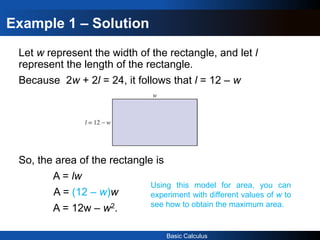
Let w represent the width of the rectangle, and let l
represent the length of the rectangle.
Because 2w + 2l = 24, it follows that l = 12 – w
So, the area of the rectangle is
A = lw
A = (12 – w)w
A = 12w – w2.
Using this model for area, you can
experiment with different values of w to
see how to obtain the maximum area.
Basic Calculus
Example 1 – Solution
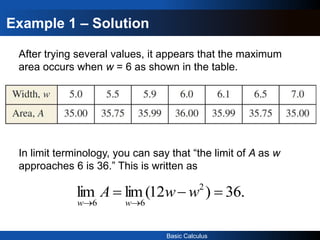
After trying several values, it appears that the maximum
area occurs when w = 6 as shown in the table.
In limit terminology, you can say that “the limit of A as w
approaches 6 is 36.” This is written as
.
36
)
12
(
lim
lim 2
6
6





w
w
A
w
w
Basic Calculus
What is a limit?
What are some examples of limits?
Basic Calculus
Limits – An Informal Approach
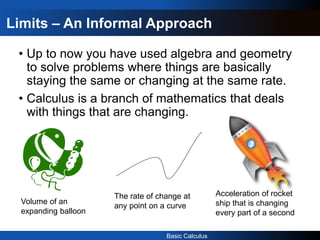
• Up to now you have used algebra and geometry
to solve problems where things are basically
staying the same or changing at the same rate.
• Calculus is a branch of mathematics that deals
with things that are changing.
Volume of an
expanding balloon
Acceleration of rocket
ship that is changing
every part of a second
The rate of change at
any point on a curve
Basic Calculus
Limits – An Informal Approach
• One of the most fundamental ideas of
calculus is limits.
• Limits allow us to look at what happens in a
very, very small region around a point.
• Two of the major formal definitions of
calculus depend on limits.
What is a limit?
Basic Calculus
Example 2 – Limit of a Function
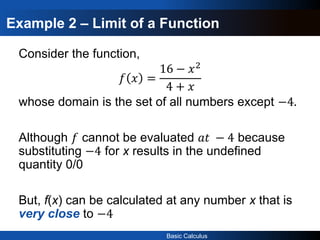
Consider the function,
𝑓 𝑥 =
16 − 𝑥2
4 + 𝑥
whose domain is the set of all numbers except −4.
Although 𝑓 cannot be evaluated 𝑎𝑡 − 4 because
substituting −4 for x results in the undefined
quantity 0/0
But, f(x) can be calculated at any number x that is
very close to −4
Basic Calculus
Example 2 – Limit of a Function
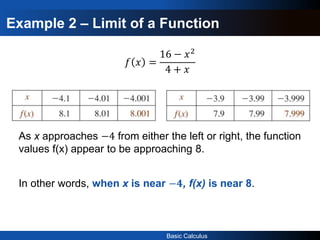
𝑓 𝑥 =
16 − 𝑥2
4 + 𝑥
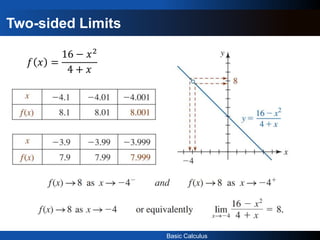
As x approaches −4 from either the left or right, the function
values f(x) appear to be approaching 8.
In other words, when x is near −𝟒, f(x) is near 8.
Basic Calculus
Example 2 – Limit of a Function
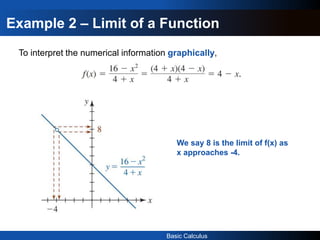
To interpret the numerical information graphically,
We say 8 is the limit of f(x) as
x approaches -4.
Basic Calculus
Limit of a Function – An Informal Approach
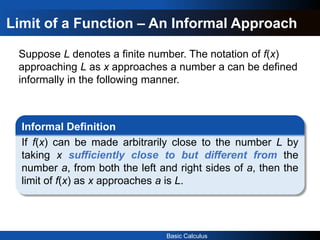
Suppose L denotes a finite number. The notation of f(x)
approaching L as x approaches a number a can be defined
informally in the following manner.
Informal Definition
If f(x) can be made arbitrarily close to the number L by
taking x sufficiently close to but different from the
number a, from both the left and right sides of a, then the
limit of f(x) as x approaches a is L.
Basic Calculus
Notation
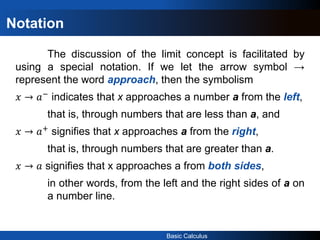
The discussion of the limit concept is facilitated by
using a special notation. If we let the arrow symbol →
represent the word approach, then the symbolism
𝑥 → 𝑎−
indicates that x approaches a number a from the left,
that is, through numbers that are less than a, and
𝑥 → 𝑎+
signifies that x approaches a from the right,
that is, through numbers that are greater than a.
𝑥 → 𝑎 signifies that x approaches a from both sides,
in other words, from the left and the right sides of a on
a number line.
Basic Calculus
Example 3 – Estimating a Limit Numerically
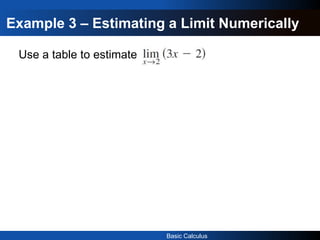
Use a table to estimate
Basic Calculus
Example 3 – Estimating a Limit Numerically
USING A TABLE TO ESTIMATE A LIMIT.
Solution:
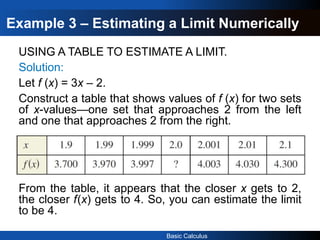
Let f (x) = 3x – 2.
Construct a table that shows values of f (x) for two sets
of x-values—one set that approaches 2 from the left
and one that approaches 2 from the right.
From the table, it appears that the closer x gets to 2,
the closer f(x) gets to 4. So, you can estimate the limit
to be 4.
Basic Calculus
Example 3 – Estimating a Limit Numerically
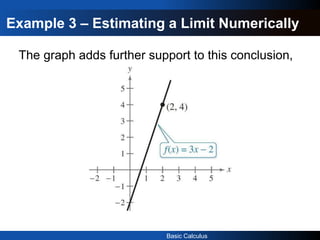
The graph adds further support to this conclusion,
Basic Calculus
Example 4 – Estimating a Limit Graphically
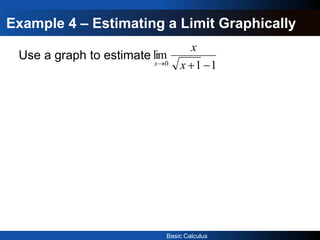
Use a graph to estimate
1
1
lim
0 

 x
x
x
Basic Calculus
Example 4 – Estimating a Limit Numerically
Reinforce with the graph.
f(x) has a limit as x  0
even though the function
is not defined at x = 0.
.
1
1
lim
0 

 x
x
x
Basic Calculus
One-sided Limits
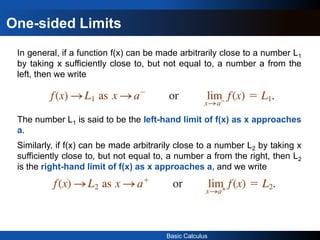
In general, if a function f(x) can be made arbitrarily close to a number L1
by taking x sufficiently close to, but not equal to, a number a from the
left, then we write
The number L1 is said to be the left-hand limit of f(x) as x approaches
a.
Similarly, if f(x) can be made arbitrarily close to a number L2 by taking x
sufficiently close to, but not equal to, a number a from the right, then L2
is the right-hand limit of f(x) as x approaches a, and we write
Basic Calculus
Two-sided Limits
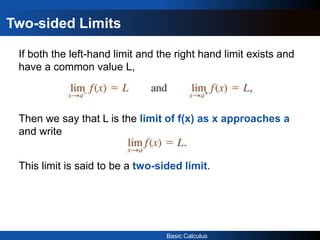
If both the left-hand limit and the right hand limit exists and
have a common value L,
Then we say that L is the limit of f(x) as x approaches a
and write
This limit is said to be a two-sided limit.
Basic Calculus
Two-sided Limits
𝑓 𝑥 =
16 − 𝑥2
4 + 𝑥
Basic Calculus
Existence and Nonexistence
The existence of a limit of a function f as x approaches a
(from one side or both sides) does NOT depend on whether
f is defined at a but ONLY on whether f is defined for x near
the number a.
Basic Calculus
Existence and Nonexistence
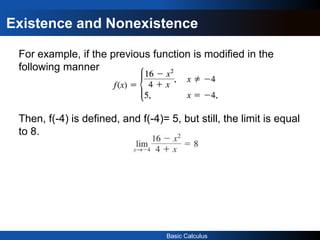
For example, if the previous function is modified in the
following manner
Then, f(-4) is defined, and f(-4)= 5, but still, the limit is equal
to 8.
Basic Calculus
Existence and Nonexistence
Basic Calculus
Basic Calculus
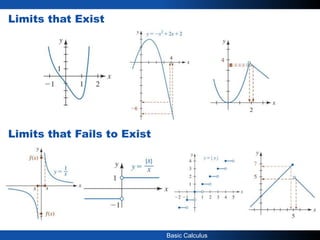
Limits that Fails to Exist
Limits that Exist
Basic Calculus
Limits that Fails to Exist
Basic Calculus
Example 5 – Comparing Left and Right Behavior
Show that the limit does not exist by analyzing the graph.
1.)
2.)
3.)
2
0
1
lim
x
x
x
x
x 0
lim

x
x
1
sin
lim
0

Basic Calculus
Basic Calculus
Basic Calculus
Introduction to Limits – Extended
Still THE informal approach...
Basic Calculus
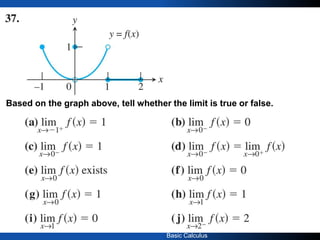
Based on the graph above, tell whether the limit is true or false.
Basic Calculus
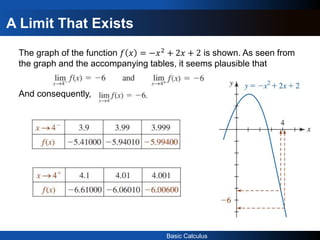
A Limit That Exists
The graph of the function 𝑓 𝑥 = −𝑥2 + 2𝑥 + 2 is shown. As seen from
the graph and the accompanying tables, it seems plausible that
And consequently,
Basic Calculus
A Limit That Exists
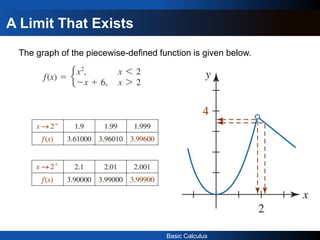
The graph of the piecewise-defined function is given below.
Basic Calculus
A Limit That Does Not Exists
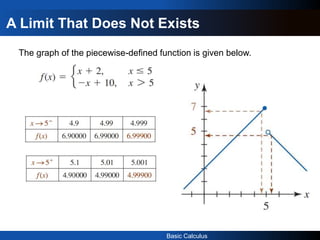
The graph of the piecewise-defined function is given below.
Basic Calculus
A Limit That Does Not Exists
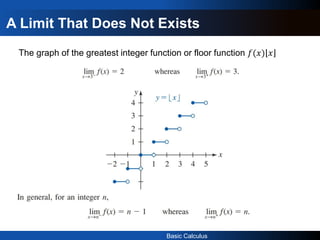
The graph of the greatest integer function or floor function 𝑓(𝑥) 𝑥

Lesson 1 - Introduction to Limits.pptx

  • 1.
    Basic Calculus Introduction toLimits An Informal Approach
  • 2.
    Basic Calculus Example 1– Finding a rectangle of Maximum Area You are given 24 inches of wire and are asked to form a rectangle whose area is as large as possible. What dimensions should the rectangle have?
  • 3.
    Basic Calculus Example 1– Solution Let w represent the width of the rectangle, and let l represent the length of the rectangle. Because 2w + 2l = 24, it follows that l = 12 – w So, the area of the rectangle is A = lw A = (12 – w)w A = 12w – w2. Using this model for area, you can experiment with different values of w to see how to obtain the maximum area.
  • 4.
    Basic Calculus Example 1– Solution After trying several values, it appears that the maximum area occurs when w = 6 as shown in the table. In limit terminology, you can say that “the limit of A as w approaches 6 is 36.” This is written as . 36 ) 12 ( lim lim 2 6 6      w w A w w
  • 5.
    Basic Calculus What isa limit? What are some examples of limits?
  • 6.
    Basic Calculus Limits –An Informal Approach • Up to now you have used algebra and geometry to solve problems where things are basically staying the same or changing at the same rate. • Calculus is a branch of mathematics that deals with things that are changing. Volume of an expanding balloon Acceleration of rocket ship that is changing every part of a second The rate of change at any point on a curve
  • 7.
    Basic Calculus Limits –An Informal Approach • One of the most fundamental ideas of calculus is limits. • Limits allow us to look at what happens in a very, very small region around a point. • Two of the major formal definitions of calculus depend on limits. What is a limit?
  • 8.
    Basic Calculus Example 2– Limit of a Function Consider the function, 𝑓 𝑥 = 16 − 𝑥2 4 + 𝑥 whose domain is the set of all numbers except −4. Although 𝑓 cannot be evaluated 𝑎𝑡 − 4 because substituting −4 for x results in the undefined quantity 0/0 But, f(x) can be calculated at any number x that is very close to −4
  • 9.
    Basic Calculus Example 2– Limit of a Function 𝑓 𝑥 = 16 − 𝑥2 4 + 𝑥 As x approaches −4 from either the left or right, the function values f(x) appear to be approaching 8. In other words, when x is near −𝟒, f(x) is near 8.
  • 10.
    Basic Calculus Example 2– Limit of a Function To interpret the numerical information graphically, We say 8 is the limit of f(x) as x approaches -4.
  • 11.
    Basic Calculus Limit ofa Function – An Informal Approach Suppose L denotes a finite number. The notation of f(x) approaching L as x approaches a number a can be defined informally in the following manner. Informal Definition If f(x) can be made arbitrarily close to the number L by taking x sufficiently close to but different from the number a, from both the left and right sides of a, then the limit of f(x) as x approaches a is L.
  • 12.
    Basic Calculus Notation The discussionof the limit concept is facilitated by using a special notation. If we let the arrow symbol → represent the word approach, then the symbolism 𝑥 → 𝑎− indicates that x approaches a number a from the left, that is, through numbers that are less than a, and 𝑥 → 𝑎+ signifies that x approaches a from the right, that is, through numbers that are greater than a. 𝑥 → 𝑎 signifies that x approaches a from both sides, in other words, from the left and the right sides of a on a number line.
  • 13.
    Basic Calculus Example 3– Estimating a Limit Numerically Use a table to estimate
  • 14.
    Basic Calculus Example 3– Estimating a Limit Numerically USING A TABLE TO ESTIMATE A LIMIT. Solution: Let f (x) = 3x – 2. Construct a table that shows values of f (x) for two sets of x-values—one set that approaches 2 from the left and one that approaches 2 from the right. From the table, it appears that the closer x gets to 2, the closer f(x) gets to 4. So, you can estimate the limit to be 4.
  • 15.
    Basic Calculus Example 3– Estimating a Limit Numerically The graph adds further support to this conclusion,
  • 16.
    Basic Calculus Example 4– Estimating a Limit Graphically Use a graph to estimate 1 1 lim 0    x x x
  • 17.
    Basic Calculus Example 4– Estimating a Limit Numerically Reinforce with the graph. f(x) has a limit as x  0 even though the function is not defined at x = 0. . 1 1 lim 0    x x x
  • 18.
    Basic Calculus One-sided Limits Ingeneral, if a function f(x) can be made arbitrarily close to a number L1 by taking x sufficiently close to, but not equal to, a number a from the left, then we write The number L1 is said to be the left-hand limit of f(x) as x approaches a. Similarly, if f(x) can be made arbitrarily close to a number L2 by taking x sufficiently close to, but not equal to, a number a from the right, then L2 is the right-hand limit of f(x) as x approaches a, and we write
  • 19.
    Basic Calculus Two-sided Limits Ifboth the left-hand limit and the right hand limit exists and have a common value L, Then we say that L is the limit of f(x) as x approaches a and write This limit is said to be a two-sided limit.
  • 20.
    Basic Calculus Two-sided Limits 𝑓𝑥 = 16 − 𝑥2 4 + 𝑥
  • 21.
    Basic Calculus Existence andNonexistence The existence of a limit of a function f as x approaches a (from one side or both sides) does NOT depend on whether f is defined at a but ONLY on whether f is defined for x near the number a.
  • 22.
    Basic Calculus Existence andNonexistence For example, if the previous function is modified in the following manner Then, f(-4) is defined, and f(-4)= 5, but still, the limit is equal to 8.
  • 23.
  • 24.
  • 25.
    Basic Calculus Limits thatFails to Exist Limits that Exist
  • 26.
  • 27.
    Basic Calculus Example 5– Comparing Left and Right Behavior Show that the limit does not exist by analyzing the graph. 1.) 2.) 3.) 2 0 1 lim x x x x x 0 lim  x x 1 sin lim 0 
  • 28.
  • 29.
  • 30.
    Basic Calculus Introduction toLimits – Extended Still THE informal approach...
  • 31.
    Basic Calculus Based onthe graph above, tell whether the limit is true or false.
  • 32.
    Basic Calculus A LimitThat Exists The graph of the function 𝑓 𝑥 = −𝑥2 + 2𝑥 + 2 is shown. As seen from the graph and the accompanying tables, it seems plausible that And consequently,
  • 33.
    Basic Calculus A LimitThat Exists The graph of the piecewise-defined function is given below.
  • 34.
    Basic Calculus A LimitThat Does Not Exists The graph of the piecewise-defined function is given below.
  • 35.
    Basic Calculus A LimitThat Does Not Exists The graph of the greatest integer function or floor function 𝑓(𝑥) 𝑥