The 2.2 Limit of a Function
2 
The Limit of a Function 
Let’s investigate the behavior of the function f defined by 
f (x) = x2 – x + 2 for values of x near 2.
3 
Limit of a Function- Numerically 
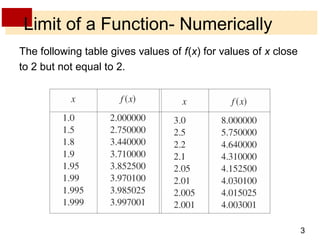
The following table gives values of f (x) for values of x close 
to 2 but not equal to 2.
Limit of a Function - Graphically 
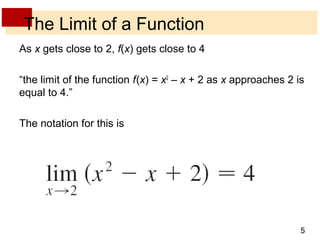
From the table and the graph of f (a parabola) shown in 
Figure 1 we see that when x is close to 2 (on either side of 2), 
f (x) is close to 4. 
4 
Figure 1
5 
The Limit of a Function 
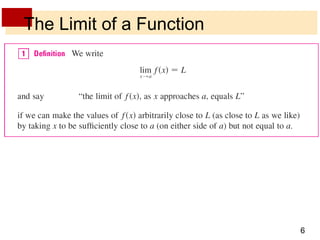
As x gets close to 2, f(x) gets close to 4 
“the limit of the function f (x) = x2 – x + 2 as x approaches 2 is 
equal to 4.” 
The notation for this is
6 
The Limit of a Function
7 
The Limit of a Function 
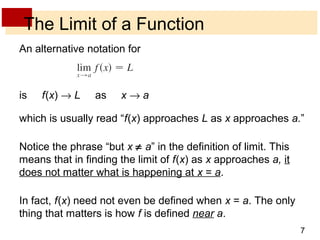
An alternative notation for 
is f (x) ® L as x ® a 
which is usually read “f (x) approaches L as x approaches a.” 
Notice the phrase “but x ¹ a” in the definition of limit. This 
means that in finding the limit of f (x) as x approaches a, it 
does not matter what is happening at x = a. 
In fact, f (x) need not even be defined when x = a. The only 
thing that matters is how f is defined near a.
8 
The Limit of a Function 
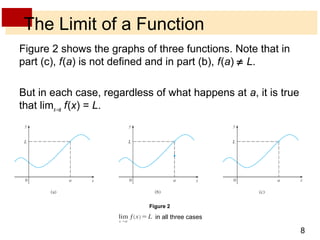
Figure 2 shows the graphs of three functions. Note that in 
part (c), f (a) is not defined and in part (b), f (a) ¹ L. 
But in each case, regardless of what happens at a, it is true 
that limx®a f (x) = L. 
Figure 2 
in all three cases
9 
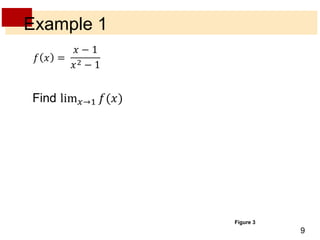
Example 1 
Figure 3
10 
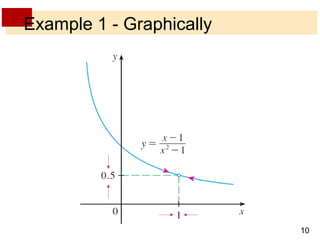
Example 1 - Graphically
Example 1 – Guessing a Limit from Numerical Values 
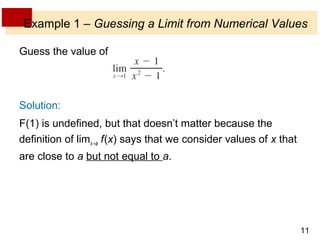
Guess the value of 
11 
Solution: 
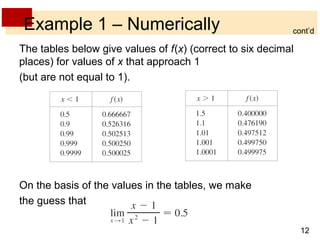
F(1) is undefined, but that doesn’t matter because the 
definition of limx®a f (x) says that we consider values of x that 
are close to a but not equal to a.
12 
Example 1 – Numerically 
The tables below give values of f (x) (correct to six decimal 
places) for values of x that approach 1 
(but are not equal to 1). 
On the basis of the values in the tables, we make 
the guess that 
cont’d
13 
Example 1 - Algebraically
14 
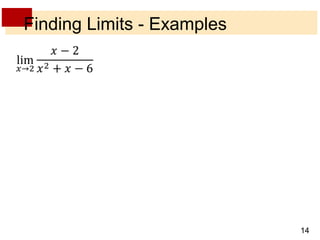
Finding Limits - Examples
15 
One-Sided Limits
16 
One-Sided Limits 
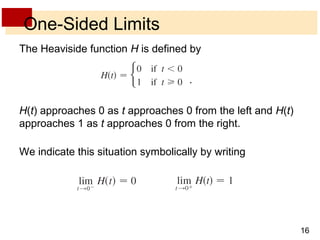
The Heaviside function H is defined by 
. 
H(t) approaches 0 as t approaches 0 from the left and H(t) 
approaches 1 as t approaches 0 from the right. 
We indicate this situation symbolically by writing 
and
17 
One-Sided Limits 
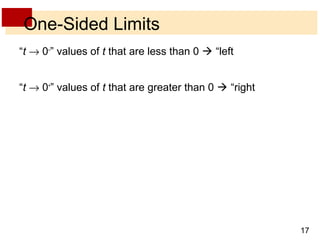
“t ® 0–” values of t that are less than 0  “left 
“t ® 0+” values of t that are greater than 0  “right
18 
One-Sided Limits 
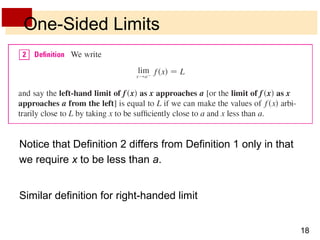
Notice that Definition 2 differs from Definition 1 only in that 
we require x to be less than a. 
Similar definition for right-handed limit
19 
One-Sided Limits 
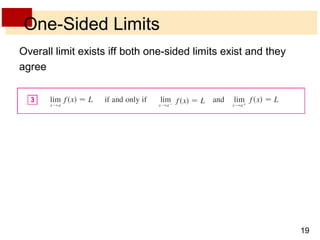
Overall limit exists iff both one-sided limits exist and they 
agree
Example 7 – One-Sided Limits from a Graph 
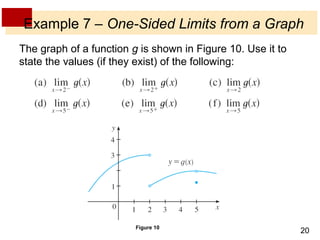
The graph of a function g is shown in Figure 10. Use it to 
state the values (if they exist) of the following: 
20 
Figure 10
Example 7 – Solution 
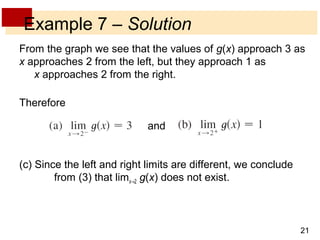
From the graph we see that the values of g(x) approach 3 as 
x approaches 2 from the left, but they approach 1 as 
21 
x approaches 2 from the right. 
Therefore 
and 
(c) Since the left and right limits are different, we conclude 
from (3) that limx®2 g(x) does not exist.
22 
Example 7 – Solution 
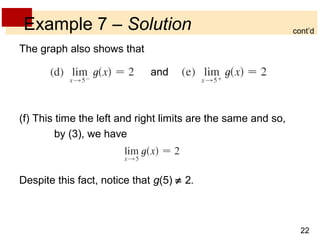
The graph also shows that 
and 
(f) This time the left and right limits are the same and so, 
by (3), we have 
Despite this fact, notice that g(5) ¹ 2. 
cont’d
23 
One-Sided Limits - Example 
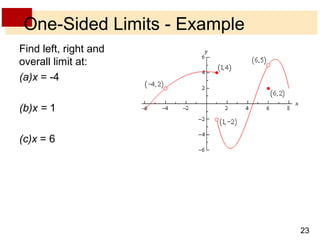
Find left, right and 
overall limit at: 
(a)x = -4 
(b)x = 1 
(c)x = 6

Lecture 4 the limit of a function

  • 1.
    The 2.2 Limitof a Function
  • 2.
    2 The Limitof a Function Let’s investigate the behavior of the function f defined by f (x) = x2 – x + 2 for values of x near 2.
  • 3.
    3 Limit ofa Function- Numerically The following table gives values of f (x) for values of x close to 2 but not equal to 2.
  • 4.
    Limit of aFunction - Graphically From the table and the graph of f (a parabola) shown in Figure 1 we see that when x is close to 2 (on either side of 2), f (x) is close to 4. 4 Figure 1
  • 5.
    5 The Limitof a Function As x gets close to 2, f(x) gets close to 4 “the limit of the function f (x) = x2 – x + 2 as x approaches 2 is equal to 4.” The notation for this is
  • 6.
    6 The Limitof a Function
  • 7.
    7 The Limitof a Function An alternative notation for is f (x) ® L as x ® a which is usually read “f (x) approaches L as x approaches a.” Notice the phrase “but x ¹ a” in the definition of limit. This means that in finding the limit of f (x) as x approaches a, it does not matter what is happening at x = a. In fact, f (x) need not even be defined when x = a. The only thing that matters is how f is defined near a.
  • 8.
    8 The Limitof a Function Figure 2 shows the graphs of three functions. Note that in part (c), f (a) is not defined and in part (b), f (a) ¹ L. But in each case, regardless of what happens at a, it is true that limx®a f (x) = L. Figure 2 in all three cases
  • 9.
    9 Example 1 Figure 3
  • 10.
    10 Example 1- Graphically
  • 11.
    Example 1 –Guessing a Limit from Numerical Values Guess the value of 11 Solution: F(1) is undefined, but that doesn’t matter because the definition of limx®a f (x) says that we consider values of x that are close to a but not equal to a.
  • 12.
    12 Example 1– Numerically The tables below give values of f (x) (correct to six decimal places) for values of x that approach 1 (but are not equal to 1). On the basis of the values in the tables, we make the guess that cont’d
  • 13.
    13 Example 1- Algebraically
  • 14.
  • 15.
  • 16.
    16 One-Sided Limits The Heaviside function H is defined by . H(t) approaches 0 as t approaches 0 from the left and H(t) approaches 1 as t approaches 0 from the right. We indicate this situation symbolically by writing and
  • 17.
    17 One-Sided Limits “t ® 0–” values of t that are less than 0  “left “t ® 0+” values of t that are greater than 0  “right
  • 18.
    18 One-Sided Limits Notice that Definition 2 differs from Definition 1 only in that we require x to be less than a. Similar definition for right-handed limit
  • 19.
    19 One-Sided Limits Overall limit exists iff both one-sided limits exist and they agree
  • 20.
    Example 7 –One-Sided Limits from a Graph The graph of a function g is shown in Figure 10. Use it to state the values (if they exist) of the following: 20 Figure 10
  • 21.
    Example 7 –Solution From the graph we see that the values of g(x) approach 3 as x approaches 2 from the left, but they approach 1 as 21 x approaches 2 from the right. Therefore and (c) Since the left and right limits are different, we conclude from (3) that limx®2 g(x) does not exist.
  • 22.
    22 Example 7– Solution The graph also shows that and (f) This time the left and right limits are the same and so, by (3), we have Despite this fact, notice that g(5) ¹ 2. cont’d
  • 23.
    23 One-Sided Limits- Example Find left, right and overall limit at: (a)x = -4 (b)x = 1 (c)x = 6