❑illustrate the limit of a function using a table of
values and the graph of the function
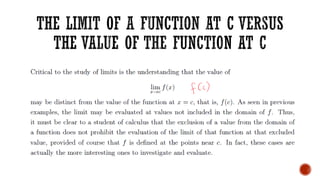
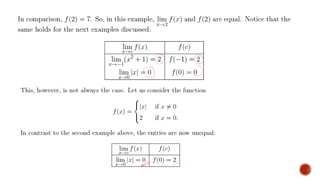
❑distinguish between lim
𝑥→𝑐
𝑓(𝑥) and f(c)
❑illustrate the limit laws
❑apply the limit laws in evaluating the limit of
algebraic functions (polynomial, rational, and
radical
LIMITS OF A FUNCTION
Limits are the backbone of
calculus, and calculus is called
the Mathematics of Change.
The study of limits is necessary
in studying change in great
detail.The evaluation of a
particular limit is what
underlies the formulation of the
derivative and the integral of a
function.
For starters, imagine that you are going
to watch a basketball game. When you
choose seats, you would want to be as
close to the action as possible. You
would want to be as close to the players
as possible and have the best view of
the game, as if you were in the
basketball court yourself.
Take note that you cannot actually be in
the court and join the players, but you
will be close enough to describe clearly
what is happening in the game.
This is how it is with limits of
functions.We will consider functions
of a single variable and study the
behavior of the function as its
variable approaches a particular
value (a constant).
The variable can only take values
very, very close to the constant, but it
cannot equal the constant itself.
However, the limit will be able to
describe clearly what is happening to
the function near that constant.
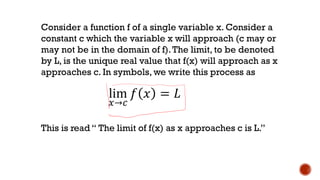
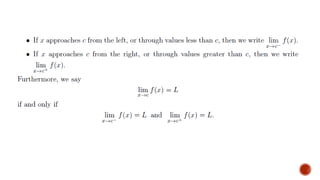
Consider a function f of a single variable x. Consider a
constant c which the variable x will approach (c may or
may not be in the domain of f).The limit, to be denoted
by L, is the unique real value that f(x) will approach as x
approaches c. In symbols, we write this process as
This is read “ The limit of f(x) as x approaches c is L.”
lim
𝑥→𝑐
𝑓 𝑥 = 𝐿
LOOKING AT A TABLE OF VALUES
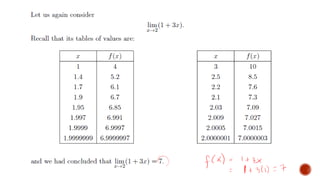
To illustrate, let us consider
lim
𝑥→2
(1 + 3𝑥)
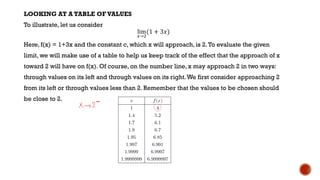
Here, f(x) = 1+3x and the constant c, which x will approach, is 2.To evaluate the given
limit, we will make use of a table to help us keep track of the effect that the approach of x
toward 2 will have on f(x). Of course, on the number line, x may approach 2 in two ways:
through values on its left and through values on its right.We first consider approaching 2
from its left or through values less than 2. Remember that the values to be chosen should
be close to 2.
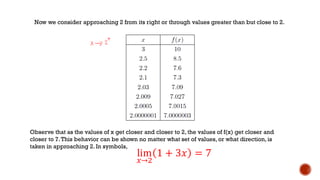
Now we consider approaching 2 from its right or through values greater than but close to 2.
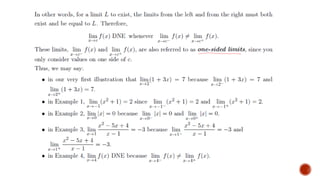
Observe that as the values of x get closer and closer to 2, the values of f(x) get closer and
closer to 7.This behavior can be shown no matter what set of values, or what direction, is
taken in approaching 2. In symbols,
lim
𝑥→2
1 + 3𝑥 = 7
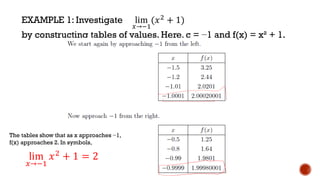
EXAMPLE 1: Investigate lim
𝑥→−1
(𝑥2 + 1)
by constructing tables of values. Here, c = −1 and f(x) = x² + 1.
The tables show that as x approaches −1,
f(x) approaches 2. In symbols,
lim
𝑥→−1
𝑥2
+ 1 = 2
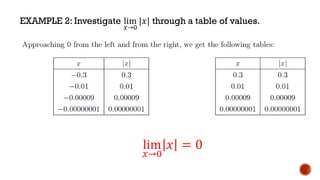
EXAMPLE 2: Investigate lim
𝑥→0
|𝑥| through a table of values.
lim
𝑥→0
𝑥 = 0
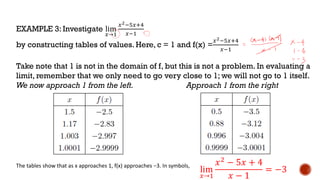
EXAMPLE 3: Investigate lim
𝑥→1
𝑥2−5𝑥+4
𝑥−1
by constructing tables of values. Here, c = 1 and f(x) =
𝑥2−5𝑥+4
𝑥−1
Take note that 1 is not in the domain of f, but this is not a problem. In evaluating a
limit, remember that we only need to go very close to 1; we will not go to 1 itself.
We now approach 1 from the left. Approach 1 from the right
The tables show that as x approaches 1, f(x) approaches −3. In symbols,
lim
𝑥→1
𝑥2
− 5𝑥 + 4
𝑥 − 1
= −3
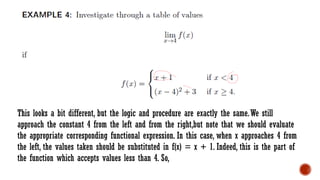
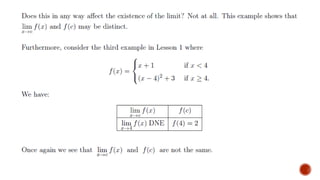
This looks a bit different, but the logic and procedure are exactly the same.We still
approach the constant 4 from the left and from the right,but note that we should evaluate
the appropriate corresponding functional expression. In this case, when x approaches 4 from
the left, the values taken should be substituted in f(x) = x + 1. Indeed, this is the part of
the function which accepts values less than 4. So,
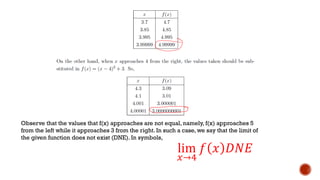
Observe that the values that f(x) approaches are not equal, namely, f(x) approaches 5
from the left while it approaches 3 from the right. In such a case, we say that the limit of
the given function does not exist (DNE). In symbols,
lim
𝑥→4
𝑓 𝑥 𝐷𝑁𝐸
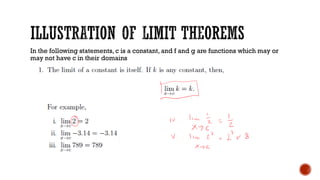
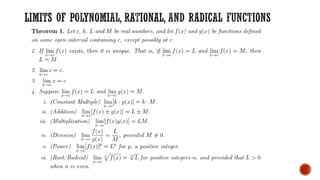
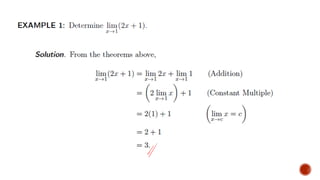
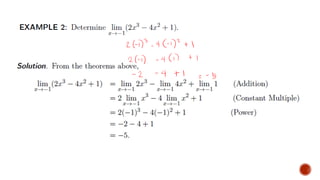
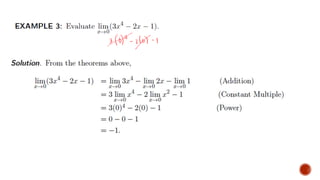
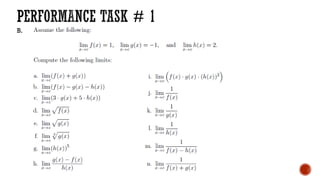
In the following statements, c is a constant, and f and g are functions which may or
may not have c in their domains
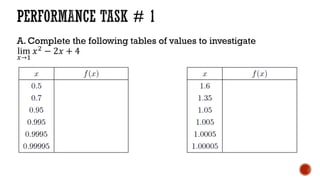
A. Complete the following tables of values to investigate
lim
𝑥→1
𝑥2 − 2𝑥 + 4
B.
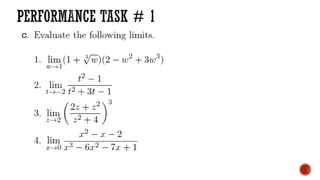
C.

Limits of a Function

  • 2.
    ❑illustrate the limitof a function using a table of values and the graph of the function ❑distinguish between lim 𝑥→𝑐 𝑓(𝑥) and f(c) ❑illustrate the limit laws ❑apply the limit laws in evaluating the limit of algebraic functions (polynomial, rational, and radical
  • 3.
    LIMITS OF AFUNCTION
  • 4.
    Limits are thebackbone of calculus, and calculus is called the Mathematics of Change. The study of limits is necessary in studying change in great detail.The evaluation of a particular limit is what underlies the formulation of the derivative and the integral of a function.
  • 5.
    For starters, imaginethat you are going to watch a basketball game. When you choose seats, you would want to be as close to the action as possible. You would want to be as close to the players as possible and have the best view of the game, as if you were in the basketball court yourself. Take note that you cannot actually be in the court and join the players, but you will be close enough to describe clearly what is happening in the game.
  • 6.
    This is howit is with limits of functions.We will consider functions of a single variable and study the behavior of the function as its variable approaches a particular value (a constant). The variable can only take values very, very close to the constant, but it cannot equal the constant itself. However, the limit will be able to describe clearly what is happening to the function near that constant.
  • 7.
    Consider a functionf of a single variable x. Consider a constant c which the variable x will approach (c may or may not be in the domain of f).The limit, to be denoted by L, is the unique real value that f(x) will approach as x approaches c. In symbols, we write this process as This is read “ The limit of f(x) as x approaches c is L.” lim 𝑥→𝑐 𝑓 𝑥 = 𝐿
  • 8.
    LOOKING AT ATABLE OF VALUES To illustrate, let us consider lim 𝑥→2 (1 + 3𝑥) Here, f(x) = 1+3x and the constant c, which x will approach, is 2.To evaluate the given limit, we will make use of a table to help us keep track of the effect that the approach of x toward 2 will have on f(x). Of course, on the number line, x may approach 2 in two ways: through values on its left and through values on its right.We first consider approaching 2 from its left or through values less than 2. Remember that the values to be chosen should be close to 2.
  • 9.
    Now we considerapproaching 2 from its right or through values greater than but close to 2. Observe that as the values of x get closer and closer to 2, the values of f(x) get closer and closer to 7.This behavior can be shown no matter what set of values, or what direction, is taken in approaching 2. In symbols, lim 𝑥→2 1 + 3𝑥 = 7
  • 10.
    EXAMPLE 1: Investigatelim 𝑥→−1 (𝑥2 + 1) by constructing tables of values. Here, c = −1 and f(x) = x² + 1. The tables show that as x approaches −1, f(x) approaches 2. In symbols, lim 𝑥→−1 𝑥2 + 1 = 2
  • 11.
    EXAMPLE 2: Investigatelim 𝑥→0 |𝑥| through a table of values. lim 𝑥→0 𝑥 = 0
  • 12.
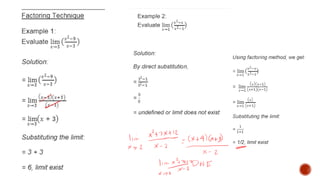
    EXAMPLE 3: Investigatelim 𝑥→1 𝑥2−5𝑥+4 𝑥−1 by constructing tables of values. Here, c = 1 and f(x) = 𝑥2−5𝑥+4 𝑥−1 Take note that 1 is not in the domain of f, but this is not a problem. In evaluating a limit, remember that we only need to go very close to 1; we will not go to 1 itself. We now approach 1 from the left. Approach 1 from the right The tables show that as x approaches 1, f(x) approaches −3. In symbols, lim 𝑥→1 𝑥2 − 5𝑥 + 4 𝑥 − 1 = −3
  • 13.
    This looks abit different, but the logic and procedure are exactly the same.We still approach the constant 4 from the left and from the right,but note that we should evaluate the appropriate corresponding functional expression. In this case, when x approaches 4 from the left, the values taken should be substituted in f(x) = x + 1. Indeed, this is the part of the function which accepts values less than 4. So,
  • 14.
    Observe that thevalues that f(x) approaches are not equal, namely, f(x) approaches 5 from the left while it approaches 3 from the right. In such a case, we say that the limit of the given function does not exist (DNE). In symbols, lim 𝑥→4 𝑓 𝑥 𝐷𝑁𝐸
  • 21.
    In the followingstatements, c is a constant, and f and g are functions which may or may not have c in their domains
  • 39.
    A. Complete thefollowing tables of values to investigate lim 𝑥→1 𝑥2 − 2𝑥 + 4
  • 40.
  • 41.