Limits and Derivatives
Concept of a Function
FUNCTIONS “ FUNCTION” indicates a relationship among objects. A FUNCTION provides a model to describe a system.  A FUNCTION expresses the relationship of one variable or a group of variables (called the domain) with another variables( called the range) by associating every member in the domain to a unique member in range.
TYPES OF FUNCTIONS LINEAR FUNCTIONS INVERSE FUNCTIONS EXPONENTIAL FUNCTIONS LOGARITHMIC FUNCTIONS
y  is a function of  x , and the relation  y  =  x 2  describes a function. We notice that with such a relation,  every value of  x  corresponds to one (and only one) value of  y . y  =  x 2
Since the value of  y  depends on a given value of  x , we call  y  the  dependent variable  and  x  the  independent variable  and of the function  y  =  x 2 .


Notation for a Function :  f ( x )


The Idea of Limits
Consider the function   The Idea of Limits x 1.9 1.99 1.999 1.9999 2 2.0001 2.001 2.01 2.1 f ( x )
Consider the function   The Idea of Limits x 1.9 1.99 1.999 1.9999 2 2.0001 2.001 2.01 2.1 f ( x ) 3.9 3.99 3.999 3.9999 un-defined 4.0001 4.001 4.01 4.1
Consider the function   The Idea of Limits x 1.9 1.99 1.999 1.9999 2 2.0001 2.001 2.01 2.1 g ( x ) 3.9 3.99 3.999 3.9999 4 4.0001 4.001 4.01 4.1 x y O 2
If a function  f ( x ) is a continuous at x 0 , then   .  approaches to, but not equal to
Consider the function   The Idea of Limits x -4 -3 -2 -1 0 1 2 3 4 g ( x )
Consider the function   The Idea of Limits x -4 -3 -2 -1 0 1 2 3 4 h ( x ) -1 -1 -1 -1 un-defined 1 2 3 4
does not exist.
A function  f ( x ) has limit  l  at  x 0  if  f ( x ) can be made as close to  l  as we please by taking  x  sufficiently close to (but not equal to)  x 0 . We write
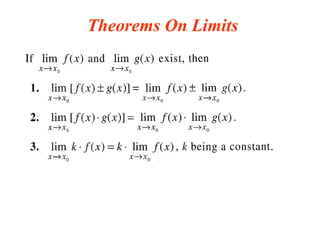
Theorems On Limits
Theorems On Limits
Theorems On Limits
Theorems On Limits
Limits at Infinity
Limits at Infinity Consider
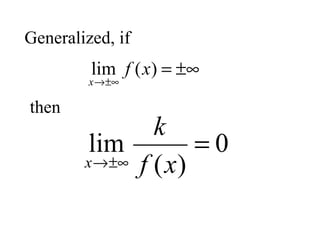
Generalized, if then
Theorems of Limits at Infinity
The Slope of the Tangent to a Curve
The Slope of the Tangent to a Curve The slope of the tangent to a curve  y  =  f ( x ) with respect to  x  is defined as provided that the limit exists.
Increments The increment △ x  of a variable is the change in  x  from a fixed value  x  =  x 0  to another value  x  =  x 1 .
For any function  y  =  f ( x ), if the variable  x  is given an increment △ x  from  x  =  x 0 , then the value of  y  would change to  f ( x 0  + △ x ) accordingly. Hence thee is a corresponding increment of  y (△ y ) such that  △ y  =  f ( x 0  + △ x ) –  f ( x 0 ) .
Derivatives (A) Definition of Derivative. The derivative of a function  y  =  f ( x ) with respect to  x  is defined as provided that the limit exists.
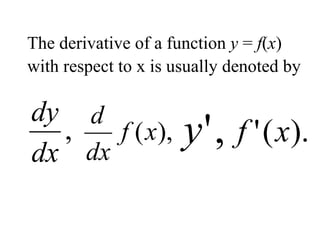
The derivative of a function  y  =  f ( x ) with respect to x is usually denoted by
The process of finding the derivative of a function is called  differentiation . A function  y  =  f ( x ) is said to be  differentiable  with respect to  x  at  x  =  x 0  if the derivative of the function with respect to  x   exists  at  x  =  x 0 .
The value of the derivative of  y  =  f ( x ) with respect to  x  at  x  =  x 0  is denoted  by  or  .
To obtain the derivative of a function by its definition is called  differentiation  of the function  from first principles .
Differentiation Rules 1.
Differentiation Rules 2.
Differentiation Rules 3.
Differentiation Rules 4.  for any positive integer n
Differentiation Rules 4.  for any positive integer n Binominal Theorem
Differentiation Rules 5.  product rule
 
Differentiation Rules 6.  where v ≠ 0 quotient rule
 
Differentiation Rules 7.  for any integer n
 
 
DIFFERENTIATION RULES y,u and v are functions of x. a,b,c, and n are constants (numbers). The derivative of a constant is zero. Duh! If everything is constant, that means its rate, its derivative, will be zero. The graph of a constant, a number is a horizontal line. y=c. The slope is zero. The derivative of x is 1. Yes. The graph of x is a line. The slope of y = x is 1. If the graph of y = cx, then the slope, the derivative is c.
MORE RULES When you take the derivative of x raised to a power (integer or fractional), you multiply expression by the exponent and subtract one from the exponent to form the new exponent. Example:
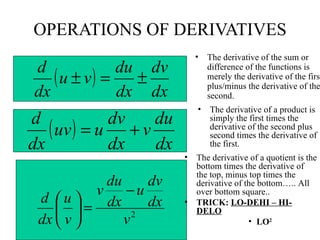
OPERATIONS OF DERIVATIVES The derivative of the sum or difference of the functions is merely the derivative of the first plus/minus the derivative of the second. The derivative of a product is simply the first times the derivative of the second plus second times the derivative of the first. The derivative of a quotient is the bottom times the derivative of the top, minus top times the derivative of the bottom….. All over bottom square.. TRICK:  LO-DEHI – HI-DELO LO 2
JUST GENERAL RULES If you have constant multiplying a function, then the derivative is the constant times the derivative. See example below: The coefficient of the x 6  term is 5 (original constant) times 7 (power rule.)
SECOND DERIVATIVES You can take derivatives of the derivative. Given function f(x), the first derivative is f’(x). The second derivative is f’’(x), and so on and so forth. Using Leibniz notation of dy/dx For math ponders , if you are interesting in the Leibniz notation of derivatives further, please see my article on that. Thank you. Hare Krishna >=) –Krsna Dhenu
EXAMPLE 4: Find the derivative: Use the power rule and the rule of adding derivatives. Note 3/2 – 1 = ½. x ½   is the square root of x. Easy eh??
EXAMPLE 5 Find the equation of the line tangent to y = x 3  +5x 2  –x + 3 at x=0. First find the (x,y) coordinates when x = 0. When you plug 0 in for x, you will see that y = 3. (0,3) is the point at x=0. Now, get the derivative of the function. Notice how the power rule works. Notice the addition and subtraction of derivative. Notice that the derivative of x is 1, and the derivative of 3, a constant, is zero.
EX 5 (continued) Now find the slope at x=0, by plugging in 0 for the x in the derivative expression. The slope is -1 since f’(0) = -1. Now apply it to the equation of a line.
EX 5. (continued) Now, plug the x and y coordinate for x 0  and y 0  respectively. Plug the slope found in for m. And simplify On the AP, you can leave your answer as the first form. (point-slope form)
EXAMPLE 6 Find all the derivatives of y = 8x 5 . Just use the power rule over and over again until you get the derivative to be zero. See how the power rule and derivative notation works?

Limits and derivatives

  • 1.
  • 2.
    Concept of aFunction
  • 3.
    FUNCTIONS “ FUNCTION”indicates a relationship among objects. A FUNCTION provides a model to describe a system. A FUNCTION expresses the relationship of one variable or a group of variables (called the domain) with another variables( called the range) by associating every member in the domain to a unique member in range.
  • 4.
    TYPES OF FUNCTIONSLINEAR FUNCTIONS INVERSE FUNCTIONS EXPONENTIAL FUNCTIONS LOGARITHMIC FUNCTIONS
  • 5.
    y isa function of x , and the relation y = x 2 describes a function. We notice that with such a relation, every value of x corresponds to one (and only one) value of y . y = x 2
  • 6.
    Since the valueof y depends on a given value of x , we call y the dependent variable and x the independent variable and of the function y = x 2 .
  • 7.
  • 8.
  • 9.
  • 10.
    Notation for aFunction : f ( x )
  • 11.
  • 12.
  • 13.
  • 14.
  • 15.
  • 16.
  • 17.
  • 18.
  • 19.
  • 20.
  • 21.
  • 22.
    Consider the function The Idea of Limits x 1.9 1.99 1.999 1.9999 2 2.0001 2.001 2.01 2.1 f ( x )
  • 23.
    Consider the function The Idea of Limits x 1.9 1.99 1.999 1.9999 2 2.0001 2.001 2.01 2.1 f ( x ) 3.9 3.99 3.999 3.9999 un-defined 4.0001 4.001 4.01 4.1
  • 24.
    Consider the function The Idea of Limits x 1.9 1.99 1.999 1.9999 2 2.0001 2.001 2.01 2.1 g ( x ) 3.9 3.99 3.999 3.9999 4 4.0001 4.001 4.01 4.1 x y O 2
  • 25.
    If a function f ( x ) is a continuous at x 0 , then . approaches to, but not equal to
  • 26.
    Consider the function The Idea of Limits x -4 -3 -2 -1 0 1 2 3 4 g ( x )
  • 27.
    Consider the function The Idea of Limits x -4 -3 -2 -1 0 1 2 3 4 h ( x ) -1 -1 -1 -1 un-defined 1 2 3 4
  • 28.
  • 29.
    A function f ( x ) has limit l at x 0 if f ( x ) can be made as close to l as we please by taking x sufficiently close to (but not equal to) x 0 . We write
  • 30.
  • 31.
  • 32.
  • 33.
  • 34.
  • 35.
  • 36.
  • 37.
    Theorems of Limitsat Infinity
  • 38.
    Theorems of Limitsat Infinity
  • 39.
    Theorems of Limitsat Infinity
  • 40.
    Theorems of Limitsat Infinity
  • 41.
    The Slope ofthe Tangent to a Curve
  • 42.
    The Slope ofthe Tangent to a Curve The slope of the tangent to a curve y = f ( x ) with respect to x is defined as provided that the limit exists.
  • 43.
    Increments The increment△ x of a variable is the change in x from a fixed value x = x 0 to another value x = x 1 .
  • 44.
    For any function y = f ( x ), if the variable x is given an increment △ x from x = x 0 , then the value of y would change to f ( x 0 + △ x ) accordingly. Hence thee is a corresponding increment of y (△ y ) such that △ y = f ( x 0 + △ x ) – f ( x 0 ) .
  • 45.
    Derivatives (A) Definitionof Derivative. The derivative of a function y = f ( x ) with respect to x is defined as provided that the limit exists.
  • 46.
    The derivative ofa function y = f ( x ) with respect to x is usually denoted by
  • 47.
    The process offinding the derivative of a function is called differentiation . A function y = f ( x ) is said to be differentiable with respect to x at x = x 0 if the derivative of the function with respect to x exists at x = x 0 .
  • 48.
    The value ofthe derivative of y = f ( x ) with respect to x at x = x 0 is denoted by or .
  • 49.
    To obtain thederivative of a function by its definition is called differentiation of the function from first principles .
  • 50.
  • 51.
  • 52.
  • 53.
  • 54.
  • 55.
  • 56.
  • 57.
    Differentiation Rules 4. for any positive integer n
  • 58.
    Differentiation Rules 4. for any positive integer n Binominal Theorem
  • 59.
  • 60.
  • 61.
  • 62.
    Differentiation Rules 6. where v ≠ 0 quotient rule
  • 63.
    Differentiation Rules 6. where v ≠ 0 quotient rule
  • 64.
  • 65.
    Differentiation Rules 7. for any integer n
  • 66.
  • 67.
  • 68.
    DIFFERENTIATION RULES y,uand v are functions of x. a,b,c, and n are constants (numbers). The derivative of a constant is zero. Duh! If everything is constant, that means its rate, its derivative, will be zero. The graph of a constant, a number is a horizontal line. y=c. The slope is zero. The derivative of x is 1. Yes. The graph of x is a line. The slope of y = x is 1. If the graph of y = cx, then the slope, the derivative is c.
  • 69.
    MORE RULES Whenyou take the derivative of x raised to a power (integer or fractional), you multiply expression by the exponent and subtract one from the exponent to form the new exponent. Example:
  • 70.
    OPERATIONS OF DERIVATIVESThe derivative of the sum or difference of the functions is merely the derivative of the first plus/minus the derivative of the second. The derivative of a product is simply the first times the derivative of the second plus second times the derivative of the first. The derivative of a quotient is the bottom times the derivative of the top, minus top times the derivative of the bottom….. All over bottom square.. TRICK: LO-DEHI – HI-DELO LO 2
  • 71.
    JUST GENERAL RULESIf you have constant multiplying a function, then the derivative is the constant times the derivative. See example below: The coefficient of the x 6 term is 5 (original constant) times 7 (power rule.)
  • 72.
    SECOND DERIVATIVES Youcan take derivatives of the derivative. Given function f(x), the first derivative is f’(x). The second derivative is f’’(x), and so on and so forth. Using Leibniz notation of dy/dx For math ponders , if you are interesting in the Leibniz notation of derivatives further, please see my article on that. Thank you. Hare Krishna >=) –Krsna Dhenu
  • 73.
    EXAMPLE 4: Findthe derivative: Use the power rule and the rule of adding derivatives. Note 3/2 – 1 = ½. x ½ is the square root of x. Easy eh??
  • 74.
    EXAMPLE 5 Findthe equation of the line tangent to y = x 3 +5x 2 –x + 3 at x=0. First find the (x,y) coordinates when x = 0. When you plug 0 in for x, you will see that y = 3. (0,3) is the point at x=0. Now, get the derivative of the function. Notice how the power rule works. Notice the addition and subtraction of derivative. Notice that the derivative of x is 1, and the derivative of 3, a constant, is zero.
  • 75.
    EX 5 (continued)Now find the slope at x=0, by plugging in 0 for the x in the derivative expression. The slope is -1 since f’(0) = -1. Now apply it to the equation of a line.
  • 76.
    EX 5. (continued)Now, plug the x and y coordinate for x 0 and y 0 respectively. Plug the slope found in for m. And simplify On the AP, you can leave your answer as the first form. (point-slope form)
  • 77.
    EXAMPLE 6 Findall the derivatives of y = 8x 5 . Just use the power rule over and over again until you get the derivative to be zero. See how the power rule and derivative notation works?