Inverse Function
Prepared by: Mr. George G.
Lescano
Learning
Objectives:
At the end of the lesson you will
be able to:
- Determine the inverse of a one- to-
one functions.
- Represent an inverse function
through it’s: table of values and
graphs.
- Find the domain and range of an
inverse function.
What is a Inverse
Function?
- A set of ordered pairs formed by
reversing the coordinates of each
ordered pair of the function.
- Remember that function ‘’ f ‘’ has
an inverse if and only if ‘’ f ‘’ is one-
to- one function.
NOTE: Not every function has an
inverse.
Domain and Range of Inverse
Function:
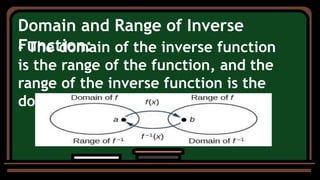
- The domain of the inverse function
is the range of the function, and the
range of the inverse function is the
domain of the function.
Concept
check:
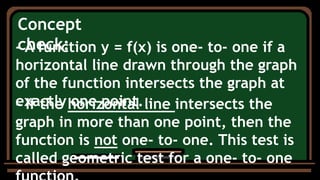
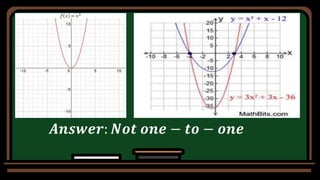
- A function y = f(x) is one- to- one if a
horizontal line drawn through the graph
of the function intersects the graph at
exactly one point.
- If the horizontal line intersects the
graph in more than one point, then the
function is not one- to- one. This test is
called geometric test for a one- to- one
Concept
check:
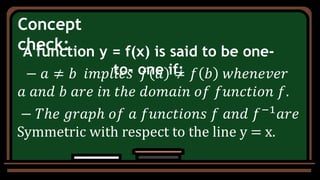
A function y = f(x) is said to be one-
to- one if:
− 𝑎 ≠ 𝑏 𝑖𝑚𝑝𝑙𝑖𝑒𝑠 𝑓 𝑎 ≠ 𝑓 𝑏 𝑤ℎ𝑒𝑛𝑒𝑣𝑒𝑟
𝑎 𝑎𝑛𝑑 𝑏 𝑎𝑟𝑒 𝑖𝑛 𝑡ℎ𝑒 𝑑𝑜𝑚𝑎𝑖𝑛 𝑜𝑓 𝑓𝑢𝑛𝑐𝑡𝑖𝑜𝑛 𝑓.
− 𝑇ℎ𝑒 𝑔𝑟𝑎𝑝ℎ 𝑜𝑓 𝑎 𝑓𝑢𝑛𝑐𝑡𝑖𝑜𝑛𝑠 𝑓 𝑎𝑛𝑑 𝑓−1𝑎𝑟𝑒
Symmetric with respect to the line y = x.
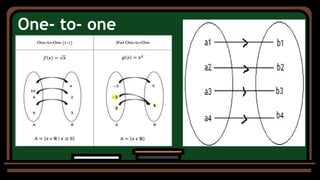
One- to- one
Function:
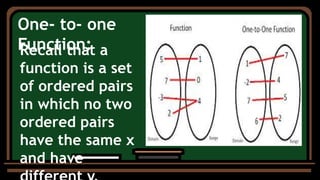
Recall that a
function is a set
of ordered pairs
in which no two
ordered pairs
have the same x
and have
One- to- one
Function:
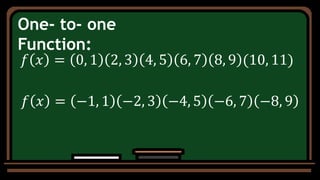
One- to- one
Function:
𝑓 𝑥 = 0, 1 2, 3 4, 5 6, 7 8, 9 (10, 11)
𝑓 𝑥 = −1, 1 −2, 3 −4, 5 −6, 7 −8, 9
One- to- one
Function:
𝐴𝑣𝑒𝑛𝑔𝑒𝑟𝑠 𝑡𝑜 𝐽𝑢𝑠𝑡𝑖𝑐𝑒 𝐿𝑒𝑎𝑔𝑢𝑒
Marvel (x) Justice League
(y)
Hulk Superman
Thor Flash
Captain
America
Batman
One- to- one
Function:
𝑓 𝑥 = 5𝑥 − 8
x y
0 - 8
1 - 3
2 2
3 7
4 12
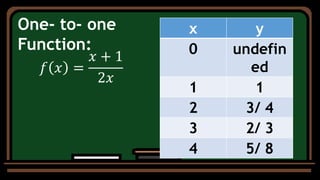
One- to- one
Function:
𝑓 𝑥 =
𝑥 + 1
2𝑥
x y
0 undefin
ed
1 1
2 3/ 4
3 2/ 3
4 5/ 8
One- to- one
Function:
Tell whether the following is a one-
to- one function or not.
𝟏. 𝒇 𝒙 = −𝟐, −𝟑 −𝟏, −𝟏 𝟎, 𝟏 𝟏, 𝟑 𝟐, 𝟓
𝑨𝒏𝒔𝒘𝒆𝒓: 𝑶𝒏𝒆 − 𝒕𝒐 − 𝒐𝒏𝒆
𝟐. 𝒇 𝒙 = 𝟎, −𝟕 𝟏, −𝟒 𝟎, 𝟏 𝟐, −𝟏 −𝟒, 𝟏
𝑨𝒏𝒔𝒘𝒆𝒓: 𝑵𝒐𝒕 𝒐𝒏𝒆 − 𝒕𝒐 − 𝒐𝒏𝒆
𝑨𝒏𝒔𝒘𝒆𝒓: 𝑶𝒏𝒆 − 𝒕𝒐 − 𝒐𝒏𝒆
Solving Inverse of a One- to-
one Function
Steps in solving Inverse of a One- to-
one Function:
STEP 1: Replace f (x) by y.
STEP 2: Interchange x and y.
STEP 3: Solve for y in terms of x.
STEP 4: Replace y with 𝒇−𝟏
𝒙 .
Example 1: 𝐟 𝒙 = 𝟐𝒙 + 𝟒
STEP 1: Replace f
(x) by y.
𝒚 = 𝟐𝒙 + 𝟒
STEP 2: Interchange
x and y.
𝒙 = 𝟐𝒚 + 𝟒
STEP 3: Solve for y
in terms of x.
(−𝟐𝒚 = −𝒙 + 𝟒)(−𝟏)
𝟐𝒚 = 𝒙 − 𝟒)
𝟐
𝒚 =
𝟏
𝟐
𝒙 − 𝟐
STEP 4: Replace y with
𝒇−𝟏 𝒙 .
𝒇−𝟏
𝒙 =
𝟏
𝟐
𝒙 − 𝟐
Example 2: 𝐟 𝒙 =
𝟐𝒙+𝟓
𝟑𝒙−𝟏
𝒚 =
𝟐𝒙 + 𝟓
𝟑𝒙 − 𝟏
𝒙 =
𝟐𝒚 + 𝟓
𝟑𝒚 − 𝟏
𝒙(𝟑𝒚 − 𝟏) = (𝟏)𝟐𝒚 + 𝟓
𝟑𝒙𝒚 − 𝒙 = 𝟐𝒚 + 𝟓
𝟑𝒙𝒚 − 𝟐𝒚 = 𝒙 + 𝟓
𝒚(𝟑𝒙 − 𝟐) = 𝒙 + 𝟓
𝟑𝒙 − 𝟐
𝒚 =
𝒙 + 𝟓
𝟑𝒙 − 𝟐
𝒇−𝟏
𝒙 =
𝒙 + 𝟓
𝟑𝒙 − 𝟐
Example 3: 𝐟 𝒙 =
𝟐𝒙 − 𝟔
𝒚 = 𝟐𝒙 − 𝟔
𝒙 = 𝟐𝒚 − 𝟔
(𝒙)𝟐= (𝟐
𝟐𝒚 − 𝟔)𝟐
𝒙𝟐
= 𝟐𝒚 − 𝟔
𝟐
𝒙𝟐
+ 𝟔 = 𝟐𝒚
𝒚 =
𝒙𝟐
+ 𝟔
𝟐
𝒇−𝟏 𝒙 =
𝟏
𝟐
𝒙𝟐 + 𝟑
Example
4: x y
0 2
1 1
2 - 4
3 0
4 - 2
x y
2 0
1 1
-4 2
0 3
-2 4
Example
5:
X Y
- 1 0
1 2
3 4
X Y
0 -1
2 1
4 3
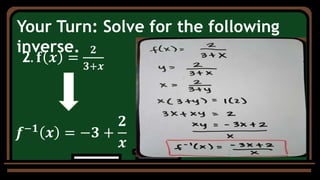
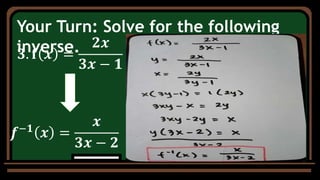
Your Turn: Solve for the following
inverse.
1. 𝐟 𝒙 = 𝟓𝒙 + 𝟐
𝟑. 𝐟 𝒙 =
𝟐𝒙
𝟑𝒙 − 𝟏
2. 𝐟 𝒙 =
𝟐
𝟑+𝒙
Your Turn: Solve for the following
inverse.
1. 𝐟 𝒙 = 𝟓𝒙 + 𝟐
𝒇−𝟏
𝒙 =
𝒙 − 𝟐
𝟓
Your Turn: Solve for the following
inverse.
2. 𝐟 𝒙 =
𝟐
𝟑+𝒙
𝒇−𝟏 𝒙 = −𝟑 +
𝟐
𝒙
Your Turn: Solve for the following
inverse.
𝟑. 𝐟 𝒙 =
𝟐𝒙
𝟑𝒙 − 𝟏
𝒇−𝟏
𝒙 =
𝒙
𝟑𝒙 − 𝟐
Picture of the
day!

Inverse Function.pptx

  • 1.
    Inverse Function Prepared by:Mr. George G. Lescano
  • 2.
    Learning Objectives: At the endof the lesson you will be able to: - Determine the inverse of a one- to- one functions. - Represent an inverse function through it’s: table of values and graphs. - Find the domain and range of an inverse function.
  • 3.
    What is aInverse Function? - A set of ordered pairs formed by reversing the coordinates of each ordered pair of the function. - Remember that function ‘’ f ‘’ has an inverse if and only if ‘’ f ‘’ is one- to- one function. NOTE: Not every function has an inverse.
  • 4.
    Domain and Rangeof Inverse Function: - The domain of the inverse function is the range of the function, and the range of the inverse function is the domain of the function.
  • 5.
    Concept check: - A functiony = f(x) is one- to- one if a horizontal line drawn through the graph of the function intersects the graph at exactly one point. - If the horizontal line intersects the graph in more than one point, then the function is not one- to- one. This test is called geometric test for a one- to- one
  • 6.
    Concept check: A function y= f(x) is said to be one- to- one if: − 𝑎 ≠ 𝑏 𝑖𝑚𝑝𝑙𝑖𝑒𝑠 𝑓 𝑎 ≠ 𝑓 𝑏 𝑤ℎ𝑒𝑛𝑒𝑣𝑒𝑟 𝑎 𝑎𝑛𝑑 𝑏 𝑎𝑟𝑒 𝑖𝑛 𝑡ℎ𝑒 𝑑𝑜𝑚𝑎𝑖𝑛 𝑜𝑓 𝑓𝑢𝑛𝑐𝑡𝑖𝑜𝑛 𝑓. − 𝑇ℎ𝑒 𝑔𝑟𝑎𝑝ℎ 𝑜𝑓 𝑎 𝑓𝑢𝑛𝑐𝑡𝑖𝑜𝑛𝑠 𝑓 𝑎𝑛𝑑 𝑓−1𝑎𝑟𝑒 Symmetric with respect to the line y = x.
  • 7.
    One- to- one Function: Recallthat a function is a set of ordered pairs in which no two ordered pairs have the same x and have
  • 8.
  • 9.
    One- to- one Function: 𝑓𝑥 = 0, 1 2, 3 4, 5 6, 7 8, 9 (10, 11) 𝑓 𝑥 = −1, 1 −2, 3 −4, 5 −6, 7 −8, 9
  • 10.
    One- to- one Function: 𝐴𝑣𝑒𝑛𝑔𝑒𝑟𝑠𝑡𝑜 𝐽𝑢𝑠𝑡𝑖𝑐𝑒 𝐿𝑒𝑎𝑔𝑢𝑒 Marvel (x) Justice League (y) Hulk Superman Thor Flash Captain America Batman
  • 11.
    One- to- one Function: 𝑓𝑥 = 5𝑥 − 8 x y 0 - 8 1 - 3 2 2 3 7 4 12
  • 12.
    One- to- one Function: 𝑓𝑥 = 𝑥 + 1 2𝑥 x y 0 undefin ed 1 1 2 3/ 4 3 2/ 3 4 5/ 8
  • 13.
  • 14.
    Tell whether thefollowing is a one- to- one function or not. 𝟏. 𝒇 𝒙 = −𝟐, −𝟑 −𝟏, −𝟏 𝟎, 𝟏 𝟏, 𝟑 𝟐, 𝟓 𝑨𝒏𝒔𝒘𝒆𝒓: 𝑶𝒏𝒆 − 𝒕𝒐 − 𝒐𝒏𝒆 𝟐. 𝒇 𝒙 = 𝟎, −𝟕 𝟏, −𝟒 𝟎, 𝟏 𝟐, −𝟏 −𝟒, 𝟏 𝑨𝒏𝒔𝒘𝒆𝒓: 𝑵𝒐𝒕 𝒐𝒏𝒆 − 𝒕𝒐 − 𝒐𝒏𝒆
  • 15.
  • 16.
  • 17.
    Solving Inverse ofa One- to- one Function
  • 18.
    Steps in solvingInverse of a One- to- one Function: STEP 1: Replace f (x) by y. STEP 2: Interchange x and y. STEP 3: Solve for y in terms of x. STEP 4: Replace y with 𝒇−𝟏 𝒙 .
  • 19.
    Example 1: 𝐟𝒙 = 𝟐𝒙 + 𝟒 STEP 1: Replace f (x) by y. 𝒚 = 𝟐𝒙 + 𝟒 STEP 2: Interchange x and y. 𝒙 = 𝟐𝒚 + 𝟒 STEP 3: Solve for y in terms of x. (−𝟐𝒚 = −𝒙 + 𝟒)(−𝟏) 𝟐𝒚 = 𝒙 − 𝟒) 𝟐 𝒚 = 𝟏 𝟐 𝒙 − 𝟐 STEP 4: Replace y with 𝒇−𝟏 𝒙 . 𝒇−𝟏 𝒙 = 𝟏 𝟐 𝒙 − 𝟐
  • 20.
    Example 2: 𝐟𝒙 = 𝟐𝒙+𝟓 𝟑𝒙−𝟏 𝒚 = 𝟐𝒙 + 𝟓 𝟑𝒙 − 𝟏 𝒙 = 𝟐𝒚 + 𝟓 𝟑𝒚 − 𝟏 𝒙(𝟑𝒚 − 𝟏) = (𝟏)𝟐𝒚 + 𝟓 𝟑𝒙𝒚 − 𝒙 = 𝟐𝒚 + 𝟓 𝟑𝒙𝒚 − 𝟐𝒚 = 𝒙 + 𝟓 𝒚(𝟑𝒙 − 𝟐) = 𝒙 + 𝟓 𝟑𝒙 − 𝟐 𝒚 = 𝒙 + 𝟓 𝟑𝒙 − 𝟐 𝒇−𝟏 𝒙 = 𝒙 + 𝟓 𝟑𝒙 − 𝟐
  • 21.
    Example 3: 𝐟𝒙 = 𝟐𝒙 − 𝟔 𝒚 = 𝟐𝒙 − 𝟔 𝒙 = 𝟐𝒚 − 𝟔 (𝒙)𝟐= (𝟐 𝟐𝒚 − 𝟔)𝟐 𝒙𝟐 = 𝟐𝒚 − 𝟔 𝟐 𝒙𝟐 + 𝟔 = 𝟐𝒚 𝒚 = 𝒙𝟐 + 𝟔 𝟐 𝒇−𝟏 𝒙 = 𝟏 𝟐 𝒙𝟐 + 𝟑
  • 22.
    Example 4: x y 02 1 1 2 - 4 3 0 4 - 2 x y 2 0 1 1 -4 2 0 3 -2 4
  • 23.
    Example 5: X Y - 10 1 2 3 4 X Y 0 -1 2 1 4 3
  • 24.
    Your Turn: Solvefor the following inverse. 1. 𝐟 𝒙 = 𝟓𝒙 + 𝟐 𝟑. 𝐟 𝒙 = 𝟐𝒙 𝟑𝒙 − 𝟏 2. 𝐟 𝒙 = 𝟐 𝟑+𝒙
  • 25.
    Your Turn: Solvefor the following inverse. 1. 𝐟 𝒙 = 𝟓𝒙 + 𝟐 𝒇−𝟏 𝒙 = 𝒙 − 𝟐 𝟓
  • 26.
    Your Turn: Solvefor the following inverse. 2. 𝐟 𝒙 = 𝟐 𝟑+𝒙 𝒇−𝟏 𝒙 = −𝟑 + 𝟐 𝒙
  • 27.
    Your Turn: Solvefor the following inverse. 𝟑. 𝐟 𝒙 = 𝟐𝒙 𝟑𝒙 − 𝟏 𝒇−𝟏 𝒙 = 𝒙 𝟑𝒙 − 𝟐
  • 28.