1
Light Emitting Diode
Devansh Gupta
M.Sc 1st
Year
2
Contents
A. LED
Introduction
Working Principle
Advantages
Disadvantages
Applications
B. OLED
Introduction
Working Principle
Advantages
Disadvantages
Application
C. Comparison Between LED &OLED
3
D. Reference
Light Emitting Diode (LED)
Introduction
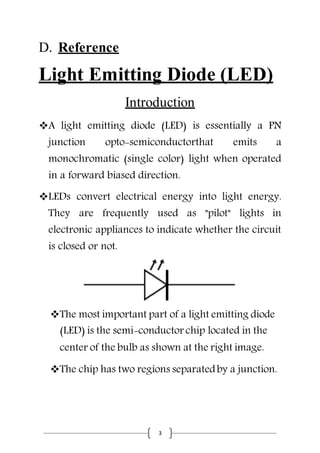
A light emitting diode (LED) is essentially a PN
junction opto-semiconductorthat emits a
monochromatic (single color) light when operated
in a forward biased direction.
LEDs convert electrical energy into light energy.
They are frequently used as "pilot" lights in
electronic appliances to indicate whether the circuit
is closed or not.
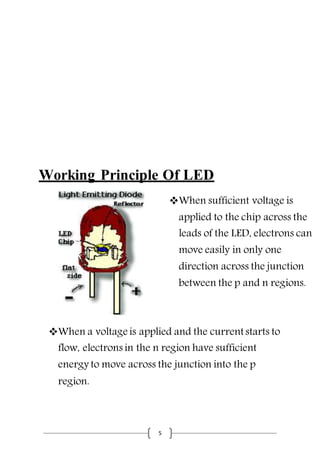
The most important part of a light emitting diode
(LED) is the semi-conductor chip located in the
center of the bulb as shown at the right image.
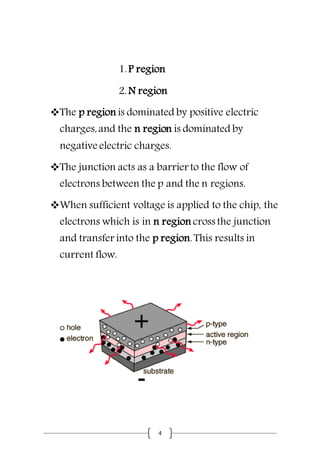
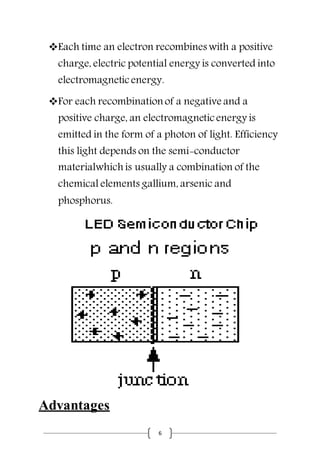
The chip has two regions separatedby a junction.
4
1.P region
2.N region
The p region is dominated by positive electric
charges,and the n region is dominated by
negative electric charges.
The junction acts as a barrier to the flow of
electrons between the p and the n regions.
When sufficient voltage is applied to the chip, the
electrons which is in n region cross the junction
and transfer into the p region.This results in
current flow.
5
Working Principle Of LED
When a voltage is applied and the current starts to
flow, electrons in the n region have sufficient
energy to move across the junction into the p
region.
When sufficient voltage is
applied to the chip across the
leads of the LED, electrons can
move easily in only one
direction across the junction
between the p and n regions.
6
Each time an electron recombines with a positive
charge, electric potential energy is converted into
electromagneticenergy.
For each recombination of a negative and a
positive charge, an electromagneticenergy is
emitted in the form of a photon of light. Efficiency
this light depends on the semi-conductor
materialwhich is usually a combination of the
chemical elements gallium, arsenic and
phosphorus.
Advantages
7
Energy efficient(producemore light per watt)
Long lifetime(60,000 Hours or more)
Rugged(made-up of solid material, no breakage like filament)
No warm-up period(achieve full bright light in nanoseconds)
Not effected by cold temperature(used in sub zero weather)
Directional(direct the light where you want)
Environment Friendly(contains no mercury)
Controllable(brightness and colour can be controlled)
Can sustain over frequent on-off cycle
Disadvantages
Very expensive than other lighting technologies
Requires accurate voltage & constant current flow
Can shift colour due to age & temperature
Cannot be used in high temperature(Lead to device
failure)
Applications
Vehicle indicator lights and brake lights.
8
Currently Audi & BMW integrate high power LEDs.
Mobile phone flash lights.(Surface Mount Diode)
LED screens for advertising & information.
Due to low power consumption, small size & long life
LEDs are used in many electrical equipments.(indicator)
Now a days airports, hotels, subways, shopping centers
and some homes feature LEDs.
LED based traffic signal has been successful & is also
growing rapidly.
Organic Light Emitting Diode
(OLED)
Introduction
OLED - OrganicLight Emitting Diode
9
An OLED is any light emitting diode (LED) which
emissive electroluminescent layer is composed of a
film of organic compounds.
In OLED a electroluminescent layer is an organic
semiconductor material which is sandwiched
between two electrodes. One of these electrodes is
transparent.
History
The first OLED device was developed by Eastman
Kodak in 1987.
In 1996, pioneer produces the world’s first
commercialPMOLED.
In 2000, many companies like Motorola, LG etc.
developed various displays.
In 2001, Sony developed world’s largest full
colour OLED.
In 2002, approximately 3.5 million passive matrix
OLED sub-displays were sold, and over 10 million
were sold in 2003.
10
In 2010 and 2011, many companies announced
AMOLED displays.
Many developments had take place in the year
2012.
11
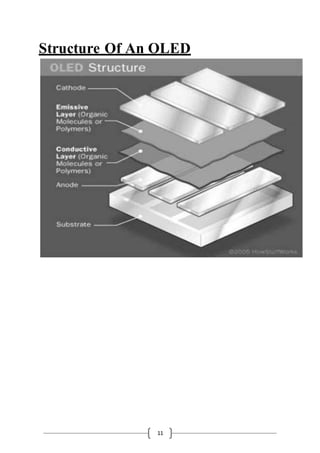
Structure Of An OLED
12
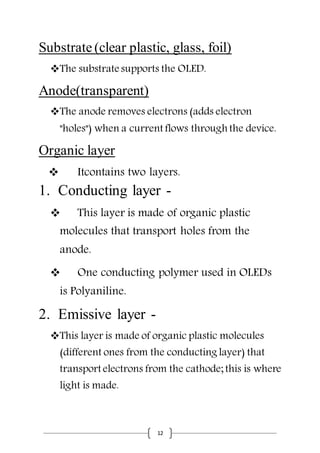
Substrate (clear plastic, glass, foil)
The substrate supports the OLED.
Anode(transparent)
The anode removes electrons (adds electron
"holes") when a current flows through the device.
Organic layer
 Itcontains two layers.
1. Conducting layer -
 This layer is made of organic plastic
molecules that transport holes from the
anode.
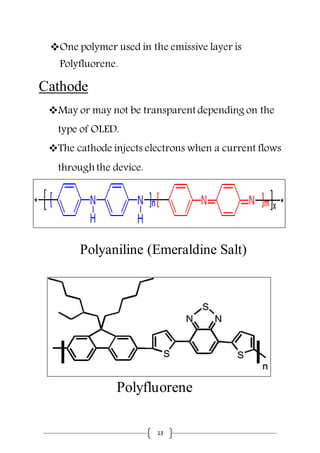
 One conducting polymer used in OLEDs
is Polyaniline.
2. Emissive layer -
This layer is made of organic plastic molecules
(different ones from the conducting layer) that
transport electrons from the cathode; this is where
light is made.
13
One polymer used in the emissive layer is
Polyfluorene.
Cathode
May or may not be transparent depending on the
type of OLED.
The cathode injects electrons when a current flows
through the device.
Polyaniline (Emeraldine Salt)
Polyfluorene
14
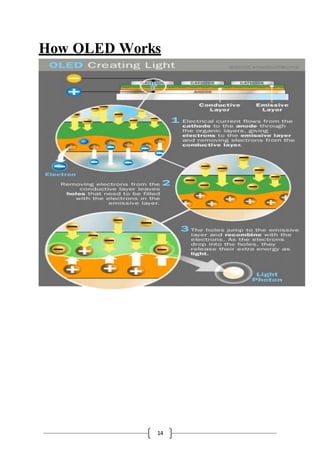
How OLED Works
15
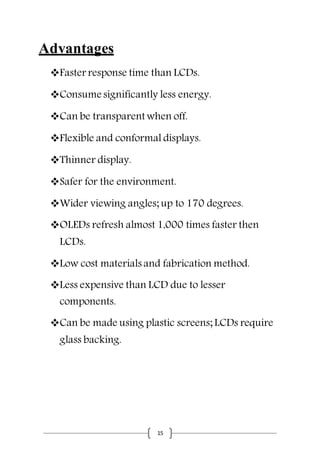
Advantages
Faster response time than LCDs.
Consume significantly less energy.
Can be transparent when off.
Flexible and conformal displays.
Thinner display.
Safer for the environment.
Wider viewing angles; up to 170 degrees.
OLEDs refresh almost 1,000 times faster then
LCDs.
Low cost materials and fabrication method.
Less expensive than LCD due to lesser
components.
Can be made using plastic screens; LCDs require
glass backing.
16
Disadvantages
OLED seems to be the perfect technology for
all types of displays, but it also has some
problems.
While red and green OLED films have longer
lifetimes (46,000 to 230,000 hours), blue
organics currently have much shorter lifetimes
(up to around 14,000 hours).
Currently,manufacturing is more expensive than
LCDs.
Water can easily damage OLEDs.
OLED screens are even worse than LCD in direct
sunlight.
Overall luminance degradation.
Limited market availability.
17
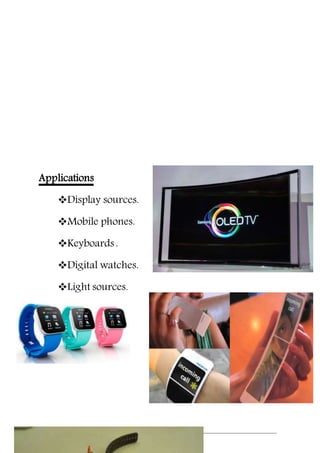
Applications
Display sources.
Mobile phones.
Keyboards.
Digital watches.
Light sources.
18
OLED vs. LCD
Greater view angle.
High contrast.
Faster response time.
Do not require backlighting.
Temperature(~50°C – 80°C).
Limited view angle.
Low contrast.
Slow response time.
Require backlighting.
Temperature(~0°C-100°C).
OLED LCD
Reference
OrganicLight Emitting Devices By Joseph Shinar-springer-
Verlag, New York, 2004, Page No 150
OrganicElectronic Materials By Riccardo
Farchichi,g.Grosso,2000,Page No 135
Physics Of Semiconductors By Wolf Gang Brutling ,VBH
Publishers, New York,1999, Page No 451
Highly Efficient OLED,S With Phosphorescent Materials By
HartmutVersin,Wiley Publishers New York 2000, Page No 121
www.oled-info.com

Light Emitting Diode Presentation Report

  • 1.
    1 Light Emitting Diode DevanshGupta M.Sc 1st Year
  • 2.
    2 Contents A. LED Introduction Working Principle Advantages Disadvantages Applications B.OLED Introduction Working Principle Advantages Disadvantages Application C. Comparison Between LED &OLED
  • 3.
    3 D. Reference Light EmittingDiode (LED) Introduction A light emitting diode (LED) is essentially a PN junction opto-semiconductorthat emits a monochromatic (single color) light when operated in a forward biased direction. LEDs convert electrical energy into light energy. They are frequently used as "pilot" lights in electronic appliances to indicate whether the circuit is closed or not. The most important part of a light emitting diode (LED) is the semi-conductor chip located in the center of the bulb as shown at the right image. The chip has two regions separatedby a junction.
  • 4.
    4 1.P region 2.N region Thep region is dominated by positive electric charges,and the n region is dominated by negative electric charges. The junction acts as a barrier to the flow of electrons between the p and the n regions. When sufficient voltage is applied to the chip, the electrons which is in n region cross the junction and transfer into the p region.This results in current flow.
  • 5.
    5 Working Principle OfLED When a voltage is applied and the current starts to flow, electrons in the n region have sufficient energy to move across the junction into the p region. When sufficient voltage is applied to the chip across the leads of the LED, electrons can move easily in only one direction across the junction between the p and n regions.
  • 6.
    6 Each time anelectron recombines with a positive charge, electric potential energy is converted into electromagneticenergy. For each recombination of a negative and a positive charge, an electromagneticenergy is emitted in the form of a photon of light. Efficiency this light depends on the semi-conductor materialwhich is usually a combination of the chemical elements gallium, arsenic and phosphorus. Advantages
  • 7.
    7 Energy efficient(producemore lightper watt) Long lifetime(60,000 Hours or more) Rugged(made-up of solid material, no breakage like filament) No warm-up period(achieve full bright light in nanoseconds) Not effected by cold temperature(used in sub zero weather) Directional(direct the light where you want) Environment Friendly(contains no mercury) Controllable(brightness and colour can be controlled) Can sustain over frequent on-off cycle Disadvantages Very expensive than other lighting technologies Requires accurate voltage & constant current flow Can shift colour due to age & temperature Cannot be used in high temperature(Lead to device failure) Applications Vehicle indicator lights and brake lights.
  • 8.
    8 Currently Audi &BMW integrate high power LEDs. Mobile phone flash lights.(Surface Mount Diode) LED screens for advertising & information. Due to low power consumption, small size & long life LEDs are used in many electrical equipments.(indicator) Now a days airports, hotels, subways, shopping centers and some homes feature LEDs. LED based traffic signal has been successful & is also growing rapidly. Organic Light Emitting Diode (OLED) Introduction OLED - OrganicLight Emitting Diode
  • 9.
    9 An OLED isany light emitting diode (LED) which emissive electroluminescent layer is composed of a film of organic compounds. In OLED a electroluminescent layer is an organic semiconductor material which is sandwiched between two electrodes. One of these electrodes is transparent. History The first OLED device was developed by Eastman Kodak in 1987. In 1996, pioneer produces the world’s first commercialPMOLED. In 2000, many companies like Motorola, LG etc. developed various displays. In 2001, Sony developed world’s largest full colour OLED. In 2002, approximately 3.5 million passive matrix OLED sub-displays were sold, and over 10 million were sold in 2003.
  • 10.
    10 In 2010 and2011, many companies announced AMOLED displays. Many developments had take place in the year 2012.
  • 11.
  • 12.
    12 Substrate (clear plastic,glass, foil) The substrate supports the OLED. Anode(transparent) The anode removes electrons (adds electron "holes") when a current flows through the device. Organic layer  Itcontains two layers. 1. Conducting layer -  This layer is made of organic plastic molecules that transport holes from the anode.  One conducting polymer used in OLEDs is Polyaniline. 2. Emissive layer - This layer is made of organic plastic molecules (different ones from the conducting layer) that transport electrons from the cathode; this is where light is made.
  • 13.
    13 One polymer usedin the emissive layer is Polyfluorene. Cathode May or may not be transparent depending on the type of OLED. The cathode injects electrons when a current flows through the device. Polyaniline (Emeraldine Salt) Polyfluorene
  • 14.
  • 15.
    15 Advantages Faster response timethan LCDs. Consume significantly less energy. Can be transparent when off. Flexible and conformal displays. Thinner display. Safer for the environment. Wider viewing angles; up to 170 degrees. OLEDs refresh almost 1,000 times faster then LCDs. Low cost materials and fabrication method. Less expensive than LCD due to lesser components. Can be made using plastic screens; LCDs require glass backing.
  • 16.
    16 Disadvantages OLED seems tobe the perfect technology for all types of displays, but it also has some problems. While red and green OLED films have longer lifetimes (46,000 to 230,000 hours), blue organics currently have much shorter lifetimes (up to around 14,000 hours). Currently,manufacturing is more expensive than LCDs. Water can easily damage OLEDs. OLED screens are even worse than LCD in direct sunlight. Overall luminance degradation. Limited market availability.
  • 17.
  • 18.
    18 OLED vs. LCD Greaterview angle. High contrast. Faster response time. Do not require backlighting. Temperature(~50°C – 80°C). Limited view angle. Low contrast. Slow response time. Require backlighting. Temperature(~0°C-100°C). OLED LCD Reference OrganicLight Emitting Devices By Joseph Shinar-springer- Verlag, New York, 2004, Page No 150 OrganicElectronic Materials By Riccardo Farchichi,g.Grosso,2000,Page No 135 Physics Of Semiconductors By Wolf Gang Brutling ,VBH Publishers, New York,1999, Page No 451 Highly Efficient OLED,S With Phosphorescent Materials By HartmutVersin,Wiley Publishers New York 2000, Page No 121 www.oled-info.com