Classification Of Polymers
Presented by
Devansh Gupta
M.ScPolymer Science
Semester 1
Contents
 Some Basic Definitions
 Classification Of Polymers
1. By Origin
2. By Monomer
3. By Thermal Response
4. By Mode Of Formation
5. By Structure
6. By Application & Physical Properties
7. By Tacticity
 Reference
Definition
The word ‘polymer’ comes from the Greek
words poly (meaning ‘many’) and meros
(meaning ‘parts’).
Example: POLYETHYLENE =
(ETHYLENE+ ETHYLENE+......)n
Where n = 4,000
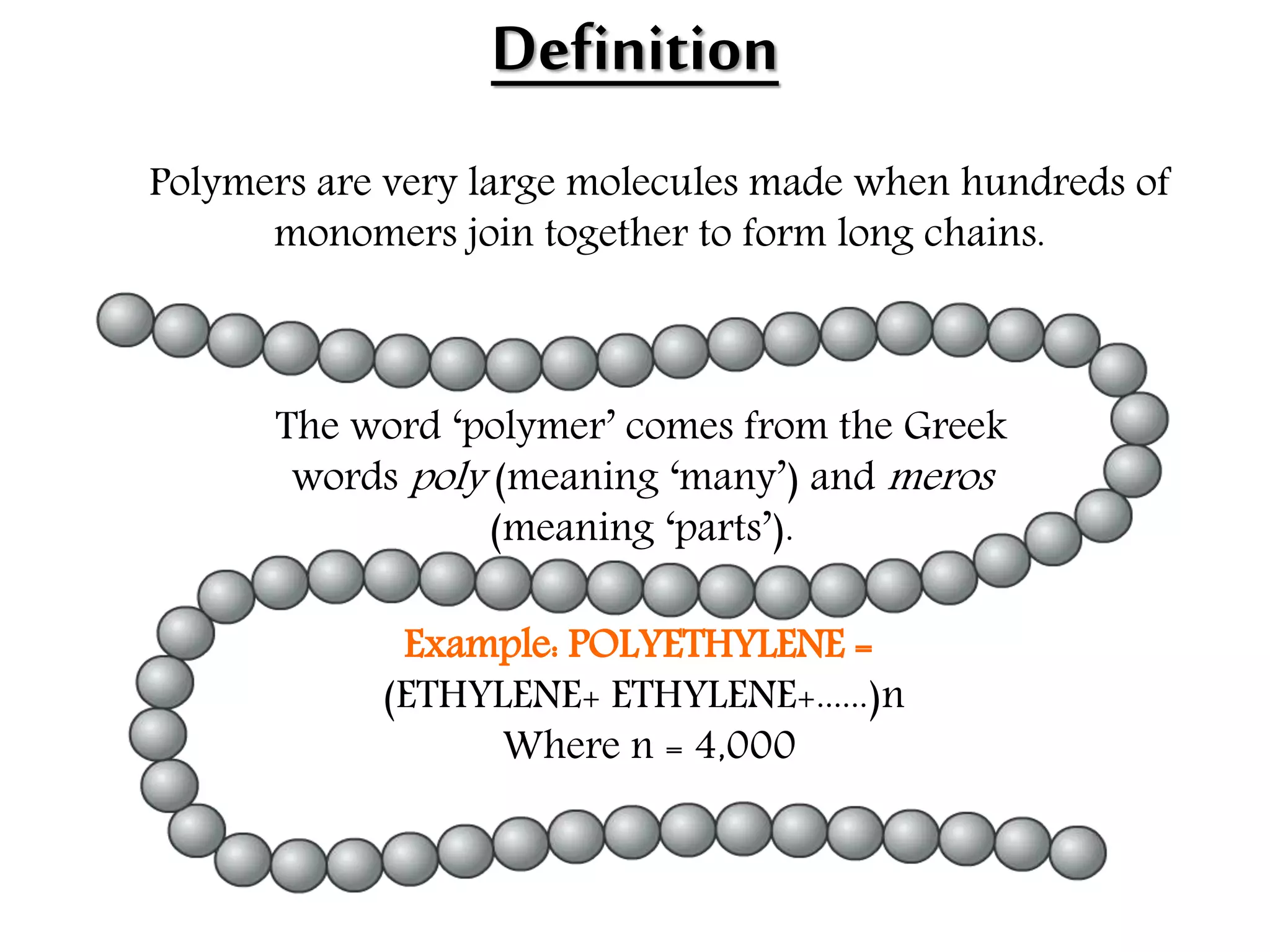
Polymers are very large molecules made when hundreds of
monomers join together to form long chains.
Monomer
The small individual repeating units/molecules
are known as monomers(means single part).
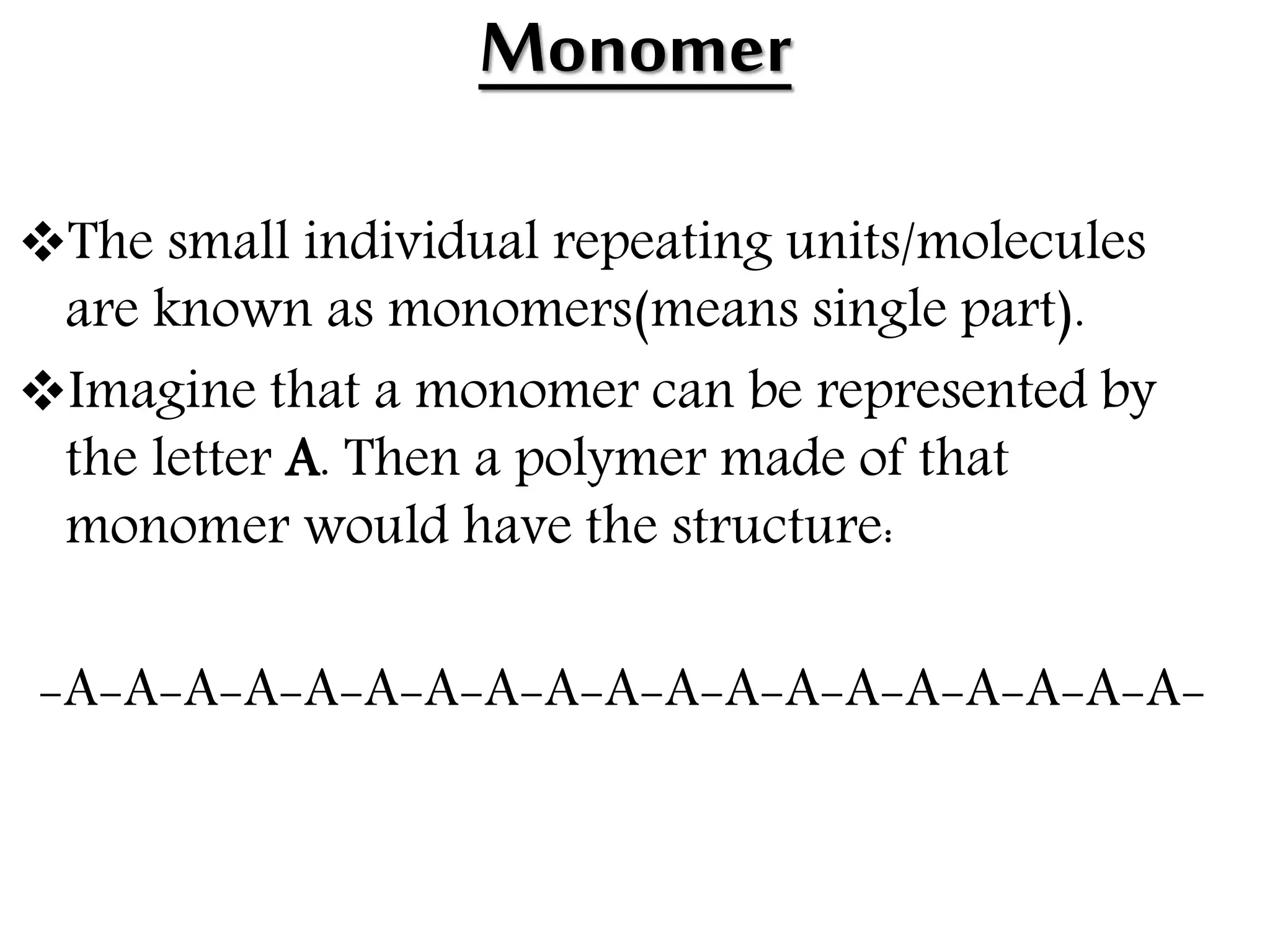
Imagine that a monomer can be represented by
the letter A. Then a polymer made of that
monomer would have the structure:
-A-A-A-A-A-A-A-A-A-A-A-A-A-A-A-A-A-A-A-
Polymerization
• The process by which the monomer molecules
are linked to form a big polymer molecule is
called ‘polymerization’.
• Polymerization is a process of bonding monomer,
or “single units” together through a variety of
reaction mechanisms to form longer chains
named Polymer
• As important as polymers are, they exist with
monomers, which are small, single molecules
such as hydrocarbons and amino acids.
Classification Of Polymers
1. By Origin
2. By Monomer
3. By Thermal Response
4. By Mode Of Formation
5. By Structure
6. By Application & Physical Properties
7. By Tacticity
By Origin
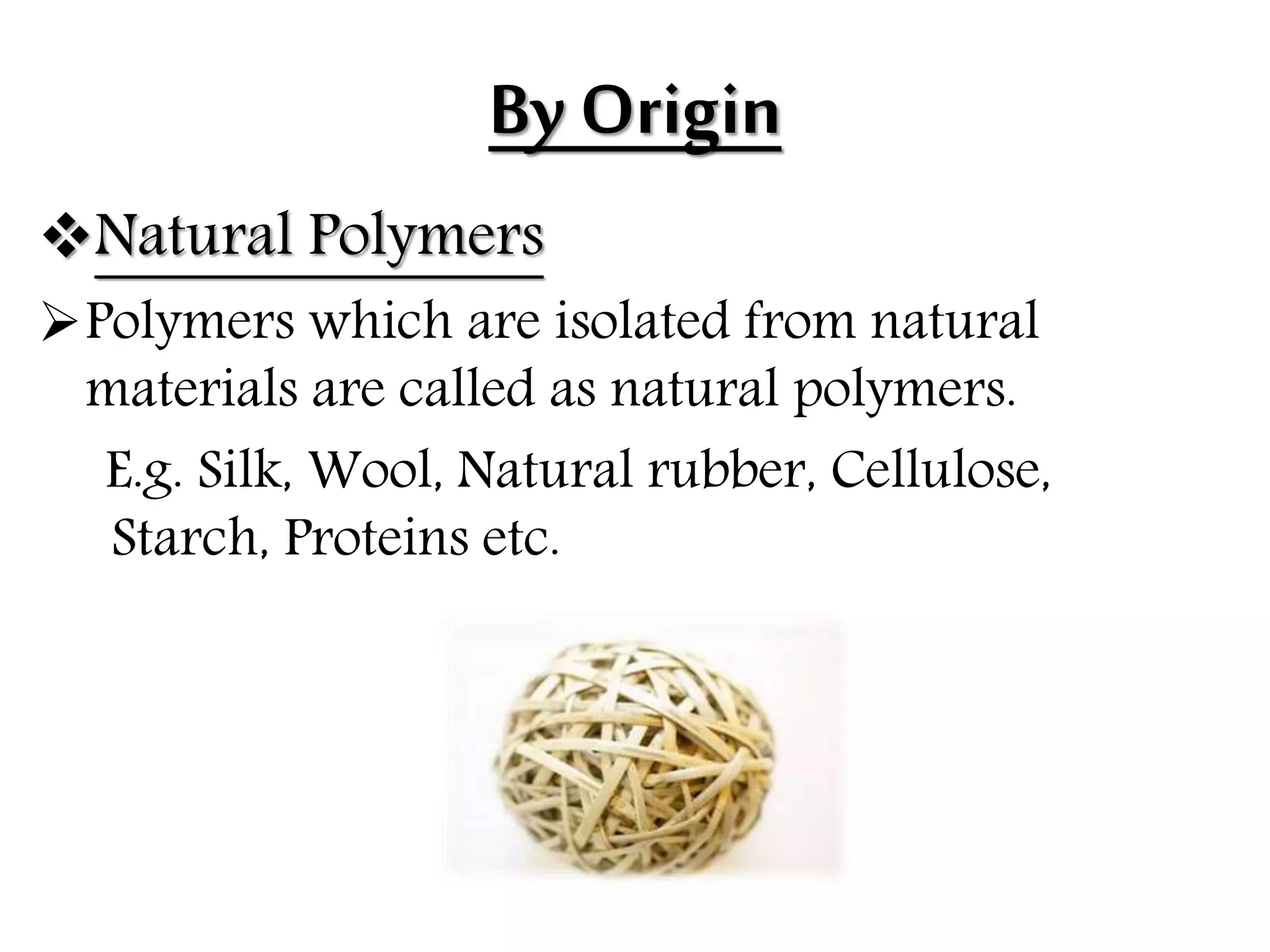
Natural Polymers
Polymers which are isolated from natural
materials are called as natural polymers.
E.g. Silk, Wool, Natural rubber, Cellulose,
Starch, Proteins etc.
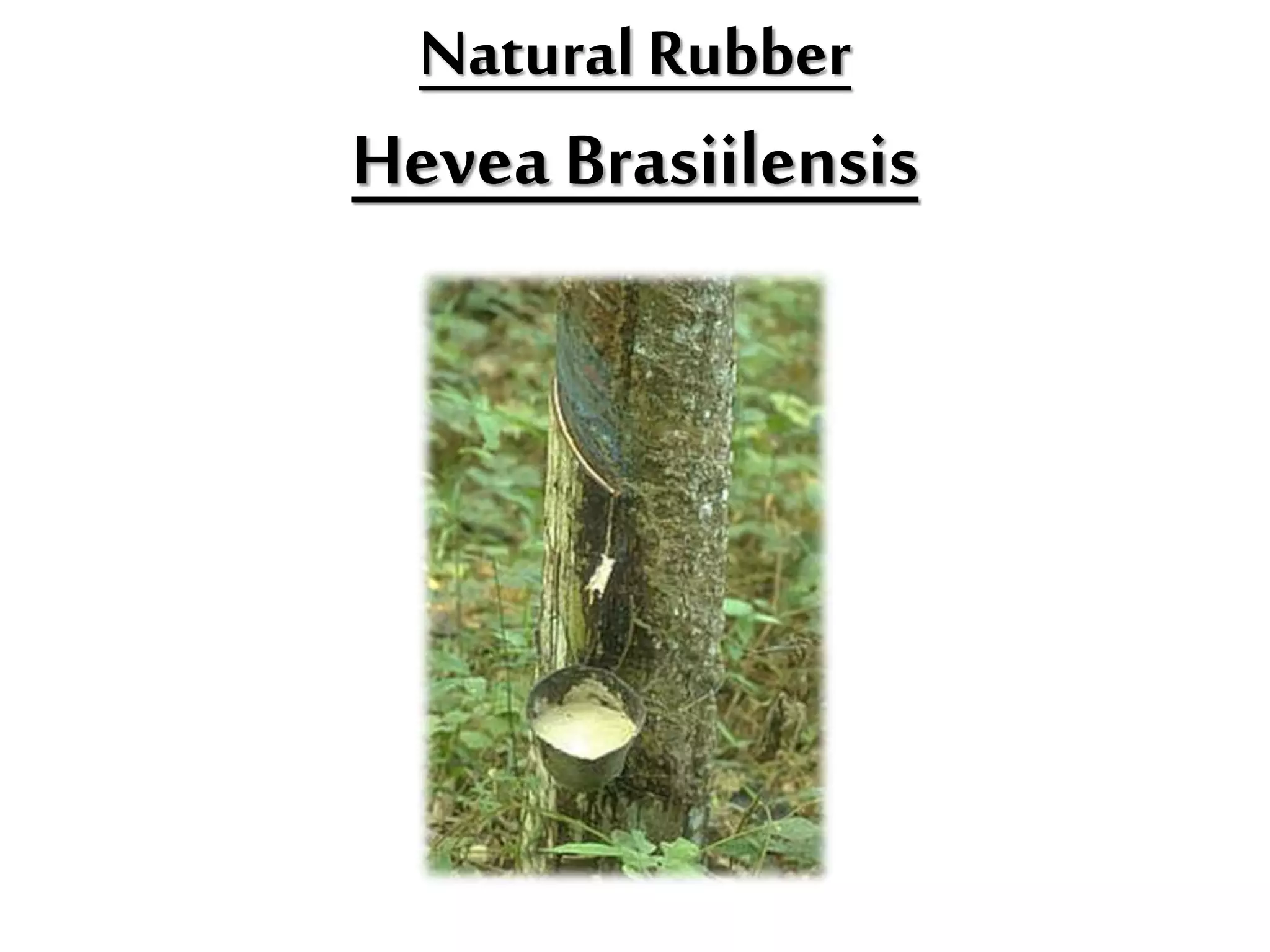
Natural Rubber
Hevea Brasiilensis
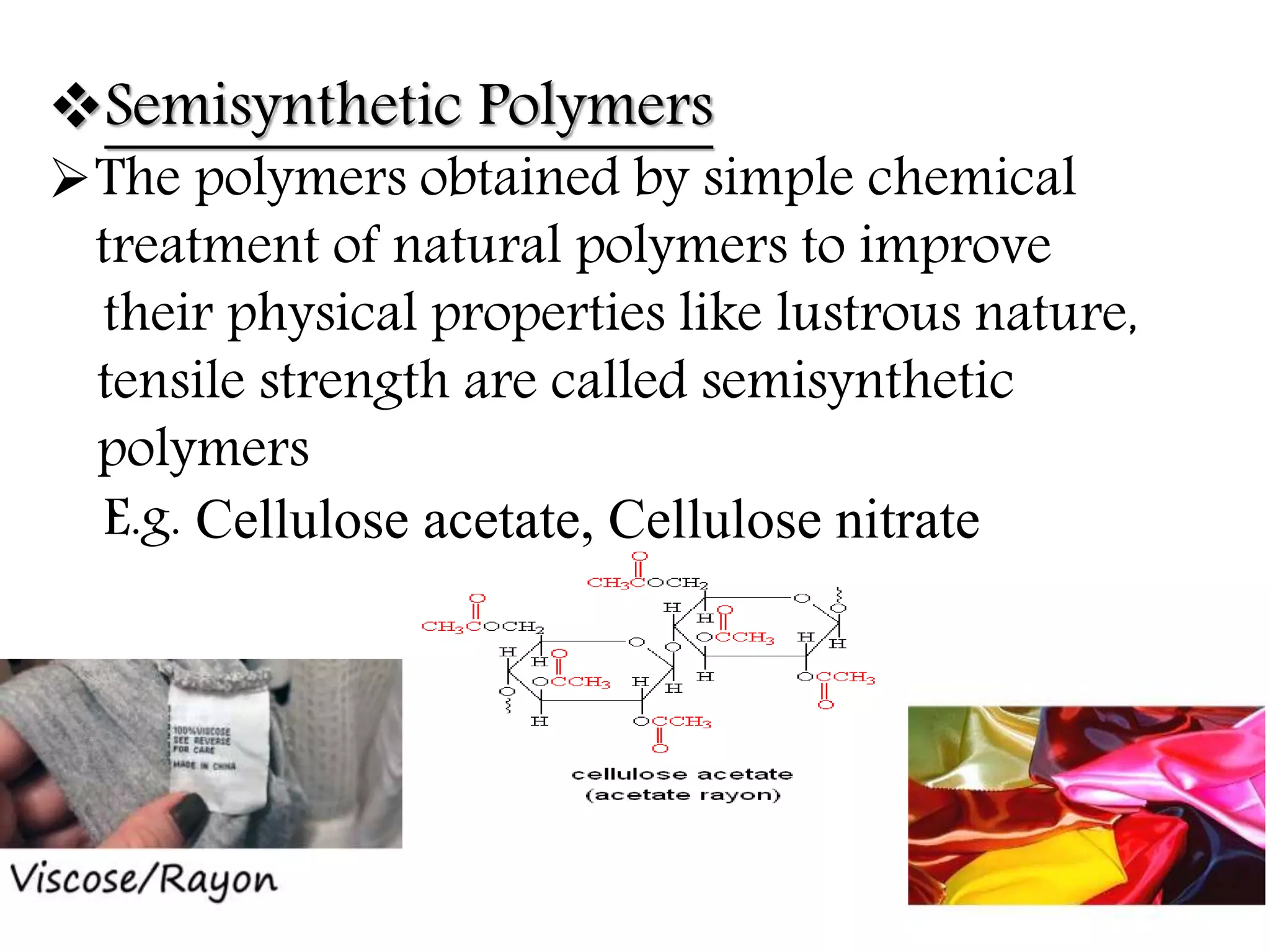
Semisynthetic Polymers
The polymers obtained by simple chemical
treatment of natural polymers to improve
their physical properties like lustrous nature,
tensile strength are called semisynthetic
polymers
E.g. Cellulose acetate, Cellulose nitrate
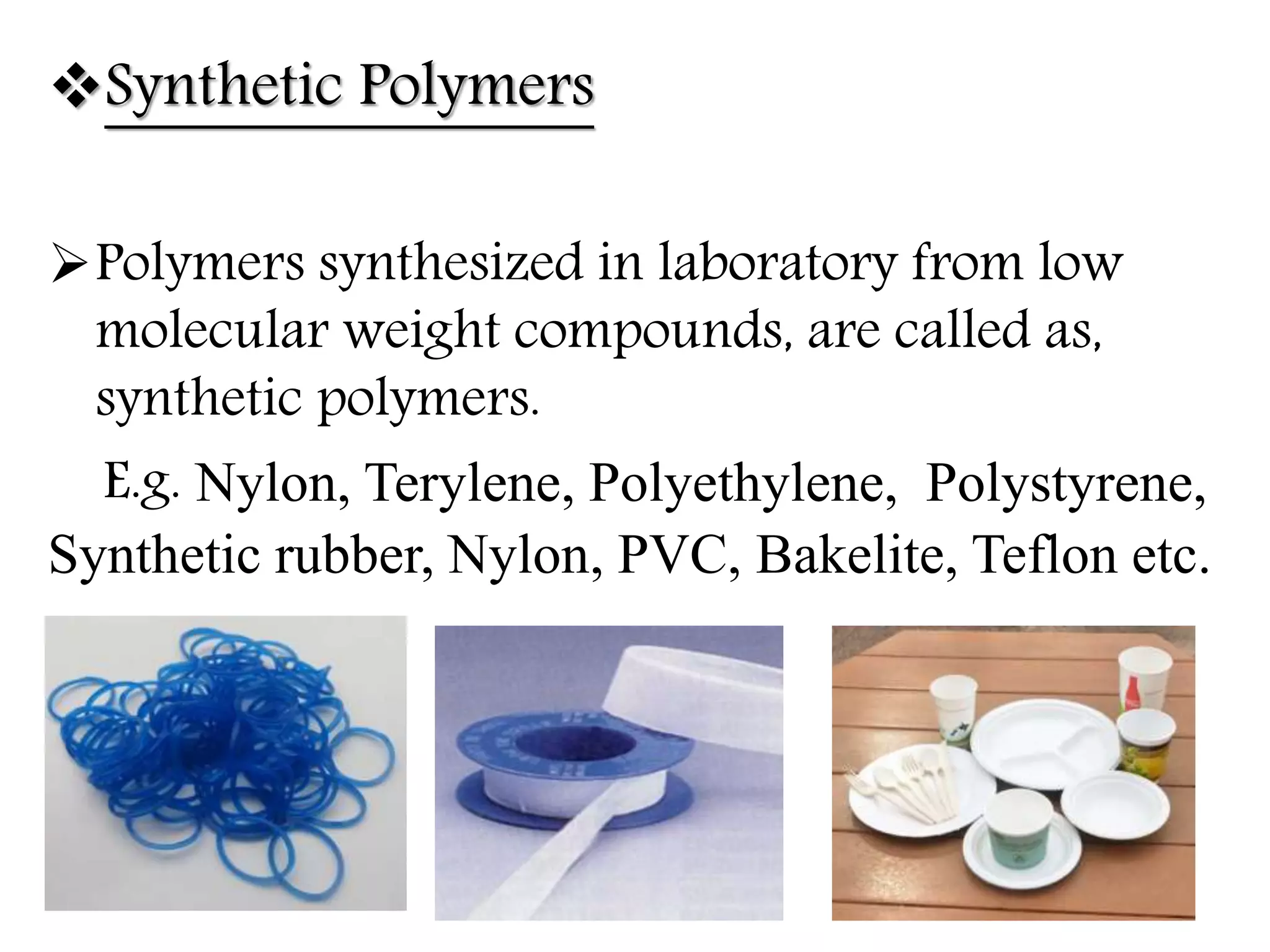
Synthetic Polymers
Polymers synthesized in laboratory from low
molecular weight compounds, are called as,
synthetic polymers.
E.g. Nylon, Terylene, Polyethylene, Polystyrene,
Synthetic rubber, Nylon, PVC, Bakelite, Teflon etc.
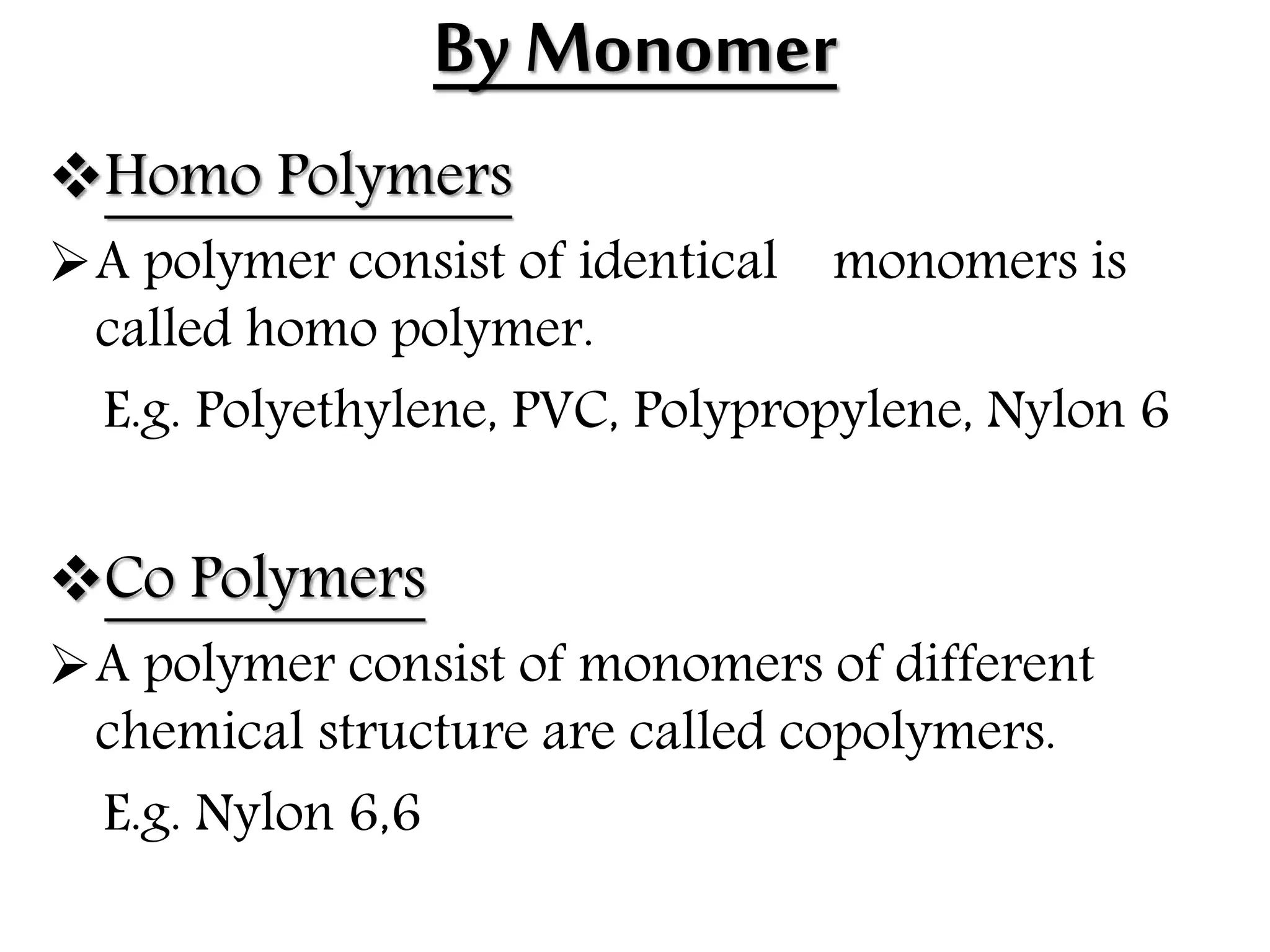
By Monomer
Homo Polymers
A polymer consist of identical monomers is
called homo polymer.
E.g. Polyethylene, PVC, Polypropylene, Nylon 6
Co Polymers
A polymer consist of monomers of different
chemical structure are called copolymers.
E.g. Nylon 6,6
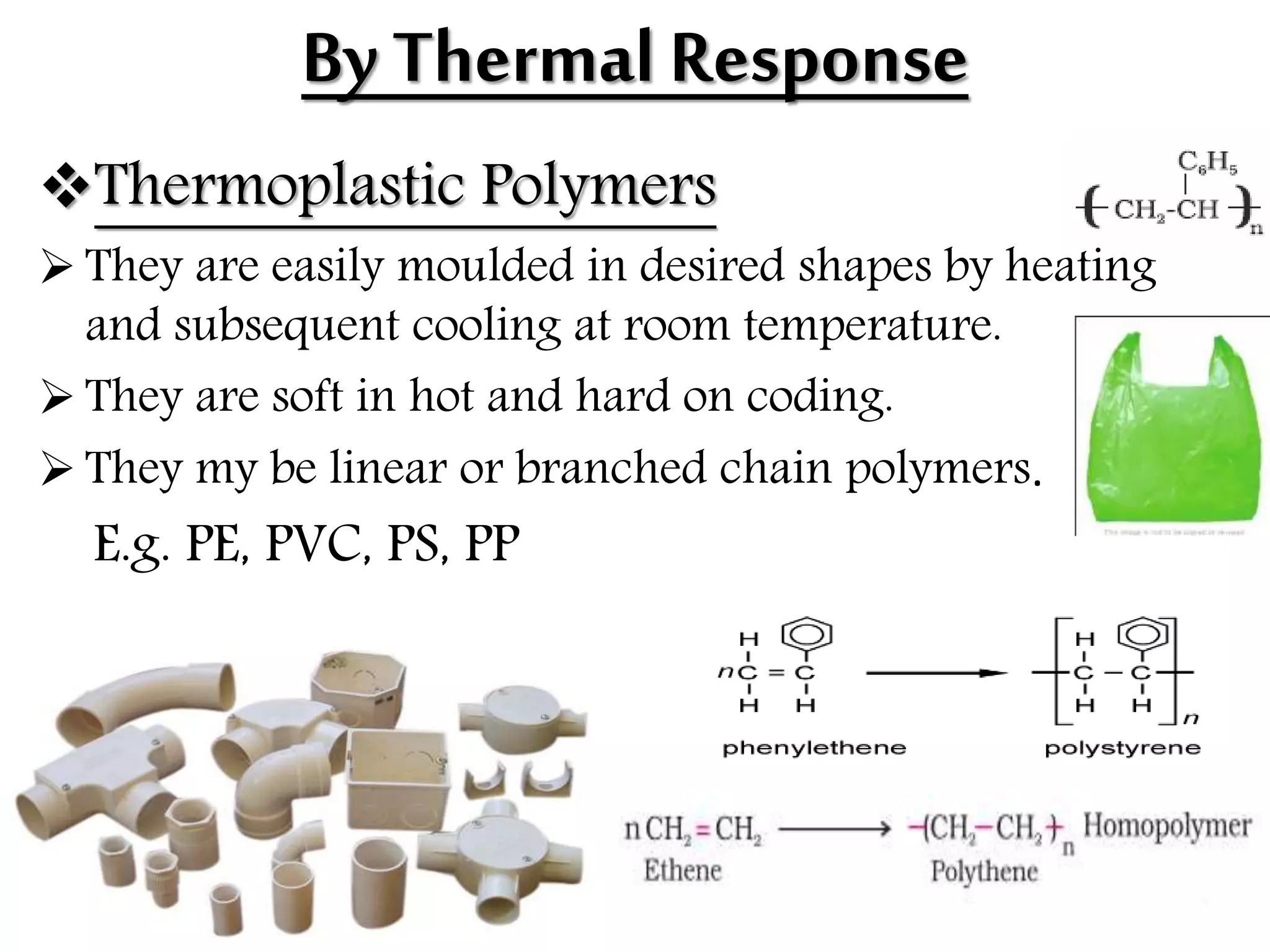
By Thermal Response
Thermoplastic Polymers
 They are easily moulded in desired shapes by heating
and subsequent cooling at room temperature.
 They are soft in hot and hard on coding.
 They my be linear or branched chain polymers.
E.g. PE, PVC, PS, PP
Thermosetting Polymers
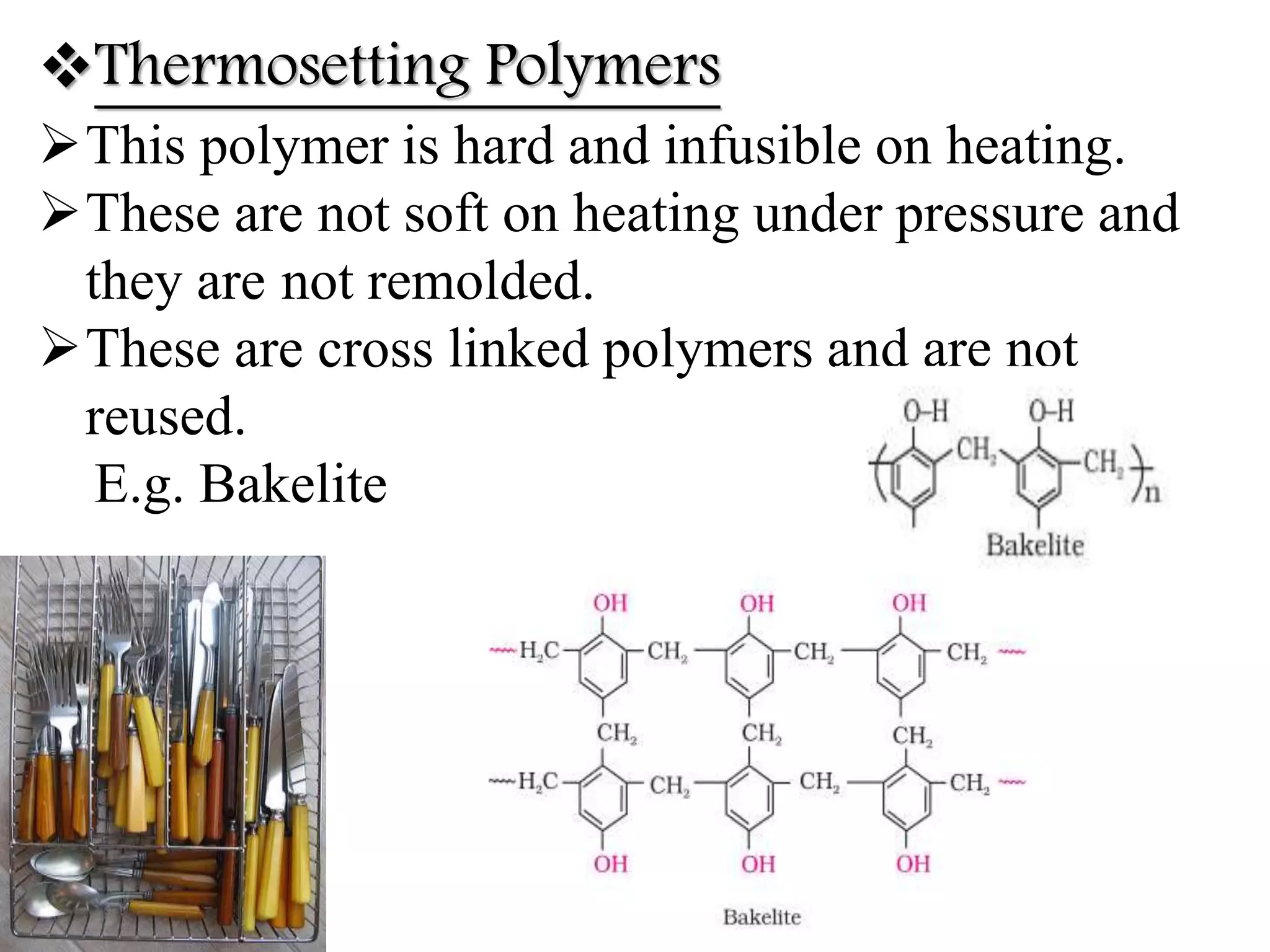
This polymer is hard and infusible on heating.
These are not soft on heating under pressure and
they are not remolded.
These are cross linked polymers and are not
reused.
E.g. Bakelite
By Mode Of Formation
Addition Polymers
The polymers formed by the addition of
monomers repeatedly without removal of by
products are called addition polymers.
These polymers contains all the atoms of
monomers hence their molecular weight are
integral multiple of monomer unit.
E.g. Teflon, Polyethylene, Polypropylene, PVC.
Condensation Polymers
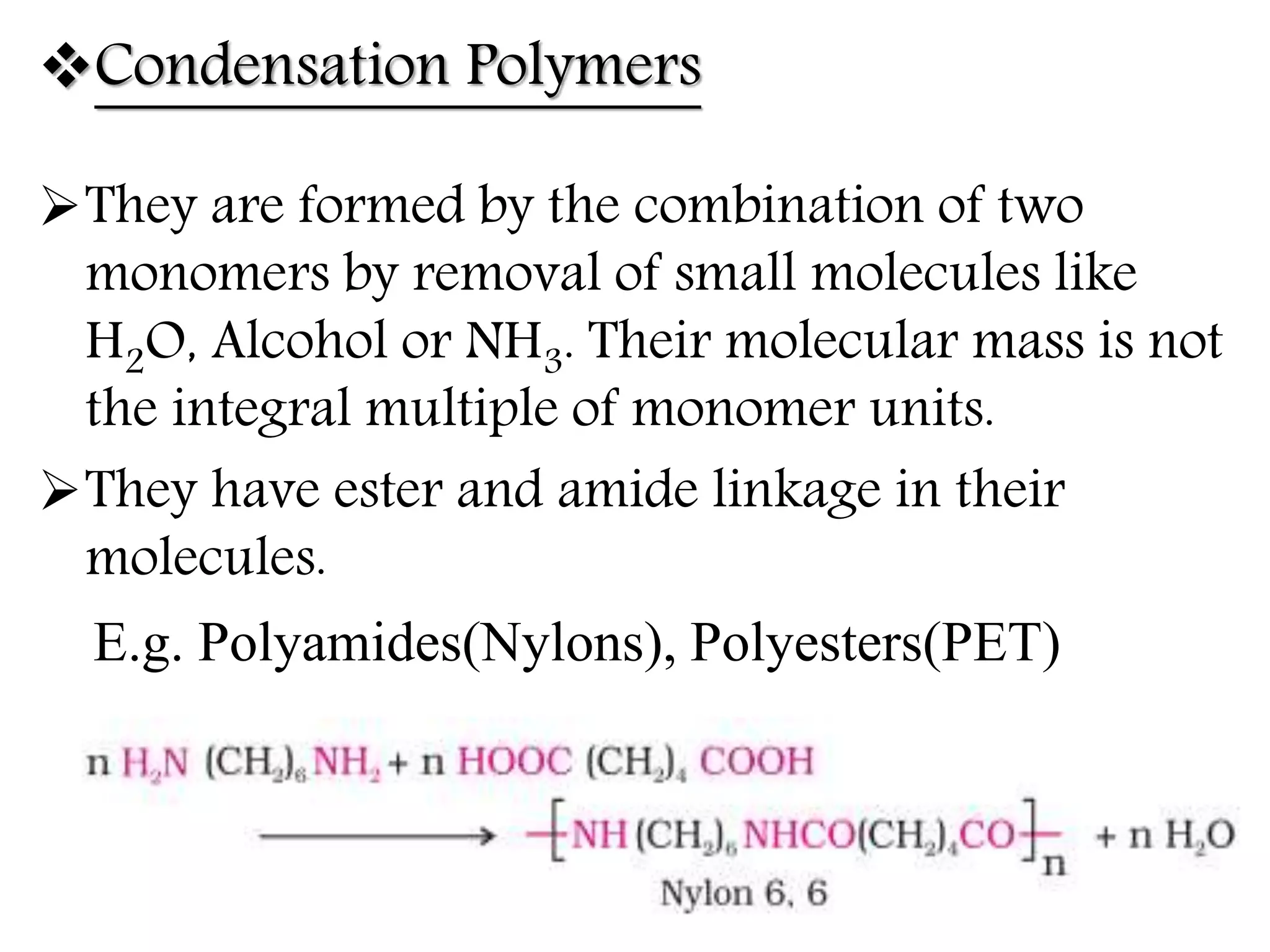
They are formed by the combination of two
monomers by removal of small molecules like
H2O, Alcohol or NH3. Their molecular mass is not
the integral multiple of monomer units.
They have ester and amide linkage in their
molecules.
E.g. Polyamides(Nylons), Polyesters(PET)
By Structure
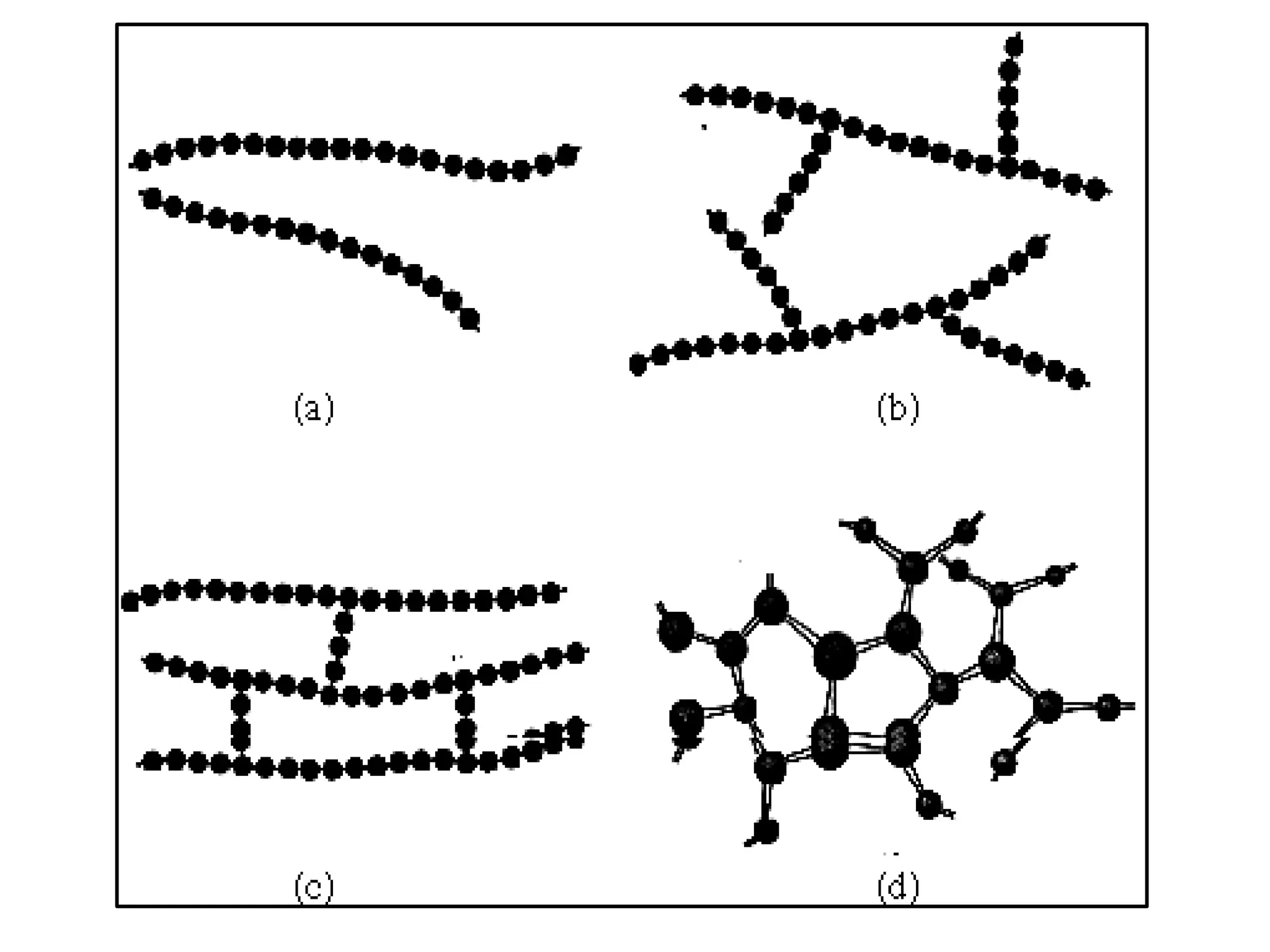
Linear Polymers
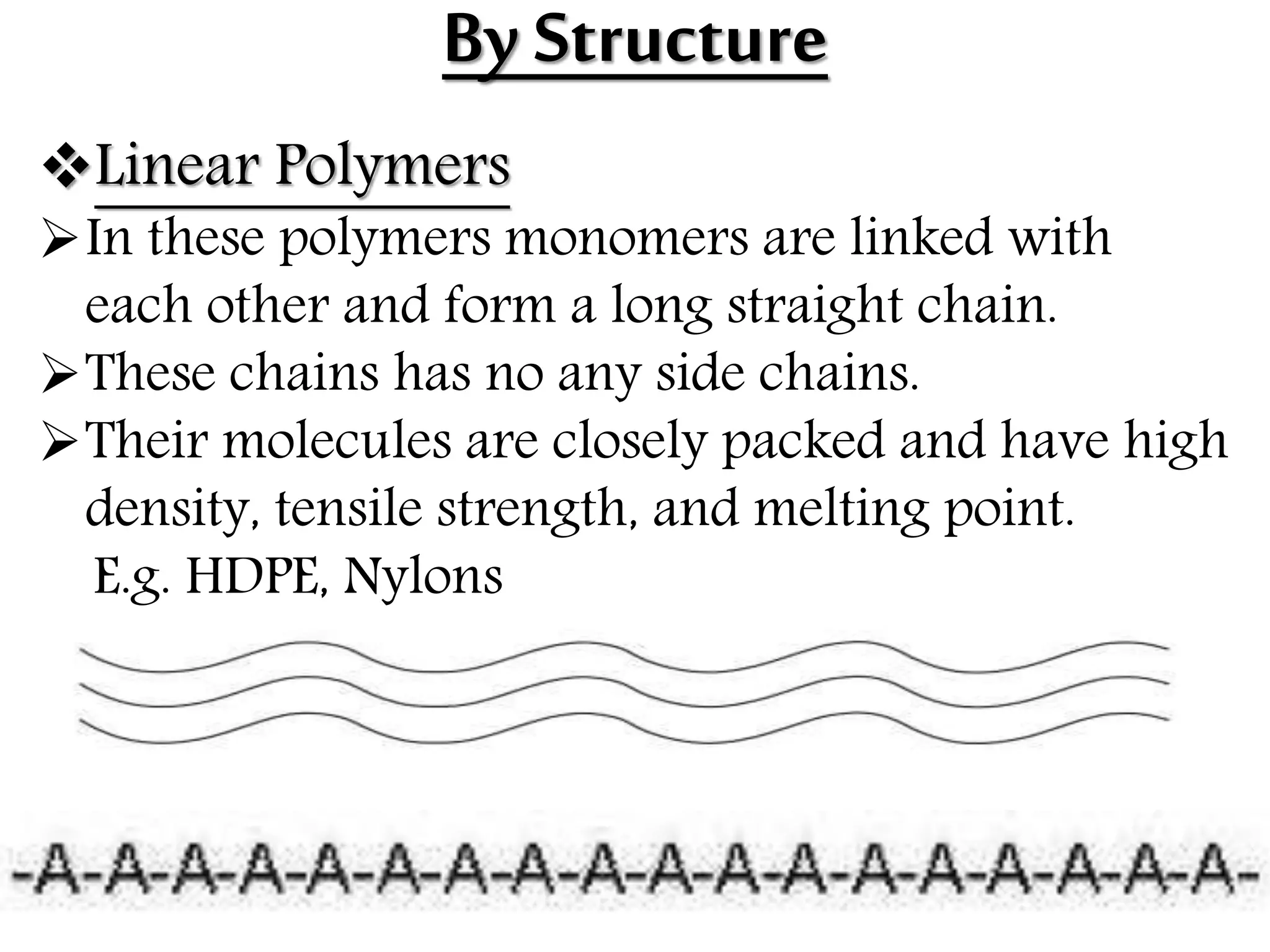
In these polymers monomers are linked with
each other and form a long straight chain.
These chains has no any side chains.
Their molecules are closely packed and have high
density, tensile strength, and melting point.
E.g. HDPE, Nylons
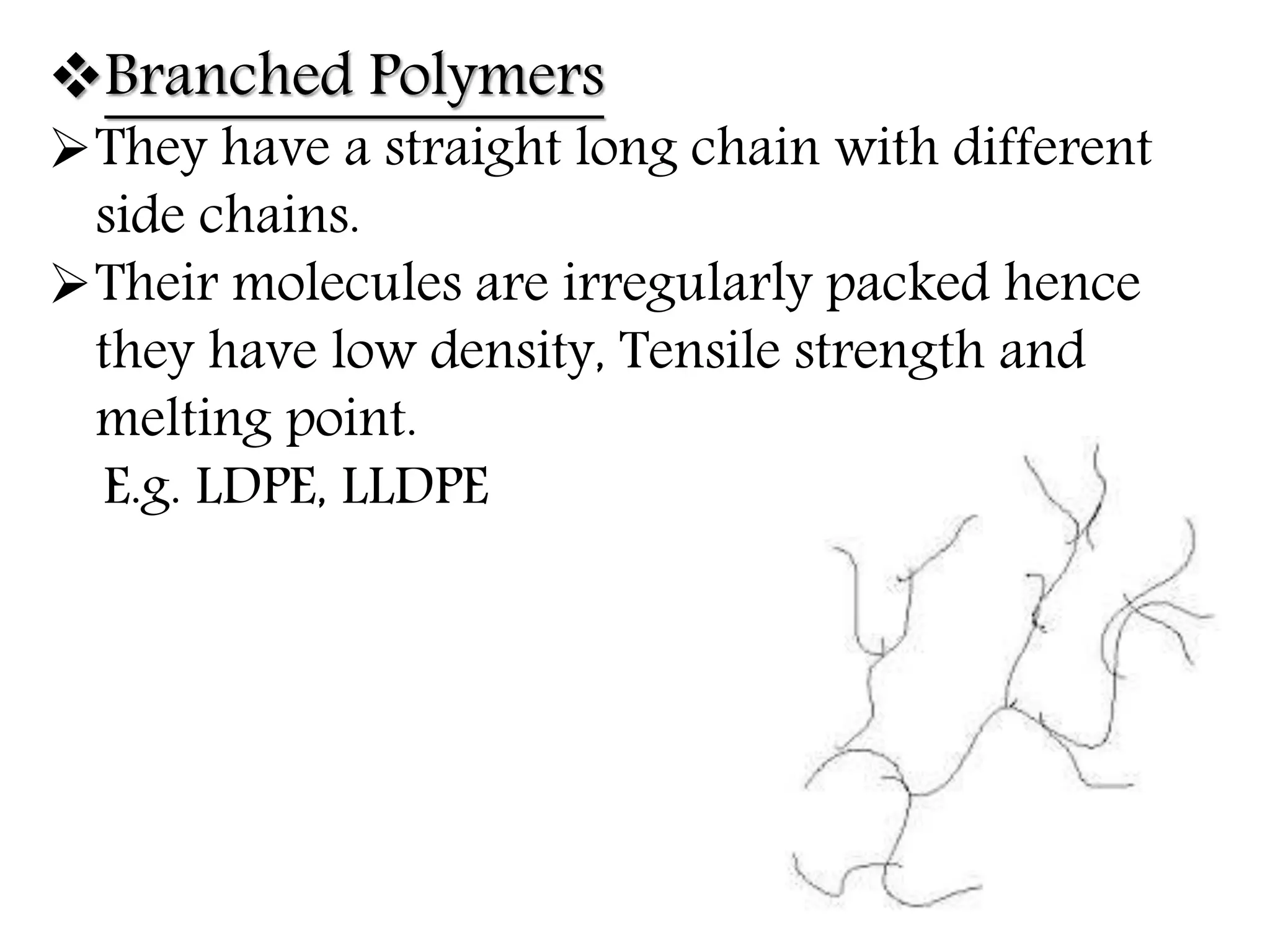
Branched Polymers
They have a straight long chain with different
side chains.
Their molecules are irregularly packed hence
they have low density, Tensile strength and
melting point.
E.g. LDPE, LLDPE
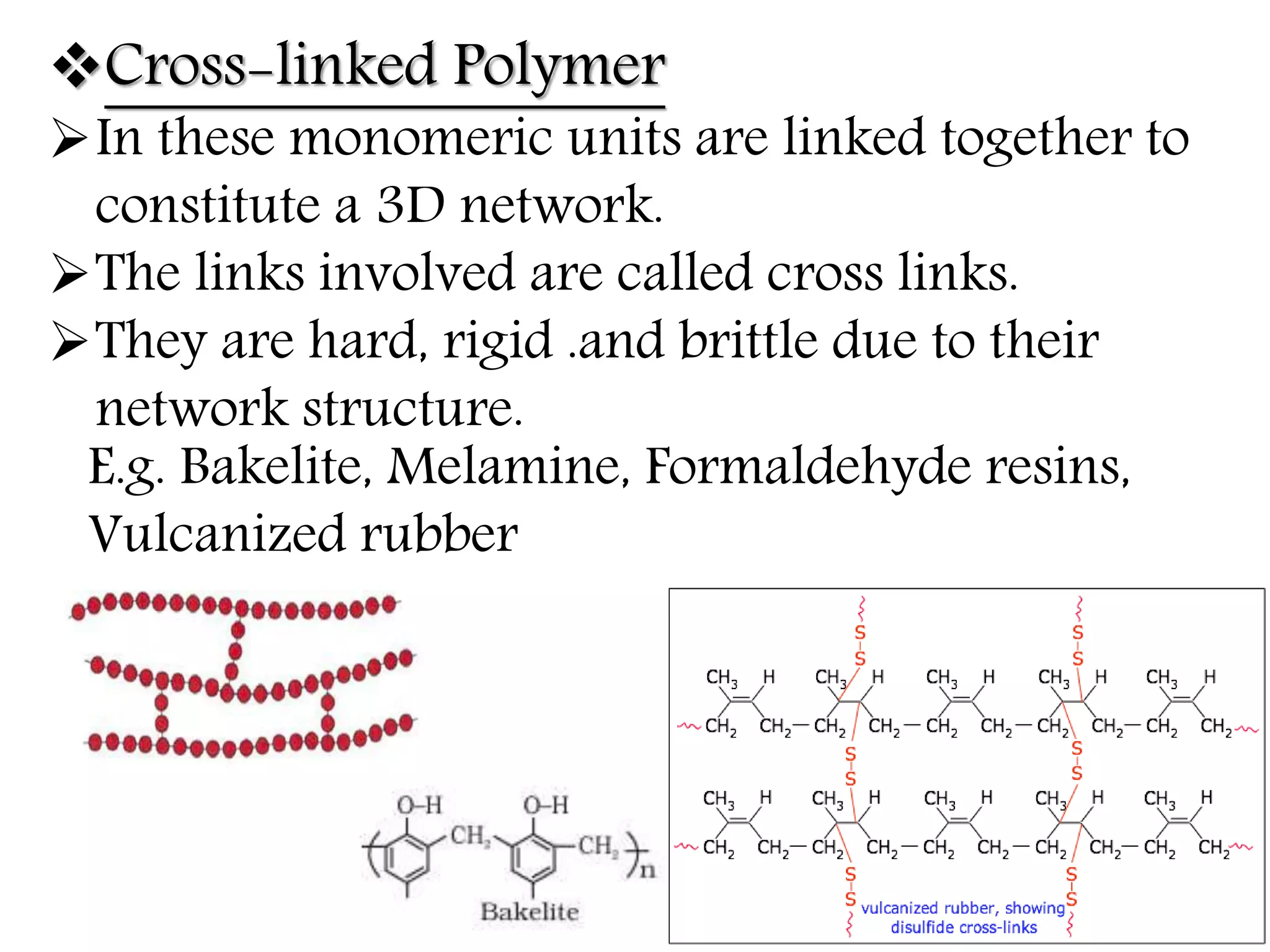
Cross-linked Polymer
In these monomeric units are linked together to
constitute a 3D network.
The links involved are called cross links.
They are hard, rigid .and brittle due to their
network structure.
E.g. Bakelite, Melamine, Formaldehyde resins,
Vulcanized rubber
By Applications & Physical Properties
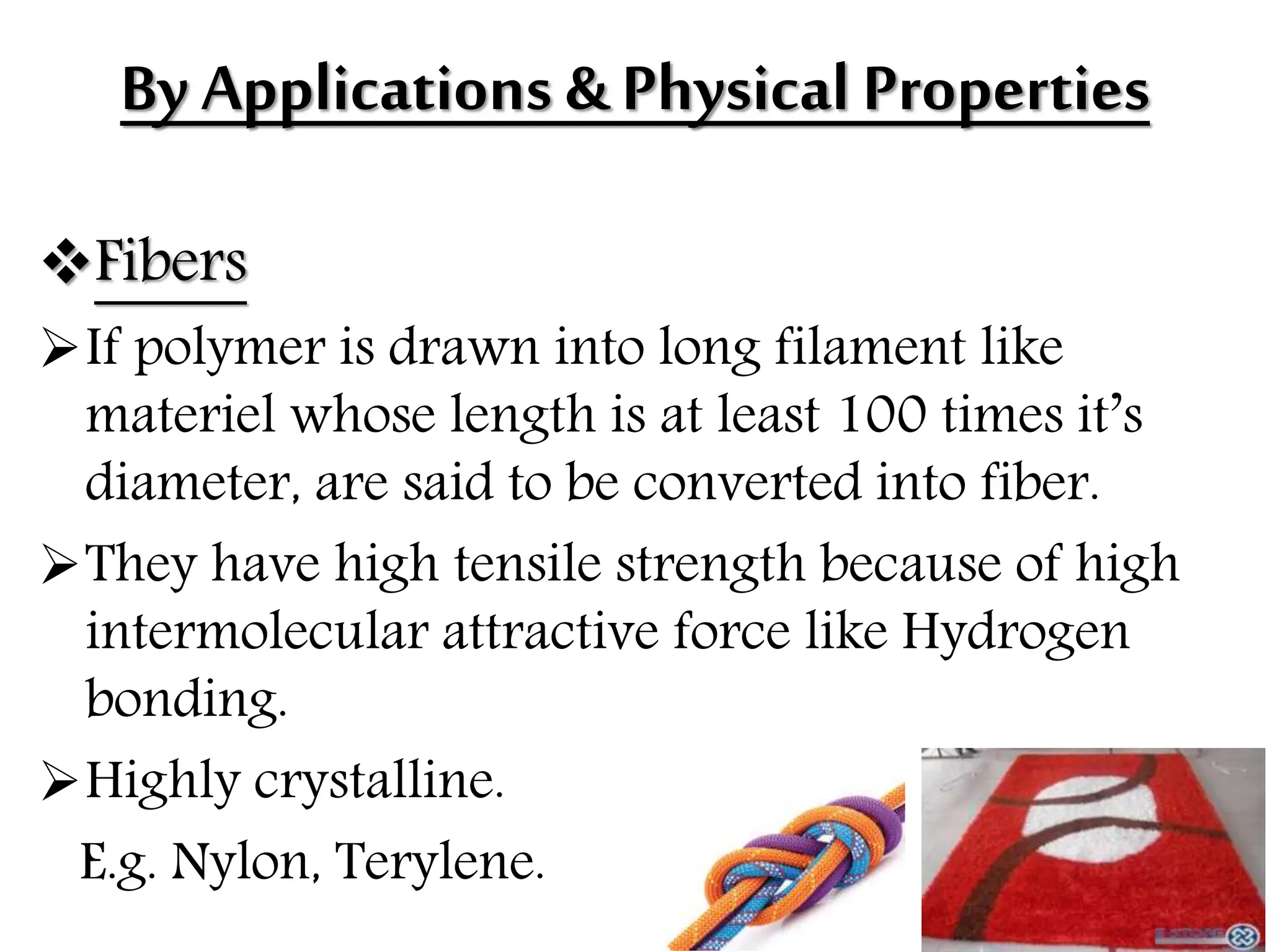
Fibers
If polymer is drawn into long filament like
materiel whose length is at least 100 times it’s
diameter, are said to be converted into fiber.
They have high tensile strength because of high
intermolecular attractive force like Hydrogen
bonding.
Highly crystalline.
E.g. Nylon, Terylene.
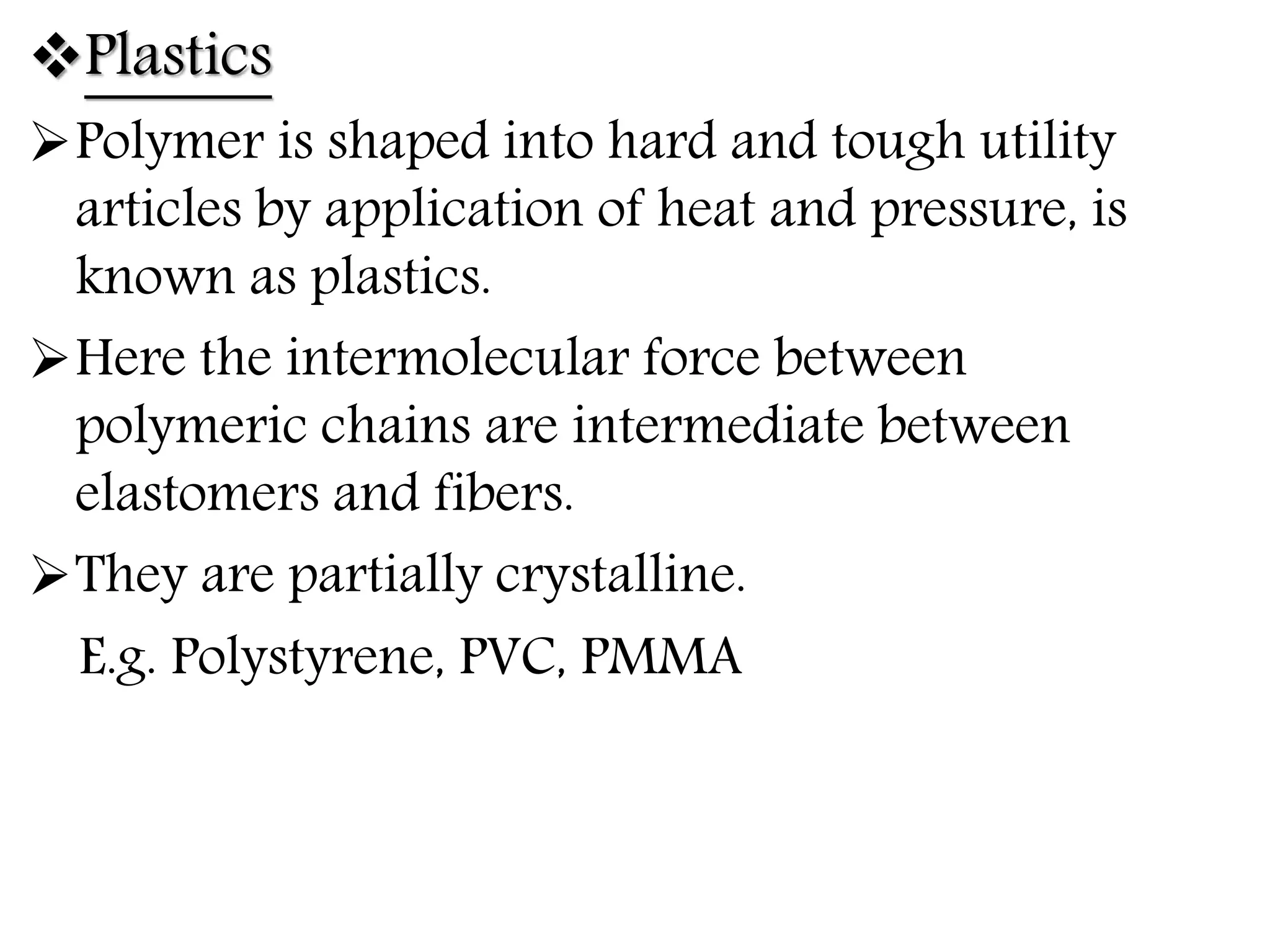
Plastics
Polymer is shaped into hard and tough utility
articles by application of heat and pressure, is
known as plastics.
Here the intermolecular force between
polymeric chains are intermediate between
elastomers and fibers.
They are partially crystalline.
E.g. Polystyrene, PVC, PMMA
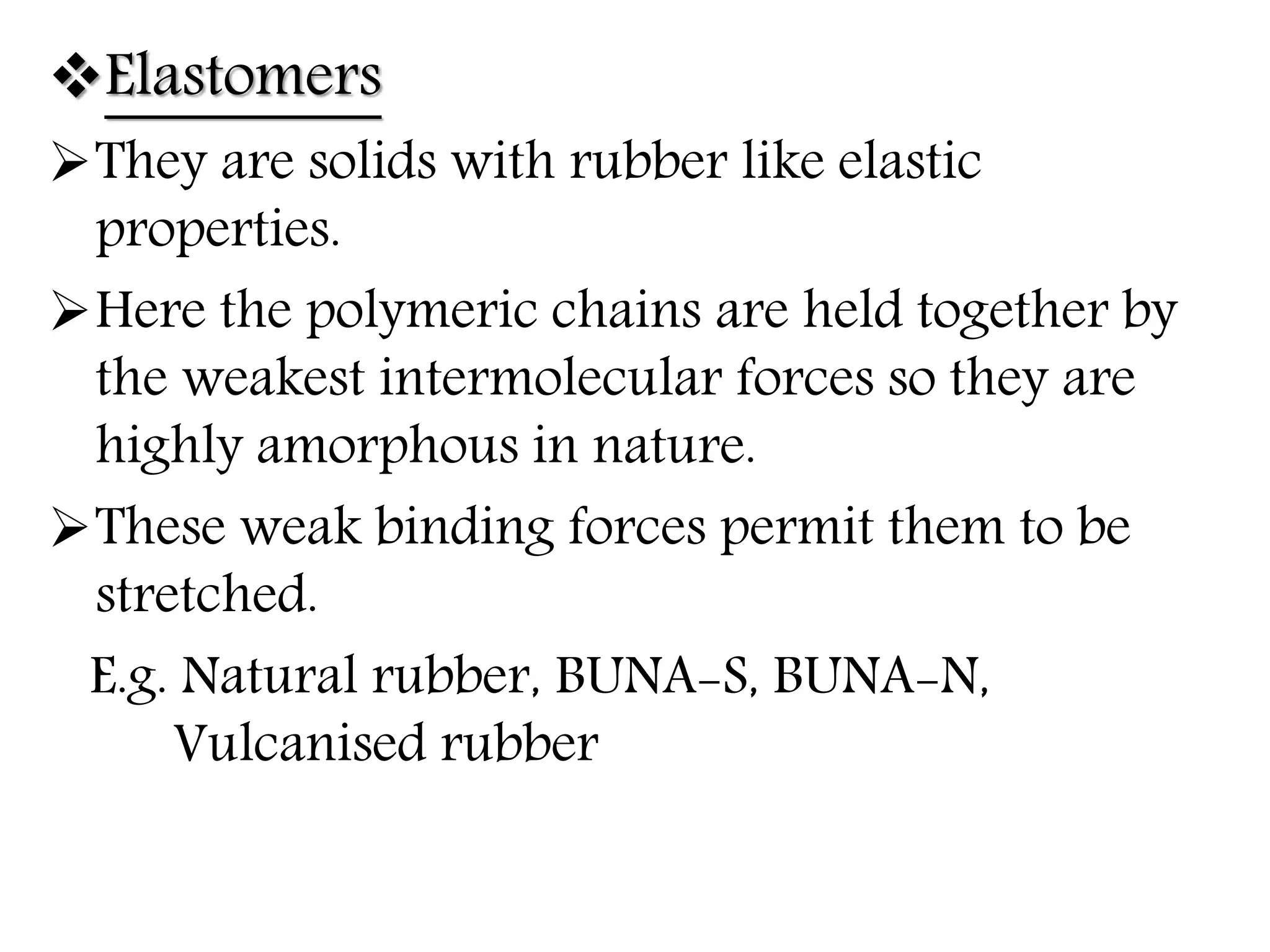
Elastomers
They are solids with rubber like elastic
properties.
Here the polymeric chains are held together by
the weakest intermolecular forces so they are
highly amorphous in nature.
These weak binding forces permit them to be
stretched.
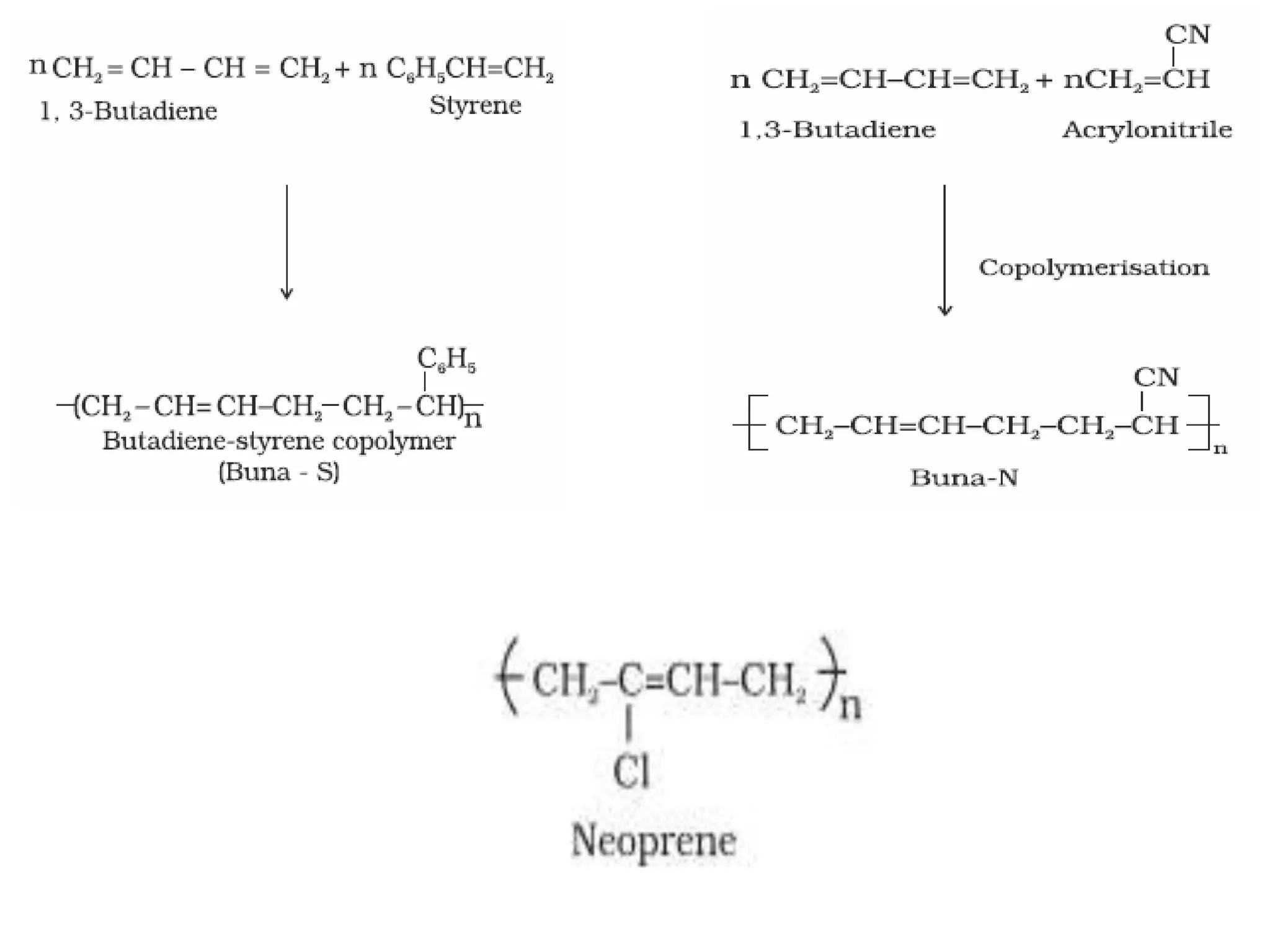
E.g. Natural rubber, BUNA-S, BUNA-N,
Vulcanised rubber
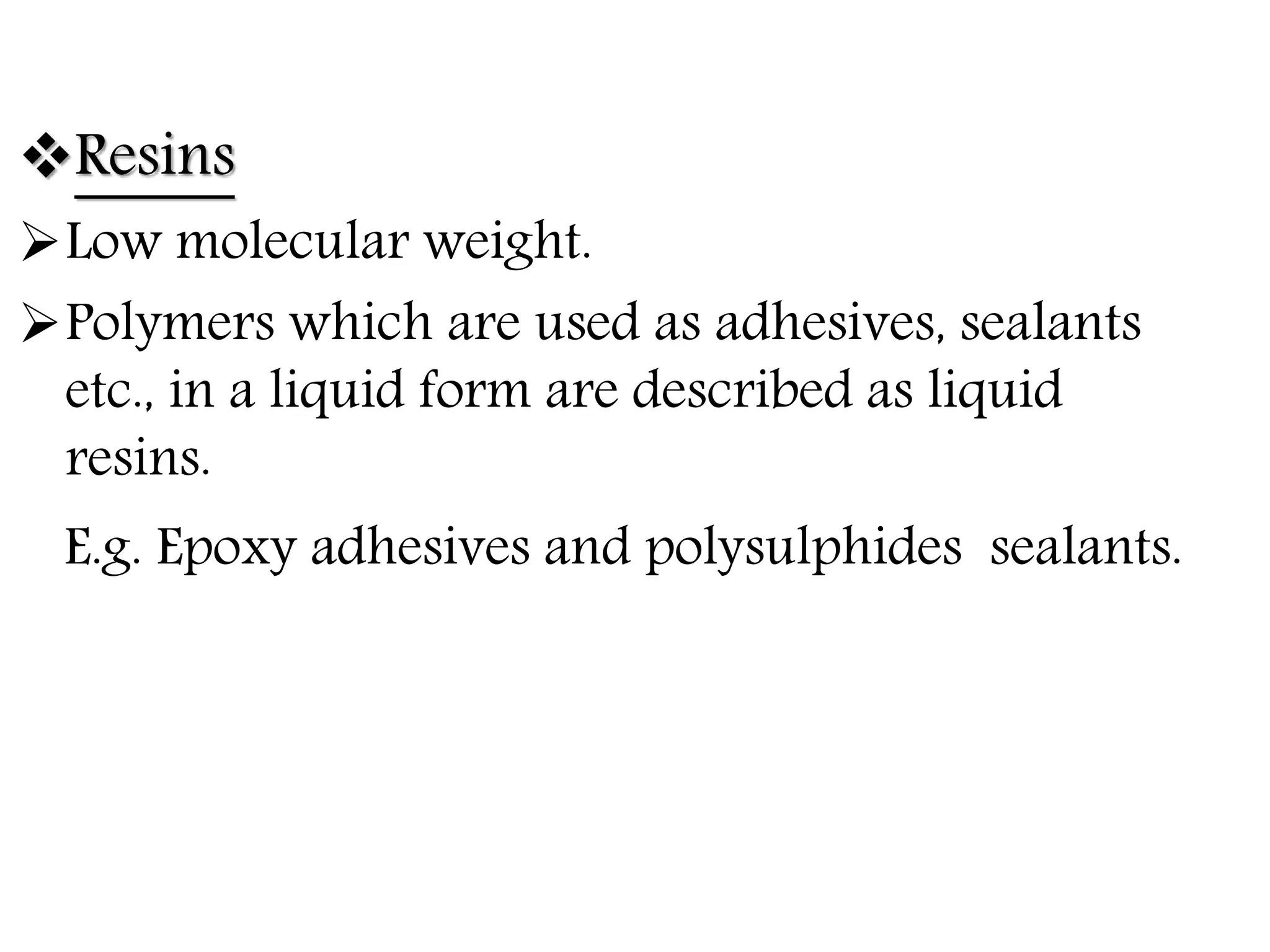
Resins
Low molecular weight.
Polymers which are used as adhesives, sealants
etc., in a liquid form are described as liquid
resins.
E.g. Epoxy adhesives and polysulphides sealants.
ByTacticity
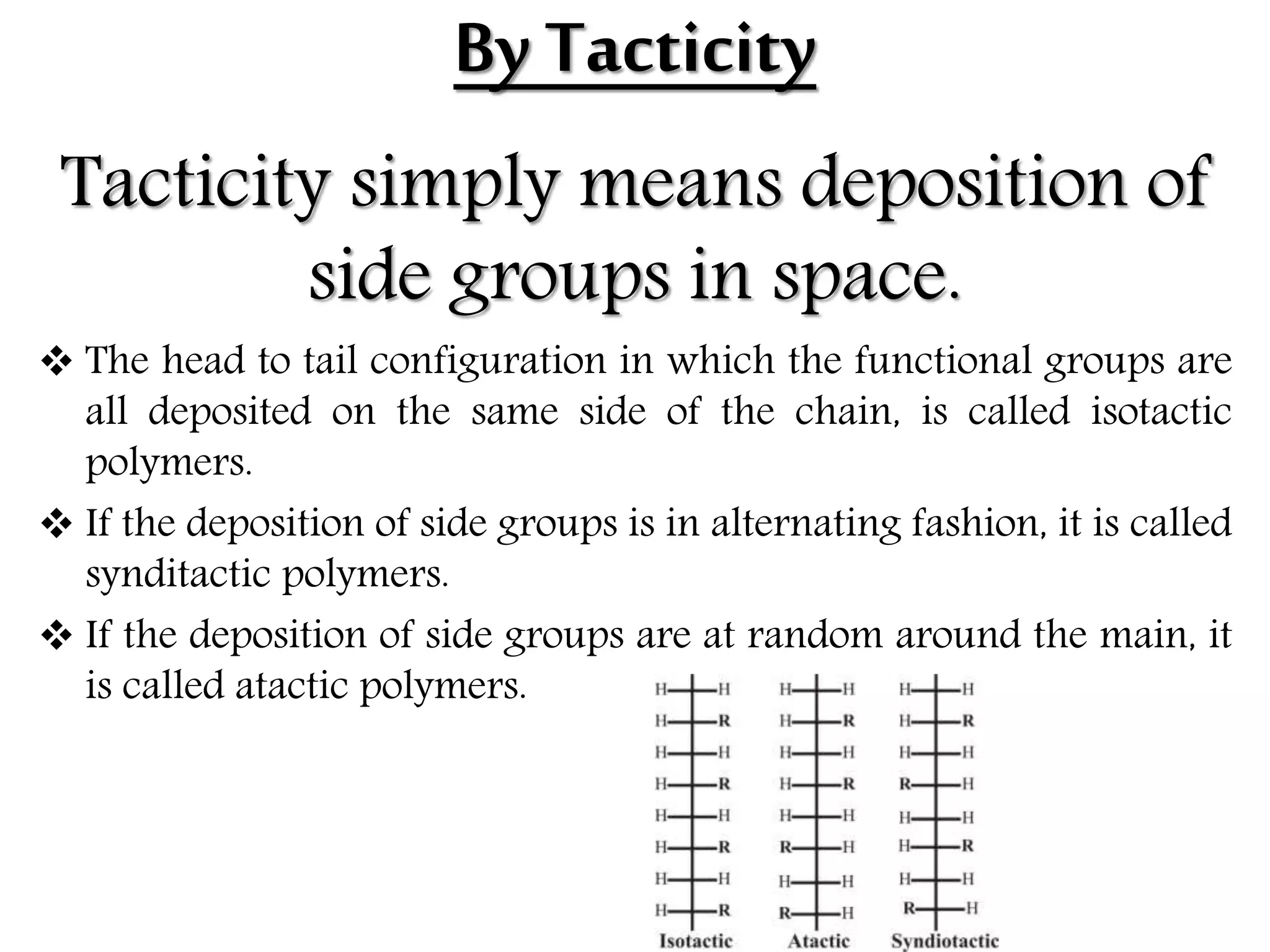
Tacticity simply means deposition of
side groups in space.
 The head to tail configuration in which the functional groups are
all deposited on the same side of the chain, is called isotactic
polymers.
 If the deposition of side groups is in alternating fashion, it is called
synditactic polymers.
 If the deposition of side groups are at random around the main, it
is called atactic polymers.
Other Parameters Of Classification
By Crystallinity
1. Crystalline – Monomers arranged in ordered way.
2. Amorphous – Monomers arranged in random way.
By Backbone Atom
1. Organic – Polymer Backbone is made-up of carbon atom.
2. Inorganic – Polymer Backbone is made-up of other atoms
References
Polymer Science - Gowariker V. R., New age
International Publishers
Textbook of Polymer Science - Billmeyer F. W,
Wiley India Publishers
Advanced Polymer Chemistry – Manas Chanda
Marcel Dekker INC.

Classification Of Polymer On Different Basis

  • 1.
    Classification Of Polymers Presentedby Devansh Gupta M.ScPolymer Science Semester 1
  • 2.
    Contents  Some BasicDefinitions  Classification Of Polymers 1. By Origin 2. By Monomer 3. By Thermal Response 4. By Mode Of Formation 5. By Structure 6. By Application & Physical Properties 7. By Tacticity  Reference
  • 3.
    Definition The word ‘polymer’comes from the Greek words poly (meaning ‘many’) and meros (meaning ‘parts’). Example: POLYETHYLENE = (ETHYLENE+ ETHYLENE+......)n Where n = 4,000 Polymers are very large molecules made when hundreds of monomers join together to form long chains.
  • 4.
    Monomer The small individualrepeating units/molecules are known as monomers(means single part). Imagine that a monomer can be represented by the letter A. Then a polymer made of that monomer would have the structure: -A-A-A-A-A-A-A-A-A-A-A-A-A-A-A-A-A-A-A-
  • 5.
    Polymerization • The processby which the monomer molecules are linked to form a big polymer molecule is called ‘polymerization’. • Polymerization is a process of bonding monomer, or “single units” together through a variety of reaction mechanisms to form longer chains named Polymer • As important as polymers are, they exist with monomers, which are small, single molecules such as hydrocarbons and amino acids.
  • 6.
    Classification Of Polymers 1.By Origin 2. By Monomer 3. By Thermal Response 4. By Mode Of Formation 5. By Structure 6. By Application & Physical Properties 7. By Tacticity
  • 7.
    By Origin Natural Polymers Polymerswhich are isolated from natural materials are called as natural polymers. E.g. Silk, Wool, Natural rubber, Cellulose, Starch, Proteins etc.
  • 8.
  • 9.
    Semisynthetic Polymers The polymersobtained by simple chemical treatment of natural polymers to improve their physical properties like lustrous nature, tensile strength are called semisynthetic polymers E.g. Cellulose acetate, Cellulose nitrate
  • 10.
    Synthetic Polymers Polymers synthesizedin laboratory from low molecular weight compounds, are called as, synthetic polymers. E.g. Nylon, Terylene, Polyethylene, Polystyrene, Synthetic rubber, Nylon, PVC, Bakelite, Teflon etc.
  • 11.
    By Monomer Homo Polymers Apolymer consist of identical monomers is called homo polymer. E.g. Polyethylene, PVC, Polypropylene, Nylon 6 Co Polymers A polymer consist of monomers of different chemical structure are called copolymers. E.g. Nylon 6,6
  • 12.
    By Thermal Response ThermoplasticPolymers  They are easily moulded in desired shapes by heating and subsequent cooling at room temperature.  They are soft in hot and hard on coding.  They my be linear or branched chain polymers. E.g. PE, PVC, PS, PP
  • 13.
    Thermosetting Polymers This polymeris hard and infusible on heating. These are not soft on heating under pressure and they are not remolded. These are cross linked polymers and are not reused. E.g. Bakelite
  • 14.
    By Mode OfFormation Addition Polymers The polymers formed by the addition of monomers repeatedly without removal of by products are called addition polymers. These polymers contains all the atoms of monomers hence their molecular weight are integral multiple of monomer unit. E.g. Teflon, Polyethylene, Polypropylene, PVC.
  • 15.
    Condensation Polymers They areformed by the combination of two monomers by removal of small molecules like H2O, Alcohol or NH3. Their molecular mass is not the integral multiple of monomer units. They have ester and amide linkage in their molecules. E.g. Polyamides(Nylons), Polyesters(PET)
  • 16.
    By Structure Linear Polymers Inthese polymers monomers are linked with each other and form a long straight chain. These chains has no any side chains. Their molecules are closely packed and have high density, tensile strength, and melting point. E.g. HDPE, Nylons
  • 17.
    Branched Polymers They havea straight long chain with different side chains. Their molecules are irregularly packed hence they have low density, Tensile strength and melting point. E.g. LDPE, LLDPE
  • 18.
    Cross-linked Polymer In thesemonomeric units are linked together to constitute a 3D network. The links involved are called cross links. They are hard, rigid .and brittle due to their network structure. E.g. Bakelite, Melamine, Formaldehyde resins, Vulcanized rubber
  • 20.
    By Applications &Physical Properties Fibers If polymer is drawn into long filament like materiel whose length is at least 100 times it’s diameter, are said to be converted into fiber. They have high tensile strength because of high intermolecular attractive force like Hydrogen bonding. Highly crystalline. E.g. Nylon, Terylene.
  • 21.
    Plastics Polymer is shapedinto hard and tough utility articles by application of heat and pressure, is known as plastics. Here the intermolecular force between polymeric chains are intermediate between elastomers and fibers. They are partially crystalline. E.g. Polystyrene, PVC, PMMA
  • 22.
    Elastomers They are solidswith rubber like elastic properties. Here the polymeric chains are held together by the weakest intermolecular forces so they are highly amorphous in nature. These weak binding forces permit them to be stretched. E.g. Natural rubber, BUNA-S, BUNA-N, Vulcanised rubber
  • 24.
    Resins Low molecular weight. Polymerswhich are used as adhesives, sealants etc., in a liquid form are described as liquid resins. E.g. Epoxy adhesives and polysulphides sealants.
  • 25.
    ByTacticity Tacticity simply meansdeposition of side groups in space.  The head to tail configuration in which the functional groups are all deposited on the same side of the chain, is called isotactic polymers.  If the deposition of side groups is in alternating fashion, it is called synditactic polymers.  If the deposition of side groups are at random around the main, it is called atactic polymers.
  • 26.
    Other Parameters OfClassification By Crystallinity 1. Crystalline – Monomers arranged in ordered way. 2. Amorphous – Monomers arranged in random way. By Backbone Atom 1. Organic – Polymer Backbone is made-up of carbon atom. 2. Inorganic – Polymer Backbone is made-up of other atoms
  • 27.
    References Polymer Science -Gowariker V. R., New age International Publishers Textbook of Polymer Science - Billmeyer F. W, Wiley India Publishers Advanced Polymer Chemistry – Manas Chanda Marcel Dekker INC.