VADODARA INSTITUTE OF ENGINEERING
EEE ACTIVITY WORK
GUIDED BY:RAJAN MODHA
PREPARED BY:KRISHNARAJ MISHRA
MANOJ CHAUHAN
DARSHAN GOHIL
HARSH MISTRY
LIGHT EMMITING DIODE
FLOW OF PRESENTATION
 INTRODUCTION
 TYPES OF LEDs
 WORKING OF LED
 ADVANTAGES & DISADVANTAGEOF LED
 USES OF LED
 BIBLIOGRAPY
INTRODUCTION
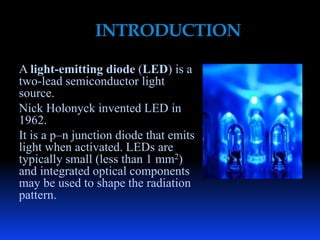
A light-emitting diode (LED) is a
two-lead semiconductor light
source.
Nick Holonyck invented LED in
1962.
It is a p–n junction diode that emits
light when activated. LEDs are
typically small (less than 1 mm2)
and integrated optical components
may be used to shape the radiation
pattern.
TYPES OF LEDs
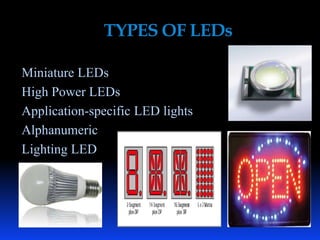
Miniature LEDs
High Power LEDs
Application-specific LED lights
Alphanumeric
Lighting LED
WORKING OF LED
N-type silicon (red) has extra electrons
(black).
P-type silicon (blue) has extra holes
(white).
Battery connected across the p-n junction
makes the diode forward biased, pushing
electrons from the n-type to the p-type and
pushing holes in the opposite direction.
Electrons and holes cross the junction and
combine.
Photons (particles of light) are given off as
the electrons and holes recombine.
ADVANTAGES
Long Life
Energy Efficiency
Ecologically Friendly
Durable Quality
Zero UV radiation
Design Flexibility
Low Voltage
Instant Lighting & Frequent
DISADVANTAGES
Expensive
Directional
Sensitive to extreme heat
Causes light pollution
Cause loss of vision as human eyes are
very sensitive.
USES OF LED
Entertainment
Events
Signage
Home
Business
Auto/Boat/RV
Art Work
BIBLIOGRAPHY
www.electronics.howstuffworks.com
www.explainthatstuff.com/diodes.
www.elprocus.com/light-emitting-diode-led-
working
www.circuitstoday.com
www.edisontechcenter.org
www.brighthubengineering.com
www.eslightbulbs.com
Thank You……..

Light emitting diode(LED)