Semi conductor
Prepared By: Mohammed
Qashlan
Energy Band
 In any material, there are 2 energy band:
1. Valence band : the outermost shell that determines the conductivity
2. Conduction band : the band outside the valence shell.
The 2 bands are separated by one energy gap called – forbidden gap.
 The valence band contains with electrons.
 The electrons can move to the conduction band if it have enough
energy ( eg: light or heat).
 When the electron absorbs enough energy to jump from valence
band to the conduction band, the electron is said to be in excited
state.
 The concept of energy bands is particularly important in classifying materials
as conductors, semiconductors, and insulators.
• Semiconductor : has a smaller forbidden band and requires less energy to
move an electron from the valence band to the conduction band.
• Therefore, for a certain amount of applied voltage, more current will flow in the
semiconductor than in the insulator.
 semiconducting elements:
– low electrical conductivity at room temperature
– Electrical conductivity increases with temp.
 Gap between valence and conduction band is intermediate in size.
 Semiconducting elements form the basis of solid state electronic
devices.
 Metalloids (such as silicon or germanium) are semiconducting
elements whose electrical conductivity increases as temperature
increases.
 A striking property of these elements is that their conductivities
increase markedly when they are doped with small quantities of other
elements.
 Made from materials that have four valence electrons in
their outer orbitals.
 Germanium and silicon are the most common.
 Silicon is preferred due to its ability to withstand heat.
 A pure semiconductor material such as silicon or
germanium has no special properties and will make a
poor conductive material.
 When silicon is doped with phosphorus, it becomes an n-type
semiconductor, in which electrical current is carried by negatively
charged electrons.
 When silicon is doped with boron, it becomes a p-type
semiconductor, in which an electrical current is carried by positively
charged holes.
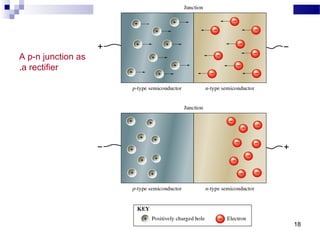
 Joining a p-type semiconductor to an n-type semiconductor produces
a p-n junction, which can function as a rectifier.
 A rectifier is a device that allows current to flow in one direction, but
not the other.
Types of Semiconductor:
 Semiconductors are mainly classified into twoSemiconductors are mainly classified into two
categories:categories:
ii.. IntrinsicIntrinsic
ii. Extrinsicii. Extrinsic
i.i. IntrinsicIntrinsic : chemically very pure and possesses: chemically very pure and possesses
poor conductivity.poor conductivity.
- It has equal numbers of negativeIt has equal numbers of negative
carriers (electrons) and positivecarriers (electrons) and positive
carriers (holes).carriers (holes).
- Impurities do not affect its electricalImpurities do not affect its electrical
behavior.behavior.
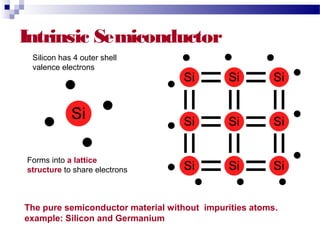
Intrinsic Semiconductor
Silicon has 4 outer shell
valence electrons
Forms into a lattice
structure to share electrons
The pure semiconductor material without impurities atoms.
example: Silicon and Germanium
Extrinsic semiconductor :
 improved intrinsic semiconductor with a small
amount of impurities added by a process, known
as doping process, which alters the electrical
properties of the semiconductor and improves its
conductivity.
 Introducing impurities into the semiconductor
materials (doping process) can control their
conductivity.
 Adding impurities atom into intrinsic
semiconductor = extrinsic semiconductor.
 The process of adding specific types of
atoms to a semiconductor to favorably alter
electric characteristics – Doping
 2 types of extrinsic (impure)
semiconductor;

N-type
 P-type
 When an impurity increases the number of
free electrons, the doped semiconductor is
negative or n-type.
 An impurity that reduces the number of free
electrons, causing more holes, creates a
positive or p-type semiconductor.
Doping
 Doping : Adding impurities to the silicon
crystal lattice to increase the number of
carriers.
 Add a small number of atoms to increase
either the number of electrons or holes.
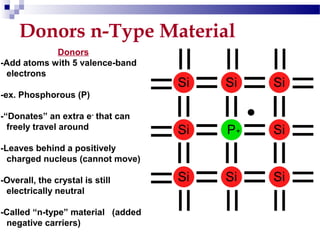
Donors n-Type Material
Donors
-Add atoms with 5 valence-band
electrons
-ex. Phosphorous (P)
-“Donates” an extra e-
that can
freely travel around
-Leaves behind a positively
charged nucleus (cannot move)
-Overall, the crystal is still
electrically neutral
-Called “n-type” material (added
negative carriers)
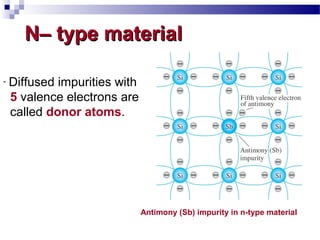
+
N– type materialN– type material
Antimony (Sb) impurity in n-type material
- Diffused impurities with
5 valence electrons are
called donor atoms.
Acceptors Make p-Type Material
––
h+
Acceptors
• Add atoms with only 3 valence-
band electrons
• ex. Boron (B)
• “Accepts” e–
and provides extra
h+
to freely travel around
• Leaves behind a negatively
charged nucleus (cannot move)
• Overall, the crystal is still
electrically neutral
• Called “p-type” silicon (added
positive carriers)
P-type materialP-type material
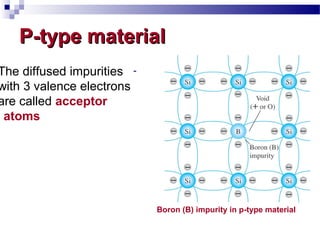
Boron (B) impurity in p-type material
-The diffused impurities
with 3 valence electrons
are called acceptor
atoms.
PN Junction Formation
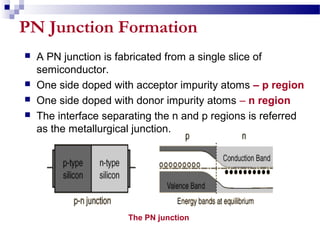
 A PN junction is fabricated from a single slice of
semiconductor.
 One side doped with acceptor impurity atoms – p region
 One side doped with donor impurity atoms – n region
 The interface separating the n and p regions is referred
as the metallurgical junction.
The PN junction
A p-n junction as
a rectifier.
18
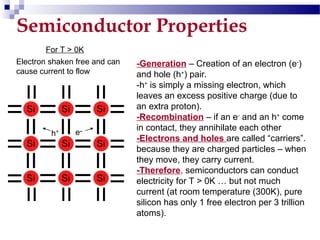
Semiconductor Properties
For T > 0K
Electron shaken free and can
cause current to flow
e–
h+
-Generation – Creation of an electron (e-
)
and hole (h+
) pair.
-h+
is simply a missing electron, which
leaves an excess positive charge (due to
an extra proton).
-Recombination – if an e-
and an h+
come
in contact, they annihilate each other
-Electrons and holes are called “carriers”.
because they are charged particles – when
they move, they carry current.
-Therefore, semiconductors can conduct
electricity for T > 0K … but not much
current (at room temperature (300K), pure
silicon has only 1 free electron per 3 trillion
atoms).

Semiconductors

  • 1.
  • 2.
    Energy Band  Inany material, there are 2 energy band: 1. Valence band : the outermost shell that determines the conductivity 2. Conduction band : the band outside the valence shell. The 2 bands are separated by one energy gap called – forbidden gap.  The valence band contains with electrons.  The electrons can move to the conduction band if it have enough energy ( eg: light or heat).  When the electron absorbs enough energy to jump from valence band to the conduction band, the electron is said to be in excited state.
  • 3.
     The conceptof energy bands is particularly important in classifying materials as conductors, semiconductors, and insulators. • Semiconductor : has a smaller forbidden band and requires less energy to move an electron from the valence band to the conduction band. • Therefore, for a certain amount of applied voltage, more current will flow in the semiconductor than in the insulator.
  • 4.
     semiconducting elements: –low electrical conductivity at room temperature – Electrical conductivity increases with temp.  Gap between valence and conduction band is intermediate in size.  Semiconducting elements form the basis of solid state electronic devices.  Metalloids (such as silicon or germanium) are semiconducting elements whose electrical conductivity increases as temperature increases.  A striking property of these elements is that their conductivities increase markedly when they are doped with small quantities of other elements.
  • 5.
     Made frommaterials that have four valence electrons in their outer orbitals.  Germanium and silicon are the most common.  Silicon is preferred due to its ability to withstand heat.  A pure semiconductor material such as silicon or germanium has no special properties and will make a poor conductive material.
  • 6.
     When siliconis doped with phosphorus, it becomes an n-type semiconductor, in which electrical current is carried by negatively charged electrons.  When silicon is doped with boron, it becomes a p-type semiconductor, in which an electrical current is carried by positively charged holes.  Joining a p-type semiconductor to an n-type semiconductor produces a p-n junction, which can function as a rectifier.  A rectifier is a device that allows current to flow in one direction, but not the other.
  • 7.
    Types of Semiconductor: Semiconductors are mainly classified into twoSemiconductors are mainly classified into two categories:categories: ii.. IntrinsicIntrinsic ii. Extrinsicii. Extrinsic i.i. IntrinsicIntrinsic : chemically very pure and possesses: chemically very pure and possesses poor conductivity.poor conductivity. - It has equal numbers of negativeIt has equal numbers of negative carriers (electrons) and positivecarriers (electrons) and positive carriers (holes).carriers (holes). - Impurities do not affect its electricalImpurities do not affect its electrical behavior.behavior.
  • 8.
    Intrinsic Semiconductor Silicon has4 outer shell valence electrons Forms into a lattice structure to share electrons The pure semiconductor material without impurities atoms. example: Silicon and Germanium
  • 9.
    Extrinsic semiconductor : improved intrinsic semiconductor with a small amount of impurities added by a process, known as doping process, which alters the electrical properties of the semiconductor and improves its conductivity.  Introducing impurities into the semiconductor materials (doping process) can control their conductivity.
  • 10.
     Adding impuritiesatom into intrinsic semiconductor = extrinsic semiconductor.  The process of adding specific types of atoms to a semiconductor to favorably alter electric characteristics – Doping  2 types of extrinsic (impure) semiconductor;  N-type  P-type
  • 11.
     When animpurity increases the number of free electrons, the doped semiconductor is negative or n-type.  An impurity that reduces the number of free electrons, causing more holes, creates a positive or p-type semiconductor.
  • 12.
    Doping  Doping :Adding impurities to the silicon crystal lattice to increase the number of carriers.  Add a small number of atoms to increase either the number of electrons or holes.
  • 13.
    Donors n-Type Material Donors -Addatoms with 5 valence-band electrons -ex. Phosphorous (P) -“Donates” an extra e- that can freely travel around -Leaves behind a positively charged nucleus (cannot move) -Overall, the crystal is still electrically neutral -Called “n-type” material (added negative carriers) +
  • 14.
    N– type materialN–type material Antimony (Sb) impurity in n-type material - Diffused impurities with 5 valence electrons are called donor atoms.
  • 15.
    Acceptors Make p-TypeMaterial –– h+ Acceptors • Add atoms with only 3 valence- band electrons • ex. Boron (B) • “Accepts” e– and provides extra h+ to freely travel around • Leaves behind a negatively charged nucleus (cannot move) • Overall, the crystal is still electrically neutral • Called “p-type” silicon (added positive carriers)
  • 16.
    P-type materialP-type material Boron(B) impurity in p-type material -The diffused impurities with 3 valence electrons are called acceptor atoms.
  • 17.
    PN Junction Formation A PN junction is fabricated from a single slice of semiconductor.  One side doped with acceptor impurity atoms – p region  One side doped with donor impurity atoms – n region  The interface separating the n and p regions is referred as the metallurgical junction. The PN junction
  • 18.
    A p-n junctionas a rectifier. 18
  • 19.
    Semiconductor Properties For T> 0K Electron shaken free and can cause current to flow e– h+ -Generation – Creation of an electron (e- ) and hole (h+ ) pair. -h+ is simply a missing electron, which leaves an excess positive charge (due to an extra proton). -Recombination – if an e- and an h+ come in contact, they annihilate each other -Electrons and holes are called “carriers”. because they are charged particles – when they move, they carry current. -Therefore, semiconductors can conduct electricity for T > 0K … but not much current (at room temperature (300K), pure silicon has only 1 free electron per 3 trillion atoms).