ORGANIC LIGHT EMITTING
DIODE
AN OLED is a Organic Light Emitting Diode
In which emissive electroluminescent layer is
a film of organic compound which emits light
In response to an electric current. This layer
Of organic semiconductor suited between to
Electrodes. Generally one of the electrode is
Transparent. OLEDS are used to create
digital displays in devices such as screens.
An OLED works without back
Light. Inflow ambient light conditions such as a dark room an OLED screens can
achieve a higher contrast ratio than an LCD ,whether the LCD uses cold Cathode
Fluorescent Lamps or LED back light.
OLED technology was firstly developed in1987 at East men kodak company
by Tang and Van slyke using small molecule (sm-OLED). IN 1990 Richard friend and
Jeremy Burroughes and DonaldBradley discovered electroluminescence capabilities
from conjugate polymers so lying down the new generation of flat panel displays
(OLED)
How OLED EMITS LIGHT
1. Voltage applied across
Cathode and Anode
1. Typically 2V-10V
2. Current flows from cathode
to anode
1. Electrons flow to emissive
layer
2. Electrons removed from
conductive layer leaving
holes
3. Holes jump into emissive
layer
3. Electron and hole combine
and light emitted
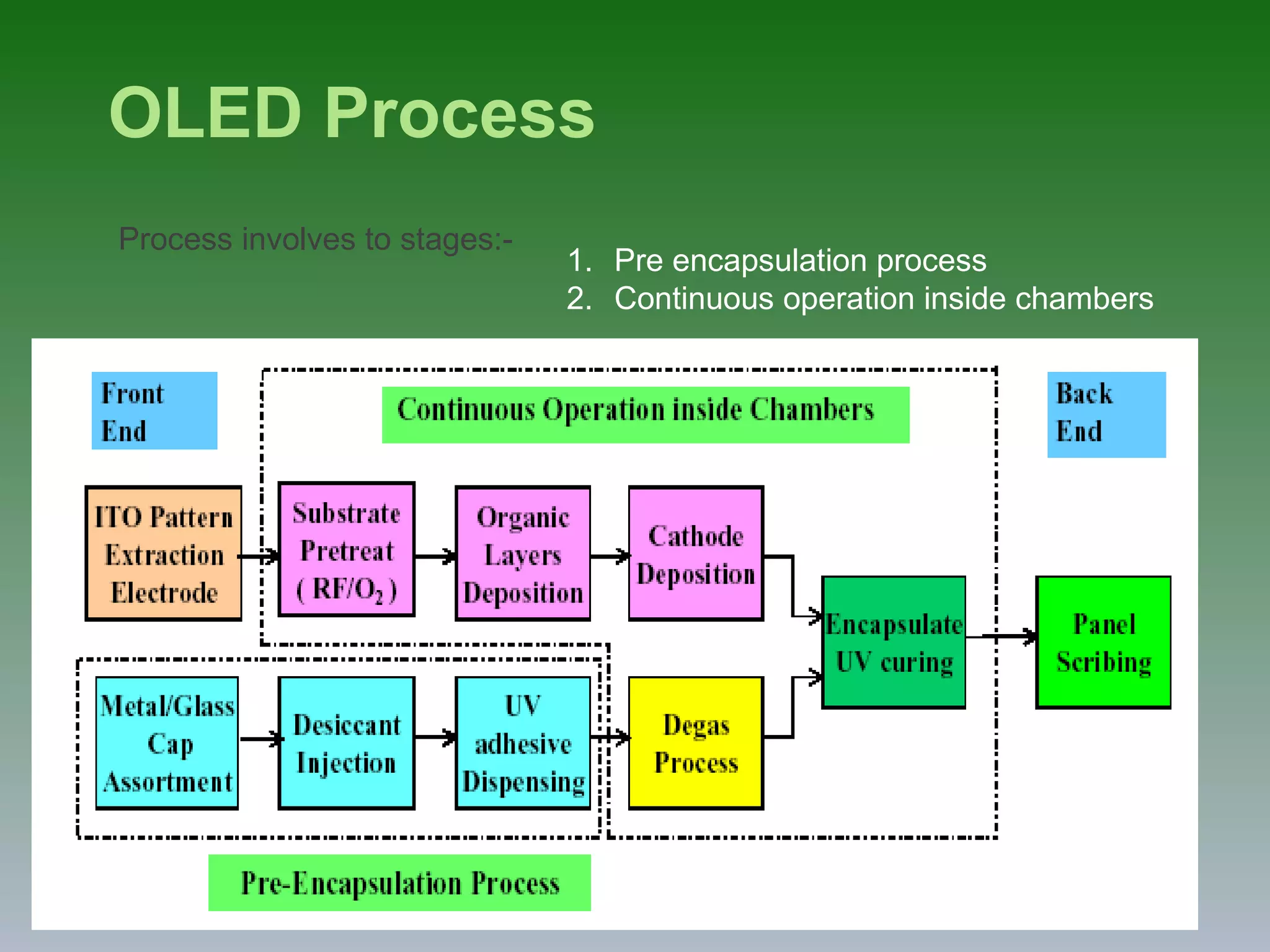
OLED Process
Process involves to stages:-
1. Pre encapsulation process
2. Continuous operation inside chambers
1. Passive-Matrix OLED (PMOLED)
 Perpendicular cathode/anode strip
orientation
 Light emitted at intersection (pixels)
 External circuitry
 Turns on/off pixels
 External circuitry
 Large power consumption
 Used on 1-3 inch screens
 Alphanumeric displays
2. Active-Matrix OLED (AMOLED)
 Full layers of cathode, anode, organic
molecules
 Thin Film Transistor matrix (TFT) on top
of anode
 Internal circuitry to determine which pixels
to turn on/off
 Less power consumed then PMOLED
 Used for larger displays
3. Transparent OLED
(TOLED)
 Transparent substrate,
cathode and anode
 Bi-direction light emission
 Passive or Active Matrix
OLED
 Useful for heads-up
display
 Transparent projector
screen
 glasses
4. Top-emitting OLED (TEOLED)
 Non-transparent or
reflective substrate
 Transparent Cathode
 Smart card displays
 Used with Active Matrix
Device
OLED Advantages over LED and LCD
 Thinner, lighter and more flexible
 Plastic substrates rather then glass
 High resolution (<5um pixel size) and fast switching (1-10um)
 Do not require backlight, light generated
 Low voltage, low power and emissive source
 Robust Design (Plastic Substrate)
 Larger sized displays
 Brighter- good daylight visibility
 Larger viewing angles -170o
 Colour Gamut comparable to CRT, with potential to get better – Striking
visual appeal
 Thinner – No backlight
 Less Expensive than LCD due to lesser components
White + Color Filter route takes away some of this advantage
 Potential for printing in manufacturing.
 Flexible and Conformal Displays
OLED Disadvantages
 Lifetime
 White, Red, Green  46,000-230,000 hours
 About 5-25 years
 Blue  14,000 hours
 About 1.6 years
 Expensive
 Susceptible to water
 Overcome multi-billion dollar LCD market
OLED Roadblocks
 Materials
 Small molecule lifetimes still not OK for TV
applications, although robust for mobile phones
 Polymers struggling with material stability
 Manufacturing
 UHV process not easily scalable to larger Mother
Glass. Currently, manufacturing restricted to 370 x
470mm
 Printing (Polymers) still in R&D stage
 Active Matrix Back plane
 Incompatible with the existing a:Si technology
 LTPS technology (considered suitable for current
driven devices) suffers from uniformity problems and
restricted to displays < 8”
5.Applications: Foldable
OLED
 Flexable metalic
foil or plastic
substrate
 Lightweight and
durable
 Reduce display
breaking
 Clothing OLED
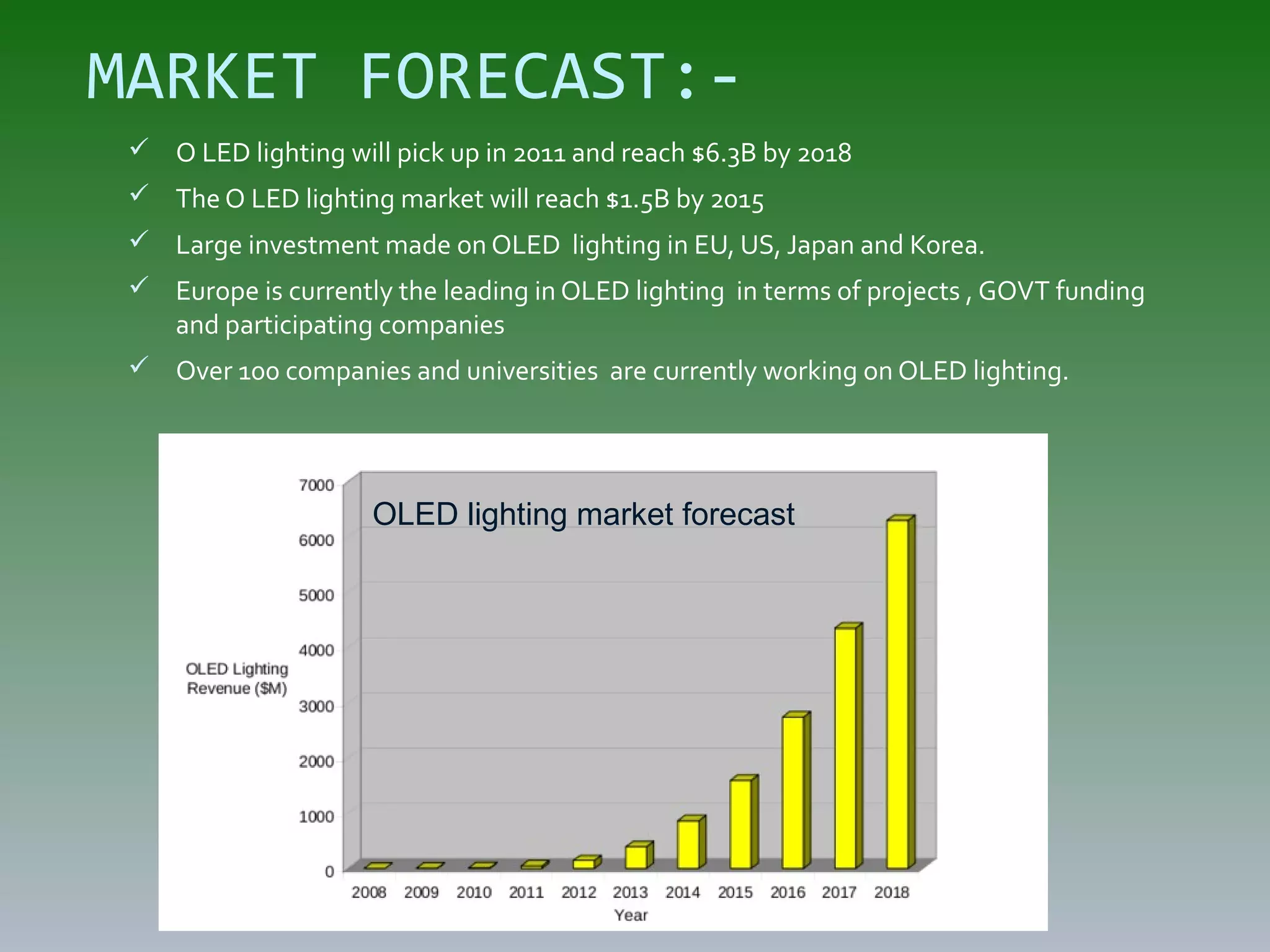
MARKET FORECAST:-
 O LED lighting will pick up in 2011 and reach $6.3B by 2018
 The O LED lighting market will reach $1.5B by 2015
 Large investment made on OLED lighting in EU, US, Japan and Korea.
 Europe is currently the leading in OLED lighting in terms of projects , GOVT funding
and participating companies
 Over 100 companies and universities are currently working on OLED lighting.
OLED lighting market forecast
 Limited use caused by degradation of
materials.
 OLED will replace current LED and LCD
technologies
 Expensive
 Flexibility and thinness will enable many
applications
Conclusions
Q&A

Full oled

  • 1.
    ORGANIC LIGHT EMITTING DIODE ANOLED is a Organic Light Emitting Diode In which emissive electroluminescent layer is a film of organic compound which emits light In response to an electric current. This layer Of organic semiconductor suited between to Electrodes. Generally one of the electrode is Transparent. OLEDS are used to create digital displays in devices such as screens. An OLED works without back Light. Inflow ambient light conditions such as a dark room an OLED screens can achieve a higher contrast ratio than an LCD ,whether the LCD uses cold Cathode Fluorescent Lamps or LED back light. OLED technology was firstly developed in1987 at East men kodak company by Tang and Van slyke using small molecule (sm-OLED). IN 1990 Richard friend and Jeremy Burroughes and DonaldBradley discovered electroluminescence capabilities from conjugate polymers so lying down the new generation of flat panel displays (OLED)
  • 2.
    How OLED EMITSLIGHT 1. Voltage applied across Cathode and Anode 1. Typically 2V-10V 2. Current flows from cathode to anode 1. Electrons flow to emissive layer 2. Electrons removed from conductive layer leaving holes 3. Holes jump into emissive layer 3. Electron and hole combine and light emitted
  • 3.
    OLED Process Process involvesto stages:- 1. Pre encapsulation process 2. Continuous operation inside chambers
  • 4.
    1. Passive-Matrix OLED(PMOLED)  Perpendicular cathode/anode strip orientation  Light emitted at intersection (pixels)  External circuitry  Turns on/off pixels  External circuitry  Large power consumption  Used on 1-3 inch screens  Alphanumeric displays 2. Active-Matrix OLED (AMOLED)  Full layers of cathode, anode, organic molecules  Thin Film Transistor matrix (TFT) on top of anode  Internal circuitry to determine which pixels to turn on/off  Less power consumed then PMOLED  Used for larger displays
  • 5.
    3. Transparent OLED (TOLED) Transparent substrate, cathode and anode  Bi-direction light emission  Passive or Active Matrix OLED  Useful for heads-up display  Transparent projector screen  glasses
  • 6.
    4. Top-emitting OLED(TEOLED)  Non-transparent or reflective substrate  Transparent Cathode  Smart card displays  Used with Active Matrix Device
  • 7.
    OLED Advantages overLED and LCD  Thinner, lighter and more flexible  Plastic substrates rather then glass  High resolution (<5um pixel size) and fast switching (1-10um)  Do not require backlight, light generated  Low voltage, low power and emissive source  Robust Design (Plastic Substrate)  Larger sized displays  Brighter- good daylight visibility  Larger viewing angles -170o  Colour Gamut comparable to CRT, with potential to get better – Striking visual appeal  Thinner – No backlight  Less Expensive than LCD due to lesser components White + Color Filter route takes away some of this advantage  Potential for printing in manufacturing.  Flexible and Conformal Displays
  • 8.
    OLED Disadvantages  Lifetime White, Red, Green  46,000-230,000 hours  About 5-25 years  Blue  14,000 hours  About 1.6 years  Expensive  Susceptible to water  Overcome multi-billion dollar LCD market
  • 9.
    OLED Roadblocks  Materials Small molecule lifetimes still not OK for TV applications, although robust for mobile phones  Polymers struggling with material stability  Manufacturing  UHV process not easily scalable to larger Mother Glass. Currently, manufacturing restricted to 370 x 470mm  Printing (Polymers) still in R&D stage  Active Matrix Back plane  Incompatible with the existing a:Si technology  LTPS technology (considered suitable for current driven devices) suffers from uniformity problems and restricted to displays < 8”
  • 10.
    5.Applications: Foldable OLED  Flexablemetalic foil or plastic substrate  Lightweight and durable  Reduce display breaking  Clothing OLED
  • 11.
    MARKET FORECAST:-  OLED lighting will pick up in 2011 and reach $6.3B by 2018  The O LED lighting market will reach $1.5B by 2015  Large investment made on OLED lighting in EU, US, Japan and Korea.  Europe is currently the leading in OLED lighting in terms of projects , GOVT funding and participating companies  Over 100 companies and universities are currently working on OLED lighting. OLED lighting market forecast
  • 12.
     Limited usecaused by degradation of materials.  OLED will replace current LED and LCD technologies  Expensive  Flexibility and thinness will enable many applications Conclusions
  • 13.