OLED


                                          Presented by
                             T.Spandana & R.G.Srujana
                                         3rd year,E.C.E
SHRI SAI INSTITUTE OF ENGINEERING AND TECHNOLOGY
Contents
 Introduction
 What is OLED?
 Birth of OLED
 History
 Architecture of OLED
 How OLED works?
 Types of OLEDs
 Advantages and disadvantages
 Current, future scope
 Conclusion
Introduction
 Imagine having high-definition TV
               8O inches wide
               less than a quarter inch thick
               consume less power &
               can be rolled up when u are not using

Is it possible??

Yes, it is possible by using OLED technology
Before technologies
 In this field first came the small LED displays (which can show
  only the numeric contents)
 Then came heavy jumbo CRTs ,which are used till now.

 the problem is they are very heavy, bulky, couldn’t carry them
  form one place to other place.
 Next to CRTs LCDs came into existence. which are lighter in
  weight compare to CRTs. the drawback in LCDs is the efficient
  result is obtained only in some particular directions.
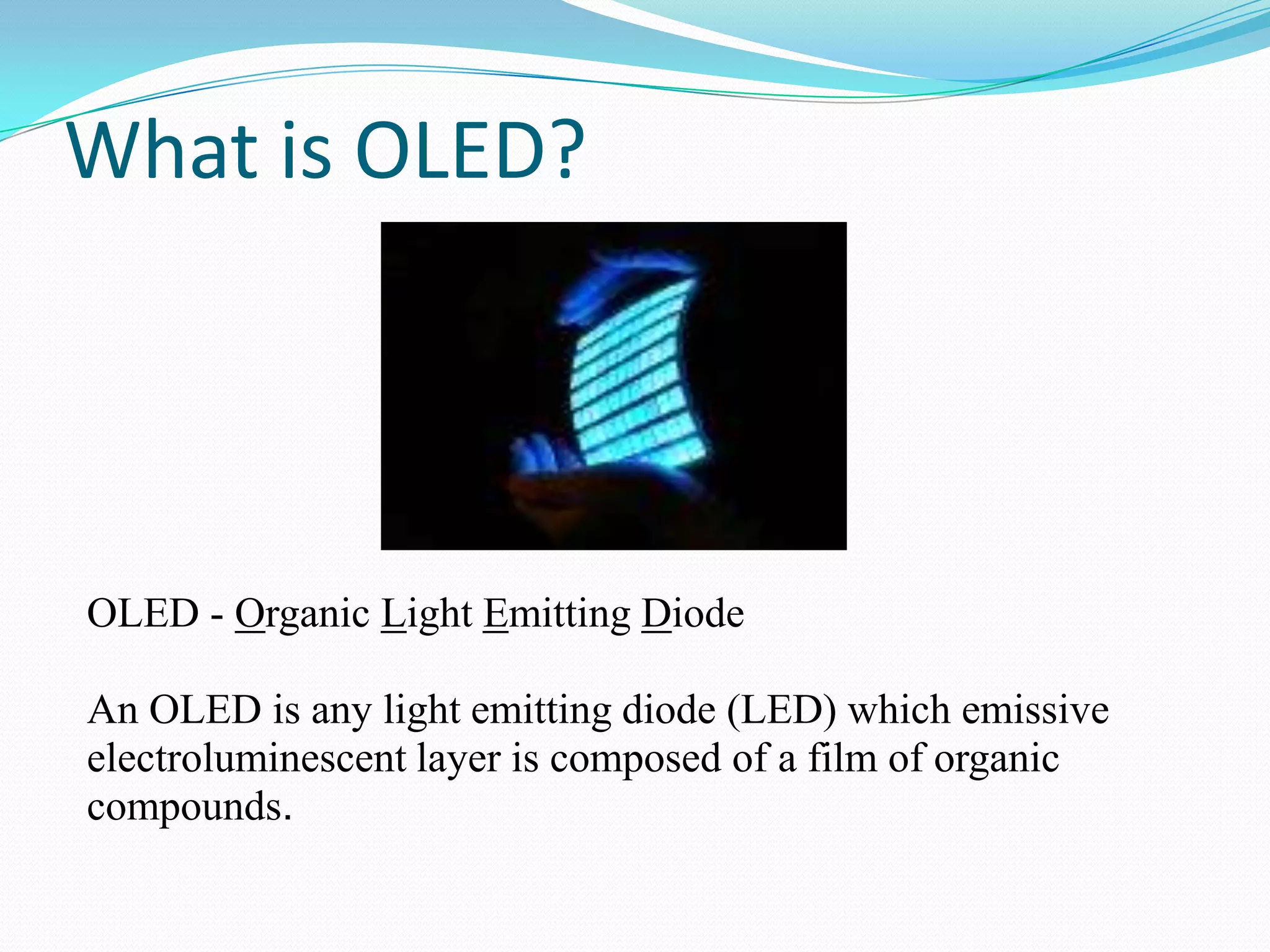
What is OLED?


OLED - Organic Light Emitting Diode

An OLED is any light emitting diode (LED) which emissive
electroluminescent layer is composed of a film of organic
compounds.
Birth of OLED
First successfully created by Ching Tang and
 Steve Van Slyke in 1987 at Kodak Labs.

First tests – very efficient, simple to make

Showed potential for displays
History
First developed in the early
 1950s in France
 1960s-AC-driven
  electroluminescent cells     was
  developed
 In 1987 Chin Tang and         Van
  Slyke introduced the first   light
  emitting diodes from          thin
  organic layers.
 In 1990 electroluminescence in
 polymers was discovered.
Architecture of OLED
 Substrate:(clear
  plastic, glass, foil) - The
  substrate supports the
  OLED.
 Anode(transparent):The
  anode removes electrons
  (adds       electron "holes")
  when a current flows through
  the device.
 Cathode (may or may not be
  transparent depending on
  the type of OLED) - The
  cathode injects electrons
  when a current flows through
  the device.
 Organic layer:
   o   Conducting layer-This layer is ma-
       de of organic plastic molecules that
       transport "holes" from the anode.
       One conducting polymer used in
       OLEDs is polyaniline.
   o   Emissive layer - This layer is made
       of   organic    plastic    molecules
       (different ones from the conducting
       layer) that transport electrons from
       the cathode; this is where light is
       made. One polymer used in the
       emissive layer is polyfluorene.
How OLED works?
Types of OLEDs
 Passive-matrix OLED

 Active-matrix OLED

 Transparent OLED

 Top-emitting OLED

 Foldable OLED

 White OLED
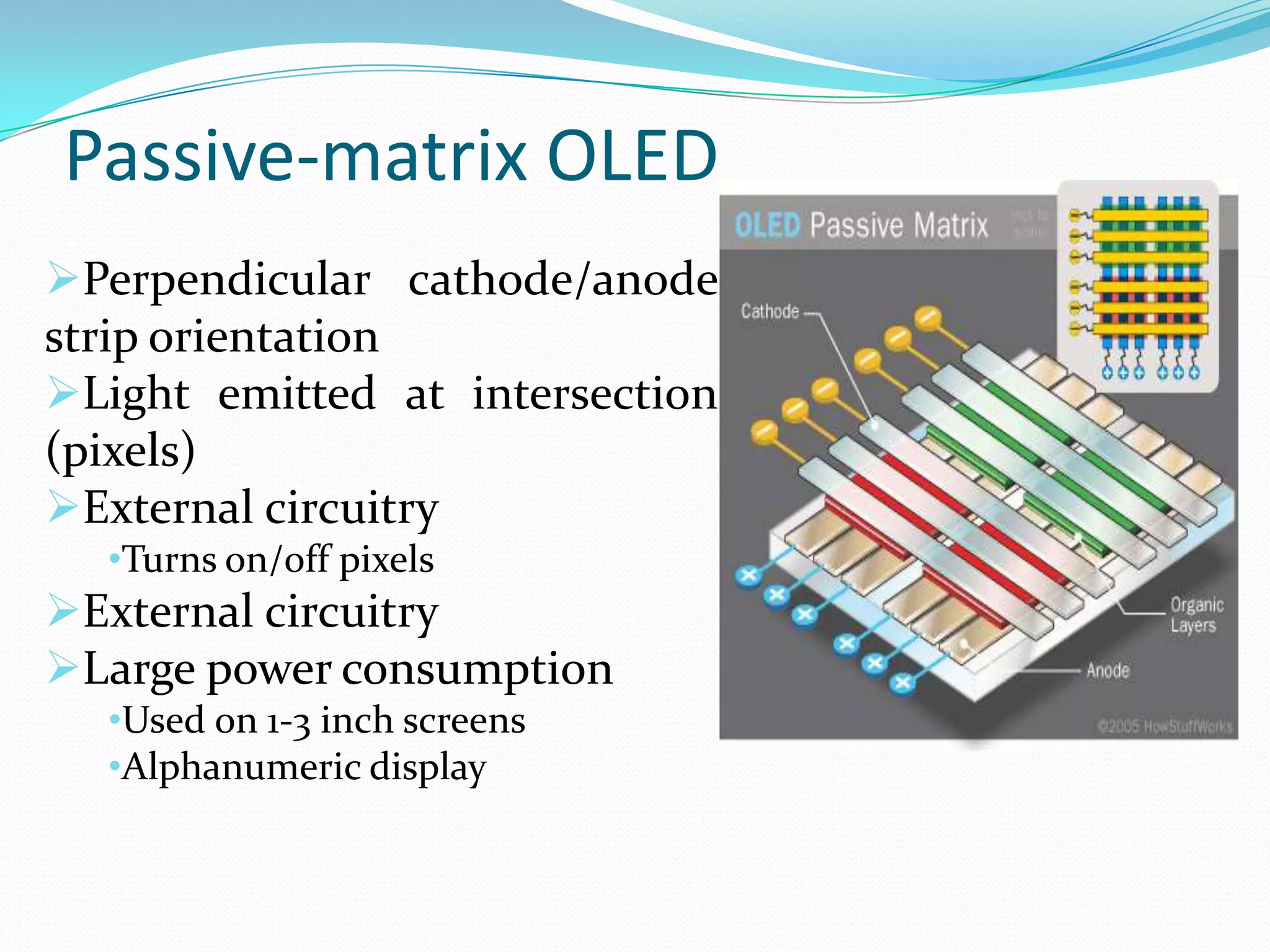
Passive-matrix OLED
Perpendicular cathode/anode
strip orientation
Light emitted at intersection
(pixels)
External circuitry
  •Turns on/off pixels
External circuitry
Large power consumption
  •Used on 1-3 inch screens
  •Alphanumeric display
Active-matrix OLED
Full layers of
cathode, anode, organic
molecules
Thin Film Transistor
matrix (TFT) on top of
anode
   •Internal circuitry to
   determine which pixels
   to turn on/off
Less power consumed
then PMOLED
   •Used for larger displays
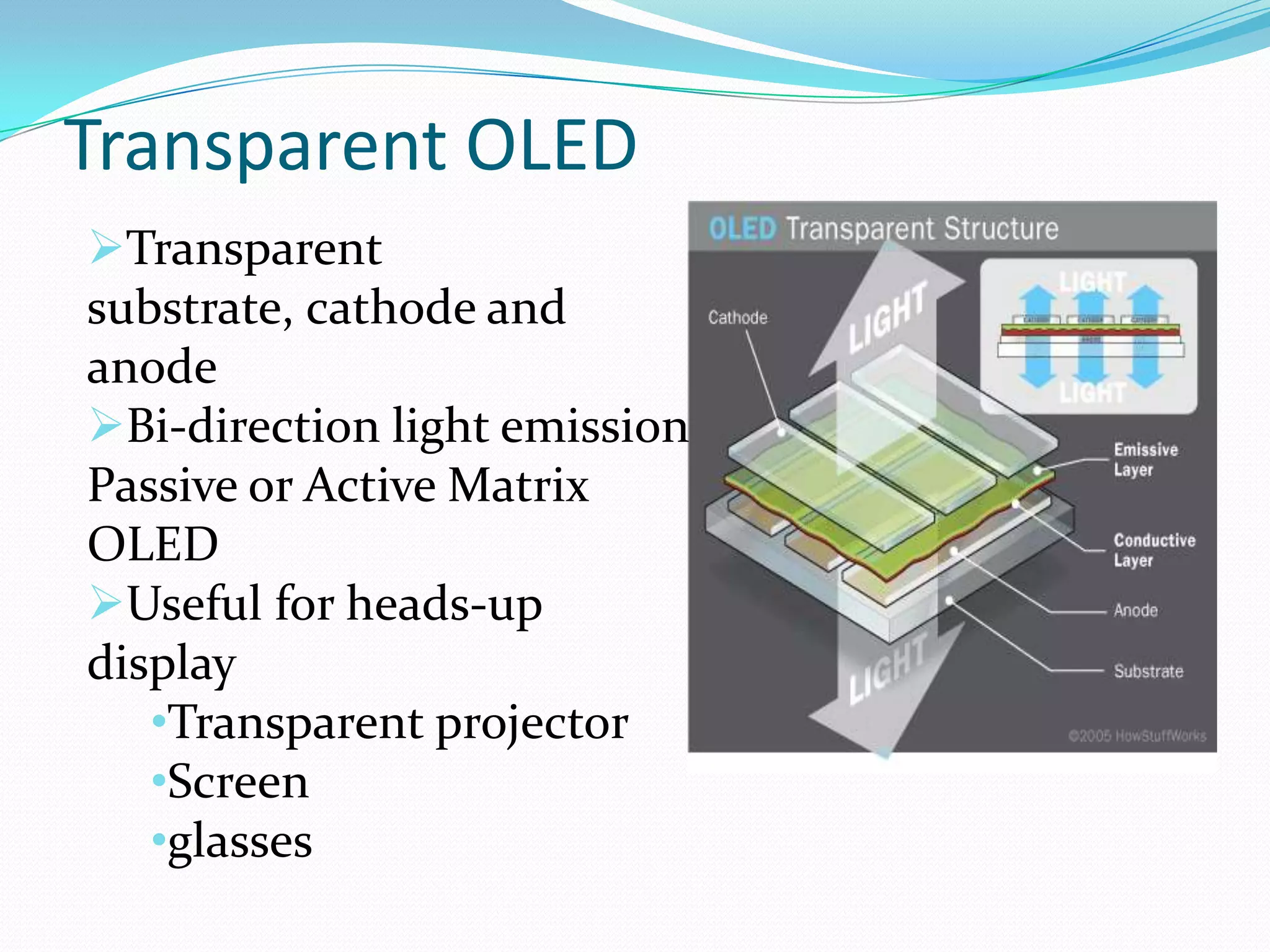
Transparent OLED
Transparent
substrate, cathode and
anode
Bi-direction light emission
Passive or Active Matrix
OLED
Useful for heads-up
display
   •Transparent projector
   •Screen
   •glasses
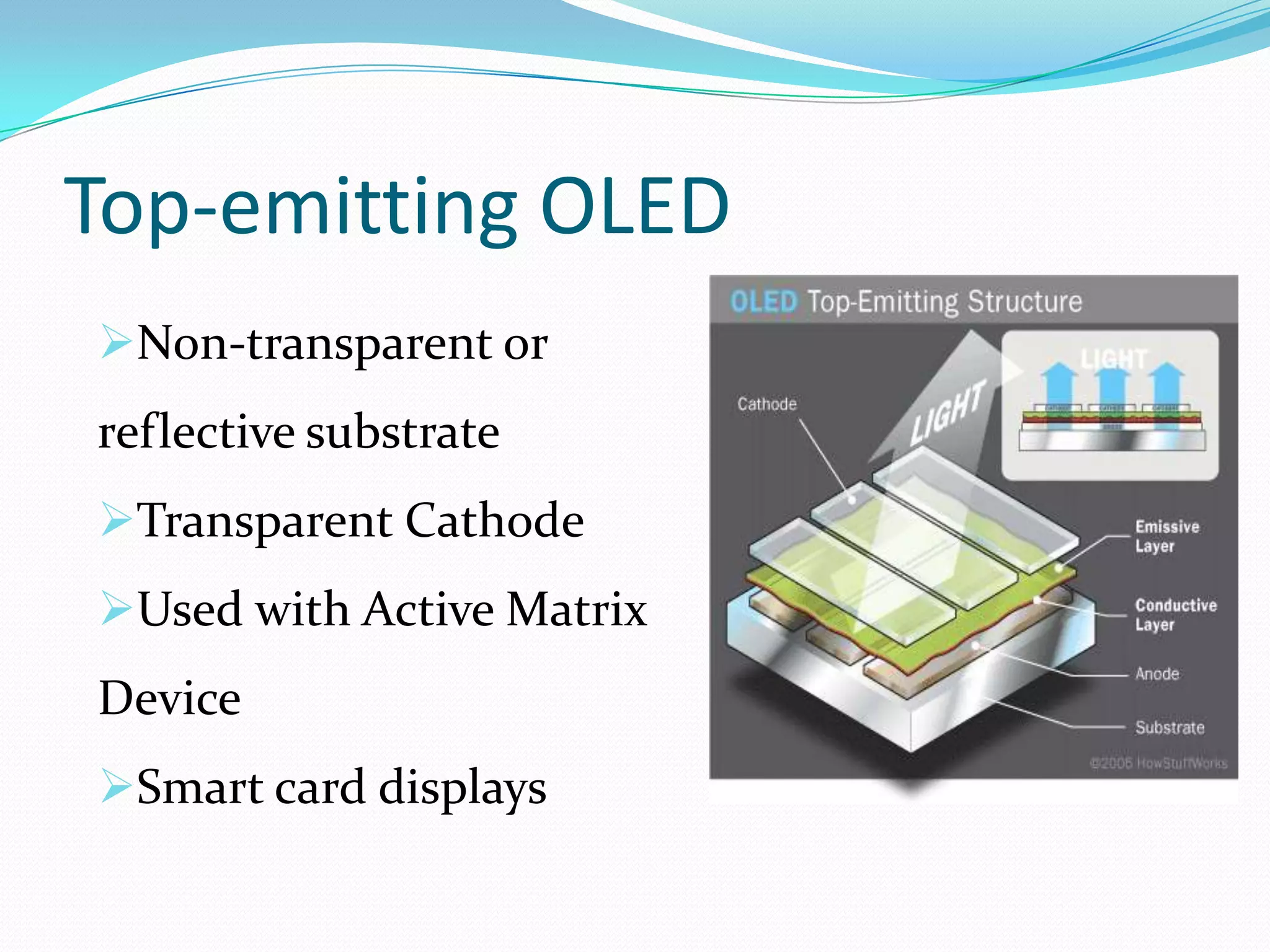
Top-emitting OLED
Non-transparent or
reflective substrate
Transparent Cathode
Used with Active Matrix
Device
Smart card displays
Foldable OLED
Flexible metallic foil or
plastic substrate
Lightweight and durable
Reduce display breaking
Clothing OLED
White OLED
 Emits bright white
 light
 Replace fluorescent
 lights
 Reduce energy cost
 for lighting
 True Color Qualities
Advantages
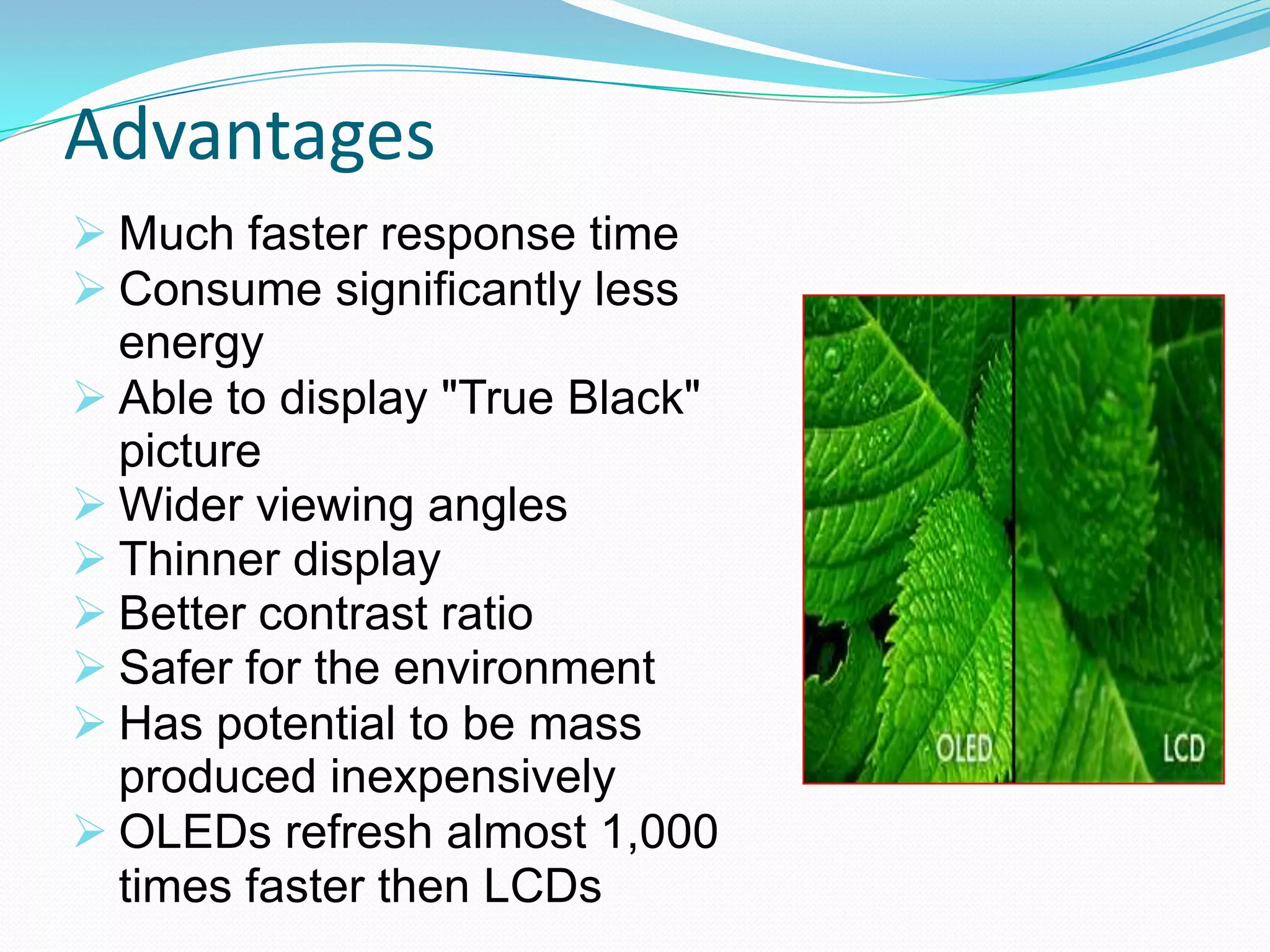
 Much faster response time
 Consume significantly less
  energy
 Able to display "True Black"
  picture
 Wider viewing angles
 Thinner display
 Better contrast ratio
 Safer for the environment
 Has potential to be mass
  produced inexpensively
 OLEDs refresh almost 1,000
  times faster then LCDs
Disadvantages
 Lifetime
   › White, Red, Green  46,000-230,000 hours
        About 5-25 years
   › Blue  14,000 hours
        About 1.6 years
 Expensive
 Susceptible to water
 Overcome multi-billion dollar LCD market
Current Research for OLEDs
o Manufacturers focusing on
  finding a cheap way to
  produce
   o "Roll-to-Roll"
     Manufacturing
o Increasing efficiency of blue
  luminance
Applications of OLEDs
 TVs
 Cell Phone screens
 Computer Screens

 Keyboards (Optimus

  Maximus)
 Lights
 Portable Divice
  displays
Future Uses for OLED
Lighting
 • Flexible / bendable lighting
 • Wallpaper lighting defining new
    ways to light a space
 • Transparent lighting doubles as
    a window

Cell Phones
 • Nokia 888
Scroll Laptop
 • Nokia concept OLED Laptop
Conclusion
 Research and development in the field of OLEDs is
 proceeding rapidly .

 And this may lead to the future application in heads-
 up displays, automotive dashboards, billboard type
 displays, home and office lightings and flexible
 displays .
THANK YOU
?

Oled

  • 1.
    OLED Presented by T.Spandana & R.G.Srujana 3rd year,E.C.E SHRI SAI INSTITUTE OF ENGINEERING AND TECHNOLOGY
  • 2.
    Contents  Introduction  Whatis OLED?  Birth of OLED  History  Architecture of OLED  How OLED works?  Types of OLEDs  Advantages and disadvantages  Current, future scope  Conclusion
  • 3.
    Introduction  Imagine havinghigh-definition TV 8O inches wide less than a quarter inch thick consume less power & can be rolled up when u are not using Is it possible?? Yes, it is possible by using OLED technology
  • 4.
    Before technologies  Inthis field first came the small LED displays (which can show only the numeric contents)  Then came heavy jumbo CRTs ,which are used till now. the problem is they are very heavy, bulky, couldn’t carry them form one place to other place.  Next to CRTs LCDs came into existence. which are lighter in weight compare to CRTs. the drawback in LCDs is the efficient result is obtained only in some particular directions.
  • 5.
    What is OLED? OLED- Organic Light Emitting Diode An OLED is any light emitting diode (LED) which emissive electroluminescent layer is composed of a film of organic compounds.
  • 6.
    Birth of OLED Firstsuccessfully created by Ching Tang and Steve Van Slyke in 1987 at Kodak Labs. First tests – very efficient, simple to make Showed potential for displays
  • 7.
    History First developed inthe early 1950s in France  1960s-AC-driven electroluminescent cells was developed  In 1987 Chin Tang and Van Slyke introduced the first light emitting diodes from thin organic layers.  In 1990 electroluminescence in polymers was discovered.
  • 8.
    Architecture of OLED Substrate:(clear plastic, glass, foil) - The substrate supports the OLED.  Anode(transparent):The anode removes electrons (adds electron "holes") when a current flows through the device.  Cathode (may or may not be transparent depending on the type of OLED) - The cathode injects electrons when a current flows through the device.
  • 9.
     Organic layer: o Conducting layer-This layer is ma- de of organic plastic molecules that transport "holes" from the anode. One conducting polymer used in OLEDs is polyaniline. o Emissive layer - This layer is made of organic plastic molecules (different ones from the conducting layer) that transport electrons from the cathode; this is where light is made. One polymer used in the emissive layer is polyfluorene.
  • 10.
  • 11.
    Types of OLEDs Passive-matrix OLED  Active-matrix OLED  Transparent OLED  Top-emitting OLED  Foldable OLED  White OLED
  • 12.
    Passive-matrix OLED Perpendicular cathode/anode striporientation Light emitted at intersection (pixels) External circuitry •Turns on/off pixels External circuitry Large power consumption •Used on 1-3 inch screens •Alphanumeric display
  • 13.
    Active-matrix OLED Full layersof cathode, anode, organic molecules Thin Film Transistor matrix (TFT) on top of anode •Internal circuitry to determine which pixels to turn on/off Less power consumed then PMOLED •Used for larger displays
  • 14.
    Transparent OLED Transparent substrate, cathodeand anode Bi-direction light emission Passive or Active Matrix OLED Useful for heads-up display •Transparent projector •Screen •glasses
  • 15.
    Top-emitting OLED Non-transparent or reflectivesubstrate Transparent Cathode Used with Active Matrix Device Smart card displays
  • 16.
    Foldable OLED Flexible metallicfoil or plastic substrate Lightweight and durable Reduce display breaking Clothing OLED
  • 17.
    White OLED  Emitsbright white light  Replace fluorescent lights  Reduce energy cost for lighting  True Color Qualities
  • 18.
    Advantages  Much fasterresponse time  Consume significantly less energy  Able to display "True Black" picture  Wider viewing angles  Thinner display  Better contrast ratio  Safer for the environment  Has potential to be mass produced inexpensively  OLEDs refresh almost 1,000 times faster then LCDs
  • 19.
    Disadvantages  Lifetime › White, Red, Green  46,000-230,000 hours  About 5-25 years › Blue  14,000 hours  About 1.6 years  Expensive  Susceptible to water  Overcome multi-billion dollar LCD market
  • 20.
    Current Research forOLEDs o Manufacturers focusing on finding a cheap way to produce o "Roll-to-Roll" Manufacturing o Increasing efficiency of blue luminance
  • 21.
    Applications of OLEDs TVs  Cell Phone screens  Computer Screens  Keyboards (Optimus Maximus)  Lights  Portable Divice displays
  • 22.
    Future Uses forOLED Lighting • Flexible / bendable lighting • Wallpaper lighting defining new ways to light a space • Transparent lighting doubles as a window Cell Phones • Nokia 888 Scroll Laptop • Nokia concept OLED Laptop
  • 23.
    Conclusion  Research anddevelopment in the field of OLEDs is proceeding rapidly .  And this may lead to the future application in heads- up displays, automotive dashboards, billboard type displays, home and office lightings and flexible displays .
  • 24.
  • 25.