VYASINSTITUTEOF ENGINEERING& TECHNOLOGY
Jodhpur(Rajasthan)
AffliatedTo
RajasthanTechnicalUniversity (RTU),Kota
SEMINAR ON
ORGANIC LIGHT EMITTING DIODE
(OLED)
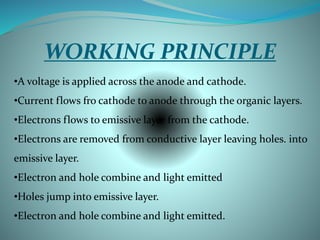
What is an OLED?
OLED – Organic Light Emitting Diode
An OLED is a light emitting diode(LED)
Which work on the principle of
electroluminescent layer is composed of a
film of organic material.
•Electroluminescence (EL)
is an optical phenomenon and
electrical phenomenon in which
a material emits light in
response to an electric current
passed through it, or to a strong
electric field
WORKING PRINCIPLE
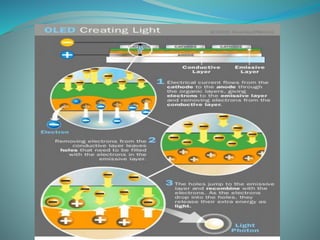
•A voltage is applied across the anode and cathode.
•Current flows fro cathode to anode through the organic layers.
•Electrons flows to emissive layer from the cathode.
•Electrons are removed from conductive layer leaving holes. into
emissive layer.
•Electron and hole combine and light emitted
•Holes jump into emissive layer.
•Electron and hole combine and light emitted.
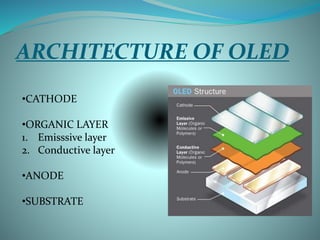
ARCHITECTURE OF OLED
•CATHODE
•ORGANIC LAYER
1. Emisssive layer
2. Conductive layer
•ANODE
•SUBSTRATE
TYPES OF OLED
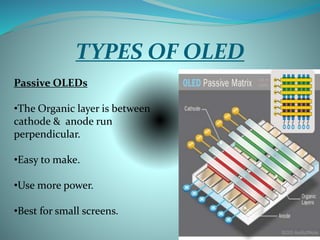
Passive OLEDs
•The Organic layer is between
cathode & anode run
perpendicular.
•Easy to make.
•Use more power.
•Best for small screens.
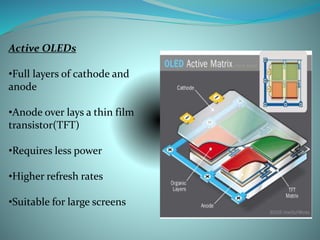
Active OLEDs
•Full layers of cathode and
anode
•Anode over lays a thin film
transistor(TFT)
•Requires less power
•Higher refresh rates
•Suitable for large screens
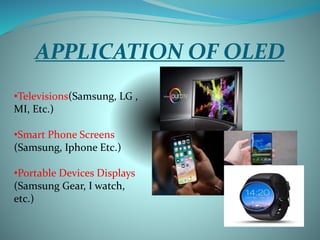
APPLICATION OF OLED
•Televisions(Samsung, LG ,
MI, Etc.)
•Smart Phone Screens
(Samsung, Iphone Etc.)
•Portable Devices Displays
(Samsung Gear, I watch,
etc.)
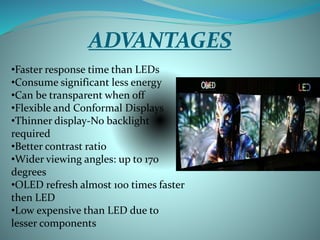
ADVANTAGES
•Faster response time than LEDs
•Consume significant less energy
•Can be transparent when off
•Flexible and Conformal Displays
•Thinner display-No backlight
required
•Better contrast ratio
•Wider viewing angles: up to 170
degrees
•OLED refresh almost 100 times faster
then LED
•Low expensive than LED due to
lesser components
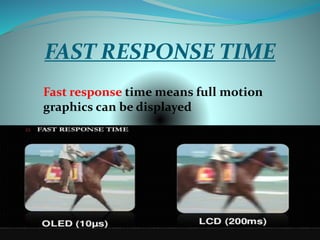
FAST RESPONSE TIME
Fast response time means full motion
graphics can be displayed
DISADVANTAGES
•Lifetime- Red and Green OLED films
have longer lifetimes ( 46,000 to 230,000
Hours) while blue OLED have much
shorter lifetimes(around 14,000 hours)
•Manufacturing – Currently,
manufacturing is more expensive then
LEDs
•Water- Water can easily damage OLEDs
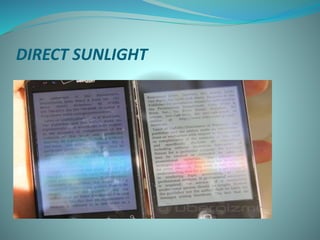
•OLED screens are even worse than LED in
direct sunlight
•Limited market availability
DIRECT SUNLIGHT
FUTURE USES FOR OLED
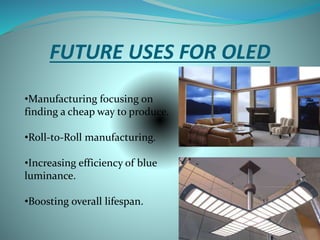
•Manufacturing focusing on
finding a cheap way to produce.
•Roll-to-Roll manufacturing.
•Increasing efficiency of blue
luminance.
•Boosting overall lifespan.
FUTURE USES FOR OLED
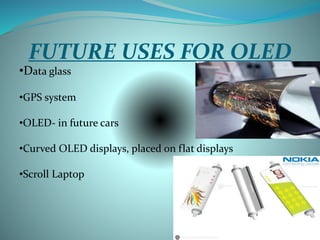
•Data glass
•GPS system
•OLED- in future cars
•Curved OLED displays, placed on flat displays
•Scroll Laptop
CONCLUSION
•Organic Light Emitting Diodes are evolving as the next
generation displays.
•OLED will replace LED and LCD technologies
•Flexibility and thinness will enable many application.
OLED ppt

OLED ppt

  • 1.
  • 2.
    What is anOLED? OLED – Organic Light Emitting Diode An OLED is a light emitting diode(LED) Which work on the principle of electroluminescent layer is composed of a film of organic material.
  • 3.
    •Electroluminescence (EL) is anoptical phenomenon and electrical phenomenon in which a material emits light in response to an electric current passed through it, or to a strong electric field
  • 4.
    WORKING PRINCIPLE •A voltageis applied across the anode and cathode. •Current flows fro cathode to anode through the organic layers. •Electrons flows to emissive layer from the cathode. •Electrons are removed from conductive layer leaving holes. into emissive layer. •Electron and hole combine and light emitted •Holes jump into emissive layer. •Electron and hole combine and light emitted.
  • 6.
    ARCHITECTURE OF OLED •CATHODE •ORGANICLAYER 1. Emisssive layer 2. Conductive layer •ANODE •SUBSTRATE
  • 7.
    TYPES OF OLED PassiveOLEDs •The Organic layer is between cathode & anode run perpendicular. •Easy to make. •Use more power. •Best for small screens.
  • 8.
    Active OLEDs •Full layersof cathode and anode •Anode over lays a thin film transistor(TFT) •Requires less power •Higher refresh rates •Suitable for large screens
  • 9.
    APPLICATION OF OLED •Televisions(Samsung,LG , MI, Etc.) •Smart Phone Screens (Samsung, Iphone Etc.) •Portable Devices Displays (Samsung Gear, I watch, etc.)
  • 10.
    ADVANTAGES •Faster response timethan LEDs •Consume significant less energy •Can be transparent when off •Flexible and Conformal Displays •Thinner display-No backlight required •Better contrast ratio •Wider viewing angles: up to 170 degrees •OLED refresh almost 100 times faster then LED •Low expensive than LED due to lesser components
  • 11.
    FAST RESPONSE TIME Fastresponse time means full motion graphics can be displayed
  • 12.
    DISADVANTAGES •Lifetime- Red andGreen OLED films have longer lifetimes ( 46,000 to 230,000 Hours) while blue OLED have much shorter lifetimes(around 14,000 hours) •Manufacturing – Currently, manufacturing is more expensive then LEDs •Water- Water can easily damage OLEDs •OLED screens are even worse than LED in direct sunlight •Limited market availability
  • 13.
  • 14.
    FUTURE USES FOROLED •Manufacturing focusing on finding a cheap way to produce. •Roll-to-Roll manufacturing. •Increasing efficiency of blue luminance. •Boosting overall lifespan.
  • 15.
    FUTURE USES FOROLED •Data glass •GPS system •OLED- in future cars •Curved OLED displays, placed on flat displays •Scroll Laptop
  • 16.
    CONCLUSION •Organic Light EmittingDiodes are evolving as the next generation displays. •OLED will replace LED and LCD technologies •Flexibility and thinness will enable many application.