Classification Of Inorganic
Polymers
Presentedby
Devansh Gupta
M.Sc Polymer Science
Semester 2
Contents
• What Are Polymers?
• Introduction
• Why Do We Need Inorganic Polymers?
• Classification Parameters
1. Classification On The Basis Of Connectivity
2. Classifications by dimensionality
3. Classification On The Basis Of Chemical
Constituents
• Sources
2
Polymers
3
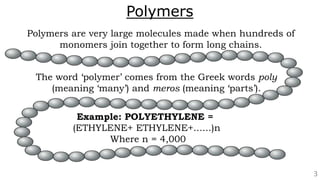
The word ‘polymer’ comes from the Greek words poly
(meaning ‘many’) and meros (meaning ‘parts’).
Example: POLYETHYLENE =
(ETHYLENE+ ETHYLENE+......)n
Where n = 4,000
Polymers are very large molecules made when hundreds of
monomers join together to form long chains.
Introduction
• Polymer chemistry impinges on nearly every aspect of modern life, from
electronics technology, to medicine, to the wide range of fibers, films,
elastomers, and structural materials on which everyone depends.
• Most of these polymers are organic materials. By this we mean that their
long polymeric backbones consist mainly of carbon atoms linked together
with covalent bonds.
• Organic polymers are derived either from petroleum or from plants,
animals, or microorganisms. Hence, they are generally accessible in large
quantities and at nominal cost. It is difficult to imagine life without them.
• After this much discussions the question comes in everyone’s mind that
Why, with the hundreds of organic polymers already available, should
scientists be interested in the synthesis of even more macromolecules?
4
Introduction Of Inorganic Polymers
• Inorganic polymers by looking its name one can say that they
are nonorganic or non-carbon containing polymers. The most
obvious definition for an inorganic polymer is a polymers with a
skeletal structure that does not include carbon atoms in the
backbone.
• Polymer that has inorganic repeating units in their main
polymeric backbone are known as inorganic polymers.
• It is a giant 3D or 2D network structure made up by number of
covalent bonds but with an absence or near-absence of
hydrocarbon units in the main molecular backbone.
5
• Many organic backbone polymers react with oxygen or ozone over a long period of time and
lose their advantageous properties.
• Most organic polymers burn, often with the release of toxic smoke.
• Many organic polymers degrade when exposed to ultraviolet or gamma radiation.
• Organic polymers sometimes soften at unacceptably low temperatures, or they swell or
dissolve in organic solvents, oils, or hydraulic fluids.
• Now in case of Inorganic polymers; inorganic elements can have different valencies than
carbon, and this means that the number of side groups attached to a backbone may be
different from the situation in an organic polymer. This will affect the flexibility of the
macromolecule, its ability to react with chemical reagents, its stability at high temperatures,
and its interactions with solvents and with other polymer molecules.
• The bonds formed between inorganic elements are often longer, stronger, and more resistant
to free radical cleavage reactions than are bonds formed by carbon.
6
Why Do We Need Inorganic Polymers
Over Organic Polymers?
Classification Parameters
• Inorganic polymers represent a rapidly growing field of chemical
research and already have many applications and any
classification is necessarily somewhat arbitrary.
• N. H. Ray, in his book on inorganic polymers, uses connectivity
as a method of classifying inorganic polymers.
• Pittman uses dimensions as a parameter for the classification of
inorganic polymers.
• The other classifying parameters are as following:
1. wholly inorganic polymers
2. inorganic-organic polymers
3. organometallic polymers
4. hybrid organic-inorganic polymers
7
Classification On The Basis Of
Connectivity
• Ray defines connectivity as the number of atoms
attached to a defined atom that are a part of the
polymer chain or matrix. This polymer connectivity can
range from 1 for a side group atom or functional group
to at least 8 or 10 in some metal-coordination and
metal-cyclopentadienyl polymers, respectively.
8
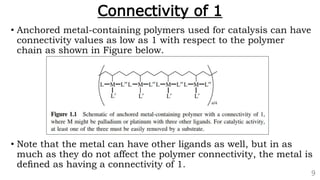
Connectivity of 1
• Anchored metal-containing polymers used for catalysis can have
connectivity values as low as 1 with respect to the polymer
chain as shown in Figure below.
• Note that the metal can have other ligands as well, but in as
much as they do not affect the polymer connectivity, the metal is
defined as having a connectivity of 1.
9
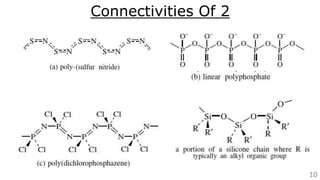
Connectivities Of 2
10
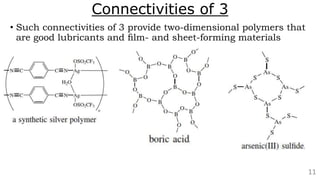
Connectivities of 3
• Such connectivities of 3 provide two-dimensional polymers that
are good lubricants and film- and sheet-forming materials
11
12
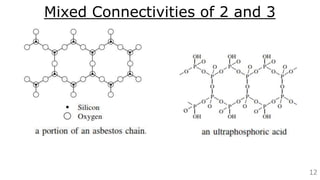
Mixed Connectivities of 2 and 3
Connectivites Of 4
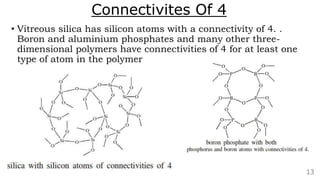
• Vitreous silica has silicon atoms with a connectivity of 4. .
Boron and aluminium phosphates and many other three-
dimensional polymers have connectivities of 4 for at least one
type of atom in the polymer
13
Mixed Connectivities of 3 and 4
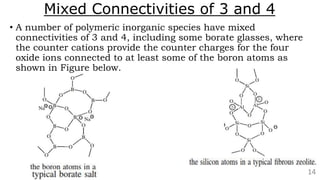
• A number of polymeric inorganic species have mixed
connectivities of 3 and 4, including some borate glasses, where
the counter cations provide the counter charges for the four
oxide ions connected to at least some of the boron atoms as
shown in Figure below.
14
Connectivities of 6
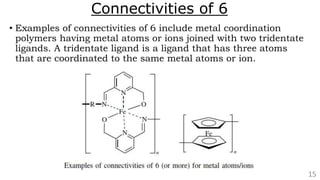
• Examples of connectivities of 6 include metal coordination
polymers having metal atoms or ions joined with two tridentate
ligands. A tridentate ligand is a ligand that has three atoms
that are coordinated to the same metal atoms or ion.
15
Mixed Connectivities of 4 and 6
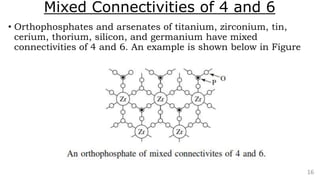
• Orthophosphates and arsenates of titanium, zirconium, tin,
cerium, thorium, silicon, and germanium have mixed
connectivities of 4 and 6. An example is shown below in Figure
16
Connectivities of 8
• Metal coordination polymers of zirconium(IV), yttrium(III), and several
lanthanide ions [cerium(IV), lanthanum(III), europium(III), gadolinium(III),
and lutetium(III)] have been synthesized that possess connectivities of 8
because two tetradentate ligands are coordinated to each metal ion that is
part of the polymer chain. An example is shown below in Figure.
17
Classifications by dimensionality
• Another manner in which polymers can be classed is by
dimensionality. Pittman use this classification for
polymeric species containing metal atoms in their
backbones. Here we will use the dimensionality for all
types of inorganic polymers.
i. 1-D Polymeric Structures
ii. 2-D Polymeric Structures
iii. 3-D Polymeric Structures
18
1-D Polymeric Structures
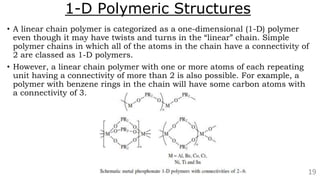
• A linear chain polymer is categorized as a one-dimensional (1-D) polymer
even though it may have twists and turns in the “linear” chain. Simple
polymer chains in which all of the atoms in the chain have a connectivity of
2 are classed as 1-D polymers.
• However, a linear chain polymer with one or more atoms of each repeating
unit having a connectivity of more than 2 is also possible. For example, a
polymer with benzene rings in the chain will have some carbon atoms with
a connectivity of 3.
19
2-D Polymeric Structures
• Simple inorganic species with a connectivity of 3 often lead to
sheet or two dimensional (2-D) polymers as shown in Figure for
boric acid & arsenic sulfide.
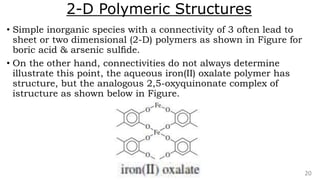
• On the other hand, connectivities do not always determine
illustrate this point, the aqueous iron(II) oxalate polymer has
structure, but the analogous 2,5-oxyquinonate complex of
istructure as shown below in Figure.
20
3-D Polymeric Structures
• Inorganic polymeric networks in which bonding occurs in three
dimensions are well known. Starting with quartz (SiO2) as a prime
example, the most common characteristic of such species is insolubility —
unless decomposition occurs during a dissolution process.
• To have a true 3-D polymer, at least some of the atoms must have a
connectivity of 4 or more. Some polymers, such as some of the polysilynes
are pseudo-3-D as a result of 3-D ring formation to relieve steric strain.
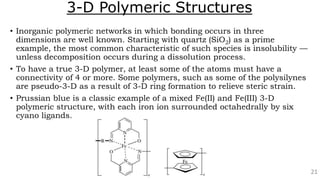
• Prussian blue is a classic example of a mixed Fe(II) and Fe(III) 3-D
polymeric structure, with each iron ion surrounded octahedrally by six
cyano ligands.
21
Classification On The Basis Of Chemical
Constituents
• According to this classification method inorganic polymers are
classified on the basis of parameters as following:
1. wholly inorganic polymers
2. inorganic-organic polymers
3. organometallic polymers
4. hybrid organic-inorganic polymers
22
wholly inorganic polymers
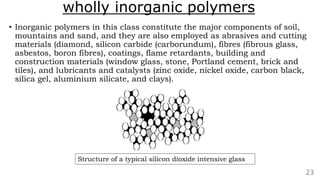
• Inorganic polymers in this class constitute the major components of soil,
mountains and sand, and they are also employed as abrasives and cutting
materials (diamond, silicon carbide (carborundum), fibres (fibrous glass,
asbestos, boron fibres), coatings, flame retardants, building and
construction materials (window glass, stone, Portland cement, brick and
tiles), and lubricants and catalysts (zinc oxide, nickel oxide, carbon black,
silica gel, aluminium silicate, and clays).
23
Structure of a typical silicon dioxide intensive glass
Inorganic-organic Polymers
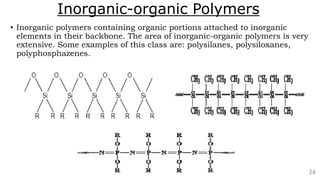
• Inorganic polymers containing organic portions attached to inorganic
elements in their backbone. The area of inorganic-organic polymers is very
extensive. Some examples of this class are: polysilanes, polysiloxanes,
polyphosphazenes.
24
Organometallic Polymers
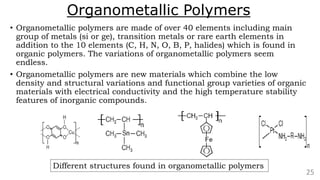
• Organometallic polymers are made of over 40 elements including main
group of metals (si or ge), transition metals or rare earth elements in
addition to the 10 elements (C, H, N, O, B, P, halides) which is found in
organic polymers. The variations of organometallic polymers seem
endless.
• Organometallic polymers are new materials which combine the low
density and structural variations and functional group varieties of organic
materials with electrical conductivity and the high temperature stability
features of inorganic compounds.
25
Different structures found in organometallic polymers
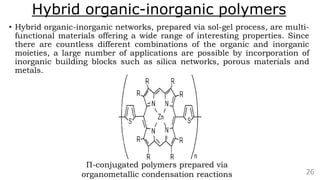
Hybrid organic-inorganic polymers
• Hybrid organic-inorganic networks, prepared via sol-gel process, are multi-
functional materials offering a wide range of interesting properties. Since
there are countless different combinations of the organic and inorganic
moieties, a large number of applications are possible by incorporation of
inorganic building blocks such as silica networks, porous materials and
metals.
26
Π-conjugated polymers prepared via
organometallic condensation reactions
Sources
•Inorganic And Organometallic Polymers By
RONALD D. Archer
•Inorganic And Organometallic Macromolecules
By Charles E. Carraher
•Inorganic Polymers, Second Edition By James E.
Mark
27

Classification of inorganic polymers

  • 1.
    Classification Of Inorganic Polymers Presentedby DevanshGupta M.Sc Polymer Science Semester 2
  • 2.
    Contents • What ArePolymers? • Introduction • Why Do We Need Inorganic Polymers? • Classification Parameters 1. Classification On The Basis Of Connectivity 2. Classifications by dimensionality 3. Classification On The Basis Of Chemical Constituents • Sources 2
  • 3.
    Polymers 3 The word ‘polymer’comes from the Greek words poly (meaning ‘many’) and meros (meaning ‘parts’). Example: POLYETHYLENE = (ETHYLENE+ ETHYLENE+......)n Where n = 4,000 Polymers are very large molecules made when hundreds of monomers join together to form long chains.
  • 4.
    Introduction • Polymer chemistryimpinges on nearly every aspect of modern life, from electronics technology, to medicine, to the wide range of fibers, films, elastomers, and structural materials on which everyone depends. • Most of these polymers are organic materials. By this we mean that their long polymeric backbones consist mainly of carbon atoms linked together with covalent bonds. • Organic polymers are derived either from petroleum or from plants, animals, or microorganisms. Hence, they are generally accessible in large quantities and at nominal cost. It is difficult to imagine life without them. • After this much discussions the question comes in everyone’s mind that Why, with the hundreds of organic polymers already available, should scientists be interested in the synthesis of even more macromolecules? 4
  • 5.
    Introduction Of InorganicPolymers • Inorganic polymers by looking its name one can say that they are nonorganic or non-carbon containing polymers. The most obvious definition for an inorganic polymer is a polymers with a skeletal structure that does not include carbon atoms in the backbone. • Polymer that has inorganic repeating units in their main polymeric backbone are known as inorganic polymers. • It is a giant 3D or 2D network structure made up by number of covalent bonds but with an absence or near-absence of hydrocarbon units in the main molecular backbone. 5
  • 6.
    • Many organicbackbone polymers react with oxygen or ozone over a long period of time and lose their advantageous properties. • Most organic polymers burn, often with the release of toxic smoke. • Many organic polymers degrade when exposed to ultraviolet or gamma radiation. • Organic polymers sometimes soften at unacceptably low temperatures, or they swell or dissolve in organic solvents, oils, or hydraulic fluids. • Now in case of Inorganic polymers; inorganic elements can have different valencies than carbon, and this means that the number of side groups attached to a backbone may be different from the situation in an organic polymer. This will affect the flexibility of the macromolecule, its ability to react with chemical reagents, its stability at high temperatures, and its interactions with solvents and with other polymer molecules. • The bonds formed between inorganic elements are often longer, stronger, and more resistant to free radical cleavage reactions than are bonds formed by carbon. 6 Why Do We Need Inorganic Polymers Over Organic Polymers?
  • 7.
    Classification Parameters • Inorganicpolymers represent a rapidly growing field of chemical research and already have many applications and any classification is necessarily somewhat arbitrary. • N. H. Ray, in his book on inorganic polymers, uses connectivity as a method of classifying inorganic polymers. • Pittman uses dimensions as a parameter for the classification of inorganic polymers. • The other classifying parameters are as following: 1. wholly inorganic polymers 2. inorganic-organic polymers 3. organometallic polymers 4. hybrid organic-inorganic polymers 7
  • 8.
    Classification On TheBasis Of Connectivity • Ray defines connectivity as the number of atoms attached to a defined atom that are a part of the polymer chain or matrix. This polymer connectivity can range from 1 for a side group atom or functional group to at least 8 or 10 in some metal-coordination and metal-cyclopentadienyl polymers, respectively. 8
  • 9.
    Connectivity of 1 •Anchored metal-containing polymers used for catalysis can have connectivity values as low as 1 with respect to the polymer chain as shown in Figure below. • Note that the metal can have other ligands as well, but in as much as they do not affect the polymer connectivity, the metal is defined as having a connectivity of 1. 9
  • 10.
  • 11.
    Connectivities of 3 •Such connectivities of 3 provide two-dimensional polymers that are good lubricants and film- and sheet-forming materials 11
  • 12.
  • 13.
    Connectivites Of 4 •Vitreous silica has silicon atoms with a connectivity of 4. . Boron and aluminium phosphates and many other three- dimensional polymers have connectivities of 4 for at least one type of atom in the polymer 13
  • 14.
    Mixed Connectivities of3 and 4 • A number of polymeric inorganic species have mixed connectivities of 3 and 4, including some borate glasses, where the counter cations provide the counter charges for the four oxide ions connected to at least some of the boron atoms as shown in Figure below. 14
  • 15.
    Connectivities of 6 •Examples of connectivities of 6 include metal coordination polymers having metal atoms or ions joined with two tridentate ligands. A tridentate ligand is a ligand that has three atoms that are coordinated to the same metal atoms or ion. 15
  • 16.
    Mixed Connectivities of4 and 6 • Orthophosphates and arsenates of titanium, zirconium, tin, cerium, thorium, silicon, and germanium have mixed connectivities of 4 and 6. An example is shown below in Figure 16
  • 17.
    Connectivities of 8 •Metal coordination polymers of zirconium(IV), yttrium(III), and several lanthanide ions [cerium(IV), lanthanum(III), europium(III), gadolinium(III), and lutetium(III)] have been synthesized that possess connectivities of 8 because two tetradentate ligands are coordinated to each metal ion that is part of the polymer chain. An example is shown below in Figure. 17
  • 18.
    Classifications by dimensionality •Another manner in which polymers can be classed is by dimensionality. Pittman use this classification for polymeric species containing metal atoms in their backbones. Here we will use the dimensionality for all types of inorganic polymers. i. 1-D Polymeric Structures ii. 2-D Polymeric Structures iii. 3-D Polymeric Structures 18
  • 19.
    1-D Polymeric Structures •A linear chain polymer is categorized as a one-dimensional (1-D) polymer even though it may have twists and turns in the “linear” chain. Simple polymer chains in which all of the atoms in the chain have a connectivity of 2 are classed as 1-D polymers. • However, a linear chain polymer with one or more atoms of each repeating unit having a connectivity of more than 2 is also possible. For example, a polymer with benzene rings in the chain will have some carbon atoms with a connectivity of 3. 19
  • 20.
    2-D Polymeric Structures •Simple inorganic species with a connectivity of 3 often lead to sheet or two dimensional (2-D) polymers as shown in Figure for boric acid & arsenic sulfide. • On the other hand, connectivities do not always determine illustrate this point, the aqueous iron(II) oxalate polymer has structure, but the analogous 2,5-oxyquinonate complex of istructure as shown below in Figure. 20
  • 21.
    3-D Polymeric Structures •Inorganic polymeric networks in which bonding occurs in three dimensions are well known. Starting with quartz (SiO2) as a prime example, the most common characteristic of such species is insolubility — unless decomposition occurs during a dissolution process. • To have a true 3-D polymer, at least some of the atoms must have a connectivity of 4 or more. Some polymers, such as some of the polysilynes are pseudo-3-D as a result of 3-D ring formation to relieve steric strain. • Prussian blue is a classic example of a mixed Fe(II) and Fe(III) 3-D polymeric structure, with each iron ion surrounded octahedrally by six cyano ligands. 21
  • 22.
    Classification On TheBasis Of Chemical Constituents • According to this classification method inorganic polymers are classified on the basis of parameters as following: 1. wholly inorganic polymers 2. inorganic-organic polymers 3. organometallic polymers 4. hybrid organic-inorganic polymers 22
  • 23.
    wholly inorganic polymers •Inorganic polymers in this class constitute the major components of soil, mountains and sand, and they are also employed as abrasives and cutting materials (diamond, silicon carbide (carborundum), fibres (fibrous glass, asbestos, boron fibres), coatings, flame retardants, building and construction materials (window glass, stone, Portland cement, brick and tiles), and lubricants and catalysts (zinc oxide, nickel oxide, carbon black, silica gel, aluminium silicate, and clays). 23 Structure of a typical silicon dioxide intensive glass
  • 24.
    Inorganic-organic Polymers • Inorganicpolymers containing organic portions attached to inorganic elements in their backbone. The area of inorganic-organic polymers is very extensive. Some examples of this class are: polysilanes, polysiloxanes, polyphosphazenes. 24
  • 25.
    Organometallic Polymers • Organometallicpolymers are made of over 40 elements including main group of metals (si or ge), transition metals or rare earth elements in addition to the 10 elements (C, H, N, O, B, P, halides) which is found in organic polymers. The variations of organometallic polymers seem endless. • Organometallic polymers are new materials which combine the low density and structural variations and functional group varieties of organic materials with electrical conductivity and the high temperature stability features of inorganic compounds. 25 Different structures found in organometallic polymers
  • 26.
    Hybrid organic-inorganic polymers •Hybrid organic-inorganic networks, prepared via sol-gel process, are multi- functional materials offering a wide range of interesting properties. Since there are countless different combinations of the organic and inorganic moieties, a large number of applications are possible by incorporation of inorganic building blocks such as silica networks, porous materials and metals. 26 Π-conjugated polymers prepared via organometallic condensation reactions
  • 27.
    Sources •Inorganic And OrganometallicPolymers By RONALD D. Archer •Inorganic And Organometallic Macromolecules By Charles E. Carraher •Inorganic Polymers, Second Edition By James E. Mark 27