Index
Abstract..............................................................................................................01
1. Introduction..................................................................................................01
1.1. Overview.....................................................................................................01
1.2 History of OLEDs.......................................................................................01
2. How does an OLED emit light?...................................................................02
3. Architecture of OLED..................................................................................03
4. Comparison..................................................................................................04
4.1 OLED and LCD..........................................................................................04
4.2 OLED and LED..........................................................................................05
4.3 OLED and TFT display..............................................................................05
5. Advantages....................................................................................................07
6. Disadvantages................................................................................................08
8. Application....................................................................................................08
9. Future uses of OLED....................................................................................10
10. Conclusion...................................................................................................12
References..........................................................................................................12
OLEDs
Abstract
OLEDs are a great breakthrough in display technology .Also a new promising
technology with high expected profitability on the display market. They show low driving
voltages in combination with unrestricted viewing angles, high color-brilliance, light weight,
small film-thicknesses and low production costs. Organic light-emitting devices (OLEDs)
operate on the principle of converting electrical energy into light, a phenomenon known as
electroluminescence. This paper focuses on structure of OLED, how it works, comparison
with other display and applications.
1. Introduction
1.1. Overview
An OLED (organic light-emitting diode) is a light-emitting diode (LED) in which the
emissive electroluminescent layer is a film of organic compound which emit light in response
to an electric current. This layer of organic semiconductor material is situated between two
electrodes. Generally, at least one of these electrodes is transparent.
There are two main families of OLEDs: those based on small molecules and those
employing polymers. Adding mobile ions to an OLED creates a light-emitting
electrochemical cell or LEC, which has a slightly different mode of operation. OLED
displays can use either passive-matrix (PMOLED) or active-matrix addressing schemes.
Active-matrix OLEDs (AMOLED) require a thin-film transistor backplane to switch each
individual pixel on or off, but allow for higher resolution and larger display sizes.
An OLED display works without a backlight. Thus, it can display deep black levels
and can be thinner and lighter than a liquid crystal display (LCD). In low ambient light
conditions such as a dark room an OLED screen can achieve a higher contrast ratio than an
LCD, whether the LCD uses cold cathode fluorescent lamps or LED backlight. Due to its low
thermal conductivity, an OLED typically emits less light per area than an inorganic LED. [3]
1.2 History of OLEDs
• First developed in the early 1950s in France
• Early technology would emitted a short burst of light when a voltage was applied
• This early form applied high-voltage alternating current field to crystalline thin films of
alcidine orange and quinacrine.
• 1960s - AC-driven electroluminescent cells using doped anthracene was developed
• In a 1977 paper, Shirakawa et al. Reported high conductivity in similarly oxidized and
iodine-doped polyacetylene.
• In 1987 Chin Tang and Van Slyke introduced the first light emitting diodes from thin
organic layers.
• In 1990 electroluminescence in polymers was discovered.[1]
2. How does an OLED emit light?
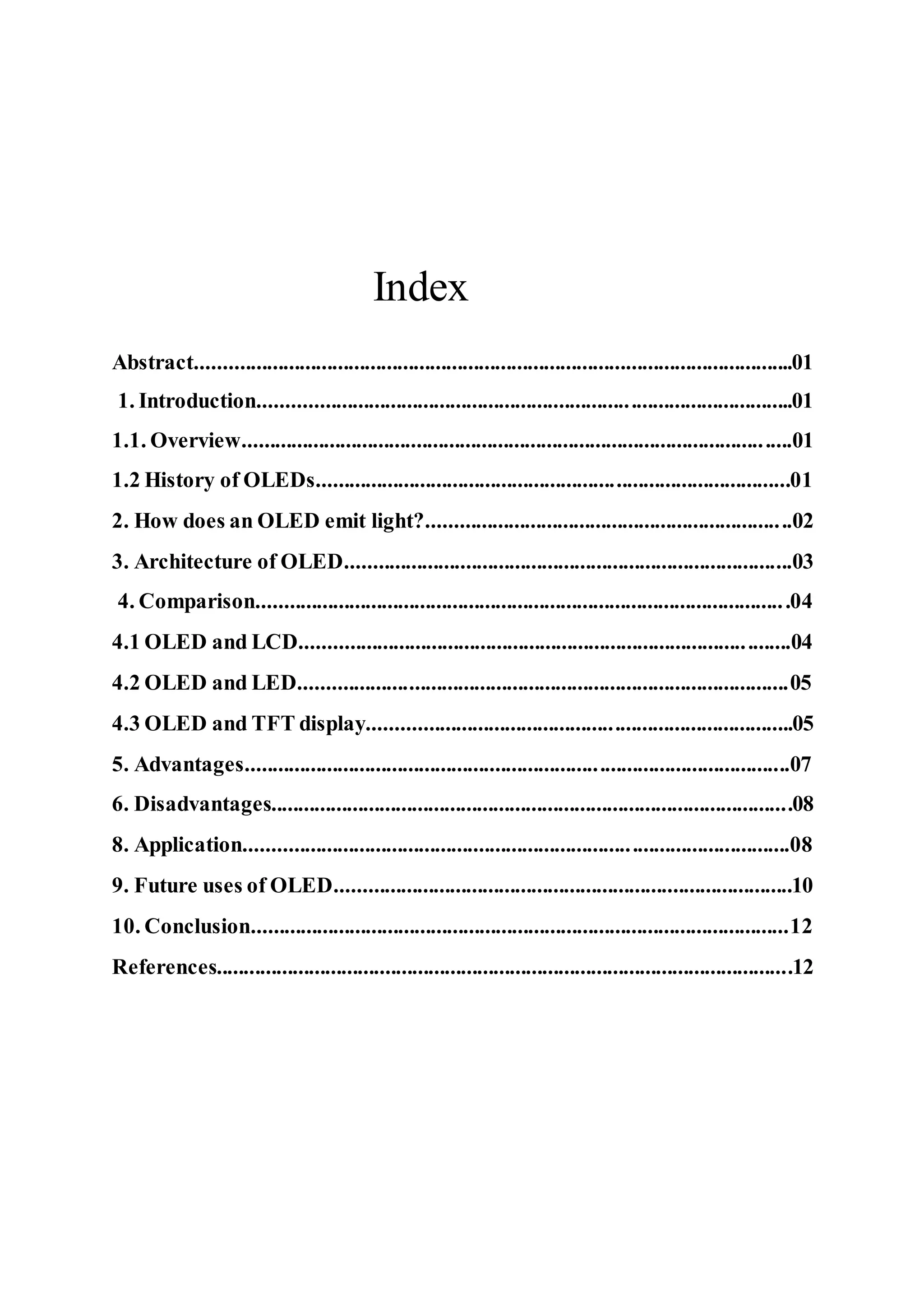
OLED’s basic structure consists of organic materials positioned between cathode
and anode, which is composed of electric conductive transparent indium tin oxide(ITO). The
organic materials compose a multilayered thin film, which includes the Hole Transporting
Layer(HTL), Emission Layer(EL) and Electron Transporting Layer(ETL). By applying the
appropriate electric voltage, holes and electrons are injected into the EML from the anode
and the cathode resp. The holes and electrons combine inside the EML , after which
electroluminescence occurs. The transfer material, emission layer material and choice of
electrode are the key factors that determine the quality of OLED components.
3. Architecture of OLED
Like an LED, an OLED is a solid-state semiconductor device that is 100 to
500nanometers thick or about 200 times smaller than a human hair. OLEDs can have either
two layers or three layers of organic material; in the latter design, the third layer helps
transport electrons from the cathode to the emissive layer.
An OLED consists of the following parts:
• Substrate (clear plastic, glass, foil) - The substrate supports the OLED.
• Anode (transparent) - The anode removes electrons (adds electron "holes") when a current
flow through the device.
• Organic layer
• Conducting layer- This layer is made of organic plastic molecules that transport "holes"
from the anode. One conducting polymer used in OLEDs is polyaniline.
• Emissive layer- This layer is made of organic plastic molecules (different ones from the
conducting layer) that transport electrons from the cathode; this is where light is made. One
polymer used in the emissive layer is polyfluorene.
• Cathode (may or may not be transparent depending on the type of OLED) - The cathode
injects electrons when a current flows through the device. [1]
4. Comparison
4.1 OLED and LCD
Liquid Crystal Displays or LCD is a fairly old technology that has seen a
recent burst in advancement. From calculator screens, LCDs are now fairly common in
mobile phones, PDAs, computers, and a lot more applications. OLEDs (Organic Light
Emitting Diode) are an improved version of LEDs that utilizes organic compounds to
produce light. OLEDs have been eyed by many manufacturers as a good replacement for
LCDs in many applications due to multiple advantages. From the phrase ‘light emitting’ we
can deduce that OLEDs produce their consumed by LCDs goes to the backlight, thus the big
power difference. The lack of a backlight also means that an OLED display can be
significantly slimmer than an LCD display. OLEDs have also been observed to show warmer
images with better contrast making their image quality far superior than what LCDs currently
achieve. Manufacturing OLEDs could also be a lot cheaper than manufacturing LCDs. LCD
screens are made out of transistors that are expensive to manufacture. OLEDs on the other
hand can be applied to a substrate that has been treated to accept organic compounds via
printing methods just like ink. Any inkjet printer can do this, making it easier and more
economical to mass produce OLED displays. [6] own light unlike LCDs which require a
backlight that means fewer parts. Another advantage is the lower power consumption; a great
amount of the power consumed by LCDs goes to the backlight, thus the big power
difference. The lack of a backlight also means that an OLED display can be significantly
slimmer than an LCD display. OLEDs have also been observed to show warmer images with
better contrast making their image quality far superior than what LCDs currently achieve.
Manufacturing OLEDs could also be a lot cheaper than manufacturing LCDs. LCD screens
are made out of transistors that are expensive to manufacture. OLEDs on the other hand can
be applied to a substrate that has been treated to accept organic compounds via printing
methods just like ink. Any inkjet printer can do this, making it easier and more economical to
mass produce OLED displays. [6]
4.2 OLED and LED
OLED is really a new large screen technology. The flat panel is made up of millions of tiny
LEDs. The “O” in OLED stands for “organic” which means there is carbon within the
molecules of the emissive (light producing) layer of the panel. Large screen OLED panels
need no lamps; it’s a self illuminating device. OLED display can be thinner and lighter than
the skinniest LED display. They provide very wide and consistent color no matter where you
are seated in the room. LED display tends to get significantly dimmer as one moves away
4.3 OLED and TFT display
TFT: First we must clarify that no TFT display is a technology itself, but it is simply a special
type of transistor with which it has succeeded in improving the quality of the image. Its use is
more prevalent with LCD screens.LCD technology uses liquid crystal molecules placed
between different layers that polarize and rotate as you want to display a color or another. Its
main advantage, besides its small size, it is energy from center and many exhibit color shift.
OLEDs are quite energy efficient, besting all other flat panels in low power consumption.
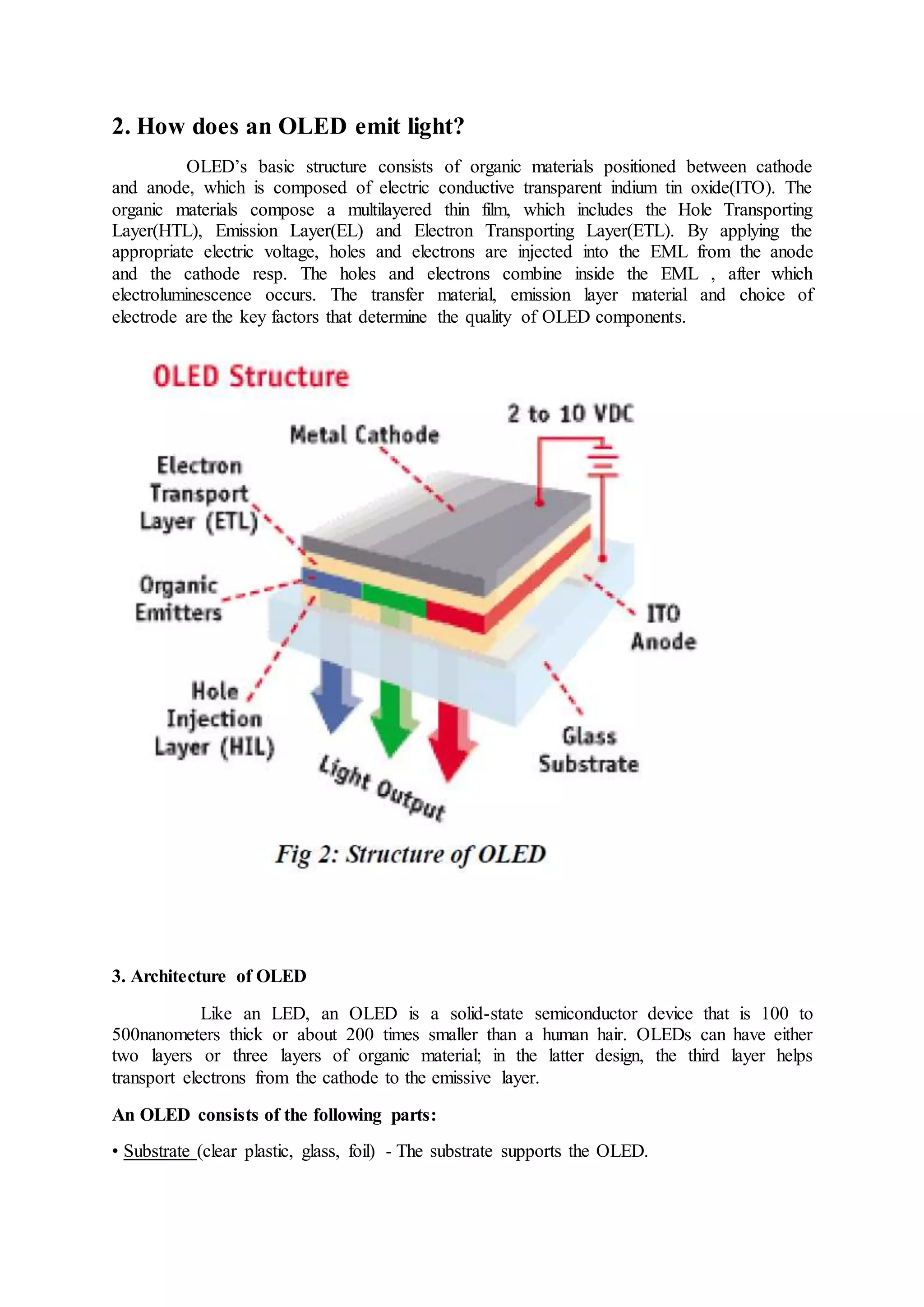
The greatest attribute of OLED is the ability to have the deepest blacks of any flat panel
technology. Unlike LED which at best can only dim the image in regions, OLEDs can
produce a very low luminescence level down the individual pixel. This ability coupled with
bright a white that is why OLEDs are expected to have the highest contrast. OLEDs can make
more colors than LE display. saving. When these transistors TFT screens used then we are
talking about TFT LCDs, which are the most widespread at present.
OLED: Finally, this technology also has quite a few years and that little by little we will also
viewing it more consistently. It is a variant of the classic LED, but where the emission layer
has an organic component. Surely you've heard that OLED screens have the advantage of not
needing
backlight, thus saving a lot more energy than any other alternative. In addition, its cost is also
lower.
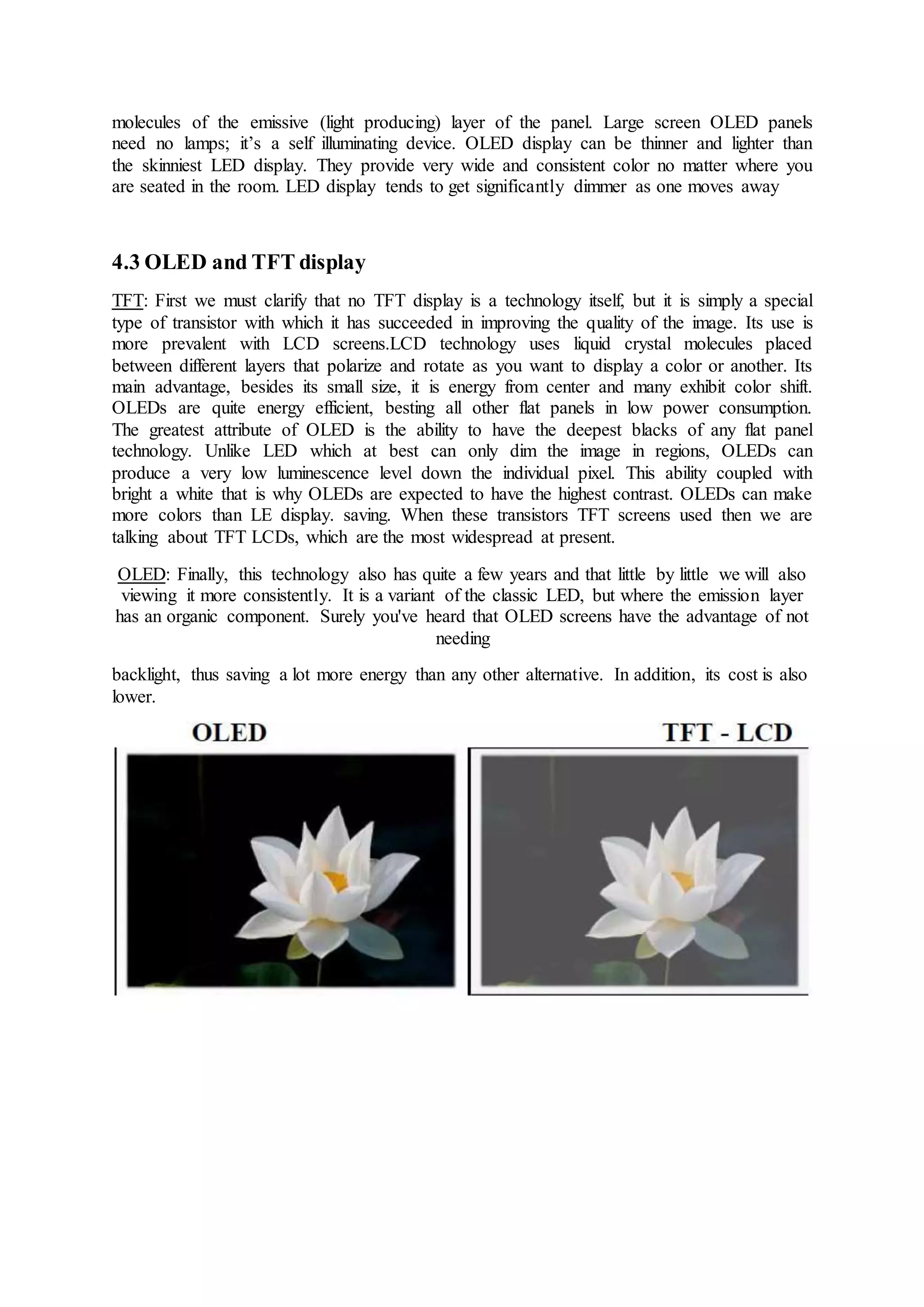
Result:
Higher contrast ratio gives impression for higher brightness. OLED is much better than TFT
for sunlight readability.
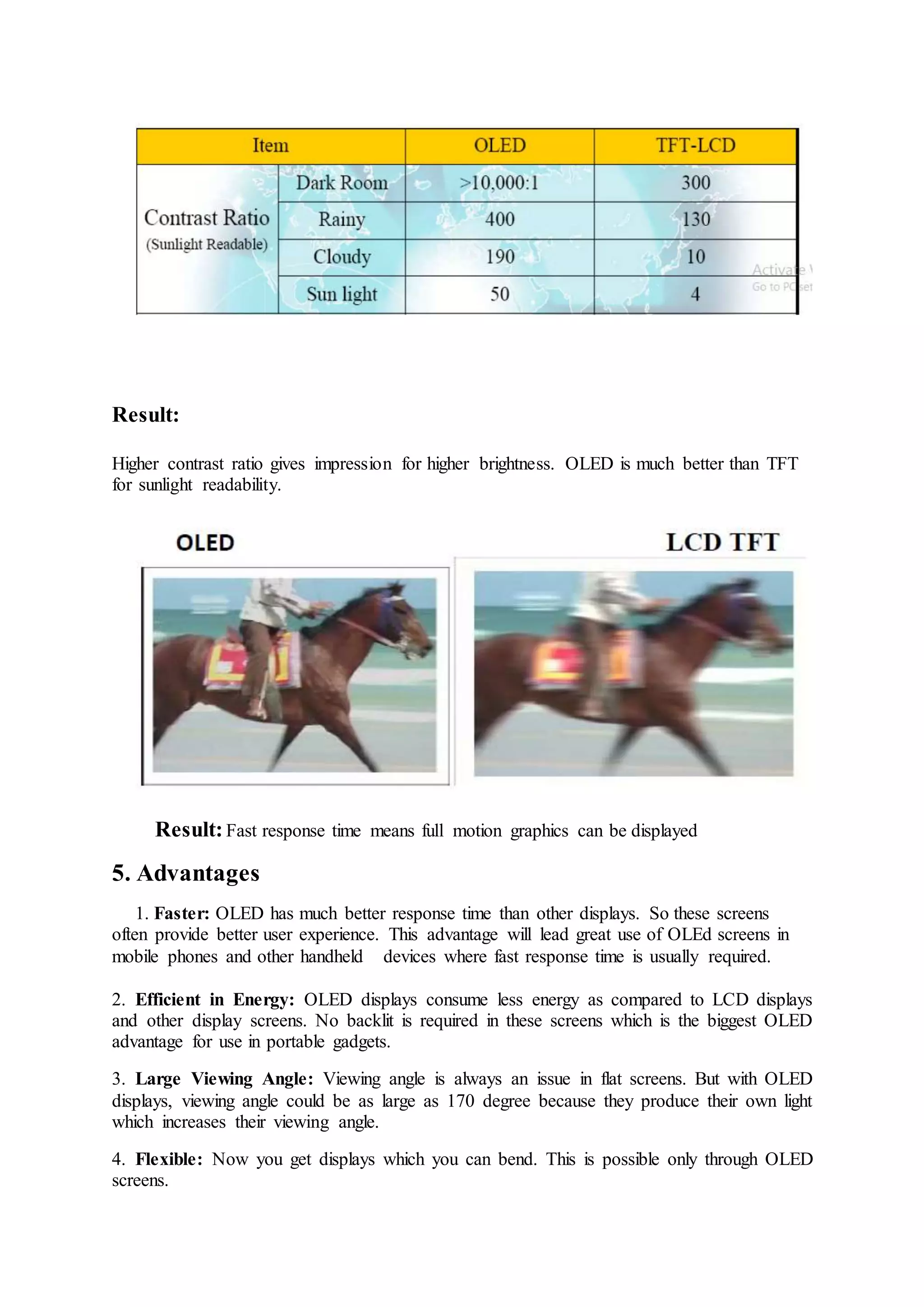
Result:Fast response time means full motion graphics can be displayed
5. Advantages
1. Faster: OLED has much better response time than other displays. So these screens
often provide better user experience. This advantage will lead great use of OLEd screens in
mobile phones and other handheld devices where fast response time is usually required.
2. Efficient in Energy: OLED displays consume less energy as compared to LCD displays
and other display screens. No backlit is required in these screens which is the biggest OLED
advantage for use in portable gadgets.
3. Large Viewing Angle: Viewing angle is always an issue in flat screens. But with OLED
displays, viewing angle could be as large as 170 degree because they produce their own light
which increases their viewing angle.
4. Flexible: Now you get displays which you can bend. This is possible only through OLED
screens.
5. Durability: Another great advantage of OLED is that it is more durable than traditional
screens. There chance of getting broken is comparatively less to LCD screens and other
displays.
6. Slimmer: OLED screen is slimmer than LCD display. While LCD andPlasma displays
could be few inches thick, but OLED advantage is that it is only few millimeters thick.
7. Low Cost: The price of OLED screens may be much higher now but it will come down as
the technology becomes popular. OLED screens could become cheaper thanLCD screens
incoming time.
8. Good for Eyes: OLEDs are eye soothening. These screens provide better viewing
experience because they have better contrast, brightness and color aspects. [4]
6. Disadvantages
1. Short Lifetime: OLED's biggest disadvantage is that these screens are not for long use.
Compared with LCD, these screens are not designed to last as long. So life time may be a
critical issue and of course a biggest disadvantage of OLED
screens. However, these screens may find good use as mobile phone displays as most people
don't keep phone for more than a year.
2. Sunlight Effect: Another disadvantage of OLED display is that they are hard to see in
direct sunlight. So if you have open lobbies where sunlight reaches directly, you will not get
benefit of viewing these screens.
3. Highly Water prone: OLED screens are highly prone to water. This adds to another
disadvantage as these screens can't withstand even small water on display. In this regard,
LCD screens are less susceptible to water damage.
4. Moisture sensitivity: Over time, moisture can react with the organic layers and cause
degradation and defects in an OLED display.
5. Power consumption: While an OLED will consume around 40% of the power of an LCD
displaying an image which is primarily black, for the majority of images it will consume 60–
80% of the power of an LCD: however it can use over three times as much power to display
an image with a white background such as a document or website. [4]
7. How to Lower Power Consumption OLED power consumption can be decreased by:
1. Black background. ( 50%~80% )
2. Lower full white brightness.
3. Auto current limit driving method.(20% )
4. OLED material & device efficiency increase. (30% )
8. Application
1. TVs
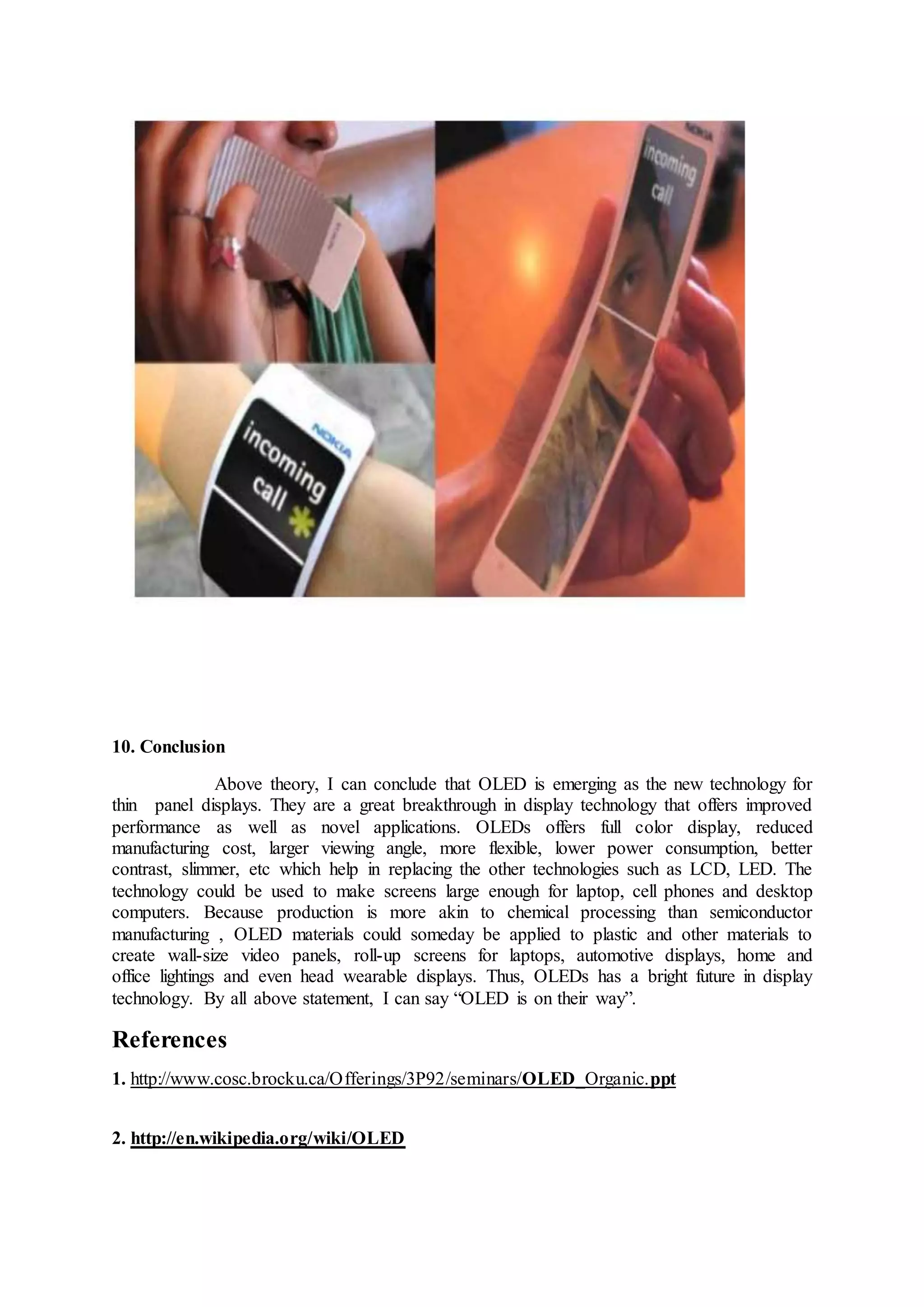
2. Cell Phone screens
3.
4. Computer Screens
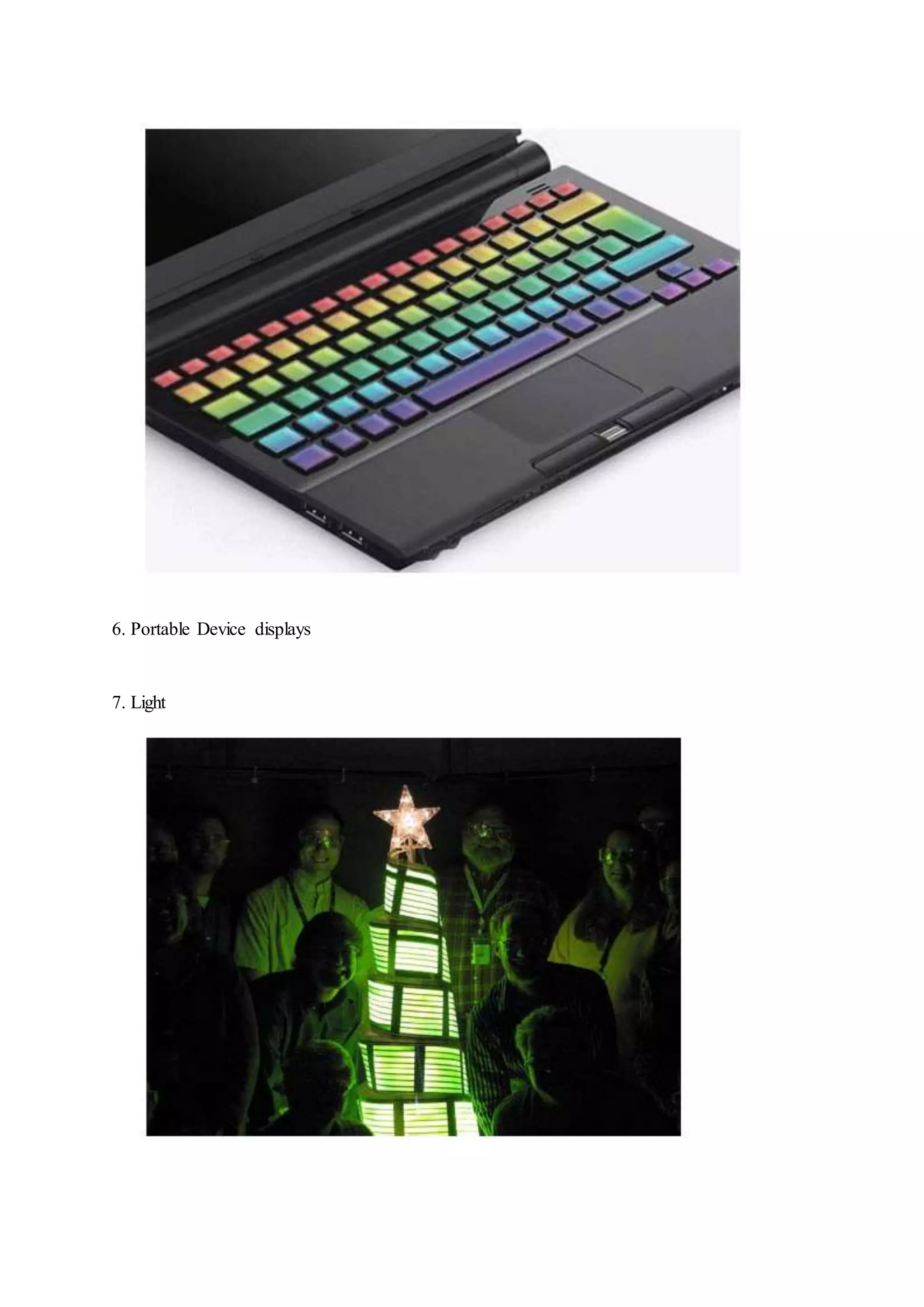
5. Keyboards (Optimus Maximus)
6. Portable Device displays
7. Light
9. Future uses of OLED
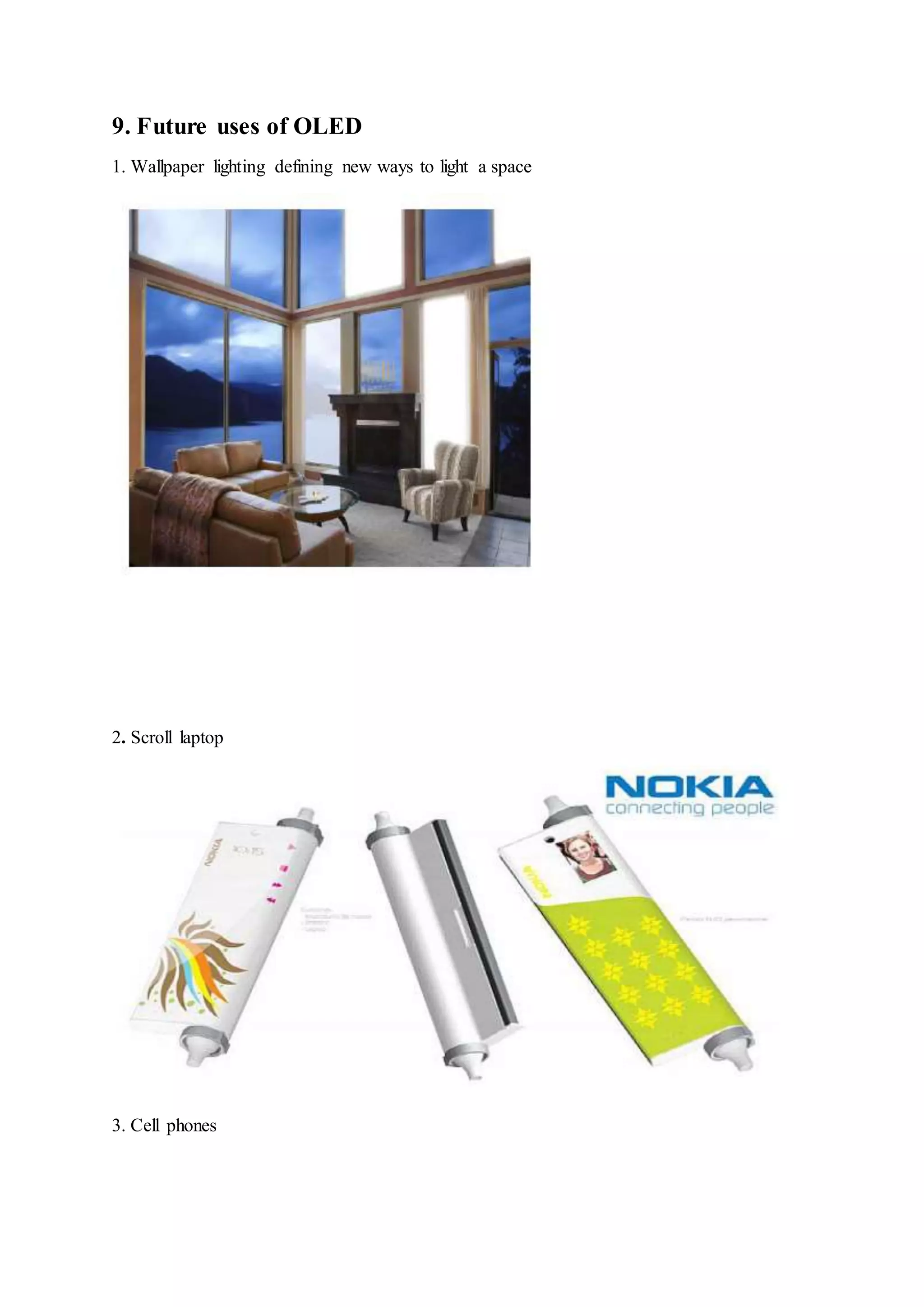
1. Wallpaper lighting defining new ways to light a space
2. Scroll laptop
3. Cell phones
10. Conclusion
Above theory, I can conclude that OLED is emerging as the new technology for
thin panel displays. They are a great breakthrough in display technology that offers improved
performance as well as novel applications. OLEDs offers full color display, reduced
manufacturing cost, larger viewing angle, more flexible, lower power consumption, better
contrast, slimmer, etc which help in replacing the other technologies such as LCD, LED. The
technology could be used to make screens large enough for laptop, cell phones and desktop
computers. Because production is more akin to chemical processing than semiconductor
manufacturing , OLED materials could someday be applied to plastic and other materials to
create wall-size video panels, roll-up screens for laptops, automotive displays, home and
office lightings and even head wearable displays. Thus, OLEDs has a bright future in display
technology. By all above statement, I can say “OLED is on their way”.
References
1. http://www.cosc.brocku.ca/Offerings/3P92/seminars/OLED_Organic.ppt
2. http://en.wikipedia.org/wiki/OLED
3.http://chemgroups.northwestern.edu/odom/jrs/Lecture%207%20--
%20Organic%20Light%20Emitting%20Diodes.pdf
4. http://expertscolumn.com/content/oled-advantages-and-disadvantages
5. http://hdguru.com/are-oled-and-led-tvs-the-same/7833/
6. http://www.differencebetween.net/technology/difference-between-lcd-and-oled/

Abstract OLEDs

  • 1.
    Index Abstract..............................................................................................................01 1. Introduction..................................................................................................01 1.1. Overview.....................................................................................................01 1.2History of OLEDs.......................................................................................01 2. How does an OLED emit light?...................................................................02 3. Architecture of OLED..................................................................................03 4. Comparison..................................................................................................04 4.1 OLED and LCD..........................................................................................04 4.2 OLED and LED..........................................................................................05 4.3 OLED and TFT display..............................................................................05 5. Advantages....................................................................................................07 6. Disadvantages................................................................................................08 8. Application....................................................................................................08 9. Future uses of OLED....................................................................................10 10. Conclusion...................................................................................................12 References..........................................................................................................12
  • 2.
    OLEDs Abstract OLEDs are agreat breakthrough in display technology .Also a new promising technology with high expected profitability on the display market. They show low driving voltages in combination with unrestricted viewing angles, high color-brilliance, light weight, small film-thicknesses and low production costs. Organic light-emitting devices (OLEDs) operate on the principle of converting electrical energy into light, a phenomenon known as electroluminescence. This paper focuses on structure of OLED, how it works, comparison with other display and applications. 1. Introduction 1.1. Overview An OLED (organic light-emitting diode) is a light-emitting diode (LED) in which the emissive electroluminescent layer is a film of organic compound which emit light in response to an electric current. This layer of organic semiconductor material is situated between two electrodes. Generally, at least one of these electrodes is transparent. There are two main families of OLEDs: those based on small molecules and those employing polymers. Adding mobile ions to an OLED creates a light-emitting electrochemical cell or LEC, which has a slightly different mode of operation. OLED displays can use either passive-matrix (PMOLED) or active-matrix addressing schemes. Active-matrix OLEDs (AMOLED) require a thin-film transistor backplane to switch each individual pixel on or off, but allow for higher resolution and larger display sizes. An OLED display works without a backlight. Thus, it can display deep black levels and can be thinner and lighter than a liquid crystal display (LCD). In low ambient light conditions such as a dark room an OLED screen can achieve a higher contrast ratio than an LCD, whether the LCD uses cold cathode fluorescent lamps or LED backlight. Due to its low thermal conductivity, an OLED typically emits less light per area than an inorganic LED. [3] 1.2 History of OLEDs
  • 3.
    • First developedin the early 1950s in France • Early technology would emitted a short burst of light when a voltage was applied • This early form applied high-voltage alternating current field to crystalline thin films of alcidine orange and quinacrine. • 1960s - AC-driven electroluminescent cells using doped anthracene was developed • In a 1977 paper, Shirakawa et al. Reported high conductivity in similarly oxidized and iodine-doped polyacetylene. • In 1987 Chin Tang and Van Slyke introduced the first light emitting diodes from thin organic layers. • In 1990 electroluminescence in polymers was discovered.[1]
  • 4.
    2. How doesan OLED emit light? OLED’s basic structure consists of organic materials positioned between cathode and anode, which is composed of electric conductive transparent indium tin oxide(ITO). The organic materials compose a multilayered thin film, which includes the Hole Transporting Layer(HTL), Emission Layer(EL) and Electron Transporting Layer(ETL). By applying the appropriate electric voltage, holes and electrons are injected into the EML from the anode and the cathode resp. The holes and electrons combine inside the EML , after which electroluminescence occurs. The transfer material, emission layer material and choice of electrode are the key factors that determine the quality of OLED components. 3. Architecture of OLED Like an LED, an OLED is a solid-state semiconductor device that is 100 to 500nanometers thick or about 200 times smaller than a human hair. OLEDs can have either two layers or three layers of organic material; in the latter design, the third layer helps transport electrons from the cathode to the emissive layer. An OLED consists of the following parts: • Substrate (clear plastic, glass, foil) - The substrate supports the OLED.
  • 5.
    • Anode (transparent)- The anode removes electrons (adds electron "holes") when a current flow through the device. • Organic layer • Conducting layer- This layer is made of organic plastic molecules that transport "holes" from the anode. One conducting polymer used in OLEDs is polyaniline. • Emissive layer- This layer is made of organic plastic molecules (different ones from the conducting layer) that transport electrons from the cathode; this is where light is made. One polymer used in the emissive layer is polyfluorene. • Cathode (may or may not be transparent depending on the type of OLED) - The cathode injects electrons when a current flows through the device. [1] 4. Comparison 4.1 OLED and LCD Liquid Crystal Displays or LCD is a fairly old technology that has seen a recent burst in advancement. From calculator screens, LCDs are now fairly common in mobile phones, PDAs, computers, and a lot more applications. OLEDs (Organic Light Emitting Diode) are an improved version of LEDs that utilizes organic compounds to produce light. OLEDs have been eyed by many manufacturers as a good replacement for LCDs in many applications due to multiple advantages. From the phrase ‘light emitting’ we can deduce that OLEDs produce their consumed by LCDs goes to the backlight, thus the big
  • 6.
    power difference. Thelack of a backlight also means that an OLED display can be significantly slimmer than an LCD display. OLEDs have also been observed to show warmer images with better contrast making their image quality far superior than what LCDs currently achieve. Manufacturing OLEDs could also be a lot cheaper than manufacturing LCDs. LCD screens are made out of transistors that are expensive to manufacture. OLEDs on the other hand can be applied to a substrate that has been treated to accept organic compounds via printing methods just like ink. Any inkjet printer can do this, making it easier and more economical to mass produce OLED displays. [6] own light unlike LCDs which require a backlight that means fewer parts. Another advantage is the lower power consumption; a great amount of the power consumed by LCDs goes to the backlight, thus the big power difference. The lack of a backlight also means that an OLED display can be significantly slimmer than an LCD display. OLEDs have also been observed to show warmer images with better contrast making their image quality far superior than what LCDs currently achieve. Manufacturing OLEDs could also be a lot cheaper than manufacturing LCDs. LCD screens are made out of transistors that are expensive to manufacture. OLEDs on the other hand can be applied to a substrate that has been treated to accept organic compounds via printing methods just like ink. Any inkjet printer can do this, making it easier and more economical to mass produce OLED displays. [6] 4.2 OLED and LED OLED is really a new large screen technology. The flat panel is made up of millions of tiny LEDs. The “O” in OLED stands for “organic” which means there is carbon within the
  • 7.
    molecules of theemissive (light producing) layer of the panel. Large screen OLED panels need no lamps; it’s a self illuminating device. OLED display can be thinner and lighter than the skinniest LED display. They provide very wide and consistent color no matter where you are seated in the room. LED display tends to get significantly dimmer as one moves away 4.3 OLED and TFT display TFT: First we must clarify that no TFT display is a technology itself, but it is simply a special type of transistor with which it has succeeded in improving the quality of the image. Its use is more prevalent with LCD screens.LCD technology uses liquid crystal molecules placed between different layers that polarize and rotate as you want to display a color or another. Its main advantage, besides its small size, it is energy from center and many exhibit color shift. OLEDs are quite energy efficient, besting all other flat panels in low power consumption. The greatest attribute of OLED is the ability to have the deepest blacks of any flat panel technology. Unlike LED which at best can only dim the image in regions, OLEDs can produce a very low luminescence level down the individual pixel. This ability coupled with bright a white that is why OLEDs are expected to have the highest contrast. OLEDs can make more colors than LE display. saving. When these transistors TFT screens used then we are talking about TFT LCDs, which are the most widespread at present. OLED: Finally, this technology also has quite a few years and that little by little we will also viewing it more consistently. It is a variant of the classic LED, but where the emission layer has an organic component. Surely you've heard that OLED screens have the advantage of not needing backlight, thus saving a lot more energy than any other alternative. In addition, its cost is also lower.
  • 8.
    Result: Higher contrast ratiogives impression for higher brightness. OLED is much better than TFT for sunlight readability. Result:Fast response time means full motion graphics can be displayed 5. Advantages 1. Faster: OLED has much better response time than other displays. So these screens often provide better user experience. This advantage will lead great use of OLEd screens in mobile phones and other handheld devices where fast response time is usually required. 2. Efficient in Energy: OLED displays consume less energy as compared to LCD displays and other display screens. No backlit is required in these screens which is the biggest OLED advantage for use in portable gadgets. 3. Large Viewing Angle: Viewing angle is always an issue in flat screens. But with OLED displays, viewing angle could be as large as 170 degree because they produce their own light which increases their viewing angle. 4. Flexible: Now you get displays which you can bend. This is possible only through OLED screens.
  • 9.
    5. Durability: Anothergreat advantage of OLED is that it is more durable than traditional screens. There chance of getting broken is comparatively less to LCD screens and other displays. 6. Slimmer: OLED screen is slimmer than LCD display. While LCD andPlasma displays could be few inches thick, but OLED advantage is that it is only few millimeters thick. 7. Low Cost: The price of OLED screens may be much higher now but it will come down as the technology becomes popular. OLED screens could become cheaper thanLCD screens incoming time. 8. Good for Eyes: OLEDs are eye soothening. These screens provide better viewing experience because they have better contrast, brightness and color aspects. [4] 6. Disadvantages 1. Short Lifetime: OLED's biggest disadvantage is that these screens are not for long use. Compared with LCD, these screens are not designed to last as long. So life time may be a critical issue and of course a biggest disadvantage of OLED screens. However, these screens may find good use as mobile phone displays as most people don't keep phone for more than a year. 2. Sunlight Effect: Another disadvantage of OLED display is that they are hard to see in direct sunlight. So if you have open lobbies where sunlight reaches directly, you will not get benefit of viewing these screens. 3. Highly Water prone: OLED screens are highly prone to water. This adds to another disadvantage as these screens can't withstand even small water on display. In this regard, LCD screens are less susceptible to water damage. 4. Moisture sensitivity: Over time, moisture can react with the organic layers and cause degradation and defects in an OLED display. 5. Power consumption: While an OLED will consume around 40% of the power of an LCD displaying an image which is primarily black, for the majority of images it will consume 60– 80% of the power of an LCD: however it can use over three times as much power to display an image with a white background such as a document or website. [4] 7. How to Lower Power Consumption OLED power consumption can be decreased by: 1. Black background. ( 50%~80% ) 2. Lower full white brightness. 3. Auto current limit driving method.(20% ) 4. OLED material & device efficiency increase. (30% ) 8. Application
  • 10.
    1. TVs 2. CellPhone screens 3. 4. Computer Screens 5. Keyboards (Optimus Maximus)
  • 11.
    6. Portable Devicedisplays 7. Light
  • 12.
    9. Future usesof OLED 1. Wallpaper lighting defining new ways to light a space 2. Scroll laptop 3. Cell phones
  • 13.
    10. Conclusion Above theory,I can conclude that OLED is emerging as the new technology for thin panel displays. They are a great breakthrough in display technology that offers improved performance as well as novel applications. OLEDs offers full color display, reduced manufacturing cost, larger viewing angle, more flexible, lower power consumption, better contrast, slimmer, etc which help in replacing the other technologies such as LCD, LED. The technology could be used to make screens large enough for laptop, cell phones and desktop computers. Because production is more akin to chemical processing than semiconductor manufacturing , OLED materials could someday be applied to plastic and other materials to create wall-size video panels, roll-up screens for laptops, automotive displays, home and office lightings and even head wearable displays. Thus, OLEDs has a bright future in display technology. By all above statement, I can say “OLED is on their way”. References 1. http://www.cosc.brocku.ca/Offerings/3P92/seminars/OLED_Organic.ppt 2. http://en.wikipedia.org/wiki/OLED
  • 14.