



VISHVAKARMA GOVERNMENT
ENGG. COLLEGE.
LED
(light emitting diode)
What is led?
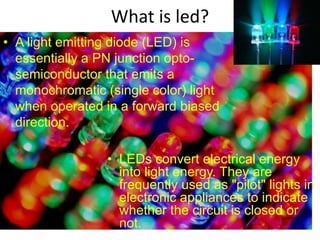
• A light emitting diode (LED) is
essentially a PN junction opto-
semiconductor that emits a
monochromatic (single color) light
when operated in a forward biased
direction.
• LEDs convert electrical energy
into light energy. They are
frequently used as "pilot" lights in
electronic appliances to indicate
whether the circuit is closed or
not.
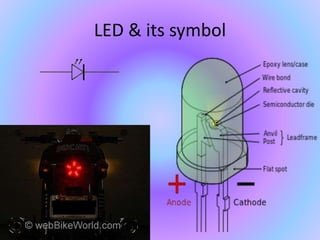
LED & its symbol
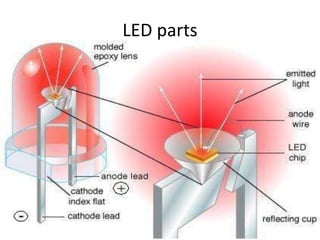
LED parts
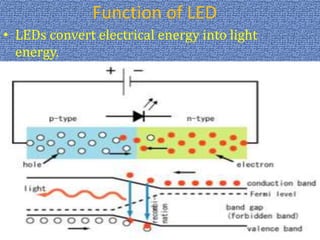
Function of LED
• LEDs convert electrical energy into light
energy.
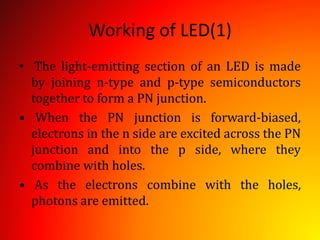
Working of LED(1)
• The light-emitting section of an LED is made
by joining n-type and p-type semiconductors
together to form a PN junction.
• When the PN junction is forward-biased,
electrons in the n side are excited across the PN
junction and into the p side, where they
combine with holes.
• As the electrons combine with the holes,
photons are emitted.
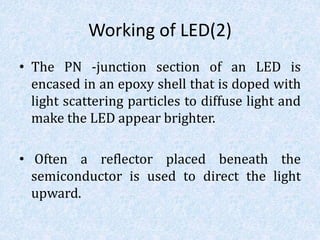
Working of LED(2)
• The PN -junction section of an LED is
encased in an epoxy shell that is doped with
light scattering particles to diffuse light and
make the LED appear brighter.
• Often a reflector placed beneath the
semiconductor is used to direct the light
upward.
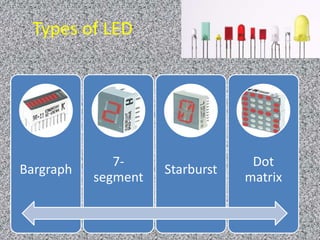
Types of LED
Bargraph
7-
segment
Starburst
Dot
matrix
Applications of LED
• Medical Instrumentation
• Bar Code Readers
• Color & Money Sensors
• Encoders
• Optical Switches
• Fiber Optic Communication
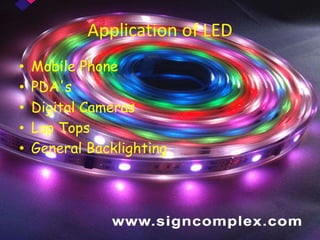
Application of LED
• Mobile Phone
• PDA's
• Digital Cameras
• Lap Tops
• General Backlighting
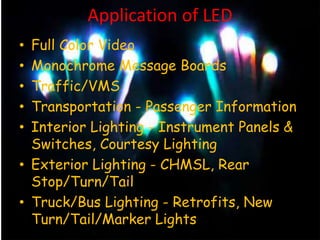
Application of LED
• Full Color Video
• Monochrome Message Boards
• Traffic/VMS
• Transportation - Passenger Information
• Interior Lighting - Instrument Panels &
Switches, Courtesy Lighting
• Exterior Lighting - CHMSL, Rear
Stop/Turn/Tail
• Truck/Bus Lighting - Retrofits, New
Turn/Tail/Marker Lights
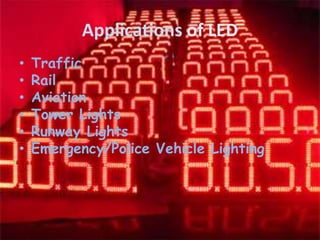
Applications of LED
• Traffic
• Rail
• Aviation
• Tower Lights
• Runway Lights
• Emergency/Police Vehicle Lighting
Benefits of LED
LEDs offer enormous benefits over
traditional incandescent lamps
including:
• Energy savings (up to 85% less power
than incandescent)
• Reduction in maintenance costs
• Increased visibility in daylight and
adverse weather conditions
Presentation by
Nisarg
Vishwesh
Vrajesh
Vijendra
Ajay
Bivin
Shijin
Abhimanyu
Hope you enjoyed our
presentation.
Thank you
Led ppt vgec ec engineering

Led ppt vgec ec engineering

  • 1.
  • 2.
    What is led? •A light emitting diode (LED) is essentially a PN junction opto- semiconductor that emits a monochromatic (single color) light when operated in a forward biased direction. • LEDs convert electrical energy into light energy. They are frequently used as "pilot" lights in electronic appliances to indicate whether the circuit is closed or not.
  • 3.
    LED & itssymbol
  • 4.
  • 5.
    Function of LED •LEDs convert electrical energy into light energy.
  • 6.
    Working of LED(1) •The light-emitting section of an LED is made by joining n-type and p-type semiconductors together to form a PN junction. • When the PN junction is forward-biased, electrons in the n side are excited across the PN junction and into the p side, where they combine with holes. • As the electrons combine with the holes, photons are emitted.
  • 7.
    Working of LED(2) •The PN -junction section of an LED is encased in an epoxy shell that is doped with light scattering particles to diffuse light and make the LED appear brighter. • Often a reflector placed beneath the semiconductor is used to direct the light upward.
  • 8.
  • 9.
    Applications of LED •Medical Instrumentation • Bar Code Readers • Color & Money Sensors • Encoders • Optical Switches • Fiber Optic Communication
  • 11.
    Application of LED •Mobile Phone • PDA's • Digital Cameras • Lap Tops • General Backlighting
  • 13.
    Application of LED •Full Color Video • Monochrome Message Boards • Traffic/VMS • Transportation - Passenger Information • Interior Lighting - Instrument Panels & Switches, Courtesy Lighting • Exterior Lighting - CHMSL, Rear Stop/Turn/Tail • Truck/Bus Lighting - Retrofits, New Turn/Tail/Marker Lights
  • 15.
    Applications of LED •Traffic • Rail • Aviation • Tower Lights • Runway Lights • Emergency/Police Vehicle Lighting
  • 17.
    Benefits of LED LEDsoffer enormous benefits over traditional incandescent lamps including: • Energy savings (up to 85% less power than incandescent) • Reduction in maintenance costs • Increased visibility in daylight and adverse weather conditions
  • 19.
  • 20.
    Hope you enjoyedour presentation. Thank you