Downloaded 77 times
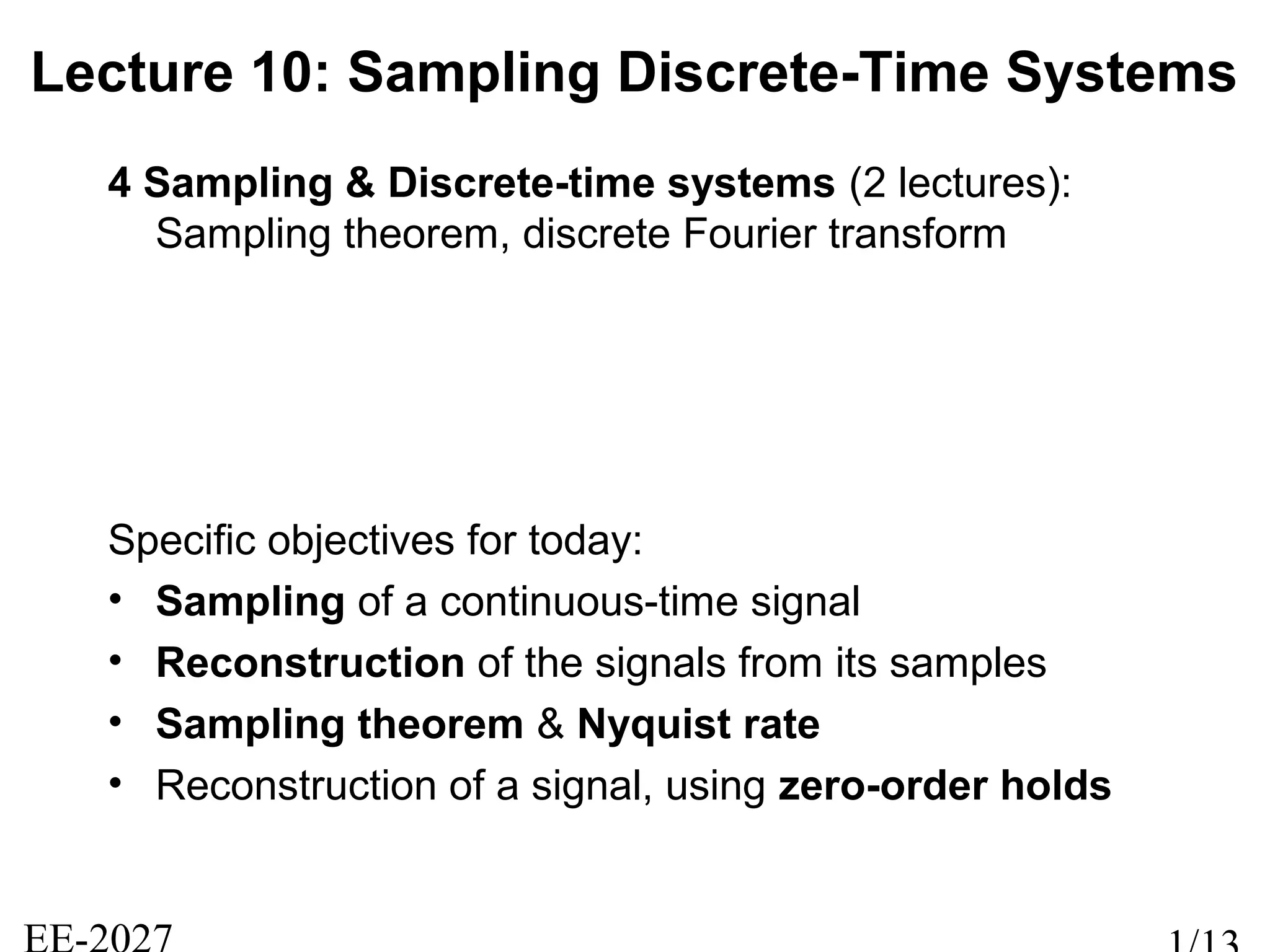

![Sampling is the transformation of a continuous signal
into a discrete signal
Widely applied in digital analysis systems
1. Sample the continuous time signal
2. Design and process discrete time signal
3. Convert back to continuous time
What is Discrete Time Sampling?
x(t),
x[n]
t=nT
Discrete
Time sampler
Discrete
time system
Signal
reconstruction
x(t) x[n] y[n] y(t)
T is the sampling
period](https://image.slidesharecdn.com/lecture9-131002071025-phpapp01/85/Lecture9-3-320.jpg)
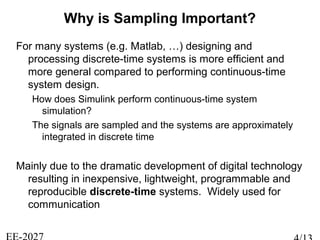
![Sampling a Continuous-Time Signal
Clearly for a finite sample period T, it is not possible to represent
every uncountable, infinite-dimensional continuous-time signal
with a countable, infinite-dimensional discrete-time signal.
In general, an infinite number of CT signals can generate a DT
signal.
However, if the signal is band (frequency) limited, and the
samples are sufficiently close, it is possible to uniquely
reconstruct the original CT signal from the sampled signal
x1(t),
x2(t),
x3(t),
x[n]
t=nT](https://image.slidesharecdn.com/lecture9-131002071025-phpapp01/85/Lecture9-5-320.jpg)
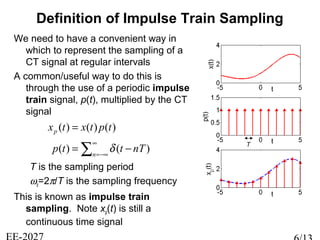
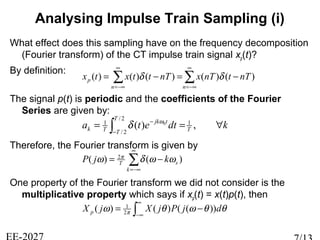
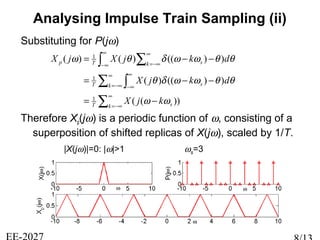
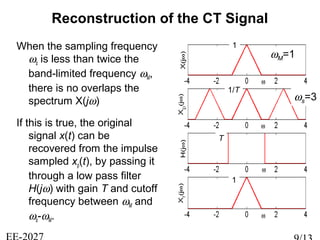
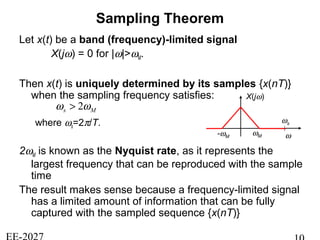
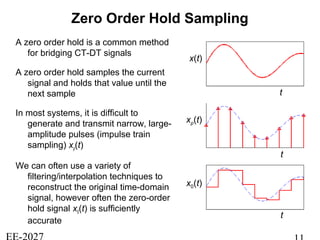
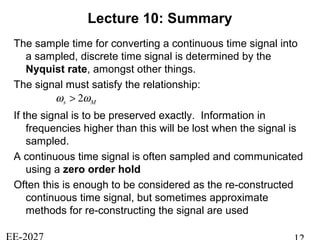

The document discusses sampling of continuous-time signals to create discrete-time signals. It explains that for perfect reconstruction, the sampling frequency must be greater than twice the maximum frequency of the original continuous-time signal, as specified by the Nyquist rate. A common method for sampling is to use an impulse train, and then reconstruct the signal by passing it through a low-pass filter. Often a zero-order hold is used to sample and communicate the signal, which simply holds each value until the next sample, and this provides a sufficiently accurate reconstructed continuous-time signal.


![Digital Signal Processing[ECEG-3171]-Ch1_L05](https://cdn.slidesharecdn.com/ss_thumbnails/dspl5ch2-180427094424-thumbnail.jpg?width=640&height=640&fit=bounds)


