EE-2027 SaS, L7 1/16
Lecture 6: Basis Functions & Fourier
Series
3. Basis functions (3 lectures): Concept of basis
function. Fourier series representation of time
functions. Fourier transform and its properties.
Examples, transform of simple time functions.
Specific objectives for today:
• Introduction to Fourier series (& transform)
• Eigenfunctions of a system
– Show sinusoidal signals are eigenfunctions of LTI
systems
• Introduction to signals and basis functions
• Fourier basis & coefficients of a periodic signal
EE-2027 SaS, L7 2/16
Lecture 6: Resources
Core material
SaS, O&W, C3.1-3.3
Background material
MIT Lecture 5
In this set of three lectures, we’re concerned with
continuous time signals, Fourier series and Fourier
transforms only.
EE-2027 SaS, L7 3/16
Why is Fourier Theory Important (i)?
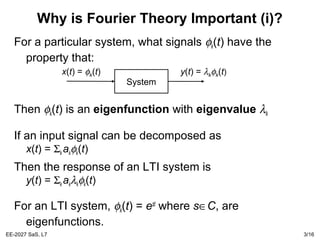
For a particular system, what signals φk(t) have the
property that:
Then φk(t) is an eigenfunction with eigenvalue λk
If an input signal can be decomposed as
x(t) = Σk akφk(t)
Then the response of an LTI system is
y(t) = Σk akλkφk(t)
For an LTI system, φk(t) = est
where s∈C, are
eigenfunctions.
System
x(t) = φk(t) y(t) = λkφk(t)
EE-2027 SaS, L7 4/16
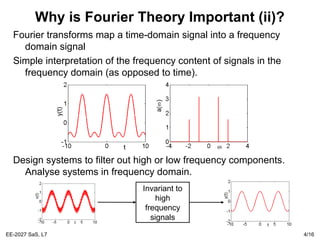
Fourier transforms map a time-domain signal into a frequency
domain signal
Simple interpretation of the frequency content of signals in the
frequency domain (as opposed to time).
Design systems to filter out high or low frequency components.
Analyse systems in frequency domain.
Why is Fourier Theory Important (ii)?
Invariant to
high
frequency
signals
EE-2027 SaS, L7 5/16
Why is Fourier Theory Important (iii)?
If F{x(t)} = X(jω) ω is the frequency
Then F{x’(t)} = jωX(jω)
So solving a differential equation is transformed from a
calculus operation in the time domain into an algebraic
operation in the frequency domain (see Laplace transform)
Example
becomes
and is solved for the roots ω (N.B. complementary equations):
and we take the inverse Fourier transform for those ω.
0322
2
=++ y
dt
dy
dt
yd
0322
=++− ωω j
0)(3)(2)(2
=++− ωωωωω jYjYjjY
EE-2027 SaS, L7 6/16
Introduction to System Eigenfunctions
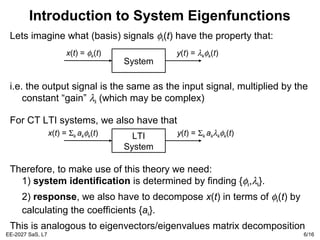
Lets imagine what (basis) signals φk(t) have the property that:
i.e. the output signal is the same as the input signal, multiplied by the
constant “gain” λk (which may be complex)
For CT LTI systems, we also have that
Therefore, to make use of this theory we need:
1) system identification is determined by finding {φk,λk}.
2) response, we also have to decompose x(t) in terms of φk(t) by
calculating the coefficients {ak}.
This is analogous to eigenvectors/eigenvalues matrix decomposition
System
x(t) = φk(t) y(t) = λkφk(t)
LTI
System
x(t) = Σk akφk(t) y(t) = Σk akλkφk(t)
EE-2027 SaS, L7 7/16
Complex Exponentials are Eigenfunctions
of any CT LTI System
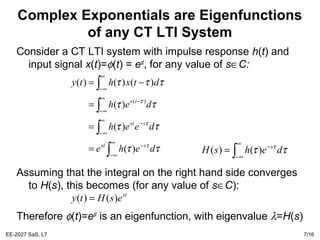
Consider a CT LTI system with impulse response h(t) and
input signal x(t)=φ(t) = est
, for any value of s∈C:
Assuming that the integral on the right hand side converges
to H(s), this becomes (for any value of s∈C):
Therefore φ(t)=est
is an eigenfunction, with eigenvalue λ=H(s)
∫
∫
∫
∫
∞
∞−
−
∞
∞−
−
∞
∞−
−
∞
∞−
=
=
=
−=
ττ
ττ
ττ
τττ
τ
τ
τ
dehe
deeh
deh
dtxhty
sst
sst
ts
)(
)(
)(
)()()(
)(
st
esHty )()( =
∫
∞
∞−
−
= ττ τ
dehsH s
)()(
EE-2027 SaS, L7 8/16
Example 1: Time Delay & Imaginary Input
Consider a CT, LTI system where the input and output are related by
a pure time shift:
Consider a purely imaginary input signal:
Then the response is:
ej2t
is an eigenfunction (as we’d expect) and the associated
eigenvalue is H(j2) = e-j6
.
)3()( −= txty
tj
etx 2
)( =
tjjtj
eeety 26)3(2
)( −−
==
EE-2027 SaS, L7 9/16
Example 1a: Phase Shift
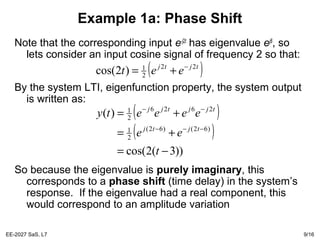
Note that the corresponding input e-j2t
has eigenvalue ej6
, so
lets consider an input cosine signal of frequency 2 so that:
By the system LTI, eigenfunction property, the system output
is written as:
So because the eigenvalue is purely imaginary, this
corresponds to a phase shift (time delay) in the system’s
response. If the eigenvalue had a real component, this
would correspond to an amplitude variation
( )tjtj
eet 22
2
1
)2cos( −
+=
( )
( )
))3(2cos(
)(
)62()62(
2
1
2626
2
1
−=
+=
+=
−−−
−−
t
ee
eeeety
tjtj
tjjtjj
EE-2027 SaS, L7 10/16
Example 2: Time Delay & Superposition
Consider the same system (3 time delays) and now consider the input
signal x(t) = cos(4t)+cos(7t), a superposition of two sinusoidal signals
that are not harmonically related. The response is obviously:
Consider x(t) represented using Euler’s formula:
Then due to the superposition property and H(s) =e-3s
While the answer for this simple system can be directly spotted, the
superposition property allows us to apply the eigenfunction concept to
more complex LTI systems.
))3(7cos())3(4cos()( −+−= ttty
tjtjtjtj
eeeetx 7
2
17
2
14
2
14
2
1
)( −−
+++=
))3(7cos())3(4cos(
)(
)3(7
2
1)3(7
2
1)3(4
2
1)3(4
2
1
721
2
1721
2
1412
2
1412
2
1
−+−=
+++=
+++=
−−−−−−
−−−−
tt
eeee
eeeeeeeety
tjtjtjtj
tjjtjjtjjtjj
EE-2027 SaS, L7 11/16
History of Fourier/Harmonic Series
The idea of using trigonometric sums
was used to predict astronomical
events
Euler studied vibrating strings, ~1750,
which are signals where linear
displacement was preserved with
time.
Fourier described how such a series
could be applied and showed that
a periodic signals can be
represented as the integrals of
sinusoids that are not all
harmonically related
Now widely used to understand the
structure and frequency content of
arbitrary signals
ω=1
ω=2
ω=3
ω=4
EE-2027 SaS, L7 12/16
Fourier Series and Fourier Basis Functions
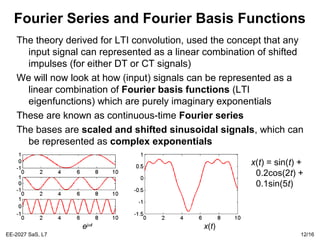
The theory derived for LTI convolution, used the concept that any
input signal can represented as a linear combination of shifted
impulses (for either DT or CT signals)
We will now look at how (input) signals can be represented as a
linear combination of Fourier basis functions (LTI
eigenfunctions) which are purely imaginary exponentials
These are known as continuous-time Fourier series
The bases are scaled and shifted sinusoidal signals, which can
be represented as complex exponentials
x(t) = sin(t) +
0.2cos(2t) +
0.1sin(5t)
x(t)ejωt
EE-2027 SaS, L7 13/16
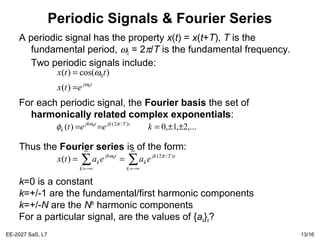
Periodic Signals & Fourier Series
A periodic signal has the property x(t) = x(t+T), T is the
fundamental period, ω0 = 2π/T is the fundamental frequency.
Two periodic signals include:
For each periodic signal, the Fourier basis the set of
harmonically related complex exponentials:
Thus the Fourier series is of the form:
k=0 is a constant
k=+/-1 are the fundamental/first harmonic components
k=+/-N are the Nth
harmonic components
For a particular signal, are the values of {ak}k?
tj
etx
ttx
0
)(
)cos()( 0
ω
ω
=
=
,...2,1,0)( )/2(0
±±=== keet tTjktjk
k
πω
φ
∑∑
∞
−∞=
∞
−∞=
==
k
tTjk
k
k
tjk
k eaeatx )/2(0
)( πω
EE-2027 SaS, L7 14/16
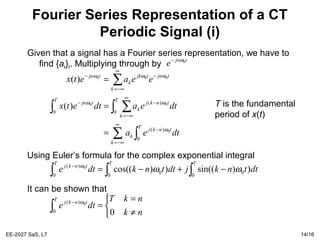
Fourier Series Representation of a CT
Periodic Signal (i)
Given that a signal has a Fourier series representation, we have to
find {ak}k. Multiplying through by
Using Euler’s formula for the complex exponential integral
It can be shown that
tjn
e 0ω−
∑ ∫
∫ ∑∫
∑
∞
−∞=
−
∞
−∞=
−−
∞
−∞=
−−
=
=
=
k
T
tnkj
k
T
k
tnkj
k
T
tjn
k
tjntjk
k
tjn
dtea
dteadtetx
eeaetx
0
)(
0
)(
0
0
00
000
)(
)(
ω
ωω
ωωω
T is the fundamental
period of x(t)
∫∫∫ −+−=−
TTT
tnkj
dttnkjdttnkdte
0
0
0
0
0
)(
))sin(())cos((0
ωωω



≠
=
=∫
−
nk
nkT
dte
T
tnkj
00
)( 0ω
EE-2027 SaS, L7 15/16
Fourier Series Representation of a CT
Periodic Signal (ii)
Therefore
which allows us to determine the coefficients. Also note that this
result is the same if we integrate over any interval of length T
(not just [0,T]), denoted by
To summarise, if x(t) has a Fourier series representation, then the
pair of equations that defines the Fourier series of a periodic,
continuous-time signal:
∫
−
=
T
tjn
Tn dtetxa
0
1 0
)( ω
∫T
∫
−
=
T
tjn
Tn dtetxa 0
)(1 ω
∫∫
∑∑
−−
∞
−∞=
∞
−∞=
==
==
T
tTjk
TT
tjk
Tk
k
tTjk
k
k
tjk
k
dtetxdtetxa
eaeatx
)/2(11
)/2(
)()(
)(
0
0
πω
πω
EE-2027 SaS, L7 16/16
Lecture 6: Summary
Fourier bases, series and transforms are extremely useful for
frequency domain analysis, solving differential equations and
analysing invariance for LTI signals/systems
For an LTI system
• est
is an eigenfunction
• H(s) is the corresponding (complex) eigenvalue
This can be used, like convolution, to calculate the output of an
LTI system once H(s) is known.
A Fourier basis is a set of harmonically related complex
exponentials
Any periodic signal can be represented as an infinite sum
(Fourier series) of Fourier bases, where the first harmonic is
equal to the fundamental frequency
The corresponding coefficients can be evaluated
EE-2027 SaS, L7 17/16
Lecture 6: Exercises
SaS, O&W, Q3.1-3.5

Lecture6 Signal and Systems

  • 1.
    EE-2027 SaS, L71/16 Lecture 6: Basis Functions & Fourier Series 3. Basis functions (3 lectures): Concept of basis function. Fourier series representation of time functions. Fourier transform and its properties. Examples, transform of simple time functions. Specific objectives for today: • Introduction to Fourier series (& transform) • Eigenfunctions of a system – Show sinusoidal signals are eigenfunctions of LTI systems • Introduction to signals and basis functions • Fourier basis & coefficients of a periodic signal
  • 2.
    EE-2027 SaS, L72/16 Lecture 6: Resources Core material SaS, O&W, C3.1-3.3 Background material MIT Lecture 5 In this set of three lectures, we’re concerned with continuous time signals, Fourier series and Fourier transforms only.
  • 3.
    EE-2027 SaS, L73/16 Why is Fourier Theory Important (i)? For a particular system, what signals φk(t) have the property that: Then φk(t) is an eigenfunction with eigenvalue λk If an input signal can be decomposed as x(t) = Σk akφk(t) Then the response of an LTI system is y(t) = Σk akλkφk(t) For an LTI system, φk(t) = est where s∈C, are eigenfunctions. System x(t) = φk(t) y(t) = λkφk(t)
  • 4.
    EE-2027 SaS, L74/16 Fourier transforms map a time-domain signal into a frequency domain signal Simple interpretation of the frequency content of signals in the frequency domain (as opposed to time). Design systems to filter out high or low frequency components. Analyse systems in frequency domain. Why is Fourier Theory Important (ii)? Invariant to high frequency signals
  • 5.
    EE-2027 SaS, L75/16 Why is Fourier Theory Important (iii)? If F{x(t)} = X(jω) ω is the frequency Then F{x’(t)} = jωX(jω) So solving a differential equation is transformed from a calculus operation in the time domain into an algebraic operation in the frequency domain (see Laplace transform) Example becomes and is solved for the roots ω (N.B. complementary equations): and we take the inverse Fourier transform for those ω. 0322 2 =++ y dt dy dt yd 0322 =++− ωω j 0)(3)(2)(2 =++− ωωωωω jYjYjjY
  • 6.
    EE-2027 SaS, L76/16 Introduction to System Eigenfunctions Lets imagine what (basis) signals φk(t) have the property that: i.e. the output signal is the same as the input signal, multiplied by the constant “gain” λk (which may be complex) For CT LTI systems, we also have that Therefore, to make use of this theory we need: 1) system identification is determined by finding {φk,λk}. 2) response, we also have to decompose x(t) in terms of φk(t) by calculating the coefficients {ak}. This is analogous to eigenvectors/eigenvalues matrix decomposition System x(t) = φk(t) y(t) = λkφk(t) LTI System x(t) = Σk akφk(t) y(t) = Σk akλkφk(t)
  • 7.
    EE-2027 SaS, L77/16 Complex Exponentials are Eigenfunctions of any CT LTI System Consider a CT LTI system with impulse response h(t) and input signal x(t)=φ(t) = est , for any value of s∈C: Assuming that the integral on the right hand side converges to H(s), this becomes (for any value of s∈C): Therefore φ(t)=est is an eigenfunction, with eigenvalue λ=H(s) ∫ ∫ ∫ ∫ ∞ ∞− − ∞ ∞− − ∞ ∞− − ∞ ∞− = = = −= ττ ττ ττ τττ τ τ τ dehe deeh deh dtxhty sst sst ts )( )( )( )()()( )( st esHty )()( = ∫ ∞ ∞− − = ττ τ dehsH s )()(
  • 8.
    EE-2027 SaS, L78/16 Example 1: Time Delay & Imaginary Input Consider a CT, LTI system where the input and output are related by a pure time shift: Consider a purely imaginary input signal: Then the response is: ej2t is an eigenfunction (as we’d expect) and the associated eigenvalue is H(j2) = e-j6 . )3()( −= txty tj etx 2 )( = tjjtj eeety 26)3(2 )( −− ==
  • 9.
    EE-2027 SaS, L79/16 Example 1a: Phase Shift Note that the corresponding input e-j2t has eigenvalue ej6 , so lets consider an input cosine signal of frequency 2 so that: By the system LTI, eigenfunction property, the system output is written as: So because the eigenvalue is purely imaginary, this corresponds to a phase shift (time delay) in the system’s response. If the eigenvalue had a real component, this would correspond to an amplitude variation ( )tjtj eet 22 2 1 )2cos( − += ( ) ( ) ))3(2cos( )( )62()62( 2 1 2626 2 1 −= += += −−− −− t ee eeeety tjtj tjjtjj
  • 10.
    EE-2027 SaS, L710/16 Example 2: Time Delay & Superposition Consider the same system (3 time delays) and now consider the input signal x(t) = cos(4t)+cos(7t), a superposition of two sinusoidal signals that are not harmonically related. The response is obviously: Consider x(t) represented using Euler’s formula: Then due to the superposition property and H(s) =e-3s While the answer for this simple system can be directly spotted, the superposition property allows us to apply the eigenfunction concept to more complex LTI systems. ))3(7cos())3(4cos()( −+−= ttty tjtjtjtj eeeetx 7 2 17 2 14 2 14 2 1 )( −− +++= ))3(7cos())3(4cos( )( )3(7 2 1)3(7 2 1)3(4 2 1)3(4 2 1 721 2 1721 2 1412 2 1412 2 1 −+−= +++= +++= −−−−−− −−−− tt eeee eeeeeeeety tjtjtjtj tjjtjjtjjtjj
  • 11.
    EE-2027 SaS, L711/16 History of Fourier/Harmonic Series The idea of using trigonometric sums was used to predict astronomical events Euler studied vibrating strings, ~1750, which are signals where linear displacement was preserved with time. Fourier described how such a series could be applied and showed that a periodic signals can be represented as the integrals of sinusoids that are not all harmonically related Now widely used to understand the structure and frequency content of arbitrary signals ω=1 ω=2 ω=3 ω=4
  • 12.
    EE-2027 SaS, L712/16 Fourier Series and Fourier Basis Functions The theory derived for LTI convolution, used the concept that any input signal can represented as a linear combination of shifted impulses (for either DT or CT signals) We will now look at how (input) signals can be represented as a linear combination of Fourier basis functions (LTI eigenfunctions) which are purely imaginary exponentials These are known as continuous-time Fourier series The bases are scaled and shifted sinusoidal signals, which can be represented as complex exponentials x(t) = sin(t) + 0.2cos(2t) + 0.1sin(5t) x(t)ejωt
  • 13.
    EE-2027 SaS, L713/16 Periodic Signals & Fourier Series A periodic signal has the property x(t) = x(t+T), T is the fundamental period, ω0 = 2π/T is the fundamental frequency. Two periodic signals include: For each periodic signal, the Fourier basis the set of harmonically related complex exponentials: Thus the Fourier series is of the form: k=0 is a constant k=+/-1 are the fundamental/first harmonic components k=+/-N are the Nth harmonic components For a particular signal, are the values of {ak}k? tj etx ttx 0 )( )cos()( 0 ω ω = = ,...2,1,0)( )/2(0 ±±=== keet tTjktjk k πω φ ∑∑ ∞ −∞= ∞ −∞= == k tTjk k k tjk k eaeatx )/2(0 )( πω
  • 14.
    EE-2027 SaS, L714/16 Fourier Series Representation of a CT Periodic Signal (i) Given that a signal has a Fourier series representation, we have to find {ak}k. Multiplying through by Using Euler’s formula for the complex exponential integral It can be shown that tjn e 0ω− ∑ ∫ ∫ ∑∫ ∑ ∞ −∞= − ∞ −∞= −− ∞ −∞= −− = = = k T tnkj k T k tnkj k T tjn k tjntjk k tjn dtea dteadtetx eeaetx 0 )( 0 )( 0 0 00 000 )( )( ω ωω ωωω T is the fundamental period of x(t) ∫∫∫ −+−=− TTT tnkj dttnkjdttnkdte 0 0 0 0 0 )( ))sin(())cos((0 ωωω    ≠ = =∫ − nk nkT dte T tnkj 00 )( 0ω
  • 15.
    EE-2027 SaS, L715/16 Fourier Series Representation of a CT Periodic Signal (ii) Therefore which allows us to determine the coefficients. Also note that this result is the same if we integrate over any interval of length T (not just [0,T]), denoted by To summarise, if x(t) has a Fourier series representation, then the pair of equations that defines the Fourier series of a periodic, continuous-time signal: ∫ − = T tjn Tn dtetxa 0 1 0 )( ω ∫T ∫ − = T tjn Tn dtetxa 0 )(1 ω ∫∫ ∑∑ −− ∞ −∞= ∞ −∞= == == T tTjk TT tjk Tk k tTjk k k tjk k dtetxdtetxa eaeatx )/2(11 )/2( )()( )( 0 0 πω πω
  • 16.
    EE-2027 SaS, L716/16 Lecture 6: Summary Fourier bases, series and transforms are extremely useful for frequency domain analysis, solving differential equations and analysing invariance for LTI signals/systems For an LTI system • est is an eigenfunction • H(s) is the corresponding (complex) eigenvalue This can be used, like convolution, to calculate the output of an LTI system once H(s) is known. A Fourier basis is a set of harmonically related complex exponentials Any periodic signal can be represented as an infinite sum (Fourier series) of Fourier bases, where the first harmonic is equal to the fundamental frequency The corresponding coefficients can be evaluated
  • 17.
    EE-2027 SaS, L717/16 Lecture 6: Exercises SaS, O&W, Q3.1-3.5