• Presented by.,
• S.Shanmathee
Sampling Theorem
2/6/2015
ADC
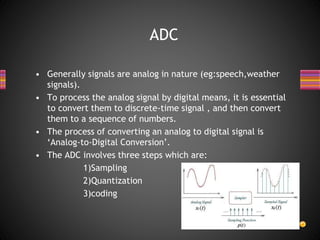
• Generally signals are analog in nature (eg:speech,weather
signals).
• To process the analog signal by digital means, it is essential
to convert them to discrete-time signal , and then convert
them to a sequence of numbers.
• The process of converting an analog to digital signal is
‘Analog-to-Digital Conversion’.
• The ADC involves three steps which are:
1)Sampling
2)Quantization
3)coding
2/6/2015
• Analog signals: continuous in time and amplitude
– Example: voltage, current, temperature,…
• Digital signals: discrete both in time and amplitude
– Example: attendance of this class, digitizes analog
signals,…
• Discrete-time signal: discrete in time, continuous in
amplitude
– Example: hourly change of temperature in Austin
TYPES OF SIGNALS
2/6/2015
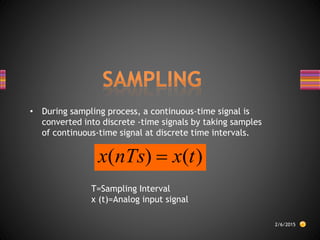
• During sampling process, a continuous-time signal is
converted into discrete -time signals by taking samples
of continuous-time signal at discrete time intervals.
)()( txnTsx 
T=Sampling Interval
x (t)=Analog input signal
2/6/2015
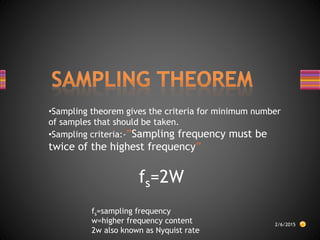
•Sampling theorem gives the criteria for minimum number
of samples that should be taken.
•Sampling criteria:-”Sampling frequency must be
twice of the highest frequency”
fs=2W
fs=sampling frequency
w=higher frequency content
2w also known as Nyquist rate
2/6/2015
•Nyquist rate is defined as the minimum sampling rate for the
perfect reconstruction of the continuous time signals from
samples.
•Nyquist rate=2*highest frequency component
=2*W
•So sampling rate must be greater than or equal to nyquist rate
2/6/2015
•There are two parts,
representation of x(t) in its samples
reconstruction of x(t)
Representation of x(t) in its samples
1.Define x∂(t)
2.Take fourier transform of x∂(t)) (i.e) x∂(f)
3.Relation between x(f) and x∂(f)
4.Relation between x(t) and x(nTs)
2/6/2015
Reconstruction of x(t)
1.Take inverse fourier transform of x∂(f)
2.Show that x(t) is obtained back with the help of
interpolation function
2/6/2015
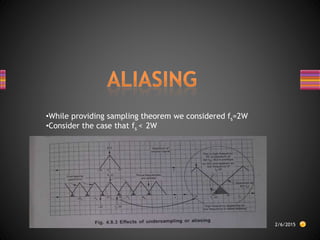
•While providing sampling theorem we considered fs=2W
•Consider the case that fs < 2W
2/6/2015
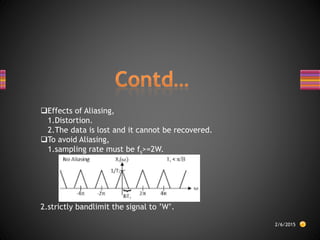
Effects of Aliasing,
1.Distortion.
2.The data is lost and it cannot be recovered.
To avoid Aliasing,
1.sampling rate must be fs>=2W.
2.strictly bandlimit the signal to ’W’.
2/6/2015
2/6/2015
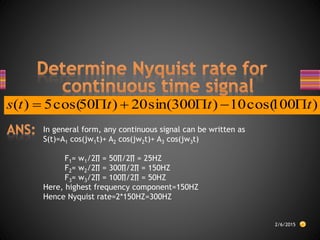
In general form, any continuous signal can be written as
S(t)=A1 cos(jw1t)+ A2 cos(jw2t)+ A3 cos(jw3t)
F1= w1/2∏ = 50∏/2∏ = 25HZ
F2= w2/2∏ = 300∏/2∏ = 150HZ
F3= w3/2∏ = 100∏/2∏ = 50HZ
Here, highest frequency component=150HZ
Hence Nyquist rate=2*150HZ=300HZ
)100cos(10)300sin(20)50cos(5)( tttts 
2/6/2015
•What is the minimum sampling rate(nyquist rate)?
Highest frequency=100HZ
So, Nyquist rate=2W=2*100=200HZ
•If sampling frequency is 400HZ then what is the discrete
time signal obtained?
f=freq of continuous signal/sampling freq
=100/400=1/4
Discrete time signal=5 cos(2∏fn)=5 cos (2∏*1/4 n)
=5 cos(∏n/2)
)200cos(5)( tts 
2/6/2015
2/6/2015
“SIGNALS AND SYSTEMS”
by Dr.J.S.Chitode
Optimist: "The glass is
half full."
Pessimist: "The glass is
half empty."
Engineer: "That glass is
twice as large as it
needs to be."
2/6/2015

Sampling theorem

  • 1.
    • Presented by., •S.Shanmathee Sampling Theorem
  • 2.
  • 3.
    ADC • Generally signalsare analog in nature (eg:speech,weather signals). • To process the analog signal by digital means, it is essential to convert them to discrete-time signal , and then convert them to a sequence of numbers. • The process of converting an analog to digital signal is ‘Analog-to-Digital Conversion’. • The ADC involves three steps which are: 1)Sampling 2)Quantization 3)coding 2/6/2015
  • 4.
    • Analog signals:continuous in time and amplitude – Example: voltage, current, temperature,… • Digital signals: discrete both in time and amplitude – Example: attendance of this class, digitizes analog signals,… • Discrete-time signal: discrete in time, continuous in amplitude – Example: hourly change of temperature in Austin TYPES OF SIGNALS 2/6/2015
  • 5.
    • During samplingprocess, a continuous-time signal is converted into discrete -time signals by taking samples of continuous-time signal at discrete time intervals. )()( txnTsx  T=Sampling Interval x (t)=Analog input signal 2/6/2015
  • 6.
    •Sampling theorem givesthe criteria for minimum number of samples that should be taken. •Sampling criteria:-”Sampling frequency must be twice of the highest frequency” fs=2W fs=sampling frequency w=higher frequency content 2w also known as Nyquist rate 2/6/2015
  • 7.
    •Nyquist rate isdefined as the minimum sampling rate for the perfect reconstruction of the continuous time signals from samples. •Nyquist rate=2*highest frequency component =2*W •So sampling rate must be greater than or equal to nyquist rate 2/6/2015
  • 8.
    •There are twoparts, representation of x(t) in its samples reconstruction of x(t) Representation of x(t) in its samples 1.Define x∂(t) 2.Take fourier transform of x∂(t)) (i.e) x∂(f) 3.Relation between x(f) and x∂(f) 4.Relation between x(t) and x(nTs) 2/6/2015
  • 9.
    Reconstruction of x(t) 1.Takeinverse fourier transform of x∂(f) 2.Show that x(t) is obtained back with the help of interpolation function 2/6/2015
  • 10.
    •While providing samplingtheorem we considered fs=2W •Consider the case that fs < 2W 2/6/2015
  • 11.
    Effects of Aliasing, 1.Distortion. 2.Thedata is lost and it cannot be recovered. To avoid Aliasing, 1.sampling rate must be fs>=2W. 2.strictly bandlimit the signal to ’W’. 2/6/2015
  • 12.
  • 13.
    In general form,any continuous signal can be written as S(t)=A1 cos(jw1t)+ A2 cos(jw2t)+ A3 cos(jw3t) F1= w1/2∏ = 50∏/2∏ = 25HZ F2= w2/2∏ = 300∏/2∏ = 150HZ F3= w3/2∏ = 100∏/2∏ = 50HZ Here, highest frequency component=150HZ Hence Nyquist rate=2*150HZ=300HZ )100cos(10)300sin(20)50cos(5)( tttts  2/6/2015
  • 14.
    •What is theminimum sampling rate(nyquist rate)? Highest frequency=100HZ So, Nyquist rate=2W=2*100=200HZ •If sampling frequency is 400HZ then what is the discrete time signal obtained? f=freq of continuous signal/sampling freq =100/400=1/4 Discrete time signal=5 cos(2∏fn)=5 cos (2∏*1/4 n) =5 cos(∏n/2) )200cos(5)( tts  2/6/2015
  • 15.
  • 16.
    Optimist: "The glassis half full." Pessimist: "The glass is half empty." Engineer: "That glass is twice as large as it needs to be." 2/6/2015