Lecture 10: Sampling Discrete-Time Systems
4 Sampling & Discrete-time systems (2 lectures):
Sampling theorem, discrete Fourier transform
Specific objectives for today:
• Sampling of a continuous-time signal
• Reconstruction of the signals from its samples
• Sampling theorem & Nyquist rate
• Reconstruction of a signal, using zero-order holds
Lecture 10: Resources
Core reading
SaS, O&W, C7
Background reading
MIT Lectures 9 & 13
In these two lectures, we’re going to develop the DT
Fourier transform as a sampled version of the CT
Fourier transform.
Note that this is opposite to time-domain convolution
where we developed CT convolution as the limiting
case of DT convolution
Sampling is the transformation of a continuous signal
into a discrete signal
Widely applied in digital analysis systems
1. Sample the continuous time signal
2. Design and process discrete time signal
3. Convert back to continuous time
What is Discrete Time Sampling?
x(t),
x[n]
t=nT
Discrete
Time sampler
Discrete
time system
Signal
reconstruction
x(t) x[n] y[n] y(t)
T is the sampling
period
Why is Sampling Important?
For many systems (e.g. Matlab, …) designing and
processing discrete-time systems is more efficient and
more general compared to performing continuous-time
system design.
How does Simulink perform continuous-time system
simulation?
The signals are sampled and the systems are approximately
integrated in discrete time
Mainly due to the dramatic development of digital technology
resulting in inexpensive, lightweight, programmable and
reproducible discrete-time systems. Widely used for
communication
Sampling a Continuous-Time Signal
Clearly for a finite sample period T, it is not possible to represent
every uncountable, infinite-dimensional continuous-time signal
with a countable, infinite-dimensional discrete-time signal.
In general, an infinite number of CT signals can generate a DT
signal.
However, if the signal is band (frequency) limited, and the
samples are sufficiently close, it is possible to uniquely
reconstruct the original CT signal from the sampled signal
x1(t),
x2(t),
x3(t),
x[n]
t=nT
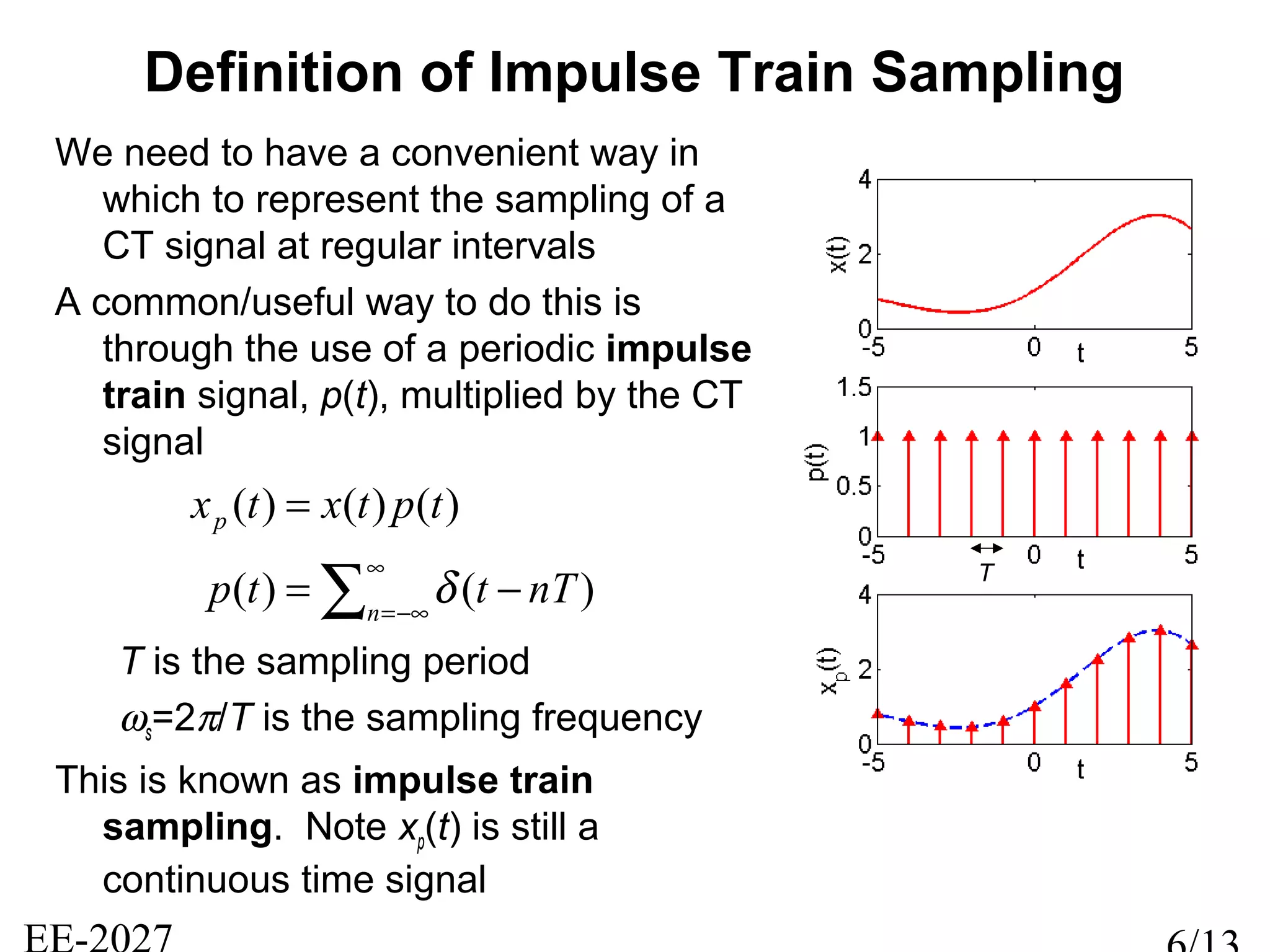
Definition of Impulse Train Sampling
We need to have a convenient way in
which to represent the sampling of a
CT signal at regular intervals
A common/useful way to do this is
through the use of a periodic impulse
train signal, p(t), multiplied by the CT
signal
T is the sampling period
ωs=2π/T is the sampling frequency
This is known as impulse train
sampling. Note xp(t) is still a
continuous time signal
∑
∞
−∞=
−=
=
n
p
nTttp
tptxtx
)()(
)()()(
δ T
Analysing Impulse Train Sampling (i)
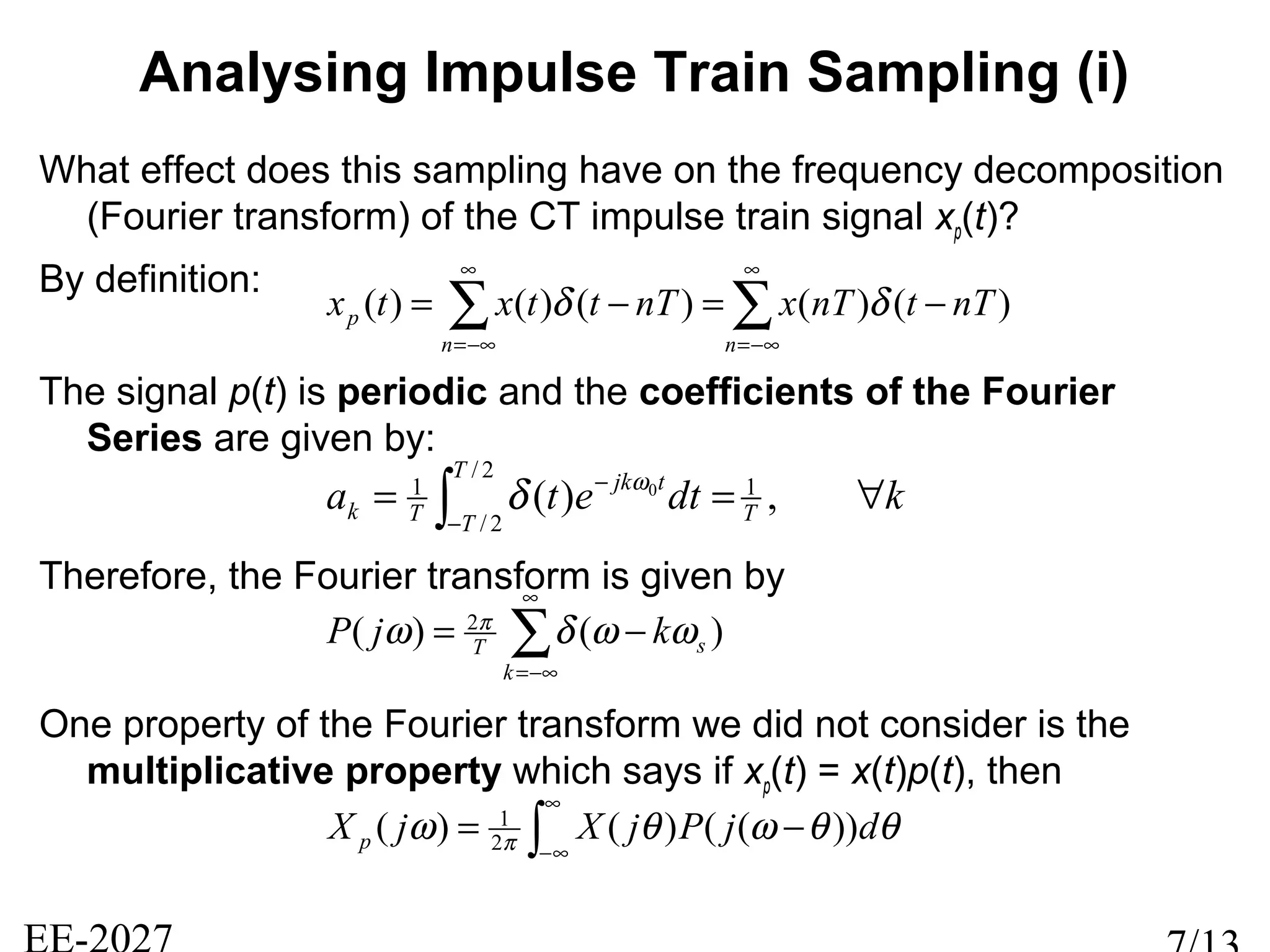
What effect does this sampling have on the frequency decomposition
(Fourier transform) of the CT impulse train signal xp(t)?
By definition:
The signal p(t) is periodic and the coefficients of the Fourier
Series are given by:
Therefore, the Fourier transform is given by
One property of the Fourier transform we did not consider is the
multiplicative property which says if xp(t) = x(t)p(t), then
∑∑
∞
−∞=
∞
−∞=
−=−=
nn
p nTtnTxnTttxtx )()()()()( δδ
∫
∞
∞−
−= θθωθω π djPjXjX p ))(()()( 2
1
∑
∞
−∞=
−=
k
sT kjP )()( 2
ωωδω π
kdteta T
T
T
tjk
Tk ∀== ∫−
−
,)( 1
2/
2/
1 0ω
δ
Analysing Impulse Train Sampling (ii)
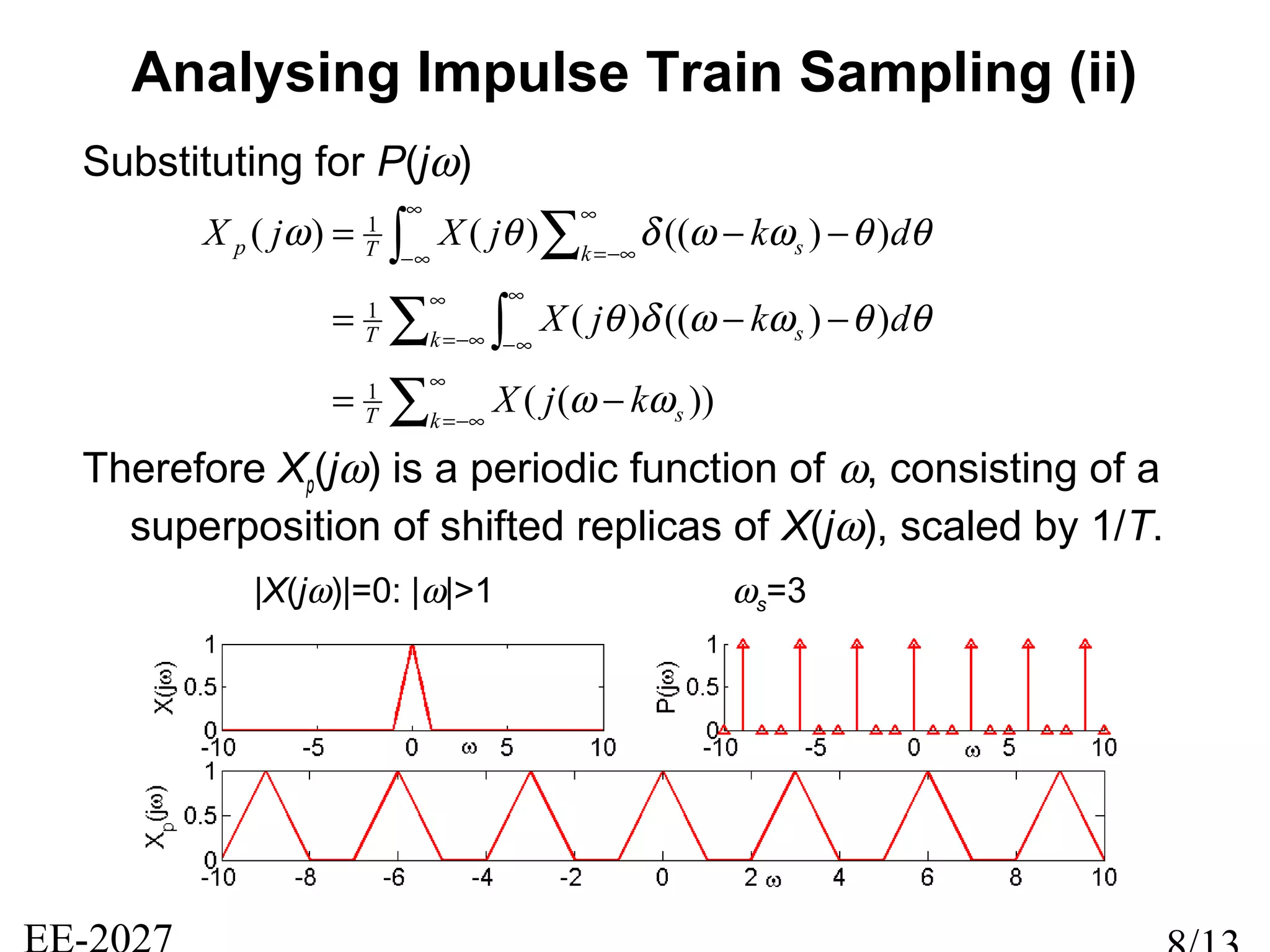
Substituting for P(jω)
Therefore Xp(jω) is a periodic function of ω, consisting of a
superposition of shifted replicas of X(jω), scaled by 1/T.
∑
∑ ∫
∫ ∑
∞
−∞=
∞
−∞=
∞
∞−
∞
∞−
∞
−∞=
−=
−−=
−−=
k sT
k sT
k sTp
kjX
dkjX
dkjXjX
))((
))(()(
))(()()(
1
1
1
ωω
θθωωδθ
θθωωδθω
|X(jω)|=0: |ω|>1 ωs=3
Reconstruction of the CT Signal
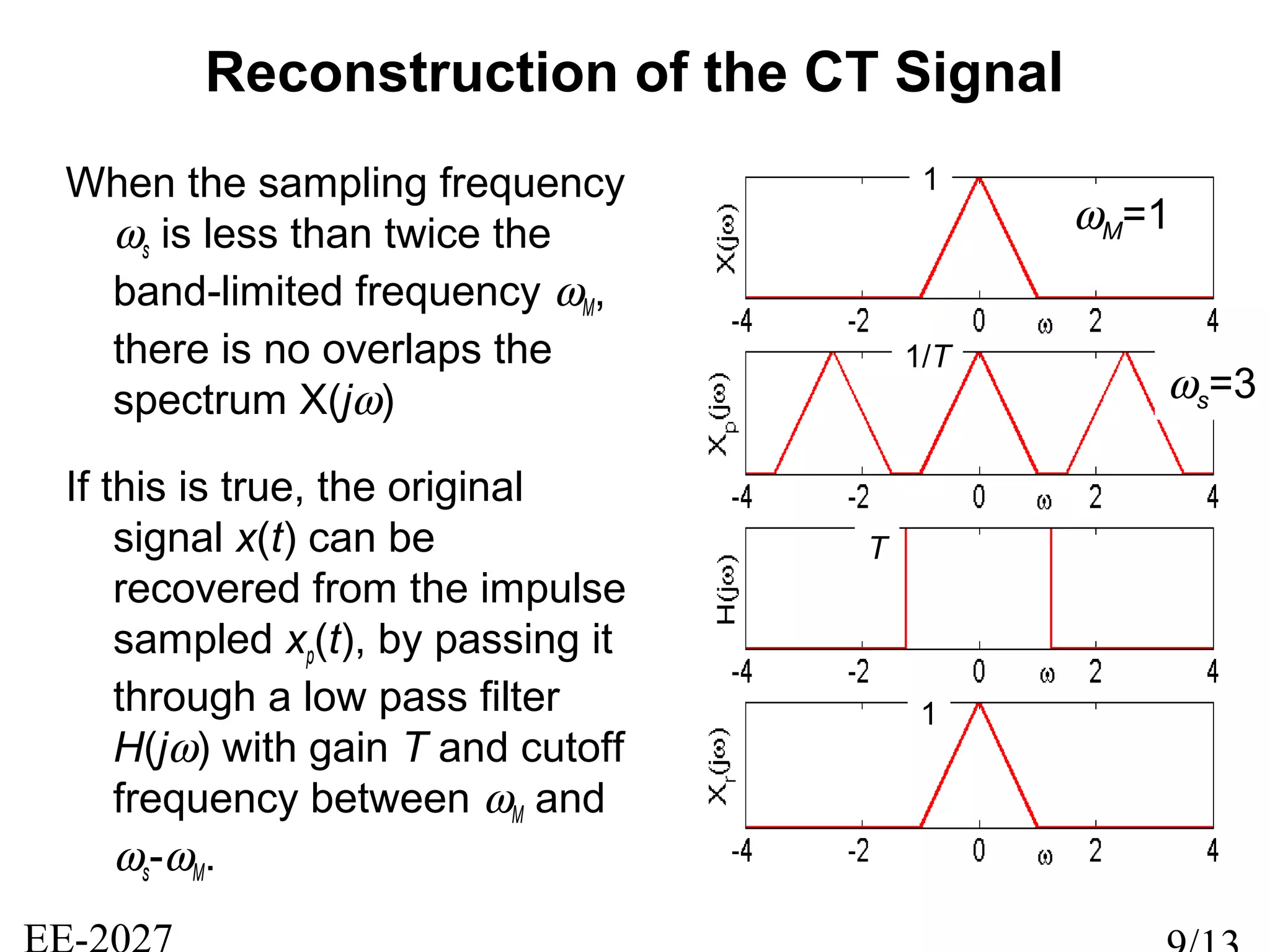
When the sampling frequency
ωs is less than twice the
band-limited frequency ωM,
there is no overlaps the
spectrum X(jω)
If this is true, the original
signal x(t) can be
recovered from the impulse
sampled xp(t), by passing it
through a low pass filter
H(jω) with gain T and cutoff
frequency between ωM and
ωs-ωM.
1
1/T
T
1
ωM=1
ωs=3
Sampling Theorem
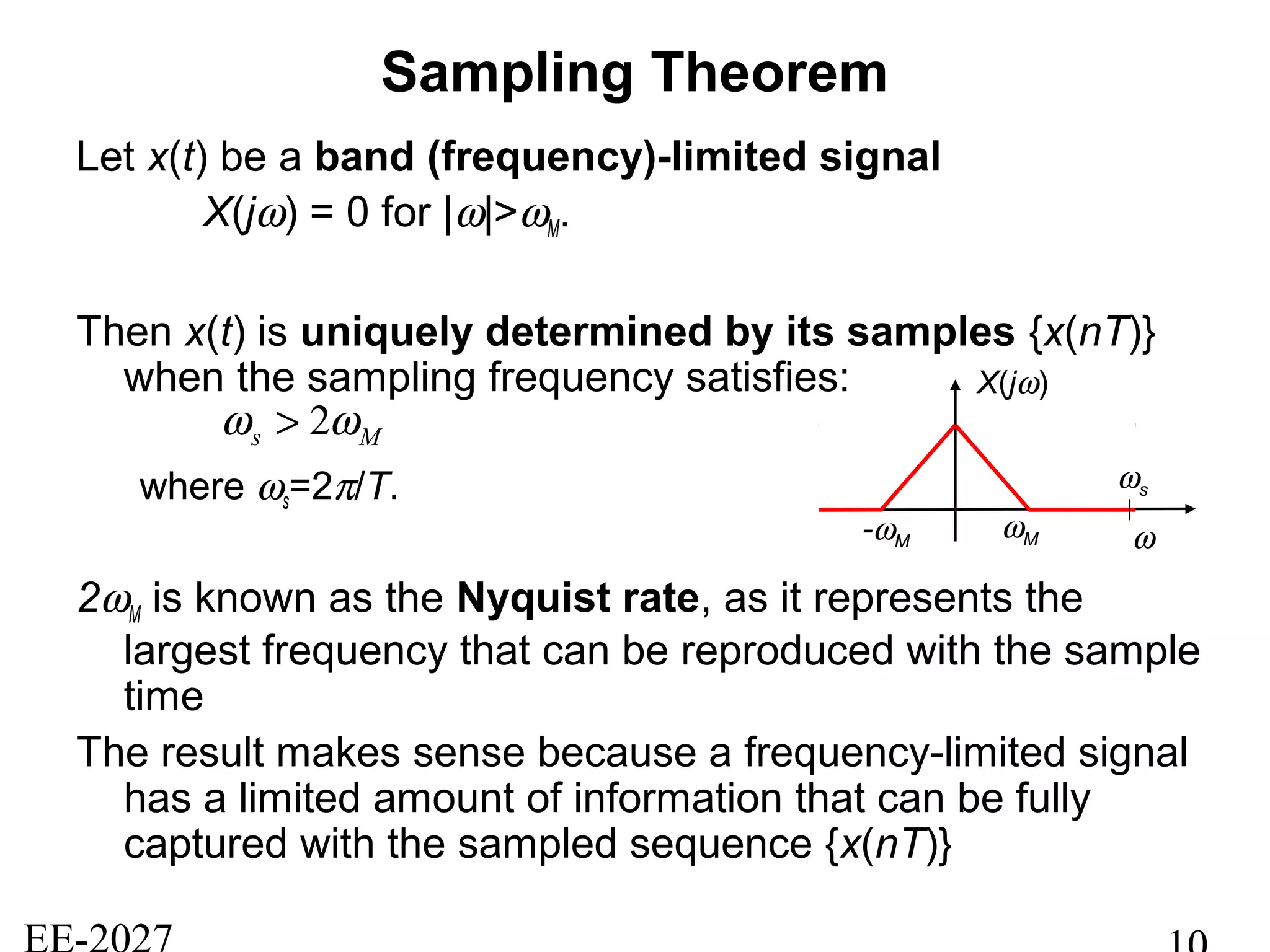
Let x(t) be a band (frequency)-limited signal
X(jω) = 0 for |ω|>ωM.
Then x(t) is uniquely determined by its samples {x(nT)}
when the sampling frequency satisfies:
where ωs=2π/T.
2ωM is known as the Nyquist rate, as it represents the
largest frequency that can be reproduced with the sample
time
The result makes sense because a frequency-limited signal
has a limited amount of information that can be fully
captured with the sampled sequence {x(nT)}
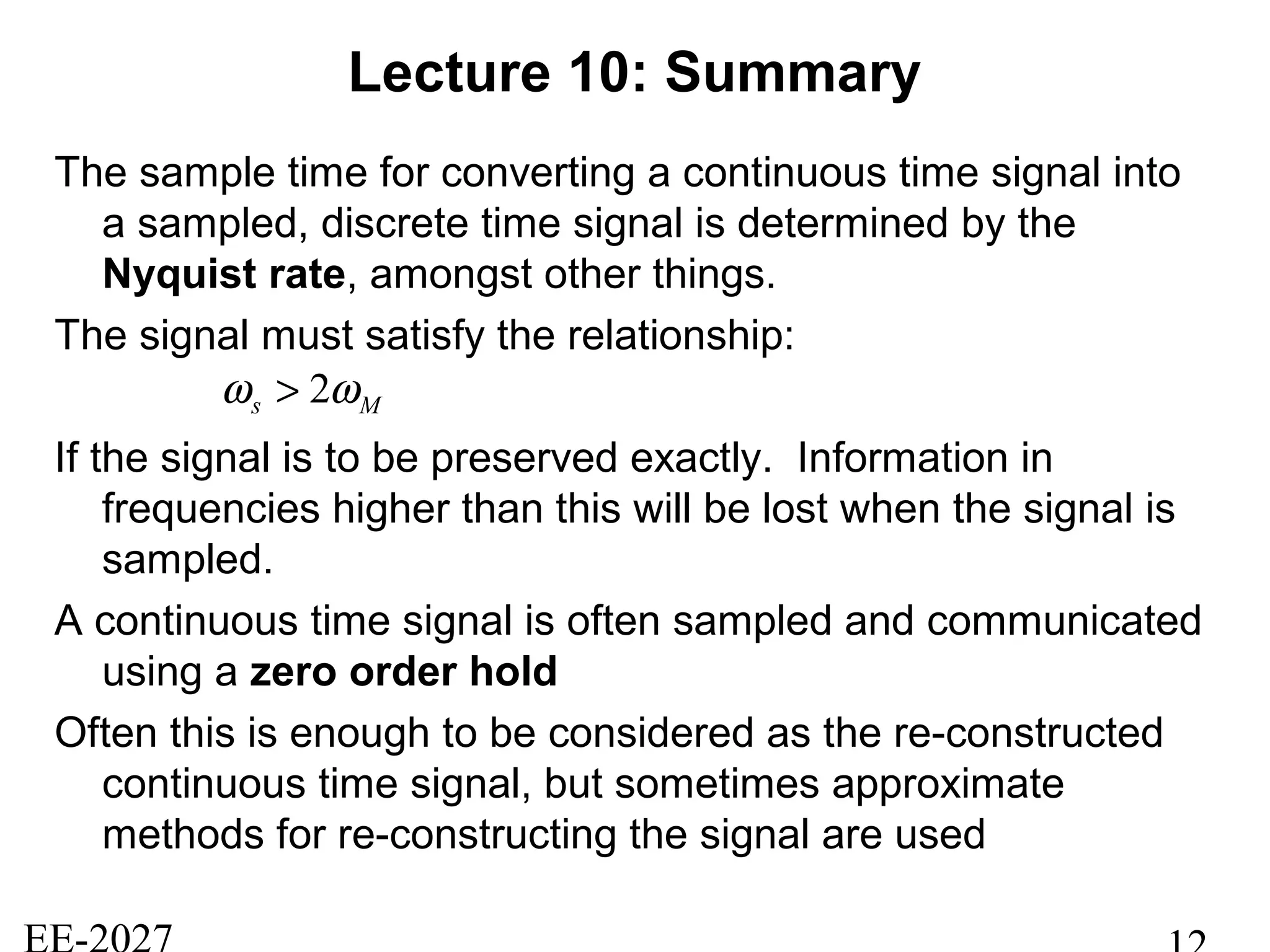
Ms ωω 2>
X(jω)
ωM ω
ωs
-ωM
Zero Order Hold Sampling
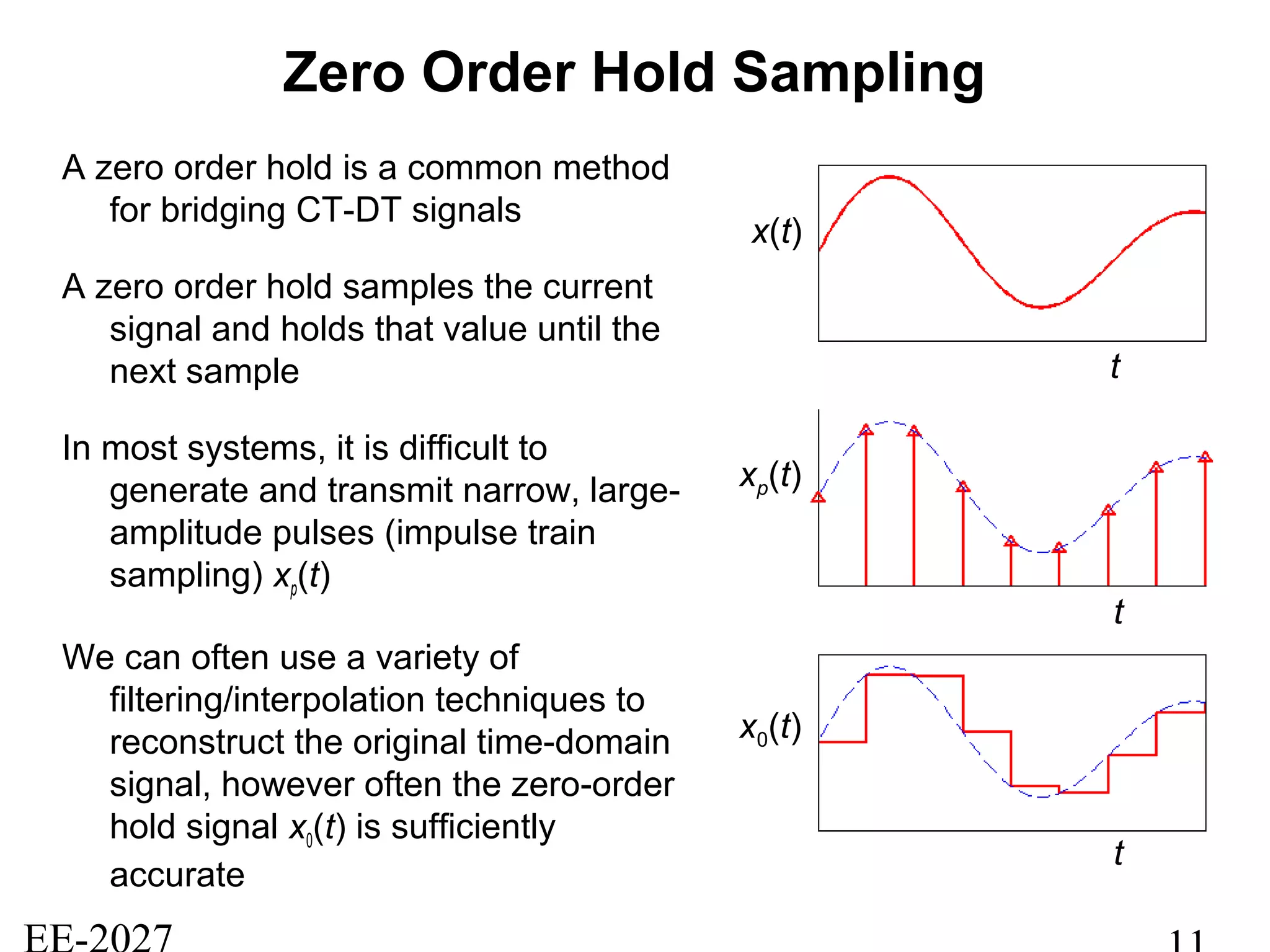
A zero order hold is a common method
for bridging CT-DT signals
A zero order hold samples the current
signal and holds that value until the
next sample
In most systems, it is difficult to
generate and transmit narrow, large-
amplitude pulses (impulse train
sampling) xp(t)
We can often use a variety of
filtering/interpolation techniques to
reconstruct the original time-domain
signal, however often the zero-order
hold signal x0(t) is sufficiently
accurate
xp(t)
x0(t)
x(t)
t
t
t
Lecture 10: Summary
The sample time for converting a continuous time signal into
a sampled, discrete time signal is determined by the
Nyquist rate, amongst other things.
The signal must satisfy the relationship:
If the signal is to be preserved exactly. Information in
frequencies higher than this will be lost when the signal is
sampled.
A continuous time signal is often sampled and communicated
using a zero order hold
Often this is enough to be considered as the re-constructed
continuous time signal, but sometimes approximate
methods for re-constructing the signal are used
Ms ωω 2>
Lecture 10: Exercises
Theory
SaS, O&W, 7.1-7.4, 7.7

Lecture9 Signal and Systems

  • 1.
    Lecture 10: SamplingDiscrete-Time Systems 4 Sampling & Discrete-time systems (2 lectures): Sampling theorem, discrete Fourier transform Specific objectives for today: • Sampling of a continuous-time signal • Reconstruction of the signals from its samples • Sampling theorem & Nyquist rate • Reconstruction of a signal, using zero-order holds
  • 2.
    Lecture 10: Resources Corereading SaS, O&W, C7 Background reading MIT Lectures 9 & 13 In these two lectures, we’re going to develop the DT Fourier transform as a sampled version of the CT Fourier transform. Note that this is opposite to time-domain convolution where we developed CT convolution as the limiting case of DT convolution
  • 3.
    Sampling is thetransformation of a continuous signal into a discrete signal Widely applied in digital analysis systems 1. Sample the continuous time signal 2. Design and process discrete time signal 3. Convert back to continuous time What is Discrete Time Sampling? x(t), x[n] t=nT Discrete Time sampler Discrete time system Signal reconstruction x(t) x[n] y[n] y(t) T is the sampling period
  • 4.
    Why is SamplingImportant? For many systems (e.g. Matlab, …) designing and processing discrete-time systems is more efficient and more general compared to performing continuous-time system design. How does Simulink perform continuous-time system simulation? The signals are sampled and the systems are approximately integrated in discrete time Mainly due to the dramatic development of digital technology resulting in inexpensive, lightweight, programmable and reproducible discrete-time systems. Widely used for communication
  • 5.
    Sampling a Continuous-TimeSignal Clearly for a finite sample period T, it is not possible to represent every uncountable, infinite-dimensional continuous-time signal with a countable, infinite-dimensional discrete-time signal. In general, an infinite number of CT signals can generate a DT signal. However, if the signal is band (frequency) limited, and the samples are sufficiently close, it is possible to uniquely reconstruct the original CT signal from the sampled signal x1(t), x2(t), x3(t), x[n] t=nT
  • 6.
    Definition of ImpulseTrain Sampling We need to have a convenient way in which to represent the sampling of a CT signal at regular intervals A common/useful way to do this is through the use of a periodic impulse train signal, p(t), multiplied by the CT signal T is the sampling period ωs=2π/T is the sampling frequency This is known as impulse train sampling. Note xp(t) is still a continuous time signal ∑ ∞ −∞= −= = n p nTttp tptxtx )()( )()()( δ T
  • 7.
    Analysing Impulse TrainSampling (i) What effect does this sampling have on the frequency decomposition (Fourier transform) of the CT impulse train signal xp(t)? By definition: The signal p(t) is periodic and the coefficients of the Fourier Series are given by: Therefore, the Fourier transform is given by One property of the Fourier transform we did not consider is the multiplicative property which says if xp(t) = x(t)p(t), then ∑∑ ∞ −∞= ∞ −∞= −=−= nn p nTtnTxnTttxtx )()()()()( δδ ∫ ∞ ∞− −= θθωθω π djPjXjX p ))(()()( 2 1 ∑ ∞ −∞= −= k sT kjP )()( 2 ωωδω π kdteta T T T tjk Tk ∀== ∫− − ,)( 1 2/ 2/ 1 0ω δ
  • 8.
    Analysing Impulse TrainSampling (ii) Substituting for P(jω) Therefore Xp(jω) is a periodic function of ω, consisting of a superposition of shifted replicas of X(jω), scaled by 1/T. ∑ ∑ ∫ ∫ ∑ ∞ −∞= ∞ −∞= ∞ ∞− ∞ ∞− ∞ −∞= −= −−= −−= k sT k sT k sTp kjX dkjX dkjXjX ))(( ))(()( ))(()()( 1 1 1 ωω θθωωδθ θθωωδθω |X(jω)|=0: |ω|>1 ωs=3
  • 9.
    Reconstruction of theCT Signal When the sampling frequency ωs is less than twice the band-limited frequency ωM, there is no overlaps the spectrum X(jω) If this is true, the original signal x(t) can be recovered from the impulse sampled xp(t), by passing it through a low pass filter H(jω) with gain T and cutoff frequency between ωM and ωs-ωM. 1 1/T T 1 ωM=1 ωs=3
  • 10.
    Sampling Theorem Let x(t)be a band (frequency)-limited signal X(jω) = 0 for |ω|>ωM. Then x(t) is uniquely determined by its samples {x(nT)} when the sampling frequency satisfies: where ωs=2π/T. 2ωM is known as the Nyquist rate, as it represents the largest frequency that can be reproduced with the sample time The result makes sense because a frequency-limited signal has a limited amount of information that can be fully captured with the sampled sequence {x(nT)} Ms ωω 2> X(jω) ωM ω ωs -ωM
  • 11.
    Zero Order HoldSampling A zero order hold is a common method for bridging CT-DT signals A zero order hold samples the current signal and holds that value until the next sample In most systems, it is difficult to generate and transmit narrow, large- amplitude pulses (impulse train sampling) xp(t) We can often use a variety of filtering/interpolation techniques to reconstruct the original time-domain signal, however often the zero-order hold signal x0(t) is sufficiently accurate xp(t) x0(t) x(t) t t t
  • 12.
    Lecture 10: Summary Thesample time for converting a continuous time signal into a sampled, discrete time signal is determined by the Nyquist rate, amongst other things. The signal must satisfy the relationship: If the signal is to be preserved exactly. Information in frequencies higher than this will be lost when the signal is sampled. A continuous time signal is often sampled and communicated using a zero order hold Often this is enough to be considered as the re-constructed continuous time signal, but sometimes approximate methods for re-constructing the signal are used Ms ωω 2>
  • 13.