Bonding Theories
Advanced Inorg. Chem.
Dr. Chris Sontag
University of Phayao
Oct.2017
1
After this lesson, we should understand:
2
O3
1. Is this molecule stable ?
2. Does this molecule have a charge ?
3. Is this molecule linear or bent ?
4. Is the bond strength higher, the same
or lower than in O2 ?
3
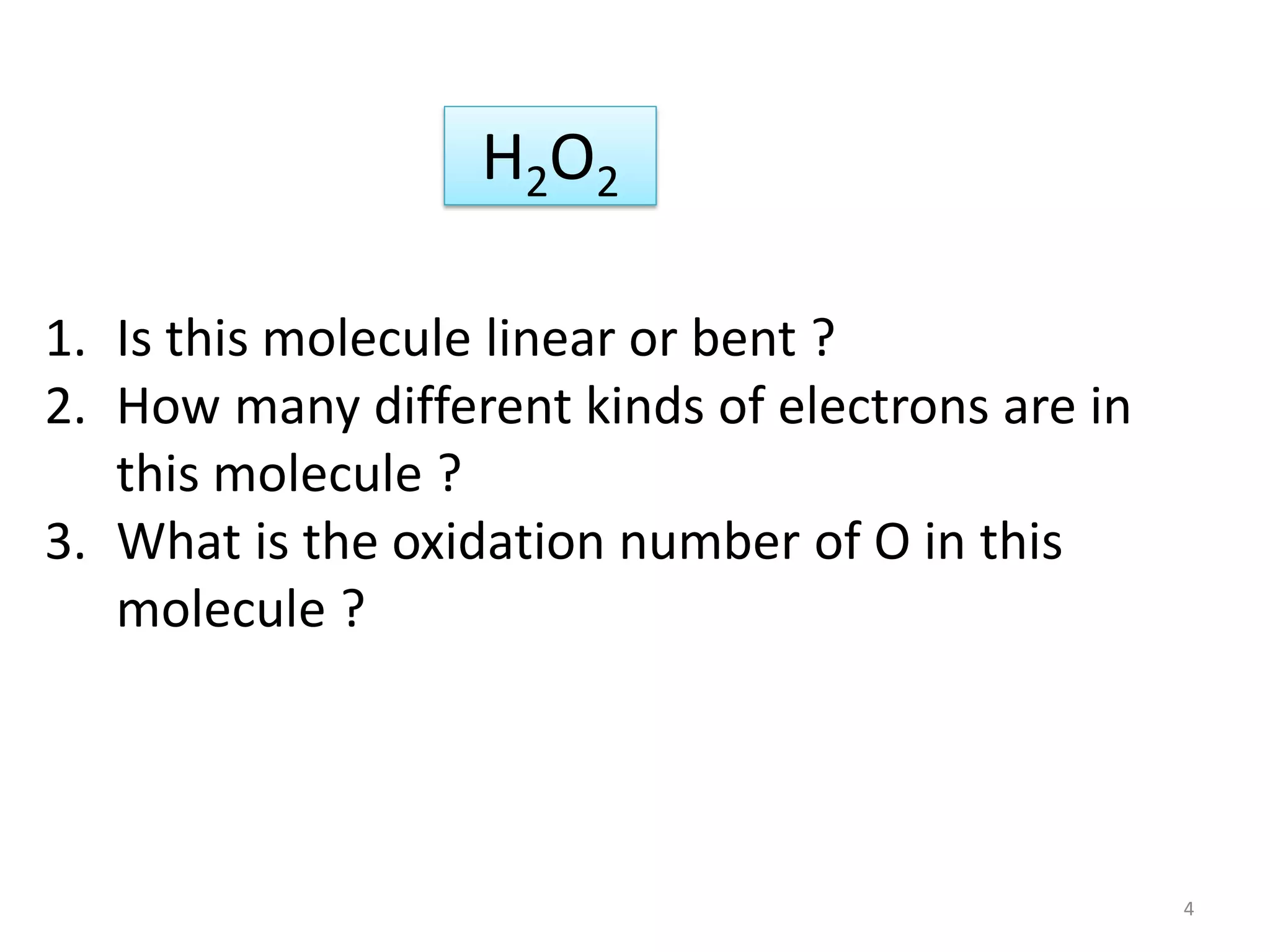
H2O2
1. Is this molecule linear or bent ?
2. How many different kinds of electrons are in
this molecule ?
3. What is the oxidation number of O in this
molecule ?
4
CO
1. Is this molecule stable ?
2. Is it polar or non-polar ?
3. Is this molecule more or less reactive than CO2 ?
5
6
Electronegativity (EN)
The amount of EN difference determines the
polarity of the bond:
7
8
9
Allred-Rochow EN
Example:
Flourine (r = 72 pm)
Carbon (r = 77 pm)
Calculate the AR
electronegativity
10
Shielding of 2p electrons:
Flourine:
S = 6 * 0.35 + 2 * 0.85 = 3.8 => Z* = 9 – 3.8 = 5.2
EN = 3590 * 5.2/(72 2) + 0.744 = 4.35
Carbon:
S = 3 * 0.35 + 2 * 0.85 = 2.75 => Z* = 6 – 2.75 = 3.25
EN = 3590 * 3.25 / (77 2) ) + 0.744 = 2.71
11
VALENCE ELECTRONS AND
LEWIS STRUCTURES
Part 2
12
The periodic table
is built up so that
elements with the
same number of VE
are in one column
= no. of VE
13
Electron configuration
do NOT use core electrons !
Practise: write the configuration for:
1. Fe2+
2. Pb
3. W
4. Ti4+
Write only the
Valence
Electrons !
http://www.slideshare.net/Hoegler6/09-lecture
14
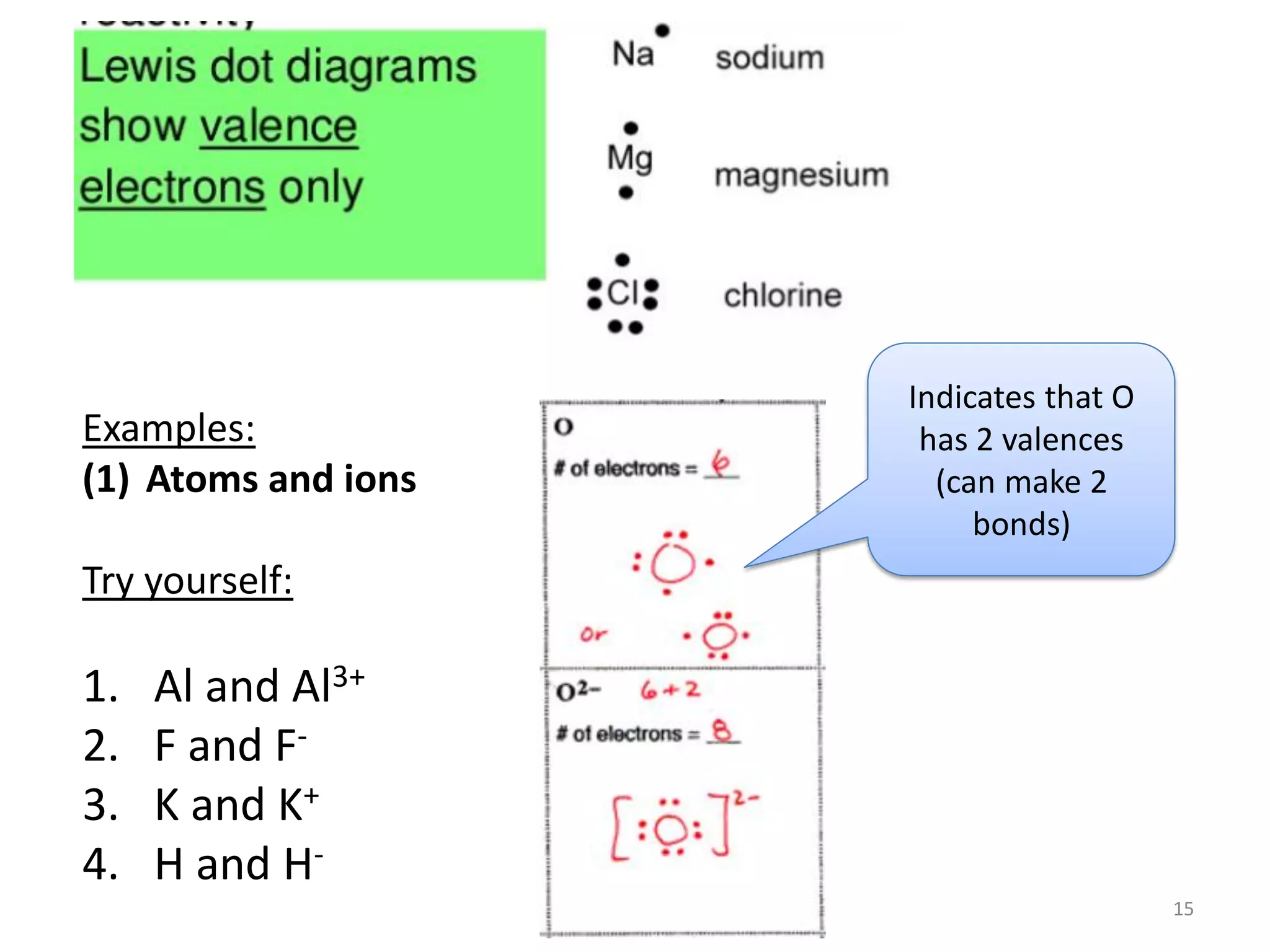
Examples:
(1) Atoms and ions
Try yourself:
1. Al and Al3+
2. F and F-
3. K and K+
4. H and H-
Indicates that O
has 2 valences
(can make 2
bonds)
15
16
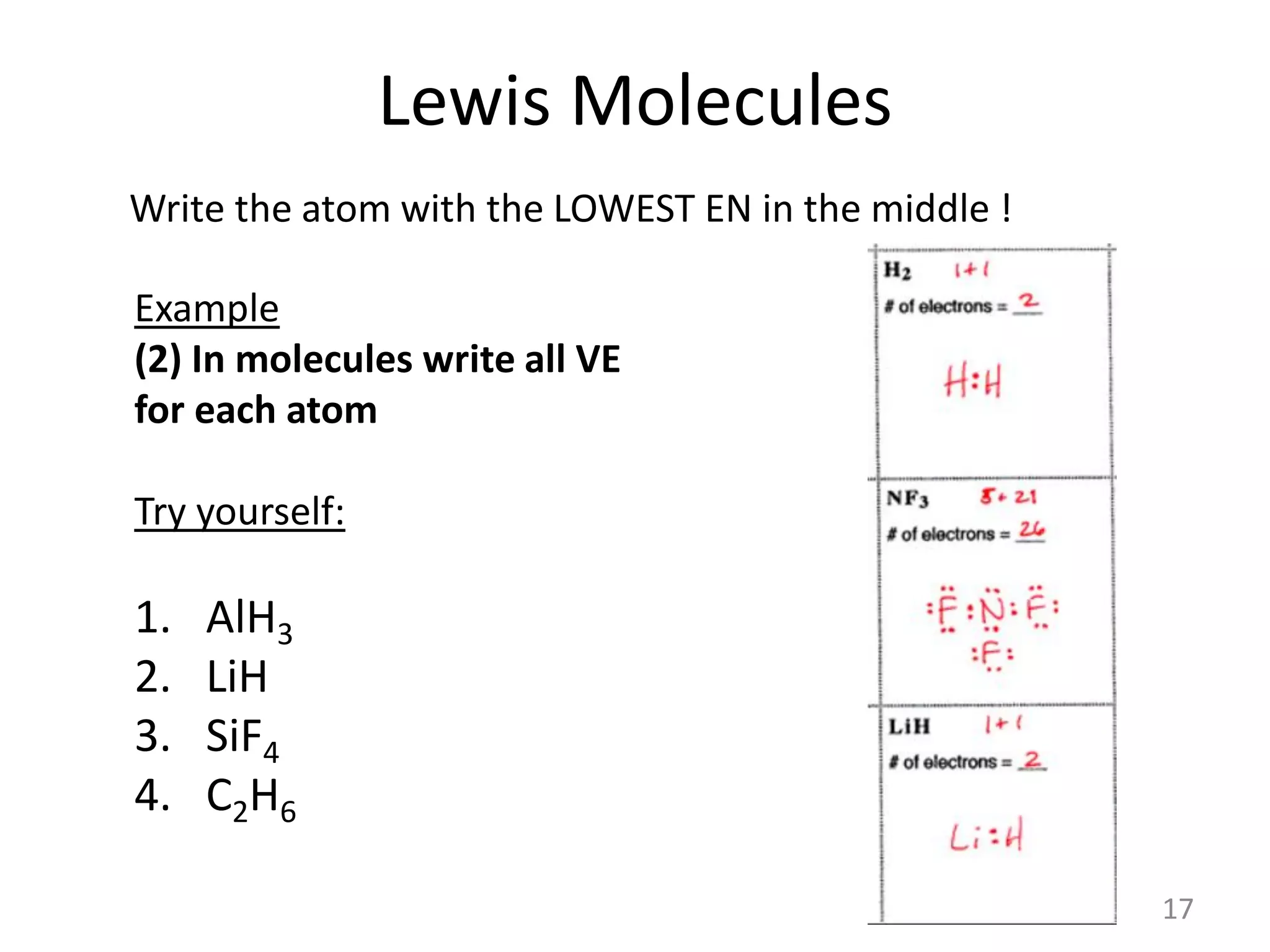
Lewis Molecules
Write the atom with the LOWEST EN in the middle !
Example
(2) In molecules write all VE
for each atom
Try yourself:
1. AlH3
2. LiH
3. SiF4
4. C2H6
17
18
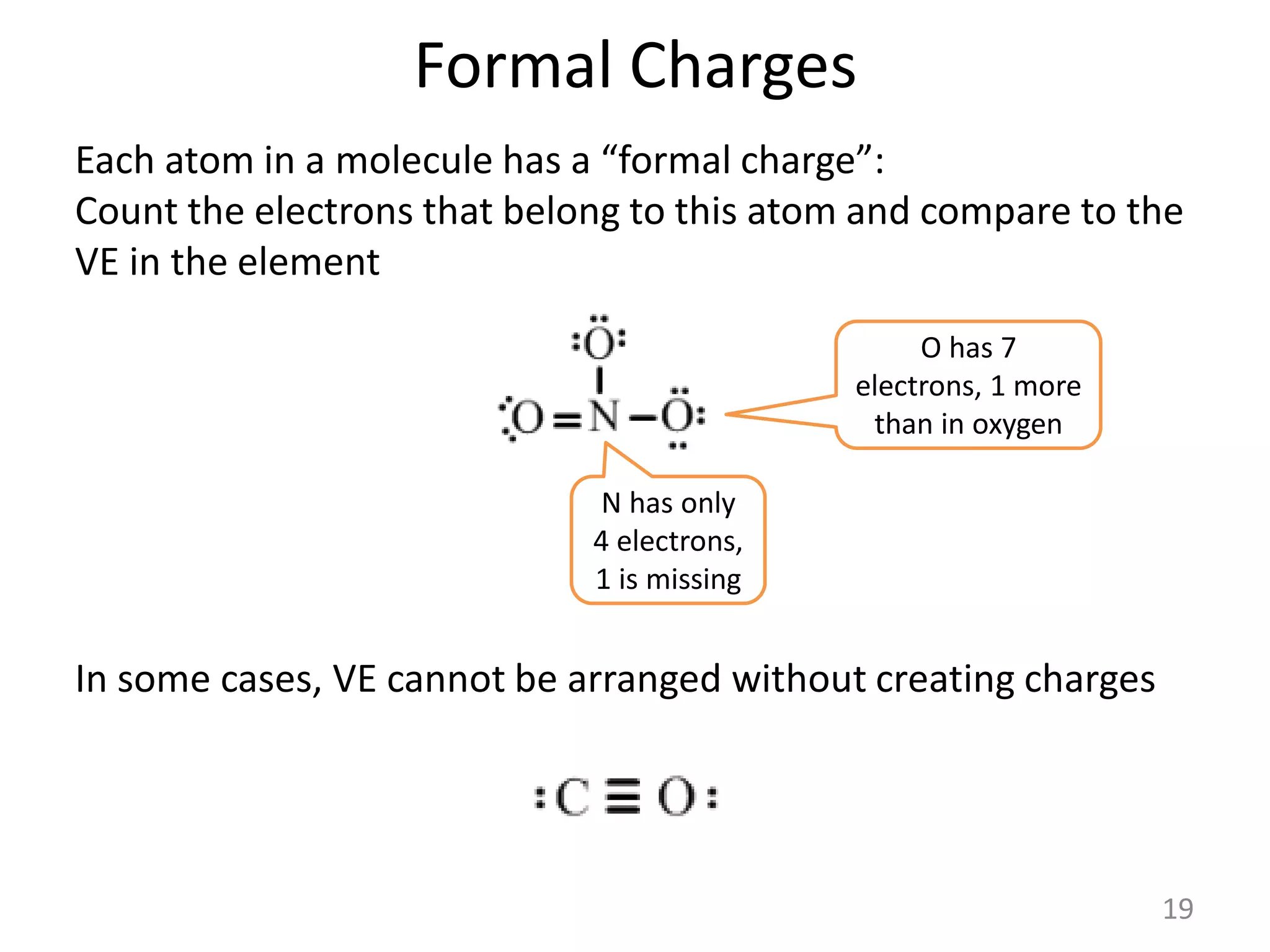
Formal Charges
In some cases, VE cannot be arranged without creating charges
Each atom in a molecule has a “formal charge”:
Count the electrons that belong to this atom and compare to the
VE in the element
N has only
4 electrons,
1 is missing
O has 7
electrons, 1 more
than in oxygen
19
Multiple Bonds and formal charges
20
Formal charges and
Oxidation numbers
Oxidation number:
assign all electrons in bonds to
the atom with higher EN !
-> N has no el. -> ox no. +5
Formal Charge:
split all bonding el. Between the
atoms and count the remaining
-> N has 4 el. -> formal charge is +1
Find the same for: CO2 HCHO H3C-OH HCOOH
21
Transition metal compounds
Example:
FeCl3 = ionic compound (“salt”)
But in water: Fe(3+) (H2O)6 + 3 Cl(-)
Lewis Formulas do not reflect the bonding in
coordination compounds:
Fe(3+) has 5 valence electrons, but forms 6 bonds !
Oxidation numbers:
can go from -1 to +7, normally +2 or +3
Find the numbers for: KMnO4, MnO2, K4Fe(CN)6, Fe(CO)5
22
23
Part 3: VSEPR
VSEPR Theory
Intro: http://www.youtube.com/watch?v=nxebQZUVvTg
Practise: http://www.youtube.com/watch?v=xwgid9YuH58
Rules to remember
Order of repulsions:
(1) Lone Pair – Lone Pair
(2) Lone Pair – Bond
(3) Bond - Bond
Examples
XeF2
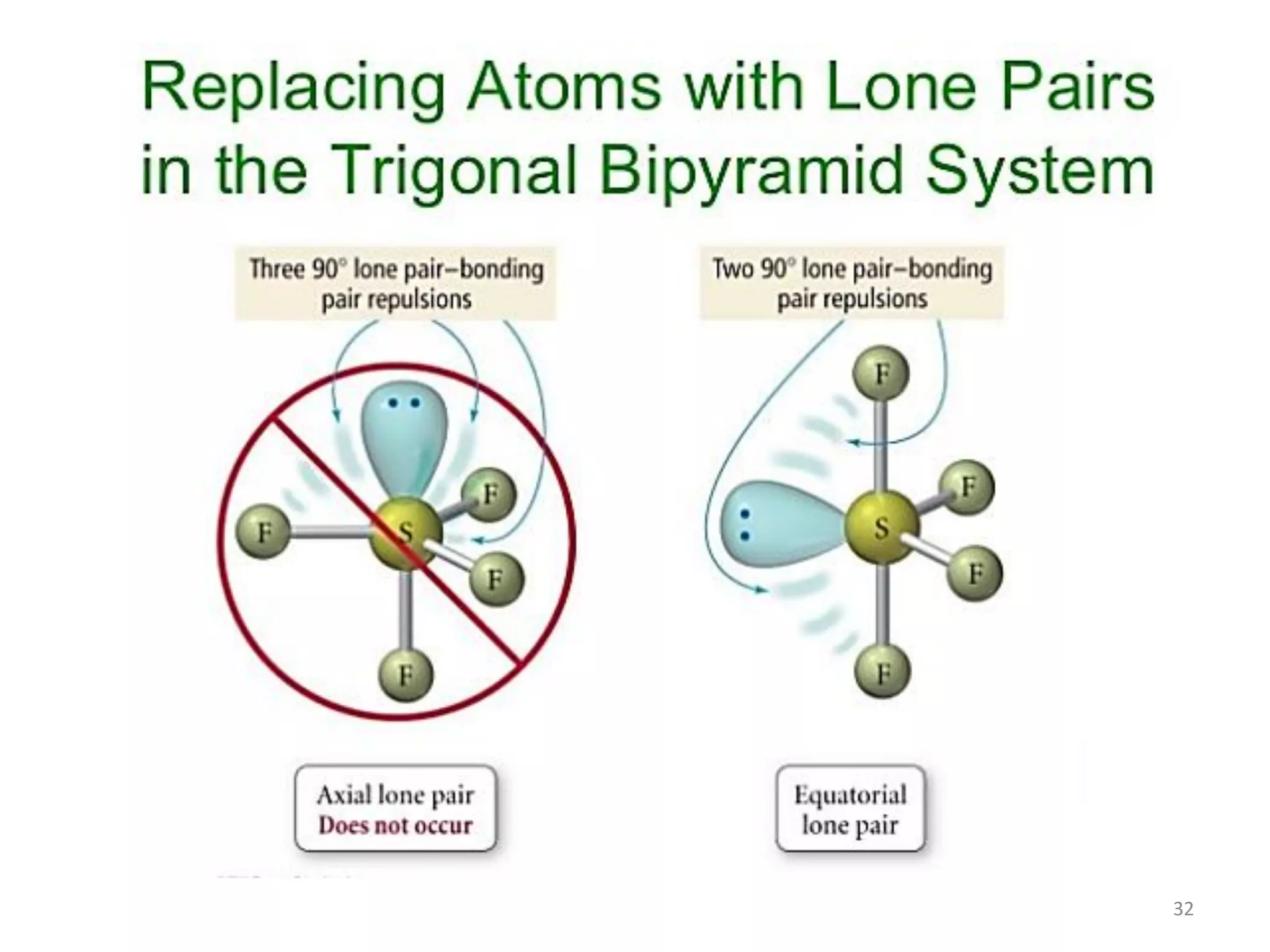
The lone pair needs most space,
so they are in equatorial position
(bond angle 120 deg)
ClF3
lone pairs again in eq. position so
have max. distance
Estimate the structures of:
SF4
BrF5
IF5
2-
AsF5
VB THEORY
(DIAGRAMS FROM:
HTTP://WWW.SLIDESHARE.NET/HOEGLER6/10-LECTURE)
Part 4
30
VB Theory and
molecular geometry
http://www.slideshare.net/Hoegler6/10-lecture 31
32
33
VB Theory = Hybridization of atomic orbitals
But NOT ALWAYS:
34
35
Sigma - bonds 36
How many sigma-bonds can each atom form ?
37
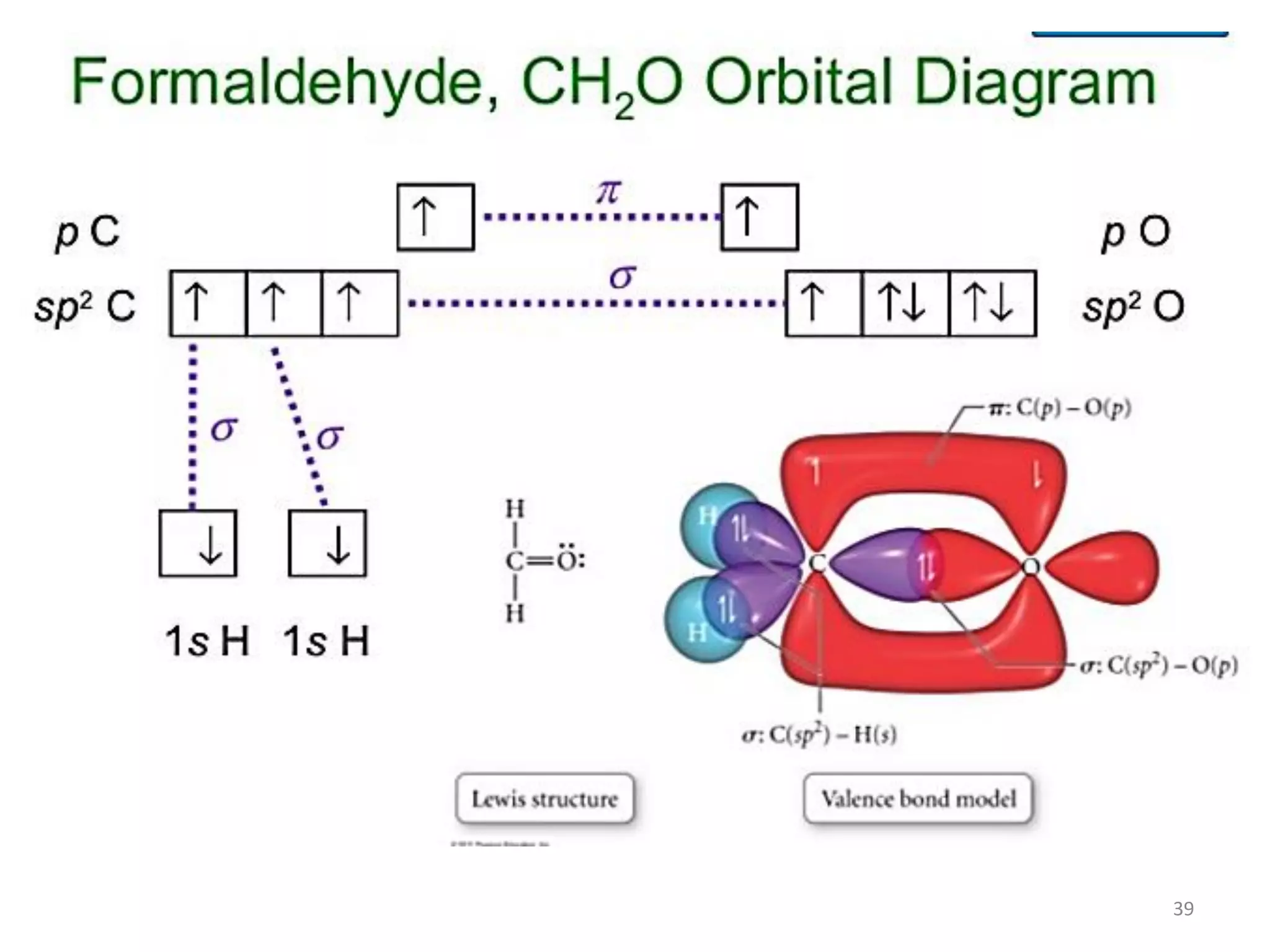
Try the same for FORMALDEHYDE HCHO 38
39
Try the same for FORMALDEHYDE HCHO
40
41
sp3d hybridization
Example: PCl5 compared to PCl3 – both molecules are stable !
42
sp3d2 hybridization
Example: SF6 compared to SCl2 – both molecules are stable !
six
43
Coordination Compounds
For TM ions the VE are
counted ALL as d-electrons !
EMPTY metal orbitals are needed
to be filled with ligand-electrons !
We can form a d2 sp3 hybrid – called “inner shell” complex
http://chemed.chem.purdue.edu/genchem/topicreview/bp/ch12/valence.php 44
Here we cannot explain 6 ligands around the Ni(2+).
In this case we have to use the “outer” 4d orbitals to form a hybrid:
Use a sp3d2 “outer shell” complex
Explain the bonding in a [Fe(CN)6] 4- complex
45
MO THEORY
Part 5
46
No orbital mixing
here – because the
energy difference
between N and O
is high
-> small s- and pz-
interaction
47
sp-mixing – example B2 molecule which is a diradical:
https://en.wikipedia.org/wiki/Molecular_orbital_diagram 48
High energy difference
-> small mixing
49
Multi-atomic molecules: form GROUP ORBITALS
50
Formation of LGO
* ligand group orbitals *
H2O molecule has c2v symmetry
The 2 H-s-orbitals can be combined
to form 2 LGO’s:
One symmetric, another anti-
symmetric
A1 symmetry
B2 symmetric
51
Get LGO’s from group theory
http://plato.mercyhurst.edu/chemistry/kjircitano/inorgstudysheets/inorgstudyexamii.htm
52
MO’s from oxygen AO’s and LGO’s
Bonding interactions: 2 Lone Pairs:
53
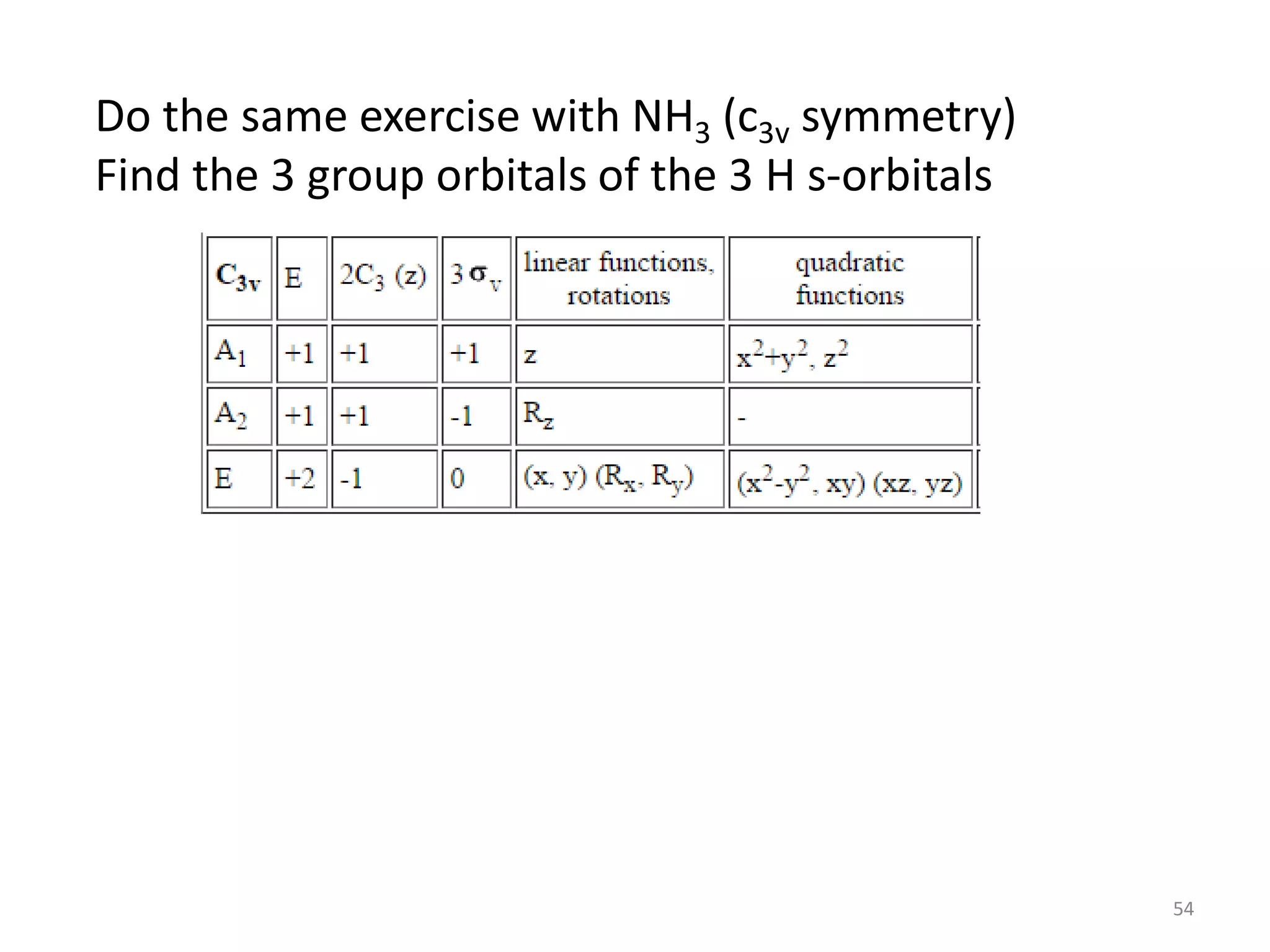
Do the same exercise with NH3 (c3v symmetry)
Find the 3 group orbitals of the 3 H s-orbitals
54
Construct LGO’s
Graphical approach
(1)Arrange all ligand orbitals around the central atom
(2)First MO-combination: all are in the same phase
(3)Draw one node plane symmetrically = next energy level
(4)Draw two node planes symmetrically
LGO no. 1
LGO no. 2
55
Example: NH3
3 H-orbitals
-> 3 LGO’s :
(1) all same phase
(2) One node
(3) One node
56
Chemical Reactivity
Important are the HOMO and LUMO (“frontier orbitals”)
http://www.meta-synthesis.com/webbook/12_lab/lab.html
Coordination compounds
Find 6 symmetry adapted ligand
combinations (SALC)
To fit with the metal s- p- and d-
orbitals
58
http://faculty.uml.edu/ndeluca/84.334/topics/topic6.htm 59
ML6 complex – Co(NH3)6 (2+)
Co(2+)
NH3 ligand binds by the lone pair
of ammonia:
Insert the
electrons -
which are
bonding, non-
bonding, anti-
bonding ?
60
Influence of ligand pi and pi* orbitals
http://wwwchem.uwimona.edu.jm/courses/LFT.html 61
Aromatic Ligands
Benzene
3 nodes
2 nodes
1 node
no node
Find the AO’s of a metal that
fit with each of these ligand
MO’s
62
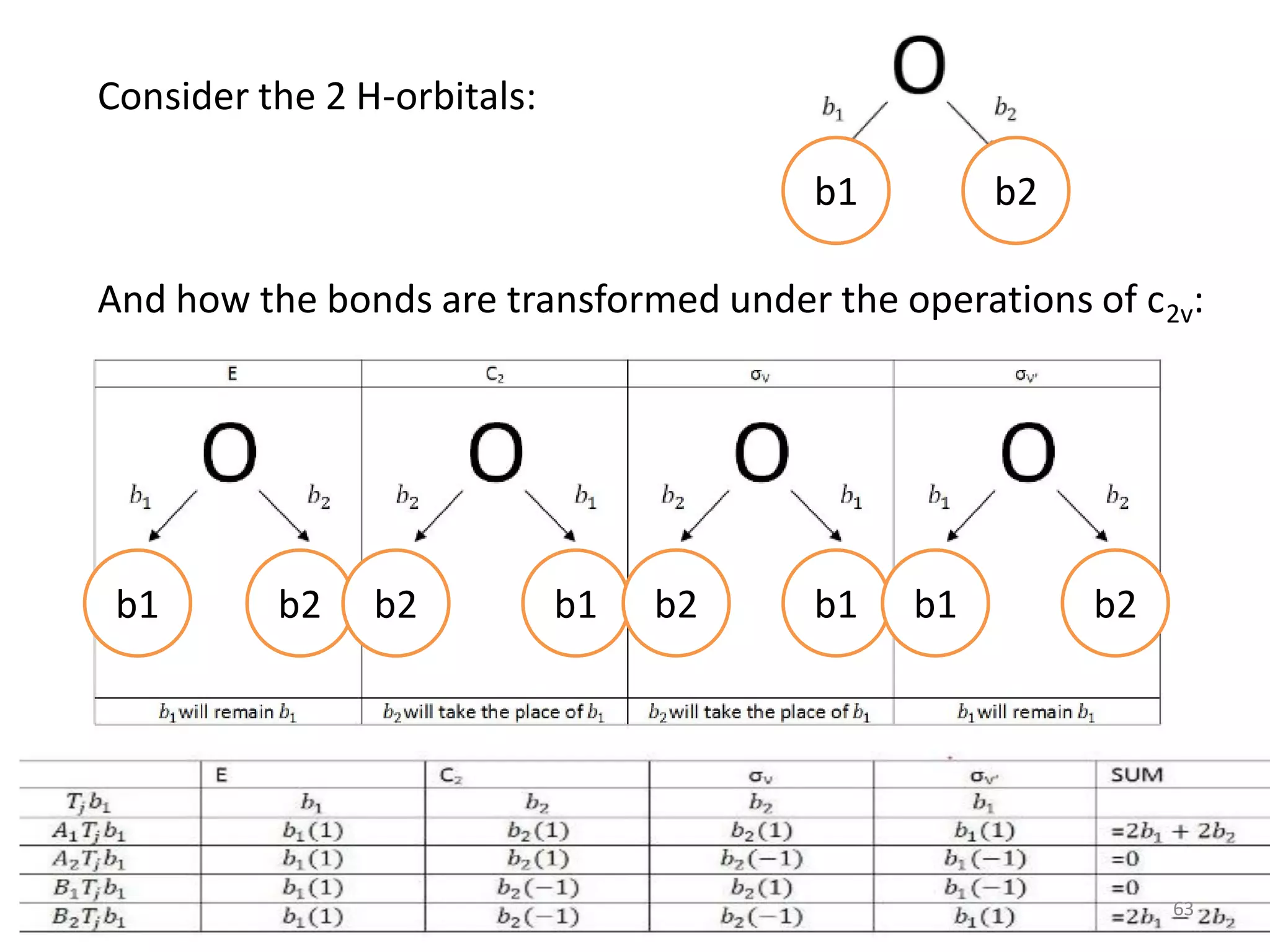
Consider the 2 H-orbitals:
And how the bonds are transformed under the operations of c2v:
b1 b2
b1 b2 b2 b1 b2 b1 b1 b2
63

Bonding theories 2017