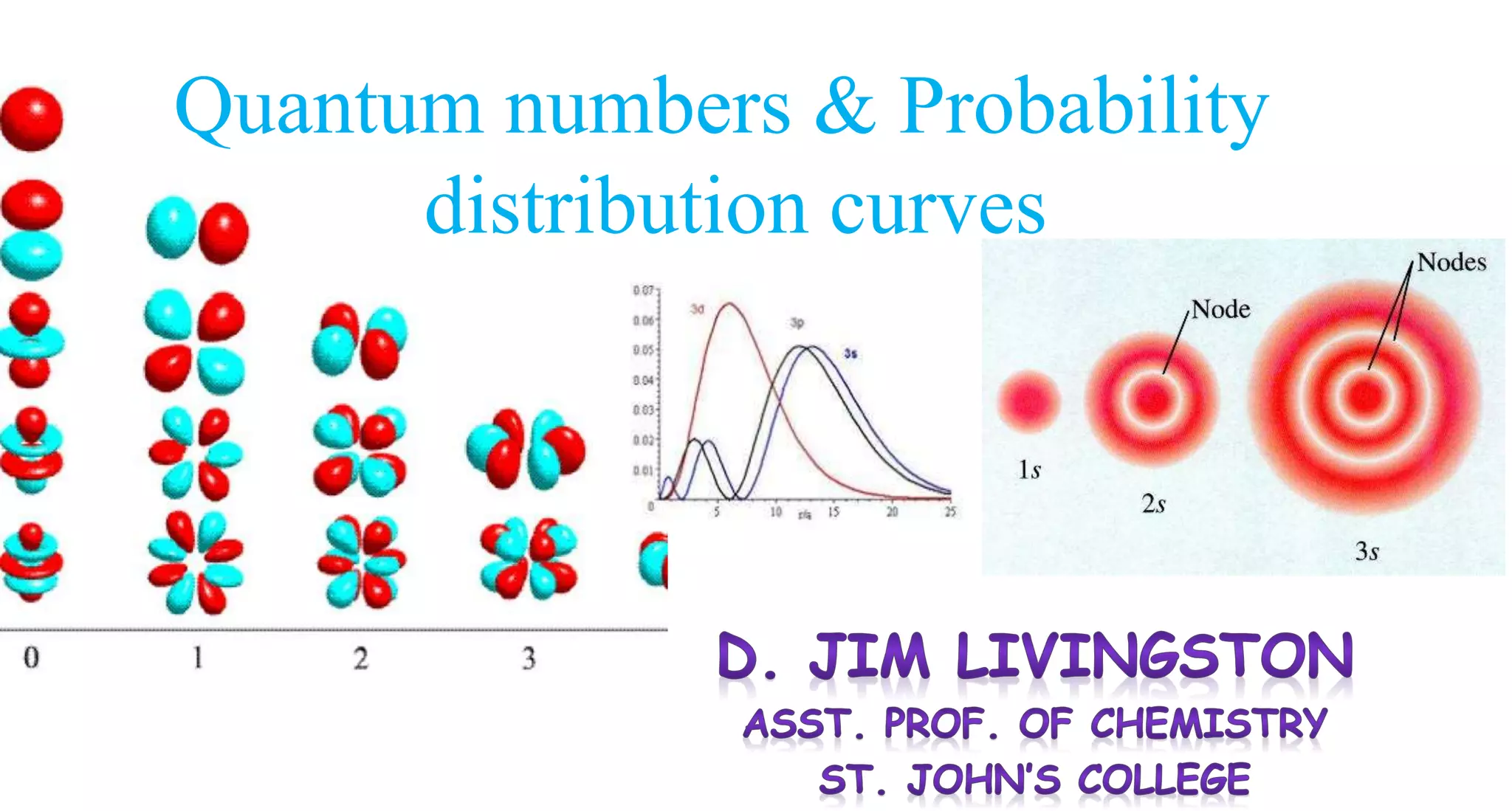
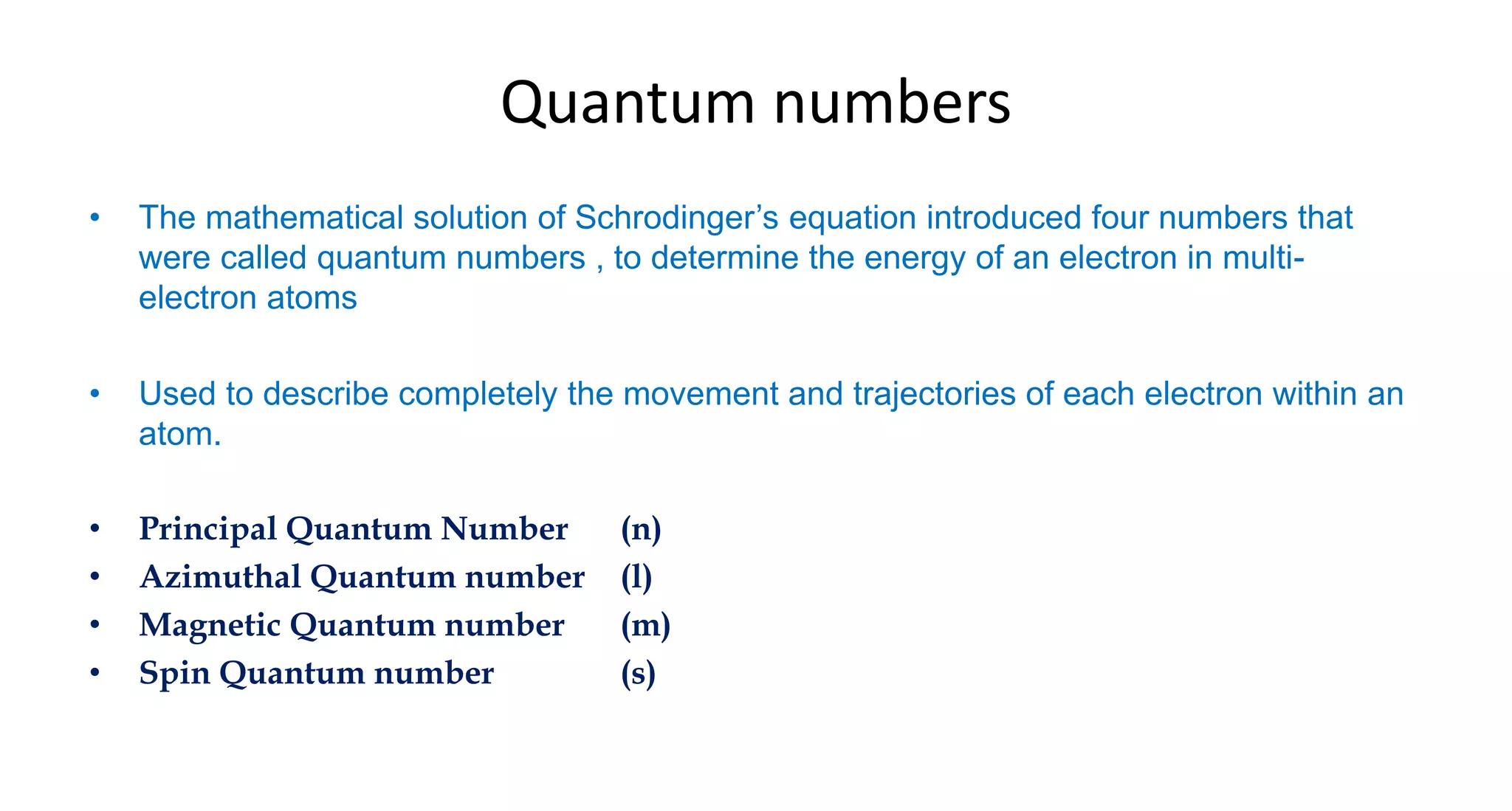
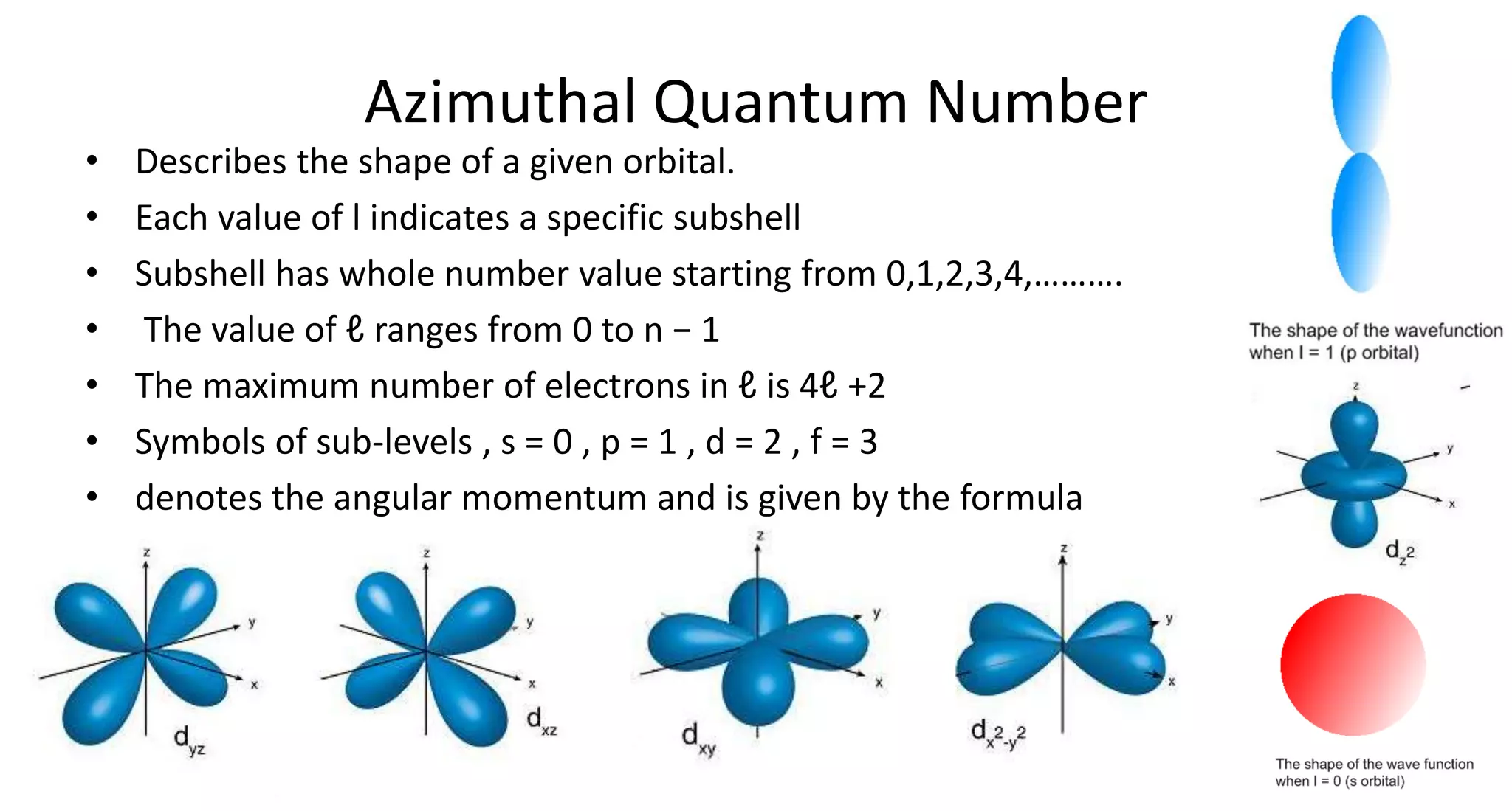
Quantum numbers & Probability
distribution curves
Quantum numbers
• The mathematical solution of Schrodinger’s equation introduced four numbers that
were called quantum numbers , to determine the energy of an electron in multi-
electron atoms
• Used to describe completely the movement and trajectories of each electron within an
atom.
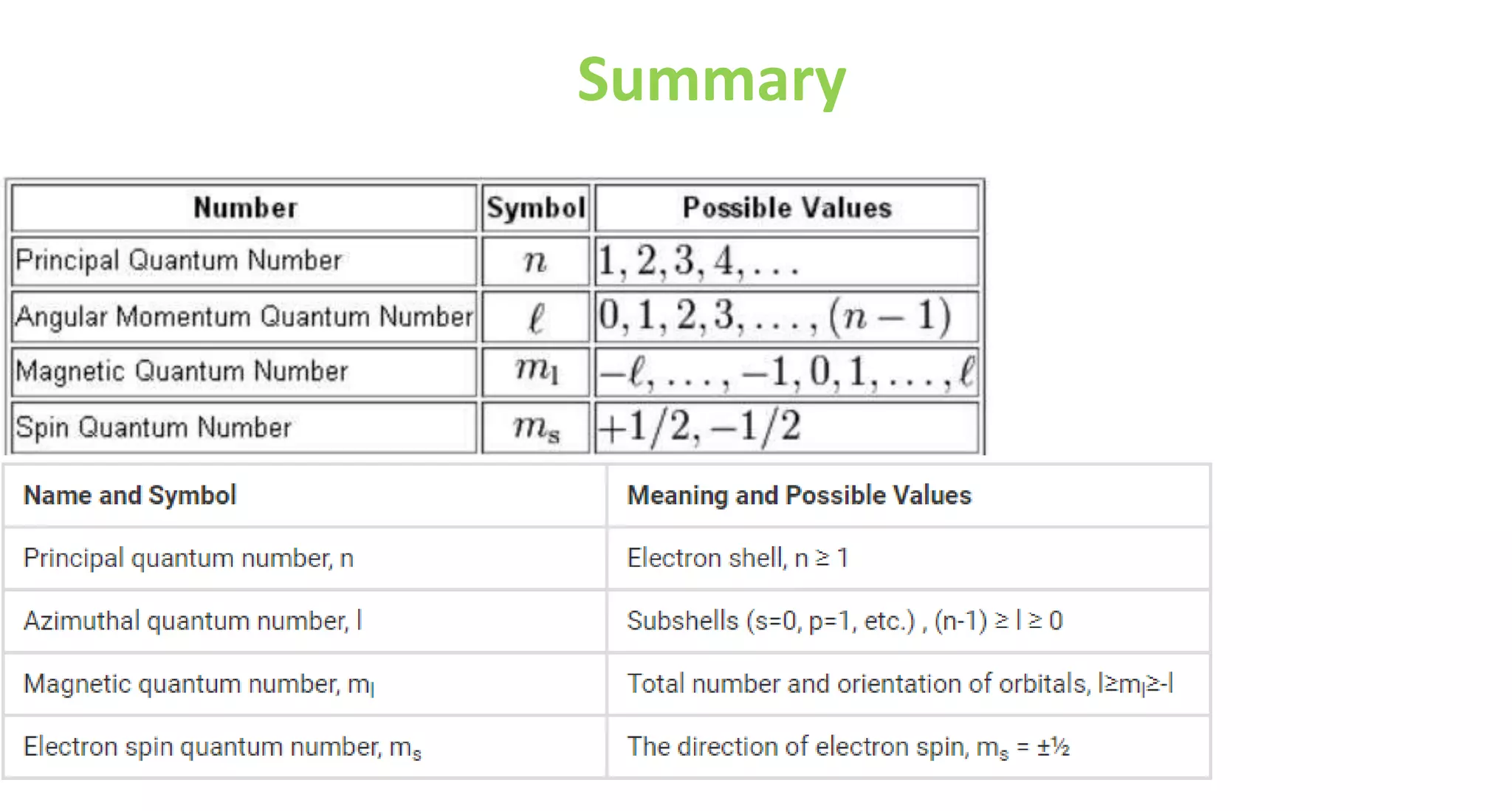
• Principal Quantum Number (n)
• Azimuthal Quantum number (l)
• Magnetic Quantum number (m)
• Spin Quantum number (s)
Principal Quantum Number
• describes the electron shell, or energy level, of an atom.
• describes tells the most probable distance of the electrons from the nucleus
• has whole number values 1 , 2 , 3 , 4 , ……. etc
• Also be designated as K,L,M,N, …… etc
• larger the number n , the larger the size of the orbit
• The maximum number of electrons in n is 2n2
• Also called as orbit.
Azimuthal Quantum Number
• Describes the shape of a given orbital.
• Each value of l indicates a specific subshell
• Subshell has whole number value starting from 0,1,2,3,4,……….
• The value of ℓ ranges from 0 to n − 1
• The maximum number of electrons in ℓ is 4ℓ +2
• Symbols of sub-levels , s = 0 , p = 1 , d = 2 , f = 3
• denotes the angular momentum and is given by the formula
Magnetic Quantum Number
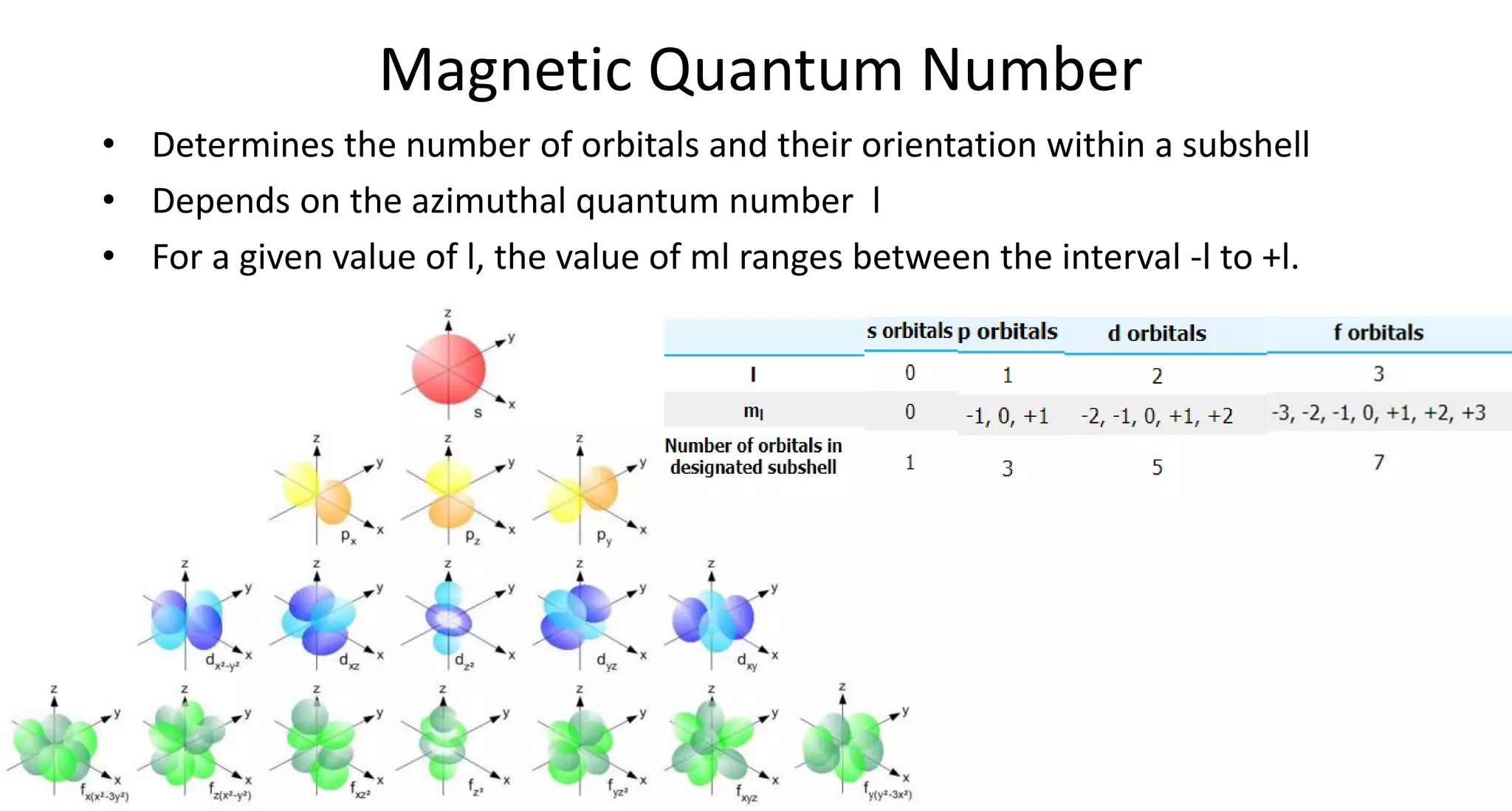
• Determines the number of orbitals and their orientation within a subshell
• Depends on the azimuthal quantum number l
• For a given value of l, the value of ml ranges between the interval -l to +l.
Spin Quantum Number
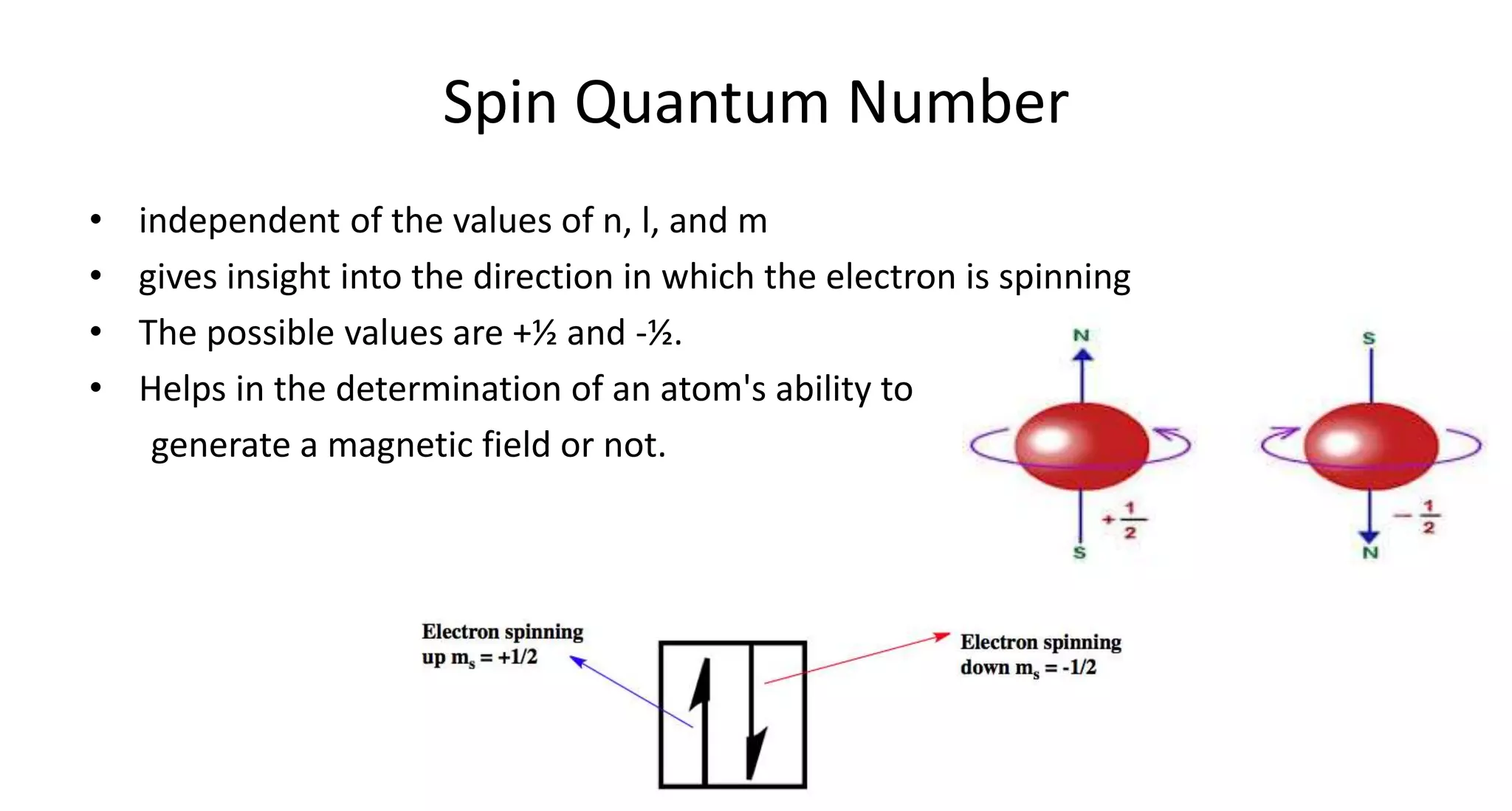
• independent of the values of n, l, and m
• gives insight into the direction in which the electron is spinning
• The possible values are +½ and -½.
• Helps in the determination of an atom's ability to
generate a magnetic field or not.
Summary
Radial Probability function
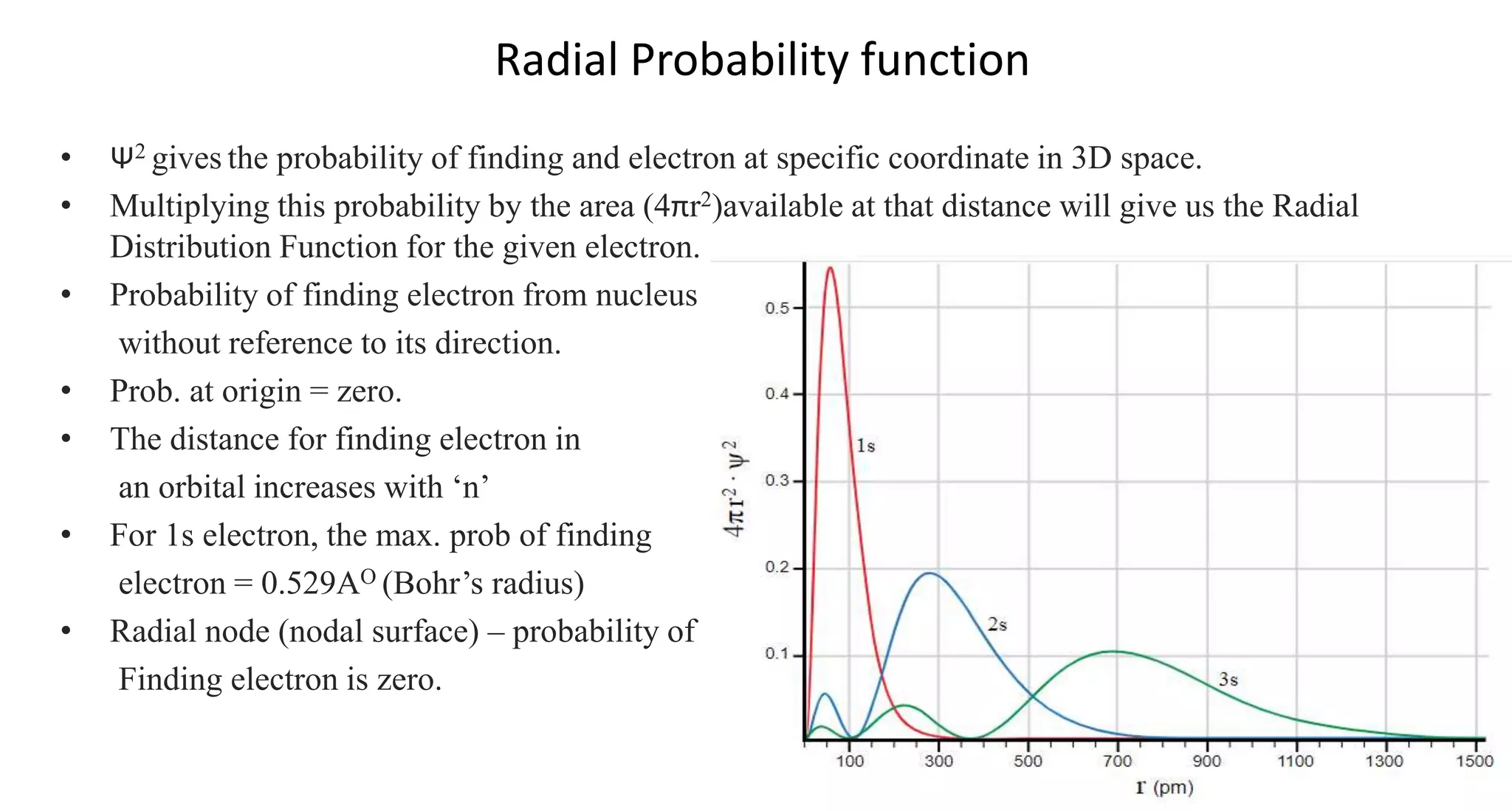
• Ψ2 gives the probability of finding and electron at specific coordinate in 3D space.
• Multiplying this probability by the area (4πr2)available at that distance will give us the Radial
Distribution Function for the given electron.
• Probability of finding electron from nucleus
without reference to its direction.
• Prob. at origin = zero.
• The distance for finding electron in
an orbital increases with ‘n’
• For 1s electron, the max. prob of finding
electron = 0.529AO (Bohr’s radius)
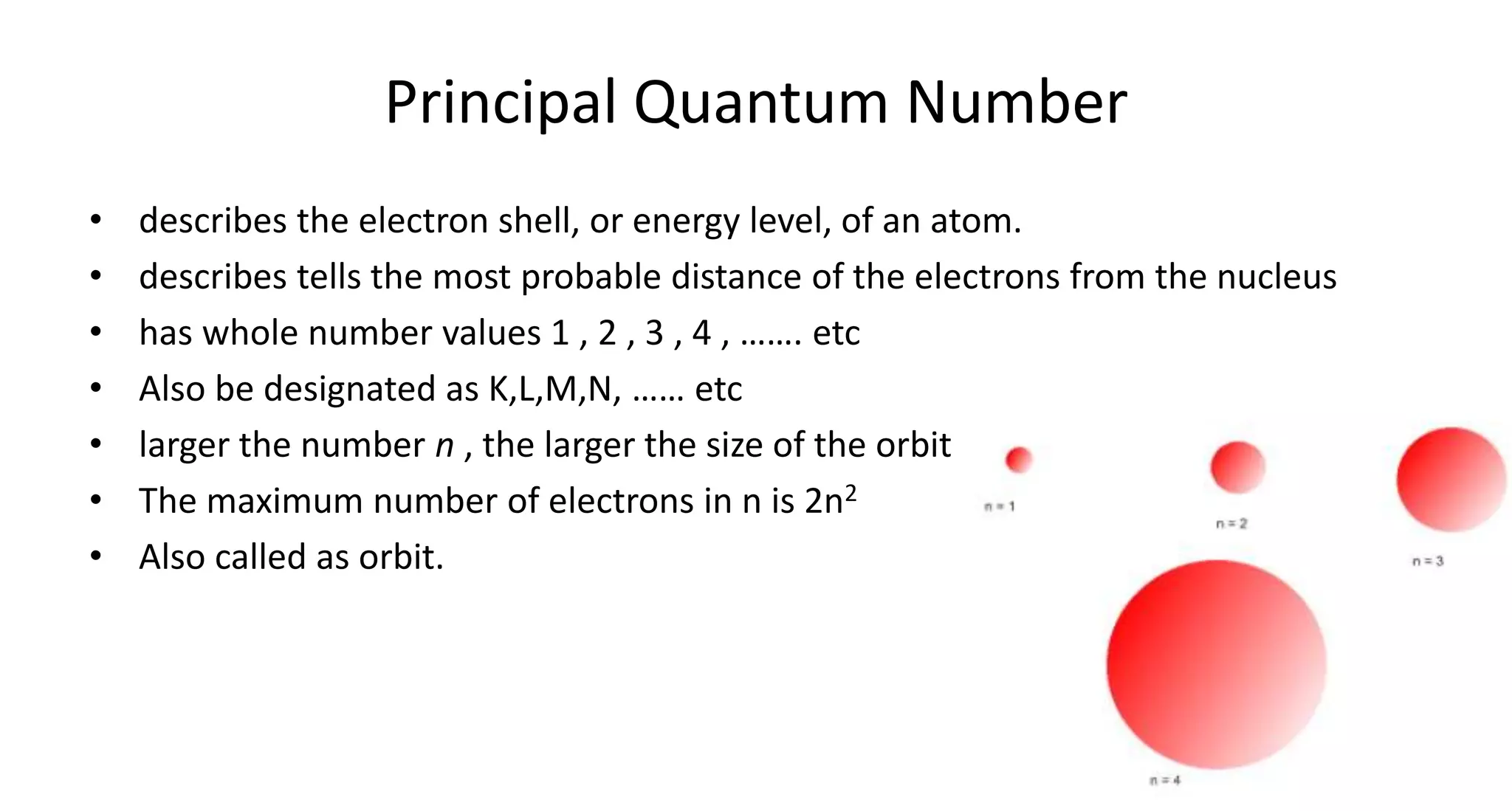
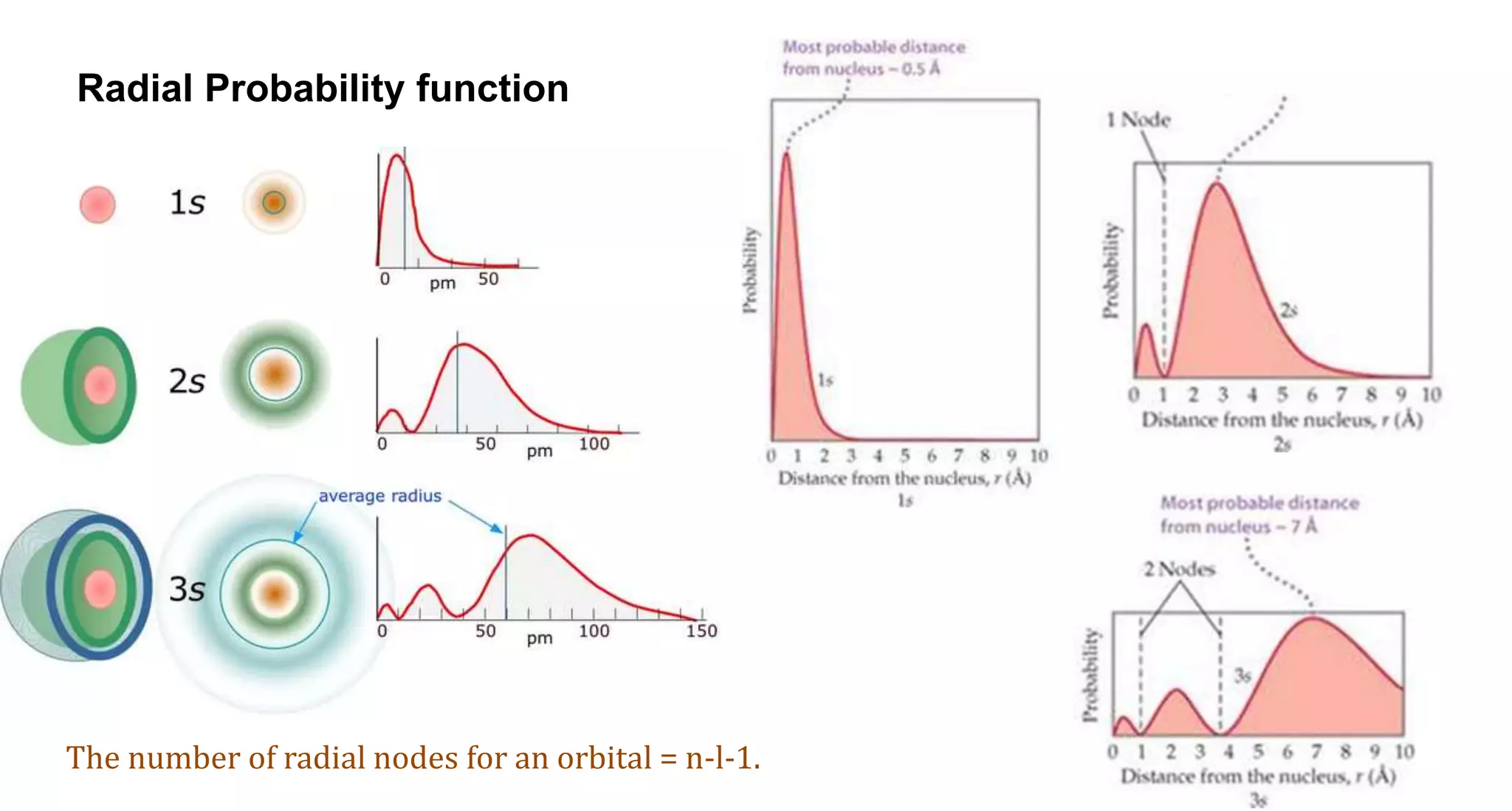
• Radial node (nodal surface) – probability of
Finding electron is zero.
Radial Probability function
The number of radial nodes for an orbital = n-l-1.
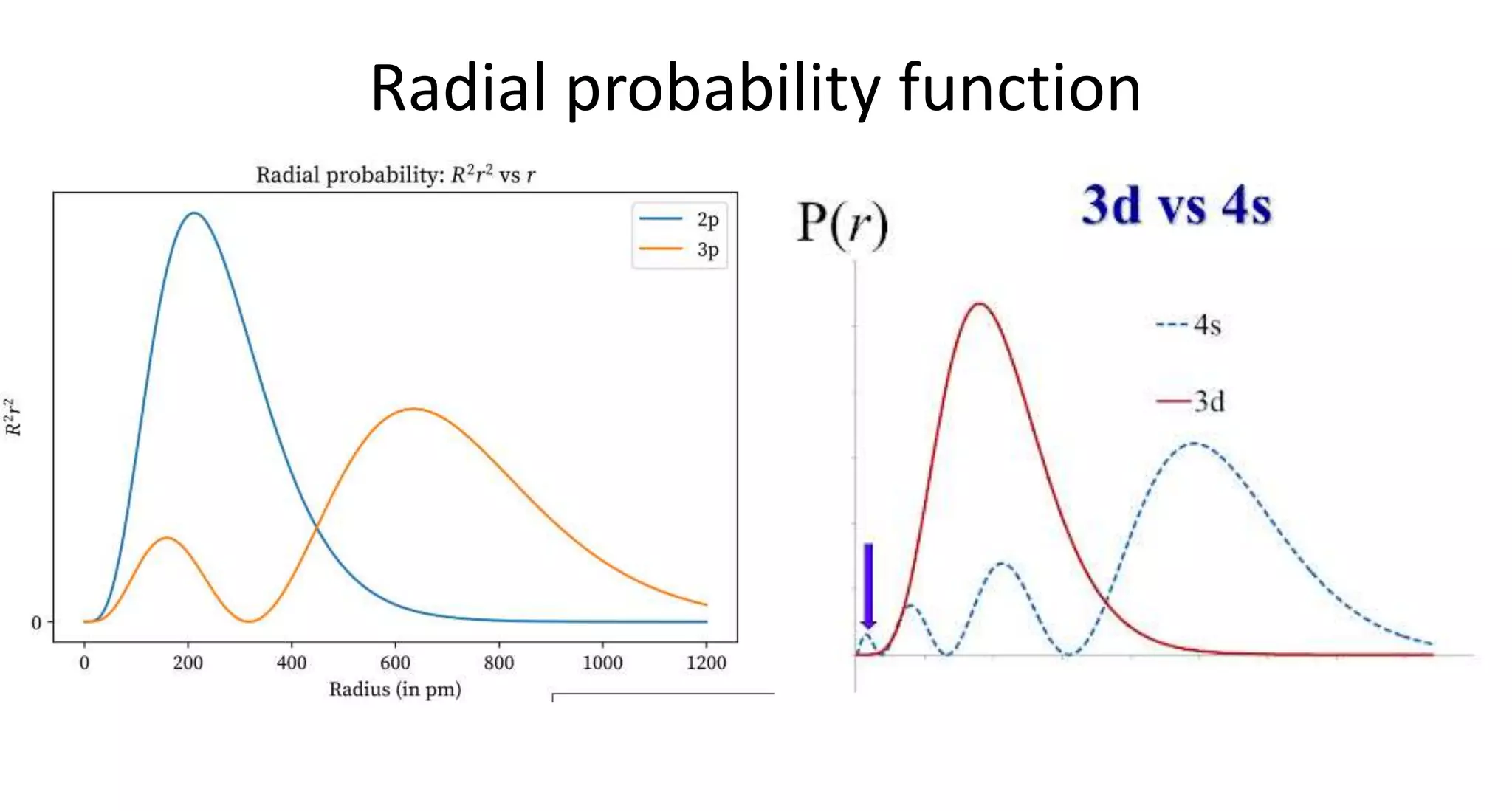
Radial probability function
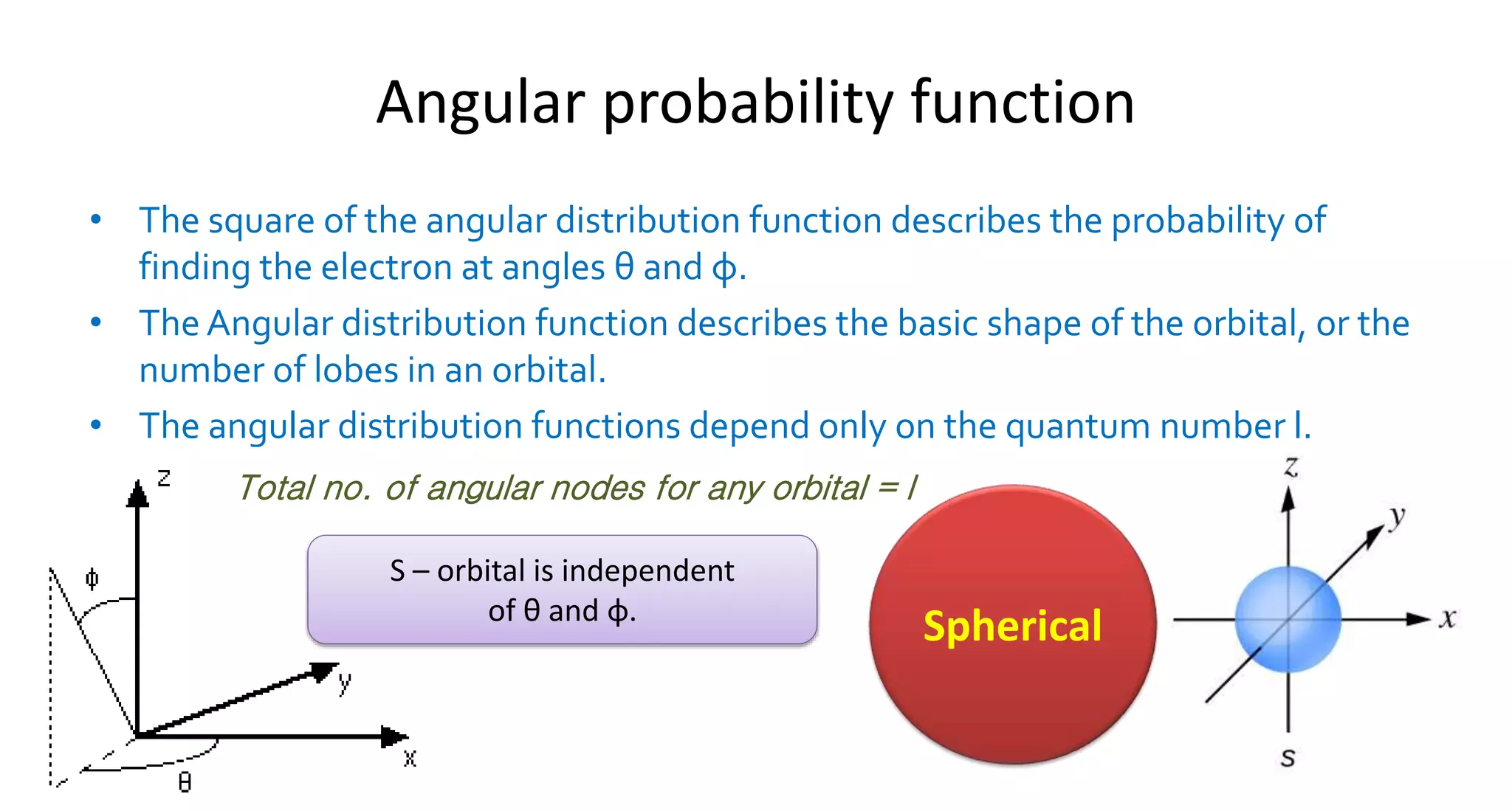
Angular probability function
• The square of the angular distribution function describes the probability of
finding the electron at angles θ and φ.
• The Angular distribution function describes the basic shape of the orbital, or the
number of lobes in an orbital.
• The angular distribution functions depend only on the quantum number l.
Total no. of angular nodes for any orbital = l
S – orbital is independent
of θ and φ.
Spherical
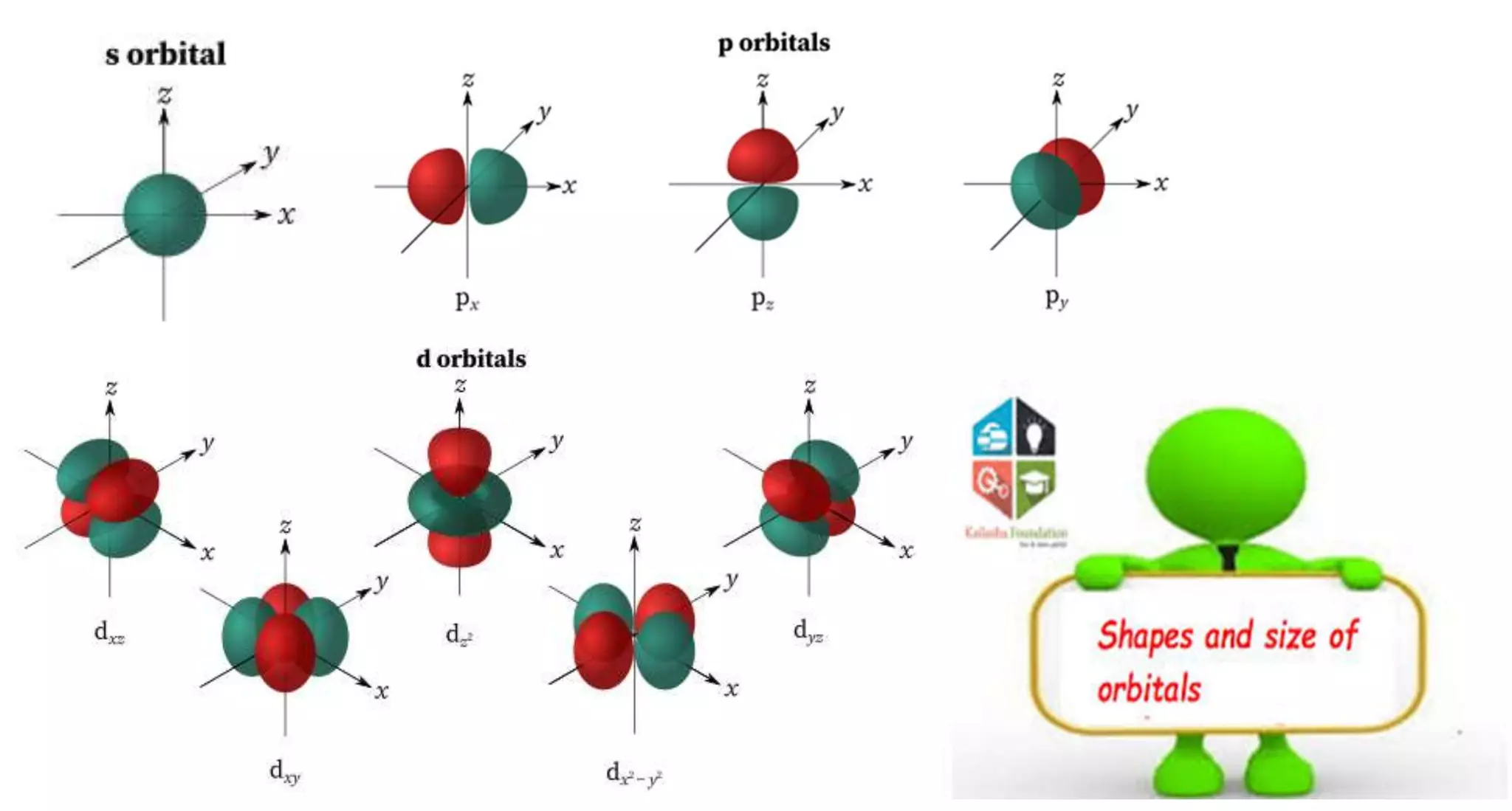
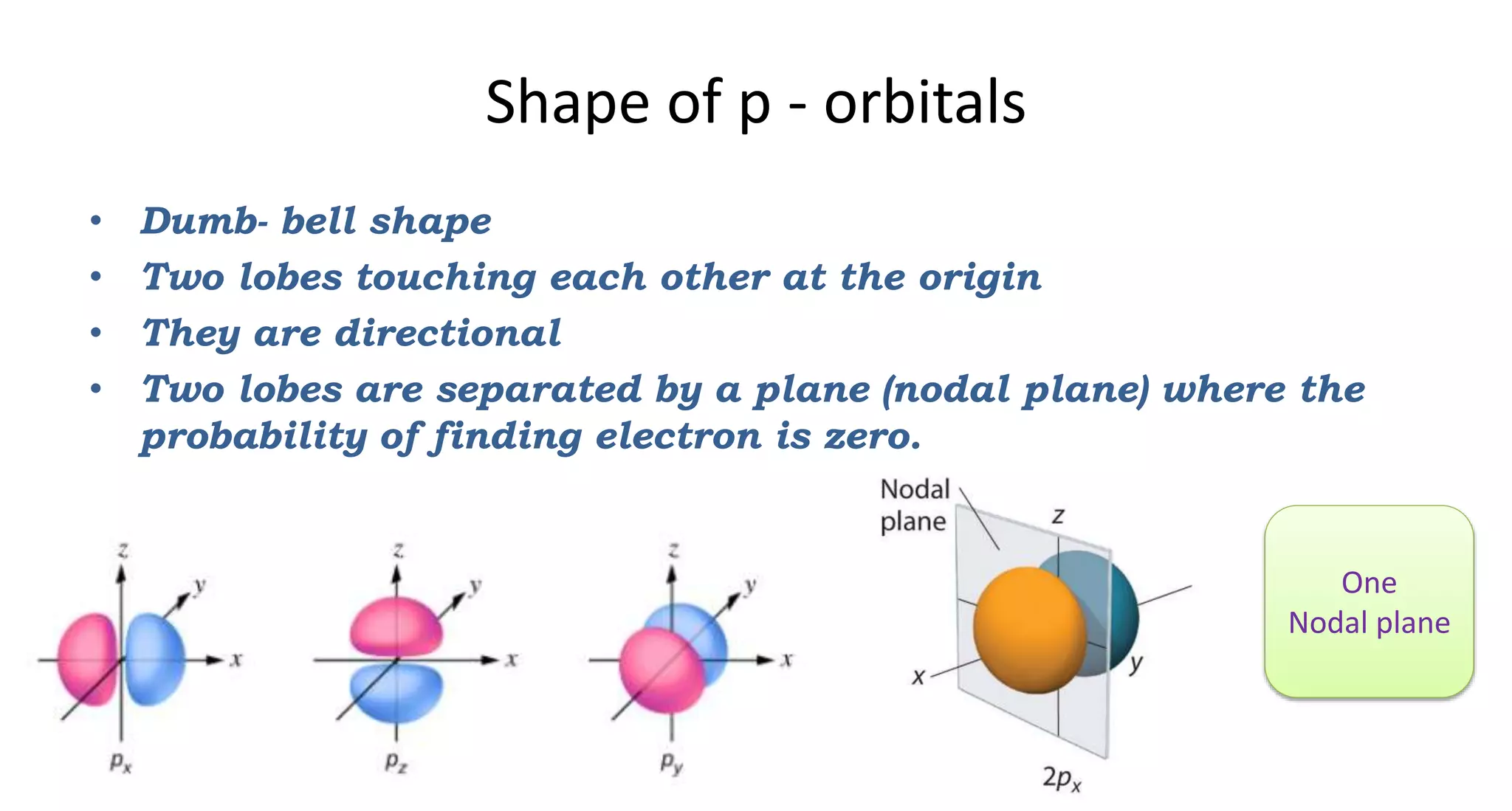
Shape of p - orbitals
• Dumb- bell shape
• Two lobes touching each other at the origin
• They are directional
• Two lobes are separated by a plane (nodal plane) where the
probability of finding electron is zero.
One
Nodal plane
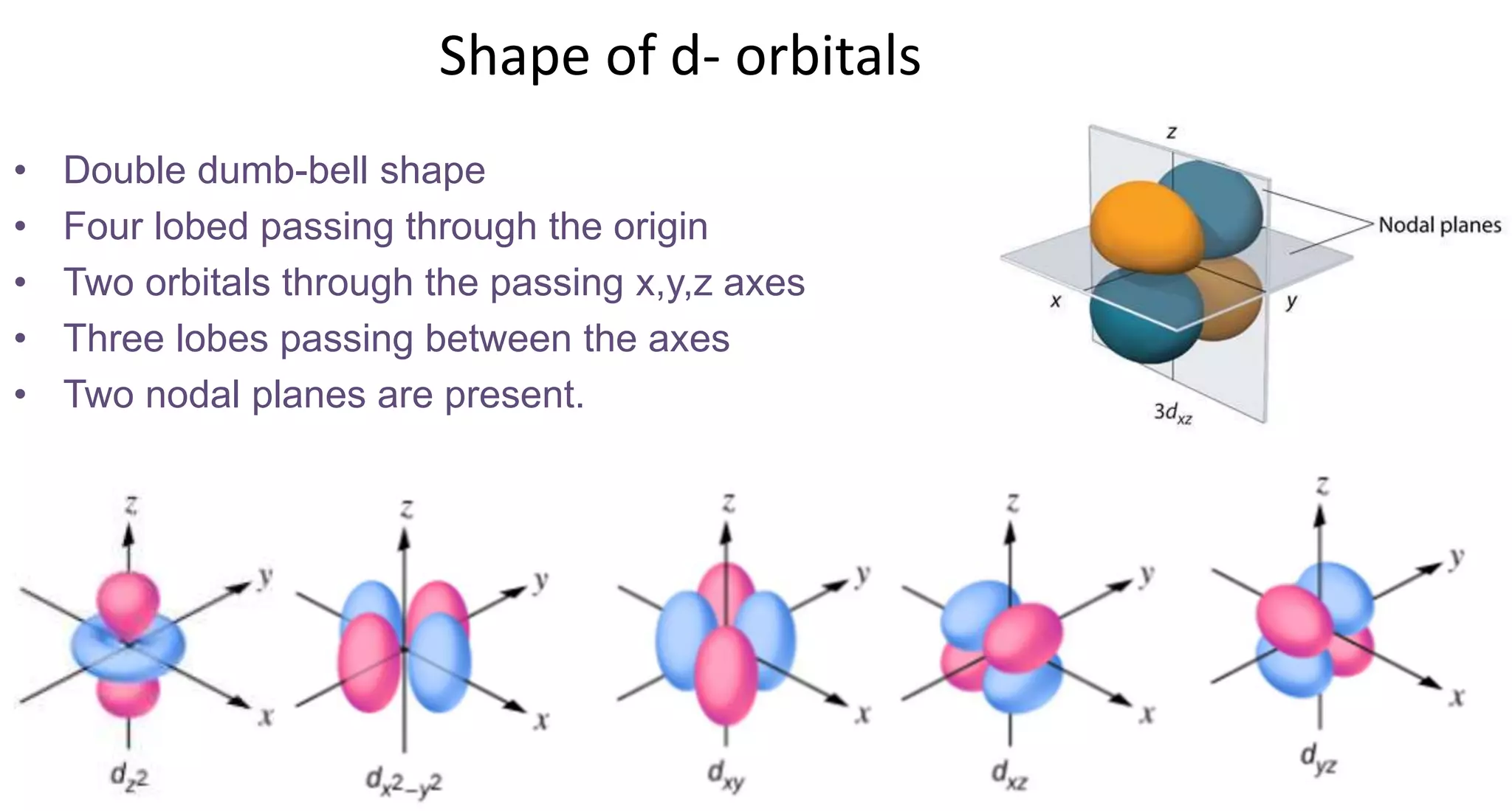
Shape of d- orbitals
• Double dumb-bell shape
• Four lobed passing through the origin
• Two orbitals through the passing x,y,z axes
• Three lobes passing between the axes
• Two nodal planes are present.

Quantum numbers and probability distribution functions

  • 1.
    Quantum numbers &Probability distribution curves
  • 2.
    Quantum numbers • Themathematical solution of Schrodinger’s equation introduced four numbers that were called quantum numbers , to determine the energy of an electron in multi- electron atoms • Used to describe completely the movement and trajectories of each electron within an atom. • Principal Quantum Number (n) • Azimuthal Quantum number (l) • Magnetic Quantum number (m) • Spin Quantum number (s)
  • 3.
    Principal Quantum Number •describes the electron shell, or energy level, of an atom. • describes tells the most probable distance of the electrons from the nucleus • has whole number values 1 , 2 , 3 , 4 , ……. etc • Also be designated as K,L,M,N, …… etc • larger the number n , the larger the size of the orbit • The maximum number of electrons in n is 2n2 • Also called as orbit.
  • 4.
    Azimuthal Quantum Number •Describes the shape of a given orbital. • Each value of l indicates a specific subshell • Subshell has whole number value starting from 0,1,2,3,4,………. • The value of ℓ ranges from 0 to n − 1 • The maximum number of electrons in ℓ is 4ℓ +2 • Symbols of sub-levels , s = 0 , p = 1 , d = 2 , f = 3 • denotes the angular momentum and is given by the formula
  • 5.
    Magnetic Quantum Number •Determines the number of orbitals and their orientation within a subshell • Depends on the azimuthal quantum number l • For a given value of l, the value of ml ranges between the interval -l to +l.
  • 7.
    Spin Quantum Number •independent of the values of n, l, and m • gives insight into the direction in which the electron is spinning • The possible values are +½ and -½. • Helps in the determination of an atom's ability to generate a magnetic field or not.
  • 8.
  • 9.
    Radial Probability function •Ψ2 gives the probability of finding and electron at specific coordinate in 3D space. • Multiplying this probability by the area (4πr2)available at that distance will give us the Radial Distribution Function for the given electron. • Probability of finding electron from nucleus without reference to its direction. • Prob. at origin = zero. • The distance for finding electron in an orbital increases with ‘n’ • For 1s electron, the max. prob of finding electron = 0.529AO (Bohr’s radius) • Radial node (nodal surface) – probability of Finding electron is zero.
  • 10.
    Radial Probability function Thenumber of radial nodes for an orbital = n-l-1.
  • 11.
  • 12.
    Angular probability function •The square of the angular distribution function describes the probability of finding the electron at angles θ and φ. • The Angular distribution function describes the basic shape of the orbital, or the number of lobes in an orbital. • The angular distribution functions depend only on the quantum number l. Total no. of angular nodes for any orbital = l S – orbital is independent of θ and φ. Spherical
  • 13.
    Shape of p- orbitals • Dumb- bell shape • Two lobes touching each other at the origin • They are directional • Two lobes are separated by a plane (nodal plane) where the probability of finding electron is zero. One Nodal plane
  • 14.
    Shape of d-orbitals • Double dumb-bell shape • Four lobed passing through the origin • Two orbitals through the passing x,y,z axes • Three lobes passing between the axes • Two nodal planes are present.