
Chapter 6   Electronic Structure and the Periodic Table
Chapter 2:  Structure of the Atom Nucleus:  protons and neutrons Surrounding the nucleus:  electrons Electron Arrangements in Atoms Energy levels Spatial locations Considerations Single electron in the hydrogen atom Multiple electrons in other atoms
Arranging Electrons in Atoms Electron configuration The electron configuration associates the energy level with the number of electrons in each level Orbital diagrams Orbital diagrams show the arrangement of electrons within each energy level The periodic table Electron configurations can be deduced from the periodic table Properties of atoms can be related to the electron configuration
Atomic Spectra Under certain circumstances, atoms can generate light, which is transmitted through space Fireworks displays Neon lights Sodium vapor streetlights
Fireworks
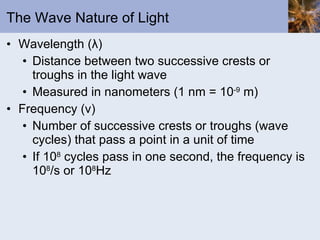
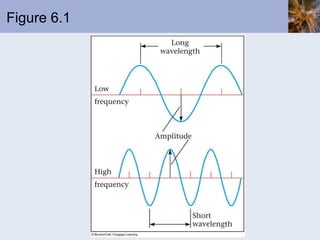
The Wave Nature of Light Wavelength ( λ ) Distance between two successive crests or troughs in the light wave Measured in nanometers (1 nm = 10 -9  m) Frequency ( ν ) Number of successive crests or troughs (wave cycles) that pass a point in a unit of time If 10 8  cycles pass in one second, the frequency is 10 8 /s or 10 8 Hz
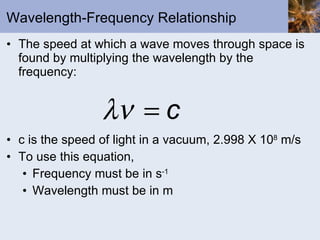
Wavelength-Frequency Relationship The speed at which a wave moves through space is found by multiplying the wavelength by the frequency: c is the speed of light in a vacuum, 2.998 X 10 8  m/s To use this equation,  Frequency must be in s -1 Wavelength must be in m
Figure 6.1
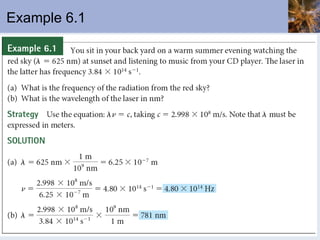
Example 6.1
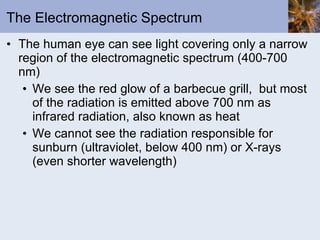
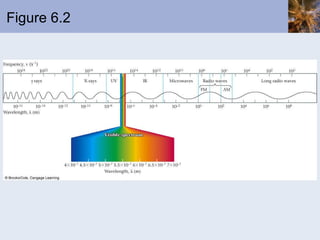
The Electromagnetic Spectrum The human eye can see light covering only a narrow region of the electromagnetic spectrum (400-700 nm) We see the red glow of a barbecue grill,  but most of the radiation is emitted above 700 nm as infrared radiation, also known as heat We cannot see the radiation responsible for sunburn (ultraviolet, below 400 nm) or X-rays (even shorter wavelength)
Figure 6.2
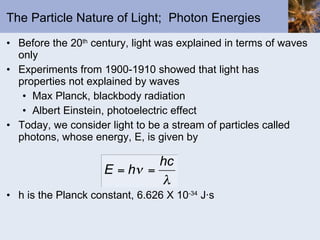
The Particle Nature of Light;  Photon Energies Before the 20 th  century, light was explained in terms of waves only Experiments from 1900-1910 showed that light has properties not explained by waves Max Planck, blackbody radiation Albert Einstein, photoelectric effect Today, we consider light to be a stream of particles called photons, whose energy, E, is given by h is the Planck constant, 6.626 X 10 -34  J · s
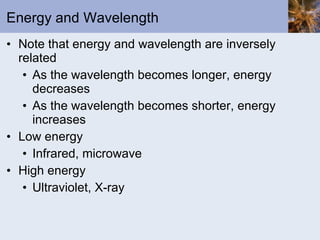
Energy and Wavelength Note that energy and wavelength are inversely related As the wavelength becomes longer, energy decreases As the wavelength becomes shorter, energy increases Low energy Infrared, microwave High energy Ultraviolet, X-ray
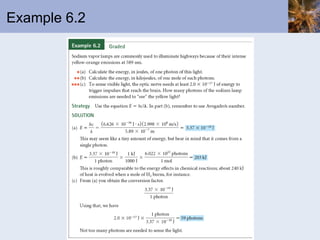
Example 6.2
Atomic Spectra Sir Isaac Newton 17 th  Century Showed that white light from the sun can be separated into color components by a prism The resulting spectrum is  continuous  (unbroken) from 400 to 700 nm
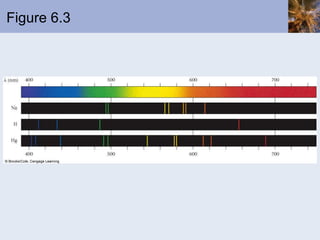
Gaseous Elements Elements can be put in to the gas phase at high energy Resulting emission of light is  not continuous Consider sodium Two strong lines in the yellow region:  589.0 and 589.6 nm Light is colored only  yellow Line Spectra
Figure 6.3
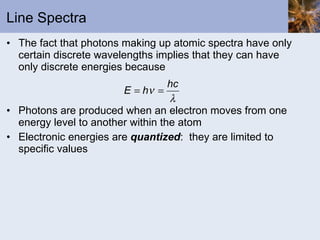
Line Spectra The fact that photons making up atomic spectra have only certain discrete wavelengths implies that they can have only discrete energies because Photons are produced when an electron moves from one energy level to another within the atom Electronic energies are  quantized :  they are limited to specific values
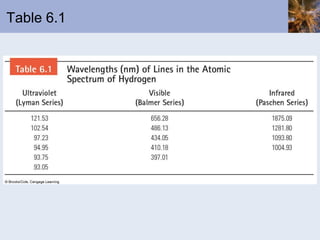
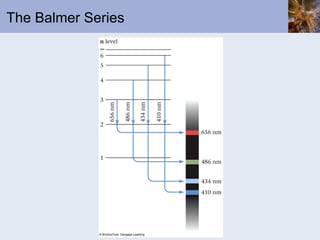
Atomic Spectrum of Hydrogen Hydrogen has a single electron and therefore a simple atomic spectrum Multi-electron atoms have complex spectra When hydrogen is energized at high voltage, atoms emit radiation  Wavelengths can be grouped into series First series was discovered by Johann Balmer (the Balmer Series)
Table 6.1
The Hydrogen Atom Niels Bohr (1885-1962) Theoretical explanation of the hydrogen spectrum 1922 Nobel Prize in physics The Bohr Model Hydrogen consists of a central proton about which moves the electron Electrostatic attraction of proton for electron likened to centrifugal force of circular motion of the electron Electrons occupy fixed orbits around the nucleus
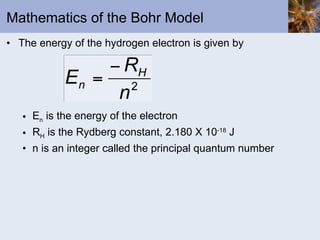
Mathematics of the Bohr Model The energy of the hydrogen electron is given by E n  is the energy of the electron R H  is the Rydberg constant, 2.180 X 10 -18  J n is an integer called the principal quantum number
Notes on the Bohr Model 1.  Zero energy is the point at which the proton and electron are infinitely separated;  energy must be absorbed to reach this state, so all states below it have negative energy. 2.  The ground state is the lowest energy state for the hydrogen atom, where n = 1.  Any n value above 1 corresponds to an excited state. 3.  When an electron emits energy as a photon of light, it falls from a higher n to a lower n.
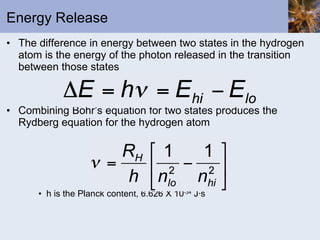
Energy Release The difference in energy between two states in the hydrogen atom is the energy of the photon released in the transition between those states Combining Bohr’s equation for two states produces the Rydberg equation for the hydrogen atom h is the Planck content, 6.626 X 10 -34  J · s
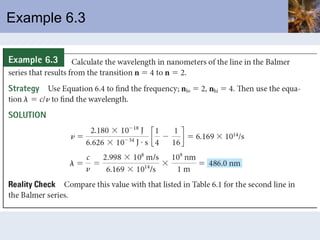
Example 6.3
The Hydrogen Series The lines in the hydrogen spectrum are grouped by the value of nlo: Balmer series has n lo  = 2 Lyman series has n lo  = 1 Paschen series has n lo  = 3
The Balmer Series
The Quantum Mechanical Model Bohr’s theory explains the hydrogen atom very well When applied to atoms with two or more electrons, the theory gives only qualitative agreement with experimental data
Matter as Waves deBroglie, 1892-1987 If light, which is ordinarily considered a wave, can have the properties of a particle, then electrons, which are ordinarily considered particles, can have the properties of a wave The result was a new branch of physics called  wave mechanics , which evolved into  quantum mechanics
Fundamental Principles of Quantum Mechanics The kinetic energy of an electron is inversely related to the volume of the region in space to which it is confined The kinetic energy increase from the shrinking volume of an electron moving toward the nucleus balances the electrostatic attraction to prevent the electron from falling into the nucleus It is impossible to specify the exact position of an electron at a given instant We can only specify the probability of finding an electron in a particular region of space
Schrodinger Erwin Schrodinger (1887-1961) 1926 Wrote a differential equation to express the wave properties of an atom Ψ  is called the wave function It is possible to find the amplitude of the electron wave at various points in space Ψ 2  is proportional to the probability of finding an electron at a particular point in space
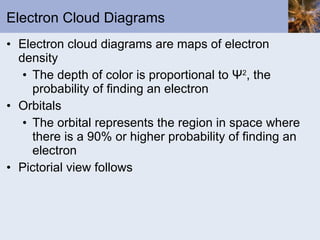
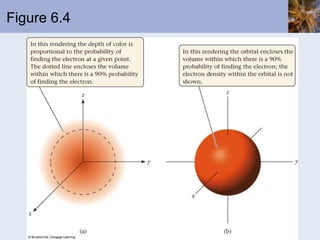
Electron Cloud Diagrams Electron cloud diagrams are maps of electron density The depth of color is proportional to  Ψ 2 , the probability of finding an electron Orbitals The orbital represents the region in space where there is a 90% or higher probability of finding an electron Pictorial view follows
Figure 6.4
Quantum Numbers The Schrodinger equation can be solved exactly only for the hydrogen atom Approximations allow for solutions of the equation relevant to atoms with two or more electrons The solutions result in orbitals, which have an energy, a shape and an orientation in space The solutions result in three  quantum numbers : n ℓ  m ℓ
First Quantum Number, n The principal energy level is specified by the first quantum number, n n = 1, 2, 3, 4, … n = 1 is the first principal level n = 2 is the second principal level, and so on …
The Second Quantum Number, ℓ  Each principal energy level (specified by n) has one or more sublevels The sublevel is specified by the quantum number ℓ  ℓ  is derived from n: ℓ  = 0, 1, 2 … (n-1) In the nth principal level, there are n sublevels Instead of using numbers, the sublevels are given letter designations For ℓ = 0, 1, 2, 3  we use  s, p, d, f
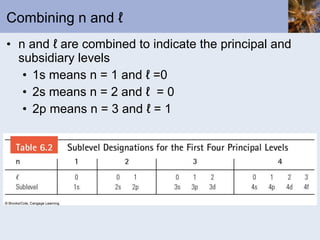
Combining n and ℓ  n and ℓ are combined to indicate the principal and subsidiary levels 1s means n = 1 and ℓ =0 2s means n = 2 and ℓ  = 0 2p means n = 3 and ℓ = 1
Relative Energy For atoms with more than one electron, the energy is dependent on both n and ℓ  ns < np < nd < nf Recall that as n increases, energy increases 2s is higher energy than 1s Combining both 2p is higher energy than 2s
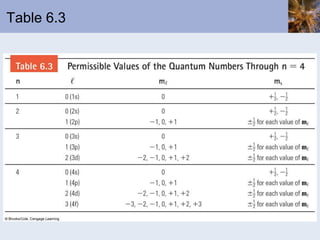
The Third Quantum Number, m ℓ   Each sublevel contains one or more orbitals, which differ from one another in the value of the third quantum number, m ℓ Just as ℓ depends on n, m ℓ  depends on ℓ m ℓ  = ℓ … -1, 0, +1, … + ℓ There are 2ℓ + 1 orbitals per sublevel
Sublevels s through f For an s sublevel, ℓ = 0, so m ℓ  = 0 For a p sublevel, ℓ = 1 so m ℓ  = -1, 0, or 1 For a d sublevel, ℓ = 2 so m ℓ  = -2, -1, 0, 1, or 2 For an f sublevel, ℓ = 3 so m ℓ  = -3, -2, -1, 0, 1, 2 or 3
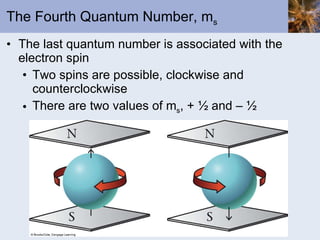
The Fourth Quantum Number, m s The last quantum number is associated with the electron spin Two spins are possible, clockwise and counterclockwise There are two values of m s , + ½ and – ½
The Pauli Exclusion Principle No two electrons in the same atom may have the same set of four quantum numbers Two electrons may occupy an orbital;  these will differ in spin The spins of two electrons in an orbital will be opposite to each other
Table 6.3
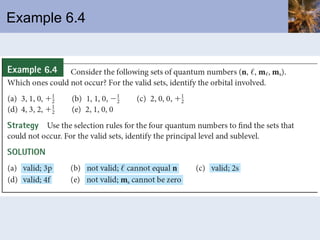
Example 6.4
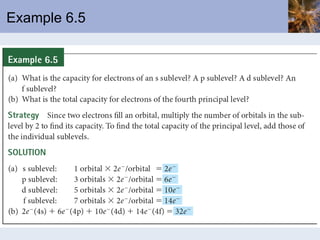
Example 6.5
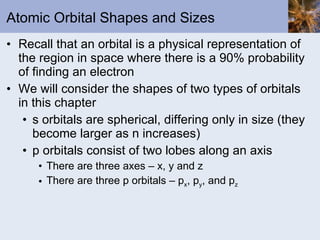
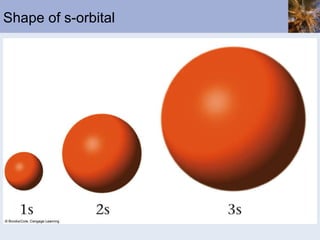
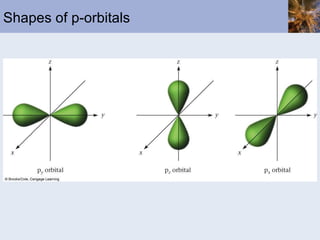
Atomic Orbital Shapes and Sizes Recall that an orbital is a physical representation of the region in space where there is a 90% probability of finding an electron We will consider the shapes of two types of orbitals in this chapter s orbitals are spherical, differing only in size (they become larger as n increases) p orbitals consist of two lobes along an axis There are three axes – x, y and z There are three p orbitals – p x , p y , and p z
Shape of s-orbital
Shapes of p-orbitals
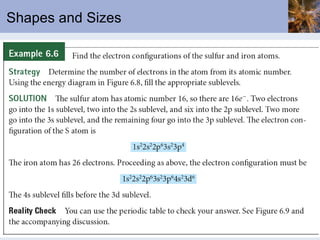
Shapes and Sizes
Shapes and Sizes (cont'd)
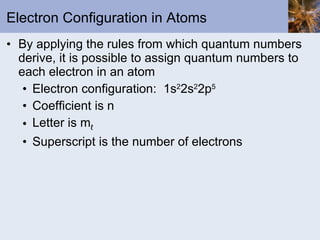
Electron Configuration in Atoms By applying the rules from which quantum numbers derive, it is possible to assign quantum numbers to each electron in an atom Electron configuration:  1s 2 2s 2 2p 5 Coefficient is n Letter is m ℓ Superscript is the number of electrons
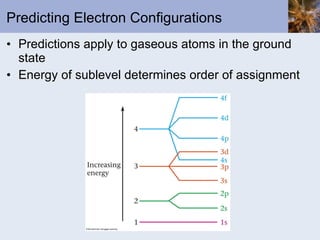
Predicting Electron Configurations Predictions apply to gaseous atoms in the ground state Energy of sublevel determines order of assignment
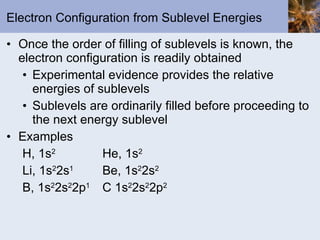
Electron Configuration from Sublevel Energies Once the order of filling of sublevels is known, the electron configuration is readily obtained Experimental evidence provides the relative energies of sublevels Sublevels are ordinarily filled before proceeding to the next energy sublevel Examples H, 1s 2 He, 1s 2 Li, 1s 2 2s 1 Be, 1s 2 2s 2 B, 1s 2 2s 2 2p 1 C 1s 2 2s 2 2p 2
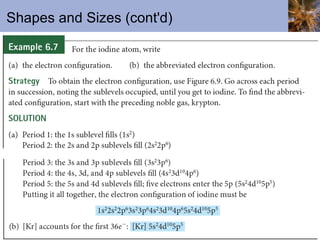
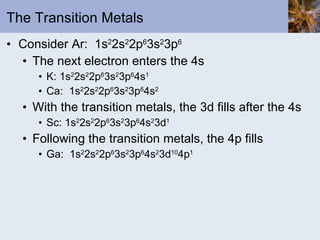
The Transition Metals Consider Ar:  1s 2 2s 2 2p 6 3s 2 3p 6 The next electron enters the 4s K: 1s 2 2s 2 2p 6 3s 2 3p 6 4s 1 Ca:  1s 2 2s 2 2p 6 3s 2 3p 6 4s 2 With the transition metals, the 3d fills after the 4s Sc: 1s 2 2s 2 2p 6 3s 2 3p 6 4s 2 3d 1 Following the transition metals, the 4p fills Ga:  1s 2 2s 2 2p 6 3s 2 3p 6 4s 2 3d 10 4p 1
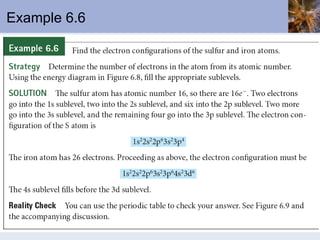
Example 6.6
Abbreviated Electron Configurations To save writing, abbreviated electron configurations are written Start with the preceding noble gas Complete the configuration with the rest of the electrons in the element S is [Ne]3s 2 3p 4 Ni is [Ar]4s 2 3d 8
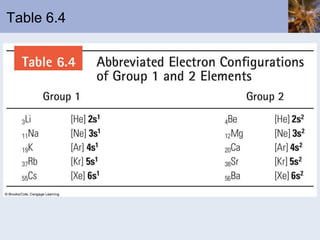
Filling of Sublevels and the Periodic Table By using the periodic table, it is possible to quickly write an electron configuration for any element Consider the Group 1 elements All have the outer configuration s 1 Consider the Group 2 elements All have the outer configuration s 2 Atoms of elements in a group have the same distribution of electrons in the outermost principal energy level
Table 6.4
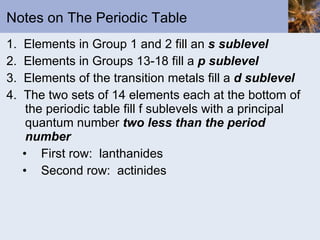
Notes on The Periodic Table 1.  Elements in Group 1 and 2 fill an  s sublevel 2.  Elements in Groups 13-18 fill a  p sublevel 3.  Elements of the transition metals fill a  d sublevel 4.  The two sets of 14 elements each at the bottom of the periodic table fill f sublevels with a principal quantum number  two less than the period number First row:  lanthanides Second row:  actinides
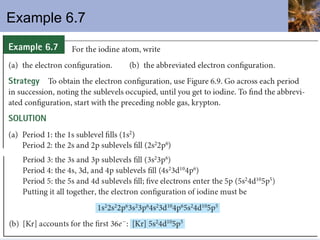
Example 6.7
Exceptions Some elements have electron configurations that differ from those expected from the application of the rules we have seen Cr is actually [Ar]4s 1 3d 5 Cu is actually [Ar]4s 1 3d 10 These difference arise because The energy levels of the orbitals are close to each other There is a gain in stability by producing a half-filled or a filled shell where possible
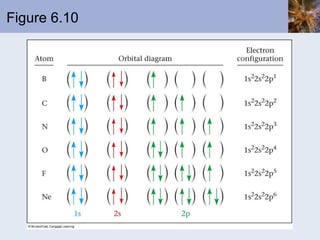
Orbital Diagrams of Atoms One step beyond the assignment of electrons to orbitals is the depiction of electrons in orbitals Parentheses indicate orbitals (__) Arrows, up and down, indicate electrons ( ↑↓) Recall the ms quantum number One electron in an atom has m s  = ½ and the other has m s  = - ½ Hund’s Rule Maximize unpaired spins where possible
Figure 6.10
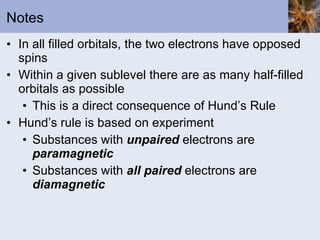
Notes In all filled orbitals, the two electrons have opposed spins Within a given sublevel there are as many half-filled orbitals as possible This is a direct consequence of Hund’s Rule Hund’s rule is based on experiment Substances with  unpaired  electrons are  paramagnetic Substances with  all paired  electrons are  diamagnetic
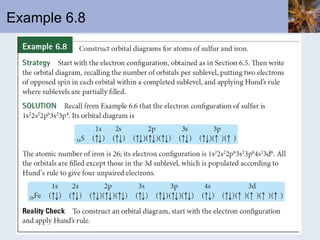
Example 6.8
Electron Arrangements in Monatomic Ions In forming an ion, electrons are  removed from (cation)  or  added to (anion)  sublevels in the highest principal energy level
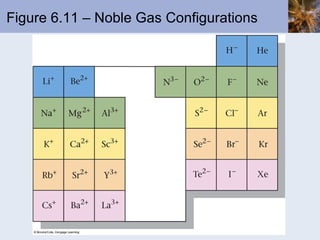
Main Group Ions and Noble Gas Structures Cations of Group 1 form +1 ions Cations of Group 2 from +2 ions Nitrogen forms a -3 ion Elements in the oxygen family form -2 ions Halogens form -1 ions
Figure 6.11 – Noble Gas Configurations
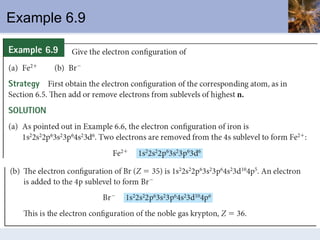
Transition Metal Cations Transition metal cations do not form ions with noble-gas configurations Cations do form, with charges ranging from +1 to higher numbers The outer s electrons are lost before the d electrons;  this is the first-in, first-out rule Consider Mn Mn is [Ar]4s 2 3d 5 Mn 2+  is [Ar]3d 5
Example 6.9
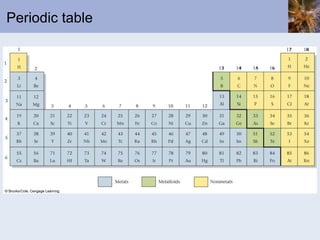
Periodic table
Periodic Trends The chemical and physical properties of elements are a periodic function of atomic number Recall that the number of electrons is equal to the atomic number of an element Properties to be considered Atomic radius (and ionic radius) Ionization energy Electronegativity
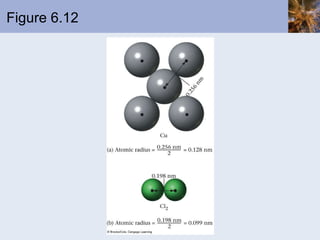
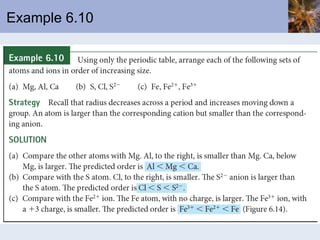
Atomic Radius The “size” of an atom is a difficult to define term The radius of an atom can be defined and measured, assuming the atom is a sphere The trend for the radius of the atom is A decrease in radius across a period An increase in radius down a group
Figure 6.12
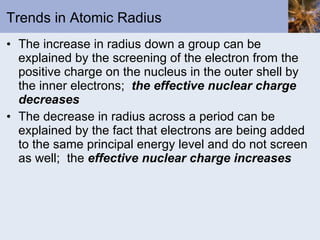
Trends in Atomic Radius The increase in radius down a group can be explained by the screening of the electron from the positive charge on the nucleus in the outer shell by the inner electrons;  the effective nuclear charge decreases The decrease in radius across a period can be explained by the fact that electrons are being added to the same principal energy level and do not screen as well;  the  effective nuclear charge increases
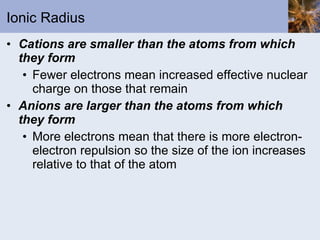
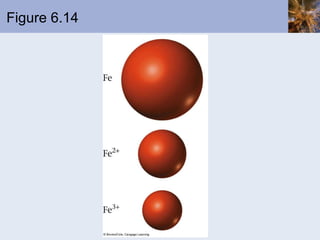
Ionic Radius Cations are smaller than the atoms from which they form Fewer electrons mean increased effective nuclear charge on those that remain Anions are larger than the atoms from which they form More electrons mean that there is more electron-electron repulsion so the size of the ion increases relative to that of the atom
Figure 6.14
Example 6.10
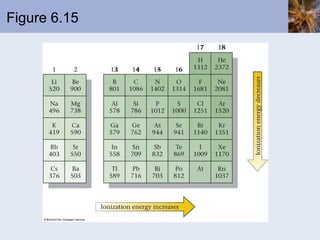
Ionization Energy The ionization energy is a measure of difficulty in removing an electron from a gaseous atom M (g)    M +  (g) + e - Ionization energy increases across a period from left to right Ionization energy decreases down a family from top to bottom
Figure 6.15
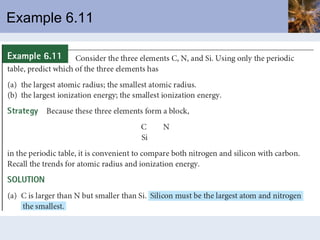
Example 6.11
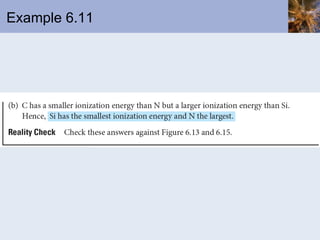
Example 6.11
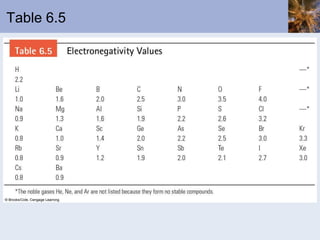
Electronegativity Electronegativity is the ability of an atom to attract electrons Linus Pauling Fluorine is the most electronegative element Cs is the least electronegative element As electronegativity increases, the formation of an anion becomes more likely Trends Electronegativity increases across a period Electronegativity decreases down a family
Table 6.5
Key Concepts 1.  Relate wavelength, frequency and energy 2.  Identify the quantum numbers of electrons in atoms 3.  Derive the electron capacity of energy levels 4.  Write electron configurations, full and abbreviated, for atoms and ions 5.  Draw orbital diagrams for atoms and ions 6.  Identify periodic trends in radii, ionization energy and electronegativity

Chapter6

  • 1.
    Chapter 6 Electronic Structure and the Periodic Table
  • 2.
    Chapter 2: Structure of the Atom Nucleus: protons and neutrons Surrounding the nucleus: electrons Electron Arrangements in Atoms Energy levels Spatial locations Considerations Single electron in the hydrogen atom Multiple electrons in other atoms
  • 3.
    Arranging Electrons inAtoms Electron configuration The electron configuration associates the energy level with the number of electrons in each level Orbital diagrams Orbital diagrams show the arrangement of electrons within each energy level The periodic table Electron configurations can be deduced from the periodic table Properties of atoms can be related to the electron configuration
  • 4.
    Atomic Spectra Undercertain circumstances, atoms can generate light, which is transmitted through space Fireworks displays Neon lights Sodium vapor streetlights
  • 5.
  • 6.
    The Wave Natureof Light Wavelength ( λ ) Distance between two successive crests or troughs in the light wave Measured in nanometers (1 nm = 10 -9 m) Frequency ( ν ) Number of successive crests or troughs (wave cycles) that pass a point in a unit of time If 10 8 cycles pass in one second, the frequency is 10 8 /s or 10 8 Hz
  • 7.
    Wavelength-Frequency Relationship Thespeed at which a wave moves through space is found by multiplying the wavelength by the frequency: c is the speed of light in a vacuum, 2.998 X 10 8 m/s To use this equation, Frequency must be in s -1 Wavelength must be in m
  • 8.
  • 9.
  • 10.
    The Electromagnetic SpectrumThe human eye can see light covering only a narrow region of the electromagnetic spectrum (400-700 nm) We see the red glow of a barbecue grill, but most of the radiation is emitted above 700 nm as infrared radiation, also known as heat We cannot see the radiation responsible for sunburn (ultraviolet, below 400 nm) or X-rays (even shorter wavelength)
  • 11.
  • 12.
    The Particle Natureof Light; Photon Energies Before the 20 th century, light was explained in terms of waves only Experiments from 1900-1910 showed that light has properties not explained by waves Max Planck, blackbody radiation Albert Einstein, photoelectric effect Today, we consider light to be a stream of particles called photons, whose energy, E, is given by h is the Planck constant, 6.626 X 10 -34 J · s
  • 13.
    Energy and WavelengthNote that energy and wavelength are inversely related As the wavelength becomes longer, energy decreases As the wavelength becomes shorter, energy increases Low energy Infrared, microwave High energy Ultraviolet, X-ray
  • 14.
  • 15.
    Atomic Spectra SirIsaac Newton 17 th Century Showed that white light from the sun can be separated into color components by a prism The resulting spectrum is continuous (unbroken) from 400 to 700 nm
  • 16.
    Gaseous Elements Elementscan be put in to the gas phase at high energy Resulting emission of light is not continuous Consider sodium Two strong lines in the yellow region: 589.0 and 589.6 nm Light is colored only yellow Line Spectra
  • 17.
  • 18.
    Line Spectra Thefact that photons making up atomic spectra have only certain discrete wavelengths implies that they can have only discrete energies because Photons are produced when an electron moves from one energy level to another within the atom Electronic energies are quantized : they are limited to specific values
  • 19.
    Atomic Spectrum ofHydrogen Hydrogen has a single electron and therefore a simple atomic spectrum Multi-electron atoms have complex spectra When hydrogen is energized at high voltage, atoms emit radiation Wavelengths can be grouped into series First series was discovered by Johann Balmer (the Balmer Series)
  • 20.
  • 21.
    The Hydrogen AtomNiels Bohr (1885-1962) Theoretical explanation of the hydrogen spectrum 1922 Nobel Prize in physics The Bohr Model Hydrogen consists of a central proton about which moves the electron Electrostatic attraction of proton for electron likened to centrifugal force of circular motion of the electron Electrons occupy fixed orbits around the nucleus
  • 22.
    Mathematics of theBohr Model The energy of the hydrogen electron is given by E n is the energy of the electron R H is the Rydberg constant, 2.180 X 10 -18 J n is an integer called the principal quantum number
  • 23.
    Notes on theBohr Model 1. Zero energy is the point at which the proton and electron are infinitely separated; energy must be absorbed to reach this state, so all states below it have negative energy. 2. The ground state is the lowest energy state for the hydrogen atom, where n = 1. Any n value above 1 corresponds to an excited state. 3. When an electron emits energy as a photon of light, it falls from a higher n to a lower n.
  • 24.
    Energy Release Thedifference in energy between two states in the hydrogen atom is the energy of the photon released in the transition between those states Combining Bohr’s equation for two states produces the Rydberg equation for the hydrogen atom h is the Planck content, 6.626 X 10 -34 J · s
  • 25.
  • 26.
    The Hydrogen SeriesThe lines in the hydrogen spectrum are grouped by the value of nlo: Balmer series has n lo = 2 Lyman series has n lo = 1 Paschen series has n lo = 3
  • 27.
  • 28.
    The Quantum MechanicalModel Bohr’s theory explains the hydrogen atom very well When applied to atoms with two or more electrons, the theory gives only qualitative agreement with experimental data
  • 29.
    Matter as WavesdeBroglie, 1892-1987 If light, which is ordinarily considered a wave, can have the properties of a particle, then electrons, which are ordinarily considered particles, can have the properties of a wave The result was a new branch of physics called wave mechanics , which evolved into quantum mechanics
  • 30.
    Fundamental Principles ofQuantum Mechanics The kinetic energy of an electron is inversely related to the volume of the region in space to which it is confined The kinetic energy increase from the shrinking volume of an electron moving toward the nucleus balances the electrostatic attraction to prevent the electron from falling into the nucleus It is impossible to specify the exact position of an electron at a given instant We can only specify the probability of finding an electron in a particular region of space
  • 31.
    Schrodinger Erwin Schrodinger(1887-1961) 1926 Wrote a differential equation to express the wave properties of an atom Ψ is called the wave function It is possible to find the amplitude of the electron wave at various points in space Ψ 2 is proportional to the probability of finding an electron at a particular point in space
  • 32.
    Electron Cloud DiagramsElectron cloud diagrams are maps of electron density The depth of color is proportional to Ψ 2 , the probability of finding an electron Orbitals The orbital represents the region in space where there is a 90% or higher probability of finding an electron Pictorial view follows
  • 33.
  • 34.
    Quantum Numbers TheSchrodinger equation can be solved exactly only for the hydrogen atom Approximations allow for solutions of the equation relevant to atoms with two or more electrons The solutions result in orbitals, which have an energy, a shape and an orientation in space The solutions result in three quantum numbers : n ℓ m ℓ
  • 35.
    First Quantum Number,n The principal energy level is specified by the first quantum number, n n = 1, 2, 3, 4, … n = 1 is the first principal level n = 2 is the second principal level, and so on …
  • 36.
    The Second QuantumNumber, ℓ Each principal energy level (specified by n) has one or more sublevels The sublevel is specified by the quantum number ℓ ℓ is derived from n: ℓ = 0, 1, 2 … (n-1) In the nth principal level, there are n sublevels Instead of using numbers, the sublevels are given letter designations For ℓ = 0, 1, 2, 3 we use s, p, d, f
  • 37.
    Combining n andℓ n and ℓ are combined to indicate the principal and subsidiary levels 1s means n = 1 and ℓ =0 2s means n = 2 and ℓ = 0 2p means n = 3 and ℓ = 1
  • 38.
    Relative Energy Foratoms with more than one electron, the energy is dependent on both n and ℓ ns < np < nd < nf Recall that as n increases, energy increases 2s is higher energy than 1s Combining both 2p is higher energy than 2s
  • 39.
    The Third QuantumNumber, m ℓ Each sublevel contains one or more orbitals, which differ from one another in the value of the third quantum number, m ℓ Just as ℓ depends on n, m ℓ depends on ℓ m ℓ = ℓ … -1, 0, +1, … + ℓ There are 2ℓ + 1 orbitals per sublevel
  • 40.
    Sublevels s throughf For an s sublevel, ℓ = 0, so m ℓ = 0 For a p sublevel, ℓ = 1 so m ℓ = -1, 0, or 1 For a d sublevel, ℓ = 2 so m ℓ = -2, -1, 0, 1, or 2 For an f sublevel, ℓ = 3 so m ℓ = -3, -2, -1, 0, 1, 2 or 3
  • 41.
    The Fourth QuantumNumber, m s The last quantum number is associated with the electron spin Two spins are possible, clockwise and counterclockwise There are two values of m s , + ½ and – ½
  • 42.
    The Pauli ExclusionPrinciple No two electrons in the same atom may have the same set of four quantum numbers Two electrons may occupy an orbital; these will differ in spin The spins of two electrons in an orbital will be opposite to each other
  • 43.
  • 44.
  • 45.
  • 46.
    Atomic Orbital Shapesand Sizes Recall that an orbital is a physical representation of the region in space where there is a 90% probability of finding an electron We will consider the shapes of two types of orbitals in this chapter s orbitals are spherical, differing only in size (they become larger as n increases) p orbitals consist of two lobes along an axis There are three axes – x, y and z There are three p orbitals – p x , p y , and p z
  • 47.
  • 48.
  • 49.
  • 50.
  • 51.
    Electron Configuration inAtoms By applying the rules from which quantum numbers derive, it is possible to assign quantum numbers to each electron in an atom Electron configuration: 1s 2 2s 2 2p 5 Coefficient is n Letter is m ℓ Superscript is the number of electrons
  • 52.
    Predicting Electron ConfigurationsPredictions apply to gaseous atoms in the ground state Energy of sublevel determines order of assignment
  • 53.
    Electron Configuration fromSublevel Energies Once the order of filling of sublevels is known, the electron configuration is readily obtained Experimental evidence provides the relative energies of sublevels Sublevels are ordinarily filled before proceeding to the next energy sublevel Examples H, 1s 2 He, 1s 2 Li, 1s 2 2s 1 Be, 1s 2 2s 2 B, 1s 2 2s 2 2p 1 C 1s 2 2s 2 2p 2
  • 54.
    The Transition MetalsConsider Ar: 1s 2 2s 2 2p 6 3s 2 3p 6 The next electron enters the 4s K: 1s 2 2s 2 2p 6 3s 2 3p 6 4s 1 Ca: 1s 2 2s 2 2p 6 3s 2 3p 6 4s 2 With the transition metals, the 3d fills after the 4s Sc: 1s 2 2s 2 2p 6 3s 2 3p 6 4s 2 3d 1 Following the transition metals, the 4p fills Ga: 1s 2 2s 2 2p 6 3s 2 3p 6 4s 2 3d 10 4p 1
  • 55.
  • 56.
    Abbreviated Electron ConfigurationsTo save writing, abbreviated electron configurations are written Start with the preceding noble gas Complete the configuration with the rest of the electrons in the element S is [Ne]3s 2 3p 4 Ni is [Ar]4s 2 3d 8
  • 57.
    Filling of Sublevelsand the Periodic Table By using the periodic table, it is possible to quickly write an electron configuration for any element Consider the Group 1 elements All have the outer configuration s 1 Consider the Group 2 elements All have the outer configuration s 2 Atoms of elements in a group have the same distribution of electrons in the outermost principal energy level
  • 58.
  • 59.
    Notes on ThePeriodic Table 1. Elements in Group 1 and 2 fill an s sublevel 2. Elements in Groups 13-18 fill a p sublevel 3. Elements of the transition metals fill a d sublevel 4. The two sets of 14 elements each at the bottom of the periodic table fill f sublevels with a principal quantum number two less than the period number First row: lanthanides Second row: actinides
  • 60.
  • 61.
    Exceptions Some elementshave electron configurations that differ from those expected from the application of the rules we have seen Cr is actually [Ar]4s 1 3d 5 Cu is actually [Ar]4s 1 3d 10 These difference arise because The energy levels of the orbitals are close to each other There is a gain in stability by producing a half-filled or a filled shell where possible
  • 62.
    Orbital Diagrams ofAtoms One step beyond the assignment of electrons to orbitals is the depiction of electrons in orbitals Parentheses indicate orbitals (__) Arrows, up and down, indicate electrons ( ↑↓) Recall the ms quantum number One electron in an atom has m s = ½ and the other has m s = - ½ Hund’s Rule Maximize unpaired spins where possible
  • 63.
  • 64.
    Notes In allfilled orbitals, the two electrons have opposed spins Within a given sublevel there are as many half-filled orbitals as possible This is a direct consequence of Hund’s Rule Hund’s rule is based on experiment Substances with unpaired electrons are paramagnetic Substances with all paired electrons are diamagnetic
  • 65.
  • 66.
    Electron Arrangements inMonatomic Ions In forming an ion, electrons are removed from (cation) or added to (anion) sublevels in the highest principal energy level
  • 67.
    Main Group Ionsand Noble Gas Structures Cations of Group 1 form +1 ions Cations of Group 2 from +2 ions Nitrogen forms a -3 ion Elements in the oxygen family form -2 ions Halogens form -1 ions
  • 68.
    Figure 6.11 –Noble Gas Configurations
  • 69.
    Transition Metal CationsTransition metal cations do not form ions with noble-gas configurations Cations do form, with charges ranging from +1 to higher numbers The outer s electrons are lost before the d electrons; this is the first-in, first-out rule Consider Mn Mn is [Ar]4s 2 3d 5 Mn 2+ is [Ar]3d 5
  • 70.
  • 71.
  • 72.
    Periodic Trends Thechemical and physical properties of elements are a periodic function of atomic number Recall that the number of electrons is equal to the atomic number of an element Properties to be considered Atomic radius (and ionic radius) Ionization energy Electronegativity
  • 73.
    Atomic Radius The“size” of an atom is a difficult to define term The radius of an atom can be defined and measured, assuming the atom is a sphere The trend for the radius of the atom is A decrease in radius across a period An increase in radius down a group
  • 74.
  • 75.
    Trends in AtomicRadius The increase in radius down a group can be explained by the screening of the electron from the positive charge on the nucleus in the outer shell by the inner electrons; the effective nuclear charge decreases The decrease in radius across a period can be explained by the fact that electrons are being added to the same principal energy level and do not screen as well; the effective nuclear charge increases
  • 76.
    Ionic Radius Cationsare smaller than the atoms from which they form Fewer electrons mean increased effective nuclear charge on those that remain Anions are larger than the atoms from which they form More electrons mean that there is more electron-electron repulsion so the size of the ion increases relative to that of the atom
  • 77.
  • 78.
  • 79.
    Ionization Energy Theionization energy is a measure of difficulty in removing an electron from a gaseous atom M (g)  M + (g) + e - Ionization energy increases across a period from left to right Ionization energy decreases down a family from top to bottom
  • 80.
  • 81.
  • 82.
  • 83.
    Electronegativity Electronegativity isthe ability of an atom to attract electrons Linus Pauling Fluorine is the most electronegative element Cs is the least electronegative element As electronegativity increases, the formation of an anion becomes more likely Trends Electronegativity increases across a period Electronegativity decreases down a family
  • 84.
  • 85.
    Key Concepts 1. Relate wavelength, frequency and energy 2. Identify the quantum numbers of electrons in atoms 3. Derive the electron capacity of energy levels 4. Write electron configurations, full and abbreviated, for atoms and ions 5. Draw orbital diagrams for atoms and ions 6. Identify periodic trends in radii, ionization energy and electronegativity