KEY


                          GENERAL CHEMISTRY-I (1411)
                                   S.I. # 26

1. What is the formula for the energy of a photon? Label each variable and include
units.       E = hν
             E = the energy,
             h = Plank’s Constant (6.626x10⁻³⁴J s),
             ν = the frequency of radiation

2. A photon at rest is considered to be on the _ground___ state and a photon that
has moved up in state is said to be on the __excited__ state.

3. Define the following:
              a. Wave Function: (Ψ) mathematical representation that describes the
                             behavior of an electron within an atom
              b. Probability Density: (Ψ 2) the probability of finding the location of the
                             electron at a particular point in space.
              c. Electron Density: The probability of finding the location of the
                             electron at all points in space.
              d. Orbitals: Allowed wave functions of they hydrogen atom
              e. Electron Shell: the set of all orbitals with the same value of n, such as
                             3s, 3p, 3d.
              f. Subshell: the set of one or more orbitals with the same n and l values.
              g. Degenerate: orbitals within the same subshell, meaning they have the
                             same energy
              h.*Pauli Exclusion Principle: states that no two electrons in an atom can
                      have exactly the same quantum number set
              i. Electron configuration: describes how the electrons are distributed
                             among the orbitals of the atom.
              j. Hunds Rule: states that the lowest energy is attained by maximizing
                             the number of electrons with the same electron spin. Same
spin                  must occupy different orbital of each energy level. Ex. ( 2p3 = ↑ ↑
↑ ).
              K. *Valence Electrons: the outer-shell electrons that are involved in
chemical bonding. Those that are not involved are called core electrons.

4. Please Fill in the Table below:
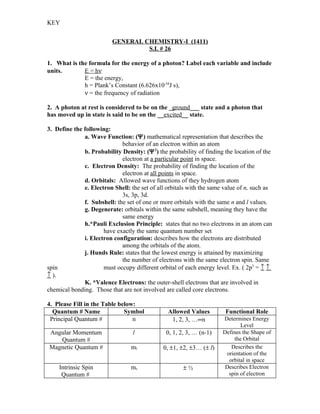
  Quantum # Name              Symbol            Allowed Values         Functional Role
 Principal Quantum #             n               1, 2, 3, …∞n         Determines Energy
                                                                             Level
Angular Momentum                  l            0, 1, 2, 3, … (n-1)    Defines the Shape of
   Quantum #                                                              the Orbital
Magnetic Quantum #               ml           0, ±1, ±2, ±3… (± l)       Describes the
                                                                       orientation of the
                                                                        orbital in space
    Intrinsic Spin               ms                   ±½               Describes Electron
     Quantum #                                                          spin of electron
KEY


5. Please Fill in the following Table:

Maximum Possible # of Electrons   Orbital       n        l               ml                ms
               2                    s           1        0                0                ±½
               6                    p           2        1              0, ±1              ±½
              10                    d           3        2            0, ±1, ±2            ±½
              14                    f           4        3          0, ±1, ±2, ±3          ±½
              18                    g           5        4        0, ±1, ±2, ±3, ±4        ±½

6. How many possible values for l and ml are there when
           a) n = 3        there are 3 l values (2, 1, 0) and 9 ml values
                   (l = 2; ml = -2,-1, 0, 1, 2)
                   (l = 1; ml = -1, 0, 1)
                   (l = 0; ml = 0)

               b) n = 5       there are 5 l values (4, 3, 2, 1, 0) and 25 ml values
                      (l = 4; ml = -4, -3, -2, -1, 0, 1, 2, 3, 4)
                      (l = 3; ml = -3, -2, -1, 0, 1, 2, 3)
                      (l = 2; ml = -2, -1, 0, 1, 2)
                      (l = 1; ml = -1, 0, 1)
                      (l = 0; ml =0)

6. Give the values for n, l, and ml for
              a) 3p           n = 3, l = 1, ml = 0, ±1
              b) 2s           n = 2, l = 0, ml = 0
              c) 4f           n = 4, l = 3, ml = 0, ±1, ±2, ±3
              d) 5d           n = 5, l = 2, ml = 0, ±1, ±2

7. Determine the electron configuration by long hand and short hand notation:

               a) Be          1s2 2s2                  [He] 2s2

               b) O           1s2 2s2 2p4              [He] 2p4

               c) Mg          1s2 2s2 2p6 3s2          [Ne] 3s2

               d) Cl          1s2 2s2 2p6 3s2 3p5      [Ne] 3s2 3p5

               e) Co          1s2 2s2 2p6 3s2 3p6 4s2 3d7
                              [Ar] 4s2 3d7
               f) Ag          1s2 2s2 2p6 3s2 3p6 4s2 3d10 4p6 5s1 4d10
                              [Kr]5s1 4d10
               g) Rb          1s2 2s2 2p6 3s2 3p6 4s2 3d10 4p6 5s1
                              [Kr]5s1
               h) Pb          1s2 2s2 2p6 3s2 3p6 4s2 3d10 4p6 5s2 4d10 5p6 6s2 5d10 6p2
                              [Xe] 6s2 5d10 6p2

#26 Key

  • 1.
    KEY GENERAL CHEMISTRY-I (1411) S.I. # 26 1. What is the formula for the energy of a photon? Label each variable and include units. E = hν E = the energy, h = Plank’s Constant (6.626x10⁻³⁴J s), ν = the frequency of radiation 2. A photon at rest is considered to be on the _ground___ state and a photon that has moved up in state is said to be on the __excited__ state. 3. Define the following: a. Wave Function: (Ψ) mathematical representation that describes the behavior of an electron within an atom b. Probability Density: (Ψ 2) the probability of finding the location of the electron at a particular point in space. c. Electron Density: The probability of finding the location of the electron at all points in space. d. Orbitals: Allowed wave functions of they hydrogen atom e. Electron Shell: the set of all orbitals with the same value of n, such as 3s, 3p, 3d. f. Subshell: the set of one or more orbitals with the same n and l values. g. Degenerate: orbitals within the same subshell, meaning they have the same energy h.*Pauli Exclusion Principle: states that no two electrons in an atom can have exactly the same quantum number set i. Electron configuration: describes how the electrons are distributed among the orbitals of the atom. j. Hunds Rule: states that the lowest energy is attained by maximizing the number of electrons with the same electron spin. Same spin must occupy different orbital of each energy level. Ex. ( 2p3 = ↑ ↑ ↑ ). K. *Valence Electrons: the outer-shell electrons that are involved in chemical bonding. Those that are not involved are called core electrons. 4. Please Fill in the Table below: Quantum # Name Symbol Allowed Values Functional Role Principal Quantum # n 1, 2, 3, …∞n Determines Energy Level Angular Momentum l 0, 1, 2, 3, … (n-1) Defines the Shape of Quantum # the Orbital Magnetic Quantum # ml 0, ±1, ±2, ±3… (± l) Describes the orientation of the orbital in space Intrinsic Spin ms ±½ Describes Electron Quantum # spin of electron
  • 2.
    KEY 5. Please Fillin the following Table: Maximum Possible # of Electrons Orbital n l ml ms 2 s 1 0 0 ±½ 6 p 2 1 0, ±1 ±½ 10 d 3 2 0, ±1, ±2 ±½ 14 f 4 3 0, ±1, ±2, ±3 ±½ 18 g 5 4 0, ±1, ±2, ±3, ±4 ±½ 6. How many possible values for l and ml are there when a) n = 3 there are 3 l values (2, 1, 0) and 9 ml values (l = 2; ml = -2,-1, 0, 1, 2) (l = 1; ml = -1, 0, 1) (l = 0; ml = 0) b) n = 5 there are 5 l values (4, 3, 2, 1, 0) and 25 ml values (l = 4; ml = -4, -3, -2, -1, 0, 1, 2, 3, 4) (l = 3; ml = -3, -2, -1, 0, 1, 2, 3) (l = 2; ml = -2, -1, 0, 1, 2) (l = 1; ml = -1, 0, 1) (l = 0; ml =0) 6. Give the values for n, l, and ml for a) 3p n = 3, l = 1, ml = 0, ±1 b) 2s n = 2, l = 0, ml = 0 c) 4f n = 4, l = 3, ml = 0, ±1, ±2, ±3 d) 5d n = 5, l = 2, ml = 0, ±1, ±2 7. Determine the electron configuration by long hand and short hand notation: a) Be 1s2 2s2 [He] 2s2 b) O 1s2 2s2 2p4 [He] 2p4 c) Mg 1s2 2s2 2p6 3s2 [Ne] 3s2 d) Cl 1s2 2s2 2p6 3s2 3p5 [Ne] 3s2 3p5 e) Co 1s2 2s2 2p6 3s2 3p6 4s2 3d7 [Ar] 4s2 3d7 f) Ag 1s2 2s2 2p6 3s2 3p6 4s2 3d10 4p6 5s1 4d10 [Kr]5s1 4d10 g) Rb 1s2 2s2 2p6 3s2 3p6 4s2 3d10 4p6 5s1 [Kr]5s1 h) Pb 1s2 2s2 2p6 3s2 3p6 4s2 3d10 4p6 5s2 4d10 5p6 6s2 5d10 6p2 [Xe] 6s2 5d10 6p2