Diagnosis
of
AIDS
AIDS
A Global Concern
TODAY THERE IS NO REGION OF THE
WORLD UNTOUCHED BY PANDEMIC OF
AIDS
Majority of persons infected with HIV
present with AIDS soon or later.
Why AIDS is more important
TODAY
 Apart from Men, there is a increasing burden of
Infections in Women.
 Implication on Mother to Child Transmission
 Female Adolescents are infected 3 - 6
times higher than male counterparts.
AIDS has turned out to be Social
Problem.
Implication of AIDS
 Being diagnosed as having HIV/AIDS has
life time repercussions.
 Every body understands AIDS as a life
threatening condition.
 A casual way of dealing as being HIV + will
have Moral, Legal, and Social
consequences.
Prompt and Precise Diagnosis of
AIDS make great impact on Humanity
Importance of precise Diagnosis of
AIDS
 All patients should be informed about
consequences of Testing for HIV infection,
 Legality of respective National Laws should be
followed.
 A pretest and posttest counseling is Growing
importance, even in Developing countries.
 Today’s debate on testing for HIV status as
matter of Health protocol ?
Counseling Improves the confidence
Purpose of Testing for HIV Infection
 A matter of great importance as in Blood donors
to prevent infected blood being transfused.
 To diagnose the patients infected with HIV virus.
 For surveillance purpose.
 Persons with high risk behavior.
 In Pregnant women to prevent Mother to Child
transmission.
 Patient's presenting with opportunistic infections.
Diagnosis of
HIV/ AIDS
Basic Tests.
1.We can detect Antigen or Antibody
2.We can detect Antigen and Antibody.
3.Majority of Laboratories depend on
Commercial Kits.
4.Devloped Nations going for Molecular and
more precise Methods.
Screening Tests for HIV/AIDS
Detection
 A screening test posses high Sensitivity
 We rarely miss the Diagnosis in Infected patients.
 Done as mass screening procedure.
 Economical.
 Developing countries depend on these tests even
for Diagnosis.
Confirmatory Tests in AIDS
 It is important to confirm all screening tests
with Confirmatory tests, or we brand some
one without infection as infected,
 Confirmatory tests differentiates false
reactive tests. and identifies truly infected
or not.
Differences of Screening and
Confirmatory Tests.
Screening test
High degree of
Sensitivity
Few false negatives
Confirmatory test
High degree of
specificity
Few / No false positive
results.
Why patients should we tested with
Screening and Confirmatory tests.
 Before you declare a person infected with
HIV / AIDS you should perform both
methods.
 Faulty testing methods can lead to
catastrophic consequences, and legal
litigations.
Choosing Screening Testing methods
 Our aim to obtain 100 % specific results ?
 But impossible.
 As few may be infected and do not have
sufficient antibodies to detect in the testing
methods.
 Depend on time tested methods.
 Explore the reputation of the suppliers.
ELISA METHOD
 Universally accepted test ,most popular
even in the developing nations.
 Useful in large scale screening.
 A common method used in Blood banks in
mass screening of Human blood.
ELISA method – A ELISA plate
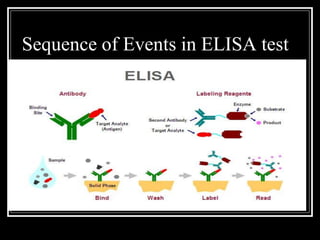
Sequence of Events in ELISA test
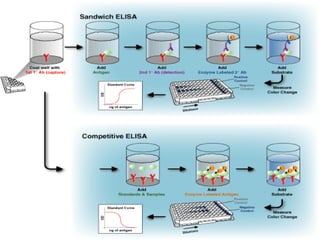
Different Methods of ELISA testing.
Why ELISA is very trust worthy.
 Easy to perform
 Free from Radiation.
 Relatively specific
 Sensitive.
 With scientific advances we have advanced to
new generation of testing methods
 Today we depend on 3rd and 4th generation
ELISA methodologies.
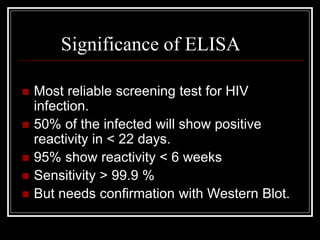
Significance of ELISA
 Most reliable screening test for HIV
infection.
 50% of the infected will show positive
reactivity in < 22 days.
 95% show reactivity < 6 weeks
 Sensitivity > 99.9 %
 But needs confirmation with Western Blot.
Advances in ELISA Methods.
1st and 2nd generation ELISA methods have
become obsolete we have to switch to
 Antigen sandwich ELISA protocols ( called
as 3rd generation ELISA ).
 Many Nations have switched to 3rd
generation methods.
What is 3rd Generation ELISA
 Helps in detection of early infections,
 Can detect all classes of antibodies
including Ig M
 All isotypes of antibodies can be captured.
 But proving to be expensive to developing
Nations.
Need for 4th
Generation ELISA
Methods
The quest for better Diagnosis of
AIDS
continues
What is 4th generation ELISA.
 A new generation Method in ELISA
 Can detect both Antigen and Antibody in
the same run ( in the same ELISA Plate )
 Helpful to make early diagnosis at least in
few cases.
Determination of P 24 Antigen by
ELISA
 Helps in the early detection of HIV infection.
 Screening of Blood for HIV infection along with
detection for antibody detection.
 Early diagnosis of HIV infection in resource poor
nations.
 Monitoring Anti-retroviral therapy. But not a
replacement for RNA quantization.
 Even P 24 Antigens are subject of false positive
results.
Limitation of Screening Tests.
 Imperfect Sensitivity,
 Sensitivity to detect HIV2 ?
 Failing to detect HIV variants.
 Other technical errors.
Confirmatory
Serological Tests
All the Screening tests need to be
confirmed before being declared as
HIV infected.
Confirmatory Serological Tests.
 HIV Western Blots.
 Line Immunoassay ( LIA )
 Immuno fluorescent Assay ( IFA )
Utility is limited due technical and
economical reasons
WESTEN BLOT TEST
 A Gold standard confirmatory test.
 When tested combined with ELISA
specificity is > 99.9 %.
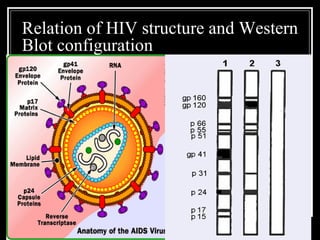
Relation of HIV structure and Western
Blot configuration
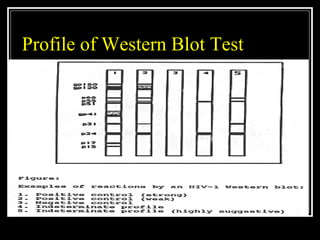
Principle of Western Blot
 HIV viral antigens are separated as;
gp160,gp120,p66,p55,p51,gp41,p31,p24,
p17, and p15.
Interpretation depends on presence /
absence of reactivity to specific antigens.
Interpretation of Western Blot.
 The antibodies in the serum should react
with at least two of following antigens,
gp 160/120 If does not meet
gp 41 requirements, marked
p 24 as indeterminate.
Negative Western Blot.
 Absence of any reactivity to the
bands is declared as Negative.
False positives are rare.
All doubtful results should be
reported as Negative.
Profile of Western Blot Test
Limitation of Western Blot Test
 If not designed for HIV 2 inclusion, we miss HIV2
infections,
 Can give Indeterminate results in
Pregnancy
After administration of Tetanus
Toxoid.
Autoimmune conditions.
Rapid tests in the Diagnosis of AIDS
 A growing importance
 Results can be issued within < 20 minutes.
 Limited protocols, and less demanding
technical skills.
 But needs confirmation with ELISA /
Western Blot testing.
 Can differentiate HIV 1 and HIV 2.
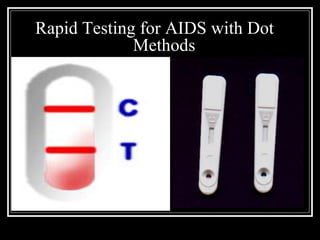
Rapid Testing for AIDS with Dot
Methods
Dot / Rapid Methods
Useful
 In patients in Labor whose Immune status
is not known,
 Resource poor establishments.
 But needs confirmation with ELISA / WB
Other supporting
tests in AIDS
Several tests will help in supporting
to identify the progression of
Disease.
Flowcytometry for Estimation of
CD 4 lymphocytes
Use of CD4 counts in Progress of
AIDS
 CD4 count measurements help for staging
the diseases.
 Flow cytometry has become the prominent
tool in estimations of CD4.
 Specimens should be promptly processed.
Uses of Absolute CD4 Lymphocyte
counts.
 Most widely used predictor of HIV
progression.
 Risk of progression to an AIDS defining
illness, opportunistic infections or
malignancy is high, when the counts drop
below 200/mcl.
Uses of CD4 Lymphocyte percentage.
 Estimation of percentages is more useful
than CD4 counts.
 When the counts drops < 20% we have to
watch for onset of opportunistic infections
and malignancy.
Molecular Methods
in
Diagnosis of AIDS
Molecular Methods in Diagnosis of
HIV / AIDS.
1. The reverse transcription polymerase
chain reaction.
2. Nucleic acid sequence
amplification. ( NASBA )
3. Branched chain DNA bDNA.
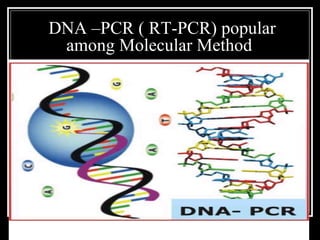
DNA –PCR ( RT-PCR) popular
among Molecular Method
Polymerase Chain Reaction.-RT- PCR
 RT-PCR Need the use of Reverse transcriptase
enzyme that converts RNA to DNA.
 The testing is based on artificially replicating
Nucleic acid sequence
of the target ( viral sequence ) so that
Millions to Billions are made available
for detection.
HIV Viral Load tests.
 The tests measure the amount of actively
replicating HIV virus.
 Correlates with response to antiretroviral
drugs
 Most helpful in diagnosis of HIV before
Sero conversion.
 False positives should be possible with low
viremia < 500 copies.
Alternative Testing Media.
From other Specimens.
 Saliva Detection of Ig G
 Urine Detection of Ig G
Both ELISA and Western Blot
can be performed.
Reporting of all Positive results is a
great concern, Avoid casual reporting
Post test counseling a Must in all
Positive results
Precautions in HIV Testing.
 Casual testing to be curtailed.
 To do with a purpose.
 HIV positive result has Moral,social,and
Economic consequences.
 Post test counseling a must in all HIV+
individuals.

Diagnosis of-aids

  • 1.
  • 2.
    AIDS A Global Concern TODAYTHERE IS NO REGION OF THE WORLD UNTOUCHED BY PANDEMIC OF AIDS
  • 3.
    Majority of personsinfected with HIV present with AIDS soon or later.
  • 4.
    Why AIDS ismore important TODAY  Apart from Men, there is a increasing burden of Infections in Women.  Implication on Mother to Child Transmission  Female Adolescents are infected 3 - 6 times higher than male counterparts. AIDS has turned out to be Social Problem.
  • 5.
    Implication of AIDS Being diagnosed as having HIV/AIDS has life time repercussions.  Every body understands AIDS as a life threatening condition.  A casual way of dealing as being HIV + will have Moral, Legal, and Social consequences.
  • 6.
    Prompt and PreciseDiagnosis of AIDS make great impact on Humanity
  • 7.
    Importance of preciseDiagnosis of AIDS  All patients should be informed about consequences of Testing for HIV infection,  Legality of respective National Laws should be followed.  A pretest and posttest counseling is Growing importance, even in Developing countries.  Today’s debate on testing for HIV status as matter of Health protocol ?
  • 8.
  • 9.
    Purpose of Testingfor HIV Infection  A matter of great importance as in Blood donors to prevent infected blood being transfused.  To diagnose the patients infected with HIV virus.  For surveillance purpose.  Persons with high risk behavior.  In Pregnant women to prevent Mother to Child transmission.  Patient's presenting with opportunistic infections.
  • 10.
    Diagnosis of HIV/ AIDS BasicTests. 1.We can detect Antigen or Antibody 2.We can detect Antigen and Antibody. 3.Majority of Laboratories depend on Commercial Kits. 4.Devloped Nations going for Molecular and more precise Methods.
  • 11.
    Screening Tests forHIV/AIDS Detection  A screening test posses high Sensitivity  We rarely miss the Diagnosis in Infected patients.  Done as mass screening procedure.  Economical.  Developing countries depend on these tests even for Diagnosis.
  • 12.
    Confirmatory Tests inAIDS  It is important to confirm all screening tests with Confirmatory tests, or we brand some one without infection as infected,  Confirmatory tests differentiates false reactive tests. and identifies truly infected or not.
  • 13.
    Differences of Screeningand Confirmatory Tests. Screening test High degree of Sensitivity Few false negatives Confirmatory test High degree of specificity Few / No false positive results.
  • 14.
    Why patients shouldwe tested with Screening and Confirmatory tests.  Before you declare a person infected with HIV / AIDS you should perform both methods.  Faulty testing methods can lead to catastrophic consequences, and legal litigations.
  • 15.
    Choosing Screening Testingmethods  Our aim to obtain 100 % specific results ?  But impossible.  As few may be infected and do not have sufficient antibodies to detect in the testing methods.  Depend on time tested methods.  Explore the reputation of the suppliers.
  • 16.
    ELISA METHOD  Universallyaccepted test ,most popular even in the developing nations.  Useful in large scale screening.  A common method used in Blood banks in mass screening of Human blood.
  • 17.
    ELISA method –A ELISA plate
  • 18.
    Sequence of Eventsin ELISA test
  • 19.
    Different Methods ofELISA testing.
  • 20.
    Why ELISA isvery trust worthy.  Easy to perform  Free from Radiation.  Relatively specific  Sensitive.  With scientific advances we have advanced to new generation of testing methods  Today we depend on 3rd and 4th generation ELISA methodologies.
  • 21.
    Significance of ELISA Most reliable screening test for HIV infection.  50% of the infected will show positive reactivity in < 22 days.  95% show reactivity < 6 weeks  Sensitivity > 99.9 %  But needs confirmation with Western Blot.
  • 22.
    Advances in ELISAMethods. 1st and 2nd generation ELISA methods have become obsolete we have to switch to  Antigen sandwich ELISA protocols ( called as 3rd generation ELISA ).  Many Nations have switched to 3rd generation methods.
  • 23.
    What is 3rdGeneration ELISA  Helps in detection of early infections,  Can detect all classes of antibodies including Ig M  All isotypes of antibodies can be captured.  But proving to be expensive to developing Nations.
  • 24.
    Need for 4th GenerationELISA Methods The quest for better Diagnosis of AIDS continues
  • 25.
    What is 4thgeneration ELISA.  A new generation Method in ELISA  Can detect both Antigen and Antibody in the same run ( in the same ELISA Plate )  Helpful to make early diagnosis at least in few cases.
  • 26.
    Determination of P24 Antigen by ELISA  Helps in the early detection of HIV infection.  Screening of Blood for HIV infection along with detection for antibody detection.  Early diagnosis of HIV infection in resource poor nations.  Monitoring Anti-retroviral therapy. But not a replacement for RNA quantization.  Even P 24 Antigens are subject of false positive results.
  • 27.
    Limitation of ScreeningTests.  Imperfect Sensitivity,  Sensitivity to detect HIV2 ?  Failing to detect HIV variants.  Other technical errors.
  • 28.
    Confirmatory Serological Tests All theScreening tests need to be confirmed before being declared as HIV infected.
  • 29.
    Confirmatory Serological Tests. HIV Western Blots.  Line Immunoassay ( LIA )  Immuno fluorescent Assay ( IFA ) Utility is limited due technical and economical reasons
  • 30.
    WESTEN BLOT TEST A Gold standard confirmatory test.  When tested combined with ELISA specificity is > 99.9 %.
  • 31.
    Relation of HIVstructure and Western Blot configuration
  • 32.
    Principle of WesternBlot  HIV viral antigens are separated as; gp160,gp120,p66,p55,p51,gp41,p31,p24, p17, and p15. Interpretation depends on presence / absence of reactivity to specific antigens.
  • 33.
    Interpretation of WesternBlot.  The antibodies in the serum should react with at least two of following antigens, gp 160/120 If does not meet gp 41 requirements, marked p 24 as indeterminate.
  • 34.
    Negative Western Blot. Absence of any reactivity to the bands is declared as Negative. False positives are rare. All doubtful results should be reported as Negative.
  • 35.
  • 36.
    Limitation of WesternBlot Test  If not designed for HIV 2 inclusion, we miss HIV2 infections,  Can give Indeterminate results in Pregnancy After administration of Tetanus Toxoid. Autoimmune conditions.
  • 37.
    Rapid tests inthe Diagnosis of AIDS  A growing importance  Results can be issued within < 20 minutes.  Limited protocols, and less demanding technical skills.  But needs confirmation with ELISA / Western Blot testing.  Can differentiate HIV 1 and HIV 2.
  • 38.
    Rapid Testing forAIDS with Dot Methods
  • 39.
    Dot / RapidMethods Useful  In patients in Labor whose Immune status is not known,  Resource poor establishments.  But needs confirmation with ELISA / WB
  • 40.
    Other supporting tests inAIDS Several tests will help in supporting to identify the progression of Disease.
  • 41.
    Flowcytometry for Estimationof CD 4 lymphocytes
  • 42.
    Use of CD4counts in Progress of AIDS  CD4 count measurements help for staging the diseases.  Flow cytometry has become the prominent tool in estimations of CD4.  Specimens should be promptly processed.
  • 43.
    Uses of AbsoluteCD4 Lymphocyte counts.  Most widely used predictor of HIV progression.  Risk of progression to an AIDS defining illness, opportunistic infections or malignancy is high, when the counts drop below 200/mcl.
  • 44.
    Uses of CD4Lymphocyte percentage.  Estimation of percentages is more useful than CD4 counts.  When the counts drops < 20% we have to watch for onset of opportunistic infections and malignancy.
  • 45.
  • 46.
    Molecular Methods inDiagnosis of HIV / AIDS. 1. The reverse transcription polymerase chain reaction. 2. Nucleic acid sequence amplification. ( NASBA ) 3. Branched chain DNA bDNA.
  • 47.
    DNA –PCR (RT-PCR) popular among Molecular Method
  • 48.
    Polymerase Chain Reaction.-RT-PCR  RT-PCR Need the use of Reverse transcriptase enzyme that converts RNA to DNA.  The testing is based on artificially replicating Nucleic acid sequence of the target ( viral sequence ) so that Millions to Billions are made available for detection.
  • 50.
    HIV Viral Loadtests.  The tests measure the amount of actively replicating HIV virus.  Correlates with response to antiretroviral drugs  Most helpful in diagnosis of HIV before Sero conversion.  False positives should be possible with low viremia < 500 copies.
  • 51.
    Alternative Testing Media. Fromother Specimens.  Saliva Detection of Ig G  Urine Detection of Ig G Both ELISA and Western Blot can be performed.
  • 52.
    Reporting of allPositive results is a great concern, Avoid casual reporting
  • 53.
    Post test counselinga Must in all Positive results
  • 54.
    Precautions in HIVTesting.  Casual testing to be curtailed.  To do with a purpose.  HIV positive result has Moral,social,and Economic consequences.  Post test counseling a must in all HIV+ individuals.