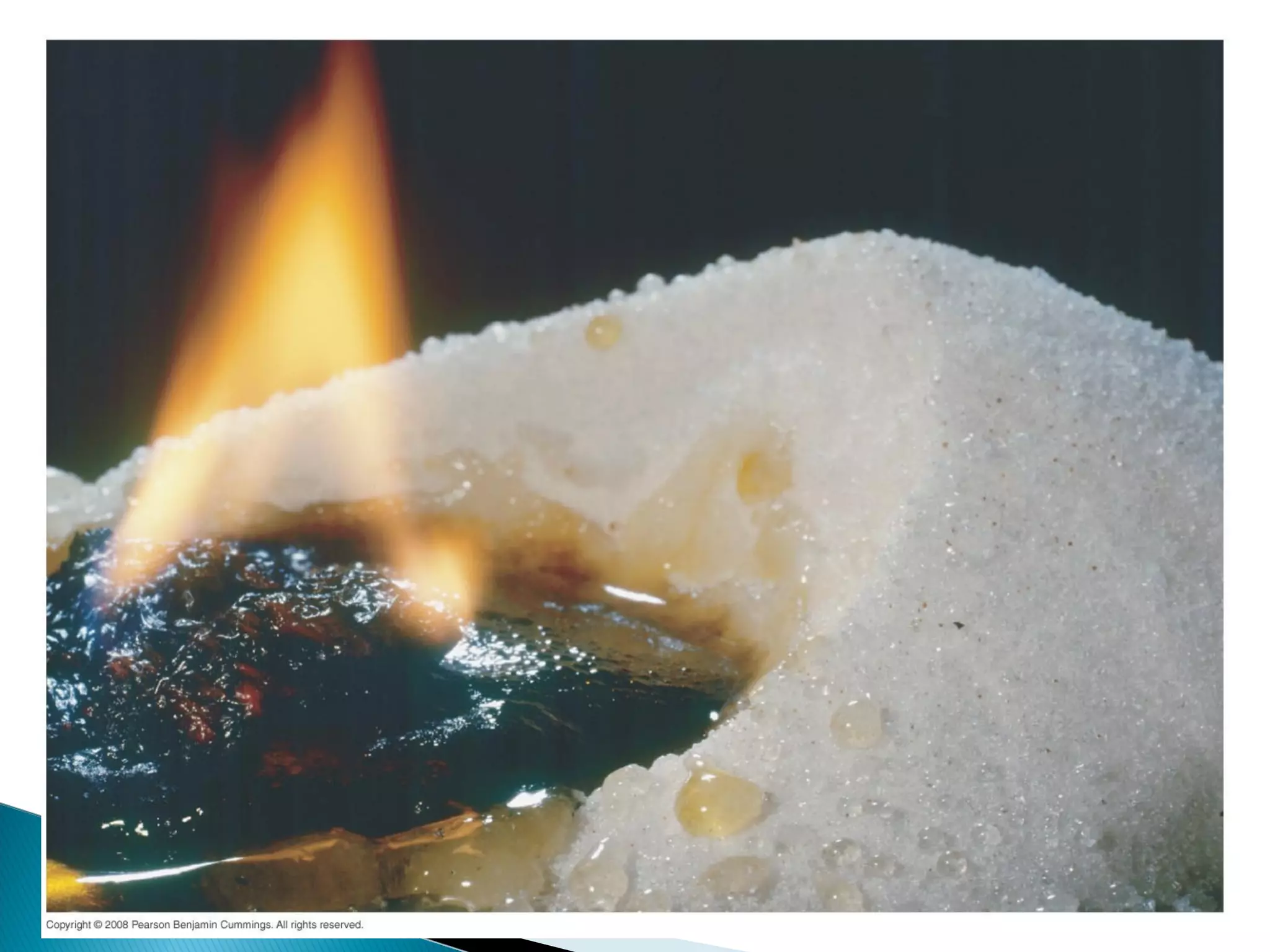
From Snickers to ATP
 Review
 ATP
 Cellular Respiration
◦ Glycolysis
◦ Pyruvate oxidation
◦ Krebs cycle
◦ Electron Transport chain
 Fermentation
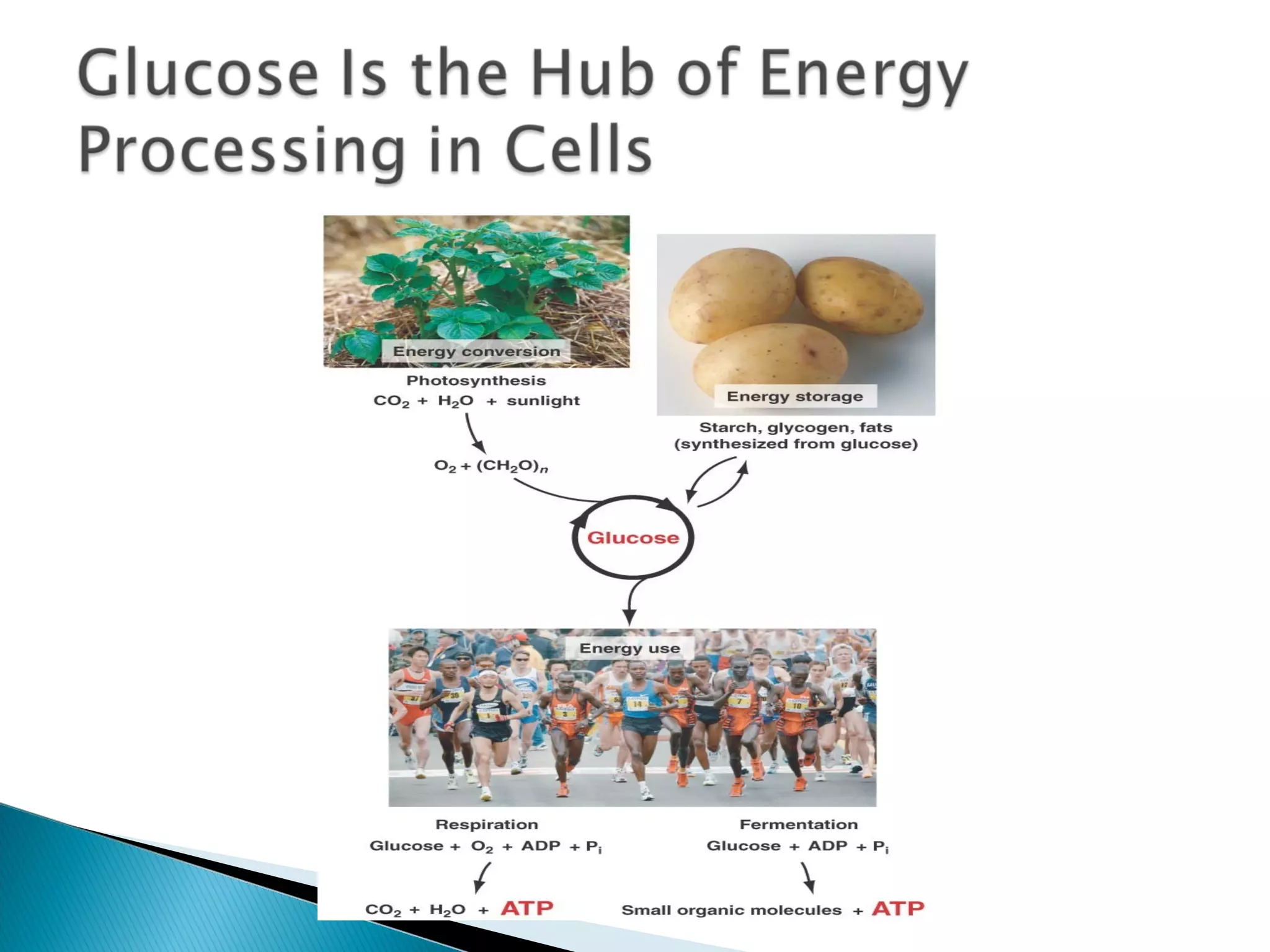
 All of our energy comes from?
 This energy is the form of?
 Plants convert this energy to?
 The energy is potential (stored) energy stored in?
 The energy is released by?
 Most living organisms require energy in the form
of?
 Oxidation of sugars, primarily glucose.
 Key chemical reactions = REDOX reactions,
transfer of electrons and H+
from one substance to
another.
 Energy is harvested from electrons and used to
produce ATP.
 ATP is stored in small quantities in cells but is
primarily produced on demand by cellular
respiration.
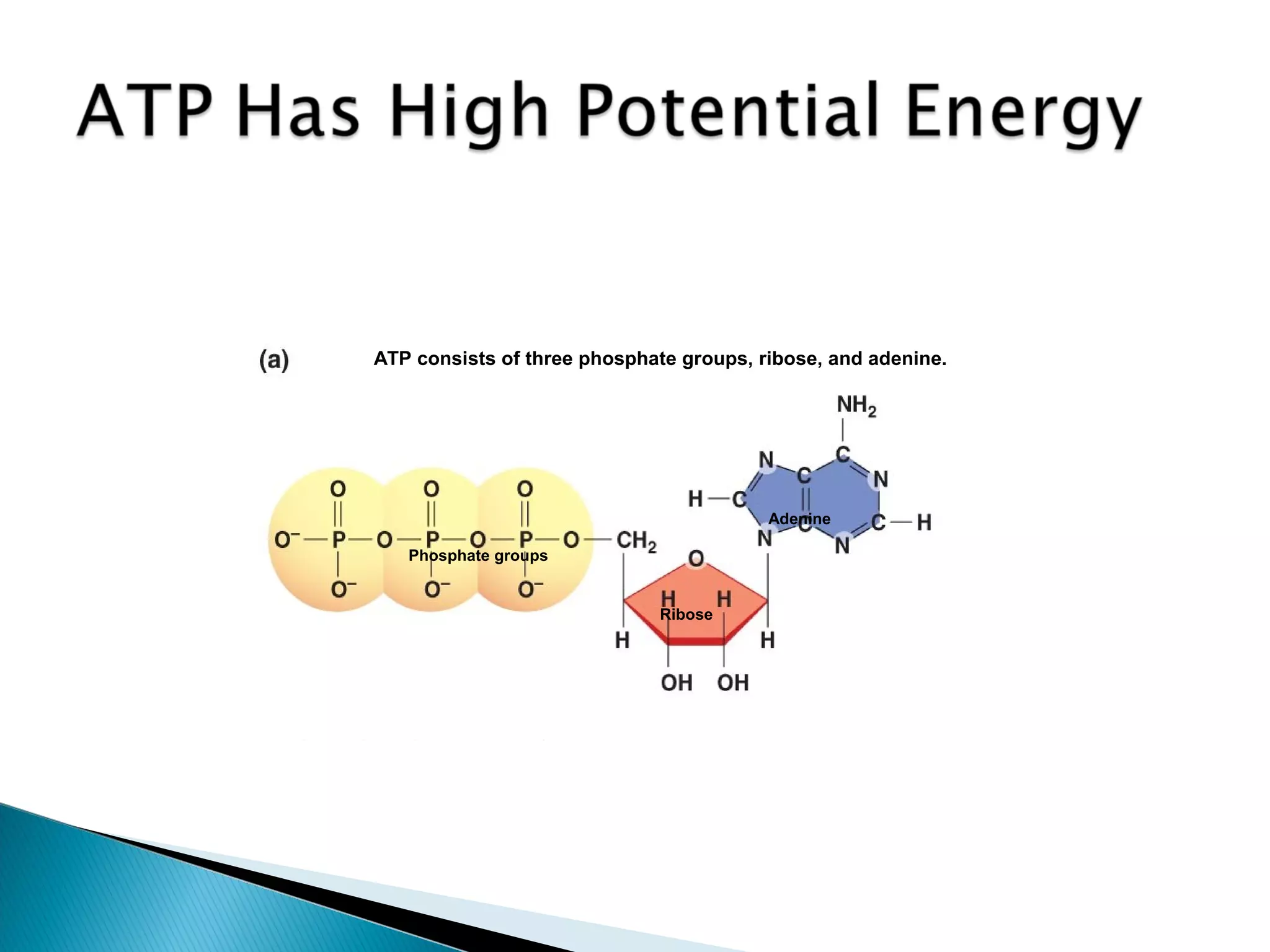
ATP consists of three phosphate groups, ribose, and adenine.
Phosphate groups
Ribose
Adenine
 ATP production: ADP + P → ATP; 2 types
◦ Substrate level phosphorylation
◦ Oxidative phosphorylation
 2 types of Cellular Respiration
◦ Aerobic - oxygen is used as the final electron acceptor.
◦ Anaerobic – final electron acceptor is an inorganic
molecule; some bacteria and archaea.
 Fermentation – is also an anaerobic process.
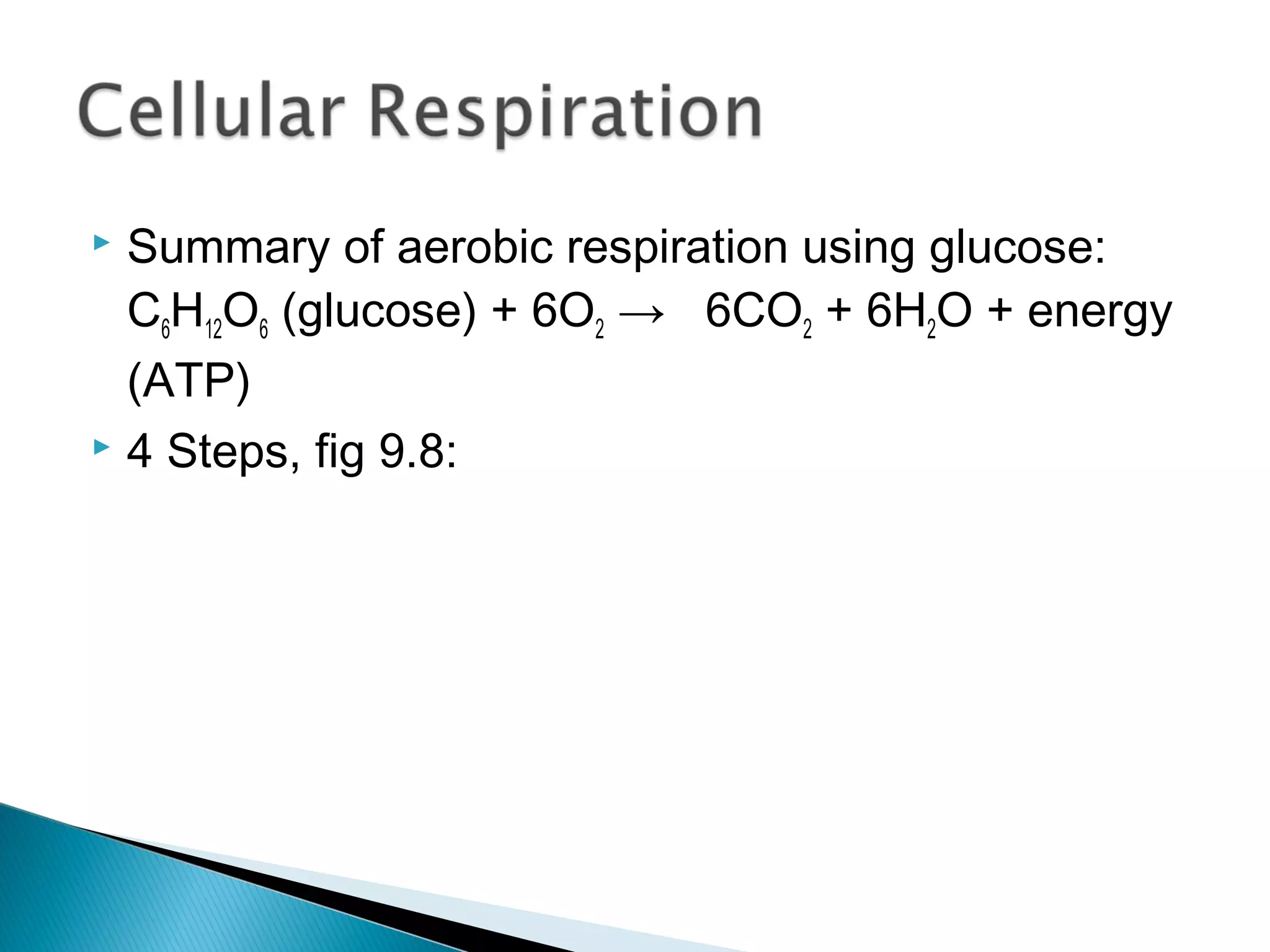
 Summary of aerobic respiration using glucose:
C6H12O6 (glucose) + 6O2 → 6CO2 + 6H2O + energy
(ATP)
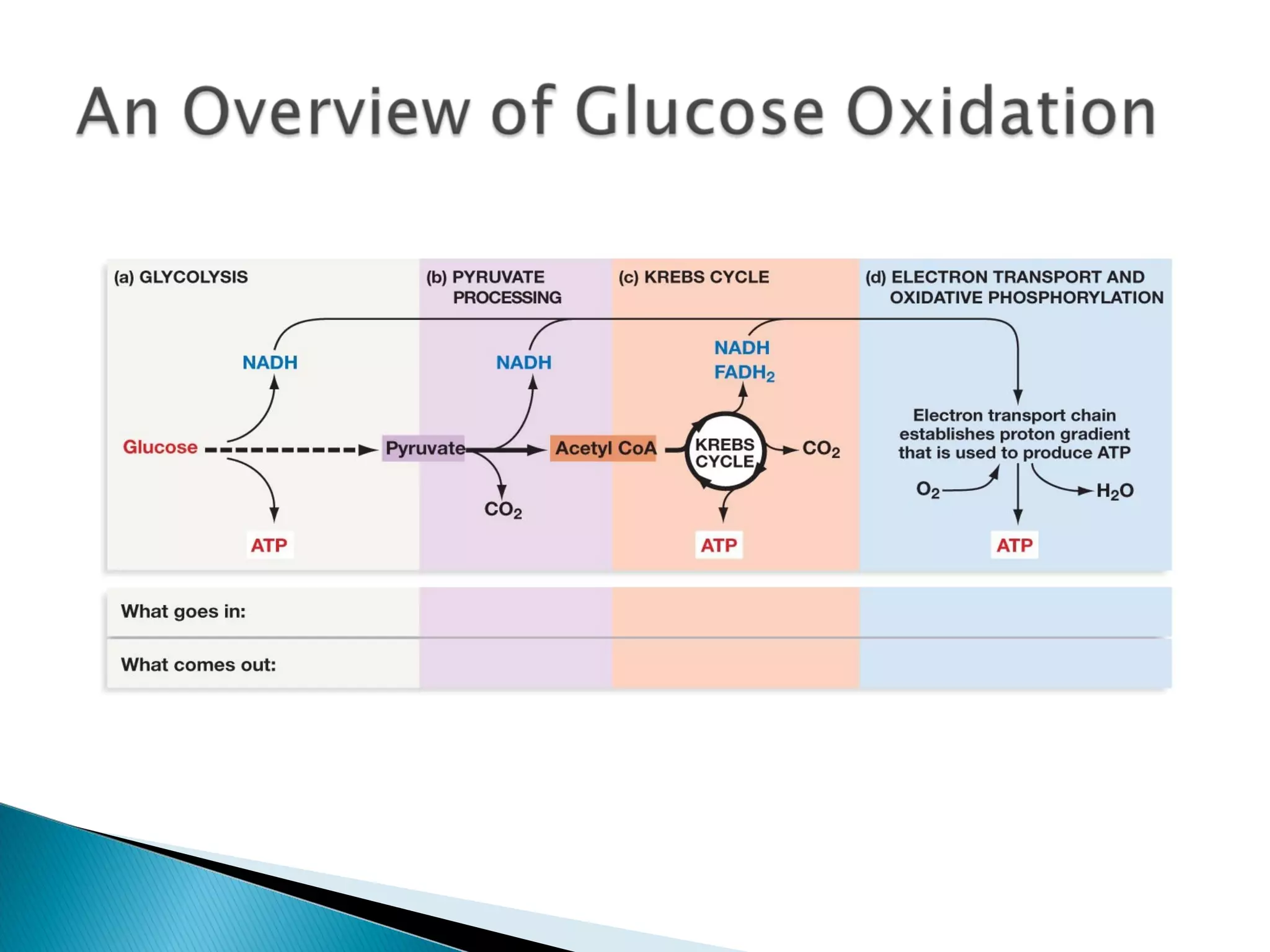
 4 Steps, fig 9.8:
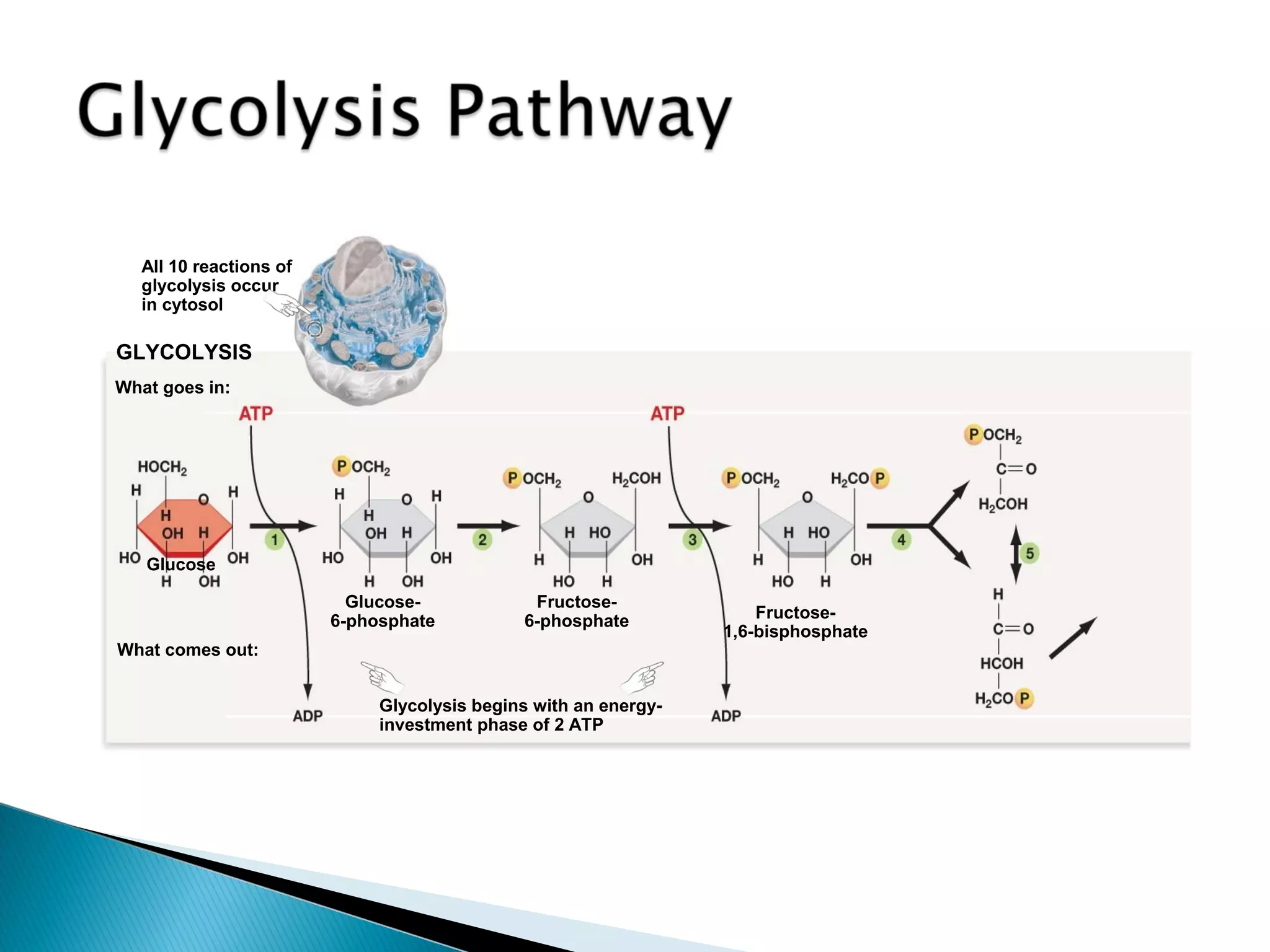
 In the cytosol, 10 reactions, 3 stages, fig 9.13
◦ Glucose (6 C) is primed, using 2 ATP’s, and converted to
fructose 1,6 – bisphosphate.
◦ Fructose is split into two 3-C molecules, glyceraldehyde
3-phosphate (G3P)
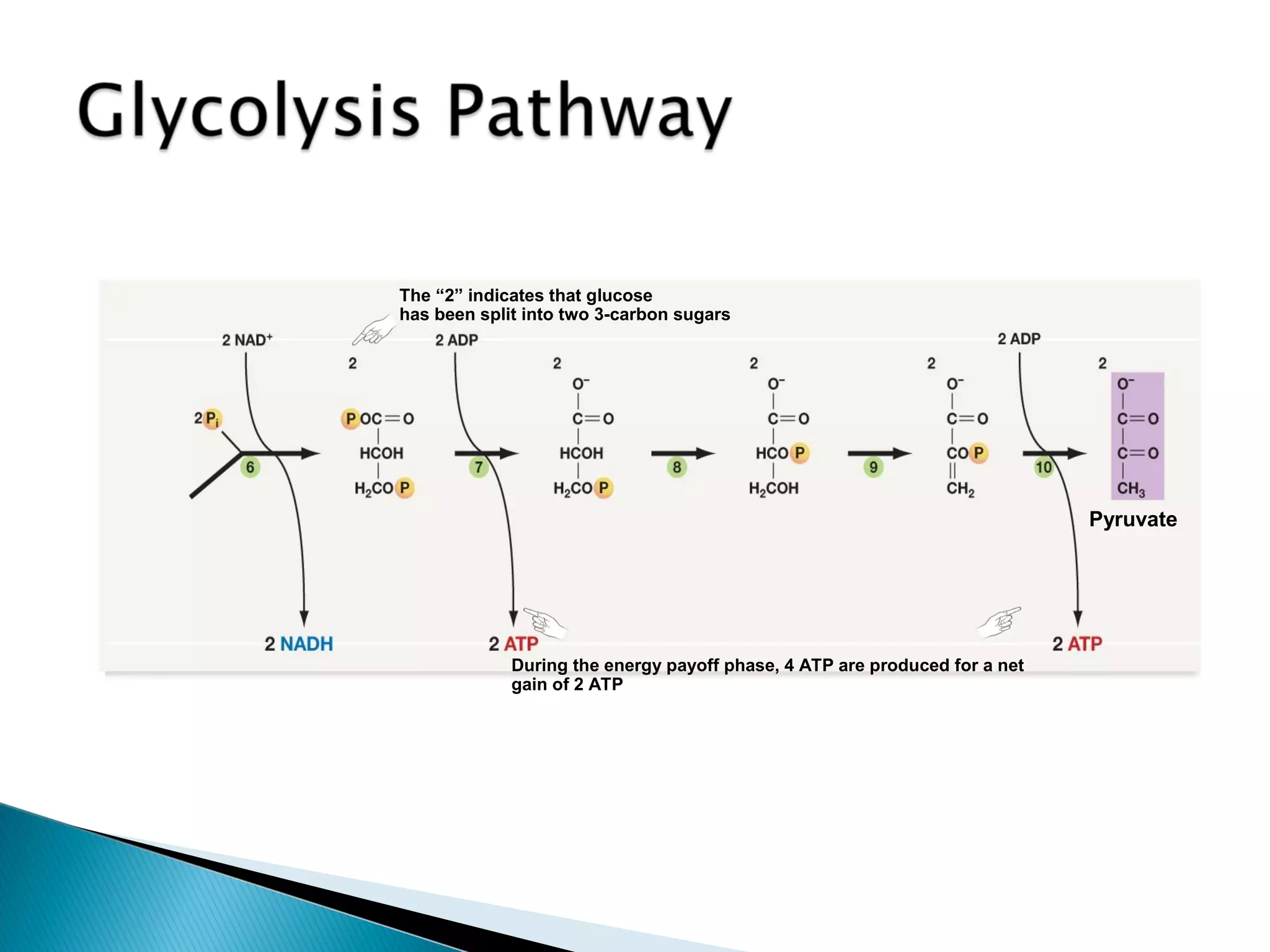
◦ Energy extraction: electrons and H+
transferred to 2NAD+
and 4 ATPs produced. Final product – 2 pyruvate
molecules (3 C).
Glycolysis begins with an energy-
investment phase of 2 ATP
All 10 reactions of
glycolysis occur
in cytosol
GLYCOLYSIS
What goes in:
What comes out:
Glucose
Glucose-
6-phosphate
Fructose-
6-phosphate Fructose-
1,6-bisphosphate
Pyruvate
The “2” indicates that glucose
has been split into two 3-carbon sugars
During the energy payoff phase, 4 ATP are produced for a net
gain of 2 ATP
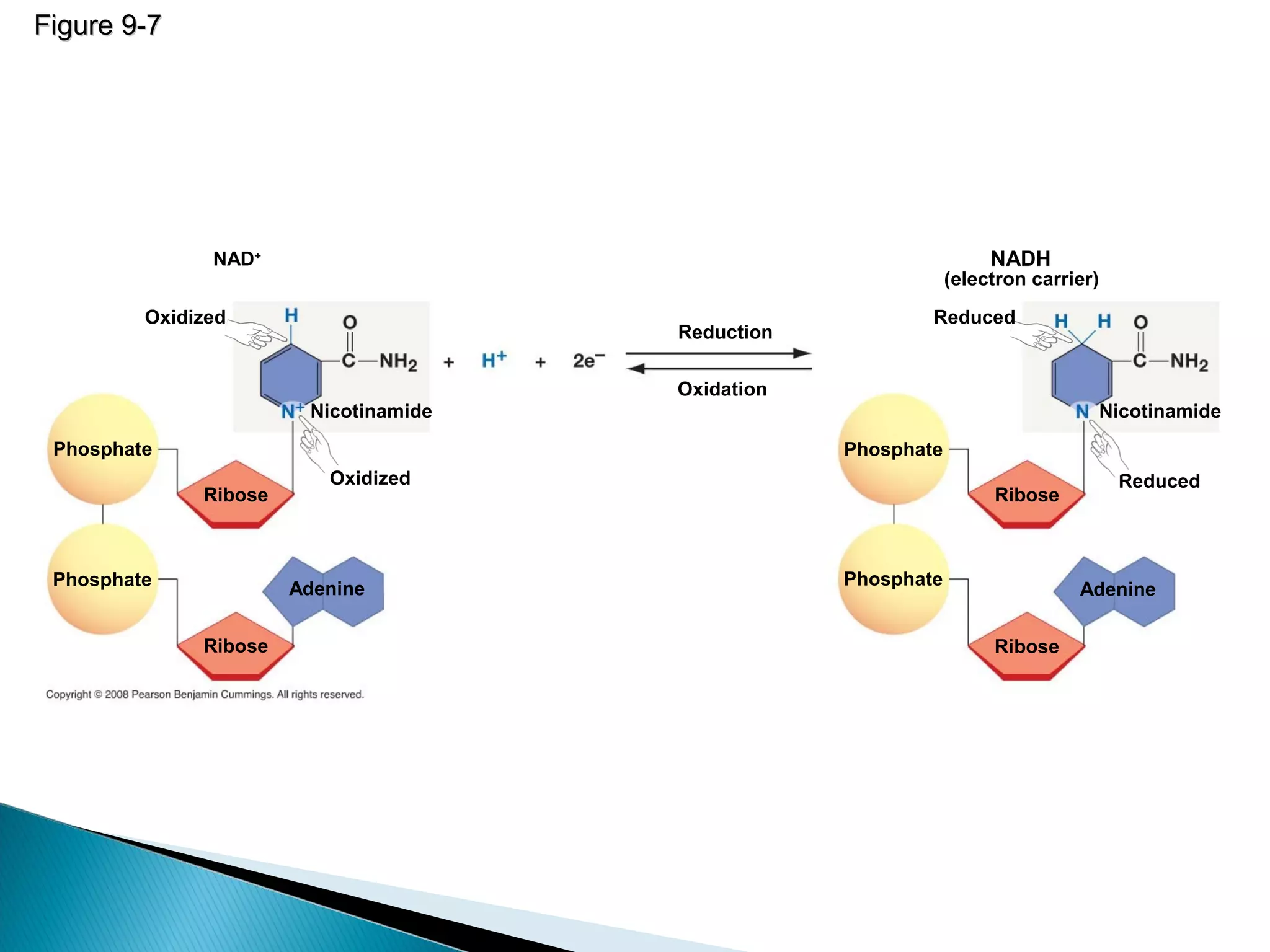
Figure 9-7Figure 9-7
NAD+
Reduction
Oxidation
Oxidized
Oxidized
Nicotinamide
Phosphate
Ribose
Phosphate
Ribose
Adenine
Phosphate
Phosphate
Ribose
Ribose
Adenine
Reduced
Nicotinamide
NADH
(electron carrier)
Reduced
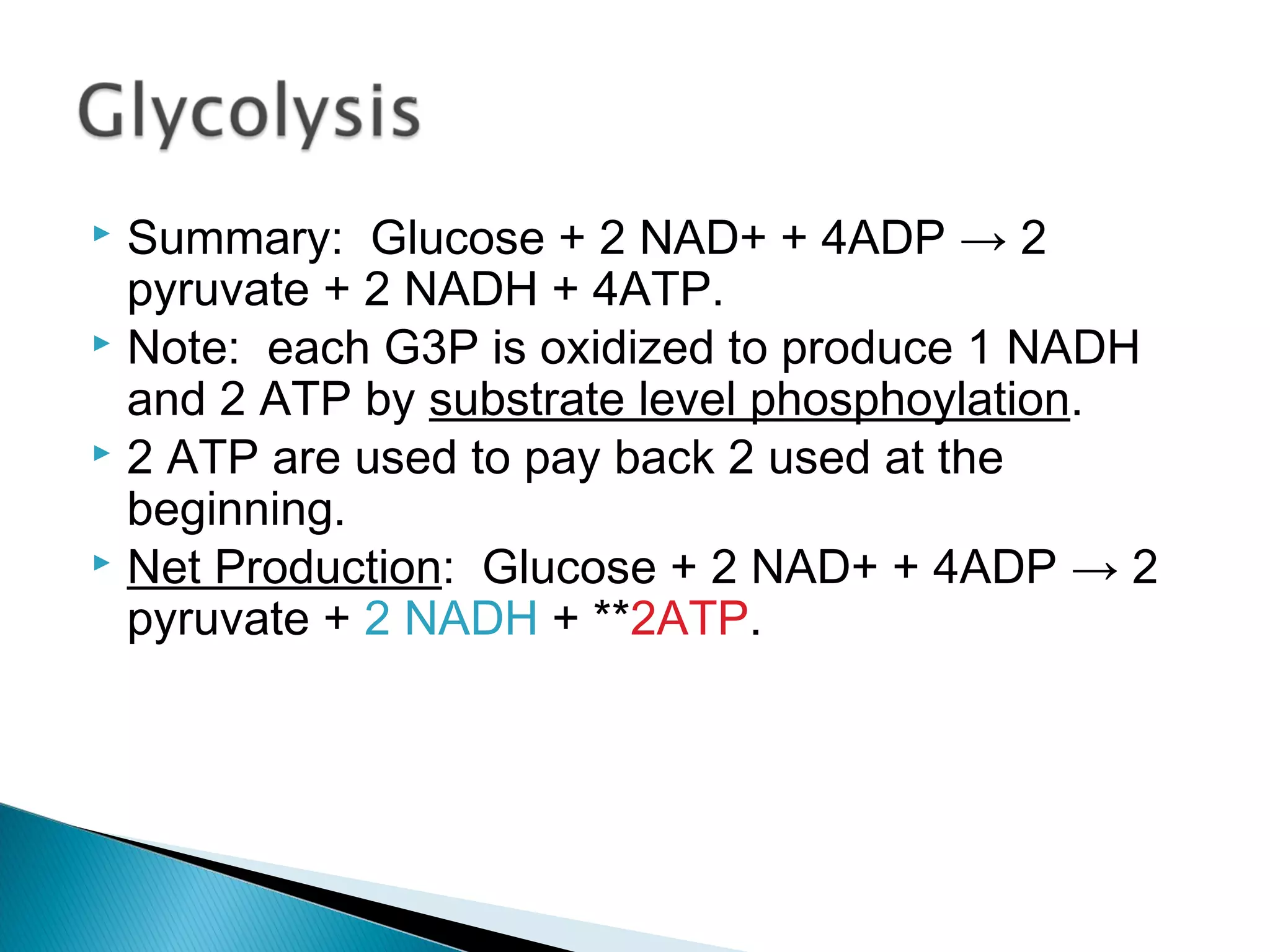
 Summary: Glucose + 2 NAD+ + 4ADP → 2
pyruvate + 2 NADH + 4ATP.
 Note: each G3P is oxidized to produce 1 NADH
and 2 ATP by substrate level phosphoylation.
 2 ATP are used to pay back 2 used at the
beginning.
 Net Production: Glucose + 2 NAD+ + 4ADP → 2
pyruvate + 2 NADH + **2ATP.
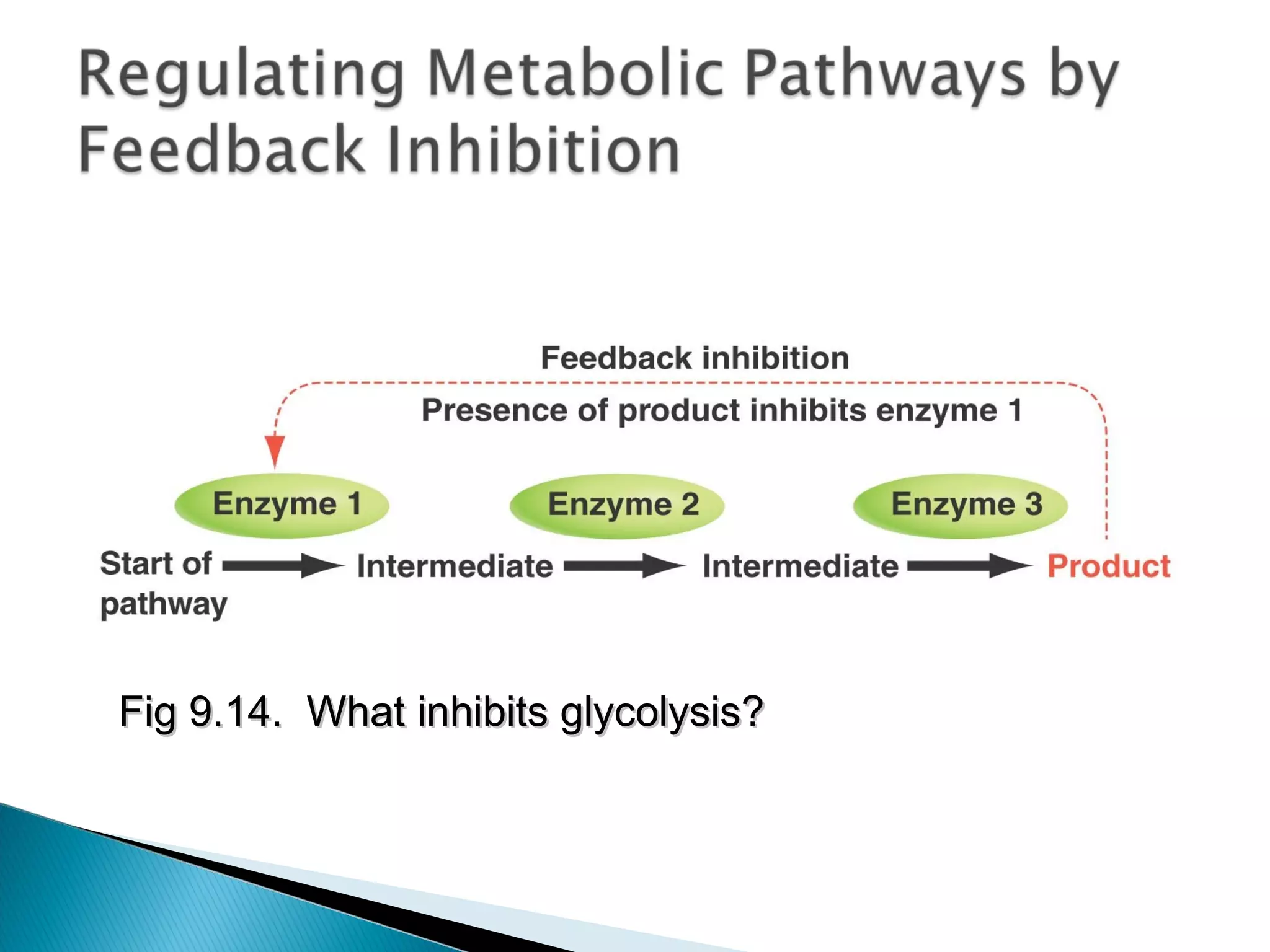
Fig 9.14. What inhibits glycolysis?Fig 9.14. What inhibits glycolysis?
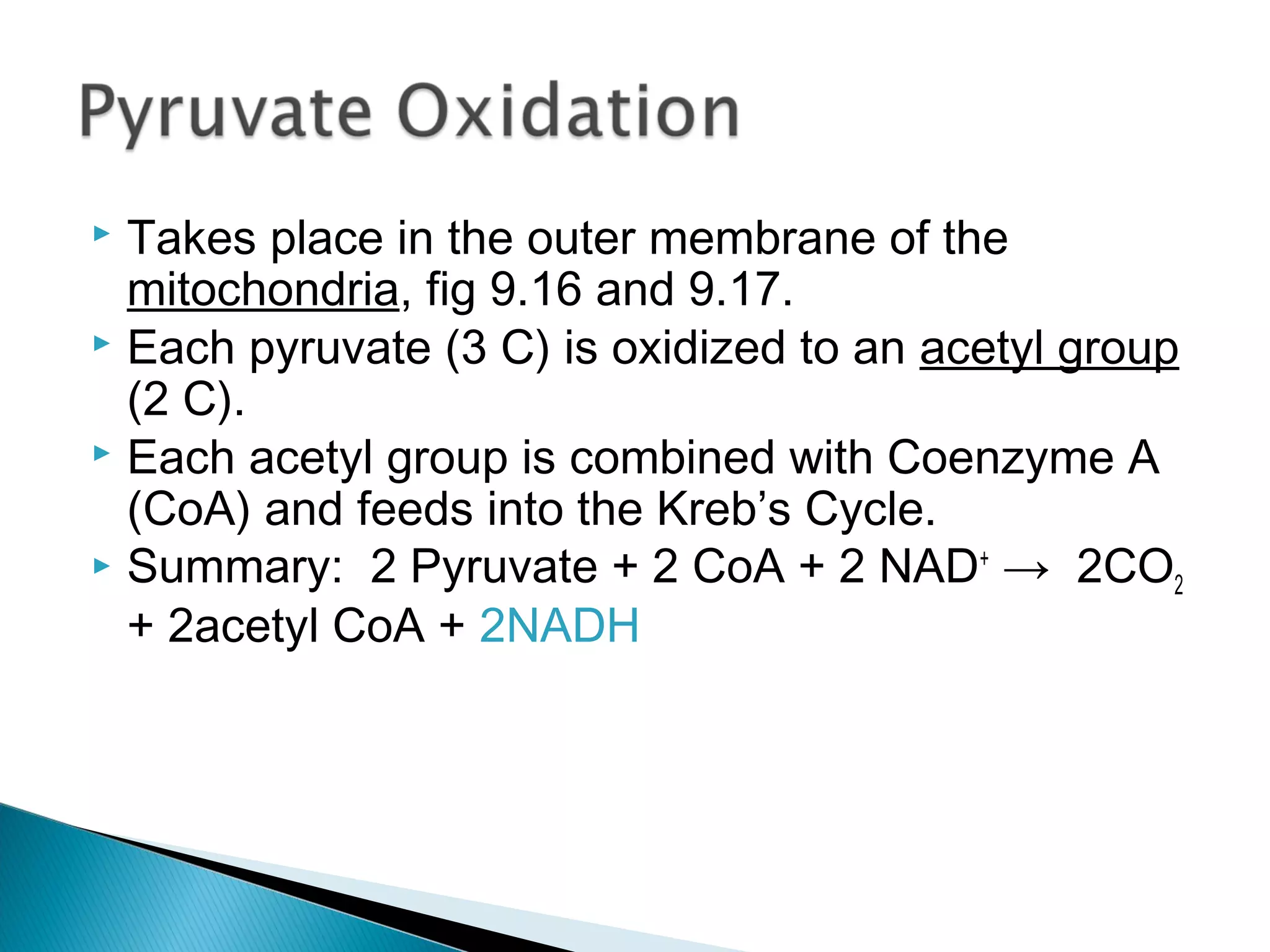
 Takes place in the outer membrane of the
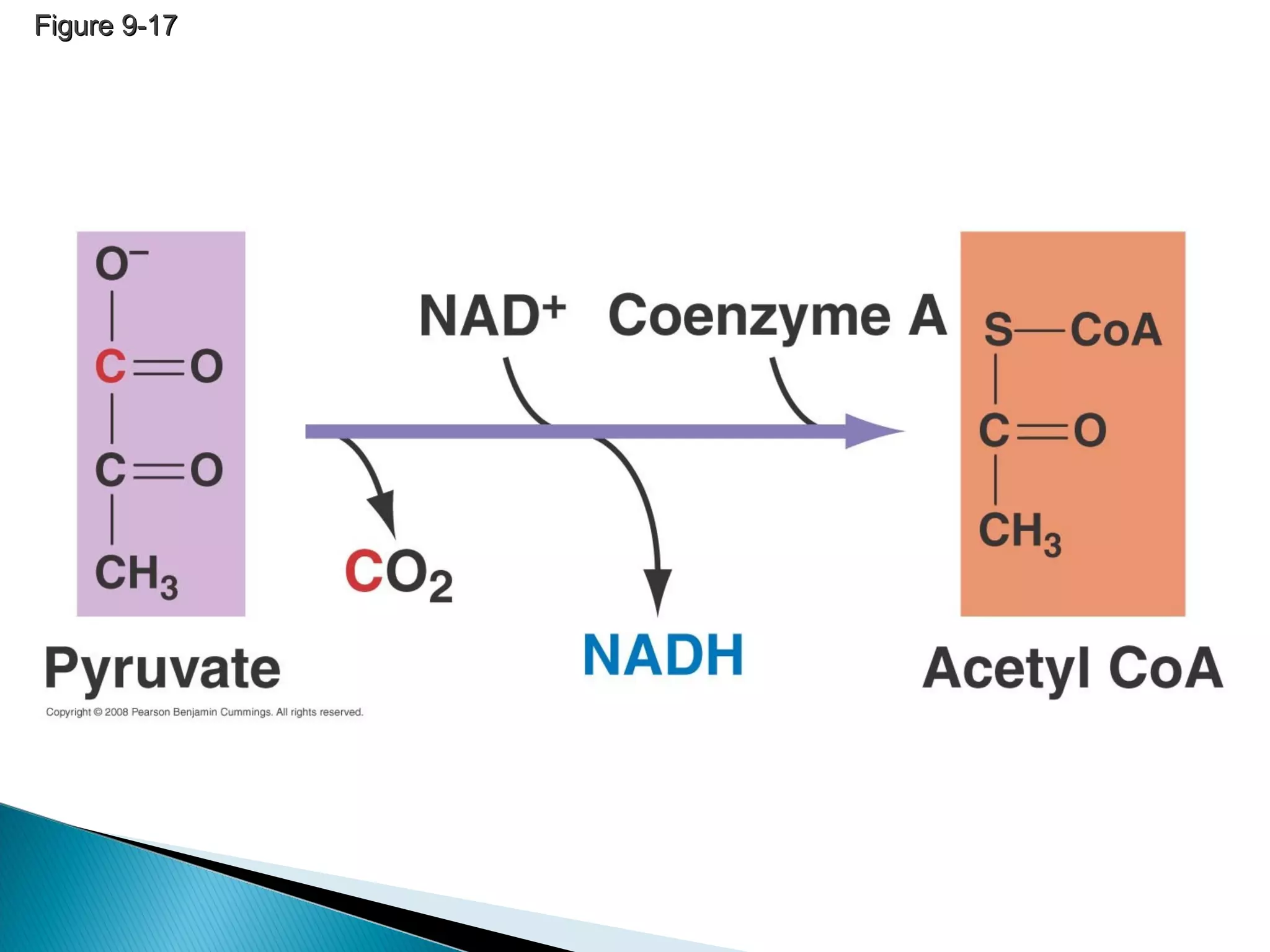
mitochondria, fig 9.16 and 9.17.
 Each pyruvate (3 C) is oxidized to an acetyl group
(2 C).
 Each acetyl group is combined with Coenzyme A
(CoA) and feeds into the Kreb’s Cycle.
 Summary: 2 Pyruvate + 2 CoA + 2 NAD+
→ 2CO2
+ 2acetyl CoA + 2NADH
Figure 9-17Figure 9-17
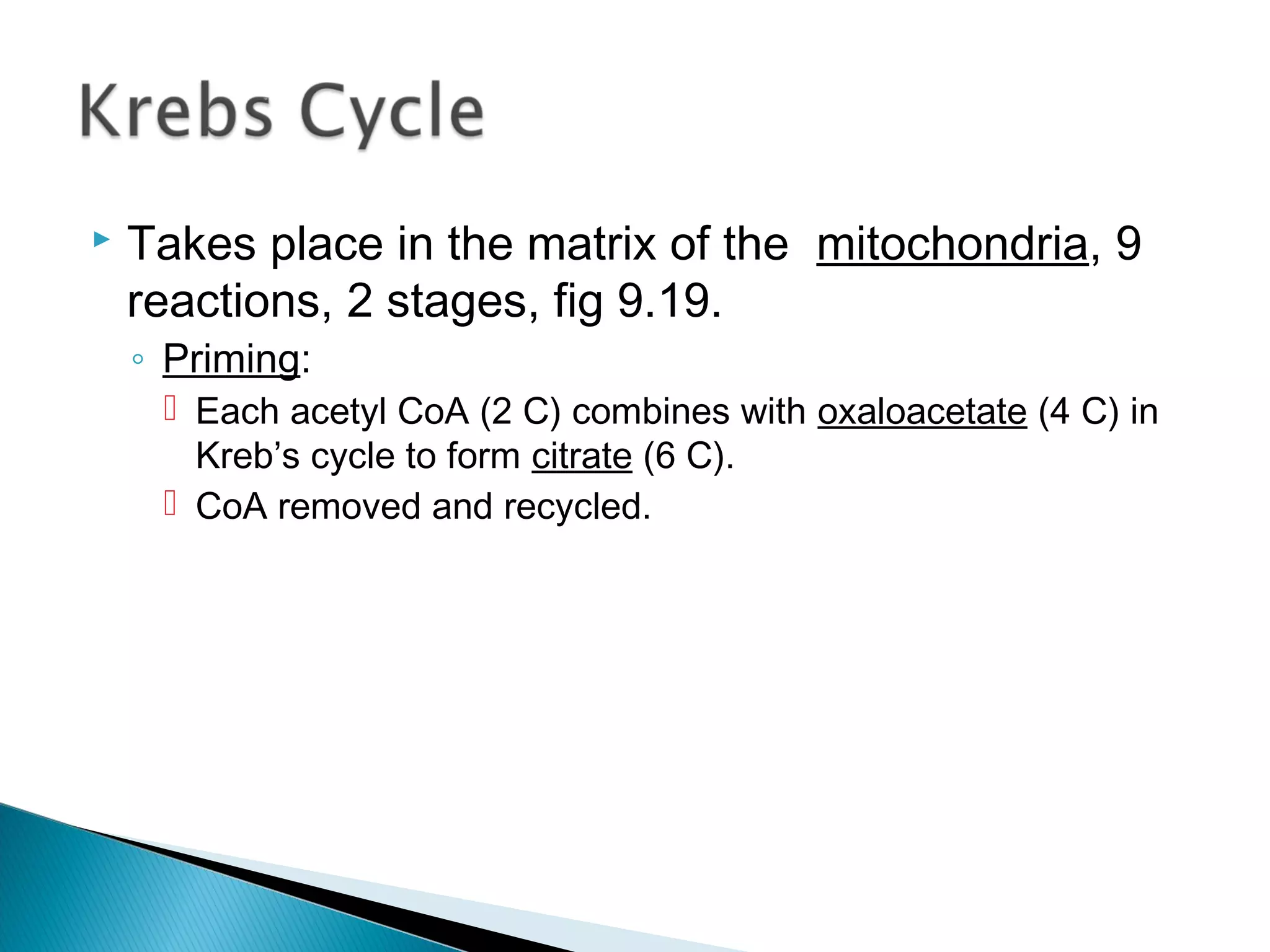
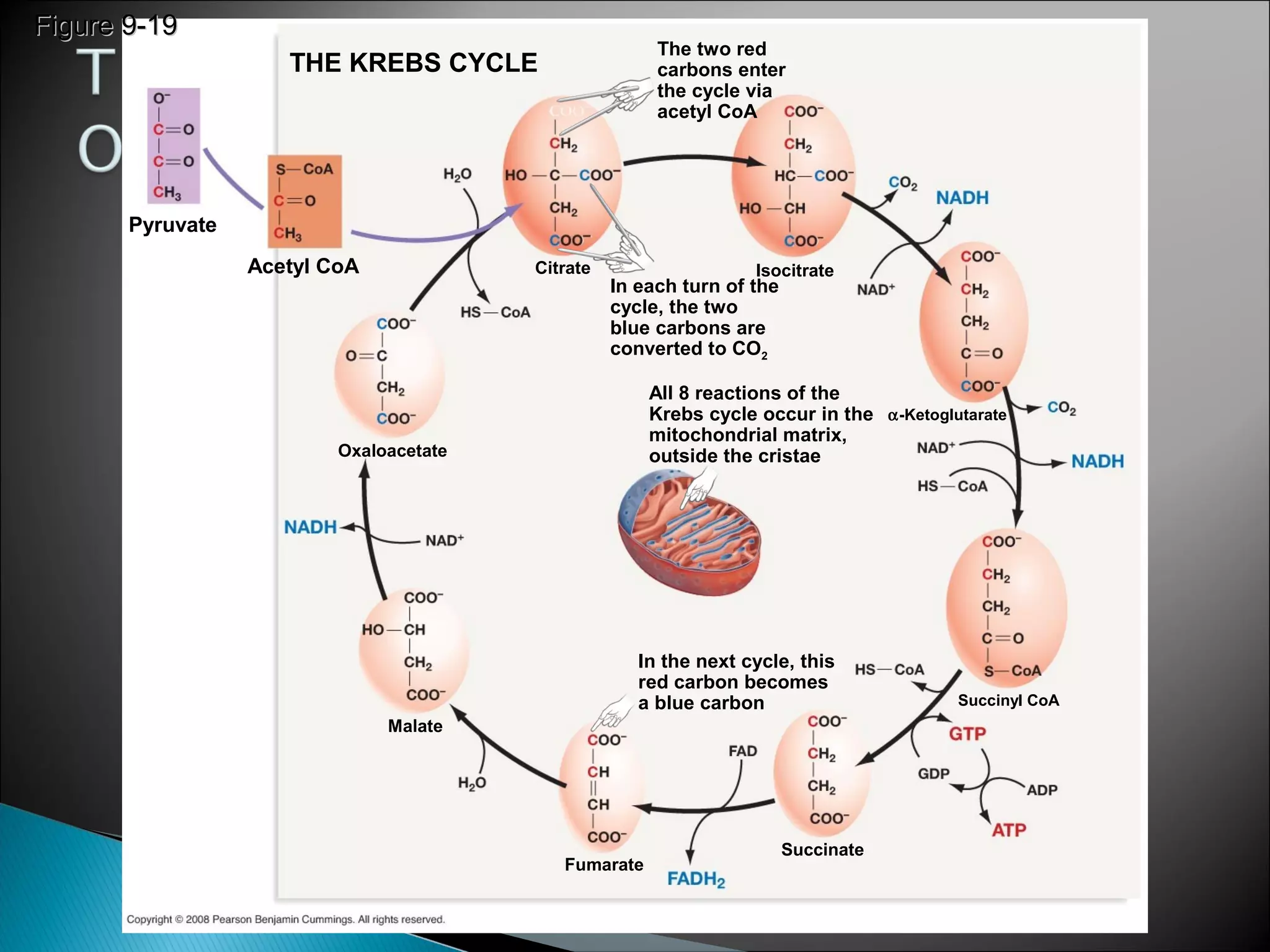
 Takes place in the matrix of the mitochondria, 9
reactions, 2 stages, fig 9.19.
◦ Priming:
 Each acetyl CoA (2 C) combines with oxaloacetate (4 C) in
Kreb’s cycle to form citrate (6 C).
 CoA removed and recycled.
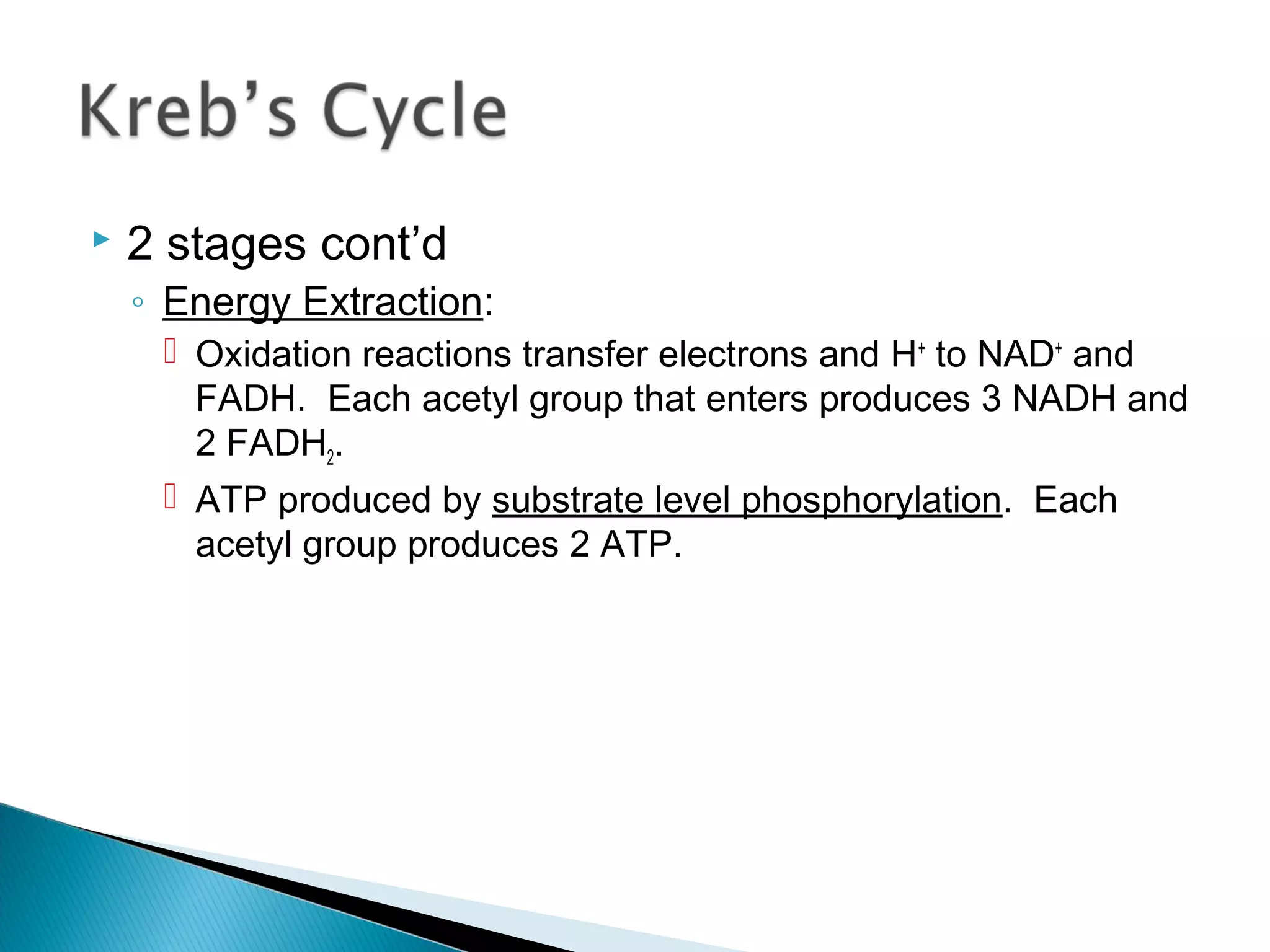
 2 stages cont’d
◦ Energy Extraction:
 Oxidation reactions transfer electrons and H+
to NAD+
and
FADH. Each acetyl group that enters produces 3 NADH and
2 FADH2.
 ATP produced by substrate level phosphorylation. Each
acetyl group produces 2 ATP.
Figure 9-19Figure 9-19
Oxaloacetate
Malate
Fumarate
Succinate
Succinyl CoA
α-Ketoglutarate
Citrate Isocitrate
Pyruvate
Acetyl CoA
THE KREBS CYCLE
In each turn of the
cycle, the two
blue carbons are
converted to CO2
The two red
carbons enter
the cycle via
acetyl CoA
All 8 reactions of the
Krebs cycle occur in the
mitochondrial matrix,
outside the cristae
In the next cycle, this
red carbon becomes
a blue carbon
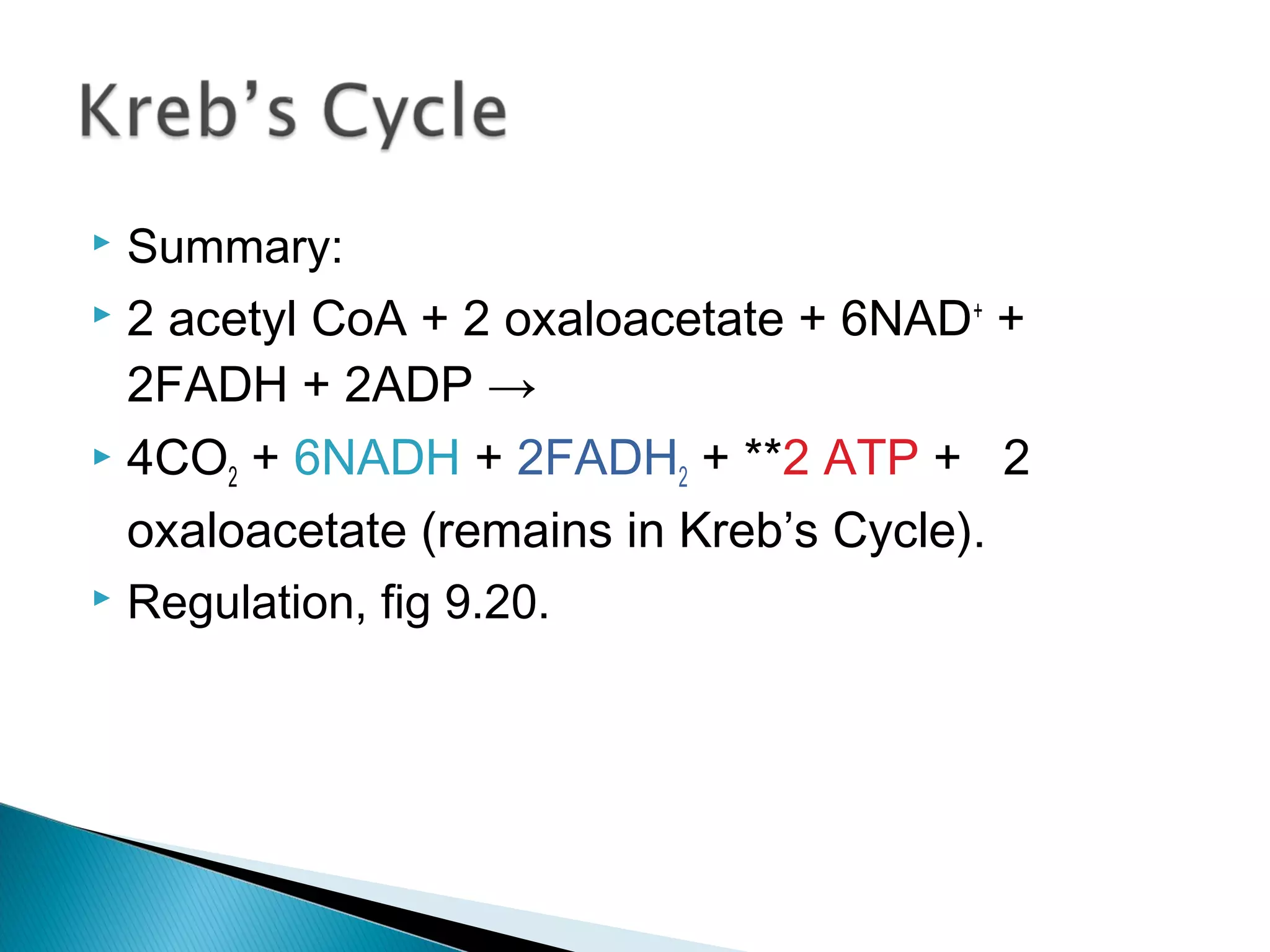
 Summary:
 2 acetyl CoA + 2 oxaloacetate + 6NAD+
+
2FADH + 2ADP →
 4CO2 + 6NADH + 2FADH2 + **2 ATP + 2
oxaloacetate (remains in Kreb’s Cycle).
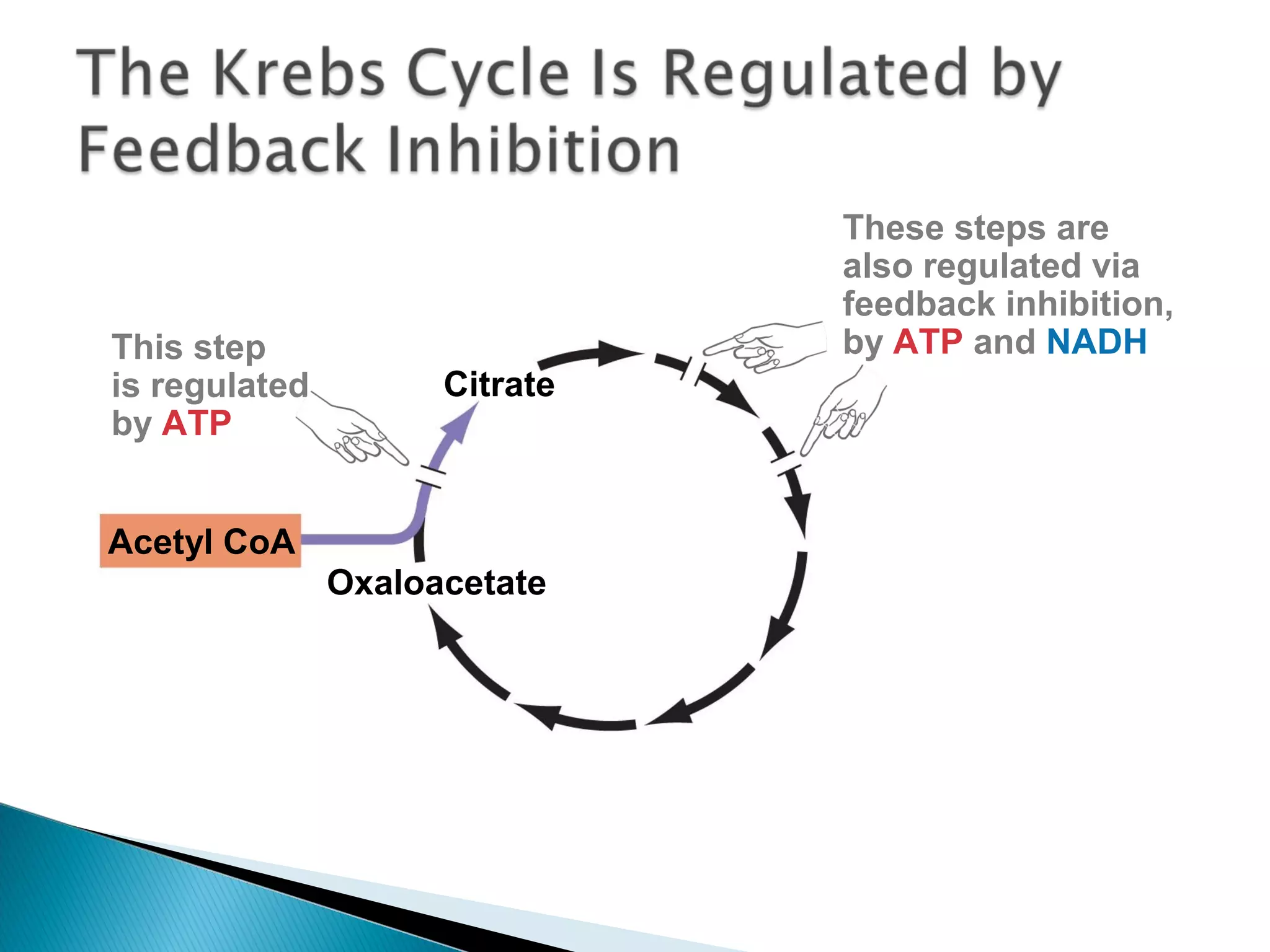
 Regulation, fig 9.20.
These steps are
also regulated via
feedback inhibition,
by ATP and NADHThis step
is regulated
by ATP
Oxaloacetate
Acetyl CoA
Citrate
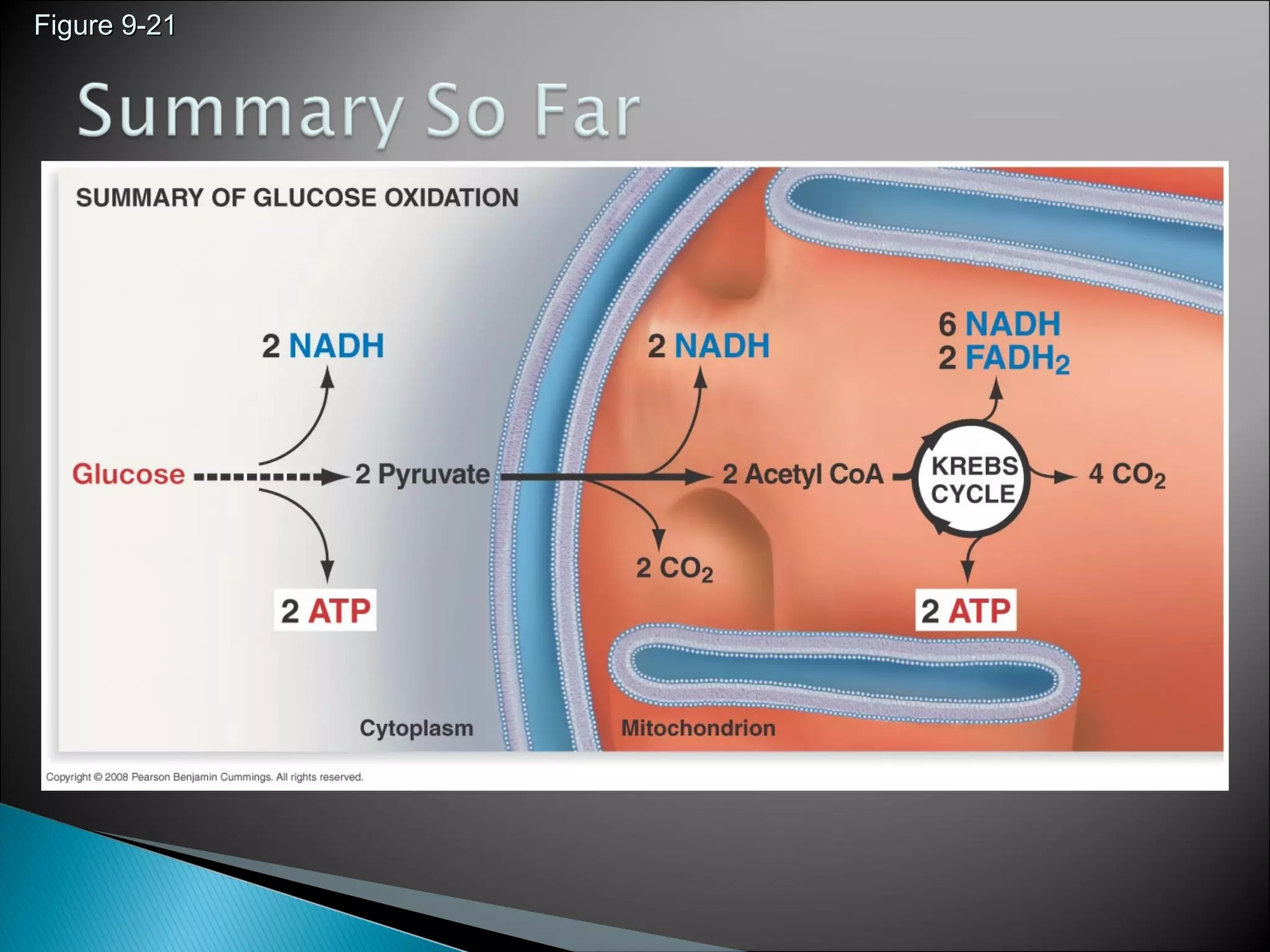
Figure 9-21Figure 9-21
 So far we have 4ATP and a bunch of electrons
(energy) and H+
carried by NADH and FADH2.
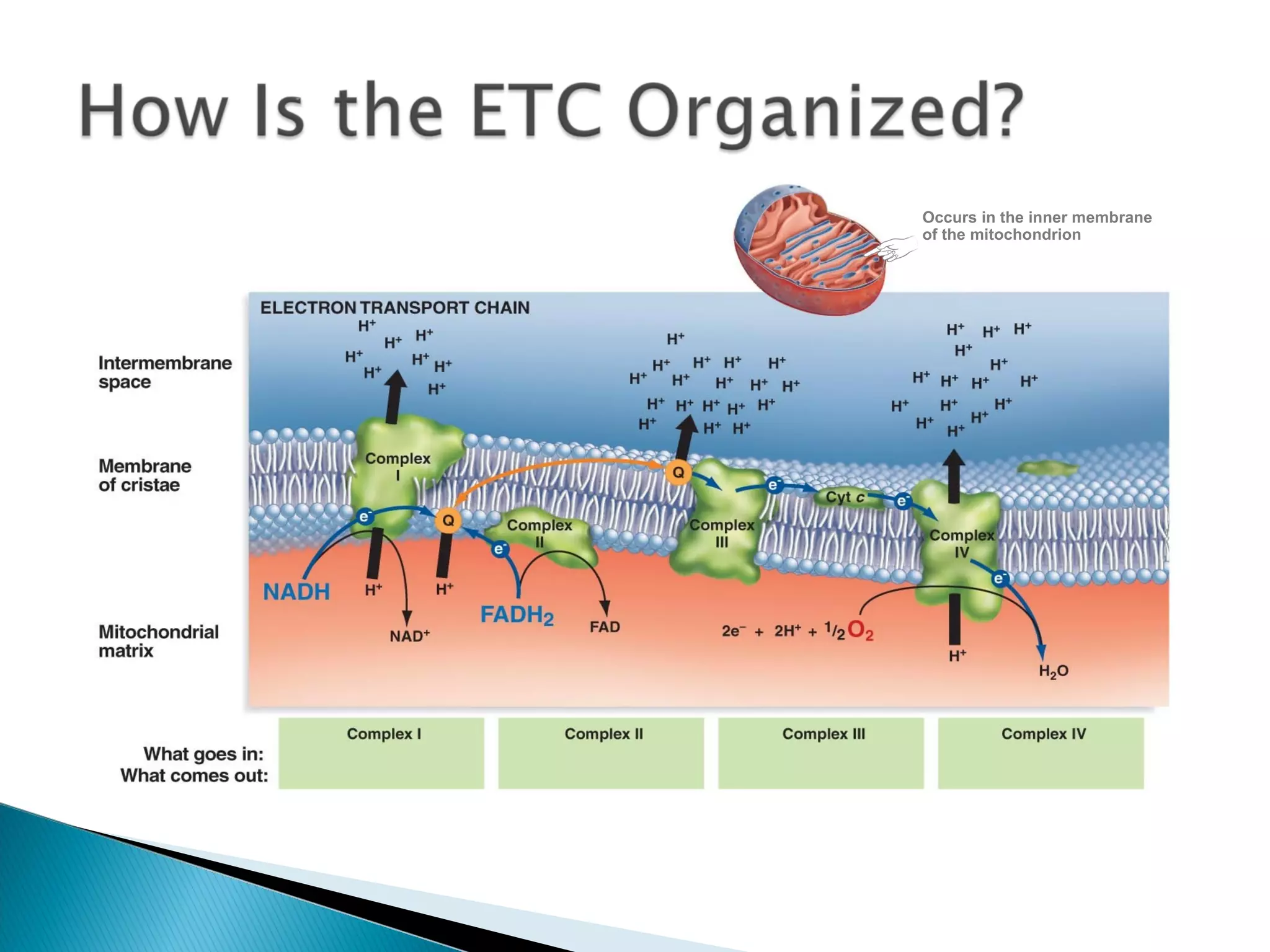
 NADH and FADH2 transfer electrons to the
transport chain (ETC) on the cristae of the
mitochondria, fig 9.24.
 The ETC “harvests” the energy from the electrons
as they pass down the chain.
 The energy harvested from the electrons is used
to “pump” H+
from the matrix to the intermembrane
space of the mitochondria (energy is stored in the
H+
).
 This produces a concentration gradient for H+
.
Occurs in the inner membrane
of the mitochondrion
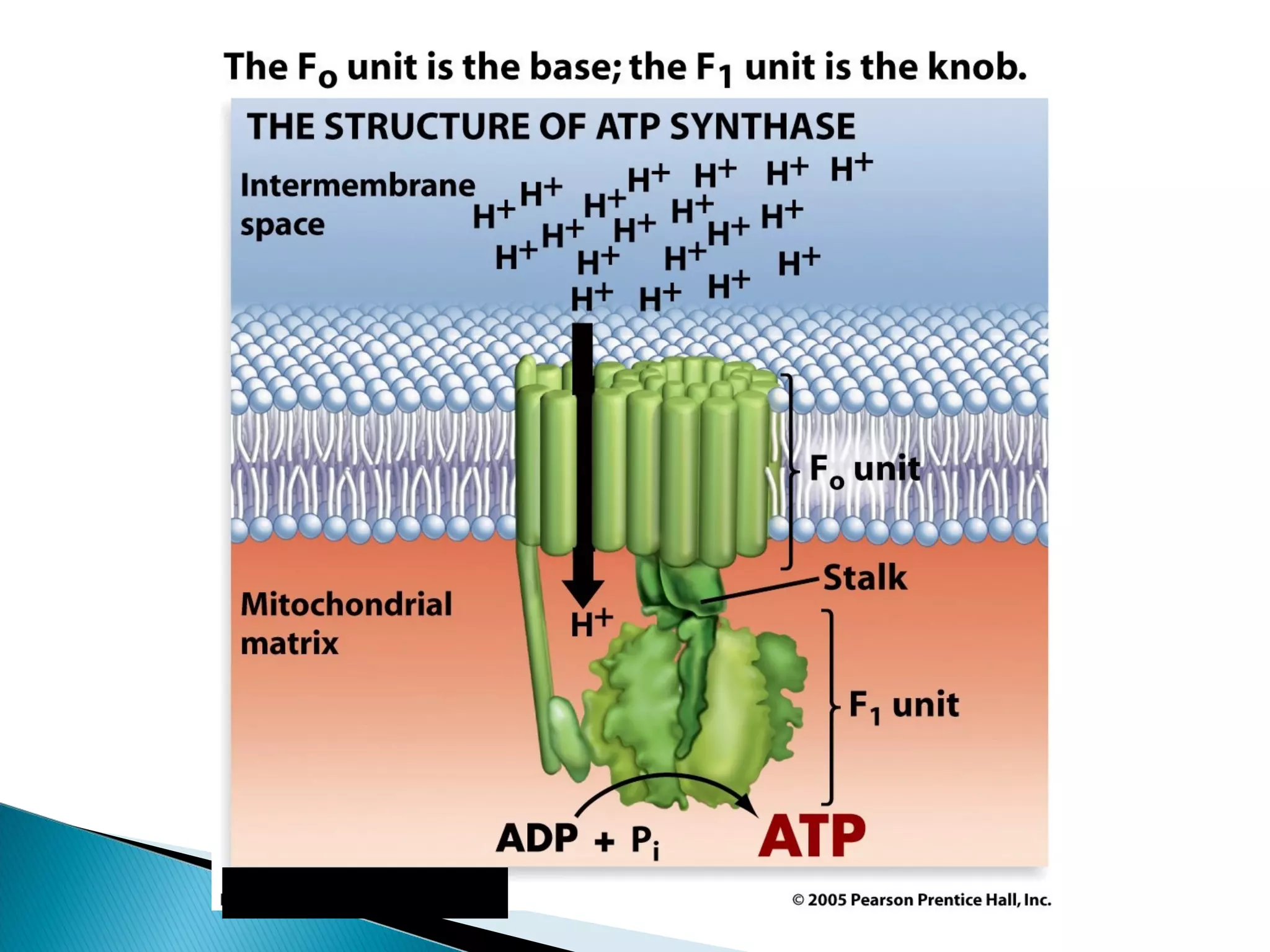
 H+
reenter the matrix through the enzyme, ATP
synthase.
 ATP synthase recovers the energy and produces
ATP via oxidative phosphorylation.
 Using the H+
gradient to produce ATP is called
chemiosmosis.
Figure 9.25
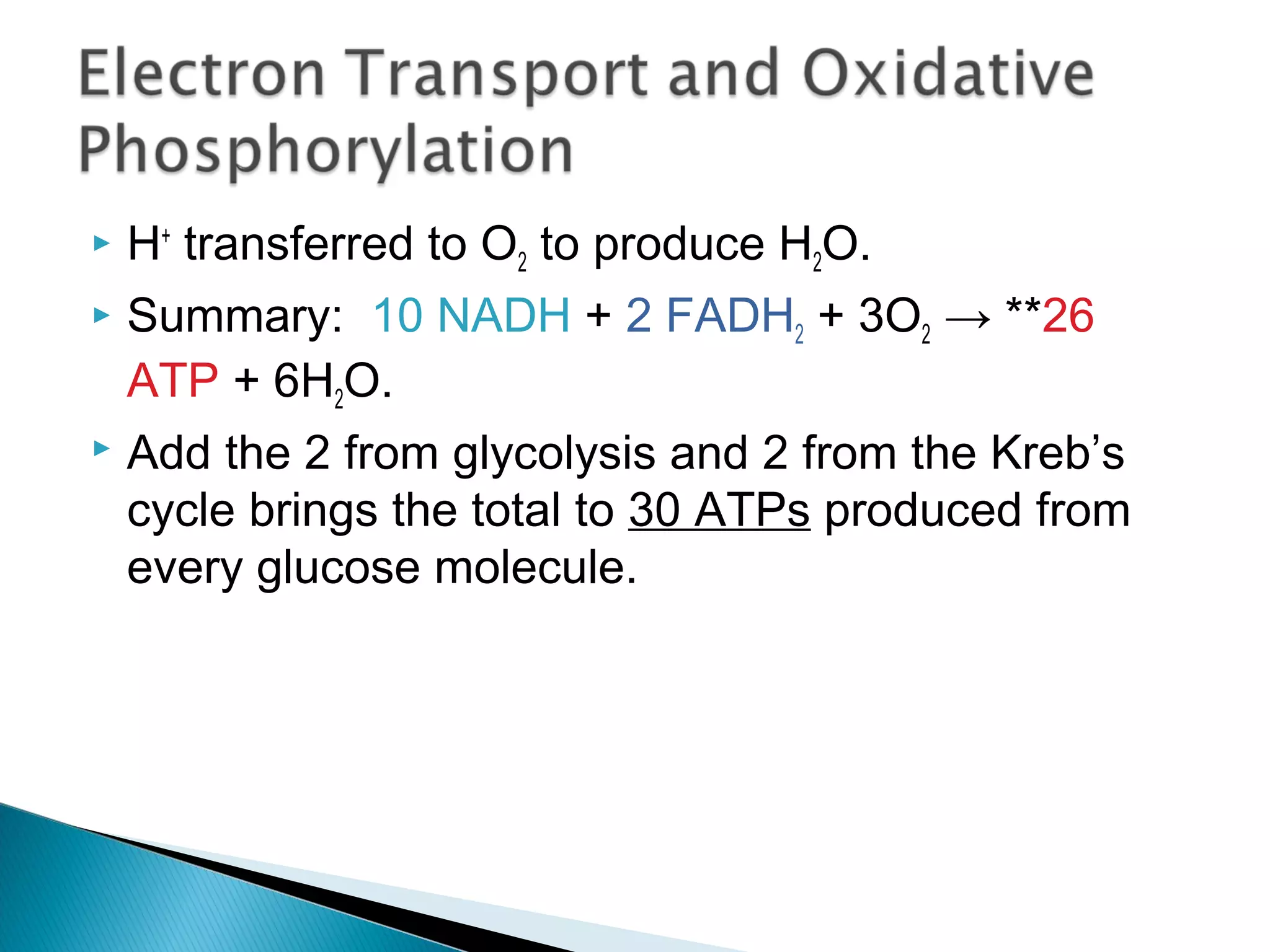
 H+
transferred to O2 to produce H2O.
 Summary: 10 NADH + 2 FADH2 + 3O2 → **26
ATP + 6H2O.
 Add the 2 from glycolysis and 2 from the Kreb’s
cycle brings the total to 30 ATPs produced from
every glucose molecule.
 Fate of pyruvate in the absence of oxygen.
 Allows for ATP production on a small scale by
recycling NAD+
for glycolysis.
 2 types:
 Lactic acid fermentation:
 Ethanol fermentation:
Figure 9-27bFigure 9-27b
Lactic acid fermentation occurs in humans.
2 Pyruvate
2 Lactate
No intermediate;
pyruvate accepts
electrons from NADH
Figure 9-27cFigure 9-27c
Alcohol fermentation occurs in yeast.
2 Pyruvate
2 Acetylaldehyde2 Ethanol
 Metabolism = all of the chemical reactions in an
organism
◦ Catabolism
◦ Anabolism
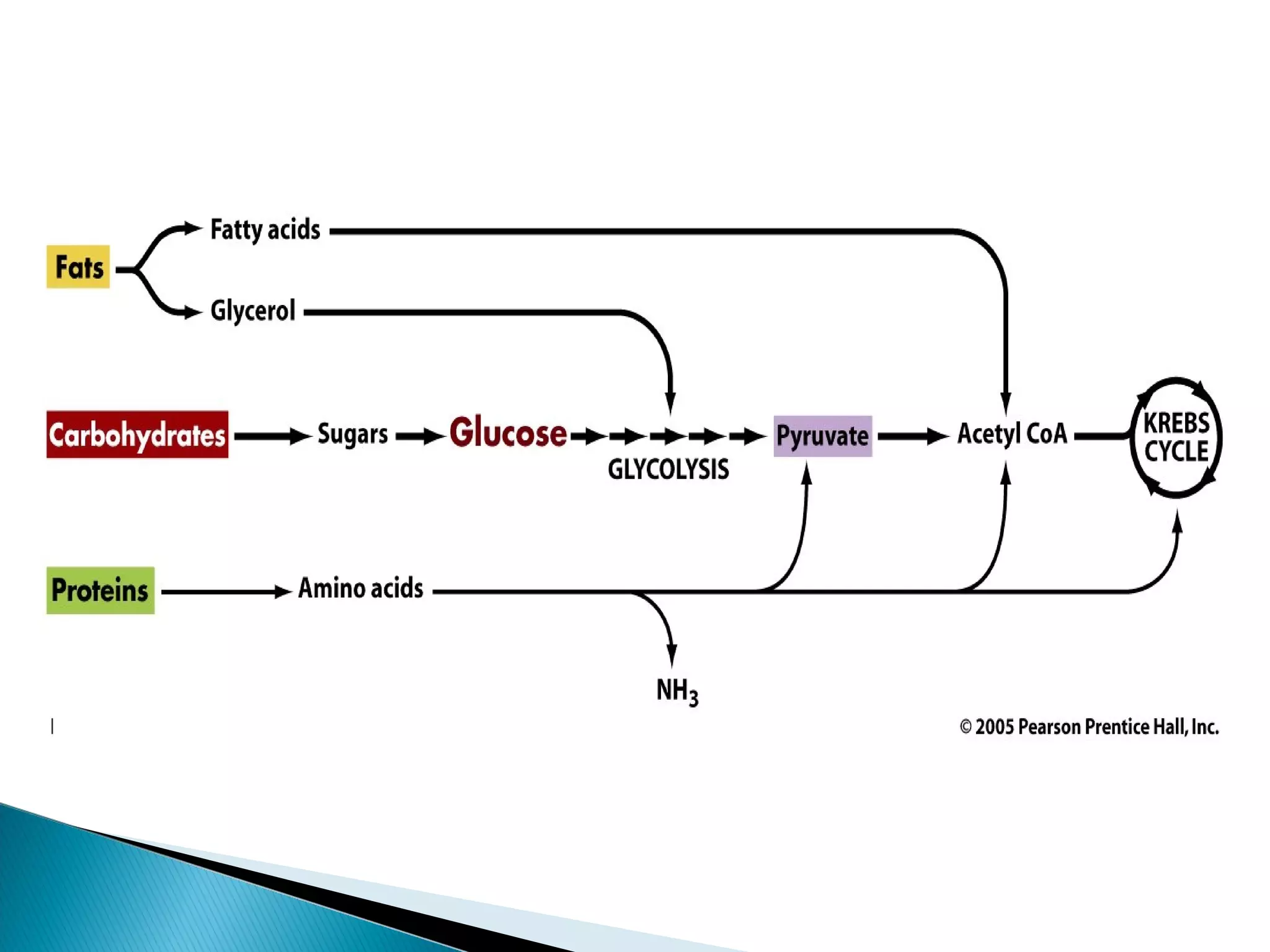
 In the absence of available glucose, fats and
proteins can feed into glycolysis and the Kreb’s
Cycle, fig 9.29.
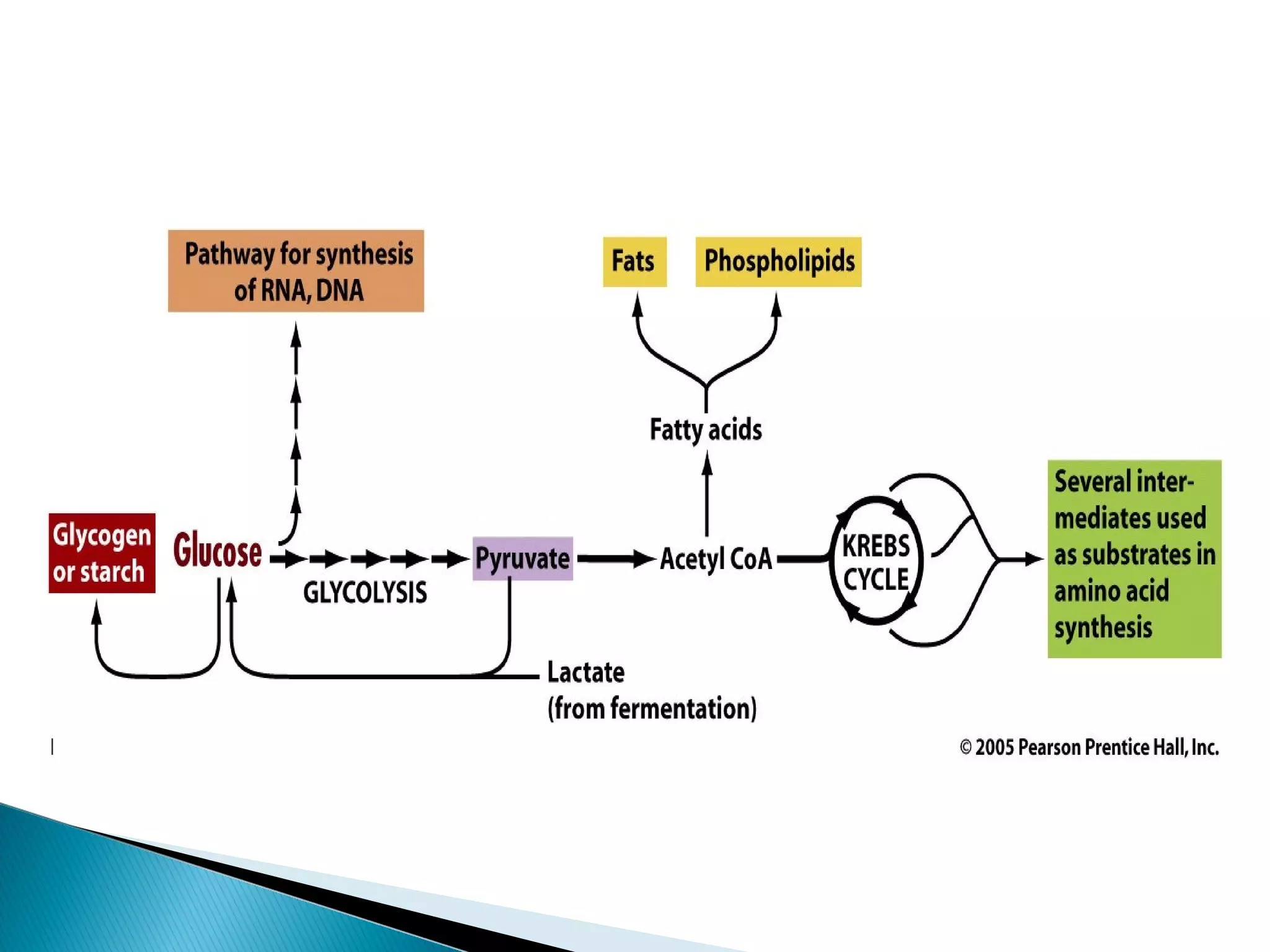
 Products of glycolysis and the Kreb’s cycle can be
used to produce RNA/DNA, proteins and fats, fig
9.30.
Figure 9.29
Figure 9.30

Cellresp.

  • 1.
  • 3.
     Review  ATP Cellular Respiration ◦ Glycolysis ◦ Pyruvate oxidation ◦ Krebs cycle ◦ Electron Transport chain  Fermentation
  • 4.
     All ofour energy comes from?  This energy is the form of?  Plants convert this energy to?  The energy is potential (stored) energy stored in?  The energy is released by?  Most living organisms require energy in the form of?
  • 6.
     Oxidation ofsugars, primarily glucose.  Key chemical reactions = REDOX reactions, transfer of electrons and H+ from one substance to another.  Energy is harvested from electrons and used to produce ATP.  ATP is stored in small quantities in cells but is primarily produced on demand by cellular respiration.
  • 7.
    ATP consists ofthree phosphate groups, ribose, and adenine. Phosphate groups Ribose Adenine
  • 8.
     ATP production:ADP + P → ATP; 2 types ◦ Substrate level phosphorylation ◦ Oxidative phosphorylation
  • 9.
     2 typesof Cellular Respiration ◦ Aerobic - oxygen is used as the final electron acceptor. ◦ Anaerobic – final electron acceptor is an inorganic molecule; some bacteria and archaea.  Fermentation – is also an anaerobic process.
  • 10.
     Summary ofaerobic respiration using glucose: C6H12O6 (glucose) + 6O2 → 6CO2 + 6H2O + energy (ATP)  4 Steps, fig 9.8:
  • 12.
     In thecytosol, 10 reactions, 3 stages, fig 9.13 ◦ Glucose (6 C) is primed, using 2 ATP’s, and converted to fructose 1,6 – bisphosphate. ◦ Fructose is split into two 3-C molecules, glyceraldehyde 3-phosphate (G3P) ◦ Energy extraction: electrons and H+ transferred to 2NAD+ and 4 ATPs produced. Final product – 2 pyruvate molecules (3 C).
  • 13.
    Glycolysis begins withan energy- investment phase of 2 ATP All 10 reactions of glycolysis occur in cytosol GLYCOLYSIS What goes in: What comes out: Glucose Glucose- 6-phosphate Fructose- 6-phosphate Fructose- 1,6-bisphosphate
  • 14.
    Pyruvate The “2” indicatesthat glucose has been split into two 3-carbon sugars During the energy payoff phase, 4 ATP are produced for a net gain of 2 ATP
  • 15.
  • 16.
     Summary: Glucose+ 2 NAD+ + 4ADP → 2 pyruvate + 2 NADH + 4ATP.  Note: each G3P is oxidized to produce 1 NADH and 2 ATP by substrate level phosphoylation.  2 ATP are used to pay back 2 used at the beginning.  Net Production: Glucose + 2 NAD+ + 4ADP → 2 pyruvate + 2 NADH + **2ATP.
  • 17.
    Fig 9.14. Whatinhibits glycolysis?Fig 9.14. What inhibits glycolysis?
  • 18.
     Takes placein the outer membrane of the mitochondria, fig 9.16 and 9.17.  Each pyruvate (3 C) is oxidized to an acetyl group (2 C).  Each acetyl group is combined with Coenzyme A (CoA) and feeds into the Kreb’s Cycle.  Summary: 2 Pyruvate + 2 CoA + 2 NAD+ → 2CO2 + 2acetyl CoA + 2NADH
  • 19.
  • 20.
     Takes placein the matrix of the mitochondria, 9 reactions, 2 stages, fig 9.19. ◦ Priming:  Each acetyl CoA (2 C) combines with oxaloacetate (4 C) in Kreb’s cycle to form citrate (6 C).  CoA removed and recycled.
  • 21.
     2 stagescont’d ◦ Energy Extraction:  Oxidation reactions transfer electrons and H+ to NAD+ and FADH. Each acetyl group that enters produces 3 NADH and 2 FADH2.  ATP produced by substrate level phosphorylation. Each acetyl group produces 2 ATP.
  • 22.
    Figure 9-19Figure 9-19 Oxaloacetate Malate Fumarate Succinate SuccinylCoA α-Ketoglutarate Citrate Isocitrate Pyruvate Acetyl CoA THE KREBS CYCLE In each turn of the cycle, the two blue carbons are converted to CO2 The two red carbons enter the cycle via acetyl CoA All 8 reactions of the Krebs cycle occur in the mitochondrial matrix, outside the cristae In the next cycle, this red carbon becomes a blue carbon
  • 23.
     Summary:  2acetyl CoA + 2 oxaloacetate + 6NAD+ + 2FADH + 2ADP →  4CO2 + 6NADH + 2FADH2 + **2 ATP + 2 oxaloacetate (remains in Kreb’s Cycle).  Regulation, fig 9.20.
  • 24.
    These steps are alsoregulated via feedback inhibition, by ATP and NADHThis step is regulated by ATP Oxaloacetate Acetyl CoA Citrate
  • 25.
  • 26.
     So farwe have 4ATP and a bunch of electrons (energy) and H+ carried by NADH and FADH2.  NADH and FADH2 transfer electrons to the transport chain (ETC) on the cristae of the mitochondria, fig 9.24.
  • 27.
     The ETC“harvests” the energy from the electrons as they pass down the chain.  The energy harvested from the electrons is used to “pump” H+ from the matrix to the intermembrane space of the mitochondria (energy is stored in the H+ ).  This produces a concentration gradient for H+ .
  • 28.
    Occurs in theinner membrane of the mitochondrion
  • 29.
     H+ reenter thematrix through the enzyme, ATP synthase.  ATP synthase recovers the energy and produces ATP via oxidative phosphorylation.  Using the H+ gradient to produce ATP is called chemiosmosis.
  • 30.
  • 31.
     H+ transferred toO2 to produce H2O.  Summary: 10 NADH + 2 FADH2 + 3O2 → **26 ATP + 6H2O.  Add the 2 from glycolysis and 2 from the Kreb’s cycle brings the total to 30 ATPs produced from every glucose molecule.
  • 32.
     Fate ofpyruvate in the absence of oxygen.  Allows for ATP production on a small scale by recycling NAD+ for glycolysis.  2 types:
  • 33.
     Lactic acidfermentation:  Ethanol fermentation:
  • 34.
    Figure 9-27bFigure 9-27b Lacticacid fermentation occurs in humans. 2 Pyruvate 2 Lactate No intermediate; pyruvate accepts electrons from NADH
  • 35.
    Figure 9-27cFigure 9-27c Alcoholfermentation occurs in yeast. 2 Pyruvate 2 Acetylaldehyde2 Ethanol
  • 36.
     Metabolism =all of the chemical reactions in an organism ◦ Catabolism ◦ Anabolism
  • 37.
     In theabsence of available glucose, fats and proteins can feed into glycolysis and the Kreb’s Cycle, fig 9.29.  Products of glycolysis and the Kreb’s cycle can be used to produce RNA/DNA, proteins and fats, fig 9.30.
  • 38.
  • 39.