ELISA to Measure
Cytochrome P450
Protein Concentration
Objectives
• To develop an ELISA procedure
to measure Cytochrome P450
protein.
What Is An ELISA?
• E- Enzyme
• L- Linked
• I- Immuno
• S- Sorbent
• A- Assay
• This technique is
designed to provide
an ultra-sensitive
process with
dependable results.
• It uses a 96-well
plate to measure a
protein or
substance based
on an
antigen/antibody
reaction.
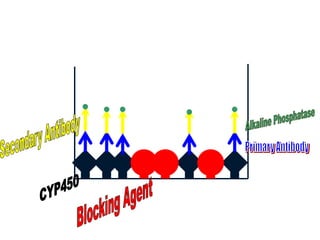
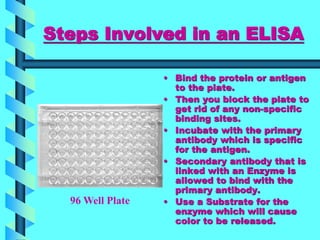
Steps Involved in an ELISA
• Bind the protein or antigen
to the plate.
• Then you block the plate to
get rid of any non-specific
binding sites.
• Incubate with the primary
antibody which is specific
for the antigen.
• Secondary antibody that is
linked with an Enzyme is
allowed to bind with the
primary antibody.
• Use a Substrate for the
enzyme which will cause
color to be released.
96 Well Plate
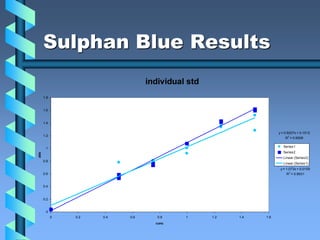
Sulphan Blue Results
individual std
y = 1.073x + 0.0159
R
2
= 0.9931
y = 0.9207x + 0.1012
R
2
= 0.9506
0
0.2
0.4
0.6
0.8
1
1.2
1.4
1.6
1.8
0 0.2 0.4 0.6 0.8 1 1.2 1.4 1.6
conc
abs
Series1
Series2
Linear (Series2)
Linear (Series1)
Cytochrome P450
• Cytochrome P450 is a large
group of enzymes that are found
in the liver of mammals. They
are the main step in the
elimination and transformation
of foreign substances.
Abbreviations
• uL- microliters
• FBS- Fetal Bovine Serum
• PBS- Phosphate Buffered Saline
• TBS- Tris Buffered Saline
• nm- nanometers
Microsomes
• We removed the liver from a
normal rat and from a
Phenobarbital treated rat.
• Use a Potter-Eljeham
homogenizer at 1000 RPM to
create a homogenate.
• Centrifuge the homogenate at
600g for 10 minutes to produce
a crude homogenate.
• Centrifuge the remaining
supernatant at 15,000g for 1
hour to separate out the
mitochondrial pellet.
• Centrifuge the remaining
supernatant at 100,000g for 1
hour to yield the microsomal
pellet.
ELISA Procedure
1. Add 100 uL protein to plate wells in triplicate.
2. Add 100 uL of 2x Carbonate-Bicarbonate buffer to
each well. Cover and store overnight at 4°C.
3. Add 200 uL of 50% FBS in PBS to each well. Mix
for 1 hour. This is the blocking solution.
4. Wash plate out with TBS-Tween 3 times
5. Add 200uL Primary Antibody Solution to each well.
Mix for 1hour at 37ºC
6. Wash plate out with TBS-Tween 3 times.
7. Add 200ul Secondary Antibody Solution to each
well. Mix for 1 hour at 37ºC.
8. Wash plate out with TBS-Tween 3 times.
9. Add 200 uL of alkaline phosphatase substrate. Mix
for 30 minutes at 25ºC.
10. Read the absorbance in a 96-well plate reader at
405 nm.
Experiment 1
• Antigen-
– CYP450 2B1 Varied from 1000 to 1
femtomoles per well.
– Microsomes from normal rat 10 to 1
ug/mL.
• 1º Antibody-
– Anti-rat CYP450 2B1 1:5000 dilution.
• 2º Antibody conjugated to Alkaline
Phosphatase
– 1:30,000 dilution.
• Resulted in no activity detected.
Experiment 2
• Antigen-
– CYP450 2B1 Varied from 1000 to 1
femtomoles per well.
– Microsomes from normal rat 10 to 1
ug/mL.
• 1º Antibody-
– Anti-rat CYP450 2B1 1:1000 or 1:2000
dilutions.
• 2º Antibody conjugated to Alkaline
Phosphatase
– 1:10,000 dilution.
• Resulted in variable and low activity.
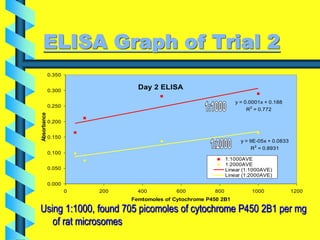
ELISA Graph of Trial 2
Day 2 ELISA
y = 0.0001x + 0.188
R2
= 0.772
y = 9E-05x + 0.0833
R2
= 0.8931
0.000
0.050
0.100
0.150
0.200
0.250
0.300
0.350
0 200 400 600 800 1000 1200
Femtomoles of Cytochrome P450 2B1
Absorbance
1:1000AVE
1:2000AVE
Linear (1:1000AVE)
Linear (1:2000AVE)
Using 1:1000, found 705 picomoles of cytochrome P450 2B1 per mg
of rat microsomes
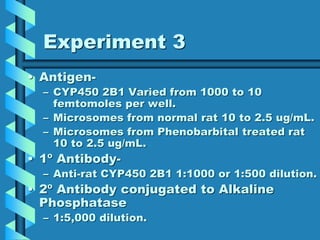
Experiment 3
• Antigen-
– CYP450 2B1 Varied from 1000 to 10
femtomoles per well.
– Microsomes from normal rat 10 to 2.5 ug/mL.
– Microsomes from Phenobarbital treated rat
10 to 2.5 ug/mL.
• 1º Antibody-
– Anti-rat CYP450 2B1 1:1000 or 1:500 dilution.
• 2º Antibody conjugated to Alkaline
Phosphatase
– 1:5,000 dilution.
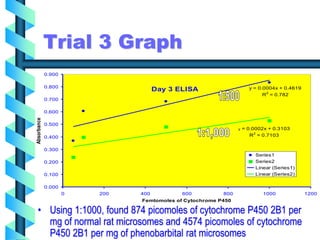
Trial 3 Graph
Day 3 ELISA y = 0.0004x + 0.4619
R2
= 0.782
y = 0.0002x + 0.3103
R2
= 0.7103
0.000
0.100
0.200
0.300
0.400
0.500
0.600
0.700
0.800
0.900
0 200 400 600 800 1000 1200
Femtomoles of Cytochrome P450
Absorbance
Series1
Series2
Linear (Series1)
Linear (Series2)
• Using 1:1000, found 874 picomoles of cytochrome P450 2B1 per
mg of normal rat microsomes and 4574 picomoles of cytochrome
P450 2B1 per mg of phenobarbital rat microsomes
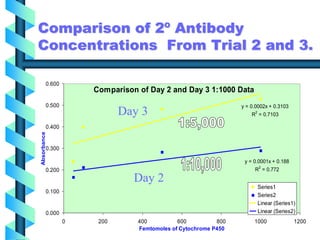
Comparison of Day 2 and Day 3 1:1000 Data
y = 0.0002x + 0.3103
R
2
= 0.7103
y = 0.0001x + 0.188
R
2
= 0.772
0.000
0.100
0.200
0.300
0.400
0.500
0.600
0 200 400 600 800 1000 1200
Femtomoles of Cytochrome P450
Absorbance
Series1
Series2
Linear (Series1)
Linear (Series2)
Comparison of 2º Antibody
Concentrations From Trial 2 and 3.
Day 3
Day 2
Experiment 4
• Antigen-
– CYP450 2B1 Varied from 1000 to 10
femtomoles per well.
– Crude extract of tissue culture from
H4IIE, an immortalized cell line of rat
hepatocytes, 10 to 2.5 ug/mL.
– Microsomes from cell extract of H4IIE 10
to 2.5 ug/mL.
• 1º Antibody-
– Anti-rat CYP450 2B1 1:500 dilution.
• 2º Antibody conjugated to Alkaline
Phosphatase
– 1:5,000 dilution.
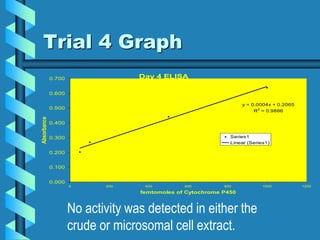
Trial 4 Graph
Day 4 ELISA
y = 0.0004x + 0.2065
R2
= 0.9886
0.000
0.100
0.200
0.300
0.400
0.500
0.600
0.700
0 200 400 600 800 1000 1200
femtomoles of Cytochrome P450
Absorbance
Series1
Linear (Series1)
No activity was detected in either the
crude or microsomal cell extract.
Conclusions
• Successfully developed an ELISA assay to
measure Cytochrome P450 2B1 protein.
– Optimized antigen, 1º and 2º antibody concentrations.
• Measured Cytochrome P450 2B1 from normal
and phenobarbital treated rats.
– There was increased levels of P450 2B1 in the
phenobarbital treated animals.
• Unable to detect Cytochrome P450 2B1 in tissue
cultures of H4IIE rat hepatocytes.

2 collinspres

  • 1.
    ELISA to Measure CytochromeP450 Protein Concentration
  • 2.
    Objectives • To developan ELISA procedure to measure Cytochrome P450 protein.
  • 3.
    What Is AnELISA? • E- Enzyme • L- Linked • I- Immuno • S- Sorbent • A- Assay • This technique is designed to provide an ultra-sensitive process with dependable results. • It uses a 96-well plate to measure a protein or substance based on an antigen/antibody reaction.
  • 5.
    Steps Involved inan ELISA • Bind the protein or antigen to the plate. • Then you block the plate to get rid of any non-specific binding sites. • Incubate with the primary antibody which is specific for the antigen. • Secondary antibody that is linked with an Enzyme is allowed to bind with the primary antibody. • Use a Substrate for the enzyme which will cause color to be released. 96 Well Plate
  • 6.
    Sulphan Blue Results individualstd y = 1.073x + 0.0159 R 2 = 0.9931 y = 0.9207x + 0.1012 R 2 = 0.9506 0 0.2 0.4 0.6 0.8 1 1.2 1.4 1.6 1.8 0 0.2 0.4 0.6 0.8 1 1.2 1.4 1.6 conc abs Series1 Series2 Linear (Series2) Linear (Series1)
  • 7.
    Cytochrome P450 • CytochromeP450 is a large group of enzymes that are found in the liver of mammals. They are the main step in the elimination and transformation of foreign substances.
  • 8.
    Abbreviations • uL- microliters •FBS- Fetal Bovine Serum • PBS- Phosphate Buffered Saline • TBS- Tris Buffered Saline • nm- nanometers
  • 9.
    Microsomes • We removedthe liver from a normal rat and from a Phenobarbital treated rat. • Use a Potter-Eljeham homogenizer at 1000 RPM to create a homogenate. • Centrifuge the homogenate at 600g for 10 minutes to produce a crude homogenate. • Centrifuge the remaining supernatant at 15,000g for 1 hour to separate out the mitochondrial pellet. • Centrifuge the remaining supernatant at 100,000g for 1 hour to yield the microsomal pellet.
  • 10.
    ELISA Procedure 1. Add100 uL protein to plate wells in triplicate. 2. Add 100 uL of 2x Carbonate-Bicarbonate buffer to each well. Cover and store overnight at 4°C. 3. Add 200 uL of 50% FBS in PBS to each well. Mix for 1 hour. This is the blocking solution. 4. Wash plate out with TBS-Tween 3 times 5. Add 200uL Primary Antibody Solution to each well. Mix for 1hour at 37ºC 6. Wash plate out with TBS-Tween 3 times. 7. Add 200ul Secondary Antibody Solution to each well. Mix for 1 hour at 37ºC. 8. Wash plate out with TBS-Tween 3 times. 9. Add 200 uL of alkaline phosphatase substrate. Mix for 30 minutes at 25ºC. 10. Read the absorbance in a 96-well plate reader at 405 nm.
  • 11.
    Experiment 1 • Antigen- –CYP450 2B1 Varied from 1000 to 1 femtomoles per well. – Microsomes from normal rat 10 to 1 ug/mL. • 1º Antibody- – Anti-rat CYP450 2B1 1:5000 dilution. • 2º Antibody conjugated to Alkaline Phosphatase – 1:30,000 dilution. • Resulted in no activity detected.
  • 12.
    Experiment 2 • Antigen- –CYP450 2B1 Varied from 1000 to 1 femtomoles per well. – Microsomes from normal rat 10 to 1 ug/mL. • 1º Antibody- – Anti-rat CYP450 2B1 1:1000 or 1:2000 dilutions. • 2º Antibody conjugated to Alkaline Phosphatase – 1:10,000 dilution. • Resulted in variable and low activity.
  • 13.
    ELISA Graph ofTrial 2 Day 2 ELISA y = 0.0001x + 0.188 R2 = 0.772 y = 9E-05x + 0.0833 R2 = 0.8931 0.000 0.050 0.100 0.150 0.200 0.250 0.300 0.350 0 200 400 600 800 1000 1200 Femtomoles of Cytochrome P450 2B1 Absorbance 1:1000AVE 1:2000AVE Linear (1:1000AVE) Linear (1:2000AVE) Using 1:1000, found 705 picomoles of cytochrome P450 2B1 per mg of rat microsomes
  • 14.
    Experiment 3 • Antigen- –CYP450 2B1 Varied from 1000 to 10 femtomoles per well. – Microsomes from normal rat 10 to 2.5 ug/mL. – Microsomes from Phenobarbital treated rat 10 to 2.5 ug/mL. • 1º Antibody- – Anti-rat CYP450 2B1 1:1000 or 1:500 dilution. • 2º Antibody conjugated to Alkaline Phosphatase – 1:5,000 dilution.
  • 15.
    Trial 3 Graph Day3 ELISA y = 0.0004x + 0.4619 R2 = 0.782 y = 0.0002x + 0.3103 R2 = 0.7103 0.000 0.100 0.200 0.300 0.400 0.500 0.600 0.700 0.800 0.900 0 200 400 600 800 1000 1200 Femtomoles of Cytochrome P450 Absorbance Series1 Series2 Linear (Series1) Linear (Series2) • Using 1:1000, found 874 picomoles of cytochrome P450 2B1 per mg of normal rat microsomes and 4574 picomoles of cytochrome P450 2B1 per mg of phenobarbital rat microsomes
  • 16.
    Comparison of Day2 and Day 3 1:1000 Data y = 0.0002x + 0.3103 R 2 = 0.7103 y = 0.0001x + 0.188 R 2 = 0.772 0.000 0.100 0.200 0.300 0.400 0.500 0.600 0 200 400 600 800 1000 1200 Femtomoles of Cytochrome P450 Absorbance Series1 Series2 Linear (Series1) Linear (Series2) Comparison of 2º Antibody Concentrations From Trial 2 and 3. Day 3 Day 2
  • 17.
    Experiment 4 • Antigen- –CYP450 2B1 Varied from 1000 to 10 femtomoles per well. – Crude extract of tissue culture from H4IIE, an immortalized cell line of rat hepatocytes, 10 to 2.5 ug/mL. – Microsomes from cell extract of H4IIE 10 to 2.5 ug/mL. • 1º Antibody- – Anti-rat CYP450 2B1 1:500 dilution. • 2º Antibody conjugated to Alkaline Phosphatase – 1:5,000 dilution.
  • 18.
    Trial 4 Graph Day4 ELISA y = 0.0004x + 0.2065 R2 = 0.9886 0.000 0.100 0.200 0.300 0.400 0.500 0.600 0.700 0 200 400 600 800 1000 1200 femtomoles of Cytochrome P450 Absorbance Series1 Linear (Series1) No activity was detected in either the crude or microsomal cell extract.
  • 19.
    Conclusions • Successfully developedan ELISA assay to measure Cytochrome P450 2B1 protein. – Optimized antigen, 1º and 2º antibody concentrations. • Measured Cytochrome P450 2B1 from normal and phenobarbital treated rats. – There was increased levels of P450 2B1 in the phenobarbital treated animals. • Unable to detect Cytochrome P450 2B1 in tissue cultures of H4IIE rat hepatocytes.