2. Basic Immunologic
Procedures
Labeled Immunoassays
 Some antigen/antibody reactions not detected
by precipitation or agglutination.
 Looking for very small amounts.
 Measured indirectly using a labeled reactant.
 Referred to as receptor-ligand assays.
Terminology
 Ligand is the substance to be measured.
 Defined as a molecule that binds to another molecule
of a complementary configuration.
 Usually binds to the substance the test is trying to
detect.
 The receptor is what binds the specific target
molecule.
 “Sandwich” technique is an example.
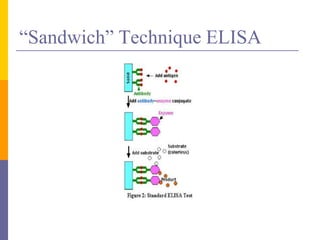
“Sandwich” Technique ELISA
Terminology
 Reactions may be competitive or non-
competitive
 Competitive – labeled known and patient
unknown are added to reaction and “compete”
for the target.
 For example, looking for an antibody.
 Add labeled reagent antibody of known specificity,
patient sample and known antigen.
 Patient antibody competes with reagent antibody for
the target antigen.
 Concentration is inversely proportional to results.
Terminology
 Non-competitive
 Add patient sample, for example looking for antibody,
to known reagent antigen.
 Reaction occurs and the concentration is directly
related to the amount of antibody in patient sample.
Terminology
 Heterogeneous or homogeneous
 Heterogeneous assays called separation
assays
 Require multiple steps
 Careful washing of surface to remove unbound
reagents and samples.
 Homogeneous assays do NOT require a
separation step.
 Mix reagents and patient sample.
 Measure the labeled product.
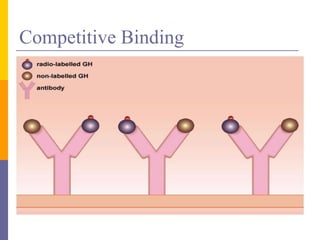
Competitive Binding
 Add known labeled antigen
 Add unknown antigen
 Will compete with each other for sites on bound
antibody molecule.
 Must wash off unreacted substances.
 Type of label on known antigen will determine
method of detection.
Competitive Binding
Noncompetitive Binding
 Patient sample added.
 Will react with its homologous antigen or
antibody, depending upon what is being tested
for.
 The reaction is measured and the concentration
is directly related to the detected amount.
Standards or Calibrators
 Substance of exact known concentration.
 Usually run for each new lot number
 Based on results create standard curve.
 Standard curve used to “read” results or built
into machine to provide results.
Labels
 Used to detect reaction which has occurred.
 Most common are:
 Radioactive
 Enzymes
 Fluorescent
 Chemiluminescent
Radioimmunassay (RIA)
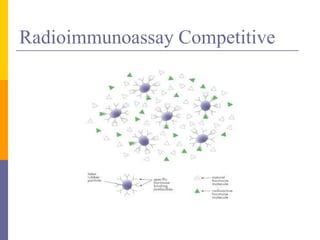
 Competitive binding
 Uses Iodine 125 (I 125) as label
 Radioactive label competes with patient for sites
 High radioactivity, small amount of patient
substance
 Low radioactivity high amount of patient
substance.
 Refer to your textbook for diagrams.
Radioimmunoassay
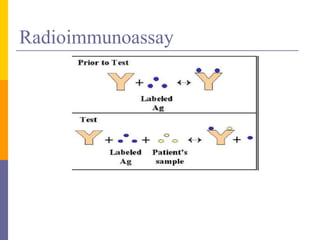
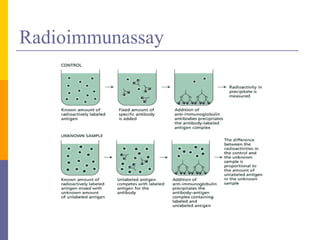
 Sensitive technique used to measure small concentrations of antigens.
 Known quantity of antigen is made radioactive, usually with Iodine 125.
 Known labeled antigen and patient sample added to the reagent antibody.
 Known antigen will compete with the unknown patient antigen for sites on
the antibody.
 The bound antigens are separated from the unbound ones.
 Can measure the radioactivity of labeled free antigen in the supernatant solution.
 Can measure radioactivity of fixed labeled antigen to the well.
 High radioactivity indicates a low concentration of patient antigen was
bound to the reagent antibody.
 Low radioactivity indicates a high concentration of patient antigen was
bound to the reagent antibody.
 Thus, the results are inversely related to the label detected.
 Standards are run and results read off of standard curve.
Radioimmunoassay
Radioimmunassay
Radioimmunoassay Competitive
Immunoradiometric Assay (IRMA)
 Labeled antibody plus patient antigen
 Solid phase antigen added to bind excess
antibody.
 Labeled antibody binds to both patient antigen, if
present, and bound antigen.
 Spin down to separate
 Labeled antibody/antigen remain in solution.
 Measure radioactivity.
Advantages/Disadvantages
 Advantages
 Extremely sensitive and precise
 Detects trace amounts of analytes small in size.
 Disadvantages
 Health hazard
 Disposal problems
 Short shelf life
 Expensive equipment necessary
 Enzyme immunoassays have largely replaced
radioimmunoassay.
Enzyme Immunoassay
 Enzymes occur naturally and catalyze
biochemical reactions.
 Enzymes are
 Cheap
 Readily available
 Have a long shelf life
 Easily adaptable to automation.
 Automation relatively inexpensive.
Enzyme Immunoassay
 Techniques pose no health hazards.
 Little reagent enzyme necessary.
 Can be used for qualitative or quantitative
assays.
 Enzymes selected according to
 Substrate molecules converted per molecule of
enzyme.
 Ease and speed of detection.
 Stability.
 Availability and cost
Enzyme Immunoassay
 Enzymes used include:
 Horseradish peroxidase
 Glucose-6-phosphate dehydrogenase
 Alkaline phosphatase
 Β-D-galactosidase
 Horseradish peroxidase and alkaline
phosphatase are the most popular.
 Highest turnover
 High sensitivity
 Easy to detect
Heterogenous EIA
 Competitive
 Enzyme labeled antigen competes with unlabeled
patient antigen for antibody sites.
 Wash to remove unbound reactants.
 Add substrate which causes color change.
 Results are inversely proportional to concentration.
 More patient antigen bound, less color.
 If little or no patient antigen bound, dark color.
 Used to measure small antigens such as insulin and
estrogen.
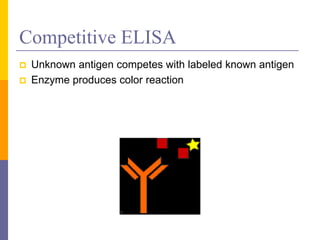
Competitive ELISA
 Unknown antigen competes with labeled known antigen
 Enzyme produces color reaction
Heterogenous EIA
 Noncompetitive are very popular.
 Often referred to as enzyme linked
immunosorbent assay – ELISA
 Enzyme labeled reagent DOES NOT participate
in the initial antigen-antibody reaction.
 Sandwich technique
 Advantages
 High sensitivity and specificity.
 Relatively simple to perform.
 Low cost.
Noncompetitive EIA
 Variety of solid support
 Microtiter plates
 Nitrocellulose membranes
 Magnetic beads
 Procedure
 Antigen bound to solid phase
 Add patient sample, antibody will bind if present
 Wash
 Add known enzyme labeled antibody
 Wash
 Add substrate
 Measure enzyme label
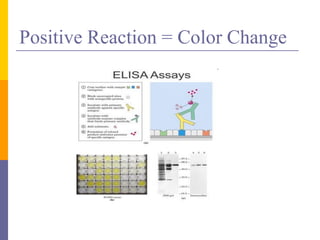
Positive Reaction = Color Change
Sandwich or Capture Assays
 Antibody bound to solid phase.
 If looking for antigen must have multiple epitopes, bound
antibody specific for one epitope, second labeled
antibody added specific for a different epitope.
 Antigens detected can be
 Antibodies
 Hormones
 Proteins
 Tumor markers
 Microorganisms especially viruses
 Enzyme label used to detect reaction
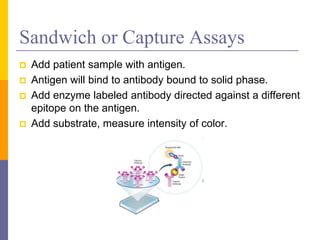
Sandwich or Capture Assays
 Add patient sample with antigen.
 Antigen will bind to antibody bound to solid phase.
 Add enzyme labeled antibody directed against a different
epitope on the antigen.
 Add substrate, measure intensity of color.
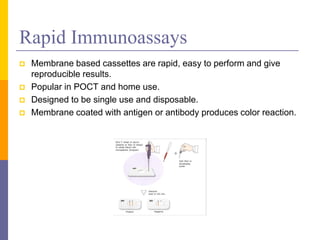
Rapid Immunoassays
 Membrane based cassettes are rapid, easy to perform and give
reproducible results.
 Popular in POCT and home use.
 Designed to be single use and disposable.
 Membrane coated with antigen or antibody produces color reaction.
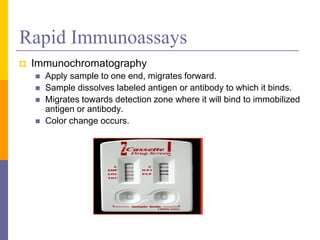
Rapid Immunoassays
 Immunochromatography
 Apply sample to one end, migrates forward.
 Sample dissolves labeled antigen or antibody to which it binds.
 Migrates towards detection zone where it will bind to immobilized
antigen or antibody.
 Color change occurs.
Homogeneous Enzyme Assay
 Reaction which requires NO separation of
reactants.
 Less sensitive BUT rapid, easy to perform and
automate.
 Chief use is to detect low molecular weight
analytes such as:
 Hormones
 Therapeutic drugs
 Drugs of abuse
 Can use serum or urine.
Homogeneous Enzyme Assay
 Based on principle of change in enzyme activity
as specific antigen-antibody combinations occur.
 Reagent antigen labeled with enzyme tag.
 Antibody binds to specific determinant sites on
antigen, active site on enzyme blocked, causes
measurable loss of activity.
 Free antigen competes with enzyme-labeled
antigen for limited number of antibody sites.
 Enzyme activity directly related to patient
antigen.
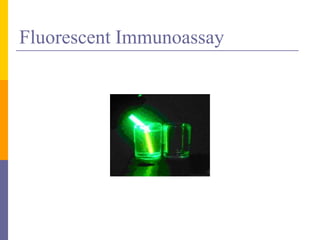
Fluorescent Immunoassay
Fluorescent Immunoassay Markers
 Fluorophores or fluorochromes
 Ability to absorb energy and emit light
 Two most commonly used:
 Fluorescein – green
 Tetramethylrhodamine – red
 Tests may be qualitative or quantitative
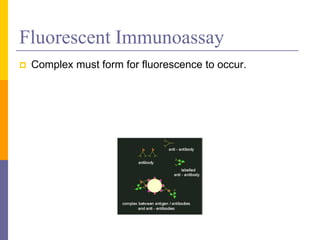
Fluorescent Immunoassay
 Complex must form for fluorescence to occur.
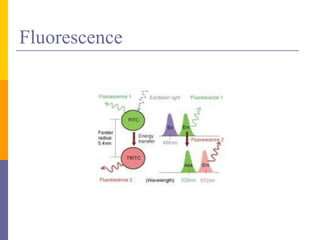
Fluorescence
Fluorescent Immunoassay
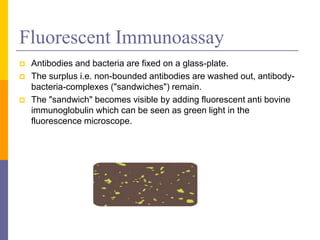
 Antibodies and bacteria are fixed on a glass-plate.
 The surplus i.e. non-bounded antibodies are washed out, antibody-
bacteria-complexes ("sandwiches") remain.
 The "sandwich" becomes visible by adding fluorescent anti bovine
immunoglobulin which can be seen as green light in the
fluorescence microscope.
Fluorescent Immunoassay
 Direct immunofluorescence
 Tagged antibody added to unknown antigen fixed to
slide
 If patient antigen present = fluorescence
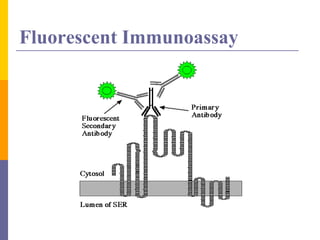
 Indirect immunofluorescence – sandwich assay
 Patient plus known fixed antigen
 Allow to react and wash off unbound reactants
 Add tagged anti-antibody
 Fluorescence
Fluorescent Immunoassay
Positive Immunofluorescence
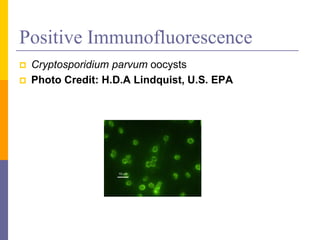
 Cryptosporidium parvum oocysts
 Photo Credit: H.D.A Lindquist, U.S. EPA
Fluorescent Polarization
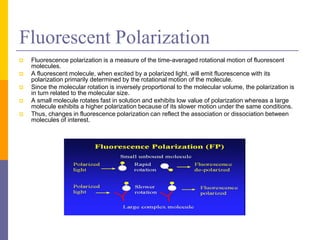
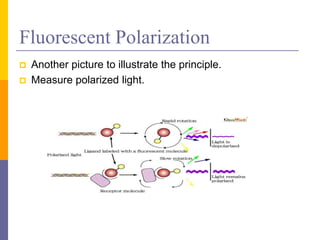
 Fluorescence polarization is a measure of the time-averaged rotational motion of fluorescent
molecules.
 A fluorescent molecule, when excited by a polarized light, will emit fluorescence with its
polarization primarily determined by the rotational motion of the molecule.
 Since the molecular rotation is inversely proportional to the molecular volume, the polarization is
in turn related to the molecular size.
 A small molecule rotates fast in solution and exhibits low value of polarization whereas a large
molecule exhibits a higher polarization because of its slower motion under the same conditions.
 Thus, changes in fluorescence polarization can reflect the association or dissociation between
molecules of interest.
Fluorescent Polarization
 Another picture to illustrate the principle.
 Measure polarized light.
Chemiluminescent Immunoassays
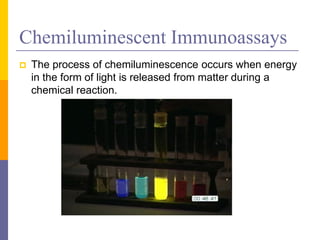
 The process of chemiluminescence occurs when energy
in the form of light is released from matter during a
chemical reaction.
Chemiluminescent Immunoassays
 Large number of molecules capable of
chemiluminescence
 Luminol
 Acridium esters
 Ruthenium derivatives
 Nitrophenyl oxalates
 Use sodium hydroxide as a catalyst
 Light emission ranges from quick burst or flash to light
which remains for a longer time.
 Different types of instruments are required based on
emission.
Chemiluminescent Immunoassays
 Can be used for heterogeneous or
homogeneous assays.
 Can attach label to antigen or antibody.
 Heterogeneous assays use competitive and
sandwich assay.
 Competitive assays used to measure smaller
analytes.
 Sandwich assays are used to measure larger
analytes.
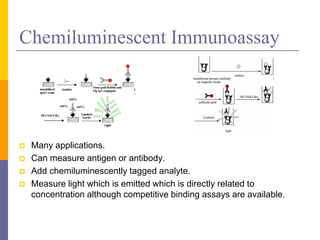
Chemiluminescent Immunoassay
 Many applications.
 Can measure antigen or antibody.
 Add chemiluminescently tagged analyte.
 Measure light which is emitted which is directly related to
concentration although competitive binding assays are available.
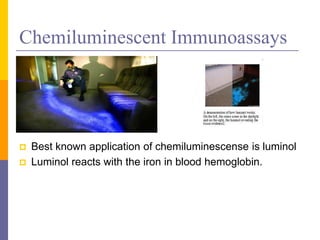
Chemiluminescent Immunoassays
 Best known application of chemiluminescense is luminol
 Luminol reacts with the iron in blood hemoglobin.
References
 http://web.indstate.edu/thcme/PSP/labtests/precip.htm
 http://www.gla.ac.uk/departments/immunology/education/nursing/lectures/antibody.ht
m
 http://www.cellsalive.com/mac.htm
 http://jeeves.mmg.uci.edu/immunology/Assays/Assays.htm
 http://www.medschool.lsuhsc.edu/microbiology/DMIP/dmex03.htm
 http://www.tulipgroup.com/Common/html/TurbidTech.pdf
 http://departments.oxy.edu/biology/Franck/Bio222/Lectures/Feb1lecture.htm
 http://www.mercodia.se/global/mainpage.asp?page_id=41 ELISA
 http://www.clinprointl.com/technical.htm ELISA
 http://www.nsbri.org/HumanPhysSpace/focus4/sf-hormonal.html
 http://ccm.ucdavis.edu/cpl/Tech%20updates/TechUpdates.htm molecular
diagnostics
References (Continued)
 http://www.liv.ac.uk/~agmclen/Medpracs/practical_5/theory_5.html
 http://www.fao.org/docrep/W0049E/w0049e06.htm
 http://www.genwaybio.com/gw_file.php?fid=6056

Labeled assays

  • 1.
  • 2.
    Labeled Immunoassays  Someantigen/antibody reactions not detected by precipitation or agglutination.  Looking for very small amounts.  Measured indirectly using a labeled reactant.  Referred to as receptor-ligand assays.
  • 3.
    Terminology  Ligand isthe substance to be measured.  Defined as a molecule that binds to another molecule of a complementary configuration.  Usually binds to the substance the test is trying to detect.  The receptor is what binds the specific target molecule.  “Sandwich” technique is an example.
  • 4.
  • 5.
    Terminology  Reactions maybe competitive or non- competitive  Competitive – labeled known and patient unknown are added to reaction and “compete” for the target.  For example, looking for an antibody.  Add labeled reagent antibody of known specificity, patient sample and known antigen.  Patient antibody competes with reagent antibody for the target antigen.  Concentration is inversely proportional to results.
  • 6.
    Terminology  Non-competitive  Addpatient sample, for example looking for antibody, to known reagent antigen.  Reaction occurs and the concentration is directly related to the amount of antibody in patient sample.
  • 7.
    Terminology  Heterogeneous orhomogeneous  Heterogeneous assays called separation assays  Require multiple steps  Careful washing of surface to remove unbound reagents and samples.  Homogeneous assays do NOT require a separation step.  Mix reagents and patient sample.  Measure the labeled product.
  • 8.
    Competitive Binding  Addknown labeled antigen  Add unknown antigen  Will compete with each other for sites on bound antibody molecule.  Must wash off unreacted substances.  Type of label on known antigen will determine method of detection.
  • 9.
  • 10.
    Noncompetitive Binding  Patientsample added.  Will react with its homologous antigen or antibody, depending upon what is being tested for.  The reaction is measured and the concentration is directly related to the detected amount.
  • 11.
    Standards or Calibrators Substance of exact known concentration.  Usually run for each new lot number  Based on results create standard curve.  Standard curve used to “read” results or built into machine to provide results.
  • 12.
    Labels  Used todetect reaction which has occurred.  Most common are:  Radioactive  Enzymes  Fluorescent  Chemiluminescent
  • 13.
    Radioimmunassay (RIA)  Competitivebinding  Uses Iodine 125 (I 125) as label  Radioactive label competes with patient for sites  High radioactivity, small amount of patient substance  Low radioactivity high amount of patient substance.  Refer to your textbook for diagrams.
  • 14.
    Radioimmunoassay  Sensitive techniqueused to measure small concentrations of antigens.  Known quantity of antigen is made radioactive, usually with Iodine 125.  Known labeled antigen and patient sample added to the reagent antibody.  Known antigen will compete with the unknown patient antigen for sites on the antibody.  The bound antigens are separated from the unbound ones.  Can measure the radioactivity of labeled free antigen in the supernatant solution.  Can measure radioactivity of fixed labeled antigen to the well.  High radioactivity indicates a low concentration of patient antigen was bound to the reagent antibody.  Low radioactivity indicates a high concentration of patient antigen was bound to the reagent antibody.  Thus, the results are inversely related to the label detected.  Standards are run and results read off of standard curve.
  • 15.
  • 16.
  • 17.
  • 18.
    Immunoradiometric Assay (IRMA) Labeled antibody plus patient antigen  Solid phase antigen added to bind excess antibody.  Labeled antibody binds to both patient antigen, if present, and bound antigen.  Spin down to separate  Labeled antibody/antigen remain in solution.  Measure radioactivity.
  • 19.
    Advantages/Disadvantages  Advantages  Extremelysensitive and precise  Detects trace amounts of analytes small in size.  Disadvantages  Health hazard  Disposal problems  Short shelf life  Expensive equipment necessary  Enzyme immunoassays have largely replaced radioimmunoassay.
  • 20.
    Enzyme Immunoassay  Enzymesoccur naturally and catalyze biochemical reactions.  Enzymes are  Cheap  Readily available  Have a long shelf life  Easily adaptable to automation.  Automation relatively inexpensive.
  • 21.
    Enzyme Immunoassay  Techniquespose no health hazards.  Little reagent enzyme necessary.  Can be used for qualitative or quantitative assays.  Enzymes selected according to  Substrate molecules converted per molecule of enzyme.  Ease and speed of detection.  Stability.  Availability and cost
  • 22.
    Enzyme Immunoassay  Enzymesused include:  Horseradish peroxidase  Glucose-6-phosphate dehydrogenase  Alkaline phosphatase  Β-D-galactosidase  Horseradish peroxidase and alkaline phosphatase are the most popular.  Highest turnover  High sensitivity  Easy to detect
  • 23.
    Heterogenous EIA  Competitive Enzyme labeled antigen competes with unlabeled patient antigen for antibody sites.  Wash to remove unbound reactants.  Add substrate which causes color change.  Results are inversely proportional to concentration.  More patient antigen bound, less color.  If little or no patient antigen bound, dark color.  Used to measure small antigens such as insulin and estrogen.
  • 24.
    Competitive ELISA  Unknownantigen competes with labeled known antigen  Enzyme produces color reaction
  • 25.
    Heterogenous EIA  Noncompetitiveare very popular.  Often referred to as enzyme linked immunosorbent assay – ELISA  Enzyme labeled reagent DOES NOT participate in the initial antigen-antibody reaction.  Sandwich technique  Advantages  High sensitivity and specificity.  Relatively simple to perform.  Low cost.
  • 26.
    Noncompetitive EIA  Varietyof solid support  Microtiter plates  Nitrocellulose membranes  Magnetic beads  Procedure  Antigen bound to solid phase  Add patient sample, antibody will bind if present  Wash  Add known enzyme labeled antibody  Wash  Add substrate  Measure enzyme label
  • 27.
    Positive Reaction =Color Change
  • 28.
    Sandwich or CaptureAssays  Antibody bound to solid phase.  If looking for antigen must have multiple epitopes, bound antibody specific for one epitope, second labeled antibody added specific for a different epitope.  Antigens detected can be  Antibodies  Hormones  Proteins  Tumor markers  Microorganisms especially viruses  Enzyme label used to detect reaction
  • 29.
    Sandwich or CaptureAssays  Add patient sample with antigen.  Antigen will bind to antibody bound to solid phase.  Add enzyme labeled antibody directed against a different epitope on the antigen.  Add substrate, measure intensity of color.
  • 30.
    Rapid Immunoassays  Membranebased cassettes are rapid, easy to perform and give reproducible results.  Popular in POCT and home use.  Designed to be single use and disposable.  Membrane coated with antigen or antibody produces color reaction.
  • 31.
    Rapid Immunoassays  Immunochromatography Apply sample to one end, migrates forward.  Sample dissolves labeled antigen or antibody to which it binds.  Migrates towards detection zone where it will bind to immobilized antigen or antibody.  Color change occurs.
  • 32.
    Homogeneous Enzyme Assay Reaction which requires NO separation of reactants.  Less sensitive BUT rapid, easy to perform and automate.  Chief use is to detect low molecular weight analytes such as:  Hormones  Therapeutic drugs  Drugs of abuse  Can use serum or urine.
  • 33.
    Homogeneous Enzyme Assay Based on principle of change in enzyme activity as specific antigen-antibody combinations occur.  Reagent antigen labeled with enzyme tag.  Antibody binds to specific determinant sites on antigen, active site on enzyme blocked, causes measurable loss of activity.  Free antigen competes with enzyme-labeled antigen for limited number of antibody sites.  Enzyme activity directly related to patient antigen.
  • 34.
  • 35.
    Fluorescent Immunoassay Markers Fluorophores or fluorochromes  Ability to absorb energy and emit light  Two most commonly used:  Fluorescein – green  Tetramethylrhodamine – red  Tests may be qualitative or quantitative
  • 36.
    Fluorescent Immunoassay  Complexmust form for fluorescence to occur.
  • 37.
  • 38.
    Fluorescent Immunoassay  Antibodiesand bacteria are fixed on a glass-plate.  The surplus i.e. non-bounded antibodies are washed out, antibody- bacteria-complexes ("sandwiches") remain.  The "sandwich" becomes visible by adding fluorescent anti bovine immunoglobulin which can be seen as green light in the fluorescence microscope.
  • 39.
    Fluorescent Immunoassay  Directimmunofluorescence  Tagged antibody added to unknown antigen fixed to slide  If patient antigen present = fluorescence  Indirect immunofluorescence – sandwich assay  Patient plus known fixed antigen  Allow to react and wash off unbound reactants  Add tagged anti-antibody  Fluorescence
  • 40.
  • 41.
    Positive Immunofluorescence  Cryptosporidiumparvum oocysts  Photo Credit: H.D.A Lindquist, U.S. EPA
  • 42.
    Fluorescent Polarization  Fluorescencepolarization is a measure of the time-averaged rotational motion of fluorescent molecules.  A fluorescent molecule, when excited by a polarized light, will emit fluorescence with its polarization primarily determined by the rotational motion of the molecule.  Since the molecular rotation is inversely proportional to the molecular volume, the polarization is in turn related to the molecular size.  A small molecule rotates fast in solution and exhibits low value of polarization whereas a large molecule exhibits a higher polarization because of its slower motion under the same conditions.  Thus, changes in fluorescence polarization can reflect the association or dissociation between molecules of interest.
  • 43.
    Fluorescent Polarization  Anotherpicture to illustrate the principle.  Measure polarized light.
  • 44.
    Chemiluminescent Immunoassays  Theprocess of chemiluminescence occurs when energy in the form of light is released from matter during a chemical reaction.
  • 45.
    Chemiluminescent Immunoassays  Largenumber of molecules capable of chemiluminescence  Luminol  Acridium esters  Ruthenium derivatives  Nitrophenyl oxalates  Use sodium hydroxide as a catalyst  Light emission ranges from quick burst or flash to light which remains for a longer time.  Different types of instruments are required based on emission.
  • 46.
    Chemiluminescent Immunoassays  Canbe used for heterogeneous or homogeneous assays.  Can attach label to antigen or antibody.  Heterogeneous assays use competitive and sandwich assay.  Competitive assays used to measure smaller analytes.  Sandwich assays are used to measure larger analytes.
  • 47.
    Chemiluminescent Immunoassay  Manyapplications.  Can measure antigen or antibody.  Add chemiluminescently tagged analyte.  Measure light which is emitted which is directly related to concentration although competitive binding assays are available.
  • 48.
    Chemiluminescent Immunoassays  Bestknown application of chemiluminescense is luminol  Luminol reacts with the iron in blood hemoglobin.
  • 49.
    References  http://web.indstate.edu/thcme/PSP/labtests/precip.htm  http://www.gla.ac.uk/departments/immunology/education/nursing/lectures/antibody.ht m http://www.cellsalive.com/mac.htm  http://jeeves.mmg.uci.edu/immunology/Assays/Assays.htm  http://www.medschool.lsuhsc.edu/microbiology/DMIP/dmex03.htm  http://www.tulipgroup.com/Common/html/TurbidTech.pdf  http://departments.oxy.edu/biology/Franck/Bio222/Lectures/Feb1lecture.htm  http://www.mercodia.se/global/mainpage.asp?page_id=41 ELISA  http://www.clinprointl.com/technical.htm ELISA  http://www.nsbri.org/HumanPhysSpace/focus4/sf-hormonal.html  http://ccm.ucdavis.edu/cpl/Tech%20updates/TechUpdates.htm molecular diagnostics
  • 50.
    References (Continued)  http://www.liv.ac.uk/~agmclen/Medpracs/practical_5/theory_5.html http://www.fao.org/docrep/W0049E/w0049e06.htm  http://www.genwaybio.com/gw_file.php?fid=6056