The Tricarboxylic Acid Cycle
(The Citric Acid Cycle)
Babylon university
College of pharmacy
Department of clinical and scientific laboratory
3rd class – biochemistry
Second semester
Dr. Abdulhussien M. K. Aljebory
The Citric Acid Cycle
– Also called Tricarboxylic Acid Cycle (TCA) or Krebs
Cycle. Three names for the same thing.
– Cellular respiration and intermediates for biosynthesis.
– Conversion of pyruvate to activated acetate
– Reactions of the citric acid cycle
– Anaplerotic reactions to regenerate the acceptor
– Regulation of the citric acid cycle
– Conversion of acetate to carbohydrate precursors in
the glyoxylate cycle
Key topics: To Know
Discovered CAC in Pigeon Flight
Muscle
Products from One Turn of the Cycle
Net Effect of the Citric Acid Cycle
Acetyl-CoA + 3NAD+ + FAD + GDP + Pi + 2 H2O
2CO2 +3NADH + FADH2 + GTP + CoA + 3H+
• Carbons of acetyl groups in acetyl-CoA are
oxidized to CO2
• Electrons from this process reduce NAD+ and FAD
• One GTP is formed per cycle, this can be
converted to ATP
• Intermediates in the cycle are not depleted
• Krebs in mitochondrial matrix
• Mitochondrion
– Outer membrane very permeable
• Space between membranes called intermembrane
space
– Inner membrane (cristae)
• Permeable to pyruvate,
• Impermeable to fatty acids, NAD, etc
– Matrix is inside inner membrane
Glucose
Glucose-6-
phosphate
Pyruvate
Glycogen Ribose, NADPH
Pentose phosphate
pathway
Synthesis of glycogen
Degradation of
glycogen
Glycolysis
Gluconeogenesis
LactateEthanol
Acetyl Co AFatty Acids Amino Acids
The citric acid
cycle is the final
common pathway
for the oxidation of
fuel molecules —
amino acids, fatty
acids, and
carbohydrates.
Most fuel
molecules
enter the cycle
as acetyl
coenzyme A.
Three main pathways for energy production:
1- Glycolysis
2- Citric acid cycle
3- Oxidative-Phosphorylation
• Certain pathways are involved in both breakdown and
buildup of molecules these pathways are called
amphibolic. The citric acid cycle is an example of this.
• Eight successive reaction steps.
• The six carbon citrate is formed from two carbon acetyl-
CoA and four carbon oxaloacetate.
• Oxidation of citrate yields CO2 and regenerates
oxaloacetate.
• The energy released is captured in the reduced
coenzymes NADH and FADH2.
An Overview of the Citric Acid Cycle
• A four-carbon oxaloacetate condenses with a two-carbon
• acetyl unit to yield a six-carbon citrate.
• An isomer of citrate is oxidatively decarboxylated and
five-carbon -ketoglutarate is formed.
• -ketoglutarate is oxidatively decarboxylated to yield a
four-carbon succinate.
• Oxaloacetate is then regenerated from
succinate.
• Two carbon atoms (acetyl CoA) enter the
cycle and two carbon atoms leave the cycle in
the form of two molecules of carbon dioxide.
• Three hydride ions (six electrons) are
transferred to three molecules of NAD+, one
pair of hydrogen atoms (two electrons) is
transferred to one molecule of FAD.
1. Citrate Synthase
• Citrate formed from acetyl CoA and oxaloacetate
• Only cycle reaction with C-C bond formation
• Addition of C2 unit (acetyl) to the keto double bond of C4
acid, oxaloacetate, to produce C6 compound, citrate
citrate synthase
2. Aconitase
• Elimination of H2O from citrate to form C=C bond of cis-
aconitate
• Stereospecific addition of H2O to cis-aconitate to form
isocitrate
aconitase aconitase
3. Isocitrate Dehydrogenase
• Oxidative decarboxylation of isocitrate to
a-ketoglutarate (a metabolically irreversible reaction)
• One of four oxidation-reduction reactions of the cycle
• Hydride ion from the C-2 of isocitrate is transferred to NAD+ to
form NADH
• Oxalosuccinate is decarboxylated to a-ketoglutarate
isocitrate dehydrogenaseisocitrate dehydrogenase
4. The -Ketoglutarate Dehydrogenase Complex
• Similar to pyruvate dehydrogenase complex
• Same coenzymes, identical mechanisms
E1 - a-ketoglutarate dehydrogenase .
E2 – dihydrolipoyl succinyltransferase .
E3 - dihydrolipoyl dehydrogenase (with FAD)
-ketoglutarate
dehydrogenase
5. Succinyl-CoA Synthetase
• Free energy in thioester bond of succinyl CoA is
conserved as GTP or ATP in higher animals (or ATP in
plants, some bacteria)
• Substrate level phosphorylation reaction
HS-+
GTP + ADP GDP + ATP
Succinyl-CoA
Synthetase
• Complex of several polypeptides, an FAD prosthetic group and iron-
sulfur clusters
• Embedded in the inner mitochondrial membrane
• Electrons are transferred from succinate to FAD and then to
ubiquinone (Q) in electron transport chain
• Dehydrogenation is stereospecific; only the trans isomer is formed
6. The Succinate Dehydrogenase Complex
Succinate
Dehydrogenase
7. Fumarase
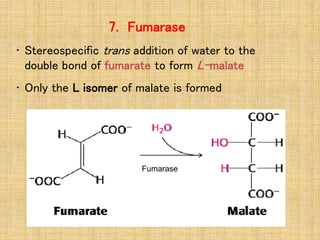
• Stereospecific trans addition of water to the
double bond of fumarate to form L-malate
• Only the L isomer of malate is formed
Fumarase
8. Malate Dehydrogenase
Malate Dehydrogenase
Malate is oxidized to form oxaloacetate.
Stoichiometry of the Citric Acid Cycle
 Two carbon atoms enter the
cycle in the form of acetyl CoA.
 Two carbon atoms leave the
cycle in the form of CO2 .
 Four pairs of hydrogen
atoms leave the cycle in four
oxidation reactions (three
molecules of NAD+ one molecule
of FAD are reduced).
 One molecule of GTP,
is formed.
 Two molecules of water are
consumed.
 9 ATP (2.5 ATP per NADH, and 1.5 ATP
per FADH2) are produced during oxidative
phosphorylation.
 1 ATP is directly formed in the citric
acid cycle.
 1 acetyl CoA generates approximately
10 molecules of ATP.
Regulation of the Citric Acid Cycle
• Pathway controlled by:
(1) Allosteric modulators
(2) Covalent modification of cycle enzymes
(3) Supply of acetyl CoA (pyruvate dehydrogenase complex)
Three enzymes have regulatory properties
- citrate synthase (is allosterically inhibited by NADH, ATP, succinyl
CoA, citrate – feedback inhibition)
- isocitrate dehydrogenase
(allosteric effectors: (+) ADP; (-) NADH, ATP. Bacterial ICDH can be
covalently modified by kinase/phosphatase)
--ketoglutarate dehydrogenase complex (inhibition by ATP,
succinyl CoA and NADH
Regulation of the TCA Cycle
Again, 3 reactions are the key sites
• Citrate synthase - ATP, NADH and succinyl-CoA
inhibit
• Isocitrate dehydrogenase - ATP inhibits, ADP and
NAD+ activate
  -Ketoglutarate dehydrogenase - NADH and
succinyl-CoA inhibit, AMP activates
• Also note pyruvate dehydrogenase: ATP, NADH,
acetyl-CoA inhibit, NAD+, CoA activate
NADH, ATP,
succinyl CoA,
citrate
-
Regulation of the citric acid cycle
Krebs Cycle is a Source of Biosynthetic Precursors
Phosphoenol-
pyruvate
Glucose
The citric acid cycle
provides
intermediates for
biosyntheses
Net From Kreb’s
• Oxidative process
– 3 NADH
– FADH2
– GTP
• X 2 per glucose
– 6 NADH
– 2 FADH2
– 2 GTP
• All ultimately turned into ATP (oxidative
phosphorylation)
Pentose Phosphate Pathway
Also known as:
• Pentose shunt
• Hexose monophosphate shunt
• Phosphogluconate pathway
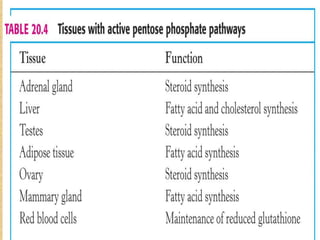
• It occurs in the cytosol.
One fate of G6P is the
pentose pathway.
It’s a shunt
What does the pentose phosphate
pathway achieve?
• The pathway yields reducing potential in
the form of NADPH to be used in anabolic
reactions requiring electrons.
• The pathway yields ribose 5-phosphate.
– Nucleotide biosynthesis leading to:
• DNA
• RNA
• Various cofactors (CoA, FAD, SAM, NAD+/NADP+).
The
pentose
pathway
can be
divided
into two
phases.
Non-
oxidative
interconv
ersion of
sugars

The tricarboxylic acid cycle

  • 1.
    The Tricarboxylic AcidCycle (The Citric Acid Cycle) Babylon university College of pharmacy Department of clinical and scientific laboratory 3rd class – biochemistry Second semester Dr. Abdulhussien M. K. Aljebory
  • 2.
    The Citric AcidCycle – Also called Tricarboxylic Acid Cycle (TCA) or Krebs Cycle. Three names for the same thing. – Cellular respiration and intermediates for biosynthesis. – Conversion of pyruvate to activated acetate – Reactions of the citric acid cycle – Anaplerotic reactions to regenerate the acceptor – Regulation of the citric acid cycle – Conversion of acetate to carbohydrate precursors in the glyoxylate cycle Key topics: To Know
  • 3.
    Discovered CAC inPigeon Flight Muscle
  • 4.
    Products from OneTurn of the Cycle
  • 5.
    Net Effect ofthe Citric Acid Cycle Acetyl-CoA + 3NAD+ + FAD + GDP + Pi + 2 H2O 2CO2 +3NADH + FADH2 + GTP + CoA + 3H+ • Carbons of acetyl groups in acetyl-CoA are oxidized to CO2 • Electrons from this process reduce NAD+ and FAD • One GTP is formed per cycle, this can be converted to ATP • Intermediates in the cycle are not depleted
  • 6.
    • Krebs inmitochondrial matrix • Mitochondrion – Outer membrane very permeable • Space between membranes called intermembrane space – Inner membrane (cristae) • Permeable to pyruvate, • Impermeable to fatty acids, NAD, etc – Matrix is inside inner membrane
  • 8.
    Glucose Glucose-6- phosphate Pyruvate Glycogen Ribose, NADPH Pentosephosphate pathway Synthesis of glycogen Degradation of glycogen Glycolysis Gluconeogenesis LactateEthanol Acetyl Co AFatty Acids Amino Acids The citric acid cycle is the final common pathway for the oxidation of fuel molecules — amino acids, fatty acids, and carbohydrates. Most fuel molecules enter the cycle as acetyl coenzyme A.
  • 9.
    Three main pathwaysfor energy production: 1- Glycolysis 2- Citric acid cycle 3- Oxidative-Phosphorylation • Certain pathways are involved in both breakdown and buildup of molecules these pathways are called amphibolic. The citric acid cycle is an example of this. • Eight successive reaction steps. • The six carbon citrate is formed from two carbon acetyl- CoA and four carbon oxaloacetate. • Oxidation of citrate yields CO2 and regenerates oxaloacetate. • The energy released is captured in the reduced coenzymes NADH and FADH2.
  • 10.
    An Overview ofthe Citric Acid Cycle • A four-carbon oxaloacetate condenses with a two-carbon • acetyl unit to yield a six-carbon citrate. • An isomer of citrate is oxidatively decarboxylated and five-carbon -ketoglutarate is formed. • -ketoglutarate is oxidatively decarboxylated to yield a four-carbon succinate. • Oxaloacetate is then regenerated from succinate. • Two carbon atoms (acetyl CoA) enter the cycle and two carbon atoms leave the cycle in the form of two molecules of carbon dioxide. • Three hydride ions (six electrons) are transferred to three molecules of NAD+, one pair of hydrogen atoms (two electrons) is transferred to one molecule of FAD.
  • 11.
    1. Citrate Synthase •Citrate formed from acetyl CoA and oxaloacetate • Only cycle reaction with C-C bond formation • Addition of C2 unit (acetyl) to the keto double bond of C4 acid, oxaloacetate, to produce C6 compound, citrate citrate synthase
  • 12.
    2. Aconitase • Eliminationof H2O from citrate to form C=C bond of cis- aconitate • Stereospecific addition of H2O to cis-aconitate to form isocitrate aconitase aconitase
  • 13.
    3. Isocitrate Dehydrogenase •Oxidative decarboxylation of isocitrate to a-ketoglutarate (a metabolically irreversible reaction) • One of four oxidation-reduction reactions of the cycle • Hydride ion from the C-2 of isocitrate is transferred to NAD+ to form NADH • Oxalosuccinate is decarboxylated to a-ketoglutarate isocitrate dehydrogenaseisocitrate dehydrogenase
  • 14.
    4. The -KetoglutarateDehydrogenase Complex • Similar to pyruvate dehydrogenase complex • Same coenzymes, identical mechanisms E1 - a-ketoglutarate dehydrogenase . E2 – dihydrolipoyl succinyltransferase . E3 - dihydrolipoyl dehydrogenase (with FAD) -ketoglutarate dehydrogenase
  • 15.
    5. Succinyl-CoA Synthetase •Free energy in thioester bond of succinyl CoA is conserved as GTP or ATP in higher animals (or ATP in plants, some bacteria) • Substrate level phosphorylation reaction HS-+ GTP + ADP GDP + ATP Succinyl-CoA Synthetase
  • 16.
    • Complex ofseveral polypeptides, an FAD prosthetic group and iron- sulfur clusters • Embedded in the inner mitochondrial membrane • Electrons are transferred from succinate to FAD and then to ubiquinone (Q) in electron transport chain • Dehydrogenation is stereospecific; only the trans isomer is formed 6. The Succinate Dehydrogenase Complex Succinate Dehydrogenase
  • 17.
    7. Fumarase • Stereospecifictrans addition of water to the double bond of fumarate to form L-malate • Only the L isomer of malate is formed Fumarase
  • 18.
    8. Malate Dehydrogenase MalateDehydrogenase Malate is oxidized to form oxaloacetate.
  • 19.
    Stoichiometry of theCitric Acid Cycle  Two carbon atoms enter the cycle in the form of acetyl CoA.  Two carbon atoms leave the cycle in the form of CO2 .  Four pairs of hydrogen atoms leave the cycle in four oxidation reactions (three molecules of NAD+ one molecule of FAD are reduced).  One molecule of GTP, is formed.  Two molecules of water are consumed.  9 ATP (2.5 ATP per NADH, and 1.5 ATP per FADH2) are produced during oxidative phosphorylation.  1 ATP is directly formed in the citric acid cycle.  1 acetyl CoA generates approximately 10 molecules of ATP.
  • 20.
    Regulation of theCitric Acid Cycle • Pathway controlled by: (1) Allosteric modulators (2) Covalent modification of cycle enzymes (3) Supply of acetyl CoA (pyruvate dehydrogenase complex) Three enzymes have regulatory properties - citrate synthase (is allosterically inhibited by NADH, ATP, succinyl CoA, citrate – feedback inhibition) - isocitrate dehydrogenase (allosteric effectors: (+) ADP; (-) NADH, ATP. Bacterial ICDH can be covalently modified by kinase/phosphatase) --ketoglutarate dehydrogenase complex (inhibition by ATP, succinyl CoA and NADH
  • 21.
    Regulation of theTCA Cycle Again, 3 reactions are the key sites • Citrate synthase - ATP, NADH and succinyl-CoA inhibit • Isocitrate dehydrogenase - ATP inhibits, ADP and NAD+ activate   -Ketoglutarate dehydrogenase - NADH and succinyl-CoA inhibit, AMP activates • Also note pyruvate dehydrogenase: ATP, NADH, acetyl-CoA inhibit, NAD+, CoA activate
  • 22.
  • 23.
    Krebs Cycle isa Source of Biosynthetic Precursors Phosphoenol- pyruvate Glucose The citric acid cycle provides intermediates for biosyntheses
  • 24.
    Net From Kreb’s •Oxidative process – 3 NADH – FADH2 – GTP • X 2 per glucose – 6 NADH – 2 FADH2 – 2 GTP • All ultimately turned into ATP (oxidative phosphorylation)
  • 25.
    Pentose Phosphate Pathway Alsoknown as: • Pentose shunt • Hexose monophosphate shunt • Phosphogluconate pathway • It occurs in the cytosol.
  • 26.
    One fate ofG6P is the pentose pathway.
  • 27.
  • 28.
    What does thepentose phosphate pathway achieve? • The pathway yields reducing potential in the form of NADPH to be used in anabolic reactions requiring electrons. • The pathway yields ribose 5-phosphate. – Nucleotide biosynthesis leading to: • DNA • RNA • Various cofactors (CoA, FAD, SAM, NAD+/NADP+).
  • 31.