Presented by:
Nursad Jahan Sultana
Contents :
Introduction
Site
Pathway
Result
Significance
Conclusion
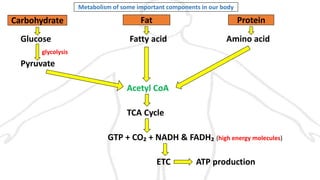
Glucose Fatty acid Amino acid
glycolysis
Pyruvate
Acetyl CoA
TCA Cycle
GTP + CO₂ + NADH & FADH₂ (high energy molecules)
ETC ATP production
Carbohydrate Fat Protein
Metabolism of some important components in our body
TCA Cycle:
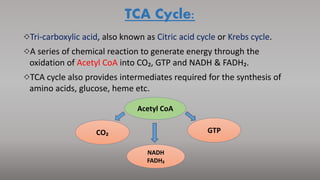
Tri-carboxylic acid, also known as Citric acid cycle or Krebs cycle.
A series of chemical reaction to generate energy through the
oxidation of Acetyl CoA into CO₂, GTP and NADH & FADH₂.
TCA cycle also provides intermediates required for the synthesis of
amino acids, glucose, heme etc.
Acetyl CoA
CO₂ GTP
NADH
FADH₂
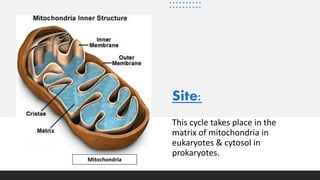
Site:
This cycle takes place in the
matrix of mitochondria in
eukaryotes & cytosol in
prokaryotes.
Mitochondria
Reactions of
TCA cycle:
Oxidative decarboxylation
of Pyruvate to Acetyl CoA by
PDH complex.
This step is connecting link
between glycolysis & TCA
cycle.
Step-1: Formation of citrate:
Oxaloacetate condenses with acetyl CoA to form Citrate, catalyzed
by the enzyme ‘citrate synthase’.
Inhibited by:
ATP, NADH, Citrate - competitive inhibitor of oxaloacetate.
Step-2 & 3: Citrate is isomerized to Isocitrate:
Citrate is isomerized to Isocitrate by the enzyme ‘aconitase’.
This is achieved in a two-stage reaction of dehydration followed by
hydration through the formation of an intermediate -cis- aconitate.
Step-4 & 5: Formation of α- ketoglutarate:
‘Isocitrate dehydrogenase’ catalyzes the conversion of isocitrate to
oxalosuccinate & then to α- ketoglutarate.
The formation of NADH & the liberation of CO2 occur at this stage.
Stimulated by:
Isocitrate, 𝑁𝐴𝐷+
, 𝑀𝑔2+
, ADP, 𝐶𝑎2+
Inhibited by:
NADH & ATP.
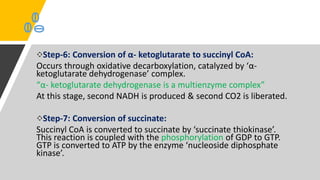
Step-6: Conversion of α- ketoglutarate to succinyl CoA:
Occurs through oxidative decarboxylation, catalyzed by ‘α-
ketoglutarate dehydrogenase’ complex.
“α- ketoglutarate dehydrogenase is a multienzyme complex”
At this stage, second NADH is produced & second CO2 is liberated.
Step-7: Conversion of succinate:
Succinyl CoA is converted to succinate by ‘succinate thiokinase’.
This reaction is coupled with the phosphorylation of GDP to GTP.
GTP is converted to ATP by the enzyme ‘nucleoside diphosphate
kinase’.
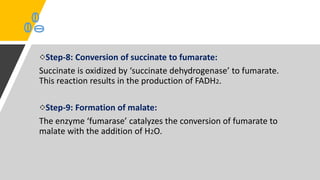
Step-8: Conversion of succinate to fumarate:
Succinate is oxidized by ‘succinate dehydrogenase’ to fumarate.
This reaction results in the production of FADH2.
Step-9: Formation of malate:
The enzyme ‘fumarase’ catalyzes the conversion of fumarate to
malate with the addition of H2O.
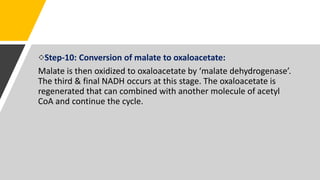
Step-10: Conversion of malate to oxaloacetate:
Malate is then oxidized to oxaloacetate by ‘malate dehydrogenase’.
The third & final NADH occurs at this stage. The oxaloacetate is
regenerated that can combined with another molecule of acetyl
CoA and continue the cycle.
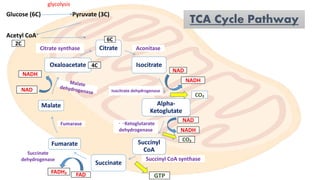
glycolysis
Glucose (6C) Pyruvate (3C)
Acetyl CoA
Citrate
Isocitrate
Alpha-
Ketoglutate
Succinyl
CoA
Succinate
Fumarate
Malate
Oxaloacetate
NAD
NADH
CO₂
NAD
NADH
CO₂
GTP
FADH₂ FAD
NADH
NAD
Citrate synthase Aconitase
Isocitrate dehydrogenase
-Ketoglutarate
dehydrogenase
Succinyl CoA synthase
Succinate
dehydrogenase
Fumarase
6C
2C
4C
TCA Cycle Pathway
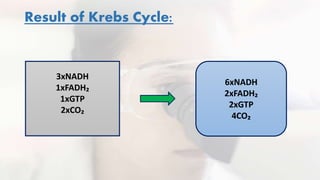
Result of Krebs Cycle:
3xNADH
1xFADH₂
1xGTP
2xCO₂
6xNADH
2xFADH₂
2xGTP
4CO₂
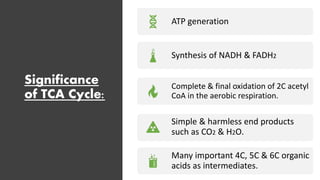
Significance
of TCA Cycle:
ATP generation
Synthesis of NADH & FADH2
Complete & final oxidation of 2C acetyl
CoA in the aerobic respiration.
Simple & harmless end products
such as CO2 & H2O.
Many important 4C, 5C & 6C organic
acids as intermediates.
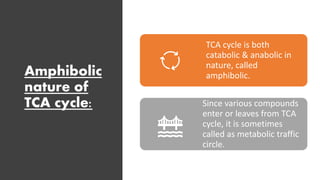
Amphibolic
nature of
TCA cycle:
TCA cycle is both
catabolic & anabolic in
nature, called
amphibolic.
Since various compounds
enter or leaves from TCA
cycle, it is sometimes
called as metabolic traffic
circle.
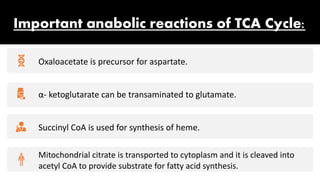
Important anabolic reactions of TCA Cycle:
Oxaloacetate is precursor for aspartate.
α- ketoglutarate can be transaminated to glutamate.
Succinyl CoA is used for synthesis of heme.
Mitochondrial citrate is transported to cytoplasm and it is cleaved into
acetyl CoA to provide substrate for fatty acid synthesis.
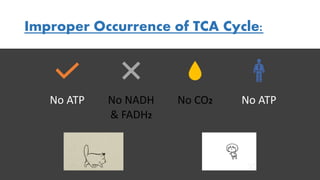
Improper Occurrence of TCA Cycle:
No ATP No NADH
& FADH2
No CO2 No ATP
Conclusion:
TCA cycle is one of the most important
reactions that takes place in both
Eukaryotes and Prokaryotes. It is the
most important central pathway,
connecting almost all the individual
metabolic pathways.
Thank You

Tri-Carboxylic Acid (TCA) cycle

  • 1.
  • 2.
  • 3.
    Glucose Fatty acidAmino acid glycolysis Pyruvate Acetyl CoA TCA Cycle GTP + CO₂ + NADH & FADH₂ (high energy molecules) ETC ATP production Carbohydrate Fat Protein Metabolism of some important components in our body
  • 4.
    TCA Cycle: Tri-carboxylic acid,also known as Citric acid cycle or Krebs cycle. A series of chemical reaction to generate energy through the oxidation of Acetyl CoA into CO₂, GTP and NADH & FADH₂. TCA cycle also provides intermediates required for the synthesis of amino acids, glucose, heme etc. Acetyl CoA CO₂ GTP NADH FADH₂
  • 5.
    Site: This cycle takesplace in the matrix of mitochondria in eukaryotes & cytosol in prokaryotes. Mitochondria
  • 6.
    Reactions of TCA cycle: Oxidativedecarboxylation of Pyruvate to Acetyl CoA by PDH complex. This step is connecting link between glycolysis & TCA cycle.
  • 7.
    Step-1: Formation ofcitrate: Oxaloacetate condenses with acetyl CoA to form Citrate, catalyzed by the enzyme ‘citrate synthase’. Inhibited by: ATP, NADH, Citrate - competitive inhibitor of oxaloacetate. Step-2 & 3: Citrate is isomerized to Isocitrate: Citrate is isomerized to Isocitrate by the enzyme ‘aconitase’. This is achieved in a two-stage reaction of dehydration followed by hydration through the formation of an intermediate -cis- aconitate.
  • 8.
    Step-4 & 5:Formation of α- ketoglutarate: ‘Isocitrate dehydrogenase’ catalyzes the conversion of isocitrate to oxalosuccinate & then to α- ketoglutarate. The formation of NADH & the liberation of CO2 occur at this stage. Stimulated by: Isocitrate, 𝑁𝐴𝐷+ , 𝑀𝑔2+ , ADP, 𝐶𝑎2+ Inhibited by: NADH & ATP.
  • 9.
    Step-6: Conversion ofα- ketoglutarate to succinyl CoA: Occurs through oxidative decarboxylation, catalyzed by ‘α- ketoglutarate dehydrogenase’ complex. “α- ketoglutarate dehydrogenase is a multienzyme complex” At this stage, second NADH is produced & second CO2 is liberated. Step-7: Conversion of succinate: Succinyl CoA is converted to succinate by ‘succinate thiokinase’. This reaction is coupled with the phosphorylation of GDP to GTP. GTP is converted to ATP by the enzyme ‘nucleoside diphosphate kinase’.
  • 10.
    Step-8: Conversion ofsuccinate to fumarate: Succinate is oxidized by ‘succinate dehydrogenase’ to fumarate. This reaction results in the production of FADH2. Step-9: Formation of malate: The enzyme ‘fumarase’ catalyzes the conversion of fumarate to malate with the addition of H2O.
  • 11.
    Step-10: Conversion ofmalate to oxaloacetate: Malate is then oxidized to oxaloacetate by ‘malate dehydrogenase’. The third & final NADH occurs at this stage. The oxaloacetate is regenerated that can combined with another molecule of acetyl CoA and continue the cycle.
  • 12.
    glycolysis Glucose (6C) Pyruvate(3C) Acetyl CoA Citrate Isocitrate Alpha- Ketoglutate Succinyl CoA Succinate Fumarate Malate Oxaloacetate NAD NADH CO₂ NAD NADH CO₂ GTP FADH₂ FAD NADH NAD Citrate synthase Aconitase Isocitrate dehydrogenase -Ketoglutarate dehydrogenase Succinyl CoA synthase Succinate dehydrogenase Fumarase 6C 2C 4C TCA Cycle Pathway
  • 13.
    Result of KrebsCycle: 3xNADH 1xFADH₂ 1xGTP 2xCO₂ 6xNADH 2xFADH₂ 2xGTP 4CO₂
  • 14.
    Significance of TCA Cycle: ATPgeneration Synthesis of NADH & FADH2 Complete & final oxidation of 2C acetyl CoA in the aerobic respiration. Simple & harmless end products such as CO2 & H2O. Many important 4C, 5C & 6C organic acids as intermediates.
  • 15.
    Amphibolic nature of TCA cycle: TCAcycle is both catabolic & anabolic in nature, called amphibolic. Since various compounds enter or leaves from TCA cycle, it is sometimes called as metabolic traffic circle.
  • 16.
    Important anabolic reactionsof TCA Cycle: Oxaloacetate is precursor for aspartate. α- ketoglutarate can be transaminated to glutamate. Succinyl CoA is used for synthesis of heme. Mitochondrial citrate is transported to cytoplasm and it is cleaved into acetyl CoA to provide substrate for fatty acid synthesis.
  • 17.
    Improper Occurrence ofTCA Cycle: No ATP No NADH & FADH2 No CO2 No ATP
  • 18.
    Conclusion: TCA cycle isone of the most important reactions that takes place in both Eukaryotes and Prokaryotes. It is the most important central pathway, connecting almost all the individual metabolic pathways.
  • 19.