01
Learning and
memory
Domina Petric, MD
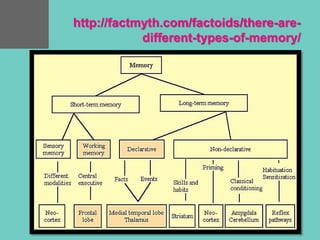
http://factmyth.com/factoids/there-are-
different-types-of-memory/
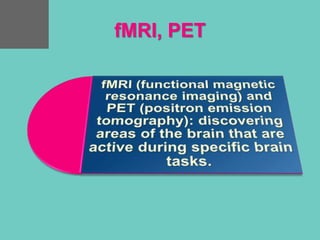
fMRI, PET
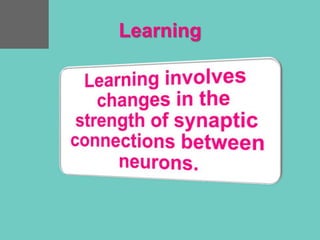
Learning
Long vs. short-term memories
• Long-term memories involve
changes in protein synthesis and
gene regulation and short-term
memories do not.
• Long-term memories in many
cases involve structural
modifications.
Long term potentiation
• Long-term potentiation (LTP) is an
enduring form of synaptic plasticity.
• It might be involved in many examples
of declarative memory.
• It is present in the hippocampus.
• Hippocampus is involved in declarative
memories.
SHORT TERM MEMORY
I.
Sensory memory
• It is the shortest-term element of
memory.
• It is the ability to retain impressions of
sensory information after the original
stimuli have ended.
• It acts as a kind of buffer for stimuli
received through the five senses: sight,
hearing, smell, taste and touch.
Sensory memory
• After the information is perceived,
it is stored in sensory
memory automatically and
unbidden.
• The sensory memory can not be
prolonged via rehearsal.
Sensory memory
Sensory memory is an ultra
short-term memory
and decays or degrades very
quickly (200 - 500 milliseconds)
after the perception of an item.
Types of sensory memory
• The sensory memory for visual
stimuli is the iconic memory.
• The memory for aural stimuli is
known as the echoic memory.
• The memory for touch is the haptic
memory.
Smell
• Smell may be even more closely linked
to other memories than the other
senses.
• The olfactory bulb and olfactory cortex
are physically very close (2 or 3
synapses away) to
the hippocampus and amygdala
(memory processes).
Working memory
• The ability to remember and process
information at the same time.
• It holds a small amount of information
(around 7 items or less) in mind in an
active, readily-available state for a
short period of time (from 10 to 15
seconds, or sometimes up to a minute).
Transfer to long-term memory
• This information will quickly
disappear forever unless we make
a conscious effort to retain it.
• The short-term memory is a
necessary step toward the next
stage of retention.
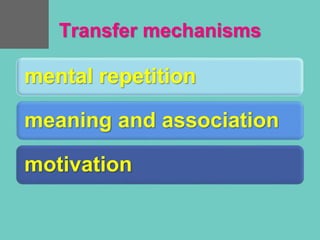
Transfer mechanisms
mental repetition
meaning and association
motivation
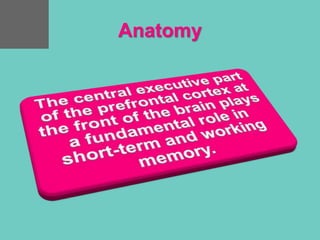
Anatomy
Neural loops of central
executive control
• For visual data: activates areas
near the visual cortex of the brain.
• For language: the ˝phonological
loop˝ uses Broca's area.
LONG TERM MEMORY
II.
Declarative memory
The declarative memory
system is the memory
system that has a
conscious component and
it includes the memories
of facts and events.
02
Non declarative memory
• Non declarative
memory (implicit
memory) includes
the types of
memory systems
that do not have a
conscious
component.
04
Non declarative memory
includes:
• memories for skills and habits (riding a
bicycle, driving a car, playing piano)
• priming phenomenon
• simple forms of associative learning
(classical conditioning or Pavlovian
conditioning)
• simple forms of nonassociative learning
(habituation and sensitization)
Priming phenomenon
• It is a non conscious form of human
memory concerned with perceptual
identification of words and objects.
• It refers to activating particular
representations or associations in
memory just before carrying out an
action or task.
Conclusion
Declarative memory:
knowing what!
Nondeclarative memory:
knowing how!
Anatomy of declarative
memory
The medial temporal lobe memory
system is for declarative memory.
It is composed of the hippocampus,
the perirhinal, entorhinal and
parahippocampal cortices.
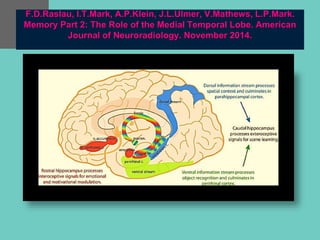
F.D.Raslau, I.T.Mark, A.P.Klein, J.L.Ulmer, V.Mathews, L.P.Mark.
Memory Part 2: The Role of the Medial Temporal Lobe. American
Journal of Neuroradiology. November 2014.
Medial temporal lobe
Has hierarchic format in which
information is:
• initially collected through the perirhinal
and parahippocampal cortices
• than passes to the entorhinal cortex
• ultimately reaches the hippocampus
Exteroceptive information
Ventral and dorsal stream
• The ventral stream from the
occipital lobe consists of visual
information (object recognition).
• The dorsal stream from the parietal
lobe carries spatial context
information to the
parahippocampal gyrus.
Interoceptive information
• Interoceptive (internal to the organism)
signals carry informations such as
emotions and motivation.
• Interoceptive signals go from the
medial prefrontal cortex, nucleus
accumbens and amygdala.
• Then project to the rostral hippocampal
formation and rhinal cortex regions.
The entorhinal cortex
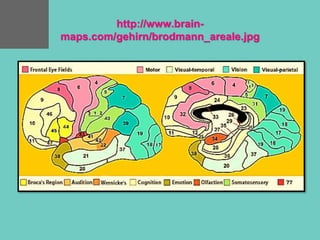
• The medial entorhinal cortex
(Brodmann area 28b) is actively
involved in the processing of spatial
information from the dorsal stream.
• The lateral entorhinal cortex
(Brodmann area 28a) is actively
involved in the object recognition
information from the ventral stream.
http://www.brain-
maps.com/gehirn/brodmann_areale.jpg
The rhinal cortex
The rhinal cortex functionally differentiates
familiar and novel information input:
• more familiar items are given fewer
resources for encoding compared with new
items
• a gatekeeper of the declarative memory
system
• optimising memory encoding resources to
novel information
Anterior temporal system
• perirhinal cortex
• temporopolar cortex
• lateral orbital frontal
cortex
• amygdala
Anterior temporal system
The anterior system is
more involved in object
and face recognition,
conceptual identity and
salience.
Semantic dementia
Posterior temporal system
• parahippocampal cortex
• retrosplenial cortex (Brodmann areas
29 and 30)
• anterior thalamic nuclei
• mammillary bodies
• presubiculum and parasubiculum
• default network
Default network
• retrosplenial cortex
• posterior cingulate gyrus
• precuneus
• angular gyrus
• ventral medial prefrontal cortex
Posterior temporal system
The posterior system
is involved in scene
recognition, location,
trajectory, temporal
context and order,
and finally situations.
Alzheimer´s disease
The parahipoccampal cortex
It is part of a
larger network
that connects
regions of the
frontal, parietal
and temporal
lobes.
The parahipoccampal cortex
• auditory association
areas of the superior
temporal gyrus
• polymodal association
areas (the retrosplenial
cortex, lateral inferior
parietal lobule, dorsal
bank of the superior
temporal sulcus)
• temporal pole
• perirhinal cortex
• parahippocampal
cortex
• entorhinal cortex
• medial prefrontal cortex
• dorsal lateral prefrontal
cortex
• orbital prefrontal cortex
• insula
The parahipoccampal cortex
Anatomy of procedural
(implicit) memory
•cerebellum
•putamen
•caudate nucleus
•motor cortex
EPISODIC AND SEMANTIC
MEMORY
A)
Declarative memory can be
divided to:
episodic memory
semantic memory
Episodic memory
• Represents our memory
of experiences and
specific events in time in a serial
form.
• It is the memory
of autobiographical events.
Episodic memory
• Activity is concentrated in
the hippocampus.
• Episodic memories are then stored in
the neocortex.
• The memories of the different elements
of a particular event (visual, olfactory,
auditory areas) are all connected
together by the hippocampus to form
an episode.
Semantic memory
• More structured record
of facts, meanings, concepts that we
have acquired.
• It refers to general factual knowledge,
independent of personal
experience and of the spatial and
temporal context in which it was
acquired.
Semantic memory
• Much of semantic memory is
abstract and relational and is
associated with the meaning
of verbal symbols.
• Semantic memory mainly activates
the frontal and temporal cortexes.
RETROSPECTIVE AND
PROSPECTIVE MEMORY
B)
Retrospective memory
• The content to be remembered (people,
words, events...) is in the past.
Includes:
• semantic
• episodic
• autobiographical memory
• declarative memory (in general)
• can be implicit also
Prospective memory
• The content to be remembered is in
the future.
• It may be defined as ˝remembering to
remember˝ or remembering to perform
an intended action.
• It may be event-based or time-based.
• It is often triggered by a cue.
Literature
• http://neuroscience.uth.tmc.edu/s4/cha
pter07.html (John H. Byrne,
Ph.D., Department of Neurobiology and
Anatomy, The UT Medical School at
Houston)
• Factmyth.com
• Brain-maps.com
• http://www.human-memory.net
Literature
• Squire LR, Wixted JT. The Cognitive
Neuroscience of Human Memory Since
H.M. Annual review of neuroscience.
2011;34:259-288. doi:10.1146/annurev-
neuro-061010-113720.
Literature
• F.D.Raslau, I.T.Mark, A.P.Klein,
J.L.Ulmer, V.Mathews, L.P.Mark.
Memory Part 2: The Role of the Medial
Temporal Lobe. American Journal of
Neuroradiology. November 2014.

Learning and memory

  • 1.
  • 2.
  • 3.
  • 4.
  • 5.
    Long vs. short-termmemories • Long-term memories involve changes in protein synthesis and gene regulation and short-term memories do not. • Long-term memories in many cases involve structural modifications.
  • 6.
    Long term potentiation •Long-term potentiation (LTP) is an enduring form of synaptic plasticity. • It might be involved in many examples of declarative memory. • It is present in the hippocampus. • Hippocampus is involved in declarative memories.
  • 7.
  • 8.
    Sensory memory • Itis the shortest-term element of memory. • It is the ability to retain impressions of sensory information after the original stimuli have ended. • It acts as a kind of buffer for stimuli received through the five senses: sight, hearing, smell, taste and touch.
  • 9.
    Sensory memory • Afterthe information is perceived, it is stored in sensory memory automatically and unbidden. • The sensory memory can not be prolonged via rehearsal.
  • 10.
    Sensory memory Sensory memoryis an ultra short-term memory and decays or degrades very quickly (200 - 500 milliseconds) after the perception of an item.
  • 11.
    Types of sensorymemory • The sensory memory for visual stimuli is the iconic memory. • The memory for aural stimuli is known as the echoic memory. • The memory for touch is the haptic memory.
  • 12.
    Smell • Smell maybe even more closely linked to other memories than the other senses. • The olfactory bulb and olfactory cortex are physically very close (2 or 3 synapses away) to the hippocampus and amygdala (memory processes).
  • 13.
    Working memory • Theability to remember and process information at the same time. • It holds a small amount of information (around 7 items or less) in mind in an active, readily-available state for a short period of time (from 10 to 15 seconds, or sometimes up to a minute).
  • 14.
    Transfer to long-termmemory • This information will quickly disappear forever unless we make a conscious effort to retain it. • The short-term memory is a necessary step toward the next stage of retention.
  • 15.
  • 16.
  • 17.
    Neural loops ofcentral executive control • For visual data: activates areas near the visual cortex of the brain. • For language: the ˝phonological loop˝ uses Broca's area.
  • 18.
  • 19.
    Declarative memory The declarativememory system is the memory system that has a conscious component and it includes the memories of facts and events. 02
  • 20.
    Non declarative memory •Non declarative memory (implicit memory) includes the types of memory systems that do not have a conscious component. 04
  • 21.
    Non declarative memory includes: •memories for skills and habits (riding a bicycle, driving a car, playing piano) • priming phenomenon • simple forms of associative learning (classical conditioning or Pavlovian conditioning) • simple forms of nonassociative learning (habituation and sensitization)
  • 22.
    Priming phenomenon • Itis a non conscious form of human memory concerned with perceptual identification of words and objects. • It refers to activating particular representations or associations in memory just before carrying out an action or task.
  • 23.
  • 24.
    Anatomy of declarative memory Themedial temporal lobe memory system is for declarative memory. It is composed of the hippocampus, the perirhinal, entorhinal and parahippocampal cortices.
  • 25.
    F.D.Raslau, I.T.Mark, A.P.Klein,J.L.Ulmer, V.Mathews, L.P.Mark. Memory Part 2: The Role of the Medial Temporal Lobe. American Journal of Neuroradiology. November 2014.
  • 26.
    Medial temporal lobe Hashierarchic format in which information is: • initially collected through the perirhinal and parahippocampal cortices • than passes to the entorhinal cortex • ultimately reaches the hippocampus
  • 27.
  • 28.
    Ventral and dorsalstream • The ventral stream from the occipital lobe consists of visual information (object recognition). • The dorsal stream from the parietal lobe carries spatial context information to the parahippocampal gyrus.
  • 29.
    Interoceptive information • Interoceptive(internal to the organism) signals carry informations such as emotions and motivation. • Interoceptive signals go from the medial prefrontal cortex, nucleus accumbens and amygdala. • Then project to the rostral hippocampal formation and rhinal cortex regions.
  • 30.
    The entorhinal cortex •The medial entorhinal cortex (Brodmann area 28b) is actively involved in the processing of spatial information from the dorsal stream. • The lateral entorhinal cortex (Brodmann area 28a) is actively involved in the object recognition information from the ventral stream.
  • 31.
  • 32.
    The rhinal cortex Therhinal cortex functionally differentiates familiar and novel information input: • more familiar items are given fewer resources for encoding compared with new items • a gatekeeper of the declarative memory system • optimising memory encoding resources to novel information
  • 33.
    Anterior temporal system •perirhinal cortex • temporopolar cortex • lateral orbital frontal cortex • amygdala
  • 34.
    Anterior temporal system Theanterior system is more involved in object and face recognition, conceptual identity and salience.
  • 35.
  • 36.
    Posterior temporal system •parahippocampal cortex • retrosplenial cortex (Brodmann areas 29 and 30) • anterior thalamic nuclei • mammillary bodies • presubiculum and parasubiculum • default network
  • 37.
    Default network • retrosplenialcortex • posterior cingulate gyrus • precuneus • angular gyrus • ventral medial prefrontal cortex
  • 38.
    Posterior temporal system Theposterior system is involved in scene recognition, location, trajectory, temporal context and order, and finally situations.
  • 39.
  • 40.
    The parahipoccampal cortex Itis part of a larger network that connects regions of the frontal, parietal and temporal lobes.
  • 41.
    The parahipoccampal cortex •auditory association areas of the superior temporal gyrus • polymodal association areas (the retrosplenial cortex, lateral inferior parietal lobule, dorsal bank of the superior temporal sulcus) • temporal pole • perirhinal cortex • parahippocampal cortex • entorhinal cortex • medial prefrontal cortex • dorsal lateral prefrontal cortex • orbital prefrontal cortex • insula
  • 42.
  • 43.
    Anatomy of procedural (implicit)memory •cerebellum •putamen •caudate nucleus •motor cortex
  • 44.
  • 45.
    Declarative memory canbe divided to: episodic memory semantic memory
  • 46.
    Episodic memory • Representsour memory of experiences and specific events in time in a serial form. • It is the memory of autobiographical events.
  • 47.
    Episodic memory • Activityis concentrated in the hippocampus. • Episodic memories are then stored in the neocortex. • The memories of the different elements of a particular event (visual, olfactory, auditory areas) are all connected together by the hippocampus to form an episode.
  • 48.
    Semantic memory • Morestructured record of facts, meanings, concepts that we have acquired. • It refers to general factual knowledge, independent of personal experience and of the spatial and temporal context in which it was acquired.
  • 49.
    Semantic memory • Muchof semantic memory is abstract and relational and is associated with the meaning of verbal symbols. • Semantic memory mainly activates the frontal and temporal cortexes.
  • 50.
  • 51.
    Retrospective memory • Thecontent to be remembered (people, words, events...) is in the past. Includes: • semantic • episodic • autobiographical memory • declarative memory (in general) • can be implicit also
  • 52.
    Prospective memory • Thecontent to be remembered is in the future. • It may be defined as ˝remembering to remember˝ or remembering to perform an intended action. • It may be event-based or time-based. • It is often triggered by a cue.
  • 53.
    Literature • http://neuroscience.uth.tmc.edu/s4/cha pter07.html (JohnH. Byrne, Ph.D., Department of Neurobiology and Anatomy, The UT Medical School at Houston) • Factmyth.com • Brain-maps.com • http://www.human-memory.net
  • 54.
    Literature • Squire LR,Wixted JT. The Cognitive Neuroscience of Human Memory Since H.M. Annual review of neuroscience. 2011;34:259-288. doi:10.1146/annurev- neuro-061010-113720.
  • 55.
    Literature • F.D.Raslau, I.T.Mark,A.P.Klein, J.L.Ulmer, V.Mathews, L.P.Mark. Memory Part 2: The Role of the Medial Temporal Lobe. American Journal of Neuroradiology. November 2014.