DISORDERS OF MEMORY
Memory is a general term for a mental process that allows the individual to store information for later recall.
Memory
Strub & black ; mental status examination in neurology; 4th
edition
MODELS OF MEMORY PROCESSING
Atkinson and shiffrin’s information-processing theory
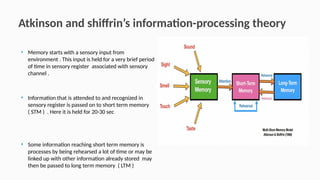
 Memory starts with a sensory input from
environment . This input is held for a very brief period
of time in sensory register associated with sensory
channel .
 Information that is attended to and recognized in
sensory register is passed on to short term memory
( STM ) . Here it is held for 20-30 sec
 Some information reaching short term memory is
processes by being rehearsed a lot of time or may be
linked up with other information already stored may
then be passed to long term memory ( LTM )
 In 1974 Baddeley and Hitch proposed a working memory model which replaced the concept of general short
term memory with specific, working memory. This consists of three basic stores
1. central executive
2. phonological loop
3. visuo-spatial sketchpad.
 In 2000 this model was expanded with the episodic buffer.
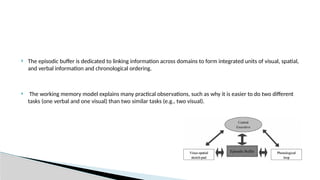
 Central executive located in the prefrontal cortex . It channels information to : the phonological loop, the
visuo-spatial sketchpad, and the episodic buffer.
 phonological loop and visuospatial system are rehersal system for retaining visual and spatial & language
aspects of stimulus .
Working memory model – baddeley and hitch
 The episodic buffer is dedicated to linking information across domains to form integrated units of visual, spatial,
and verbal information and chronological ordering.
 The working memory model explains many practical observations, such as why it is easier to do two different
tasks (one verbal and one visual) than two similar tasks (e.g., two visual).
 They suggested that the more deeply information is processed; the more likely it is to be retained (Baron, 2005).
 They argued that all of these processes would lead to some long-term learning, but that the amount of learning
depended on the type of processing, with "deep" processing in terms of meaning leading to much better
retention than "shallow" processing.
 Maintenance rehearsal might keep material available, but would not enhance long-term learning.
Levels of processing model- Craik and Lockharts
Encoding / registration : process of receiving sensory input and and transforming into a form / code that can be
stored.
Storage/ retention : It is a process of actually putting a information into memory
Retrieval : it is the capacity to access stored information from memory by recognition or recall .
Recall is the effortful retrieval of stored information into consciousness at a chosen moment. Eg what is capital of
india ? Requires recall function .
Recognition is the retrieval of stored information that depends on the identification of items previously learned and
is based on either remembering (effortful recollection) or knowing (familiarity based recollection)
eg which of the following is the capital of india ? Delhi , mumbai , lucknow . Tests recognition function .
Stages of memory process
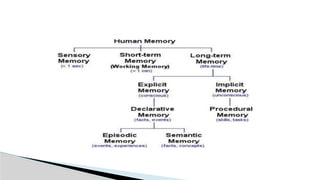
1. SENSORY MEMORY
2. SHORT TERM MEMORY / WORKING MEMORY
3. LONG TERM MEMORY
BASED ON DURATION
It is primarily a selecting and recording system that comes into play in the early phase of memory formation
via which perceptions ( auditory, visual, touch, taste etc.) enter the memory network.
 Visual stimulus is registered as an exact replica called Iconic image lasting up to 1 sec .
 Auditory stimuli is registered as an Echoic image lasting up to 4-5 sec in sensory register .
We pay “ attention and recognize” some of the information in sensory register , this attended to
information is converted to short term memory .
Sensory memory / sensory register
 It is the capacity for holding a small amount of information in mind in an active, readily available state for a short
period of time.
 Short term memory can withhold information received from sensory register up to about 30 seconds.
 For example, if you saw a person walking a dog and a few seconds later heard a dog bark you would not be
surprised since you would identify the likely source of the sound from sensory (visual) memory that had been
processed and encoded in short-term (working) memory.
Short term memory/ working memory
 It provides lasting retention of information and skills from minutes to a lifetime and has a limitless capacity.
Long term memory
Two types of long term memory 1.Explicit / declarative /relational memory
2.Implicit / procedural/ skill memory
Encompasses all the information that we can consciously describe or report i.e. the person is conscious that they
are remembering .
Areas of brain involved : hippocampus and medial temporal lobe .
It is of two types
1. semantic memory
2. episodic memory
Declarative / explicit / relational memory
Semantic memory is the memory of abstract facts .
It is the memory that make use of language possible i.e. it consist of knowledge about what words mean , how are
they related to each other and about the rules of using them in communication and thinking .
Eg . What is the capital of india .
Semantic memory
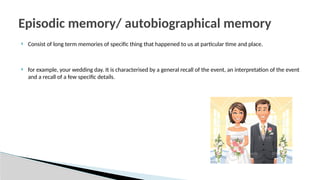
 Consist of long term memories of specific thing that happened to us at particular time and place.
 for example, your wedding day. It is characterised by a general recall of the event, an interpretation of the event
and a recall of a few specific details.
Episodic memory/ autobiographical memory
Refers to skills, habits or other manifestation of learning that can be expressed without an awareness of what has
been learned. It is heterogeneous collection of unconscious memory abilities.
Subtypes –
1. Procedural
2. Simple classical Conditioning
3. Priming
Implicit / Skill memory
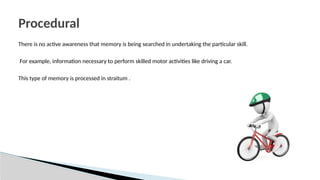
There is no active awareness that memory is being searched in undertaking the particular skill.
For example, information necessary to perform skilled motor activities like driving a car.
This type of memory is processed in straitum .
Procedural
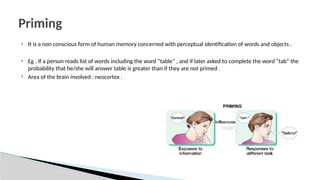
 It is a non conscious form of human memory concerned with perceptual identification of words and objects .
 Eg . If a person reads list of words including the word “table” , and if later asked to complete the word “tab” the
probability that he/she will answer table is greater than if they are not primed .
 Area of the brain involved : neocortex .
Priming
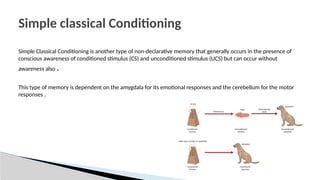
Simple Classical Conditioning is another type of non-declarative memory that generally occurs in the presence of
conscious awareness of conditioned stimulus (CS) and unconditioned stimulus (UCS) but can occur without
awareness also .
This type of memory is dependent on the amygdala for its emotional responses and the cerebellum for the motor
responses .
Simple classical Conditioning
 The TOT phenomenon indicates that information is organized in long-term memorv.
 Suppose you are trying to retrieve a person's name hut you cannot quite remember it; the name is on the "tip of
your tongue," but you just cannot recall it.
In TOT state we try to retrieve it from our long term memory so we tend to retrieve word which are
1. sound like target word
2. start from the same letter as target word
3. Contained same no. of syllables as target word
4. has meaning similar to target word .
Eg . While trying to write the child was” abandoned” by parents , we wrote child was “ absconded ‘ by parents .
Tip of tongue phenomenon
Forgetting refers to the apparent loss of information already learned and stored in long term memory.
Intereference theory
Forgetting is a result of some memories interfering with others.
 Proactive interference: Old memories interfere with ability to remember new memories.
 Retroactive interference: New memories interfere with ability to remember old memories.
Intereference is stronger when material is similar.
Forgetting
The three are distinguished by the time interval between presentation of the stimuli and retrieval.
 Immediate memory
 Recent memory
 Remote memory
Clinical classification
 patient should have sustained attention  inattentive, distractible patients cannot perform optimally on
such tests.
Patients who cannot perform optimally on these tests-
 Patients in an acute confusional state
 With severe psychotic disorder (usually have impaired attention)
 deaf, aphasic patients
 anxious, depressed, or grossly inattentive may reflect memory impairment caused by these processes
alone .
Things to keep in mind before clinical memory evaluation
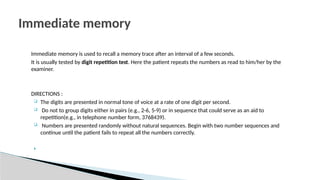
Immediate memory is used to recall a memory trace after an interval of a few seconds.
It is usually tested by digit repetition test. Here the patient repeats the numbers as read to him/her by the
examiner.
DIRECTIONS :
 The digits are presented in normal tone of voice at a rate of one digit per second.
 Do not to group digits either in pairs (e.g., 2-6, 5-9) or in sequence that could serve as an aid to
repetition(e.g., in telephone number form, 3768439).
 Numbers are presented randomly without natural sequences. Begin with two number sequences and
continue until the patient fails to repeat all the numbers correctly.

Immediate memory
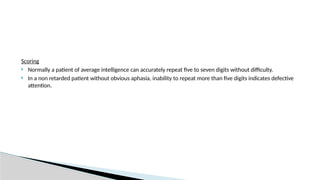
Scoring
 Normally a patient of average intelligence can accurately repeat five to seven digits without difficulty.
 In a non retarded patient without obvious aphasia, inability to repeat more than five digits indicates defective
attention.
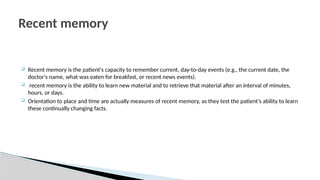
 Recent memory is the patient's capacity to remember current, day-to-day events (e.g., the current date, the
doctor's name, what was eaten for breakfast, or recent news events).
 recent memory is the ability to learn new material and to retrieve that material after an interval of minutes,
hours, or days.
 Orientation to place and time are actually measures of recent memory, as they test the patient’s ability to learn
these continually changing facts.
Recent memory
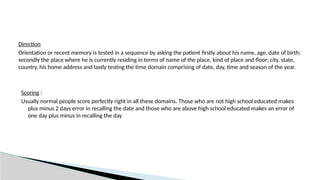
Direction
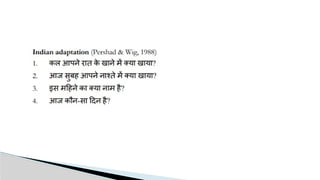
Orientation or recent memory is tested in a sequence by asking the patient firstly about his name, age, date of birth;
secondly the place where he is currently residing in terms of name of the place, kind of place and floor; city, state,
country, his home address and lastly testing the time domain comprising of date, day, time and season of the year.
Scoring :
Usually normal people score perfectly right in all these domains. Those who are not high school educated makes
plus minus 2 days error in recalling the date and those who are above high school educated makes an error of
one day plus minus in recalling the day
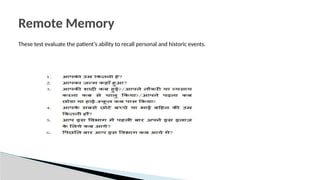
These test evaluate the patient’s ability to recall personal and historic events.
Remote Memory
 Instructions: Tell the patient, “I am going to tell you four words that I would like you to remember. In a few
minutes, I will ask you to recall these words”.
 To ensure that the patient has heard, understood, and initially retained the four words, have him or her to
repeat the words immediately and to correct any errors.
 Then he is asked to recall the words at 5, 10 and 30 minutes. To eliminate possible mental rehearsal,
interference should be used between presentation and recall of words.
New learning ability
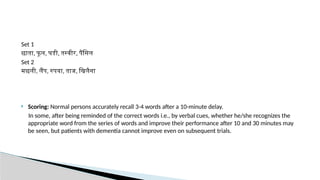
Set 1
छाता, फू ल, घडी, तस्वीर, पैंसिल
Set 2
मछली, लैंप, रुपया, ताज, खिलैना
 Scoring: Normal persons accurately recall 3-4 words after a 10-minute delay.
In some, after being reminded of the correct words i.e., by verbal cues, whether he/she recognizes the
appropriate word from the series of words and improve their performance after 10 and 30 minutes may
be seen, but patients with dementia cannot improve even on subsequent trials.
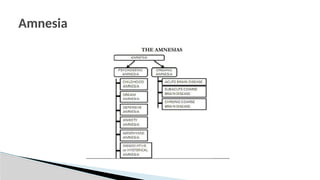
Memory disorders can be broadly classified into–
1. Amnesias (loss of memory)
2. Paraamnesias (distortions of memory)
3. Hyperamnesias
Memory disorders
Amnesia
FREUD used the concept of repression to account for childhood amnesia.
He said that we are unable to retrieve childhood memories because they are associated with the forbidden, guilt
arousing sexual and aggressive urges.
 According to SAHACTHEL there are different ways young children and older people encode & store
information .
 Adult store info in language form while Young and without language people encode info in the form of images
and feelings , which are difficult to retrieve .
Childhood amnesia
 Freud’s used concept of repression to account for dream amnesia .
 He considered dreams to be expression of forbidden sexual and aggressive urges. These urges have a capacity to
generate guilt , anxiety feelings hence are difficult to retrieve .
Another concept “ STATE DEPENDENT MEMORY “
 If people encode and store info in a particular emotional or drugged state they may not be able to retrieve info
in another emotional state .
 Eg alcoholic who were under the influence of alcohol when they hid a bottle , then forget where they put it
when sober but remember when drunk again .
 In dreaming brain seems to be in a special state different from that of waking again .
Dream amnesia
It is the inability to recall specific painful memories and is believed to occur due to defense mechanism of
repression.
There is no loss of personal identity as occurs in dissociative amnesia .
Catathymic amnesia/ motivational forgetting
 This is a sudden amnesia that occurs during periods of extreme trauma and may be concerned about the
stressful or traumatic life events that may last for hours or even days
 The amnesia will be for personal identity such as name, address and history as well as for personal events,
while at the same time the ability to perform complex behaviors is maintained (Casey and Kelly,2007).
 Dissociation may be associated with a fugue or wandering state in which the subject travels to another town or
country, and is often found wandering and lost.
 There is no demonstrable anterograde amnesia.
.
Dissociative amnesia
 a way of protecting oneself from the guilt or anxiety that can result from intense, intolerable life situations and
conflicts .
 The amnesia will be for personal identity such as name, address and history as well as for personal events.
 Amnesic episode can last for weeks, months, or years but the information stored during the amnesic episode is
not retrieveable i.e memory gap present .
Defensive amnesia
ORGANIC AMNESIAS
Referred to as true amnesia and can affect different functions of memory. There
can be impairment of registration, retention, retrieval or recall, or recognition
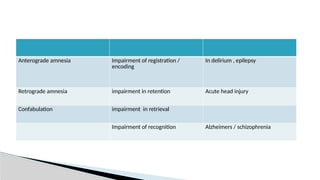
Anterograde amnesia Impairment of registration /
encoding
In delirium , epilepsy
Retrograde amnesia impairment in retention Acute head injury
Confabulation impairment in retrieval
Impairment of recognition Alzheimers / schizophrenia
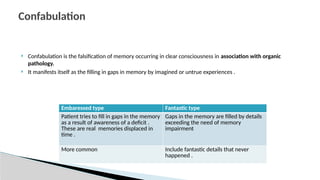
 Confabulation is the falsification of memory occurring in clear consciousness in association with organic
pathology.
 It manifests itself as the filling in gaps in memory by imagined or untrue experiences .
Confabulation
Embaressed type Fantastic type
Patient tries to fill in gaps in the memory
as a result of awareness of a deficit .
These are real memories displaced in
time .
Gaps in the memory are filled by details
exceeding the need of memory
impairment
More common Include fantastic details that never
happened .
Amnestic syndromes
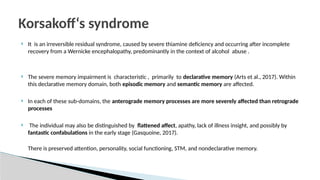
 It is an irreversible residual syndrome, caused by severe thiamine deficiency and occurring after incomplete
recovery from a Wernicke encephalopathy, predominantly in the context of alcohol abuse .
 The severe memory impairment is characteristic , primarily to declarative memory (Arts et al., 2017). Within
this declarative memory domain, both episodic memory and semantic memory are affected.
 In each of these sub-domains, the anterograde memory processes are more severely affected than retrograde
processes
 The individual may also be distinguished by flattened affect, apathy, lack of illness insight, and possibly by
fantastic confabulations in the early stage (Gasquoine, 2017).
There is preserved attention, personality, social functioning, STM, and nondeclarative memory.
Korsakoff‘s syndrome
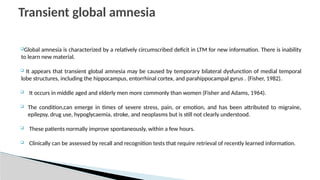
Global amnesia is characterized by a relatively circumscribed deficit in LTM for new information. There is inability
to learn new material.
 It appears that transient global amnesia may be caused by temporary bilateral dysfunction of medial temporal
lobe structures, including the hippocampus, entorrhinal cortex, and parahippocampal gyrus . (Fisher, 1982).
 It occurs in middle aged and elderly men more commonly than women (Fisher and Adams, 1964).
 The condition,can emerge in times of severe stress, pain, or emotion, and has been attributed to migraine,
epilepsy, drug use, hypoglycaemia, stroke, and neoplasms but is still not clearly understood.
 These patients normally improve spontaneously, within a few hours.
 Clinically can be assessed by recall and recognition tests that require retrieval of recently learned information.
Transient global amnesia
 This is distortion of memory .
 This can occur in normal subjects due to the process of normal forgetting or due to proactive and retroactive
interference from newly acquired material and is also seen in persons suffering from emotional problems or
other organic states.
 `It can be divided into Distortions of recall & Distortions of recognition
Paraamnesia
DISTORTIONS OF RECALL
It refers to the unintentional distortion of memory that occurs when it is
filtered through a person's current emotional, experiential and cognitive
state .
 Eg. depressive illness people describe all past experiences in negative
terms due to the impact of their current mood. So a depressed person will
highlight their failures while ignoring and/or forgetting about their
successes.
Retrospective falsification
 Retrospective delusions are found in some patients with psychoses who
backdate their delusions in spite of the clear evidence that the illness is of
recent origin .
 Eg . A patient will say that he has always been persecuted .
Retrospective delusions
These are recollection of events that did not occur but which the
individual subsequently believes that it did take place .
It entails a person to construct a memory around a event that did not
take place .
False memory
 It is a recollection that is partly true and partly false.
 Person only recalls part of true memory because entirety of the true memory is too painfull to recall .
 Eg an individual recall that a childhood sexual abuse was done by the neigbour because it is too painfull to recall
that sexual abuse was done by their own brother.
Screen memory
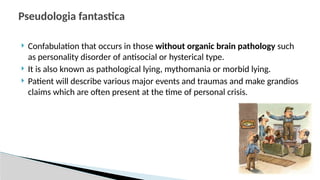
 Confabulation that occurs in those without organic brain pathology such
as personality disorder of antisocial or hysterical type.
 It is also known as pathological lying, mythomania or morbid lying.
 Patient will describe various major events and traumas and make grandios
claims which are often present at the time of personal crisis.
Pseudologia fantastica
 A variant of pathological lying .
 In this an individual present to the hospital with bogus illness , complex
medical histories and often multiple surgical scars.
Munchausen’s Syndrome
 Patient produces facticious illness in someone else, generally child .
Munchausen’s Syndrome by proxy
Ganser in 1898 described set of symptoms which include approximate answers (Vorbeireden).
The approximate answers suggest that the patient understands the question but appears to deliberately avoiding
correct answers.
Eg . when asked how many eyes does the cat have . Patient will answer 3 .
In gansers syndrome there is clouding of consciousness present while in similar condition of approximate answers
is found in those consciously feigning illness as seen in malingring consciousness in clear .
Ganser Syndrome
 Experience of not remembering that one is remembering .
 Eg a person writes a witty passage and does nor realise that they are
quoting from some passage that they have seen elsewhere rather than
writing something original .
Cryptoamnesia
DISTORTIONS OF RECOGNITION
Déjà vu It comprises the feeling of having experienced a current event in the past, although it has no basis in fact.
Jamais vous is the knowledge that an event has been experienced before but is not presently associated with the
appropriate feelings of familiarity.
Déjà entendu is the feeling of auditory recognition .
Déjà pense, a new thought recognized as having previously occurred.
 It is related to déjàvu, being different only in the modality of experience.
 These experiences occur occasionally in normal persons but they may become excessive in temporal lobe
lesions.
 This may occur in confusion psychosis and in acute and chronic schizophrenia. Misidentification may be positive
and negative.
Positive misidentification
 The patient recognizes strangers as his friends and relatives even though there is no physical resemblance. Some
patients assert that all of the people whom they meet are doubles of real people.
Negative misidentification
 The patient insist that friends and relatives are not whom they say they are and that the are strangers in disguise
.
Misidentification
Fregoli syndrome
In fregoli syndrome hyperidentification takes place.
The patient identifies a familiar person (usually his persecutor) in various strangers, who are therefore
fundamentally the same individual.
Capgras Syndrome
 The essential feature of this syndrome is hypoidentification.
 Patients insists that a particular person (or persons), usually somebody with whom the patients is emotionally
linked, is not the person he claims to be but is really a double.
 The commonest cause of capgras syndrome is schizophrenia and less common causes include involutional
depression and hysteria.
MIS-IDENTIFICATION SYNDROMES
 The opposite of amnesia and paramnesia .
 There is exaggerated registration, retention and recall.
 Flashbulb memories are unusually vivid, detailed and long Flashbacks that are associated with the cognitive
and emotional experiences of a traumatic event such as an accident. Eg 9/ 11 bombing witnesses
 It is regarded as one of the characteristic symptoms of post-traumatic stress disorder but is also associated with
substance misuse disorders and emotional events
 Eidetic images are exceptionally vivid memory images and occurs immediately after any type of perception.
More common in childen than adults .
Hyperamnesia
 Fish’s clinical psychopathology ; 4th
edition
 Sims symptoms in the mind ; 6th
edition
 Morgan and king ; introduction to psychology
 Strub & black ; the mental status examination in neurology
Refrences
DISORDERS OF MEMORY / memory / learning.pptx

DISORDERS OF MEMORY / memory / learning.pptx

  • 1.
  • 2.
    Memory is ageneral term for a mental process that allows the individual to store information for later recall. Memory Strub & black ; mental status examination in neurology; 4th edition
  • 3.
    MODELS OF MEMORYPROCESSING
  • 4.
    Atkinson and shiffrin’sinformation-processing theory  Memory starts with a sensory input from environment . This input is held for a very brief period of time in sensory register associated with sensory channel .  Information that is attended to and recognized in sensory register is passed on to short term memory ( STM ) . Here it is held for 20-30 sec  Some information reaching short term memory is processes by being rehearsed a lot of time or may be linked up with other information already stored may then be passed to long term memory ( LTM )
  • 5.
     In 1974Baddeley and Hitch proposed a working memory model which replaced the concept of general short term memory with specific, working memory. This consists of three basic stores 1. central executive 2. phonological loop 3. visuo-spatial sketchpad.  In 2000 this model was expanded with the episodic buffer.  Central executive located in the prefrontal cortex . It channels information to : the phonological loop, the visuo-spatial sketchpad, and the episodic buffer.  phonological loop and visuospatial system are rehersal system for retaining visual and spatial & language aspects of stimulus . Working memory model – baddeley and hitch
  • 6.
     The episodicbuffer is dedicated to linking information across domains to form integrated units of visual, spatial, and verbal information and chronological ordering.  The working memory model explains many practical observations, such as why it is easier to do two different tasks (one verbal and one visual) than two similar tasks (e.g., two visual).
  • 7.
     They suggestedthat the more deeply information is processed; the more likely it is to be retained (Baron, 2005).  They argued that all of these processes would lead to some long-term learning, but that the amount of learning depended on the type of processing, with "deep" processing in terms of meaning leading to much better retention than "shallow" processing.  Maintenance rehearsal might keep material available, but would not enhance long-term learning. Levels of processing model- Craik and Lockharts
  • 8.
    Encoding / registration: process of receiving sensory input and and transforming into a form / code that can be stored. Storage/ retention : It is a process of actually putting a information into memory Retrieval : it is the capacity to access stored information from memory by recognition or recall . Recall is the effortful retrieval of stored information into consciousness at a chosen moment. Eg what is capital of india ? Requires recall function . Recognition is the retrieval of stored information that depends on the identification of items previously learned and is based on either remembering (effortful recollection) or knowing (familiarity based recollection) eg which of the following is the capital of india ? Delhi , mumbai , lucknow . Tests recognition function . Stages of memory process
  • 9.
    1. SENSORY MEMORY 2.SHORT TERM MEMORY / WORKING MEMORY 3. LONG TERM MEMORY BASED ON DURATION
  • 11.
    It is primarilya selecting and recording system that comes into play in the early phase of memory formation via which perceptions ( auditory, visual, touch, taste etc.) enter the memory network.  Visual stimulus is registered as an exact replica called Iconic image lasting up to 1 sec .  Auditory stimuli is registered as an Echoic image lasting up to 4-5 sec in sensory register . We pay “ attention and recognize” some of the information in sensory register , this attended to information is converted to short term memory . Sensory memory / sensory register
  • 12.
     It isthe capacity for holding a small amount of information in mind in an active, readily available state for a short period of time.  Short term memory can withhold information received from sensory register up to about 30 seconds.  For example, if you saw a person walking a dog and a few seconds later heard a dog bark you would not be surprised since you would identify the likely source of the sound from sensory (visual) memory that had been processed and encoded in short-term (working) memory. Short term memory/ working memory
  • 13.
     It provideslasting retention of information and skills from minutes to a lifetime and has a limitless capacity. Long term memory Two types of long term memory 1.Explicit / declarative /relational memory 2.Implicit / procedural/ skill memory
  • 14.
    Encompasses all theinformation that we can consciously describe or report i.e. the person is conscious that they are remembering . Areas of brain involved : hippocampus and medial temporal lobe . It is of two types 1. semantic memory 2. episodic memory Declarative / explicit / relational memory
  • 15.
    Semantic memory isthe memory of abstract facts . It is the memory that make use of language possible i.e. it consist of knowledge about what words mean , how are they related to each other and about the rules of using them in communication and thinking . Eg . What is the capital of india . Semantic memory
  • 16.
     Consist oflong term memories of specific thing that happened to us at particular time and place.  for example, your wedding day. It is characterised by a general recall of the event, an interpretation of the event and a recall of a few specific details. Episodic memory/ autobiographical memory
  • 17.
    Refers to skills,habits or other manifestation of learning that can be expressed without an awareness of what has been learned. It is heterogeneous collection of unconscious memory abilities. Subtypes – 1. Procedural 2. Simple classical Conditioning 3. Priming Implicit / Skill memory
  • 18.
    There is noactive awareness that memory is being searched in undertaking the particular skill. For example, information necessary to perform skilled motor activities like driving a car. This type of memory is processed in straitum . Procedural
  • 19.
     It isa non conscious form of human memory concerned with perceptual identification of words and objects .  Eg . If a person reads list of words including the word “table” , and if later asked to complete the word “tab” the probability that he/she will answer table is greater than if they are not primed .  Area of the brain involved : neocortex . Priming
  • 20.
    Simple Classical Conditioningis another type of non-declarative memory that generally occurs in the presence of conscious awareness of conditioned stimulus (CS) and unconditioned stimulus (UCS) but can occur without awareness also . This type of memory is dependent on the amygdala for its emotional responses and the cerebellum for the motor responses . Simple classical Conditioning
  • 21.
     The TOTphenomenon indicates that information is organized in long-term memorv.  Suppose you are trying to retrieve a person's name hut you cannot quite remember it; the name is on the "tip of your tongue," but you just cannot recall it. In TOT state we try to retrieve it from our long term memory so we tend to retrieve word which are 1. sound like target word 2. start from the same letter as target word 3. Contained same no. of syllables as target word 4. has meaning similar to target word . Eg . While trying to write the child was” abandoned” by parents , we wrote child was “ absconded ‘ by parents . Tip of tongue phenomenon
  • 22.
    Forgetting refers tothe apparent loss of information already learned and stored in long term memory. Intereference theory Forgetting is a result of some memories interfering with others.  Proactive interference: Old memories interfere with ability to remember new memories.  Retroactive interference: New memories interfere with ability to remember old memories. Intereference is stronger when material is similar. Forgetting
  • 23.
    The three aredistinguished by the time interval between presentation of the stimuli and retrieval.  Immediate memory  Recent memory  Remote memory Clinical classification
  • 24.
     patient shouldhave sustained attention  inattentive, distractible patients cannot perform optimally on such tests. Patients who cannot perform optimally on these tests-  Patients in an acute confusional state  With severe psychotic disorder (usually have impaired attention)  deaf, aphasic patients  anxious, depressed, or grossly inattentive may reflect memory impairment caused by these processes alone . Things to keep in mind before clinical memory evaluation
  • 25.
    Immediate memory isused to recall a memory trace after an interval of a few seconds. It is usually tested by digit repetition test. Here the patient repeats the numbers as read to him/her by the examiner. DIRECTIONS :  The digits are presented in normal tone of voice at a rate of one digit per second.  Do not to group digits either in pairs (e.g., 2-6, 5-9) or in sequence that could serve as an aid to repetition(e.g., in telephone number form, 3768439).  Numbers are presented randomly without natural sequences. Begin with two number sequences and continue until the patient fails to repeat all the numbers correctly.  Immediate memory
  • 26.
    Scoring  Normally apatient of average intelligence can accurately repeat five to seven digits without difficulty.  In a non retarded patient without obvious aphasia, inability to repeat more than five digits indicates defective attention.
  • 27.
     Recent memoryis the patient's capacity to remember current, day-to-day events (e.g., the current date, the doctor's name, what was eaten for breakfast, or recent news events).  recent memory is the ability to learn new material and to retrieve that material after an interval of minutes, hours, or days.  Orientation to place and time are actually measures of recent memory, as they test the patient’s ability to learn these continually changing facts. Recent memory
  • 28.
    Direction Orientation or recentmemory is tested in a sequence by asking the patient firstly about his name, age, date of birth; secondly the place where he is currently residing in terms of name of the place, kind of place and floor; city, state, country, his home address and lastly testing the time domain comprising of date, day, time and season of the year. Scoring : Usually normal people score perfectly right in all these domains. Those who are not high school educated makes plus minus 2 days error in recalling the date and those who are above high school educated makes an error of one day plus minus in recalling the day
  • 30.
    These test evaluatethe patient’s ability to recall personal and historic events. Remote Memory
  • 31.
     Instructions: Tellthe patient, “I am going to tell you four words that I would like you to remember. In a few minutes, I will ask you to recall these words”.  To ensure that the patient has heard, understood, and initially retained the four words, have him or her to repeat the words immediately and to correct any errors.  Then he is asked to recall the words at 5, 10 and 30 minutes. To eliminate possible mental rehearsal, interference should be used between presentation and recall of words. New learning ability
  • 32.
    Set 1 छाता, फूल, घडी, तस्वीर, पैंसिल Set 2 मछली, लैंप, रुपया, ताज, खिलैना  Scoring: Normal persons accurately recall 3-4 words after a 10-minute delay. In some, after being reminded of the correct words i.e., by verbal cues, whether he/she recognizes the appropriate word from the series of words and improve their performance after 10 and 30 minutes may be seen, but patients with dementia cannot improve even on subsequent trials.
  • 33.
    Memory disorders canbe broadly classified into– 1. Amnesias (loss of memory) 2. Paraamnesias (distortions of memory) 3. Hyperamnesias Memory disorders
  • 34.
  • 35.
    FREUD used theconcept of repression to account for childhood amnesia. He said that we are unable to retrieve childhood memories because they are associated with the forbidden, guilt arousing sexual and aggressive urges.  According to SAHACTHEL there are different ways young children and older people encode & store information .  Adult store info in language form while Young and without language people encode info in the form of images and feelings , which are difficult to retrieve . Childhood amnesia
  • 36.
     Freud’s usedconcept of repression to account for dream amnesia .  He considered dreams to be expression of forbidden sexual and aggressive urges. These urges have a capacity to generate guilt , anxiety feelings hence are difficult to retrieve . Another concept “ STATE DEPENDENT MEMORY “  If people encode and store info in a particular emotional or drugged state they may not be able to retrieve info in another emotional state .  Eg alcoholic who were under the influence of alcohol when they hid a bottle , then forget where they put it when sober but remember when drunk again .  In dreaming brain seems to be in a special state different from that of waking again . Dream amnesia
  • 37.
    It is theinability to recall specific painful memories and is believed to occur due to defense mechanism of repression. There is no loss of personal identity as occurs in dissociative amnesia . Catathymic amnesia/ motivational forgetting
  • 38.
     This isa sudden amnesia that occurs during periods of extreme trauma and may be concerned about the stressful or traumatic life events that may last for hours or even days  The amnesia will be for personal identity such as name, address and history as well as for personal events, while at the same time the ability to perform complex behaviors is maintained (Casey and Kelly,2007).  Dissociation may be associated with a fugue or wandering state in which the subject travels to another town or country, and is often found wandering and lost.  There is no demonstrable anterograde amnesia. . Dissociative amnesia
  • 39.
     a wayof protecting oneself from the guilt or anxiety that can result from intense, intolerable life situations and conflicts .  The amnesia will be for personal identity such as name, address and history as well as for personal events.  Amnesic episode can last for weeks, months, or years but the information stored during the amnesic episode is not retrieveable i.e memory gap present . Defensive amnesia
  • 40.
    ORGANIC AMNESIAS Referred toas true amnesia and can affect different functions of memory. There can be impairment of registration, retention, retrieval or recall, or recognition
  • 41.
    Anterograde amnesia Impairmentof registration / encoding In delirium , epilepsy Retrograde amnesia impairment in retention Acute head injury Confabulation impairment in retrieval Impairment of recognition Alzheimers / schizophrenia
  • 42.
     Confabulation isthe falsification of memory occurring in clear consciousness in association with organic pathology.  It manifests itself as the filling in gaps in memory by imagined or untrue experiences . Confabulation Embaressed type Fantastic type Patient tries to fill in gaps in the memory as a result of awareness of a deficit . These are real memories displaced in time . Gaps in the memory are filled by details exceeding the need of memory impairment More common Include fantastic details that never happened .
  • 43.
  • 44.
     It isan irreversible residual syndrome, caused by severe thiamine deficiency and occurring after incomplete recovery from a Wernicke encephalopathy, predominantly in the context of alcohol abuse .  The severe memory impairment is characteristic , primarily to declarative memory (Arts et al., 2017). Within this declarative memory domain, both episodic memory and semantic memory are affected.  In each of these sub-domains, the anterograde memory processes are more severely affected than retrograde processes  The individual may also be distinguished by flattened affect, apathy, lack of illness insight, and possibly by fantastic confabulations in the early stage (Gasquoine, 2017). There is preserved attention, personality, social functioning, STM, and nondeclarative memory. Korsakoff‘s syndrome
  • 45.
    Global amnesia ischaracterized by a relatively circumscribed deficit in LTM for new information. There is inability to learn new material.  It appears that transient global amnesia may be caused by temporary bilateral dysfunction of medial temporal lobe structures, including the hippocampus, entorrhinal cortex, and parahippocampal gyrus . (Fisher, 1982).  It occurs in middle aged and elderly men more commonly than women (Fisher and Adams, 1964).  The condition,can emerge in times of severe stress, pain, or emotion, and has been attributed to migraine, epilepsy, drug use, hypoglycaemia, stroke, and neoplasms but is still not clearly understood.  These patients normally improve spontaneously, within a few hours.  Clinically can be assessed by recall and recognition tests that require retrieval of recently learned information. Transient global amnesia
  • 46.
     This isdistortion of memory .  This can occur in normal subjects due to the process of normal forgetting or due to proactive and retroactive interference from newly acquired material and is also seen in persons suffering from emotional problems or other organic states.  `It can be divided into Distortions of recall & Distortions of recognition Paraamnesia
  • 47.
  • 48.
    It refers tothe unintentional distortion of memory that occurs when it is filtered through a person's current emotional, experiential and cognitive state .  Eg. depressive illness people describe all past experiences in negative terms due to the impact of their current mood. So a depressed person will highlight their failures while ignoring and/or forgetting about their successes. Retrospective falsification
  • 49.
     Retrospective delusionsare found in some patients with psychoses who backdate their delusions in spite of the clear evidence that the illness is of recent origin .  Eg . A patient will say that he has always been persecuted . Retrospective delusions
  • 50.
    These are recollectionof events that did not occur but which the individual subsequently believes that it did take place . It entails a person to construct a memory around a event that did not take place . False memory
  • 51.
     It isa recollection that is partly true and partly false.  Person only recalls part of true memory because entirety of the true memory is too painfull to recall .  Eg an individual recall that a childhood sexual abuse was done by the neigbour because it is too painfull to recall that sexual abuse was done by their own brother. Screen memory
  • 52.
     Confabulation thatoccurs in those without organic brain pathology such as personality disorder of antisocial or hysterical type.  It is also known as pathological lying, mythomania or morbid lying.  Patient will describe various major events and traumas and make grandios claims which are often present at the time of personal crisis. Pseudologia fantastica
  • 53.
     A variantof pathological lying .  In this an individual present to the hospital with bogus illness , complex medical histories and often multiple surgical scars. Munchausen’s Syndrome
  • 54.
     Patient producesfacticious illness in someone else, generally child . Munchausen’s Syndrome by proxy
  • 55.
    Ganser in 1898described set of symptoms which include approximate answers (Vorbeireden). The approximate answers suggest that the patient understands the question but appears to deliberately avoiding correct answers. Eg . when asked how many eyes does the cat have . Patient will answer 3 . In gansers syndrome there is clouding of consciousness present while in similar condition of approximate answers is found in those consciously feigning illness as seen in malingring consciousness in clear . Ganser Syndrome
  • 56.
     Experience ofnot remembering that one is remembering .  Eg a person writes a witty passage and does nor realise that they are quoting from some passage that they have seen elsewhere rather than writing something original . Cryptoamnesia
  • 57.
  • 58.
    Déjà vu Itcomprises the feeling of having experienced a current event in the past, although it has no basis in fact. Jamais vous is the knowledge that an event has been experienced before but is not presently associated with the appropriate feelings of familiarity. Déjà entendu is the feeling of auditory recognition . Déjà pense, a new thought recognized as having previously occurred.  It is related to déjàvu, being different only in the modality of experience.  These experiences occur occasionally in normal persons but they may become excessive in temporal lobe lesions.
  • 59.
     This mayoccur in confusion psychosis and in acute and chronic schizophrenia. Misidentification may be positive and negative. Positive misidentification  The patient recognizes strangers as his friends and relatives even though there is no physical resemblance. Some patients assert that all of the people whom they meet are doubles of real people. Negative misidentification  The patient insist that friends and relatives are not whom they say they are and that the are strangers in disguise . Misidentification
  • 60.
    Fregoli syndrome In fregolisyndrome hyperidentification takes place. The patient identifies a familiar person (usually his persecutor) in various strangers, who are therefore fundamentally the same individual. Capgras Syndrome  The essential feature of this syndrome is hypoidentification.  Patients insists that a particular person (or persons), usually somebody with whom the patients is emotionally linked, is not the person he claims to be but is really a double.  The commonest cause of capgras syndrome is schizophrenia and less common causes include involutional depression and hysteria. MIS-IDENTIFICATION SYNDROMES
  • 61.
     The oppositeof amnesia and paramnesia .  There is exaggerated registration, retention and recall.  Flashbulb memories are unusually vivid, detailed and long Flashbacks that are associated with the cognitive and emotional experiences of a traumatic event such as an accident. Eg 9/ 11 bombing witnesses  It is regarded as one of the characteristic symptoms of post-traumatic stress disorder but is also associated with substance misuse disorders and emotional events  Eidetic images are exceptionally vivid memory images and occurs immediately after any type of perception. More common in childen than adults . Hyperamnesia
  • 62.
     Fish’s clinicalpsychopathology ; 4th edition  Sims symptoms in the mind ; 6th edition  Morgan and king ; introduction to psychology  Strub & black ; the mental status examination in neurology Refrences