MODERATOR – DR.MAYURNATH REDDY SIR
PRESENTER – DR.K.RAGA SUMEDHA
OVERVIEW:
Biology of Memory
Memory Processes
Types of Memory
Forgetting
BIOLOGY OF MEMORY
■ Memory is the glue that binds mental life, the
scaffolding for personal history.
■ Memory is a special case of the general
biological phenomenon of Neural Plasticity .
NEURAL PLASTICITY
■ Neurons can show history dependent activity
by responding differently as a function of prior
input and this plasticity of nerve cells and
synapses is the basis of memory.
■ Researchers proposed that the persistence of
memory could be accounted for by nerve cell
growth.
NEURAL PLASTICITY
SHORT-LASTING
■ Lasts for
seconds/minutes
■ Depends on
specific synaptic
events, including
an increase in
neurotransmitter
release.
LONG-LASTING
Depends on:
■ New protein
synthesis
■ Physical growth of
neural processes
■ Increase in the
number of synaptic
connections.
A major source of information about memory has
come from extended study of the marine mollusk ,
Aplysia Californica .
LONG-TERM POTENTIATION
 LTP is a candidate mechanism for
mammalian long term memory.
 High frequency burst of presynatic neural
firing
Persistant depolarization of postsynaptic
neuron
Properties of LTP that make it suitable as a
physiological substrate of memory:
 Established quickly and lasts for a long time.
 It is associative i.e.,depends on the co-
occurrence of presynaptic activity and
postsynaptic depolarization.
 Occurs only at potentiated synapses (but not all
synpases terminating on the postsynaptic cell).
 Occurs prominently in the HIPPOCAMPUS, a
structure important for memory.
 The induction of LTP is known to be mediated
postsynaptically and involves,
Activation of NMDA receptors
Influx of calcium into postsynaptic neurons
 LTP is maintained by an :
 Increase in the number of postsynaptic
AMPA(non-NMDA) receptors
 Also by increased neurotransmitter release
CORTICAL ORGANISATION OF MEMORY
Karl Lashley in 1920s searched
for the site of memory storage by
studying the behaviour of rats
following removal of different
amounts of cerebral cortex and he
found that –
“Deficit is directly
proportional to the
amount of cortex removed
(but did not depend on
the particular location of
cortical damage)”
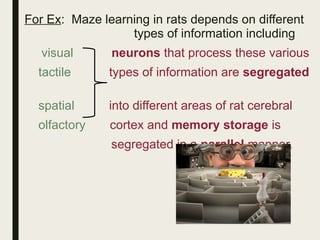
For Ex: Maze learning in rats depends on different
types of information including
visual neurons that process these various
tactile types of information are segregated
spatial into different areas of rat cerebral
olfactory cortex and memory storage is
segregated in a parallel manner.
Visual Input from Retina
Primary Visual Cortex/Striate Cortex/ V1
Ventrally into Dorsally into
InferoTemporal Cortex Parietal Cortex
(identification of visual objects) (spatial location)
Convergence of these 2 streams in the Medial Temporal Lobe,
including HIPPOCAMPUS provides an anatomical rationale for
the key role of this area in constructing and retrieving memories
comprised different sorts of episodic and semantic information.
 Special visual processing areas in dorsal and
ventral streams , together with areas in
prefrontal cortex register the immediate
experience of perceptual processing.
The results of perceptual processing are first
available as IMMEDIATE MEMORY.
(refers to the amount of information that can be
held in mind , like a telephone number , so that it
is available for immediate use)
 Immediate memory can be extended in time by
rehearsing or otherwise manipulating the
information, in which case it is WORKING MEMORY.
 In sum , memory is both distributed and localized in
cerebral cortex.
MEMORY PROCESSES
 Memory is the “capacity for storing and
retrieving information”.
 Three processes are involved in memory.
Encoding determine whether
Storage something is
Retrieval remembered/forgotten
ENCODING:
Information Memory
 People automatically encode some types of
information without being aware of it.
 However, other types of information become encoded
only if people pay attention to it.
Ways of Encoding verbal information:
Structural-what words look like
Phonemic-how words sound
Semantic-meaning of words
deeper level of processing
and better memory
STORAGE:
 After information enters the brain.
 Based on three stage model by Richard Atkinson
and Richard Shiffrin.
 According to this model,information is stored
sequentially in three memory systems.
Sensory Memory
Short-Term Memory
Long-Term Memory
SENSORY MEMORY:
 Selecting and recording system via which
perceptions enter the memory system(Lezak et
al.,2004).
 Stores incoming sensory information in detail
but only for an instant.
 Registered for each of the senses.
(Visual sensory memory is called Iconic
memory;
Auditory sensory memory is called Echoic
memory)
 Capacity of sensory memory is very large , but
the information in it is unprocessed.
Selective Attention:
Since there are numerous stimuli bombarding
the individual , selective attention allows for
sifting of relevant material from sensory
memory , for further processing and storage
in short term memory.
SHORT-TERM MEMORY:
 Some of the information in sensory memory
transfers to short-term memory which can hold
information for approximately twenty seconds.
 Rehearsing can help keep information in short-
term memory longer.
 It has a limited capacity.
 It can store about 7 + 2 pieces of information.
Chunking:
■ Can help to increase the capacity of short-term
memory.
■ Combines small bits of information into bigger
familiar pieces.
Small
(Individual numbers or
letters)
Large
(familiar strings of numbers ,
words or sentences)
Example of chunking:
A person confronted with this sequence of twelve
letters would probably have difficulty remembering
in ten seconds later , because short-term memory
cannot handle twelve pieces of information: HO TB
UT TE RE DP OP CO RN IN AB OW L. However these
letters can be easily remembered if they are
grouped into six familiar words , because short-
term memory can hold six pieces of information:
HOT BUTTERED POPCORN IN A BOWL
WORKING MEMORY:
 Psychologists today consider short-term
memory to be a working memory.
 Working memory is an active system.
(Rather than being just a temporary
information storage system)
 Information can be kept while people process
or examine it.
BADDELEY and HITCH (1974) MODEL OF
WORKING MEMORY:
This model comprises:
■ A central executive
■ A visuospatial scratch pad and
■ A phonological loop.
Central executive is the attentional controller.
(assisted by)
Visuospatial scratch pad
(temporary storage and
manipulation of visual and
spatial information)
Phonological loop
(holds memory traces of verbal
information for couple of seconds
combined with subvocal rehearsal)
LONG-TERM MEMORY:
Short-term memory Long-term memory
 When memories have been rehearsed in short
term memory, they are encoded into long term
memory.
 Long-term memory has an almost infinite
capacity and information in long- term memory
usually stays there for the duration of a person’s
life.
 Long-term memory is resilient to attack , unlike
short-term memory which is sensitive to
disorders of brain tissue, like Alzheimer’s
disease.
ORGANIZATION OF MEMORIES:
 If memories are not organized in the brain, there
would be difficulty in retrieving the information.
 One way in which brain organizes information in
long-term memory is by category.(Ex: Semantic)
 Categories can also be based on how words
sound or look.
 Long-term memory organises information not
only by categories but also by the information’s
 Familiarity
 Relevance
 Connection to other information
RETRIEVAL:
 Process of getting information out of memory.
 Retrieval cues are stimuli that help the process of
retrieval.
 Retrieval cues include:
 Associations
 Context
 Mood
ASSOCIATIONS:
Brain stores information as networks of
associated concepts so, recalling a particular
word becomes easier if another related word is
recalled first. This process is called priming.
Ex: If Tim shows his roommate a picture of
sunbathers on a nude beach and then asks him
to spell the word bear , the roommate may be
more likely to spell bare because the picture
primed him to recall that form of the word.
CONTEXT:
People can often remember an event by
placing themselves in the same context they
were in when the event happened.
MOOD:
If people are in the same mood they were in
during an event they may have an easier time
recalling the event.
TYPES OF MEMORY:
Long term memory can be conceptualized into two
retrieval systems.
EPISODIC SEMANTIC
EXPLICIT/DECLARATIVE/RELATIONAL
MEMORY
Person is conscious that they are
remembering.(i.e., available to
consciousness for declaration)
Deals with events and facts
IMPLICIT/PROCEDURAL/SKILLS MEMORY
Performance of tasks such as typing ,
swimming or cutting a loaf of bread are
also expressions of prior learning but
there is no active awareness that memory
is being searched in undertaking the
particular skill
Memory for specific events ,
which can be specific
autobiographical incidents or
personally experienced events.
Ex: I had a kipper for breakfast
today,
Going to the shop this morning.
-Memory for abstract facts
-storage of information in pure form
without specification of time/place.
Ex: Remembering the capital of France,
General Psychopathology was written
by Karl Jaspers .
PARTS OF BRAIN INVOLVED:
Declarative and procedural memory use different
parts of the brain and can function independently.
Hippocampu
s
Limbic system,
Amygdala and
cerebellum
Explicit(Declarative) Implicit(Procedural)
OTHER TYPES OF MEMORY:
Autobiographical Memory:(Active experience of
remembering)
 Memories for events and issues that relate to
oneself.
 For specific facts (whether you are married) and
specific experiences (your wedding day).
 General recall of the event, interpretation of the
event and recall of few specific details.
Flashbulb Memories:
 Vivid detailed memories of
emotionally arousing events.
Ex: 9/11 terrorist bombings.
Lost Memories:
People often recall lost memories when
hypnotized, indicating information in long term
memory is not lost-it is just difficult to retrieve.
FORGETTING:
Hermann Ebbinghaus was the first
person to do scientific studies of
forgetting.
 Later researchers have found that doesn’t
always occur that quickly. Meaningful
information fades more slowly.
 Retention is the proportion of learned
information that is retained or remembered.
Ebbinghaus Forgetting Curve: A forgetting curve
is a graph that shows how quickly learned
information is forgotten over time.
MEASURES OF FORGETTING AND
RETENTION:
Researchers measure forgetting and retention in
three different ways: recall, recognition, and
relearning.
Recall:
Recall is remembering without any external
cues.
Recognition:
Recognition is identifying learned information
using external cues. In general, recognition
is easier than recall.
Relearning:
When using the relearning method to
measure retention, a researcher might ask a
subject to memorize a long grocery list. She
might measure how long he has to practice
before he remembers every item.
Causes of forgetting:
Everyone forgets things. There are six main
reasons for forgetting:
■ Ineffective coding
■ Decay
■ Interference(retroactive and proactive)
■ Retrieval failure
■ Motivated forgetting
■ Physical injury or trauma
Motivated Forgetting:
Psychologist Sigmund Freud proposed that people
forget because they push unpleasant or intolerable
thoughts and feelings deep into their unconscious,
called repression. The idea that people forget
things they don’t want to remember is also called
motivated forgetting or psychogenic amnesia.
Physical Injury or Trauma:
Injury/Traumatic
event
Enhancing Memory:
■ Rehearsal
■ Overlearning
■ Distributed practice/Spacing effect
(Opposite of massed practice/cramming)
■ Minimizing Interference
■ Deep Processing (By Elaboration)
■ Organizing material
■ Mnemonics
(Acronyms, Acrostics, Narrative Methods, Rhymes)
■ Visual Imagery
(Method of Loci, The Link Method, Peg Word Method)
REFERENCES:
 Comprehensive Textbook of Psychiatry, 10th
Edition.
 Introduction to Psychology, King, Morgan, 7th
Edition.
 Fish’s Clinical Psychopathology, 3rd
Edition.
 SIMS’ symptoms in the mind, 5th
Edition.

MEMORY pathophysiology and disorders.pptx

  • 1.
    MODERATOR – DR.MAYURNATHREDDY SIR PRESENTER – DR.K.RAGA SUMEDHA
  • 2.
    OVERVIEW: Biology of Memory MemoryProcesses Types of Memory Forgetting
  • 3.
    BIOLOGY OF MEMORY ■Memory is the glue that binds mental life, the scaffolding for personal history. ■ Memory is a special case of the general biological phenomenon of Neural Plasticity .
  • 4.
    NEURAL PLASTICITY ■ Neuronscan show history dependent activity by responding differently as a function of prior input and this plasticity of nerve cells and synapses is the basis of memory. ■ Researchers proposed that the persistence of memory could be accounted for by nerve cell growth.
  • 5.
    NEURAL PLASTICITY SHORT-LASTING ■ Lastsfor seconds/minutes ■ Depends on specific synaptic events, including an increase in neurotransmitter release. LONG-LASTING Depends on: ■ New protein synthesis ■ Physical growth of neural processes ■ Increase in the number of synaptic connections.
  • 6.
    A major sourceof information about memory has come from extended study of the marine mollusk , Aplysia Californica .
  • 7.
    LONG-TERM POTENTIATION  LTPis a candidate mechanism for mammalian long term memory.  High frequency burst of presynatic neural firing Persistant depolarization of postsynaptic neuron
  • 8.
    Properties of LTPthat make it suitable as a physiological substrate of memory:  Established quickly and lasts for a long time.  It is associative i.e.,depends on the co- occurrence of presynaptic activity and postsynaptic depolarization.  Occurs only at potentiated synapses (but not all synpases terminating on the postsynaptic cell).  Occurs prominently in the HIPPOCAMPUS, a structure important for memory.
  • 9.
     The inductionof LTP is known to be mediated postsynaptically and involves, Activation of NMDA receptors Influx of calcium into postsynaptic neurons  LTP is maintained by an :  Increase in the number of postsynaptic AMPA(non-NMDA) receptors  Also by increased neurotransmitter release
  • 10.
    CORTICAL ORGANISATION OFMEMORY Karl Lashley in 1920s searched for the site of memory storage by studying the behaviour of rats following removal of different amounts of cerebral cortex and he found that – “Deficit is directly proportional to the amount of cortex removed (but did not depend on the particular location of cortical damage)”
  • 11.
    For Ex: Mazelearning in rats depends on different types of information including visual neurons that process these various tactile types of information are segregated spatial into different areas of rat cerebral olfactory cortex and memory storage is segregated in a parallel manner.
  • 12.
    Visual Input fromRetina Primary Visual Cortex/Striate Cortex/ V1 Ventrally into Dorsally into InferoTemporal Cortex Parietal Cortex (identification of visual objects) (spatial location) Convergence of these 2 streams in the Medial Temporal Lobe, including HIPPOCAMPUS provides an anatomical rationale for the key role of this area in constructing and retrieving memories comprised different sorts of episodic and semantic information.
  • 13.
     Special visualprocessing areas in dorsal and ventral streams , together with areas in prefrontal cortex register the immediate experience of perceptual processing. The results of perceptual processing are first available as IMMEDIATE MEMORY. (refers to the amount of information that can be held in mind , like a telephone number , so that it is available for immediate use)
  • 14.
     Immediate memorycan be extended in time by rehearsing or otherwise manipulating the information, in which case it is WORKING MEMORY.  In sum , memory is both distributed and localized in cerebral cortex.
  • 15.
    MEMORY PROCESSES  Memoryis the “capacity for storing and retrieving information”.  Three processes are involved in memory. Encoding determine whether Storage something is Retrieval remembered/forgotten
  • 16.
    ENCODING: Information Memory  Peopleautomatically encode some types of information without being aware of it.  However, other types of information become encoded only if people pay attention to it. Ways of Encoding verbal information: Structural-what words look like Phonemic-how words sound Semantic-meaning of words deeper level of processing and better memory
  • 17.
    STORAGE:  After informationenters the brain.  Based on three stage model by Richard Atkinson and Richard Shiffrin.  According to this model,information is stored sequentially in three memory systems. Sensory Memory Short-Term Memory Long-Term Memory
  • 18.
    SENSORY MEMORY:  Selectingand recording system via which perceptions enter the memory system(Lezak et al.,2004).  Stores incoming sensory information in detail but only for an instant.  Registered for each of the senses. (Visual sensory memory is called Iconic memory; Auditory sensory memory is called Echoic memory)
  • 19.
     Capacity ofsensory memory is very large , but the information in it is unprocessed. Selective Attention: Since there are numerous stimuli bombarding the individual , selective attention allows for sifting of relevant material from sensory memory , for further processing and storage in short term memory.
  • 20.
    SHORT-TERM MEMORY:  Someof the information in sensory memory transfers to short-term memory which can hold information for approximately twenty seconds.  Rehearsing can help keep information in short- term memory longer.  It has a limited capacity.
  • 21.
     It canstore about 7 + 2 pieces of information. Chunking: ■ Can help to increase the capacity of short-term memory. ■ Combines small bits of information into bigger familiar pieces. Small (Individual numbers or letters) Large (familiar strings of numbers , words or sentences)
  • 22.
    Example of chunking: Aperson confronted with this sequence of twelve letters would probably have difficulty remembering in ten seconds later , because short-term memory cannot handle twelve pieces of information: HO TB UT TE RE DP OP CO RN IN AB OW L. However these letters can be easily remembered if they are grouped into six familiar words , because short- term memory can hold six pieces of information: HOT BUTTERED POPCORN IN A BOWL
  • 23.
    WORKING MEMORY:  Psychologiststoday consider short-term memory to be a working memory.  Working memory is an active system. (Rather than being just a temporary information storage system)  Information can be kept while people process or examine it.
  • 24.
    BADDELEY and HITCH(1974) MODEL OF WORKING MEMORY: This model comprises: ■ A central executive ■ A visuospatial scratch pad and ■ A phonological loop. Central executive is the attentional controller. (assisted by) Visuospatial scratch pad (temporary storage and manipulation of visual and spatial information) Phonological loop (holds memory traces of verbal information for couple of seconds combined with subvocal rehearsal)
  • 25.
    LONG-TERM MEMORY: Short-term memoryLong-term memory  When memories have been rehearsed in short term memory, they are encoded into long term memory.  Long-term memory has an almost infinite capacity and information in long- term memory usually stays there for the duration of a person’s life.  Long-term memory is resilient to attack , unlike short-term memory which is sensitive to disorders of brain tissue, like Alzheimer’s disease.
  • 27.
    ORGANIZATION OF MEMORIES: If memories are not organized in the brain, there would be difficulty in retrieving the information.  One way in which brain organizes information in long-term memory is by category.(Ex: Semantic)  Categories can also be based on how words sound or look.  Long-term memory organises information not only by categories but also by the information’s  Familiarity  Relevance  Connection to other information
  • 28.
    RETRIEVAL:  Process ofgetting information out of memory.  Retrieval cues are stimuli that help the process of retrieval.  Retrieval cues include:  Associations  Context  Mood
  • 29.
    ASSOCIATIONS: Brain stores informationas networks of associated concepts so, recalling a particular word becomes easier if another related word is recalled first. This process is called priming. Ex: If Tim shows his roommate a picture of sunbathers on a nude beach and then asks him to spell the word bear , the roommate may be more likely to spell bare because the picture primed him to recall that form of the word.
  • 30.
    CONTEXT: People can oftenremember an event by placing themselves in the same context they were in when the event happened. MOOD: If people are in the same mood they were in during an event they may have an easier time recalling the event.
  • 31.
    TYPES OF MEMORY: Longterm memory can be conceptualized into two retrieval systems. EPISODIC SEMANTIC EXPLICIT/DECLARATIVE/RELATIONAL MEMORY Person is conscious that they are remembering.(i.e., available to consciousness for declaration) Deals with events and facts IMPLICIT/PROCEDURAL/SKILLS MEMORY Performance of tasks such as typing , swimming or cutting a loaf of bread are also expressions of prior learning but there is no active awareness that memory is being searched in undertaking the particular skill Memory for specific events , which can be specific autobiographical incidents or personally experienced events. Ex: I had a kipper for breakfast today, Going to the shop this morning. -Memory for abstract facts -storage of information in pure form without specification of time/place. Ex: Remembering the capital of France, General Psychopathology was written by Karl Jaspers .
  • 32.
    PARTS OF BRAININVOLVED: Declarative and procedural memory use different parts of the brain and can function independently. Hippocampu s Limbic system, Amygdala and cerebellum Explicit(Declarative) Implicit(Procedural)
  • 33.
    OTHER TYPES OFMEMORY: Autobiographical Memory:(Active experience of remembering)  Memories for events and issues that relate to oneself.  For specific facts (whether you are married) and specific experiences (your wedding day).  General recall of the event, interpretation of the event and recall of few specific details. Flashbulb Memories:  Vivid detailed memories of emotionally arousing events. Ex: 9/11 terrorist bombings.
  • 34.
    Lost Memories: People oftenrecall lost memories when hypnotized, indicating information in long term memory is not lost-it is just difficult to retrieve.
  • 35.
    FORGETTING: Hermann Ebbinghaus wasthe first person to do scientific studies of forgetting.  Later researchers have found that doesn’t always occur that quickly. Meaningful information fades more slowly.  Retention is the proportion of learned information that is retained or remembered. Ebbinghaus Forgetting Curve: A forgetting curve is a graph that shows how quickly learned information is forgotten over time.
  • 36.
    MEASURES OF FORGETTINGAND RETENTION: Researchers measure forgetting and retention in three different ways: recall, recognition, and relearning. Recall: Recall is remembering without any external cues. Recognition: Recognition is identifying learned information using external cues. In general, recognition is easier than recall.
  • 37.
    Relearning: When using therelearning method to measure retention, a researcher might ask a subject to memorize a long grocery list. She might measure how long he has to practice before he remembers every item.
  • 38.
    Causes of forgetting: Everyoneforgets things. There are six main reasons for forgetting: ■ Ineffective coding ■ Decay ■ Interference(retroactive and proactive) ■ Retrieval failure ■ Motivated forgetting ■ Physical injury or trauma
  • 39.
    Motivated Forgetting: Psychologist SigmundFreud proposed that people forget because they push unpleasant or intolerable thoughts and feelings deep into their unconscious, called repression. The idea that people forget things they don’t want to remember is also called motivated forgetting or psychogenic amnesia. Physical Injury or Trauma: Injury/Traumatic event
  • 40.
    Enhancing Memory: ■ Rehearsal ■Overlearning ■ Distributed practice/Spacing effect (Opposite of massed practice/cramming) ■ Minimizing Interference ■ Deep Processing (By Elaboration) ■ Organizing material ■ Mnemonics (Acronyms, Acrostics, Narrative Methods, Rhymes) ■ Visual Imagery (Method of Loci, The Link Method, Peg Word Method)
  • 41.
    REFERENCES:  Comprehensive Textbookof Psychiatry, 10th Edition.  Introduction to Psychology, King, Morgan, 7th Edition.  Fish’s Clinical Psychopathology, 3rd Edition.  SIMS’ symptoms in the mind, 5th Edition.