MEMORY
Presented by:
M.SAI SRUTHI
II/VI PHARM-D
Y17PHD0819
NIRMALA COLLEGE
OF PHARMACY
The human memory
• Memory is our ability to encode, store, retain and
subsequently recall information and past experiences
in the human brain.
• It can be thought of in general terms as the use of past
experience to affect or influence current behaviour.
• Etymologically, the modern English word “memory”
comes to us from the Latin memoria and memor,
meaning "mindful" or "remembering".
HISTORY:
• Until 1950’s no idea how brain converts an experience into
memory.
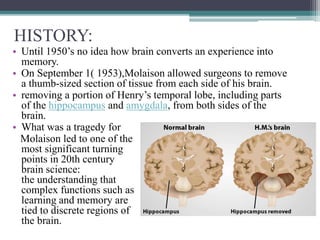
• On September 1( 1953),Molaison allowed surgeons to remove
a thumb-sized section of tissue from each side of his brain.
• removing a portion of Henry’s temporal lobe, including parts
of the hippocampus and amygdala, from both sides of the
brain.
• What was a tragedy for
Molaison led to one of the
most significant turning
points in 20th century
brain science:
the understanding that
complex functions such as
learning and memory are
tied to discrete regions of
the brain.
The human memory
• our memory is located not in one particular place in
the brain, but is instead a brain-wide process in which
several different areas of the brain act in conjunction with
one another (sometimes referred to as distributed
processing).
• For example, the simple act of riding a bike is actively
and seamlessly reconstructed by the brain from
many different areas: the memory of how to operate the
bike comes from one area, the memory of how to get
from here to the end of the block comes from another, the
memory of biking safety rules from another, and that
nervous feeling when a car veers dangerously close
comes from still another.
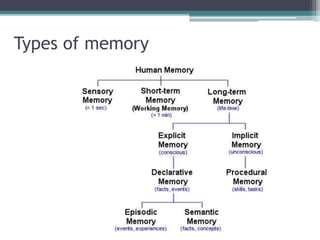
Types of memory
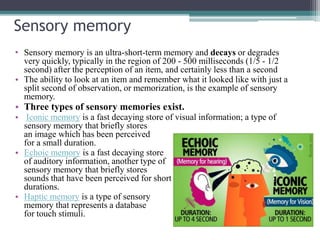
Sensory memory
• Sensory memory is an ultra-short-term memory and decays or degrades
very quickly, typically in the region of 200 - 500 milliseconds (1/5 - 1/2
second) after the perception of an item, and certainly less than a second
• The ability to look at an item and remember what it looked like with just a
split second of observation, or memorization, is the example of sensory
memory.
• Three types of sensory memories exist.
• Iconic memory is a fast decaying store of visual information; a type of
sensory memory that briefly stores
an image which has been perceived
for a small duration.
• Echoic memory is a fast decaying store
of auditory information, another type of
sensory memory that briefly stores
sounds that have been perceived for short
durations.
• Haptic memory is a type of sensory
memory that represents a database
for touch stimuli.
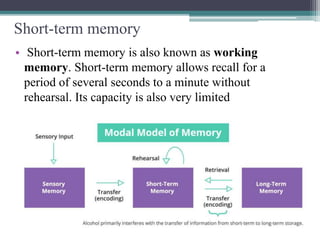
Short-term memory
• Short-term memory is also known as working
memory. Short-term memory allows recall for a
period of several seconds to a minute without
rehearsal. Its capacity is also very limited
Long-term memory
• The storage in sensory memory and short-term memory
generally has a strictly limited capacity and duration, which
means that information is not retained indefinitely.
• By contrast, long-term memory can store much larger
quantities of information for potentially unlimited duration
(sometimes a whole life span).
• Its capacity is immeasurable. For example, given a random
seven-digit number we may remember it for only a few
seconds before forgetting, suggesting it was stored in our
short-term memory.
• On the other hand, we can remember telephone numbers for
many years through repetition; this information is said to be
stored in long-term memory.
• Physiologically, the establishment of long-term memory involves a process of
physical changes in the structure of neurons (or nerve cells) in the brain, a process
known as long-term potentiation, although there is still much that is not
completely understood about the process.
• At its simplest, whenever something is learned, circuits of neurons in the brain,
known as neural networks, are created, altered or strengthened. These neural
circuits are composed of a number of neurons that communicate with one another
through special junctions called synapses.
• Through a process involving the creation of new proteins within the body of
neurons, and the electrochemical transfer of neurotransmitters across synapse
gaps to receptors, the communicative strength of certain circuits of neurons in the
brain is reinforced. With repeated use, the efficiency of these synapse connections
increases, facilitating the passage of nerve impulses along particular neural circuits,
which may involve many connections to the visual cortex, the auditory cortex,
the associative regions of the cortex, etc.
• Unlike with short-term memory, forgetting occurs in long-term memory when the
formerly strengthened synaptic connections among the neurons in a neural network
become weakened, or when the activation of a new network is superimposed over
an older one, thus causing interference in the older memory.
Facts:
• Our brains can store a countless amount of information.
• According to Northwestern University psychology
professor Paul Reber, our brains have the capacity to store up
to 2.5 petabytes of data. That’s the equivalent of
three millionhours of TV shows—or about the same storage as
nearly 4,000 256GB iPhones (the largest size available).
• Left-handed people have better memories.
• A quick nap can help you retain new information.
• Exercising improves your ability to remember new
information. improve the functioning of the hippocampus, the
part of the brain that is the center of memory storage.
• Sit up straight to recall memories more easily.
• Taking a photo of something makes your memories of it
worse.
• You are more likely to remember something if you say it
out loud.
• Learning new things produces physical changes in
your brain structure
• Memories start forming in the womb – as early as 4
months into a pregnancy!
• There is no single place where a given memory lives in
the brain; it’s scattered across many different regions
Memory

Memory

  • 1.
    MEMORY Presented by: M.SAI SRUTHI II/VIPHARM-D Y17PHD0819 NIRMALA COLLEGE OF PHARMACY
  • 2.
    The human memory •Memory is our ability to encode, store, retain and subsequently recall information and past experiences in the human brain. • It can be thought of in general terms as the use of past experience to affect or influence current behaviour. • Etymologically, the modern English word “memory” comes to us from the Latin memoria and memor, meaning "mindful" or "remembering".
  • 3.
    HISTORY: • Until 1950’sno idea how brain converts an experience into memory. • On September 1( 1953),Molaison allowed surgeons to remove a thumb-sized section of tissue from each side of his brain. • removing a portion of Henry’s temporal lobe, including parts of the hippocampus and amygdala, from both sides of the brain. • What was a tragedy for Molaison led to one of the most significant turning points in 20th century brain science: the understanding that complex functions such as learning and memory are tied to discrete regions of the brain.
  • 4.
    The human memory •our memory is located not in one particular place in the brain, but is instead a brain-wide process in which several different areas of the brain act in conjunction with one another (sometimes referred to as distributed processing). • For example, the simple act of riding a bike is actively and seamlessly reconstructed by the brain from many different areas: the memory of how to operate the bike comes from one area, the memory of how to get from here to the end of the block comes from another, the memory of biking safety rules from another, and that nervous feeling when a car veers dangerously close comes from still another.
  • 5.
  • 6.
    Sensory memory • Sensorymemory is an ultra-short-term memory and decays or degrades very quickly, typically in the region of 200 - 500 milliseconds (1/5 - 1/2 second) after the perception of an item, and certainly less than a second • The ability to look at an item and remember what it looked like with just a split second of observation, or memorization, is the example of sensory memory. • Three types of sensory memories exist. • Iconic memory is a fast decaying store of visual information; a type of sensory memory that briefly stores an image which has been perceived for a small duration. • Echoic memory is a fast decaying store of auditory information, another type of sensory memory that briefly stores sounds that have been perceived for short durations. • Haptic memory is a type of sensory memory that represents a database for touch stimuli.
  • 7.
    Short-term memory • Short-termmemory is also known as working memory. Short-term memory allows recall for a period of several seconds to a minute without rehearsal. Its capacity is also very limited
  • 8.
    Long-term memory • Thestorage in sensory memory and short-term memory generally has a strictly limited capacity and duration, which means that information is not retained indefinitely. • By contrast, long-term memory can store much larger quantities of information for potentially unlimited duration (sometimes a whole life span). • Its capacity is immeasurable. For example, given a random seven-digit number we may remember it for only a few seconds before forgetting, suggesting it was stored in our short-term memory. • On the other hand, we can remember telephone numbers for many years through repetition; this information is said to be stored in long-term memory.
  • 9.
    • Physiologically, theestablishment of long-term memory involves a process of physical changes in the structure of neurons (or nerve cells) in the brain, a process known as long-term potentiation, although there is still much that is not completely understood about the process. • At its simplest, whenever something is learned, circuits of neurons in the brain, known as neural networks, are created, altered or strengthened. These neural circuits are composed of a number of neurons that communicate with one another through special junctions called synapses. • Through a process involving the creation of new proteins within the body of neurons, and the electrochemical transfer of neurotransmitters across synapse gaps to receptors, the communicative strength of certain circuits of neurons in the brain is reinforced. With repeated use, the efficiency of these synapse connections increases, facilitating the passage of nerve impulses along particular neural circuits, which may involve many connections to the visual cortex, the auditory cortex, the associative regions of the cortex, etc. • Unlike with short-term memory, forgetting occurs in long-term memory when the formerly strengthened synaptic connections among the neurons in a neural network become weakened, or when the activation of a new network is superimposed over an older one, thus causing interference in the older memory.
  • 10.
    Facts: • Our brainscan store a countless amount of information. • According to Northwestern University psychology professor Paul Reber, our brains have the capacity to store up to 2.5 petabytes of data. That’s the equivalent of three millionhours of TV shows—or about the same storage as nearly 4,000 256GB iPhones (the largest size available). • Left-handed people have better memories. • A quick nap can help you retain new information. • Exercising improves your ability to remember new information. improve the functioning of the hippocampus, the part of the brain that is the center of memory storage.
  • 11.
    • Sit upstraight to recall memories more easily. • Taking a photo of something makes your memories of it worse. • You are more likely to remember something if you say it out loud. • Learning new things produces physical changes in your brain structure • Memories start forming in the womb – as early as 4 months into a pregnancy! • There is no single place where a given memory lives in the brain; it’s scattered across many different regions