Domina Petric, MD
ECG I
Interventricular conduction delay
Burns E. Interventricular Conduction Delay (April 16, 2017).
Retrieved from https://lifeinthefastlane.com/ecg-library/ivcd/
PowerPlugs Templates for PowerPoint Preview 2
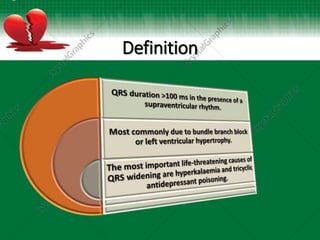
Definition
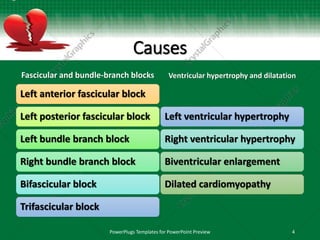
Causes
Fascicular and bundle-branch blocks
Left anterior fascicular block
Left posterior fascicular block
Left bundle branch block
Right bundle branch block
Bifascicular block
Trifascicular block
Ventricular hypertrophy and dilatation
Left ventricular hypertrophy
Right ventricular hypertrophy
Biventricular enlargement
Dilated cardiomyopathy
PowerPlugs Templates for PowerPoint Preview 4
Causes
Electrolyte abnormalities
Hyperkalaemia
Toxins
Sodium-channel
blocker toxicity
(TCA overdose):
wide QRS +
positive R’ wave
in aVR.
PowerPlugs Templates for PowerPoint Preview 5
Causes
Pre-excitation
Wolff-
Parkinson-
White
syndrome:
wide QRS
+ delta waves.
Arrhythmogenic cardiac conditions
Brugada syndrome: localised QRS
widening in V1-V2 with RBBB
morphology.
Arrhythmogenic right ventricular
dysplasia (AVRD): localised QRS
widening in V1-V2 + epsilon
waves + variable signs of right
ventricular hypertrophy.
PowerPlugs Templates for PowerPoint Preview 6
Non-specific interventricular conduction delay
When other causes
are excluded!
PowerPlugs Templates for PowerPoint Preview 7
Intracranial haemorrhage
Burns E. Raised Intracranial Pressure (August 29, 2017). Retrieved from
https://lifeinthefastlane.com/ecg-library/raised-intracranial-pressure/
PowerPlugs Templates for PowerPoint Preview 8
Raised intracranial pressure triad
Widespread giant T-wave inversions called
CEREBRAL T WAVES.
QT prolongation.
Bradycardia as the consequence of the Cushing
reflex-indicates imminent brainstem herniation.
PowerPlugs Templates for PowerPoint Preview 9
Other ECG features
•ST segment elevation or depression.
•Increased U wave amplitude.
•Other rhythm disturbances: sinus
tachycardia, junctional rhythms,
premature ventricular contractions,
atrial fibrillation.
PowerPlugs Templates for PowerPoint Preview 10
ECG changes due to raised ICP are most commonly seen with:
massive intracranial
haemorrhage such as
subarachnoid haemorrhage and
intraparenchymal haemorrhage
(haemorrhagic stroke).
PowerPlugs Templates for PowerPoint Preview 11
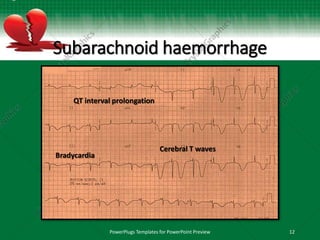
Subarachnoid haemorrhage
PowerPlugs Templates for PowerPoint Preview 12
Cerebral T waves
QT interval prolongation
Bradycardia
References
PowerPlugs Templates for PowerPoint Preview 13

ECG I

  • 1.
  • 2.
    Interventricular conduction delay BurnsE. Interventricular Conduction Delay (April 16, 2017). Retrieved from https://lifeinthefastlane.com/ecg-library/ivcd/ PowerPlugs Templates for PowerPoint Preview 2
  • 3.
  • 4.
    Causes Fascicular and bundle-branchblocks Left anterior fascicular block Left posterior fascicular block Left bundle branch block Right bundle branch block Bifascicular block Trifascicular block Ventricular hypertrophy and dilatation Left ventricular hypertrophy Right ventricular hypertrophy Biventricular enlargement Dilated cardiomyopathy PowerPlugs Templates for PowerPoint Preview 4
  • 5.
    Causes Electrolyte abnormalities Hyperkalaemia Toxins Sodium-channel blocker toxicity (TCAoverdose): wide QRS + positive R’ wave in aVR. PowerPlugs Templates for PowerPoint Preview 5
  • 6.
    Causes Pre-excitation Wolff- Parkinson- White syndrome: wide QRS + deltawaves. Arrhythmogenic cardiac conditions Brugada syndrome: localised QRS widening in V1-V2 with RBBB morphology. Arrhythmogenic right ventricular dysplasia (AVRD): localised QRS widening in V1-V2 + epsilon waves + variable signs of right ventricular hypertrophy. PowerPlugs Templates for PowerPoint Preview 6
  • 7.
    Non-specific interventricular conductiondelay When other causes are excluded! PowerPlugs Templates for PowerPoint Preview 7
  • 8.
    Intracranial haemorrhage Burns E.Raised Intracranial Pressure (August 29, 2017). Retrieved from https://lifeinthefastlane.com/ecg-library/raised-intracranial-pressure/ PowerPlugs Templates for PowerPoint Preview 8
  • 9.
    Raised intracranial pressuretriad Widespread giant T-wave inversions called CEREBRAL T WAVES. QT prolongation. Bradycardia as the consequence of the Cushing reflex-indicates imminent brainstem herniation. PowerPlugs Templates for PowerPoint Preview 9
  • 10.
    Other ECG features •STsegment elevation or depression. •Increased U wave amplitude. •Other rhythm disturbances: sinus tachycardia, junctional rhythms, premature ventricular contractions, atrial fibrillation. PowerPlugs Templates for PowerPoint Preview 10
  • 11.
    ECG changes dueto raised ICP are most commonly seen with: massive intracranial haemorrhage such as subarachnoid haemorrhage and intraparenchymal haemorrhage (haemorrhagic stroke). PowerPlugs Templates for PowerPoint Preview 11
  • 12.
    Subarachnoid haemorrhage PowerPlugs Templatesfor PowerPoint Preview 12 Cerebral T waves QT interval prolongation Bradycardia
  • 13.