Deep Brain Stimulation:
Basic Principles
Dr. Raja Sekhar. R
SR, Neurosurgery, PGIMER
Moderator: Dr.Manjul Tripathi
Definition:
Deep Brain Stimulation
• “Reversible and adjustable electronic
neuromodulation
• using high frequency stimulation with
stereotactically implanted electrodes
• in specific targets of brain
• to produce therapeutic effects”
Larson. DBS Review.Neurotherapeutics (2014) 11:465–474
DBS Hardware
History of Neuromodulation and treatment of movement
disorders
• Mucuna pruriens [Kiwanch, Devil
Beans] contains - 3–7% dry weight levels
of L-DOPA; Ayurveda – 1000 B.C for PD
• Scribonius Largo, 46 A.D-
“Compositiones medicamentorum”-
Torpedo torpedo for Headache and
psychiatric illness
Sironi VA (2011) Origin and evolution of deep brain stimulation.
Front. Integr. Neurosci. 5:42
• Giovanni Aldini, 1804- Cortical stimulation evoked horrible
facial grimaces in freshly decapitated prisoners-
Experimental and Therapeutic Electrical Neuromodulation
• Victor Horsley,1890 -extirpation of the motor cortex for
treatment of athetosis
• Penfield and Boldrey, 1937; Penfield and Rasmussen,
1950- cortical homunculus
• Ernst Spiegel, 1947- stereotactic frame, lesions to interrupt
pallidofugal fibers causing improvement in bradykinesia,
rigidity, and tremor
• Hassler,Riechert and Talairach, 1950s treated PD with
lesions in the VL thalamic nucleus
• Irving Cooper, 1952- sacrifice of the anterior choroidal
artery
• José M. Delgado, 1948- deep neurophysiologic
electrical stimulation with implantation of
intracranial electrodes
• 1963 Albe Fessard et al11 reported that
stimulation in the area of the Vim at 100-200 Hz
improved tremor in PD
• Bekthereva, 1963; Sem-Jacobsen 1968; Irving S.
Cooper, 1970- long term implantation of
electrodes subcortical structures-for central
palsy, spasticity and epilepsy,movement
disorders
• RM Varma, 1965,NIMHANS, percutaneous
chemothalamotomy
• Arvid Carlsson and George Cotzias, 1968-
levodopa/carbidopa as the gold standard
• Louis Benabid, 1987- Thalamic (Vim) stimulation for tremor
• Laitinen, 1992- Gpi Stimulation for PD
• Pollak, 1994- STN Stimulation for PD
• FDA approval, 1997- Thalamic DBS for ET and PD related tremor
• Coubes, 2000- GPi DBS for dystonia
• FDA approval, 2003- STNand Gpi for PD
• Humanitarian Device exemption, 2003- STN and Gpi DBS for dystonia;
in 2009 for OCD
• Lasker – Debakey Clinical Medical Research Award, 2014- Mahlon
DeLong (Neurologist) and Louis Benebid (Neurosurgeon) – the two
modern pioneers of DBS
Indications
Parkinson disease:
Adequate response to dopamine therapy predicts successful DBS for
bradykinesia and rigidity.
• Severe motor fluctuations (on – off periods)- STN and Gpi (Level A)
• Drug induced Dyskinesias -STN and Gpi (Level A)
• Tremor predominant PD – Vim (Level A)
Deep brain stimulation in dystonia:
• GPi DBS- Primary generalized or segmental dystonia, once medication including
botulinum toxin has failed (Level A)
• Cervical dystonia once medication including botulinum toxin has failed (Level B)
Essential tremor:
• Drug resistant ET DBS of Vim of thalamus effectively treats contralateral limb
tremors in ET that is refractory to medical management (Level C)
Other indications of DBS but still not approved
• Tourette syndrome , Headache, Huntington’s disease; Epilepsy
• Depression, OCD, Addiction,Eating disorders
• Medication resistant tremor in multiple sclerosis
• Stroke recovery
Contraindications
• Severe dementia
• Severe autonomic dysfunction
• Poor dopaminergic response
• Atypical parkinsonism (e.g., Corticobasal ganglionic degeneration, progressive
supranuclear palsy, multiple system atrophy, and dementia with Lewy bodies)
• Freeze episodes
• Unstable psychiatric disease
• Secondary Dystonia
• Secondary tremor
• Absence of a dedicated caregiver, realistic expectations
• Medical comorbidities with unacceptable risks
Cortico-basal-ganglia-thalamo-cortical circuitry
DeLong MR. Basal ganglia-thalamocortical circuits: parallel substrates for motor,
oculomotor, “prefrontal” and “limbic” functions. Prog Brain Res. 1990;85:119–146.
• Depigmentation of the substantia nigra in PD
• Intracytoplasmic eosinophilic inclusion, the Lewy body
Wichmann T. Pathophysiology of parkinsonism. Clin Neurophysiol. 2008;119:1459.)
Mechanism of action
• “Rogue neural circuits struck in the states of abnormal oscillation in
many diseases have become the candidates for DBS therapy”
- Micheal S. Okun, 2014
Paradox of stereotaxic surgery:
• Interventions ameliorate the signs of these disorders without causing
obvious impairment of voluntary movement
• High frequency stimulation is acting similar to a lesion
Herrinton. Mechanism of DBS. J Neurophysiol 115: 19–38, 2016
Various disease symptoms exhibit different latencies in response to deep brain stimulation (DBS)
treatment, supporting the theory that different mechanisms of DBS are responsible
DBS acts via several, nonexclusive mechanisms:
• Local and network-wide electrical and neurochemical effects of
stimulation
• Modulation of oscillatory activity- ‘Informational lesion’
• Synaptic plasticity
• Neuroprotection and neurogenesis.
• Different mechanisms vary in importance depending on the condition
being treated and the target being stimulated
• Dissociation between neuronal somatic and axonal
activity
• Informational lesion
• Beta oscillation Excess
• Synaptic plasticity related changes similar to learning
and memory- effects over mins to days
• Animal studies show retardation of neuronal
degeneration and activation of neuronal precursor cell
proliferation
Multidisciplinary team- Decision making
• Neurologist- Accurate diagnosis
Adequate drug trials
Postoperative DBS programming – drug changes
• Neurophysiologist
• Neuropsychologist
• Patient and family counselling
Target selection
Disease Target of stimulation
PD Sub-thalamic nucleus, GPi
Dystonia Globus pallidus interna
Essential tremor Ventral intermediate nucleus of
thalamus
PD with freezing of gait Pedunculopontine nucleus
Obsessive compulsive
disorder
Ventral capsule/ventral striatum
Tourette syndrome Centromedian-parafascicular
Depression, addiction Nucleus accumbens
Epilepsy Anterior and centromedian N.
Surgical procedure
Accuracy of electrode
placement is the key.
Basic components:
• Stereotactic anatomic targeting
- Acquisition of stereotactic coordinates:
i) Image acquisition: Frame based and frameless techniques
ii) Target localization: Indirect (Targeting formulas, Brain atlases) and
Direct (High resolution MRI)
• Physiological target verification- intraoperative electrophysiology
- Microelectrode recording, Macroelectrode stimulation
• DBS lead implantation
• Implantable pulse generator (IPG) placement
Imaging: Acquisition of stereotactic coordinates
• Ventriculography
• CT- Excellent stereotactic precision
• MRI- Excellent anatomic resolution
• Fusion of both
• Neuroimaging inaccuracy:
-Frame shift
-Image distorsion, artifacts
-Brain shift- CSF leak, Pneumocephalus
• T1C, T1 and T2 data set covering the whole brain in 1-mm axial cuts is used together with
two two dimensional image sets optimized for the best delineation of the targets: an axial
• Inversion recovery fast spin echo (IR-FSE) and an axial T2-weighted fast spin echo (T2-FSE),
both acquired as interleaved sequences to provide contiguous slices (zero interspace).
Images are imported into a stereotactic surgical planning software package for planning.
Reference plane
Ventriculography
• Lateral and AP views with standard magnification by using orthogonal x-ray
imaging with a fixed distance.
• The stereotactic coordinates of the AC, the PC, and the theoretical target points
relative to the AC-PC line are then calculated.
Frame based Stereotaxy
• Leksell (Elekta, Stockholm, Sweden)
• Cosman-Roberts-Wells (Radionics, Burlington, MA)
• Riechert-Mundinger (Fischer-Leibinger, Freiburg, Germany)
Frameless Stereotaxy
-Neuronavigation
MicroTargeting platform stereotaxy system (FHC Inc., Bowdoin, ME)
Cerefy electronic brain atlas database,
Thieme Medical Publishers
• Atlas for Stereotaxy of the Human Brain (Schaltenbrand and Wahren, 1977)
• Co-Planar Stereotactic Atlas of the Human Brain (Talairach and Tournoux, 1988)
• Referentially Oriented Cerebral MRI Anatomy: Atlas of Stereotaxic Anatomical
Correlations for Gray and White Matter (Talairach and Tournoux, 1993)
• Atlas of the Cerebral Sulci (Ono, Kubik, and Abernathey,1990)
CD ROM of electronically coregistered 3D formats of above atlases
Used in work stations of Stereotactic Systems
New directions in atlas-assisted stereotactic functional neurosurgery. In: Advanced Techniques in
Image-Guided Brain and Spine Surgery (ed. Germano IM), Thieme, New York, 2002:162-174
Digitalised Schantelbrand Wahren Sterotactic atlas and Talairach-Tournoux brain atlas.
• User interface of the Stereotactic System Planning console: Using multiple atlases
in multiple orientations.
• The goal is to achieve the most precise localization using multiple data sources
Direct anatomic localization
Subthalamic Nucleus Coordinates:
• 3 mm posterior, 4 inferior, and 12 mm lateral to the
MCP
• T2-FSE or IR-FSE image set is then used to adjust the
target with respect to the unique anatomy of each
patient
GPi Coordinates:
• 2 mm anterior, 5 mm inferior, and 21 mm lateral to
the MCP
Trajectory
For both STN and GPi stimulation is 60
degrees from the AC-PC line in the sagittal
plane and 0 to 15 degrees from the vertical
in the coronal plane
Patient-specific adjustments:
Avoiding cortical sulci
Vascular structures superficially and deep
Lateral ventricle
Neurophysiological Assessment
• Refine lead position in the target, preliminarily localised by imaging
and stereotaxy
- Confirm target based on electrophysiological signature
- To demonstrate the clinical outcome
- To minimize stimulation related side effects
• Techniques:
- MER (Microelectrode stimulation)
- Macroelectrode stimulation-simulation of DBS effect
- DBS Stimulation
• Representative samples of neuronal
recordings in a typical tract while
targeting the STN
• All of the samples are 1 second in
length and demonstrate the typical
firing pattern at each of those nuclei
• STN Electrophysiologic signature:
- High background activity
- Abundance of kinaesthetic
responsive units and bursting units
- Firing rate: 34-47Hz ±25 Hz
- Irregular pattern of activity
Starr PA. Placement of deep brain stimulators technical approach.
Stereotact Funct Neurosurg. 2002;79:118-145
Macroelectrode
Stimulation
Asleep interventional MRI Technique
• The planning, insertion, and confirmation of lead
placement are integrated into a single MRI procedure
• The use of the bur hole–mounted aiming device
obviates the need for a stereotactic frame system
• Because navigation is performed in the coordinate
system defined by the MRI isocenter, defining a separate
stereotactic space (registered using fiducial markers) is
unnecessary
• The patients are asleep for the procedure and no test
stimulations or MERs are performed
• The possible errors resulting from mechanical
properties of the aiming device are corrected in real time
• Brain shift errors are decreased as target images are
acquired after bur hole creation and intracranial air entry.
Postoperative Programming
• Selecting the most appropriate stimulation parameters to provide the
patient with maximum therapeutic benefit while minimizing adverse
effects
• Variables- optimal electrode contact, stimulus amplitude, pulse width,
and frequency
• Trial and error: Trying out various combinations of stimulation
parameters while subjectively assessing the clinical results
Miocinovic. History, Applications, and Mechanisms of DBS.JAMA Neurol. 2013;70(2):163-171.
Patient-specific
computational deep
brain stimulation (DBS)
model
Minimize the amount of
patient time spent in
programming sessions
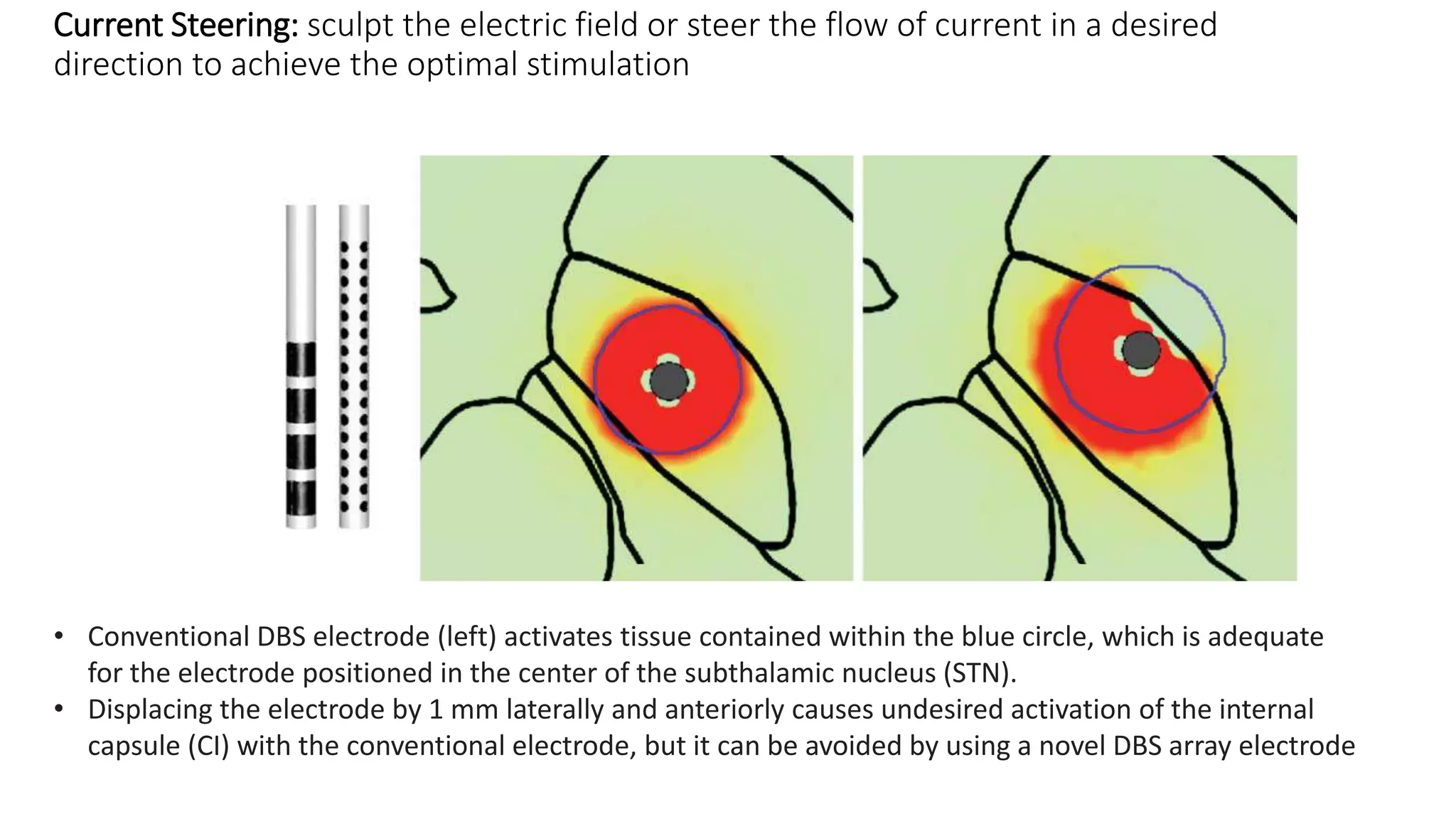
Current Steering: sculpt the electric field or steer the flow of current in a desired
direction to achieve the optimal stimulation
• Conventional DBS electrode (left) activates tissue contained within the blue circle, which is adequate
for the electrode positioned in the center of the subthalamic nucleus (STN).
• Displacing the electrode by 1 mm laterally and anteriorly causes undesired activation of the internal
capsule (CI) with the conventional electrode, but it can be avoided by using a novel DBS array electrode
Closed loop Stimulation
• Defined as a dynamic adjustment of stimulation parameters based on a
patient’s current clinical status
• Various pathological electrophysiological and biochemical signatures can be
used to provide feedback to the stimulator
• Coordinated reset stimulation was designed specifically to counteract
pathological synchronization processes by providing an antikindling effect and
retraining the neural network
• Duration of response after a single
dose of levodopa becomes
progressively shorter
• With BDS: Reduction in duration
and severity of OFF time, more
consistent and longer ON time
• Further reducing variability in
motor function and improving
clinical efficacy
Outcomes
PD SURG Trial: 366 patients. At 1 year,
• the mean improvement in PDQ-39 summary index score compared with
baseline was 5·0 points in the surgery group and 0·3 points in the medical
therapy group (difference −4·7, 95% CI −7·6 to −1·8; p=0·001);
• Mobility domain −8·9 (95% CI −13·8 to −4·0; p=0·0004),
• Activities of daily living domain was −12·4 (−17·3 to −7·5; p<0·0001),
• Bodily discomfort domain was −7·5 (−12·6 to −2·4; p=0·004).
• Differences all other domains -not significant.
• 19% patients had serious surgery-related adverse events
Vim DBS for ET: Mean F/U 5yr : DBS on/off TADLS 65- 85% improvement; 70-
80% improvement in handwriting
Copyright © 2010 Elsevier Ltd Terms and Conditions
Willams. PD SURG trial. Volume 9, No. 6, p581–591, June 2010
Complications
Related to surgery :
Haemorrhage (0.2 to 12.5%)
Infection (1-15%)
Death (0-4%)
Related to hardware (2.7 to 50%)
Lead breakage,
Malfunction of implanted pulse generator
Skin erosion
Air embolism; Chronic pain
Related to stimulation: (4-20%)
Hypophonia, Gaze deviation, Dysarthria,
post-operative confusion, Depression,
Aggressive behavior, Sadness,
Suicidal tendency, decrease world fluency
Future- Next generation Neuromodulation
• Brain is electric device – mostly unexplored
• Rogue neural circuits are everywhere – more targets for more diseases
• Goal change from blocking or overriding the transmission of
misinformation to normalise the network activity for long term
• Computational programming, Current steering, Closed loop Stimulation
• Optogenetic Neuromodulation - selective activation of neurons using light,
A viral vector targeted to select neural populations can be used to carry
genes for light-sensitive excitatory or inhibitory ion channels
• Integration of Cortical stimulation; Brain computer interface with DBS
• DREADDS (Designer Receptors Exclusively Activated by Designer Drugs)
References
• Ali R. Rezai. Surgery for movement disorders. Neurosurgery 62[SHC Suppl 2], 2008
• Micheal S.Okun. DBS for PD, Review. N Engl J Med 2012;367:1529-38
• Larson. DBS Review.Neurotherapeutics (2014) 11:465–474
• Starr PA. Placement of deep brain stimulators technical approach. Stereotact Funct Neurosurg.
2002;79:118-145
• Youman. Neurological Surgery.7/e; 2016
• Sweet. Operative Neurosurgical techniques. 6/e; 2012
• Sironi VA (2011) Origin and evolution of deep brain stimulation. Front. Integr. Neurosci. 5:42
• Herrinton. Mechanism of DBS. J Neurophysiol 115: 19–38, 2016
• Miocinovic. History, Applications, and Mechanisms of DBS.JAMA Neurol. 2013;70(2):163-171
• Ferreira . Summary of the recommendations of the EFNS. Management of Parkinson’s disease. Eur
J Neurol 2013;20:5-15.
• Willams. PD SURG trial. Volume 9, No. 6, p581–591, June 2010
Principles of DBS 31 Jan 2017

Principles of DBS 31 Jan 2017

  • 1.
    Deep Brain Stimulation: BasicPrinciples Dr. Raja Sekhar. R SR, Neurosurgery, PGIMER Moderator: Dr.Manjul Tripathi
  • 2.
    Definition: Deep Brain Stimulation •“Reversible and adjustable electronic neuromodulation • using high frequency stimulation with stereotactically implanted electrodes • in specific targets of brain • to produce therapeutic effects” Larson. DBS Review.Neurotherapeutics (2014) 11:465–474
  • 3.
  • 4.
    History of Neuromodulationand treatment of movement disorders • Mucuna pruriens [Kiwanch, Devil Beans] contains - 3–7% dry weight levels of L-DOPA; Ayurveda – 1000 B.C for PD • Scribonius Largo, 46 A.D- “Compositiones medicamentorum”- Torpedo torpedo for Headache and psychiatric illness Sironi VA (2011) Origin and evolution of deep brain stimulation. Front. Integr. Neurosci. 5:42
  • 5.
    • Giovanni Aldini,1804- Cortical stimulation evoked horrible facial grimaces in freshly decapitated prisoners- Experimental and Therapeutic Electrical Neuromodulation • Victor Horsley,1890 -extirpation of the motor cortex for treatment of athetosis • Penfield and Boldrey, 1937; Penfield and Rasmussen, 1950- cortical homunculus • Ernst Spiegel, 1947- stereotactic frame, lesions to interrupt pallidofugal fibers causing improvement in bradykinesia, rigidity, and tremor • Hassler,Riechert and Talairach, 1950s treated PD with lesions in the VL thalamic nucleus • Irving Cooper, 1952- sacrifice of the anterior choroidal artery
  • 6.
    • José M.Delgado, 1948- deep neurophysiologic electrical stimulation with implantation of intracranial electrodes • 1963 Albe Fessard et al11 reported that stimulation in the area of the Vim at 100-200 Hz improved tremor in PD • Bekthereva, 1963; Sem-Jacobsen 1968; Irving S. Cooper, 1970- long term implantation of electrodes subcortical structures-for central palsy, spasticity and epilepsy,movement disorders • RM Varma, 1965,NIMHANS, percutaneous chemothalamotomy • Arvid Carlsson and George Cotzias, 1968- levodopa/carbidopa as the gold standard
  • 7.
    • Louis Benabid,1987- Thalamic (Vim) stimulation for tremor • Laitinen, 1992- Gpi Stimulation for PD • Pollak, 1994- STN Stimulation for PD • FDA approval, 1997- Thalamic DBS for ET and PD related tremor • Coubes, 2000- GPi DBS for dystonia • FDA approval, 2003- STNand Gpi for PD • Humanitarian Device exemption, 2003- STN and Gpi DBS for dystonia; in 2009 for OCD • Lasker – Debakey Clinical Medical Research Award, 2014- Mahlon DeLong (Neurologist) and Louis Benebid (Neurosurgeon) – the two modern pioneers of DBS
  • 8.
    Indications Parkinson disease: Adequate responseto dopamine therapy predicts successful DBS for bradykinesia and rigidity. • Severe motor fluctuations (on – off periods)- STN and Gpi (Level A) • Drug induced Dyskinesias -STN and Gpi (Level A) • Tremor predominant PD – Vim (Level A)
  • 9.
    Deep brain stimulationin dystonia: • GPi DBS- Primary generalized or segmental dystonia, once medication including botulinum toxin has failed (Level A) • Cervical dystonia once medication including botulinum toxin has failed (Level B) Essential tremor: • Drug resistant ET DBS of Vim of thalamus effectively treats contralateral limb tremors in ET that is refractory to medical management (Level C) Other indications of DBS but still not approved • Tourette syndrome , Headache, Huntington’s disease; Epilepsy • Depression, OCD, Addiction,Eating disorders • Medication resistant tremor in multiple sclerosis • Stroke recovery
  • 10.
    Contraindications • Severe dementia •Severe autonomic dysfunction • Poor dopaminergic response • Atypical parkinsonism (e.g., Corticobasal ganglionic degeneration, progressive supranuclear palsy, multiple system atrophy, and dementia with Lewy bodies) • Freeze episodes • Unstable psychiatric disease • Secondary Dystonia • Secondary tremor • Absence of a dedicated caregiver, realistic expectations • Medical comorbidities with unacceptable risks
  • 13.
    Cortico-basal-ganglia-thalamo-cortical circuitry DeLong MR.Basal ganglia-thalamocortical circuits: parallel substrates for motor, oculomotor, “prefrontal” and “limbic” functions. Prog Brain Res. 1990;85:119–146.
  • 14.
    • Depigmentation ofthe substantia nigra in PD • Intracytoplasmic eosinophilic inclusion, the Lewy body Wichmann T. Pathophysiology of parkinsonism. Clin Neurophysiol. 2008;119:1459.)
  • 15.
    Mechanism of action •“Rogue neural circuits struck in the states of abnormal oscillation in many diseases have become the candidates for DBS therapy” - Micheal S. Okun, 2014 Paradox of stereotaxic surgery: • Interventions ameliorate the signs of these disorders without causing obvious impairment of voluntary movement • High frequency stimulation is acting similar to a lesion Herrinton. Mechanism of DBS. J Neurophysiol 115: 19–38, 2016
  • 16.
    Various disease symptomsexhibit different latencies in response to deep brain stimulation (DBS) treatment, supporting the theory that different mechanisms of DBS are responsible
  • 17.
    DBS acts viaseveral, nonexclusive mechanisms: • Local and network-wide electrical and neurochemical effects of stimulation • Modulation of oscillatory activity- ‘Informational lesion’ • Synaptic plasticity • Neuroprotection and neurogenesis. • Different mechanisms vary in importance depending on the condition being treated and the target being stimulated
  • 18.
    • Dissociation betweenneuronal somatic and axonal activity • Informational lesion • Beta oscillation Excess • Synaptic plasticity related changes similar to learning and memory- effects over mins to days • Animal studies show retardation of neuronal degeneration and activation of neuronal precursor cell proliferation
  • 19.
    Multidisciplinary team- Decisionmaking • Neurologist- Accurate diagnosis Adequate drug trials Postoperative DBS programming – drug changes • Neurophysiologist • Neuropsychologist • Patient and family counselling
  • 20.
    Target selection Disease Targetof stimulation PD Sub-thalamic nucleus, GPi Dystonia Globus pallidus interna Essential tremor Ventral intermediate nucleus of thalamus PD with freezing of gait Pedunculopontine nucleus Obsessive compulsive disorder Ventral capsule/ventral striatum Tourette syndrome Centromedian-parafascicular Depression, addiction Nucleus accumbens Epilepsy Anterior and centromedian N.
  • 21.
    Surgical procedure Accuracy ofelectrode placement is the key.
  • 22.
    Basic components: • Stereotacticanatomic targeting - Acquisition of stereotactic coordinates: i) Image acquisition: Frame based and frameless techniques ii) Target localization: Indirect (Targeting formulas, Brain atlases) and Direct (High resolution MRI) • Physiological target verification- intraoperative electrophysiology - Microelectrode recording, Macroelectrode stimulation • DBS lead implantation • Implantable pulse generator (IPG) placement
  • 23.
    Imaging: Acquisition ofstereotactic coordinates • Ventriculography • CT- Excellent stereotactic precision • MRI- Excellent anatomic resolution • Fusion of both • Neuroimaging inaccuracy: -Frame shift -Image distorsion, artifacts -Brain shift- CSF leak, Pneumocephalus • T1C, T1 and T2 data set covering the whole brain in 1-mm axial cuts is used together with two two dimensional image sets optimized for the best delineation of the targets: an axial • Inversion recovery fast spin echo (IR-FSE) and an axial T2-weighted fast spin echo (T2-FSE), both acquired as interleaved sequences to provide contiguous slices (zero interspace). Images are imported into a stereotactic surgical planning software package for planning.
  • 24.
    Reference plane Ventriculography • Lateraland AP views with standard magnification by using orthogonal x-ray imaging with a fixed distance. • The stereotactic coordinates of the AC, the PC, and the theoretical target points relative to the AC-PC line are then calculated.
  • 25.
    Frame based Stereotaxy •Leksell (Elekta, Stockholm, Sweden) • Cosman-Roberts-Wells (Radionics, Burlington, MA) • Riechert-Mundinger (Fischer-Leibinger, Freiburg, Germany)
  • 26.
    Frameless Stereotaxy -Neuronavigation MicroTargeting platformstereotaxy system (FHC Inc., Bowdoin, ME)
  • 27.
    Cerefy electronic brainatlas database, Thieme Medical Publishers • Atlas for Stereotaxy of the Human Brain (Schaltenbrand and Wahren, 1977) • Co-Planar Stereotactic Atlas of the Human Brain (Talairach and Tournoux, 1988) • Referentially Oriented Cerebral MRI Anatomy: Atlas of Stereotaxic Anatomical Correlations for Gray and White Matter (Talairach and Tournoux, 1993) • Atlas of the Cerebral Sulci (Ono, Kubik, and Abernathey,1990) CD ROM of electronically coregistered 3D formats of above atlases Used in work stations of Stereotactic Systems New directions in atlas-assisted stereotactic functional neurosurgery. In: Advanced Techniques in Image-Guided Brain and Spine Surgery (ed. Germano IM), Thieme, New York, 2002:162-174
  • 28.
    Digitalised Schantelbrand WahrenSterotactic atlas and Talairach-Tournoux brain atlas.
  • 29.
    • User interfaceof the Stereotactic System Planning console: Using multiple atlases in multiple orientations. • The goal is to achieve the most precise localization using multiple data sources
  • 30.
    Direct anatomic localization SubthalamicNucleus Coordinates: • 3 mm posterior, 4 inferior, and 12 mm lateral to the MCP • T2-FSE or IR-FSE image set is then used to adjust the target with respect to the unique anatomy of each patient GPi Coordinates: • 2 mm anterior, 5 mm inferior, and 21 mm lateral to the MCP
  • 31.
    Trajectory For both STNand GPi stimulation is 60 degrees from the AC-PC line in the sagittal plane and 0 to 15 degrees from the vertical in the coronal plane Patient-specific adjustments: Avoiding cortical sulci Vascular structures superficially and deep Lateral ventricle
  • 32.
    Neurophysiological Assessment • Refinelead position in the target, preliminarily localised by imaging and stereotaxy - Confirm target based on electrophysiological signature - To demonstrate the clinical outcome - To minimize stimulation related side effects • Techniques: - MER (Microelectrode stimulation) - Macroelectrode stimulation-simulation of DBS effect - DBS Stimulation
  • 33.
    • Representative samplesof neuronal recordings in a typical tract while targeting the STN • All of the samples are 1 second in length and demonstrate the typical firing pattern at each of those nuclei • STN Electrophysiologic signature: - High background activity - Abundance of kinaesthetic responsive units and bursting units - Firing rate: 34-47Hz ±25 Hz - Irregular pattern of activity Starr PA. Placement of deep brain stimulators technical approach. Stereotact Funct Neurosurg. 2002;79:118-145
  • 34.
  • 35.
    Asleep interventional MRITechnique • The planning, insertion, and confirmation of lead placement are integrated into a single MRI procedure • The use of the bur hole–mounted aiming device obviates the need for a stereotactic frame system • Because navigation is performed in the coordinate system defined by the MRI isocenter, defining a separate stereotactic space (registered using fiducial markers) is unnecessary • The patients are asleep for the procedure and no test stimulations or MERs are performed • The possible errors resulting from mechanical properties of the aiming device are corrected in real time • Brain shift errors are decreased as target images are acquired after bur hole creation and intracranial air entry.
  • 36.
    Postoperative Programming • Selectingthe most appropriate stimulation parameters to provide the patient with maximum therapeutic benefit while minimizing adverse effects • Variables- optimal electrode contact, stimulus amplitude, pulse width, and frequency • Trial and error: Trying out various combinations of stimulation parameters while subjectively assessing the clinical results Miocinovic. History, Applications, and Mechanisms of DBS.JAMA Neurol. 2013;70(2):163-171.
  • 37.
    Patient-specific computational deep brain stimulation(DBS) model Minimize the amount of patient time spent in programming sessions
  • 38.
    Current Steering: sculptthe electric field or steer the flow of current in a desired direction to achieve the optimal stimulation • Conventional DBS electrode (left) activates tissue contained within the blue circle, which is adequate for the electrode positioned in the center of the subthalamic nucleus (STN). • Displacing the electrode by 1 mm laterally and anteriorly causes undesired activation of the internal capsule (CI) with the conventional electrode, but it can be avoided by using a novel DBS array electrode
  • 39.
    Closed loop Stimulation •Defined as a dynamic adjustment of stimulation parameters based on a patient’s current clinical status • Various pathological electrophysiological and biochemical signatures can be used to provide feedback to the stimulator • Coordinated reset stimulation was designed specifically to counteract pathological synchronization processes by providing an antikindling effect and retraining the neural network
  • 40.
    • Duration ofresponse after a single dose of levodopa becomes progressively shorter • With BDS: Reduction in duration and severity of OFF time, more consistent and longer ON time • Further reducing variability in motor function and improving clinical efficacy
  • 41.
    Outcomes PD SURG Trial:366 patients. At 1 year, • the mean improvement in PDQ-39 summary index score compared with baseline was 5·0 points in the surgery group and 0·3 points in the medical therapy group (difference −4·7, 95% CI −7·6 to −1·8; p=0·001); • Mobility domain −8·9 (95% CI −13·8 to −4·0; p=0·0004), • Activities of daily living domain was −12·4 (−17·3 to −7·5; p<0·0001), • Bodily discomfort domain was −7·5 (−12·6 to −2·4; p=0·004). • Differences all other domains -not significant. • 19% patients had serious surgery-related adverse events Vim DBS for ET: Mean F/U 5yr : DBS on/off TADLS 65- 85% improvement; 70- 80% improvement in handwriting
  • 42.
    Copyright © 2010Elsevier Ltd Terms and Conditions Willams. PD SURG trial. Volume 9, No. 6, p581–591, June 2010
  • 43.
    Complications Related to surgery: Haemorrhage (0.2 to 12.5%) Infection (1-15%) Death (0-4%) Related to hardware (2.7 to 50%) Lead breakage, Malfunction of implanted pulse generator Skin erosion Air embolism; Chronic pain Related to stimulation: (4-20%) Hypophonia, Gaze deviation, Dysarthria, post-operative confusion, Depression, Aggressive behavior, Sadness, Suicidal tendency, decrease world fluency
  • 44.
    Future- Next generationNeuromodulation • Brain is electric device – mostly unexplored • Rogue neural circuits are everywhere – more targets for more diseases • Goal change from blocking or overriding the transmission of misinformation to normalise the network activity for long term • Computational programming, Current steering, Closed loop Stimulation • Optogenetic Neuromodulation - selective activation of neurons using light, A viral vector targeted to select neural populations can be used to carry genes for light-sensitive excitatory or inhibitory ion channels • Integration of Cortical stimulation; Brain computer interface with DBS • DREADDS (Designer Receptors Exclusively Activated by Designer Drugs)
  • 45.
    References • Ali R.Rezai. Surgery for movement disorders. Neurosurgery 62[SHC Suppl 2], 2008 • Micheal S.Okun. DBS for PD, Review. N Engl J Med 2012;367:1529-38 • Larson. DBS Review.Neurotherapeutics (2014) 11:465–474 • Starr PA. Placement of deep brain stimulators technical approach. Stereotact Funct Neurosurg. 2002;79:118-145 • Youman. Neurological Surgery.7/e; 2016 • Sweet. Operative Neurosurgical techniques. 6/e; 2012 • Sironi VA (2011) Origin and evolution of deep brain stimulation. Front. Integr. Neurosci. 5:42 • Herrinton. Mechanism of DBS. J Neurophysiol 115: 19–38, 2016 • Miocinovic. History, Applications, and Mechanisms of DBS.JAMA Neurol. 2013;70(2):163-171 • Ferreira . Summary of the recommendations of the EFNS. Management of Parkinson’s disease. Eur J Neurol 2013;20:5-15. • Willams. PD SURG trial. Volume 9, No. 6, p581–591, June 2010