Domina Petric, MD
ECG S
Sgarbossa criteria
Burns E. Sgarbossa Criteria (November 15, 2017). Retrieved from
https://lifeinthefastlane.com/ecg-library/basics/sgarbossa/
PowerPlugs Templates for PowerPoint Preview 2
In patients with left bundle
branch block (LBBB) or
ventricular paced rhythm,
infarct diagnosis based on
the ECG is difficult.
The baseline ST segments
and T waves tend to be
shifted in a discordant
direction (appropriate
discordance), which can
mask or mimic acute
myocardial infarction.
Sgarbossa criteria
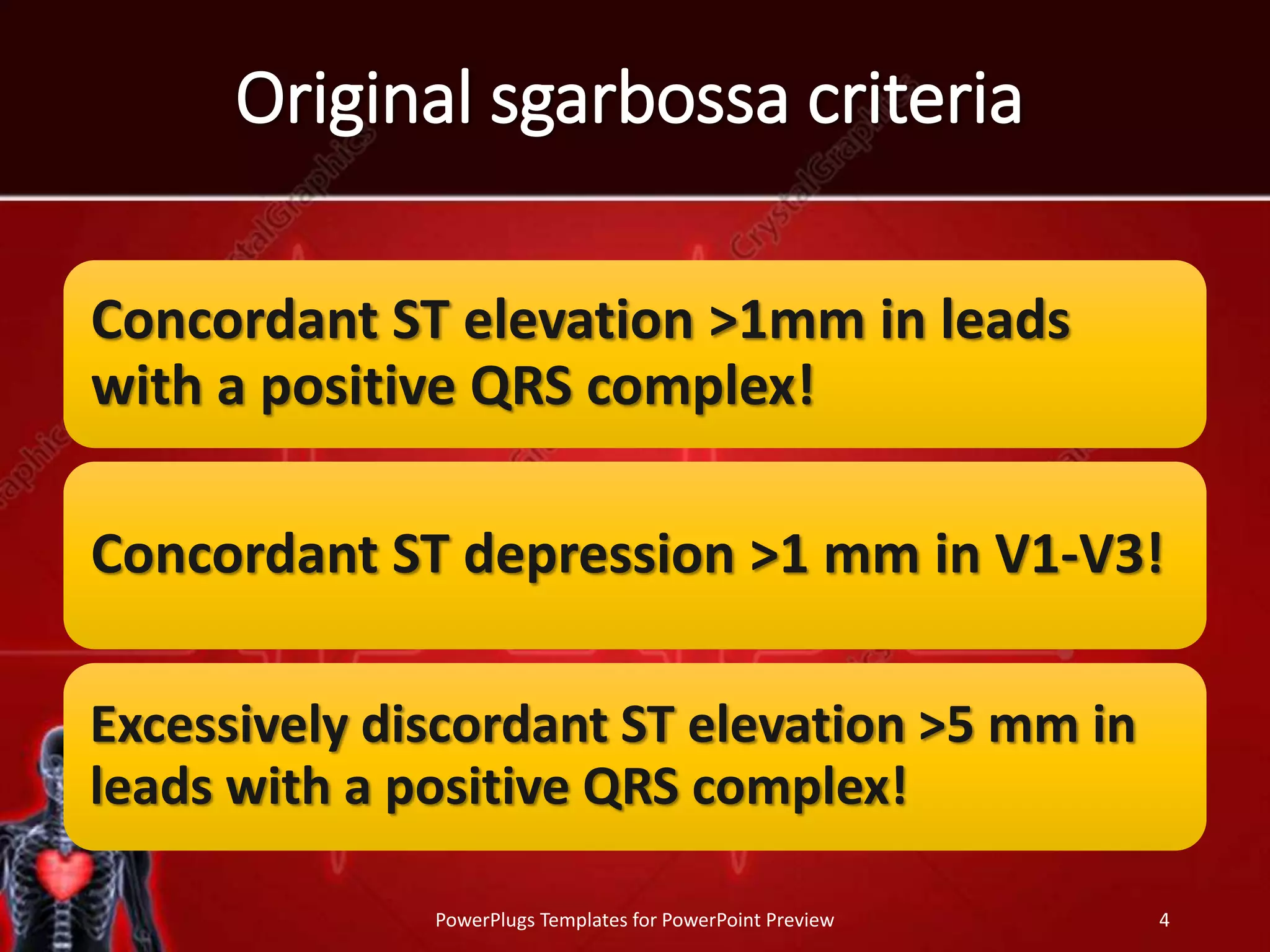
Original sgarbossa criteria
Concordant ST elevation >1mm in leads
with a positive QRS complex!
Concordant ST depression >1 mm in V1-V3!
Excessively discordant ST elevation >5 mm in
leads with a positive QRS complex!
PowerPlugs Templates for PowerPoint Preview 4
Original sgarbossa criteria
ECGMedicalTraining.com 5
Concordant ST elevation >1mm
in leads with a positive QRS complex!
Excessively discordant ST elevation >5 mm
in leads with a positive QRS complex!
Concordant ST depression
>1 mm in V1-V3!
Modified Sgarbossa criteria
≥1 lead with ≥1 mm of concordant ST
elevation
≥1 lead of V1-V3 with ≥1 mm of concordant ST
depression
≥1 lead anywhere with ≥1 mm ST elevation and
proportionally excessive discordant ST elevation
(≥ 25% of the depth of the preceding S-wave)
PowerPlugs Templates for PowerPoint Preview 6
STEMI
Burns E. STEMI. Lifeinthefastlane.com
PowerPlugs Templates for PowerPoint Preview 7
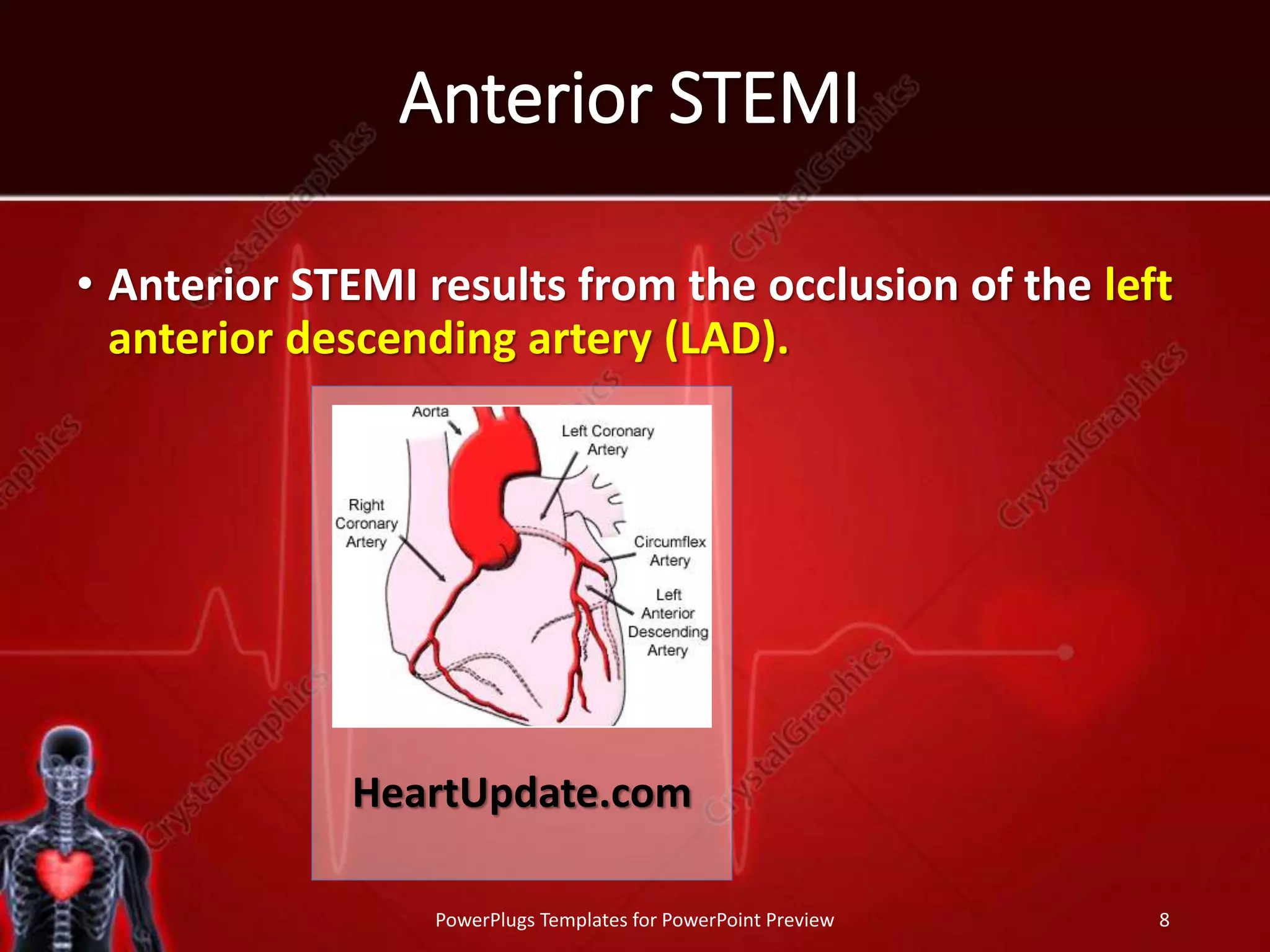
Anterior STEMI
• Anterior STEMI results from the occlusion of the left
anterior descending artery (LAD).
PowerPlugs Templates for PowerPoint Preview 8
HeartUpdate.com
Anterior STEMI
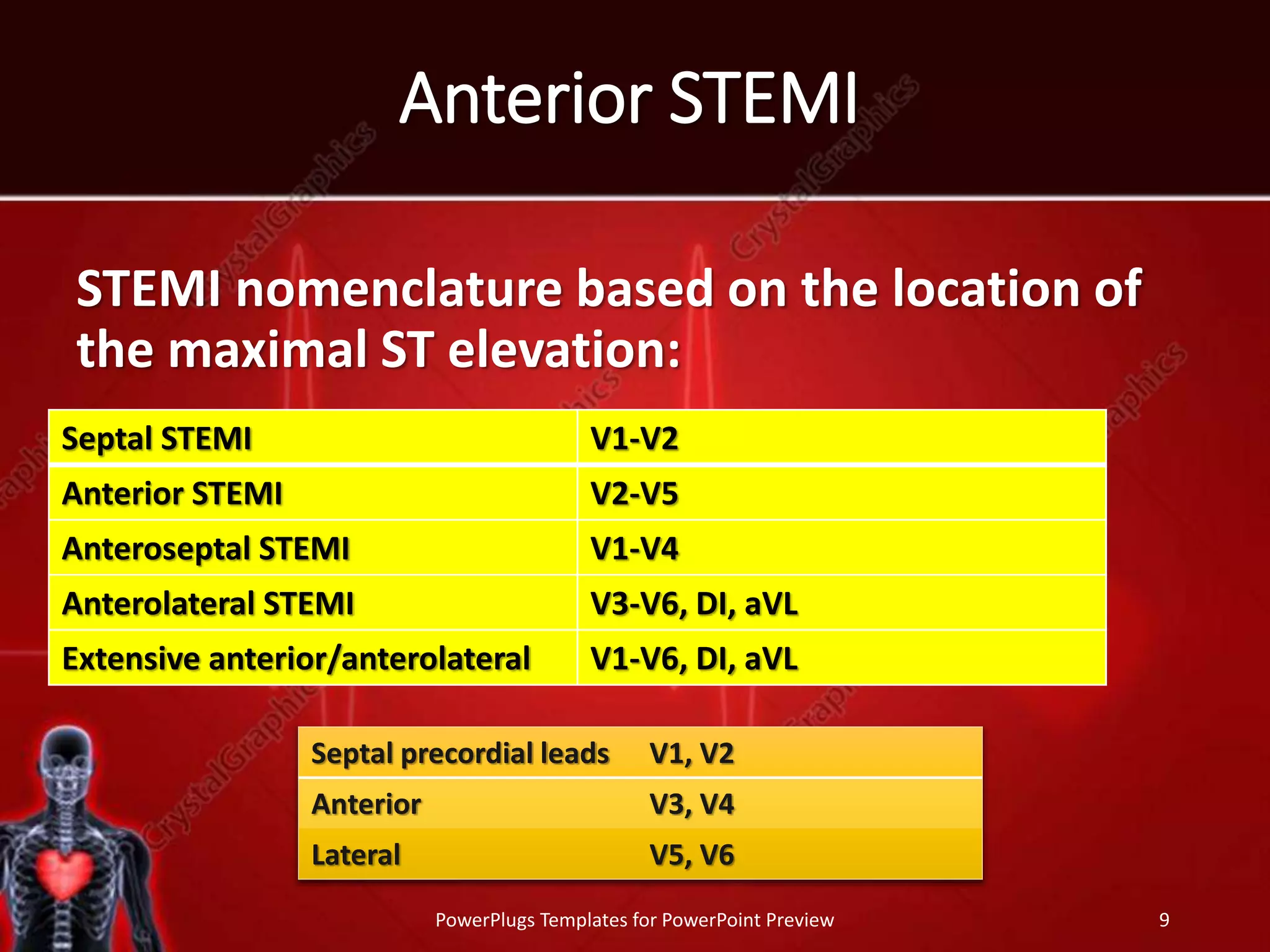
STEMI nomenclature based on the location of
the maximal ST elevation:
PowerPlugs Templates for PowerPoint Preview 9
Septal STEMI V1-V2
Anterior STEMI V2-V5
Anteroseptal STEMI V1-V4
Anterolateral STEMI V3-V6, DI, aVL
Extensive anterior/anterolateral V1-V6, DI, aVL
Septal precordial leads V1, V2
Anterior V3, V4
Lateral V5, V6
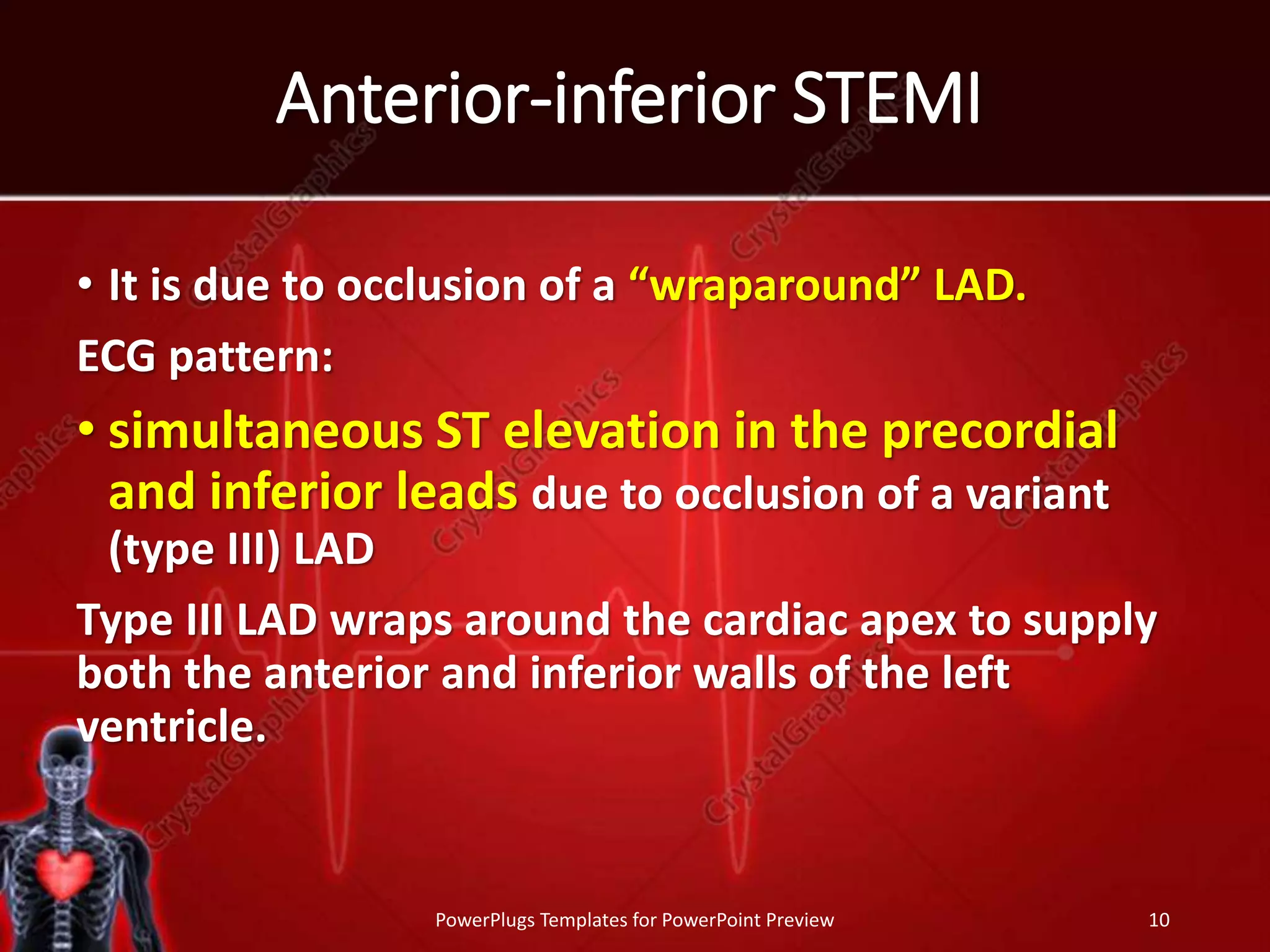
Anterior-inferior STEMI
• It is due to occlusion of a “wraparound” LAD.
ECG pattern:
• simultaneous ST elevation in the precordial
and inferior leads due to occlusion of a variant
(type III) LAD
Type III LAD wraps around the cardiac apex to supply
both the anterior and inferior walls of the left
ventricle.
PowerPlugs Templates for PowerPoint Preview 10
Anterior-inferior STEMI
PowerPlugs Templates for PowerPoint Preview 11
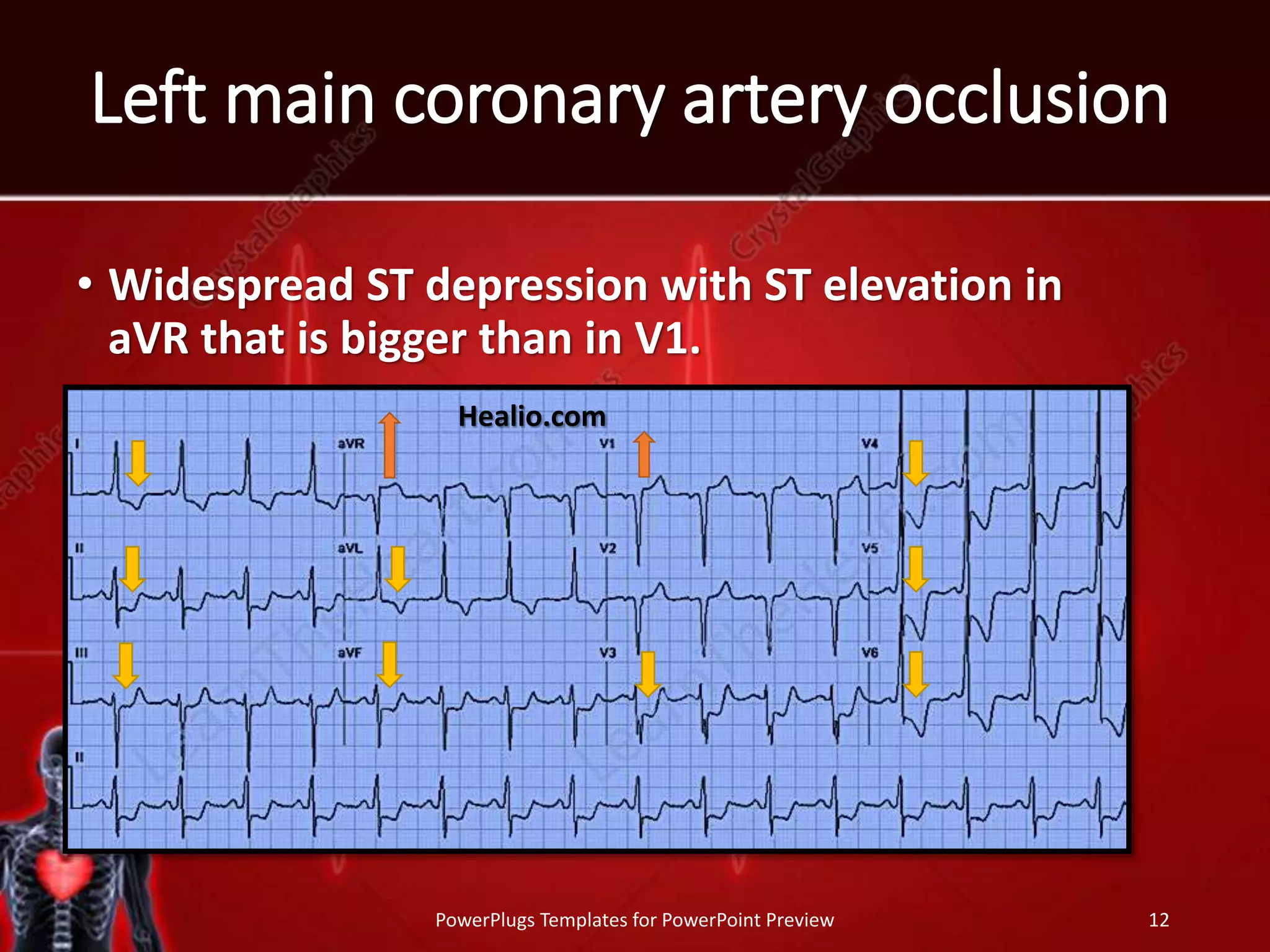
Left main coronary artery occlusion
• Widespread ST depression with ST elevation in
aVR that is bigger than in V1.
PowerPlugs Templates for PowerPoint Preview 12
Healio.com
High lateral STEMI
ST elevation
primarily
localized to
leads DI and
aVL is
referred to
as a high
lateral
STEMI.
It is usually
associated
with
reciprocal ST
depression
and T wave
inversion in
the inferior
leads (DII,
DIII and
aVF).
Occlusion of
the first
diagonal
branch (D1)
of the left
anterior
descending
artery (LAD)
may produce
isolated ST
elevation in
DI and aVL.
Occlusion of
the
circumflex
artery may
cause ST
elevation in
DI, aVL along
with leads
V5-V6.
PowerPlugs Templates for PowerPoint Preview 13
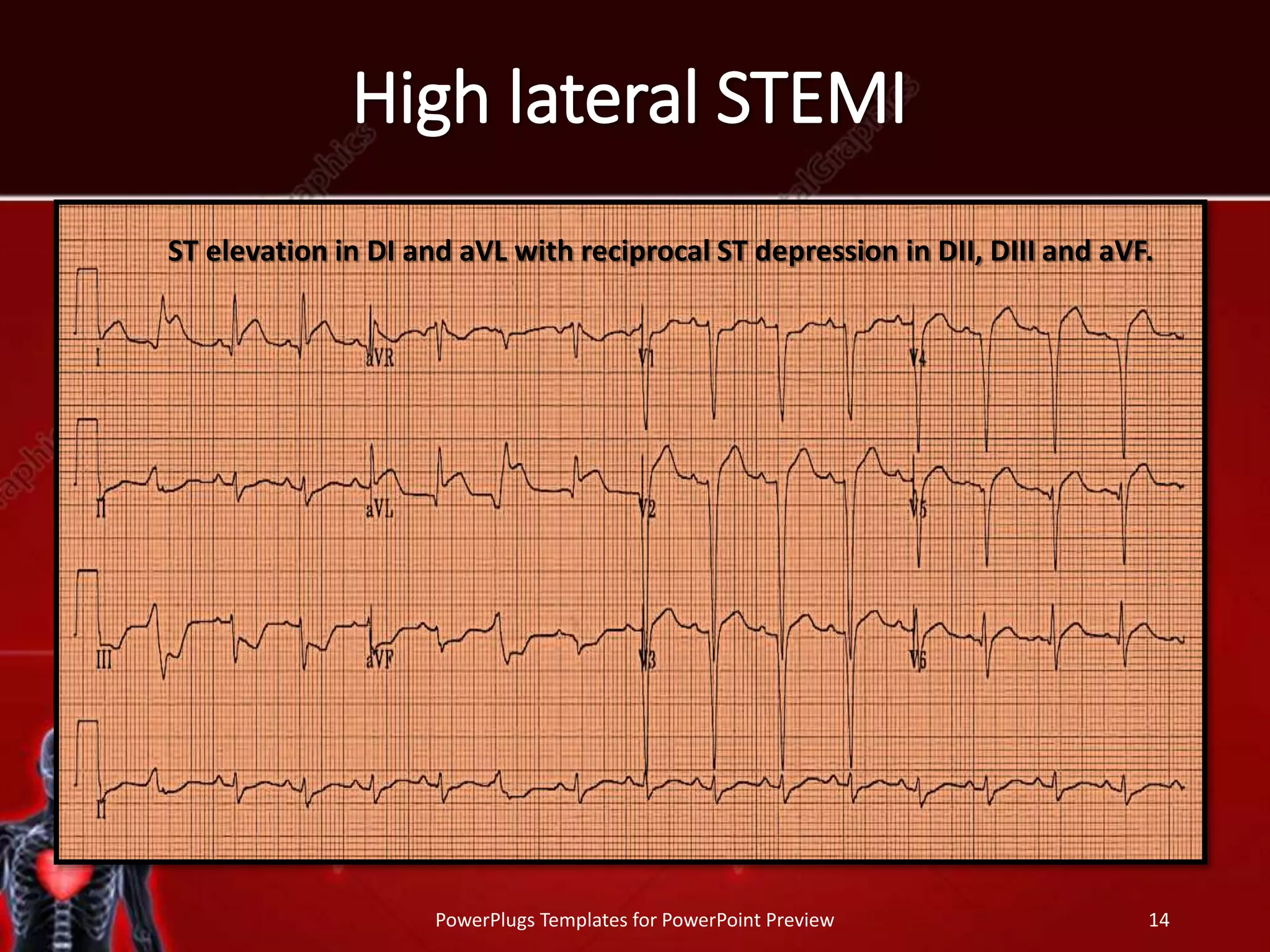
High lateral STEMI
PowerPlugs Templates for PowerPoint Preview 14
ST elevation in DI and aVL with reciprocal ST depression in DII, DIII and aVF.
Inferior STEMI
40-50% of all myocardial infarctions!
Up to 40% of patients with an inferior STEMI will have a
concomitant right ventricular infarction.
Up to 20% of patients with inferior STEMI will develop
significant bradycardia due to II. or III. AV block.
Inferior STEMI may also be associated with posterior
infarction with worse prognosis.
PowerPlugs Templates for PowerPoint Preview 15
Inferior STEMI
ST elevation in leads DII,
DIII and aVF!
Progressive development of Q
waves in DII, DIII and aVF!
Reciprocal ST depression in
aVL (± lead DI)!
PowerPlugs Templates for PowerPoint Preview 16
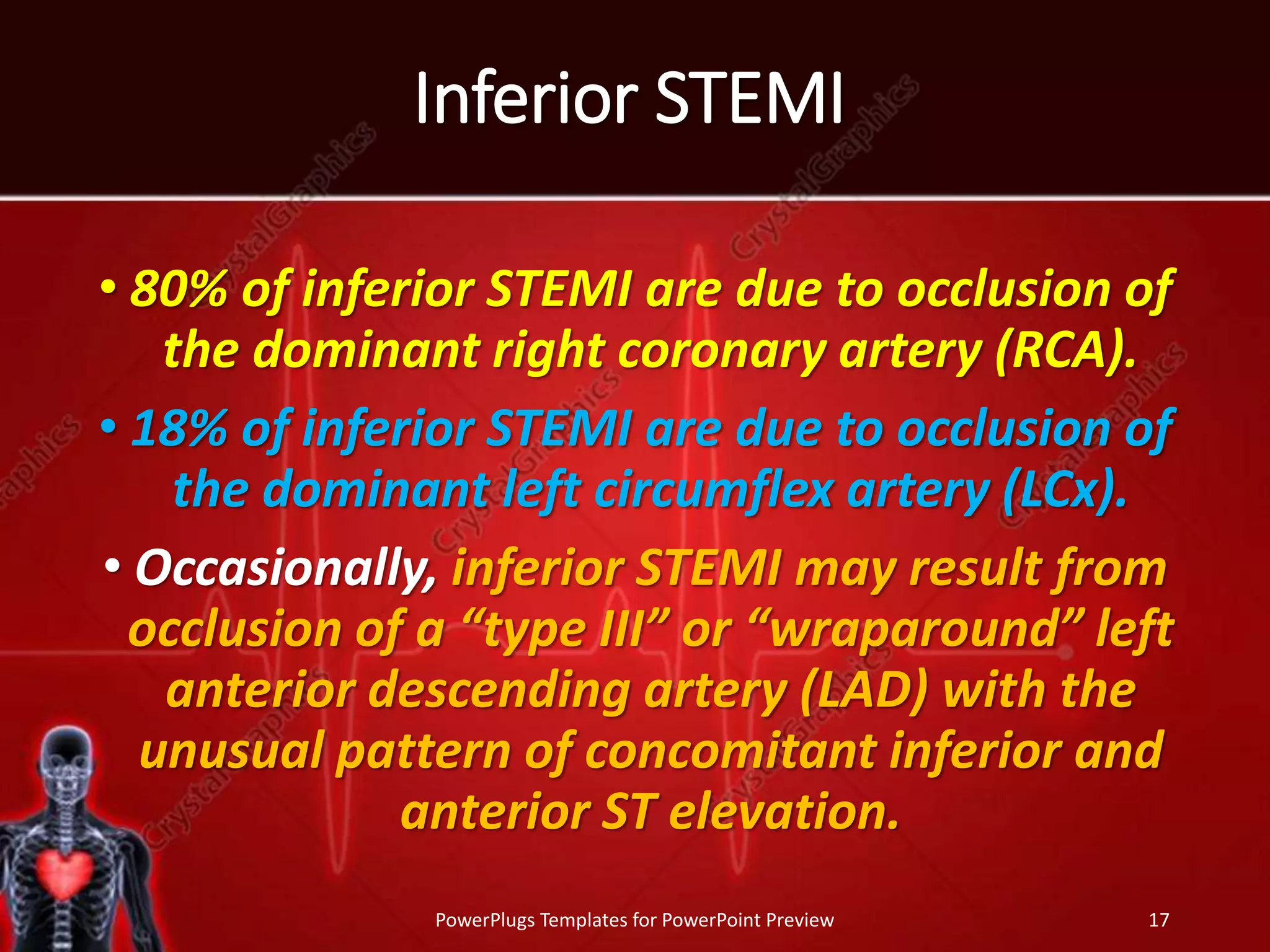
Inferior STEMI
• 80% of inferior STEMI are due to occlusion of
the dominant right coronary artery (RCA).
• 18% of inferior STEMI are due to occlusion of
the dominant left circumflex artery (LCx).
• Occasionally, inferior STEMI may result from
occlusion of a “type III” or “wraparound” left
anterior descending artery (LAD) with the
unusual pattern of concomitant inferior and
anterior ST elevation.
PowerPlugs Templates for PowerPoint Preview 17
Inferior STEMI
PowerPlugs Templates for PowerPoint Preview 18
ST elevation in DII, DIII and aVF with reciprocal ST depression in aVL.
Lateral STEMI
• The lateral wall of the LV is supplied by branches of
the left anterior descending (LAD) and left circumflex
(LCx) arteries.
• Infarction of the lateral wall usually occurs as part of
a larger territory infarction-anterolateral STEMI.
• Isolated lateral STEMI is less common, but may be
produced by occlusion of smaller branch arteries that
supply the lateral wall: the first diagonal branch (D1)
of the LAD, the obtuse marginal branch (OM) of the
LCx or the ramus intermedius.
PowerPlugs Templates for PowerPoint Preview 19
Lateral STEMI
ST elevation in the lateral
leads (DI, aVL, V5-V6).
Reciprocal ST depression in the
inferior leads (DIII and aVF).
PowerPlugs Templates for PowerPoint Preview 20
ST elevation in DI and aVL, subtle ST elevation with hyperacute T
waves in V5 and V6, reciprocal ST depression in DIII and aVF.
PowerPlugs Templates for PowerPoint Preview 21
Posterior STEMI
•Posterior infarction accompanies 15-20%
of STEMIs, usually occurring in the
context of an inferior or lateral
infarction.
•Isolated posterior myocardial infarction
is less common (3-11% of infarcts).
PowerPlugs Templates for PowerPoint Preview 22
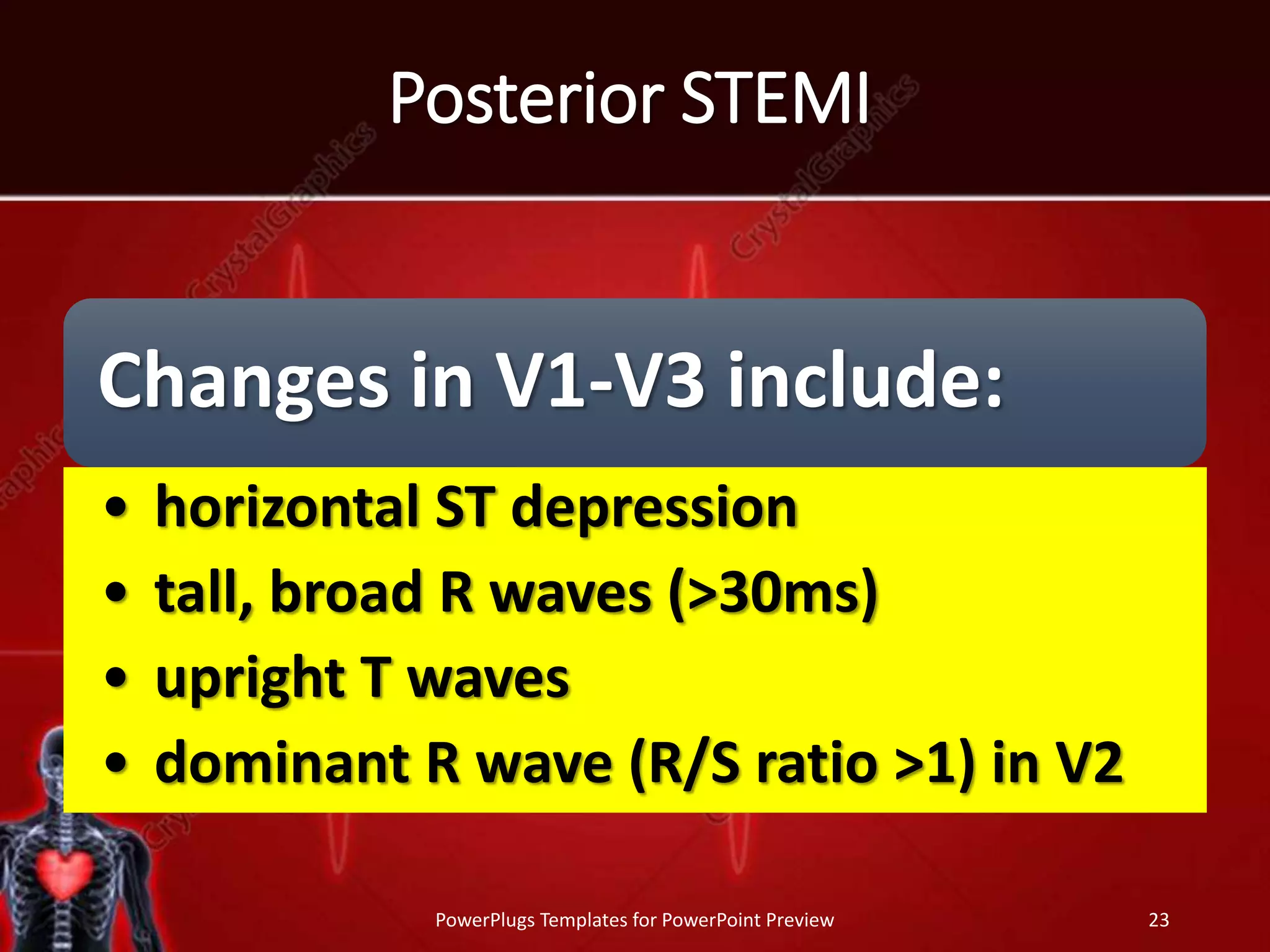
Posterior STEMI
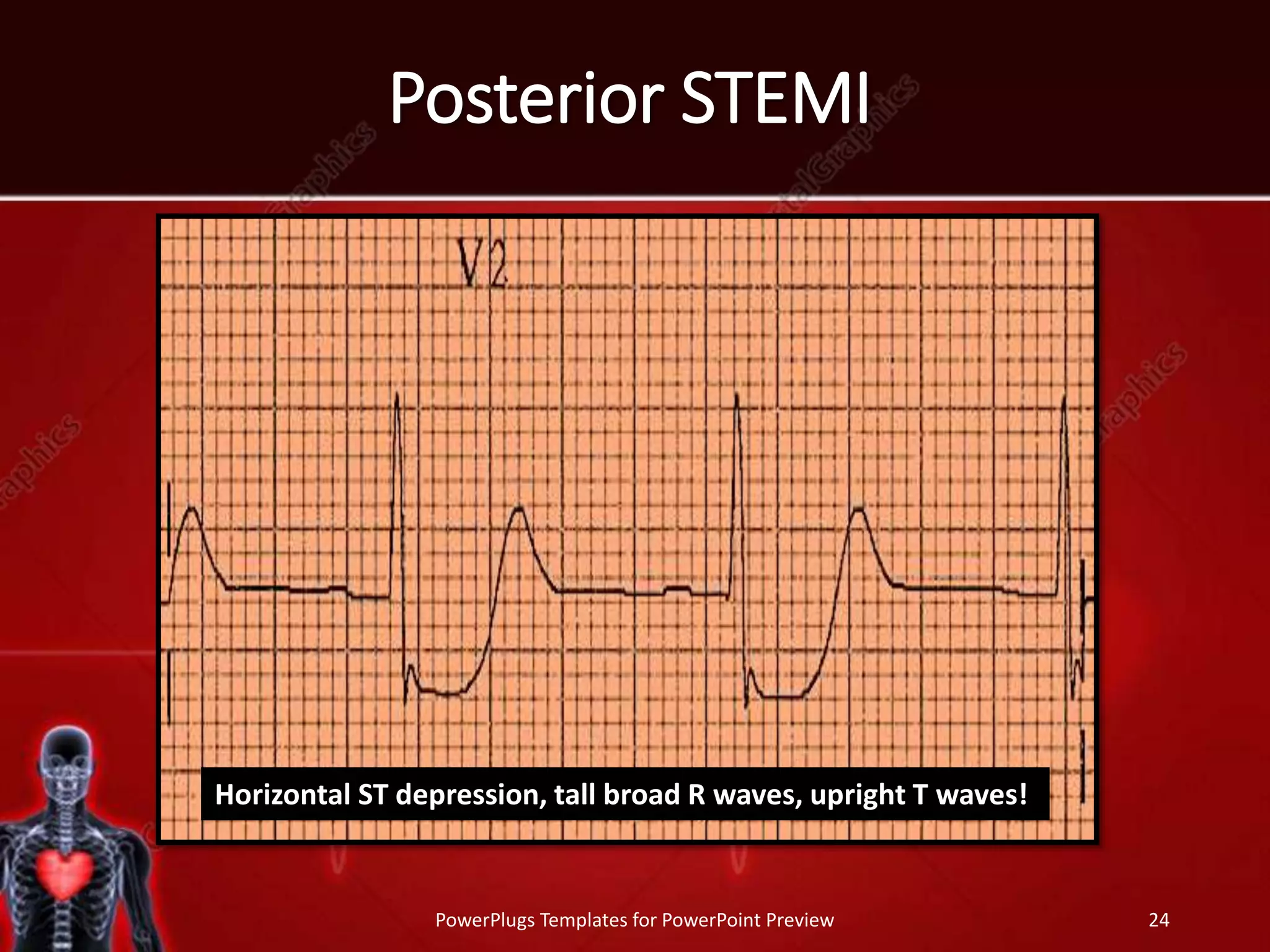
Changes in V1-V3 include:
• horizontal ST depression
• tall, broad R waves (>30ms)
• upright T waves
• dominant R wave (R/S ratio >1) in V2
PowerPlugs Templates for PowerPoint Preview 23
Posterior STEMI
PowerPlugs Templates for PowerPoint Preview 24
Horizontal ST depression, tall broad R waves, upright T waves!
Right STEMI
PowerPlugs Templates for PowerPoint Preview 25
Right STEMI
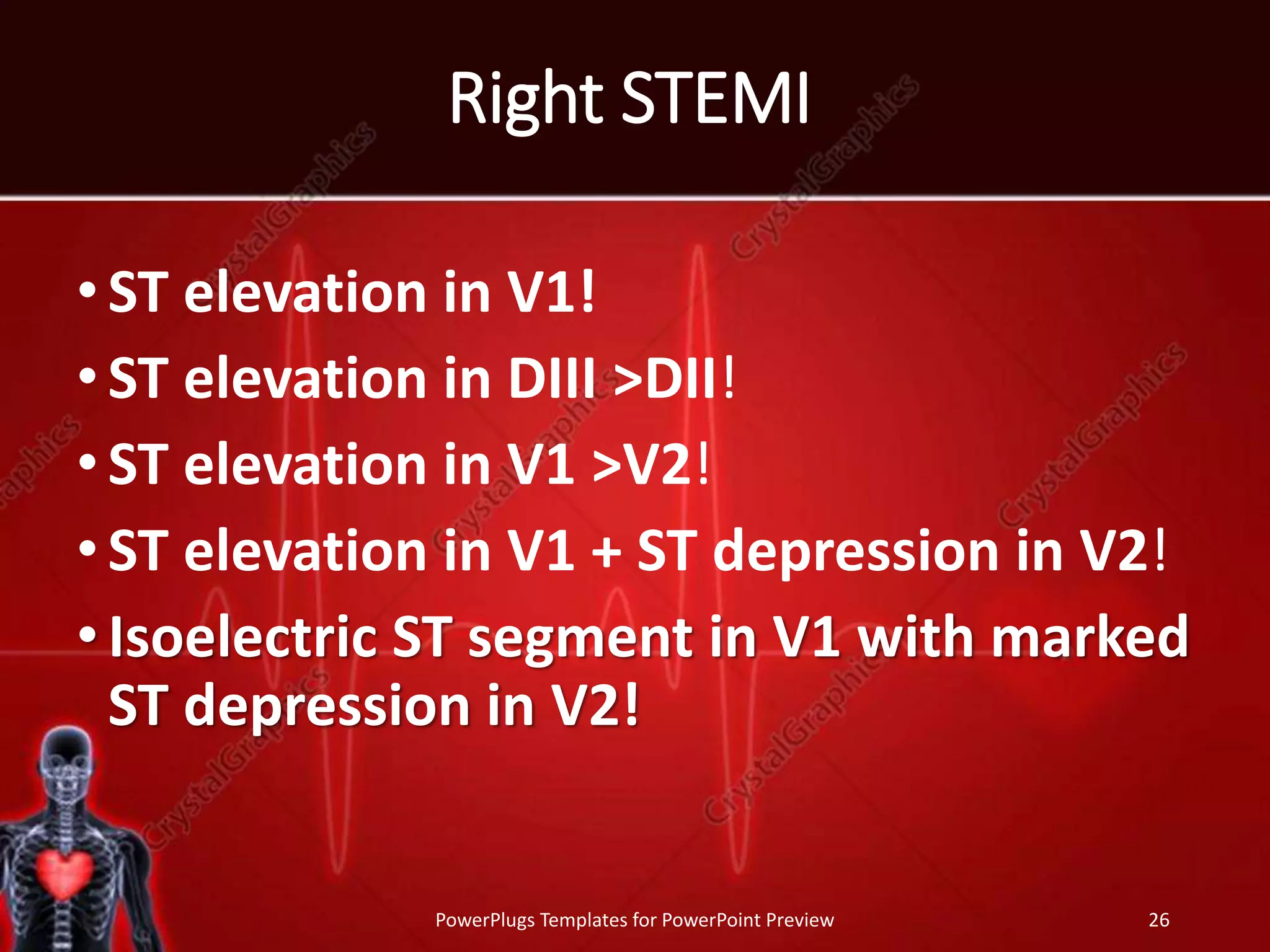
•ST elevation in V1!
•ST elevation in DIII >DII!
•ST elevation in V1 >V2!
•ST elevation in V1 + ST depression in V2!
•Isoelectric ST segment in V1 with marked
ST depression in V2!
PowerPlugs Templates for PowerPoint Preview 26
Right STEMI
PowerPlugs Templates for PowerPoint Preview 27
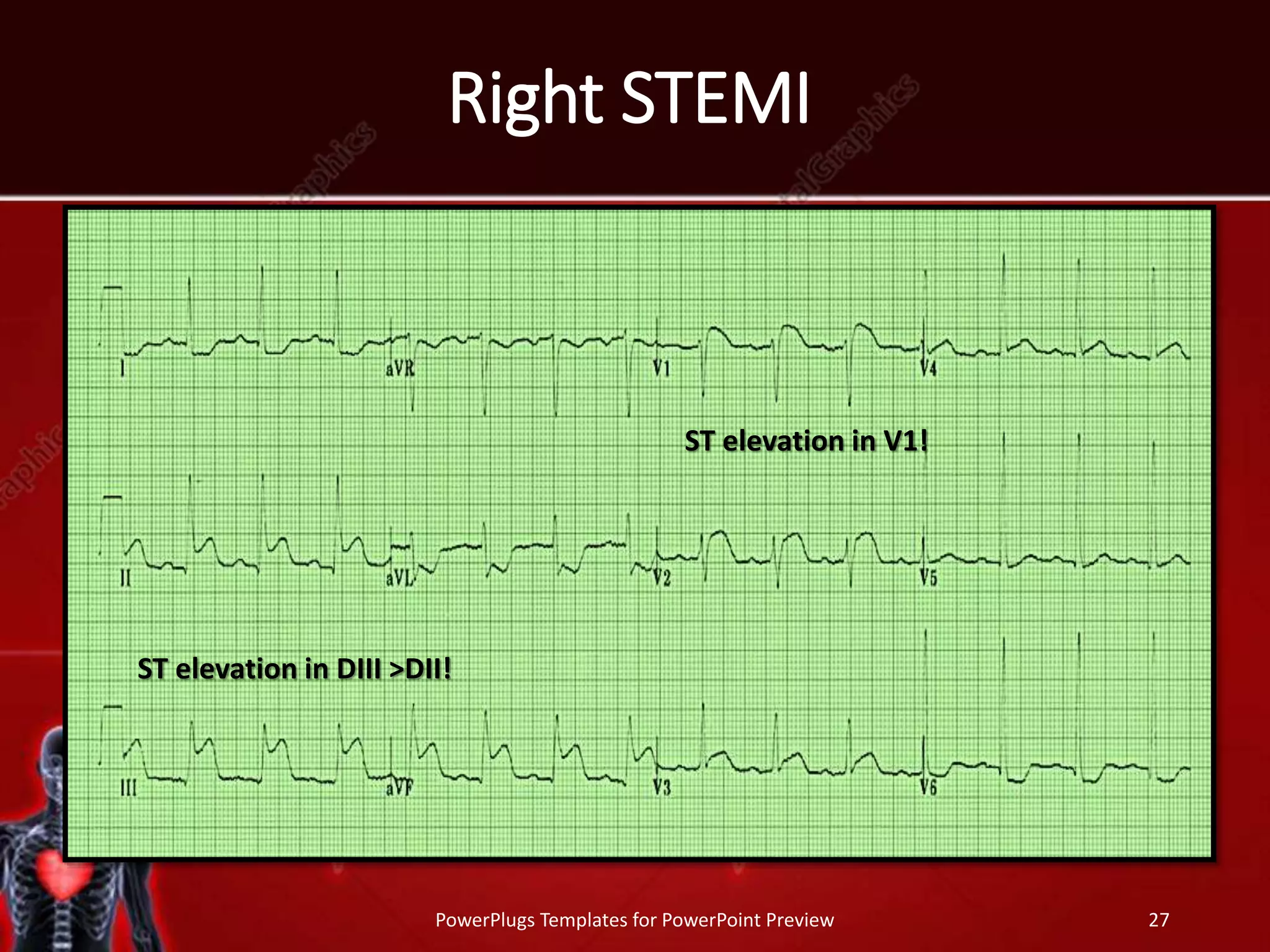
ST elevation in DIII >DII!
ST elevation in V1!
PowerPlugs Templates for PowerPoint Preview 28

ECG S

  • 1.
  • 2.
    Sgarbossa criteria Burns E.Sgarbossa Criteria (November 15, 2017). Retrieved from https://lifeinthefastlane.com/ecg-library/basics/sgarbossa/ PowerPlugs Templates for PowerPoint Preview 2
  • 3.
    In patients withleft bundle branch block (LBBB) or ventricular paced rhythm, infarct diagnosis based on the ECG is difficult. The baseline ST segments and T waves tend to be shifted in a discordant direction (appropriate discordance), which can mask or mimic acute myocardial infarction. Sgarbossa criteria
  • 4.
    Original sgarbossa criteria ConcordantST elevation >1mm in leads with a positive QRS complex! Concordant ST depression >1 mm in V1-V3! Excessively discordant ST elevation >5 mm in leads with a positive QRS complex! PowerPlugs Templates for PowerPoint Preview 4
  • 5.
    Original sgarbossa criteria ECGMedicalTraining.com5 Concordant ST elevation >1mm in leads with a positive QRS complex! Excessively discordant ST elevation >5 mm in leads with a positive QRS complex! Concordant ST depression >1 mm in V1-V3!
  • 6.
    Modified Sgarbossa criteria ≥1lead with ≥1 mm of concordant ST elevation ≥1 lead of V1-V3 with ≥1 mm of concordant ST depression ≥1 lead anywhere with ≥1 mm ST elevation and proportionally excessive discordant ST elevation (≥ 25% of the depth of the preceding S-wave) PowerPlugs Templates for PowerPoint Preview 6
  • 7.
    STEMI Burns E. STEMI.Lifeinthefastlane.com PowerPlugs Templates for PowerPoint Preview 7
  • 8.
    Anterior STEMI • AnteriorSTEMI results from the occlusion of the left anterior descending artery (LAD). PowerPlugs Templates for PowerPoint Preview 8 HeartUpdate.com
  • 9.
    Anterior STEMI STEMI nomenclaturebased on the location of the maximal ST elevation: PowerPlugs Templates for PowerPoint Preview 9 Septal STEMI V1-V2 Anterior STEMI V2-V5 Anteroseptal STEMI V1-V4 Anterolateral STEMI V3-V6, DI, aVL Extensive anterior/anterolateral V1-V6, DI, aVL Septal precordial leads V1, V2 Anterior V3, V4 Lateral V5, V6
  • 10.
    Anterior-inferior STEMI • Itis due to occlusion of a “wraparound” LAD. ECG pattern: • simultaneous ST elevation in the precordial and inferior leads due to occlusion of a variant (type III) LAD Type III LAD wraps around the cardiac apex to supply both the anterior and inferior walls of the left ventricle. PowerPlugs Templates for PowerPoint Preview 10
  • 11.
  • 12.
    Left main coronaryartery occlusion • Widespread ST depression with ST elevation in aVR that is bigger than in V1. PowerPlugs Templates for PowerPoint Preview 12 Healio.com
  • 13.
    High lateral STEMI STelevation primarily localized to leads DI and aVL is referred to as a high lateral STEMI. It is usually associated with reciprocal ST depression and T wave inversion in the inferior leads (DII, DIII and aVF). Occlusion of the first diagonal branch (D1) of the left anterior descending artery (LAD) may produce isolated ST elevation in DI and aVL. Occlusion of the circumflex artery may cause ST elevation in DI, aVL along with leads V5-V6. PowerPlugs Templates for PowerPoint Preview 13
  • 14.
    High lateral STEMI PowerPlugsTemplates for PowerPoint Preview 14 ST elevation in DI and aVL with reciprocal ST depression in DII, DIII and aVF.
  • 15.
    Inferior STEMI 40-50% ofall myocardial infarctions! Up to 40% of patients with an inferior STEMI will have a concomitant right ventricular infarction. Up to 20% of patients with inferior STEMI will develop significant bradycardia due to II. or III. AV block. Inferior STEMI may also be associated with posterior infarction with worse prognosis. PowerPlugs Templates for PowerPoint Preview 15
  • 16.
    Inferior STEMI ST elevationin leads DII, DIII and aVF! Progressive development of Q waves in DII, DIII and aVF! Reciprocal ST depression in aVL (± lead DI)! PowerPlugs Templates for PowerPoint Preview 16
  • 17.
    Inferior STEMI • 80%of inferior STEMI are due to occlusion of the dominant right coronary artery (RCA). • 18% of inferior STEMI are due to occlusion of the dominant left circumflex artery (LCx). • Occasionally, inferior STEMI may result from occlusion of a “type III” or “wraparound” left anterior descending artery (LAD) with the unusual pattern of concomitant inferior and anterior ST elevation. PowerPlugs Templates for PowerPoint Preview 17
  • 18.
    Inferior STEMI PowerPlugs Templatesfor PowerPoint Preview 18 ST elevation in DII, DIII and aVF with reciprocal ST depression in aVL.
  • 19.
    Lateral STEMI • Thelateral wall of the LV is supplied by branches of the left anterior descending (LAD) and left circumflex (LCx) arteries. • Infarction of the lateral wall usually occurs as part of a larger territory infarction-anterolateral STEMI. • Isolated lateral STEMI is less common, but may be produced by occlusion of smaller branch arteries that supply the lateral wall: the first diagonal branch (D1) of the LAD, the obtuse marginal branch (OM) of the LCx or the ramus intermedius. PowerPlugs Templates for PowerPoint Preview 19
  • 20.
    Lateral STEMI ST elevationin the lateral leads (DI, aVL, V5-V6). Reciprocal ST depression in the inferior leads (DIII and aVF). PowerPlugs Templates for PowerPoint Preview 20
  • 21.
    ST elevation inDI and aVL, subtle ST elevation with hyperacute T waves in V5 and V6, reciprocal ST depression in DIII and aVF. PowerPlugs Templates for PowerPoint Preview 21
  • 22.
    Posterior STEMI •Posterior infarctionaccompanies 15-20% of STEMIs, usually occurring in the context of an inferior or lateral infarction. •Isolated posterior myocardial infarction is less common (3-11% of infarcts). PowerPlugs Templates for PowerPoint Preview 22
  • 23.
    Posterior STEMI Changes inV1-V3 include: • horizontal ST depression • tall, broad R waves (>30ms) • upright T waves • dominant R wave (R/S ratio >1) in V2 PowerPlugs Templates for PowerPoint Preview 23
  • 24.
    Posterior STEMI PowerPlugs Templatesfor PowerPoint Preview 24 Horizontal ST depression, tall broad R waves, upright T waves!
  • 25.
    Right STEMI PowerPlugs Templatesfor PowerPoint Preview 25
  • 26.
    Right STEMI •ST elevationin V1! •ST elevation in DIII >DII! •ST elevation in V1 >V2! •ST elevation in V1 + ST depression in V2! •Isoelectric ST segment in V1 with marked ST depression in V2! PowerPlugs Templates for PowerPoint Preview 26
  • 27.
    Right STEMI PowerPlugs Templatesfor PowerPoint Preview 27 ST elevation in DIII >DII! ST elevation in V1!
  • 28.
    PowerPlugs Templates forPowerPoint Preview 28