Physiology of memory and emotions  &  the limbic system  Prof. Vajira Weerasinghe Dept of Physiology, Faculty of Medicine, University of Peradeniya
Terminology  Cognition  Memory  Learning Speech and communication  Emotions  etc
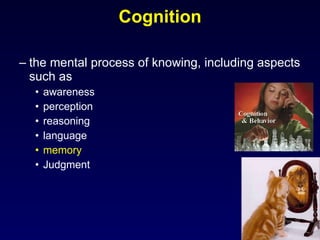
Cognition the mental process of knowing, including aspects such as  awareness  perception  reasoning  language  memory Judgment
Emotions  a conscious mental reaction (as anger or fear)  subjectively experienced as strong feeling usually directed toward a specific object  and typically accompanied by physiological  and behavioral changes in the body  eg.  happiness anger love confidence anxiety stress relaxed
Physiology of memory
Answer following questions? Did you drink tea at breakfast? Can a rabbit play golf? Who sang the song “This land belongs to you” What South American country begins with S? How many eggs are in a dozen? What is Julius Caesar’s telephone number? Is welderly an English word? Do all birds fly?
memory highly organised there are ways to effectively and efficiently analyse, manipulate, search memory
Process of storing and retrieving information in the brain  This process is central to learning and thinking memory
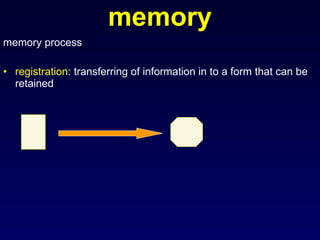
memory memory process registration : transferring of information in to a form that can be retained
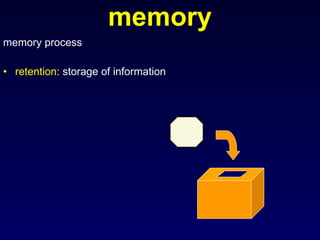
memory memory process retention : storage of information
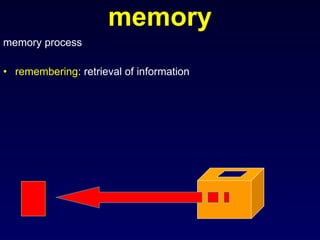
memory memory process remembering : retrieval of information
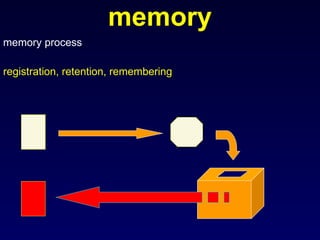
memory memory process registration, retention, remembering
memory There are four different types of remembering: recollection recall recognition relearning
memory There are four different types of remembering: recollection : the reconstruction of events or facts on the basis of partial cues recall : the active and unaided remembering of something from the past recognition : the ability to identify previously encountered information as familiar relearning : the ability to learn once familiar material more easily than unfamiliar material
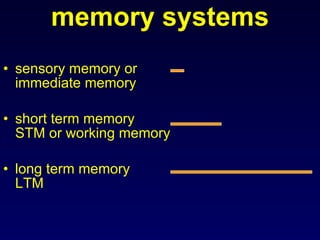
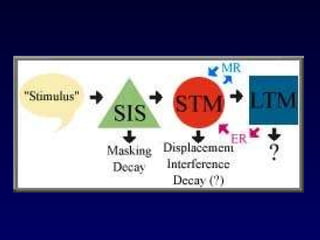
memory systems sensory memory or immediate memory short term memory STM or working memory long term memory LTM
sensory memory or immediate memory lasting few sec (less than 2 sec) act as buffers for stimuli received through senses if ignored -> forgotten If attention is paid -> passed into STM visual sensory memory is more commonly referred to as iconic memory  auditory sensory memory is known as echoic memory
short term memory Known as primary, working or active memory Stores a limited amount of information for about 30 sec  Contain recently processed sensory input or items recently retrieved from LTM  With rehearsal can be kept for several min acts as a scratch-pad for temporary recall of the information  Has a limited capacity. Capacity is about 7 items ± 2 (memory span)  By chunking can remember more items (eg. phone numbers)
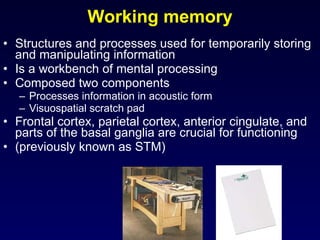
Working memory Structures and processes used for temporarily storing and manipulating information Is a workbench of mental processing Composed two components Processes information in acoustic form Visuospatial scratch pad Frontal cortex, parietal cortex, anterior cingulate, and parts of the basal ganglia are crucial for functioning (previously known as STM)
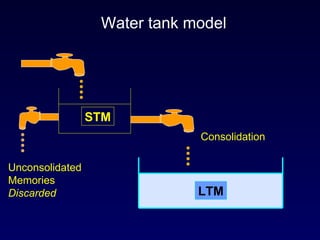
long term memory lasting days, months, yrs Long-term memory can store a very large quantity of information and  can maintain that information for very long periods of time It holds many different kinds of information including: facts, events, motor and perceptual skills,  knowledge of physical laws,  spatial models of familiar environments, attitudes and beliefs about ourselves and others Long term potentiation moves STM to LTM
Unconsolidated Memories Discarded Consolidation Water tank model STM LTM
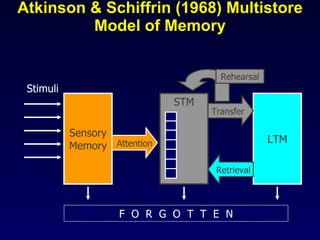
Atkinson & Schiffrin (1968) Multistore Model of Memory Sensory Memory LTM STM Stimuli Attention Transfer Retrieval Rehearsal F  O  R  G  O  T  T  E  N
 
forgetting
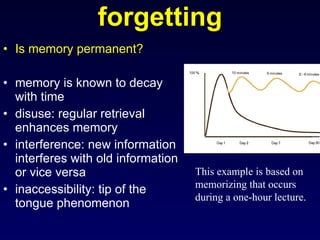
forgetting Is memory permanent? memory is known to decay with time disuse: regular retrieval enhances memory interference: new information interferes with old information or vice versa inaccessibility: tip of the tongue phenomenon This example is based on memorizing that occurs during a one-hour lecture.
Further types of memory  Explicit memory Implicit memory
memories from events that have occurred in the external world  facts and events if the process of remembering involves the conscious recollection of previous experiences Explicit Memory
Episodic memory refers to memory related to specific events and experiences in our life eg. first time a dog bites you Hippocampus and cortical areas may be involved Semantic memory refers to memory related to general or generic knowledge meaning of all words, symbols, rules, facts not tied to specific events eg. a child after seeing several dogs develop the concept of “dog” Hippocampus or widespread throughout the brain  Types of Explicit Memory
Consist of memories necessary to perform events and tasks, or to produce a specific type of response if the process of remembering  does not  involves the conscious recollection of previous experiences Implicit memory is best demonstrated when performance is improved on a task Implicit Memory
Procedural memory refers to memory related to knowledge concerning learning that is obtained incrementally and that is inaccessible to conscious recollection learning how to perform a task or acquire a new skill Motor cortical areas and cerebellum, basal ganglia may be involved Priming when subjects are exposed to a set of words and then later tested it is said to be primed and recall is easier Types of Implicit memory
Prospective memory ability to plan and remember to perform future tasks factors influencing cues, reminders, compliance, motivation, commitment Prospective memory can be further broken down into Event-based prospective memory triggered by cues, such as remembering to post a letter (action) after seeing a mailbox (cue). Time-based prospective memory triggered by a time-cue, such as going to the doctor (action) at 4pm (cue).  frontal lobe, prefrontal region and parietal cortex  may play a role is called “remembering to remember”
Emotional memory memory for events that evoke a particularly strong emotion  consciously available, but elicit a powerful, unconscious physiological reaction  Involves amygdala
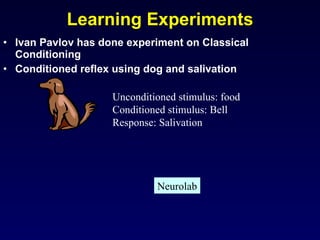
Learning Experiments Ivan Pavlov has done experiment on Classical Conditioning Conditioned reflex using dog and salivation Unconditioned stimulus: food Conditioned stimulus: Bell Response: Salivation Neurolab
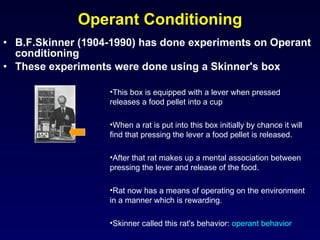
Operant Conditioning B.F.Skinner (1904-1990) has done experiments on Operant conditioning These experiments were done using a Skinner's box This box is equipped with a lever when pressed releases a food pellet into a cup When a rat is put into this box initially by chance it will find that pressing the lever a food pellet is released.  After that rat makes up a mental association between pressing the lever and release of the food.  Rat now has a means of operating on the environment in a manner which is rewarding. Skinner called this rat's behavior:  operant behavior
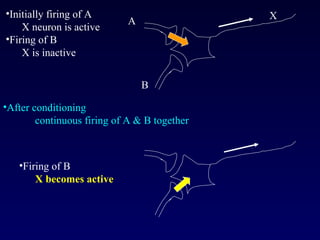
Synaptic strengthening Conditioning of synaptic activity  Hebb first theorised this " cells that fire together, wire together "  any two cells or systems of cells that are repeatedly active at the same time will tend to become 'associated', so that activity in one facilitates activity in the other
Initially firing of A X neuron is active Firing of B X is inactive After conditioning continuous firing of A & B together  Firing of B X becomes active A B X
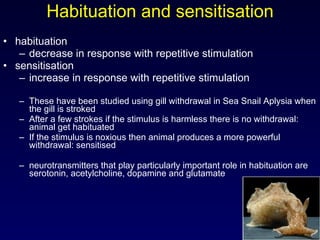
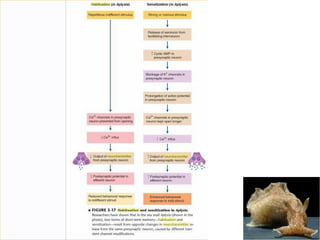
Habituation and sensitisation habituation  decrease in response with repetitive stimulation sensitisation  increase in response with repetitive stimulation These have been studied using gill withdrawal in Sea Snail Aplysia when the gill is stroked After a few strokes if the stimulus is harmless there is no withdrawal: animal get habituated If the stimulus is noxious then animal produces a more powerful withdrawal: sensitised neurotransmitters that play particularly important role in habituation are serotonin, acetylcholine, dopamine and glutamate
 
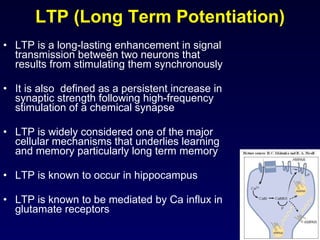
LTP is a long-lasting enhancement in signal transmission between two neurons that results from stimulating them synchronously It is also  defined as a persistent increase in synaptic strength following high-frequency stimulation of a chemical synapse LTP is widely considered one of the major cellular mechanisms that underlies learning and memory particularly long term memory LTP is known to occur in hippocampus LTP is known to be mediated by Ca influx in glutamate receptors LTP (Long Term Potentiation)
LTP mechanism Stimulation of presynaptic neuron Release of glutamate Binds to  AMPA receptor Na infux EPSP is created  NMDA receptor  Glutamate binds and open the ion gate EPSP will remove Mg2+ which blocks the NMDA receptor  Result is Ca2+ influx Second messenger system Upregulation of AMPA receptors  Release of retrograde paracrine substances (eg. NO) Long lasting EPSP
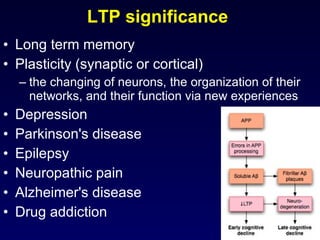
LTP significance  Long term memory  Plasticity (synaptic or cortical) the changing of neurons, the organization of their networks, and their function via new experiences Depression Parkinson's disease Epilepsy Neuropathic pain Alzheimer's disease  Drug addiction
NMDA receptor n Methyl d Aspartate receptor has a role in the memory processes occurring in hippocampal neurons NMDA receptor is both voltage gated and ligand gated NMDA receptor activity causes Ca2+ influx which is an important mechanism of LTP
NMDA receptor modulators Glutamate or aspartate (less effective) binds  Glycine biding is also necessary Mg2+ blocks Membrane depolarisation Antagonists Anaesthetics, alcohol, ketamine
limbic system (hippocampus, amygdala) thalamus frontal lobe interconnections brain areas responsible for memory
History 1980s: James and Lange developed a theory of emotion stating that emotional experience was nothing more than conscious awareness of  autonomic activity  in the body 1920s: Cannon and Bard proposed an alternative theory of emotion which held that portions of the brain, the  hypothalamus  and  thalamus ,mediated emotion 1937:  Papez  proposed that the  limbic system , a ring of primitive cortex was the critical brain system mediating emotion 20th century: Papez’s conception of the limbic system was expanded to include a number of additional brain areas which are interconnected with the ring of primitive cortex, eg.  amygdala
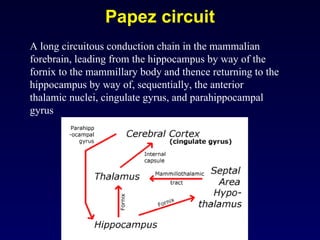
Papez circuit A long circuitous conduction chain in the mammalian forebrain, leading from the hippocampus by way of the fornix to the mammillary body and thence returning to the hippocampus by way of, sequentially, the anterior thalamic nuclei, cingulate gyrus, and parahippocampal gyrus
 
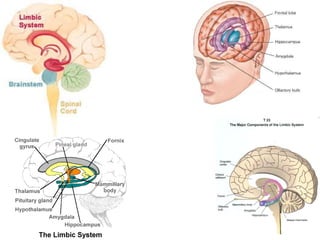
limbic system nuclei amygdala septal nuclei mammillary body hypothalamus cortical areas hippocampal gyrus cingulate gyrus dentate gyrus entorhinal, amygdaloid cortex paralimbic structures orbital gyrus, insula, nucelus accumbens, thalamic nuclei, superior temporal gyrus,  fibre tracts: fornix, medial forebrain bundle
limbic cortex consist of 3 layered cortex (in contrast to 6 layered cortex of the neocortex)
Limbic system is a link between the brain stem and neocortex Limbic structures are connected to each other and with the association cortex and the brain stem
Medial forebrain bundle is a major efferent connection of the limbic system:  projected to the hypothalamus, reticular formation. Influence on autonomic and endocrine activity Amygdala receives inputs from olfactory pathways Connections with the neocortex provide a synthesis of emotional and rational thought
Functions Limbic system is also referred to as the ‘emotional brain’ Emotional (include motor activity) Behavioural (Motivations, Drives: appetite, thirst, sexual behaviour, Reward system) Memory Utilizes the hypothalamus to effect the physical manifestations associated with emotions, etc.
Complex role of the limbic system as an intermediary between external events  (carried to the CNS via afferents) our  processing  of those events (involving cortical and subcortical brain areas)  our  responses  to those events (both behavioral and autonomic)
Role in memory storage Working memory—short term  cortical phenomenon Explicit (declarative)—factual knowledge temporal events, stored in  hippocampus Examples: what innervates biceps femoris m.? Implicit (procedural)—learned skills unconsciously recalled—includes emotional responses—stored in  amygdala   (at least in part) Examples: writing, playing a musical instrument
Hippocampus is a part of the brain located inside the temporal lobe plays a major role memory consolidation  responsible for spatial memory might act as a  cognitive map  — a neural representation of the layout of the environment.  In Alzheimer's disease, the hippocampus becomes one of the first regions of the brain to suffer damage
Physiology of emotions
 
Physiology of emotions  Within the limbic system, emotional impulses originate in the amygdala A network of neural pathways connect the amygdala to the neocortex, the "thinking brain," allowing us to reflect on our feelings and to think before acting In times of perceived crisis, however, those pathways are bypassed and impulse overrides reason and the amygdala takes over the brain
Physiology of emotions  Each emotion sparks a distinctive physiological reaction Happiness cues the brain to suppress worrisome or negative feelings and increases the body’s energy level  Sadness does the opposite, slowing down its metabolism Anger floods the brain with catecholamines *Stress and *anxiety set off the nervous system’s "flight-or-fight" response
Neurotransmitters released Ach Dopamine Endorphines GABA Glutamate Norepinephrine Serotonin
Limbic system Amygdala Involved in aggression, jealousy, and  fear ;  Cingulate gyrus Autonomic functions regulating heart rate and blood pressure as well as cognitive and attentional processing;  Fornicate gyrus Region encompassing the cingulate , hippocampus , and parahippocampal gyrus;  Hippocampus Required for the formation of long-term  memories ;  Hypothalamus Regulates the autonomic nervous system via hormone production and release. Affects and regulates blood pressure, heart rate, hunger, thirst, sexual arousal, and the sleep/wake cycle;
Limbic system Mammillary body Important for the formation of memory;  Nucleus accumbens Involved in reward,  pleasure , and addiction;  Orbitofrontal cortex Required for  decision making ;  Parahippocampal gyrus Plays a role in the formation of spatial memory.  Septum regulates emotion and the ability to learn and control impulses as well as such drives as sex, hunger, thirst and aggression
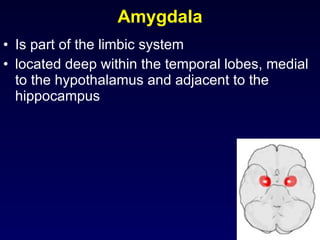
Amygdala Is part of the limbic system  located deep within the temporal lobes, medial to the hypothalamus and adjacent to the hippocampus
Functions:   Arousal  Controls Autonomic Responses Associated with Fear (“fear centre”) Emotional Responses  Hormonal Secretions  Memory
Amygdala As a central component of the limbic system, the amygdala oversees  emotional processing Its principal task is to filter and interpret sophisticated incoming  sensory information  in the context of our survival and emotional needs, and then help initiate the appropriate responses. In a recent imaging study pictures of frightening faces initiate a quick rise and fall of activity in the amygdala
Prefrontal Cortex  The most frontal part of the frontal cortex Connected to reticular  Performs executive functions  Involved in planning complex cognitive behaviors, personality expression, decision making and moderating correct social behavior Activity of this region is considered to be orchestration of thoughts and actions in accordance with internal goals
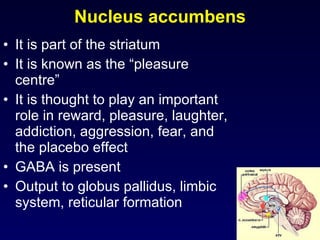
Nucleus accumbens It is part of the striatum It is known as the “pleasure centre” It is thought to play an important role in reward, pleasure, laughter, addiction, aggression, fear, and the placebo effect GABA is present Output to globus pallidus, limbic system, reticular formation
Executive functions Executive functions relate to  abilities to differentiate among conflicting thoughts determine good and bad, better and best, same and different future consequences of current activities working toward a defined goal prediction of outcomes expectation based on actions social "control" (the ability to suppress urges that, if not suppressed, could lead to socially-unacceptable outcomes)

Y2 s1 memory

  • 1.
    Physiology of memoryand emotions & the limbic system Prof. Vajira Weerasinghe Dept of Physiology, Faculty of Medicine, University of Peradeniya
  • 2.
    Terminology Cognition Memory Learning Speech and communication Emotions etc
  • 3.
    Cognition the mentalprocess of knowing, including aspects such as awareness perception reasoning language memory Judgment
  • 4.
    Emotions aconscious mental reaction (as anger or fear) subjectively experienced as strong feeling usually directed toward a specific object and typically accompanied by physiological and behavioral changes in the body eg. happiness anger love confidence anxiety stress relaxed
  • 5.
  • 6.
    Answer following questions?Did you drink tea at breakfast? Can a rabbit play golf? Who sang the song “This land belongs to you” What South American country begins with S? How many eggs are in a dozen? What is Julius Caesar’s telephone number? Is welderly an English word? Do all birds fly?
  • 7.
    memory highly organisedthere are ways to effectively and efficiently analyse, manipulate, search memory
  • 8.
    Process of storingand retrieving information in the brain This process is central to learning and thinking memory
  • 9.
    memory memory processregistration : transferring of information in to a form that can be retained
  • 10.
    memory memory processretention : storage of information
  • 11.
    memory memory processremembering : retrieval of information
  • 12.
    memory memory processregistration, retention, remembering
  • 13.
    memory There arefour different types of remembering: recollection recall recognition relearning
  • 14.
    memory There arefour different types of remembering: recollection : the reconstruction of events or facts on the basis of partial cues recall : the active and unaided remembering of something from the past recognition : the ability to identify previously encountered information as familiar relearning : the ability to learn once familiar material more easily than unfamiliar material
  • 15.
    memory systems sensorymemory or immediate memory short term memory STM or working memory long term memory LTM
  • 16.
    sensory memory orimmediate memory lasting few sec (less than 2 sec) act as buffers for stimuli received through senses if ignored -> forgotten If attention is paid -> passed into STM visual sensory memory is more commonly referred to as iconic memory auditory sensory memory is known as echoic memory
  • 17.
    short term memoryKnown as primary, working or active memory Stores a limited amount of information for about 30 sec Contain recently processed sensory input or items recently retrieved from LTM With rehearsal can be kept for several min acts as a scratch-pad for temporary recall of the information Has a limited capacity. Capacity is about 7 items ± 2 (memory span) By chunking can remember more items (eg. phone numbers)
  • 18.
    Working memory Structuresand processes used for temporarily storing and manipulating information Is a workbench of mental processing Composed two components Processes information in acoustic form Visuospatial scratch pad Frontal cortex, parietal cortex, anterior cingulate, and parts of the basal ganglia are crucial for functioning (previously known as STM)
  • 19.
    long term memorylasting days, months, yrs Long-term memory can store a very large quantity of information and can maintain that information for very long periods of time It holds many different kinds of information including: facts, events, motor and perceptual skills, knowledge of physical laws, spatial models of familiar environments, attitudes and beliefs about ourselves and others Long term potentiation moves STM to LTM
  • 20.
    Unconsolidated Memories DiscardedConsolidation Water tank model STM LTM
  • 21.
    Atkinson & Schiffrin(1968) Multistore Model of Memory Sensory Memory LTM STM Stimuli Attention Transfer Retrieval Rehearsal F O R G O T T E N
  • 22.
  • 23.
  • 24.
    forgetting Is memorypermanent? memory is known to decay with time disuse: regular retrieval enhances memory interference: new information interferes with old information or vice versa inaccessibility: tip of the tongue phenomenon This example is based on memorizing that occurs during a one-hour lecture.
  • 25.
    Further types ofmemory Explicit memory Implicit memory
  • 26.
    memories from eventsthat have occurred in the external world facts and events if the process of remembering involves the conscious recollection of previous experiences Explicit Memory
  • 27.
    Episodic memory refersto memory related to specific events and experiences in our life eg. first time a dog bites you Hippocampus and cortical areas may be involved Semantic memory refers to memory related to general or generic knowledge meaning of all words, symbols, rules, facts not tied to specific events eg. a child after seeing several dogs develop the concept of “dog” Hippocampus or widespread throughout the brain Types of Explicit Memory
  • 28.
    Consist of memoriesnecessary to perform events and tasks, or to produce a specific type of response if the process of remembering does not involves the conscious recollection of previous experiences Implicit memory is best demonstrated when performance is improved on a task Implicit Memory
  • 29.
    Procedural memory refersto memory related to knowledge concerning learning that is obtained incrementally and that is inaccessible to conscious recollection learning how to perform a task or acquire a new skill Motor cortical areas and cerebellum, basal ganglia may be involved Priming when subjects are exposed to a set of words and then later tested it is said to be primed and recall is easier Types of Implicit memory
  • 30.
    Prospective memory abilityto plan and remember to perform future tasks factors influencing cues, reminders, compliance, motivation, commitment Prospective memory can be further broken down into Event-based prospective memory triggered by cues, such as remembering to post a letter (action) after seeing a mailbox (cue). Time-based prospective memory triggered by a time-cue, such as going to the doctor (action) at 4pm (cue). frontal lobe, prefrontal region and parietal cortex may play a role is called “remembering to remember”
  • 31.
    Emotional memory memoryfor events that evoke a particularly strong emotion consciously available, but elicit a powerful, unconscious physiological reaction Involves amygdala
  • 32.
    Learning Experiments IvanPavlov has done experiment on Classical Conditioning Conditioned reflex using dog and salivation Unconditioned stimulus: food Conditioned stimulus: Bell Response: Salivation Neurolab
  • 33.
    Operant Conditioning B.F.Skinner(1904-1990) has done experiments on Operant conditioning These experiments were done using a Skinner's box This box is equipped with a lever when pressed releases a food pellet into a cup When a rat is put into this box initially by chance it will find that pressing the lever a food pellet is released. After that rat makes up a mental association between pressing the lever and release of the food. Rat now has a means of operating on the environment in a manner which is rewarding. Skinner called this rat's behavior: operant behavior
  • 34.
    Synaptic strengthening Conditioningof synaptic activity Hebb first theorised this " cells that fire together, wire together " any two cells or systems of cells that are repeatedly active at the same time will tend to become 'associated', so that activity in one facilitates activity in the other
  • 35.
    Initially firing ofA X neuron is active Firing of B X is inactive After conditioning continuous firing of A & B together Firing of B X becomes active A B X
  • 36.
    Habituation and sensitisationhabituation decrease in response with repetitive stimulation sensitisation increase in response with repetitive stimulation These have been studied using gill withdrawal in Sea Snail Aplysia when the gill is stroked After a few strokes if the stimulus is harmless there is no withdrawal: animal get habituated If the stimulus is noxious then animal produces a more powerful withdrawal: sensitised neurotransmitters that play particularly important role in habituation are serotonin, acetylcholine, dopamine and glutamate
  • 37.
  • 38.
    LTP is along-lasting enhancement in signal transmission between two neurons that results from stimulating them synchronously It is also defined as a persistent increase in synaptic strength following high-frequency stimulation of a chemical synapse LTP is widely considered one of the major cellular mechanisms that underlies learning and memory particularly long term memory LTP is known to occur in hippocampus LTP is known to be mediated by Ca influx in glutamate receptors LTP (Long Term Potentiation)
  • 39.
    LTP mechanism Stimulationof presynaptic neuron Release of glutamate Binds to AMPA receptor Na infux EPSP is created NMDA receptor Glutamate binds and open the ion gate EPSP will remove Mg2+ which blocks the NMDA receptor Result is Ca2+ influx Second messenger system Upregulation of AMPA receptors Release of retrograde paracrine substances (eg. NO) Long lasting EPSP
  • 40.
    LTP significance Long term memory Plasticity (synaptic or cortical) the changing of neurons, the organization of their networks, and their function via new experiences Depression Parkinson's disease Epilepsy Neuropathic pain Alzheimer's disease Drug addiction
  • 41.
    NMDA receptor nMethyl d Aspartate receptor has a role in the memory processes occurring in hippocampal neurons NMDA receptor is both voltage gated and ligand gated NMDA receptor activity causes Ca2+ influx which is an important mechanism of LTP
  • 42.
    NMDA receptor modulatorsGlutamate or aspartate (less effective) binds Glycine biding is also necessary Mg2+ blocks Membrane depolarisation Antagonists Anaesthetics, alcohol, ketamine
  • 43.
    limbic system (hippocampus,amygdala) thalamus frontal lobe interconnections brain areas responsible for memory
  • 44.
    History 1980s: Jamesand Lange developed a theory of emotion stating that emotional experience was nothing more than conscious awareness of autonomic activity in the body 1920s: Cannon and Bard proposed an alternative theory of emotion which held that portions of the brain, the hypothalamus and thalamus ,mediated emotion 1937: Papez proposed that the limbic system , a ring of primitive cortex was the critical brain system mediating emotion 20th century: Papez’s conception of the limbic system was expanded to include a number of additional brain areas which are interconnected with the ring of primitive cortex, eg. amygdala
  • 45.
    Papez circuit Along circuitous conduction chain in the mammalian forebrain, leading from the hippocampus by way of the fornix to the mammillary body and thence returning to the hippocampus by way of, sequentially, the anterior thalamic nuclei, cingulate gyrus, and parahippocampal gyrus
  • 46.
  • 47.
    limbic system nucleiamygdala septal nuclei mammillary body hypothalamus cortical areas hippocampal gyrus cingulate gyrus dentate gyrus entorhinal, amygdaloid cortex paralimbic structures orbital gyrus, insula, nucelus accumbens, thalamic nuclei, superior temporal gyrus, fibre tracts: fornix, medial forebrain bundle
  • 48.
    limbic cortex consistof 3 layered cortex (in contrast to 6 layered cortex of the neocortex)
  • 49.
    Limbic system isa link between the brain stem and neocortex Limbic structures are connected to each other and with the association cortex and the brain stem
  • 50.
    Medial forebrain bundleis a major efferent connection of the limbic system: projected to the hypothalamus, reticular formation. Influence on autonomic and endocrine activity Amygdala receives inputs from olfactory pathways Connections with the neocortex provide a synthesis of emotional and rational thought
  • 51.
    Functions Limbic systemis also referred to as the ‘emotional brain’ Emotional (include motor activity) Behavioural (Motivations, Drives: appetite, thirst, sexual behaviour, Reward system) Memory Utilizes the hypothalamus to effect the physical manifestations associated with emotions, etc.
  • 52.
    Complex role ofthe limbic system as an intermediary between external events (carried to the CNS via afferents) our processing of those events (involving cortical and subcortical brain areas) our responses to those events (both behavioral and autonomic)
  • 53.
    Role in memorystorage Working memory—short term cortical phenomenon Explicit (declarative)—factual knowledge temporal events, stored in hippocampus Examples: what innervates biceps femoris m.? Implicit (procedural)—learned skills unconsciously recalled—includes emotional responses—stored in amygdala (at least in part) Examples: writing, playing a musical instrument
  • 54.
    Hippocampus is apart of the brain located inside the temporal lobe plays a major role memory consolidation responsible for spatial memory might act as a cognitive map — a neural representation of the layout of the environment. In Alzheimer's disease, the hippocampus becomes one of the first regions of the brain to suffer damage
  • 55.
  • 56.
  • 57.
    Physiology of emotions Within the limbic system, emotional impulses originate in the amygdala A network of neural pathways connect the amygdala to the neocortex, the "thinking brain," allowing us to reflect on our feelings and to think before acting In times of perceived crisis, however, those pathways are bypassed and impulse overrides reason and the amygdala takes over the brain
  • 58.
    Physiology of emotions Each emotion sparks a distinctive physiological reaction Happiness cues the brain to suppress worrisome or negative feelings and increases the body’s energy level Sadness does the opposite, slowing down its metabolism Anger floods the brain with catecholamines *Stress and *anxiety set off the nervous system’s "flight-or-fight" response
  • 59.
    Neurotransmitters released AchDopamine Endorphines GABA Glutamate Norepinephrine Serotonin
  • 60.
    Limbic system AmygdalaInvolved in aggression, jealousy, and fear ; Cingulate gyrus Autonomic functions regulating heart rate and blood pressure as well as cognitive and attentional processing; Fornicate gyrus Region encompassing the cingulate , hippocampus , and parahippocampal gyrus; Hippocampus Required for the formation of long-term memories ; Hypothalamus Regulates the autonomic nervous system via hormone production and release. Affects and regulates blood pressure, heart rate, hunger, thirst, sexual arousal, and the sleep/wake cycle;
  • 61.
    Limbic system Mammillarybody Important for the formation of memory; Nucleus accumbens Involved in reward, pleasure , and addiction; Orbitofrontal cortex Required for decision making ; Parahippocampal gyrus Plays a role in the formation of spatial memory. Septum regulates emotion and the ability to learn and control impulses as well as such drives as sex, hunger, thirst and aggression
  • 62.
    Amygdala Is partof the limbic system located deep within the temporal lobes, medial to the hypothalamus and adjacent to the hippocampus
  • 63.
    Functions: Arousal Controls Autonomic Responses Associated with Fear (“fear centre”) Emotional Responses Hormonal Secretions Memory
  • 64.
    Amygdala As acentral component of the limbic system, the amygdala oversees emotional processing Its principal task is to filter and interpret sophisticated incoming sensory information in the context of our survival and emotional needs, and then help initiate the appropriate responses. In a recent imaging study pictures of frightening faces initiate a quick rise and fall of activity in the amygdala
  • 65.
    Prefrontal Cortex The most frontal part of the frontal cortex Connected to reticular Performs executive functions Involved in planning complex cognitive behaviors, personality expression, decision making and moderating correct social behavior Activity of this region is considered to be orchestration of thoughts and actions in accordance with internal goals
  • 66.
    Nucleus accumbens Itis part of the striatum It is known as the “pleasure centre” It is thought to play an important role in reward, pleasure, laughter, addiction, aggression, fear, and the placebo effect GABA is present Output to globus pallidus, limbic system, reticular formation
  • 67.
    Executive functions Executivefunctions relate to abilities to differentiate among conflicting thoughts determine good and bad, better and best, same and different future consequences of current activities working toward a defined goal prediction of outcomes expectation based on actions social "control" (the ability to suppress urges that, if not suppressed, could lead to socially-unacceptable outcomes)