MENTAL IMAGERY
Dr. Manasi Kulkarni
MPT-Neurophysiotherapy
Guide: Dr. Suvarna Ganvir
D.V.V.P.F’s College of Physiotherapy, Ahmednagar
CONTENT
• Introduction
• History
• Theories
• Recent Advances
• References
INTRODUCTION
• Mental imagery refers to the active process by which humans relive
sensations with or without external stimuli..
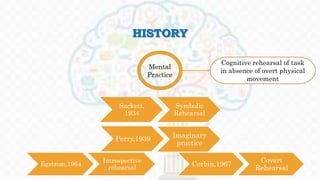
HISTORY
Mental
Practice
Cognitive rehearsal of task
in absence of overt physical
movement
Perry,1939 Imaginary
practice
Sackett,
1934
Symbolic
Rehearsal
Corbin,1967
Covert
Rehearsal
Egstrom,1964
Introspective
rehearsal
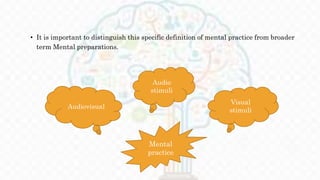
• It is important to distinguish this specific definition of mental practice from broader
term Mental preparations.
Mental
practice
Visual
stimuli
Audiovisual
Audio
stimuli
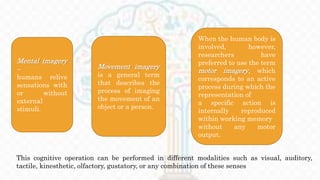
Movement imagery
is a general term
that describes the
process of imaging
the movement of an
object or a person.
Mental imagery
–
humans relive
sensations with
or without
external
stimuli.
When the human body is
involved, however,
researchers have
preferred to use the term
motor imagery, which
corresponds to an active
process during which the
representation of
a specific action is
internally reproduced
within working memory
without any motor
output.
This cognitive operation can be performed in different modalities such as visual, auditory,
tactile, kinesthetic, olfactory, gustatory, or any combination of these senses
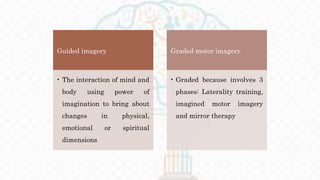
Guided imagery
• The interaction of mind and
body using power of
imagination to bring about
changes in physical,
emotional or spiritual
dimensions
Graded motor imagery
• Graded because involves 3
phases: Laterality training,
imagined motor imagery
and mirror therapy
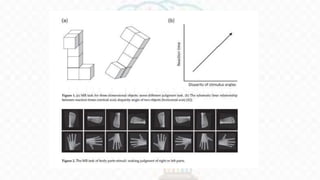
• Mental Rotation-
• Refers to ability to Imagine the rotation of an object in space.
• Motion Imagery- Concerned with prediction of path and direction of movements of
non-bodily objects moving in space
• According to research When participants were given 3D objects result showed that
time required for the judgement increased as the angle of rotation.
THEORIES OF MENTAL IMAGERY
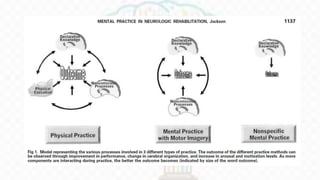
• Many theories have been proposed to explain the mechanisms by which mental practice
acts to increase performance in motor learning.
1. Sackett proposed the symbolic learning theory
• States mental practice facilitates motor performance by allowing subjects to rehearse the
cognitive component of a task.
• Implies the movements are symbolically coded in the CNS, making them easier to execute.
• Limitation: Does not explain other findings such as increase in muscular strength
reported after mental practice of isometric contractions
• Psychoneuromuscular theory
• More compatible with results obtained form pure motor tasks.
• Proposes that micronerve impulses are propagated to target muscles when a
subject engages in mental practice of a movement, hence facilitating future
performance.
• Some researchers raised possibility that increase in muscular activity during
mental practice is not specific to the muscle groups involved in the execution of
the movement but EMG confirmed that increase was found in nonrelated
muscle groups also.
• A theory by Paivio
• Suggested that mental practice enhances performance by acting on both the motivational
and cognitive components of an activity at either general (e.g. degree of physiologic arousal
of an individual) or specific levels (e.g. actual practice of motor task using motor imagery)
• Van Leeuwen and Inglis modified above theory
• They correctly argue that large part of preoccupation in rahabilitation is given to physical
components of training often neglecting motivational conditions
• Mental practice would help patients focus on specific goals and could contribute to reduction
of depressive state frequently observed in neurologic disorders
CORTICAL AREAS INVOLVED
• Supplementary motor cortex
• Precentral and post central gyri
• Superior Parietal area
• A study was done on Cortical changes after mental imagery training combined with
EMG –triggered electrical stimulation in patients with stroke.
• 14 stroke patients divided in 2 groups EMG & FES
• Outcome measures- FMA, motor activity log, Barthel index
F-Flurocodeoxyglucose brain positron emission tomography
• Significantly increased cerebral glucose metabolism after 4 week was seen in EMG
group
• Mental imagery training combined with electromyogram-triggered electri
stimulation improved motor function of the paretic extremity in patients with
chronic stroke. The intervention increased metabolism in the contralesional motor–
sensory cortex
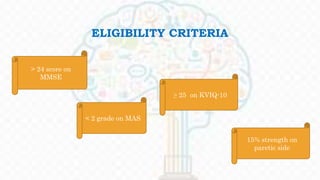
ELIGIBILITY CRITERIA
> 24 score on
MMSE
≥ 25 on KVIQ-10
< 2 grade on MAS
15% strength on
paretic side
ADVANTAGES
• Innovative in many conditions
• Effective
• Easy to use
• Cost effective
• Can be used as an adjunct or independently as a treatment modality.
CRITICIZED POINTS
• It is not possible to decide between imaginal and propositional representations
strictly on the basis of behavioral data.
• There are a number of reactions to the possibility that we may not be able to identify
the nature of information representation.
PAST EVIDENCES
• A study by Letswaart M. et al done on Mental practice with motor imagery
in stroke recovery: RCT (2011)
• 121 stroke patients were included-3 groups- control,
Attention placebo and
Mental imagery
• Outcome measures- ARAT, Grip Strength by dynamometer
Timed manual dexterity performance
• 45 min session-3days/week for 4 weeks for each group
• Conclusion:
It remains unclear whether the benefit of this combination is associated with
enhanced cognitive models of performed movements, motivational mechanisms, or an
indirect effect of neuroplasticity where mental practice reactivates recently used
motor representations allowing for an increased effect of the physical practice itself.
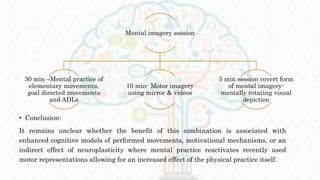
Mental imagery session
30 min –Mental practice of
elementary movements,
goal directed movements
and ADLs
10 min- Motor imagery
using mirror & videos
5 min session covert form
of mental imagery-
mentally rotating visual
depiction
• Potential role of mental practice using motor imagery in neurologic
rehabilitation –a review by Jackson P. (2001)
• This article discusses the rationale for investigating mental practice as a means
of promoting motor recovery in with a neurologic disorder.
• Brain mapping studies of healthy subjects executing anf imagining Upper limb
movements were included in this study.
• Although the behavioral effects of mental practice on the learning of a motor
skill have been investigated using different types of paradigms, only a few
studies have examined physiologic correlates of the changes in performance
• Conclusion:
• It will be useful to elaborate guidelines to determine the best timing to introduce
mental practice in the rehabilitation process.
• Additional important clinical issues that await further support include the selection
of patients most likely to benefit from mental practice, the effects of cognitive
deficits after brain lesion on the ability to imagine movements, the choice of
instruments able to detect small changes in performance, as well as the use of a
technologic medium such as virtual reality in mental practice.
• Amasiatu A N. conducted study on Mental Imagery rehearsal as a
psychological technique to enhance sports performance-Review article
• Mental imagery rehearsal has become one of the vital tools that can make
the difference on cutting edge to enhancing sports excellence if properly
utilized.
• No matter how good or how limited your imagery skills are now, you can
improve them through daily practice.
RECENT ADVANCES
• A study by Guerra Z. et al on Effect of mental practice based on motor imagery for
mobility recovery after subacute stroke (2018)
• 14 acute stroke patients (<3 months) 2 groups- Mental imagery & control
• Outcome measures- TUG
5 mWT
4 week intervention for both the groups- Strengthening and stretching exercises for
both groups
1) Control group- Cognitive therapy 30 min ( Memorizing, calculations, logical
reasoning, relaxation and non motor imagery)
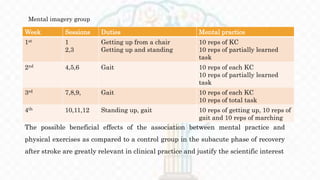
Week Sessions Duties Mental practice
1st 1
2,3
Getting up from a chair
Getting up and standing
10 reps of KC
10 reps of partially learned
task
2nd 4,5,6 Gait 10 reps of each KC
10 reps of partially learned
task
3rd 7,8,9, Gait 10 reps of each KC
10 reps of total task
4th 10,11,12 Standing up, gait 10 reps of getting up, 10 reps of
gait and 10 reps of marching
Mental imagery group
The possible beneficial effects of the association between mental practice and
physical exercises as compared to a control group in the subacute phase of recovery
after stroke are greatly relevant in clinical practice and justify the scientific interest
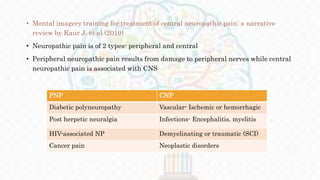
• Mental imagery training for treatment of central neuropathic pain: a narrative
review by Kaur J. et al (2019)
• Neuropathic pain is of 2 types- peripheral and central
• Peripheral neuropathic pain results from damage to peripheral nerves while central
neuropathic pain is associated with CNS
PNP CNP
Diabetic polyneuropathy Vascular- Ischemic or hemorrhagic
Post herpetic neuralgia Infections- Encephalitis, myelitis
HIV-associated NP Demyelinating or traumatic (SCI)
Cancer pain Neoplastic disorders
• The presence of pain is associated with negative images .The use of a mirror based
on the concept of mirror neurons by Ramachandran et al. to train patients with
phantom limb pain supports the role of MI in chronic pain.
• Several techniques like graded imagery, Guided imagery can be used. Imagery is not
just a visualization but it involves all the senses.
• This is the first review to focus on MI techniques for CNP in neurological conditions.
It helps to bring about the similarity and differences in the nature and treatment of
MI techniques for treating CNP. They are innovative, effective and easy to use.
• Weigelt M & Memmert conducted a study on The mental rotation ability of Expert
Basketball players: identifying On court plays (2020)
• Purpose of study- (1) To test a new version of a mental rotation task (MRT), which
assesses mental rotation abilities of men and women for sport-specific items,
and
(2) To investigate potential differences in MRT performance, which are
based on athletic expertise.
• Participants: 88 basketball players- 42 females & 46 males
123 novices without specific BB-64 females & 57 males
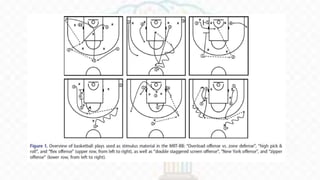
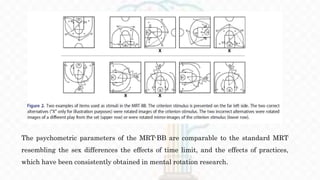
• The Mental Rotation Task—Basketball (MRT-BB) was constructed as a paper-and-
pencil test that was similar to the original MRT. six different basketball plays were
used as basic stimuli to create the MRT-B
The psychometric parameters of the MRT-BB are comparable to the standard MRT
resembling the sex differences the effects of time limit, and the effects of practices,
which have been consistently obtained in mental rotation research.
REFERENCE
1. De varies S., Mulder T. Motor imagery and stroke rehabilitation: a critical discussion. J
Rehabil Med 2007; 39: 5-13.
2. Jackson P., Lafleur M., Malouin F., Richards C., Doyon D. Potential role of mental
practice using motor imagery in neurologic rehabilitation. Arch Phys Med Rehabil
2001;82 : 1133-1141
3. Kawasaki Tsubasa. Clinical Applicarion of Motor Imagery Training. Neurological
Physical Therapy.Chpt 4 : 51-69.
4. Letswaart M., Johnston M., Dijkerman HC., Joice S., Scott C., Macwalter R., Hamilton
S. Mental Practice with motor imagery in stroke recovery: randomized controlled trial of
efficacy. Brain 2011;134: 1373-1386.
5. Hong I.K., Choi J B., Lee J H. Cortical changes after mental imagery training combined
with electromyography- triggered electrical stimulation in patients with chronic stroke.
6. Driskell J., Moran A. Does mental practice enhance performance? Journal of applied
psychology 1994; 79(4): 481-492.
7. Kaur J., Ghosh S., Sahani A., Sinha J. Mental imagery for treatment of central
neuropathic pain: a narrative review. Acta Neurologica Belgica 2019
8. Weigelt M., Memmert D. The mental rotation ability of expert Basketball players:
identifying on court plays. Research Quarterly for Exercise and Sports 2020
9. Lopez N., Pereira E., Jodra E., Page C.M. Motor Imagery as a complementary technique
for functional recovery after stroke: a systematic review. Topics on Stroke rehabilitation
2019: 1945-1952.
10. Guerra Z., Bellose L., Faria C., Lucchetti G. The effect of mental practice based on motor
imagery for mobility recovery after subacute stroke: protocol for a randomized controlled
trial. Complementary Therapies in Clinical Practice 2018
11. Anderson John. Arguments concenrning representations for mental Imagery:
Psychological review.1978 ;85(4)
THANK YOU

Mental imagery

  • 1.
    MENTAL IMAGERY Dr. ManasiKulkarni MPT-Neurophysiotherapy Guide: Dr. Suvarna Ganvir D.V.V.P.F’s College of Physiotherapy, Ahmednagar
  • 2.
    CONTENT • Introduction • History •Theories • Recent Advances • References
  • 3.
    INTRODUCTION • Mental imageryrefers to the active process by which humans relive sensations with or without external stimuli..
  • 4.
    HISTORY Mental Practice Cognitive rehearsal oftask in absence of overt physical movement Perry,1939 Imaginary practice Sackett, 1934 Symbolic Rehearsal Corbin,1967 Covert Rehearsal Egstrom,1964 Introspective rehearsal
  • 5.
    • It isimportant to distinguish this specific definition of mental practice from broader term Mental preparations. Mental practice Visual stimuli Audiovisual Audio stimuli
  • 6.
    Movement imagery is ageneral term that describes the process of imaging the movement of an object or a person. Mental imagery – humans relive sensations with or without external stimuli. When the human body is involved, however, researchers have preferred to use the term motor imagery, which corresponds to an active process during which the representation of a specific action is internally reproduced within working memory without any motor output. This cognitive operation can be performed in different modalities such as visual, auditory, tactile, kinesthetic, olfactory, gustatory, or any combination of these senses
  • 7.
    Guided imagery • Theinteraction of mind and body using power of imagination to bring about changes in physical, emotional or spiritual dimensions Graded motor imagery • Graded because involves 3 phases: Laterality training, imagined motor imagery and mirror therapy
  • 8.
    • Mental Rotation- •Refers to ability to Imagine the rotation of an object in space. • Motion Imagery- Concerned with prediction of path and direction of movements of non-bodily objects moving in space • According to research When participants were given 3D objects result showed that time required for the judgement increased as the angle of rotation.
  • 10.
    THEORIES OF MENTALIMAGERY • Many theories have been proposed to explain the mechanisms by which mental practice acts to increase performance in motor learning. 1. Sackett proposed the symbolic learning theory • States mental practice facilitates motor performance by allowing subjects to rehearse the cognitive component of a task. • Implies the movements are symbolically coded in the CNS, making them easier to execute. • Limitation: Does not explain other findings such as increase in muscular strength reported after mental practice of isometric contractions
  • 11.
    • Psychoneuromuscular theory •More compatible with results obtained form pure motor tasks. • Proposes that micronerve impulses are propagated to target muscles when a subject engages in mental practice of a movement, hence facilitating future performance. • Some researchers raised possibility that increase in muscular activity during mental practice is not specific to the muscle groups involved in the execution of the movement but EMG confirmed that increase was found in nonrelated muscle groups also.
  • 12.
    • A theoryby Paivio • Suggested that mental practice enhances performance by acting on both the motivational and cognitive components of an activity at either general (e.g. degree of physiologic arousal of an individual) or specific levels (e.g. actual practice of motor task using motor imagery) • Van Leeuwen and Inglis modified above theory • They correctly argue that large part of preoccupation in rahabilitation is given to physical components of training often neglecting motivational conditions • Mental practice would help patients focus on specific goals and could contribute to reduction of depressive state frequently observed in neurologic disorders
  • 13.
    CORTICAL AREAS INVOLVED •Supplementary motor cortex • Precentral and post central gyri • Superior Parietal area
  • 14.
    • A studywas done on Cortical changes after mental imagery training combined with EMG –triggered electrical stimulation in patients with stroke. • 14 stroke patients divided in 2 groups EMG & FES • Outcome measures- FMA, motor activity log, Barthel index F-Flurocodeoxyglucose brain positron emission tomography • Significantly increased cerebral glucose metabolism after 4 week was seen in EMG group • Mental imagery training combined with electromyogram-triggered electri stimulation improved motor function of the paretic extremity in patients with chronic stroke. The intervention increased metabolism in the contralesional motor– sensory cortex
  • 15.
    ELIGIBILITY CRITERIA > 24score on MMSE ≥ 25 on KVIQ-10 < 2 grade on MAS 15% strength on paretic side
  • 16.
    ADVANTAGES • Innovative inmany conditions • Effective • Easy to use • Cost effective • Can be used as an adjunct or independently as a treatment modality.
  • 17.
    CRITICIZED POINTS • Itis not possible to decide between imaginal and propositional representations strictly on the basis of behavioral data. • There are a number of reactions to the possibility that we may not be able to identify the nature of information representation.
  • 18.
    PAST EVIDENCES • Astudy by Letswaart M. et al done on Mental practice with motor imagery in stroke recovery: RCT (2011) • 121 stroke patients were included-3 groups- control, Attention placebo and Mental imagery • Outcome measures- ARAT, Grip Strength by dynamometer Timed manual dexterity performance • 45 min session-3days/week for 4 weeks for each group
  • 19.
    • Conclusion: It remainsunclear whether the benefit of this combination is associated with enhanced cognitive models of performed movements, motivational mechanisms, or an indirect effect of neuroplasticity where mental practice reactivates recently used motor representations allowing for an increased effect of the physical practice itself. Mental imagery session 30 min –Mental practice of elementary movements, goal directed movements and ADLs 10 min- Motor imagery using mirror & videos 5 min session covert form of mental imagery- mentally rotating visual depiction
  • 20.
    • Potential roleof mental practice using motor imagery in neurologic rehabilitation –a review by Jackson P. (2001) • This article discusses the rationale for investigating mental practice as a means of promoting motor recovery in with a neurologic disorder. • Brain mapping studies of healthy subjects executing anf imagining Upper limb movements were included in this study. • Although the behavioral effects of mental practice on the learning of a motor skill have been investigated using different types of paradigms, only a few studies have examined physiologic correlates of the changes in performance
  • 22.
    • Conclusion: • Itwill be useful to elaborate guidelines to determine the best timing to introduce mental practice in the rehabilitation process. • Additional important clinical issues that await further support include the selection of patients most likely to benefit from mental practice, the effects of cognitive deficits after brain lesion on the ability to imagine movements, the choice of instruments able to detect small changes in performance, as well as the use of a technologic medium such as virtual reality in mental practice.
  • 23.
    • Amasiatu AN. conducted study on Mental Imagery rehearsal as a psychological technique to enhance sports performance-Review article • Mental imagery rehearsal has become one of the vital tools that can make the difference on cutting edge to enhancing sports excellence if properly utilized. • No matter how good or how limited your imagery skills are now, you can improve them through daily practice.
  • 24.
    RECENT ADVANCES • Astudy by Guerra Z. et al on Effect of mental practice based on motor imagery for mobility recovery after subacute stroke (2018) • 14 acute stroke patients (<3 months) 2 groups- Mental imagery & control • Outcome measures- TUG 5 mWT 4 week intervention for both the groups- Strengthening and stretching exercises for both groups 1) Control group- Cognitive therapy 30 min ( Memorizing, calculations, logical reasoning, relaxation and non motor imagery)
  • 25.
    Week Sessions DutiesMental practice 1st 1 2,3 Getting up from a chair Getting up and standing 10 reps of KC 10 reps of partially learned task 2nd 4,5,6 Gait 10 reps of each KC 10 reps of partially learned task 3rd 7,8,9, Gait 10 reps of each KC 10 reps of total task 4th 10,11,12 Standing up, gait 10 reps of getting up, 10 reps of gait and 10 reps of marching Mental imagery group The possible beneficial effects of the association between mental practice and physical exercises as compared to a control group in the subacute phase of recovery after stroke are greatly relevant in clinical practice and justify the scientific interest
  • 26.
    • Mental imagerytraining for treatment of central neuropathic pain: a narrative review by Kaur J. et al (2019) • Neuropathic pain is of 2 types- peripheral and central • Peripheral neuropathic pain results from damage to peripheral nerves while central neuropathic pain is associated with CNS PNP CNP Diabetic polyneuropathy Vascular- Ischemic or hemorrhagic Post herpetic neuralgia Infections- Encephalitis, myelitis HIV-associated NP Demyelinating or traumatic (SCI) Cancer pain Neoplastic disorders
  • 27.
    • The presenceof pain is associated with negative images .The use of a mirror based on the concept of mirror neurons by Ramachandran et al. to train patients with phantom limb pain supports the role of MI in chronic pain. • Several techniques like graded imagery, Guided imagery can be used. Imagery is not just a visualization but it involves all the senses. • This is the first review to focus on MI techniques for CNP in neurological conditions. It helps to bring about the similarity and differences in the nature and treatment of MI techniques for treating CNP. They are innovative, effective and easy to use.
  • 28.
    • Weigelt M& Memmert conducted a study on The mental rotation ability of Expert Basketball players: identifying On court plays (2020) • Purpose of study- (1) To test a new version of a mental rotation task (MRT), which assesses mental rotation abilities of men and women for sport-specific items, and (2) To investigate potential differences in MRT performance, which are based on athletic expertise. • Participants: 88 basketball players- 42 females & 46 males 123 novices without specific BB-64 females & 57 males • The Mental Rotation Task—Basketball (MRT-BB) was constructed as a paper-and- pencil test that was similar to the original MRT. six different basketball plays were used as basic stimuli to create the MRT-B
  • 30.
    The psychometric parametersof the MRT-BB are comparable to the standard MRT resembling the sex differences the effects of time limit, and the effects of practices, which have been consistently obtained in mental rotation research.
  • 31.
    REFERENCE 1. De variesS., Mulder T. Motor imagery and stroke rehabilitation: a critical discussion. J Rehabil Med 2007; 39: 5-13. 2. Jackson P., Lafleur M., Malouin F., Richards C., Doyon D. Potential role of mental practice using motor imagery in neurologic rehabilitation. Arch Phys Med Rehabil 2001;82 : 1133-1141 3. Kawasaki Tsubasa. Clinical Applicarion of Motor Imagery Training. Neurological Physical Therapy.Chpt 4 : 51-69. 4. Letswaart M., Johnston M., Dijkerman HC., Joice S., Scott C., Macwalter R., Hamilton S. Mental Practice with motor imagery in stroke recovery: randomized controlled trial of efficacy. Brain 2011;134: 1373-1386.
  • 32.
    5. Hong I.K.,Choi J B., Lee J H. Cortical changes after mental imagery training combined with electromyography- triggered electrical stimulation in patients with chronic stroke. 6. Driskell J., Moran A. Does mental practice enhance performance? Journal of applied psychology 1994; 79(4): 481-492. 7. Kaur J., Ghosh S., Sahani A., Sinha J. Mental imagery for treatment of central neuropathic pain: a narrative review. Acta Neurologica Belgica 2019 8. Weigelt M., Memmert D. The mental rotation ability of expert Basketball players: identifying on court plays. Research Quarterly for Exercise and Sports 2020 9. Lopez N., Pereira E., Jodra E., Page C.M. Motor Imagery as a complementary technique for functional recovery after stroke: a systematic review. Topics on Stroke rehabilitation 2019: 1945-1952. 10. Guerra Z., Bellose L., Faria C., Lucchetti G. The effect of mental practice based on motor imagery for mobility recovery after subacute stroke: protocol for a randomized controlled trial. Complementary Therapies in Clinical Practice 2018
  • 33.
    11. Anderson John.Arguments concenrning representations for mental Imagery: Psychological review.1978 ;85(4)
  • 34.