• Multi Store Memory Model: Proposed by
Atkinson and Shiffrin in 1968. It is a structural
model composing of three separate stores:
– Sensory Memory (SM)
– Short-Term Memory (STM)
– Long-Term Memory (LTM)
The information passes through these stores in a linear
way.
• Encoding: The way information is changed so that
it can be stored in the memory
• Capacity: How much information can be stored in
that memory store.
• Duration: The period of time that information can
last in that memory store.
• Environmental stimuli enters the sensory memory.
It has several stores called sensory registers which
each process information from each of the senses.
Information enters here first and is raw and
unprocessed. It has a very large capacity as it is
constantly receiving information but since most of
the information does not get any special attention,
it only remains in the SM for a very brief time.
– If one gives any specific piece of information special
attention, it is transferred to the short-term memory.
Attention is the first step to remembering something.
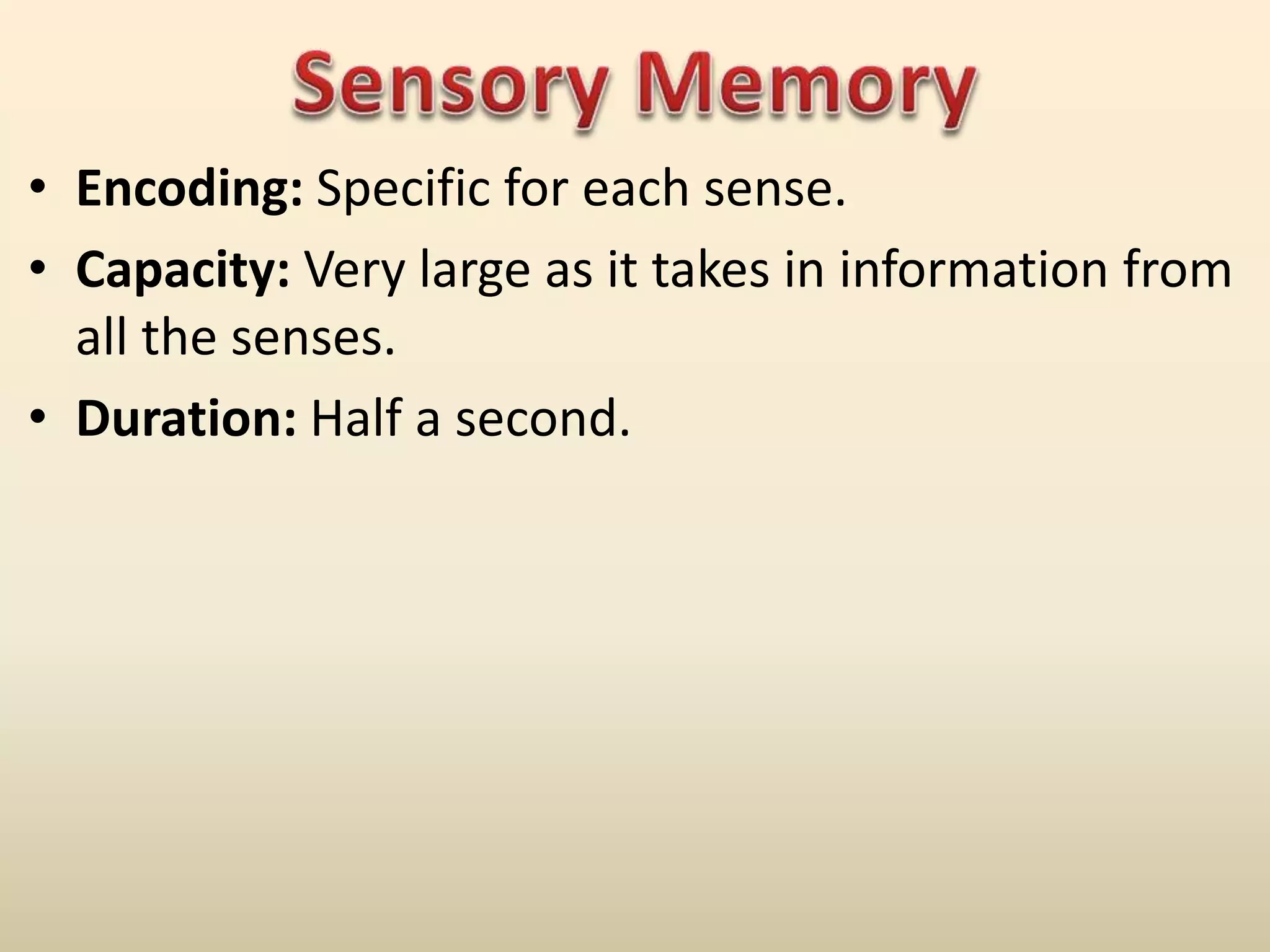
• Encoding: Specific for each sense.
• Capacity: Very large as it takes in information from
all the senses.
• Duration: Half a second.
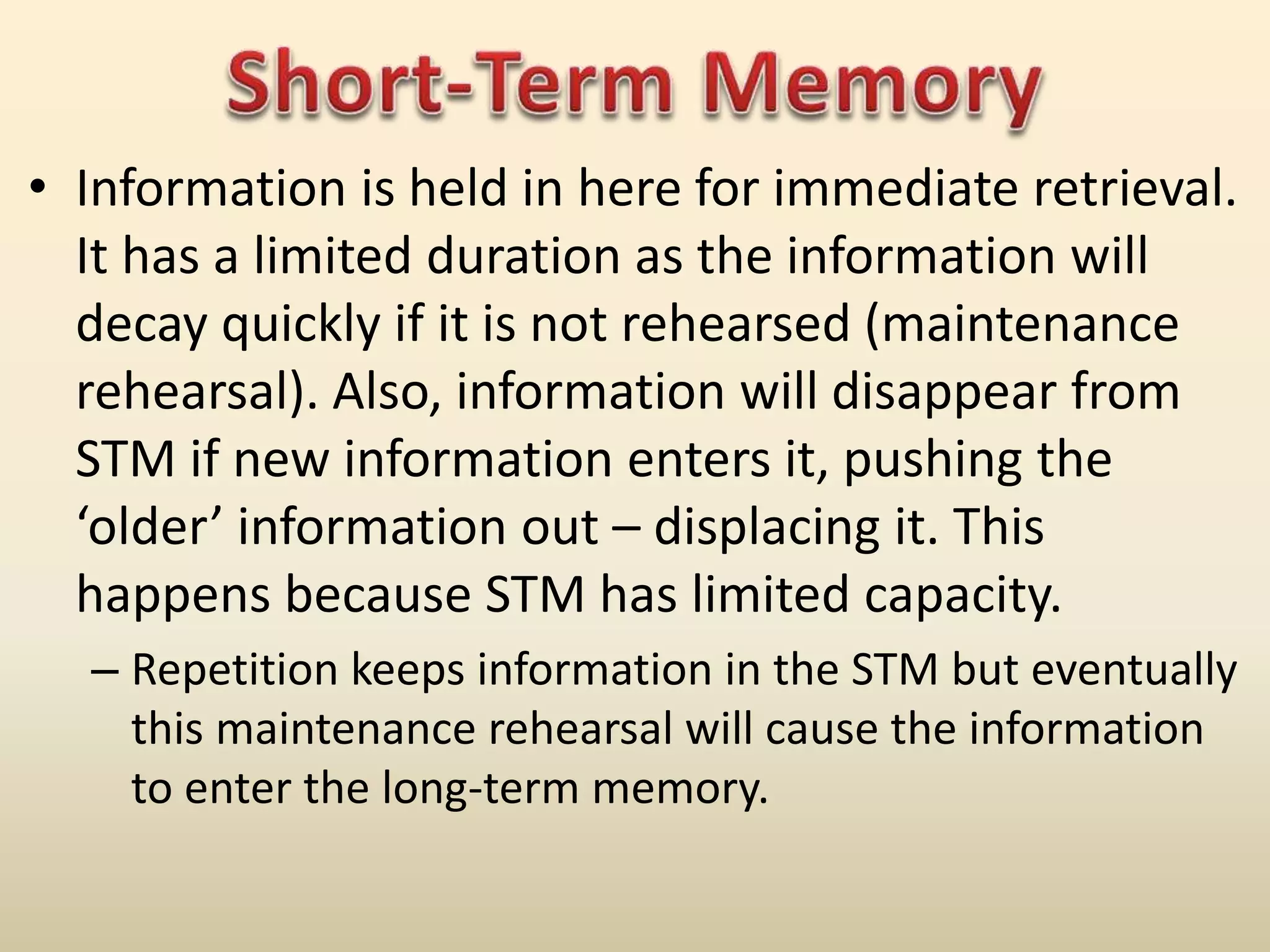
• Information is held in here for immediate retrieval.
It has a limited duration as the information will
decay quickly if it is not rehearsed (maintenance
rehearsal). Also, information will disappear from
STM if new information enters it, pushing the
‘older’ information out – displacing it. This
happens because STM has limited capacity.
– Repetition keeps information in the STM but eventually
this maintenance rehearsal will cause the information
to enter the long-term memory.
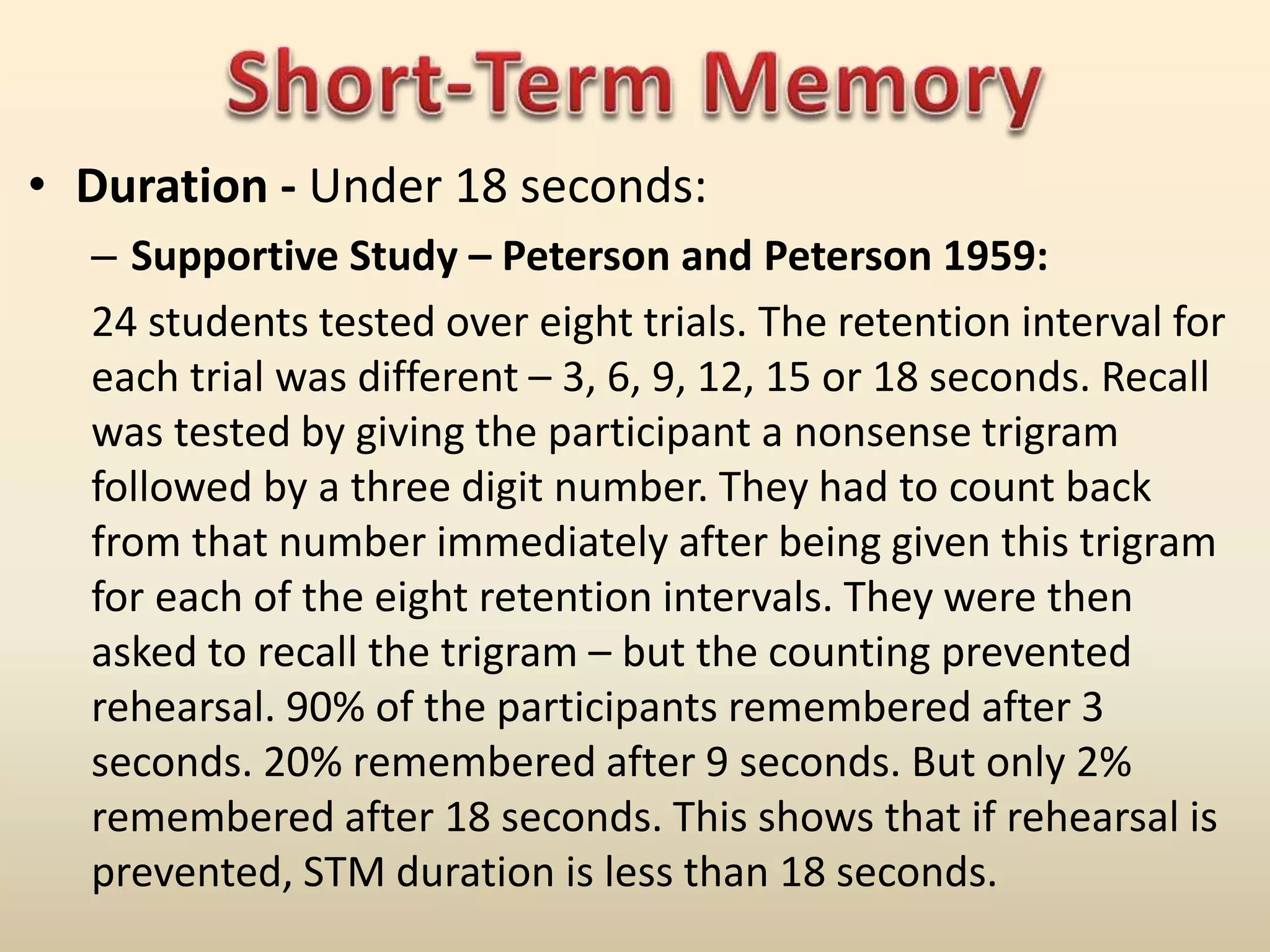
• Duration - Under 18 seconds:
– Supportive Study – Peterson and Peterson 1959:
24 students tested over eight trials. The retention interval for
each trial was different – 3, 6, 9, 12, 15 or 18 seconds. Recall
was tested by giving the participant a nonsense trigram
followed by a three digit number. They had to count back
from that number immediately after being given this trigram
for each of the eight retention intervals. They were then
asked to recall the trigram – but the counting prevented
rehearsal. 90% of the participants remembered after 3
seconds. 20% remembered after 9 seconds. But only 2%
remembered after 18 seconds. This shows that if rehearsal is
prevented, STM duration is less than 18 seconds.
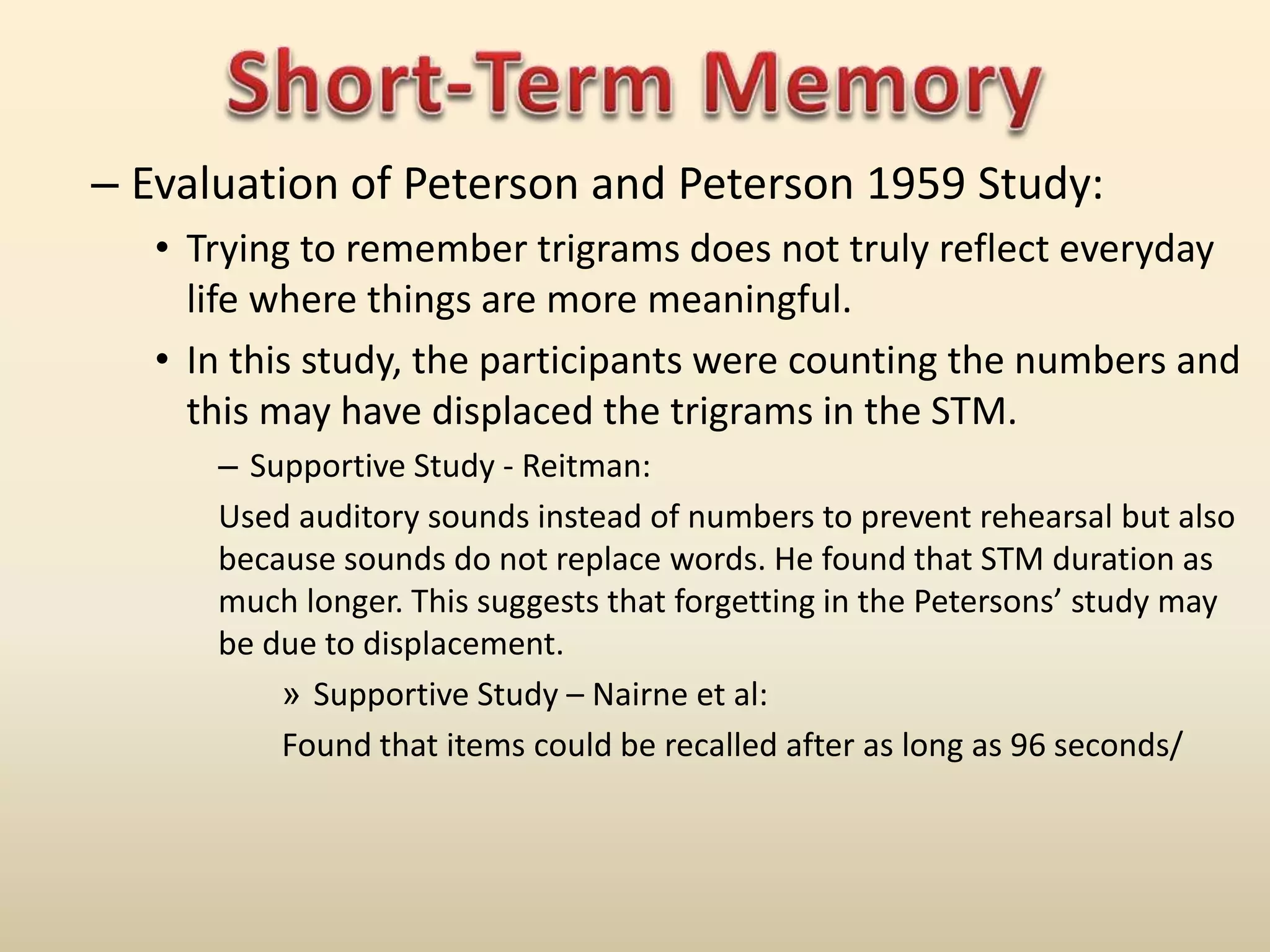
– Evaluation of Peterson and Peterson 1959 Study:
• Trying to remember trigrams does not truly reflect everyday
life where things are more meaningful.
• In this study, the participants were counting the numbers and
this may have displaced the trigrams in the STM.
– Supportive Study - Reitman:
Used auditory sounds instead of numbers to prevent rehearsal but also
because sounds do not replace words. He found that STM duration as
much longer. This suggests that forgetting in the Petersons’ study may
be due to displacement.
» Supportive Study – Nairne et al:
Found that items could be recalled after as long as 96 seconds/
• Capacity - 7+/- 2 items:
– Supportive Study – Jacobs 1887:
Used a digit span technique to assess STM capacity and found that for digits, it
was 9.3 items on average but for letters it was 7.3. This is probably due to there
being many more letters in the alphabet than single digits, so they are harder to
recall.
– Supportive Study – George Miller:
He reviewed psychological research and proposed that the span of STM was
around 7 with perhaps two units more or less. He also found that we can recall
five words just as well as fie letters because we can ‘chunk’ things together and
therefore remember more.
• Evaluation – Cowan:
Reviewed a variety of studies and claimed that capacity could actually be about four chunks.
Other research suggests that for visual information , the limit is four items (Vogel et al). This
means that the lower ranger of Miller’s scale is more appropriate 7-2 (5) items.
• Evaluation – Jacobs:
Found that capacity of STM increases with age. Eight year olds could remember an average of
6.6 digits, whereas a 19 year old could remember 8.6 digits on average. This could be due to an
increase in brain size or an improvement of learning strategies.
• Encoding - Mainly acoustic:
– Supportive Study – Alan Baddeley:
Used word lists that were either
1. Acoustically similar (rhyme) but semantically different (not
synonyms).
2. Or acoustically different (don’t rhyme) but semantically
different (synonyms).
He found that participants had difficulty remembering acoustically
similar words in STM suggesting that sound is more important in
STM and concluded that the STM encoding in mainly acoustic
form.
• Evaluation Brandimote et al:
Found that STM can encode visually too when he gave participants visual
tasks and were prevented from doing verbal rehearsal in the retention
period. Normally, visual images would be translated into verbal codes in
STM but if prevented from doing so, participants used visual codes.
• Rehearsed information enters the LTM which has
unlimited duration and capacity.
• This may be many things that you once knew that
you no longer do now. Evidence suggests that the
memory was never made permanent or that you
just cannot find it.
• To get information from the LTM, it has to travel
back to the STM for immediate use.
• (Types of LTM are discussed in the next PP)
• Duration – Unlimited.
• Capacity – Unlimited.
• Encoding – Mainly semantic
– Supportive Study – Alan Baddeley:
From the same experiment mentioned before, he used word
lists that were acoustically and semantically similar or
different. He found that participants had difficulty
remembering semantically similar (synonymous) words in the
LTM. This suggests that LTM encodes semantically.
• Evaluation – In this study, STM was tested by asking participants
for immediate answers to questions, whereas LTM was tested by
asking them 20 minutes later. It is questionable as to whether this
is really testing the LTM.
• Evaluation – Frost showed that the LTM recall was related to visual
as well as semantic.
• Evaluation – Nelson and Rothbart found evidence of acoustic
coding in the LTM.
• Controlled lab studies - all support the existence of
separate stores and their capacity, duration and encoding
methods.
• Brain Scans – Demonstrated that there is a difference
between STM and LTM as different parts of the brain are
active when engaging with either store.
– In the case of brain damage patient HM, his hippocampus was
removed from both sides to reduce epilepsy. His personality and
intellect remained the same but he could not form new LTMs.
Even though he could remember LTMs he had made before the
surgery.
• It is too simple – This model suggests that STM and LTM are
unitary stores but research does not support this, as shown
in the working memory model.
• LTM involves more than maintenance rehearsal. Craik and
Lockhart suggested that memories are made by processing
instead. The deeper and more complicatedly memories are

A-Level Psychology: Multi Store Memory Model - New Spec

  • 2.
    • Multi StoreMemory Model: Proposed by Atkinson and Shiffrin in 1968. It is a structural model composing of three separate stores: – Sensory Memory (SM) – Short-Term Memory (STM) – Long-Term Memory (LTM) The information passes through these stores in a linear way.
  • 3.
    • Encoding: Theway information is changed so that it can be stored in the memory • Capacity: How much information can be stored in that memory store. • Duration: The period of time that information can last in that memory store.
  • 4.
    • Environmental stimulienters the sensory memory. It has several stores called sensory registers which each process information from each of the senses. Information enters here first and is raw and unprocessed. It has a very large capacity as it is constantly receiving information but since most of the information does not get any special attention, it only remains in the SM for a very brief time. – If one gives any specific piece of information special attention, it is transferred to the short-term memory. Attention is the first step to remembering something.
  • 5.
    • Encoding: Specificfor each sense. • Capacity: Very large as it takes in information from all the senses. • Duration: Half a second.
  • 6.
    • Information isheld in here for immediate retrieval. It has a limited duration as the information will decay quickly if it is not rehearsed (maintenance rehearsal). Also, information will disappear from STM if new information enters it, pushing the ‘older’ information out – displacing it. This happens because STM has limited capacity. – Repetition keeps information in the STM but eventually this maintenance rehearsal will cause the information to enter the long-term memory.
  • 7.
    • Duration -Under 18 seconds: – Supportive Study – Peterson and Peterson 1959: 24 students tested over eight trials. The retention interval for each trial was different – 3, 6, 9, 12, 15 or 18 seconds. Recall was tested by giving the participant a nonsense trigram followed by a three digit number. They had to count back from that number immediately after being given this trigram for each of the eight retention intervals. They were then asked to recall the trigram – but the counting prevented rehearsal. 90% of the participants remembered after 3 seconds. 20% remembered after 9 seconds. But only 2% remembered after 18 seconds. This shows that if rehearsal is prevented, STM duration is less than 18 seconds.
  • 8.
    – Evaluation ofPeterson and Peterson 1959 Study: • Trying to remember trigrams does not truly reflect everyday life where things are more meaningful. • In this study, the participants were counting the numbers and this may have displaced the trigrams in the STM. – Supportive Study - Reitman: Used auditory sounds instead of numbers to prevent rehearsal but also because sounds do not replace words. He found that STM duration as much longer. This suggests that forgetting in the Petersons’ study may be due to displacement. » Supportive Study – Nairne et al: Found that items could be recalled after as long as 96 seconds/
  • 9.
    • Capacity -7+/- 2 items: – Supportive Study – Jacobs 1887: Used a digit span technique to assess STM capacity and found that for digits, it was 9.3 items on average but for letters it was 7.3. This is probably due to there being many more letters in the alphabet than single digits, so they are harder to recall. – Supportive Study – George Miller: He reviewed psychological research and proposed that the span of STM was around 7 with perhaps two units more or less. He also found that we can recall five words just as well as fie letters because we can ‘chunk’ things together and therefore remember more. • Evaluation – Cowan: Reviewed a variety of studies and claimed that capacity could actually be about four chunks. Other research suggests that for visual information , the limit is four items (Vogel et al). This means that the lower ranger of Miller’s scale is more appropriate 7-2 (5) items. • Evaluation – Jacobs: Found that capacity of STM increases with age. Eight year olds could remember an average of 6.6 digits, whereas a 19 year old could remember 8.6 digits on average. This could be due to an increase in brain size or an improvement of learning strategies.
  • 10.
    • Encoding -Mainly acoustic: – Supportive Study – Alan Baddeley: Used word lists that were either 1. Acoustically similar (rhyme) but semantically different (not synonyms). 2. Or acoustically different (don’t rhyme) but semantically different (synonyms). He found that participants had difficulty remembering acoustically similar words in STM suggesting that sound is more important in STM and concluded that the STM encoding in mainly acoustic form. • Evaluation Brandimote et al: Found that STM can encode visually too when he gave participants visual tasks and were prevented from doing verbal rehearsal in the retention period. Normally, visual images would be translated into verbal codes in STM but if prevented from doing so, participants used visual codes.
  • 11.
    • Rehearsed informationenters the LTM which has unlimited duration and capacity. • This may be many things that you once knew that you no longer do now. Evidence suggests that the memory was never made permanent or that you just cannot find it. • To get information from the LTM, it has to travel back to the STM for immediate use. • (Types of LTM are discussed in the next PP)
  • 12.
    • Duration –Unlimited. • Capacity – Unlimited. • Encoding – Mainly semantic – Supportive Study – Alan Baddeley: From the same experiment mentioned before, he used word lists that were acoustically and semantically similar or different. He found that participants had difficulty remembering semantically similar (synonymous) words in the LTM. This suggests that LTM encodes semantically. • Evaluation – In this study, STM was tested by asking participants for immediate answers to questions, whereas LTM was tested by asking them 20 minutes later. It is questionable as to whether this is really testing the LTM. • Evaluation – Frost showed that the LTM recall was related to visual as well as semantic. • Evaluation – Nelson and Rothbart found evidence of acoustic coding in the LTM.
  • 13.
    • Controlled labstudies - all support the existence of separate stores and their capacity, duration and encoding methods. • Brain Scans – Demonstrated that there is a difference between STM and LTM as different parts of the brain are active when engaging with either store. – In the case of brain damage patient HM, his hippocampus was removed from both sides to reduce epilepsy. His personality and intellect remained the same but he could not form new LTMs. Even though he could remember LTMs he had made before the surgery. • It is too simple – This model suggests that STM and LTM are unitary stores but research does not support this, as shown in the working memory model. • LTM involves more than maintenance rehearsal. Craik and Lockhart suggested that memories are made by processing instead. The deeper and more complicatedly memories are