Cognitive Psychology
 Memory
 Memory’s Three Basic Tasks
 3 Basic parts: encoding
 Encoding-3 types
 Synaptic Changes and storage
 Eidetic imagery
 3 stages of memory
 Levels of Processing
 Types of forgetting
 Several Theories
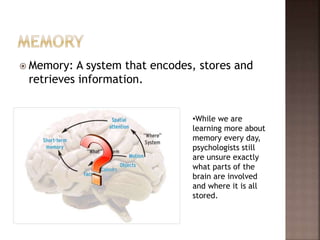
 Memory: A system that encodes, stores and
retrieves information.
•While we are
learning more about
memory every day,
psychologists still
are unsure exactly
what parts of the
brain are involved
and where it is all
stored.
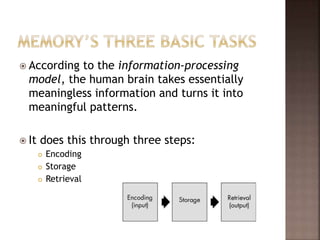
 According to the information-processing
model, the human brain takes essentially
meaningless information and turns it into
meaningful patterns.
 It does this through three steps:
 Encoding
 Storage
 Retrieval
 Encoding: the modification of information to
fit the preferred format for the memory
system.
 In most cases, encoding is automatic and
happens without our awareness. Other encoding,
however, like these notes, require extra encoding
effort called elaboration to make the memory
useful.
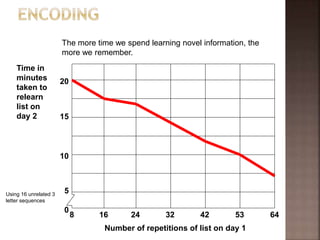
20
15
10
5
0
8 16 24 32 42 53 64
Time in
minutes
taken to
relearn
list on
day 2
Number of repetitions of list on day 1
Using 16 unrelated 3
letter sequences
The more time we spend learning novel information, the
more we remember.
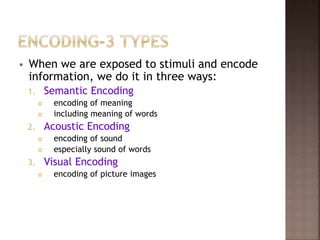
 When we are exposed to stimuli and encode
information, we do it in three ways:
1. Semantic Encoding
 encoding of meaning
 including meaning of words
2. Acoustic Encoding
 encoding of sound
 especially sound of words
3. Visual Encoding
 encoding of picture images
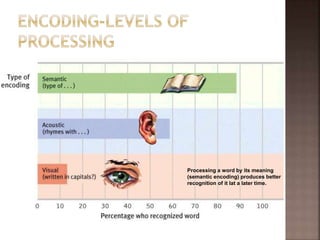
Processing a word by its meaning
(semantic encoding) produces better
recognition of it lat a later time.
 Storage: the retention of encoding material
over time.
 In terms of storing material, we have three
stages of memory
 Sensory Memory
 Working Memory (short-term memory)
 Long-term Memory
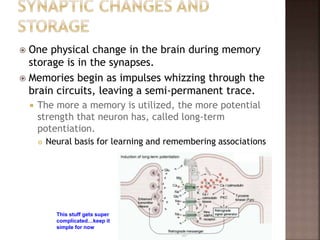
 One physical change in the brain during memory
storage is in the synapses.
 Memories begin as impulses whizzing through the
brain circuits, leaving a semi-permanent trace.
 The more a memory is utilized, the more potential
strength that neuron has, called long-term
potentiation.
 Neural basis for learning and remembering associations
This stuff gets super
complicated…keep it
simple for now
 Research suggests that the best way to
remember things is to study them and then
sleep!
 Once LTP has occurred, even passing an
electrical current through the brain will not
erase well stored memories.
 More recent memories will be be wiped out
 People who have a concussion and cannot remember
what happened just before or after the injury have not
had a chance to “consolidate” their memories to the
long-term
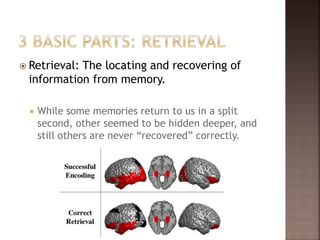
 Retrieval: The locating and recovering of
information from memory.
 While some memories return to us in a split
second, other seemed to be hidden deeper, and
still others are never “recovered” correctly.
 Eidetic imagery is a technical term for a
photographic memory.
 Eidetic imagery can recall a memory in
minute detail and portray the most
interesting and meaningful parts most
accurately. These images can last as short as
a brief moment, or as long as days.
 Eidetic imagery tends to be more common in
children, and seems to decline as a person’s
language abilities increase
 We encode information and store it in one of three
types of memory, depending on what we need the
information for.
 Our memory works like an assembly line, and before
information can make it to our long-term memory, it
must first pass through sensory memory and working
memory.
External
events
Sensory
memory
Short-term
memory
Long-term
memory
Sensory input
Attention to important
or novel information
Encoding
Encoding
Retrieving
 Sensory memory is the shortest of our memories
and generally holds sights, sounds, smells,
textures and other sensory information for a
fraction of a second.
 Sensory memory holds a large amount of
information, far more than ever reaches
consciousness.
 Sperling’s experiment: letters in rows, tone to indicate which
row to recall.
 Sensory memories lasts just long enough to
dissolve into the next one, giving us the
impression of a constant flow.
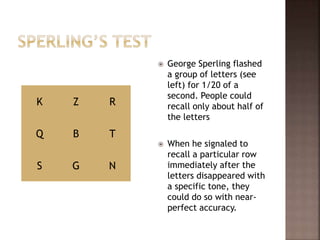
 George Sperling flashed
a group of letters (see
left) for 1/20 of a
second. People could
recall only about half of
the letters
 When he signaled to
recall a particular row
immediately after the
letters disappeared with
a specific tone, they
could do so with near-
perfect accuracy.
K Z R
Q B T
S G N
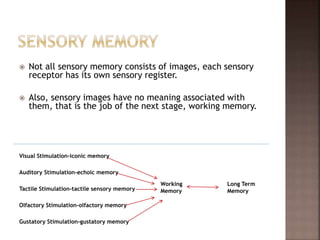
Visual Stimulation-iconic memory
Auditory Stimulation-echoic memory
Tactile Stimulation-tactile sensory memory
Olfactory Stimulation-olfactory memory
Gustatory Stimulation-gustatory memory
 Not all sensory memory consists of images, each sensory
receptor has its own sensory register.
 Also, sensory images have no meaning associated with
them, that is the job of the next stage, working memory.
Working
Memory
Long Term
Memory
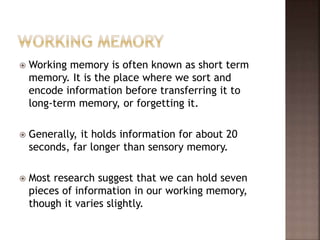
 Working memory is often known as short term
memory. It is the place where we sort and
encode information before transferring it to
long-term memory, or forgetting it.
 Generally, it holds information for about 20
seconds, far longer than sensory memory.
 Most research suggest that we can hold seven
pieces of information in our working memory,
though it varies slightly.
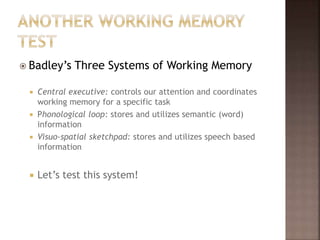
 Badley’s Three Systems of Working Memory
 Central executive: controls our attention and coordinates
working memory for a specific task
 Phonological loop: stores and utilizes semantic (word)
information
 Visuo-spatial sketchpad: stores and utilizes speech based
information
 Let’s test this system!
 Working memory is subject to two
limitations: limited capacity and short
duration.
 We do have coping mechanisms, however:
 Chunking
 Rehearsal
 A chunk is any memory pattern or meaningful
unit of memory.
 By creating these chunks, a process called
chunking, we can fit more information into the
seven available slots of working memory.
 Example: 5036574100 vs. 503-657-4100
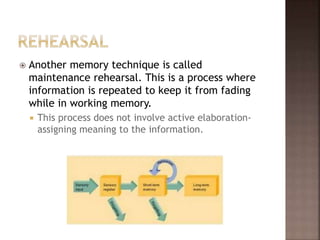
 Another memory technique is called
maintenance rehearsal. This is a process where
information is repeated to keep it from fading
while in working memory.
 This process does not involve active elaboration-
assigning meaning to the information.
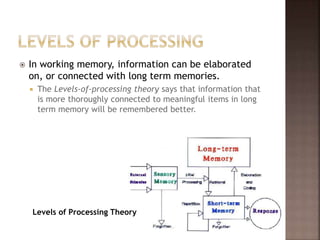
 In working memory, information can be elaborated
on, or connected with long term memories.
 The Levels-of-processing theory says that information that
is more thoroughly connected to meaningful items in long
term memory will be remembered better.
Levels of Processing Theory
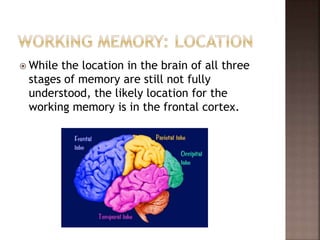
 While the location in the brain of all three
stages of memory are still not fully
understood, the likely location for the
working memory is in the frontal cortex.
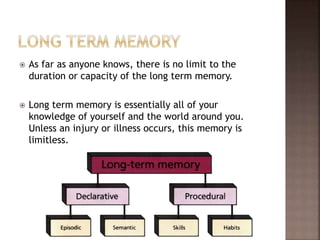
 As far as anyone knows, there is no limit to the
duration or capacity of the long term memory.
 Long term memory is essentially all of your
knowledge of yourself and the world around you.
Unless an injury or illness occurs, this memory is
limitless.
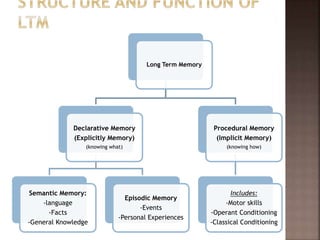
Long Term Memory
Declarative Memory
(Explicitly Memory)
(knowing what)
Semantic Memory:
-language
-Facts
-General Knowledge
Episodic Memory
-Events
-Personal Experiences
Procedural Memory
(Implicit Memory)
(knowing how)
Includes:
-Motor skills
-Operant Conditioning
-Classical Conditioning
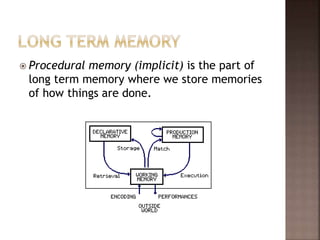
 Procedural memory (implicit) is the part of
long term memory where we store memories
of how things are done.
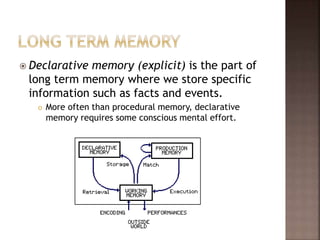
 Declarative memory (explicit) is the part of
long term memory where we store specific
information such as facts and events.
 More often than procedural memory, declarative
memory requires some conscious mental effort.
 Declarative memory has two divisions:
 Episodic Memory: This is the portion of memory
that stores personal events or “episodes.”
 This is the storage of things like time and place.
 Semantic Memory: This portion of memory stores
general knowledge, facts and language meaning.
 This is specifically where all the information you
“know” is stored.
 People with amnesia who read a story once, will
read it faster a second time, showing implicit
memory.
 There is no explicit memory though as they cannot recall
having seen the text before
 People with Alzheimer's who are repeatedly
shown the word perfume will not recall having
seen it.
 If asked the first word that comes to mind in response to
the letters per, the say perfume readily displaying
learning.
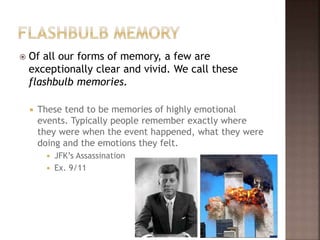
 Of all our forms of memory, a few are
exceptionally clear and vivid. We call these
flashbulb memories.
 These tend to be memories of highly emotional
events. Typically people remember exactly where
they were when the event happened, what they were
doing and the emotions they felt.
 JFK’s Assassination
 Ex. 9/11
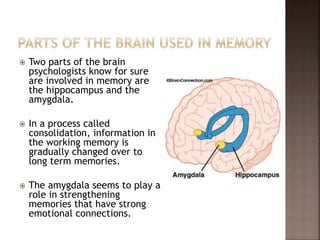
 The engram is the biological basis for long-term
memory. It is also known as the memory trace.
 Psychologists have been trying to identify
exactly where exactly memory is stored. There
are currently two theories; one involving the
neural circuitry and the other at biological
changes in synapses.
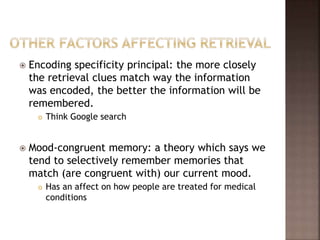
 Two parts of the brain
psychologists know for sure
are involved in memory are
the hippocampus and the
amygdala.
 In a process called
consolidation, information in
the working memory is
gradually changed over to
long term memories.
 The amygdala seems to play a
role in strengthening
memories that have strong
emotional connections.
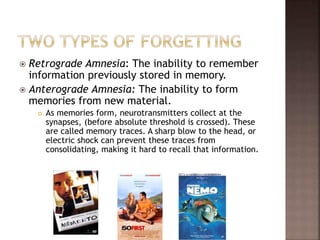
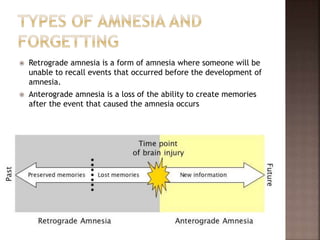
 Retrograde Amnesia: The inability to remember
information previously stored in memory.
 Anterograde Amnesia: The inability to form
memories from new material.
 As memories form, neurotransmitters collect at the
synapses, (before absolute threshold is crossed). These
are called memory traces. A sharp blow to the head, or
electric shock can prevent these traces from
consolidating, making it hard to recall that information.
 Retrograde amnesia is a form of amnesia where someone will be
unable to recall events that occurred before the development of
amnesia.
 Anterograde amnesia is a loss of the ability to create memories
after the event that caused the amnesia occurs
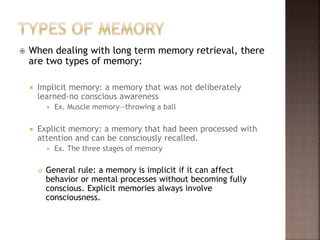
 When dealing with long term memory retrieval, there
are two types of memory:
 Implicit memory: a memory that was not deliberately
learned-no conscious awareness
 Ex. Muscle memory—throwing a ball
 Explicit memory: a memory that had been processed with
attention and can be consciously recalled.
 Ex. The three stages of memory
 General rule: a memory is implicit if it can affect
behavior or mental processes without becoming fully
conscious. Explicit memories always involve
consciousness.
 Retrieval clues are the search terms we use
to activate memory—think of a Google
search. The more specific you are, the better
the results will be.
 Some memories are easily remembered, while
others are much harder to bring up. For
example, if you draw a blank on a test, it may be
a result of the wording on the test not being the
same as the wording you used while studying.
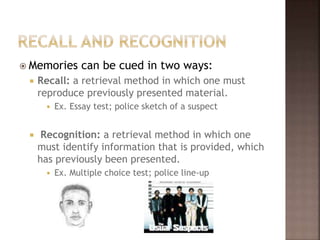
 Memories can be cued in two ways:
 Recall: a retrieval method in which one must
reproduce previously presented material.
 Ex. Essay test; police sketch of a suspect
 Recognition: a retrieval method in which one
must identify information that is provided, which
has previously been presented.
 Ex. Multiple choice test; police line-up
 Encoding specificity principal: the more closely
the retrieval clues match way the information
was encoded, the better the information will be
remembered.
 Think Google search
 Mood-congruent memory: a theory which says we
tend to selectively remember memories that
match (are congruent with) our current mood.
 Has an affect on how people are treated for medical
conditions
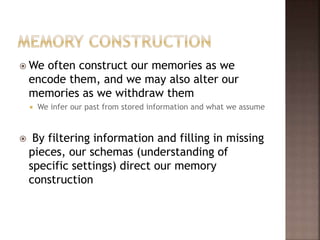
 We often construct our memories as we
encode them, and we may also alter our
memories as we withdraw them
 We infer our past from stored information and what we assume
 By filtering information and filling in missing
pieces, our schemas (understanding of
specific settings) direct our memory
construction
 As memory fades with time following an
event, the injection of misinformation
becomes easier.
 Misinformation effect: incorporating misleading
information into one’s memory of an event.
 Imagination inflation occurs because
visualizing something and actually perceiving
it activate similar brain areas.
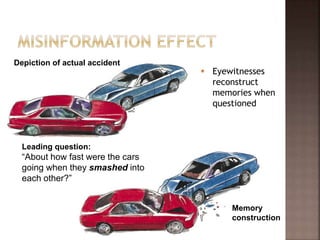
Depiction of actual accident
Leading question:
“About how fast were the cars
going when they smashed into
each other?”
Memory
construction
 Eyewitnesses
reconstruct
memories when
questioned
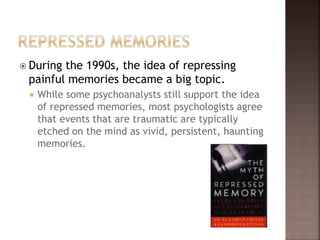
 During the 1990s, the idea of repressing
painful memories became a big topic.
 While some psychoanalysts still support the idea
of repressed memories, most psychologists agree
that events that are traumatic are typically
etched on the mind as vivid, persistent, haunting
memories.
 As you know, not all the information you
learn will stick in your brain. According to
Daniel Schacter, this is the result of one of
the “seven sins of memory:”
 Transience
 Absent-mindedness
 Blocking
 Misattribution
 Suggestibility
 Bias
 Persistence
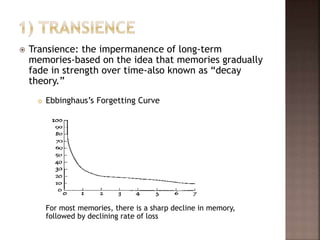
 Transience: the impermanence of long-term
memories-based on the idea that memories gradually
fade in strength over time-also known as “decay
theory.”
 Ebbinghaus’s Forgetting Curve
For most memories, there is a sharp decline in memory,
followed by declining rate of loss
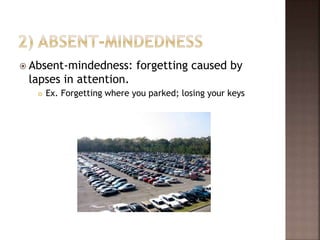
 Absent-mindedness: forgetting caused by
lapses in attention.
 Ex. Forgetting where you parked; losing your keys
 Blocking: forgetting when a memory cannot
be retrieved because of interference.
 Proactive Interference: When an old memory
disrupts the learning and remembering of a new
memory.
 Ex. Trying to put the dishes away at a new house
 Retroactive Memory: When a new memory blocks
the retrieval of an old memory.
 Ex. Driving an automatic after driving a manual
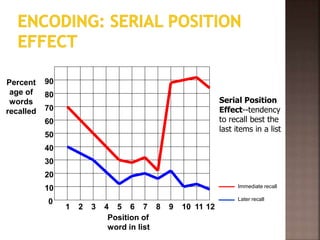
 The serial position effect is a form of
interference related to the sequence in which
material is presented.
 Generally items in the middle are remembered less.
 Primacy: relative ease of remembering the first
information in a series.
 Recency: Strong memories of the most recent
information in a series
 Info in the middle is exposed to both retroactively and
proactively.
12
Percent
age of
words
recalled
0
90
80
70
60
50
40
30
20
10
Position of
word in list
1 2 3 4 5 6 7 8 9 10 11
Serial Position
Effect--tendency
to recall best the
last items in a list
Immediate recall
Later recall
 Misattribution: Memory faults that occur
when memories are retrieved, but are
associated with the wrong time, place or
person.
 Ex. Psychologist Donald Thompson accused of rape.
Alibi was airtight as he was giving a TV interview the
victim had been watching just prior to the assault.
 Suggestibility: The process of memory
distortion as the result of deliberate or
inadvertent suggestion.
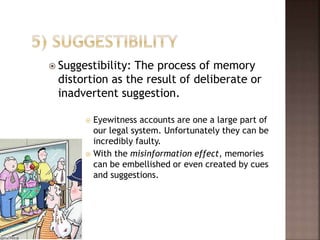
 Eyewitness accounts are one a large part of
our legal system. Unfortunately they can be
incredibly faulty.
 With the misinformation effect, memories
can be embellished or even created by cues
and suggestions.
 Bias: The influence of personal beliefs,
attitudes and experiences on memory.
 Expectancy Bias: A memory tendency to distort
recalled events to fit one’s expectations.
 Self-consistency Bias: A commonly held idea that
we are more consistent in our attitudes and
beliefs, over time, than we actually are.
 Persistence: A memory problem where unwanted
memories cannot be put out of our mind.
 Depressed people cannot stop thinking about how bad
their life is and how unhappy they are. It can create a
self-fulfilling problem.
 Psychologists think that emotions strengthen the
physical changes in the synapses that hold our
memories, thus highly emotional memories can
be harder to put out of mind.
 According to Schacter, the “seven sins” are actually
a normal part of human memory, and are the results
of adaptive features in our memories.
 According to Schacter, each of the “sins” is for a reason:
 Transience-to prevent memory overload
 Blocking-to focus on task at hand
 Absent-mindedness-ability to shift attention
 Misattribution/bias/suggestibility-to focus on meaning and
not detail
 Persistence-to remember especially emotional memories
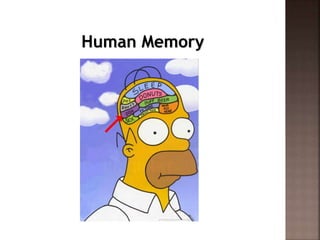
Human Memory
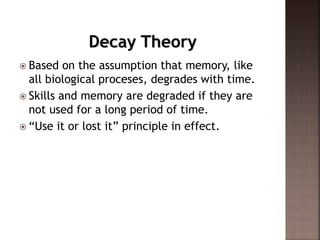
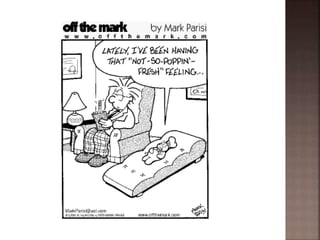
Decay Theory
 Based on the assumption that memory, like
all biological proceses, degrades with time.
 Skills and memory are degraded if they are
not used for a long period of time.
 “Use it or lost it” principle in effect.
Interference Theory
 Forgetting is caused by one memory competing
with, or trying to replace, another memory.
 Interference is very strong among memories for
similar events or with similear retriveal cues.
 Research has shown that a great deal of
everyday forgetting comes from simple everyday
activites and a consolidation failure.
 Example—learning your new phone number often
causes forgetting of your old phone number.
Motivated Forgetting Theory
 An unconscious wish to forget something
unpleasant.
 We tend to forget for a reason.
 Examples—forgetting the name of a teacher
who have you a low grade, your doctor
appointment, the embarrasing speech you
made in 9th grade English class.
Memory - cognition

Memory - cognition

  • 1.
  • 2.
     Memory  Memory’sThree Basic Tasks  3 Basic parts: encoding  Encoding-3 types  Synaptic Changes and storage  Eidetic imagery  3 stages of memory  Levels of Processing  Types of forgetting  Several Theories
  • 3.
     Memory: Asystem that encodes, stores and retrieves information. •While we are learning more about memory every day, psychologists still are unsure exactly what parts of the brain are involved and where it is all stored.
  • 4.
     According tothe information-processing model, the human brain takes essentially meaningless information and turns it into meaningful patterns.  It does this through three steps:  Encoding  Storage  Retrieval
  • 5.
     Encoding: themodification of information to fit the preferred format for the memory system.  In most cases, encoding is automatic and happens without our awareness. Other encoding, however, like these notes, require extra encoding effort called elaboration to make the memory useful.
  • 6.
    20 15 10 5 0 8 16 2432 42 53 64 Time in minutes taken to relearn list on day 2 Number of repetitions of list on day 1 Using 16 unrelated 3 letter sequences The more time we spend learning novel information, the more we remember.
  • 7.
     When weare exposed to stimuli and encode information, we do it in three ways: 1. Semantic Encoding  encoding of meaning  including meaning of words 2. Acoustic Encoding  encoding of sound  especially sound of words 3. Visual Encoding  encoding of picture images
  • 8.
    Processing a wordby its meaning (semantic encoding) produces better recognition of it lat a later time.
  • 9.
     Storage: theretention of encoding material over time.  In terms of storing material, we have three stages of memory  Sensory Memory  Working Memory (short-term memory)  Long-term Memory
  • 10.
     One physicalchange in the brain during memory storage is in the synapses.  Memories begin as impulses whizzing through the brain circuits, leaving a semi-permanent trace.  The more a memory is utilized, the more potential strength that neuron has, called long-term potentiation.  Neural basis for learning and remembering associations This stuff gets super complicated…keep it simple for now
  • 11.
     Research suggeststhat the best way to remember things is to study them and then sleep!  Once LTP has occurred, even passing an electrical current through the brain will not erase well stored memories.  More recent memories will be be wiped out  People who have a concussion and cannot remember what happened just before or after the injury have not had a chance to “consolidate” their memories to the long-term
  • 12.
     Retrieval: Thelocating and recovering of information from memory.  While some memories return to us in a split second, other seemed to be hidden deeper, and still others are never “recovered” correctly.
  • 13.
     Eidetic imageryis a technical term for a photographic memory.  Eidetic imagery can recall a memory in minute detail and portray the most interesting and meaningful parts most accurately. These images can last as short as a brief moment, or as long as days.  Eidetic imagery tends to be more common in children, and seems to decline as a person’s language abilities increase
  • 14.
     We encodeinformation and store it in one of three types of memory, depending on what we need the information for.  Our memory works like an assembly line, and before information can make it to our long-term memory, it must first pass through sensory memory and working memory. External events Sensory memory Short-term memory Long-term memory Sensory input Attention to important or novel information Encoding Encoding Retrieving
  • 15.
     Sensory memoryis the shortest of our memories and generally holds sights, sounds, smells, textures and other sensory information for a fraction of a second.  Sensory memory holds a large amount of information, far more than ever reaches consciousness.  Sperling’s experiment: letters in rows, tone to indicate which row to recall.  Sensory memories lasts just long enough to dissolve into the next one, giving us the impression of a constant flow.
  • 16.
     George Sperlingflashed a group of letters (see left) for 1/20 of a second. People could recall only about half of the letters  When he signaled to recall a particular row immediately after the letters disappeared with a specific tone, they could do so with near- perfect accuracy. K Z R Q B T S G N
  • 17.
    Visual Stimulation-iconic memory AuditoryStimulation-echoic memory Tactile Stimulation-tactile sensory memory Olfactory Stimulation-olfactory memory Gustatory Stimulation-gustatory memory  Not all sensory memory consists of images, each sensory receptor has its own sensory register.  Also, sensory images have no meaning associated with them, that is the job of the next stage, working memory. Working Memory Long Term Memory
  • 18.
     Working memoryis often known as short term memory. It is the place where we sort and encode information before transferring it to long-term memory, or forgetting it.  Generally, it holds information for about 20 seconds, far longer than sensory memory.  Most research suggest that we can hold seven pieces of information in our working memory, though it varies slightly.
  • 19.
     Badley’s ThreeSystems of Working Memory  Central executive: controls our attention and coordinates working memory for a specific task  Phonological loop: stores and utilizes semantic (word) information  Visuo-spatial sketchpad: stores and utilizes speech based information  Let’s test this system!
  • 20.
     Working memoryis subject to two limitations: limited capacity and short duration.  We do have coping mechanisms, however:  Chunking  Rehearsal
  • 21.
     A chunkis any memory pattern or meaningful unit of memory.  By creating these chunks, a process called chunking, we can fit more information into the seven available slots of working memory.  Example: 5036574100 vs. 503-657-4100
  • 22.
     Another memorytechnique is called maintenance rehearsal. This is a process where information is repeated to keep it from fading while in working memory.  This process does not involve active elaboration- assigning meaning to the information.
  • 23.
     In workingmemory, information can be elaborated on, or connected with long term memories.  The Levels-of-processing theory says that information that is more thoroughly connected to meaningful items in long term memory will be remembered better. Levels of Processing Theory
  • 24.
     While thelocation in the brain of all three stages of memory are still not fully understood, the likely location for the working memory is in the frontal cortex.
  • 25.
     As faras anyone knows, there is no limit to the duration or capacity of the long term memory.  Long term memory is essentially all of your knowledge of yourself and the world around you. Unless an injury or illness occurs, this memory is limitless.
  • 26.
    Long Term Memory DeclarativeMemory (Explicitly Memory) (knowing what) Semantic Memory: -language -Facts -General Knowledge Episodic Memory -Events -Personal Experiences Procedural Memory (Implicit Memory) (knowing how) Includes: -Motor skills -Operant Conditioning -Classical Conditioning
  • 27.
     Procedural memory(implicit) is the part of long term memory where we store memories of how things are done.
  • 28.
     Declarative memory(explicit) is the part of long term memory where we store specific information such as facts and events.  More often than procedural memory, declarative memory requires some conscious mental effort.
  • 29.
     Declarative memoryhas two divisions:  Episodic Memory: This is the portion of memory that stores personal events or “episodes.”  This is the storage of things like time and place.  Semantic Memory: This portion of memory stores general knowledge, facts and language meaning.  This is specifically where all the information you “know” is stored.
  • 30.
     People withamnesia who read a story once, will read it faster a second time, showing implicit memory.  There is no explicit memory though as they cannot recall having seen the text before  People with Alzheimer's who are repeatedly shown the word perfume will not recall having seen it.  If asked the first word that comes to mind in response to the letters per, the say perfume readily displaying learning.
  • 31.
     Of allour forms of memory, a few are exceptionally clear and vivid. We call these flashbulb memories.  These tend to be memories of highly emotional events. Typically people remember exactly where they were when the event happened, what they were doing and the emotions they felt.  JFK’s Assassination  Ex. 9/11
  • 32.
     The engramis the biological basis for long-term memory. It is also known as the memory trace.  Psychologists have been trying to identify exactly where exactly memory is stored. There are currently two theories; one involving the neural circuitry and the other at biological changes in synapses.
  • 33.
     Two partsof the brain psychologists know for sure are involved in memory are the hippocampus and the amygdala.  In a process called consolidation, information in the working memory is gradually changed over to long term memories.  The amygdala seems to play a role in strengthening memories that have strong emotional connections.
  • 34.
     Retrograde Amnesia:The inability to remember information previously stored in memory.  Anterograde Amnesia: The inability to form memories from new material.  As memories form, neurotransmitters collect at the synapses, (before absolute threshold is crossed). These are called memory traces. A sharp blow to the head, or electric shock can prevent these traces from consolidating, making it hard to recall that information.
  • 35.
     Retrograde amnesiais a form of amnesia where someone will be unable to recall events that occurred before the development of amnesia.  Anterograde amnesia is a loss of the ability to create memories after the event that caused the amnesia occurs
  • 36.
     When dealingwith long term memory retrieval, there are two types of memory:  Implicit memory: a memory that was not deliberately learned-no conscious awareness  Ex. Muscle memory—throwing a ball  Explicit memory: a memory that had been processed with attention and can be consciously recalled.  Ex. The three stages of memory  General rule: a memory is implicit if it can affect behavior or mental processes without becoming fully conscious. Explicit memories always involve consciousness.
  • 37.
     Retrieval cluesare the search terms we use to activate memory—think of a Google search. The more specific you are, the better the results will be.  Some memories are easily remembered, while others are much harder to bring up. For example, if you draw a blank on a test, it may be a result of the wording on the test not being the same as the wording you used while studying.
  • 38.
     Memories canbe cued in two ways:  Recall: a retrieval method in which one must reproduce previously presented material.  Ex. Essay test; police sketch of a suspect  Recognition: a retrieval method in which one must identify information that is provided, which has previously been presented.  Ex. Multiple choice test; police line-up
  • 39.
     Encoding specificityprincipal: the more closely the retrieval clues match way the information was encoded, the better the information will be remembered.  Think Google search  Mood-congruent memory: a theory which says we tend to selectively remember memories that match (are congruent with) our current mood.  Has an affect on how people are treated for medical conditions
  • 40.
     We oftenconstruct our memories as we encode them, and we may also alter our memories as we withdraw them  We infer our past from stored information and what we assume  By filtering information and filling in missing pieces, our schemas (understanding of specific settings) direct our memory construction
  • 41.
     As memoryfades with time following an event, the injection of misinformation becomes easier.  Misinformation effect: incorporating misleading information into one’s memory of an event.  Imagination inflation occurs because visualizing something and actually perceiving it activate similar brain areas.
  • 42.
    Depiction of actualaccident Leading question: “About how fast were the cars going when they smashed into each other?” Memory construction  Eyewitnesses reconstruct memories when questioned
  • 43.
     During the1990s, the idea of repressing painful memories became a big topic.  While some psychoanalysts still support the idea of repressed memories, most psychologists agree that events that are traumatic are typically etched on the mind as vivid, persistent, haunting memories.
  • 44.
     As youknow, not all the information you learn will stick in your brain. According to Daniel Schacter, this is the result of one of the “seven sins of memory:”  Transience  Absent-mindedness  Blocking  Misattribution  Suggestibility  Bias  Persistence
  • 45.
     Transience: theimpermanence of long-term memories-based on the idea that memories gradually fade in strength over time-also known as “decay theory.”  Ebbinghaus’s Forgetting Curve For most memories, there is a sharp decline in memory, followed by declining rate of loss
  • 46.
     Absent-mindedness: forgettingcaused by lapses in attention.  Ex. Forgetting where you parked; losing your keys
  • 47.
     Blocking: forgettingwhen a memory cannot be retrieved because of interference.  Proactive Interference: When an old memory disrupts the learning and remembering of a new memory.  Ex. Trying to put the dishes away at a new house  Retroactive Memory: When a new memory blocks the retrieval of an old memory.  Ex. Driving an automatic after driving a manual
  • 48.
     The serialposition effect is a form of interference related to the sequence in which material is presented.  Generally items in the middle are remembered less.  Primacy: relative ease of remembering the first information in a series.  Recency: Strong memories of the most recent information in a series  Info in the middle is exposed to both retroactively and proactively.
  • 49.
    12 Percent age of words recalled 0 90 80 70 60 50 40 30 20 10 Position of wordin list 1 2 3 4 5 6 7 8 9 10 11 Serial Position Effect--tendency to recall best the last items in a list Immediate recall Later recall
  • 50.
     Misattribution: Memoryfaults that occur when memories are retrieved, but are associated with the wrong time, place or person.  Ex. Psychologist Donald Thompson accused of rape. Alibi was airtight as he was giving a TV interview the victim had been watching just prior to the assault.
  • 51.
     Suggestibility: Theprocess of memory distortion as the result of deliberate or inadvertent suggestion.  Eyewitness accounts are one a large part of our legal system. Unfortunately they can be incredibly faulty.  With the misinformation effect, memories can be embellished or even created by cues and suggestions.
  • 52.
     Bias: Theinfluence of personal beliefs, attitudes and experiences on memory.  Expectancy Bias: A memory tendency to distort recalled events to fit one’s expectations.  Self-consistency Bias: A commonly held idea that we are more consistent in our attitudes and beliefs, over time, than we actually are.
  • 53.
     Persistence: Amemory problem where unwanted memories cannot be put out of our mind.  Depressed people cannot stop thinking about how bad their life is and how unhappy they are. It can create a self-fulfilling problem.  Psychologists think that emotions strengthen the physical changes in the synapses that hold our memories, thus highly emotional memories can be harder to put out of mind.
  • 54.
     According toSchacter, the “seven sins” are actually a normal part of human memory, and are the results of adaptive features in our memories.  According to Schacter, each of the “sins” is for a reason:  Transience-to prevent memory overload  Blocking-to focus on task at hand  Absent-mindedness-ability to shift attention  Misattribution/bias/suggestibility-to focus on meaning and not detail  Persistence-to remember especially emotional memories
  • 55.
  • 56.
    Decay Theory  Basedon the assumption that memory, like all biological proceses, degrades with time.  Skills and memory are degraded if they are not used for a long period of time.  “Use it or lost it” principle in effect.
  • 58.
    Interference Theory  Forgettingis caused by one memory competing with, or trying to replace, another memory.  Interference is very strong among memories for similar events or with similear retriveal cues.  Research has shown that a great deal of everyday forgetting comes from simple everyday activites and a consolidation failure.  Example—learning your new phone number often causes forgetting of your old phone number.
  • 59.
    Motivated Forgetting Theory An unconscious wish to forget something unpleasant.  We tend to forget for a reason.  Examples—forgetting the name of a teacher who have you a low grade, your doctor appointment, the embarrasing speech you made in 9th grade English class.