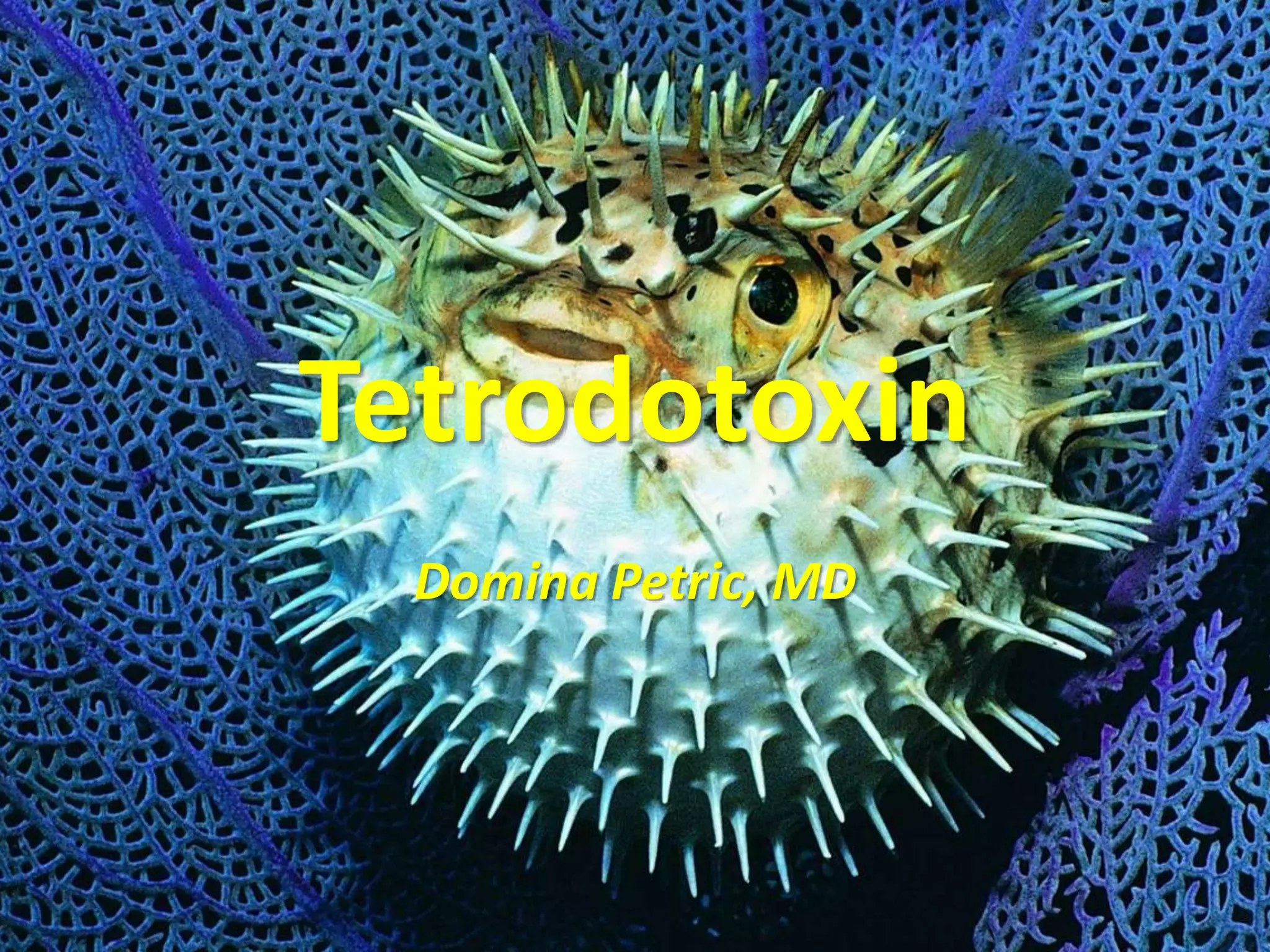
Tetrodotoxin
Domina Petric, MD
Introduction
• Tetrodotoxin is a neurotoxin that is most
commonly found in marine animals.
• It is known to cause perioral numbness in
consumers of pufferfish sushi (fugu).
• The toxin is heat-stable.
• There are 26 known naturally occurring analogs.
• The toxin blocks sodium channels leading to
gastrointestinal, neurological, and cardiac
symptoms in poisoned patients.
• There is currently no known antidote.
The bacteria implicated in the
production of tetrodotoxin are:
• Pseudoalteromonas
• Pseudomonas
• Vibrio
• Aeromonas
• Alteromonas
• Shewanella
• Roseobacter
• Raoultella
• Actinomycetes
• Microbacterium
• Serratia
Incidence
The incidence
of tetrodotoxin poisoning is very
rare but is higher in countries where
people eat pufferfish regularly, such
as Japan, Taiwan, and some
Southeast Asian countries.
Pathophysiology
• Tetrodotoxin inhibits voltage-gated
sodium channels, preventing cell
membranes from depolarizing.
• This, in turn, inhibits action
potential propagation and prevents
neurons and myocytes from
functioning.
Clinical presentation
• Onset and severity of the symptoms
of tetrodotoxin poisoning are dependent on
time after ingestion and is dose-dependent.
• In the majority of cases, symptoms usually
occur within 30 minutes of ingestion.
• A few cases have had symptoms start to
occur after 20 hours.
• Poisoning manifests in four grades.
Grade 1
• Paresthesias and perioral
numbness with or without
gastrointestinal symptoms
(nausea, vomiting, abdominal
pain, and diarrhea).
Grade 2
•Facial numbness, slurred
speech, early motor
paralysis, and
incoordination, but with
normal reflexes.
Grade 3
•Generalized flaccid
paralysis, aphonia,
respiratory failure, and
fixed/dilated pupils (in a
conscious patient).
Grade 4
• Severe respiratory failure
with hypoxia, bradycardia,
hypotension, cardiac
dysrhythmias, and
unconsciousness.
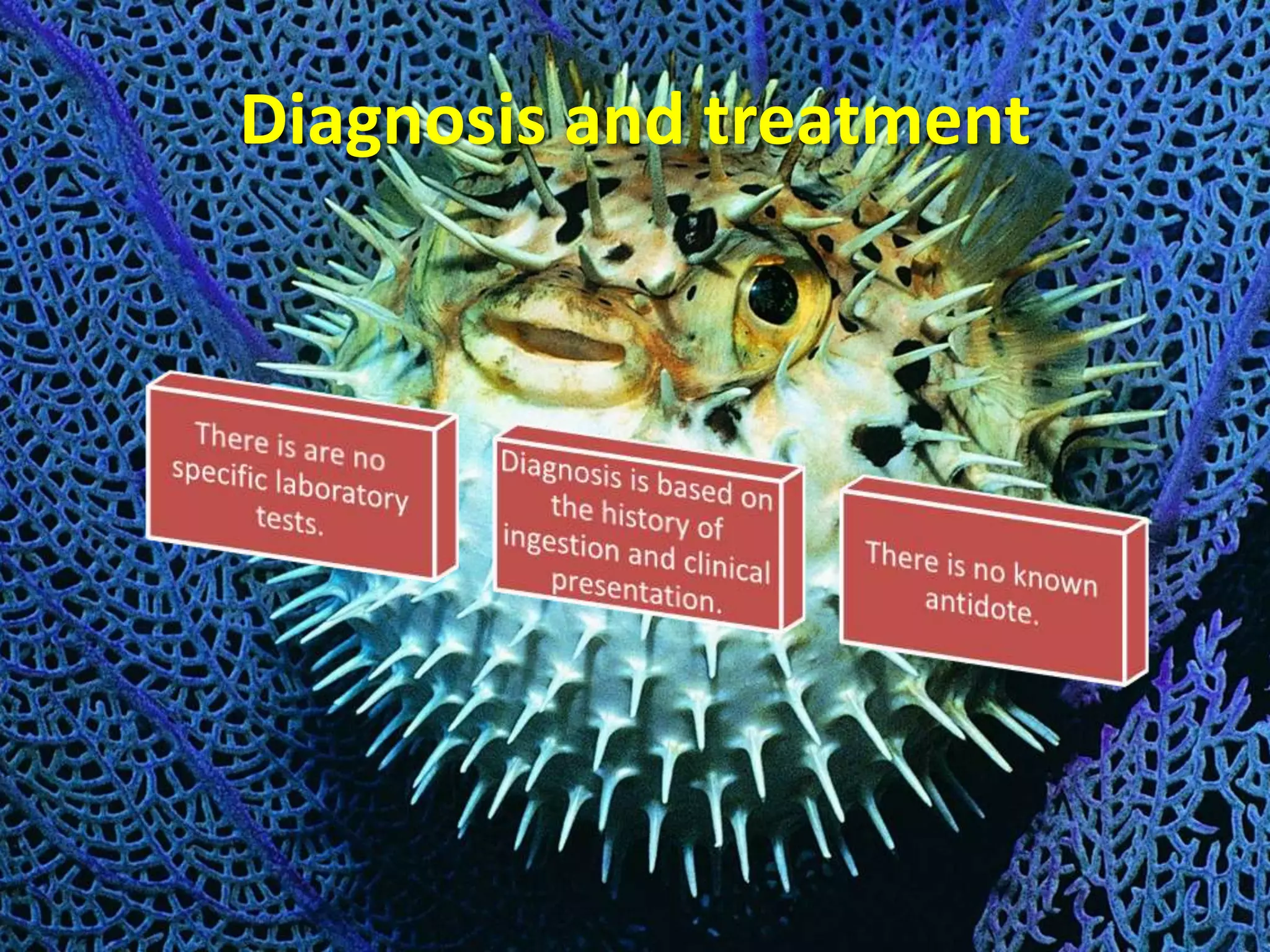
Diagnosis and treatment
Treatment
• The mainstay of treatment is respiratory support
and supportive care until the tetrodotoxin is
excreted in the urine.
• Activated charcoal and/or gastric lavage can be
done if the patient presents within 60 minutes
of ingestion.
• Hemodialysis may be useful, especially in
patients with renal disease.
• A monoclonal antibody against tetrodotoxin
(anti-tetrodotoxin) is also available.
Treatment
• Some clinicians use neostigmine to treat
acute respiratory failure.
• For suspected poisoning, patients should
be observed in the intensive care unit for
24 hours due to some patients having a
delayed onset of symptoms of up to 20
hours.
References
• Kotipoyina HR, Warrington SJ.
Tetrodotoxin Toxicity. [Updated 2019
Feb 4]. In: StatPearls [Internet]. Treasure
Island (FL): StatPearls Publishing; 2019
Jan-. Available from:
https://www.ncbi.nlm.nih.gov/books/N
BK507714/

Tetrodotoxin

  • 1.
  • 2.
    Introduction • Tetrodotoxin isa neurotoxin that is most commonly found in marine animals. • It is known to cause perioral numbness in consumers of pufferfish sushi (fugu). • The toxin is heat-stable. • There are 26 known naturally occurring analogs. • The toxin blocks sodium channels leading to gastrointestinal, neurological, and cardiac symptoms in poisoned patients. • There is currently no known antidote.
  • 3.
    The bacteria implicatedin the production of tetrodotoxin are: • Pseudoalteromonas • Pseudomonas • Vibrio • Aeromonas • Alteromonas • Shewanella • Roseobacter • Raoultella • Actinomycetes • Microbacterium • Serratia
  • 4.
    Incidence The incidence of tetrodotoxinpoisoning is very rare but is higher in countries where people eat pufferfish regularly, such as Japan, Taiwan, and some Southeast Asian countries.
  • 5.
    Pathophysiology • Tetrodotoxin inhibitsvoltage-gated sodium channels, preventing cell membranes from depolarizing. • This, in turn, inhibits action potential propagation and prevents neurons and myocytes from functioning.
  • 6.
    Clinical presentation • Onsetand severity of the symptoms of tetrodotoxin poisoning are dependent on time after ingestion and is dose-dependent. • In the majority of cases, symptoms usually occur within 30 minutes of ingestion. • A few cases have had symptoms start to occur after 20 hours. • Poisoning manifests in four grades.
  • 7.
    Grade 1 • Paresthesiasand perioral numbness with or without gastrointestinal symptoms (nausea, vomiting, abdominal pain, and diarrhea).
  • 8.
    Grade 2 •Facial numbness,slurred speech, early motor paralysis, and incoordination, but with normal reflexes.
  • 9.
    Grade 3 •Generalized flaccid paralysis,aphonia, respiratory failure, and fixed/dilated pupils (in a conscious patient).
  • 10.
    Grade 4 • Severerespiratory failure with hypoxia, bradycardia, hypotension, cardiac dysrhythmias, and unconsciousness.
  • 11.
  • 12.
    Treatment • The mainstayof treatment is respiratory support and supportive care until the tetrodotoxin is excreted in the urine. • Activated charcoal and/or gastric lavage can be done if the patient presents within 60 minutes of ingestion. • Hemodialysis may be useful, especially in patients with renal disease. • A monoclonal antibody against tetrodotoxin (anti-tetrodotoxin) is also available.
  • 13.
    Treatment • Some cliniciansuse neostigmine to treat acute respiratory failure. • For suspected poisoning, patients should be observed in the intensive care unit for 24 hours due to some patients having a delayed onset of symptoms of up to 20 hours.
  • 14.
    References • Kotipoyina HR,Warrington SJ. Tetrodotoxin Toxicity. [Updated 2019 Feb 4]. In: StatPearls [Internet]. Treasure Island (FL): StatPearls Publishing; 2019 Jan-. Available from: https://www.ncbi.nlm.nih.gov/books/N BK507714/